Pulmonary hypertension is among the major causes of morbidity and mortality during the natural course of CHDs. This clinical entity is defined as an elevated mean pulmonary arterial pressure of 25 mmHg or higher and a pulmonary wedge pressure of 15 mmHg or lower. CHD may lead to pulmonary hypertension during childhood or adulthood.Reference Beghetti and Berger 1 , Reference Takatsuki and Ivy 2
Right heart catheterisation is addressed as the gold standard method for the diagnosis of pulmonary hypertension. Catheter angiography is also an important tool for determining the eligibility of patients with CHDs to undergo operations for the correction of heart defects. Moreover, right heart catheterisation is performed before medical treatment for pulmonary hypertension is initiated. Catheter angiography is an invasive test, however, and it is not always practical to perform this test for repeated ongoing evaluation.Reference Rosenzweig, Feinstein and Humpl 3 , Reference Beghetti, Berger and Schulze-Neick 4
Imaging techniques such as echocardiography are frequently utilised for the measurement of haemodynamic parameters during the assessment, treatment, and observation of children with CHDs. Another non-invasive technique comprises the biomarkers that may participate in the pathophysiology of pulmonary hypertension. These biomarkers may mediate endothelial damage, promote endothelial dysfunction, induce vasoconstriction, and thus cause severe inflammation within the pulmonary vasculature.Reference Jone and Ivy 5
Recently, it has been hypothesised that inflammation may participate in the pathogenesis of pulmonary hypertension. Related evidence for this hypothesis has been provided by studies that report that the concentrations of inflammatory markers such as interleukin-6 (IL-6) and fractalkine (CX3CL1) are increased in case of pulmonary hypertension.Reference El Chami and Hassoun 6 – Reference Perros, Dorfmüller and Souza 8
The present study aims to identify the role of inflammatory markers such as C-reactive protein, interleukin-6, and fractalkine in CHD-associated pulmonary hypertension in children.
Materials and methods
Ethical considerations
This study was approved by the Local Ethical Committee (decision no: 100/07.03.2012) and Scientific Research Projects Board of Gazi University Medical Faculty (grant no: SBE 01/2011-71). Written informed consent was obtained from the parents of all participants.
Study design
This is descriptive review of 80 children who underwent consultation in the Department of Pediatric Cardiology at the study centre between January, 2012 and December, 2012. The study cohort consisted of three groups. Group I included 37 children who consecutively underwent cardiac catheterisation and who were eventually diagnosed with CHD-related pulmonary hypertension. Approximately 50% of this group (n=14) underwent cardiac surgery subsequently and the remaining 14 children still have ongoing shunts.
Group II included 21 children who consecutively underwent cardiac catheterisation and who were found to have no signs of pulmonary hypertension despite the unrepaired congenital heart defects. Group III included 22 healthy children who were consecutively referred to the study centre because of the auscultation of cardiac murmurs. These children were the ones who agreed to participate in the study among 40 children who were found eligible for Group 3.
Detailed history and physical examination including age, gender, weight, height, body surface area and body mass index, chest X-ray, electrocardiography, echocardiography, and right heart catheterisation were performed. Children with acute or chronic bacterial and viral infections, diabetes mellitus, systemic hypertension, hypercholesterolaemia, hepatic dysfunction, and renal failure were excluded from the study.
Cardiac catheterisation
Groups I and II included 58 children who had CHDs. These children underwent routine cardiac catheterisation, which was performed with intravenous midazolam sedation. Pressure measurements were recorded using fluid-filled catheters connected to pressure transducers. Oxygen consumption was estimated based on age, sex, and heart rate, according to the method of LaFarge and Miettinen.Reference LaFarge and Miettinen 9 Pulmonary (Qp) and systemic (Qs) blood flow was calculated using the Fick equation and indexed for body surface area. The ratio of Qp/Qs blood flow, the pulmonary (Rp) and systemic (Rs) vascular resistance, and the Rp/Rs ratio were calculated according to standard formulae. The pulmonary artery pressures were measured along the right femoral vein-right atrium-right ventricle-pulmonary artery.
Laboratory studies
Venous blood samples of 10 ml were drawn by phlebotomy from all subjects after 12 hours of fasting. Plasma samples were obtained via centrifugation at 3500 rpm for 5 minutes and stored at −80°C. Serum levels of C-reactive protein and fractalkine were measured by means of enzyme-linked immunosorbent assay (ELH-CRP-2 and Human Fractalkine ELISA Kits, RayBiotech Inc., Georgia, United States of America). Serum levels of interleukin-6 were measured by immunoassay (DIAsource IL-6-EASIA Kit, DIAsource ImmunoAssays, Brussels, Belgium). The intra-assay coefficients of variation were 6.2, 5.0, and 6.2%, whereas the inter-assay coefficients of variation were 5.7, 4.1, and 5.3% for C-reactive protein, interleukin-6, and fractalkine, respectively.
Statistical analysis
Collected data were analysed using Statistical Package for the Social Sciences, version 18.0 (SPSS Inc., Chicago, Illinois, United States of America). Continuous variables were expressed as mean±standard deviation, whereas categorical variables were denoted as numbers or percentages. The Student t test was used to compare two groups, whereas one-way ANOVA and Kruskal–Wallis test were used to compare three groups and a post hoc analysis was made to determine the two variables between which there is a statistically significant difference. Spearman’s correlation test and logistic regression analysis were used to specify the relationships among the variables. All p values <0.05 were considered to be statistically significant.
Results
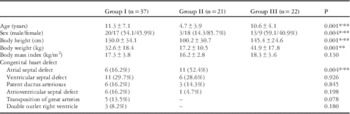
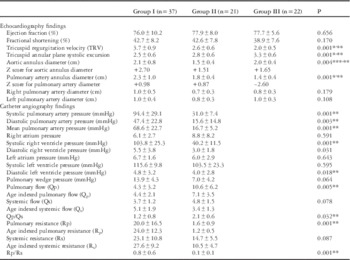
Table 1 compares the demographic and clinical characteristics of the study cohort. The mean patient age was significantly higher, the number of affected females was significantly lower, and atrial septal defect was significantly less frequent in the children with CHD-related pulmonary hypertension (respectively, p=0.001, 0.004, and 0.004). Table 2 shows the echocardiography and catheter angiography findings of the study cohort. Pulmonary artery pressures and systolic right ventricle pressure were significantly higher, whereas diastolic left ventricle pressure was lower in the CHD-related pulmonary hypertension group (p<0.05 for each).
Demographic and clinical characteristics of the study cohort.

* Statistical significance is detected between Group I and Group II
** p<0.05 was accepted to be statistically significant
Echocardiography and catheter angiography findings of the study cohort.

* Statistical significance is detected between Group I and Group III
** p<0.05 was accepted to be statistically significant
*** Statistical significance is detected between Group II and Group III
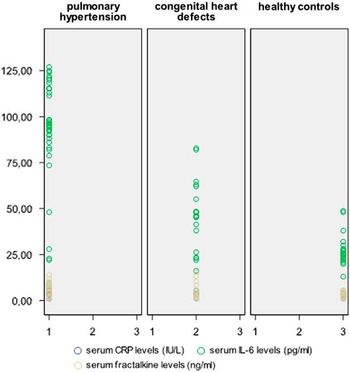
Table 3 shows that serum C-reactive protein and interleukin-6 levels were significantly higher in the children with pulmonary hypertension (respectively, p=0.049 and 0.026). Figure 1 displays the variability in serum concentrations of CRP, IL-6, and fractalkine after stratification by cohort subgroups.
Scatter plot graphs for serum levels of C-reactive protein, interleukin-6, and fractalkine levels after stratification by cohort.

Inflammatory biomarkers of the study cohort.

* Statistical significance is detected between Group I and Group III
** p<0.05 was accepted to be statistically significant
Serum C-reactive protein concentrations correlated negatively with ejection fraction (r=−0.609, p=0.001) and fractional shortening (r=−0.452, p=0.007) in the pulmonary hypertension group. Serum fractalkine concentrations correlated negatively with ejection fraction (r=−0.522, p=0.002) and fractional shortening (r=−0.395, p=0.021) in the children with pulmonary hypertension. Serum interleukin-6 concentrations also correlated negatively with Qs (r=−0.572, p=0.021), positively with Rs (r=0.774, p=0.001), and positively with pulmonary wedge pressure (r=0.796, p=0.006) in the pulmonary hypertension group.
Serum CRP and IL-6 concentrations were found to be significant and independent factors in the prediction of pulmonary hypertension in children with CHD failure (OR: 4.2, 95% confidence interval: 1.14–10.05, p=0.001; and OR: 2.9, 95% confidence interval: 1.14–5.38, p=0.001, respectively).
Discussion
The key pathologic change observed in pulmonary hypertension is the remodelling of precapillary resistance pulmonary arteries, which is characterised by the thickening of the intima, media, and adventitia. As the disease progresses, intimal fibrosis occurs, along with in situ thrombosis and the development of the characteristic plexiform lesions.Reference Rubin 10
The role of altered immunity and inflammation has been increasingly recognised in various types of pulmonary hypertension, such as idiopathic pulmonary hypertension and diseases associated with pulmonary hypertension including connective tissue diseases and HIV infection. This observation is based on the finding of circulating auto-antibodies – e.g., anti-nuclear antibodies – and elevated levels of circulating pro-inflammatory cytokines – e.g., interleukin-1 and interleukin-6. Inflammation is also prominent in various experimental animal models of pulmonary hypertension.Reference El Chami and Hassoun 6
Another body of evidence supporting the relationship between inflammation and pulmonary hypertension is the presence of inflammation in the histopathologic specimens and studies of blood-borne cells and mediators obtained from the affected patients. Inflammation has been defined as a complex series of interactions among soluble factors and cells that can arise in response to traumatic, infectious, post-ischaemic, toxic, or autoimmune injury.Reference Nathan 11 It is well recognised that inflammatory processes promote the development and progression of systemic vascular disease.Reference Zernecke and Weber 12 – Reference Schober 14
IL-6 is a pro-inflammatory cytokine synthesised by many cell types. Plasma levels of interleukin-6 are elevated in idiopathic pulmonary hypertension, and these levels correlate with the severity of disease and with increased mortality.Reference Soon, Holmes and Treacy 15 In patients with scleroderma, the rise in the circulating interleukin-6 levels predicts the presence of associated pulmonary hypertension.Reference Gourh, Arnett and Assassi 16 Elevated serum interleukin-6 levels also correlate with haemodynamic severity in the case of chronic obstructive pulmonary disease-associated pulmonary hypertension and sickle-cell disease-related pulmonary hypertension.Reference Eddahibi, Chaouat and Tu 17 , Reference Niu, Nouraie and Campbell 18 Pulmonary interleukin-6 production is increased in experimental pulmonary hypertension and is thought to reflect increased production by both inflammatory cells and vascular cells.Reference Savale, Tu and Rideau 7
As for the present study, a significant increase was specified in the serum interleukin-6 concentrations of children with CHD-related pulmonary hypertension when compared with those of children with CHDs and healthy children. Moreover, there were correlations among interleukin-6, Qs, Rs, and pulmonary wedge pressure values. These findings imply that this cytokine may participate in the pathogenesis of CHD-related pulmonary hypertension.
Fractalkine is a chemokine that is expressed as a soluble molecule or in a membrane-bound form. The effects of fractalkine are mediated through chemokine (C-X3-C motif) receptor 1 (CX3CR1), which is the fractalkine receptor expressed by many cell types. Although there are no studies focusing on the association between fractalkine and pulmonary hypertension, elevated levels of fractalkine are detected in patients with pulmonary hypertension.Reference Balabanian, Foussat and Dorfmüller 19
On the contrary, this study was unable to detect a significant difference in serum fractalkine levels in children with CHD-related pulmonary hypertension. Serum fractalkine concentrations, however, were found to correlate with ejection fraction and fractional shortening. Such discrepancy may be attributed to the small cohort size and the lack of longitudinal data.
Being a prominent marker of inflammation, C-reactive protein has been widely investigated. Elevated levels of C-reactive protein have been reported to predict increased cardiovascular morbidity and mortality among apparently healthy subjects, patients with coronary artery disease, and patients with atherosclerosis.Reference Ndrepepa, Braun and Cassese 20 Quarck et al demonstrated that circulating C-reactive protein levels of the pulmonary hypertension patients were significantly higher than those of healthy adults.Reference Quarck, Nawrot and Meyns 21 , Reference Scognamiglio, Kempny and Price 22 Elevated C-reactive protein has been recently proposed as a predictor of pulmonary hypertension in Gaucher disease.Reference Elstein, Nir and Klutstein 23 In chronic obstructive pulmonary disease, which is also associated with systemic inflammation, C-reactive protein has been identified as a marker of prognosis.Reference Dahl, Vestbo and Lange 24 , Reference Joppa, Petrasova and Stancak 25
This study was able to detect a significant increase in the serum C-reactive protein concentrations of children with CHD-related pulmonary hypertension when compared with those of children with CHDs and healthy children. In addition, C-reactive protein values correlated with ejection fraction and fractional shortening in the pulmonary hypertension group.
It would be prudent, therefore, to assume that C-reactive protein may also participate in the physiopathology of the vascular wall, as demonstrated in atherosclerosis and coronary artery diseases. To the best of our knowledge, this is the first study to investigate the role of inflammatory biomarkers in the pathogenesis of CHD-related paediatric pulmonary hypertension. The findings represented here suggest that inflammatory markers C-reactive protein and interleukin-6 may have a role in the clinical evaluation of paediatric pulmonary hypertension related with CHDs. The power of the present study, however, is limited by the small cohort size, absence of longitudinal data, and lack of matching with respect to patient age and sex. Further research is warranted to clarify the role of inflammatory biomarkers in the pathogenesis of CHD-associated paediatric pulmonary hypertension.
Acknowledgements
None.
Financial Support
This research was funded by Scientific Research Projects Board of Gazi University Medical Faculty (grant no: SBE 01/2011-71).
Conflicts of Interest
None.
Ethical Standards
The authors assert that all procedures contributing to this work comply with the ethical standards of the relevant national guidelines on human experimentation (Iyi Klinik Uygulamaları, Klinik Arastirmalar Dernegi, 2015) and with the Helsinki Declaration of 1975, as revised in 2008, and have been approved by the Ethical Committee of Ankara Gazi University Medical Faculty.