Introduction
Snoring in the paediatric population is a common reason for referral to ENT surgeons from primary care physicians. This can range from simple snoring to more severe obstructive sleep apnoea (OSA). Obstructive sleep apnoea is defined as a ‘disorder of breathing during sleep characterised by prolonged partial upper airway obstruction and/or intermittent complete obstruction that disrupts normal ventilation during normal sleep patterns’. 1 Studies suggest that 6–12 per cent of children have significant snoring and 1–3 per cent have OSA.Reference Kanona, Sharma, Chaidas and Kotecha 2 , Reference Anuntaseree, Rookkapan, Kuasirikul and Thongsuksai 3
Adenotonsillectomy often improves OSA in children, but it must be borne in mind that other factors such as obesity, poor neuromuscular tone of the upper airways, and craniofacial abnormalities, can also affect this condition.Reference Brunetti, Rana and Lospalluti 4 The American Academy of Pediatrics has published a group of signs and symptoms associated with paediatric OSA, which can help to identify patients at risk of OSA who may require further investigation.Reference Marcus, Brooks, Draper, Gozal, Halbower and Jones 5
There is still controversy over the best way to manage children with suspected OSA. There are clear guidelines regarding the management of children deemed ‘at risk’ of post-operative cardiorespiratory complications (e.g. age less than two years, weight less than 15 kg, significant co-morbidities and severe OSA) and the need for the availability of paediatric intensive care facilities, drawn up by a UK multidisciplinary working party.Reference Robb, Bew, Kubba, Murphy, Primhak and Rollin 6 However, there are still variations in practice across the UK in terms of the investigations and management of ‘healthy’ children with suspected OSA. The American Academy of Pediatrics has suggested that all children with suspected OSA should undergo polysomnography as a ‘gold standard’, but this is expensive and not readily available in many UK institutions.Reference Marcus, Brooks, Draper, Gozal, Halbower and Jones 5 One alternative is overnight pulse oximetry, but this test has a low negative predictive value (47 per cent), so some children with severe OSA may be missed.Reference Nixon, Kermack, Davis, Manoukian, Brown and Brouillette 7 , Reference Brouillette, Morielli, Leimanis, Waters, Luciano and Ducharme 8 The aforementioned UK multidisciplinary working party and American Academy of Otolaryngology – Head and Neck Surgery Foundation have suggested reserving polysomnography for higher risk patients only.Reference Robb, Bew, Kubba, Murphy, Primhak and Rollin 6 , Reference Roland, Rosenfeld, Brooks, Friedman, Jones and Kim 9
There is also controversy regarding the post-operative management of these patients with pulse oximetry and whether an overnight stay is necessary for all children with OSA.Reference Pringle, Natesh and Buchanan 10
Based on anecdotal evidence from colleagues, we found that there were wide variations in practice with regard to the management of paediatric OSA, both within our department and in other institutions across the country. With this in mind, we set out to investigate the current trends of assessment and management of children with snoring and OSA in ENT departments across the UK, and to identify variations in practice. In particular, we aimed to investigate: the use of pulse oximetry by clinicians, the influence of a clinical commissioning group on funding for surgical interventions, the presence of formal protocols for the management of paediatric OSA and follow-up arrangements for these patients. These particular aspects have not been assessed formally in previous similar studies.Reference Pringle, Natesh and Buchanan 10 , Reference Weatherly, Mai, Ruzicka and Chervin 11
Based on our findings, we have developed recommendations for a protocol for the management of children with snoring and OSA who present to our department.
Materials and methods
This study was approved by the Barking, Havering and Redbridge University Hospitals NHS Trust Clinical Governance Department.
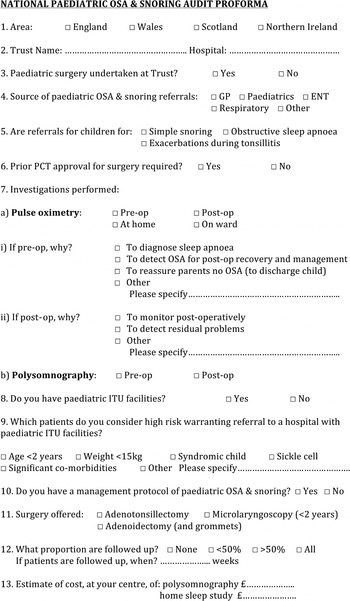
A questionnaire was devised based on our experience and knowledge of the management of snoring and sleep apnoea in the paediatric population. This included questions on various aspects of evaluation and management, both surgical and non-surgical, that individual departments are able to provide for these patients. There was particular emphasis in the questionnaire on the investigations offered to these patients and the reasons for performing them. The questionnaire was initially piloted within our ENT department, and a revised version was used for the main study (Figure 1).
Telephone questionnaire on the assessment and management of paediatric obstructive sleep apnoea and snoring. OSA = obstructive sleep apnoea; GP = general practitioner; PCT = primary care trust; pre-op = pre-operative; post-op = post-operative; ITU = intensive therapy unit

A telephone survey was conducted of 139 otolaryngology departments in acute National Health Service trusts in the UK over a period of 16 weeks, from January 2015 to April 2015.
We separated the questionnaire results into those that represented responses from district general hospitals and those that represented responses from tertiary referral centres.
The responses to the questionnaire were tabulated and analysed using Microsoft Excel (Seattle, Washington, USA). Statistical analyses and comparisons were carried out with the Fisher's exact test using GraphPad Software (La Jolla, California, USA); 12 significance was set at p < 0.05. Confidence interval (CI) levels were set at 95 per cent.
Results
The response rate was 61 per cent (85 out of 139 trusts). All 85 of the respondents undertake paediatric surgery within the trusts. All 85 trusts (100 per cent) receive their referrals from primary care, and 54 (64 per cent (95 per cent CI = 54–74)) also receive referrals from the paediatric team. A small number of respondents also reported referrals from respiratory medicine (n = 4, 5 per cent) and from other ENT departments (n = 8, 9 per cent (95 per cent CI = 3–15)).
All respondents (100 per cent) reported receiving referrals for simple snoring and OSA. A smaller number of respondents (12 out of 85, 14 per cent (95 per cent CI = 7–21)) reported receiving referrals for exacerbations during tonsillitis. Interestingly, 29 out of 85 respondents (34 per cent (95 per cent CI = 24–44)) reported the need for prior clinical commissioning group approval, before proceeding with surgery.
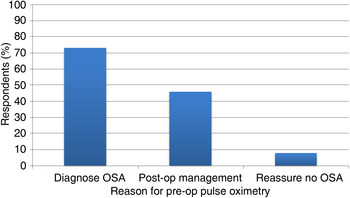
Seventy-one of the 85 respondents (84 per cent (95 per cent CI = 76–92)) reported the use of pre-operative pulse oximetry. Interestingly, 17 out of 71 respondents who do request pre-operative pulse oximetry (24 per cent (95 per cent CI = 14–34)) reported that this was a mandatory requirement by anaesthetists for all children undergoing adenotonsillectomy. Fifty-two of the 71 respondents (73 per cent (95 per cent CI = 63–83)) reported that pre-operative pulse oximetry was utilised to diagnose OSA, whilst 33 of the respondents (46 per cent (95 per cent CI = 34–58)) utilised pre-operative pulse oximetry to detect OSA for post-operative management, and 6 of the respondents (8 per cent (95 per cent CI = 2–14)) utilised it to reassure parents that there was no OSA (i.e. to discharge the child from ENT) (Figure 2).
Respondents’ reasons for organising pre-operative pulse oximetry. OSA = obstructive sleep apnoea; post-op = post-operative; pre-op = pre-operative

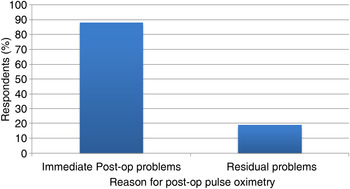
Twenty-six of the 85 respondents (31 per cent (95 per cent CI = 21–41)) reported the use of post-operative pulse oximetry. Within this group, 23 respondents (88 per cent (95 per cent CI = 76–100)) reported that this was to monitor immediate problems in recovery, whilst 5 respondents (19 per cent (95 per cent CI = 4–34)) utilised post-operative pulse oximetry to detect residual problems (Figure 3).
Respondents’ reasons for organising post-operative pulse oximetry. Post-op = post-operative

Of the 72 respondents who use pulse oximetry, 42 (58 per cent (95 per cent CI = 47–69)) reported that it is utilised at the patient's home, as compared to 30 (42 per cent (95 per cent CI = 31–53)) who utilise it on the paediatric ward with an overnight stay.
Twenty-one of the 85 respondents (25 per cent (95 per cent CI = 16–34)) performed polysomnography pre-operatively, whilst 2 (2 per cent (95 per cent CI = 0–5)) performed polysomnography post-operatively. Twenty-four of the 85 respondents (28 per cent (95 per cent CI = 18–38)) had paediatric intensive therapy unit facilities available at the trust, although more trusts had paediatric high dependency unit facilities available at the hospital.
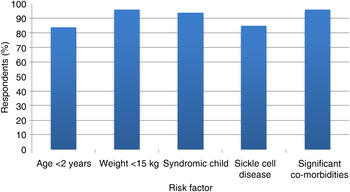
When respondents were asked which patients they would consider high risk, warranting a referral to a hospital with paediatric intensive therapy unit facilities, 71 out of 85 (84 per cent (95 per cent CI = 76–92)) reported that they would refer children aged less than 2 years, 82 respondents (96 per cent (95 per cent CI = 92–100)) would refer children weighing less than 15 kg, 80 respondents (94 per cent (95 per cent CI = 89–99)) would refer a child with a syndrome, 72 (85 per cent (95 per cent CI = 77–93)) would refer children with sickle cell anaemia, and 82 (96 per cent (95 per cent CI = 92–100)) would refer children with significant co-morbidities (Figure 4).
Factors considered by respondents to necessitate referral of child to hospital with paediatric intensive therapy unit facilities.

Twenty-one of the 85 respondents (25 per cent (95 per cent CI = 16–34)) reported having a dedicated management protocol for paediatric OSA and snoring.
In terms of the surgery offered for management of OSA and snoring in the paediatric population, all 85 respondents (100 per cent) offered adenotonsillectomy, 65 (76 per cent (95 per cent CI = 67–85)) offered adenoidectomy, and 17 (20 per cent (95 per cent CI = 12–29)) offered microlaryngoscopy (if aged less than 2 years).
In terms of post-surgical intervention follow up, 36 out of 85 respondents (42 per cent (95 per cent CI = 32–52)) do not follow up OSA patients routinely, 14 (16 per cent (95 per cent CI = 8–24)) follow up less than 50 per cent of patients, 18 (21 per cent (95 per cent CI = 12–30)) follow up 50–99 per cent, and 17 (20 per cent (95 per cent CI = 12–29)) follow up all patients after surgery. For those patients who were followed up, the mean (±standard deviation) follow-up duration was 6.8 ± 1.2 weeks (95 per cent CI = 6.5–7.0).
None of the respondents were able to estimate the cost of polysomnography and home sleep study.
When we separated the responses into those from district general hospitals (n = 66) and those from tertiary referral centres (n = 19), we found that tertiary referral centres were significantly more likely to: perform pulse oximetry pre-operatively (19 out of 19 vs 52 out of 66, p = 0.03), perform polysomnography pre-operatively (9 out of 19 vs 12 out of 66, p = 0.02) and follow up patients post-operatively (15 out of 19 vs 34 out of 66, p = 0.04).
Discussion
The management of paediatric snoring and OSA is variable across the UK. There is some inconsistency with regard to the assessment of paediatric snoring and OSA. Eighty-four per cent of our respondents performed pre-operative evaluation with pulse oximetry. Only 25 per cent performed polysomnography prior to surgical intervention, mainly in the larger tertiary paediatric referral centres. This is interesting as the American Academy of Pediatrics recommends the use of polysomnography as the gold standard for pre-operative investigation for all children with OSA.Reference Marcus, Brooks, Draper, Gozal, Halbower and Jones 5 A previous survey of American ENT surgeons found that only 5 per cent of ENT surgeons arranged for polysomnography prior to surgical intervention.Reference Weatherly, Mai, Ruzicka and Chervin 11 A previous survey of UK ENT surgeons found this figure to be even lower, at 2 per cent.Reference Pringle, Natesh and Buchanan 10 However, the low number of pre-operative polysomnography ordered by our respondents is in line with the UK multidisciplinary working party guidelines, which advise that children with mild-to-moderate OSA and no other risk factors can be investigated in terms of patient history and examination alone.Reference Robb, Bew, Kubba, Murphy, Primhak and Rollin 6
Pre-operative pulse oximetry was utilised by 84 per cent of the respondents in our study. This is probably because pulse oximetry is much more readily available within most hospitals, and does not have the inherent costs and technical expertise associated with polysomnography. The most common reason for using pre-operative pulse oximetry was for diagnosing OSA (73 per cent), but, as per the UK multidisciplinary working party guidelines, the diagnosis of OSA can be made clinically through history and examination alone; it is the severity of OSA that pre-operative pulse oximetry can be useful in determining.
A smaller percentage of respondents used pre-operative pulse oximetry to detect OSA for post-operative recovery and management (i.e. to screen for patients with severe OSA), which is the most appropriate use as per the UK multidisciplinary working party guidelines. The concerns are that children undergoing adenotonsillectomy may have altered neuromuscular tone of upper airway patency, making them prone to post-operative respiratory complications. Perhaps surprisingly, papers have reported high rates of post-operative complications (e.g. oxygen desaturations, atelectasis, pneumonia, pulmonary oedema, pneumothorax and stridor), of 5–25 per cent.Reference McColley, April, Carroll, Naclerio and Loughlin 13 Interestingly, 20 per cent of respondents reported the use of pre-operative pulse oximetry in all children as a mandatory requirement by anaesthetists, and this may reflect concerns regarding post-operative complications.
Very few respondents (8 per cent) used pre-operative pulse oximetry to reassure patients that there was no OSA (to facilitate discharge). The increased use of pre-operative pulse oximetry in our questionnaire study, when compared to previously published similar questionnaire studies, may be the result of increasing pressure from anaesthetists for mandatory documented evidence of the presence and severity of OSA, to enable appropriate post-operative management planning.Reference Pringle, Natesh and Buchanan 10
The definition of OSA in children is not clear. Polysomnography, which is accepted as the gold standard investigation, involves measuring markers of sleep quality, including brain activity, oxygen saturation, heart rate, breathing, and eye and limb movements. If polysomnography results are available, the presence and severity of OSA is determined using the apnoea-hypopnoea index (a score of less than 1 indicates no OSA, 1–5 indicates mild OSA, 5–10 indicates moderate OSA and more than 10 indicates severe OSA).Reference Gupta, Nicoli and Kotecha 14 However, as we have demonstrated in this questionnaire, polysomnography is rarely used. Polysomnography was only used in tertiary referral centres where sleep research was being undertaken, and, hence, pre- and post-operative polysomnography was encouraged.
The McGill oximetry scoring system was developed as a way to estimate the severity of OSA pre-operatively. It uses both the number of desaturations and the clusters that occur as a means to prioritise surgery for children with OSA.Reference Nixon, Kermack, Davis, Manoukian, Brown and Brouillette 7 Other cheaper alternatives (compared with polysomnography) for measuring paediatric OSA severity have been developed, including symptom questionnaires (e.g. the OSA-18 quality of life questionnaire). However, these have limited sensitivity, of 40 per cent, and they are not accurate at detecting OSA.Reference Constatin, Tewfik and Brouillette 15 , Reference Caulfield 16
Fewer of our respondents (31 per cent) utilise post-operative pulse oximetry monitoring compared to pre-operative pulse oximetry. The most common reason for its use was for overnight monitoring in the immediate post-operative period (88 per cent). Very few respondents used post-operative pulse oximetry as a method for detecting residual problems (19 per cent). Previously published guidelines provide no clear recommendations for post-operative pulse oximetry, and the UK multidisciplinary working party does not mention the use of post-operative pulse oximetry.Reference Robb, Bew, Kubba, Murphy, Primhak and Rollin 6 One could argue that the use of post-operative pulse oximetry should not be necessary, as patients who are deemed ‘high risk’ would be initially screened prior to surgery and therefore referred to the appropriate centre. Nonetheless, if clinicians have any concerns regarding the post-operative period, they tend to keep patients in overnight rather than arrange specific post-operative pulse oximetry.Reference Pringle, Natesh and Buchanan 10
The use of sleep nasendoscopy has been described in previous literature. It is particularly useful for those patients who continue to have upper airway obstruction despite adenotonsillectomy, and in those patients with airway obstruction due to cerebral palsy, syndromes and craniofacial malformations.Reference Caulfield 16 , Reference Myatt and Beckenham 17 However, in the UK it is rarely performed, and where it is used, it is reserved for those patients who have already had surgery or have upper airway obstruction secondary to a syndrome or craniofacial malformation.Reference Myatt and Beckenham 17 There are also concerns about subjecting children to sedation for sleep nasendoscopy as a first-line investigation. For these reasons, we did not include it in our questionnaire.
There is an increasing trend in the UK for paediatric ENT surgery only to be performed after funding has been confirmed from the clinical commissioning group. This was reflected in our questionnaire by the fact that 34 per cent of our respondents required prior clinical commissioning group approval. Indeed, it is possible that in the future, clinical commissioning groups may demand mandatory pulse oximetry or polysomnography to prove that there is OSA present, before funding is approved. However, some clinicians would argue that overnight pulse oximetry provides a snapshot of 1 night, and therefore will not accurately diagnose all children with OSA, as reflected by its low negative predictive value of 47 per cent.
In children, the most common cause for OSA is enlarged adenotonsillar tissue relative to the upper airway size.Reference Stradling, Thomas, Warley, Williams and Freeland 18 All of the respondents in our questionnaire offer adenotonsillectomy in the management of children with snoring and OSA, in common with previously published questionnaire studies.Reference Pringle, Natesh and Buchanan 10 A smaller number of respondents offer adenoidectomy for snoring symptoms (76 per cent). Only 20 per cent offer microlaryngoscopy combined with adenotonsillectomy (for those aged less than two years), probably because only specialist centres will anaesthetise children under the age of two years.
Adenotonsillar hypertrophy is responsible for the majority of upper airway obstructions in children. However, other causes, such as cerebral palsy, craniofacial malformations and syndromes, can lead to the development of upper airway obstruction, as a result of factors such as poor muscle tone.Reference Brunetti, Rana and Lospalluti 4 However, investigation of such causes is beyond the scope of this study.
Continuous positive airway pressure (CPAP) is a well-established treatment for OSA in both adults and children.Reference Palombini, Pelayo and Guilleminault 19 In children, CPAP has a useful role in those who are ineligible for surgery or awaiting an operation, in those with complex diseases, or in cases where surgery has failed to resolve symptoms.Reference Girbal, Goncalves, Nunes, Ferreira, Pereira and Saianda 20 We did not include this treatment in the questionnaire, as we were primarily interested in surgical interventions for paediatric OSA.
The majority of our respondents were aware of the UK multidisciplinary working party guidelines in terms of which patients should be referred on to a centre with paediatric intensive therapy unit facilities. Interestingly, when it came to the age of a child, there was some variation in practice, and some centres without paediatric intensive therapy unit facilities were operating on children younger than two years, citing that it was dependent on the anaesthetists at the hospital. All centres that responded to the questionnaire were able to refer patients to a centre with paediatric intensive therapy unit facilities, but only 28 per cent had on-site paediatric intensive therapy unit facilities. The centres with paediatric intensive therapy unit facilities were sometimes a large distance away from the referring hospital, and had limited bed availability, which influenced decision-making for surgery for children with OSA aged less than two years.
Only 58 per cent of our respondents follow up patients after surgical intervention for paediatric snoring and OSA. However, the American Thoracic Society recommends that all children with OSA should be reassessed six to eight weeks post-operatively. 1 The literature suggests that some patients may continue to have OSA despite surgery because of anatomical and neuromuscular factors that affect the size and shape of the pharyngeal airway.Reference Nishmura, Morishima, Hasegawa, Shibata, Iwanaga and Yagisawa 21 Patients who continue to have symptoms are in the ‘high risk’ group and should go on to have a post-intervention sleep study.Reference Constatin, Tewfik and Brouillette 15
Interestingly, none of our respondents were able to provide an estimate of the costs of pulse oximetry and polysomnography. At our hospital, pulse oximetry testing using a Masimo Radical-7™ device costs approximately £150. The cost of an overnight stay on a paediatric ward is £500. In contrast, a standard polysomnography study costs approximately £820 (excluding hospital stay).
A significant proportion of respondents in our survey (75 per cent) do not have a formal management protocol for paediatric snoring and OSA. Based on the findings of our questionnaire study and a previously published study investigating the use of pulse oximetry,Reference Kanona, Sharma, Chaidas and Kotecha 2 in our local department we have developed a local trust protocol for the management of children with snoring and OSA (Figure 5).
Local trust protocol for management of paediatric snoring and obstructive sleep apnoea.Reference Kanona, Sharma, Chaidas and Kotecha 2 OSA = obstructive sleep apnoea; ADHD = attention-deficit hyperactivity disorder; O2 sat = oxygen saturation; post-op = post-operative; HDU = high dependency unit; PICU = paediatric intensive care unit

This study had a higher response rate than any of the other previously published questionnaire studies on paediatric OSA, most likely because we obtained responses via telephone, rather than e-mail or post. However, we would have expected a higher response rate given that this was a telephone questionnaire study. The reasons for the limited response rate include an inability to contact clinicians despite repeated attempts, and the fact that some clinicians were not aware of the management guidelines at their centre for children with OSA. As there was a response rate of less than 100 per cent, this study may be susceptible to response bias. A significant proportion of the non-responders may be unable to or do not provide services for the assessment or management of paediatric snoring and OSA.
We did not survey anaesthetists, which would have been useful, particularly for establishing reasons why some centres operate on children aged less than two years or weighing less than 15 kg when paediatric intensive therapy unit facilities are not available on-site. We asked some follow-up questions not included in the questionnaire if the centre's management differed significantly from most centres, but this could have been more formally assessed. Our questionnaire was not validated and the responses can be subjective as they can represent a particular surgeon's view as opposed to that of the trust.
-
• Assessment and management of snoring and obstructive sleep apnoea (OSA) in the paediatric population varies across the UK
-
• Further guidelines, particularly in terms of post-operative pulse oximetry, are necessary
-
• Pre-operative pulse oximetry is sometimes used for suspected mild-to-moderate OSA in children with no co-morbidities, contrary to guidelines
-
• This could be because of pressure from anaesthetists and clinical commissioning groups regarding documented evidence of OSA severity
-
• All UK ENT surgeons surveyed offer adenotonsillectomy to treat paediatric OSA
-
• A significant proportion of UK clinicians routinely follow up patients after surgery for paediatric OSA
Further studies are warranted to investigate the long-term effects of untreated mild-to-moderate OSA in the paediatric population and evaluate the management of children in the immediate post-operative period.
Conclusion
There is variation in the assessment and management of snoring and OSA in the paediatric population across the UK. There is particular variation in the use of pre- and post-operative pulse oximetry monitoring across different centres. Further guidelines regarding this, particularly in terms of post-operative pulse oximetry, are necessary. All ENT surgeons in the UK appear to offer adenotonsillectomy to treat paediatric OSA. A significant proportion of ENT surgeons use pulse oximetry pre-operatively for suspected mild-to-moderate OSA in children with no co-morbidities, contrary to the UK multidisciplinary working party guidelines; this could be because of increasing pressure from anaesthetists and clinical commissioning groups regarding documented evidence of OSA severity. Most clinicians in the UK do not routinely follow up patients after surgery for paediatric OSA.
Acknowledgement
Grateful thanks to the administrative staff in the ENT Department at Queen's Hospital, Romford, UK.