




No CrossRef data available.
Article contents
Expressed emotion in multiple subsystems of the families of toddlers with depressed mothers
Published online by Cambridge University Press: 01 September 2004
Abstract
Expressed emotion was examined in families of toddlers (N = 101) whose mothers had experienced major depressive disorder occurring since the child's birth, and contrasted with expressed emotion in demographically comparable families (N = 54) with no history of parental mental disorder to elucidate family systems processes as contributors to child functioning. Both mothers and fathers provided Five-Minute Speech Samples on their child, their spouse, and themselves, and completed measures of marital adjustment, trait affect, relationship quality with their own parents in childhood, and child behavior problems. Maternal-expressed emotion criticism regarding child, self, and spouse was higher in the families with depressed mothers; paternal criticism regarding self and spouse also was higher in the depressed families. Mothers and fathers in the depressed group also differed on relational/affective features, exhibiting lower marital satisfaction, higher trait negative affect, and more negative childhood relationship representations, relative to the nondepressed group, and mothers reported more child behavior problems. Mediational models were evaluated separately for the different targets of maternal and paternal criticism and child behavior problems, and findings supported both individual parent and spouse contributions as mediators of the relation between depression group status and expressed criticism and child behavior problems. The findings are discussed in terms of the multiple levels of family system influence on negativity in the emotional environment of toddlers of depressed mothers, developmental risk, and the need for family-level interventions.Completion of this work was supported by grant funding from the National Institute of Mental Health (R01MH45027) and the Spunk Fund, Inc. We thank Traci McCabe for her diligent coding of the Five Minute Speech Samples.
Information
- Type
- Research Article
- Information
- Copyright
- © 2004 Cambridge University Press
The emotional life of the toddler is immersed in the affective climate of the family system. Toddlers growing up in families in which mothers struggle with major depressive disorder are particularly likely to experience a negative emotional environment, not only in relation to their mothers, but also in the context of the larger family system. Consequently, this exposure to a relational context high in negative emotion poses considerable risk for the competent emotional development of these young offspring of depressed mothers (Cicchetti & Toth, 1995, 1998). In this article, we focus on the construct of expressed emotion to characterize the affective environment in families with a depressed mother. We will examine the extent to which mothers and fathers exhibit negative-expressed emotion in regard to their toddlers, their spouse, and themselves, and processes that may serve to mediate relations between maternal depression and negative-expressed emotion in the family. By utilizing expressed emotion to characterize emotion expression among family members, a family systems perspective can be brought to the study of offspring development (Minuchin, 1985).
Expressed emotion was originally conceived in efforts to understand family processes that contribute to relapse in individuals with schizophrenia (Brown, Birley, & Wing, 1972; Brown & Rutter, 1966; Vaughn & Leff, 1976). For discharged patients with schizophrenia returning to their families, relapse has been consistently shown to occur more frequently among individuals living with relatives who exhibit high expressed emotion. The expressed emotion construct, composed of criticism, hostility, emotional overinvolvement, warmth, and positivity, was intended to capture variation in routine emotional features of family life, rather than highly atypical or unusual patterns of relating. Expressed emotion has traditionally been scored from the Camberwell Family Interview (CFI), in which a relative discusses the family member with a disorder, his/her illness, their history of relationship, and how they currently relate. The content and affective tone expressed during the interview are used to identify high expressed emotion, with the expectation that the features exhibited during the interview correspond to emotional communication enacted in family relations. Later research sought to reduce the time needed to obtain expressed emotion assessments, and the Five-Minute Speech Sample (FMSS; Magana, Goldstein, Karno, Miklowitz, Jenkins, & Falloon, 1986) was devised as an alternative assessment strategy.
In addition to schizophrenia, expressed emotion also has been investigated in relation to the course of disorder for other psychiatric (e.g., major depression, bipolar disorder, posttraumatic stress disorder, alcoholism) and medical conditions (e.g., asthma, epilepsy, diabetes; for a review see Wearden, Tarrier, Barrowclough, Zastowny, & Rahill, 2000). In a meta-analysis, Butzlaff and Hooley (1998) found larger effect sizes for the association of high expressed emotion and relapse among individuals with mood disorders, compared to schizophrenia. High expressed emotion spouses of depressed individuals have been found to be less positive and more negative, to make more critical remarks, to disagree with their depressed partner more often, and to be less accepting (Hooley, 1986). Furthermore, spouses rated high in expressed emotion also are more likely to attribute responsibility and controllability to their depressed partners for their depressive symptoms (Hooley & Licht, 1997). Thus, high expressed emotion from spouses of individuals with depression is likely to contribute to ongoing symptomatology and relapse, as well as to generate negativity more broadly in the family milieu, thereby affecting other family members.
Beyond the extensive research on expressed emotion in understanding the course of adult psychopathology, expressed emotion research has been extended to the study of child functioning and psychopathology. Parental-expressed emotion has been investigated in the families of clinic-referred and normative child populations, with developmental periods assessed ranging from preschool through adolescence. Evidence consistently had been attained that reveals that parental-expressed emotion is associated with a wide range of childhood behavior problems, psychiatric diagnoses, and medical conditions. In a community sample of 6- to 12-year-olds, Stubbe, Zahner, Goldstein, and Leckman (1993) found specificity in the associations of the dimensions of expressed emotion and different child diagnoses. Disruptive behavior disorders were more frequent in families with high criticism from parents, whereas anxiety disorders were associated with high parental emotional overinvolvement. Asarnow and her colleagues (Asarnow, Tompson, Hamilton, Goldstein, & Guthrie, 1994; Asarnow, Tompson, Woo, & Cantwell, 2001) have demonstrated that high expressed emotion is more frequent in families of children with depressive disorders, compared to children with schizophrenia spectrum disorders, attention-deficit/hyperactivity disorder (ADHD), or normal controls, and influences subsequent outcomes among children with depressive disorders (Asarnow, Goldstein, Tompson, & Guthrie, 1993). Maternal-expressed emotion also has been shown to correspond to a threefold increase in the incidence of offspring having an affective, substance abuse, or conduct disorder, and to confer additional risk for a child diagnosis beyond that associated with having a parent with an affective disorder (Schwartz, Dorer, Beardslee, Lavori, & Keller, 1991).
Parental-expressed emotion toward children provides an independent contribution to differentiating clinical and nonclinical child samples, beyond the influences associated with overall family functioning and psychological distress in mothers (Kershner, Cohen, & Coyne, 1996). Thus, parental-expressed emotion in families indicates a negative family process that is not reducible to other forms of family distress and dysfunction. Moreover, stability of parental-expressed emotion toward children over the course of 2 years has been demonstrated in a community sample of preschoolers followed to first grade (Peris & Baker, 2000), suggesting continuity in expressed emotion in families over time. Peris and Baker (2000) also demonstrated that preschool-expressed emotion predicted ADHD 4 years later when children were in third grade.
In addition to child psychopathology, parental-expressed emotion has been linked to other developmental domains, including attachment and behavioral inhibition. In a small German sample of 6-year-olds, Jacobsen, Hibbs, and Ziegenhain (2000) found that maternal-expressed emotion regarding the child was related to insecure attachment, particularly disorganized attachment, in 6-year-old children. This association was maintained even when earlier attachment organization and level of family stress were considered. Higher rates of maternal criticism also have been found among mothers of behaviorally inhibited children (Hirshfeld, Bierderman, Brody, Faraone, & Rosenbaum, 1997a), and maternal criticism was related to a higher number of child disorders and to higher externalizing symptoms. Particularly high rates of maternal criticism were directed at behaviorally inhibited children when mothers had anxiety disorders (Hirshfeld, Bierderman, Brody, Faraone, & Rosenbaum, 1997b).
In contrast to the findings of Stubbe et al. (1993), most research has found that high parental criticism is the crucial element of expressed emotion that is associated with child psychopathology, whereas emotional overinvolvement has not been shown to relate to functioning in child and adolescent samples (Daley, Sonuga–Barke, & Thompson, 2003; Kershner et al., 1996; McCarty & Weisz, 2002; Nelson, Hammen, Brennan, & Ullman, 2003; Peris & Baker, 2000; Wamboldt, O'Connor, Wamboldt, Gavin, & Klinnert, 2000). Emotional overinvolvement, implying intrusiveness and excessive emotional concern, is thought to impair autonomy strivings among adults with schizophrenia or other major psychopathology. However, the emotional overinvolvement construct, as identified in expressed emotion research, may not be tapping developmentally inappropriate behavior for parents of younger children and adolescents (McCarty & Weisz, 2002; Wamboldt et al., 2000).
Research has demonstrated the construct validity of parental criticism through observational studies of parent–child interaction. In a large sample of clinically referred children age 7 to 17, McCarty, Lau, Valeri, and Weisz (2004) found that parents with high expressed emotion criticism regarding their child evinced higher antagonism, negativity, disgust, and harshness, as well as less responsiveness during observed interactions with their child. Similarly, Daley et al. (2003) observed mothers with high child criticism to be less affectionate and more directive and to engage in less joint play when interacting with their preschool children. Mothers exhibiting high criticism also had more negative and fewer positive feelings about parenting their child. Additionally, it has been shown that high maternal criticism is related to maternal causal attributions about child problem behavior. Highly critical mothers are more likely to view their child's behavior problems as internal and controllable, and to blame the child for behavioral difficulty (Bolton, Calam, Barrowclough, Peters, Roberts, Wearden, & Morris, 2003). Recent research has demonstrated that maternal-expressed emotion contributes to the differential development of antisocial behavior in monozygotic twins (Caspi, Moffitt, Morgan, Rutter, Taylor, Arseneault, Tully, Jacobs, Kim–Cohen, & Polo–Tomas, 2004). This research indicates that maternal-expressed emotion is not primarily attributable to individual features of the child, and that maternal-expressed emotion influences the development of antisocial behavior through processes not attributable to genetic differences. Overall, the findings from these studies illustrate that the criticism captured in expressed emotion assessments corresponds to actual differences in parental attitudes and behavior directed to children, and that these parental attributions and interaction styles are inconsistent with the promotion of child competence.
Various investigators have found that parental-expressed emotion is related to parental psychopathology (Bolton et al., 2003; Brennan, Hammen, Katz, & Le Broque, 2002; Hibbs, Hamburger, Kruesi, & Lenane, 1993; McCarty & Weisz, 2002; Schwartz et al., 1991), and maternal depression is a frequently noted diagnosis. More importantly, in several studies, expressed emotion has been identified as a mediator of the relation between maternal psychopathology and child behavior problems and diagnoses (Bolton et al., 2003; McCarty & Weisz, 2002; Nelson et al., 2003). In one study (Nelson et al., 2003), multiple aspects of maternal depression, expressed emotion, and adolescent behavior problems were evaluated. Maternal depression was associated with internalizing and externalizing problems and with functional impairment in adolescents. Moreover, maternal criticism was found to partially mediate the relation between maternal depression and adolescent externalizing problems and functional impairment. Brennan et al. (2003) also established a mediating role for expressed emotion. In particular, paternal-expressed emotion was found to mediate the relations between maternal depression, paternal substance use, and adolescent diagnoses for depression. This study is particularly important because it incorporates a broader family perspective through attending to the role of the father's mental health and paternal-expressed emotion. These findings indicate that a broader perspective on other features of the family system are important considerations in understanding linkages among maternal depression, expressed emotion, and child functioning.
We know of no existing research that has extended the concept of expressed emotion to the study of the early family relational environment of toddlers or to the study of offspring of mothers with major depressive disorder during the child's second year of life. If toddlers of depressed mothers are at greater risk for experiencing criticism from their mothers, then these children are in jeopardy of being confronted with negative communications about the self at a time when the early self is being differentiated. Among older children, self-blaming comments and attributional style have been related to observed maternal criticism (Jaenicke, Hammen, Zupan, Hiroto, Gordon, Adrian, & Burge, 1987). Thus, negative-expressed emotion from parents toward a young child would constitute a detrimental family process likely to undermine competent emotional development in these children.
Expressed emotion research has largely focused on a single target of parents', spouses', or relatives' criticism and emotional overinvolvement (e.g., the patient with severe mental disorder, children with behavior problems). Less attention has been directed toward expressed emotion that may be exhibited more broadly in the family, across multiple relationships. Depressed mothers, for example, are likely to be highly self-critical (Blatt, Quinlan, Chevron, McDonald, & Zuroff, 1982; Coyne & Whiffen, 1995), as well as critical of their husbands, given high levels of marital dissatisfaction and conflict among couples with a depressed spouse (Coyne, Downey, & Boergers, 1992; Cummings, Davies, & Campbell, 2000; Weissman & Paykel, 1974). Similarly, the husbands of depressed women are more likely to exhibit negative-expressed emotion about their wives, potentially in a reciprocal fashion. In so doing, husbands may exacerbate symptoms in their wives and contribute to a higher risk of relapse. Thus, the toddler in these families may not only be subjected to parental criticism, but also is likely to experience negative-expressed emotion across different primary relationships in the family system. As a result, high levels of negativity, hostility, and criticism across relationships may characterize the family environment of toddlers with a depressed mother, generating a hazardous emotional context for socioemotional development.
Women with depressive disorders are more likely to be married to husbands with a history of psychopathology (Merikangas & Spiker, 1982; Peterson, Coyne, & Kessler, 1991). Moreover, depressed adults are more likely to have experienced conflict and negativity in their relationships with their parents during childhood (Blatt, 2004; Blatt & Homann, 1992), and Coyne et al. (1992) suggest that depressed persons and their spouses may be attracted to each other based on similarities in early adversity. Accordingly, a confluence of negative early childhood experiences, psychopathology with attendant high levels of negative affect, and martial conflict and dissatisfaction may characterize the marital relationship in families with a depressed mother (Cummings & Davies, 1994a, 1994b). Not only mothers with depressive disorders, but also their husbands are likely candidates for exhibiting high expressed emotion, particularly criticism. Moreover, these features of depressed families are likely to promote negative-expressed emotion across relationships, and may contribute to negative-expressed emotion in relation to the young child.
Whereas psychopathology in the relatives of patients with severe mental illness has been indicated as a contributor to expressed emotion (Wearden et al., 2000), there has been limited research on broader predictors of individual differences in the tendency to exhibit expressed emotion. When an individual is asked to describe a family member and their relationship during the CFI or FMSS, one must draw upon processes contributing to how one conceptualizes self and other. More broadly, representations of self and other have roots in the individual's experiences with caregivers during childhood (Bowlby, 1969, 1980; Bretherton, 1990; Sullivan, 1953). Given the likelihood of compromised childhood relationships with parents for both depressed mothers and their husbands, internal working models of self and other in relationships among depressed mothers and their spouses are prone to be negative. Consequently, when asked to describe the self and others in current relationships, aspects of negative early experiences may impinge upon how representations are formulated and expressed. This process could constitute an intergenerational contributor to current expressed emotion in the family, whereby earlier relationship difficulties influence the emotional features of current family relationships.
Negative affect as a trait also may contribute to the propensity of individuals to express criticism in relation to others, as well as to the self. Negative affect is a general dimension of subjective distress, including a variety of aversive mood states, such as anger, contempt, disgust, guilt, fear, and nervousness (Watson, Clark, & Tellegen, 1988). Individuals who exhibit high levels of trait negative affect would be expected to be more liable to expressing negativity, hostility, and criticism in relation to others. Moreover, trait-negative affect is expected to be considerably higher among depressed mothers, thereby increasing their vulnerability to exhibiting high expressed emotion. In turn, spouses may react to high negative-trait affect in their partners, and exhibit high expressed emotion in response. In families with a depressed mother, high levels of marital distress and dissatisfaction are likely to promote negative-expressed emotions by both spouses. Thus, negative childhood relationship experiences, trait-negative affect, and marital distress are examples of processes that are candidates for increasing expressed emotion in regard to another family member. Furthermore, these processes are expected to be heightened in families with a depressed parent, and may serve to mediate or account for higher levels of expressed emotion in these families.
Expressed emotion may constitute a generalized interpersonal style of an individual, and, as such, the tendency to exhibit expressed emotion may occur across multiple relationships. In contrast, expressed emotion may only occur in relation to a specific family member. Furthermore, there may be specificity in the most potent predictors of the tendency to exhibit expressed emotion in regard to particular relationship figures. For example, negative-expressed emotion in regard to the self may be more strongly predicted by early childhood relationship characteristics, whereas expressed emotion in regard to the spouse may be based more on marital dissatisfaction or a high negative affect in the spouse. Consequently, we will examine statistical models to identify the strongest predictors of expressed emotion and the specificity of these predictors in regard to different relationship figures.
From a family systems perspective, we also are interested in determining the extent to which the expressed emotion of one family member is influenced not only by internal processes, but also by contributions from other family members. For example, high negative-trait affect in one parent may contribute to greater negative-expressed emotion exhibited by the other parent in regard to the self or the child. Similarly, marital dissatisfaction experienced by one parent may translate into criticism of the child, or negative childhood relationship experiences in one parent may influence expressed emotion tendencies in the other parent. Thus, we anticipate that, in addition to within-individual predictors, there will be cross-person contributions to an individual's tendency to exhibit expressed emotion.
In this investigation we will examine the emotional climate of families of toddlers with a depressed mother. We will investigate expressed emotion exhibited by mothers and fathers in regard to their child, their spouse, and themselves and evaluate the following hypotheses:
- Mothers with a history of major depressive disorder will exhibit higher levels of negative-expressed emotion, particularly in the form of criticism, in regard to their child, their spouse, and themselves than will mothers who do not have a history of major depressive disorder (MDD).
- Fathers in families with a depressed mother will also be likely to be more critical of child, self, and spouse than will fathers in families with nondepressed wives.
- Families with depressed versus nondepressed mothers will differ on variables potentially related to expressed emotion, including less positive maternal and paternal representations of their childhood relationships with parents, greater trait-negative affect for mothers and fathers, and greater marital dissatisfaction among spouses.
- These relational/affective processes will be related to expressed emotion/criticality of child, self, and spouse.
- These relational/affective processes will mediate the relation between families with a depressed mother and higher criticism across relationships.
Method
Participants
The current sample is drawn from a larger longitudinal investigation (N = 200 families) of the effects of maternal depression on child development and an evaluation of a preventive intervention for toddlers of depressed mothers (Cicchetti, Toth, & Rogosch, 2004). Inclusion in this subsample (N = 155) required that both mothers and fathers had participated in baseline research assessments. For 19 of the excluded families, no father was present in the home, and 22 additional fathers declined to participate. Four families were excluded because of malfunctions in the taperecording of the FMSSs. Comparison of the retained and excluded families indicated that they were comparable on major demographic variables, with no significant differences in child gender, maternal age, family income, or family socioeconomic status.
The mean age of the toddlers at baseline was 20.35 months (SD = 2.56); 88 were boys and 67 were girls. Among parents of these children, 101 mothers had a history of MDD occurring since the child's birth. The fathers of the toddlers in the MDD group varied in terms of psychiatric history, with 24.8% having a Diagnostic and Statistical Manual of Mental Disorders, Third Edition—Revised (DSM-III-R; American Psychiatric Association, 1987) Axis I diagnosis currently or in the past 6 months. Paternal diagnoses included, for example, alcohol and substance use disorders, anxiety disorders, depressive disorders, and antisocial personality disorder. In the comparison families (n = 54), mothers and fathers had no history of current or past psychiatric disorder. The age of mothers in the sample ranged from 21 to 41 years (M = 31.88, SD = 4.64), and the age of fathers ranged from 21 to 57 years (M = 34.41, SD = 6.00).
Participant recruitment
Families of toddlers whose mothers had experienced MDD since the birth of the target child were recruited from the community through referrals from mental health and medical professionals and through advertisements in local newspapers, newsletters, medical offices, and community bulletin boards. To be included in the sample, mothers needed to have met DSM-III-R diagnostic criteria for MDD at some time since the birth of their child. Among these mothers, the age of onset for their first major depressive episode occurred prior to the child's birth (68.3%), and most of the mothers (87.2%) had experienced recurrent episodes of major depression. The fathers of children in these families were not required to meet any specific diagnostic criteria. To reduce the effects of co-occurring risk factors that may accompany depression (Downey & Coyne, 1990), families with middle or higher socioeconomic status were selected. All parents minimally had a high school education.
Comparison families with toddlers were identified utilizing county birth records. Families with similar socioeconomic status and living in the same geographic areas as the families with depressed mothers were targeted. Mothers and fathers were interviewed individually using the Diagnostic Interview Schedule (DIS-III-R; Robins, Heltzer, Orvaschel, Anthony, Blazer, Burnam, & Burke, 1985) to screen for psychopathology, and inclusion criteria for the comparison group required that mothers and fathers have no history of current or past DSM-III-R Axis I diagnoses.
The parents and children in the depressed and nondepressed comparison group families were comparable on a range of demographic variables, including child age (M = 20.04, SD = 2.29 vs. M = 20.94, SD = 2.93), child gender (53.5% male vs. 63.0%), and child cognitive functioning (Bayley MDIs: M = 110.95, SD = 17.50 vs. M = 111.07, SD = 19.90). Maternal and paternal age, race, and socioeconomic status also were equivalent for families in the two groups. The race of parents was primarily nonminority (93.9%), and 73.6% of the families were in the two highest socioeconomic strata (Hollingshead, 1975). The groups also were comparable in terms of the child's primary caregiver; 79.2% of the depressed mothers and 75.9% of the nondepressed mothers considered themselves the child's primary caregiver. For the remaining families, both the mother and father shared equally in child care responsibilities. Both groups of families were equally likely to utilize some form of daycare (60.6 and 71.8%, for depressed and nondepressed groups).
Procedures
Participants were seen for a series of home- and center-based assessment sessions. During sessions conducted in the home, mothers and fathers were interviewed independently by trained research interviewers. Initially, parents were administered the DIS-III-R, to confirm the diagnosis of MDD for mothers in the depressed group and to screen for parental psychopathology in the comparison group. Both mothers and fathers also completed questionnaires and audiotaped recordings of FMSSs to assess expressed emotion.
Measures
DIS-III-R
The DIS-III-R is a structured psychiatric interview, designed to assess diagnostic criteria for Axis I disorders of the DSM-III-R. The interview consists of a series of modules that probe the history of symptoms for different categories of DSM-III-R Axis I disorders. Questions are answered in a yes/no basis, reducing the need for interviewer interpretation. As a result, sensitive clinical judgments are not required and the interviews can be conducted by trained nonprofessional interviewers. This DIS-III-R allows for the determination of 49 DSM-III-R diagnoses.
FMSS
Expressed emotion was assessed for mothers and for fathers with the FMSS in regard to three relationships: child, spouse, and self. Administration of the FMSS involves asking the parent to speak into a tape recorder for 5 min, without interruption, about their thoughts and feelings about the target relationship figure and how they get along together. FMSSs for the child, spouse, and self were obtained in an invariant order during the same interview session. However, other questionnaire measures were administered between the three FMSSs completed by each parent. The FMSS was coded based on verbal content and vocal tone, according to the coding system developed by Magana et al. (1986). High expressed emotion is scored based on ratings of criticism and/or emotional overinvolvement. High criticism is assigned when mothers use a negative opening statement, describe a negative relationship, or express one or more criticisms. High emotional overinvolvement ratings are made based on the parent expressing self-sacrifice or overprotectiveness, exhibiting emotional displays (e.g., crying), making five or more positive remarks combined with statements of strong affection, or providing excessive detail about the past or excessive praise.
Traditionally, a FMSS meeting criteria for either high criticism or high emotional overinvolvement is classified as exhibiting high expressed emotion; all other samples are categorized as low expressed emotion. In addition to high versus low categorization for criticism and for emotional overinvolvement, it also is possible to designate borderline levels of these domains. In research involving children and adolescents, it has been suggested that attention to borderline levels of expressed emotion is important (Nelson et al., 2003). Following Nelson et al. (2003), we generated 3-point scales (low, borderline, high) for criticism and for emotional overinvolvement, and these dimensional scores were used in subsequent analyses. Thus, ratings of criticism and of emotional overinvolvement were determined separately for mothers and for fathers, in regard to FMSSs about the child, the spouse, and the self. All FMSSs were coded by the same trained coder, who met reliability standards established by the UCLA Family Project. The coder was not aware of the group status of mothers or fathers in the study or of the study's hypotheses. Each of the three FMSSs provided by mothers and by fathers was scored independently; the coder was not aware of which FMSSs were from the same parent or which parents were spouses. Coding was completed on large subsamples of one participant/target category at a time (e.g., maternal FMSS on spouse), to reduce any carryover in the ratings made across a participant's individual FMSSs.
Dyadic Adjustment Scale (DAS)
The DAS (Spanier, 1989) was administered to assess the quality of the marital relationship. The DAS is a frequently used measure of marital adjustment, consisting of 32 items assessing four component dimensions, including consensus, cohesion, affectional expression, and marital satisfaction. In the current investigation, we focused on the marital satisfaction scale to utilize a broad index of marital functioning. This scale assesses the degree to which the couple is satisfied with the state of the relationship and is committed to its continuance. Numerous investigations have demonstrated the psychometric reliability and validity of the DAS, and have shown the DAS to differentiate between happily married and unhappily married and divorced samples (e.g., Spanier, 1976; Whiffen & Gotlib, 1989). Higher scores on the satisfaction scale reflect greater marital satisfaction.
Positive and Negative Affect Schedule (PANAS)
The PANAS (Watson, Clark, & Tellegen, 1988) was designed to measure two higher order dimensions of self-rated trait affect. The PANAS consists of 10 items assessing positive affect (active, alert, attentive, determined, enthusiastic, excited, inspired, interested, proud, strong) and 10 items assessing negative affect (afraid, ashamed, distressed, guilty, hostile, irritable, jittery, nervous, scared, upset). Parents were asked to rate how they generally feel in regard to each affect; a 5-point scale ranging from very slightly or not at all to extremely was used. The scales have been shown to be highly internally consistent and largely uncorrelated (Watson et al., 1988). In the current study, internal consistencies for positive affect were .87 and .86, for mothers and for fathers, respectively, and for negative affect, they were .92 and .88, respectively. The PANAS also has been found to have a moderate level of stability for both positive and negative affect over a 6-year period, and to be related to subsequent anxiety and depressive symptoms (Watson & Walker, 1996).
Mother–Father–Peer Scale (MFP)
The MFP (Epstein, 1983) is a 70-item questionnaire that was used to assess parents' memories of their relationships with their mother and their father during childhood. Both mothers and fathers completed the questionnaire in regard to their own parents. Two subscales, acceptance versus rejection and encouraging of independence versus overprotection, are derived from the MFP to characterize the quality of the relationship the individual experienced with each parent. Sample items on the acceptance scale include “Enjoyed being with me,” “Could always be depended upon when I really needed his/her help and trust,” and “Made me feel that I was a burden to him/her (reverse scored).” For the encouragement of autonomy scale, sample items include: “Encouraged me to express my own opinion,” “Helped me learn to be independent,” and “Was overprotective of me (reverse scored).” Items were scored on a 5-point scale, ranging from strongly agree to strongly disagree. Internal consistencies for the scales were high for both mothers and fathers, ranging from .83 to .87 for the acceptance scales and from .88 to .95 for the encouragement of independence scales. Significant relations have been reported between MFP scales and self-esteem (Epstein, 1983), maternal sensitivity (Biringen, 1990), and infant attachment (Ricks, 1985).
Child Behavior Checklist (CBCL 2–3)
The CBCL (Achenbach, 1992) is a widely used and psychometrically sound instrument that was developed to obtain parent assessments of behavioral and emotional problems in their child. Parents rate their child on 100 items that describe the child's functioning currently and in the previous 2 months. Ratings range from 0 (not true of the child) to 2 (very true or often true of the child). The CBCL yields a score for Total Behavior Problems, as well as for broadband Internalizing and Externalizing scales. Mean 1-week test–retest reliability for all scales was r = .87, and 1-year stability was r = .69 (Achenbach, Edelbrock, & Howell, 1987).
Results
Expressed emotion in families with a depressed mother
Expressed emotion scores of criticism and emotional overinvolvement were determined for mothers and for fathers, for each of the relationships that were described in the separate FMSSs (self, spouse, and child). For each of these 3-point scores, t tests were conducted to compare the families with depressed and nondepressed mothers, as shown in Table 1. Consistent group differences were found for criticism, whereas no depressed group differences were observed for emotional overinvolvement. Depressed mothers expressed significantly higher criticism in regard to self, spouse, and child. Fathers in the depressed group also expressed significantly higher criticism for self and for spouse; no group differences were found for fathers' criticism of the child. Thus, higher levels of criticism across relationships mark the emotional climate in the families of the depressed group, and both mothers and fathers contribute to the expression of criticism.
Comparison of depressed and nondepressed groups on expressed emotion criticism and emotional overinvolvement

Correlations among the six mother and father criticism variables are presented in Table 2. For mothers, criticism expressed in one relationship corresponded to criticism expressed in other relationships. Similarly, fathers' criticism scores were significantly intercorrelated. However, in examining correlations between mothers and fathers, only one correlation was significant. Criticism expressed regarding the spouse was correlated for mothers and fathers (r = .20, p = .01), suggesting a degree of reciprocity among spouses in the tendency to be critical of each other.
Correlations among mother and father expressed emotion criticism variables

Depression group differences in marital satisfaction, trait-negative affect, and childhood relationships with parents
We wanted to examine influences from both mothers and fathers that could contribute to the higher levels of criticism observed in the depressed group families. Initially, group differences in maternal and paternal marital satisfaction, the tendency to experience and exhibit negative affect, and appraisals of the quality of parents' childhood relationships with their own parents were examined (see Table 3). In the families of the depressed group, significant differences were found in these domains for both mothers and fathers. Depressed mothers, compared to nondepressed mothers, reported significantly lower marital satisfaction and higher trait negative affect. Depressed mothers also indicated that their own mothers and fathers in childhood were less accepting and less encouraging of independence, relative to nondepressed mothers. The findings for fathers in the depressed group also indicated substantial group differences on these variables. Fathers in the depressed group reported significantly lower marital satisfaction, higher negative affect, and poorer relationship qualities with their own parents in childhood, than did fathers in the nondepressed group.
Comparison of depressed and nondepressed groups on relational/affective variables

Because some of the fathers in the depressed group had histories of psychopathology, we examined whether having an Axis I diagnosis currently or in the past 6 months contributed to the differences observed for the depressed group. Accordingly, we compared variables for the depressed group families depending on whether fathers had current/recent mental disorders or whether diagnoses were absent. No differences were found for any of the mother- or father-expressed emotion variables, and only one mother and one father relational/affective variable differed significantly between groups. Depressed mothers with husbands without current/recent diagnoses reported higher negative affect (M = 2.83, SD = 0.60) than did depressed mothers with husbands who had current/recent mental disorder (M = 2.84, SD = 0.61), t (98) = 2.24, p < .05. In contrast, fathers with current/recent diagnoses reported lower marital satisfaction (M = 3.48, SD = 0.72) than did fathers without diagnoses (M = 3.79, SD = 0.51), t (98) = 2.34, p > .05. Due to this limited effect of paternal psychopathology in the depressed group, we did not consider this feature further.
As expected, the relational/affective variables shared considerable variance. Among mothers, 13 of 14 correlations among these variables were significant. Similarly, among fathers, 13 of 14 correlations also were significant. In contrast, however, mother and father negative affect was not correlated, and the MFP variables regarding childhood relationships also were not significantly correlated. Mothers and fathers did, however, agree strongly on their marital satisfaction (r = .62, p < .001). Marital satisfaction was significantly positively correlated with the other spouse's childhood relationship quality with parents and negatively correlated with the spouse's negative affect. These relations were found for both mothers' and fathers' marital satisfaction.
We next examined how these relationship/affect variables correlated with the mother- and father-expressed emotion criticism variables (see Table 4), and important associations were identified. For mothers, negative affect and MFP childhood relationship variables were significantly correlated with self- and spouse criticism. Maternal marital satisfaction also was negatively correlated with criticism of her husband. In contrast, maternal criticism of the child was only correlated with maternal negative affect. For fathers as with mothers, marital satisfaction was negatively correlated with spousal criticism. Fathers' negative affect was not correlated with his criticism across the relationships examined, and self- and spouse criticism did not show the consistent relations with MFP childhood relationship variables as was observed among mothers. However, each of the fathers' MFP variables was negatively correlated with criticism of the child. Thus, fathers who reported less harmonious relations with their own parents tended to exhibit more criticism regarding their child.
Correlations of expressed emotion criticism with relational/affective variables

Of particular interest were associations of one parent's criticism variables with self-reported variables from the other parent. Paternal marital satisfaction was negatively correlated with maternal criticism of both her child and her spouse. Similarly, maternal marital satisfaction was negatively correlated with paternal self- and spouse criticism. Fathers' acceptance from both of his parents was correlated negatively with maternal spousal criticism, and fathers' negative affect was correlated positively with all three of the maternal criticism variables. In contrast, maternal negative affect showed no relationship to any of the fathers' criticism variables. However, mothers who reported that their fathers were more encouraging of independence had husbands who were less critical. Thus, relational/affective processes in one parent demonstrated associations with levels of criticism in the other parent, and differential relations were observed depending on the target of criticism.
Mediational models of the relations between maternal depression group and criticism
Given the differences observed between the depressed and nondepressed groups on expressed emotion criticism exhibited in multiple relationships, the differences between the depressed groups on a variety of maternal and paternal relational/affective variables, as well as various associations between the relational/affective variables and maternal and paternal criticism, we sought to determine whether these maternal and paternal relational/affective variables served to mediate relations between depression group membership and expressed emotion criticism. Moreover, as a result of considerable shared variance among the relational/affective variables, we sought to determine the most parsimonious models that could be identified to predict each of the maternal and paternal criticism variables. Following the guidelines delimited by Baron and Kenny (1986) for evaluating mediation, we have already established preliminary criteria for potential mediational relationships. In particular, we have demonstrated that the independent variable, maternal depression group, is related to the outcomes of expressed emotion criticism and to various potential mediators, that is, the maternal and paternal relational/affective variables. Relations between these latter variables and the expressed emotion criticism variables also have been demonstrated. Thus, in a series of hierarchical multiple regression analyses, we entered maternal depression group into the regression equation in the first step, and in the second step we added relational/affective variables that significantly correlated with the criticism outcome variable. Final models were trimmed so as to retain only relational/affective variables demonstrating an independent contribution to the regression equation. Table 5 presents the regression summary tables for the final models.
Regression models predicting expressed emotion and child behavior problems

Maternal criticism of self
Among maternal variables, maternal negative affect and aspects of the mother's relationships with her own parents were associated with maternal self-criticism. Paternal negative affect and the father's appraisal of acceptance from his own father also had significant associations. In Step 1 of the regression equation, depression group status was entered, and subsequently in Step 2, the potential mediating variables were added. Father's negative affect and the mother's appraisal of her father's encouragement of independence each made significant independent contributions to the regression equation. However, depression group status also retained a significant independent effect, and the strength of this relation was not substantially reduced compared to Step 1. Thus, the final regression model obtained is an additive model, with all three variables contributing independently to prediction. It is noteworthy that, in addition to maternal depression, negative affect of her husband and a variable involving negative relations with the mother's father in childhood each contributed to predicting the mother's tendency to be critical of herself.
Paternal criticism of self
In examining the possible mediators of the relation between depression group and paternal self-criticism, only two variables were found to be significantly associated with self-criticism (see Table 4); maternal marital satisfaction and paternal feelings of acceptance from his own father were negatively correlated with self-criticism. When these variables were entered in Step 2 of the regression equation along with depression group, only depression group and paternal acceptance retained independent contributions. As was the case in predicting maternal self-criticism, a mediational model was not supported for paternal self-criticism. Rather an additive model in which depression group and the father's feelings of acceptance from his own father contributed to the regression equation.
Maternal criticism of spouse
In addition to depression group, multiple maternal and paternal variables (marital satisfaction, negative affect, and MFP variables) were associated with mothers' level of criticism of their spouses. When these variables were entered into the regression equation in Step 2, two variables retained significant independent effects, maternal marital satisfaction and mothers' feelings of their own fathers encouraging independence. Additionally, the inclusion of these variables substantially reduced the effect of maternal depression group, with depression retaining only marginal significance. Thus, this model indicates that the relation of depression group status to greater maternal criticism of her spouse is mediated by the mother's marital dissatisfaction and feelings of her father not encouraging her independence in childhood.
Paternal criticism of spouse
Interestingly, similar predictors of maternal spousal criticism also were retained in the model of fathers' spousal criticism. In Step 2, when entered along with depression group, two variables—fathers' marital satisfaction and mothers' feelings about her father encouraging independence—retained significant independent effects. Moreover, the effect of maternal depression group was substantially reduced and no longer significant, indicating that fathers' marital satisfaction and aspects of the mother's relationship with her father mediated the relation between depression group status and father's spousal criticism. This model is noteworthy, given the contribution of both paternal and maternal processes in accounting for higher levels of spousal criticism in families with depressed mothers. Moreover, as in the case of maternal spousal criticism, current and family of origin relational influences were found to be contributors to fathers expressing criticism of their wives.
Maternal criticism of the child
Both maternal and paternal variables contributed to the prediction of mothers expressing criticism of their child. In particular, in Step 2, both maternal and paternal trait negative affect were retained in the regression equation when added along with depression group. Additionally, these two variables completely mediated the relation between depression group and maternal child criticism. Not only does maternal negative affect contribute to tendencies to be more critical of the child, but also the presence of higher levels of paternal negative-trait affect represents another process operating to increase maternal criticism of the child.
Paternal criticism of the child
In contrast to the findings for mothers, neither maternal nor paternal negative affect was related to fathers expressing criticism of their child. Moreover, no maternal variables were correlated with paternal criticism of the child, and paternal criticism levels did not differ between the depressed and the nondepressed groups. One domain of paternal variable was found to relate to higher child criticism from fathers. The MFP variables of fathers' feelings that their mothers and fathers encouraged independence, and that their fathers were accepting were negatively correlated with paternal criticism. Given shared variance among these variables, when examined collectively in a regression equation, only mother's encouragement of independence retained a significant effect. Thus, fathers' tendency to express criticism of their child appeared to be uniquely related to childhood family of origin relationships.
Child behavior problems and expressed emotion criticism
Both mothers and fathers provided assessments of their child's behavioral functioning through independent completion of the CBCL. Mothers' and fathers' reported levels of total behavior problem t scores were significantly correlated (r = .33, p < .001). Mothers in the depressed group (M = 50.63, SD = 8.09) reported significantly higher levels of child behavior problems than did mothers in the nondepressed group (M = 47.33, SD = 7.90), t (151) = 2.37, p < .02. The two groups did not differ, t (152) = 1.03, ns, in the level of father-reported child behavior problems.
The expressed emotion criticism of the child by both mothers and fathers was correlated with maternal reports of child behavior problems (rs = .19 and .20, ps < .05, for mothers and fathers, respectively) and with paternal reports of child behavior problems (rs = .26 and .30, ps < .001, respectively). Thus, higher criticism expressed by parents corresponds to higher levels of child behavior problems reported by both parents.
Given the higher levels of child behavior problems reported by mothers in the depressed group, we wanted to determine if maternal and paternal affect/relational variables and/or expressed emotion criticism would serve to mediate this relation. Among the maternal and paternal relational/affect variables, the only variable that correlated with mothers' reports of child behavior problems was maternal negative affect. Following the previous procedures for evaluating mediation, we first examined whether maternal criticism of the child qualified as a mediator. When entered in the second step of a regression equation along with depression group, both group status and maternal criticism retained independent effects in predicting child behavior problems. Thus, maternal criticism did not serve as a mediator of the relation between depression group status and higher maternal report of child behavior problems.
Subsequently, we also included maternal negative affect in the regression model at Step 2. In this model, the independent effect of maternal criticism was no longer significant. Rather maternal negative affect made an independent contribution and served to mediate the relation between maternal depression group and child behavior problems. Finally, we also considered contributions from paternal variables. The only paternal variable associated with maternal report of child behavior problems was fathers' expressed criticism of the child. When this variable was added in Step 2, along with depression group and maternal negative affect, the mediating effect of maternal negative affect was retained, and fathers' criticism contributed further variance to prediction of maternal reports of child behavior problems. However, because fathers' criticism was not associated with depression group status, paternal criticism did not serve as mediator.
Although fathers' reports of child behavior problems were not related to depression group, we evaluated whether maternal and paternal negative affect and criticism collectively related to fathers' reports of behavior problems. Following depression group status entered in Step 1, in Step 2, maternal and paternal negative affect and maternal and paternal child criticism were entered. Each of these variables retained a significant independent effect in contributing to fathers' reports of child behavior problems. Thus, both maternal and paternal contributions were associated with fathers' reports of child behavior problems.
Discussion
The findings of the current investigation provide clear evidence that heightened levels of negative-expressed emotion are prominent in the family relational environment of toddlers with depressed mothers. Whereas the majority of prior research with depressed samples has focused on a single relationship target of expressed emotion (e.g., patient or spouse with depressive disorder, offspring of depressed parents), our results reveal that expressed emotion criticism is more prevalent at multiple levels of the family system. At the level of the self, not only depressed mothers but also their husbands were more likely to express self-criticism, compared to mothers and fathers in nondepressed families. Moreover, at the marital level, both depressed wives and their husbands more frequently expressed criticism about their spouses than did spouses in the nondepressed families. Finally, 20-month-old children were more frequently the recipients of criticism when their mothers were depressed, whereas the fathers of these toddlers with depressed mothers were not found to be more critical. The greater criticism of depressed mothers in regard to their children is consistent with previous research demonstrating that depressed mothers express more criticism toward their school-age and adolescent children (Brennan et al., 2003; Nelson et al., 2003; Schwartz et al., 1991). Our findings extend previous research by illustrating that very young children of depressed mothers are more likely to experience criticism from their mothers. As such, negativity and criticism expressed toward the child are likely to emerge earlier in ontogenesis than is suggested in prior research, and thereby pose risk for the course of development in these offspring. Furthermore, toddler-age children also are more likely to be exposed to criticism communicated between their parents, resulting in a family emotional climate rife with negativity across relationships.
In considering the expressed emotion construct more broadly, the centrality of criticism at multiple levels of the family system is emphasized by comparison of the results for emotional overinvolvement. No differences between the families with depressed versus nondepressed mothers were found for emotional overinvolvement as expressed by either mothers or fathers, across relationship partners. These findings are consistent with prior research (e.g., McCarty & Weisz, 2002; Nelson et al., 2003; Wamboldt et al., 2000) in calling into question the validity of the emotional overinvolvement dimension as applied to expressed emotion toward children. In contrast, our results indicate the importance of negative patterns of communication and relating (Weissman & Paykel, 1974) as prominent features associated with maternal depression.
The presence of expressed emotion in the form of criticism toward a family member suggests vulnerability in the family system of relationships more broadly. Family systems are organized as integrated wholes (Bowen, 1978; Minuchin, 1974), and because of interdependencies among subsystems in the family, the existence of criticism expressed in one relationship subsystem has implications for the functioning of other subsystems. Even when the young child is not the object of maternal or paternal criticism, the toddler in the families of mothers with major depression is nevertheless likely to be subjected to system processes operating in response to criticism in other relationships. For example, when husbands express criticism of their wives, the negativity expressed in the marital relationship likely intrudes on the functioning of the mother–child relationship. Children in families with depressed mothers are more likely to be exposed to reciprocal criticism between their parents, and such a conflictual marital relationship poses risk for children's socioemotional development (Cummings & Davies, 1994b, 1999). Moreover, the tension inherent in high levels of criticism being expressed between the parents portends poorly for the success of the marriage over time, potentially contributing to additional subsequent threats to the child's successful adaptation.
In conceptualizing the family system beyond individual dyadic relationships, family theorists have emphasized the concept of triangles (Bowen, 1978; Minuchin, Rosman, & Baker, 1978). As anxiety or conflict intensifies between two individual family members, the dyad experiences stress, and a third family member is engaged, forming a triangle as a strategy for managing the anxiety or conflict. Several forms of triangles may emerge. When two parents are engaged in high conflict, they both may seek the attention and sympathy of the child. Alternatively, a “detouring-attacking” triangle may evolve, in which both parents deflect relational marital conflict onto the child, that is, scapegoating. Conversely, in a “detouring–supportive” triangle, parents avoid marital conflict through exhibiting overinvolvement and expressing overconcern regarding child behavior problems (Minuchin et al., 1978). A fourth type of triangle involves a parent–child coalition, in which one parent aligns with the child and both then side against the other parent. Our findings indicate that in families with a depressed mother, varied forms of expressed emotion criticism occur with greater frequency than in nondepressed families. However, this does not imply that all forms of criticism exist in the same family. Some of the families in the depressed group may be dominated by husbands who criticize their depressed wives; other families may involve wives criticizing their husbands, as well as both spouses being critical of each other. Similarly, one or both parents may be involved in expressing criticism regarding the child. Thus, in families with depressed mothers, the patterning of varied targets of maternal and paternal criticism likely results in diverse types of triangles. Consequently, different forms of problematic family systems may emerge, posing risk for the developing child.
The marital subsystem is vital to the structure and functioning of the family system (Cummings et al., 2000). In the families of toddlers with depressed mothers, greater difficulty in the marital subsystem was found, as indicated by both lower marital satisfaction and higher spousal criticism exhibited by both husbands and wives. Moreover, marital dissatisfaction served as a mediator contributing to explaining the relation between depression group status and both husbands' and wives' expression of criticism of their spouses. Thus, the marital dissatisfaction and criticality frequently occurring in the spousal relationship in the depressed group generates a family context with high likelihood of triangulation of the child.
Maternal negative-trait affect independently contributed to mothers expressing criticism of both themselves and their child, as well as to maternal and paternal reports of child behavior problems. Thus, this aspect of maternal personality appears to fuel mothers' tendencies to express criticism in relationships and to account in part for greater criticism expressed by depressed mothers. Importantly, however, mothers' criticism of her child also was uniquely influenced by fathers' levels of negative-trait affect. Rather than internal processes alone, the presence of paternal negative-trait affect in the family relational environment also contributed to mothers being critical of their child. These findings suggest that depressed mothers may project negative features of their spouse's personality onto the child, thereby resulting in dissatisfaction and critical comments directed toward the child. Alternatively, the emotional climate resulting from high negativity from the husbands of depressed women may contribute to affective spillover that is directed toward the child. Furthermore, both maternal and paternal negative affect, as well as maternal and paternal criticism, were related to fathers' perceptions of child behavior problems. Thus, in addition to within-person contributions, the perceptions and behavior of one parent toward the child are influenced by larger aspects of the family system, including the personality features and behavior of the other parent.
In the families in the depressed group, parents were found to report a history of more difficult relationships with their own parents. Not only mothers but also fathers in the depressed group rated their own mothers and fathers as less accepting and encouraging of autonomy in childhood. These findings support potential assortative mating (Merikangas & Spiker, 1982) in the spouse selection of depressed women and the tendency for correspondence between spouses in the experience of earlier adversity in relationships. The parents in the depressed group have formed a new family unit that is built upon more negative representations of primary attachment figures, and these representations may form a foundation for how these parents perceive and respond to each other and their child.
Various schools of family therapy have emphasized intergenerational influences on family system functioning (Boszormenyi–Nagy & Spark, 1973; Bowen, 1978; Framo, 1992). In the current investigation, the influence of family of origin experiences on the current family system was assessed through parent representations of their relationships with their own mothers and fathers in childhood. These representational processes were found to have unique predictive effects on all targets of expressed emotion. For both mothers and fathers, self-criticism was uniquely related to perceptions of their relationships with their fathers in childhood. Spousal criticism by both husbands and wives was influenced by wives' feelings of being overprotected by their own fathers, and fathers were found to be more critical of their children when they felt their own mothers thwarted their independence. As we have noted that criticism occurring in any relationship in the family is likely to reverberate through the family system influencing all relationships, it appears that parents' family of origin experiences have an impact across multiple relational subsystems in the family. Diamond and Doane (1994) similarly found that disturbances in maternal attachment representations were related to negative affect displayed toward hospitalized adolescent offspring.
Our results linking family of origin influences on current family relations and how husbands and wives feel about themselves are consistent with conceptualizations of internal working models that are formed through experiences in childhood relationships with attachment figures and form the foundation for how the self and others are perceived in later relationships (Bowlby, 1969, 1980; Bretherton, 1990; Main, Kaplan, & Cassidy, 1985). The present investigation extends the internal working model conceptualization to the family process of expressed emotion, and indicates that both parents' representational models may influence expressed emotion. The finding that maternal depression was related to husband's spousal criticism in part through aspects of the wife's representational models provides a broader family systems perspective on how internal working models operate and influence the family affective environment. Research has shown that wives' marital behavior is related to their husbands' attachment organization (Paley, Cox, Burchinal, & Payne, 1999), and similar findings were attained in the current investigation for husbands' criticism of their depressed wives. Thus, aspects of one parent's internal working models may influence not only his/her own perceptions and behavior toward self and others in the family, but also the perceptions and behavior of his/her spouse.
In addition to expressed emotion criticism regarding the toddler, both parents also reported on the extent of behavioral symptomatology in their young child. Depressed mothers reported higher total behavior problems in their children, whereas the fathers' reports of behavior problems did not differ by depression group. Maternal report of child behavior problems also was associated with both maternal and paternal child criticism, as well as maternal negative affect. However, only maternal negative affect served to mediate the relation between maternal depression and maternal report of child behavior problems, and paternal child criticism contributed independently to explaining additional variance. These results for paternal criticism are reminiscent of the findings of Brennan et al. (2003), who found paternal criticism to contribute to the prediction of adolescent psychopathology among offspring of depressed mothers. As with maternal child criticism, maternal trait-negative affect may contribute to less tolerance for child behavior and attributions of greater disturbance. Alternatively, the offspring of depressed mothers may be exhibiting greater symptomatology as a consequence of being reared by mothers who are consistently negative. Mothers may also perceive greater behavioral difficulty in their child when their spouses express criticism of the child. When we examined processes contributing to fathers' reported level of behavior problems, we found that maternal and paternal negative affect and expressed criticism each made independent contributions to the predicted level of child difficulty. Thus, each parent's negative affect and criticism were associated additively with reported child problem behavior. Such young children would appear to be exposed to a high level of parental negativity, which may result in higher levels of disturbance.
It must be kept in mind that the children in these families were well under 2 years of age at the time of assessment, and it is unlikely that many of these children were exhibiting significant psychopathology. What is noteworthy is the extent to which parental criticism is expressed regarding these youngsters, and the associations of perceived child behavior problems with parental criticism and high negativity in the family system. Family theorists frequently conceptualize psychopathology in the child as a manifestation of disturbance in the family system (Minuchin, 1985). When children are presented as the “identified patient,” family, therapists examine what function child symptomatology serves in preserving the family system, and work toward alleviating those sources of dysfunction. The multiple levels of criticism expressed by both parents in the families of the depressed group readily suggest family processes that need to be altered to insure adaptive family functioning.
Beyond the role that children's symptomatology may serve in the family system, the highly negative and critical relational environment is nevertheless likely to affect the developing child. The central stage-salient issue during the toddler period is the differentiation of self and other and the development of an autonomous self (Cicchetti, 1991; Sroufe & Rutter, 1984). Toddlers of depressed mothers are more likely to experience criticism from their mothers, as well as maternal and paternal negative affect. These sources of negativity likely influence emerging self-representations of the child, and may inculcate a negative self-structure that may form the foundation for a depressotypic developmental organization (Cicchetti & Schneider–Rosen, 1986; Cicchetti & Toth, 1995, 1998).
The young offspring of depressed mothers are immersed in a relational climate that bodes poorly for their optimal socioemotional development. The findings of this investigation suggest that preventive strategies for these families should attend to broader aspects of the family system, and interventions involving the whole family should be implemented. For both mothers and fathers, differentiation of current relationships from those experienced in their families of origin would be valuable for reducing a source of expressed criticism. Marital quality and satisfaction also could be enhanced to alleviate spousal criticism expressed by both husbands and wives. This approach could also have the benefit of decreasing the risk of relapse for depressed mothers. Improving mothers' and fathers' awareness of how their propensities for high negative affect may distort perceptions of their child could contribute to more benign communication patterns in relation to the child. All of these efforts should reduce negativity in the family relational environment to the benefit of child, parent, and family functioning.
References
REFERENCES
Achenbach, T. M.
(1992).
Manual for the Child Behavior Checklist 2–3 and 1992 Profile.
Burlington, VT:
University of Vermont, Department of Psychiatry.
Achenbach, T. M.,
Edelbrock, C., &
Howell, C.
(1987).
Empirically-based assessment of the behavioral and emotional
problems of 2–3 year old children.
Journal of Abnormal Child Psychology
15,
629–650.CrossRefGoogle Scholar
American Psychiatric Association.
(1987).
Diagnostic and statistical manual of mental disorders
(3rd ed., Rev.).
Washington, DC:
Author.
Asarnow, J. R.,
Goldstein, M. J.,
Tompson, M., &
Guthrie, D.
(1993).
One-year outcomes of depressive disorders in child psychiatric
inpatients: Evaluation of the prognostic power of a brief measure of
expressed emotion.
Journal of Child Psychology and Psychiatry
34,
129–137.CrossRefGoogle Scholar
Asarnow, J. R.,
Tompson, M.,
Hamilton, E. B.,
Goldstein, M. J., &
Guthrie, D.
(1994).
Family expressed emotion, childhood-onset depression, and
childhood-onset schizophrenia spectrum disorders: Is expressed emotion
a nonspecific correlate of child psychopathology or a specific risk
factor for depression.
Journal of Abnormal Child Psychology
22,
129–145.CrossRefGoogle Scholar
Asarnow, J. R.,
Tompson, M.,
Woo, S., &
Cantwell, D. P.
(2001).
Is expressed emotion a specific correlate for depression or a
nonspecific correlate of psychopathology.
Journal of Abnormal Child Psychology
29,
573–583.CrossRefGoogle Scholar
Baron, R. M. &
Kenny, D. A.
(1986).
The moderator–mediator distinction in social psychological
research: Conceptual, strategic, and statistical considerations.
Journal of Personality and Social Psychology
51,
1173–1182.CrossRefGoogle Scholar
Biringen, Z.
(1990).
Direct observation of maternal sensitivity and dyadic interactions
in the home: Relations to maternal thinking.
Developmental Psychology
26,
278–284.CrossRefGoogle Scholar
Blatt, S. J.
(2004).
Experiences of depression: Theoretical, clinical, and research
perspectives.
Washington, DC:
American Psychological Association.
Blatt, S. J., &
Homann, E.
(1992).
Parent–child interaction in the etiology of depression.
Clinical Psychology Review
12,
47–91.CrossRefGoogle Scholar
Blatt, S. J.,
Quinlan, D. M.,
Chevron, E. S.,
McDonald, C., &
Zuroff, D. C.
(1982).
Dependency and self-criticism: Psychological dimensions of
depression.
Journal of Consulting and Clinical Psychology
50,
113–124.CrossRefGoogle Scholar
Bolton, C. B.,
Calam, R.,
Barrowclough, C.,
Peters, S.,
Roberts, J.,
Wearden, A., &
Morris, J.
(2003).
Expressed emotion, attributions, and depression in mothers of
children with problem behavior.
Journal of Child Psychology and Psychiatry
44,
242–254.CrossRefGoogle Scholar
Boszormenyi–Nagy, I., &
Spark, G. M.
(1973).
Invisible loyalties.
New York:
Harper & Row.
Bowen, M.
(1978).
Family therapy in clinical practice.
New York:
Jason Aronson.
Bowlby, J.
(1969).
Attachment and loss: Vol. 1. Attachment.
New York:
Basic Books.
Bowlby, J.
(1980).
Attachment and loss; Vol. 3. Loss.
New York:
Basic Books.
Brennan, P. A.,
Hammen, C.,
Katz, A. R., &
Le Broque, R. M.
(2002).
Maternal depression, paternal psychopathology, and adolescent
diagnostic outcomes.
Journal of Consulting and Clinical Psychology
70,
1075–1085.CrossRefGoogle Scholar
Brennan, P. A.,
Le Broque, R., &
Hammen, C.
(2003).
Maternal depression, parent–child relationships, and
resilient outcomes in adolescence.
Journal of the American Academy of Child and Adolescent Psychiatry
42,
1469–1477.CrossRefGoogle Scholar
Bretherton, I.
(1990).
Open, communication and internal working models: Their role in the
development of attachment relationships. In
R. A. Thompson (Ed.),
Socioemotional development. Nebraska Symposium on Motivation
(Vol. 36, pp.
57–113).
Lincoln, NE:
University of Nebraska Press.
Brown, G. W.,
Birley, J. L. T., &
Wing, J. K.
(1972).
Influences of family life on the course of schizophrenic disorders:
A replication.
British Journal of Psychiatry
121,
241–248.CrossRefGoogle Scholar
Brown, G. W., &
Rutter, M.
(1966).
The measurement of family activities and relationships: A
methodological study.
Human Relations
19,
241–263.CrossRefGoogle Scholar
Butzlaff, R. L., &
Hooley, J. M.
(1998).
Expressed emotion and psychiatric relapse: A meta-analysis.
Archives of General Psychiatry
55,
547–552.CrossRefGoogle Scholar
Caspi, A.,
Moffitt, T. E.,
Morgan, J.,
Rutter, M.,
Taylor, A.,
Arseneault, L.,
Tully, L.,
Jacobs, C.,
Kim–Cohen, J., &
Polo–Tomas, M.
(2004).
Maternal expressed emotion predicts children's antisocial
behavior problems: Using monozygotic-twin differences to identify
environmental effects on behavioral development.
Developmental Psychology
40,
149–161.CrossRefGoogle Scholar
Cicchetti, D.
(1991).
Fractures in the crystal: Developmental psychopathology and the
emergence of the self.
Developmental Review
11,
271–287.CrossRefGoogle Scholar
Cicchetti, D., &
Schneider–Rosen, K.
(1986).
An organizational approach to child depression. In
M. Rutter,
C. Izard, &
P. Read (Eds.),
Depression in young people, clinical and developmental perspectives
(pp.
71–143).
New York:
Guilford Press.
Cicchetti, D., &
Toth, S. L.
(1995).
Developmental psychopathology and disorders of affect. In
D. Cicchetti &
D. J. Cohen (Eds.),
Developmental psychopathology: Vol. 2. Risk, disorder and
adaptation (pp.
369–420).
New York:
Wiley.
Cicchetti, D., &
Toth, S. L.
(1998).
The development of depression in children and adolescents.
American Psychologist
53,
221–241.CrossRefGoogle Scholar
Cicchetti, D.,
Toth, S. L., &
Rogosch, F. A.
(2004).
Toddler–parent psychotherapy for depressed mothers and their
offspring: Implications for attachment theory. In
L. Atkinson &
S. Goldberg (Eds.),
Attachment issues in psychopathology and intervention (pp.
229–275).
Mahwah, NJ:
Erlbaum.
Coyne, J. C.,
Downey, G., &
Boergers, J. E.
(1992).
Depression in families: A systems perspective. In
D. Cicchetti &
S. L. Toth (Eds.),
Developmental perspectives on depression. Rochester Symposium on
Developmental Psychopathology
(Vol. 4, pp.
211–249).
Rochester, NY:
University of Rochester Press.
Coyne, J. C., &
Whiffen, V. E.
(1995).
Issues in personality as diathesis for depression: The case of
sociotropy-dependency and autonomy-self-criticism.
Psychological Bulletin
118,
358–378.CrossRefGoogle Scholar
Cummings, E. M., &
Davies, P. T.
(1994a).
Children and marital conflict: The impact of family dispute and
resolution.
New York:
Guilford Press.
Cummings, E. M., &
Davies, P. T.
(1994b).
Maternal depression and child development.
Journal of Child Psychology and Psychiatry
35,
73–112.Google Scholar
Cummings, E. M., &
Davies, P. T.
(1999).
Depressed parents and family functioning: Interpersonal effects
and children's functioning and development. In
T. Joiner &
J. C. Coyne (Eds.),
The interactional nature of depression: Advances in interpersonal
approaches (pp.
299–327).
Washington, DC:
American Psychological Association.
Cummings, E. M.,
Davies, P. T., &
Campbell, S. B.
(2000).
Developmental psychopathology and family process.
New York:
Guilford Press.
Daley, D.,
Sonuga–Barke, E. J. S., &
Thompson, M.
(2003).
Assessing expressed emotion in mothers of preschool AD/HD
children: Psychometric properties of a modified speech sample.
British Journal of Clinical Psychology
42,
53–67.CrossRefGoogle Scholar
Diamond, D., &
Doane, J. A.
(1994).
Disturbed attachment and negative affective style: An
intergenerational spiral.
British Journal of Psychiatry
164,
770–781.CrossRefGoogle Scholar
Downey, G., &
Coyne, J. C.
(1990).
Children of depressed parents: An integrative review.
Psychological Bulletin
108,
50–76.CrossRefGoogle Scholar
Epstein, S.
(1983).
The Mother–Father–Peer Scale.
Unpublished manuscript.
University of Massachusetts,
Amherst.
Framo, J. L.
(1992).
Family-of-origin therapy: An intergenerational approach.
New York:
Brunner/Mazel.
Hibbs, E.,
Hamburger, S. D.,
Kruesi, M. J., &
Lenane, M.
(1993).
Factors affecting expressed emotion in families of disturbed and
normal children.
American Journal of Orthopsychiatry
63,
103–112.CrossRefGoogle Scholar
Hirshfeld, D. R.,
Bierderman, J.,
Brody, L.,
Faraone, S. V., &
Rosenbaum, J. F.
(1997a).
Associations between expressed emotion and child behavioral
inhibition and psychopathology: A pilot study.
Journal of the American Academy of Child and Adolescent Psychiatry
36,
205–213.Google Scholar
Hirshfeld, D. R.,
Bierderman, J.,
Brody, L.,
Faraone, S. V., &
Rosenbaum, J. F.
(1997b).
Expressed emotion toward children with behavioral inhibition:
Associations with maternal anxiety disorder.
Journal of the American Academy of Child and Adolescent Psychiatry
36,
910–917.Google Scholar
Hollingshead, A.
(1975).
Four-Factor Index of social status.
Unpublished manuscript,
Yale University.
Hooley, J. M.
(1986).
Expressed emotion and depression: Interactions between patients and
high- versus low-expressed-emotion spouses.
Journal of Abnormal Psychology
95,
237–247.CrossRefGoogle Scholar
Hooley, J. M., &
Licht, D. M.
(1997).
Expressed emotion and causal attributions in the spouse of
depressed patients.
Journal of Abnormal Psychology
196,
298–306.CrossRefGoogle Scholar
Jacobsen, T.,
Hibbs, E., &
Ziegenhain, U.
(2000).
Maternal expressed emotion related to attachment disorganization in
early childhood: A preliminary report.
Journal of Child Psychology and Psychiatry
41,
899–906.CrossRefGoogle Scholar
Jaenicke, C.,
Hammen, C.,
Zupan, B.,
Hiroto, D.,
Gordon, D.,
Adrian, C., &
Burge, D.
(1987).
Cognitive vulnerability in children at risk for depression.
Journal of Abnormal Child Psychology
15,
559–572.CrossRefGoogle Scholar
Kershner, J. G.,
Cohen, N. J., &
Coyne, J. C.
(1996).
Expressed emotion in families of clinically refereed and
nonreferred children: Toward a further understanding of the expressed
emotion index.
Journal of Family Psychology
10,
97–106.CrossRefGoogle Scholar
Magana, A. B.,
Goldstein, M. J.,
Karno, M.,
Miklowitz, D. J.,
Jenkins, J., &
Falloon, R. H.
(1986).
A brief method for assessing expressed emotion in relatives of
psychiatric patients.
Psychiatry Research
17,
203–212.Google Scholar
Main, M.,
Kaplan, N., &
Cassidy, J.
(1985).
Security in infancy, childhood, and adulthood: A move to the level of
representation.
Monographs for the Society for Research in Child Development,
50(1–2, Serial No. 209),
66–104.CrossRefGoogle Scholar
McCarty, C. A.,
Lau, A. S.,
Valeri, S. M., &
Weisz, J. R.
(2004).
Parent–child interactions in relation to critical and
emotionally-overinvolved expressed emotion (EE): Is EE a proxy for
behavior?
Journal of Abnormal Child Psychology
32,
83–93.Google Scholar
McCarty, C. A., &
Weisz, J. R.
(2002).
Correlates of expressed emotion in mothers of clinically-referred
youth: An examination of the Five-Minute Speech Sample.
Journal of Child Psychology and Psychiatry
43,
759–768.CrossRefGoogle Scholar
Merikangas, K., &
Spiker, D. G.
(1982).
Assortative mating among inpatients with primary affective
disorder.
Psychological Medicine
12,
753–764.CrossRefGoogle Scholar
Minuchin, P.
(1985).
Families and individual development: Provocations from the field of
family therapy.
Child Development
56,
289–302.CrossRefGoogle Scholar
Minuchin, S.
(1974).
Families and family therapy.
Cambridge, MA:
Harvard University Press.
Minuchin, S.,
Rosman, B. L., &
Baker, L.
(1978).
Psychosomatic families: Anorexia nervosa in context.
Cambridge, MA:
Harvard University Press.CrossRef
Nelson, D. R.,
Hammen, C.,
Brennan, P. A., &
Ullman, J. B.
(2003).
The impact of maternal depression on adolescent adjustment: The
role of expressed emotion.
Journal of Consulting and Clinical Psychology
71,
935–944.CrossRefGoogle Scholar
Paley, B.,
Cox, M. J.,
Burchinal, M. R., &
Payne, C. C.
(1999).
Attachment and marital functioning: Comparison of spouses with
continuous-secure, earned-secure, dismissing, and preoccupied
attachment stances.
Journal of Family Psychology
13,
580–597.CrossRefGoogle Scholar
Peris, T. S., &
Baker, B. L.
(2000).
Applications of the expressed emotion construct to young children
with externalizing behavior: Stability and prediction over time.
Journal of Child Psychology and Psychiatry
41,
457–462.CrossRefGoogle Scholar
Peterson, P.,
Coyne, J. C., &
Kessler, R. C.
(1991).
Assortative mating for psychopathology in a community sample.
Unpublished manuscript,
University of Michigan.
Ricks, M.
(1985).
The social transmission of parental behavior: Attachment across
generations.
Monographs for the Society of Research in Child Development,
50(1–2, Serial No. 209),
211–227.CrossRefGoogle Scholar
Robins, L.,
Heltzer, J.,
Orvaschel, H.,
Anthony, J.,
Blazer, D.,
Burnam, A., &
Burke, J.
(1985).
The Diagnostic Interview Schedule. In
W. Eaton &
R. Kessler (Eds.),
Epidemiologic field methods in psychiatry (pp.
143–170).
New York:
Academic Press.
Schwartz, C. E.,
Dorer, D. J.,
Beardslee, W. R.,
Lavori, P. W., &
Keller, M. D.
(1991).
Maternal expressed emotion and parental affective disorder: Risk
for childhood depressive disorder, substance abuse, or conduct
disorder.
Journal of Psychiatric Research
24,
231–250.Google Scholar
Spanier, G.
(1976).
Measuring dyadic adjustment: New scales for assessing the quality
of marriage and similar dyads.
Journal of Marriage and the Family
38,
15–28.CrossRefGoogle Scholar
Spanier, G.
(1989).
Dyadic Adjustment Scale Manual.
North Tonawanda, NY:
Multi-Health Systems.
Sroufe, L. A., &
Rutter, M.
(1984).
The domain of developmental psychopathology.
Child Development
55,
17–29.CrossRefGoogle Scholar
Stubbe, D. E.,
Zahner, G. E.,
Goldstein, M., &
Leckman, J.
(1993).
Diagnostic specificity of a brief measure of expressed emotion: A
community sample of children.
Journal of Child Psychology and Psychiatry
34,
139–154.CrossRefGoogle Scholar
Sullivan, H. S.
(1953).
The interpersonal theory of psychiatry.
New York:
Norton.
Vaughn, C. E., &
Leff, J. P.
(1976).
The influence of family and social factors on the course of
psychiatric illness: A comparison of schizophrenic and depressed
patients.
British Journal of Psychiatry
129,
125–137.CrossRefGoogle Scholar
Wamboldt, F. S.,
O'Connor, S. L.,
Wamboldt, M. Z.,
Gavin, L. A., &
Klinnert, M. D.
(2000).
The Five Minute Speech Sample in children with asthma:
Deconstructing the construct of expressed emotion.
Journal of Child Psychology and Psychiatry
41,
887–898.CrossRefGoogle Scholar
Watson, D.,
Clark, L. A., &
Tellegen, A.
(1988).
Development and validation of brief measures of positive and
negative affect: The PANAS scales.
Journal of Personality and Social Psychology
54,
1063–1070.CrossRefGoogle Scholar
Watson, D., &
Walker, L. K.
(1996).
The long-term stability and predictive validity of trait measures
of affect.
Journal of Personality and Social Psychology
70,
567–577.CrossRefGoogle Scholar
Wearden, A. J.,
Tarrier, N.,
Barrowclough, C.,
Zastowny, T. R., &
Rahill, A. A.
(2000).
A review of expressed emotion in health care.
Clinical Psychology Review
20,
633–666.CrossRefGoogle Scholar
Weissman, M. M., &
Paykel, E. S.
(1974).
The depressed woman.
Chicago:
University of Chicago Press.
Whiffen, V. E., &
Gotlib, I. H.
(1989).
Depression and marital functioning: An examination of specificity
and gender differences.
Journal of Abnormal Psychology
98,
23–30.Google Scholar

Comparison of depressed and nondepressed groups on expressed emotion criticism and emotional overinvolvement
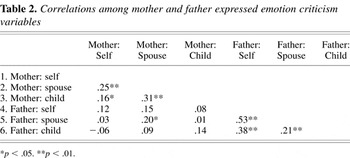
Correlations among mother and father expressed emotion criticism variables
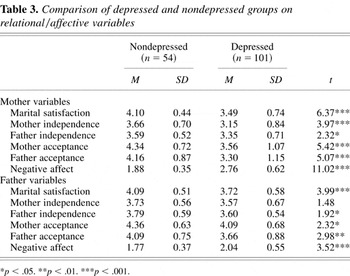
Comparison of depressed and nondepressed groups on relational/affective variables
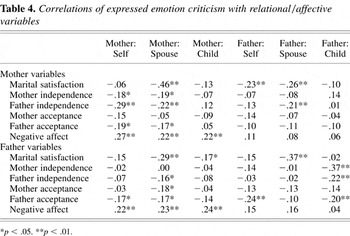
Correlations of expressed emotion criticism with relational/affective variables
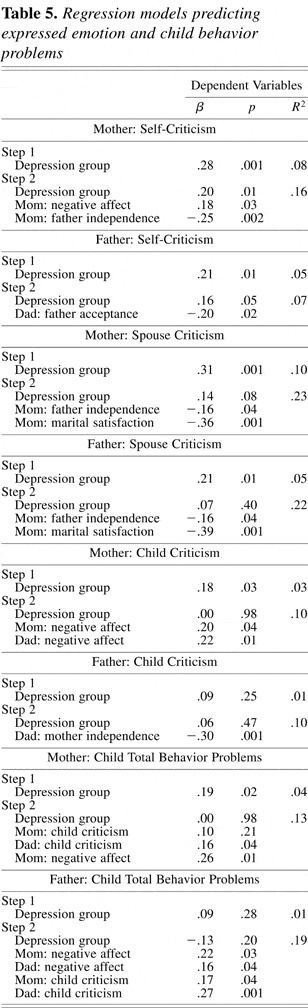
Regression models predicting expressed emotion and child behavior problems
 You have
Access
- 60
- Cited by