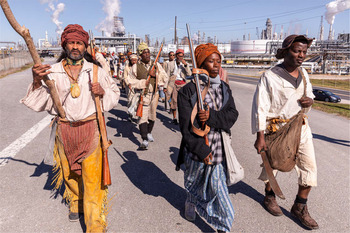
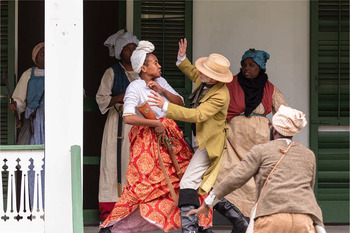
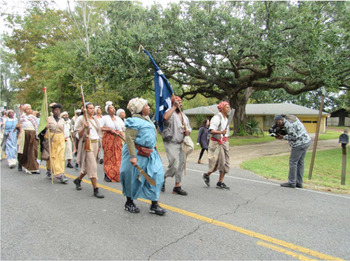
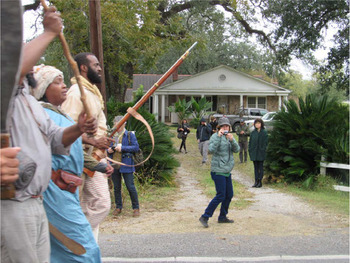
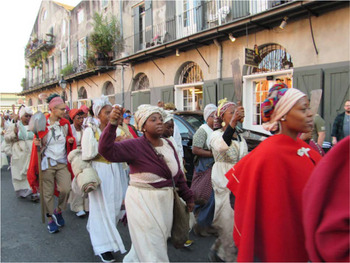
Slave Rebellion Reenactment, performance still-01. River Parishes outside of New Orleans, November 2019. (Photo by Soul Brother; courtesy of Dread Scott)

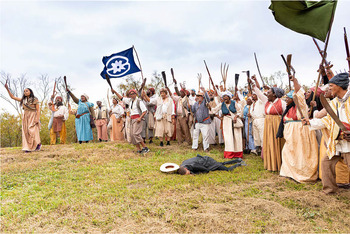
In early November 2019 in LaPlace, Louisiana, a gaggle of press stood on a country road at nine in the morning opposite a plantation house with a roof composed mostly of rusted sheets of corrugated tin. They waited for what promised to be a two-day roving performance piece to begin. Those who had advance knowledge of this event (mostly media through distributed press packets, but also neighbors who had received notice from the city, and others by word of mouth) watched people in period costume perform a scene of revolt representing the events of 8 January 1811 when enslaved persons, led by the overseer Charles Deslondes, attacked their master, raided his storehouse for weapons, and began a march toward New Orleans. The light-skinned Deslondes, meant to be the master’s instrument for the oppression of his fellow slaves, turned the tables on Manuel Andry and guided his slaves into rebellion. It was a moving scene when you could tune out the journalists jockeying for position, pleading with each other to lower booms and get out of each other’s shots.
As the staged performance began, a woman declared that her body would no longer be touched. “We are free now!” she asserted.Footnote 1 The white man playing the plantation owner ordered the group back to the fields, projecting from the porch as a man with some kind of a weapon crept closer to him. “Why are you doing this? Haven’t I been a master that treated you with love and understanding? Why, Charles, why?” he pleaded, before being cut down and collapsing, as the group, amidst shouts of encouragement, ran around to the back of the house.
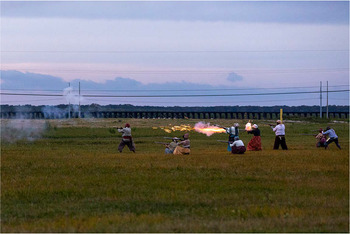
Thus began artist Dread Scott’s collaborative performance Slave Rebellion Reenactment, a restaging of what is sometimes considered the largest slave rebellion in US history.Footnote 2 This superlative takes into account not the body count of its white victims (two), but rather the number of enslaved persons involved, and the geographic distance covered by the rebel army that proceeded along the River Road, taking on numbers at each plantation along the way. By some accounts, the rebels, called “the brigands” or “the banditti” in the newspaper reports of the period, swelled to nearly 500 before being dispersed by a militia of landowners (Moniteur 1811c, 1811d, 1811e; Louisiana Gazette Reference Gazette1811; Amis des Lois 1811).Footnote 3 Scott’s performance was not merely a reenactment, but also a revision. In actuality, on the levee in 1811 the rebels faced armed planters; the militia would come later to roust any slaves that had escaped into the swamp. Here, the history books tell of a slaughter as the insurgents’ ammunition gave out. A few were captured to be put on trial as an example; but many others, including the leader Charles Deslondes, were executed on the spot (Rasmussen Reference Rasmussen2011:136–37).Footnote 4 In Scott’s performance, however, the rebels whooped victoriously as the militia retreated at the end of day one, imagining how things might have turned out otherwise. Rewriting the slave army as victoriously routing the militia, Scott’s group continued the march on the second day, shouting “On to New Orleans.” The performance ended in the afternoon with a procession through the streets of the French Quarter, which then funneled into the Tremé neighborhood’s Congo Square where a celebration of poetry readings, musical performances, and dancing concluded the two-day collaborative event.
Slave Rebellion Reenactment, performance still-06. River Parishes outside of New Orleans, November 2019. (Photo by Soul Brother; courtesy of Dread Scott)

What the Slave Rebellion Reenactment intended was an acknowledgment of the role of history in black performance. As Valerie Cassel Oliver writes in the preface to Radical Presence: Black Performance in Contemporary Art, “For black artists, the emphasis on ‘body as material’ does not come without its own historical tethers. The black body carries with it signifiers and markers that are deeply rooted in historical narratives” (Reference Oliver and Oliver2013:10). To display the black body as the material object of the artwork is inherently to recall the slave on the auction block, the abolitionist photograph of the whipped slave, the Hottentot Venus — if not the commodification of the black body, then at least, the black body offered up as subject of the gaze.Footnote 5 And yet, in the context of performance art, with its intentional rupture from the marketplace, this history could be purposefully détourned, in the parlance of the Situationists.Footnote 6 By making history the explicit subject of the performance, Slave Rebellion Reenactment laid bare an inescapable element of black corporeal art: the history of the black body as commodity. It also called into question the choices of which histories are celebrated and who chooses. At the same time, it also defied some other expectations of black performance. Footnote 7 Scott’s event was neither “without sanction,” for a gathering of such proportions necessitated permits, nor was it radically available. Footnote 8 In fact, these issues of authorization, access, and historical agency are the central features I’ll continue to highlight in my own firsthand witnessing of the performance.
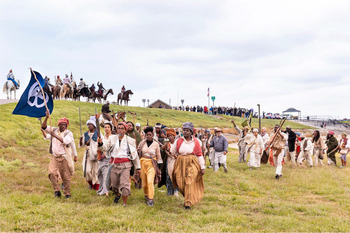
The Slave Rebellion Reenactment procession begins after the scene at viewing point 1, with the performers chanting “On to New Orleans.” Dread Scott is the performer to the far right. LaPlace, Louisiana, 8 November 2019. (Photo courtesy of Christina Connor)

But returning to that moment in LaPlace, Louisiana, on the November morning when the performance was launched: The media were told to hold their positions opposite the house. The packet provided to us (I had a press pass for Art Papers [Lauro Reference Lauro2020a]) explicitly stated: “Due to our permits, no access will be permitted onto the plantation itself or the private property around it.” But some members of the press jumped the fence and ran around to the back, following the reenactors. Perhaps the nature of the exhibition — defiance of the master’s orders — invited such a move, but because I am fascinated by what the director leaves offstage, and what the poet leaves off the page, or maybe because I’m a nonconfrontational rule follower and wimp, I stayed put. From what I know of the historical event, I presumed that what was occurring out of sight was a representation of the insurrectionists’ killing of “young Mr. Andry,” the plantation owner’s son, based on the shouts and cries of action I could hear. Footnote 9
As I stood on the roadside by the plantation house, watching some members of the media defy the order, their cameras clicking at something I could not see, I was keenly aware of the issue of access and the importance of withholding aspects of the narrative representation of historical slave resistance from the contemporary spectator. It’s a larger artistic device that I’ve shorthanded elsewhere with the phrase “the gap” (as opposed to, but mindful of, Fred Moten’s acknowledgment of phonology in resistance, In the Break [Reference Moten2003]), and I use it to signify any place in a text where obstruction, abstraction, or redaction stand in for the insurmountable distance between ourselves and the historical enslaved person. The gap can be a break in the text’s immersiveness that returns the “spect-actor” (in Augusto Boal’s sense of the term) to themselves (see Lauro Reference Lauro2020b). Or it can be a detail withheld from the viewer, suggesting the piece of information lost to posterity, the ruined record, the unrecorded detail. I read such moments subversively, as safeguarding what Saidiya Hartman calls the enslaved person’s “right to obscurity” (Reference Hartman1997:36). Daniel Rasmussen often muses about the gaps in our record in his book about the 1811 slave uprising: “What did these men talk about in their secret meetings, behind the closed doors of the slave cabins or under the tall trees on the edges of the fields? They wrote nothing down and told no one” (Reference Rasmussen2011:87–88); “No records survive to tell us what Charles said to his men in the final minutes before they attacked” (98); “We can never know the thoughts that went through the slaves’ heads as they took their stand” (138). This history eludes the records that we have, but our not knowing is not the tragedy.
Perhaps the roving camera (the event was shot by John Akomfrah) that served as the official document of the performance would have access to and capture all aspects of the performance; however, the limits placed on access in this first-generation audience highlight important aspects of the historical slave rebellion: one is this tension between whether to follow instructions or disobey, and another concerns the flow of information, of information lost or withheld, of misinformation, and of person-to-person news, spread by word of mouth. Ultimately, these facets of the performance emphasize the collaborative nature of the performance, the fluid agency of the collective.
Although I’m aware of criticism of Dread Scott’s event (see for example Anderson Reference Anderson2019) I’ll leave it to others to articulate the performance’s insufficiencies. Footnote 10 Instead, I’d like to make three main points about the way the event worked to dramatize issues of authorization, access, and agency: 1) spectatorship was stratified in a manner that parallels the diverse roles in the historic slave rebellion; 2) moments of blockage in the reenactment were instantiations of “the gap,” an artistic device found more broadly in commemorations of slave revolt to point to the elisions in the historical record and to safeguard the history of black resistance from appropriation and commodification; 3) the reenactment might be thought of as both rereading and rewriting the insurgents’ extralinguistic text. On all of these points, it might be fruitless to either credit or blame Scott, or any of the event’s organizers or collaborators; what these aspects of the event engender is a conversation about the ways that, like resistance, a performance of this scale has no single author.
Tavia Nyong’o writes, “When and where body art repeats the immiserating conditions or routinized scenarios confronted daily by black people, the effect of that repetition is to undermine the mechanics through which such domination is reproduced and dare us to imagine and to act otherwise” (Reference Nyong’o and Oliver2013:29). The substance of Scott’s latest piece is not everyday black life, but rather the hidden histories of ancestral resistance that went unrecorded, and in US society at least, are too rarely celebrated. Nonetheless, I keep coming back to this line from Nyong’o’s essay: “What black performance art does […] by taking the body as its medium, is to enact a new cartography of the subject” (28; emphasis added). By retracing the route of the self-liberated enslaved persons who took up arms against their masters, fled their plantations, proclaimed themselves free, and called for others to join their cause, Scott’s Slave Rebellion Reenactment literalizes this concept: it retraces the cartographic declaration of the enslaved persons’ agency written on the landscape.
Part I: Stratification of Spectatorship
In his book on the 1811 revolt, American Uprising, Rasmussen notes that, in the early hours after the initial rebellion, slave masters “heard about the revolt just as many newly minted insurgents had — through the grapevine telegraph of news and information that coursed through the slave quarters” (Reference Rasmussen2011:104). That is, plantation owners were warned by enslaved persons who made a calculation to betray the rebellion. Rasmussen also stresses the likely use of “slave spies” (129) and a Kongolese war strategy of doubling-back “to confuse the enemy” (130). In short, obtaining and controlling information was of paramount concern to the renegade slave army, and this aspect, too, became a feature of Scott’s collaborative performance piece. Scott himself acknowledges this as an aspect of the history he was hoping to reenact in an interview conducted when he was planning the event. He also notes a desire not to “exclude people” (Orr Reference Orr2018:919), though the actual event was more rigid (in terms of inviting onlookers to join) than he at first imagined.
Spectators watch and photograph the Slave Rebellion Reenactment procession. LaPlace, Louisiana, 8 November 2019. (Photo courtesy of Christina Connor)

The precise route the performers would take was a closely guarded secret. The media were given advance notice of five designated viewing areas; the general public was officially invited only to the last three (Maccash Reference Maccash2019); but those with inside information turned up even at the preliminary viewing points that were not publicly advertised. Scott’s performance thus stratified spectatorship and participation into several different levels in a manner that underlined how the event would reach people. Many read about it in local papers or heard of it through word of mouth, but in contrast the event itself dramatized access and control.
Although the media were given detailed instructions, the email that shared locations led with this caveat: “Please note that this information is highly confidential. We ask that you do not share outside of your team.” And the local paper Gambit stated, “Due to concerns about event safety, information about the route was not posted in advance. Information about recommended viewing sites will be posted on the project website this week” (Coviello Reference Coviello2019:20). Delivering upon this promise, just a couple of days before the performance, an article posted on the website nola.com listed three possible viewing spots available to the general public, which in the press packet were listed as viewing spots 3, 4, and 5. However, there were people present at the unadvertised viewing spots 1 and 2 who were not members of the media or staff. I talked to two people in this group and they had heard either from a friend who was in the reenactment or an acquaintance who had given permission for the performance to use their land. The journalists were privy to guarded information about the location of the first two viewing spots, but the presence of others clearly shows that word got around despite these safeguards, which parallels the actual rebellion’s need to disseminate the details of the revolt to those who might join, but not to those who would betray the cause.
In various moments throughout the performance I was keenly aware that I was not merely a spectator but something akin to a spect-actor, playing a role true to the historical rebellion — a member of the community trying to learn details of the revolt. Rather than seeing these moments as either ingenious parts of the plot or merely attributing them to organizational gaffes, I read them as developing an apt portrait of the way information was contained and flowed around the historical slave rebellion, spreading to some by word of mouth, withheld from others by secrecy and misinformation. This seemed somewhat ironic given that the media packet was fairly explicit about the separation between reenactors, spectators, and journalists. The lack of a published, detailed route and itinerary was intended to protect the performance from outsider intervention. In a climate of rising hate crimes, this was a necessary precaution. But it had the added benefit of creating a larger community effect — privileging the word-of-mouth spread of information, which paralleled the way information about the revolt would have been disseminated in 1811.
Here is an example of how this worked. In the afternoon of the first day, I ducked into the gift shop of the Destrehan plantation, which has an exhibit devoted to the 1811 revolt, to try to ascertain (unsuccessfully) why the plantation wasn’t officially participating in the event. The shopkeeper and a handful of customers were trading information about the performance. A local woman said that she had first heard about it from the sheriff’s office; the shopkeeper confirmed for some out-of-towners that the performance would pass by the plantation the following day but refuted, brusquely, that Destrehan was officially involved. My attempts to prompt her to expand on this point were rebuffed. Someone raised a rumor they had heard that the reenactors were to be spending the night on the Destrehan plantation. The shopkeeper disavowed this. She heard that they would spend the night at the Catholic church in Norco. This exchange had none of the tension or the stakes of the historic event, but I was aware of an eerie parallel. As I stood there in the gift shop, with its general store ambiance, on a plantation that was attacked by rebel slaves in 1811, I found myself reenacting a role in the drama, though it wasn’t one included in our media packet. I was a townsperson gossiping about the slave army’s progress up River Road.
Even more striking was that the spread of information during the rebellion was dramatized in the reenactment by including misinformation in the press packets, intentionally or not. That evening, I found myself wandering in the cold at dusk on the spillway wondering where I had gone wrong. There I found Danny, a man who heard some tourists talking about the reenactment over lunch and came out to find it. He had been raised in the county, he told me, but he had never heard of the revolt in school. Moved to learn about this history, which might have touched the lives of his own ancestors, he jumped in his truck and drove to the vicinity where he had heard the rebellion would be staging its final act of the day, the first “viewing point” officially open to the public. But Danny and I were clearly in the wrong place. We could see on the horizon action happening far away, so we clearly weren’t at the viewing point. Other figures dotted the landscape, some meters distant, and Danny and I walked to join them. There we found a handful of lost journalists. It turned out that some of the pins on maps shared with the media to designate viewing locations were incorrect. Danny and I joined the reporters being picked up by an organizer in a van with a walkie-talkie who drove us back to our parked cars and gave us instructions on how to find the rebels.
Whether we were at the right place at the wrong time I never discovered. Danny and I arrived in time to see the rebels chase off the militia as the sun set over the spillway. This was a dramatic reversal of the historical reality of the 1811 revolt, in which the nonuniformed militia of local landowners successfully scattered the armed rebels in the battle on the levee, effectively ending the revolt. Over the next few days, the landowners rounded up, arrested, or executed rebels who fled to the woods.
Slave Rebellion Reenactment, performance still-03. River Parishes outside of New Orleans, November 2019. (Photo by Soul Brother; courtesy of Dread Scott)

Revising history, the performance was to continue the next day, winding through the French Quarter, and ultimately ending with a celebration in Congo Square. Spectators were invited to participate in this final performative text that revised the 1811 slave rebellion. However, while the performance was to end with a party to which everyone was invited, the strict regimentation of information ensured a stratified spectatorship that paralleled the historical revolt: those invited to be in-the-know; those receiving information illicitly; those hearing by word of mouth and feeling moved to join, like Danny; those as yet unaffected, idly gossiping; and those perhaps purposefully given bad intel, thrown off the track.
On the one hand, the different levels of information and misinformation creates an apt historical parallel to the 1811 rebellion; but on the other, withholding access from some suggests that this history of black resistance should not belong to everyone. This control of access approximates the gap, productive blockage, interruptions, and things left out of the frame: a strategy of performative subversion that aptly translates how the slaves resisted. For example, at the Amistad memorial in downtown New Haven, Connecticut, one of the few examples of a public monument commemorating slave resistance in the United States (as opposed to countless examples in other nations in the Western hemisphere, including Brazil, Haiti, Cuba, Barbados, Jamaica, and many others), the triangular Amistad memorial actually has a fourth side, one visible only to those looking from the upper floors of the courthouse before which the sculpture stands (Macaluso Reference Macaluso2016:133). There are diverse effects that can be achieved by exploiting the gap formed by this withheld content. In the most extreme cases, it may signal that this history ought not belong to all equally (Lauro Reference Lauro2017); less aggressively, the gap may point to all that the historical records omit, to what lies beyond the records we have, which were preserved by the operators of the institution of slavery.
Part II: The Gap
Here are three visuals from the two-day performance art piece, images unworthy of publication, but which for me represent something pivotal about how the performance worked:
The first is an image of the throng of photographers at 9:00 a.m. on the side of a country road in LaPlace, Louisiana, the launch point of the procession. Having jumped the fence past which the media were told not to go, the photographers click feverishly at some action taking place on the other side of the farmhouse, beyond my view.
The second is an image of a spectator. To his left runs a line of cars, the traffic slowed to a crawl by viewing point 2, to his right a line of reenactors walking along the ridge of the hill. This spectator is an acquaintance of mine whom I have encountered unexpectedly, and he tells me that I have missed a murder.
The third is a picture taken on the spillway at dusk where I am walking with Danny; journalists dot the foreground. Like me, they have followed a pin in our media packets that turned out to be incorrect. We cannot see the performers with the naked eye, but by zooming all the way in on my digital camera, in the far distance I see they appear to be wearing uniforms, signifying the white militia that, in reality, scattered the rebel army in battle. There is no sign of the rebelling slaves led by Charles Deslondes.
The gap in commemorations of slave revolts is any aspect of the text or performance or game (as in my recent studies of slave revolt videogames [2017, 2020b]) that is withheld from some viewers. In a similar vein, Sampada Aranke writes of the uses of abstraction in the black radical artistic practice:
black radical aesthetic practices endeavor to recompose the relationship between the body and visibility, often by sidestepping representational mandates towards “accuracy.” […The] definition of black radical aesthetics builds upon the notion of blackness as an originary abstraction — a category created in the service of devastating material, corporeal, and psychological violences that trafficked through the Middle Passage and whose afterlives are still active today.
(2017)When we speak of “blackness” in this way, then, we are specifically talking about the constitution of race in the transatlantic slave trade, and in the diaspora. As a white scholar who grew up in Africa, I’ve often struggled with the way this definition of blackness may efface Africans’ blackness. I share a hesitation to reduce blackness to one aspect, especially when it is equated with loss or pain or negative determination, with the likes of Okwui Enwezor, who wrote in 1999 that such “ratification” of difference “denies African artists a claim to subjectivity and self-narration” (in Powell Reference Powell2002:233). But what I find useful in Aranke’s delineation here is her appeal to Caribbean philosopher Édouard Glissant’s (Reference Glissant1997) use of “opacity” as “a response to Western colonial impulses for a transparent world” (Aranke Reference Aranke2017). For Aranke, “opacity is a strategy that saturates the field of vision in the very matter of blackness as a means of obscuring desires to see and know entirely, to make transparent.” I am especially interested in the work of artists for whom “Opacity denies complete incorporation,” who may include in their toolbox the use of abstraction to “disturb visibility” and “impede sight.” Like Aranke, for whom opacity can obstruct our comprehension or at least create a moment of pause in which to consider the uptake of the African from the archive of slavery’s taxonomies of blackness to the contemporary surveillance record, I am interested in the ways that impediments to seeing can productively challenge historical epistemologies. Footnote 11
Although Aranke’s interest is in the way that “these practices turn to the potentiality of abstract or conceptual approaches in materializing black corporeality” (2017), I’m fascinated by the uses of abstraction, and principally, redaction: to not comment about black corporeality, but to underscore the fissures, gaps, and aporiae in our historical record.
Here is a concrete literalization of this effect: In the Moniteur of 10 January 1811, one day before the revolt, an advertisement for an “Esclave Marron” describes a missing person whose owner was seeking to recapture him. The slave is described as a young mulatto who had an iron clasped about his foot and a “carcan au col,” a shackle fixed about his neck, wearing a blue shirt and brown pants. But most fascinatingly, the place where his name is meant to be printed is followed by several blank spaces, as if the printer were waiting on this information but went to print without receiving it. In a subsequent issue (12 January) the same ad is run, but here his name fills the gap: Joseph Martin. For me the ad of 10 January, with its gap instead of the enslaved person’s name, points to a central feature of the way we need to understand slave resistance and its celebration in contemporary artistic works: the gap where his name should be signifies all that is beyond our epistemological grasp of this history. The blank space in that newspaper ad operates as an abstraction pointing to the apophatic nature of the horrors of slavery — that it cannot be contained in language — but also to the insufficiencies of historical records. In that moment, Joseph Martin not only escaped M.A. Bayon of Donaldsonville, his master; he had also escaped the archive.
Interlude
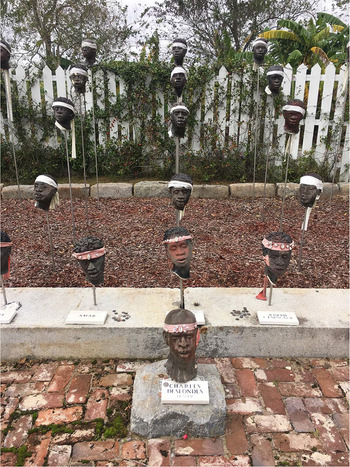
Confused by the instructions given to the press in its detailed rules of engagement regarding what aspects of the performance we were invited to witness, I mistakenly thought that the media was only given access to the performance at the designated viewing points. After the staged rebellion at the Andry plantation (viewing point 1), the reenactors began their march, chanting in English and French. It was a striking scene as the marchers passed, dressed in period costume and holding various weapons and farm implements that might be used for self-defense. Footnote 12 As the throng moved on, some members of the press followed, but others headed to their vehicles, and with the instructions we had been given in mind — “The durational artwork will involve hundreds of reenactors and has been carefully timed and planned, so we ask you not to disturb the performers or interrupt their path and allow the procession to pass” (Slave Rebellion Reenactment 2019) — I headed back to my own vehicle, thinking that the implication was we should plan to meet up with them several hours hence, further down their route, at viewing point number 2. With my traveling companion, another professor, I took a detour during this downtime to visit the Whitney Plantation. I had been there several years earlier, when it first opened as a museum, but subsequently I learned of the addition of a new installation, one specifically dedicated to the 1811 slave revolt, and we wanted to see it. Some controversy surrounds the 1811 monument on the Whitney Plantation, which memorializes the rebel slaves who were executed in the aftermath of the River Road rebellion. Specifically, I had heard at an academic conference that there was some suspicion surrounding the fact that the exhibit is not included on the official walking tour, but tucked away, out of sight, as if its celebration of resistance was too subversive. Woodrow Nash’s sculpture depicting 63 realistic severed heads mounted on steel rods was unveiled on the Whitney Plantation’s grounds in 2017 to acknowledge the violent aftermath of the 1811 revolt. The monument is described on the Slavery and Remembrance website:
Dozens of slaves were condemned to death, executed, and beheaded, at the plantations to which they belonged. The heads were planted on poles at places where each of them had undergone punishment. In New Orleans and St. John the Baptist parish, many death sentences were also pronounced.
(Colonial Williamsburg Foundation 2021)1811 Slave Revolt Memorial by Woodrow Nash, Whitney Plantation, Edgard, Louisiana, 8 November 2019. (Photo by Sarah Juliet Lauro)

We were given permission to visit the monument and take photographs. I noted that the severed heads looked different than the pictures I had seen online. Many of them had been decorated, and Yvonne Holden, director at the Whitney, told me that an annual blessing is performed by a local group, wherein they adorn the severed heads with talismans like cowrie shells. Though it is grisly, here is a place where one can pay homage to the leaders of the revolt, like Charles Deslondes, Kook, Quamana, and Zenon. I was convinced by my friend’s assessment that it was not problematic that it was hidden from view — located off the beaten path and behind some hedges — but rather that it was shielded, not as a way of hiding this history but out of respect for the victims of the brutal retaliation against the insurgent slaves, many of whom were tortured before being beheaded or otherwise murdered. One might interpret the monument’s seclusion as a serene and sober memorialization for the incredible bravery and sacrifice of the insurgents, sustained by its placement apart from the site of their enslavement.
When we caught up with the procession, a thick knot of traffic around viewing point number 2 prohibited our access. As my companion continued driving at the slow pace of stop-and-go traffic, I hopped out of the car to walk with the spectators and media whose march was paralleling that of the reenactors. It was cold, and the rebel army was marching atop a hillside while media members kept abreast, walking tenuously on the slope, trying not to fall into a water-logged ditch. In the marshy grass I met a man I knew from graduate school. A colleague of his was in the reenactment, and he hoped to teach it in his classes. He told me that he and a pair of his friends were following the reenactors as they marched. “Is that allowed?” I asked, perhaps, naively; no one seemed to know. They had the inside scoop from the reenactor, and had decided to shadow the march, regardless. Several people I had spoken with had also gotten the impression that the performance was only really open to the public once the performers reached the spillway that evening, for the staging of their battle with the militia. When my friend told me that at 11:30 a.m. there had been a “murder” along the route they were walking with the army, my first reaction was to feel deprived: that wasn’t in the media packet!
Slave Rebellion Reenactment, performance still-02. River Parishes outside of New Orleans, November 2019. (Photo by Soul Brother; courtesy of Dread Scott)

Were there scripted moments that would be shielded from anyone but the performers themselves? It made sense that the organizers sought to control the audience’s level of engagement, but that moments so pivotal to the history, including the only other assassination of a white planter carried out by the rebel army, would occur between viewing points surprised me. In point of fact, the rebels only killed two white persons: Gilbert Thomassin Andry (called “M. Thomassin” in one contemporary source, which might lead to confusion [in Rasmussen Reference Rasmussen2011:142]) and Francois Trépagnier, who refused to flee his plantation as the rebels closed in on it. In addition, the army also burned down the house of a doctor for whom they might have had a particular animus (126), and burned and pillaged various plantations. But no other whites were killed.
I’m still not clear on whether or not Dread Scott intended that the media walk the entire length of the procession along with the rebels, or whether he hoped to signal that they only attend the viewing spots designated in the media packet, but his intentions matter little. That I missed the murder of Francois Trépagnier reinforces the idea that the performance was not for the spectators, and nor was it for the documenting media. It was a performance that could only be completely experienced by those participating in the reenactment. Control, agency, access, and information are all key components of the history of slave resistance and its artistic commemorations, and I marked the way this performance pointed to the variant complexities of each.
These elements, whether intentional aspects of its design or not, point both to stratified levels of spectatorship/participation and to the withholding of elements: the gap. In this spirit, I understand the three images I cited at the outset of this section as moments of opacity: the assassination of “young Mr. Andry,” occurring in a location that was meant to be off-limits for press (inviting some, perhaps appropriately for a narrative about revolt, to defy given orders); the point when I was informed that scenes pivotal to the history of the revolt were being staged in between the designated viewing points, scenes excluded from the oblique instructions given regarding what parts of the procession could be viewed and who was invited to follow along; and when, misguided by a faulty pin shared with media, I turned up in the wrong place for the spillway battle. We might think that the 1811 monument at the Whitney Plantation, shielded behind a row of trees, and not included as a central part of the official walking tour, too, was working on this level of limited accessibility. These instances of opacity suggest that we must reconceive of the way we treat the history of slave resistance. It is not a history that is fully legible in the record, and therefore it demands a reconceptualization that will not merely seek out the traces of this history, but the spaces — the gaps — that interrupt the archive, indicating that which we may never come to know.
Part 3: Alternative “Readings” of Slave Resistance
The problem with the historical record is the omission of the enslaved subject’s narrative and voice. Jennifer Morgan states that “the significance of slave trading bookkeepers — who generated a logical system by which African laborers would be routinely brutalized in service of national accumulations of wealth while simultaneously omitted from the categories of subject and citizen — cannot be overstated” (2016:189). Footnote 13 As Saidiya Hartman notes, the archive is full of ghosts, gaps, and silences; interpreting the absences in the record is as vital a skill as reading what is there. Footnote 14 The question of representation and the archive, “its limits, its possibilities, its futures,” propels the special issue of the journal History of the Present edited by Brian Connolly and Marisa Fuentes. Footnote 15 The authors included in the issue consider broadening what might be considered “the/an archive,” doing poetic work to narrate the gaps that exist in the record, as well as looking to creative works that address this history, resisting a sense of loss associated with the historical record’s incompleteness and instead turning to creative strategies for making meaning of the archive — gaps and all. For example, we can search for those rare places in the archive where the subaltern speaks, as does Katherine McKittrick when she insists upon a single line from a ship’s ledger, “Betty Rapelje, 21, stout wench…Says she was born free” (Reference McKittrick2014:17); or we can “[remake] the scraps and fragments of the archive — to produce a different order of statements,” conjuring an “unthinkable narrative from the confines of the hold” (Hartman Reference Hartman2016:209, 210). Stephanie Smallwood writes that “the silences we encounter in the slavery archive reflect the necessary failure of the attempt to represent subalterns in that idiom […] Our task, then, is to tell the stories that bring the ghostly outline of that tracing fully into view” (Reference Smallwood2016:126, 128).
As with the history of slavery, our knowledge of slave resistance is likewise limited by our reliance upon documents written by the oppressor, such as ads for fugitive slaves penned by those who would recuperate their “property,” the contemporary accounts of slave revolts from a biased perspective, and even those occasionally found in plantation records. Even when we have a document like “Nat Turner’s Confessions,” purportedly his testimony given as he awaited trial, the record is unreliable. Footnote 16 Aside from a handful of texts authored by past and escaped slaves, like Olaudah Equiano, Harriet Jacobs, Frederick Douglass, Solomon Northup, and others, our knowledge of slave resistance can be signified by the blank spaces in the record, like that belonging to Joseph Martin, in the fugitive slave ad referenced previously. What remains to be seen is whether the statistical sepulcher (the cold numbers we have from captains’ logs, sales receipts, plantation ledgers, and other documents preserved by masters) can be reanimated to new purposes — not merely to mourn for the victims of slavery, but to celebrate their resistance as well. From another perspective, Michel-Rolph Trouillot writes,
Silences enter the process of historical production at four crucial moments: the moment of fact creation (the making of sources); the moment of fact assembly (the making of archives); the moment of fact retrieval (the making of narratives); and the moment of retrospective significance (the making of history in the final instance).
(Reference Trouillot1995:26)Whereas the historian’s objective is to “understand why not all silences are equal and why they cannot be addressed — or redressed — in the same manner,” acknowledging that “the operation required to deconstruct these silences will vary accordingly” (Trouillot Reference Trouillot1995:27), my goal is different: it is to highlight the important work that silences do in works of art and culture as a means of gesturing to lost histories and archival gaps, which stand as acts of mourning or illustrate the paradox of commemorating acts of resistance that shouldn’t have had to happen in the first place. My preference, as a cultural historian, is to observe the gap in a manner that would highlight, rather than seek to fill, silences: beholding the gap, rather than bridging it.
A very different model for how to approach slave resistance is presented by Vincent Brown in his animated map of a slave revolt in Jamaica, which allows us to read the rebels’ movements across geographic space (see Brown Reference Brown2012, Reference Brown2015). Animating the insurgents’ movements allows us to read their writing upon the landscape with the movement of their bodies, and in the case of Brown’s digital animation, it reveals “clear evidence of strategic coordination across an uneven landscape” (2016:179). In a sense, Brown’s animated map restores to the rebels their voice, as we read their movements across geography, but it also emphasizes the gaps and fissures in our knowledge, as he gestures, with a blurred line, to that which we do not know for certain. And so, we return to the idea, borrowed from Nyong’o, that Dread Scott’s performance entailed a cartography of the subject of the rebel enslaved. Footnote 17
What Dread Scott’s performance retraced is the rebel slaves’ narrative: it was a history written not by ink on paper but by the enslaved persons with their bodies, as they moved across the Louisiana landscape, seeking their freedom. Scott’s performance emphasizes that he is not speaking for the original rebels, but that we have a text from them, though it is legible in a different manner than we would read a manuscript: it is almost as if the performance retraced the groove in a phonograph as the reenactors followed their path, giving voice to those long dead. Naturally, it’s not a perfect reproduction: the timeline is condensed, the maps do not match up precisely. Whereas Rasmussen’s history tells us that the slaves doubled-back upon their path from Fortier’s plantation all the way to Bernoudy’s cane fields before their battle with planters, Scott reimagines the second day not in retreat but as an advance towards New Orleans. Nonetheless, it is a narrative retelling of a different kind of text.
As such, Slave Rebellion Reenactment points to the insufficiencies in the historical archive that we have about the 1811 revolt, consisting of records, like the contemporary newspaper accounts, that painted the rebel army as thieves…for stealing themselves from the landowners. Scott’s performance also used geographic space as a means of narrativizing this history. In addition to its operation as a cartographic phonograph, at least in its initial phase as it dramatized the route of the rebels from the start of the revolt to the levee, a narrative of speculative history ensued in Scott’s performance. It also willfully obstructed the smooth workings of everyday capitalism, as when the procession created knots of traffic, and expanded its reach, especially in the final act when the reenactors wound through the streets of the French Quarter, inviting spectators to join, thereby incarnating the spirit of rebellion and dramatizing the reach of slavery.
Cartography: Zooming Out
At the performance launch in LaPlace, Louisiana, I spoke to some neighbors as they came out of their houses to watch the procession. A woman said that she thought it “wonderful for this generation to know about this history,” while her neighbor said flatly that he thought it was “a good way to screw up a Friday morning.” One hopes he meant the traffic. Dread Scott’s performance obstructed traffic at various points on its 26-mile, two-day journey from the outlying areas of New Orleans to the French Quarter. I acknowledge that some might have viewed this as an inattention to working people’s precarity (as in, their need to get to work on time). Cars were halted in LaPlace where it began, and the march created a bottleneck around viewing point 2, identified as “Near Harry’s One Stop 18356 River Rd, LaPlace, LA” in my media guide. Streets were blocked off by a police escort as we marched through the French Quarter, although, of course, New Orleans is a place used to such interruptions. One of the fascinating things about this type of performance is the way it foists a role upon unwilling nonparticipants, who may find themselves sitting in bumper-to-bumper traffic, for example, at 11:00 a.m. on a Friday. In doing so, it evoked the Situationist International’s goal of interrupting the smooth flow of the everyday. This is a laudable goal, especially insofar as it traces a through-line from slavery to present-day capitalism.
This aspect of the performance also dramatizes the ways that the historical revolt obstructed business as usual, if only temporarily: The newspaper of 12 January 1811 issued a call-up of the militia, imposed a curfew for all “Negro males,” and closed the cabarets. The paper of that date states “The brigands were on last evening at the plantation of Col. Fortier; — their numbers are variously stated from 150 to 500” (Moniteur 1811b). The Moniteur de la Louisiane of 15 January published a letter written by Mr. Andry, the owner of the first plantation to be attacked, with his account of the events (Andry Reference Andry1811). A 19 January notice in the Gazette refers to a rescheduling of a delayed sale of a plantation, “by reason of the late disturbances in this Territory” (Louisiana Gazette Reference Gazette1811). How slavery changed in New Orleans as a result of this “shocking insurrection” (Louisiana Gazette Reference Gazette1811) is beyond the purview of this article, but in the days subsequent to the revolt, the newspapers conveyed new laws prohibiting gatherings of enslaved persons, and other measures to prevent future acts of revolt (Louisiana Gazette Reference Gazette1811; Moniteur 1811d; Moniteur 1811e). The issue of the Moniteur of the same date presents nine new articles “concernant les esclaves de la ville et des faubourgs de la Nlle-Orleans,” which included prohibitions against sleeping away from one’s plantation, the gathering of large groups of slaves (even with the master’s permission), and prohibiting the carrying of batons in public, excepting slaves who are blind (Moniteur 1811e). One senses the panic of the white slaveholding class in these articles. Callously, they are flanked by announcements of the sale of humans and ads describing persons whom their owners seek to recapture.
And yet, for some slaveholders the calculus was surely on profits above even punishment. The Moniteur of 17 January prints a list of names of slaves who may have been involved to various degrees, but whom the owner would seek to recuperate (a notice submitted by L. Moreau Lislet), and this is printed in successive issues (Lislet Reference Lislet1811). I want to note here, because these contemporary documents are so difficult to access, further proof of the difficulty the rebels had in communicating their intentions only to those whom they could trust not to betray their cause: a printed account by M. Charles Perret recommends seven men of color for commendation who aided the rebellion’s quashing (Perret Reference Perret1811). That Scott orchestrated a commentary upon agency, control, and access in his performance was in keeping with the rebels’ historical struggle to safeguard their plan from those who would betray their cause.
Slave Rebellion Reenactment, performance still-04. River Parishes outside of New Orleans, November 2019. (Photo by Soul Brother; courtesy of Dread Scott)

Another aspect of the performance that paralleled the historic rebellion was the reach created by the event, suggested first by the radial waves of information, as news of the performance spread. I think now of a line from a poem that Sunni Patterson recited in the finale of the Slave Rebellion Reenactment in Congo Square, “You can hear them breathing from miles away…” On the most obvious level, the performance suggested the spirit of revolution, concretized in the penultimate act, in which the reenactors marched through the French Quarter, joined by tourists, community members, and other onlookers, many of whom enlisted spontaneously. But I also think that embedded in the performance was another aspect of the reach of historical slavery: complicity.
Slave Rebellion Reenactment performers march through the French Quarter to Congo Square, New Orleans, 9 November 2019. (Photo courtesy of Christina Connor)

If a person bought calico cotton, loaf sugar, indigo, rum, or tobacco in January 1811, they were a part of the institution of slavery, whether they wanted to be or not. And if one were in the right part of the French Quarter on Saturday 9 November 2019, they were part of Scott’s performance, whether they only sensed the vibration of drums in the distance, or gazed bemusedly on an odd parade before turning back to the game on the bar’s TV, or, catching the spirit of rebellion, joined and marched along. Scott crafted a wide-scale performance that dramatized not only the difficulty of apprehending history from the record written by the oppressor, but also the issue of agency and choice, which he accomplished through the strict regimentation of access, spectatorship, and performance.
The triumphant performance in Congo Square, Scott’s revision of history to depict an alternative reality, directly linked the contemporary Black Lives Matter movement to the struggles for self-emancipation of the rebel enslaved. Those interested in this aspect of the performance, what Scott calls “interrupt[ing] the historic timeline” (in Orr Reference Orr2018:918), especially the line between historical reenactment and “imagined history” (917), will perhaps be especially interested in Scott’s description of the event as in dialogue with Afro-futurism as an “Afro-past-ist piece” that acknowledges that “some of the history is actually not knowable” (917). Others might attend to what Moten refers to as a “phonology,” in interpreting Scott’s performance, by which Moten means becoming “attuned to certain liberating operations sound performs at the intersection of racial performance and critical philosophy. […] Sound gives us back the visuality that occularcentrism had repressed” (Reference Moten2003:235), and the performance’s use of sound — of the drums, footsteps, chanting of the performers, especially heard at a distance in the final act — deserves more attention for its redefinition of the spectacle’s reach.
I leave it to others to address these aspects. My contribution here has been to state the ways that Scott’s performance (1) mobilized diverse strategies for the stratification of spectatorship; (2) pointed to the gap as a subversive strategy that withholds certain aspects from the viewer; and (3) emphasized the cartography of the slave revolt as a text that could be read and rewritten. By means of its careful control of access, its stratification of the audience, and its use of elision as an artistic strategy, Scott’s performance highlighted the inequity of the historical archive, with its concern only for some humans, and its unequal representation of facts in the demonization of those willing to die for their freedom. Dread Scott has not merely rewritten history, he has written a more complex history, in the broadest sense of the term, of the 1811 slave rebellion and its participants, as a narrative that cannot be contained between the margins of the page.
To view supplemental materials related to this article, please visit https://doi.org/10.1017/S1054204321000307.