Introduction
In Switzerland, 58% of nursing home (NH) residents are diagnosed with or show symptoms of dementia (Zúñiga et al., Reference Zúñiga, Ausserhofer, Serdaly, Bassal, De Geest and Schwendimann2013). The reasons for NH placement of persons with dementia are mainly the severity of the disease, behavioral disturbances, and the inability of family caregivers to cope with their complex needs (Knopman et al., Reference Knopman, Berg, Thomas, Grundman, Thal and Sano1999). Therefore, NH residents with dementia (RWD) have usually reached moderate to severe stages, and often show behavioral and psychological symptoms of dementia (BPSD). These symptoms include agitation, aggression, calling out, sleep disturbances, wandering, apathy, anxiety, depression, delusions, and hallucinations (Ferri et al., Reference Ferri, Sousa, Albanese, Ribeiro and Honyakshiki2009). Agitation and aggressive behavior are among the most common symptoms (Ferri et al., Reference Ferri, Sousa, Albanese, Ribeiro and Honyakshiki2009). These symptoms are especially challenging for care workers, as the residents who display them are often aggressive or hostile, have little control over their behavior, and are resistive and unpredictable (Brodaty et al., Reference Brodaty, Draper and Low2003). Being exposed to this behavior may contribute to work-related stress.
Work-related stress can be defined as “. . . the response people may have when presented with work demands and pressures that are not matched to their knowledge and abilities and which challenge their ability to cope.” (Leka et al., Reference Leka, Griffiths and Cox2004). The experience of work stress contributes to poor physical and mental health and may lead, for example, to sleep disturbances, feelings of tiredness or depression, and difficulty thinking logically or making decisions. Stress is further thought to affect the organization through increases in absenteeism, staff turnover, unsafe working practices, and accident rates (Leka et al., Reference Leka, Griffiths and Cox2004).
Alongside the occurrence of BPSD, several other factors are related to care worker stress in dementia care. These can be classified into three categories: work environment factors, resident characteristics, and care worker characteristics. Some stress factors vary across NH unit types (Morgan et al., Reference Morgan, Stewart, D'Arcy, Forbes and Lawson2005; Pekkarinen et al., Reference Pekkarinen, Sinervo, Elovainio, Noro, Finne-Soveri and Leskinen2006). In the literature, two classifications of unit have accounted for the majority of research to date: (1) non-specialized units, where residents with and without dementia live together; and (2) special care units (SCUs), which are designed to meet the specific care needs of RWD, particularly those who show severe behavioral symptoms. SCUs usually provide dementia-specific activities, specially trained staff, doors with alarms or locked exit doors, and enclosed courtyards (Park-Lee et al., Reference Park-Lee, Sengupta and Harris-Kojetin2013). In Switzerland, most NH care for RWD is provided on non-specialized units (Curaviva.ch, Reference Curaviva.ch2013). However, there is a lack of evidence concerning differences in care workers’ stress in these units in relation to the amount of dementia care they provide.
Independent of unit characteristics, the most frequently reported stress factors related to the work environment are lack of time and the need to deal with high or incompatible job demands (Morgan et al., Reference Morgan, Semchuk, Stewart and D'Arcy2002; Brodaty et al., Reference Brodaty, Draper and Low2003; Edvardsson et al., Reference Edvardsson, Sandman, Nay and Karlsson2009; Jeon et al., Reference Jeon2012; Saarnio et al., Reference Saarnio, Sarvimaki, Laukkala and Isola2012). Negative perceptions of leadership and support, control at work, mastery of work, social interaction, and organizational culture are associated with increased care worker stress (Testad et al., Reference Testad, Mikkelsen, Ballard and Aarsland2010; Jeon et al., Reference Jeon2012). In a comparison between small group living facilities for RWD and traditional NHs, care workers in the former reported significantly lower job demands, higher job control, and higher social support from co-workers than their counterparts in traditional NHs. These care workers additionally showed higher job satisfaction and less burnout (te Boekhorst et al., Reference te Boekhorst, Willemse, Depla, Eefsting and Pot2008). In view of the physical work environment, work was associated with significantly more stress on larger units than on small ones (Saarnio et al., Reference Saarnio, Sarvimaki, Laukkala and Isola2012).
Resident characteristics associated with care worker stress include BPSD, an increased dependency in activities of daily living (ADL), and a decrease in cognition (Pekkarinen et al., Reference Pekkarinen, Sinervo, Elovainio, Noro, Finne-Soveri and Leskinen2006; Miyamoto et al., Reference Miyamoto, Tachimori and Ito2010). How these factors’ effects vary across unit types is unclear. Two studies have associated all with care worker strain on SCUs (Miyamoto et al., Reference Miyamoto, Tachimori and Ito2010; Zwijsen et al., Reference Zwijsen2013); others have yielded no associations between BPSD and increased care worker stress (Morgan et al., Reference Morgan, Stewart, D'Arcy, Forbes and Lawson2005; Pekkarinen et al., Reference Pekkarinen, Sinervo, Elovainio, Noro, Finne-Soveri and Leskinen2006; Testad et al., Reference Testad, Mikkelsen, Ballard and Aarsland2010). However, problematic behavior is more often related to increased time pressure and distress in care workers on non-specialized units compared to SCUs (Morgan et al., Reference Morgan, Stewart, D'Arcy, Forbes and Lawson2005; Pekkarinen et al., Reference Pekkarinen, Sinervo, Elovainio, Noro, Finne-Soveri and Leskinen2006). Regarding care worker characteristics associated with stress, evidence is inconclusive regarding educational level, work experience, age, hours worked per week, or having had dementia care training (Morgan et al., Reference Morgan, Semchuk, Stewart and D'Arcy2002; Brodaty et al., Reference Brodaty, Draper and Low2003; Edvardsson et al., Reference Edvardsson, Sandman, Nay and Karlsson2009; Saarnio et al., Reference Saarnio, Sarvimaki, Laukkala and Isola2012).
In short, dementia care worker stress appears to be influenced by various factors, several of which differ between unit types; however, results are inconsistent. Regarding unit composition, some evidence indicates that SCU care workers perceive less work-related stress than workers on non-specialized units, although these differences might be explained by the lack of a consistent definition of an SCU. To date, only one study has compared both work environment factors and exposure to disruptive behavioral problems on different unit types in relation to care worker stress (Morgan et al., Reference Morgan, Stewart, D'Arcy, Forbes and Lawson2005). In spite of the fact that most RWD live on non-specialized units, evidence is surprisingly scant concerning differences in care worker stress between these units. However, with a 44% increase expected in Western Europe's dementia prevalence between 2010 and 2030 (World Health Organization and Alzheimer's Disease International, 2012), it is crucial both to maximize our insights into care forms appropriate for this NH population and to keep geriatric care workers healthy and on the job.
Therefore, the aims of this study were (1) to explore associations between different NH unit types (SCUs and non-specialized units with either high or low proportions of RWD) and care worker stress, and (2) to explore associations between additional potential stressors (work environment factors and aggressive behavior) and care worker stress in Swiss NHs.
Methods
Design, setting, and sample
This study was a secondary data analysis of the Swiss Nursing Homes Human Resources Project (SHURP), a multicenter study with a cross-sectional design. The SHURP study was conducted to develop a comprehensive understanding of the relationships between Swiss NH care worker outcomes and various NH characteristics including work environment and resident outcomes. At the time of data collection, Switzerland had 1,556 registered public, private subsidized, and private NHs (Bundesamt für Statistik, 2015). On average, these had 61 beds, while 57.2% of their nursing staff had professional qualifications (Bundesamt für Gesundheit, 2015). The SHURP study used a representative sample of 163 NHs with 5,323 care workers across Switzerland's three major language regions. Detailed information on the researchers’ methods has been published elsewhere (Schwendimann et al., Reference Schwendimann, Zúñiga, Ausserhofer, Schubert, Engberg and de Geest2013). For the present study, data from all care workers directly involved in resident care, but who were neither unit supervisors nor managers, were included. All care workers not assigned to specific units (e.g. night shift teams and activation teams) were excluded.
Data collection and ethical consideration
Data were collected between May 2012 and April 2013. The SHURP study was approved by all relevant regional ethics committees. Participating care workers received information about the study's purpose, the protection of data, and their right not to participate. Informed consent was assumed with the return of the questionnaire. The care worker questionnaires were distributed internally by local coordinators and were returned directly to the research team with addressed and pre-stamped envelopes.
Data collection included questionnaires on facility- and unit-characteristics, as well as personnel questionnaires for the participating care workers. Additionally, residents’ data were gathered either from NH assessment instruments used in Switzerland (“Resident Assessment Instrument for Nursing Homes” (RAI-NH), the “BewohnerInnen Einstufungs- und Abrechnungssystem” (BESA), the “Planification Informatisée des Soins Infirmiers Requis” (PLAISIR)) or from the NH's administrative records.
Variables and measurement
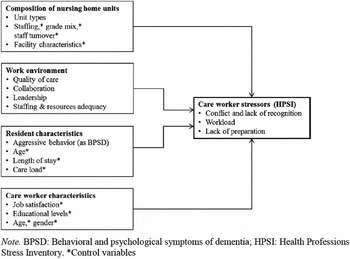
This study employed data from all of the SHURP study's sources. Figure 1 provides a summary of the variables, including the control variables.
Care worker stressors in dementia care included in the GEE models.

Care worker stress
Care worker stress was assessed via a shortened version of the Health Professions Stress Inventory (HPSI) included in the personnel questionnaire (Wolfgang, Reference Wolfgang1988). In order to reduce the overall questionnaire burden, the original scale's four subscales were reduced from 30 items to 12. In a survey, 12 experts prioritized three items per subscale. However, an exploratory factor analysis of the associated data resulted in the number of subscales being reduced to three, with the headings “conflict and lack of recognition” (six items, Cronbach's α: 0.760), “workload” (three items, Cronbach's α: 0.738), and “lack of preparation” (three items, Cronbach's α: 0.637).
The items included “How often do you feel stressed because you are not able to use all of your skills on the job?” (conflict and lack of recognition); “How often do you feel stressed when dealing with ‘difficult’ residents (for example behavioral problems)?”or “How often do you feel stressed because you have so much work to do that everything cannot be done well?” (workload); and “How often do you feel stressed because you are not prepared to meet the needs of residents based on your training or experience?” (lack of preparation). Responses were registered on a five-point Likert-type scale ranging from never (= 0) to very often (= 4), with higher scores indicating more frequent stress. The mean value per subscale was used as the total score.
Composition of nursing home units
Three unit types in view of dementia were created: (1) special care units, (2) units with a high proportion of RWD (≥ 60%) and units with a low proportion of RWD (<60%). For the purposes of this study, we defined SCUs as closed units housing 100% RWD and employing specialized care workers. The non-specialized units were split at the median in the original SHURP sample. RWD were defined as residents either diagnosed with or showing symptoms of dementia. Additional assessed unit characteristics were the unit size, staffing (full-time equivalent posts (FTEs)/100 beds), grade mix (proportion of registered nurses FTEs of overall FTEs per unit), and staff turnover (proportion of personnel who had quit in the last six months to the personnel present at data collection). As facility characteristics the size (small (20–50 beds), medium (50–99 beds), large (≥100 beds)), profit status (public, private subsidized, private), and language region (German, French, Italian) were included.
Work environment
As well as staffing and resources adequacy, leadership was assessed via the two corresponding subscales of the Practice Environment Scale-Nursing Work Index (PES-NWI) (Lake, Reference Lake2007). All five items of the original PES-NWI leadership subscale (e.g. “Supervisors use mistakes as learning opportunities, not criticism”) were included, along with three of the four items of the staffing and resources adequacy subscale (e.g. “Enough staff to get the work done”). All items were adapted to NH use regarding wording (e.g. “nursing home” instead of “hospital”). Total scores were the means of all items per subscale, with higher scores indicating better leadership (Cronbach's α: 0.84) or staffing and resources adequacy (Cronbach's α: 0.74). Care workers’ satisfaction with the general quality of care of the residents on their unit was assessed with scores from very low (= 1) to very high (= 4). The quality of collaboration with team colleagues on the unit was surveyed via one item from the Safety Attitudes Questionnaire (SAQ) (Sexton et al., Reference Sexton2006), again with answer options ranging from very low (= 1) to very high (= 4) on a four-point Likert scale, with higher scores indicating better collaboration.
Resident and care worker characteristics
As an important indicator for behavioral and psychological symptoms of residents, aggressive behavior was surveyed across three dimensions – verbal, physical, and sexual – and differentiated between aggression against care workers and against co-residents. Care workers were asked how often they had experienced each dimension of aggressive behavior themselves and had observed it between residents in the preceding four weeks (six-point Likert-type scale from never to several times a day). Each type of aggressive behavior was introduced with examples (verbal aggression: e.g. cursing, name calling, hostile or obscene language, verbal threats; physical aggression: e.g. making threatening gesture, pushing, hitting, kicking, throwing an object, scratching, spitting, pulling hairs; sexual aggression: e.g. making obscene gesture, hugging against one's will, touching intimate body parts). Due to right-skewing of data, this study's scales of verbal aggression against care workers or co-residents were collapsed into three categories: never, once a week or less, and several times a week to several times a day; similarly, the scales measuring physical and sexual aggression against care workers or co-residents were each collapsed into either no occurrence or any occurrence of aggression. Additionally included resident characteristics were the mean age, mean length of stay, and mean care load (resulting from the NH assessment instruments, measured in levels from 1 to 12, with one level being equal to 20 minutes of care time), all of which were aggregated to unit level.
In addition to their socio-demographic characteristics (gender, age, work experience, and working percentage), care workers were asked for their overall job satisfaction on a four-point Likert-type scale ranging from very dissatisfied (= 1) to very satisfied (= 4). To indicate their educational level, care workers could choose between registered nurse (three to four years of education), licensed practical nurse (three years of education), certified assistant nurse (one to two years of education), nurse aide (training on the job), or other (e.g. therapists).
Statistical analysis
Descriptive statistics were calculated for NH, unit, resident, and care worker characteristics on their corresponding levels. These included frequencies, percentages, means, and standard deviations (SD), and were based on measurement levels and distributions as appropriate.
Addressing this study's two main aims, i.e. to explore associations linking care worker stress (1) with the three studied unit types and (2) with additional potential stressors (work environment and aggressive behavior), required the use of generalized estimating equation models (GEE). To account for the nesting of care worker data within units and facilities (ICC1: HPSI conflict and lack of recognition on unit level: 0.08/facility level: 0.06; HPSI workload on unit level: 0.14/facility level: 0.08; HPSI lack of preparation on unit level: 0.02/facility level: 0.02), hierarchical modeling was applied. For aim 1, unit type was used as the independent variable. For aim 2, work environment factors and aggressive behavior were added to the models. The outcome variables were in both cases the three subscales of HPSI.
In a first step, bivariate regression analyses were conducted for all variables. Independent variables with associations of p < 0.2 with at least one of the outcome variables were included in the models. Unit size was therefore excluded as a control variable. For each subscale of the HPSI, two models were constructed. For the first, only the unit types were included as independent variables; for the second, work environment factors and aggressive behavior were added. All models were calculated unadjusted, then adjusted for control variables (language region, profit status, NH size, staffing, grade mix, staff turnover, resident age, resident length of stay, resident care load, care worker age, gender, educational levels, and job satisfaction). As there were no relevant differences between the unadjusted and the adjusted models, only the adjusted models are reported.
Multicollinearity was assessed using the variance inflation factor (VIF) with the cut-off point set at 5 (Field, Reference Field2013), and indicated no collinear variables. Cases with missing values were deleted. The data of both outcome variables – work-related stress due to lack of preparation as well as that resulting from conflict and lack of recognition – were right-skewed. To determine sensitivity, both were log-transformed, after which the models were compared to models with non-transformed variables with no significant differences in the predictors. Therefore, only non-transformed results are presented here. All analyses were performed using SPSS version 22.0, using a significance level (alpha) of 0.05.
Results
Description of the sample
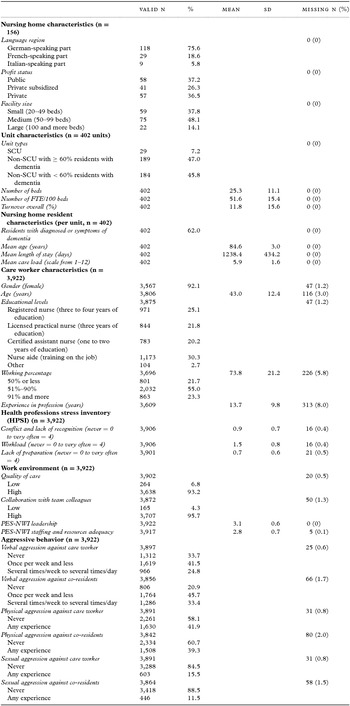
Data from 156 NHs, including 402 units and 3,922 participating care workers, were eligible for analysis. Of the NHs, 118 were from the German part of Switzerland, 29 from the French part, and 9 from the Italian part.
Table 1 shows that 92.1% of the participants were female; mean age was 43.0 years (SD 12.4). Most of the care workers were employed part-time (mean 73.8%), and nearly half (46.9%) of all participants had three or four years’ nursing education, including registered nurses and licensed practical nurses (25.1% and 21.8%, respectively). The unit sizes ranged between 6 and 86 beds, with a mean of 25.3 (SD 11.1) beds per unit. Across all units, nearly two-thirds (62.0%) of residents were either diagnosed with dementia or showed symptoms. Of the 402 included units, 29 (7.2%) were categorized as SCUs. Of the remainder, 189 (47.0%) had 60% or more RWD and 184 (45.8%) had fewer than 60% RDW. The HPSI subscales yielded mean stress scores of 0.9 (SD 0.7) for conflict and lack of recognition, 1.5 (SD 0.8) for workload, and 0.7 (SD 0.6) for lack of preparation, with possible responses ranging from 0 (never) to 4 (very often). The vast majority rated the quality of care and the quality of collaboration with team colleagues as rather high or very high (93.2% and 95.7%, respectively). Measured on a four-point scale (1 = strongly disagree; 4 = strongly agree), the mean PES-NWI leadership score was 3.1; on an identical scale, the mean PES-NWI staffing and resources adequacy score was 2.8. Among the different dimensions of aggressive behavior, verbal aggression was both most often experienced (66.3%) and most often observed against co-residents (79.1%).
Characteristics of the study sample

Note. SD: Standard deviation; SCU: Special dementia care unit; Non-SCU: non-specialized unit; FTE: full-time equivalent posts; PES-NWI: Practice Environment Scale-Nursing Work Index.
Associations between unit type and care worker stress
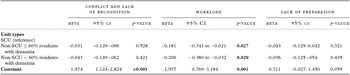
In a first step, only the unit types were included in the models. At this stage, the various types’ scores did not differ significantly on either the HPSI conflict and lack of recognition or the HPSI lack of preparation subscales. Initially, on the HPSI workload scale, non-specialized units – both with high and with low proportions of RWD – had significantly lower mean scores for stress due to workload than SCUs (see Table 2). However, after the additional potential stressors were included in the models, these differences were no longer significant.
Associations between unit types and the three dimensions of stress (HPSI)

Note. HPSI: Health Professions Stress Inventory; CI: confidence interval; SCU: special dementia care unit; Non-SCU: non-specialized unit. The models were adjusted for the following variables: facility: language region, profit status, size; units: staffing (full-time equivalent posts FTE/100 beds), grade mix (FTE registered nurses/FTE overall), staff turnover; resident characteristics: age, length of stay, care load, all aggregated on unit level; care worker characteristics: age, gender, educational levels, job satisfaction. p-values < 0.05 are shown in bold.
Associations between additional potential stressors and care worker stress
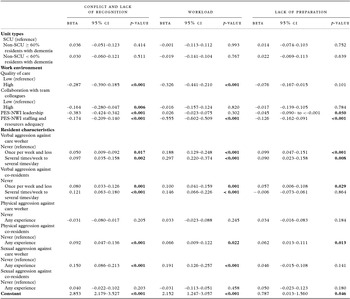
Second, work environment factors and aggressive behavior were added to the models (the results are shown in Table 3). Among the work environment factors, staffing and resources adequacy was significantly negatively associated with all three dimensions of stress. Better leadership was significantly associated with lower scores both for conflict and lack of recognition and for stress due to lack of preparation, but had no significant relationship with HPSI workload scores. Care workers reporting high satisfaction with their units’ quality of care had significantly lower mean scores for HPSI conflict and lack of recognition and HPSI workload, whereas higher ratings for collaboration with team colleagues were associated with lower stress due to conflict and lack of recognition.
Multivariate linear GEE models assessing the associations between potential stressors and three dimensions of stress (HPSI)

Note. GEE: Generalized Estimating Equation; HPSI: Health Professions Stress Inventory; CI: confidence interval; SCU: special dementia care unit; Non-SCU: non-specialized unit; PES-NWI: Practice Environment Scale-Nursing Work Index. The models were adjusted for the following variables: facility: language region, profit status, size; units: staffing (full time employment equivalents FTE/100beds), grade mix (FTE registered nurses/FTE overall), staff turnover; resident characteristics: age, length of stay, care load, all aggregated on unit level; care worker characteristics: age, gender, educational levels, job satisfaction. p-values < 0.05 are shown in bold. PES-NWI leadership.
Aggressive behavior was measured across three dimensions – verbal, physical, and sexual aggression – against care workers and against co-residents. Care workers who had experienced verbal aggression reported significantly more stress on all three HPSI subscales compared to those who had experienced none. Likewise, on all three HPSI subscales, those reporting any observation of verbal aggression against co-residents also reported significantly higher stress levels than the group who witnessed no such behavior. Only regarding stress due to lack of preparation did incidences of observed aggression – at least several times per week – not correlate with stress ratings significantly above those of the group who had observed none.
Regarding physical aggression, mean stress ratings of workers who reported experiences of resident aggression did not differ significantly from those of workers who reported none. In contrast, observing physical aggression between co-residents correlated significantly with higher scores on all three HPSI subscales.
Finally, in both the HPSI conflict and lack of recognition and HPSI workload subscales, mean stress scores of workers who reported experiencing sexual aggression from residents were significantly higher than of those who reported none.
Discussion
This study explored the relationships between care worker stress and unit type, work environment, and resident and care worker characteristics in Swiss NHs. The overall stress levels of care workers were low, with workload receiving the highest mean scores of the three HPSI subscales. The most prevalent aggressive behavior was verbal aggression directed either at the respondents or at other residents, with two-thirds of participants reporting exposure over the previous four weeks. Care workers who experienced verbal or witnessed verbal or physical aggression between residents had significantly higher scores in all three dimensions of stress compared to those who had neither experienced nor witnessed these types of aggression. As a work environment factor, staffing and resources adequacy was significantly inversely associated with all three HPSI subscale scores. Compared to work environment and aggressive behavior by residents, unit type played only a minor role regarding care worker stress.
When only the unit types were included in the models, HPSI workload scores of care workers on special care units were significantly higher than those on non-specialized units. According to our definition of an SCU, we can suppose these residents show rather severe behavioral symptoms, as they are afforded a closed environment and specialized staff (Morgan et al., Reference Morgan, Stewart, D'Arcy, Forbes and Lawson2005). Congruently, previous research has correlated more severe symptoms with increased stress in SCUs (Zwijsen et al., Reference Zwijsen2013). As SCU care workers’ special training sensitizes them particularly to their residents’ special care needs, this heightened sensitivity may also lead to stronger perceptions of high workloads, i.e. periods when they are unable to manage those needs to a professional standard.
However, when the additional stressors were added to the models, they clearly outweighed the differences between unit types. These findings suggest that, at the unit level, exposure to aggressive behavior (whether direct or witnessed) and poor work environment conditions contribute more to care worker stress than the number of RWD. Previous studies support these findings: both in SCUs and in non-specialized units, researchers have noted significantly higher stress levels among care workers exposed to residents’ agitation, aggression, and other disruptive behavior than in those not exposed to such behavior (Morgan et al., Reference Morgan, Stewart, D'Arcy, Forbes and Lawson2005; Zwijsen et al., Reference Zwijsen2013). Furthermore, regarding work environment characteristics in both setting types, care workers’ more positive ratings of their leadership, control over their work, and their organizational culture – especially concerning the adequate provision of resources – are all associated with lower stress and burnout scores (Testad et al., Reference Testad, Mikkelsen, Ballard and Aarsland2010; Jeon et al., Reference Jeon2012). In contrast to our findings, however, Testad et al. found no association between agitation and care worker stress (Testad et al., Reference Testad, Mikkelsen, Ballard and Aarsland2010).
Among the current study's work environment factors, lower ratings of staffing and resources adequacy were significantly associated with higher stress scores in all three HPSI subscales. In view of stress due to workload, this finding also corresponds to those of previous research, as care workers felt particularly stressed when they had too little time to provide adequate care (Edvardsson et al., Reference Edvardsson, Sandman, Nay and Karlsson2009; Testad et al., Reference Testad, Mikkelsen, Ballard and Aarsland2010; Saarnio et al., Reference Saarnio, Sarvimaki, Laukkala and Isola2012). Perceived resource shortfalls might also produce or increase conflicts within teams and between teams and unit or facility leaders, while heightening the stress of not feeling recognized for work done. Conversely, as conflicts hinder teams from performing smoothly, they might exacerbate any perceived lack of resources.
The subscale results for lack of preparation correspond directly with those for perceptions of inadequate staffing and resources. One possible explanation is that when care workers have the impression that they need to work with inadequate resources they are more nervous about making mistakes, or doubt their readiness to master the demands of their work.
Along with staffing and resources adequacy, quality of leadership played an important role in care workers’ perceptions of stress due both to conflicts and lack of recognition and to lack of preparation. In line with previous research associating higher ratings of leadership, organizational culture and support from leaders, co-workers or friends with lower stress, and burnout scores in care workers (Testad et al., Reference Testad, Mikkelsen, Ballard and Aarsland2010; Jeon et al., Reference Jeon2012), these results emphasize the vital role of supportive leadership. Nevertheless, our analyses indicated no association between leadership and stress due to workload. This is surprising: in nursing, supportive- or relation-oriented leadership styles are generally associated with lower stress and emotional exhaustion levels than task oriented – e.g. laissez-faire–leadership (Cummings et al., Reference Cummings2010). However, simply measuring leaders’ supportiveness might not offer a full enough image. For example, a unit supervisor might be perceived as supportive for agreeing that a team member's workload is too high, but may take no steps to alleviate the problem.
Previous research linked higher ratings of the provided quality of care with lower burnout scores and better health in care workers (Schmidt et al., Reference Schmidt, Dichter, Bartholomeyczik and Hasselhorn2013), and associated better social interaction between co-workers with less perceived stress (Testad et al., Reference Testad, Mikkelsen, Ballard and Aarsland2010). Likewise, our analyses significantly associated higher ratings for quality of care and collaboration with team colleagues with lower ratings in the HPSI subscales for conflict and lack of recognition (quality of care and collaboration) and workload (quality of care). However, these findings should be interpreted with caution, as 93.2% and 95.7% of care workers respectively rated the quality of care and collaboration on their units as rather high or high. Additionally, it must be considered that the study's cross-sectional design allows no inferences of causality. Still, these results indicate that care workers who perceived less work-related stress also tended to be more satisfied with their units’ levels of collaboration and quality of care.
As one of the most prevalent and challenging classes of dementia symptoms, aggression is strongly associated with increased care worker stress (Brodaty et al., Reference Brodaty, Draper and Low2003; Zwijsen et al., Reference Zwijsen2013). Furthermore, according to a recent longitudinal study, the relationship between the experience of aggression and work-related stress is bidirectional, i.e. stress predicts the experience of aggression, and the experience of aggression predicts stress (Magnavita, Reference Magnavita2014). We partially confirmed these associations. Our results showed that care workers reported higher ratings on all three HPSI subscales when they experienced any verbal aggression – but not when they experienced physical aggression.
This contradicts Morgan et al., who found physical aggression to be associated with increased job strain (Morgan et al., Reference Morgan, Stewart, D'Arcy, Forbes and Lawson2005), and Zeller et al., who found physical aggression to be perceived as more negative than verbal aggression (Zeller et al., Reference Zeller, Needham, Dassen, Kok and Halfens2013). Considering that acts of physical aggression often occur during caring procedures, such as personal hygiene, when many RWD are unable to understand care workers’ intentions (Zeller et al., Reference Zeller, Needham, Dassen, Kok and Halfens2013), one possible explanation for our finding is that many affected care workers may believe they would be able to prevent this type of aggression if they could adapt their work rhythms to the residents’ needs (Zeller et al., Reference Zeller, Needham, Dassen, Kok and Halfens2013). An approach such as this, which acknowledges the aggression as instrumental rather than with the intention to harm care workers, may reduce their stress. On the other hand, any exposure to verbal aggression was significantly related to all three HPSI subscales. In relation to stress due to workload, like physical aggression, verbal aggression might occur more frequently when care workers lack time to sufficiently explain the intended care procedures or activities to RWD. As for stress due to lack of preparation, care workers not adequately trained in communication with and care of RWD may be exposed more often to verbal aggression, have more difficulties coping with this behavior and therefore feel more stressed. The question of how to handle verbally aggressive residents might contribute to conflicts within a team, which would explain the significant relationship between verbal aggression and ratings for the conflict and lack of recognition subscale. Additionally, care workers exposed to aggressive behavior might feel they are not receiving enough recognition for their demanding work.
Supporting previous research, we found that care workers who witnessed either physical or verbal aggression between residents had significantly higher scores in all three HPSI subscales than those who did not (Rosen et al., Reference Rosen2008). These findings suggest that care workers empathize with the vulnerability of residents as they have a low capacity either to understand the reasons for aggressive behavior in others or to defend themselves. Care workers who devote extra time to preventing or calming aggressive situations among residents might experience increased workload. Furthermore, care workers unable to protect residents from aggression might feel insufficiently trained to manage such situations. The ability to manage aggressive residents might also be critical in view of the subscale for conflict and lack of recognition. In teams, conflicts can easily arise over which interventions are most effective to prevent aggressive resident behavior. Additionally, care workers doing their best to provide high quality of care, including resident safety, might not feel enough recognition from unit supervisors or team members for their work. Effective strategies to prevent aggressive behavior are neither obvious nor easily measurable.
One exception was regarding resident-to-resident sexual aggression, which had no apparent effect on any HPSI subscale. As this was the type of aggression least frequently observed, care workers might simply have intervened or sought support from superiors to stop inter-resident sexual aggression as soon as they noticed it. As this type of aggressive behavior usually targets only specific co-residents, it is easier to prevent than verbal or physical aggression, which are more often responses to situations than to individuals.
One of this study's chief strengths was that the research team could combine many stressors from previous research in a large representative sample of Swiss NHs. The associations indicated between the various aggressive behaviors and work-related stress are new findings in this field and contribute to the available knowledge of care staff in Swiss NHs. Regarding the differences between unit types, the secondary nature of this study meant the results were limited by a shortage of detailed information, e.g. on the severity of the residents’ dementia in participating units, or the prevalence and severity of other BPSD (Brodaty et al., Reference Brodaty, Draper and Low2003; Zwijsen et al., Reference Zwijsen2013). The cross-sectional study design precludes causal interpretation of the results. As all scales were assessed via a single questionnaire, common method bias must be considered. Additional research will be necessary to improve the evidence on the effects of different unit compositions on care worker stress, particularly regarding the characteristics and proportions of RWD. Further evidence on the observation of aggressive behavior would be very useful in interpreting our results, improving future trainings for care workers in coping with such situations and protecting residents from harm.
Although stress scores in the present study were low, NH managers will have to account for projected increases of RWD with complex needs, and therefore provide work environments that help protect health professionals from care worker stress and its consequences. On the one hand, the low stress levels might be due to a recall bias: in the moment of filling out the questionnaire, former stress experienced might not be present. On the other hand, the overall high ratings of work environment factors show a context, within which good collaboration and supportive leadership keep the overall stress level low. Accordingly, the further provision of sufficient numbers of adequately trained staff will play a key role to keep stress levels low. The findings presented here will help shape the ongoing political debate as how to meet future needs for sufficiently skilled health professionals.
Furthermore, these results clearly indicate that adequate support and training for care workers in NHs in the handling of aggressive behavior – one of the most prevalent BPSD – is required. Physically, verbally, and sexually aggressive behavior were all strongly associated with care worker stress, which might have negative consequences not only for the care workers, but for the ability of NHs to attract and retain them, and ultimately for the quality of the care they provide.
In conclusion, this study shows that, regardless of unit type, stress levels in Swiss NHs are low. Nevertheless, to minimize care worker stress, while increasing the attractiveness of NHs as employers, the improvement of their work environments, and support in the handling of challenging behaviors such as aggression are suggested targets for interventions.
Conflict of interest
None.
Description of authors’ roles
B. Vogel drafted the paper, analyzed, and interpreted the data. F. Zúñiga was responsible for the conception and design of the study as well as the acquisition of data. She was involved in drafting the paper, the analysis and interpretation of the data, and revising the paper. S. De Geest, K. Fierz, and S. Beckmann were involved in drafting and revising the paper.
Acknowledgements
The SHURP study was funded by the Swiss Health Observatory, Nursing Science Foundation Switzerland, University of Basel's Research fund 2012, Swiss Alzheimer Association, and an anonymous sponsor. We thank all participating nursing homes and their care workers for their support of the SHURP study.