Introduction
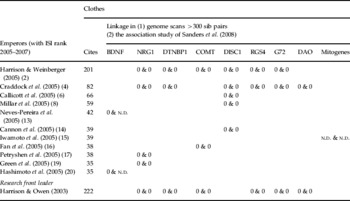
A recent Institute of Scientific Information (ISI) citation analysis identified the 20 most cited papers in research on schizophrenia in the epoch 2005–2007. Ten papers (cited between 35 and 212 times) were in the field of genetics (Table 1), nine of which drew positive conclusions concerning a basket of 12 candidate genes. The authors of the ISI review relate these papers to a ‘research front leader’ (Harrison & Owen, Reference Harrison and Owen2003; cited 222 times) that argued in support of seven of these candidates. The reader is lured by the thesis that (1) a major thrust of psychosis research is now genetic, (2) there is substantive progress, and (3) genes that contribute to predisposition have already been identified.
Lack of evidence for the candidate genes identified in the 10 studies in the ISI most highly cited list for 2005–2007

BDNF, Brain-derived neurotrophic factor; NRG1, neuregulin; DTNBP1, dysbindin; DISC1, disordered in schizophrenia 1; RGS4, regulator of G-protein signalling 4; G72, D-amino-acid oxidase activator; DAO, D-amino-acid oxidase; mitogenes, mitochondrial genes.
The ISI list is summarized with respect to the genome scan findings in sibling pairs (Crow, Reference Crow2007), first symbol in each cell, and the association (LD) study of Sanders et al. (Reference Sanders, Duan, Levinson, Shi, He, Hou, Burrell, Rice, Nertney, Olincy, Rozic, Vinogradov, Buccola, Mowry, Freedman, Amin, Black, Silverman, Bylerley, Crowe, Cloninger, Martinez and Gejman2008), second symbol. 0, Not supported; n.d., no data. Neves-Pereira et al. (Reference Neves-Pereira, Cheung, Pasdar, Zhang, Breen, Yates, Sinclair, Crombie, Walker and St Clair2005) and Hashimoto et al. (Reference Hashimoto, Bergen, Nguyen, Xu, Monteggia, Pierri, Sun, Sampson and Lewis2005) studied BDNF, which was not included by Sanders et al., and Iwamoto et al. studied mitochondrial genes that were not covered by either Crow (Reference Crow2007) or Sanders et al. (Reference Sanders, Duan, Levinson, Shi, He, Hou, Burrell, Rice, Nertney, Olincy, Rozic, Vinogradov, Buccola, Mowry, Freedman, Amin, Black, Silverman, Bylerley, Crowe, Cloninger, Martinez and Gejman2008). Fan et al. (Reference Fan, Zhang, Gu, Li, Sun, Wang, Feng, Clair and He2005) drew negative conclusions regarding COMT. Each of the other papers drew positive conclusions regarding an association between the gene(s) in question and schizophrenia.
On the contrary it can be argued that (1) the trend depicted in the ISI analysis reflects the triumph of optimism over sober appraisal, (2) there are no grounds for regarding these genes separately or in combination as having any specific relation to schizophrenia, and (3) the emphasis on polygenes of small effect that permeates this literature obscures a challenge with implications within and outside the boundaries of psychosis research.
What I tell you seven times is not necessarily true
No casual reader of this body of work or the ISI analysis will be aware of the fragility of the data. A chorus of reviews with titles including ‘The discovery of susceptibility genes for mental disorders’ (Cloninger, Reference Cloninger2002), ‘Genes for schizophrenia? Recent findings and their pathophysiological implications’ (Harrison and Owen, Reference Harrison and Owen2003), ‘The molecular genetics of schizophrenia: new findings promise new insights’ (Owen et al. Reference Owen, Williams and O'Donovan2004), ‘Schizophrenia – genes at last?’ (Owen et al. Reference Owen, Craddock and O'Donovan2005), ‘Schizophrenia genes, gene expression, and neuropathology: on the matter of their convergence’ (Harrison and Weinberger, Reference Harrison and Weinberger2005), ‘The genetics of schizophrenia and bipolar disorder: dissecting psychosis’ (Craddock et al. Reference Craddock, O'Donovan and Owen2005), and ‘The genetic deconstruction of psychosis’ (Owen et al. Reference Owen, Craddock and Jablensky2007) pervades the literature and will convince all but the most inquisitive that a solid foundation of evidence supports the pathophysiological relevance of these candidate genes.
With one or two possible exceptions (COMT, G72) each candidature originated in a genetic linkage study. All have later been reported as supported (‘confirmed’) by a genetic ‘linkage’ or ‘association’ study, in most cases several.
Draining the pond dry
The distinction between ‘linkage’ and ‘association’ (also referred to as linkage disequilibrium or LD) is important. Both strategies use genetic variation (polymorphisms) to identify the location of a disease-predisposing gene at a particular site within the genome. Whereas linkage refers to the co-transmission within families of variants at a given site and disease (the ‘phenotype’), association refers to the relationship between such variation and disease within populations. When the same variant (allele) travels with disorder within a given family linkage is said to be present, and the case is strengthened if in another family variation at that same locus also does so, whether the disease-related allele is the same or different from that in the first family. When LD is present a particular allele (sequence variation) is associated with disease above expectation within the whole population. The implication is that insufficient time has elapsed after a ‘mutation’ for recombination to restore the random association between variants at the marker locus and presence or absence of the mutation in the disease-predisposing gene.
To detect genetic linkage families can be collected from different populations. LD is best detected in homogeneous populations that have remained relatively isolated. Within such populations there is a high probability that a ‘founder effect’ mutation may have occurred, and account for a significant proportion of the variation related to disease within that population. Linkage can be detected over relatively long genetic distances [measured in centimorgans (cM), say 20–30 or more] whereas linkage disequilibrium implies that the variation is close to the disease locus, perhaps within 1–2 cM. Thus in the classical approach the techniques are used in tandem – linkage to detect the general region within which a disease-causing gene is suspected, LD to locate it with greater precision, and thus to lead to its identification.
The pond is empty
Has the combination of techniques succeeded in psychosis? Many in linkage research thought that success was inevitable – one would ‘drain the pond dry’ and there would be the genes! However, the reality is that in spite of a plethora of well-hyped findings no linkage claim has proven robust. In each case an apparent finding in a modest-sized population of families that was then used to ‘identify’ a candidate gene has not been found linked in more systematic and larger studies. Thus the advent of genome scans (unbiased surveys with markers across the whole genome) has not strengthened any of the claims (Table 1). Damagingly two meta-analyses of the genome scans of schizophrenia and bipolar disorder revealed no strong findings and failed to agree on loci of interest even though they examined largely the same body of studies. If one takes the three largest (>300 sibling pairs) genome scans there is little agreement between the studies, and no consistent support for any candidate gene (Crow, Reference Crow2007).
Three counter-arguments are mounted as follows: (1) the polygenes are more numerous and of smaller effect than had been thought, (2) different genes are present in different populations, (3) linkage evidence will be overtaken by definitive findings from association studies.
Argument 1 flouts Ockham's principle; as an hypothesis it approaches unfalsifiability. Argument 2 gives no account of constancy of incidence across populations (Jablensky et al. Reference Jablensky, Sartorius, Ernberg, Anker, Korten, Cooper, Day and Bertelsen1992) or relative uniformity of the spectrum of psychosis, e.g. with respect to sex differences, structural brain change and relationship between form of illness and age of onset (Crow, Reference Crow1993).
Argument 3 is now directly testable. With technical advances genome-wide association studies are possible with half a million or more markers on populations measured in thousands. The findings of such studies have been preceded by a systematic assessment of the existing list of candidate genes in a population of over 1870 patients and 2002 screened controls (Sanders et al. Reference Sanders, Duan, Levinson, Shi, He, Hou, Burrell, Rice, Nertney, Olincy, Rozic, Vinogradov, Buccola, Mowry, Freedman, Amin, Black, Silverman, Bylerley, Crowe, Cloninger, Martinez and Gejman2008). For a list that includes the above genes (with the exception of BDNF) association was systematically pursued in regions beside each of the candidates. The sample size and density of markers dwarf previous studies. No evidence of an association with any alleles at the polymorphic sites was obtained (Table 1).
Magical thinking in the Clinical Brain Disorders Branch
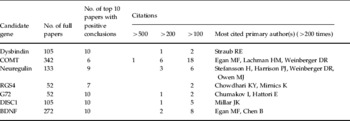
The most euphoric interpretation of linkage and association findings comes from the National Institute of Mental Health. In a paper entitled ‘Schizophrenia genes: famine to feast’, Straub & Weinberger (2006) extend the above list of 12 ‘candidates’ to include six more, each of which they describe as ‘linked to a gene locus’. These claims cannot be sustained in the findings of the large and systematic linkage studies (Crow, Reference Crow2007) or the association study of Sanders et al. (Reference Sanders, Duan, Levinson, Shi, He, Hou, Burrell, Rice, Nertney, Olincy, Rozic, Vinogradov, Buccola, Mowry, Freedman, Amin, Black, Silverman, Bylerley, Crowe, Cloninger, Martinez and Gejman2008). They represent the salient manifestation of an exuberant growth in the literature (Table 2), purporting to relate variation at candidate gene loci to the phenomena of psychosis. But if the origin of the relationship was in a genetic linkage, and that linkage has proven not replicable, the claim of significance in relation to psychosis has been built on sand.
Analysis of ISI Web of Science data on ‘candidate’ genes associated with (psychosis or schizophrenia or bipolar or manic or mania) to show numbers of papers, rates of positive conclusions in the most cited papers, numbers of highly cited papers and highly cited authors of papers drawing positive conclusions

In view of the negative findings of the large genome scans and the Sanders et al. (Reference Sanders, Duan, Levinson, Shi, He, Hou, Burrell, Rice, Nertney, Olincy, Rozic, Vinogradov, Buccola, Mowry, Freedman, Amin, Black, Silverman, Bylerley, Crowe, Cloninger, Martinez and Gejman2008) study the papers enumerated in column 3 must be regarded as false positives.
At the World Congress of Psychiatric Genetics held in New York in October 2007 separate sessions addressed the state of genome-wide association studies in relation to bipolar disorder and schizophrenia. Full publications are not yet available but it was apparent that no strong findings had emerged, and that such weak associations as were observed were neither in relation to the candidate genes, nor in agreement between different studies.
The discussion was sombre. In the morning Francis Collins, Head of the Human Genome Project, had predicted sure future progress with these technical advances. In the afternoon it was seen that just such a strategy had failed to yield decisive findings. Thus association studies have not vindicated the enthusiastic interpretation that many had placed on modest and early linkage findings. Neither technique has succeeded in establishing the location of a gene predisposing to psychosis, still less are they in agreement concerning the identity of such a gene.
What explanations are there for this absence of evidence in the face of twin, adoption and family findings indicating substantial genetic predisposition? Two, and perhaps only two – a high mutation site (Book, Reference Book1953) and an epigenetic imprint – are feasible. The former might well escape association searches (different mutations occurring in the same genomic background would add noise to the signal) but would not have escaped linkage (siblings would inherit the same mutation above chance expectation). This leaves variation in modification of the DNA sequence (by methylation), or of the histones (methylation, acetylation or phosphorylation) with which it is associated in the scaffolding of the chromosome, as the single viable explanation. Such might also account for the paternal age effect and discordance for presence or form of illness in twins and other multiple births. Chromosomal rearrangements suggested to have played a role in the origin of the species (Crow, Reference Crow2002) are susceptible to just such an epigenetic process – now referred to as ‘meiotic suppression of unpaired chromosomes’ – or MSUC (Turner, Reference Turner2007).
Conclusion
Claims for ‘candidate’ genes are not supported either by the larger and more systematic linkage studies or by a targeted association comparison of a population of 1870 patients with 2004 controls. Whole genome association studies reviewed at the IXth World Congress of Psychiatric Genetics suggest that no strong and consistent findings emerge. Thus genetic predisposition to psychosis reflects variation not in the DNA sequence, but in modification of the sequence itself, or more likely of the histone structure with which it is associated within the framework of the chromosome. The failure of the search for psychosis genes by linkage and association therefore reveals the trans-generational reality of the epigenetic imprint.
Declaration of Interest
None.