




Introduction
Ever since the implementation of USDA organic certification standards in 2002, production and sales of organic foods have increased exponentially. According to the Organic Trade Association (OTA), organic food sales reached a record high of $56.4 billion in 2020 (OTA, 2021). OTA (2017) forecasts that this trend will continue, since the millennial generation is the largest purchaser of organic foods. This growth in organics has coincided with increased interest in the history of organic food and farming. Previous historical studies have focused on the social aspects (Peters, Reference Peters1979; Beeman and Pritchard, Reference Beeman and Pritchard2001; Conford, Reference Conford2001, Reference Conford2011; Reed, Reference Reed2010; Obach, Reference Obach2015; O'Sullivan, Reference O'Sullivan2015; Barton, Reference Barton2018), countercultural connections (Belasco, Reference Belasco2007; Kirk, Reference Kirk2007; Kauffman, Reference Kauffman2018), philosophies (Guthman, Reference Guthman2004; Clark, Reference Clark2007; Vos, Reference Vos2007), and politics of the organic and sustainable agriculture movement (Ingram, Reference Ingram2007; Youngberg and DeMuth, Reference Youngberg and DeMuth2013; Gershuny, Reference Gershuny2017). Several organic and sustainable agriculture organizations have compiled collections of historical essays (Kaufman and Christianson, Reference Kaufman and Christianson2017; MOFGA, 2021b). Oral history projects at the University of California Santa-Cruz and the Minnesota Institute of Sustainable Agriculture have focused on interviewing farmers, researchers and policy leaders involved with organic and sustainable agriculture (Reti and Rabkin, Reference Reti and Rabkin2012; MISA, n.d.; WHS, n.d.).
While these authors and projects have done excellent work documenting the social movement aspects of organic and sustainable agriculture, less research has been done on the historical development and dissemination of organic farming methods. Several scientists have written articles exploring the connections between organic farming and composting (Blum, Reference Blum1992), horticulture (Treadwell et al., Reference Treadwell, McKinney and Creamer2003), forestry (Barton, Reference Barton2001) and soil science (Heckman, Reference Heckman2006, Reference Heckman2013, Reference Heckman2019). Most authors trace the origin of organic farming methods to Sir Albert Howard's composting work in India (Howard and Wad, Reference Howard and Wad1931; Howard, Reference Howard1940, Reference Howard1945), F. H. King's observations of composting and farming methods in China (King, Reference King1911), and the biodynamic methods brought to the United States from Germany by Ehrenfried Pfeiffer (Pfeiffer, Reference Pfeiffer1940). Almost all sources agree that the most important promoter of organic farming methods in the United States from 1942 to 1970 was J. I. Rodale, whose Rodale Press published Organic Gardening magazine and practical gardening and farming guides (Jackson, Reference Jackson1974; Jundt, Reference Jundt2014; O'Sullivan, Reference O'Sullivan2015; Case, Reference Case2018).
One factor that makes the development and dissemination of organic farming methods difficult to document is the animosity that existed between agricultural researchers and organic farmers from the late 1940s to mid-1980s. By 1951, agronomists and soil scientists at many American land grant universities were attacking organic farming as ‘bunk’ and a ‘cult’ based on ‘half truths, pseudo science and emotion’ that threatened to ‘destroy the chemical fertilizer industry on which so much of our agriculture depends’ (Throckmorton, Reference Throckmorton1951). Entomologists and nutritionists joined the attack in the 1960s and 1970s, and many university extension bulletins and USDA agricultural yearbooks published during this time period dismissed organic food as an unscientific ‘fad’ that could never feed the world (Barton, Reference Barton1966; Utzinger et al., Reference Utzinger, Trierweiler, Janson, Miller, Saddam and Crean1973; Darling, Reference Darling1976). The unspoken ‘taboo’ against even mentioning the ‘O-word’ favorably in agricultural science circles was so strong that scientists interested in natural farming methods in the 1980s turned to words like ‘alternative,’ ‘low-input,’ and ‘sustainable’ instead (Lipson, Reference Lipson1997; Youngberg and DeMuth, Reference Youngberg and DeMuth2013). Up through the mid-1990s, many university extension educators continued to hold negative attitudes toward organic farming (Harp and Sachs, Reference Harp and Sachs1992; Batie and Swinton, Reference Batie and Swinton1993; Lyson, Reference Lyson1998).
Because of this historical animosity, organic farmers did not usually turn to university extension or USDA bulletins to find information about organic farming (Delate and DeWitt, Reference Delate and DeWitt2004; Bloom and Duram, Reference Bloom and Duram2007). Instead, they predominately learned about farming methods through nongovernmental and nonacademic sources, including farmer-to-farmer networking, organizations, conferences, workshops, farm field days, books, periodicals, certification agencies, and—more recently—the internet (Delate and DeWitt, Reference Delate and DeWitt2004; Bloom and Duram, Reference Bloom and Duram2007; Crawford et al., Reference Crawford, Grossman, Warren and Cubbage2015; Alotaibi et al., Reference Alotaibi, Yoder, Brennan and Kassem2021). The importance of these information sources has been confirmed by multiple studies, but most of these studies do not discuss the content of information from these sources or who originally developed the methods they promote. The largest lacuna in the current literature is lack of information about which specific authors, publications and organizations have most influenced the development of organic and sustainable agriculture methods.
The purpose of this study was to address this deficiency by surveying the organic and sustainable agriculture community in the midwestern and northeastern United States to identify authors, publications and organizations that influenced farming methods in this region. The organic and sustainable agriculture community is broadly defined to include organic/sustainable farmers and gardeners, organizational leaders, agricultural researchers with an interest in organic/sustainable agriculture, certification inspectors, agricultural product suppliers, writers, educators and anyone else who plays a role in developing and distributing information about organic/sustainable agricultural methods. The inclusion of both farmers and non-farmers is consistent with previous historical studies, which included researchers and organization leaders in addition to farmers (Reti and Rabkin, Reference Reti and Rabkin2012; MISA, n.d.). By identifying these influential authors and organizations, this study lays the groundwork for further historical research on the development and dissemination of organic and sustainable farming and gardening methods in this region.
Methods
Organic farming operations in the United States are concentrated in five main geographic areas: California, the Pacific Northwest, the Mountain West, the Great Lake states/Upper Midwest and the Northeast (Reti and Rabkin, Reference Reti and Rabkin2012; Kuo and Peters, Reference Kuo and Peters2017). Because farming methods and cropping systems are climatically dependent and vary between regions, this study focuses on the northeastern quarter of the continental United States, where the majority of agricultural land falls in USDA plant hardiness zones 4a–6a and receives 30–50 inches (76–127 cm) of annual rainfall. This region encompasses both the Northeast and Great Lakes/Upper Midwest concentrations of organic farming operations. It was hypothesized that there would be little difference in farming methods or influences between these two regions because they have similar climates and cropping systems. The study region was divided into two broad groups: Midwest (Minnesota, Iowa, Wisconsin, Illinois, Michigan, Indiana, Ohio, Missouri and Kentucky) and Northeast (Pennsylvania, New York, Vermont, New Hampshire, Maine, Massachusetts, Connecticut, Rhode Island, New Jersey, Delaware, Maryland, West Virginia and Virginia).
Information about influences on farming practices was collected using an anonymous online survey, created using Qualtrics software and distributed by organic and sustainable agriculture organizations in the study area. An anonymous survey design was chosen because of lack of access to comprehensive lists of email addresses for organic/sustainable farmers and lack of funding for a large-scale paper survey mailing. The online format was inexpensive and easy to distribute, but may have selectively biased the sample to exclude people who do not use computers and/or do not subscribe to the email/mailing lists of the targeted organizations. One group that likely had limited or no access to the survey was Amish and Mennonite farmers, who represent an estimated 30 percent or more of the organic farming community in some midwestern states like Wisconsin and Ohio (Kraybill et al., Reference Kraybill, Johnson-Weiner and Nolt2013; Cross, Reference Cross2023). The promotional material for the survey mentioned that a paper survey was available upon request, but only 3 respondents returned a paper survey. These responses were entered into Qualtrics and pooled with the rest of the responses.
Because users had to complete the anonymous survey in one session, it was designed to be short and quick to fill out. Information deemed most useful for the study's goal of determining influential publications and organizations included farm location (zip code), the time period during which respondents farmed (before 1970, 1970–1979, 1980–1989, 1990–2002 and 2003–2021), their connection to organic/sustainable agriculture (farmer, gardener/homesteader, researcher and other), how they self-described their farming practices (certified organic, uncertified organic, sustainable and other), and the broad categories of crops and livestock raised on their farms (vegetables, fruit, grain/beans, seeds, dairy animals, meat animals, fiber animals, poultry and other). All demographic questions allowed respondents to select multiple categories. Detailed data on farm size, income, specific cropping practices and personal demographics were not collected because of the short, anonymous nature of the survey. After the demographic questions, respondents were asked three open-ended questions: ‘Is there anyone who mentored you in organic/sustainable farming or greatly influenced your farming practices?’ ‘Are there any books/publications that influenced your farming practices?’ and ‘Were you affiliated with any organic/sustainable agriculture organizations?’ If respondents answered ‘yes’ to any of these questions, they were directed to a text entry box that required them to enter text before continuing to the next survey question. This survey received exemption from the University of Wisconsin-Madison IRB (Submission ID no. 2021–0383). The full survey text is available in Supplement 1.
Organic/sustainable farming organizations in the study area were identified using two publicly available national databases: the National Sustainable Agriculture Coalition's member list and the National Center for Appropriate Technology's ATTRA list of ‘Sustainable Agriculture Organizations and Publications’ (NSAC, n.d.; NCAT, n.d.). An initial email query was sent out to 150 organizations, and 51 organizations and periodicals (including most major state and regional organizations in the study area) agreed to send the survey link to some or all of their members (Table S-1). The organizations who declined to participate were mostly small or not specifically focused on agriculture. The email and mailing lists of all participating organizations, listservs and magazines total over 50,000 subscribers. However, organizations were inconsistent in the amount of space they devoted to advertising the survey in their publications; some included a full article and others only mentioned it in a small and easily overlooked news note or only sent the link to leaders of the organization. This makes it impossible to determine how many people were aware that the survey existed and thus impossible to calculate a response rate. Because of these limitations, percentages and significant differences from this study cannot be generalized to the region as a whole, but the results can still provide a useful guide for future historical research. The survey was open from May 2021 to December 2021, with the majority of responses collected between May and June 2021.
After the survey results had been collected, the data was manually sorted and classified to facilitate analysis. Because some respondents entered information into the wrong text entry boxes, the answers to the three open-ended questions about influential people, publications and organizations were combined and manually re-assigned to the appropriate category. The number of unique names was recorded, and names in each category were ranked according to the number of mentions. Since the demographic questions allowed multiple responses, these categories were ranked in priority for descriptive statistics. Individual responses were categorized by the region in which the first zip code they entered was located (Midwest or Northeast); the earliest date range selected (before 1970, 1970–1979, 1980–1989, 1990–2002 or 2003–2021); their most important connection to organic/sustainable agriculture (farmer > gardener/homesteader > researcher > other); and their predominant farming system (certified organic > uncertified organic > sustainable > other).
To determine whether there were any correlations between these demographic categories and the influential authors, organizations and individuals listed in the open-ended categories, data analysis was conducted using Pearson's χ 2 test for independence of variables, following the methods used by Dawson and Goldberger (Reference Dawson and Goldberger2008). Pearson's χ 2 test works best with contingency tables that are no larger than 3 × 3, with 2 × 2 contingency tables yielding the most useful results, so responses to each demographic question were condensed into two categories for this analysis (Everitt, Reference Everitt1977). Location data was condensed into Midwest (Minnesota, Iowa, Wisconsin, Illinois, Michigan, Indiana, Ohio, Kentucky and Missouri) and Northeast (Pennsylvania, New York, Vermont, New Hampshire, Maine, Massachusetts, Connecticut, Rhode Island, New Jersey, Maryland, Delaware, West Virginia and Virginia). Dates were condensed into two categories: those who began farming before USDA organic certification began in 2002 (including the before 1970, 1970–1979, 1980–1989 and 1990–2002 categories) and those who began farming after 2002 (the 2003–2021 category). Connection to organic/sustainable agriculture was condensed into grower (respondents who selected farmer and/or gardener/homesteader) and non-grower (all other respondents). Farming systems were condensed into two categories: certified organic (those who identified as certified organic) and uncertified (all other responses). Crop types were condensed into two categories: livestock (respondents listed meat animals, fiber animals, dairy animals and/or poultry) and crops only (respondents did not list meat animals, fiber animals, dairy animals or poultry). These condensed demographic categories were tested against yes/no responses from the open-ended questions, including mention of any authors, organizations, individuals or the top seven authors.
Results
Demographics
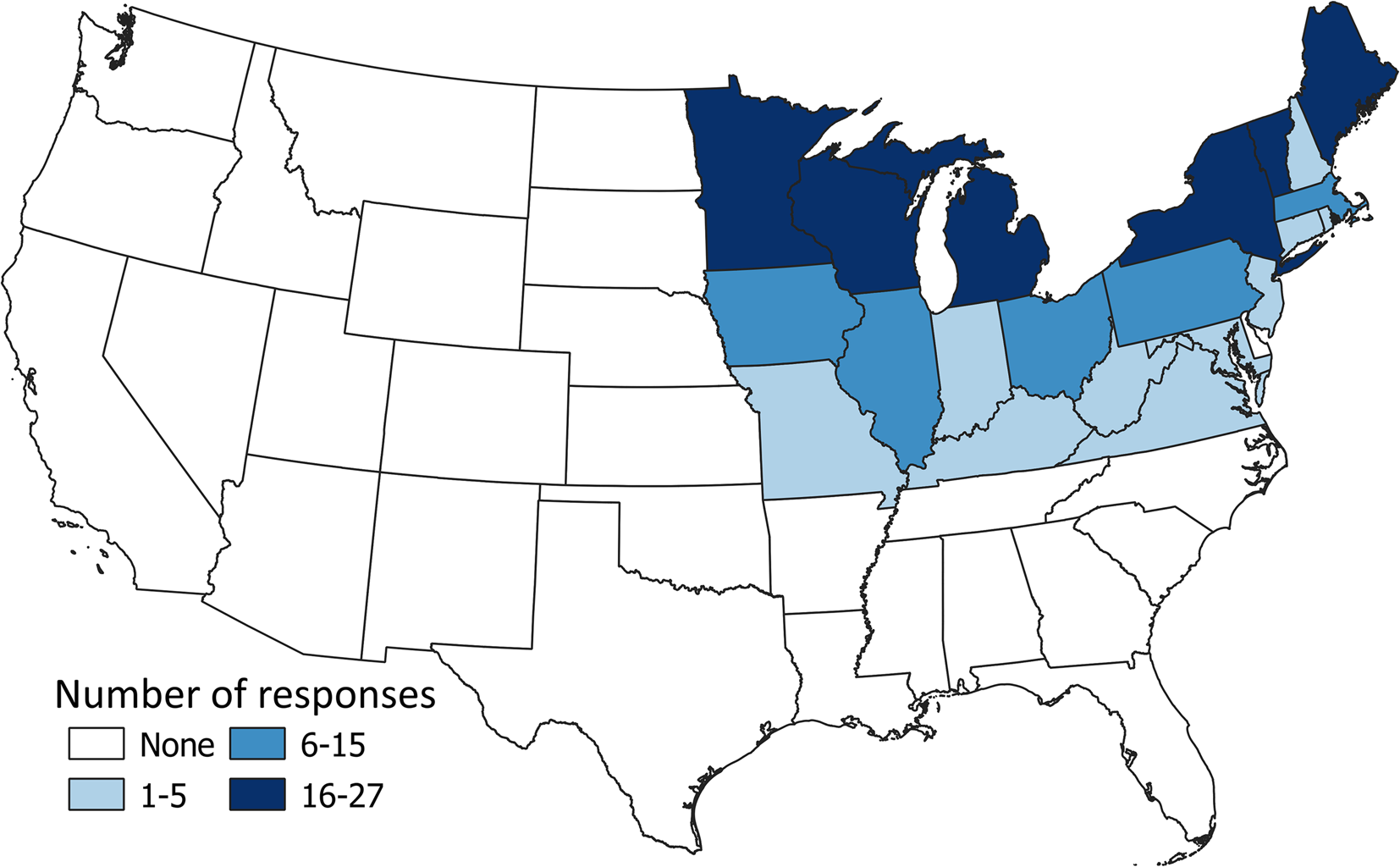
A total of 253 respondents completed the survey, but 29 responses were discarded because they were from outside the study region. The remaining 224 responses were evenly distributed between the Midwest (51%, N = 114) and Northeast (49%, N = 110). The geographic distribution of survey responses is similar to the distribution of organic farms identified by Kuo and Peters (Reference Kuo and Peters2017), suggesting that the survey was effectively distributed to the organic community throughout the study region (Fig. 1). All respondents completed the demographic questions about location and connection to organic/sustainable agriculture. Respondents were allowed to select multiple connections to organic/sustainable agriculture, and 135 (60%) listed a single connection, 59 (26%) listed two connections and 30 (14%) listed three or more connections. The highest number of connections listed by one respondent was 6. The most frequent self-described connection with organic/sustainable agriculture was farmer, followed by homesteader/gardener and researcher (Table 1). Text entry responses in the ‘other’ category included educator (9%, N = 20), organizational leader (8%, N = 18), product/service supplier (6%, N = 14), advocate/consumer (5%, N = 10), certifier (4%, N = 8), consultant (4%, N = 8) and writer (3%, N = 7). When responses were grouped by primary self-described connection to organic/sustainable agriculture, 143 (64%) identified as farmers, 26 (12%) identified as homesteaders/gardeners, 16 (7%) identified as researchers and 39 (17%) identified with some other connection. A total of 169 (75%) were classed as growers (farmers and homesteaders/gardeners) and 55 (25%) were classed as non-growers (all others).
Choropleth map showing number of survey responses per state in the study region.
Responses to demographic questions

Because respondents were allowed to select multiple answers, cumulative percentages are greater than 100.
Only growers were given the opportunity to respond to the three farming-specific demographic questions. Table 1 lists the total number and percentage of respondents who selected each response to these questions. Within the grower category, responses were evenly divided between those who began production before 2002 (46%, N = 78) and after 2002 (54%, N = 92). Certified organic (44%, N = 75) and uncertified growers (56%, N = 94) were also equally represented. Uncertified organic and sustainable were the most popular terms that uncertified growers used to self-describe their farming practices; other terms included biodynamic (10%, N = 16), regenerative (4%, N = 7), agroecological (2%, N = 3), permaculture (2%, N = 3) and holistic (1%, N = 2). Respondents who raised livestock (meat animals, dairy animals, fiber animals and poultry) (59%, N = 100) and those who grew only crops (vegetables, fruits, grain/beans and seeds) (41%, N = 69) were both represented. Of the farmers who raised livestock, 91 (91%) raised both crops and livestock and 9 (9%) raised only livestock. Most respondents listed multiple crop types, with 21 (13%) raising only one type of crop or livestock, 46 (27%) raising two types and 102 (60%) raising three or more types of crops. The highest number of crop types listed by a single respondent was 11. Vegetables were the most frequently grown crop (85%, N = 143) and poultry were the most frequently raised livestock (46%, N = 78). Text entry responses in the ‘other’ crop category included herbs (4%, N = 7), hay/pasture (4%, N = 6), flowers (3%, N = 5), mushrooms (3%, N = 5), honeybees (2%, N = 4) and maple syrup (1%, N = 2).
Books and publications
A total of 171 respondents (76%) listed at least one book or publication as influential. Growers were more likely to mention books than non-growers (P ⩽ 0.01), but there were no other significant differences between demographic groups (Table 2). Of the respondents who listed books or periodicals, 37 (22%) listed one author or publication, 29 (17%) listed two authors and 105 (62%) listed three or more authors. The highest number of authors mentioned by one respondent was 17. Respondents listed a total of 199 unique authors or publications, with multiple titles by many of these authors (Table S-2). 122 of these authors (61%) were mentioned by one respondent, 27 (14%) received two mentions and 50 (25%) received three or more mentions. Only 12 authors (6%) were mentioned by ten or more respondents (Table 3). The number of unique authors listed reflects both the breadth of literature on organic farming and the individuality of reading choices. Books ranged from classics like F. H. King's Farmers of Forty Centuries to recent works like Leah Penniman's Farming While Black, on a wide variety of topics from practical gardening to rural sociology.
Percent of respondents in each demographic category who listed books, organizations and farmers as influences, with analysis results from Pearson's χ 2 test

*P ⩽ 0.05; **P ⩽ 0.01; ***P ⩽ 0.001 (Pearson χ 2 test).
Top authors, titles and number of mentions

Despite this wide diversity in authors and topics, several authors were mentioned more frequently than others. Eliot Coleman's The New Organic Grower (Reference Coleman1995), Four-Season Harvest (Reference Coleman1999) and The Winter Harvest Handbook (Reference Coleman2009) were mentioned by 60 different respondents in the target region. Other top authors included Rodale publications like Organic Gardening magazine, How to Grow Vegetables and Fruits by the Organic Method (Rodale and staff, Reference Rodale1961) and Encyclopedia of Organic Gardening (Rodale and staff, Reference Rodale1959); Wendell Berry's The Unsettling of America (Reference Berry1977); Acres U.S.A. magazine; Masanobu Fukuoka's One Straw Revolution (Reference Fukuoka1978); Joel Salatin's You Can Farm (Reference Salatin1998) and Folks, This Ain't Normal (Reference Salatin2011); and Michael Pollan's The Omnivore's Dilemma (Reference Pollan2006) and In Defense of Food (Reference Pollan2008). Each of these authors received enough mentions to run Pearson's χ 2 test against the farm demographic categories collected in the first part of the survey (Table 4). More growers (P ⩽ 0.001), farmers (P ⩽ 0.05), and certified organic growers (P ⩽ 0.05) read Eliot Coleman than non-growers, gardeners and uncertified growers, respectively. More growers who began production before 2002 mentioned Rodale publications (P ⩽ 0.001) and Acres U.S.A. (P ⩽ 0.05) than those who began farming after 2002, while more who began production after 2002 read Joel Salatin (P ⩽ 0.05) and Michael Pollan (P ⩽ 0.01) than those who began before 2002. Growers (P ⩽ 0.05) and respondents from the Northeast (P ⩽ 0.05) mentioned Joel Salatin more than non-growers and respondents from the Midwest, respectively. This was the only significant difference between regions, confirming the hypothesis that farmers in the Midwest and Northeast read similar books and publications.
Percent of respondents in each demographic category who mentioned the top seven authors, with results from Pearson's χ 2 test

*P ⩽ 0.05; **P ⩽ 0.01; ***P ⩽ 0.001 (Pearson χ 2 test).
a A χ 2 test was not conducted on this demographic because the expected value for one or more categories was below 5.
Organizations
A total of 169 respondents in the target region (75%) listed at least one organization. More certified growers (P ⩽ 0.001), farmers (P ⩽ 0.001), growers who began production before 2002 (P ⩽ 0.05), and growers who raised livestock (P ⩽ 0.05) listed organizations than uncertified growers, gardeners, growers who began production after 2002 and growers who raised only crops, respectively (Table 2). Of the respondents who listed organizations, 44 (26%) listed one organization, 45 (27%) listed two organizations and 80 (47%) listed three or more organizations. The highest number of organizations mentioned by one respondent was 10. Respondents listed a total of 217 unique organizations, with 151 (70%) receiving one mention, 28 (13%) receiving two mentions and 38 (18%) receiving three or more mentions (Table S-3). Only 10 organizations (5%) were mentioned by nine or more respondents in the study area. All of the top organizations were state or regional organizations, divided evenly between the Midwest and Northeast (Table 5). Of the respondents who mentioned an organization, 144 (85%) listed at least one organization in their home state and 127 (75%) listed at least one of the top ten organizations.
Top organizations, locations and number of mentions

Individuals
A total of 123 respondents in the study region (55%) listed the name of an influential individual who could not be identified as a published author. More farmers (P ⩽ 0.001) and certified growers (P ⩽ 0.05) listed individuals than gardeners and uncertified growers, respectively (Table 2). A total of 208 unique individuals were named by survey respondents. An additional 27 respondents mentioned unnamed farmers (including five mentions of indigenous farmers and two mentions of Amish farmers), and 18 respondents mentioned an unnamed relative (including seven mentions of grandparents and seven mentions of parents), for a total of 253 unique individuals. Out of these individuals, 101 (40%) were identified as farmers, 20 (8%) were identified as relatives, 19 (8%) were identified as affiliated with a university, 15 (6%) were identified as organizational leaders, 7 (3%) were identified as business owners and 91 (36%) were simply listed by name with no descriptive information.
Discussion
One of the most significant findings from this survey was the strong influence of Eliot Coleman, who was the most frequently listed author in almost all demographic groups. Coleman developed his vegetable production methods through a combination of extensive reading in the classic organic farming literature, trips to his state university's library, visiting other farms in the US and Europe, and decades of personal experimentation at his coastal Maine farm (Coleman, Reference Coleman1995, Reference Coleman1999, Reference Coleman2009). His practical vegetable production guides are based on his experience farming in USDA plant hardiness zones 4 and 5 and include winter gardening and season extension methods that are applicable across the entire study region. Despite his strong influence on vegetable production in this region, Coleman has only received brief mention in the organic farming history literature (O'Sullivan, Reference O'Sullivan2015). One possible reason for the lack of historical research on Coleman is that previous scholarship has been predominately focused on California, where season extension and winter gardening methods are unnecessary (Guthman, Reference Guthman2004; Reti and Rabkin, Reference Reti and Rabkin2012).
The strong influence of Rodale Press is consistent with the findings of previous scholars (Jackson, Reference Jackson1974; Jundt, Reference Jundt2014; O'Sullivan, Reference O'Sullivan2015; Case, Reference Case2018). Up through the 1970s, Rodale's Organic Gardening magazine and books were the primary source of information about organic gardening and farming. As expected, Rodale publications were mentioned by significantly more growers who began production before 2002 than those who began after 2002. This is because the influence of Rodale was waning by the turn of the century, with Rodale classics like How to Grow Vegetables and Fruits by the Organic Method replaced by newer works by Coleman and others. Wendell Berry and Masanobu Fukuoka have also been mentioned by several historical scholars (Treadwell et al., Reference Treadwell, McKinney and Creamer2003; O'Sullivan, Reference O'Sullivan2015), but the influence of more recent authors like Joel Salatin, Michael Pollan, Bill Mollison and Mark Shepard remains to be documented. Other important areas for future study include the history of Acres U.S.A. and Mother Earth News magazines and their influence on organic and sustainable farming methods. Previous scholarship on back-to-the-land periodicals has focused mainly on The Whole Earth Catalog, which was only mentioned by one survey respondent (Kirk, Reference Kirk2007).
These survey results also suggest that organizations have played and continue to play an important role in connecting farmers and disseminating information about organic farming. Twenty respondents mentioned attending conferences sponsored by state and regional organizations, with the annual Marbleseed (MOSES at the time of this study) conference receiving nine mentions. One ‘beginning young farmer’ found the MOSES conference, which attracts over 2800 farmers a year, ‘really inspirational’; another called it ‘a rich environment for learning and inspiration.’ Another respondent mentioned conferences sponsored by the Maine Organic Farmers and Gardeners Association (MOFGA) as highly influential: ‘Many talks at MOFGA's Common Ground Fair influenced my practices. Countless homesteaders and small farmers have presented there. Lastly, MOFGA's Farmer to Farmer Conference has been probably the biggest influence on how I operate my farm.’ All of the top organizations host some sort of annual conference, along with farm field days and workshops.
Six respondents referred to organizational newsletters, including two mentions of Marbleseed (MOSES)'s Organic Broadcaster and two mentions of the Northeast Organic Farming Association's The Natural Farmer. Most of these organizational newsletters contain a mix of practical farming articles, updates on organic-related politics, lists of upcoming events, and classified advertisement sections to help farmers buy and sell land, labor and products. Some organizations also coordinate apprenticeship programs. Seven respondents mentioned participating in an apprenticeship through a Collaborative Regional Alliance for Farmer Training (CRAFT) program; one participated in the MOFGA apprenticeship program; and one listed the Pennsylvania Association for Sustainable Agriculture (PASA) apprenticeship program and conference as ‘a great encouragement’ and important source of information. Other common organizational programs not specifically mentioned by respondents include organic certification programs, webinars, political advocacy, university research partnerships and farm directories. Specific programs have changed over the years, but based on these responses it seems that these organizations have played an important role in educating farmers about practical organic and sustainable agricultural methods and connecting them with other farmers.
Little is known about the non-author individuals listed by survey respondents, but these results suggest that personal relationships were also an important source of influence. Most survey respondents did not give details about how they were influenced by the people they listed on the survey, but 18 specifically mentioned networking with other farmers, either through a formal mentorship program or simply ‘local farmers sharing thoughts and practices’ through organizational networks. ‘Working on various other organic farms before starting my own influenced my methods,’ one respondent noted. Others mentioned ‘the people who ran the farms where I worked before starting my own farm’ or ‘farmers whose farms I worked on’ as important influences. Consistent with the results of other studies, these responses suggest significant farmer-to-farmer networking in the organic and sustainable agriculture community, at least partially facilitated by farmer-oriented organizations and formal apprenticeship programs (Delate and DeWitt, Reference Delate and DeWitt2004; Bloom and Duram, Reference Bloom and Duram2007; Crawford et al., Reference Crawford, Grossman, Warren and Cubbage2015; Alotaibi et al., Reference Alotaibi, Yoder, Brennan and Kassem2021).
Conclusion
This research provides a glimpse into the specific authors and organizations that influence and connect organic and sustainable farmers in the Midwest and Northeast. Many of these books, organizations and individuals were cited by only one respondent, reflecting the diversity and individuality of the organic farming community. At the same time, several clear leaders came to the forefront. Eliot Coleman was mentioned far more frequently than any other author or organization, and his vegetable production methods are used by many organic vegetable growers in the Northeast and Midwest. Rodale Press publications played a similar role in the past. Yet out of the top ten or fifteen most influential authors, only Rodale Press and Wendell Berry have received much mention in organic farming histories. The influence of Eliot Coleman, Acres U.S.A., Joel Salatin, and many others remains to be documented. Many of these authors are still living at the time of this writing, and they should be prioritized for oral history interviews and archival collection.
Regional and state organizations are also an important and under-researched influence in the organic community. As organizations like NOFA and MOFGA reach their fiftieth anniversaries, they have worked to collect oral histories and archive historical information (Kittredge, Reference Kittredge2018; MOFGA, 2021a, 2021b). The Michigan Organic Food and Farm Alliance has compiled one of the most extensive organizational histories to date (Kaufman and Christianson, Reference Kaufman and Christianson2017). The Wisconsin Historical Society is actively collecting organizational records as part of its sustainable agriculture collection (WHS, n.d.); other organizations have archived their records at their local state historical societies and land grant universities. But many organizations lack a clear archival plan, and much work remains to be done to preserve their publications and stories for posterity. With source material difficult to access and sometimes unavailable, little to no research has been done on the interaction between these organizations. Once their archives are available for research, a comparison of their newsletters and publications could provide valuable insights into chronological trends and the similarities and differences between state and regional organizations. Identifying key organizational leaders and founders from these organizations for oral history interviews and archival collection should be a priority for future researchers.
These survey results suggest that the existing literature has only scratched the surface of the complex history of organic and sustainable agriculture in the Northeast and Midwest. While specific rankings and percentages from this study cannot be generalized to the entire organic and sustainable agriculture community in this region, they provide a useful starting place to identify which authors and organizations deserve more study by scholars. Many stories remain untold; many records remain unarchived. It is essential to preserve as much of this history as possible before it is lost forever.
Supplementary material
The supplementary material for this article can be found at https://doi.org/10.1017/S1742170523000212.
Data
The data that support the findings of this study are available from the corresponding author, Anneliese Abbott, upon reasonable request.
Acknowledgements
I would like to thank all of the organizations who distributed the survey, all of the people who took the time to fill out the survey, my advisor Julie Dawson, and the Nelson Institute for Environmental Studies for their support and encouragement.
Financial support
This research was funded in part by a University Fellowship and a Linda Wernecke Marshall Graduate Award.
Conflict of interest
The author declares none.


 Open access

