1. Introduction
Age of acquisition (AoA) is considered an important factor for the acquisition of new skills, particularly in the domain of language (Hernandez & Li, Reference Hernandez and Li2007). Clear evidence of AoA effects has been found in non-linguistic domains concerning, for example, the very early development of sensory systems. This supports the idea of a critical period characterized by brain plasticity, which is essential for the full development of specific brain functions, as has, for example, been shown for binocular vision (Banks, Aslin & Letson, Reference Banks, Aslin and Letson1975; Daw, Reference Daw2009).
The hypothesis of a critical period for first language (L1) acquisition was advanced by Penfield and Roberts (Reference Penfield and Roberts1959) and further explored by Lenneberg (Reference Lenneberg1967). Subsequent studies supported the role of AoA effects and the Critical Period Hypothesis (CPH). When the ability to acquire a language was compared between hearing and deaf individuals, no significant differences were found between individuals exposed to language in infancy, whether signed or spoken, whereas deaf individuals with little or no language experience in early life performed poorly (Mayberry & Lock, Reference Mayberry and Lock2003; Mayberry, Lock & Kazmi, Reference Mayberry, Lock and Kazmi2002). These results confirmed that early L1 acquisition lays the foundations of language competence throughout life independently of the sensory-motor form of the early experience.
Although the same principles may not be apply to second language (L2) acquisition, the CPH was extended to L2 acquisition by Johnson and Newport (Reference Johnson and Newport1989). Johnson and Newport compared the English proficiency level attained by 46 Korean or Chinese individuals who were living in the United States by means of a grammaticality judgment task. The study reported that participants with an earlier age of arrival (3–7 years) had a proficiency level that was indistinguishable from that of American native speakers, while proficiency declined nearly linearly with increasing AoA between 7 and 17 years, and was lower and highly variable in the adult-arrival group. On the basis of these results, the authors argued for a maturational account of the age effect. In their view, individuals have a special capacity for acquiring language, be it L1 or an L2, during childhood, which is related to brain maturation and gradually declines during a critical period ending with puberty. After puberty, the ability to acquire language remains at a low level even if the post-maturational period is associated with high inter-individual variability.
The CPH for L2 acquisition has been challenged by several studies. Bialystock and Miller (Reference Bialystok and Miller1999) found that performance in a grammaticality judgment task was affected by age of learning across different ages, but they considered their findings insufficient to support a critical period. Flege, Yeni-Komshian and Liu (Reference Flege, Yeni-Komshian and Liu1999) found an increase of foreign accent with AoA, but a decline of lexical and morphosyntactic performance with age was explained by other confounding factors, such as the education received in the United States, and the rate of L1 and L2 use. From their results, Flege et al. (Reference Flege, Yeni-Komshian and Liu1999) concluded that earlier findings about AoA effects on syntactic proficiency might be due to confounding factors, and argued against the role of a critical period involved in brain maturation. In a similar vein, Birdsong and Molis (Reference Birdsong and Molis2001), who found post-maturational age-related effects, underlined the role of language practice in determining L2 acquisition.
White and Genesee's (Reference White and Genesee1996) finding that adult L2 learners may reach a level of language competence that is indistinguishable from that of native speakers provided further counter-evidence to the CPH. The possibility of native-like achievement by late learners was, however, questioned by Abrahamsson and Hyltenstam (Reference Abrahamsson and Hyltenstam2009). In a study of Spanish–Swedish bilinguals, who were scrutinized in linguistic detail with a battery of 10 highly complex tasks, they found significant AoA effects involving different linguistic competences. They claimed that no late learners performed within the native-speaker range, even if at least in one case the deviance from nativelikeness was restricted to phonetic aspects. This long-standing controversy about AoA and the CPH raised methodological problems, which were discussed by Long (Reference Long2005) and involved the definition of a strictly critical or simply sensitive period (Singleton, Reference Singleton2005), and the evaluation of native-like linguistic performance in association with the underlying neural mechanisms.
Following the increasing availability of neuroimaging and other techniques for functional brain exploration, a number of studies were carried out concerning the characterization of neural structures involved in L1 and L2 processing. Cerebral activities were evaluated by positron emission tomography (PET) (Klein, Milner, Zatorre, Zhao & Nikelski, Reference Klein, Milner, Zatorre, Zhao and Nikelski1999; Perani, Paulesu, Galles, Dupoux, Dehaene, Bettinardi, Cappa, Fazio & Mehler, Reference Perani, Paulesu, Galles, Dupoux, Dehaene, Bettinardi, Cappa, Fazio and Mehler1998), functional magnetic resonance imaging (fMRI) (Kotz, Reference Kotz2009; Park, Badzakova-Trajkov & Waldie, Reference Park, Badzakova-Trajkov and Waldie2012; Perani, Abutalebi, Paulesu, Brambati, Scifo, Cappa & Fazio, Reference Perani, Abutalebi, Paulesu, Brambati, Scifo, Cappa and Fazio2003), and event-related potentials (ERP) (Kotz, Reference Kotz2009; Proverbio, Cok & Zani, Reference Proverbio, Cok and Zani2002). Neuroimaging studies highlighted regional differences, mainly consisting in a greater extension of the regions activated during L2 processing, in contrast with the narrower and lateralized activations characterizing L1 processing.
Such differences were variously associated with AoA, frequency of use and proficiency in L2 (Abutalebi, Reference Abutalebi2008; Park et al., Reference Park, Badzakova-Trajkov and Waldie2012; Perani et al., Reference Perani, Abutalebi, Paulesu, Brambati, Scifo, Cappa and Fazio2003). On the basis of fMRI data, Dehaene and colleagues suggested that L2 learning, as well as weaker-language processing, requires more attention and auxiliary cognitive processing, which may be correlated with the activities in the anterior cingulate cortex (Dehaene, Dupoux, Mehler, Cohen, Paulesu, Perani, van de Moortele, Lehericy & Le Bihan, Reference Dehaene, Dupoux, Mehler, Cohen, Paulesu, Perani, van de Moortele, Lehericy and Le Bihan1997). Abutalebi, Tettamanti and Perani (Reference Abutalebi, Tettamanti and Perani2009) suggested that these differences in cerebral activation may be explained by additional cognitive effort rather than by a different language representation.
The distribution of brain activation was also related to known memory systems, in particular by the Declarative/Procedural Model proposed by Ullman (Reference Ullman2001). According to this model, language processing includes two main components: 1) a dictionary or mental lexicon, which depends on declarative memory and involves the temporal lobe of the brain; 2) a set of grammatical rules, which can be managed by procedural memory involving the fronto-striatal network, including Broca's area and the basal ganglia. This model proposes that, while L1 acquisition extensively relies on implicit learning and procedural memory activation, later L2 acquisition mainly involves explicit learning by declarative memory, leading to a different neural structure involvement (see also Fabbro, Reference Fabbro2001; Paradis, Reference Paradis2004). In this way, the additional cognitive effort associated with L2 learning, which also involves attention and executive functions, is evidence of the greater use of explicit knowledge in L2 relative to L1 acquisition (Abutalebi, Reference Abutalebi2008).
There is also clinical evidence for different processing in L1 and L2. In agreement with the Declarative/Procedural Model, different types of language impairment were found in patients with neurodegenerative diseases or brain lesions. In Parkinson's disease, neurodegeneration mainly affects subcortical structures, such as the basal ganglia, with associated movement impairment and involvement of procedural memory and cognitive functions (Litvan, Aarsland, Adler, Goldman, Kulisevsky, Mollenhauer, Rodriguez-Oroz, Troster & Weintraub, Reference Litvan, Aarsland, Adler, Goldman, Kulisevsky, Mollenhauer, Rodriguez-Oroz, Troster and Weintraub2011; Picconi, Piccoli & Calabresi, Reference Picconi, Piccoli and Calabresi2012). Bilingual Parkinson patients were found to suffer from phonological, morphological and syntactic impairments involving L1 more than L2, suggesting a particular impairment of implicit language processing (Johari, Ashrafi, Zali, Ashayeri, Fabbro & Zanini, Reference Johari, Ashrafi, Zali, Ashayeri, Fabbro and Zanini2013; Zanini, Tavano & Fabbro, Reference Zanini, Tavano and Fabbro2010; Zanini, Tavano, Vorano, Schiavo, Gigli, Aglioti & Fabbro, Reference Zanini, Tavano, Vorano, Schiavo, Gigli, Aglioti and Fabbro2004).
On the other hand, patients with Alzheimer's disease, which affects the hippocampal system and progressively involves neocortical regions, are faced with a dramatic loss of explicit and semantic memory and a longer lasting maintenance of procedural capabilities (Albert, Reference Albert2011; Nelson, Alafuzoff, Bigio, Bouras, Braak, Cairns, Castellani, Crain, Davies, Del Tredici, Duyckaerts, Frosch, Haroutunian, Hof, Hulette, Hyman, Iwatsubo, Jellinger, Jicha, Kovari, Kukull, Leverenz, Love, Mackenzie, Mann, Masliah, McKee, Montine, Morris, Schneider, Sonnen, Thal, Trojanowski, Troncoso, Wisniewski, Woltjer & Beach, Reference Nelson, Alafuzoff, Bigio, Bouras, Braak, Cairns, Castellani, Crain, Davies, Del Tredici, Duyckaerts, Frosch, Haroutunian, Hof, Hulette, Hyman, Iwatsubo, Jellinger, Jicha, Kovari, Kukull, Leverenz, Love, Mackenzie, Mann, Masliah, McKee, Montine, Morris, Schneider, Sonnen, Thal, Trojanowski, Troncoso, Wisniewski, Woltjer and Beach2012). As for linguistic competence, Alzheimer's patients showed a major impairment of literacy and vocabulary knowledge, and a specific loss of L2 competence (Hyltenstam & Stroud; Reference Hyltenstam, Stroud, Hyltenstam and Viberg1993, Meguro, Senaha, Caramelli, Ishizaki, Chubacci, Meguro, Ambo, Nitrini & Yamadori, Reference Meguro, Senaha, Caramelli, Ishizaki, Chubacci, Meguro, Ambo, Nitrini and Yamadori2003).
The dissociation between implicit and explicit language competence was also observed in brain lesions. Injuries to the perisylvian area or basal ganglia were associated with aphasia, implicit memory loss and greater L1 impairment, while injuries to the hippocampal system and medial temporal lobes were associated with amnesia, explicit memory and loss of L2 competence (Paradis, Reference Paradis2004, Reference Paradis2009; Zanini, Angeli & Tavano, Reference Zanini, Angeli and Tavano2011).
According to Paradis (Reference Paradis2004), verbal communication involves various components, not only grammatical and lexical competences, but also pragmatic competences. Pragmatic competences enable the comprehension and use of sentences appropriate to the context beyond literal meaning, which include figurative, metaphoric and idiomatic expressions. These competences are subsumed under the term “pragmatics” and have been reported to be vulnerable to right hemisphere damage (Paradis, Reference Paradis2004). Albeit pragmatics is an important component of bilingual communication, there is a lack of evidence concerning the organization of pragmatic knowledge in bilinguals.
In line with the Convergence Hypothesis proposed by Green (Reference Green, van Hout, Hulk, Kuiken and Towell2003), a number of studies underlined that differences in cerebral activities between native and L2 speakers tend to disappear as proficiency increases (Abutalebi, Reference Abutalebi2008; Abutalebi et al., Reference Abutalebi, Tettamanti and Perani2009; Kotz, Reference Kotz2009; Perani et al., Reference Perani, Paulesu, Galles, Dupoux, Dehaene, Bettinardi, Cappa, Fazio and Mehler1998; Perani et al., Reference Perani, Abutalebi, Paulesu, Brambati, Scifo, Cappa and Fazio2003), and that this neural convergence is independent of L2 AoA (Consonni, Cafiero, Marin, Tettamanti, Iadanza, Fabbro & Perani, Reference Consonni, Cafiero, Marin, Tettamanti, Iadanza, Fabbro and Perani2013). A similar argument was made in studies based on ERP associated with morphosyntactic tasks. ERP patterns recorded in native speakers were only partially replicated in L2 learners (Pakulak & Neville, Reference Pakulak and Neville2011), but many data support the hypothesis that native-like patterns can be obtained in late L2 learners with high proficiency (Geyer, Holcomb, Midgley & Grainger, Reference Geyer, Holcomb, Midgley and Grainger2011; Rossi, Gugler, Friederici & Hahne, Reference Rossi, Gugler, Friederici and Hahne2006). A recent study by Morgan-Short, Steinhauer, Sanz and Ullman (Reference Morgan-Short, Steinhauer, Sanz and Ullman2012) applied performance tests and ERP measures to compare the effect of explicit and implicit training on L2 competence in adults, concluding that similar performance can be obtained under either condition but that only implicit training leads to a native-like neural pattern. These results suggest that implicit learning favours the acquisition of native-like automatic procedures for processing language structures with the involvement of procedural memory.
Altogether these studies show that the interpretation of AoA effects on L2 acquisition is still controversial. Many findings contradict the CPH but some studies argue for AoA effects differentially affecting some aspects of L2, such as phonological and syntactic skills (Paradis, Reference Paradis2009; Singleton, Reference Singleton2005).
Apart from the degree of (grammatical, lexical and pragmatic) competence in each language, bilingualism also entails another pragmatic competence, namely the ability to switch between languages without code-mixing and interferences, i.e. the ability to control and inhibit antagonist linguistic systems. According to the Inhibitory Control Model proposed by Green (Reference Green1998), lemmas are tagged as belonging to L1 or L2, and this tagging supports the inhibition of the non-target language. Neurophysiological studies suggest the involvement of a fronto-basal ganglia network interacting with a fronto-parietal network for executive control and switching in bilinguals (Hervais-Adelman, Moser-Mercer & Golestani, Reference Hervais-Adelman, Moser-Mercer and Golestani2011). Pathological mixing and switching, with loss of appropriate language control, was found in association with bilingual aphasia and was mainly related to injuries involving the basal ganglia and connected brain regions (Lorenzen & Murray, Reference Lorenzen and Murray2008). Furthermore, pathological switching in patients with brain lesions involving the anterior cingulate cortex, who alternated their languages across different utterances in the absence of any other linguistic impairment, was described by Fabbro, Skrap and Aglioti (Reference Fabbro, Skrap and Aglioti2000). The authors suggested an impairment of executive cognitive function independent of specific language mechanisms. Consequently, speed and accuracy of the switching process should be considered an important component of bilingual competence.
The implications of speed differences in bilingual processing were discussed by Segalowitz and colleagues, who suggested a relationship between intra-subject variability in reaction times and the presence of automatic processes (Segalowitz & Hulstijn, Reference Segalowitz and Hulstijn2005; Segalowitz & Trofimovich, Reference Segalowitz, Trofimovich, Gass and Mackey2011). This relationship was also supported by a study associating reaction times and ERP data (Phillips, Segalowitz, O’Brien & Yamasaki, Reference Phillips, Segalowitz, O’Brien and Yamasaki2004).
As Birdsong remarked in a selective review (Birdsong, Reference Birdsong2006), there is a multiplicity of mediating factors underlying L2 acquisition, such as cognitive, neural and experiential effects, and perhaps this phenomenon has often been considered too simplistically. The literature we have reviewed shows, on the whole, that there are reasons to question a simple effect of AoA on L2 performance, and that other factors should be brought into play. These include cognitive effects that depend on extent and kind of language practice, as well as executive functions that manage automatic processes, task switching, and inhibition of irrelevant responses.
The aim of this study was to evaluate the effects of AoA and the degree of the use of two languages on the proficiency of early and late bilinguals in a sentence recognition task, which favoured automatic procedures for context-sensitive detection of various syntactic and semantic structures. The degree of language use was included as a variable in addition to AoA, following previous studies in which its effect on proficiency was pointed out (Birdsong & Molis, Reference Birdsong and Molis2001; Flege et al., Reference Flege, Yeni-Komshian and Liu1999; Perani et al., Reference Perani, Abutalebi, Paulesu, Brambati, Scifo, Cappa and Fazio2003) or controlled (Abrahamsson & Hyltenstam, Reference Abrahamsson and Hyltenstam2009).
We performed an experiment that focused on the ability to recognize whole sentences at a pragmatic (i.e. context-related and functionally unambiguous) level, and to switch between languages without interferences. Unlike other studies, which used tasks involving lexical processing (e.g. lexical decision, word recognition, picture naming, etc.), the present study involved full-sentence processing. Precision and efficiency in the requested task were compared between different groups of Italian–Spanish bilinguals (early versus late AoA, intensive versus occasional use) and a reference group of university students, who attended high-level linguistics courses in Spanish and Italian. The students were considered to have good knowledge of their L2, which they had studied explicitly in a formal context. General cognitive functions were also evaluated in order to check for possible effects on language proficiency and to explore their reciprocal relationships.
2. Methods
2.1 Participants
The 56 voluntary participants in this study were adult Italian–Spanish bilinguals (N = 37), who, as a result of emigration or a bilingual environment in their family, used their two languages in everyday life, and a reference group of Italian and Spanish students of linguistics with a high level of proficiency in their L2 Italian or Spanish as verified by a preliminary test (N = 19). All participants underwent a test for bilingualism, consisting of a brief oral conversation conducted by one of the authors, Mara Morelli, a bilingual Italian–Spanish assistant professor teaching conference interpreting, where both languages were alternated and participants were checked for native-like proficiency. They also took part in a standard interview to ascertain age, schooling and linguistic experience.
Participants were carefully screened for their general medical history and current condition by clinical examination. Exclusion criteria included previous or present neurological, psychiatric, metabolic or cardiovascular disorders, and the intake/use of any possible psychotropic drugs. Handedness was assessed by the Annett Hand Preference Questionnaire (Annett, Reference Annett1970). All participants completed the Beck Depression Inventory (BDI, a self-report questionnaire aimed at evaluating possible depression signs; Beck, Steer, Ball & Ranieri, Reference Beck, Steer, Ball and Ranieri1996) since mood disorders may be associated with a pattern of cognitive impairment. The BDI score was included as a covariate in the analysis.
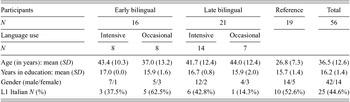
The age of onset of second language acquisition within the 37 bilinguals ranged from 0 to 35 years (mean = 15.0 years, SD = 10.9 years) while the onset of intensive second language learning for the 19 students was in a narrow range between 20 and 26 years. Participants were requested to specify their current use of each language in terms of frequency, context, mode and extent, as well as time and topics. Based on the frequency and intensity of their use of both languages, they were classified as intensive users or occasional users. Intensive users use their languages every day for job or personal needs, in other words, their bilingualism is exercised in their main daily activities, while occasional users have variable, but sufficient opportunities every month to keep their bilingualism alive. A summary of the demographic data concerning the study group and its arrangement into subgroups is presented in Table 1.
Main demographic data and group arrangement.

The bilinguals were classified either as early (AoA ≤ 10 years) or late (AoA > 10 years). The mean age of all participants was 36.5 years (SD = 12.6 years). It was significantly lower for the reference group (mean = 26.8 years, SD = 6.3 years) compared to the bilinguals (mean = 41.5 years, SD = 11.9 years; p < .01) with non-significant differences between the bilingual subgroups. Education level was homogeneously high (mean = 16.2 years in education, SD = 1.4 years), and participants were almost evenly matched with respect to their L1 (L1 Italian = 44.6%, L1 Spanish = 55.4%), with some differences between the subgroups (Table 1).
The majority of participants (N = 49) were fully right-handed, six were predominantly right-handed and one was left-handed.
The study was performed according to the guidelines of the Declaration of Helsinki; participants were informed about the general aim and modalities of the study and provided their written consent.
2.2 Preliminary cognitive tests
All participants underwent a short battery of neuropsychological tests to verify their general cognitive functions; relevant scores were inserted as covariates in the statistical analysis.
-
• Auditory and visual reaction times were used to evaluate attention and speed in information processing. Participants were required to signal the perception of a simple stimulus, and the elapsed time between stimulus and response was measured (Nissen & Bullemer, Reference Nissen and Bullemer1987).
-
• The Stroop Colour and Word Test was applied to evaluate selective attention and executive functions measuring the ability to maintain a goal in mind and suppress a habitual response in favour of a less familiar one (Barbarotto, Laiacona, Frosio, Vecchio, Farinato & Capitani, Reference Barbarotto, Laiacona, Frosio, Vecchio, Farinato and Capitani1998). In the colour mode of this test (Stroop C), participants were required to name the different colours of a series of squares as fast as possible; in the colour–word form (Stroop CW) they were required to name the colour of a series of words representing non-congruent colours (such as the word blue written in yellow).
-
• A word-fluency test was used to evaluate efficiency in memory access and organization. In this test participants were required to name as many words as they could in a given category and within a given time (Novelli, Papagno, Capitani, Laiacona & Cappa, Reference Novelli, Papagno, Capitani, Laiacona and Cappa1986).
-
• The Gurd paradigm was applied to evaluate verbal switching abilities (Gurd, Weiss, Amunts & Fink, Reference Gurd, Weiss, Amunts and Fink2003). In the category-switching task, participants were required to retrieve words alternately from contrasting semantic sets of categories (cars, animals, fruits); in the sequence-switching task the words were alternately retrieved from different sets of overlearned, ordered sequences (days of the week, letters of the alphabet, and months of the year).
All these tests were performed in Italian. In order to avoid possible bias due to native language status, this difference was estimated for each cognitive test by a linear model also considering age and gender. A small difference between the L1 Italian and L1 Spanish groups was found with higher scores in all tests for Italian L1. Even though this difference was not statistically significant, the effect of the administration of each test in L1 versus L2 Italian was quantified and used to correct the relevant scores.
2.3 Bilingual proficiency test
A bilingual proficiency test was developed for this study with the aim of evaluating efficiency in the pragmatic processing of complete meaningful sentences. Unlike previous studies, where the analysis focused on particular skills concerning the morphosyntactic rather than the semantic domain (Hernandez & Li, Reference Hernandez and Li2007; Morrison & Ellis, Reference Morrison and Ellis2000; Pakulak & Neville, Reference Pakulak and Neville2011), our aim was to evaluate proficiency in the recognition of pragmatic inter-linguistic correspondences, that is the recognition of units of meaning or utterances that have the same function in the two languages (Setton, Reference Setton1999).
The test consisted of 96 items. Each item included a reference sentence in one language (the input language), and two possible corresponding sentences in the other (target) language. Only one of the target sentences corresponded to the input sentence at the semantic/pragmatic level of the phrasal meaning. The other either differed in meaning or was unambiguously wrong. For one half of the 96 items the input language was Italian and the target language Spanish; for the other half the situation was reversed (see Supplementary Materials Online for details).
The presentation of the items in two languages, and the alternation of Italian and Spanish as input and target languages were designed to put subjects in bilingual mode (Grosjean, Reference Grosjean1998), to test switching skills, and to favour balanced bilinguals. Furthermore, considering that the sample was composed of both Spanish–Italian and Italian–Spanish bilinguals, who may be L1- or L2-dominant, the counter-balancing of items in the two languages should help to avoid a test bias associated with the dominant language. On the other hand, associations between L1 and target language may be analysed to explore language dominance.
The testing material was constructed by first selecting 48 idiomatic expressions including collocations, and 48 sentences including cognate words (Fusco, Reference Fusco1995) with a very similar spelling in both languages, but which are used in different contexts, have а slightly different or even а completely different meaning (false friends). These cognate words were divided into adjectives, nouns, verbs and adverbs. The selected items were deemed to be familiar to all native speakers and to be used by subjects in their everyday non-professional lives.
Target sentences were created so as to have two possible alternatives. One was a calque (literal) translation of the input, which would be pragmatically inadequate, while the other was a fixed expression with the same functional meaning in the target language. The idiomatic Spanish expression Esta situación me pone entre la espada y la pared has a literal translation into Italian, Questa situazione mi mette tra la spada e il muro “This situation puts me between the sword and the wall”, which is lexically and grammatically correct but pragmatically inadequate, since the idiomatic meaning, i.e. the choice between two unpleasant options, such as “between a rock and a hard place”, is lost in the literal translation. In Italian the choice between two unpleasant options is expressed with the idiom Questa situazione mi mette tra l’incudine e il martello “This situation puts me between the anvil and the hammer”.
As a second example, the Spanish expression Es un oficio bastante peligroso “It's a rather dangerous job” contains a false friend, oficio. Rendered literally into Italian, the phrase would become È un ufficio abbastanza pericolante “It's a rather unsafe office”. However, the current Spanish meaning of oficio is “job”; and the pragmatically adequate rendering È un mestiere abbastanza pericoloso also enables a correct association with the adjective peligroso “dangerous”. Finally, the simple Italian input È un brav'uomo “He is a good fellow/man” was followed by the calque target sentence Es un hombre bravo “He is a brave man”, which is grammatically correct, but does not correspond pragmatically to the adequate target Es un buen hombre.
Sentence length ranged from 1 to 11 words (2–11 words for the input sentences, and 1–11 words for the target sentences). Within each item, both correct (pragmatically adequate) and incorrect (calque) target sentences were approximately the same length. They had exactly the same number of words in 65/96 items and a difference of just one word in another 23 items, covering 94% of all items. Sentence length was also similar and evenly distributed between correct and incorrect targets in relation to the number of characters (mean difference = 0.06 characters, SD = 4.08 characters). As a result of the procedure applied to creating the target sentences (calque translation versus equifunctional utterances), cognate words were included with higher frequency in incorrect targets.
During pre-testing, all sentences were presented to three bilinguals (one early Italian L2 speaker, one early Spanish L2 speaker from Latin America and one early peninsular Spanish speaker from Spain) to validate the material. In the authors’ view, the test did not require translation abilities, but, rather, abilities in understanding and matching what was understood in the two languages as a result of the complex procedural process of recognition: the stronger L1 and L2 proficiency, the faster the procedure.
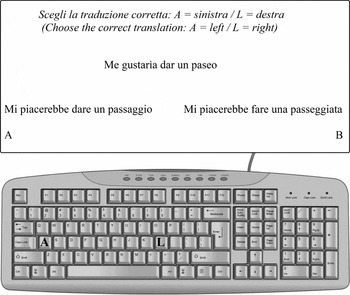
The software for test presentation and data recording was specifically developed using Matlab (Matlab v. 2011b, www.mathworks.com) and compiled to be implemented on the testing computer. Before the 96-item test, each participant was requested to read, silently and as quickly as possible, a sample sequence of Italian and Spanish sentences on a screen. The reading time was recorded as a possible confounding variable for the subsequent analysis. Items were then presented one at a time (Figure 1), with target sentences at opposite sides of the screen. Half of the items had the correct target on the left, and the other half on the right. The position (left/right) of the correct target was fixed for each item, while the sequence of items was randomized for each subject.
Schematic example of the bilingual proficiency test. One item at a time is presented on the screen, including a sentence in the input language (Spanish or Italian) and two suggested correspondences in the target language (Italian or Spanish). The subject is requested to press a key to indicate correspondence (A for the left target, and L for the right target).

Participants were requested to choose the best correspondence considering the functional meaning of each sentence. They were asked to respond as fast as possible with the aim of stimulating automatic switching and processing; correctness and response time were evaluated for each answer. The program waited for the subject to answer by pressing, on a standard keyboard, either one of two selected keys (‘A’ for the left target, ‘L’ for the right target). Subjects had their left and right index fingers continuously positioned on the relevant keys. Subsequent items were presented following subjects’ response without any choice-dependent feedback.
2.4 Statistical analysis
A preliminary analysis was performed concerning the distribution of the 96 items in terms of time and matching of answers. Those items which received a large number of answers (over 50%) that differed from the expected one were considered ambiguous and were excluded from the subsequent analysis. In order to prevent a possible bias due to response times associated with wrong answers (some subjects may have passed over unknown phrases), the response times associated with right and wrong answers for the items which had yielded both types of answers were compared by paired t-test. The effect of sentence length and correct-target position on response time and error rate was evaluated by correlation and regression analysis. Internal consistency reliability was evaluated by item-total correlation and Cronbach's alpha, and by the correlation between mean response time per subject and percentage of correct answers. Discriminant validity was then evaluated by comparing the bilingual group with the reference group of students.
For discriminant validity and subsequent analyses, the dependent variables were transformed by the log transform for the response times, and by the logit transform for the percentage of correct answers, in order that they would approach the normal distribution. The analysis was then performed by multivariate general linear model (GLM).
To evaluate the effect of AoA and language use on L2 proficiency, multivariate GLM analysis was therefore applied with two dependent variables, the log-transformed mean response time, relevant to all included items, and the logit-transformed percentage of correct answers. Degree of language use was considered as an independent categorical variable and classified into three levels corresponding to the reference group, the group of occasional users and the group of intensive users, respectively. AoA, age, years of education, cognitive scores (Stroop C and CW, fluency and switching scores, visual and auditory reaction times), BDI score, and the reading time for the test screen were inserted as covariates. Non-significant covariates were then removed and residuals of the GLM analysis were checked for deviations from the normal distribution using the Shapiro–Wilk test. Group means were compared post hoc with the Newman–Keuls test while the covariate effects were evaluated by their regression coefficients and associated t-values.
In order to exclude the effect of ambiguity and uncertainty associated with difficult sentences, and to verify whether differences in proficiency may affect response times for unambiguous items, the GLM analysis was repeated considering only the items which were answered correctly by all subjects. In this case, the analysis was univariate as the rate of correct responses was 100% for all subjects, and the only dependent variable entered was the response time.
Following the approach proposed by Segalowitz and colleagues (Phillips et al., Reference Phillips, Segalowitz, O’Brien and Yamasaki2004; Segalowitz & Hulstijn, Reference Segalowitz and Hulstijn2005; Segalowitz & Trofimovich, Reference Segalowitz, Trofimovich, Gass and Mackey2011), the inter-item coefficient of the variation of response time (the standard deviation divided by the mean) was computed for each subject and analysed as a function of the predictors found in the previous analysis, with the aim of exploring a possible indicator of automaticity.
A correlation matrix was also computed to explore the associations between each pair of quantitative variables involved in the analysis. The relevant significance was evaluated at a nominal level of p < .05, without correction for multiple tests.
Statistical analyses were performed by means of the software package STATISTICA (STATISTICA v. 10, www.statsoft.com).
3. Results
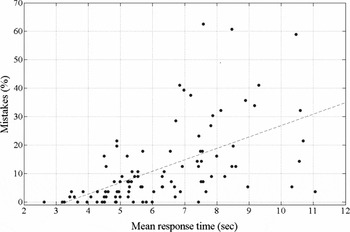
The scatterplot of the percentage of mistakes for each item as a function of the mean response time is shown in Figure 2, where the (expected) increasing frequency of mismatches with response time can be observed. A total of 15 items (15.6%) were matched correctly by all subjects, with a mean response time within 7.5 sec. A further 50 items (52.1%) were answered with a mean response time of less than 6 sec and a maximum of 12 mismatches (21.4% of subjects). The remaining 46 items (47.9%) had higher mean response times associated with variable but on average higher mismatch rates, and three of them had more than 50% mismatches, showing ambiguity or unexpected difficulty. These three items were excluded from the subsequent analysis, which was thus based on the remaining 93 items.
The scatterplot shows the distribution of the percentage of subjects providing incorrect answers for each of the 96 items used in the bilingual proficiency test as a function of the mean response time. The association between error rate and response time is depicted by the grey dashed regression line (linear correlation coefficient = .556, p < .0001).

The response time associated with mismatches was significantly higher than the time associated with correct matches of the same items (mean difference = 2.33 sec, SD = 2.60 sec, paired t(77) = 7.93, p < .0001), which confirms the association between response time and difficulty in mental evaluation/computation of the item. The number of mismatched answers by more than 10 subjects was 16. Of these, five were related to a noun, five to an idiomatic expression, two to a verb, three to a collocation, and one to an adverb. Some details concerning items with a high error rate are reported in the discussion.
The mean response time correlated with the length of the input sentence (and of the target, as the length was almost the same), measured as number of words (Pearson's correlation coefficient, r = .596, p < .0001) but the percentage of errors did not (r = .011, ns). In order to exclude any bias associated with the side (left/right) of the correct target, a GLM analysis was applied with response time as a dependent variable, correct target side as a categorical predictor, and target length and percentage of correct items included as continuous covariates. No effect was found for correct-target side while the significant effects of sentence length and percentage of correct responses were reconfirmed in accordance with the previous results. No relationship was found between handedness and correct-target side.
Internal consistency reliability, as evaluated by Cronbach's alpha, was .975, with an average inter-item correlation of .360, and an item-total correlation ranging from .327 to .799. The correlation between the mean response time per subject and the percentage of correct answers was .478 (p < .0005). The difference between the bilingual and the reference groups, as evaluated by multivariate GLM, was significant (F(2,53) = 7.44, p < .002), stronger for correctness rate (F(1,54) = 14.97, p < .0005) than for response time (F(1,54) = 4.07, p < .05). The difference in reaction times between items with Spanish versus Italian input was slightly greater for the reference group than for bilinguals, but the group effect was not significant. Neither was the effect of L1, nor the interaction between group membership and L1.
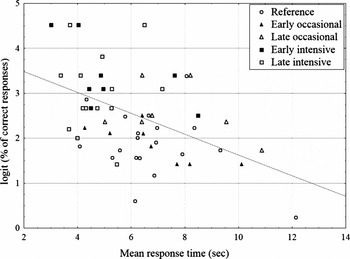
The distribution of participants with regard to the percentage of matches (logit-transformed, 93 items) versus mean response time is depicted in Figure 3. Shorter response times and a higher percentage of correct matches were found for the early and late intensive groups, while the other three groups showed the opposite trend with longer response times associated with more mismatches. Considering only the first two groups (early and late bilinguals with intensive language use, N = 22), the mean percentage of correct answers was 94.66% (SD = 4.23%). In total, 51 items were answered correctly by all subjects from these groups, a further 18 items had one wrong answer, 11 items had more than 3 errors, and one item the maximum number of 9 errors.
Distribution of subject performances: percentage of correct answers (logit-transformed) as a function of the mean response time based on 93 items. Symbols indicate group membership according to language use (reference group, occasional and intensive users) and to the age of second language acquisition (early and late learners). The association between percentage of correct answers and mean response time is depicted by the grey dashed regression line (linear correlation coefficient = −.469, p < .0001).

Multivariate GLM analysis, with response time and rate of correct answers as simultaneous dependent variables, showed significant effects for language use (Wilks's lambda = .574, F(4,94) = 7.52, p < .00001), for category-switching score (Wilks's lambda = .614, F(2,47) = 14.8, p < .00001), for Stroop C (Wilks's lambda = .858, F(2,47) = 3.88, p = .028) and reading time (Wilks's lambda = .878, F(2,47) = 3.27, p = .047).
AoA was not significant. Its possible interaction with the most significant effect (language use) was checked post hoc but was itself not significant.
No significant effects were found for either age, gender, years of education, BDI score, visual or auditory reaction times, or for the other cognitive tests (fluency, Stroop CW and sequence-switching test).
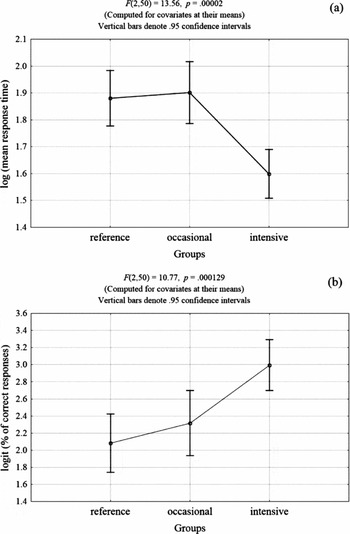
The differences between the group means, computed for the covariates at their means and checked by the Newman–Keuls post-hoc test, are shown in Figure 4. Figure 4a shows that mean response times for subjects with intensive use of both languages were significantly shorter than the mean times of the other two groups (occasional users and reference group), while these were not significantly different from one another. Figure 4b shows that the rate of correct matches for the group of intensive users was also significantly higher than that for the reference and occasional groups. The occasional group's values were slightly but not significantly higher than those of the reference group.
Mean patterns for three groups of participants (reference group, occasional and intensive users of both languages): (a) mean response time; (b) percentage of correct answers. Means and 95% confidence intervals were drawn from a multivariate general linear model analysis accounting for significant covariates (categorical switching, Stroop C score and reading time).

As for the effect of the covariates, mean response time was negatively associated with the category-switching score (t(49) = −4.13, p = .00015) and was positively associated with reading time (t(49) = 2.57, p = .013), but not with Stroop C. The rate of correct answers showed a significant effect of the category-switching score (t(49) = 3.80, p = .0004) and Stroop C (t(49) = −2.68, p = .010), but not of reading time. Explained variance, as estimated by adjusted R2 for the whole model, was 58.8% for response time and 51.1% for the percentage of correct responses (logit-transformed). The deviation of residuals from normal distribution, as evaluated by the Shapiro–Wilk test, was not significant (response time: W = .986, p = .782; percentage of correct responses: W = .976, p = .332).
The GLM analysis was repeated on the 15 items which had been answered correctly by all subjects. In this case the analysis was univariate as the rate of correct responses was 100% for all subjects, and the only dependent variable included was the response time. The analysis confirmed the significant effects of language use (F(2,50) = 17.65, p < .0001) and category-switching score (F(1,50) = 7.55, t(50) = −2.75, p = .0083), and returned an increased effect of reading time (F(1,50) = 16.61, t(50) = 4.08, p < .00016) as well as a significant effect of Stroop CW (F(1,50) = 6.08, t(50) = −2.47, p = .017).
In a further GLM analysis we assessed, as a dependent variable, the coefficient of variation of reaction times as computed for each subject, considering only the 15 selected items. Among the independent variables, the only significant effect was found for language use (F(2,53) = 9.83, p = .0002). The mean coefficient of variation for subjects with intensive use of both languages was significantly lower than the means of the other two groups (occasional users and reference), which, in turn, were not significantly different from one another.
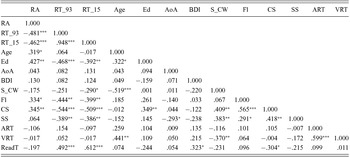
Pair-wise correlations between the variables involved in the previous analysis are shown in Table 2, where a nominally significant association between the response time at the bilingual proficiency test and a number of other variables, in particular the cognitive scores, can be observed. This association was not equally evident in GLM results due to the inter-correlation among independent variables, so that the strongest effects (category-switching and Stroop CW score) turned out to be significant. A slightly different pattern can be found for the correct-answer rate, which was associated with the semantic component of the cognitive tests.
Matrix of pair-wise correlations between quantitative variables involved in the analysis of bilingual proficiency.

RA = correct answers; RT_93 = response time based on 93 items; RT_15 = response time based on 15 items; Age = age at testing; Ed = years in education; AoA = age of L2 acquisition; BDI = Beck's Depression Inventory; S_CW = Stroop colour–word; Fl = fluency; CS = category switch; SS = sequence switch; ART = auditory reaction time; VRT = visual reaction time; ReadT = reading time
Nominally significant correlations (not corrected for multiple tests): * p < .05; ** p < .01; *** p < .001
4. Discussion
The results of this study strongly support the hypothesis that intensive use of L1 and L2 is a major factor influencing language proficiency for both accuracy and speed of recognition of pragmatically equivalent utterances across two languages, while the effect of AoA turned out not to be significant. Subjects who had acquired L2 early in life and continued to use both languages intensively recorded the highest rate of correct answers and the shortest mean response times, but the difference with late L2 learners who used both languages intensively was not significant.
As for language use, subjects were sharply divided into two groups, intensive and occasional users. In our opinion this reflects the common polarization between one set of circumstances, in which people are forced, mainly for professional reasons, to communicate intensively in bilingual mode during their main daily activities, and another set, in which bilingual people occasionally or frequently switch between L1 and L2 in their social/family environment. Of course, a variety of different situations can occur, and researchers may identify different ways to quantify the rate of L1 and L2 use. However, based on the information recorded during this study, the bimodal classification seemed to fit the bilingual sample adequately even though further studies, which would explore language use in greater detail, are desirable.
The bilingual proficiency test was associated with the verbal switching task, which is thought to involve the frontal, parietal and sub-cortical structures. It was also associated with the Stroop test, which is indicative of selective attention. This is in accordance with the suggestion that enhanced bilingual executive functions are related to the constant need for selecting the appropriate language (MacWhinney, Reference MacWhinney2005). Proficiency at the bilingual test was also associated with the speed of reading a screen page. These effects obtain irrespective of group membership.
No effects were found with regard to visual and acoustic reaction time, suggesting that the response time recorded in this study was related to high-level information processing but unaffected by differences in low-level sensory input. No significant effects were found in terms of age and years of education; the absence of the latter may, however, be explained by the high level of education common to all participants. A possible association between length of education and bilingual proficiency was suggested by the descriptive correlation analysis, which also suggested an association between bilingual proficiency and verbal fluency. As expected, the cognitive tests were inter-correlated and the verbal switching task proved to be most important for bilingual proficiency.
When the analysis was restricted to the 15 items which were correctly answered by all subjects, we also found a significant effect of Stroop CW, which is indicative of interference inhibition. These items were associated with shorter response times and a stronger effect of reading time since they most likely included well-known sayings in the input and the corresponding target, whose correct identification was only hindered by interference from a literal but inadequate translation of the input, including cognate words with divergent meanings. Higher Stroop CW scores might then be associated with the ability to inhibit stimuli raised by misleading similarities.
On the whole our study showed an important effect of switching and inhibition capabilities on different aspects of bilingual proficiency along with other cognitive competences. This particular role of switching and inhibition control might have been emphasized by the characteristics of the administered test. A more general cognitive competence seems, however, to affect bilingual proficiency, as was also suggested by other studies concerning cognitive advantages of bilingualism (Hilchey & Klein, Reference Hilchey and Klein2011).
As pointed out in the Introduction, the hypothesis of a critical period for L2 acquisition in early life was put forward by Johnson and Newport (Reference Johnson and Newport1989), and an AoA effect was asserted in other studies (Fabbro, Reference Fabbro2001; Hernandez & Li, Reference Hernandez and Li2007; Pakulak & Neville, Reference Pakulak and Neville2011). On the other hand, the CPH, as proposed by Johnson and Newport, was questioned by Flege et al. (Reference Flege, Yeni-Komshian and Liu1999), showing that other confounding factors, such as education and language use, could explain the AoA effect. In several later studies, in particular some concerning brain activities associated with language skills (Abutalebi, Reference Abutalebi2008; Abutalebi et al., Reference Abutalebi, Tettamanti and Perani2009; Kotz, Reference Kotz2009; Perani et al., Reference Perani, Abutalebi, Paulesu, Brambati, Scifo, Cappa and Fazio2003), the role of AoA was questioned. Such studies found minor differences in brain activation between early and late L2 learners, but they also showed a trend towards a decrease in these differences as a function of L2 proficiency in accordance with Green's Convergence Hypothesis (Green, Reference Green, van Hout, Hulk, Kuiken and Towell2003). In further agreement with this hypothesis, our study shows that intensive bilingual experience can lead to high levels of proficiency and the disappearance of AoA-related differences, as evaluated by an experimental test of bilingual skills.
The most relevant result of our study was that the highest levels of bilingual proficiency were not related to AoA, but, rather, to the intensive use of both languages. This raises the question of why such experience in two languages proved so beneficial for bilingual proficiency. One hypothesis is that increasing practice involves changes in mental representation (Riehl, Reference Riehl2010). Many early studies in bilingualism focused, for example, on processes that allow direct lexical access to L2 without the mediation of L1 (Costa, Miozzo & Caramazza, Reference Costa, Miozzo and Caramazza1999; Frenck-Mestre & Prince, Reference Frenck-Mestre and Prince1997; Potter, So, Eckardt & Feldman, Reference Potter, So, Eckardt and Feldman1984). A common view in the literature is, however, that bilingual proficiency is not simply a question of developing satisfactory representations in L2. There is increasing evidence that both languages are always active in bilingual comprehension (Hartsuiker, Costa & Finkbeiner, Reference Hartsuiker, Costa and Finkbeiner2008; Marian, Spivey & Hirsch, Reference Marian, Spivey and Hirsch2003; Van Assche, Duyck, Hartsuiker & Diependaele, Reference Van Assche, Duyck, Hartsuiker and Diependaele2009). This provides a strong argument for the assumption that proficiency is a matter of how L1 and L2 are selectively activated and inhibited.
Specifically, processes controlling representations in the lexicon must be associated with other general cognitive procedures that become more and more efficient with practice and that enable the management of native and later acquired languages. This management is based on executive functions, particularly inhibition, tagging, language switching and monitoring. According to the Inhibitory Control Model (Green, Reference Green1998), the appropriate language is selected by inhibition of competing representations in the inappropriate language. This model predicts that higher levels of L2 proficiency will be achieved more easily by individuals who are better able to inhibit irrelevant information. This prediction is corroborated by the correlation we found between performance in the switching task, the Stroop CW score, and the response times in our bilingual proficiency test. Such skills are individual competences, possibly interacting with bilingual experience, but independent of AoA of L2.
The substantial gap between intensive and occasional bilinguals in terms of response times suggests that automatic procedures can become available, irrespective of AoA, as a result of frequency and recency of bilingual experience. The decrease of response times may alternatively be explained by the speeding up of non-automatic (controlled) cognitive processes, but the parallel decrease of inter-item variability, as suggested by Segalowitz (Phillips et al., Reference Phillips, Segalowitz, O’Brien and Yamasaki2004; Segalowitz & Hulstijn, Reference Segalowitz and Hulstijn2005) is a more specific indication that automatic processes are operating that involve the pragmatic skills fostered by the task.
The results of our study do not provide information about the neural substrate of cognitive activities. We can only point out that, apart from the contrast between declarative and procedural memory in processing language rules, which has been extensively discussed in the previously referenced studies (Abutalebi, Reference Abutalebi2008; Fabbro, Reference Fabbro2001; Paradis, Reference Paradis2004; Ullman, Reference Ullman2001), we should also take into consideration the possible contrast between active (involving effort) and automatic memory retrieval (Miyashita, Reference Miyashita2004) and suggest that automatic processes involving associative memory retrieval might be present in bilinguals with intensive language experience. Proficiency is, conversely, weakened when bilingual experience becomes occasional or ceases. The trends found for the percentage of correct matches differed slightly between occasional users and the reference groups. The former performed slightly better than the latter, however, this difference was not significant. This can only suggest that pragmatic competence was partially preserved and supported by mechanisms based on explicit memory in this group. The importance of intensive bilingual experience is consistent with other findings concerning the role of implicit L2 training in the achievement of native-like brain activation patterns (Morgan-Short et al., Reference Morgan-Short, Steinhauer, Sanz and Ullman2012).
Phonetic and prosodic components of language perception and production were not directly assessed in the proficiency test in this study, even though a mental representation of such components was likely active while subjects were processing the sentences. Therefore, a specific effect of AoA on phonetics, as suggested in previous studies (Flege et al., Reference Flege, Yeni-Komshian and Liu1999; Singleton, Reference Singleton2005), cannot be excluded. Instead, the test applied in this study sought to evaluate the subjects’ performance in appropriately understanding and communicating typical utterances they may encounter in everyday life, as well as in maintaining adequate language control in bilingual mode. Reliability measures, such as item-total correlation and the association between reaction times and the correctness of answers, confirmed the internal consistency of the test, while the comparison between bilinguals and reference group indicated its discrimination capability, at least for accuracy and reaction times, though not for bilingual balance. The test did not explore an extensive range of bilingual competences but proved to be sensitive to pragmatic bilingual skills.
The study was carried out between two typologically related languages, Spanish and Italian. Language similarity entails that some lexical and syntactic structures can be coded from/to L1 and L2 more easily than in the case of typologically distant languages, such as Korean/Chinese versus English, which were the test languages in the studies discussed above (Flege et al., Reference Flege, Yeni-Komshian and Liu1999; Johnson & Newport, Reference Johnson and Newport1989). The issue of L2 acquisition involves both distant and related languages (Bialystok & Miller, Reference Bialystok and Miller1999). In the present study, the similarity may have produced problems of interference and language mixing, since it stressed the ability to switch between languages, to select the appropriate language and inhibit the other.
The correlation between bilingual proficiency and the scores of the cognitive tests measuring switching abilities and selective attention confirmed the role of language control and switching in the present test. In many cases, mismatches were associated with interferences triggered by false friends; false friends were in fact present in the three items excluded from the analysis due to the large number of errors.
In one of these items, the word postura “posture”, which has a similar meaning but different fields of application in the two languages, posed an additional collocation problem, the alternation between the adjectival and the adverbial forms (input: Es una postura de franca intimidación; correct target: È una posizione di intimidazione decisa “It's a position of firm intimidation”; alternative: È decisamente una postura di intimidazione “It's definitely a posture of intimidation”). In the second critical item, the problem was the Spanish verb rebasar “to increase”, which sounds very similar to its opposite rebajar “to decrease”, and to the Italian ribassare, again “to decrease”, while in the third critical item the problem (mainly for the occasional and reference groups) was the Italian noun Illuminismo, the historical age of the Enlightenment, whose correct Spanish target was Ilustración but which was matched with Iluminismo, a term seldom used in Spanish indicating a religious movement of the 15th–16th centuries. In spite of the high education level of the subjects, the correspondence of Illuminismo and Illustración seems to have been unfamiliar to many.
Among the items included in the analysis, 15 items were matched correctly by all participants. In general, the intensive-use group had the largest number of error-free items (51 items) followed by the occasional users (38 items) and the reference group (20 items). The percentage of errors for the intensive-use group was higher than for the other two groups in just four cases, including two items, in which the alternative meaning of a noun was deemed to be acceptable, and one item with a misinterpreted medical term (the Spanish autista “autistic”, which was confused with the Italian autista “driver”). In these three cases the percentage of mismatches was less than 15%, while it was almost 32% in the fourth case, the Spanish idiom quítate de en medio “get out of the way”. This item had two acceptable Italian correspondences, togliti da lì “get out of there”, and togliti dai piedi, literally “get out of my feet”, but the second one, as an idiom, was more pragmatically adequate.
The items which recorded mismatches by more than 10 subjects (17% of the sample) involved both the occasional users and the reference group. The occasional users showed a particularly high mismatch rate for three job-related items. In the first item, the Italian anzianità, meaning “job seniority”, was matched with ancianidad “old age” instead of the adequate equivalent antigüedad (de servicio). In the second item, Me ha llegado la nómina “My pay-roll has arrived/I received my pay-roll”, the Italian nomina “appointment” was activated, while, in this case, nómina means “pay-roll”. The third item was Es un facultativo muy conocido “He is a well-recognized physician”. Here facultativo is an uncommon noun corresponding to Italian medico “physician”, but was matched by many subjects with the Italian facoltoso “rich man”.
On the other hand, the reference subjects gave more mismatches concerning the interpretation of everyday words or idioms, for example, the sentence Lo ha hecho de la noche a la mañana “He did it overnight”. Half of the students did not perceive (as natives do) the idiom and isolated the single Spanish lexeme noche as corresponding to the Italian notte “night”, instead of choosing the Italian dalla sera alla mattina “from evening to morning”, meaning “overnight”. And again, concerning cognates with divergent meanings, the majority of reference subjects failed to match the Italian ufficio “office” and the Spanish oficina, interpreting ufficio as the Spanish oficio “trade”.
On the whole, all subjects tended to recognize both correct and incorrect sentences in the two languages, but correct matches between the two languages were improved by the familiarity of terms and idioms, while the presence of false friends made correct matches more difficult. Mismatches were presumably encouraged as the subjects were required to answer as fast as possible. Further analysis of the items with a focus on the relationship between the input/target languages and the subjects’ L1 may provide more information about the features influencing bilingual proficiency, even though a larger sample would be necessary to draw reliable inferences concerning such complex effects and interactions.
As was already suggested by Mohamed Zied and colleagues, “manipulating two languages may enhance the efficiency of inhibitory mechanisms” (Mohamed Zied, Phillipe, Pinon, Havet-Thomassin, Aubin, Roy & Le Gall, Reference Mohamed Zied, Phillipe, Pinon, Havet-Thomassin, Aubin, Roy and Le Gall2004, p. 254, 256). Recent studies confirmed the advantage for proficient bilinguals in tests involving executive functions, in particular inhibition, self-monitoring, problem solving, generative fluency (Festman, Rodriguez-Fornells & Munte, Reference Festman, Rodriguez-Fornells and Munte2010), and flexible mental shifting (Prior & MacWhinney, Reference Prior and MacWhinney2010). An open question concerns the nature of the relationship between executive functions and language control abilities, and the direction of this relationship (Festman et al., Reference Festman, Rodriguez-Fornells and Munte2010). Do only pre-existent individual differences in executive functions affect language control, or does intensive bilingual experience improve these functions too?
An interesting contribution to this topic, which is also an important clinical finding, comes from a recent study indicating a protective role of bilingualism against the onset of symptoms of Alzheimer's disease (Craik, Bialystok & Freedman, Reference Craik, Bialystok and Freedman2010). According to this study, the intensive use of two or more languages throughout one's life and particularly in old age is intellectually demanding and supports the cognitive reserve, which is considered a protective factor capable of delaying the onset of critical cognitive impairments. The present study shows that continuous and intensive use of both L1 and L2 is a major factor in achieving and maintaining preserving a high level of bilingual proficiency, and confirms the latter's relationship with general cognitive functions.