The activity pattern of an organism is a key aspect of its biology, and understanding how biotic and abiotic factors determine daily cycles of activity may reveal adaptations and constraints on animal species (Halle Reference HALLE, Halle and Stenseth2001). Periods of high activity should coincide with the best compromise between potentially conflicting demands, for instance feeding vs. reduction of predation risk vs. physiological stress. Temperature affects activity patterns in small mammals (McManus Reference MCMANUS1969). Endothermic animals maintain body temperature during periods of high or low ambient temperatures, resulting in a high amount of energy lost in thermoregulation. To minimize energy expenditure, possible strategies are to reduce activity, cease activity, or change it to other periods (Fitch & Shirer Reference FITCH and SHIRER1970, McManus Reference MCMANUS1969). In neotropical marsupials, the only species that reaches temperate latitudes, Didelphis virginiana, decreases activity below 8°C (Ryser Reference RYSER1995), and is rarely active in the hottest hours of the day. Even in tropical and subtropical latitudes, temperature may limit activity of species, such as with D. marsupialis (Morrison Reference MORRISON1946).
Activity of marsupials can vary between sexes, ages and seasons, among other factors (Atramentowicz Reference ATRAMENTOWICZ1982, Galliez et al. Reference GALLIEZ, LEITE, QUEIROZ and FERNANDEZ2009, Ladine Reference LADINE1997). In didelphid marsupials, the opossum Didelphis aurita Wied-Neuwied, 1826 is one of the most abundant in the Atlantic Forest (Gentile et al. Reference GENTILE, FINOTTI, RADEMAKER and CERQUEIRA2004). Reproductive and climatic seasons affect its movements; males use larger areas less intensively in the reproductive period, and females increase movements in the dry season in response to reduced food availability (Loretto & Vieira Reference LORETTO and VIEIRA2005). Differences between sexes and seasons in activity could occur if affected by the same environmental cues, such as food availability and search for mates.
This study describes the activity pattern of D. aurita and evaluates the influence of sex, age class, reproductive and climatic seasons, and minimum temperature. We expected temporal differences between sexes and seasons, as observed in movement patterns in the same population (Loretto & Vieira Reference LORETTO and VIEIRA2005). Additionally, we predicted low temperatures will reduce activity.
We conducted the study in the Serra dos Órgãos National Park (PARNASO; 22°28′S, 42°59′W), an Atlantic Forest area, state of Rio de Janeiro, south-eastern Brazil. The climate is mild humid-mesothermic (Nimer Reference NIMER1989), and during the study total monthly rainfall ranged between 2.8 mm and 708.8 mm, with mean minimum and maximum monthly temperatures of 4.5 °C (June 2009) and 34.8 °C (March 2010). We obtained meteorological data from a climatic station of the PARNASO (22°26′S, 42°59′W) at 980 m asl. Sampling points and the climatic station are on the same slope of the mountain range and within the same valley. Therefore, despite the altitudinal difference between climatic station and our study site, minimum temperatures should follow the same pattern of variation throughout the region, and up to the altitude of the climatic station used.
We captured individuals in three grids, in 10 sessions of five nights each from June 2009 to December 2010 (for details see Gentile et al. Reference GENTILE, FINOTTI, RADEMAKER and CERQUEIRA2004). We equipped Tomahawk live traps with digital timing devices that indicated the time the animal was captured. We recorded capture time, sex, reproductive condition and age class. Individuals were classified in three age classes based on tooth eruption sequence: juveniles, subadults and adults (Macedo et al. Reference MACEDO, LORETTO, VIEIRA and CERQUEIRA2006). The reproductive period of D. aurita occurs from July to February, and was defined as the period when every adult or subadult female showed reproduction signs.
Time of capture was converted to minutes after sunset (min as). Subsequent captures of the same individual during the following nights were ignored because of potential stress-related changes in activity. For the purpose of classification of activity patterns, we pooled captures in classes of 2-h intervals. Individuals were classified as diurnal, nocturnal, crepuscular, non-circadian, or acyclic based on time of activity, and as unimodal, bimodal or multimodal according to the distribution of activity (Bartness & Alberts Reference BARTNESS, ALBERTS, Halle and Stenseth2000). Activity distributions were modelled as finite mixtures, using the package mixtools (version 1.0.0). We formulated nine models to determine the influence of sex, age class, nightly minimum temperature, reproductive (breeding and non-breeding) and climatic seasons (humid and super-humid) on the time of capture of D. aurita. We used Akaike's Information Criterion corrected for small sample size (AICc) to compare models based on the maximum likelihood (Burnham & Anderson Reference BURNHAM and ANDERSON1998). We included an intercept-only model to compare the explanatory power of predictor variables relative to other unaccounted sources of variation. Model selection was performed with the package MuMIn (version 1.9.11). All analyses were performed in R environment (version 2.13.0, R Development Core Team).
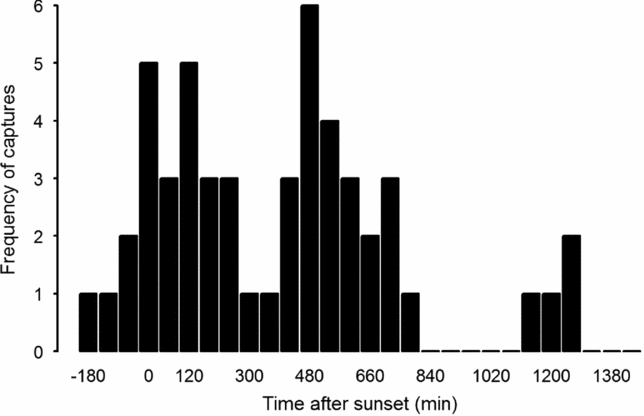
We captured 37 individuals of D. aurita 51 times (28 females and 23 males): 19 females and 17 males in the reproductive period, nine females and six males in the non-reproductive period. When grouped by climatic season, 14 females and 13 males were captured during the super-humid season, and 14 females and 10 males in the humid season. Regarding age, we captured nine juveniles, 19 subadults and 23 adults. Didelphis aurita was mostly nocturnal, with a bimodal activity pattern in the night, but some individuals were also active during the day (Figure 1). The first activity peak started around sunset, and declined thereafter until achieving minimum activity between 240 and 300 min as. Latter, activity increased, and a second peak was recorded until 780 min as. Daytime activity encompassed 12% (N = 6) of the total activity, and was recorded mostly in adults, with only one juvenile male. Most daytime activity was in the afternoon, but the weak activity in the morning could be a result of interference by researchers who checked traps.
Frequency of captures of the marsupial Didelphis aurita in periods of 60 min with relation to local sunset time (zero mark) in an Atlantic Forest area, south-eastern Brazil. Negative values represent activity before sunset.

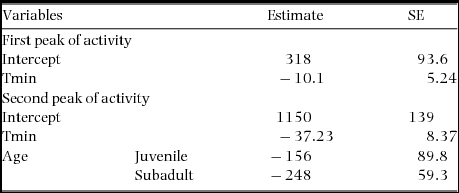
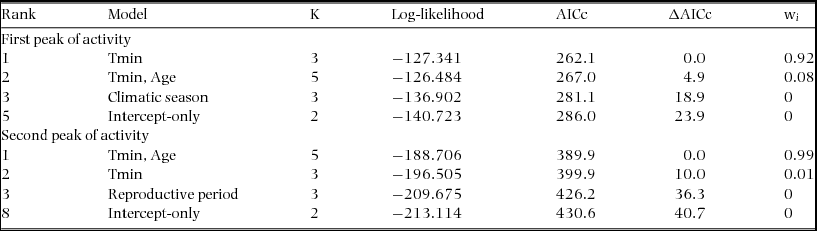
Due to the bimodal distribution of activity, we evaluated the effect of biotic and abiotic factors in the first (117 ± 90.0 min as) and second (560 ± 137 min as) peak of activity separately. Minimum temperature was the top-ranked variable for both activity periods (Appendix 1). In the first peak, the most plausible model included only minimum temperature. The second-ranked model, which also included age, was less plausible. In the second peak, minimum temperature and age formed the only plausible model, with juveniles and subadult less captured than adults.
The number of individuals active during the night reduced as minimum temperature increased. The negative relationship between number of individuals active and minimum temperature, observed in both activity peaks, reveal that low temperatures do not seem to limit activity of D. aurita (Table 1). Activity in a wide range of temperatures shows that D. aurita is able to persist at different temperatures and may be active at lower temperatures than its congener, D. virginiana (McManus Reference MCMANUS1971).
Standardized parameters of the best models predicting activity pattern of Didelphis aurita.
The bimodal distribution agrees with observations on another population of D. aurita (Fernandez Reference FERNANDEZ1989), and on a population of the marsupial Gracilinanus microtarsus in the study area (Matheus Dalloz, pers. comm.). This activity may be a result of intrinsic circadian rhythms, which generally are bimodal (Aschoff Reference ASCHOFF1966). In the field, bimodal activity has also been recorded in bats (Erkert Reference ERKERT, Halle and Stenseth2001), rodents (Bacigalupe et al. Reference BACIGALUPE, REZENDE, KENAGY and BOZINOVIC2003) and carnivores (Julien-Laferrière Reference JULIEN-LAFERRIÈRE1993). Conversely, unimodal distribution of nocturnal activity was recorded in other marsupials (Galliez et al. Reference GALLIEZ, LEITE, QUEIROZ and FERNANDEZ2009, McManus Reference MCMANUS1971, Ryser Reference RYSER1995). These contrasting results point to flexibility in the activity pattern within didelphid marsupials. However, generalizations are premature considering the few studies conducted with the group.
It is common for young to be active in distinct periods of adults in mammals (Ladine Reference LADINE1997). In this study, we detected differences in activity in the second peak, with juveniles and subadults less active compared with adults. Young opossums tend to move within small areas, and stay close to their dens (Fitch & Shirer Reference FITCH and SHIRER1970). These inexperienced individuals also require less food intake compared with adults, which could lead to a shorter period of activity, concentrated in the first hours of the night.
Different from expected based on movement patterns (Loretto & Vieira Reference LORETTO and VIEIRA2005), reproductive and climatic seasons did not influence the activity pattern of D. aurita. The use of larger areas by males in the reproductive season and by females in the driest season was not reflected in the time range used in the same population, despite the knowledge that, in marsupials, movements as well as activity patterns can be affected by both seasons (Atramentowicz Reference ATRAMENTOWICZ1982, Loretto & Vieira Reference LORETTO and VIEIRA2005, McManus Reference MCMANUS1971). Differences in activity during the year may be apparent when time allocated to distinct activities such as sleeping and eating is taken into account. In winter, when food availability is low, D. virginiana was active in the same period as in summer (between 17h00 and 07h00), but devoted almost twice the time to feeding and nest construction (McManus Reference MCMANUS1971). Nonetheless, time budget studies are difficult to conduct with cryptic animals in the field and studies in semi-natural environments are exceptions (McManus Reference MCMANUS1971).
The present study demonstrates the dynamic aspect of activity patterns. Individuals of Didelphis aurita are generally nocturnal, as usually assumed, but a great number of individuals were active during the day. Besides, bimodal activity may not be simply a circadian, intrinsic rhythm, but also may have a behavioural and more plastic component; juveniles and subadults have a more unimodal activity. Finally, minimum temperatures commonly encountered in tropical regions do not seem to limit the foraging behaviour of D. aurita. Opossums were more active on colder nights, indicating a behavioural adjustment in this environment.
ACKNOWLEDGEMENTS
We thank students of the Laboratório de Vertebrados for assistance in the field work. Renato Crouzeilles provided valuable comments in the manuscript. Nélio Barros and Angela Marcondes provided vital support in the laboratory. This study was part of the MSc. dissertation of Mariana Ferreira -- Programa de Pós-Graduação em Ecologia. Fundação de Amparo à Pesquisa do Estado do Rio de Janeiro (FAPERJ) and Conselho Nacional de Desenvolvimento Científico e Tecnológico (CNPq) (to MVV), Coordenação de Aperfeiçoamento de Pessoal de Nível Superior (CAPES), and PROBIO II/MCT/MMA/GEF provided financial support.
Comparison of the top models predicting activity patterns of Didelphis aurita. Explanatory variables were age (juvenile, subadult and adult), sex (female vs male), climatic season (humid and super-humid), reproductive period (breeding and non-breeding) and minimum temperature (Tmin). K = number of parameters of the model, AICc = Akaike Information Criteria corrected for small ratio sample size/number of parameters, ΔAICc = AICci – minimum AICc, wi = Akaike weight. Evaluated models: Tmin; Tmin + Age; Sex; Sex + Age; Sex + Climatic Season; Sex + Reproductive period; Climatic Season; Age; Reproductive period; Intercept-only.