In a pivotal moment in Mabel Wotton's short story, “The Fifth Edition” (1896), Janet Suttaby, a struggling writer unable to find a publisher for her novel, offers the rising literary star, Franklyn Leyden, her manuscript, telling him, “If you really think there is any good in it . . . it must either go back to the drawer until I have time to polish it, or . . . you must take it” (179). Miss Suttaby offers almost no explanation for her act, nor does she outline what she expects Leyden to do with the manuscript, so when Leyden accepts, re-writes, and then publishes it under his own name, he hasn't done anything that she has explicitly forbidden. Nevertheless, his appropriation of her work is clearly marked in the text as ethically compromised, especially when Miss Suttaby's subsequent death from starvation underscores her desperate need for the money that the sale of a novel would have brought. At the same time, the text offers a much more nuanced critique of Leyden's actions that reaches beyond the ethics of plagiarism and into the realm of literary invention itself; as Leyden revises the manuscript, his creative act is bound up with a parasitical translation of Miss Suttaby herself into text, and he is thus implicated as a fraud on the grounds of both literal and figurative appropriation. In this way, the appropriated manuscript becomes a metaphor for the uneasy relationship between art and life, a concern that is central to fin-de-siècle literary culture. As I will argue, the emphasis in this story, and elsewhere in Wotton's fiction, on what Susan Sontag has termed in another context the “shady commerce between art and truth” (6) makes visible concerns about the connection between inspiration and invention that emerge in the aesthetic theories of Pater, Wilde, and James, as well as in debates over plagiarism and New Woman fiction.
Because almost nothing is known about the life of “forgotten female aesthete” (to use Talia Schaffer's term) Mabel Wotton (1863–1927), it has been tempting to identify her with Janet Suttaby, the tragic protagonist of the “The Fifth Edition,” who dies of starvation while the opportunistic writer who has re-worked and published her novel under his own name reaps the fame and profits from its stunning success. However, Meri-Jane Rochelson's recent discovery of Wotton's letters to the novelist and playwright Israel Zangwill, letters that were filed away under the wrong name in the Central Zionist Archives, sheds a very different light on Wotton as artist and critic.Footnote 1 These letters reveal that, far from a reclusive, starving artist, Wotton was deeply involved in the cultural and social life of turn of the century London. In her letters, she comments on her negotiations with leading publishers of the day, offers advice and criticism of Zangwill's work, and reveals her connections to prominent theatrical and literary figures, including George Egerton and Alice Meynell. Although she consults Zangwill on financial and literary matters, she is far from the trusting and naive Janet Suttaby and at times rejects his advice about her work.
Beyond adding to our biographical and bibliographical knowledge of Wotton, this new evidence of her ties to the literary world, as well as of her insistence on professional independence, also invites us to re-think the broader context of her work and to acknowledge the ways in which it was deeply embedded in contemporary aesthetic debates over the relationship between art and life, literary invention, and literary property. Like that of Vernon Lee, her fiction evinces a deep suspicion of literary realists such as George Moore and Henry James, authors who drew on and dissected women's lives, transforming real subjects into fictional subjects, thus translating (someone else's) “real” experience into art.Footnote 2 Wotton calls into question the ethics of this kind of artistic representation in stories such as “The Fifth Edition” by leaving on the stage the shattered figure of the subject who is left behind. Unlike Oscar Wilde, who complains in “The Decay of Lying” that realism erases the art from fiction, according to Wotton, realism takes the soul out of those who provide its raw material.
Locating Wotton's work within a constellation of fin-de-siècle debates over the relationship between art and life not only reveals her embeddedness within late nineteenth-century literary culture, but also helps establish a place for her within recent critical conversations about the period. Although Margaret Stetz reintroduced Wotton in 1986 by reprinting “The Fifth Edition” in the journal Turn-of-the-Century Women, Wotton has remained on the outskirts of literary history. Despite appearing in influential anthologies of fin-de-siècle women's writing, such as Elaine Showalter's Daughters of Decadence (1993) and Carolyn Christensen Nelson's A New Woman Reader (2001), as well as in critical overviews, such as Schaffer's The Forgotten Female Aesthetes (2000) and Ann Heilmann's New Woman Fiction (2000), Wotton's work has received little sustained critical engagement. That her work has hovered on the margins of the critical conversation about women's writing in the period is due, I would argue, to the fact that we haven't known where to place her within that conversation – is she a New Woman, an aesthete, a conservative idealist, an experimentalist? In other words, should we identify her with the seemingly victimized Janet Suttaby or with the arch narrative voice that in telling Suttaby's story mocks and exposes the parasite Leyden's charade?
One way to begin locating Wotton is to examine “The Fifth Edition” within the broader context of her work and working life and to recognize the nuanced point that story makes about artistic invention and the potentially parasitic relationship between art and life. While Heilmann has pointed to the ways in which “The Fifth Edition” can be read as a New Woman story (157–59), Schaffer problematizes the usefulness of the term in identifying writers from the period by pointing to the still unresolved question of defining the New Woman. Schaffer points to a split in the criticism between inclusivists, who class any writer interested in women as a New Woman, and those who would restrict the label to “feminist ideologues” (TFFA 11). Schaffer asserts that the pressure “to prove [writers] acceptably feminist” can both lead to over-reductive readings and a tendency to overlook writers who do not pass the litmus test of feminism (11). While Wotton's work is not overtly political, and thus might not seem to line up with Heilmann's assertion that New Woman fiction “constituted, and conceived itself as, an agent of social and political transformation” (4), Wotton is nevertheless concerned with the (often gendered) social and professional inequities between those who have access and opportunity, and who take ruthless advantage of those opportunities, and those on the margin. At the same time, while Wotton's work is concerned with women's lives, it does not neatly line up along feminist lines, and the exploiters in her stories are just as likely to be female as male. Thus, while her vivid portrayals of the powerless and exploited and her critique of the largely male-dominated professional system link her to New Woman writing, I propose moving beyond the question of whether or not she is a New Woman by focusing on the ways that her work targets the inequities brought about by professional, social, and financial hierarchies. More specifically, I will argue that Wotton's fiction illuminates the ways that fin-de-siècle aesthetic theories created vexed dichotomies between inspiration and execution, creation and appreciation, dichotomies that excluded those who did not have equal access to the marketplace.
Wotton's work threads together a series of contemporaneous debates related to aestheticism and originality that run through the writings of Pater, Wilde, and James, as well as debates over plagiarism and New Woman critiques of male artists. An analysis of Wotton's short fiction, in particular “The Fifth Edition” and her neglected story, “Amongst Her Following” (1893), demonstrates how she complicates and challenges her contemporaries' assumptions about the often vexed relationship between the artist and his or her material. Both “The Fifth Edition” and “Amongst Her Following” question the ethics of invention and inspiration by depicting characters who destroy the subjects on which they base their fictions. At the same time, Wotton defends the autonomy of the artist, even if that artist's work is simply one's self. Both stories depict two different types of artists – one a parasitic stylist who translates what he or she sees and one, to whom our sympathies are directed, whose art is an expression of the self. Rather than relying on pure invention, the parasitic artists create art by transcribing the experiences of others, claiming that what gives their work value is the effect of critical appreciation and translation. While “The Fifth Edition” satirically targets the male literary aesthete, that story's critique does not neatly line up along gender lines (i.e., men exploiting women) because the male dandy figure borrows the life stories of both male and female characters; “Amongst Her Following” further muddies our readings of Wotton's gender politics by inverting the male and female roles, this time presenting a female artist who destroys her devoted male admirer by acting out his suffering in an improvised recitation. Reading “The Fifth Edition” and “Amongst Her Following” alongside one another reveals Wotton's awareness of the opportunism underpinning artistic invention, an equal opportunity opportunism practiced by both genders within late nineteenth-century literary culture. Wotton's formulation of artistic invention echoes and revises a host of deeply interconnected ideas and anxieties about literary borrowing.
In “The Fifth Edition,” Franklyn Leyden's most obvious ethical transgression is publishing Miss Suttaby's manuscript – albeit in a drastically revised form – as his own. This act, however, is part of a pattern in Leyden's working life; his first successful work, Wrecked, was little more than the faithful transcription of a dying man's life story which “he had ‘tipped’. . . into manuscript,” faithfully reproducing “the weary voice, and the inert hands, lying open on the coverlet” (160–61). Before publishing Wrecked, Leyden strategically waited until his source was dead, hoping that no one would recognize the parallels in the story. In creating this scenario, Wotton's story echoes the 1887 debate over whether Rider Haggard had plagiarized portions of both She (1887) and Jess (1887). The Pall Mall Gazette, Haggard's most energetic critic, accused him of heavily borrowing the plot for She from Thomas Moore's The Epicurean (1827). Perhaps more embarrassingly for Haggard, and closest to the plot of Wotton's story, the editors also discovered that Haggard had included in Jess some verses by R. C. V. Myers that had appeared fifteen years earlier in the Christian Union.Footnote 3 In his defense, Haggard asserted that he had been sent the verses by a friend whom he believed to have written them. As he explained in a letter to the editor, after the friend's death, “I put the lines, or rather some of them, into the mouth of Jess, because I knew that my dead friend would have been pleased at my doing so” (“The Song of ‘Jess’” 5). Since the friend was dead, we have no evidence other than Haggard's word that this indeed would have been the case. If Haggard's assumption that the verses were the work of his dead friend had been correct, his appropriation of the verses would have gone undetected. By failing to attribute the lines, Haggard implied that he had written them himself, a charge which he vehemently denied: “I have, however, never claimed the authorship of them, and I should have acknowledged it in the book, only to do so would have been to spoil the vraisemblance of the scene” (“The Song of ‘Jess’” 5). The Pall Mall Gazette was clearly dissatisfied with Haggard's casuistic argument and countered that “Mr. Haggard's explanation does not strike us as satisfactory. His incorporation of some one else's verses in his novel without any acknowledgment . . . seems to us a clear case of literary dishonesty” (5). The editor continues by linking Haggard's defense to broader questions of professional ethics: “The adoption of this code – implying as it does that an author is at liberty to beg, borrow, or steal so long as he does not expressly deny that the property is stolen – would . . . completely revolutionize literary ethics”(5).Footnote 4 This debate points to two divergent conceptions of originality: one in which art is created anew by interweaving and building upon existing work and one that values the myth of original genius.Footnote 5 The two sides are diametrically opposed – the interweaving camp accusing those who argue for original genius of hopeless naiveté and the original genius camp accusing the interweavers of advocating theft.Footnote 6
Although in Wotton's story Leyden has not incorporated a written manuscript into Wrecked, his appropriation of the dying man's tale raises a similar ethical dilemma about whether art that builds on someone else's work can be termed original. It is likely that Leyden, who rationalizes his act by reassuring himself that “everything depended on the fashion of narration” (161), would have enthusiastically seconded the critic Andrew Lang's defense of Haggard in “Literary Plagiarism” (1887):
Not the matter, but the casting of the matter; not the stuff, but the form given to the stuff, makes the novel, the novelty, and the success . . . no dullard can make anything, even if he steals all his materials. On the other hand, genius, or even considerable talent, can make a great deal, if it chooses, even out of stolen material – if any of the material of literature can be properly said to be stolen, and is not rather the possession of whoever likes to pick it up. (832–33)
Through this metaphor of raw materials waiting to be shaped by a superior artist, Lang asserts a view of invention that is closer to an act of revision than “pure” originality. By “casting” the dying man's story into a successful novel, Leyden has demonstrated his own particular “genius” – not for invention, but rather for molding raw materials into marketable commodities. Lang's point about literary material being available for “whoever likes to pick it up” transfers the burden of proving rightful ownership onto the original producer, who has been too much of a “dullard” to capitalize on his own story.
Thinking along much the same lines, when Leyden happens upon Janet Suttaby and reads her manuscript, he realizes that here is the material to be “shaped” into the perfect follow-up to his first piece. Fantasizing that Miss Suttaby might die and leave the manuscript to him, he imagines the critical reaction to this new work edited and published under his name: “Naturally, what would strike the critics most would be his extraordinary versatility. . . . There was only one quality which, the reviewers would point out, largely dominated both books; and that . . . was his enormous sympathy with suffering” (175–76). To Leyden's delight, Miss Suttaby rejects his suggestion that they collaborate on revising the novel and instead offers him the manuscript as a gift. Declaring that she has “robbed me of words,” it is in fact he who will rob her (180). When Leyden first begins planning to find a way to make Miss Suttaby's work his own, and thus cement his reputation by producing a follow-up book that is more powerful than his first, he wonders, “Was he not really enthralled of the book as he would have made it, rather than of the book as it actually was?” (176). In other words, Miss Suttaby's book, which Leyden sees as both “a miserable book” and “a powerful book, because it bore so plainly the impress of truth” (173), represents raw material to be shaped by his own particular type of stylistic genius. Miss Suttaby's manuscript is “powerful” on its own because it appears to reflect authentic experience, but Leyden can transform it into what the public wants.
In his re-writing of Miss Suttaby's work and his elaborate self-justifications, Leyden embodies the theories of a disparate group of late nineteenth-century apologists for plagiarism mapped out by Paul K. Saint-Amour in The Copywrights (2003). Although, as Saint-Amour points out, this was not a coherent group of theorists, but rather “scattered purveyors of an emerging critique of original genius and literary property” (241, n. 37), these writers shared an emphasis on observation, appreciation, and revision that I will argue was shared by the aesthetes. Like Andrew Lang in his defense of Haggard, these writers not only defended plagiarism, but argued that plagiarism itself cannot exist because all art is a re-working of old ideas. According to these writers, borrowing literary works is only another form of revising, which is entirely admirable if it can be said to improve on what is already there. The raw materials are there for everyone to share, but it is only the true genius who can transform them into works of art. The writer E. F. Benson articulates this idea of theft as improvement in his 1899 essay, “Plagiarism”:
Uncut diamonds, artistically speaking, may be legitimately taken away from their idiot-possessor, provided the thief will well and truly cut them, thus giving them a new brilliance. This is not a theft, properly speaking: rather it is a duty. It is good that diamonds should be stolen, be they yours, ours, or another's, provided only – this is essential – that the new possessor exhibits them to better advantage. They may already have been pebbles in some barbarous toilet; it is the artist's business to steal them thence, and make of them a parure for a queen. (977–78; also qtd. in Saint-Amour 23)
According to Benson, it is not only the métier of an artist to work with pre-existing materials, but a “duty.” Far from morally reprehensible, plagiarism in this light is the ethical course of action to take. The language of theft, and its concomitant implication that the original possessor has untold riches that he or she fails to appreciate or know how to exploit, marks the plagiarist as performing a public good. As Edward Wright added in 1904, “is it not an act of infinite grace for a genius to make perfect the labour of inferior men?” (514).
According to those who argued that borrowing for the sake of creating superior art was not plagiarism, the practice should only be condemned if it is not done well: “Unintelligent theft is theft which does not see and show in the material stolen a higher possibility for its use than that in which it was previously employed. To fail in this is to be convicted of plagiarism” (Benson 977). Benson claims that an artist must have “critical perception,” which is “practically the same thing as Originality,” in order to be able to recognize the potential in raw material and to be able to transform it into art (974–75). Wotton's parasitic artists reflect this view of originality as a re-shaping of existing materials, emphasizing that their talent lies in the faculty of “critical perception,” which enables them to recognize the potential in apparently ordinary materials. Edward Wright further articulates this view of the artist as creative thief when he writes, “Plagiarism is an art in which the finest critical power is exhibited by means of creation. To understand fully another man's work is to create it anew under the form of an idea, and to embody this idea in another artistic mode is to criticise the original work in the best manner” (515). Accordingly, in order to be a successful plagiarist, which in Wright's view requires considerable talent and is a skill to emulate, one must show a deeper understanding of the original work than did its originator in order to render it into another, presumably superior, form. Wright's definition of plagiarism calls for both heightened artistic perception and a skill at translation.
Wotton offers a much less sanguine view of artistic work emerging out of revision than in any of the theories discussed above. The pro-plagiarists' words are so close to Leyden's view that “everything depended on the fashion of narration,” (161) in fact, that one could almost read “The Fifth Edition” as Wotton's rejoinder to the pro-plagiarists. By ending “The Fifth Edition” with the information that Miss Suttaby has died of starvation, while Leyden has reaped fame, money, and a successful marriage out of the transaction, Wotton refuses the glib opportunism of the pro-plagiarists and makes literal what is at stake in the debate over artistic originality and literary property. In the world of “The Fifth Edition,” losing control over one's literary property has tangible consequences. It is not simply a matter of an “idiot possessor” who fails to appreciate her riches or have the talent to capitalize on them; in Miss Suttaby's case, her manuscript represents the artist's attempt to survive in a marketplace that has thus far rejected her work. As an outsider to this marketplace, she has no means of negotiating it, either by targeting her work for a specific audience that might appreciate it or by revising it in order to make it acceptable. It is thus less the case that Leyden has superior talent or artistic perception, but rather that he has greater access to this market through publishing contacts, an eager public, and the insider's knowledge of literary trends.
While Leyden might congratulate himself for turning Janet Suttaby's “pebble” into a “parure,” Margaret Stetz has offered an alternative reading of his editorial improvement of the text. As Stetz puts it, the problem is less with Miss Suttaby's manuscript than with the conservative, religious weeklies to which she sent her work, which “were probably the least promising destinations for her unconventional narrative” (“New Grub Street” 39). Stetz asserts furthermore that Miss Suttaby might have found a publisher on her own had she known to send her “unconventional” manuscript to a publishing firm such as the Bodley Head (which published Day-Books itself), “specializing in volumes by and about ‘New Women’” (39). Unlike Miss Suttaby, Wotton received such advice from Zangwill, who introduced her to John Lane. Stetz's reading thus erases Leyden's sense of superior ability and attributes his success, instead, to opportunity and connections in the publishing world to which the lonely Miss Suttaby did not have access.
Wotton's belief that the originator of an idea deserves full recognition comes through most clearly in her letters to Zangwill in reference to a scheme she had of stimulating his sales through a Zangwill calendar, which she describes in an undated letter as a “tear away leaf by leaf [almanac] . . . each [page] of which bears the date and a quotation.” Wotton conceived of the plan following Zangwill's admission that his “back sales were small as compared with Marie Corelli and Mrs. Caird” (7 Feb. [1901]), and her letters reveal her awareness that his publisher wanted to take over the project and assign it to someone else. She writes to Zangwill, “I write at once to say please don't make it a sine quâ non that I should do the calendar. The point is that it should be done, not that I should do it, and if TuckFootnote 7 be cad enough to steal a woman's idea and then give its embodiment to somebody else, it matters very little, (except to his conscience)” (9 Feb. [1901]). In these lines, Wotton reveals that she is concerned both that the calendar be published, regardless of who receives credit, and with asserting that she originated the idea. Unlike the pro-plagiarists, Wotton values the originator of an idea rather than the stylist who executes the work itself. Edward Wright and the pro-plagiarists would have vehemently disagreed with Wotton's view here, declaring instead that “The men who first conceive an idea, a situation, a melody, a colour scheme, an effect in sculpture, are insignificant. . . . By discovering the material of art one acquires no right over it. The claim to a title in it rests on incomparableness of form alone” (Wright 514). Obviously, the idea, as opposed to its form, mattered very much to Wotton. She declares, “I hope in any case you'll make Mr. Tradesman Tuck see that it is not the work but the idea he is asked to pay for. Since calendars first were, anybody might have suggested it of any living author, but nobody ever has” (9 Feb. [1901]). In other words, no one had produced this kind of calendar before, and, although she would obviously have liked to compile it herself, she is more concerned that she receive recognition (as well as financial compensation) for the idea itself.
As her letters to Zangwill reveal, and her fiction suggests, Wotton valued both the act of artistic invention, which she saw as springing from an individual's creativity, and the autonomy accorded to successful artists. Her view on artistic autonomy becomes complicated, however, by the suggestion that she may have “allowed five ladies to sign articles practically written by herself!”, as Zangwill declares in a 1906 letter to his wife (qtd. in Rochelson 307). Although we do not have the details of these incidents, and her contributions may have been heavy editing rather than writing, this statement opens up the possibility that Wotton's “exaggerated unselfishness” (qtd. in Rochelson 308), which, according to his wife, Zangwill often worried about, may have prompted Wotton to allow herself to be used in a manner closely akin to Miss Suttaby.
Wotton's critical view of artistic appropriation in “The Fifth Edition,” however, points to another, perhaps more insidious, aspect of literary theft: Leyden's drawing on Miss Suttaby herself for material. Not only does Leyden co-opt the manuscript, but in the process of re-writing it, he draws material from both Miss Suttaby's text and Miss Suttaby as text: “He built upon Miss Suttaby's foundations, and . . . his material was Miss Suttaby herself . . . nothing of what he had observed escaped transmittal” (183–84). That Leyden could not have created the new work without having Miss Suttaby as source material is emphasized when the narrator remarks, “He could not create. No one seemed to have discovered this as yet, for his critical powers were good, and his receptivity enormous” (159). Leyden's parasitic reliance on Miss Suttaby both for literal and figurative material puts a more damning spin on the pro-plagiarists' dismissal of originality because it moves plagiarism beyond the theft of an idea to an appropriation of the individual's self.
Wotton's depiction of Leyden as an artist whose work has a parasitic relation to its source material re-casts a dominant strain in late Victorian aesthetic theory that runs through the writings of Pater, Wilde, and James and that yokes together the ideas of artistic perception, inspiration, and translation into a form of revision. In Pater's The Renaissance, we see the roots of an idea about artistic revision that is key to late nineteenth-century aesthetic theory. Pater's influential re-writing of Arnold's directive “to see the object as in itself it really is” (Arnold 1) shifts the emphasis from the art object itself to the critic's reaction to the object by asking, “What is this song or picture, this engaging personality presented in life or in a book, to me? What effect does it really produce on me?” (Pater xxix). In this way, Pater transforms the art object into an object of consumption whose function is to provoke an effect on the critic, forcing him or her, as Pater famously put it, “To burn always with this hard, gem-like flame” (152). The critic's expression of that subjective reaction to the work of art becomes paramount, and in Wilde's reformulation of Pater, takes on its clearest revisionist tone by delineating the artistic act as a form of consumption of raw materials in which those materials are shaped through the artist's interpretation or appreciation.
In “The Critic as Artist” (1890), Wilde develops this notion by declaring that the critical reaction is a work of art in itself. In other words, the critic experiences the work of art and translates that experience into a new work by writing about it. In Wilde's view, it is the translation (or revision into another form of art) that matters. Criticism, according to Wilde, “works with materials, and puts them into a form that is at once new and delightful” (1027). Because the highest criticism aims primarily to “chronicle [the critic's] own impressions” (1028), the quality of the original materials is unimportant. Drawing on the example of the “sordid and sentimental amours of the silly wife of a small country doctor” out of which Flaubert created Madame Bovary, Wilde concludes that the true artist “does not even require for the perfection of his art the finest materials” (1027). In words that sound closely akin to Leyden's musing whether he is “really enthralled of the book as he would have made it, rather than of the book as it actually was?” (176), Wilde tells us that, through the exercise of the true artist's critical faculty, “the picture becomes more wonderful to us than it really is, and reveals to us a secret of which, in truth, it knows nothing” (1029). It is this aspect of Wilde's critical theory that moves his aesthetics closest to revision.
This intertwining of consumption and perception in the process of creating, or revising, art reappears in another register in the working life of Henry James, who argued that the artist transforms the elements of everyday life into art. Henry James articulates this view in “The Art of Fiction” (1884) when he describes the imaginative artist as a constant observer who “takes to itself the faintest hints of life, [and] converts the very pulses of air into revelations” (509). James's realist observes the world and, according to the quality of his or her perception, translates it into art. A sense of anxiety about the relationship between source material and art – i.e., of the distinction between originality and borrowing from life – comes through in James's careful delineation of artistically inspired use of source material in his preface to the New York edition of The Princess Casamassima. In this preface, James asserts that his art emerges from inspiration that resulted from critical observation, an idea closely akin to the “critical faculty” described by Wilde as “that fine spirit of choice and delicate instinct of selection by which the artist realises life for us, and gives to it a momentary perfection . . . that spirit of choice, that subtle tact of omission, is really the critical faculty . . . and no one who does not possess this critical faculty can create anything at all in art” (“Critic as Artist” 1020). Like the pro-plagiarists quoted above, James suggests that it requires an artistic perception that is akin to genius to recognize the potential in ordinary materials and to transform those materials into a superior work of art. James asserts that the inspiration for The Princess Casamassima emerged from “the habit and interest of walking the streets,” observing and absorbing all that he saw. He emphasizes his critical observation of what he sees in this way: “One walked of course with one's eyes greatly open, and I hasten to declare that such a practice, carried on for a long time and over a considerable space, positively provokes, all round, a mystic solicitation, the urgent appeal, on the part of everything, to be interpreted and, so far as may be, reproduced” (v). As James describes it, everything that he sees has the potential to be “interpreted” and rendered into art, thus transforming the world around him into raw material waiting to be shaped by the artist.
James's secretary, Theodora Bosanquet, describes the increasing urgency that this habit of observation, interpretation, and rendering into art came to acquire in James's mind:
He was perpetually and mercilessly exposed, incessantly occupied with the task of assimilating his experience, freeing the pure workable metal from the base, remoulding it into new beauty with the aid of every device of his craft. He used his friends not, as some completely uninspired artists do, as in themselves the material of his art, but as the sources of his material. He took everything they could give and he gave it back in his books. (qtd. in Licht 285)
Although the distinction that they are drawing is not self-evident, both James and his secretary carefully differentiate between uninspired borrowing from real life and an inspired “remoulding” of observed life into art. An implicit question here is how experience is being defined – is it his own, or that of others? Both James's and Bosanquet's description of the artistic process suggests an aesthetic of observed rather than lived experience. By taking “everything they could give” from his friends for his books, James is positioned ever on the outside as the observer who judges and translates all he sees. James describes his own fiction as emerging from the “notes” that were his “gathered impressions and stirred perceptions” of his experience of London. He asserts that the art of fiction is predicated on this habituated mental note-taking: “If one was to undertake to tell tales and to report with truth on the human scene, it could be but because ‘notes’ had been from the cradle the ineluctable consequence of one's greatest inward energy: to take them was as natural as to look, to think, to feel, to recognise, to remember, as to perform any act of understanding” (Preface to The Princess Casamassima xxi). James thus draws a careful distinction between the novelist who journalistically researched life, embodying the belief, as Mary Poovey has recently described Charles Reade as doing, “that the ability to animate facts was what made fiction an ‘art’” (445), and the deliberation with which he observed life. In the preface to The Princess Casamassima, he emphasizes the difference between making the most of what you naturally observe and intrusive, active inquiry: “I recall pulling no wires, knocking at no closed doors, applying for no ‘authentic’ information; but I recall also on the other hand the practice of never missing an opportunity to add a drop, however small, to the bucket of my impressions or to renew my sense of being able to dip into it” (xxii). The artist, therefore, is able to make much of what naturally falls in his or her way, and, James suggests, this is a far cry from a sordid and parasitic search after knowledge.
It is this practice of seeing art and life as raw material to be defined, shaped, and interpreted by an expert, in this case an artist-as-connoisseur, that assumes its most insidious role in “The Fifth Edition.” Here the relationship between the artist and his materials takes on its most parasitic form. Wotton and other late nineteenth-century women writers on both sides of the Atlantic reversed James's formulation of critical perception as inspiration by revealing how the (generally male) artist's use of (generally female) living material affected the muses left behind. These writers thus engaged the gender-inflected question of male appropriation of the female subject, a topic most notably explored in Edith Wharton's short story “The Muse's Tragedy” (1899), Vernon Lee's “Lady Tal” (1892), and Sarah Grand's “The Undefinable: A Fantasia” (1908) – stories which might be called muse's revenge tales, either because the muse beats the artist at his own appropriative game or because the story of the muse's suffering takes center stage. Writers like Grand and Wharton suggest that the male artist's reliance on women as inspiration often left women as depleted objects. In her work, Wotton problematizes the position of the artist-reviser or connoisseur by showing the depleted objects (male and female) and dramatizing the relationship between art and life, ultimately revealing the parasitic dichotomy between the original artist/subject and the critic/stylist.
Whether Leyden's act can be read as outright theft, plagiarism, realistic appropriation, or something else, Wotton clearly presents his behavior as unethical. As Wotton characterizes it, Leyden's offense arises not simply from his appropriation of Miss Suttaby's text, but also from his re-shaping of the rough materials of Miss Suttaby's experience. Stetz suggests that Wotton's story reflects the working methods of writers such as George Moore, “who boasted in his memoirs of how he systematically pumped his housemaid for details of her existence, then used these in his fiction . . . which made the author, though not the servant, rich” (“Turning Points” 3). In her memoir, As I Knew Them: Sketches of People I Have Met on the Way, Ella Hepworth Dixon confirms this view of Moore, writing that “he knew nothing of the backstairs. . . . The painful details of Esther Waters – most tragic of stories . . . had to be laboriously gathered from the person who ‘did for him’ in Danes' Inn, hired, by the hour, it was said, to reveal the psychology of the toiling classes” (55). Like Leyden, Moore was applauded by critics for his realism and sympathy. For example, in a review of Esther Waters (1894), George Cotterell comments that:
Following Esther through her varied experiences – squalid for the most part, and almost unrelieved by any gleam or breath of real gladness – one marvels at the intimate description by which they are all made so intensely actual. Whether Mr. Moore depicts the little cook-and-butler-ruled oligarchy of a better-class kitchen; or the patient toil-worn existence that is lived by suffering women in the houses of the coarser poor . . . in all he writes with knowledge vivified with sympathy, and sympathy directed to the ends of art. (“New Novels” 433–34)
This sympathy is belied by Moore's callous account of the housemaid in his memoir:
I used to ask you all sorts of cruel questions; I was curious to know the depth of animalism you had sunk to, or rather out of which you had never been raised. And generally you answered innocently and naïvely enough. But sometimes my words were too crude, and they struck through the thick hide into the quick, into the human, and you winced a little; but this was rarely, for you were very nearly, oh, very nearly an animal. . . . Dickens would sentimentalise or laugh over you; I do neither. I merely recognise you as one of the facts of civilisation. (164–65)
It would seem that Moore's view of the housemaid reveals that sympathy for “one of the facts of civilisation” is beside the point. His description of his research into the servant's life reveals not only his systematic investigation into the housemaid's psyche, but the contempt that he felt for his subject. Judging from this brutally honest account, one wonders if he was as surprised as Leyden at the critical reaction to his work: As Wotton's narrator informs us, “Nothing amazed [Leyden] so much about ‘Wrecked’ as the number of times he had been told how he had suffered. He could only explain it as a fresh witness to the extreme faithfulness with which he had reproduced that poor chap in Algiers of whom he had made copy” (152–53).
From the beginning, Leyden looks upon Miss Suttaby as a subject to be studied and congratulates himself for his ability to find “attractive” what would “be found uninteresting by most people” (153). When he first reads her manuscript, he reflects that “There was no art about it at all. . . . She had simply obeyed a forgotten mandate, and with perfect literalness. She had looked into her own heart, and written of what she found there, and what she wrote of was a great loneliness” (172–73). He directs particular derision toward a scene in which a woman whose baby has died goes to bed clutching a bundle of rags. To him, the scene is absurdly maudlin, and only later does he realize that to Miss Suttaby it was perfectly plausible and that she could easily imagine behaving in such a way in a moment of desperation. This criticism echoes that aimed at George Egerton and other New Women writers whose work focused, as Egerton famously put it, on the “terra incognita of herself, as she knew herself to be, not as man liked to imagine her” (58). The criticism directed against Egerton that such self expression was tantamount to pornography demonstrates, as Ann Ardis points out in New Women, New Novels (1990), how much the “‘realer’ realism” (32) – i.e., fiction that reveals “‘the truth’ about human sexuality”(34) – called for by George Moore, Thomas Hardy, and Eliza Lynn Linton was not acceptable, and certainly not considered art, when it dealt explicitly with women's lives and desires (37).
As Wotton dramatizes it, the debate over New Woman fiction versus the masculine “new” realism represents a struggle over narrative authority and calls into question who has the power to tell a woman's story. Alison Case points out that in much eighteenth and nineteenth-century fiction, narrative authority (as opposed to moral authority) was denied to women. “Feminine narration,” she writes, was restricted “to the role of narrative witness; that is, by her exclusion from the active shaping of narrative form and meaning” (4). Thus, a masculine narrator's “mastery” over the text was demonstrated by providing the “form and meaning” of the experiences recounted by the female narrator, as in R. D. Blackmore's novel Lorna Doone (4). Similarly, Leyden views Miss Suttaby's manuscript as simply relating the story of her life, whereas he as male artist can explain its meaning and, like the true aesthetic connoisseur, uncover its hidden beauty:
So far as he knew, the portrayal of a woman had never been done before in the only way in which fidelity is likely to be secured. She had never been drawn first by one who has suffered the actual suffering and enjoyed the actual joys, and then by a second who has noted the visible results. She had never been the joint work of a woman dealing with the subtleties a man could not divine, and of a man writing of what a woman never notices. (183)
A woman's story on its own, Leyden tells himself, is not art, whereas the same story, given meaning by a male “objective” observer, is. In these lines Leyden expresses a view of realism as translation that seems to add a sinister note to Henry James's view of the artist as observer when Wotton presents us with the literal destruction of Miss Suttaby that ultimately results from these observations. Ironically, Leyden looks to Janet Suttaby to translate him in the same way when he waits expectantly for her to make sense of a vague statement he has made about amateur artists: “He was not quite sure what he meant, though he thought it sounded well. But he had often found that women made a beautiful translation from a very imperfect original, and he waited for her answer, knowing it would furnish the keynote to what she believed she had discovered in him” (168). In her reply, Janet Suttaby draws meaning from Leyden's empty words, offering the gloss that one must experience “duty and self-sacrifice, and conquered longings” (168) before creating art, thus enacting the implied opposite of Leyden's working methods; in other words, rather than revising from an inspiring original, Miss Suttaby creates meaning out of meaninglessness. Because of his talent in translation, and because of his greater access to the market, Leyden's re-writing of Miss Suttaby is an immediate success, but it is only when it has reached a fifth edition that he attempts to fulfill his promise to pay her for the manuscript. However, by co-opting her novel and erasing her authorial presence in it, Leyden effectively erases the real Miss Suttaby, and in the final scene we learn that she has died waiting for the promised financial compensation.
Wotton's “Amongst Her Following,” which appeared in Temple Bar in 1893, depicts an even more explicitly destructive act of artistic appropriation. It is the story of Rosamond Travers, a “bewitchingly pretty” girl-reciter, whose brilliance stems from the “impromptu, or what pretended to be impromptu” (417) quality of her performances. In Rosamond's hands, recitation, an art form based on memorization of set texts, becomes a site for invention. This skill would have had tremendous social and economic value in the late nineteenth century when the craze for public recitations in schools, theatres, and private parties inevitably resulted in a desperate search for texts, as well as a publishing industry that met that need with books such as Harding Cox's Six Pieces for Recitation (1884) and Aylmer Gowing's Ballads and Poems for Recitation (1884). The dearth of high quality material with which to impress one's audience is satirized in Punch's six-part series in 1887 entitled “Mr. Punch's Manual for Young Reciters.” The opening piece explains that:
Nothing, as is well known, renders a young man (or for the matter of that, a young woman) so deservedly beloved as the practice of repeating in public, a poem of respectable proportions. Unfortunately the dearth of really effective pieces for recitation obliges many Reciters to repeat themselves as often as their poems, and it is with a desire to remedy this inconvenience, that Mr. Punch has commissioned one of his stud of poets . . . to knock him off a few sweet little things, which would be likely to ‘tell’ in a drawing room. (109)
Rosamond, however, never appears at a loss for material, and her talent for improvisation comes most powerfully into play when a nobleman who has been courting her encourages her to recite at an “At Home” she is holding in Zurich. Sensing that a success might result in a marriage proposal, she draws for material on her own experience as an object of admiration. She launches into a sketch which she entitles Pierrot in Love. To “render it more life-like” (421), she calls to mind Pierre Meier, a “friendless Swiss . . . music master . . . cursed by poverty and by a racking cough” (418). Meier, who is devoted to Rosamond, had only the day before found the courage to write her a love note consisting entirely of two lines taken from De MussetFootnote 8 – an act which unconsciously mirrors Rosamond's own acts of recitation. That night, ill after the exertions of delivering his letter, Pierre agonizes over whether he had gotten his lines right: “What he had intended to tell her was simply a little of what she was to him. . . . Had he said this? or not enough? or too much?” (420). Obsessed with this uncertainty, he struggles over to Rosamond's house and witnesses her recitation of his story in which she delights her audience by satirizing Pierre's inability to express his love. In words that echo her description of Leyden, Wotton writes that Rosamond “had never had any powers of invention, but, with the material ready there to her hand, it was not difficult to-night to wax really witty over the drolleries of this absurd Pierrot” (421). Rosamond's performance is striking because it is both recitation and invention; it is performed as a recitation, but draws on a text that she improvises and vivifies with a mental picture of her subject. Pierrot in Love is a spectacular success, but at the moment of her triumph, she looks out in the audience and sees Pierre's face, “drawn and deadly pale . . . all the piteousness of his outraged love and self-respect, all of which went to make up the man which this dazzling vision of lace and roses had killed, cried to her from out [of] his sunken haggard eyes” (422). Too late, Rosamond attempts to atone for her act of satiric translation by adding a few lines about the heartlessness of those who would “laugh at the Pierrots of this world” (422); Pierre dies on the spot, and, unlike Leyden who walks away self-satisfied and unaware that Miss Suttaby has died, Rosamond realizes what her art has cost its subject.
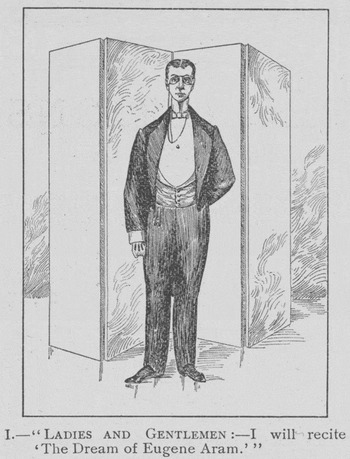
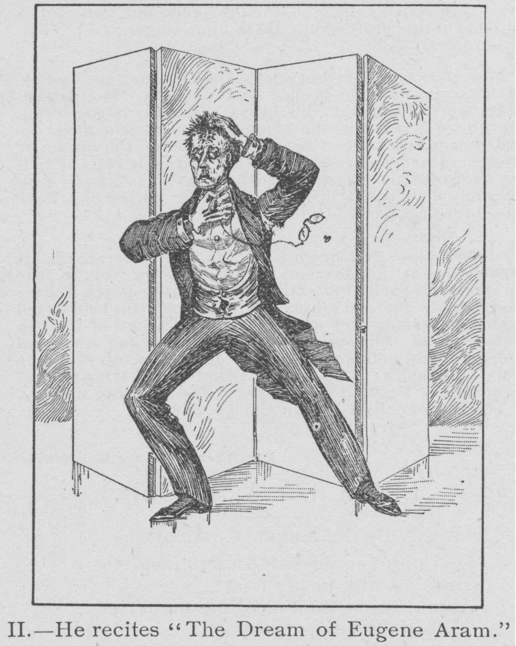
What this moment of epiphany signifies in terms of the potentially parasitic relationship between art and life is another question. An 1891 cartoon from Werner's Voice Magazine, entitled “Does the Reciter Feel His Part?”, depicts a reciter spent and emotionally overwrought after the act of reciting Thomas Hood's melodramatic poem, “The Dream of Eugene Aram” (1829) (Figures 8a, 8b, 8c). As I have suggested, Wotton, along with other late nineteenth-century women writers, presents the act of literary translation as having the opposite effect – the conduit for the story is not affected, although the subject is irretrievably spent in the process. Just as the vampire in Bram Stoker's Dracula sucks out the lifeblood of his victims so as to prolong his own existence, the realists of Wotton's fiction become what Stetz describes as the “literary-realist-as-vampire, sucking out life-stories and leaving corpses behind” (“Turning Points” 3), thus demonstrating something fundamentally problematic about the nature of artistic invention.
W. B., “Does the Reciter Feel His Part?: A Study of Realism.” Cartoon from Werner's Voice Magazine (Nov. 1891): 300. Courtesy of the Harvard Theatre Collection, Houghton Library. First frame.

W. B., “Does the Reciter Feel His Part?: A Study of Realism.” Cartoon from Werner's Voice Magazine (Nov. 1891): 300. Courtesy of the Harvard Theatre Collection, Houghton Library. Second frame.
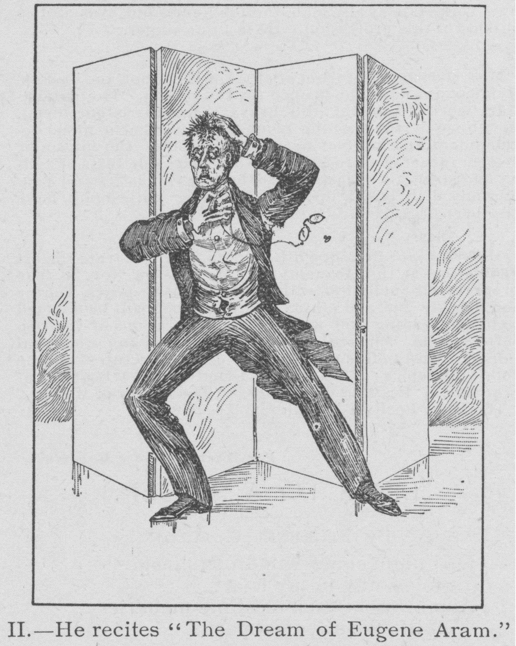
W. B., “Does the Reciter Feel His Part?: A Study of Realism.” Cartoon from Werner's Voice Magazine (Nov. 1891): 300. Courtesy of the Harvard Theatre Collection, Houghton Library. Third frame.

In the process of questioning the nature of artistic creation, doesn't Wotton leave us with a paradox? Isn't she also implicated in the ethics (or lack thereof) of invention in her own work? Can Leyden as vampire-realist really be separated from Wotton herself, the creator of these stories who profits artistically from affectingly depicting the tragedies of Miss Suttaby and Pierre Meier? Likewise, when Wotton compiled a collection of descriptions of well-known authors in Word-Portraits of Famous Writers (1887) was she also parasitically drawing on others' work in creating her own? Reviewing the book in The Woman's World, Oscar Wilde noted both her industry in collecting a wide range of descriptive anecdotes of writers ranging from Chaucer to Mrs. Henry Wood and that she “has invented a new form of picture gallery” (280). Her compilation of “word-portraits” of authors, in most cases drawn up by other famous authors, both weaves together and stands in contrast to Leyden's appropriation of Miss Suttaby – editing a non-fiction collection of physical descriptions of artists necessarily entails an appropriation of others' words and selves, but her careful documentation of sources ensures that the original subjects are recognizable (as opposed to pretending that they are the products of her imagination) and that the authors themselves are credited.
Perhaps another way to conceive of this paradox is to acknowledge how it echoes the contradiction that many critics have pointed to in aestheticism's attempts to claim art as an autonomous realm, despite its inevitable participation in the marketplace as a commodity. Jonathan Freedman, Talia Schaffer, and Kathy Psomiades have argued that aesthetes participated in a debate over the possibility or impossibility of, as Freedman puts it, “plac[ing] the work of art in an ideal world existing beyond or outside the social realm” (47).Footnote 9 Psomiades asserts that aestheticism negotiated this contradiction through images of the female form because “the dual nature of femininity allows feminine figures to mediate between the aesthetic and economic realms in which art must necessarily find itself, [and] allows for the simultaneous figuration of the category of the aesthetic as subject to market conditions and as inviolable by them” (3). Thus, by producing images of the idealized female form, images ostensibly removed from the sordid world of the marketplace, aestheticism found the perfect aesthetic commodity – a saleable item that allowed it to maintain its own pose as removed from that marketplace. In “The Fifth Edition,” Leyden's performed understanding of and sympathy for female interiority allows him to create a highly marketable aesthetic commodity. That performance is drawn from Miss Suttaby's tragic narrative of a woman deserted by her husband and intermingled with Leyden's observations of Miss Suttaby herself.
Psomiades's reading of aestheticism hints at an anxiety about maintaining this separation between art and the “public world of politics and economics” (2), a protesting too much that implies a repressed awareness of the impossibility of maintaining this separation. Similarly, as Regenia Gagnier reads Dorian Gray, Wilde is in part musing on the monstrosity of attempting to divorce art and life (7). As Psomiades points out, “The problem with aestheticism, then, is not that it is too private, too closed off from the rest of culture, but rather that its privacy is a cover for an intense and vulgar publicity. In this narrative it is little wonder that Rossetti paintings should resemble . . . late twentieth-century advertisements for cosmetics” (12). As an artist herself, Wotton expresses, and perhaps mourns, the inevitable, and sometimes destructive, appropriation involved in artistic invention. Within the contested space of invention in late nineteenth-century art, Wotton does not, and perhaps cannot, imagine a world in which art and its subject can remain integrated. Stetz points to this dilemma in the “confused sensibility” that she describes as tormenting writers in the 1890s, “at odds with themselves, advocating total freedom for Art from the tyranny of Life on the one hand, yet bound to Life for their subject matter and inspiration on the other” (“Life's ‘Half-Profits’” 183). In this light, Wotton's work seems to dramatize the vexed question of creating art that is not irrevocably bound up with its source material, as well as inextricably mired in the necessity of producing a marketable commodity.
Perhaps another way to think about this question is to re-invoke Stoker's text and Mina's “vampiric typewriting,” as Jennifer Wicke has termed it. By transforming the disparate accounts of those who come into contact with Dracula into a single typewritten text, Mina ultimately helps to contain him, creating a coherent narrative for Van Helsing (another connoisseur, albeit a scientific one) to interpret, while inevitably becoming a textual vampire herself. Andrew McCann has recently pointed to the pervasiveness of vampirism as a trope for late nineteenth-century aestheticism, with vampiric possession standing in for the complex relationship between cultural value and celebrity within the fin-de-siècle literary field (176). Wotton's own texts seem to transform and contain these vampiric artists while allowing the subjects, if not the last word, then the last glance.