Infections are a leading cause of hospitalization, loss of vascular access (catheter or arteriovenous fistula), and death in hemodialysis patients. Many infections but not all are hemodialysis catheter–associated infections and are caused by gram-positive cocci such as Staphylococcus aureus. 1 , Reference Parker and Doebbeling 2 Methicillin-susceptible S. aureus and methicillin-resistant S. aureus (MRSA) are the most common pathogensReference Kang, Tai, Yu, Kang and Huang 3 and may cause a wide array of infections. Colonization with S. aureus is a prerequisite for subsequent infection.Reference Tacconelli, Carmeli, Aizer, Ferreira, Foreman and D’Agata 4 – Reference Lai, Liao and Pai 6 Screening for MRSA is therefore a key component of successful infection control strategies in that it identifies asymptomatic reservoirs of MRSA relevant for transmission.Reference Bühlmann, Bögli-Stuber, Droz and Mühlemann 7 Screening has been used to assess the burden of MRSA carriage in hemodialysis patients prior to interventions.
The aim of our study was to determine the prevalence of MRSA nasal colonization in hemodialysis patients and to analyze the cost-effectiveness of our screening approach compared with an alternative strategy in which no mass screenings would be conducted.
METHODS
Setting and Infection Prevention Strategies
The University Hospital of Bern, Switzerland, is a tertiary care hospital with 950 beds. The mass screening studies were conducted in the hemodialysis unit from January 1, 2004, through December 31, 2013. This unit accommodates 30 patients per day in a single, large treatment room, with dialysis sessions divided into morning and afternoon sessions. One nurse is responsible for 5 patients undergoing hemodialysis at a time.
Our MRSA policy included, first, screening of high-risk groups, such as hemodialysis patients and patients who were transferred from hospitals with high MRSA prevalence in the previous 6 months. Second, there were contact precautions for all MRSA colonized/infected patients with placement in single rooms, and use of a door sign, gowns, and gloves in addition to standard precautions. Precautions were discontinued once a patient had 3 consecutive negative results for MRSA during 9 months of follow-up. Third, contact screening was conducted for inpatients who shared the same ward with a newly identified MRSA carrier at the time of diagnosis and for those who had been concurrently hospitalized with the index case during the previous 12 months.
No decolonization methods were used for any of the MRSA carriers identified in hemodialysis screenings.
Data Collection, Laboratory Method, and Data Analysis
We determined the prevalence of MRSA in dialysis patients during twice-yearly mass screenings for the years 2004–2013. Demographic data including sex and age were collected for each patient during screening session. For laboratory purposes, we obtained NaCl 0.9% wet cotton nasal swabs, which were circled in both nares of a participant. The samples were then placed into the transport medium (Copan Transystem) immediately. The samples were cultured on a screening agar for MRSA (mannitol-oxacillin biplate). Identification was performed according to standard laboratory procedures. Susceptibility testing was performed using disk diffusion tests and the results were interpreted according to the Clinical and Laboratory Standards Institute. For determining methicillin resistance we used oxacillin disks.
Those patients who had at least one positive nasal MRSA culture were defined as MRSA carriers, whereas all patients with negative MRSA culture results were regarded as noncarriers. We determined the yield of each screening and the overall yield and expressed it as a percentage.
Cost Analysis
We compared the cost of our MRSA prevention strategy with a scenario where no active screening of MRSA carriage is performed on a routine basis (ie, the alternative strategy).
The current strategy has 2 major contributors of cost, which are mass screening and isolation of carriers. In contrast, the alternative strategy would generate cost due to the isolation of infected patients and screening of their contacts.
The screening program cost itself consists of the cost of the swab material and laboratory processing. The cost of contact precautions was calculated as cost of gloves, gowns, and handrub bottles and included the terminal cleaning of single rooms where carriers are isolated.
In the alternative strategy, in order to calculate the contact tracing costs, we assumed that the rate of hospital admission of unidentified MRSA carriers among hemodialysis patients would be similar to what we found in colonized patients over 10 years (see Results section). Of the 15 MRSA carriers among 415 hemodialysis patients, 13 [86.7%] would have been admitted under that assumption. According to the literature, MRSA carriage has a 33% likelihood of progressing to infection in the year after detection of colonization.Reference Huang, Hinrichsen and Datta 8 We took this percentage to calculate the number of MRSA-colonized, hospitalized hemodialysis patients who would progress to MRSA infection—that is, 5 of the 13 admitted colonized patients. Per our MRSA policy these 5 index patients would have required isolation, thus generating cost for contact precautions. Owing to the lack of accurate information on inpatient acquisition of MRSA in our hospital, we used the overall prevalence of MRSA from our screening study—that is, 3.6%, as a surrogate for the MRSA acquisition rate in hospitalized patients. These 5 MRSA-infected patients would be index cases to start MRSA contact screening. The average number of patients included in the contact tracing of an index case is 17 (range, 1–66) (information taken from unpublished MRSA contact tracing data of the hospital in the same study period). This subsequently led us to estimate the cost of contact tracing, which shares variables with cost of screening—that is, cost of swab transport system and laboratory processing costs for 85 (5 times 17) exposed patients.
RESULTS
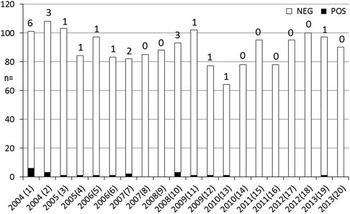
There were 20 mass screenings during the 10-year study period. We identified 415 hemodialysis patients who participated in at least 1 screening, with an average of 4.5 screenings per patient. On average, 90 samples were taken at each mass screening. Overall, a total of 1,901 individual nasal swab samples were taken, among which 22 (1.2%) were positive for MRSA (Figure 1). These 22 positive swab samples were obtained from 15 patients. Of the total 415 screened individual hemodialysis patients, 15 (3.6%) were found to be MRSA carriers. One patient had 5, and 3 patients each had 2, MRSA positive nasal swabs in different screening sessions.
Methicillin-resistant staphylococcus aureus prevalence in hemodialysis patients at Bern University Hospital from January 1, 2004, through December 31, 2013. Screening occurred twice yearly; the number of the screening follows the year on the x-axis. The number of samples collected at each screening is indicated on the y-axis. NEG, negative; POS, positive.

The first mass screening, in 2004, yielded the highest percentage of MRSA carriage (6/101 [6%]). Only 7 subsequent screenings revealed new MRSA carriers, whereas 4 screenings simply confirmed previously known carriers, and 8 screenings remained negative.
Men were predominant among the MRSA carriers (20/22 [91%]). Twenty of the 22 positive swabs came from patients aged more than 65 years, which represented the largest age group of participants (53%).
From our MRSA follow-up data, we were able to extract the median duration of MRSA carriage in 12 of these patients; it was 7 months (range, 3–23 months). Two patients had intermittent colonization and for another one, no follow-up data was available. None of the identified MRSA carriers developed MRSA bacteremia during the study period. We have found that in the 15 MRSA carriers, 13 underwent hospital admission at our center over a 10-year period.
The current laboratory cost for processing a negative sample is approximately US $42 and for a positive sample US $50. The total screening costs inclusive of the swab material for the 20 screenings were estimated to be US $89,266 in 2014; the average cost for identifying each of the 15 MRSA carriers was US $5,951. The cost of contact precautions for 13 patients who were admitted was calculated to be US $4,664. The total cost of our screening strategy, which is the sum of screening cost and isolation cost, was US $93,930 (Table 1).
Cost Comparison Between Screening and Alternative Strategy

NOTE. Laboratory processing cost includes both negative and positive samples. Cost of isolation: estimated 100 encounters of nurses per 1 isolated patient and hand hygiene compliance 80% using 5 mL per rub that costs US $1.03 per 100 mL handrub (5.15 cents per indication)=US $4.12; use of gloves per indication 5 contacts with 5 glove indications each, resulting in 25 glove indications per day (4.12 cents per glove)=US $1.03; use of gown 20 indications per day (US $1.40 per gown)=US $28; cleaning of positive room=US $11.9; average estimated stay of an isolated patient=10 days.
The total cost of the alternative strategy (based on assumptions) would be equivalent to the cost for contact tracing performed on 85 patients, which would be US $3,969, and for isolation of 5 MRSA-infected cases equaling US $1,413 (ie, a total of 5 MRSA-infected patients and their 85 contacts), resulting in a total of US $5,382. This results in a difference of US $88,548 between the 2 strategies.
DISCUSSION
Screening and isolation, with or without efforts to eradicate carriage, have been associated with fewer secondary MRSA transmissions and a decreased rate of MRSA bacteremia.Reference Filice, Nyman and Lexau 9 Starting in 2004, we found the overall prevalence of MRSA colonization in hemodialysis patients over the 2004–2013 decade to be low at 3.6% (or 1.2% of all specimens obtained). At that time, the proportion of all S. aureus isolates from clinical specimens that was MRSA was approximately 8% for the entire country of Switzerland, varying from 4% in central to 14% in western Switzerland.Reference Senn, Basset and Greub 10 The fact that our institution is situated in an area of low MRSA prevalence (<5%) coincides with the results reported here. A screening study by Bühlmann et alReference Bühlmann, Bögli-Stuber, Droz and Mühlemann 7 in the same institution, which was performed on 236 patients who had contact with a MRSA patient in the hospital or were transfers from high-prevalence areas from other parts of Switzerland, yielded a 1.7% carriage rate (ie, 4 patients were positive). This suggests that our hemodialysis patients had a higher risk of MRSA colonization compared with a general patient population.
To date, a number of studies have focused on catheter site application of mupirocinReference McCann and Moore 11 and nasal decolonization in the prevention of bloodstream infection in hemodialysis patients.Reference Kang, Tai, Yu, Kang and Huang 3 , Reference Tacconelli, Carmeli, Aizer, Ferreira, Foreman and D’Agata 4 , Reference Lederer, Riedelsdorf and Schiffl 12 , Reference Resić, Corić, Dedeić-Ljubović, Hukić, Avdić and Kukavica 13 Our study differs from these studies in that it addresses screening and isolation measures in the control of MRSA only in hemodialysis patients.
Although we lack information on subsequent rates of MRSA infection other than bacteremia, there were no bacteremia cases reported in our MRSA-colonized hemodialysis patients in the study period. Other studies have found that a substantial proportion of patients who develop MRSA infection following colonization develop pneumonia, wound infections, and others.Reference Huang, Hinrichsen and Datta 8 , Reference Dantes, Mu and Belflower 14 Patients may still have presented to an outside hospital with MRSA infection, however.
We also determined the median time until MRSA clearance to be 7 months. This finding is in agreement with an earlier study in our hospital aiming to examine the duration of MRSA carriage, its determinants, and the influence of an eradication regimen performed on 116 patients (including but not limited to those on hemodialysis), which revealed the median time to clearance to be 7.4 months.Reference Marschall and Mühlemann 15 Because no decolonization regimes were administered during the study period, we cannot estimate what marginal benefit in reducing MRSA infection such a strategy might have achieved.
Currently, there are no universal guidelines for hospital control of MRSA. Various hospitals and countries have used their own practices to suit their needs and resources.
Given the low rate of carriage and the high cost of our MRSA screening strategy in hemodialysis patients, we questioned the cost-effectiveness of such a strategy in a low-prevalence area. A cost comparison of MRSA screening and management in a decision tree study showed that, at a low MRSA prevalence, “no screening” produces costs comparable with targeted screening strategies. Costs for targeted screening become disproportionately high as MRSA prevalence increases.Reference Tübbicke, Hübner, Hübner, Wegner, Kramer and Fleßa 16 The prevalence of MRSA colonization therefore exerts a significant influence on the choice of the optimal preventive strategy. As reported here, there is a significant difference of US $88,548 for the entire study period between our relatively costly current screening strategy and an alternative strategy, which is based on certain assumptions.
Although a study in another Swiss tertiary hospital that examined MRSA admission screening of patients in a low-prevalence setting concluded that, in terms of cost-effectiveness, individualized (or targeted) screening strategies seem to be more favorable in a low-prevalence setting,Reference Witteck, Rettenmund and Schlegel 17 our results showed that such a conclusion needs to be further studied.
Limitations of the study include the single-center setting and that risk factors for MRSA colonization were not identified in detail in our patients. It is also possible that we missed colonization of body sites other than the anterior nares. Genotyping was not performed, likewise, and we cannot distinguish whether the 4 patients who tested positive on more than one occasion were recolonizations by the same strain or acquired a new one.Reference Price, Sarween, Gupta and Baharani 18
Although the role of decolonization treatment in controlling MRSA is controversial, with some studies showing no effect, others have reported a decrease in subsequent infection rates.Reference Kohler, Bregenzer-Witteck, Rettenmund, Otterbech and Schlegel 19 There were no decolonization attempts in our MRSA carrier population. We also did not determine overall crude mortality.
We conclude that, in an area of low prevalence, it would be cost saving to discontinue mass screenings and instead to concentrate on tracing contacts of newly identified MRSA-infected hemodialysis patients. As a first step, we reduced mass screening from twice yearly to once yearly in our institution. Future studies may help determine the most cost-effective strategy for MRSA prevention in hemodialysis patients or other high-risk populations as a function of the local prevalence.
Acknowledgments
We are indebted to the entire infection prevention team for their assistance in the study. Our special thanks go to Silvia Andrist and Alexia Cusini, MD, for reviewing the manuscript.
Financial support. None reported.
Potential conflicts of interest. All authors report no conflicts of interest relevant to this study.