Introduction
Soybean [Glycine Max (L.) Merrill] yield gain has increased markedly in the past 40 years due to genetic improvement and better crop management, which includes symbiotic nitrogen fixation (SNF) as inoculation strategy (Picoli et al., Reference Picoli, Pasquetto, Muraoka, Milani, Marin, Souchie, Braccini, Lazarini, Torneli, Cato and Tezotto2022). Soybean has a high demand for N to achieve greater grain yield and seed protein content (Fabre and Planchon, Reference Fabre and Planchon2000). However, N fertilization is not recommended due to the high SNF efficiency in Brazil (Hungria et al., Reference Hungria, Campo, Mendes, Graham, Singh, Shankar and Jaiwal2006a; Reference Hungria, Franchini, Campo, Crispino, Moraes, Sibaldelli, Mendes and Arihara2006b). The exception is at sowing, when a maximum rate of 20 kg N ha−1 can be applied to supply N without affecting SNF establishment (Embrapa, 2013).
Although soil and SNF are sufficient to satisfy the N demand of the average Brazilian soybean yield (i.e., 3.03 Mg ha−1 – Conab, 2022), additional N fertilization could be beneficial to high-yield systems that might be N-limited (Cafaro La Menza et al., Reference Cafaro La Menza, Monzon, Specht and Grassini2017, Reference Cafaro La Menza, Monzon, Lindquist, Arkebauer, Knops, Unkovich, Specht and Grassini2020; Ciampitti and Salvagiotti, Reference Ciampitti and Salvagiotti2018; Salvagiotti et al., Reference Salvagiotti, Cassman, Specht, Walters and Weiss2008). This N limitation is further increased by the soybean-corn (Zea mays L.) double cropping system, an intensive land use during the same growing season. To optimize the sowing schedule of this system, farmers have adopted early-maturing soybean cultivars, shortening the soybean growth period. Such a strategy might negatively affect the SNF input into the cropping system as early-maturing cultivars have to supply the high N demand in a shorter growing time (Saturno et al., Reference Saturno, Cerezini, Moreira da Silva, de Oliveira, de Oliveira, Hungria and Nogueira2017).
Effective nodulation and N fixation of soybean genotypes is usually achieved in Brazil (Hungria et al., Reference Hungria, Campo, Mendes, Graham, Singh, Shankar and Jaiwal2006a), and complementary N fertilization shows contradictory results on yield (Ferreira et al., Reference Ferreira, Balbinot Junior, Werner, Zucareli, Franchini and Debiasi2016; McCoy et al., Reference McCoy, Kaur, Golden, Orlowski, Cook, Bond and Cox2018; Ortez et al., Reference Ortez, Tamagno, Salvagiotti, Prasad and Ciampitti2019; Saturno et al., Reference Saturno, Cerezini, Moreira da Silva, de Oliveira, de Oliveira, Hungria and Nogueira2017). Also, readily available N derived from fertilizers can reduce the SNF efficiency and/or establishment (Saturno et al., Reference Saturno, Cerezini, Moreira da Silva, de Oliveira, de Oliveira, Hungria and Nogueira2017), which is an undesirable effect as SNF is the most sustainable way of providing this nutrient (Hungria and Mendes, Reference Hungria and Mendes2015).
One alternative to avoid SNF impairment and increase the efficiency of fertilization is to supplement N between the beginning pod (R3) and seed-fill (R5) growth stages, when relative abundance of ureides (%RAU) and N derived from the atmosphere (%Ndfa) are low (Pitumpe Arachchige et al., Reference Pitumpe Arachchige, Rosso, Hansel, Ramundo, Torres, Asebedo, Ciampitti and Jagadish2020; Zapata et al., Reference Zapata, Danso, Hardarson and Fried1987). During these reproductive growth stages, the SNF could be insufficient to supply the high N demand (Cafaro La Menza et al., Reference Cafaro La Menza, Monzon, Lindquist, Arkebauer, Knops, Unkovich, Specht and Grassini2020).
The use of controlled release fertilizers (CRFs), such as coated urea, is another alternative to supply N at these specific conditions. CRF release N gradually over time depending on its coating, which is selected according to the growth demands of the target crop (Bortoletto-Santos et al., Reference Bortoletto-Santos, Guimarães, Junior, Da Cruz, Polito and Ribeiro2020; Trenkel, Reference Trenkel2010). Different types of CRF have distinct lag periods, which is the time (in days) it takes for the coating to be degraded and the starting of nutrient release in soil (Trenkel, Reference Trenkel2010). Recently, the use of these fertilizers has greatly increased for main cereal crops such as corn, wheat (Triticum aestivum L.), and rice (Oryza sativa L.), providing yield gains from 5 to 8% in comparison with common fertilizers and increasing N use efficiency by 23% on average (Zhu et al., Reference Zhu, Liu, Xu, Yang and Shi2020). Despite these potential benefits reported among cereals, the use of CRF as an additional source of N for leguminous species and its effect on yield remain poorly studied.
Interactions among SNF, N fertilizer, field history, management, and environmental conditions affect the contribution of exogenous N to soybean yield (Ciampitti and Salvagiotti, Reference Ciampitti and Salvagiotti2018; dos Santos Cordeiro and Echer, Reference dos Santos Cordeiro and Echer2019). It should be noted that soybean response to N fertilization is quite complex, and a wide range of studies has investigated this topic, as crop phenology, timing, and rate of fertilizer application can modulate the results (de Oliveira et al., Reference de Oliveira, Pierozan, Lago, de Almeida, Trivelin and Favarin2019; Hatano et al., Reference Hatano, Fujita, Nagumo, Ohtake, Sueyoshi, Takahashi, Sato, Tanabata, Higuchi, Saito and Ohyama2019; Pierozan Junior et al., Reference Pierozan Junior, Favarin, Lago, de Almeida, de Oliveira, Trivelin, Oliveira and Gilabel2020; Santachiara et al., Reference Santachiara, Salvagiotti and Rotundo2019). Nonetheless, it is not clear how much of the N applied is efficiently absorbed by the plant, especially whether CRFs enhance fertilizer recovery and plant N content compared to common fertilizers.
N application could result in soybean yield gains in particular situations as mentioned above, and therefore to investigate how to implement it in practice without prejudicing the SNF process is of fundamental importance. The use of CRF has been considered promising due to their potential low damage on SNF, which lack support from experimental data. Thus, additional studies are needed to understand the effect of CRF on N yield and N dynamic in soybean, including the form of N uptake under different fertilization strategies. This study aimed to evaluate the N fertilization effect on soybean yield using common urea (CU) and controlled release urea (CRU) labeled with 15N isotopes under different environmental conditions. An additional goal was to quantify the effect of exogenous N on SNF as well as the contribution of each N source (atmosphere, soil, and fertilizer) to total N uptake.
Material and Methods
Experimental area
Field experiments with different N fertilizers were carried out in two sites representing the most important environmental growing conditions for Brazilian soybean production. The study in the tropical environment was conducted in a farmer’s field near Primavera do Leste, Mato Grosso (15 ° 25'46.5 “S 54 ° 22'21.1" W), at 650 m above sea level, located in the Cerrado biome, which is characterized by dry winter and hot rainy summer (Aw climate by the Köppen classification). The study in the subtropical environment was conducted in a farmer’s field in Taquarituba, São Paulo (23º34'54” S, 49º15'11” W), at 646 m above sea level, located in the Atlantic Forest biome, which is characterized by moist winter and hot rainy summer (Cfa climate according to Köppen classification). Both experimental areas have been under a continuous soybean-corn double cropping system for the last 10 years.
Soybean sowing occurred on 10/29/2013 in the tropical area (cultivar Nidera 7901RR, maturation group 7.9) and on 10/20/2013 in the subtropical area (cultivar Nidera 5909RR, maturation group 6.2). Both cultivars are early-maturing commonly used in their respective locations. The final plant stand was 300 000 plants ha−1.
Soil in the tropical site is classified as Typical Oxisol (Soil Survey Staff, 1999), with 500, 220, and 280 g kg−1 of clay, silt, and sand, respectively. Chemical analysis of the 0–20 cm soil layer before sowing showed pH (CaCl2): 5.0, soil organic matter (SOM): 23.7 g dm−3, P-resin: 16.5 mg dm−3, and K-resin: 2.9 mmolc dm−3. The subtropical experimental area has a soil classified as Typical Ultisol (Soil Survey Staff, 1999) with 530, 270, and 200 g kg−1 of clay, silt, and sand, respectively. Chemical analysis of the 0–20 cm soil layer showed pH: 5.5 (CaCl2), SOM: 40 g dm−3, P-resin: 19 mg dm−3, and K-resin: 7.6 mmolc dm−3. According to the soil-test recommendations and application guidelines for P and K (de Souza and Lobato, Reference de Souza and Lobato2004; Van Raij et al., Reference Van Raij, Cantarella, Quaggio and Furlani1997), the interpretation of soil-test values indicated relative levels of nutrients ranging from optimum to high between the experimental areas. Following previous recommendations, we applied 300 kg ha−1 0-25-25 (N-P-K) fertilizer top dressing (V2 growth stage) on the tropical experimental field (Primavera do Leste) while the subtropical field (Taquarituba) received 2-29-22 (N-P-K) fertilizer banding on one side of the seed row at a rate of 300 kg ha−1. The low rate of N fertilizer (6 kg ha−1) applied as N-P-K fertilizer in subtropical field was not taken into account for 15N fertilizer calculations.
Climate
Supplementary Figure 1 shows the temperature and rainfall during the time of the study for both sites. Total rainfall was higher in the tropical (1.167 mm) compared to the subtropical environment (864 mm).
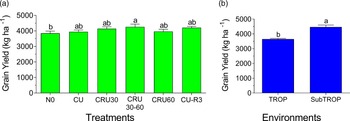
Effect of N fertilizer on soybean yield. Vertical bars are means of both environmental conditions (a) and N treatments (b). Statistical significance (Fisher’s LSD test at 5% probability) is indicated by letters. The error bars indicate the standard errors of the means. Control with no N fertilizer (N0); common urea (CU); controlled release urea with a lag time of 30 days (CRU30); 1:1 mix of controlled release urea with a lag time of 30 and 60 days (CRU 30-60); controlled release urea with a lag time of 60 days (CRU60); and CU applied at the beginning pod, R3 growth stage (CU-R3). TROP and SubTROP mean tropical and subtropical environment, respectively.

Experimental design and treatments
The experiments were carried out in a randomized block design, with six treatments and four replicates. The experimental plot consisted of five rows 15 m long, spaced at 0.45 m. Before sowing, all seeds were inoculated to provide 1.2 × 10⁶ viable cells of bradyrhizobia per seed (Hungria et al., Reference Hungria, Nogueira and Araujo2015) with a liquid inoculant containing Bradyrhizobium japonium at a concentration of 5 × 10⁹ cells ml−1. Six treatments were performed: control with no N fertilizer (N0); CU; CRU with a lag time of 30 days (CRU30); 1:1 mix of CRU with a lag time of 30 and 60 days (CRU 30-60); CRU with a lag time of 60 days (CRU60); and CU applied at the beginning pod, R3 growth stage (CU-R3) (Fehr and Caviness, Reference Fehr and Caviness1977). The lag period information was provided by the fertilizer manufacturer (Agroplanta Company, Brazil).
CRU fertilizer was developed by coating urea prills with polyurethane polymer based on urea mass (Agroplanta Company, Brazil). Polymer-coated urea with a lag time of 30 or 60 days were prepared using 3.7% or 4.55% (w/w) polyurethane polymer, respectively, and conventional urea prills. The same procedure was employed with urea labeled with 15N.
N was applied in the emergence stage (VE) (Fehr and Caviness, Reference Fehr and Caviness1977), excluding control and CU applied in the R3 growth stage (CU-R3). The N fertilizer was banded 5 cm beside the soybean row at 5 cm soil depth.
15N sampling and analysis
To assess the amount of N fertilizer recovered by soybean, we used 15N-labeled fertilizer applied in the form of labeled urea with an isotopic abundance of 2.53 atom % 15N. The labeled urea received polymer-coated and was applied in microplots at the same dates and in the same way as the unlabeled N. The microplots consisted of three rows 1 m length at the center of each plot.
Plants that received labeled urea were harvested at physiological maturation (R7) (Fehr and Caviness, Reference Fehr and Caviness1977) at 95 (tropical environment) or 102 (subtropical environment) DAE to avoid leaf loss due to senescence, which would reduce the 15N recovery in the soybean plants. Four plants from the middle rows were sampled in the center of the microplots. For 15N determination, plants were partitioned into root, grains, and shoot (leaf, petioles, branches, and shell/pods). For root sampling, a trench was opened [45 cm wide (22.5 cm to the right and 22.5 cm to the left of the sowing line), 12 cm long, and 20 cm deep]. Approximately 97% of the total soybean roots are at this depth (Benjamin and Nielsen, Reference Benjamin and Nielsen2006). Soil samples were collected from depth intervals of 0–20, 20–40, 40–60, and 60–80 cm within the intra-rows and inter-rows, using a manual tubular soil probe (gouge auger) with 1.20 m length.
The sampled plants were dried in an oven with air circulation at 60 ºC for 72 h to determine the dry matter. Subsequently, the samples were ground in a Wiley mill, with a 2-mm mesh sieve. N-total content and 15N (% in atoms) abundance were determined in the fine ground material using an automated mass spectrometer coupled to an N analyzer (model ANCA-GSL, Sercon Co., UK). Total N concentrations and the 15N/14N isotope ratio were determined according to Barrie and Prosser (Reference Barrie, Prosser, Boutton and Yamasaki1996). Total N uptake (kg ha−1) by soybean, N derived from fertilizer (Ndff) in the plant (kg ha−1), and the percentage of N in the plant derived from the fertilizer (% Ndff) were determined.
Ndff was calculated with equation 1:
 $$Ndff = {{\left( {15Np - 15Nn} \right)} \over {\left( {15Nf - 15Nn} \right)}} \times Np$$
where Ndff is the amount of N in the plant derived from the fertilizer (kg ha−1), 15Np is the amount of 15N in the plant (% of atoms), 15Nn is the natural abundance of 15N (% of atoms), 15Nf is the amount of 15N in the fertilizer (2.53% of atoms), and Np is the total N in the plant.
Ndff was calculated from equation 2:
 $$\% Ndff = {{Ndff} \over {Np}} \times 100$$
where %Ndff is the percentage of N in the plant derived from fertilizer (%).
SNF analysis
Additional three soybean plants were sampled at stage R5.3–R5.4 (Fehr and Caviness, Reference Fehr and Caviness1977) to estimate soybean SNF. The stems and petioles were immediately removed from the leaves according to the methodology of Herridge (Reference Herridge1982) and dried in an oven with air circulation at 65ºC. Determination of N-ureides (Nur), N-nitrate (Nit), and N-amino acid (Naa) were performed to estimate the relative abundance of ureides (Rur) and the N derived from the atmosphere (Ndfa) in soybeans. The percentage of Ndfa was calculated from equation 3 (the correct one to determine ureides at the R5.3 stage) calibrated as proposed by Herridge and Peoples (Reference Herridge and Peoples1990):
 $$Rur = 0,0034{\rm{\;\% }}Ndf{a^2} + 0,\!50{\rm{\;\% }}Ndfa + 10,7$$
Isolating %Ndfa from equation 3, equation 4 is obtained:
 $${\rm{\% }}Ndfa = {{ - 0,\!5 + \sqrt {0,\!10448 + 0,\!0136Rur} } \over {0,0068}}$$
N in ureides (Rur) is calculated by equation 5:
 $$Rur{\rm{\% }} = \left( {{{4Nur} \over {4Nur + Nnit + Naa}}} \right) \times 100$$
where Rur refers to the percentage N in the xylem sap in the form of ureides, Nur is the molar concentration of ureides determined by the method of Young and Conway (Reference Young and Conway1942), Nnit is the molar nitrate concentration determined by the salicylic acid method of Cataldo et al. (Reference Cataldo, Maroon, Schrader and Youngs1975), and Naa is the concentration of ammonium in the form of amino acids determined colorimetrically according to Yemm et al. (Reference Yemm, Cocking and Ricketts1955) with modifications (Herridge, Reference Herridge1984).
From equation 4, the Ndfa (kg ha−1) was calculated using equation 6:
 $$Ndfa = {{{\rm{\% }}Ndfa} \over {100}} \times Np$$
Determination of plant N derived from soil (Ndfs)
Ndfs was calculated from total N content, Ndff, and Ndfa 1 – using equations 7 (kg ha-) and 8 (% Ndfs):
 $$Ndfs = Np - Ndff - Ndfa$$
 $$\% Ndfs = 100 - \% Ndff - \% Ndfa$$
Yield measurement
To estimate the yield, grains were collected from soybeans at stage R8 (Fehr and Caviness, Reference Fehr and Caviness1977) from 3 m in the three central lines of each plot, in a total of 9 m. The grain yield was expressed in kg ha−1, and grain moisture was adjusted to 130 g of water per kg of grain.
Statistical analyses
The data were submitted to normality (PROC UNIVARIATE) and variance homogeneity (PROC TRANSREG via model BOX COX) tests, as well as analysis of variance (ANOVA) by the F test (p ≤ 0.05), using the PROC GLM with the software “Statistical Analysis System version Windows 9.2 (Inst. SAS, 2008). A joint analysis of the two experimental sites was carried out for the variables displaying a quotient of the mean squared error of variance of each year ≤ 7, according to Banzato and Kronka (Reference Banzato and Kronka2006). If the null hypothesis was rejected, Fisher’s media comparison tests (LSD) (p ≤ 0.05) were applied for sites and treatments.
Results
Grain yield
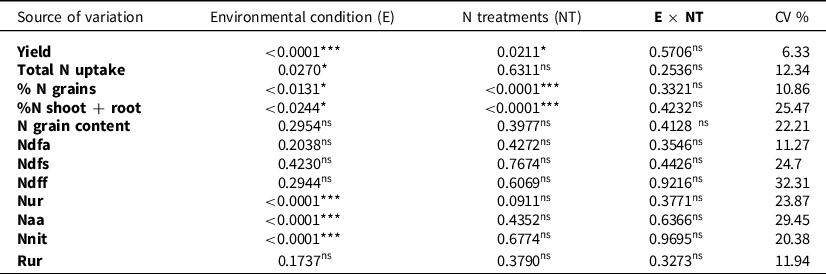
Yield across experimental areas ranged from 3,464 to 4,513 kg ha−1. N fertilization and environmental conditions had a significant effect on yield without interaction between these factors (Table 1). Compared to control, CRU 30-60 increased yield by 10.7% (Figure 1a). Soybean growing under the subtropical condition achieved 22.46% higher yield compared to the tropical condition, on average 4,470 and 3,650 kg ha−1, respectively (Figure 1b).
Statistical analysis evaluating differences between N treatments, environmental conditions, and environmental × N treatments interactions. Measured variables were yield, total N uptake, N derived from atmosphere (Ndfa), N derived from soil (Ndfs), N derived from fertilizer (Ndff), N-ureides (Nur), N-amino acid (Naa), N-nitrate (Nnit), and N in ureides (Rur)

ns Not significant; *significant at 5%; ***significant at less than 0.1% probability of error by the F test.
Amount of N taken up by soybean
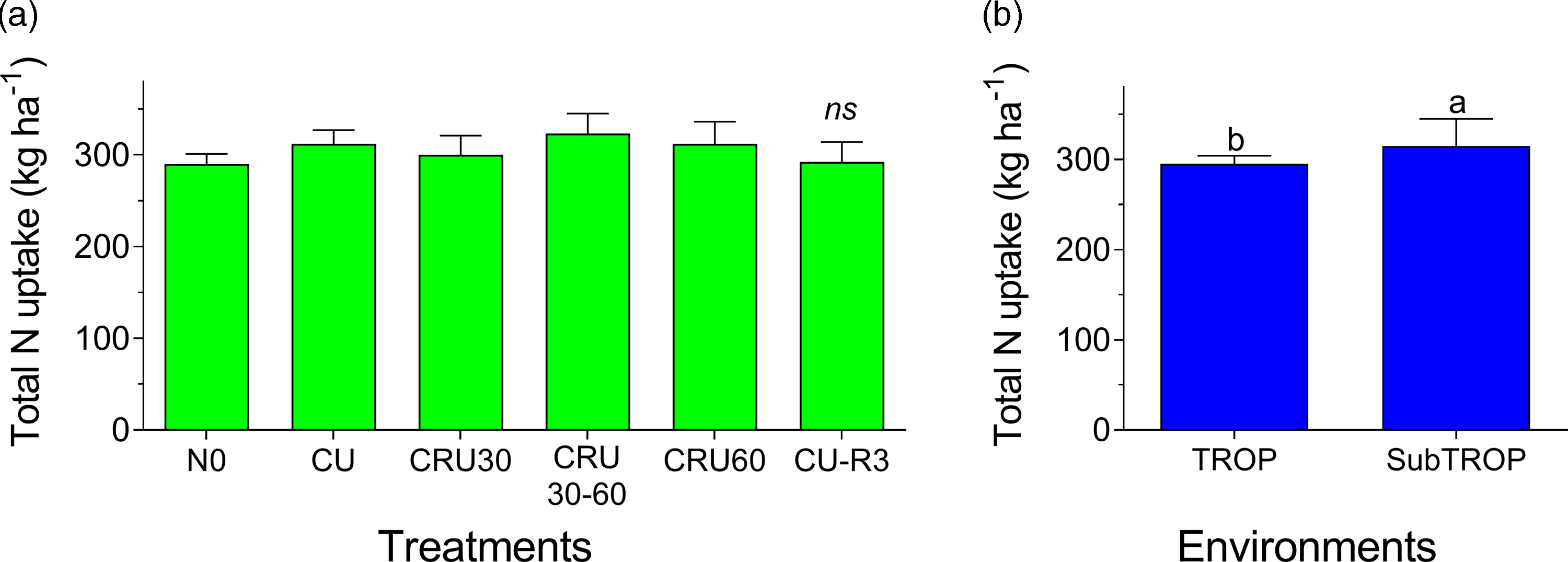
Significant differences in total N uptake was found between environmental conditions (Table 1; Figure 2b), but not among N treatments and their interaction (Figure 2a). Soybean growing under the subtropical condition absorbed 6.8% more N compared to the tropical condition.
Effect of N fertilizer on soybean N uptake at physiological maturity (R7). Vertical bars are means of both environmental conditions (a) and N treatments (b). Statistical significance (Fisher’s LSD test at 5% probability) is indicated by letters, ns = not significant. The error bars indicate the standard errors of the means. Control with no N fertilizer (N0); common urea (CU); controlled release urea with a lag time of 30 days (CRU30); 1:1 mix of controlled release urea with a lag time of 30 and 60 (CRU 30-60); controlled release urea with a lag time of 60 days (CRU60); and CU applied at the beginning pod, R3 growth stage (CU-R3). TROP and SubTROP mean tropical and subtropical environment, respectively.

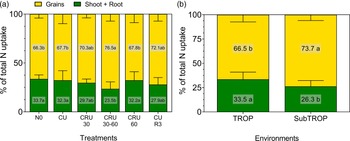
Application of CRU 30-60 increased N partitioning in grains by 10.2% compared to the control (Figure 3a). Soybean under the subtropical condition accumulated 7.2% more N in grains than in the tropical condition (Figure 3b). No differences were observed among N treatments and their interaction in N grain content (Table 1, Supplementary Figure 2).
Effect of N fertilizer on N partition among grains and plant shoot + roots. Vertical bars are means of both environmental conditions (a) and N treatments (b). Statistical significance (Fisher’s LSD test at 5% probability) is indicated by letters, ns = not significant. The error bars indicate the standard errors of the means. Control with no N fertilizer (N0); common urea (CU); controlled release urea with a lag time of 30 days (CRU30); 1:1 mix of controlled release urea with a lag time of 30 and 60 days (CRU 30-60); controlled release urea with a lag time of 60 days (CRU60); and CU applied at the beginning pod, R3 growth stage (CU-R3). TROP and SubTROP mean tropical and subtropical environment, respectively.

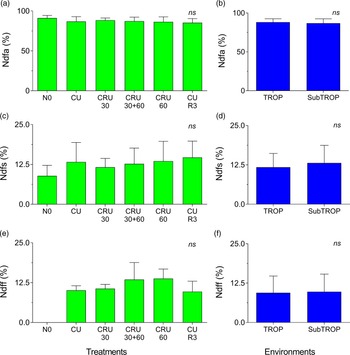
The Ndfa, Ndfs, and Ndff parameters indicate the amount of N uptake from different sources – atmosphere (via SNF), soil, and fertilizer, respectively. No differences for all these parameters were found among N treatments, environmental conditions, and their interaction (Table 1). Across N treatments and environmental conditions, Ndfa, Ndfs, and Ndff averaged 220, 59, and 34 kg N ha−1, respectively (Figure 4).
Effect of N fertilizer on N derived from atmosphere (Ndfa – a, b), N derived from soil (Ndfs – c, d), and N derived from fertilizer (Ndff – e, f). Vertical bars are means of both environmental conditions (a) and N treatments (b). Statistical significance (Fisher’s LSD test at 5% probability) is indicated by letters, ns = not significant. The error bars indicate the standard errors of the means. Control with no N fertilizer (N0); common urea (CU); controlled release urea with a lag time of 30 days (CRU30); 1:1 mix of controlled release urea with a lag time of 30 and 60 days (CRU 30-60); controlled release urea with a lag time of 60 days (CRU60); and CU applied at beginning pod, R3 growth stage (CU-R3). TROP and SubTROP mean tropical and subtropical environment, respectively.

Form of N uptake in soybean stems and petioles
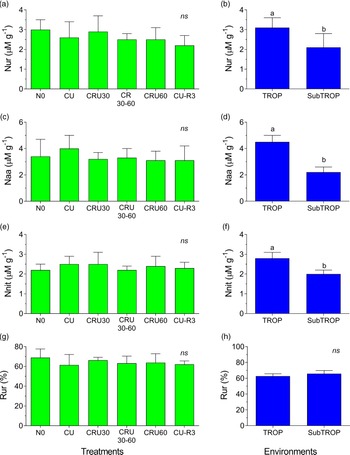
N fertilization did not affect N forms of stems and petioles (Nur, Naa, Nnit, and Rur) nor the interactions environmental condition × N treatments (Table 1, Figure 5). However, we observed a higher concentration of ureides (Nur: 3.1 µM g−1) (Figure 5b), N-amino (Naa: 4.5 µM g−1) (Figure 5d), and N-nitrate (Nnit: 2.8 µM g−1) (Figure 5f) in the subtropical condition than in the subtropical condition (Nur: 2.1 µM g−1, Naa: 2.2 µM g−1, and Nnit: 2.0 µM g−1).
Effect of N fertilizeron the concentration of ureides (Nur – a, b), N-amino acid (Naa – c, d), N-nitrate (Nnit – e, f), and percentage of N in the xylem sap in the form of ureides (Rur – g, h) in the stems and petioles. Vertical bars are means of both environmental conditions (a) and N treatments (b). Statistical significance (Fisher’s LSD test at 5% probability) is indicated by letters, ns = not significant. The error bars indicate the standard errors of the means. Control with no N fertilizer (N0); common urea (CU); controlled release urea with a laag time of 30 days (CRU30); 1:1 mix of controlled release urea with a lag time of 30 and 60 days (CRU 30-60); controlled release urea with a lag time of 60 days (CRU60); and CU applied at the beginning pod, R3 growth stage (CU-R3). TROP and SubTROP mean tropical and subtropical environment, respectively.

Discussion
Grain yield and soybean N uptake
The average yield recorded here was higher than reported in previous studies with exogenous N application in soybean (Hungria et al., Reference Hungria, Franchini, Campo, Crispino, Moraes, Sibaldelli, Mendes and Arihara2006b; Ortez et al., Reference Ortez, Tamagno, Salvagiotti, Prasad and Ciampitti2019; Tamagno et al., Reference Tamagno, Balboa, Assefa, Kovács, Casteel, Salvagiotti, García, Stewart and Ciampitti2017) that obtained values < 3,000 kg ha−1. This shows that (i) both sites are high-yield environments in which soybeans might be N-limited (Cafaro La Menza et al., Reference Cafaro La Menza, Monzon, Specht and Grassini2017; Ciampitti and Salvagiotti, Reference Ciampitti and Salvagiotti2018) and (ii) CRU-30-60 fertilization improved yield in these areas (Figure 1). According to Cafaro La Menza et al. (Reference Cafaro La Menza, Monzon, Specht and Grassini2017), yields above 2,500 kg ha−1 are responsive to N fertilization.
In contrast, N rate and timing of supplementation were achieved only with CRU fertilizer. Compared to the control, CRU 30-60 increased yield by 10.7%. Similar yield gains with CRU were also reported in a series of experiments by Tewari et al. (Reference Tewari, Suganuma, Fujikake, Ohtake, Sueyoshi, Ohyama and Takahashi2002, Reference Tewari, Suganuma, Fujikake, Ohtake, Sueyoshi, Takahashi and Ohyama2004, Reference Tewari, Onda, Ito, Yamazaki, Fujikake, Ohtake, Sueyoshi, Takahashi and Ohyama2005, Reference Tewari, Onda, Ito, Yamazaki, Fujikake, Ohtake, Sueyoshi, Takahashi, Nagumo, Tsuchida and Ohyama2006, Reference Tewari, Sato, Abiko, Ohtake, Sueyoshi, Takahashi, Nagumo, Tutida and Ohyama2007), in which deep placement of coated urea and lime increased soybean yield. These studies indicated that the slow release of N sources and distance from the nodulation zone enabled higher N uptake without nodule impairment, which led to increased photosynthesis and higher SNF. By contrast, late N-urea application resulted in 9 % increase in soybean yield with 56 kg N ha−1 fertilization on the R3 growth stage relative to the control (zero N) (Ortez et al., Reference Ortez, Tamagno, Salvagiotti, Prasad and Ciampitti2019). In southern Brazil, 40 kg N ha−1 applied at R4 increased yield by 14% and 26% in two different experiments (Moreno et al., Reference Moreno, Albrecht, Albrecht, Junior, Pivetta, Tessele, Lorenzetti and Furtado2018). Pierozan Junior et al. (Reference Pierozan Junior, Favarin, Lago, de Almeida, de Oliveira, Trivelin, Oliveira and Gilabel2020) reported that application of CU at the R3 stage resulted in higher N uptake and 10% greater yield than applications in VE. However, in our study, CU-R3 treatment did not improve yield compared with the control (N0).
N early application as CU and CRU-30 and late N application as CRU60 and CU-R3 did not increase yield. We observed that these treatments did not impair SNF (Figure 5) nor improved N total recovery (Figure 4). One possible explanation is that N supply from these sources and N demand by soybean were not well synchronized (McCoy et al., Reference McCoy, Kaur, Golden, Orlowski, Cook, Bond and Cox2018). Similar results were reported by Ferreira et al. (Reference Ferreira, Balbinot Junior, Werner, Zucareli, Franchini and Debiasi2016), in which soybean yield upon application of 45 kg N ha−1 as ammonium sulfate at the V4 stage did not differ from control in two different years. Craft et al. (Reference Craft, Lindsey, Barker and Lindsey2019) also observed no effect of N fertilization applied as CU on the soil on yield at V1 and R1. Mourtzinis et al. (Reference Mourtzinis, Lee, Shapiro, Wortmann, Holshouser, Nafziger, Kandel, Niekamp, Orlowski, Lofton, Vonk, Roozeboom, Thelen, Lindsey, Staton, Naeve, Casteel, Conley, Ross, Wiebold, Kaur and Orlowski2018) reported no differences between application at reproductive stages and other development stages, but when splitting N between sowing and reproductive stages, yield increased if compared to one single N application. Moreno et al. (Reference Moreno, Albrecht, Albrecht, Junior, Pivetta, Tessele, Lorenzetti and Furtado2018) recorded that split application of N (20 kg N ha−1 at sowing and 40 kg N ha−1 at the R4) promoted greater yield by 47% relative to the control. However, when the split application was carried out with 40 kg N ha−1 at sowing and 20 kg N ha−1 at R4 yield did not increase. This indicates that a more synchronized N supply concerning the N demand by the plant can achieve better yield responses, as shown in the CRU 30-60 treatment.
Contribution of SNF, soil, and fertilizer to soybean N uptake
Higher contribution of Ndfa to soybean N uptake is well documented in the literature. Salvagiotti et al. (Reference Salvagiotti, Cassman, Specht, Walters and Weiss2008) reviewed the contribution of SNF on soybean nutrition under N fertilization and found that 50% to 60% of all N was derived from the atmosphere and crops that did not receive N fertilization had higher %Ndfa. Specifically in Brazil, the %Ndfa can be higher, reaching 69% to 94% (Hungria et al., Reference Hungria, Campo, Mendes, Graham, Singh, Shankar and Jaiwal2006a). Here, we found Ndfa values of 71% on average.
It should be noted that N fertilization had a high efficiency in our study. Overall, approximately 68% of the N applied was recovered by soybean (∼ 35 kg N ha−1), a higher recovery value than reported in the literature (around 55% maximum) (De Oliveira et al., Reference De Oliveira, Estevam, De Almeida, Ciampitti, Junior, Lago, Cesar and Trivelin2018; Pierozan Junior et al., Reference Pierozan Junior, Favarin, Lago, de Almeida, de Oliveira, Trivelin, Oliveira and Gilabel2020; Tewari et al., Reference Tewari, Onda, Ito, Yamazaki, Fujikake, Ohtake, Sueyoshi, Takahashi and Ohyama2005). Few studies have used 15N isotope fertilizers to evaluate N recovery efficiency. Conventional urea fertilization (up to 120 kg N ha−1) in soybean promoted a 55% fertilizer recovery in subtropical environment, while the recovery varied from 40% to 64% under tropical environment, with lower recovery observed in higher doses (Pierozan Junior et al., Reference Pierozan Junior, Favarin, Lago, de Almeida, de Oliveira, Trivelin, Oliveira and Gilabel2020). Deep placement of coated urea with 100-day lag period was reported to have a 47.5 % recovery efficiency from the fertilizer (Takahashi et al., Reference Takahashi, Chinushi, Nagumo, Nakano and Ohyama1991). Values for N recovery from the fertilizer are very variable, from 36% (Tewari et al., Reference Tewari, Onda, Ito, Yamazaki, Fujikake, Ohtake, Sueyoshi, Takahashi and Ohyama2005) to 61% (Tewari et al., Reference Tewari, Sato, Abiko, Ohtake, Sueyoshi, Takahashi, Nagumo, Tutida and Ohyama2007) for the same polymer-coated urea. When applied on leaves, the recovery efficiency of N fertilization in soybean ranged from 53% (de Oliveira et al., Reference de Oliveira, Pierozan, Lago, de Almeida, Trivelin and Favarin2019) to 64% (Pierozan et al., Reference Pierozan, Favarin, de Almeida, Maciel de Oliveira, Lago and Trivelin2015).
Despite the higher fertilizer recovery by soybean, Ndff accounted only for 11% of the N total uptake, while Ndfa was, on average, 71 %. These values are similar to the ones reported by Takahashi et al. (Reference Takahashi, Chinushi, Nagumo, Nakano and Ohyama1991), 15.6 % and 70% of N total uptake was derived from the fertilizer and SNF, respectively. It is clear that the fertilizer is not the main N source for soybean, and N fertilization should be considered as an additional N source in some growth conditions. The differences found here for CRU30-60 suggest that N released from 30 to 60 days improved N grain and reduced N root-shoot partitioning (Figure 3). Moreover, the increasing trend in the N fraction derived from fertilizer in soybean by CRU indicates that N delivered by the soil through organic matter mineralization and fertilizer can be equally important to soybean N nutrition, a condition seldom reported among leguminous or non-leguminous crops (De Oliveira et al., Reference De Oliveira, Estevam, De Almeida, Ciampitti, Junior, Lago, Cesar and Trivelin2018; Pierozan Junior et al., Reference Pierozan Junior, Favarin, Lago, de Almeida, de Oliveira, Trivelin, Oliveira and Gilabel2020).
Conclusion
Our results show that CRU 30-60 (1:1 mix of 30 and 60-day lag period) in early applications at the VE stage increased soybean yield by 10.7% compared to control (N0) in high-yield environments. At the fixed rate of 50 kg N ha−1, N application resulted in high recovery efficiency (68%) and did not impair SNF, which delivered 71% of the N total uptake. Overall, N released over a longer period during soybean growth meets soybean nutritional needs better than a single application and is a promising alternative to provide additional N to soybean in high-yield environments. This can be beneficial to increase grain yield without affecting SNF.
Supplementary material
For supplementary material accompanying this paper visit https://doi.org/10.1017/S0014479722000540
Data Availability
The datasets generated during and/or analyzed during the current study are available from the corresponding author on reasonable request.
Acknowledgements
The authors would like to thank Serrado Chão Quente and Cidade Verde farms for allowing the experiment to be conducted in their area and Fapesp for the research grant (2013/06515-2).
Author Contributions
Clovis Pierozan Junior, José Laércio Favarin, Rodrigo Estevam Munhoz de Almeida, Silas Maciel de Oliveira, Bruno Cocco Lago, and Tiago Tezotto contributed to the study conception and design. Methodology was established by Tiago Tezotto, Rodrigo Estevam Munhoz de Almeida, and Clovis Pierozan Junior. Material preparation, data collection, and analysis were performed by Clovis Pierozan Junior, Silas Maciel de Oliveira, Bruno Cocco Lago, and João Leonardo Corte Baptistella. The first draft of the manuscript was written by João Leonardo Corte Baptistella and Clovis Pierozan Junior; all authors commented on previous versions of the manuscript. All authors read and approved the final manuscript.
Funding
This research study was supported by The São Paulo Research Foundation – FAPESP (2013/06515-2).
Conflict of Interests
The authors declare no conflict of interest. The funders had no role in the design of the study, in the collection, analyses, or interpretation of data, in the writing of the manuscript, or in the decision to publish the results.
Consent for Publication
All the authors hereby give consent for publication of this manuscript and the public availability of the material.