There is growing interest in cognitive processes that mediate SLA through conversational interactions. Long's (1996) interaction hypothesis characterized interactions as a forum in which input, learner-internal capacities, and output effectively come together through negative feedback. One source of negative feedback that has been extensively researched is recasts. Nicholas, Lightbown, and Spada (2001) defined recasts as “the teacher's correct restatement of a learner's incorrectly formed utterance” (p. 720). Recasts are generally classified as implicit negative feedback, as opposed to explicit feedback (e.g., Long, 2006). However, this dichotomous classification might be problematic. First, despite their label, recasts can be quite explicit, depending on their characteristics, including linguistic targets, length, and number of changes (Ellis & Sheen, 2006; Nicholas et al.). Second, the classification scheme imposed by researchers might not necessarily coincide with the second language (L2) learners' perspective. Recasts are complex utterances that serve a dual function of corrective feedback and pragmatic discourse move (e.g., confirmation), as illustrated in (1), which presents a nonnative speaker (NNS)–native speaker (NS) exchange in Japanese. Learners therefore might not always attend to the feedback function of recasts (e.g., Carpenter, Jeon, MacGregor, & Mackey, 2006; Lyster, 1998a, 1998b, 2004; Lyster & Ranta, 1997).

All examples in this article were taken from the data gathered for the current study. An asterisk means that the utterance is not targetlike.
The NS's reformulation of *hashiru desu “run is” to hashitteimasu “running” provided a targetlike model (i.e., positive evidence) while signaling to the learner that his original statement was problematic (i.e., negative evidence). At the same time, the recast confirmed the information provided by the learner, maintaining the flow of the communicative exchange. Given this multifunctional nature of recasts, Long (1996) stated:
The fact that an utterance is intended as a correction, therefore, does not necessarily mean that a learner will perceive it that way. From a learner's perspective, interlocutors might be repeating part of an utterance quizzically because they did not catch all of it, because the meaning was clear but surprising, because there is another way of saying the same thing, because they disagree, because something was linguistically awry, or for multiple reasons. (pp. 432–433)
Because recasts have multiple functions, learners might interpret them in different ways when noticing takes place (Schmidt, 2001); that is, noticing of recasts does not necessarily mean that learners have accurately recognized recasts as corrections (e.g., Egi, in press; Ellis & Sheen, 2006). Even if learners fail to interpret recasts as feedback, they could still notice recasts but interpret them as another way of saying the same thing or as a response to content (e.g., confirmation, acknowledgment). Indeed, in (1), it is unclear from the learner's response (hai, soo desu “yes, that's right”) whether the learner interpreted the recast as feedback or as the NS's confirmation of meaning.
Despite the growing body of research on noticing of interactional feedback (e.g., Mackey, 2006; Mackey, Gass, & McDonough, 2000; Philp, 2003; Roberts, 1995), little research has addressed how learners interpret the recasts that they notice—that is, recasts as responses to content, negative evidence, positive evidence, or a combination of negative and positive evidence (Egi, in press)—and the factors that might influence their interpretations. Earlier research has pointed to several factors that could critically affect the salience of recasts as feedback. It has been claimed that recasts become more salient when they target lexical or phonological errors (e.g., Carpenter et al., 2006; Kim & Han, in press; Lyster, 1998b; Mackey et al., 2000; Sheen, 2006), when they are short and involve minimal changes (e.g., Kim & Han; Loewen & Philp, 2006; Philp; Sheen), or both. It is possible that these types of salience are closely related to learners' interpretations of recasts. Research on learners' interpretations in relation to these factors might uncover cognitive processes activated by recasts and thus contribute to ongoing discussions about what linguistic evidence recasts constitute from the learner's perspective. To this end, the present study investigates the questions of how L2 learners interpret recasts and how linguistic targets, recast length, and number of changes might affect their interpretations. To outline the theoretical framework of the study, the next section examines the claim that recasts are ambiguous. Then the review turns to discussions about recast length and number of changes within this framework. Finally, the relevance of linguistic targets in influencing learners' interpretations will be addressed.
AMBIGUITY OF RECASTS
The claim about the ambiguity of recasts initially emerged from descriptive analyses of communicative classrooms, where the primary focus was on meaning. For example, Lyster (1998a) suggested that recasts might have been ambiguous to L2 learners in French immersion classrooms in which teachers provided both corrective repetitions (i.e., recasts) and noncorrective repetitions at similar frequencies. These two utterance types shared the same pragmatic functions: providing and seeking confirmation or additional information. These similarities might have obscured the corrective force of recasts, leading to Lyster's (1998b) claim that “recasts of grammatical errors probably do not provide young classroom learners with negative evidence, in that they fail to convey what is unacceptable in the L2” (p. 207). As evidence, he reported that learners rarely responded to recasts (i.e., uptake) or corrected their problematic utterances (i.e., repair).
However, the didactic nature of recasts might be more perceptible in contexts in which the instructional focus disambiguates the purpose of the teacher's repetitions. For instance, Lyster (1998b) found that during a reading-aloud activity, French immersion students often modified phonological errors targeted by recasts. Recasts provided during such an activity, according to Lyster, “would be perceptually salient as well as unequivocal in terms of purpose” (p. 205). Oliver and Mackey (2003) also found that when lessons explicitly focused on language, learners in English as a second language (ESL) classrooms produced modified output in response to feedback, whereas when the primary focus was on classroom management issues, they produced no modified output. Oliver and Mackey stated, “in the explicit language-focused contexts there was an abundance of teacher feedback and thus the teachers' expectations for the learners were quite transparent” (pp. 529–530).
In sum, the corrective force of recasts might become clearer to learners when the context explicitly focuses on form and, consequently, disambiguates the purpose of the teacher's repetitions. In contrast, when the context primarily focuses on meaning, recasts might become ambiguous to learners. Therefore, in such a context, learners might be more likely to interpret recasts as responses to content, as claimed by Lyster (1998a, 1998b) and other classroom researchers (e.g., Chaudron, 1988; Fanselow, 1977). However, it is important to point out the limitations of this claim—specifically, that it is not informed by empirical data demonstrating that learners indeed interpret recasts as conversational responses. Uptake and repair, based on which classroom researchers have advanced their claim, have provided only limited supporting evidence because they do not offer any qualitative information about what functions learners assign to the recasts that they notice. Qualitative data, such as introspective commentary, might further substantiate the claim that learners interpret recasts in various ways.
LENGTH AND NUMBER OF CHANGES
A number of studies (e.g., Chaudron, 1977; Lyster, 1998a; Philp, 2003; Roberts, 1995; Sheen, 2006) have examined learner uptake and repair in relation to recast length. Recast length has been defined in both relative and absolute terms. Relative length refers to the length of a recast relative to the problematic learner utterance that triggered the recast (i.e., the trigger). A recast might reduce or expand the trigger or retain the original length. In contrast, absolute length is measured using objective measurement units (e.g., the number of morphemes), irrespective of the trigger length.
Early research on the relative length of recasts by Chaudron (1977) found that French immersion classroom learners were more likely to demonstrate uptake after recasts that underwent reduction (where triggers were segmented) as opposed to those that expanded the triggers or retained the same length. More recent research by Sheen (2006) corroborated these findings. Reduced recasts led to substantially more frequent repair in ESL/English as a foreign language (EFL) classrooms. Roberts' (1995) introspective research provided further insight into the higher salience of short recasts. Learners in a Japanese classroom more often reported interpreting recasts as feedback when the “teacher only model[ed] the segment of the utterance in which the error occurr[ed]” (Roberts, p. 170). Interestingly, Lyster (1998a) reported that recasts incorporated into longer sentences (i.e., incorporated recasts) rarely led to repair. Thus, there is some evidence that recasts that are shorter relative to the triggers might be more salient to learners.
Philp (2003) measured recast length in terms of absolute length. In her laboratory-based research, shorter recasts were defined as those of five or fewer morphemes and longer recasts as those of six or more morphemes. ESL learners more accurately repeated shorter recasts when prompted by the researcher. Based on this finding, Philp concluded that learners were more likely to notice shorter recasts. Overall, research on both relative and absolute length of recasts has suggested that shorter recasts might be more easily noticed by learners.
Another factor that might affect recast salience is the number of changes made to the trigger. Doughty (1993) found that learners in an interaction-oriented French classroom were more likely to repeat recasts when they contained a single change than when they contained multiple changes. Sheen (2006) also found that ESL/EFL learners modified their problematic utterances significantly more often when recasts involved only one change. Similarly, Philp (2003) reported that learners repeated (i.e., noticed) recasts more accurately when they involved only one or two changes. Interestingly, Loewen and Philp (2006) found that recasts with only one change reliably predicted successful uptake by ESL classroom learners. Kim and Han's (in press) introspective study also suggested the higher salience of recasts that resemble the trigger. EFL classroom learners were more likely to recognize the gap between their interlanguage form and the targetlike model when recasts involved only one change. In short, research to date has suggested that learners are more likely to notice recasts when they closely resemble the trigger.
In the preponderance of these studies, however, learner-internal processes were indirectly assessed using uptake and repair. Without more studies that directly assess their thoughts, the question of how length and number of changes influence learners' interpretations remains open.
LINGUISTIC TARGETS
Several studies have suggested that the linguistic targets of recasts might also affect the way learners interpret recasts. Mackey et al. (2000) found that during dyadic interactions, ESL learners recognized lexical and phonological feedback as such with relative accuracy, whereas they were less likely to recognize the targets of morphosyntactic feedback. Likewise, learners of Italian were unsuccessful in identifying morphosyntactic feedback as such. In both cases, over 70% of the morphosyntactic feedback took the form of recasts. Kim and Han's (in press) findings corroborated those of Mackey et al. In Kim and Han's study, ESL learners reported recognizing the gap between the targetlike and nontargetlike forms more accurately for phonological and lexical recasts than for morphological and syntactic recasts. Similarly, Lyster (1998b) and Sheen (2006) found that phonological recasts led to a higher rate of uptake than did grammar-focused recasts. In Sheen's database, phonological recasts were generally short and involved only one change; both factors are argued to enhance recast salience. An interaction between linguistic targets and recast features was also suggested by Carpenter et al. (2006). In their study, ESL learners viewed video clips of NS-NNS interactions that included both recasts and noncorrective repetitions. One group watched the clips that showed learners' nontargetlike utterances followed by NS responses, whereas another group viewed the same clips with the learners' initial nontargetlike turns that had triggered the recasts removed. The group that overheard the trigger was significantly better able to recognize recasts as corrections than the other group when recasts targeted phonological and lexical errors but not when they targeted morphosyntactic errors. In Carpenter et al.'s data, phonological and lexical recasts were generally shorter than morphosyntactic recasts. In sum, lexical and phonological feedback might be more easily noticed by learners, whereas morphosyntactic feedback might not be noticed by learners at the same rate. Additionally, lexical and phonological feedback was often characterized by features strongly associated with learner noticing—specifically, short length and minimal changes.
SUMMARY
In summary, research has suggested that linguistic targets, recast length, and number of changes might individually and collectively affect the extent to which learners notice recasts and subsequently interpret them as feedback. However, definitions of noticing were not uniform across studies, and, in many cases, they are best viewed as indirect measures of this construct (e.g., uptake or repair). When introspective data were gathered, noticing was generally defined as learners' selective attention to one function of recasts, namely their corrective function. The current study refines the construct of noticing by examining which functions learners assign to the recasts they notice: responses to content, negative evidence, positive evidence, or a combination of negative and positive evidence. The study also examines how linguistic targets, recast length, and number of changes might influence learners' interpretations of recasts. The following research questions guided the current study:
- Do learners interpret morphosyntactic and lexical recasts they notice as (a) responses to content, (b) negative evidence, (c) positive evidence, or (d) a combination of negative and positive evidence? Is there a relationship between learners' interpretations of recasts and linguistic targets?
- Is there a relationship between learners' interpretations of morphosyntactic and lexical recasts and (a) recast length and (b) the number of changes?
METHOD
Operationalizations
Recasts were operationalized as a NS restatement of a nontargetlike learner utterance in a more targetlike way (Long, 1996; Nicholas et al., 2001).2
In this study, any NS restatement of a nontargetlike learner utterance that corrected the error(s) was considered as a recast regardless of the NS's intention; that is, recasts in which the NS reformulated the error with a didactic intention and those in which she genuinely confirmed meaning in the form of a recast were equally treated as recasts.
Given the multifunctional nature of recasts, when learners notice recasts (operationalized as verbal reports indicating that they attended to recasts), they might assign particular function(s) to the recasts. Learners' interpretations of recasts were operationalized as their selective attention to particular properties of the recasts that they noticed—namely responses to content, negative evidence, positive evidence, or a combination of negative and positive evidence. These categories were developed based on the theoretical construct of recasts (e.g., Long, 1996) and the examination of the verbal report data. Each category will be described later in this section.
Participants
The participants were 49 learners recruited from high-beginning to intermediate Japanese language courses at universities and language schools in North America. On average, they had received formal instruction in Japanese for 29 months (SD = 19).3
The length of prior instruction ranged widely because the language school students (n = 29) had been learning Japanese for a longer period of time than the university students (n = 20) (M = 31 and 26, respectively). Because most language school classes met only once or twice a week, their students who had achieved proficiency levels similar to the university students in intensive courses generally took a greater number of courses over a longer period of time, causing the wide variation in the length of prior Japanese instruction. Nevertheless, the two groups' proficiency was deemed comparable based on their performance on communicative tasks.
NS Interlocutors
Japanese NSs (the researcher and two research assistants) led task activities and elicited verbal reports from the learners.4
For the majority of the interaction sessions, the researcher served as an interlocutor. The assistants' primary role was to gather stimulated recall data and occasionally serve as an interlocutor when the researcher was not available. This arrangement was made both for practical reasons and to maintain consistency in data elicitation.
Communicative Tasks
The learners engaged in two task-based interaction sessions with a NS. Because previous research has suggested that the type of task might impact the nature of interactions (e.g., Gass, Mackey, & Ross-Feldman, 2005; Pica, Kanagy, & Falodun, 1993), each session included a one-way task and a two-way task. The learners received different versions of the tasks at each session.
All of the tasks were information gap tasks. The one-way tasks were picture description tasks illustrating scenes before and after a robbery incident at a restaurant or shopping mall. The NNS described the scene before the crime to a police officer (the NS) who took notes of the NNS's testimony. In this task, the NNS supplied all of the information needed for task completion, creating a one-way information flow. The two-way tasks were spot-the-difference tasks in which the NS and NNS each received a similar picture illustrating a party or picnic scene. The goal was to identify the differences between the scenes by exchanging information about the pictures, resulting in a two-way information flow. During the task activities, the NNS received recasts of various morphosyntactic and lexical errors. All tasks were designed to elicit the use of the morpheme -te and numeral classifiers in Japanese; however, they also elicited a wide range of other grammatical structures and lexical items.5
The morpheme -te is a bound inflectional morpheme that by itself does not indicate any tense or aspect. It might occur with auxiliaries to encode various morphosyntactic functions; however, in the current database, it predominantly appeared in the polite imperative (verb-te kudasai, please verb) and progressive (verb-te imasu, verb-ing) forms. Numeral classifiers occur with numeral expressions and specify the quantity of nouns they modify (e.g., biiru ni-hon “two bottles of beer”). Japanese has a wide variety of numeral classifiers, and the selection of a classifier is determined based on semantic properties of the noun (e.g., -hon is used with long, cylindrical objects, such as bottles and pens; e.g., Yamamoto & Keil, 1996).
In designing the tasks, care was taken to simulate a meaning-focused context in which recasts would serve multiple functions, because recasts are claimed to be ambiguous in such a context (Lyster, 1998a). A pilot test involving five NS-NNS dyads and three NS-NS dyads confirmed that these tasks naturally induced both corrective and noncorrective repetitions with various discourse functions identified by Lyster, such as providing and seeking confirmation or additional information. For instance, in the one-way tasks, the NS often repeated the NNS's utterances to verify the content of his or her testimony regardless of the linguistic well-formedness of these utterances. Similarly, during the two-way tasks, both members of a dyad frequently repeated each other's utterances to confirm the differences between the pictures. In both cases, repetitions occurred for communicative, pragmatic purposes.
Introspective Data Elicitation Measures
Learners' interpretations of recasts were assessed using either immediate reports (n = 31) or stimulated recall (n = 18). Both procedures retrospectively elicit qualitative data; they differ in the timing of recall elicitation. Immediate reports (Egi, 2004) elicit learner comments immediately after a brief conversational turn during interaction. In contrast, stimulated recall (Gass & Mackey, 2000) elicits comments after the completion of the interaction. For elicitation of valid retrospective data, Ericsson and Simon (1993) suggested that researchers gather recall comments immediately after the recall event, before memory traces fade away. They predicted highly accurate recall when reports are elicited within approximately 10 s after the task (p. xvi). Because immediate reports elicit recall within a similar time range, they were used with a greater number of learners. Adoption of the two measures was motivated by methodological issues in measuring learner awareness during oral interaction (e.g., Egi; Philp, 2003). However, these are beyond the scope of the current study and thus will not be discussed further.
Immediate Reports
In immediate reports, the learner reported any thoughts he or she had during a brief conversational turn (10–15 s long), as prompted by the NS interlocutor. The NS made two knocking sounds after (a) recasts of the learner's morphosyntactic and lexical errors (target recall) and (b) the learner's correct utterances (distracter recall). The order of target recall, distracter recall, and no recall (i.e., continuation of the conversation without recall) was randomized to obscure the timing and purpose of the recall. When prompted by the NS, the learner verbalized in English any thoughts he or she remembered as if talking to himself or herself. After the learner finished reporting thoughts, the dyad returned to the communicative activity.
Stimulated Recall
The stimulated recall interview followed the methodology described by Gass and Mackey (2000). The NS conducted the interview on the day following the second interaction session by showing the learner the videotaped interactions and communicative tasks. The NS paused the video after (a) recasts of the learner's morphosyntactic and lexical errors (target recall) and (b) the learner's correct utterances (distracter recall). The order of these two types of stimulus was randomized. The NS then requested the learner to report in English what he or she was thinking at that time using an undirected verbal prompt (e.g., “what were you thinking at that time?”) and passively listened to the learner's reports.
Procedure
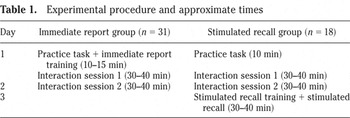
The experimental procedure is summarized in Table 1. On day 1, the participants first completed a practice task (one-way picture description task) similar to the communicative tasks. During this practice session, learners in the immediate report group (n = 31) received training in immediate reports. Learners in the stimulated recall group (n = 18) completed the practice task without receiving any training. All participants then engaged in their first interaction session. On day 2, learners completed another session. The order of task types was counterbalanced. On day 3, members of the stimulated recall group met individually with the interviewer for a third session in which they received training in stimulated recall using a videotape of their practice task. The training was followed by a stimulated recall interview.
Experimental procedure and approximate times

Coding
Linguistic Targets
Recast episodes were coded for the type of linguistic error addressed in the recast. Often a nontargetlike learner utterance involved more than one type of linguistic error; however, only errors addressed in the recast were analyzed. The linguistic domains examined in the current study were morphosyntax and lexis. The linguistic foci of morphosyntactic recasts included the morpheme -te, morphophonological changes involving the te-formation and numeral classifiers, tense, particles, word order, and so forth, as in examples (1)–(5), (8), (9), and (12) in this article.6
Morphophonological changes (Tsujimura, 1996) refer to morphological as well as phonological changes involved in the te-formation of verbs whose roots end with consonants. Similar to the te-form construction, some numeral classifiers also involve morphophonological changes to the classifiers, numeral expressions, or both.
Length of Recasts
Recast episodes were coded for absolute length (shorter or longer) on the basis of morpheme counts, following Philp (2003). However, Philp's coding scheme (short ≤5; longer ≥6), developed for English data, was not applied to the Japanese data of this study due to the structural differences between the two languages. Because Japanese is an agglutinative language, a Japanese word generally comprises a greater number of morphemes than does an English word; the length of recasts in the current database ranged from 1 to 26, with an average of seven morphemes (SD = 4.32). To account for this language-specific issue, a higher threshold than Philp's was selected for the current study. Shorter recasts were operationalized as those of seven or fewer morphemes, as in (2), whereas longer recasts were operationalized as those of eight or more morphemes, as in (3) (for the procedure of morpheme counts in Japanese, see Iwashita, 2006; Oshima-Takane, MacWhinney, Shirai, Miyata, & Naka, 1998).

Number of Changes
The degree of difference between the learner's problematic utterance and the recast was coded for the number of corrective changes made to the trigger. The number of changes in the current database ranged from one to six, with an average of two (SD = 0.98). When a recast involved one or two changes, as measured by morpheme counts, it was coded as fewer changes. A recast involving three or more changes was coded as more changes. The cutoff point of two was selected because in many cases, a reformulation of one word involved at least two morphemes. When counting changes, only the errors that the recast targeted were examined. The coding did not consider additional linguistic elements in the recast that were unrelated to the learner errors.7
It is also possible that not only corrective but any noncorrective changes might affect the salience and processing load of a recast. To address this issue, an additional analysis that considered all types of changes was conducted. In this analysis, recasts with fewer and more changes were defined using the same cutoff point as the recast length (i.e., fewer, ≤7; more, ≥8). The results of this analysis showed similar patterns to the results reported in this article. As pointed out by an anonymous SSLA reviewer, this analysis might confound the number of changes with recast length to some extent; however, it provides additional insight into the overall impact the trigger-recast differences might have on learners' interpretations of recasts.

Recall Data
As shown in Figure 1, the verbal protocols were categorized first according to whether or not the learner paid attention to a recast and, second, for the aspect of the recast to which the learner attended. When the learner reported attending to the semantic aspect of the recast, it was coded as a response to content. In contrast, when the learner reported noticing the linguistic evidence relevant to the linguistic targets of the recast, it was coded as negative evidence or positive evidence. When the learner reported attending to both types of linguistic evidence, it was then coded as negative + positive evidence. An additional set of comments in which the learner's attention to the recast was not apparent was coded as no reported noticing of recasts. This included comments about (a) the general interactional content, (b) the tasks, (c) the learner's feelings, actions, and speech production, (d) issues unrelated to the experiment, and (e) not remembering one's thoughts or not having had any specific thoughts. Following this procedure, only one interpretation category was assigned to each recast episode.

Recall data coding scheme.
Responses to content were operationalized as comments indicating that the learner interpreted the recast as the interlocutor's replies to the conversational content, such as confirmation and acknowledgement, as shown in (6).

In (6), the NS provided a recast of the nontargetlike lexical item; however, the learner thought that the NS had confirmed or doubted the fact that there was a phone book in the learner's picture. The category of responses to content also included learner comments that concerned the semantic or pragmatic content of the recast, as shown in (7).

In (7), the learner attended primarily to the semantic content of the recast provided in response to his inappropriate selection of a classifier. He found it funny that the NS asked if there was only one mouse, as he would feel uncomfortable seeing any mice at a restaurant. The examples in (6) and (7) were distinguished from a comment like (8), in which the learner reported attending to the global meaning of the interaction. Because this recall comment does not explicitly suggest that the learner attended to the recast, it was coded as no reported noticing of recasts.

Negative evidence was operationalized as comments indicating that the learner was aware of error production or correction without a clear indication that the learner noticed the targetlike form provided in the recast, as illustrated in (9). The learner reported that he incorrectly conjugated the verb. This comment, however, does not clearly suggest that he noticed the targetlike form the NS provided.

Positive evidence was operationalized as comments indicating that the learner attended to the targetlike model without reporting having produced errors or having been corrected, as shown in (10). The learner received a recast of her error on the lexical item “fishbowl.” Her mention of the correct Japanese word in the recall comment suggests that she had attended to the NS model. This comment, however, does not explicitly suggest that she was aware that her original utterance was problematic.

Negative + positive evidence was operationalized as comments that indicated the learner's (a) recognition of error production or correction and (b) attention to the targetlike form in the recast.

Intercoder Reliability
Two independent coders (the researcher and a L1 Japanese research assistant) coded a randomly selected 25% of the interaction and recall data. The remainder of the data was coded by the researcher. The assistant was trained in the coding procedures: She received information about (a) interactional feedback, (b) morpheme counts, (c) linguistic categories, and (d) interpretation categories, and practiced coding data that were not included in the analysis. For the interaction data, intercoder reliability, as measured by simple agreement percentage and Cohen's kappa, yielded high agreement rates: recast length, 100%, κ = 1.00; number of changes, 99%, κ = .98; and linguistic categories, 100%, κ = 1.00. For the recall data, intercoder reliability was 97% and κ = .97. For all datasets, high kappa values (.97–1.00) were interpreted as excellent (Orwin, 1994).8
Orwin (1994) proposed the following interpretations of kappa values: κ < .40 (poor), .40 < κ < .59 (fair), .60 < κ < .74 (good), and .75 < κ < 1.00 (excellent).
Statistical Analysis
In each interpretation category, the frequencies of morphosyntactic and lexical recasts, shorter and longer recasts, and recasts with fewer and more changes were tallied. In order to examine learners' interpretations of recasts in relation to the recasts' linguistic targets, length, and number of changes, raw frequencies were submitted to Pearson's χ2 test with an α-level set at .05. Fisher's exact test was applied when expected cell frequencies were below five.9
Fisher's exact test is commonly used for 2 × 2 contingency tables; however, this test could extend to tables of arbitrary size r × c. For more information, see Agresti and Finlay (1997).
RESULTS
The first research question asked whether learners interpreted morphosyntactic and lexical recasts they had noticed as (a) responses to content, (b) negative evidence, (c) positive evidence, or (d) a combination of negative and positive evidence. It also asked if there was a relationship between learners' interpretations of recasts and linguistic targets.
The interaction data included 2,017 feedback episodes; the learners recalled their thoughts for 51.02% (n = 1,029) of them. Of the recalled episodes, 785 were recasts provided on morphosyntactic items and 134 were recasts on lexical items. On average, the learners reported noticing 60.64% (SD = 20.90, n = 476) of the morphosyntactic recasts and 57.46% (SD = 37.71, n = 77) of the lexical recasts, with noticing operationalized as any verbal protocols indicating that learners had attended to recasts.
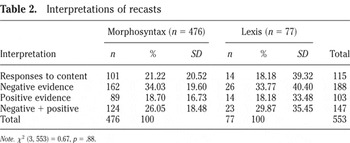
The learners' noticing of recasts was further categorized according to the aspect(s) of the recasts they attended to, as presented in Table 2. For morphosyntactic recasts, the learners reported interpreting 21.22% as responses to content. At other times, they reported interpreting recasts as linguistic evidence related to their morphosyntactic errors (negative, 34.03%; positive, 18.70%; negative + positive, 26.05%). For lexical items, interpretation categories exhibited similar distributions. The learners reported interpreting lexical recasts as responses to content 18.18% of the time, whereas at other times they reported attending to the linguistic evidence related to their lexical errors (negative, 33.77%; positive, 18.18%; negative + positive, 29.87%). The χ2 analysis indicated no significant relationships between linguistic targets and the learners' interpretations of recasts, χ2 (3, 553) = 0.67, p = .88, which suggests that learners interpreted recasts of morphosyntactic and lexical errors in a similar manner. However, these findings must be interpreted with caution because there was significant variability for the learners' interpretations as reflected in high standard deviations (Table 2).
Interpretations of recasts

The second research question asked if there was a relationship between learners' interpretations of morphosyntactic and lexical recasts and (a) recast length and (b) the number of changes.
Length of Recasts
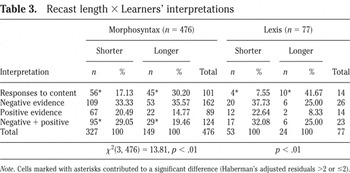
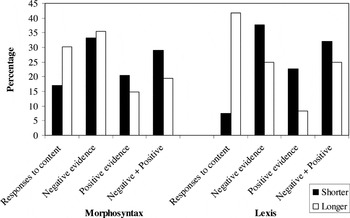
Of the 476 morphosyntactic recasts that were noticed, 327 (68.70%) were shorter recasts and 149 (31.30%) were longer recasts. Of the 77 lexical recasts that were noticed, 53 (68.83%) were shorter recasts and 24 (31.17%) were longer recasts. Table 3 shows raw frequencies and percentages of shorter and longer recasts across the interpretation categories. Figure 2 provides graphical representations of the patterns. The results indicated that there was a significant relationship between recast length and the learners' interpretations of morphosyntactic, χ2 (3, 476) = 13.81, p < .01, as well as lexical (Fisher's exact test, p < .01) recasts. Post hoc Haberman's adjusted residuals indicated that for morphosyntactic items, the learners reported interpreting a significantly greater proportion of longer recasts (30.20%) than shorter recasts (17.13%) as responses to content. In contrast, they reported interpreting a significantly greater proportion of shorter recasts (29.05%) than longer recasts (19.46%) as providing both negative and positive evidence. Also, for lexical items, the learners were significantly more likely to report interpreting longer recasts (41.67%) as responses to content compared to shorter recasts (7.55%). However, unlike morphosyntactic recasts, learners' interpretations were not significantly related to length when they reported attending to the linguistic evidence in recasts.
Recast length × Learners' interpretations


Percentage of shorter and longer morphosyntactic and lexical recasts.
Number of Changes
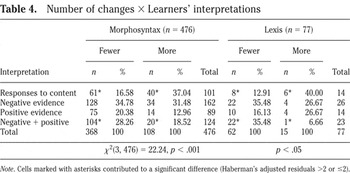
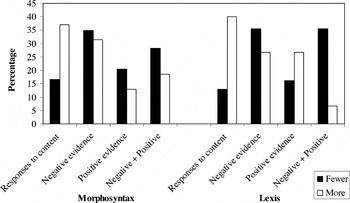
Of the 476 morphosyntactic recasts, 368 (77.31%) involved one or two changes and 108 (22.69%) involved three or more changes. Of the 77 lexical recasts, 62 (80.52%) and 15 (19.48%) were classified as recasts with fewer and more changes, respectively. Table 4 shows raw frequencies and percentages of recasts with fewer and more changes across the interpretation categories. Figure 3 graphically presents the patterns. The results showed that the learners' interpretations of recasts were significantly related to the number of changes made to their problematic utterances: morphosyntax, χ2 (3, 476) = 22.24, p < .001; lexis, Fisher's exact test, p < .05. For both linguistic types, the learners reported interpreting recasts with more changes as responses to content (morphosyntax, 37.04%; lexis, 40.00%) significantly more often than they did recasts with fewer changes (morphosyntax, 16.58%; lexis, 12.91%). In contrast, learners were significantly more likely to report interpreting recasts as providing both negative and positive evidence when they involved fewer changes (morphosyntax, 28.26%; lexis, 35.48%) than when they involved more changes (morphosyntax, 18.52%; lexis, 6.66%).
Number of changes × Learners' interpretations


Percentage of morphosyntactic and lexical recasts with fewer and more changes.
DISCUSSION
Learners' Interpretations and Dual Functions of Recasts
The first research question asked how learners interpreted recasts they had noticed and whether there was a relationship between their interpretations and linguistic targets (i.e., morphosyntax or lexis). A similar pattern emerged regardless of the linguistic type. When noticing occurred, the learners primarily reported attending to the linguistic evidence in recasts (i.e., negative evidence, positive evidence, or both), whereas they reported interpreting recasts as responses to content (e.g., confirmation and acknowledgement) 18–21% of the time. This finding substantiates the theoretical claim that learners do not always view recasts as corrections, although at lower levels than has been claimed by research based on uptake and repair (e.g., Lyster, 1998a, 1998b; Lyster & Ranta, 1997; Panova & Lyster, 2002). The learners in this study typically reported this type of interpretation in a context in which recasts played the dual role of corrective feedback and pragmatic discourse move, as illustrated in (12). Of the 115 recasts that were interpreted as responses to content, 71 (61.74%) occurred in this context.

In (12), in which the NNS described a restaurant scene before a crime, the NS provided a recast of the nontargetlike numeral classifier (*nipiki). At the same time, the NS confirmed the number of mice as she wrote it down; that is, from the NS's perspective, the recast served a dual purpose of correction and confirmation. To the learner, however, only the latter seemed evident. As his recall comment indicated, the recast prompted him to reexamine the picture to verify the number of mice, instead of drawing his attention to the correction.
This finding might be discussed in relation to Carroll's (2001) relevance theory, which claimed that “the interpretation of linguistic feedback requires interpreting an utterance as obeying the Cooperative Principle but violating Relevance” (p. 390). Grice's (1975) cooperative principle refers to a belief that conversational participants contribute to the conversation in a manner consistent with its goal and direction. Relevance is a belief that the contributions that participants make are pertinent to the ongoing conversational topic. Carroll argued that when interpreting an interlocutor's utterance, the learner first seeks an interpretation most consistent with the topic of the ongoing talk, as in (12), when the NS was understood to be confirming the number of mice. When this interpretation is implausible, the learner then resorts to an alternative interpretation that is not directly relevant to the conversational topic, such as corrective feedback on form. Thus, when a recast serves the dual role of corrective feedback and pragmatic discourse moves, its didactic function might not immediately engage learners' attention. On the contrary, in discourse where the primary focus is on form, as in form-focused classrooms, learners might be more likely to interpret recasts as feedback because this might be the interpretation most relevant to the context.
The effects of instructional foci have been well illustrated in studies by Sheen (2004) and Lyster and Mori (2006). Sheen compared teachers' feedback and learners' uptake and repair across four learning contexts. The results indicated that learners produced substantially more uptake and repair after receiving recasts in New Zealand ESL (database from Ellis, Basturkmen, & Loewen, 2001) and Korean EFL settings than in French immersion (Lyster & Ranta, 1997) and Canadian ESL (Panova & Lyster, 2002) settings. Lyster and Mori also found much less uptake and repair in the French immersion setting than in a Japanese as a foreign language setting. Both studies related the higher rates of uptake and repair to a form-focused orientation observed in their respective instructional settings.
However, unlike these studies, the current study did not compare meaning-focused and form-focused contexts. Thus, a more definitive answer to the question of how contexts impact learners' interpretations requires introspective research that empirically examines whether students in meaning- and language-focused classrooms interpret recasts differently.
Linguistic Targets
The linguistic targets of recasts are another factor that might influence learners' interpretations (e.g., Carpenter et al., 2006; Kim & Han, in press; Lyster, 1998b; Mackey et al., 2000; Sheen, 2006). However, in the current study, the learners' interpretations of lexical and morphosyntactic recasts showed similar patterns. This was unexpected, because lexical items are generally believed to have higher communicative value and salience than many morphosyntactic items (e.g., Mackey et al.). The findings reported here might be explained by different frequencies and linguistic foci of lexical and morphosyntactic recasts in this study. Because the tasks targeted two particular morphosyntactic items (the morpheme -te and numeral classifiers), recasts were frequently and consistently provided for these two items, which made up 77.96% (612 of 785) of the morphosyntactic recasts. In contrast, the targets of lexical recasts varied widely without a consistent focus. Additionally, they occurred far less frequently than morphosyntactic recasts (134 vs. 785). Importantly, both quantity and quality of recasts, such as a consistent focus, might affect their salience (Han, 2002; Kim & Han). It is thus possible that the frequency and consistency of morphosyntactic recasts elevated their salience to a level comparable to lexical recasts. Future research that carefully controls these factors might provide more accurate information about the relationship between linguistic targets and learners' interpretations.
Features of Recasts and Learners' Interpretations
In addition to linguistic targets and interactional contexts, length and number of changes might influence learners' interpretations of recasts. The second research question addressed this issue. Because the preponderance of previous work on these recast features employed indirect measures of learner-internal processes (e.g., uptake and repair), relatively little is known about how these features might affect learners' interpretations. Through introspective reports, the present study found that both length and number of changes were significantly related to how learners interpreted recasts. Specifically, they reported interpreting longer recasts and those with more changes as responses to content significantly more often than they did shorter recasts and those with fewer changes. In contrast, when recasts were shorter and involved fewer changes, the learners were significantly more likely to report an interpretation consistent with the theoretical definition of recasts—that is, sources of both negative and positive evidence (e.g., Long, 1996). These patterns were generally observed for both morphosyntactic and lexical recasts.
These findings might be related to limited attentional capacity.11
The limited capacity is one feature of attention, and attention can be characterized in various ways. For other theoretical views of attention, see Robinson (1995) and Schmidt (2001).
Differential effects of length and number of changes on learners' interpretations can be further discussed in terms of working memory capacity, often defined as active simultaneous storage and processing functions of memory (e.g., Harrington & Sawyer, 1992; Miyake & Friedman, 1998). Research has suggested that working memory is involved in processing verbal input in a L2 (e.g., Ellis, 1996; Ellis & Schmidt, 1997; Miyake & Friedman; Robinson, 1995, 2003; Sawyer & Ranta, 2001; Skehan, 1998; Williams & Lovatt, 2003) and might contribute to individual differences in noticing feedback (e.g., Mackey, Philp, Egi, Fujii, & Tatsumi, 2002; Philp, 2003). In the current study, the definitions of both positive evidence and positive + negative evidence included any mention of the targetlike form in recasts. The target input supplied in shorter recasts might be more readily stored in working memory and later become available for verbal reports. On the contrary, longer recasts might be less likely to be retained in memory because they exceed immediate processing limits. Likewise, recasts with minimal changes might be more easily retained than those with multiple changes because the rehearsal and short-term storage of fewer elements are thought to be less demanding. Future research could extend this study by including measurements of working memory.
Given that recast features such as length and number of changes influenced learners' interpretations, the dichotomous categorization of recasts as implicit or explicit feedback is problematic if these features are not considered carefully. It might be more appropriate to consider recasts as situated within an implicit-explicit continuum (Sheen, 2006). Longer recasts that deviate from the trigger might be on the implicit end of the continuum, whereas shorter recasts that resemble the trigger might be on the explicit end.
LIMITATIONS AND FUTURE DIRECTIONS
The findings of the current study should be generalized with caution. Although the communicative tasks simulated a meaning-focused context, the nature of interaction might not be comparable to classroom interactions. The learners in this study were provided with intensive recasts in dyadic interactions in which they received individual attention from the NS interlocutor. In contrast, learners in classroom settings are generally exposed to various types of feedback without the teacher's personalized attention. A crucial next step would be to investigate learners' interpretations of recasts in communicative classrooms, particularly in immersion classrooms, which gave rise to the claim that recasts are ambiguous.
It is also important to acknowledge that there were large individual differences in the ways the learners interpreted recasts. The adult learners in this study were relatively homogeneous in that all of them were well educated and had been learning Japanese in formal classroom settings. Sheen (2004) reported that learners similar to those in the current study in terms of age and educational background produced more uptake and repair than younger immersion students and less educated adult learners. She characterized educated adult learners in her study as metalinguistically sophisticated learners who were highly sensitive to linguistic form. Consistent with this observation, the learners in this study generally attended to form over meaning. Yet, there were wide variations among learners. Whereas some individuals consistently attended to meaning despite intensive recasts provided on form, some consistently attended to form. These individual differences were evident in large standard deviations in the percentages of the four interpretation categories. Although differences in instructional settings are clearly an important factor when addressing learners' interpretations of recasts, it is possible that some learner-internal factors additionally affect their interpretations. Future research could compare characteristics of meaning-oriented and form-oriented learners within a single setting. Detailed profiling of these learners in terms of language aptitude, memory capacity, and personality, for example, might provide further insight into cognitive factors that affect learners' interpretations of recasts.
In addition to the concerns already elaborated, future research might also focus on the operationalizations of recast length and number of changes. There are a number of issues to consider. First, only a small number of studies have examined these features using morpheme counts, especially for Japanese data. It is thus important to note that the use of morpheme counts is an explanatory attempt. Second, what constitutes shorter versus longer recasts and fewer versus more changes might be relative to individual differences in working memory capacity. How much information one can hold in memory depends on a number of factors, including speech rates (e.g., Baddeley, 1996), the position of the word in a list (e.g., Cowan, Day, Saults, Keller, Johnson, & Flores, 1992), chunking (Miller, 1956), and acquired strategies (e.g., Baddeley & Logie, 1999; Cowan, 1988). However, provided that memory capacity might not be entirely language independent (e.g., Thorn & Gathercole, 1999), language proficiency might also be confounded with L2 learners' memory span (Philp, 2003). In short, learners' experiences with longer or shorter recasts and more or fewer changes might not coincide with the researchers' perspectives (Philp). The operationalizations of these recast features are still evolving.
Further research in this area might also address recast length in terms of relative, rather than absolute, length. The current study operationalized recast length in terms of absolute length but did not distinguish between (a) a long, incorporated recast with new information and (b) a long recast that resulted from the NS's corrective repetition of a long trigger without new information. If the processing load of a recast depends on the amount of information provided, rather than the length, the former might carry a heavier processing load than the latter. Likewise, a shorter recast that substantially differs from the trigger might be more cognitively demanding than a longer recast with minimal changes. Interaction between length and the number of new information units is an interesting research question for future investigation.
Finally, it is important to acknowledge the limitations of introspective research. As a well-worn research axiom states, an absence of evidence is not evidence of an absence. That learners reported interpreting a recast in a certain way does not suggest that they did not interpret the recast in other ways. Nevertheless, in the current study, the coders interpreted verbal report data based solely on the information learners provided in order to maintain reliability in coding. Despite these limitations, introspective techniques provide a more direct source of information about learners' cognitive processes than discourse analysis techniques used in prior research.
CONCLUSION
The present study investigated how L2 learners interpret recasts they notice and how recast features (linguistic targets, length, and number of changes) influence their interpretations. Learners in this study mainly attended to the linguistic evidence in recasts. However, they occasionally reported interpreting recasts as responses to content, particularly when recasts served the dual role of corrective feedback and pragmatic discourse moves. This finding supports the argument that recasts are ambiguous in meaning-focused contexts in which recasts serve multiple functions. Learners' failure to interpret recasts as feedback was significantly related to features of the recasts. When recasts were long and differed substantially from the trigger, the learners were likely to report interpreting them as responses to content. On the contrary, when recasts were short and closely resembled the trigger, learners were more likely to attend to the linguistic evidence provided in recasts. Additionally, overall, there were no obvious effects of linguistic targets on learners' interpretations. In conclusion, recast length and number of changes might, in part, determine their explicitness as corrective feedback and thus influence the ways learners interpret recasts. Continued research on learner-internal processes is essential to understanding the mechanisms that underlie interaction-driven learning.