History painting was the most admired of early modern genres, but it is also the one moderns find hardest to define. By common agreement, “history” was the most elevated task a painter could tackle, yet just what constituted a history painting was neither stable nor clear. On the contrary, a general air of taken-for-grantedness hung over the art, blurring its considerable variety and masking the inevitable changes that are inherent in long-standing traditions. Lesser “kinds,” on the other hand, were easier to characterize. Portraits, landscapes, and genre scenes had their own particular subject matter, as did conversation pieces, battle paintings or “marines.” “Histories,” however, were identified by their grandeur or distance as much as by any definable theme. Thus while other genres suffered confusion when they encroached on “history” by reaching too high, “histories” risked losing their special dignity if their subjects seemed private or commonplace. The proper home for the “great style” was amongst public concerns, where heroic images formed a natural accompaniment to ceremonies of power, whether sacred or secular, mythic or historical.
A second complexity rested in the word “history/istoria”—a term whose artistic usage seemed more elastic than that of most historians. Witness the late seventeenth-century description given by William Aglionby, who writes that “History-Painting is an Assembling of many Figures in one Piece, to Represent any Action of Life, whether True or Fabulous, accompanied with all its Ornaments of Land-skip and Perspective.”Footnote 1 No one, so far as I know, has carefully studied the stages by which Aglionby's early modern mixture of “truth” and “fable” was brought under tighter constraints. Nonetheless, it seems clear that by the nineteenth century history painting had joined history writing in acquiring a broadly modern commitment to secularity and documentable fact. In the process, the “great style” had to relinquish some cherished symbols of grandeur, especially those associated with earlier regimes of church and state. Yet despite considerable changes, the genre did not lose its traditional identification as the most elevated branch of art. On the contrary, as earlier legacies lost currency, history painting (like history writing) built new claims around the political culture of secular nationalism and a vision of history as the sum of social experience. In this way history painting retained its identity as an art form enlarged by public concerns, albeit in an epoch in which historical sensibilities were turning towards the representation of everyday life.
In short, though both “distance” and “history” remained essential elements of history painting, there was considerable room for change in both the prevailing idea of history and the modes and degrees of distance.Footnote 2 Following in the track of Edgar Wind's classic study of the “Revolution in History Painting,” this essay will examine some issues of distance and historical representation in Benjamin West and David Wilkie, two key transitional figures in British art c.1800. The comparison, I acknowledge, may seem strained. After all, West has been credited with initiating a “revolution in history painting,” while Wilkie's experiments with historical subjects have generally been assigned to common life. If a comparison of eighteenth- and nineteenth-century painters is wanted, why not a professed “historical painter” like Haydon, rather than a difficult hybrid like Wilkie?Footnote 3
My purpose is not to adjudicate this argument, whether by sustaining or correcting contemporary responses to Wikie's art. Rather, pushing against the prescriptiveness that is built into traditional definitions of history painting, I want to approach Wilkie's divided reception as a sort of diagnostic. My aim is to illustrate the continued importance of elevation as a criterion of judgment, as well as to explore the difficulties that arose from the tension between contrary impulses of distancing and familiarization. By extension—though far more briefly—my conclusion will suggest that Wilkie's hybridization of history and everyday life bore a significant resemblance to parallel changes in historiographical sensibilities introduced by Hume and the Scottish Enlightenment.Footnote 4 Thus contemporary uncertainties about how to place Wilkie's The Gazette of Waterloo (1822) hold a larger interest as a commentary on the evolving relationship between history painting and other forms of historical representation.
JOSHUA REYNOLDS AND NEOCLASSICAL HISTORY PAINTING
Historians of baroque and neoclassical painting routinely admonish their students not to confuse eighteenth-century history painting with the ordinary concerns of modern historians. The “history” in history painting is a special usage, derived from the Renaissance idea of istoria and closer to the religious and dynastic culture of early modern Europe than to the secular nationalism of modernity. Sacred history, ancient myth, dynastic allegories, the memory of Rome or Greece—these loosely gathered “histories” provided the eighteenth-century painter with his subject, not the nationalist imperatives of later generations.
Despite some obvious ambiguities, few eighteenth-century artists felt the need to define history painting more closely. Why question a title so rich in prestige? One exception, however, was Joshua Reynolds, who built his idea of the genre on the strict Aristotelian distinction between the particular truths of history and the general truths of art.Footnote 5 To avoid semantic confusion, Reynolds preferred to speak about the “Great Style,” while freely acknowledging the painter's liberty to “deviate from vulgar and strict historical truth, in pursuing the grandeur of his design.”Footnote 6 Facts and events, he insisted, “however they may bind the Historian, have no dominion over the Poet or the Painter.” The artist is not restricted by a mere imitative idea of truth; instead he bends history “to his great idea of Art.” And yet even Reynolds needed to cede to common usage. “In conformity to custom,” he wrote, “I call this part of the art History Painting; it ought to be called Poetical, as indeed it really is.”Footnote 7
Reynolds's pragmatism suited a worldly artist who made his living by painting portraits, not “histories.” As first president of the Royal Academy, however, he championed a strict hierarchy of genres, with history painting at its summit. The “Great Style” required all the skills belonging to lesser forms of art, but it alone found its home in representing the Ideal. “The Art which we profess has beauty for its object,” wrote Reynolds,
the beauty of which we are in quest is general and intellectual; it is an idea that subsists only in the mind; the sight never beheld it, nor has the hand expressed it: it is an idea residing in the breast of the artist, which he is always labouring to impart.Footnote 8
As the second president of the Royal Academy, Benjamin West followed in Reynolds's footsteps, but his idea of history painting incorporated a tie to history that was alien to Reynolds. As the familiar story is told in Galt's biography of West (1816–20), the artist responded to a visit from a sceptical Joshua Reynolds with a ringing defence of the historical grounds for his artistic choice. General Wolfe's victory in Quebec
took place on the 13th of September, 1758, in a region of the world unknown to the Greeks and Romans, and at a period of time when no such nations, nor heroes in their costume, any longer existed. The subject I have to represent is the conquest of a great province of America by the British troops. It is a topic that history will proudly record, and the same truth that guides the pen of the historian should govern the pencil of the artist.Footnote 9
Much of West's celebrity has rested on his decision to portray Wolfe and his comrades in contemporary clothing. Yet when we read this passage from Galt's biography against the authority exercised by Reynolds, West's challenge to neoclassical doctrines seems a matter less of dress than of a new relation to historical writing. For Reynolds, after all, the “Great Style” depended upon maintaining a clear, hierarchical distinction between the poetic freedoms of history painting and the commonplace particulars of ordinary history. West's declaration, however, subsumes the problem of contemporary dress under the requirements of history, thereby separating history painting from poetry and endowing it with a new obligation to the kind of truthfulness that Reynolds dismissed as “vulgar and strict.”
As Edgar Wind pointed out in his classic article on “The Revolution in History Painting,” West's invocation of historical truth seems all the more noteworthy because history painting and historical writing had been moving in contrary directions in the second half of the eighteen century.Footnote 10 In brief, while neoclassical history painters strove to create heroic images, Hume, Voltaire, and Gibbon sought ways to familiarize the past.Footnote 11 This tension, as will be seen, would become very significant for understanding a painter like Wilkie. More immediately, however, it meant that West's modification of neoclassical principles would remain a conservative “revolution,” whose blend of grandeur and ordinary history still leaned heavily towards the ideal. And beyond West himself, the same smooth harmony was evident in a number of other Americans, who followed West's example in endowing recent events with a full measure of the heroic. Witness John Singleton Copley's massive canvas of the Defeat of the Floating Batteries at Gibraltar in the Guildhall (1783–91), with its echo of the “continence of Scipio,” equally, his The Death of Major Pearson (1783), where a minor battle in Jersey is fitted out with Raphaelesque borrowings.
In the longer view, however, harmonizing the two histories became harder to manage on such traditional terms. On the contrary, as painting lost its moorings in the sacred histories and dynastic allegories of an earlier era, a new and closer relationship with history writing was forged. In consequence, though West's own practice was hardly radical, his equation of history painting with historical truth seems prophetic of new directions in nineteenth-century art.
DISTANCE AND DISTANCES IN THE DEATH OF GENERAL WOLFE
West's depiction of modern heroes in contemporary dress represented a challenge to neoclassical conventions, but Wind argues that West's real originality lay in his strategy for depicting a modern event while maintaining the requisite distance. What West understood was that by exchanging settings that seemed exotic (North America) for those that were venerable (Roman antiquity) he could endow a recent event with all the elevation history painting required. In short, as Wind writes (quoting Racine), “Distance of country compensates in some measure for nearness of time: for people do not distinguish that which is . . . a thousand years, and that which is a thousand miles away from them.”
Benjamin West, The Death of General Wolfe, 1770, oil on canvas, 152.6 × 214.5 cm. National Gallery of Canada, 8007.

Wind's proposal is ingenious, but distance is a complex construction, not to be reduced to the measurement of linear time. At best, the proposed substitution of space for time introduces one more marker of distance without adding fundamentally to its plasticity or interpretive value. On the level of artistic practice, however, even a cursory description of The Death of General Wolfe (1771) suggests the variety of ways in which our responses are shaped by its modulations of distance (Fig. 1). No doubt the much-talked-about issue of contemporary dress modernizes the scene and makes West's heroes appear less remote, yet this sense of increased accessibility has to be weighed against a formal design which pictures the wounded general in the pose of the dying Christ. Witness the pyramidal arrangement, the circle of grief-stricken onlookers, the slumping body supported by a merciful hand (in this case not that of the Virgin but of a doctor stemming the flow of blood). These features summon us by evoking the iconography of Christian sacrifice. Wolfe's death—familiarized in one way, elevated and distanced in others—is no ordinary military casualty, but a moment of spiritual heroism, its pathos tempered by the recognition that a larger fate hangs over the occasion. Lament though we may, the young soldier's death is a sacrifice lovingly offered—one we are called upon to admire in its fineness rather than to regret or wish to forestall.
Setting off the Christian iconography, West introduces the exotic majesty of the indigenous warrior. This is the work's most striking invention, a crucial term in history painting going back to the writings of Leon Battista Alberti. By contrast, in Barry's slightly later rendering of the same scene (1776), a Native figure lies dead and little noticed at the bottom of the canvas. Here the corpse indicates the location of the battle, but does nothing to raise the grandeur of the scene.Footnote 12 West, on the other hand, makes the warrior central. Silent and thoughtful, he contemplates the spectacle of death-in-victory. He is not there to participate in the struggle, but to take part in an unspoken dialogue. One of these warriors is mortally wounded, the other is expected to “vanish,” but for a moment the two soldiers jointly hold the stage and give the painting its ideological impact. They are America's future and past.
As in Barry's painting, West's indigenous warrior functions as an emblem of place, but West presents us with a much larger and more historical idea. For all his speechless grandeur, the Native warrior remains an image of thought rather than of action. By his presence, he gives witness not only to the good death of the English general, but also to the larger victory his death brings the nation. Wolfe, we know, has to die on the Plains of Abraham, but so too will the world symbolized by this image of exotic nobility. Crucial as he is to what Alberti called the painting's istoria, the Native warrior is a vivid personification of the grand historical drama concluded by Wolfe's sacrifice—the annexation of a great continent to British rule.
Like other eighteenth-century painters, West was uncomfortable with the artificiality of traditional allegory, once a common feature of history painting. Instead, he deployed the Native warrior as a natural symbol and added to the realistic effect by copying some items of costume imported from America. The result was a powerful image that was at once highly idealized and historically precise. The same balance characterizes the picture as a whole, allowing West to seek acceptance as an orthodox history painter while also claiming (at least in biographical retrospect) that his work remained faithful to a particular moment of history.
No simple formula, it is evident, could account for the full array of gestures—formal, affective, ideological, and conceptual—that mediate our response to West's painting and confirm its status as a history painting. At the most elementary level, the size and complexity of such a work were prime characteristics of a genre associated with the weight and dignity of public art. Equally, viewers would have been alert to West's invocation of the pieta, just as they understood the intellectual ambition that led him to enrich a historical narrative with allegorical significance. Though no one element alone would have accomplished everything the artist intended, the combination raised the painting above a mere “battle piece” and identified it as a “history.”
These formal vocabularies overlap with a variety of other features that work in similar terms, sometimes distancing the scene, other times bringing it closer. What weight, for example, should we give to the emotional resonances of a picture concerned with the death of a young hero so far from home? And what about the conceptual dimension of West's painting—a matter of the utmost importance in neoclassical discussions of the artistic hierarchy? According to the Albertian formula, still dominant in eighteenth-century Britain, landscape and portraiture required essentially mechanical skills; only history painting's faculty of invenzione placed it amongst the liberal arts. As Reynolds put it, the “value and rank of every art is in proportion to the mental labour employed in it, of the mental pleasure produced by it. As this principle is observed or neglected, our profession becomes either a liberal art, or a mechanical trade.”Footnote 13
As a liberal art, history painting was expected to educate and enlighten. Like poetry, a “history” could summon the cultivated viewer by offering a strong impression of greatness. Nor would its lessons fade with the ages. As West himself put it in an address to the Royal Academy,
it is by those higher and more refined excellencies of painting, sculpture, and architecture, that Grecian and Roman greatness are transmitted down to the age in which we live, as if they were still in existence; although many centuries have elapsed since both Greeks and Romans have been overthrown and dissolved as a people; while those nations, by whom those refinements were not known, or not cultivated, are erased from the face of the earth, without any other monument or vestige to give the demonstration that they were great.Footnote 14
West's experiment in “contemporary history” has given him the reputation of a cautious modernizer, but this passage—though not directly related to the Death of Wolfe—suggests a wider reflection on the problem of distance and ideology. Not only must the history painter accept the intellectual challenges Reynolds underlined, but his art also carries a special burden of historical memory. For Protestant Britain the consequence was often a deep sense of anxiety, especially in relation to France. If (as everyone agreed) history painting had its roots in religious images, there was no escaping the fact that Catholic Europe had schooled itself in just that class of devotional works that Puritan Britain had banished from its churches and public buildings. When Britons looked far into the future and examined their own artistic record against the achievements of their neighbours, they confronted a bleak failure of representation. What legacy could they offer compared to the glories of Rome, Paris, or Madrid? What memory, if any, would remain?
AFTER BENJAMIN WEST—WILKIE’S THE VILLAGE POLITICIANS AND THE GAZETTE OF WATERLOO
West's declaration that history painting must be truthful as well as heroic marked a significant modification to Reynolds's teaching, yet if West succeeded in harmonizing history with grandeur it was largely because elevation still held precedence over faithfulness to the historical record. A generation later, however, these priorities were reversed by David Wilkie, an artist who can be understood as a painter of histories, but not as one who aspired to mix history with the heroic.Footnote 15
Royal patronage had made West the most visible history painter of the day, but despite his unanimous election to the presidency of the Royal Academy in 1792, he never exercised Reynolds's authority, nor did he succeed in giving Britain the historical school it so urgently wanted. Wilkie's carefully detailed pictures of everyday life, on the other hand, found early success, and despite some notable changes of style in later years, he commanded a steady popularity. Significantly, the reproductive engravings that spread his fame largely referred back to his earlier, familiar style, rather than to the Spanish-influenced works that came later. As a consequence, in popular imagination at least, he continued to be associated with art that was felt to be particularly British, rather than classical. If, as commentators often agreed, the power of Wilkie's imagination raised his work above mere genre painting and made his pictures “national,” his affinity was with Hogarth, not with Reynolds or West.
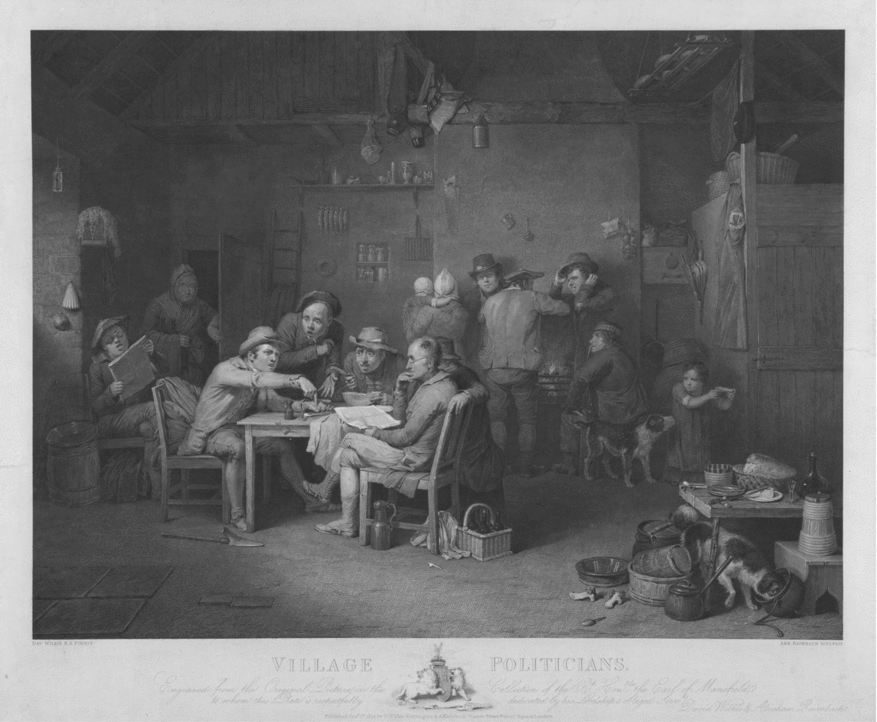
Abraham Raimbach after David Wilkie, The Village Politicians, 1814, engraving and etching, 50.8 × 62 cm, Yale Center for British Art, Paul Mellon Collection, B1977.14.14559.
Like the Death of Wolfe, Wilkie's The Village Politicians (1806) depicted a scene that was both contemporary and historical, but it lacked the formal and affective markers that distinguish a “history” in art. Too small, too dark, too obviously influenced by Dutch genre painting, this early effort lacked the dignity that might elevate it to the higher class. A study of rustic manners set in the interior of a common tavern, The Village Politicians offered nothing of West's elegance or refinement (Fig. 2). In this sense the work formed a contrast with Wilkie's Alfred in the Neat Herd's Cottage (1807), where the challenge was to signal King Alfred's nobility without doing violence to the idea that the fugitive sovereign might have passed for a rustic who could be scolded for burning the cakes.Footnote 16 In The Village Politicians, however, there is no mix of low and high. All the characters are common peasants and their mildly caricatured expressions suggest satire, rather than open sympathy. Distancing is also suggested by the title, with its implication of something absurd in the spectacle of peasant debate.Footnote 17
David Wilkie, Chelsea Pensioners Reading the Waterloo Dispatch, 1822, oil on wood, 158 × 97 cm, Apsley House, the Wellington Museum, London, UK, B/86334.
According to Albertian tradition, history painting was elevated by an exercise of mind. In this sense, what distinguished Wilkie's tavern scene from scores of others was a conceptual invention that was all the more powerful for being relocated to the setting of peasant manners. And if part of the fun was to take a poke at uppity peasants, the painting also brought the history of the great Revolution into the intimacy of everyday life. Thus Allan Cunningham—discussed below as Wilkie's biographer—was not wrong to find in it the germ of a much larger idea by which the sphere of historical representation would soon be redistanced and given new closeness and meaning. “As the painter's mind expanded,” Cunningham suggested, “the subject expanded also; and before he arrived in London it had assumed, in his fancy at least, a character of national interest, and took its rank with historical compositions.”Footnote 18
From the Edinburgh newspaper at the center of The Village Politicians to the similar device in The Gazette of Waterloo (1822) is, I hope, a forgivable shortcut (Fig. 3). John Burnet, who engraved this work, ranked it amongst the best pictures of Wilkie's first manner, along with a number of other scenes of everyday life. In short, Burnet saw The Gazette as primarily a genre study, not a “history.” In truth, The Gazette retains many of the features of crowded liveliness that mark genre painting, though the high importance of the occasion—Wellington's decisive victory over Napoleon—is also supported by a careful formal design. The stretch of Royal Hospital Road is a busy place, albeit carefully contained by an exterior view that recedes in elegant symmetry towards the point of central focus. Balanced too is the upper register, which sets a carefully drawn terrace on one side against a more distant view of Wren's baroque towers and the grace of tall trees that seem almost more Italianate than English.
In the foreground of the painting we see women in bonnets; men, young and old, in bright-coloured uniforms; infants held aloft to play their part in the spectacle; stray elements of commerce or music; along with multiple contrasts of generation, dress, religion, and skin colour. But unlike the decentered crowd scenes that became popular a generation later—William Powell Frith's Ramsgate Sands (1854), for instance, or his Railway Station (1862)—The Gazette creates the unity of a moment of hubbub suspended. Everyone turns (or nearly so) to hear the extraordinary news from Belgium, rushed in by a mounted messenger and just beginning to be read out by an old soldier. As in traditional “histories,” Wilkie shows his formal skills by organizing a complex variety of poses that articulate the sentiments of the gathering. The predominant mood is a burst of patriotic elation, but much comment has also pointed to the alarmed eyes of a young woman, who pushes in to read the news herself, neglecting in her fear the crying baby in her arms. The woman, we understand, will find herself a widow, her child an orphan.
The visual focus of the painting, however, does not rest with the frantic woman, any more than it does with the elderly soldier who reads out the message of victory and its heavy cost in lives. Rather it is the document itself—its pages lit up by a bright sun—that immediately strikes the eye. This focus on the gazette is an artifice, of course, yet like West's Indigenous warrior, it also serves as a natural symbol. In contrast to West's exotic figure, however, the newspaper is a familiarizing invention, a perfectly commonplace object which draws the crowd together in an eruption of national feeling.
THE RECEPTION OF WILKIE: JOHN BURNET, AUTHOR AND ENGRAVER
Two Scottish contemporaries (already mentioned) provide the best introduction to Wilkie's reception.Footnote 19 Both John Burnet and Allan Cunningham ranked David Wilkie amongst the first artists of the day, but the conflict between Burnet's neoclassicism and Cunningham's romanticism made for quite different estimates of Wilkie's place in the narrative of British art. Both knew their subject well (Burnet was Wilkie's schoolfellow and later one of his favorite engravers; Cunningham became his biographer), but the clash of perspectives cannot be resolved on simple grounds of factual knowledge. On the contrary, much of the value of the comparison lies in the access it allows to conflicting definitions of “history” in early nineteenth-century painting.
In addition to his work as an engraver and artist, Burnet was a frequent contributor to the Art Union, where he wrote a series of essays on the character and history of the British school. Following the conventions of the day, Burnet did not write about Wilkie until after the painter's death in 1841, at which point he collected the essays and added a supplement on Wilkie under the title Practical Essays on Various Branches of the Fine Arts, to which is added a Critical Inquiry into the Principles and Practice of the Late Sir David Wilkie. Burnet thought Wilkie the greatest artist of the age, yet in a study centered on the failures of British history painting, Wilkie could not be the hero he had been in Cunningham's biography, published just a few years before. For Burnet, Wilkie's gifts placed him above any ordinary genre painter, but despite occasional ventures into “history,” his affinities lay with the Dutch rather than the high-minded clarity of the Italian masters. Historical themes were certainly present in works like The Village Politicians or The Gazette of Waterloo, but at bottom Wilkie's genius linked him to Rembrandt or Hogarth, not to Raphael or Reynolds.
Burnet wrote from a commitment to neoclassicism, with its stress on the formal and intellectual qualities that conferred dignity on art. Even so, three generations separated Reynolds's Discourses from the publication of Practical Essays Footnote 20—time enough for Burnet to modify Reynolds's ideas in accordance with the new realities of nineteenth-century nationalism.
Driven from the Church, the parent of historical painting from the earliest ages, the British artists turned their thoughts to subjects connected with the history of their country, filled as it is with many of the brightest examples of virtue, talent, and courage; and the Death of Chatham, the Sortie of Gibraltar, and the Battle of La Hogue, showed their capability of producing works worthy of being handed down to posterity, and laying a foundation for a school of painting worthy of a great nation.Footnote 21
Burnet's account of history painting in this passage reasserts the traditional desire for elevation, but his nationalism places the secular state in the position once commanded by less worldly symbols of the ideal. In the process, history—ordinary secular history—displaces history painting's traditional roots in sacred history and dynastic authority. This redistancing of what is meant by “history” carries important implications for neoclassicism's commitment to painting the ideal—a point I will return to in the conclusion. For the moment it seems necessary to add that Burnet shows no sign of recognizing how fundamental a shift his society had experienced, leaving him free to continue to wear the mantle of tradition.
From another standpoint, Burnet's most obvious difference from Reynolds resided in his grudging acceptance of Britain's continued resistance to public art. Notwithstanding “the formation of the Royal Academy, the excellent lectures of Reynolds, and the enthusiasm of many individuals, historical painting has never rested among us.”Footnote 22 Even Reynolds himself had failed to lift his own work to the dignity of history, and still less had he been able to raise up the painting of others. Barry too had damaged the cause by loading his cycle in the Adelphi with pompous absurdities. “As a grand attempt to embody the higher qualities in the great Italian frescoes, it fails from a lack of dignity.”Footnote 23 Nor was Burnet kinder to those of his contemporaries who offended against his principles of simplicity and clarity:
Hence solidity, strength, and tone, all highly requisite, and existing in the best historical works, have given place to white-washed crudities and effects of light; works that satisfy and amuse the eye in a transient glance are all that claim attention; hence the absence of true legitimate art.Footnote 24
Except for Wilkie's The Preaching of Knox, his Christopher Columbus (“pictures that would do honour to any country”), and a few others, “Historical painting has gradually become extinct; and her higher attributes, which can only be appreciated by a few, are prostituted to the ignorant attractions of the many.”Footnote 25
Quoting Wilkie's own fragmentary writings on history painting, Burnet concludes his chapter by reproducing a passage that both accepts the private character of English art and reiterates his longing for a renewal of “history”: “The taste for art in our isle is of a domestic rather than an historical character,” Wilkie had written;
a fine picture is one of our household gods, and kept for private worship. [And yet] . . . may not the lover of art and England exclaim, “What!” and must we, who take the lead among the nations of the earth in all other departments of human genius abandon the hope of rivalling foreign states, and cease to hope for the production of a series of great historical and devotional pictures, like those which render the Vatican immortal, the Palace of the Luxembourg renowned, and the Escurial famed all over all the earth?Footnote 26
By assimilating Wilkie's text into his own discussion, Burnet recruits Wilkie to the party of those who (like himself) were preoccupied with Britain's failures in the great style. At the same time, Burnet underscores the discontinuities in Wilkie's engagement with history by dividing the later, Spanish-influenced pictures from the genre studies of his earlier manner. Thus on one side we are left with The Preaching of Knox (1832) and Christopher Columbus (1835)—paintings Burnet singles out as proper “histories”—while on the other he places works of a “domestic rather than an historical character” leading up to The Gazette of Waterloo.Footnote 27
THE RECEPTION OF WILKIE: ALLAN CUNNINGHAM, BIOGRAPHER
Burnet's Practical Essays possesses a sense of order that is especially notable in a book that began life as a series of periodical essays. Cunningham's instinct, on the other hand, is enthusiastic rather than critical, cumulative rather than classificatory. He does not segregate his materials into categories, nor hinge his narrative on a series of careful prescriptions. Instead, writing rapidly and in the aftermath of his friend's early death, Cunningham wants more than anything else for us both to know and to like the man.
Cunningham's loosely bundled biography moves easily through his hero's life, guided by little more than chronology and affection. The result is a book not easily summarized, even by the author himself. Indeed, Cunningham waits until the final pages of his “Conclusion” before attempting a brief synopsis of Wilkie's style. There what emerges is a romantic rewriting of neoclassical ideas, in which conclusions not dissimilar to Burnet's prove to be founded upon quite different aesthetic commitments. Like Burnet, Cunningham distinguishes earlier and later styles and confers the accolade of history on a part, but not all, of Wilkie's best-known efforts.Footnote 28 For the romantic biographer, however, history painting no longer seems quite the lodestar it had been for previous generations of artists, and its long-established formal vocabulary counts for much less. Above all, he reinterprets Albertian invention in the light of the romantic cult of imagination.
The guiding principal is very simple: “It cannot but be perceived,” writes Cunningham, in reference to two early paintings, “that the conception of The Village Politicians is of the imagination; while the conception of Pitlessie Fair is of fact and reality.”Footnote 29 For Cunningham what makes Politicians remarkable is Wilkie's re-creation in paint of the rancorous “sentiment” of political dispute. The individual figures
are all marked out as plain as if their debate was put into words; no other heads could represent these worthies; they are personifications of their classes, and are perfect in their kind; The Rent Day, The Reading of the Will, and The Blind Fiddler belong to the same class, and may be called historical pictures, from that circumstance. It is otherwise with Pitlessie Fair, with The Waterloo Gazette, and in some degree with the John Knox.Footnote 30
Cunningham's judgment sets aside many of the traditional markers of history painting: high social rank, the size and complexity of the canvas, public versus private settings. Instead, he gives primacy to artistic imagination and the passions, while also recognizing that much of Wilkie's best work formed a hybrid class which “mingled portraiture and history.”Footnote 31 In The Gazette of Waterloo, he explains, the “business of the painter was selection rather than invention; therefore this noble picture, though it possesses . . . a deep claim to admiration, cannot take rank with those pure emanations of mind, where the heads are personifications of passions rather than of individuals.”Footnote 32
The same limitation applies to The Preaching of John Knox, though to a lesser degree. This painting, “though of a loftier order of art, stands in the same rank of conception with the half portrait and half historical pictures of Reynolds and Lawrence, superadding a dramatic effect and power to which their finest conceptions can make but a slender claim.” Despite this mixture of genres, however, Cunningham considered Knox one of Wilkie's finest works, “an admirable union of the high qualities of the Italian school, with the lower, but still valuable qualities of the Dutch . . . a picture in which Wilkie had extended the boundaries of art, and achieved that which no painter had done before him.”Footnote 33
Cunningham's “Conclusion” adds a significant dimension to the biography, but taken as a whole the book remains a personal narrative, not a critique. The model is the sort of life-and-letters narrative that nudges life writing in the direction of autobiography by allowing the subject his own voice.Footnote 34 One consequence of this structure is that readers accustomed to thinking of Wilkie in terms of clearly differentiated genres and periods may find this informality confusing. The Gazette of Waterloo, for example, is introduced at the start of Volume 2 amidst a medley of other works—many of them arguably historical in the ordinary sense—with virtually nothing said either to organize them as a sequence or to point to their differences. Thus we learn that Wilkie's friend Dobree approached him to paint something on the theme of the death of great men. Wilkie, however, was reluctant, saying that “a particular line of study is necessary to paint historical and biographical incidents.” Nonetheless, he eventually found his subject in “the heroic death of Sir Philip Sidney.”Footnote 35 Wilkie's thoughts turned to “the national picture of The Penny Wedding,” a work in which “the manners and customs and character of old Scotland reign and triumph.”Footnote 36 Soon after (Cunningham reports), there was much speculation when it became known that Wilkie had been commissioned by the Duke of Wellington to paint something of “a military character.”Footnote 37 “But no one guessed that out of the wooden legs, mutilated arms, and the pension lists of old Chelsea, he was about to evoke a picture which the heart of the nation would accept as a remembrance of Waterloo.”
For many pages we follow the progress of this “great national work,”Footnote 38 interspersed with others of the same period: the exploration of Highland “manners and customs” in the Whisky Still, for instance, or the Newsmongers,Footnote 39 with its repetition in miniature of the central visual motif of The Gazette. The most striking juxtaposition, however, comes with a series of journal entries regarding Wilkie's final touches to The Gazette; the approbation of his patron, the Duke of Wellington; and the painting's success at the Exhibition. All this, however, is followed immediately by an entry recording completion of a sketch for The Preaching of John Knox—a work that Burnet assigns to another time and genre altogether.Footnote 40
Illness and travels meant that The Preaching of John Knox would not be completed for another ten years. Thus we don't customarily think of this touchstone of his later style being conceived immediately after the completion of The Gazette of Waterloo. Similarly, we may not notice Wilkie's continued involvement in the production and marketing of engravings after his earlier, more popular paintings. In Cunningham's narrative, however, these disparate chronologies run together, an arrangement that suggests continuities in Wikie's art that might be difficult to perceive from Burnet's prescriptive approach.
CONCLUSION: REDISTANCING THE PAST IN WEST AND WILKIE
In both Burnet and Cunningham, we see evidence of the unspoken process by which the “history” in history painting was changing its context and meaning. The redistancing that these changes implied was gradual, but unmistakable in its direction, as an art form that had once been associated with dynastic allegories and sacred histories was drawn into more immediate and secular concerns. The result was a mood of ideological urgency fuelled by nationalistic sentiments, disturbing neoclassical decorum and inhibiting the pursuit of a stable marriage between high art and idealized histories. For conservatives like Burnet, ever anxious to cap Britain's victories with cultural graces, what followed was a slow retreat from the hopes once vested in the future of public painting. Cunningham, for his part, did not so much dispense with the neoclassical hierarchy as recast it in romantic terms. In this context Wilkie's humane but slightly sceptical realism may seem like an odd style for him to champion. But what Cunningham most valued in his countryman was his ability to endow the most ordinary feelings with their full imaginative weight and consequence.
Both receptions carry conviction, just as each raises its own set of problems. The neoclassical view was upheld by much contemporary opinion, but it leaves us with what is essentially a period definition that takes no account of this genre's extraordinary longevity. How far nineteenth-century styles should conform to eighteenth-century prescriptions has to remain open to question. Conversely, Cunningham's romantic focus on the imagination sacrifices some of the precision that is neoclassicism's most obvious virtue, but its more open approach could be more sensitive to important historical shifts, including the crucial issue of history painting's increasing parallels with historical writing. From a historiographical point of view, after all, The Gazette of Waterloo follows a pattern already familiar since Hume by which history was redistanced towards social and sentimental themes.Footnote 41
When this convergence is taken into account, our conception of nineteenth-century history painting needs some adjustment. Wilkie, for one thing, seems less of a hybrid and more plainly a product of the historical sensibilities of his age. Beginning with the writings of the Scottish Enlightenment a half-century earlier, British historical thought had become increasingly engaged with the idea that, at the deepest level, society is constituted by the interplay of the passions and interests. The initial effect may have been to put history painting and historical writing on opposite trajectories—one focused on heroic elevation, the other on undercurrents of manners and sentiment.Footnote 42 And yet, since artists and historians inhabited the same worlds, we cannot wonder that the two narrative forms drew closer together and even merged their vocabularies. As Benjamin West had put it, “the same truth that guides the pen of the historian should govern the pencil of the artist.”