INTRODUCTION
The principle that environmental protection can be best assured through valuing and trading natural commodities, often referred to as ‘payments for ecosystem services’ (PES), is attracting much attention from practitioners, academics, governments and non-governmental organizations (NGOs) in the field of conservation and development. PES involve voluntary transactions whereby a buyer purchases a well-defined environmental service, or an activity designed to ensure the provision of that service, from a seller conditional upon the service being provided (Wunder Reference Wunder2007). PES therefore reflect an emphasis on Coasean economics, wherein an efficient allocation of environmental goods and services can be attained via trading in an open market, which in turn assumes clearly defined and legally enforceable property rights, low transaction costs and independent monitoring systems (Clements et al. Reference Clements, John, Nielsen, An, Tan and Milner-Gulland2010; Muradian et al. Reference Muradian, Corbera, Pascual, Kosoy and May2010).
The continued evidence for accelerating biodiversity loss (Brooks et al. Reference Brooks, Mittermeier, Mittermeier, da Fonseca, Rylands, Konstart, Rick, Pilgrim, Oldfield, Magin and Hilton-Taylor2002; Butchart et al. Reference Butchart2010) may often reflect the failure of ‘indirect incentives’, such as non-timber forest products or ecotourism, to promote the sustainable use of natural resources (Agrawal & Redford Reference Agrawal and Redford2006; Miller et al. Reference Miller, Minteer and Malan2011). The implementation of direct incentives for conservation whereby financial payments are made to individuals, user groups or communities in return for meeting pre-defined conservation criteria has been highlighted as a more economically and environmentally effective mechanism to deliver these conservation goals (Ferraro & Kiss Reference Ferraro and Kiss2002; Ferraro & Simpson Reference Ferraro and Simpson2002). It is claimed that substituting ineffective indirect incentives for systems whereby individuals or communities engage in conservation contracts allows for simpler and more flexible arrangements that deliver tangible benefits in a short timescale to local resource users (Ferraro Reference Ferraro2000). This also facilitates a more principled distribution of costs and benefits, with the global community offsetting the opportunity costs of conservation legislation accruing to local resource users (Balmford & Whitten Reference Balmford and Whitten2003). The extension of PES schemes into conservation, specifically areas of rich biodiversity within tropical developing countries, has engendered an active discussion focusing upon the consequences of introducing economic incentives in situations characterized by poorly defined property rights and weak institutions (Gong et al. Reference Gong, Bull and Baylis2010; Sommerville et al. Reference Sommerville, Jones, Rahajaharison and Milner-Gulland2010). These concerns can be contextualized into broader debates concerning the equity and legitimacy of PES and the commodification of nature (Kosoy & Corbera Reference Kosoy and Corbera2010; Büscher Reference Büscher2012; Gross-Camp et al. Reference Gross-Camp, Martin, McGuire, Kebede and Munyarukaza2012).
The Indonesian archipelago is characterized by high degrees of endemism, encompassing two of the 25 global biodiversity hotspots identified by Myers et al. (Reference Myers, Mittermeier, Mittermeier, da Fonseca and Kent2000), yet is suffering acute habitat loss and degradation in both terrestrial and marine environments (Sodhi et al. Reference Sodhi, Koh, Brook and Ng2004; Burke et al. Reference Burke, Reytar, Spalding and Perry2011). Indonesia's marine protected area estate covered a total of 14 million hectares by mid 2010, approaching the national target of 20 million hectares by 2020 (Gunawan & Visser Reference Gunawan and Visser2012). However, Indonesian protected areas are beset by problems of funding for conservation activities and enforcement as well as overlapping administrative responsibilities (Satria & Matsuda Reference Satria and Matsuda2004). The proliferation of marine conservation agreements (MCAs) involving direct payments for conservation, which number at least 20 across the archipelago (TNC [The Nature Conservancy] 2010), may be partly attributed to these perceived failures of the national protected area system.
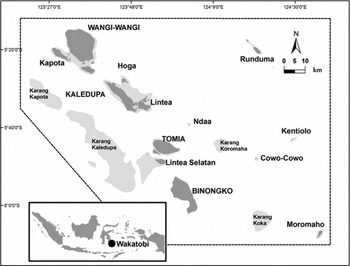
The Wakatobi National Park (WNP) in south-east Sulawesi is one of Indonesia's largest marine national parks, covering 1.39 million ha and containing c. 100000 people (Fig. 1). The presence of Bajau settlements within the WNP is of particular significance, as this widely dispersed minority ethnic group found throughout south-east Asia is characterized by a heavy reliance on marine resources for food, fuel and building materials, leading to calls for their specific inclusion in management (Djohani Reference Djohani, Parnwell and Bryant1996). As in many developing countries, there is a paucity of data relating to the status of marine flora and fauna in within the WNP. However, there is evidence of declining populations of individual species and catch per unit effort due to fishing pressure (Unsworth et al. Reference Unsworth, Smith, Powell and Hukon2007; Exton Reference Exton, Clifton, Unsworth and Smith2010), whilst coral diseases may present a longer term hazard (Haapkylä et al. Reference Haapkylä, Unsworth, Seymour, Melbourne-Thomas, Flavell, Willis and Smith2009).
Location of the Wakatobi National Park. Islands in dark shading, major reefs denoted by light shading.

Prior to 2003, there had been little involvement by international conservation organizations in the management of the WNP. More recently, the Coral Triangle Initiative announced in 2009 involved a concerted effort by international NGOs to promote the profile of the WNP, which is located centrally within the Coral Triangle (Clifton Reference Clifton2009; Rosen & Olsson Reference Rosen and Olsson2013). At a local level, two overseas organizations have been active within the WNP since prior to its gazettal in 1997, consisting of a dive tour operator and a ‘research ecotourism’ operator, hereafter referred to as Operator A and Operator B, respectively. Both of these have implemented systems of direct payments for conservation to fishing communities in close proximity to their facilities.
Whilst the use of financial incentives for terrestrial resource conservation has been extensively documented (Wunder et al. Reference Wunder, Engel and Pagiola2008; Venter et al. Reference Venter, Meijaard, Possingham, Dennis, Sheil, Wich, Hovani and Wilson2009; Gómez-Baggethun et al. Reference Gómez-Baggethun, de Groot, Lomas and Montes2010), there has been little attention paid to these programmes in a maritime context. Furthermore, the salience of issues such as institutional weakness and resource ownership in the context of PES outcomes is magnified in countries such as Indonesia, where government authority is decentralized to local administrative tiers (Larson & Soto Reference Larson and Soto2008; Siry Reference Siry2011). Recent critiques have highlighted the variable outcomes associated with PES schemes, underlining the need to undertake detailed small scale analyses of local institutions, actors and relations to understand the impacts and effects of PES initiatives (Roth & Dressler Reference Roth and Dressler2012). This will be pursued through examining two such programmes in an Indonesian marine protected area. The objectives of the paper are to: discuss how PES schemes operate in a decentralized environment; explore the extent to which local participation in PES is facilitated through existing institutions; analyse the impact of PES initiatives on existing resource uses; and examine whether these programmes offer optimal ecological benefits.
METHODS
Data collection required a high degree of flexibility and sensitivity, reflecting the contentious nature of the issues at stake. Consequently, a research programme was designed using different interview techniques and settings over a period of six weeks in 2007 and again in 2008. Formal pre-arranged interviews were conducted separately with the chief executives of both tourism operators and a total of five village heads; these focused upon the rationale, implementation process and outcomes of each direct payments system. A similar interview with the head of the marine park was also conducted, which explored the relationship between the tour operators and the national park authority, along with issues and opinions relating to the direct payments systems. A series of informal semi-structured interviews were also carried out with fishers on an opportunistic basis in and around their own homes. Through the assistance of a translator with no personal stake in the topic, potential interviewees were identified randomly to avoid sample bias and asked if they would be willing to discuss issues relating to the direct payments initiative. The interviews consisted of six open-ended questions relating to (1) personal experience of the no-take area (NTA) designation process; (2) personal recollection of subsequent measures to inform communities of the designation; (3) willingness and ability of the individual to engage with village-level institutions and the external operator; (4) views on the necessity and consequences of restricting fishing effort; (5) views on the process of enforcement and sanctions; and (6) views on the relationships between external tour operators, local government and fishing communities. A total of 40 anonymous individuals, equally divided between the two case study locations, were interviewed in this manner. Whilst recent or reliable census data are not available, I estimated that this sample represented approximately 10% of active fishers in each community. All interviews were recorded in note form and analysed to determine recurring themes and issues in relation to the four research objectives.
RESULTS
Direct payments schemes
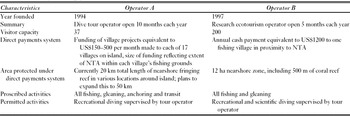
Operator A was catering principally for the North American and European diving holiday market, offering all-inclusive packages focusing on the nearshore reefs around the resort and adjacent island. Measures to ensure the preservation of reef biodiversity originated in 1999, with the operator unilaterally banning all fishing activity along a 600-m stretch of reef adjacent to the resort. Following discussions in 2001 between Operator A and each village representative council (Badan Perwakilan Desa or BPD), fishing grounds used by each of the 17 coastal villages on the island were delineated and submitted to the tour operator (Table 1). Where these coincided with dive sites used by the operator, so-called ‘reef leasing’ agreements were reached whereby bans on fishing, transit and anchoring in these sites would be recompensed through monthly investments in village infrastructure funded by Operator A and organized in conjunction with the BPD (Table 1). The payments thereby accrued to the community as a whole, rather than selected individuals. The monthly payments to each village of US$150–500 (Table 1) were significantly greater than the average local individual income of c. US$50 per month. These reef leasing agreements had funded repairs to public buildings, such as mosques, schools and roads, as well as providing electricity to all households in one Bajau village particularly affected by the fishing ban.
Summary of direct payments schemes in the Wakatobi National Park.
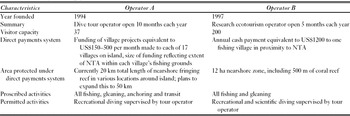
Operator B was recruiting paying volunteers, principally higher education students from Europe and the USA, to implement a wide range of research projects designed to provide biological and social data to assist WNP management. The instigation of direct payments followed discussions with the village head of a nearby Bajau fishing community in 2000. This resulted in an agreement with the Bajau villagers to cease all fishing activity in a 12-ha area used for diving and research activities by Operator B (Table 1). It was intended that this system would allow evidence to be collected which would demonstrate increased fish stocks and individual fish sizes, and this would enhance community perception of longer term conservation measures within the WNP. This money had funded village infrastructure developments including footbridges, schools and public buildings, as well as helping individuals to meet mandatory government property taxes.
Perceptions of direct payments initiatives
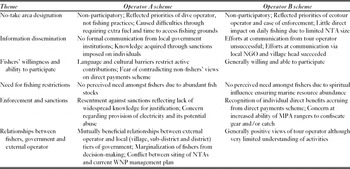
The process by which the NTAs had been designed was viewed by local fishers as non-participatory and reflective of the interests of the tour operator in both cases (Table 2). The NTA designation process followed by Operator A involved discussion between the operator and the BPD with physical landmarks such as headlands and bays used as boundaries of villagers’ fishing activity. Fishers unanimously stated that they were not invited to participate in this discussion. As a consequence, many fishing grounds were rendered inaccessible, thereby increasing fuel costs and individual effort in daily fishing activities. By contrast, the NTA designated by Operator B was limited in extent and therefore had little direct impact upon everyday fishing activities.
Summary of interviewees’ assessment of direct payments schemes in the Wakatobi National Park.

Information dissemination followed two contrasting paths in the case studies (Table 2). There was no recollection amongst fishers of any formal or informal awareness-raising activities relating to NTA rules in the case of Operator A, with interviewees indicating that awareness of fishing restrictions arose from sanctions imposed upon those engaged in fishing activity within the NTAs. Operator B initially attempted to raise awareness through formalized presentations emphasizing scientific concepts of fish stock replenishment through spillover effects and the long-term sustainability of the fishery. Subsequently, an alliance with an independent locally-based NGO enabled community support to be gained through working with small groups of fishers on an informal basis over a period of two years, expressing the NTA in terms of its importance to the tour operator and the availability of other fishing grounds nearby. The role of the village head was seen as crucial by the NGO in this process, fundamental to which was his status as an ethnic Bajau supportive of traditional community values and his willingness to physically assist with development projects funded by the payments system; this raised the profile of the tour operator and increasing acceptance of it within the community.
The issue of participation in decision-making processes involved in the designation of each NTA received mixed responses. Interviews with fishers affected by Operator A's reef leasing agreements indicated a lack of faith in the BPD being able or willing to represent their views in the process of discussing conservation payments. This partly reflects practical barriers such as village meetings organized by the BPD being conducted in Indonesian, in which fishers are frequently not conversant. Eighteen of the 20 interviewees stated that they would not argue in public against a system which enjoys general community support on account of the benefits to infrastructure and facilities at the village level. By contrast, fishers affected by Operator B's NTA felt able to contribute towards public meetings and debate regarding the NTA, reflecting the more inclusive approach towards dissemination through the local NGO and the activities of the village head.
Both sets of interviews revealed a markedly positive perception of fish stock abundance amongst fishers, leading to a lack of support for imposition of fishing restrictions. This reflected a view within both fishing communities that there were sufficient resources available to sustain current fishing effort, with no noted declines in catch levels or individual fish size. In both locations, the Bajau fishers believed that the continued abundance of fish was ensured by spiritual intervention, with individual or collective fishing effort being unconnected to fish stocks.
These views were further reflected in fishers’ responses to enforcement and sanctions, which were considered as unjust or unnecessary with regard to the health of the resource (Table 2). Enforcement was also seen as a means through which WNP officials could confiscate gear and catches, reflecting general concerns regarding corruption and lack of accountability within state institutions. In addition, the provision of electricity to one fishing village as part of Operator A's incentives scheme was also viewed by fishers as a potential sanction mechanism through termination of the supply to offending individuals or the community as a whole. In contrast, the use of Operator B's payments revenue to offset individual household tax liabilities mitigated fishers’ concerns regarding the necessity for such regulations.
Operator A was perceived by the local fishers as acting in concert with local government and marginalizing fishing communities from decision making. The scale of the financial contributions to each village and the fear amongst local officials of being excluded from this process were acknowledged during interviews with government representatives. Interviews with the head of the WNP added another dimension to relationships between Operator A and government officials. The ‘reef leasing’ initiative was perceived as interference by a foreign agent with no authority to undertake such measures without official sanction from the WNP authority; the prohibition of artisanal fishing, boat transit and anchoring within the NTAs was in areas where these activities are permitted under the current Park management plan. The reef leasing scheme predates the current management plan which was produced in 2008, thereby highlighting issues of management under decentralization which are discussed later. This issue did not arise with respect to Operator B because the regulations governing the NTA were consistent with the current management plan. Operator B was also seen by fishers in a generally positive light, citing its relatively minor impact upon daily fishing activities and its widely respected village head. The scientific rationale for Operator B's research activities remained a source of widespread confusion amongst all fishers interviewed 15 years after this programme commenced.
DISCUSSION
The two PES schemes operating in the WNP had in common absence of active participation from local users, concern over the potential penalties associated with infringements and lack of perceived need within fishing communities to conserve fish stocks. However, differences existed in relation to PES structure, administration and the effect of PES on relationships between tour operators and Park administrators; these will now be discussed.
Conservation payments and decentralized governance
The conflicting legislation of Indonesian decentralization has led to policy confusion because responsibilities and jurisdictions overlap within and across different administrative levels of government (Thorburn Reference Thorburn2002; Setiawan & Hadi Reference Setiawan and Hadi2007). This policy vacuum creates opportunities for external agents to implement regulations designed to secure returns on their investment, as exemplified by this research. Operator A liaised closely with village and sub-district levels of government, thereby effectively sidelining the role of the Konservasi Sumber Daya Alam (KSDA, the National Park Authority) and higher tiers of government. Through creating these alliances with local government at the island level, Operator A was forging links which served to mobilize support for its policies. The use of direct payments to fund village-level activities gained the backing of village government, whilst alliances with the sub-district government served to reinforce this administrative tier which had been stripped of many functions during the decentralization process (Antlov & Eko Reference Antlov and Eko2012). Furthermore, the WNP Authority was vulnerable to exclusion from this network. From an administrative perspective, the KSDA, which manages Indonesia's terrestrial and marine national parks, is situated within the highly centralized Ministry of Forestry based in Jakarta. The KSDA is subject to perpetual shortages of resources, whilst park rangers and other field staff are regularly rotated around Indonesia's national park estate (Clifton Reference Clifton2003). Local KSDA representatives therefore have little opportunity or capacity to forge connections with local communities or government in the manner developed by Operator A.
Operator B, by contrast, maintained close working relationships with the WNP Authority to justify its role as a conservation-focused organization, whilst also focusing on working with village and district tiers of government. The limited size of the NTA obviated the need to build alliances with government in more than one village. The transfer of responsibility for marine resource management within four nautical miles of the shoreline from provincial to district government under legislation enacted in 2007 (Siry Reference Siry2011) has reinforced the incentive for Operator B to work strategically with district government in matters relating to marine conservation.
This situation has given rise to multiple independent centres of decision making within the WNP, which are reflective of polycentric nested institutions as described by Ostrom (Reference Ostrom1990, Reference Ostrom2005). The recognition of these overlapping foci of decision-making at various administrative levels may assist in understanding how the outcomes of decentralised resource management vary from place to place (Andersson & Ostrom Reference Andersson and Ostrom2008; Roth & Dressler Reference Roth and Dressler2012). In the present study, the implementation of direct payments initiatives in a polycentric governance system characterized by weak or malleable decentralized state institutions has served to facilitate and reinforce inequalities in power.
Elite capture
The lack of fishing communities’ participation in decision-making institutions is not uncommon, through intimidation, fear or apathy (Hernandez & Kempton Reference Hernandez and Kempton2003; Cinner et al. Reference Cinner, Daw and McClanahan2008). Language barriers, reflecting the fact that many elderly or poorly educated individuals have not been schooled in the lingua franca of Indonesian, may further restrict participation in the present study. However, this analysis also suggests that local stakeholders’ reactions to direct incentives arrangements will depend largely on their perceptions of the institution acting on behalf of the community. Furthermore, outsiders’ expectations of institutional representativeness and accountability may not reflect the reality of the situation. This is illustrated with reference to the BPD that liaises with Operator A and recommends activities to be funded through the reef leasing agreement. BPDs are village-level institutions established across Indonesia since 1999 as part of the decentralization process. They are intended to reflect the religious, age, gender and occupational characteristics of the village and are responsible for developing acceptable village regulations in line with local traditions (Burkard Reference Burkard2002). Whilst originally designed to be an elected body, subsequent legislation in 2004 amended this to the effect that council members are appointed by consensus (Antlov & Eko Reference Antlov and Eko2012). The village head is frequently elected unopposed and may often retain this role through hereditary or kinship rights (Woodhouse Reference Woodhouse2004). Therefore, despite being appointed rather than elected, the BPD may be perceived by outside agencies as more representative of village stakeholders than the village head, and would therefore be better situated to collaborate with these agencies in the establishment of direct payments initiatives.
The perceived inability of fishers to interact with or influence the BPD may, therefore, be indicative of the capture of institutions by local elites (Platteau Reference Platteau2004; Büscher & Wolmer Reference Büscher and Wolmer2007; Agrawal & Ostrom, Reference Agrawal, Ostrom, Webb and Shivakoti2008), particularly given these institutions were created as part of the hasty reform process experienced by Indonesia since the late 1990s. This is reflected in interviewees’ statements that, despite legislation to the contrary, members of the BPD were also involved with other village institutions such as women's groups or religious groups. It is also important to note the scale of the financial payments made by Operator A to each village via the BPD. These enhanced the status of the BPD, cementing its alliance with Operator A and rendering it highly unlikely that dissent to the payments system would be heard in public. The forging of a partnership between the local political elite and an economically powerful private sector entity therefore provides mutual benefits through ensuring power accrues to the local elite whilst providing the appearance of democratic accountability for the private sector's activities.
Resource access and ownership
The second and more fundamental alteration to fishers’ livelihoods was included under Operator A's reef leasing scheme. Prior to this, the fringing reef and its fish were open-access resources available to all Indonesian subsistence fishers in accordance with national legislation (Indonesian Law 31/2004). The introduction of the reef leasing agreement reflects a transition to a privately owned resource with extractive and access rights assigned to the tour operator. The resulting loss of fishers’ entitlement to nearshore reef resources has clear consequences for individual livelihoods. The reliance on physical landmarks for demarcating fishing grounds and an outright ban on all fishing activity is clearly advantageous from the viewpoint of Operator A in terms of simplicity and ease of enforcement. However, they fail to represent the complexity of spatial and temporal patterns of fishing practices. Artisanal fishers in the WNP and elsewhere commonly target a diversity of species and habitats following short- and long-term temporal variations in tidal and climatic conditions along with the distribution and timing of fish spawning and aggregation events (Exton Reference Exton, Clifton, Unsworth and Smith2010; Gunawan & Visser Reference Gunawan and Visser2012). Fixed coastal landmarks and shoreline configuration are therefore unable to adequately reflect the complexity of artisanal fishing practices, thus negative impacts upon individuals affected by the ban on nearshore fishing are likely to be enhanced. Whilst the termination of electricity supply to the Bajau village had not been deployed as a sanction mechanism, it is evident that direct incentives may be used as enforcement measures in this manner, raising ethical and other concerns. The implications for local fishers are further exacerbated by the paucity of alternative income-generating activities in this remote location, thereby reducing individual fishers’ ability to respond by exiting the fishery (Cinner et al. Reference Cinner, Daw and McClanahan2008).
These issues apply equally to the alteration of access rights embodied within the NTA initiated by Operator B. However, there are several factors which served to mitigate the losses incurred by restricted access. Whilst the Bajau fishers considered themselves users of the NTA, these was not based on historical rights of access. Rather, they reflect spiritual beliefs found within the Bajau, which underline universal access rights to fishing grounds for all fishers regardless of their origin (Clifton & Majors Reference Clifton and Majors2012). The inclusion of an annual inauguration ceremony dedicating the NTA to the care of the sea spirit reinforced the level of acceptance within the fishing community in this respect to some extent. This was further augmented by more practical matters, such as the limited size of the zone and the fact that the payments benefited the whole community through meeting household and village tax bills. In contrast to Operator A, who funded improvements to collective goods such as public buildings, this focus on ensuring universal individual benefits accruing from the NTA would doubtless dilute opposition.
Conservation payments and ecological benefits
Whilst a ban on fishing activity logically leads to more abundant fish stocks, the degree to which payments initiatives deliver ecological benefits in the contemporary policy context promoting networked and mutually reinforcing marine protected areas requires consideration. Pattanayak et al. (Reference Pattanayak, Wunder and Ferraro2010) described several scenarios whereby payments may not deliver additional conservation benefits. One of these involves the counterfactual case, which refers to the hypothetical level of protection in the absence of any payments. In the present study, this reflects positively on the payments initiatives, as fishing and resource extraction, possibly extending to destructive fishing practices, would otherwise take place within both NTA sites, despite one being located within a core zone of the national park. This reflects the limitations on park enforcement in the WNP and elsewhere in Indonesia (Clifton Reference Clifton2003; Dirhamsyah Reference Dirhamsyah2006). Pattanayak et al. (Reference Pattanayak, Wunder and Ferraro2010) also referred to the displacement of anthropogenic pressure to other locations as a result of payments initiatives. Neither initiative in the present study involves a reduction in total fishing effort or in the demand for marine resources, thus displacement of fishing activity elsewhere is inevitable. Thirdly, it is important to consider whether any payments initiative delivers optimum conservation value in terms of the area protected. In the current study, the selection of NTA locations reflected both operators’ business priorities rather than being based on any ecological criteria such as species abundance or habitat diversity. Thus, it is uncertain whether greater conservation value could have been achieved through protection of other sites; fishing activity under the present arrangements could in theory be displaced to neighbouring sites of equal or higher ecological value. This highlights the importance of integrating scientific data into direct payments initiatives, particularly in marine environments characterized by high degrees of connectivity (Unsworth et al. Reference Unsworth, Salinas de Leon, Garrard, Jompa, Smith and Bell2008). Thus, the ability of both payments initiatives to deliver environmental additionality or added value in terms of conservation is open to doubt.
CONCLUSIONS
With growth in the implementation of direct incentives in the Indonesian marine environment (TNC 2010), and in purported evidence of their conservation benefits, this study examined impacts of two such incentives initiatives from the perspective of individuals and fishing communities in an Indonesian marine protected area. Analysis of two relatively small examples of such schemes based on qualitative information nevertheless has implications for similar assessments focusing on the socioeconomic impact of direct payments initiatives.
This study demonstrates that the expansion of the private sector into conservation through PES initiatives can be an unintended consequence of rapid or poorly planned decentralization when the capacity to govern at the local administrative level is limited (Ito Reference Ito2011). The role of other institutions such as national park authorities can also be sidelined through alliances formed between the private sector and local government, reinforcing the need to evaluate conservation payments agreements on grounds of democracy and good governance. The potential for elites to capture revenues associated with PES, together with stricter regulations regarding local access to resources, has clear implications with regards to maintaining positive levels of trust, norms and values within a community, with negative implications for individual and community participation in conservation. Finally, the underlying rationale for PES in terms of delivering environmental benefits is questionable when these programmes are instigated by private-sector tour operators.
Nevertheless, the analysis also demonstrates that certain factors can reduce the likelihood of encountering some of these problems. The gradual introduction of the community to the NTA concept via individuals or organizations capable of acting in the role of ‘gatekeepers’ (Mackelworth & Carić Reference Mackelworth and Carić2010) can facilitate acceptance of the concept. Taking care to express or symbolize the NTA with reference to local belief systems obviates the need for justification on scientific grounds, which may have a limited cultural frame of reference with regard to local fishers. Ensuring that all individuals benefit equally from financial incentives could facilitate a gradual expansion of the NTA over time. Finally, limiting the spatial extent of the NTA will evidently reduce opposition based on reduced access to fishing grounds and need not necessarily lead to diminished ecological outcomes (Unsworth et al. Reference Unsworth, Smith, Powell and Hukon2007).
Further research examining the extent to which these mitigating measures can be instigated would help an understanding of how user groups’ acceptance and compliance with direct payments initiatives can be improved. However, the advocates of direct incentives rarely consider such issues, preferring instead to emphasize the potential to rapidly initiate radical changes in resource use and exemplifying these supposed advantages in pure cost-benefit terms without reference to the implications for individuals who are often poorly represented in village government institutions (Ferraro & Simpson Reference Ferraro and Simpson2005; van Hecken & Bastiaensen Reference van Hecken and Bastiaensen2010). This study demonstrates the potential shortcomings of this approach in terms of governance, social justice, sustaining fishers’ livelihoods and ensuring effective conservation measures, all of which require attention if direct payments incentives are to generate long-term benefits to both conservation and local communities.
ACKNOWLEDGEMENTS
I am grateful to fishers in villages within the WNP for their contribution to this research. The participation of the national park authority and tour operators is also acknowledged.