


Introduction: the three ‘black boxes’
Kenneth Arrow remarked that standard economic theory once took the firm as ‘a point, or at any rate, a black box’ (Reference Arrow, Carroll and Teece1999: vii; cited in Williamson, Reference Williamson2005: 371). However, firms ‘are not points. They have internal structure’ (ibid.), an idea first introduced systematically by transaction cost economics, thanks to Coase (Reference Coase1937).
The same applies to individual agents, whose internal complexity – which is responsible for decision-making and problem-solving – was reduced to a simple mechanism of utility maximization. This also rendered individuals as black boxes. However, the work of Denzau and North (Reference Denzau and North1994), Simon (Reference Simon1957), Tversky and Kahneman (Reference Tversky and Kahneman1974), among others, revealed that individuals are constrained by bounded rationality and guided by different mental models.
We propose that one more ‘box’ was once left unscrutinized. The process of opening it has already begun in the literature, but more work is needed. This time, it’s not the black box inside an agent – whether a firm or an individual – but rather the black box that the agent is in. It is an environment in which individuals and collectives can act and regulate their behaviour by setting goals, creating rules and establishing patterns – an institutional environment.
This paper proceeds as follows. First, we explain why the institutional environment remains, to some extent, a ‘black box.’ Second, we invoke two related concepts: affordance and physical-behavioural unit. They allow us to provide an initial characterization of an individual agent’s action environment. Then, through references to theories of entrepreneurship and Frank Knight’s classic studies of risk and uncertainty, we introduce the distinction between realizations and opportunities. Next, we highlight collective aspects of the two realms and discuss the role of routines and property assignments. Regarding the latter, we discuss a key fact: unlike realizations, opportunities are a common pool resource. This creates specific conditions for any attempt to institutionalize the action environment. Therefore, we devote much time to these conditions, especially since opportunities cannot be directly regulated. The closing section expands on selected issues and briefly juxtaposes our conception with similar views.
State of the art: opening of the black box we’re in
The assertion we started from might come as a surprise given the extensive use of terms such as ‘institutional environment’ or ‘business environment.’ In this paper, we focus on the former. First, we will explain why we consider the concept underdeveloped.
There is a consensus that institutions matter to individuals and firms. They provide ‘the rules of the game’ (North, Reference North1990: 6) or spontaneous, bottom-up solutions to cooperation problems (Hindriks and Guala, Reference Hindriks and Guala2021; see also Aoki, Reference Aoki2001; Binmore, Reference Binmore2010; Greif and Kingston, Reference Greif, Kingston, Schofield and Caballero2011). Blending these two views, we adopt the perspective that institutions are behavioural patterns or routines backed by rules, expectations, and other normative factors.
However, in most cases, the term ‘environment’ lacks serious conceptual treatment when used with the qualification ‘institutional.’ The focus shifts to rules, norms, governance, etc.:
The institutional environment is the set of fundamental political, social and legal ground rules that establishes the basis for production, exchange and distribution. Rules governing elections, property rights, and the right of contract are examples (Davis and North, Reference Davis and North1971: 6).
Williamson (Reference Williamson2000) distinguishes four levels of institutional analysis. The level he explicitly dubs ‘institutional environment’ consists of laws that establish property rights within a broader constitutional and cultural framework. Similarly, the Palgrave Encyclopedia of Strategic Management defines the institutional environment as ‘composed of regulations, customs, and taken-for-granted norms’ (Swaminathan and Wade, Reference Swaminathan, Wade, Augier and Teece2016: 1).
The meaning of ‘institutional environment’ is often assumed to be self-evident. For example, Bui et al. (Reference Bui, Doan and Kang2020: 1, preprint) claim that ‘a better-developed institutional environment results in greater availability of reliable firm-specific information,’ yet they do not define the concept. The same occurs with Henisz (Reference Henisz2000) or Su et al., (Reference Su, Mou and Zhou2023).
Neo-institutional theories in management more closely align with our intended theme (see Powell and DiMaggio, Reference Powell and DiMaggio1991). The concept of institutional isomorphism, for example, refers to how organizations become similar under the pressure of laws and regulations. This environment is therefore more tangible; it’s not just a set of abstract rules, but rather real pressures. However, conceptualizing these pressures solely in terms of rule enforcement prioritizes the term ‘institutional’ while leaving the term ‘environment’ with a more intuitive understanding.
Finally, Thompson (Reference Thompson1967) describes organizations as open systems constantly exchanging resources with their surroundings, and from this angle, a system’s environment consists of the entities that affect its performance. Therefore, not all things serve as ‘environment’; only those relevant to the system’s actions do. However, selectivity is only part of what is going on. In our opinion, it is a consequence of something more fundamental: a certain dynamic between agents and their surroundings that we will discuss in the next section.
Action environment
First, let’s take the term ‘environment’ at face value. In the biological sciences, an environment is more than just a place or a collection of physical objects surrounding an agent. Lewontin (Reference Lewontin2000: 48) notes that there is ‘a confusion between the correct assertion that there is a physical world outside of an organism which would continue to exist in the absence of the species, and the incorrect claim that environments exist without species’. This is because environments are relative to species, constituted by the capacities and needs of specific agents.
The non-trivial sense of ‘environment’ can be elucidated by the following simplified illustration. Imagine a room filled with chairs. One chair can serve as a seat, as a weapon against an attacker, but also as fuel in a building with no other source of heat. Thus, the non-trivial sense of ‘environment’ generally refers to the actions made possible by a given set of physical entities and the agent’s capacities and needs, especially cognitive ones.
This approach portrays the agent as both an object affected by its surroundings and a subject capable of transforming those surroundings and aligns with the most up-to-date approach, known as niche construction theory (see Odling-Smee, Reference Odling-Smee2024).
The idea of enabling actions allows us to shed light on the concept of environment from a complementary perspective to Lewontin’s. We are talking about the concept of affordance, which was first introduced by the ecological psychologist James J. Gibson and has since become a staple in the field of cognitive science. The key idea is that agents never perceive bare objects. Rather, they perceive the ‘affordances of the environment,’ or what the environment ‘offers the animal, what it provides or furnishes, either for good or ill’ (Gibson, Reference Gibson1979: 127). Affordances therefore ‘provide opportunity for particular kinds of behavior’ (Chemero, Reference Chemero2003: 182). This implies ‘the complementarity of the animal and the environment’ (Gibson, Reference Gibson1979: 127).
In recent decades, this ‘complementarity’ has become central to philosophy and cognitive science, thanks to broad approaches such as embodied cognition, enactivism (see Chemero, Reference Chemero2009; Gallagher, Reference Gallagher2017, Reference Gallagher2020; Varela et al., Reference Varela, Thompson and Rosch1991; Werner, Reference Werner2025), and extended cognition (see Menary, Reference Menary2010). Some of these ideas have found their way into economic theory, thanks to the work of Felin et al. (Reference Felin, Kauffman, Mastrogiorgio and Mastrogiorgio2016), Gallagher (Reference Gallagher2013), Petracca and Gallagher (Reference Petracca and Gallagher2020, Reference Petracca and Gallagher2025), Frolov (Reference Frolov2023) and Werner (Reference Werner2024). All of these views focus on active interaction with entities in the agent’s surrounds and the bottom-up emergence of behavioural patterns. We believe our considerations contribute to this emerging body of scholarship.
However, rather than speaking about the affordances of a particular environment, as Gibson originally articulated, we propose that an environment suitable for action is composed of affordances. The aforementioned ‘complementarity’ between the acting agent and its environment means more than the agent selecting usable features of surrounding entities as if situated in two positions simultaneously: inside the domain of affordances as their ‘co-creator’ and outside the domain as their selector. Rather, we interpret the concept of complementarity in a way that is informed by the work of Francisco Varela, one of the founders of the embodied/enactive cognition movement. According to him, while the ‘traditional wisdom’ in philosophy and cognitive science states that the ‘environment in which organisms evolve and that they come to know is given, fixed, and unique’ and that ‘organisms are basically parachuted into a pregiven environment’ (Varela et al., Reference Varela, Thompson and Rosch1991: 198), there are good reasons to hold that ‘cognition is not the representation of a pregiven world by a pregiven mind but is rather the enactment of the world and a mind on the basis of a history of the variety of actions that a being in the world performs’ (ibid.: 9).
In this interpretation, agent-environment complementarity implies that all that the agent has access to takes the form of agent-specific affordances. While this may seem like a metaphysical subtlety, it will have ramifications for properly understanding our final proposal.
Finally, to render the metaphorical idea of affordances more explicit, we will make use of what Roger Barker (Reference Barker1968) referred to as behavioural settings, which were further elaborated on by Barry Smith as part of his ontology of physical-behavioural units. The point is that behaviour must be explained by fixed entities paired with what a specific agent can do with them. Smith writes in this spirit:
Each physical-behavioral unit has at least two sorts of components: human beings behaving in certain ways – lecturing, sitting, listening, eating – and nonpsychological objects with which behavior is transacted – chairs, walls, paper, forks, scalpels (…) (Smith, Reference Smith and Abbarno2015: 22)
Intuitive examples of physical-behavioural units include ‘Wendy’s Friday afternoon class, Jim’s meeting with his teacher, your Thursday lunch, Frank’s early morning swim, the 8 o’clock train to Long Island. Such physical-behavioural units may repeat themselves, that is, may exist in many copies’ (ibid.).
A physical-behavioural unit is the smallest ‘unit of analysis’ combining a physical surroundings with the behavioural patterns occurring within it. As such, it has ‘a boundary that separates an organized internal, or foreground, pattern from an external, or background, pattern’ (Smith, Reference Smith and Abbarno2015: 22). This means that Jim’s meeting with his teacher, for example, is a different unit than his meeting with his girlfriend afterwards. We propose that these simple units compose larger action scenarios, e.g., ‘Jim’s meeting with his teacher followed by his lunch with Sven.’ Throughout this paper, we will talk interchangeably of physical-behavioural units and larger action scenarios, bearing in mind that the latter are discrete complexes made of the former.
There are four caveats. First, while the affordance metaphor, as interpreted through the lens of Varela, is intended to capture the nature of environments, the concept of a physical-behavioural unit is adopted here for pragmatic reasons; namely, to render the metaphor applicable to real-world analyses of action – to conceptually decompose any complex environment in which a given action scenario takes place into analyzable units.Footnote 1
Keeping the latter in mind, second, the term ‘physical’ does not represent a commitment to physicalism as a metaphysical position. Here, ‘physical’ means ‘concrete,’ ‘tangible,’ and ‘perceivable.’ Therefore, given the pragmatic stance announced above, the point of the qualification ‘physical’ is that each complex action scenario should decompose into units of analysis that provide a clear list of the concrete objects, including technical devices, used by the agent to execute the action. This also refers to action scenarios in which the agent acts with other agents under the condition of their tangible or at least perceivable presence (e.g., online).
Third, still in this pragmatic mode, speaking of basic units of analysis does not presuppose what this ‘basic’ level is; it depends on the specifics of a particular case. For example, a conceptual decomposition of the institutional environment created in Denmark for IT start-ups will produce different basic units of analysis than a conceptual decomposition of the institutional environment of the tourist sector in South Tyrol.
Fourth, and perhaps most importantly, as pointed out by Gallagher (see also Chemero, Reference Chemero2003) the ‘offers’ coming from entities in the surrounding world should be seen ‘as primarily affording possibilities for action’ (Reference Gallagher2020: 11; our emphasis). Therefore, affordances should be represented by a set of possible physical-behavioural units, both realized and unrealized. In summary, we propose a stepwise reconstruction of the concept of the institutional environment, beginning with a simpler notion of the action environment. Our final proposition, given in (6), shall be nested in all the preceding concepts (1)–(5). To begin this effort, we propose the following for a singleFootnote 2 agent:
(1) The agent’s action environment can be represented by:
(a) a realm of objects, events, and processes, including man-made infrastructure, technology and vehicles of knowledge (e.g. online repositories or more traditional libraries). This shall be called the base of the action environment.
(b) A set of physical-behavioural units (and larger action scenarios) that are possible on that base, given the agent’s cognitive capacities, needs, etc.
What needs to be further dealt with is the question of what it means for an action environment to be institutional. So, on our take, when Petracca and Gallagher (Reference Petracca and Gallagher2025: 7) speak of ‘the idea of individual-institution coupling that afford specific patterns of social action,’ this should be interpreted not as making an institution into a specific ‘thing,’ but rather in terms of an identifiable set of everyday objects and institutionalized action scenarios of making use thereof. The question now is what this institutionalization stands for.
We will distinguish two types of physical-behavioural units, then two subdomains within the action environment: realizations and opportunities. The former will be conceptualized as conducive to private goods and the latter as a commons. To set the distinction, we will use Knight’s (Reference Knight1921) classic concepts of risk and uncertainty. But first, the concept of entrepreneurship must be invoked, as it refers to the economic process that brings about the realization of opportunities. Paying attention to these conceptual components may seem like detours at first, but it’s like collecting the necessary pieces of a puzzle.
Recognizing opportunities and dealing with uncertainty
We wrote earlier that affordances provide an ‘opportunity for particular kinds of behavior’ (Chemero, Reference Chemero2003: 182). However, as benign as this may sound, this statement brings up a large body of literature devoted to the concept of opportunity, which is not without controversy. It has become especially prominent in entrepreneurship theory, beginning with Kirzner’s (Reference Kirzner1973) ‘opportunity discovery’ approach. According to this view, ‘the entrepreneur’s task is to discover and exploit opportunities’ (Hsieh et al., Reference Hsieh, Nickerson and Zenger2007: 1255). Yet, as Audretsch and Belitski (Reference Audretsch and Belitski2021: 1007) note, it is not clear ‘whether these opportunities objectively exist or need to be created by entrepreneurs endogenously’ (see also Foss and Klein, Reference Foss and Klein2020).
Alternatively, the key thing for Audretsch and Belitski (Reference Audretsch and Belitski2021: 1006) is the fact that some individuals ‘are risk-takers and possess a greater capacity to meet the uncertainty’ and ‘to innovate and introduce this innovation in the market by starting a new venture.’ This is made possible by the power of judgment possessed by some under conditions of ‘absolute unpredictability’ referring to ‘resources, scientific and technical conditions, consumer preferences (…)’ (ibid.). Similarly, Lawrence and Lorsch (Reference Lawrence and Lorsch1967) discussed how environmental uncertainty impacts organizational design. There, the term ‘environment’ can be understood as referring to sources of uncertainty. In this context, our goal is to draw a connection between the three concepts: opportunity, uncertainty, and environment.
Audretsch and Belitski (Reference Audretsch and Belitski2021) draw on Frank Knight’s (Reference Knight1921) classic distinction between risk and uncertainty. The latter, unlike the former, are ‘situations in which the decision-maker is unable to assign probabilities to events because it is not possible to calculate chances’ (Runde, Reference Runde1998: 540). This distinction is assumed here to be familiar.
However, in light of our concept of the action environment, this reference to Knight is controversial. Entrepreneurs cannot directly ‘meet uncertainty’ because what is fundamentally uncertain cannot be part of any action environment. In short, fundamental uncertainty forms no possible physical-behavioural unit. On the other hand, Knight himself writes that it is ‘this true uncertainty which by preventing the theoretically perfect outworking of the tendencies of competition gives the characteristic form of ‘enterprise’ to economic organization as a whole and accounts for the peculiar income of the entrepreneur’ (Knight, Reference Knight1921: 232). So, in order to gain a more substantial understanding of how possible action scenarios constitute opportunities, we need to address the issue that just arose.
First, following Runde (Reference Runde1998), we assume that the distinction between risk and uncertainty should be understood in the context of Knight’s classification of types of probability. So, a priori probability can be calculated without any empirical observation because of the structure of a given case. For example, it is a priori determined that when tossing a coin, the probability of either side landing up is ½. Next, there is statistical or empirical probability, which is based on frequencies distilled from past data. Therefore, it is never perfectly accurate, but it is quantifiable and usable. Finally, there are estimates, which are cases where there is no quantifiable data and thus no probability distribution. Estimates are based on belief and intuition.
From our perspective, the key aspect of Knight’s distinctions involves imposing a certain structure on the unknown and rendering future events, if they occur, as if fitting a certain predetermined repertoire of options. Tossing a coin is an example of a case where our ignorance of what will happen is perfectly structured by what we do know. Statistical probability provides a measure that depends on previous observations; nevertheless, new observables are still knowable in principle, as they fit a certain structure of predetermined expectations. Finally, when it comes to estimates, no such precise structure can be given, and therefore, this is what Audretsch and Belitski (Reference Audretsch and Belitski2021) likely had in mind when they spoke of entrepreneurs ‘meeting’ uncertainty by the power of their judgment.
Alchian’s (Reference Alchian1950) classic treatment of behaviour under uncertainty is the natural point of reference here. According to him, the environment ‘selects’ firms whose behaviour happens to be adaptive. However, this account operates at the level of outcomes, leaving the mechanism that generates the behavioural variation upon which selection operates underdeveloped. Our framework can be read as extending Alchian’s account at precisely this point: it specifies where novel behavioural variants may come from (section ‘Realizations and opportunities’) and how institutions shape access to them (section ‘Institutional environment’). Furthermore, while Alchian focuses on the selective pressures that the environment exerts on firms and their behaviour, we focus on the nature of the environment itself. Thus, the two accounts are complementary: Alchian’s evolutionary theory of how an environment creates selection pressures on firms and our account of the structure of that environment.
The reference to Knight sets the stage for the introduction of a distinction between realizations and opportunities. This distinction shall enable us to amend (1). However, Knight’s distinctions need to be reframed first. While Knight talks about observable events, we are interested here, following entrepreneurship theory, in genuine agency. These are two different conceptual frameworks, a distinction that Audretsch and Belitski (Reference Audretsch and Belitski2021) somewhat bypass when they speak of ‘meeting uncertainty’ thanks to the ‘power of judgment.’ A more explicit conceptual link between the two frameworks must be established. One observation is in order here: often entrepreneurial judgement is modelled as belief revision over priors; our account specifies the environmental conditions under which such priors are definable (available) at all.
Realizations and opportunities
Here’s how we draw the aforementioned link: Events with an assigned probability of occurrence, belonging to one of Knight’s types, belong to the base of a possible physical-behavioural unit. Therefore, they contribute to the probability of that unit’s realization. Note, however, that realization differs from occurrence. Realization is related to specific goals, and one may succeed or fail in pursuing them.
Keeping the latter in mind, we propose that the structuredness we emphasized in Knight’s distinctions is also applicable to physical-behavioural units. Some of these units are realized in the form of certain repeatable behavioural patterns, and their outcomes fit a more or less precise framework of options. Cases such as ‘John throwing a die and getting a five’ approach the ideal end of a spectrum of perfectly structured physical-behavioural units, albeit somewhat artificially designed. Then, there are more real-life units structured by routines. Their routinization is a matter of degree. For example, leaving your office building can be broken down into a familiar set of units whose realization depends on situational factors and therefore cannot be perfectly structured (e.g., if there is a big crowd waiting for the elevator, you may prefer the stairs). Nevertheless, this process is fairly routinized.
Thus, we propose the following. For a given agent:
(2) The agent’s realizations consist of two sets. (a) Possible physical-behavioural units that the agent has tried, does repeatedly and can therefore perform routinely (with practically negligible risk of failure); (b) units that the agent has not tried, but which, if carried out, will also be routinized thanks to specific rules, patterns, and instructions (which means that the probability of failure can be calculated, and if it occurs, the cost will be relatively low).
This is therefore the domain of familiar risks, as it were, given Knight’s sense of the term. Some action scenarios within realizations may present themselves as opportunities to an individual agent, who can choose whether to take them and then succeed or fail. However, these opportunities are not what we are interested in here, as their realization is part of a certain routinized practice. Examples include earning a university degree, learning Spanish, or learning Krav Maga. The agent takes some risk in such cases; nonetheless, it’s a familiar risk in a scenario that has already been tried by many.
Meanwhile:
(3) The agent’s opportunities are filled with possible, yet untried, physical-behavioural units that are not structured or routinized. This means that their realization is not attributed a calculable probability of success or failure.
Opportunities are enabled by the base, including the current state of infrastructure and technology, as well as knowledge and other factors attributable to the agent. However, the likelihood of their realization can, at best, be estimated (given Knight’s distinction). Unlike learning Spanish or Krav Maga, these are action scenarios that have not been structured in the form of routines, instructions, etc.
Consider the pioneers of personal computers. The necessary know-how and the physical and technological base were present, even if incomplete. Therefore, according to our conceptualization, certain possible but untried action scenarios were set for a large group of agents active in the computer business. These were series of specific physical-behavioural units whose realization was initially only loosely estimable and, crucially for us, free of any routinized instructions or scripts from business guidebooks. Thus, it required the entrepreneurial ‘power of judgment’ of individuals to recognize them, a topic we will discuss in due time.
Opportunities are akin to what Kauffman (Reference Kauffman2000) called ‘adjacent possibilities’: possible reconfigurations of things that are ‘one step away from what actually exists and could be reached by the incremental recombination of existing elements’ (Gravino et al., Reference Gravino, Monechi and Loreto2019: 2), whether recognized or not. We will discuss this relationship in the discussion section.
Finally, at the other end of the spectrum, opposite the ideal of perfectly structured realizations, we have
(4) Fundamental (Knightian) uncertainty represents the ultimate form of epistemic opacity, or inaccessibility, where no identifiable physical-behavioural unit exists.
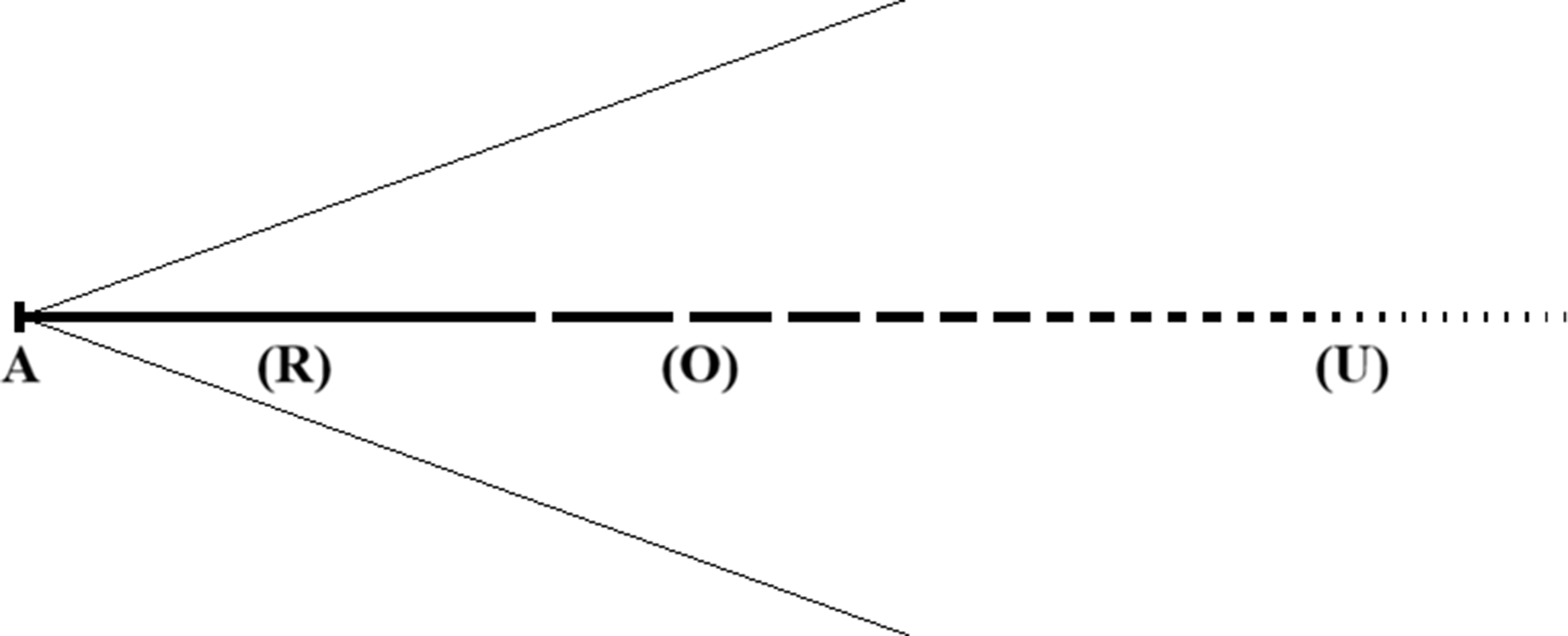
Metaphorically speaking, opportunities gradually appear as if in a beam of light or a light cone. Here, we use the metaphor of the cognitive light cone proposed by biologist Levin (Reference Levin2019). This ‘light cone’ is cast across the spectrum (see Figure 1) defined by a fixed measure of structuredness applicable to physical-behavioural units (for example, Knight’s distinctions between types of probability attributed to a unit’s realization). It is anchored at the point of ideal, a priori structure (point A), which is never actually achieved. The agent transitions within the ‘light cone’ from close-to-perfectly routinized physical-behavioural units, whether tried or not, to sufficiently, but not perfectly, routinized ones. This constitutes the domain of realizations (R). Then, at some point, the agent leaves the area where the routinized units occur and enters the domain of untried and un-routinized opportunities (O). Then, the realm barely touched by the ‘light’ gradually begins and finally fades into the dark field of no recognizable physical-behavioural units – i.e., fundamental uncertainty (U).
The structure of the action environment.

Given all that, (1) can now be revised.
(5) The agent’s action environment can be represented by its base and the set of physical-behavioural units, both of which are understood as in (1), consisting of two subsets: realizations as characterized in (2) and afforded opportunities as characterized in (3), all against the backdrop of fundamental uncertainty.
Four remarks are in order. First, opportunities and realizations change over time. The size of these two realms depends on various factors, including circumstances that are independent of the agent as well as the agent’s newly acquired skills and knowledge.
Second, we limit our attention to units whose realization could benefit the agent. This means that we are not discussing negative scenarios, which may be referred to as threats. This is an important topic for another investigation.
Third, we define two subdomains of the action environment, realizations and opportunities, but make no claims about how individuals evaluate, rank, or trade off the scenarios within them. A comprehensive theory of action in these domains would require an account of subjective evaluation, and here Buchanan’s (Reference Buchanan1969) subjectivist theory of opportunity cost is the natural complement.Footnote 3 However, Buchanan’s theory is a theory of choice within a set of perceived alternatives; our paper is a theory of what constitutes the set of alternatives in the first place: the ontology and structure of the action environment. The two are complementary, and ours is logically prior: opportunity-cost reasoning presupposes that the agent confronts identifiable alternatives, and our framework explains where those alternatives come from and how they are structured. In short, we are not primarily interested in the action itself, but rather in the kind of realm that makes action possible.
Moreover, our framework largely supports rather than bypasses Buchanan’s subjectivism. Within the domain of realizations, alternatives are routinized and structured, so forgone alternatives (and thus opportunity costs) can at least be approximated intersubjectively. However, within the domain of opportunity, the alternatives themselves are non-routinized and unstructured, so the cost of pursuing one opportunity rather than another cannot be given an objective representation.
Fourth, our conceptual apparatus does the work Bayesian belief revision cannot do. Bayesian updating operates comfortably within the domain of realizations; it loses its usefulness exactly where opportunities begin, since standard Bayesian updating presupposes a fixed and well-defined hypothesis space within which probabilities are revised. This is not a refusal to use the Bayesian reasoning; it is a positive claim about its scope conditions, fully in line with the standard reading of Knight (Reference Knight1921). To be clear, this is a claim about standard Bayesian conditioning under a fixed and well-defined hypothesis space. We do not deny that Bayesian approaches can be adapted to problems of model uncertainty or expanding hypothesis spaces; our point is only that any such extension presupposes at least a partial structuring of the space of possibilities, and it is precisely this structuring that proper opportunities, as defined in (3), lack.
The pathway to reintroducing institutions
It’s time to reintroduce institutions into the story. However, before proceeding, let us make the architecture of the argument explicit. The definition of the institutional environment we aim to establish will be logically nested in everything we have established thus far. It will define the institutional environment as an action environment in the sense of (5). This environment will have two subdomains: realizations, as in (2), and opportunities, as in (3). These subdomains will be subject to two distinct institutional conditions. The asymmetry between these conditions will be derived from a difference in the theory of goods between the two domains (sections ‘Realizations and property’, ‘Non-exclusivity of opportunities’, and ‘Problem-solution specification and rivalry over opportunities’). Therefore, the shift from the individual perspective of sections ’Action environment’, ‘Recognizing opportunities and dealing with uncertainty’ and ‘Realizations and opportunities’ to the collective perspective that begins here is not a change of subject, but rather the central turning point of the argument. As we will demonstrate, the concept of routinized units was implicitly collective all along.
First, we must acknowledge that (2) was a theoretical fiction since no such domain emerges for a single agent. Therefore, speaking of individual realizations is only justified when going down to the level of individual actions is explanatorily plausible in the analyzed case. In reality, social or collective factors are always present. This is because individual realizations consist of physical-behavioural units whose execution is routinized thanks to specific rules, patterns, and instructions. Meanwhile, the very idea of a routine, pattern, or instruction only makes sense in the context of a collective. However, this observation alone is insufficient and must be properly unpacked if we aim to systematically introduce institutions into the conceptual framework that has been developed thus far.
Second, given the recent observation, it makes sense to speak of a collective domain of realizations composed of physical-behavioural units available to many individual agents with similar cognitive capacities, skills, etc., and the base they share. For example, an apple tree affords the possibility of harvesting apples, a stick affords the possibility of knocking an apple down from the tree, and the apples afford the possibility of being sold as food to all humans who see the tree and its fruit, given their shared perceptual apparatus, physiology, and manipulative skills. Moreover, the collective domain of realizations can be interpreted as a realm filled with social affordances, as defined by Petracca and Gallagher (Reference Petracca and Gallagher2020) – those arising from intersubjective relations, practices, and roles. In our vocabulary, this includes not only physical-behavioural units that many agents perform individually, but also units that they genuinely realize together. The latter include what Petracca and Gallagher call ‘market affordances,’ in which agents play roles specific to economic activities. For example, there are apple sellers and apple buyers.
Institutions emerge in the form of particular formal and informal rules and behavioural patterns. Therefore, the routinization we have referred to thus far can also be interpreted as institutionalization. The constitutive feature of individual realizations, as defined in (2), is that they are institutionalized in the form of rule-based routines. We will unpack this later.
However, Audretsch and Belitski (Reference Audretsch and Belitski2021: 1010) observe that ‘emergent novelty and innovation are in constant tension with institutional context. Although institutions may create order, they also constrain the emergence of new laws, ideas, and limit human behavior.’ At the same time, they acknowledge the significance of ‘regional institutions and the culture of entrepreneurship’ (ibid.: 1014). Along similar lines, Mokyr (Reference Mokyr2016) speaks of a ‘culture of growth,’ which allows innovation to be more than just an explosion of individual creativity. If it were, it would naturally produce diminishing marginal results. Instead, the culture of growth is based on a long-term feedback loop involving thousands of agents participating in a system of knowledge transfer and stepwise development.
Therefore, institutions provide stability in the collective domain of realizations, yet they also incentivize exploration of opportunities. A stepwise conceptualization of these two roles will provide the expected concept of the institutional environment.
Realizations and property
We begin this part by outlining the role of institutions within the collective domain of realizations. First, we propose that, even before the issue of expanding the domain of realizations arises, institutions enable agents to take advantage of some of the already routinized or patterned action scenarios within it. This allows agents to seize opportunities that manifest from their subjective perspective, such as finding a good job thanks to a prestigious diploma.
However, emphasizing the enabling role prioritizes the desired case. In practice, institutions may fail to provide these conditions to some individuals due to their ethnicity, gender, or economic status, for example. In this context, the collective domain of realizations is similar to what Sen (Reference Sen and McMurrin1979) referred to as ‘capabilities.’ In short, Sen argues that referring to the resources available to people is insufficient because what really matters are the ‘real freedoms’ one can exercise with these resources to become who one wants to be. The feasibility of things varies due to individual factors and institutional constraints. Therefore, the collective domain of realizations can be represented as a realm of capabilities, the specific distribution of which is determined by institutional frameworks.
The latter observation offers an important lesson. Namely, there is rivalry over the realization of certain physical-behavioural units. Furthermore, agents may be excluded from certain realizations. Therefore, it makes sense to speak of exclusive property rights in this domain.
The type of property assignment in any realm can be defined ‘based on two key attributes: rivalry, which refers to whether one person’s consumption of the good reduces its availability for others, and excludability, which denotes whether people can be prevented from the consumption of the good’ (Mazzucato, Reference Mazzucato2024: 4). Realizations appear to satisfy both conditions. Details matter, though. While realizations are, in principle, subject to rivalry and exclusion, the real difference between collectives is made by the factors that decide how this rivalry is resolved within a particular collective and how exclusion is organized there.
Thus, our first approximation of what it means for an action environment to be institutional is as follows. In addition to determining bottom-up and rule-based routines, institutions determine the specific allocation of physical-behavioural units available in a given collective domain of realizations. In simple terms, institutions determine who is capable of doing what and differ in terms of how they allocate that capability. For example, you cannot realize a unit involving your neighbor’s car, which is hardly controversial. However, this may also involve preventing people from engaging in certain action scenarios due to their skin color or ethnicity, which is a more problematic case, to say the least.
Another role of institutions in collective realizations, remaining in tension with the previous one, is fostering ‘the culture of entrepreneurship’ (Audretsch and Belitski, Reference Audretsch and Belitski2021) or ‘the culture of growth’ (Mokyr, Reference Mokyr2016). In our vocabulary, this means expanding the domain of realizations. However, note one subtlety: going beyond realizations is itself a realization. If it is not supposed to be a matter of chance, it must be institutionalized (the role of serendipity will be briefly discussed in the closing section).
Arguably, collectives are heterogeneous in the sense that some individuals within them are especially skilled at expanding their realizations. Yet the latter cannot be seen within the framework we propose (as they seem to be seen in the tradition beginning with Richard Cantillon and Jean-Baptiste Say up to Schumpeter; see Boutillier and Uzunidis, Reference Boutillier, Uzunidis and Carayannis2013) as heroic figures introducing ‘creative disruptions’ that fundamentally go against the status quo. This is because, although the institutionally constrained collective domain of realizations is ‘conservative’ by nature – filled with familiar risks and repeatable, rule-governed routines – it nevertheless establishes conditions for transgressing its own limits.
Therefore, the transgressions rely not only on individual talent, judgment, and readiness to take bigger risks or ‘face uncertainty’ but also on how these institutional conditions are set. Institutions differ in how they manage internal heterogeneity, design the relevant division of labour, and finally how they allocate newly recognized opportunities so that some opportunities tried by an individual can be adopted by others. Entrepreneurs who indirectly expand the collective domain of realizations can be called ‘institutional entrepreneurs’ (DiMaggio’s (Reference DiMaggio and Zucker1988) term; see also Garud et al., Reference Garud, Hardy, Maguire and Carayannis2013). However, this latter function usually does not depend on their individual intention but rather on the specificity of the institutional framework within which they work.
Therefore, the allocation of a specific Senian capability requires special attention: the somewhat paradoxical capability to transcend the existing repertoire of capabilities. The latter means exploring the domain of opportunity. The next step, then, is to clarify the specificity of the latter in terms of property attribution, which is crucially different from realizations.
Non-exclusivity of opportunities
Chemero (Reference Chemero2003: 182) explicitly states that an affordance is ‘a resource that the environment offers any animal that has the capabilities to perceive and use it.’ In economic terms, this means that non-routinized physical-behavioural units, which constitute opportunities, are a type of good (as are realizations, of course). The following question then arises: What kind of goods are they, especially in light of what we have pointed out about realizations? How is property assigned to them? In this section, we will argue that opportunities constitute a commons or a common-pool resource.
As with realizations, we can talk about collective opportunities consisting of untried, non-routinized units and larger action scenarios available to many agents belonging to a collective with similar cognitive capacities, skills, etc., and a shared base. However, this does not mean that all individual opportunities contribute to the collective pool. Those that do not may include physical-behavioural units that require unique physical or technological resources or very specialized knowledge. In our terminology, however, this exclusivity applies to the bases, not the opportunities themselves. Therefore, when one agent in a given collective has different opportunities than the others, it can be characterized as a case in which some key parts of the base – especially those having to do with specific and rare resources or technology – are either publicly known but in the possession of the privileged agent (e.g., patents) or not known to anyone else (e.g., trade secrets). Nevertheless, cases of such strict exclusivity of the base seem to be relatively rare.
Assuming, then, that at least large parts of the base are shared, let us focus on the opportunities themselves. The subtlety we would like to highlight here is that while individuals can be easily excluded from doing something, excluding anyone from having certain opportunities is difficult once a given action scenario is afforded to the collective in the form of possible physical-behavioural units. This is because the rules governing the realization of a given action scenario are not what constitutes that possibility as such.
To see how the latter distinction works, let us first refer to the realm of collective realization, where some untried but routinized scenarios can present themselves as opportunities from an individual’s perspective. For example, one might be excluded from realizing a scenario that includes one’s neighbour’s car. However, one cannot be excluded from recognizing the car as a usable entity and including it in one’s action environment. In other words, exclusive rights to use and profit from a physical-behavioural unit (e.g., ‘John drives his car to the office’) do not eliminate affordances offered to different agents (e.g., ‘Steve drives John’s car to the hospital’).
We argue that the same applies to proper opportunities, as defined in (3). To expand the example into a fully fictional yet illustrative case, imagine a car that can be transformed into an unmanned aerial vehicle (UAV). Assuming the existence of a technology with a probability of success that can be loosely estimated (in Knight’s sense), this affordance of a UAV is also available to the owner’s neighbour. Ownership gives one an advantage in realizing the affordance, but not in possessing it.
We propose therefore that collective opportunities taken as goods are in principle not exclusive. This constitutes a major difference between them and realizations. The question now is, whether opportunities are rivalrous. We argue that in a very specific sense they indeed are.
Problem-solution specification and rivalry over opportunities
Let us return to the ability to transcend the existing repertoire of capabilities. How does it work? Kirzner’s (Reference Kirzner1973) ‘opportunity discovery’ approach offers some insight. This is why, despite the criticism mentioned earlier, we decided to bring it up in this investigation. However, a more specific view of this phenomenon comes from Nickerson and Zenger’s (Reference Nickerson and Zenger2004) knowledge-based theory of the firm and Hsieh et al. (Reference Hsieh, Nickerson and Zenger2007) development of it.
According to Nickerson and Zenger, firms create new knowledge. Therefore, they are not only “avoiders of negative frictions,” as Hardt (Reference Hardt2009: 31) calls it, i.e., of transaction costs, but also creators of positive value. However, managers ‘cannot simply choose new knowledge to acquire because, more often than not, the desired knowledge does not exist. Instead, the manager must choose valuable problems – those which, if successfully solved, yield desirable knowledge or capability’ (Nickerson and Zenger, Reference Nickerson and Zenger2004: 618). And ‘[o]nce a problem is selected, the manager organizes a search for solutions’ (ibid.). Based on this, ‘opportunity discovery involves a matching process, and opportunities relate to unique, valuable problem-solution pairings’ (Hsieh et al., Reference Hsieh, Nickerson and Zenger2007: 1257).
Based on this, we propose that the ability to transcend existing capabilities and reach beyond the realm of realizations to the realm of opportunity involves identifying problems within the former and searching for solutions within the latter (see also Felin et al., Reference Felin, Kauffman and Zenger2023). However, this does not mean that a precisely identified problem must exist prior to the search for a solution. In fact, such specificity seems rather rare. Instead, we may have to deal with what von Hippel and von Krogh (Reference von Hippel and von Krogh2016) called a ‘problem-solution pair’ (akin to Hiż’s Reference Hiż1962 question-answer pairs), in which identifying a solution is only possible in relation to a specific problem. Likewise, identifying the problem is only possible in connection with its possible solutions. The nature of a problem merits its own study. Here, we assume familiarity with the classic distinction between ill-defined and well-defined problems, as described in Newell and Simon (Reference Newell and Simon1972). In our view, the two extremes constitute a spectrum that correlates with the spectrum of more or less routinized physical-behavioural units.
This mutual specification fits well with what we said earlier about entrepreneurs relying on estimates rather than probability calculations. Insofar as Knightian estimates are concerned, precise identification of the problem is impossible. Estimates, perhaps based on heuristics (see Gigerenzer, Reference Gigerenzer2008), are all the agents have to guide their search for solutions within the domain of realizations. In other words, if they have any ‘search images’ at their disposal, as Felin et al. (Reference Felin, Kauffman and Zenger2023) term them, these images are akin to incomplete sketches, like the ones Gestalt psychologists used. Their ‘completion’ into the form of a definite, recognizable problem (‘shape’) is possible only within a feedback loop with loosely identified candidates for solutions.
From an economic standpoint, this is a key issue with two subtle aspects. First, the allocation of the capability to specify problems and solutions is a key factor in any institutionalized collective because opportunities can yield positive payoffs. While opportunities themselves are not exclusive, their specification is, since it’s in the domain of realizations.
Second, we argue that the status of a given action scenario as an opportunity depends partly on how many agents recognize it. This means the following: While opportunities by definition consist of possible, non-routinized physical-behavioural units that can bring positive payoffs to the agent(s), these payoffs vary in degree, ranging from highly beneficial down to neutral (not considering negative ones). The claim here is that the number of agents recognizing a given action scenario impacts how beneficial it may be for them on this spectrum. An opportunity recognized by nine out of ten people is much less attractive to the tenth person than if the latter were the first to recognize it (see Rogers, Reference Rogers2003). From an economic perspective, this is hardly a controversial claim. For example, if every well-established company in Silicon Valley suddenly recognized the potential benefits of offering personal computers, Jobs’ realization of that opportunity would be much less attractive.
This makes opportunities themselves quite specifically rivalrous. Rivalry means that consuming a good limits another agent’s ability to consume it, even if neither agent can be excluded from it. For example, there is a limited number of fish in a fishery, so one fisherman’s use of it limits the use of it by all others. Yet it would make little sense to divide up the fishery so that each fisherman has his own ‘piece.’ Now, the recognition of an opportunity by one person makes the scenario in question less of an opportunity for others. Therefore, one’s recognition negatively impacts the ‘quality’ of the scenario – how much it offers others.
Taking all this into account, we propose that the best way to describe collective opportunities is to say that they constitute a common-pool resource, or a commons. We read that common-pool resources are ‘rivalrous but non-excludable. They are non-excludable because excluding people from use proves difficult and they are rivalrous because the benefits are not without limit – there are only so many fish in the sea – but the (limited) benefits are good for all’ (Mazzucato, Reference Mazzucato2024: 5; see also Ostrom, Reference Ostrom1990, Reference Ostrom2005).
To avoid ambiguity, let us gather in one place the distinctions our classification presupposes. Our claim concerns opportunities in one precise sense only: possible, untried, non-routinized physical-behavioural units and larger action scenarios, as defined in (3). It does not concern opportunities as ideas, since once produced, ideas are non-rivalrous in use and belong to the knowledge commons. It does not concern opportunities as completed entrepreneurial discoveries, i.e., these are already problem-solution specifications and, as argued below, specification is exclusive and belongs to the domain of realizations. Nor does it concern opportunities as institutionalized practices, since these are, by definition, realizations. Only opportunities in the first sense are classified here as a common-pool resource.
It is worth making the classification systematic since the institutional implications differ across the standard types of goods. In the precise sense at issue here, opportunities, as defined in (3), are not private goods. Once a scenario is afforded to a group, no one can be excluded from having it in their domain of action. For this reason, they are not club goods either: no feasible exclusion mechanism exists at the level of the opportunity itself. However, they are not public goods either. As previously discussed, recognition is rivalrous; each act of recognition degrades the quality of the scenario as an opportunity for subsequent agents, whereas consumption of a public good does not diminish its quality. They also do not reduce to a knowledge commons because ideas are non-rivalrous in use once produced, whereas opportunities are consumed by recognition itself. The remaining combination, non-excludable and rivalrous, is the defining characteristic of a common-pool resource.
We are well aware of some limitations of defining opportunities as commons given the peculiarity of the ‘use’ we are discussing, which refers to opportunity specification prior to proper realization. However, the key idea that benefits are ‘not without limit’ applies. Benefits from opportunities are limited because they decrease with the number of recognitions – the mutual specifications of problems and possible solutions.
One might challenge our approach based on the following argument: In a commons, the relevant resource is shared. Meanwhile, a majority of economic activities comprise private entities, which, by definition, are exclusive. As long as property rights to specific entities, and thus the exclusivity of their use, are not renegotiated or pooled, these entities cannot form a commons.
In response, let us recall the distinction between the base of a given physical-behavioural unit or larger action scenario and the unit itself. The private entities mentioned in the argument belong to the base. The specificity of the opportunities is that they do not mirror the property assignment imposed on the base. They are a different kind of economic entity.
Another possible challenge may come from the argument that we are postulating a theoretical fiction. Meanwhile, analogously to what we pointed out in reference to realizations, certain groups of people may be deprived of the real capability to include specific action scenarios in their ‘repertoires.’ For example, denying a good education based on race, class, or gender makes it less likely that those affected by such policies will recognize the opportunities given to more privileged members of the collective. Therefore, opportunities are exclusive in practice, and, according to the argument, it is hardly plausible to say that these opportunities exist ‘out there’ in a collective action environment, awaiting even these less privileged agents. We will address this concern in the discussion section.
Institutional environment
The specific kind of rivalry attributable to opportunities makes it the case that, while they cannot be directly institutionalized – since, by definition, they are free from any structure imposed by rules, routines, etc. – they nevertheless require some indirect institutional framework. In our view, this means constraints imposed directly on the capability for problem-solution specification. These constraints, as it were, project institutional scaffolding from the domain of realizations onto those segments within the domain of opportunity that are within the relevant agents’ cognitive reach.
Taking all this into account, we propose a conceptualization of the institutional environment in which the concepts discussed in previous sections are nested. For a given collective of agents, we have
(6) The institutional environment of the collective is an action environment (as defined in (5)), that is, a realm decomposable into physical-behavioural units (as defined in (1)), consisting of the domains of collective realizations and opportunities. This action environment satisfies the following conditions:
(a) Within the domain of realizations, formal and informal rules and enforcement mechanisms create behavioural patterns or routines of rivalry over realizations (as defined in (2)) and exclusive rights to them. These largely mirror property attribution within the physical, infrastructural, and technological base of this action environment.
(b) Among the rules, routines, and enforcement mechanisms mentioned in (a), there is a subset dedicated to problem-solution specification, thus constraining the capability for reaching beyond the existing realizations, and, unlike in (a), these rules, routines, and enforcements do not have to mirror the property assignment within the base.
One additional remark is needed. One might argue that, if the institutional environment, as (6) proposes, decides the distribution of the capability to specify problem-solution pairs and explore opportunities, and if the latter capability is determined by institutions, then there is a certain circularity. This is partly correct, though we prefer to speak of a feedback loop. At each given moment t, there are capacities attributable to individuals that must be allocated within the given collective by either existing or newly established institutions. However, the emergence of these very capacities was conditioned by institutions at t–1. As mentioned previously, although entrepreneurship is an individual effort, focusing solely on the Schumpeterian ‘heroic entrepreneur’ who acts against the institutional status quo only tells part of the story. The other part concerns how institutions ‘write’ the roles, so to speak.
Discussion
In light of the previous paragraph’s conclusion, one might ask: Why is any indirect institutionalization of the domain of opportunity necessary? Why not allow those of us who are more entrepreneurial to explore it freely? In reply, we propose the following hypothesis: Without indirect institutionalization of opportunities, neither their recognition nor the subsequent innovation could have taken the form of organized collective efforts and produced a stable trend. Individual creativity alone, as we already noted following Mokyr (Reference Mokyr2016), is insufficient at a relatively high level of social and economic complexity. This relates to the issue of the heterogeneity of any population of agents mentioned earlier. Given the differences among individuals regarding their talents and attitudes towards risk and uncertainty, a certain degree of institutionalization is necessary to create a collective, sustainable effort. Of course, none of this presupposes or predetermines the type of institutionalization that comes into play. Rather, a certain variety thereof should likely be considered.
The latter caveat is also related to the earlier counterargument that conceptualizing opportunities as commons relates to an idealized model that has little to do with the reality of highly exclusive or discriminatory institutions. In reply, let us first reiterate our point to avoid any misconceptions. Institutions organize rivalry and exclusion within realizations. Since opportunities by definition are free from any direct institutionalization, they are also free from ‘bad’ institutions, such as discriminatory ones. Therefore, attempts to exclude specific groups can affect their ability to recognize problems and solutions, and in turn, their likelihood of realizing specific opportunities. However, they cannot affect the realm of opportunities itself.
There is one major reason why we believe this theoretical fiction may be useful. Thanks to the recognition of the specificity of opportunities as a commons, we can evaluate the institutions put in place within a given domain of realizations. This refers to assessments of which real-life institutions are labeled as ‘bad’ – to use simple language – why that is the case, and ‘how bad’ they are. The answer is straightforward: ‘Bad’ (e.g. discriminatory) institutions do not respect the specificity of the domain of opportunities – its status as a commons – and aim to privatize it indirectly by excluding certain people from the capability to specify opportunities.
Setting aside extreme cases, such as a system that explicitly excludes certain individuals from identifying opportunities, it may not always be clear how to evaluate a policy proposal addressing this capability. Thus, recognizing the specificity of the domain of opportunities allows us to develop means to determine whether a policy respects that specificity. Even if our conceptualization does not offer strict instructions, a guiding idea is worthwhile.
As to demonstrate what this ‘respect’ represents, we will present a historical example that, although distant, is quite illustrative: the informal institutionalization of research in the guise of the so-called Republic of Letters (see Epstein, Reference Epstein2005; Madison, Reference Madison, Sanfilippo, Frischmann and Strandburg2021). According to Mokyr (Reference Mokyr2016), it was crucial in early modern Europe to lay the groundwork for the Industrial Revolution. One peculiarity of this historical case is that, while ideas flew freely among all the ‘citizens’ of this imaginary ‘republic’ without restrictions we now call intellectual property, and while there were no strict entry conditions for those who wanted to join the community, there was rivalry over reputation and, in turn, a certain social hierarchy. In other words, nobody tried to exclude newcomers from the community or to privatize ideas (regardless of whether the idea was in metaphysics, science, public policy, or commerce), but recognition, prestige, and claims to originality were highly valued and jealously guarded. Thus, this system created incentives to explore new intellectual avenues, even though one’s discoveries quickly became public knowledge. Yet, the prestige stemming from the discovery remained with the explorer. This is a specific institutional framework possible only among people who shared a conception of knowledge and its role, as well as a conception of the individual agent in which the issue of authorship and individual recognition is valuable.
So, the Republic ‘respected’ the specificity of opportunities as a commons, which here was usually limited to intellectual experimentation, by not trying to privatize ideas. However, it also did justice to their rivalrous character, exactly as we propose to see it – an opportunity explored by one becomes less attractive, and thus less of an opportunity, to the second explorer in line, because only the first discoverer was rewarded with prestige. As such, it can serve as a paradigmatic case and model for future policies alongside many other model cases meriting a separate debate.
That being said, no institution can completely control the process of recognizing and trying new opportunities. This has to do with the issue of serendipity – that is, coming across a certain opportunity by chance. This issue merits a separate study, but here is our quick take. First, since opportunities cannot be the subject of precise probability calculations and can only be loosely estimated (in Knight’s sense of the term), the role of chance or luck cannot be ignored. On the other hand, if the pursuit of opportunity specification were fully determined by individual talent strengthened by individual luck, then innovation would not break free from the grip of the mechanism of diminishing marginal productivity. Therefore, we would argue that institutionalizing the pursuit of problem-solution/opportunity specification within collective realizations allows for a more organized form of chance, however peculiar it may sound at first. In this context, the Republic of Letters is a good example of how an emphasis on ‘heroic’ individuals coexists with an equally strong emphasis on the institutional framework.
Finally, let’s discuss some proposals similar to ours. First, the concept of adjacent possible, which we mentioned earlier, comes to mind. This concept was introduced by biologist Stuart Kauffman. According to Kauffman (Reference Kauffman2019: 129), not just human agency, but the entire biosphere is ‘sucked into’ the ‘adjacent possible opportunities,’ meaning nearby reconfigurations of the current state of affairs. In other words, an adjacent possibility is ‘the set of things – could be molecules, organisms, technological products, ideas, etc. – that are one step away from what is currently the case and could be reached by the incremental recombination of existing elements’ (Gravino et al., Reference Gravino, Monechi and Loreto2019: 2).
This concept has a broad reference at virtually all levels of complexity. Thus, we are talking about ‘the set of possibilities available to individuals, communities, institutions, organisms’ (Loreto, Reference Loreto2015: 9; see also Felin et al., Reference Felin, Kauffman, Mastrogiorgio and Mastrogiorgio2016, Reference Felin, Kauffman and Zenger2023; Loreto et al., Reference Loreto, Servedio, Strogatz, Tria and Esposti2016; for a possible operationalization see Tria et al., Reference Tria, Servedio and Strogatz2014).
There is, however, an important conceptual difference between our realization vs. opportunity division and Kauffman’s distinction between ‘what actually exists’ and adjacent possibilities. The dynamic we have been discussing is not only between realized objects and those awaiting ‘one step away from what actually exists.’ First, it is a distinction between what is structured by routines or rules and thus cognitively grasped and institutionalized, and what is not institutionalized (or only indirectly). Second, it is primarily a distinction between two groups of physical-behavioural units, not between objects belonging to their bases. This is an ontologically different delineation. One might ask, however, why the difference matters.
This is how we propose to approach the issue. All animals actively reconstruct their environments to accelerate their cognitive functions (see Odling-Smee, Reference Odling-Smee2024). This means that ‘skill develops in a world (…) adaptively organized to make that information available and salient’ (Sterelny, Reference Sterelny2010: 471). Sterelny calls this a ‘scaffolded mind.’ However, non-human animals scaffold what they already do repeatedly with varying flexibility. Meanwhile, just as languages ‘enhance our capacity to think, even when we do not have external resources to hand’ (ibid.: 471; our emphasis), we propose that humans also have an unparalleled capacity to structure action potentialities not yet taken by means of rules, instructions, patterns, and the like. These potential actions also belong to realizations, in our view. Therefore, realizations in our sense contain not only ‘what actually exists’ as opposed to ‘nearby’ adjacent possibilities but also some of the latter insofar as they follow certain rule-backed routines. For example, suppose nobody has ever been killed with a baby milk bottle. Yet, we can assume that each such bottle, insofar as it is made of glass and is similar to other bottles, affords the possibility of murder. The agent who first uses a milk bottle to kill a fellow human will realize this affordance, thus realizing an adjacent possibility. However, it will not be an opportunity in our sense of the term. This is because, from the perspective adopted here – in terms of skills, routines, property, payoffs, and legal rules – the physical-behavioural units ‘John attacks Max with a bottle of beer in hand’ and ‘Max attacks John with a baby milk bottle in hand’ are hardly distinguishable.
Moreover, the idea of the mutual problem-solution specification, built more on Varela’s enactive approach (Varela et al., Reference Varela, Thompson and Rosch1991) rather than Clark and Chalmers’ (Reference Clark and Chalmers1998) extended mind hypothesis, also makes our proposal related to Kauffman’s in an interesting way that would merit a separate study. This is because, in the framework we propose, the action environment is not considered a pre-existing pool of options simply awaiting agents to explore different opportunities. If opportunities are candidates for solutions to problems that emerge in a given domain of realizations and, conversely, these problems are specified by opportunities that serve as potential solutions, then this mutual specification may ‘produce’ different action environments based on the same physical and technological foundation (as understood in (1)) depending on agent capacities. If there are collective, thus shared, domains of realizations and opportunities, as we argue here, this results from a long history of agent–environment and agent–agent interactions. Hence, rather than one set of adjacent possibilities determined by ‘what actually exists,’ there is a plurality of opportunity domains. These domains are determined by what problems emerge in the domain of realization of a specific agent or group thereof.
Interestingly, Kauffman himself notes that there is no predetermined number of adjacent possibilities because evolving reality is essentially creative in this respect. However, this key idea remains conceptually underdeveloped with regard to what determines this plurality of possibilities in the social world. Our proposal offers at least a partial answer applicable to institutional theory, broadly construed.
Second, our distinction between the institutionalized domain of realizations, which is characterized by rule-backed routines, formal rules, and expectations, and the domain of opportunity, which is free from any imposed structure, resembles Vernon Smith’s (Reference Smith2007) distinction between constructivist and ecological rationality. Our argument that the domain of opportunity cannot be directly institutionalized yet can be indirectly constrained by allocating problem-solution specification capabilities aligns with Smith’s assertion that constructivist design cannot easily replace ecological rationality. However, despite the similarities between our approach and Smith’s, there are also significant differences. First, Smith’s approach is Darwinian; the environment selects institutions that work and eliminates those that do not. The agent adapts to a pre-given environment whose structure is independent of the agent’s cognition. In contrast, our paper draws on a different intellectual tradition: Gibson’s affordance theory, Varela’s enactivism, and niche construction theory. These theories assert that the agent and environment co-exist and co-evolve. Thus, the environment is not pre-given, but rather enacted through the agent’s capacities and history of interaction. Second, Smith emphasizes how agents think and reason without a ‘theory’ of the environment itself. Stated positively, our framework aims to reframe and render explicit what remains largely presupposed in Smith’s account: the origin and structure of the option set over which ecological rationality operates.
Third, one might argue that the distinction between realizations and opportunities resembles the distinction between ‘known knowns,’ ‘known unknowns,’ and ‘unknown unknowns,’ which were popularized by Donald Rumsfeld. We assume it’s familiar. Arguably, known knowns belong to the domain of realizations. However, individuals do not actually know everything in that domain. There may be things they need to learn; the point is that acquiring new knowledge within the domain of realizations is routinized and institutionalized (which is what lab work usually consists of). Therefore, if a similar terminological convention is to be maintained, these are unknown knowns but at the same time, crucially, knowable knowns.
The issue with the domain of opportunity is even more interesting, and the modal notion of something being knowable rather than already known is crucial there. The set of unstructured and untried scenarios characterized above is only partly a realm filled with things we know we don’t know because some opportunities may not be recognized by anyone at a given point. The important point is that they are all knowable, unlike the field of uncertainty, which is cognitively opaque. Therefore, we should say that the domain of opportunity consists of knowable unknowns rather than known unknowns.
Conclusion
This paper addressed a persistent conceptual gap in institutional economics: the underdeveloped treatment of the ‘environment’ as part of the concept of the ‘institutional environment.’ Speaking of the latter requires a more serious engagement with how agents interact with their tangible surroundings. These interactions are determined by how the surroundings present themselves to the agents, taking into account their cognitive and other capacities. We use the concept of physical-behavioural units to conceptualize this interaction. Some of these units, and thus some of the ways agents interact with their surroundings, are institutionally framed by rules, expectations, and predictions. These are called realizations. Others are not and are called opportunities. Furthermore, from an economic perspective, the two groups of units are different domains: realizations are subject to private property distribution, but opportunities constitute a commons.
Thus, the institutional environment is one in which institutions perform two complementary functions: allocating rights within realizations and indirectly regulating the capability for problem-solution specification.
Our contribution is a small yet novel step in the collective effort to better understand the kind of place or domain in which institutions can fulfil their key function of constraining and enabling human behaviour in general and economic activities in particular.
Funding statement
Konrad Werner’s work was supported by the National Science Centre, Poland (Narodowe Centrum Nauki), grant 2022/45/B/HS1/02822, and by the Autonomous Province Bolzano/Bozen-South Tyrol, Italy, grant n. 13585/2023.

 Open access

