The Portable Antiquities Scheme (PAS) was established in 1997 as an initiative to record archaeological objects found by members of the general public. In 2003 it was extended to the whole of England and Wales.Footnote 1 Surveys of Roman period finds recorded by the PAS have been published in Britannia annually since 2004. This thirteenth report gives an overview of the character and distribution of finds reported in 2015 and publishes significant individual artefacts recorded by Finds Liaison Officers in this year.
OVERVIEW
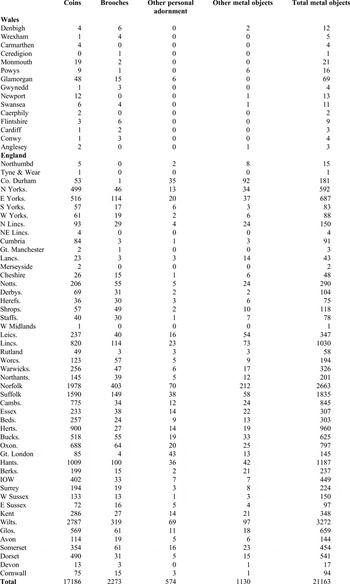
More than 21,000 metallic artefacts of Roman date were recorded on the PAS database in 2015. As in previous annual statistics, this figure includes objects to which a date is attributed spanning the late Iron Age to early Roman transition. Table 1 presents the numbers of artefacts recorded on the database by county, using older administrative boundaries for consistency with previous reports; counties are grouped by PAS region. It divides these artefacts into four principal groups, coins and brooches (the two numerically most significant categories of finds), other personal ornaments and other metal finds. Ceramic, glass and stone objects and building materials documented in 2015 are omitted.
NUMBERS OF NON-CERAMIC ARTEFACTS RECORDED BY THE PAS IN 2015 BY COUNTY AND TYPE

As in previous years coins comprise the artefacts most frequently recorded in the database in 2015, accounting for 81 per cent of all metallic finds.Footnote 2 More than 210,000 Roman coins have now been documented by the PAS, demonstrating the ongoing impact of the initiative to record large assemblages of Roman coins in toto.Footnote 3 The number of coins reported is lower than for 2014 as few coin records from large hoards were entered in the database in 2015.Footnote 4 The distribution of coin finds, however, remains similar to that of previous years; much larger numbers are documented in eastern and some central and southern counties of England than in Wales and in western and northern England.
The 2,273 brooches recorded in 2015 account for c. 11 per cent of all recorded metallic finds. In total 23,444 brooches have been documented by the Scheme between 2003 and 2015.Footnote 5 Again the distribution of instances recorded in 2015 closely resembles the pattern reported in previous years. Many more brooches are documented in the counties of eastern England, from East Yorkshire to Suffolk, and in some central southern and south-western counties, especially Hampshire and Wiltshire, than elsewhere. Significant regional variability in the ratio of coins to brooches is again attested. In particular, the high ratio of brooches to coins among finds from Herefordshire, Shropshire, Staffordshire and Cheshire stands out as an exception to the general pattern.Footnote 6 Other items of personal adornment (mainly finger-rings, bracelets and beads) and the remaining diverse metal objects account respectively for c. 3 and 5 per cent of all metal finds. The distribution within these categories varies markedly between counties, depending in part on the vagaries of discovery of individual assemblages. For example, the continuing documentation of objects from the bed of the Tees at Piercebridge and the discovery of a group of vessels at Milton Lillborne (WILT-0F898C) contribute to the high numbers of ‘other’ objects in County Durham and Wiltshire respectively. When all metallic finds from 2015 are considered the distribution by county demonstrates a similar regional variability to that observed over the last 12 years. This variability is, as previously noted, the product of multiple ancient and modern causes. These include regional differences in the availability and circulation of metal objects in the Roman period, past and current agricultural practice and the varying intensity of metal-detector use across England and Wales.Footnote 7
ARTEFACT DESCRIPTIONS
The entries below present individual highlights of the past year's discoveries recorded by members of the PAS and Treasure Department at the British Museum.Footnote 8 As previously these are selected because of their contribution to the understanding of object type, distribution or iconography. In some instances they comprise objects not previously recorded from the province. The reference number associated with each record is the unique identifier which can be used to consult these object records on the PAS website: www.finds.org.uk. One object was treated as a Treasure case and is also designated with its Treasure number in the format of year (20XX) and reference number (TXX).Footnote 9
The artefacts presented below belong to diverse categories and manifest wide variety in technique, style and iconography. The dates at which they were made extends from the transitional phase between the Iron Age and Roman period to Late Antiquity. They comprise six figurines, a (probable) bust in the form of a grotesque, personal ornament, including five brooches, a hairpin terminal and a button-and-loop fastener, an inscribed intaglio and mirror, a foil made as a likely votive, two terminals from staffs or sceptres, fragments of painted glass and copper-alloy vessels and fittings from belts, horse gear and furniture.Footnote 10
WREXHAM
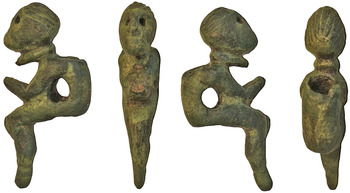
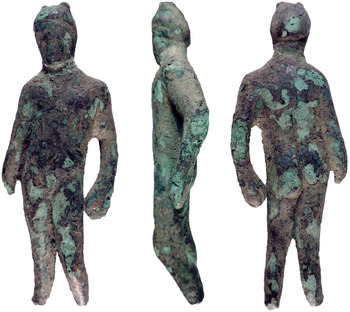
(1) Holt (LVPL-8C4A48) (fig. 1).Footnote 11 A worn copper-alloy anthropomorphic figurine representing a sitting bound and naked captive. The figurine is 44 mm long, 7 mm wide and 20 mm thick at its deepest. It weighs 14.7 g. Some features on the outsize head have survived the wear which has especially affected the sloping face, on which circular sunken eyes (perhaps with a glass setting), traces of a linear mouth and nose are visible. No ears can be seen but the hair is modelled in thick bands swept towards the back of the head. The torso has a block-like thickening to allow for the perforations which pierce the figure horizontally and vertically through its centre. This thickening gives the figure a hunched appearance. The elbows rest on the upper legs and the forearms are raised tightly together; the clasped and bound hands are missing. The knees and feet are likewise tight together, this posture being dictated by the rope which bound the captive, tying together the neck, hands and feet. The rope, however, survives only around the neck and is elsewhere lost to damage.
Holt, captive figurine (No. 1). Scale 1:1. (Photo: V. Oakden; © V. Oakden and National Museums Liverpool)

To the 16 figurines of this type documented by Jackson in 2005, mainly from the Rhine/Danube frontier and in Britannia, four further examples documented by the PAS can now be added, including the present case, making rural Roman Britain the provenance of the majority of known examples.Footnote 12 The block-like extension at the rear allows the figure to be identified as an example of Type I in the series defined by Jackson for these objects.Footnote 13 These objects are in general likely to represent barbarian captives (especially so in the cases where the figures have leonine facial features), their chains simultaneously emphasising their beast-like character as well as their humiliated and controlled state. Their clasped hands too reference their supplicant status.Footnote 14 Their purpose is uncertain, however. The perforations allow them to be mounted, although on what is unknown. A dating to the second or third century a.d. is suggested, although only one of the figurines is associated with a stratified context.Footnote 15
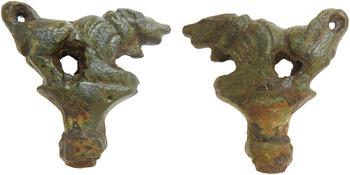
(2) Farndon (LVPL-B4BC19) (fig. 2).Footnote 16 A copper-alloy terminal from a hairpin in the form of a dog mounted on an oval capital-like platform. The surviving part is 26.4 mm long and 27.7 mm wide. The anatomy is well modelled, although wear has obscured some surface detail. The animal has a tapering face with pellet eyes and lentoid ears flat against the head. Its mouth is open and the snout projects beyond the lower lip. Around the neck is a broad collar. The top of the head and the shoulders carry deep grooves representing long strands from a mane or thick fur. The forelegs (also furred) rest on the ground and the rear legs bend backwards, giving the impression that the animal is about to pounce. The narrowing of the back emphasises the muscularity of the haunches. The tail curls up and forward over the animal before falling over the left haunch. Below the platform is the collar which joins the terminal to the iron shaft, of which some corroded remains are visible.
Farndon, hairpin (No. 2). Scale 1:1. (Photo: V. Oakden; © V. Oakden and National Museums Liverpool)

The Farndon terminal is similar to examples of terminals in canine form documented across the northern provinces, not yet closely dated, and is paralleled in detail in a terminal from Cologne which seems very likely to be from the same workshop.Footnote 17 Other terminals for metal hairpins in figural form recorded by the PAS include another dog from Letcombe Regis, Oxon., and a bird from Lilleshall, Shrops.Footnote 18
CUMBRIA
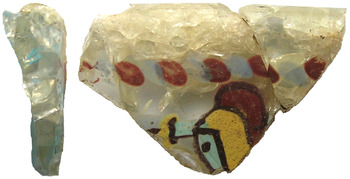
(3) Holme-St-Cuthbert (LANCUM-91E341) (fig. 3).Footnote 19 Two joining rim fragments of a painted glass cylindrical cup, dating to the later second or early/mid-third century a.d. Fitted together they are 31 mm long, 20.5 mm high and 3 mm thick. The cup, in greenish-colourless glass, has a rounded rim and when complete would have been between 60 and 100 mm high, standing on a double base ring.Footnote 20 What is preserved of the painted decoration includes an upper border (alternating blue and red dots) and a helmeted head and sword from a likely figural frieze below. The helmet is rendered in three colours, the crest in red, cap in yellow and face mask with small eyeholes in blue. The sword is raised as if to strike. Its guard is in yellow while what can be seen of the blade is also light blue. The different coloured sections of helmet and sword are demarcated by black outlining. The crest and small eyeholes in the mask reveal that the figure is a secutor, the gladiator whose fight with the retiarius is one of the most widely figured depictions of arena combat. Although the pose of the secutor suggests he is no longer concerned to maintain his guard, and may therefore be poised to dispatch his opponent, too little is preserved to reconstruct the scene with confidence.
Holme-St-Cuthbert, painted glass cup (No. 3). Scale 2:1. (Photo: D. Boughton; © D. Boughton and Tullie House Museum and Art Gallery Trust)

This is one of a group of rarely found painted glass cups which showed arena scenes as well as other subjects. The best preserved example from Britain, found in excavations at Vindolanda, also shows a fight between a secutor and a retiarius alongside a probable probatio armorum (the testing of weapons’ efficacy) for another secutor. The helmet of the last figure shares the colour scheme of the helmet on the Holme-St-Cuthbert fragment.Footnote 21 The latter's findspot in a field north of the Roman fort at Beckfoot also ties it closely to a military community; other painted cups of this type are documented at frontier sites in Britain and on the Rhine, as well as in transfrontier settings in northern Europe, especially Denmark.Footnote 22
DARLINGTON
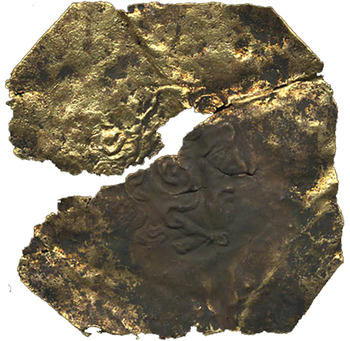
(4) Piercebridge (BM-9978DC) (fig. 4).Footnote 23 A square copper-alloy sheet (37 by 36 mm), originally folded into four, with its corners also folded over. The sheet has a thickness of only 0.25 mm and weighs 1.3 g. In the centre is a repoussé profile portrait which resembles the image of Hercules wearing the lion skin on coins minted by Alexander the Great and successor monarchs. The face is clearly visible in profile, with a carefully rendered eye, nose, mouth and right ear. The figure may be bearded. Some of the coiffure along the temples can be seen, perhaps including the inverted U-shaped curls at the centre, but damage makes it impossible to see in detail much of the hair or of the lion's upper jaw. Beneath Hercules’ ear the lion's curving lower jaw and (probably) a projecting canine tooth may be seen. The lion's ear and details of its mane are visible on the left and upper margins of the profile image. The paws of the lion skin are tied under the chin.
Piercebridge, metal sheet with lion skin portrait (No. 4). Scale 2:1. (Photo: P. Walton; © P. Walton)

The image may have been created by rubbing the metal foil over a coin image. Similar sheets bearing repoussé impressions of Iron Age and later third- and fourth-century coins have been documented amongst the material from the shrine at Woodeaton, Oxon.Footnote 24 One Roman emperor, Commodus, used the Alexandrine image as inspiration for one of his coin portraits, but whether the Piercebridge image is bearded is not certain.Footnote 25 A coin of Alexander or of his successors may instead have been used to make this impression, perhaps brought from the East by a soldier. Conquerors (and would-be conquerors) of Britain such as Caesar and Caracalla had Alexander on their minds as an exemplary predecessor and objects from the province also indicate a wider, albeit faint, echo of his reputation.Footnote 26 He may be the subject of a statuette with a Suffolk provenance and the paired dedications to Ocean and Neptune at Newcastle and to Ocean and Tethys at York have been argued to echo those perhaps made by the Greek monarch at the furthest limits of his exploration. A small number of intaglio images likely to show Alexander's portrait are also documented from Britain.Footnote 27 Alternatively the Piercebridge image is simply intended as Hercules himself. Whoever it represents, like the sheets from Woodeaton this piece may be described as a coin-like offering, a further votive among many such objects from the Tees bed.Footnote 28
NORTH YORKSHIRE
(5) Selby (YORYM-5FFBFB) (fig. 5).Footnote 29 This copper-alloy figurine depicts a nude standing Mercury, 76.7 mm tall and weighing 201 g. The deity is recognisable from the winged cap, but otherwise lacks the attributes commonly associated with the god. He faces forward with his right leg straight and his left bent, i.e. in the contrapposto pose common for standing divine figures. The figure has a marked asymmetry, the tilt at the waist being especially visible at the rear, where the god's right buttock is higher (and smaller) than the left. Of the extremities only the left hand is preserved, holding an unidentifiable object; the right arm is held close to the side. The neck is short and broad, sloping to the shoulders. Most details from the face and torso are lost to wear, with the exception of a (probable) torc around his neck; the musculature of the back and buttocks is a little better preserved.
Selby, Mercury figurine (No. 5). Scale 1:1. (Photo: R. Griffiths; © R. Griffiths and York Museums Trust)

Mercury is the most commonly represented deity among small metal figurines from Britain.Footnote 30 This example is most distinctive for its integrally cast torc, a trait occasionally encountered in the images of other deities although not hitherto to in the case of Mercury; in other examples where the god wears a torc, it is a separately cast piece.Footnote 31
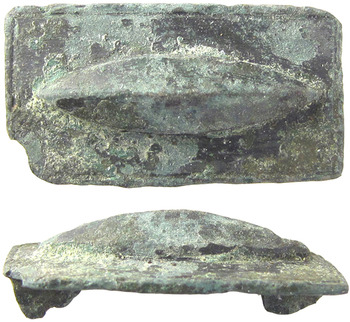
(6) Kirkby Wharfe (SWYOR-FFF684) (fig. 6).Footnote 32 A copper-alloy rectangular plate brooch of probable second-century a.d. date, with one corner broken off. It is 28.8 mm long, 15.7 mm wide and 9 mm thick. It weighs 4.9 g. Within the incised border much of the plate is filled with a raised ellipse with a marked ridge down the middle, i.e. a moulding of ‘coffee-bean’ form. At the back of the brooch a recess corresponds to this raised area on the front. At one end is a double pin lug, and at the other, the remains of the catch-plate. The pin is missing. The brooch has a grey-green patina and may originally have had a white-metal coating.
Kirkby Wharfe, plate brooch (No. 6). Scale 1:1. (Photo: A. Downes; © A. Downes)

Another brooch of near-identical form has been recorded by the PAS less than two kilometres away, south of Tadcaster (SWYOR-54B456). The brooch may be intended to represent a Roman shield, as do other plate brooches of hexagonal and rectangular form, albeit with different ways of representing the boss.Footnote 33 It also recalls the form of harness mounts decorated with the apotropaic vulva or ‘coffee bean’ motif. In this case, however, unlike the harness mounts, the central line is ridged rather than indented.Footnote 34
WAKEFIELD
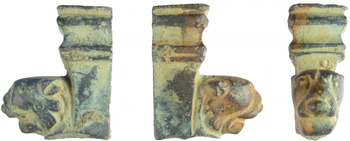
(7) Darrington (SWYOR-1016E4) (fig. 7).Footnote 35 Part of the copper-alloy foot from one of the legs of a tripod, in the form of a trapezophoric feline. What survives is 43 mm high, 36.8 mm wide (including the head) and 20 mm thick. The object has a square socket at the top which is filled with lead alloy. The top of the socket is decorated with two raised mouldings. A feline head projects from one side of the socket, below which the rest of the foot and the remainder of the animal, i.e. its chest and paw, have broken off. The head is more convincingly modelled in its profile than frontal views. The tufts of hair visible from the sides may suggest a lion's mane, but the form of the face, with a short lower jaw, does not allow the identification of species.
Darrington, tripod foot (No. 7). Scale 1:1. (Photo: A. Downes; © A. Downes)

Other instances are also documented of feet in the form of trapezophoric felines for tripods, i.e. folding portable supports for vessels for dining or ritual use. Well-preserved examples of similar feet are reported from the villa at Anthée (Namur) and the later second-century a.d. burial at Tienen-Grimde (Brabant), both in Belgium. The complete tripods reported from tombs at Bois-et-Borsu (Liège) also have feline feet, but lack animal heads.Footnote 36 Other tripod feet have not yet been documented by the PAS but several examples of anthropomorphic mounts which topped the tripod legs have been recorded.Footnote 37
DERBYSHIRE
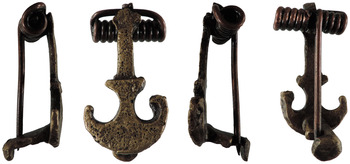
(8) South Darley (DENO-6E647A) (fig. 8).Footnote 38 A near-complete copper-alloy plate brooch closely resembling the ‘anchor-shaped’ type (Ankerfibel). The brooch is 40.4 mm long, 19.5 mm wide and 14.2 mm thick. It weighs 9.9 g. The foot takes the form of an anchor with a narrow shaft and a broad pelta. The long catch-plate is integral to the foot. The pin and spring appear to be made from a different alloy to the plate and foot. The narrow straight-sided bow terminates in a slightly rounded head and the spring has eight complete turns.
South Darley, anchor brooch (No. 8). Scale 1:1. (Photo: A. Willis; © A. Willis and Derby Museums Trust)

No parallel has been found to this brooch in Britain. In its anchor-shaped plate it generally resembles the Ankerfibeln, dated to the second and third centuries a.d., of which more than 200 examples are documented from the north-eastern edge of Italy through Dalmatia, Pannonia, Dacia and Moesia to the Black Sea. However, there is no close resemblance to any of the sub-types identified for this brooch, in all of which the anchor-shaped element covers the spring at the head rather than the foot and the bow has a pronounced curve.Footnote 39
LINCOLNSHIRE
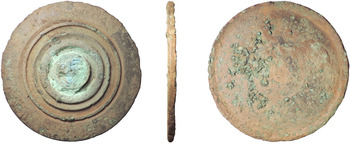
(9) Linwood (LIN-0B4401) (fig. 9).Footnote 40 A circular copper-alloy hand mirror, 120 mm in diameter and 5 mm thick. The mirror generally has a dull green-brown patina but on both sides patches of a smooth, darker coloured, surface patina are visible. SEM analysis confirms these to be tin, indicating that the mirror was tinned all-over. The front has a convex surface with an out-turned rim. High magnification of the tinned area on this convex surface shows very regular, linear polishing marks, set at right angles. The back of the mirror is decorated with five concentric circles of varying thickness, separated by deep channels.
Linwood, mirror (No. 9). Scale 2:3. (Photo: A. Daubney; © A. Daubney)

This mirror closely resembles Lloyd-Morgan's Group E disc mirrors, in particular Type Ea which is characterised by the concentric circles moulded on the back. The Linwood example is, however, much larger than the other mirrors of this group, the diameter of which varies between 34 and 62 mm, although it has the typically thicker cross-section. On the Continent the distribution of Group E mirrors is focused strongly on Trier and Cologne where they may have been made, probably in the second and third centuries a.d.Footnote 41
HEREFORDSHIRE
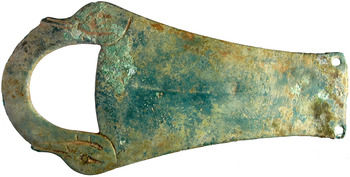
(10) Adforton (HESH-6403DC) (fig. 10).Footnote 42 Part of a copper-alloy pan handle of flaring or waisted form, dating to the second century a.d. The object is 102 mm long, 50.8 mm at its widest and 2.6 mm thick. The flat handle is broken approximately halfway along its length. The surviving element comprises the end of the handle which terminates in a large semi-circular suspension loop. The junctions between the loop and the main body of the handle take the form of water-bird heads of which the beaks extend onto the suspension loop. Details of the heads, including eyes, beaks and, on one side, possible teeth, are rendered by quite crude incision on the handle's upper surface. From the loop the handle tapers to a straight broken edge that has two small circular perforations at each corner. These suggest a later adaptation for a secondary purpose. The bottom of the handle is undecorated.
Adforton, vessel handle (No. 10). Scale 1:1. (Photo: V. Allnutt; © V. Allnutt and Birmingham Museums Trust)

Decoration on metal vessel handles is diverse but includes other examples of water birds.Footnote 43 For example the join between the flat handle and the suspension loop on an analogous handle from a deep pan from Liège is made by two similar but much more elegantly rendered bird heads. The avian decoration on a handle from Marbury cum Quoiseley, Cheshire, serves a similar purpose.Footnote 44
LEICESTERSHIRE
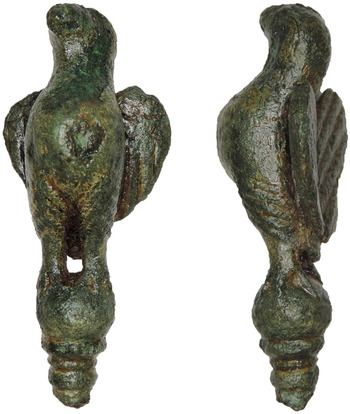
(11) Near Bosworth Field (LEIC-9F3451) (fig. 11).Footnote 45 A copper-alloy probable sceptre or staff terminal, representing an eagle standing on a small globe. Although worn, especially on the head, some surface detail is preserved. The terminal is 54.5 mm long and 22.5 mm wide. The head is turned slightly up and to the bird's right. The beak is indicated by grooves and the eyes by a punched dot and circle. The neck expands towards a large breast, on which, curiously, a marked irregularity on the surface coincides with the position of the heart. Where the torso meets the legs the diagonal grooves rendering the bird's plumage survive. Both legs narrow towards the feet which terminate in four claws splayed across a globe, with a collar below, decorated with three circular mouldings, by which the terminal was attached to a staff or similar object. The wings are partly extended. Some detail of the feathers is rendered on their inner and outer surfaces; on the exterior opposing sets of diagonal lines form recurrent ‘V's- to indicate plumage.
Near Bosworth Field, staff terminal (No. 11). Scale 1:1. (Photo: W. Scott; © W. Scott and Leicestershire County Council)

Terminals of this kind are documented in structured deposits of priestly regalia and as excavated and metal-detected finds, including several examples reported to the PAS.Footnote 46 They take multiple forms, including images of emperors (see No. 14 below) and deities, including several in the form of a male figure in a crested helmet identified as the god Mars.Footnote 47 Among the zoomorphic terminals are further instances in avian form, including other examples of eagles, more readily comprehensible as a choice than some other species because of their association with Jupiter.Footnote 48 The Bosworth terminal is associated with other likely votive finds, including a statue fragment and many horse and rider brooches which are likely to derive from a temple site, the existence of which is supported by evidence from geophysical survey.Footnote 49
BUCKINGHAMSHIRE
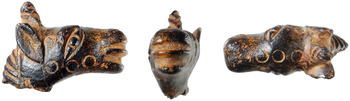
(12) Haddenham (BH-9713CC) (fig. 12).Footnote 50 The head and upper part of the neck of a copper-alloy horse figurine. Its stylised physiognomy is modelled in some detail, supplemented by incised and punched decoration. The head is 23.2 mm long, 16.9 mm high and 9.4 mm wide. Two horizontal grooves form the open mouth of the animal, while the ridge that divides them may represent the bridle bit. The near-vertical eyes are disproportionately large. Each is framed by a strong brow and formed by near-vertical oval recesses, the larger right eye being modelled in more detail, including a distinct iris. A line of punched circles on the side and top of the head from mouth to ears model the bridle straps and their fittings in stylised form. The large pointed ears, each with a central grooved recess, prick upwards from the back of the head, flanking a spiral topknot. The rest of the mane is rendered by parallel grooves across the back of the neck. A dark orange-brown, shiny patina may indicate deposition within a wet environment.
Haddenham, horse figurine (No. 12). Scale 1:1. (Photo: J. Watters; © J. Watters and St Albans Museum)

Horses are not uncommon as figurines, although in antiquity some of them may also have carried riders.Footnote 51 The embellishments of the Haddenham horse, illustrating the importance of equine presentation for exhibiting the wealth of its owner, can be paralleled in other figurines. The horse figurines from Bunwell, Norfolk, or Stow-cum-Quy, Cambs., for example, also possess a stylised topknot.Footnote 52 On the figurine from West Wratting, Cambs. (CAM-778DD0), punched dots are similarly distributed across the face to indicate the bridle fittings.
MILTON KEYNES
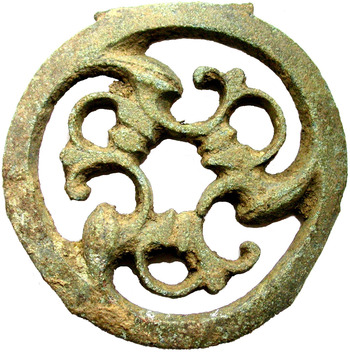
(13) Hanslope (BUC-384F77) (fig. 13).Footnote 53 A copper-alloy openwork harness mount dated to the second half of the second or the third century a.d. with Trompetenmuster motifs. The mount is almost circular, being 58 mm in diameter and 5.3 mm thick. The openwork design is framed by a circular border. Within this border three sinuous trumpet-like motifs are repeated and connect around an open centre. On one side the mount has traces of an attachment lug. Other harness mounts of this general form are documented but not common. Mounts from Dormagen and Zugmantel as well as an unprovenanced example offer quite close parallels.Footnote 54
Hanslope, harness mount (No. 13). Scale 1:1. (Photo: R. Tyrell; © R. Tyrell and Buckinghamshire County Council)

OXFORDSHIRE
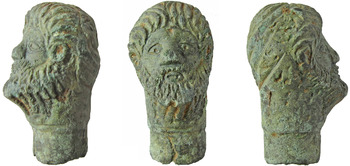
(14) Bix (BERK-BF8EC4) (fig. 14).Footnote 55 A cast copper-alloy sceptre terminal, of probable second-century a.d. date. The terminal, 44.1 mm long and 23.3 mm wide, is in the form of a bearded male human head, modelled in the round. The features generally survive in clear and crisp condition. The face is framed by a full head of hair and luxuriant beard. From the top of the head thick strands of hair are shown as combed forward, curving to the left and right above the forehead, and backward to the nape of the neck. The eyes and broad-bridged nose are disproportionately large, the former extending almost to the edges of the face. The fullness of the moustache and especially of the beard, which frame a down-turned mouth, is rendered by deep grooves on chin and neck, especially the front and left sides. Below the neck is a slightly recessed socket for the staff on which the object was probably mounted; the interior of the terminal is hollow. The recessing of the socket may suggest that an element, such as a ring, assisted in securing the terminal to the staff.
Bix, staff terminal (No. 14). Scale 1:1. (Photo: A. Byard; © A. Byard)

The full hair and beard recall the portraits of Hadrian and, especially, of the Antonine emperors. In this respect the object is analogous to other staff terminals in forms approximating to the portraits of the second-century emperors, for example from Willingham and Cottenham (Cambs.), Duston (Northants.) and Icklingham and Mildenhall (Suffolk). However, the Bix terminal does not share the stylisation characteristic of several of these bronzes.Footnote 56 This is one of several terminals of varied types documented by the PAS, including the example from near Bosworth Field described above (No. 11, with further references).
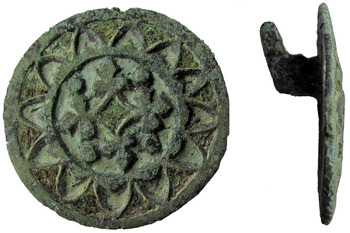
(15) Bucknell (BERK-3F53D1) (fig. 15).Footnote 57 An elaborate though incomplete copper-alloy button-and-loop fastener of Wild's class Vb, missing the loop from the end of the shank.Footnote 58 The object is 32.3 mm in diameter, 2.6 mm thick and weighs 13.3 g. The circular plate is divided into a central cell and outer ring, both of which are decorated with an elaborate pattern of enamel inlays of uncertain colour, little of which now survives. Within the inner cell is a lozenge-shaped centre with curving sides. From the corners of this lozenge extend four repeated raised motifs of approximately clover-leaf form. Four circles finish the design, one in each of the quarters created by the leaf-like motifs. In the outer cell short rays with curving sides radiate from the centre, leaving triangular spaces between each ray and the raised outer edge. Most of the surviving enamel can be seen in these triangular spaces.
Button-and-loop fasteners are not uncommon objects, many examples of which have been recorded by the PAS.Footnote 59 The Bucknell fastener, however, has unusually elaborate enamel decoration. This suggests a second- or third-century a.d. date.
Bucknell, button-and-loop fastener (No. 15). Scale 1:1. (Photo: A. Byard; © A. Byard)

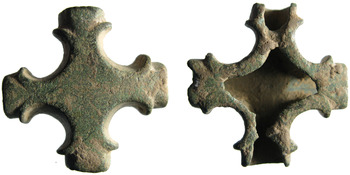
(16) Wantage (HESH-F2AF88) (fig. 16).Footnote 60 A copper-alloy cruciform bridle mount. It is 35.5 mm in length, 34.4 mm wide and 10.4 mm thick. It weighs 15.9 g. The object is cast in one piece and hollow. The front face is flat and consists of four short arms forming a cross. The edges of each arm curve to volutes at either end. Each arm ends in a near-square socket, two of which have been slightly distorted and broken. The mount is open at the back.
Wantage, cruciform bridle mount (No. 16). Scale 1:1. (Photo: P. Reavill; © P. Reavill and Birmingham Museums Trust)

An identical mount is documented from the auxiliary fort at Buciumi, Romania.Footnote 61 Other similar cruciform mounts with varying degrees of elaboration have been occasionally documented in Britain and beyond, mainly from military sites.Footnote 62 Two further finds of cruciform bridle mounts reported to the PAS include a simpler example from St Ann Without, between Lewes and Brighton (SUSS-7A9952), and a larger piece with more flamboyant volutes from Piercebridge (NCL-A195D4), which is paralleled by examples among the harness equipment found at Kastell Weissenburg, Bavaria.Footnote 63
SUFFOLK
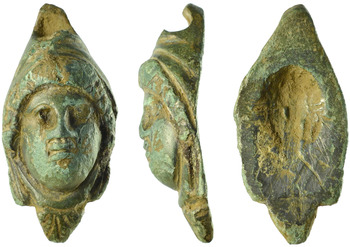
(17) Hintlesham (SF-2B9C68) (fig. 17).Footnote 64 A near-complete, though worn, cast copper-alloy mount, probably from a vessel, in the form of a young male face framed by a hood, cast in high relief on the front. It is 49.8 mm long, 24.1 mm wide and 12.8 mm thick. It weighs 38.1 g. At the top of the mount the hood is broken, revealing the mount's hollow interior. The folds in the hood over the forehead and what survives of the peak might suggest that a Phrygian cap is intended, but the further fabric visible on the side of the head and below the chin indicates that this is more likely to be a hooded cape. Beneath the hood emerges a thick band of curling hair above a beardless fleshy oval face. This has deeply recessed circular eyes, with the eyelids and irises clearly defined, a prominent flaring nose, and a narrow mouth framed by short straight lips. At the base of the mount is a flat triangular knop decorated with radiating grooves. Behind the mount is hollow and carries tool marks on all surfaces and traces, perhaps, of a silvery solder, although there is no other obvious means of attachment.
Hintlesham, mount (No. 17). Scale 1:1. (Photo: A. Brown; © Suffolk County Council)

No direct parallel has been found. The hooded cape, if rightly identified, suggests various possible candidates for the identity of the figure, for example a Genius Cucullatus, a personification of winter or a countryman, although the youthful features and thick hair are more characteristic of heroic youths.Footnote 65 Smaller mounts showing a similar figure with a Phrygian cap have been documented by the PAS, but they are riveted and may be chamfron fittings.Footnote 66
NORFOLK
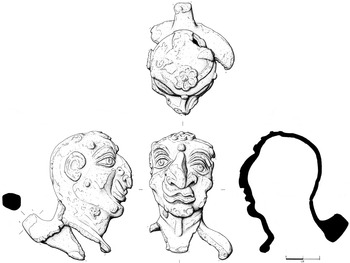
(18) Wymondham (NMS-6FC605) (fig. 18).Footnote 67 An incomplete cast copper-alloy grotesque male head. The object is 72 mm tall and weighs 189.4 g. Despite the damage to the head (much of the left side is missing, including the ear) and the obscuring of surface detail by corrosion, the caricatured portrait features are clearly visible. Within the eyes, asymmetrically arranged on either side of the nose, the large circle of the iris is clearly differentiated, framed by eyelids in high relief, above which an eyebrow and further folds of skin are also modelled. The bulbous twisted nose has wide flaring nostrils of unequal size. Below these is an irregular mouth framed by large undulating lips and a large chin, beneath which hangs a fold of loose skin on a lined neck. Excrescences are visible across the face, including a very prominent example directly above the nose. On both sides of the face the cheeks are pulled back as wide flaps of skin. The top of the head, mostly hairless, is circled by a wreath; a rosette is clearly visible above the forehead, connected by a band to what may be ivy leaves over the ears. At the back of the head is a likely cirrus (i.e. the lock of hair worn by athletes, buffoons and others), but corrosion impedes its confident identification. A joining fragment from the back of the neck carries a projecting element, perhaps the stub of a handle or thumb-piece. The break at the neck is not recent. The projection from the back of the neck suggests that the object served some function, but what this might be is uncertain.Footnote 68 It was found very close to a small waisted bronze vessel of very unusual form (NMS-6F4340), but the specific nature of the association is not clear.
Wymondham, grotesque head (No. 18). Scale 2:3. (Drawn by J. Gibbons © Norfolk Landscape Archaeology)

This is the second example documented by the PAS of an object in the form of a grotesque male portrait, the other being a steelyard weight from Osbournby, Lincs.Footnote 69 The wrinkling of the skin above the eyes and the flared cheeks give an exaggerated expression to the face. Along with the sagging of the skin around the chin and neck and the lack of hair they also lend an impression of advanced age and misfortune. The tradition of grotesque images, i.e. of individuals suffering from illness or infirmity or of advanced age, is established in Hellenistic genre sculpture and sees multiple Roman re-interpretations.Footnote 70 The rosette above the temples is paralleled on small-scale busts of Bacchus, for example a steelyard weight from Barrenstein, Kr. Grevenbroich (Nordrhein-Westfalen) or a tripod mount from Augst.Footnote 71 The wreath and rosette might thus identify the Wymondham figure as a symposiast and thus as close in spirit to the caricatured elderly diners among the terracotta figurines buried in the ‘Child's grave’ at Colchester.Footnote 72 Alternatively, it might represent a servile figure from a convivial setting, a type which is often also garlanded and represented with grotesque features.Footnote 73
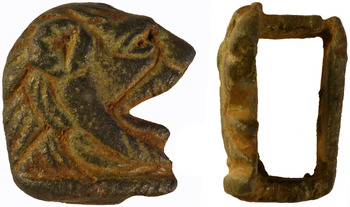
(19) Methwold (NMS-32F636) (fig. 19).Footnote 74 A cast copper-alloy looped strap mount or slide from horse harness in the form of a right-facing, open-mouthed lion's head on a basal line. The object is 20.5 mm high, 18.8 mm wide and 12.3 mm thick. The features are carefully rendered, with a staring eye between eyelids modelled in high relief and beneath a strong brow line. The upper face ends in a short worn nose above a powerful jaw. Teeth are indicated by short grooves along the upper gum. The lower jaw is differentiated from the neck by a curving band running from the ear around the cheek and below the open mouth. On the side of the head clumps of fur are rendered by blocks of grooved decoration running in varying directions. The reverse is slightly recessed and connected at top and bottom with an integrally-cast rectangular loop. This strap loop is very closely paralleled by an example from Norwich.Footnote 75 Objects of this type generally date to the first to third centuries a.d.
Methwold, harness mount (No. 19). Scale 1:1. (Photo: G. Crace; © Norfolk County Council)

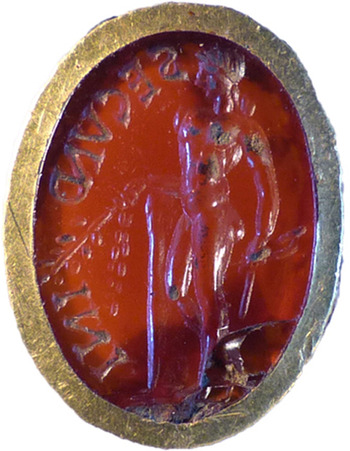
(20) Billingford (NMS-B6A4F4; 2015T371) (fig. 20).Footnote 76 An oval carnelian showing the god Apollo, with a flat upper face and bevelled edges on the reverse. The gem measures 13 by 10 mm and is 2 mm thick. The upper face is engraved with a standing naked male youthful figure, finely modelled, wearing a wreath of which the ribbons fall on his neck. He faces left, with left leg straight and right leg bent. The lower legs are lost to damage. The figure's right arm is supported by a column and he holds a laurel branch in his right hand and an unidentified object, perhaps a bow, in his left. SECVND-INI (‘of Secundinus’) is engraved retrograde in capitals along the left edge of the gem.Footnote 77 The thin rectangular-sectioned gold band or collet around the edge suggests that that this find may have been lost from a medieval seal in which it had been re-used and need not, therefore, have arrived in Britain in antiquity.
Billingford, intaglio (No. 20). Scale 3:1. (Photo: E. Darch; © Norfolk County Council)

The attributes of laurel branch and column are common in representations of Apollo, but the image on the intaglio is best matched by a cornelian of Augustan date from the colonia at Xanten, in which Apollo also leans upon a column.Footnote 78 It is also similar to an example in the Kunsthistorisches Museum in Vienna of similar date, although in this case the god leans on a column behind him.Footnote 79 Inscribed gems are rare and mainly Republican or Augustan in date. Like the Billingford gem some other examples (all retrograde) also give the name in the genitive.Footnote 80 However, names are more commonly given in the nominative (also retrograde), for example ALBA, scratched on a gem from a pit fill dated to the a.d. 50s, from Eastcheap, London, depicting a dextrarum iunctio (clasped hands).Footnote 81 In such cases the name supplements or, as here, overshadows the carved image in projecting the owner's status.
GREATER LONDON
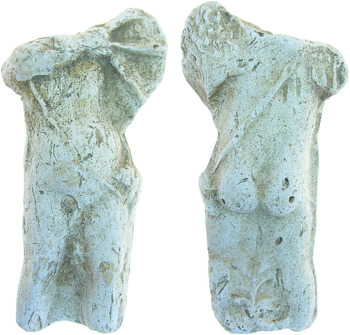
(21) Dowgate (LON-799A6C) (fig. 21).Footnote 82 A small incomplete white pipe-clay figurine of a winged male archer, presumably Cupid, missing its head and feet and now measuring 60 mm long. The wing which sprouts from the left shoulder is well preserved, with some rendering of the feathers visible on the back; a wing also sprouts from the right shoulder but much less of it survives. The figure faces right with his right arm raised across his body to draw the bow on which an arrow is nocked. He wears a small side-quiver on his left hip, suspended on a baldric from the right shoulder and running diagonally across his body on front and back. A production mould line can be seen down both sides of the figurine. It is white with some patches of staining, probably from its riverine depositional context.
Dowgate, London, pipe-clay figurine (No. 21). Scale 1:1. (Photo: E. Wood; © E. Wood and Museum of London)

It has not been possible to find a parallel for this figure among other pipe-clay figurines from London or elsewhere in Britain and continental Europe.Footnote 83 The god is not uncommon as a metal figurine (or in the repertoire of Hellenistic pipe-clay figurines), but he is not normally represented in the act of firing his bow.Footnote 84 Among the many representations in other media he is, however, occasionally figured in this pose.Footnote 85 The figurine was found on the Thames north foreshore, c. 100 m west of London Bridge. A cluster of figurines has been documented from London's ancient river port, typically among material dumped as part of Roman period riverside reclamation.Footnote 86 Although this object is documented a considerable distance south and west of other figurine findspots, it too was perhaps incorporated in a deposit of this kind before erosion into the river.
ISLE OF WIGHT
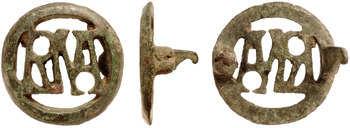
(22) West of Newport (IOW-DA5661) (fig. 22).Footnote 87 An openwork monogram brooch, probably of second- to third-century a.d. date. The brooch has a circular flat frame, 34 mm in diameter, bevelled on its outer and inner edges. Within it is a monogram formed by three serifed and ligatured capital letters, from left to right R, M and A. The letters connect to the frame at the extremities of R and A. If read from left to right the text may be read as a lightly abbreviated form of R(o)ma or, if read from right to left as Am(o)r.Footnote 88 If the bowl of the R might be read as containing the otherwise absent O, then Roma and/or Amor can be read without abbreviation. At the rear the frame carries a pair of perforated lugs containing an iron axis bar and the loop of an iron pin, opposite a flat elongated catch-plate.
Near Newport, Isle of Wight brooch (No. 22). Scale 1:1. (Photo: F. Basford; © F. Basford)

Other examples are documented in small numbers from sites on and in the environs of the Danube limes in southern Germany as well as in Bulgaria and Romania, but this is the first discovery of an example in Britain. With one exception in silver from Nifon, Tulcea (Romania) other examples are in copper alloy.Footnote 89 The limited context information from other finds suggests that the type dates to the later second and earlier third centuries a.d. R(o)ma is most plausibly identified as Dea Roma, the personification of the city of Rome. Other openwork monogram brooches of similar date, provenance and form name Mars, albeit in the genitive rather than the nominative.Footnote 90 In general these brooches exemplify the taste for openwork decoration in contemporary dress fittings in the Roman army. Like the visual representations of these deities on arms and armour, through their names the gods are invited to protect the body of the soldier wearing the brooch which serves as a ‘porte-bonheur’.Footnote 91 The inherent ambiguity of the brooch's reading (Roma or Amor?), an anagram widely played on in antiquity, perhaps suggests a supplementary protective function, to confuse the viewer and deflect any malign gaze.
WILTSHIRE
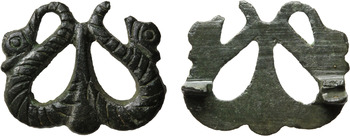
(23) Kingston Deverill (PUBLIC-A192C4) (fig. 23).Footnote 92 A cast copper-alloy zoomorphic plate brooch of unusual form. The brooch is 26.7 mm wide, 20.9 mm high and 2 mm thick. It weighs 3.5 g. The brooch is formed by the symmetrical arrangement of two back-to-back water birds, each taking the form of a tapering ‘S’ curve. Both birds terminate in large heads which rest on their curving necks. The decoration formed by repeated angled grooves may be a stylised rendering of plumage. There are vestiges of white-metal coating on the front of the brooch. The reverse retains a broken catch-plate stub and one lug for a now-lost hinge pin; the absence of iron staining on the reverse implies the pin was non-ferrous. The type is identified by Mackreth as being mainly found in South-East England and the Midlands and of likely continental origin. It may date to the first century a.d. Footnote 93
Kingston Deverill, plate brooch (No. 23). Scale 1:1. (Photo: R. Henry; © R. Henry and Salisbury and South Wiltshire Museum)

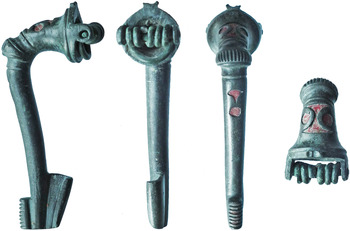
(24) Amesbury (SUR-3D1503) (fig. 24).Footnote 94 A very well-preserved and unusual copper-alloy trumpet-type brooch. The brooch is 57.1 mm long and weighs 20.6 g. The colour of the metal is a uniform mid-grey, with the exception of some red enamel decoration. The brooch has a circular head on the top of which is a circular loop, now mostly broken away. The pin is missing but the spring (with six surviving turns) and separate bar are well preserved; the bar is held in place by two single lugs which project forward from the sides of the head. The brooch has three red enamel cells on the head, two circular and one of hourglass shape. The bow has a circular section and changes angle sharply just behind the head. On the angle are two narrow collars separated by a crescentic moulding which is decorated with nine closely spaced parallel grooves. These may formerly have held enamel, no trace of which is evident. Below the expansion the bow is plain with the exception of two cells, both filled with red enamel; one is pelta-shaped and one is circular. The bow tapers to a flattened foot with a short rounded rectangular projection on the front carrying seven grooves, each filled with red enamel. A plain catch-plate survives on the back. Elements of the decoration, especially the grooved foot, are idiosyncratic and enamel decoration of this type is more characteristic of Iron Age brooches than of the trumpet type. Trumpet brooches date between the later first and later second centuries a.d. but the Amesbury brooch is likely to date from the beginning of this period if not earlier.
Amesbury (No. 24). Scale 1:1. (Photo: D. Williams; © D. Williams)

DORSET
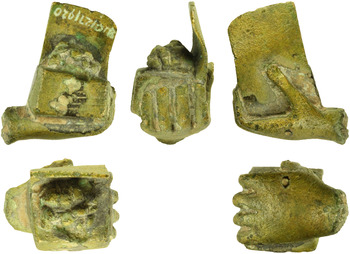
(25) Pentridge (DOR-8C6C09) (fig. 25).Footnote 95 A fragment of a copper-alloy figurine, comprising a left hand broken off at the wrist which holds a rectangular box, just over a centimetre long, with a raised lid. The box fits in the palm of the hand, with the fingers wrapped around the side and the thumb on the back. The open box contains a heaped substance and can be identified as an acerra, i.e. an incense box. The fragment may be argued to derive from a figurine of a priest or Genius, being the first example from Britain of this type documented as holding an incense box.Footnote 96 Several examples are recorded outside Britain of togate priestly figures with a fold of the tunic over their heads (capite velato) holding such a box in their left hands.Footnote 97 This pose corresponds to Type II in Kunckel's classification of Genius figures, i.e. with libation bowl in right hand and acerra in left.Footnote 98 In some cases the finger tips grip the front of the box with the thumb on the side, turning the opened box towards the viewer, but in this case and others the box opens towards the sacrificing figure. It is difficult to tell if the Pentridge box holds an irregular mass of incense or single balls; the latter are more clearly differentiated on some stone reliefs and figurines.Footnote 99
Pentridge, hand from figurine (No. 25). Scale 2:1. (Photo: R. Henry; © R. Henry and Salisbury and South Wiltshire Museum)

The offering of incense and wine as a libation may comprise a simple sacrifice in its own right or form the praefatio, where the playing of music and the mingled odours from the offerings of wine and incense invite the god to the sacrifice before the killing of the animal victims.Footnote 100 In representations on stone reliefs showing public and private sacrifice from the early imperial period until Late Antiquity the acerra is usually held by a young male ancillary participant, the camillus.Footnote 101 However, among the figurines noted above it is the priest/Genius, who holds both acerra and libation bowl, i.e. the implements containing wine and incense, the essential components of the sacrificial sequence. Huet's analysis of sacrifice iconography on reliefs from Gaul and Germany shows incense to be a very frequently represented offering and recent scientific analysis work has revealed the recurring use of plant exudates in funerary ritual in Britain. If as seems likely, this also characterises non-funerary sacrifice, then incense may be a key part of ritual in practice and not only a visual convention.Footnote 102
KENT
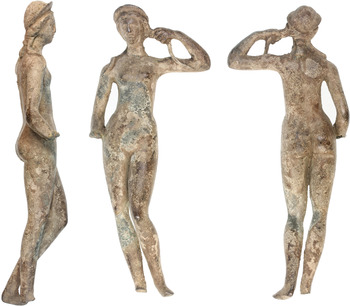
(26) Wingham (KENT-E80066) (fig. 26).Footnote 103 A near-complete copper-alloy figurine of Venus, generally well modelled and standing naked in a contrappostal position. The figurine is 133.9 mm tall, 51.3 mm wide and 17.7 mm thick. It weighs 202.7 g. The head is turned slightly to her right. The separate strands of hair are lightly indicated on the crown of the head, and parted beneath the diadem where thick curling strands extend on either side of her face. Some are drawn together on the left by her hand, through which they pass to fall on her shoulder, while others fall on her neck and end in a curl on her right shoulder. The features on the thin oval face are much worn. The goddess has a slender figure, with small breasts and a shallow navel, a wider waist and legs which lean to the left to contrast the slight rightward tilt of the torso. On her back a shallow depression for her spine meets a hollow at the base, from which the figure's buttocks curve lightly outwards. The arms are slender; her left arm is raised and bent in order for her hand, on which the fingers are carefully differentiated, to wring her hair. Her right arm is broken below the elbow but what survives of it suggests that it covered her groin. The figure's legs separate at the thighs, the right being straight to support the weight of the goddess, the left bent. The muscles of the legs are modelled with care; the right leg is broken at the ankle.
Wingham, Venus figurine (No. 26). Scale 2:3. (Photo: J. Jackson; © Kent County Council)

In the pose and the modelling of the figure's anatomy this is a quite sophisticated rendering of the goddess in comparison with many examples from Britain. It appears to be a variant of the Venus Anadyomene type which combines the wringing of her hair as the goddess emerges from her purity-restoring bath with the modesty gesture from the Venus pudica type.Footnote 104 A figurine from Pitsea, Essex (ESS-CEA6C1), of comparable sophistication to the Wingham piece shows both arms raised towards the head to wring the hair, while other examples of the Venus Anadyomene type show the goddess holding a mirror in one hand or with her hand by her side.Footnote 105 Although Venus, along with Minerva and Fortuna, is one of the most commonly occurring figurines of a female deity, few certain copper-alloy examples have yet been documented by the PAS other than the Pitsea figure.Footnote 106