As Jan Assmann writes, the concept of “cultural memory”Footnote 1 both “draws our attention to the role of the past in constituting our world” and also investigates “the motives that prompt our recourse to it” (ix). Cultural memory is transmitted through a variety of mediators ranging from texts and images to commemorative sites, whose complex aesthetic and ideological configurations – whether associated with trauma or glory – are a source of great interest. In his New Science (1725–44), Giambattista Vico claimed that “humanitas in Latin comes first and properly from humando” (8), highlighting the importance burial rituals had in the creation of civilised society. The commemoration of the dead is indeed at the core of cultural memory as the foundation on which the social compact between the living and the dead rests.
Memory is not only the basis of present identity, but the past is continually reused – both by individuals and communities – to design the future and thus achieve a sense of direction. Starting from these premises, I will study Westminster Abbey as a site of memory where the illustrious dead are commemorated, as in other “pantheons,” by celebrating what is represented as the unity of intent and variety of achievements of the English/British nation. As signifiers of fame, the Abbey memorials are part of a centuries-long process of canonisation that involved a number of agents, including religious and political authorities, rich patrons, and the general public. Far from being linear, this process involves tensions and conflicts, being the result of a multitude of cultural, religious, political, and economic forces.
The history of Poets’ Corner is fraught with conflict right from its origin. Chaucer's monument bears a date – 1556 – that brings us back to a peculiar time in the history of England and of the Abbey, the Catholic restoration of Mary I. It was Nicholas Brigham – a minor poet and antiquary, but also a public servant – who had the monument erected. Was this meant as an ideological move to reinforce the connection between modern England and its Catholic past? I have no definite answer, although the proximity of the donor to the court seems to indicate that the act was not exempt from political connotations. What is certain, Chaucer's memorialisation triggered a chain reaction which turned the south transept into the cultural shrine of the nation.
Under the reign of Elizabeth I, due to the destruction of the monastic altars that had previous stood against the walls of the chapels where the Mass was formerly celebrated, a space was opened up which could now be filled with new memorial contents, thus obliterating the Catholic past. Sumptuous monuments were soon erected all over the church to house the remains of aristocrats whose families purchased this honour by paying an appropriate sum to the Dean and Chapter. Poets were also memorialised in the Abbey. Edmund Spenser was buried near Chaucer in 1599, while Francis Beaumont was bestowed this honour at the beginning of 1616.
Outlining the centuries-long development of Poets’ Corner exceeds the scope of this article, and moreover the complex web of aesthetic and ideological factors involved in these canonical dynamics has already been investigated in a variety of studies, be they concerned with the belated memorialisation of Shakespeare in 1741Footnote 2 or with the canonical impasse that followed Byron's death, when the Abbey authorities refused to sanction his burial in the Abbey due to his scandalous life.Footnote 3
What I aim to examine here is the late nineteenth-century creation of a “separate branch” of Poets’ Corner – which was aptly named Little Poets’ Corner – inside Westminster Abbey. The interest of this project lies in the fact that it was meant to celebrate both the nation and wider geo-political entities such as the empire and the English-speaking world or “race,” a concept that implies the acknowledgment of an interconnected world, both inviting and resisting a cosmopolitan attitude. As Tanya Agathocleous claims, by the mid-nineteenth century “the scale of imagined community changed dramatically” (xv). London was perceived not only as “a symbol of the nation and the ‘heart of the Empire,’” but “with the new and fast-expanding networks of trade, finance, post, steamship, telegraph, print, and immigration . . . it became unmistakably linked to the world beyond the nation as well” (xv).
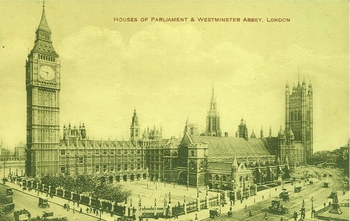
Westminster Abbey's location at the core of London, close to the Houses of Parliament (Figure 9), and its attraction to pilgrims coming from distant lands, meant that it was not a sanctuary where one could retreat from the pressure of the modern world. And it seems very likely that the attempts to address the Abbey's celebration of English literature to a wider English-speaking public and to include American literature in the pantheon was partly a response to the increasing importance of transcontinental travel. At the same time, the emphasis placed on the common cultural roots of English speaking-countries may also be regarded as an effort to “contain” the variety of languages that were invading the space of the nation. In fact, at the turn of the century London was often referred to as a multilingual and multifarious Babylon,Footnote 4 among others by Henry James in his Preface (1909) to Princess Casamassima, where the “great grey Babylon” is exoticised as a “thick jungle” (33) teeming with stories. At a time when globalisation made itself strongly felt in the British metropolis, the Abbey authorities could not fail to acknowledge the changing visage of the world and strove to come to terms with it.
“Houses of Parliament and Westminster Abbey.” Historical postcard. Author's own collection.

The Abbey and the English-Speaking Race
“Can any sacred building in the British Empire compare with Westminster Abbey? Is it not the most unique and priceless treasure of the English-speaking race? Such was the exclamation uttered by an American friend of mine whom I was taking round the Abbey.” So begins “The Abbey and the Empire,”Footnote 5 an article the Dean of Westminster devoted to the relation between the Abbey and the empire in the first half of the twentieth century. After expanding on the symbolic import this sacred edifice had for people coming from Canada, Australia, New Zealand, or South Africa, the Dean concluded his eulogy by urging “that the Abbey be not looked upon as a mere museum or Valhalla. It has a message of its own, religious, vital and true, as the mother-shrine of the English speaking peoples.” As the article makes clear, this message had much to do with a supranational sense of kinship, since according to the Dean the building proved capable of awakening visitors “to a full sense of the significance of this great inheritance from our common Anglo-Saxon ancestry.”
In the second half of the nineteenth century Westminster Abbey was “promoted” from a national to an imperial shrine and was increasingly regarded as a symbol of what came to be called “Greater Britain.” What is less known, however, is that the Abbey was also used to further the international relations between Britain and the United States. To investigate this phenomenon I will concentrate on the development of Little Poets’ Corner, whose creation was orchestrated by Arthur Penrhyn Stanley (1815–81), the Dean of Westminster from 1864 till his death.
Under the watchful eye of Stanley, Little Poets’ Corner grew to become a religious pantheon expressing the alliance between Church, State, and culture that characterised the Victorian period. In his influential The State in its Relation with the Church (1838), William Gladstone had already discussed what he regarded as the positive effects of the post-Reformation association between Church and nation.Footnote 6 In the following decades, Dean Stanley also took part in this debate, as is proved by his Essays Chiefly on Questions of Church and State: from 1850 to 1870, a volume he published in 1870 with the aim “to maintain the advantages which flow from the Church as a national institution” (x).Footnote 7
In the same years, Stanley's oft-reprinted Historical Memorials of Westminster Abbey (1868) revived public interest in the Abbey's history and its connections with the nation at large. As Stanley claimed, the proper title of the book should have been The History of England in Westminster Abbey (Stanley 1899, 11). The Dean was well aware of the importance the Abbey had as a site of memory and as a focus of national identity. Moreover, Stanley was extremely well travelled and well connected, and had important personal ties with the empire. In 1862, for instance, he had accompanied the Prince of Wales on a tour of the Near East. And in December 1863, just before becoming Dean, he had married Lady Augusta Bruce (daughter of Thomas Bruce, 7th Earl of Elgin), who was not only a woman of the bedchamber to Queen Victoria but also the sister of diplomats such as James Bruce – 8th Earl of Elgin, who had been both Governor General of Canada and Viceroy of India – and Frederick Wright-Bruce, who would conclude his diplomatic career in the United States.
Stanley was therefore involved in the imperial adventure both on a personal level and because of his public role. On 11 October 1875, for instance, he preached a sermon on “England and India” to celebrate the departure of the Prince of Wales for that part of the empire. It goes without saying that various makers of the empire were memorialised in the Abbey under his Deanship, and in 1904 two architects even published a scheme entitled “Imperial Monumental Halls and Towers at Westminster,” a proposal to extend the Abbey to immortalise the achievements of those who had contributed to the greatness of the empire.Footnote 8 However, the imperial dimension of the Abbey at large is beyond the scope of this article. What follows is rather an attempt to analyse the cultural politics implicit in the creation of Little Poets’ Corner, notably in relation to the concomitant transatlantic journeys and symbolic exchanges that were aimed at strengthening the ties between the Abbey and the United States.
The Origins of Little Poets’ Corner
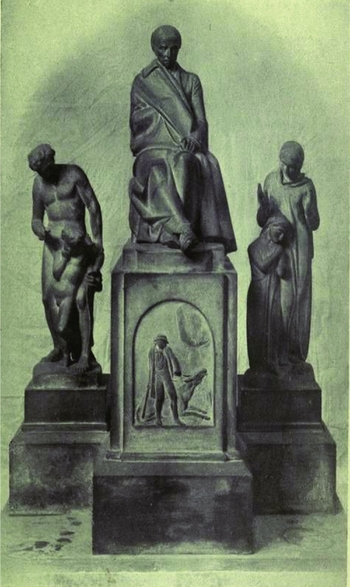
When Wordsworth died in 1850 he was buried at Grasmere, but further forms of monumentalisation were envisaged. Already in 1852 Thomas Woolner – who had created the Grasmere memorial – designed a complex monument (Figure 10), including a seated figure of the poet, flanked by two groups – a father and son on the right, and a mother and daughter on the left.Footnote 9 Although this cumbersome plan was never translated into stone, when Frederick Thrupp sculpted a statue of Wordsworth for the Abbey – in 1854Footnote 10 – he again chose to portray the poet as seated, with crossed legs, a book on his lap and a quill in his hand. The body of the poet is given a dignified appearance by what looks like a toga, but that loose garment actually evokes the plaid the poet used to wear while working outside and the statue simply aims at a realistic rendering.Footnote 11
Thomas Woolner's design for the Wordsworth Monument. Illustration from Amy Woolner. Thomas Woolner, R. A.: Sculptor and Poet (New York: E. P. Dutton, 1917).

Edward Twistleton, who had subscribed to the fund from which the cost of the statue had been defrayed, not only felt inclined to say: “Kneel down, Sir, don't remain sitting in that way in the Baptistery” (25 June 1866), but proclaimed himself amazed that Christopher Wordsworth – the nephew of the poet, and a Canon of Westminster – “could have been a party to what is in such bad taste for a Cathedral or Abbey” (25 June 1866).Footnote 12 From our distant observatory, we can regard this diatribe with a smile. Wordsworth's crossed legs are after all a venial sin. The monument was not set in Poets’ Corner, but in the Baptistry – that is to say in Saint George's Chapel, beneath the south-west towerFootnote 13 – and these lines were inscribed on the base:
The quotation comes from the last of the four sonnets by Wordsworth that go under the title of “Personal Talk,” and in the original it is followed by two closing verses:
Although these verses were tactfully omitted from the inscription, the memorial presented itself – in the eyes of the cognoscenti – both as a token of gratitude and as a fulfilment of the poet's wish for remembrance.Footnote 14
In 1876 Stanley described the collocation of the statue as “not unsuited to the innocent presence of childhood at the sacred font – not unworthy to make that angle of the Nave the nucleus of a new Poets’ Corner of future years” (302). When Stanley wrote these words, other poets had already joined Wordsworth in the Baptistry, such as John Keble (d. 1866),Footnote 15 who had authored his devotional poem The Christian Year in 1827.Footnote 16 As Stanley remarked, the bust of Keble had been erected beside Wordsworth, “by a like concord of ideas,” mainly thanks to the “munificence of a generous admirer” (302) – the above-mentioned Edward Twistleton, whose letter to Stanley – dated 25 June 1866, shortly after the death of Keble, on 29 March – testifies to the backstage negotiations that went into the making of a monument:
It is quite right that you should decide on the locality of the Tablet – for I suppose a Tablet is preferable in a Church to a Bust or a Statue. But before you decide, let me mention two points.
1. In addition to the general charm of Poets Corner, there would be a peculiar appropriateness in Keble's monument being placed over Thomson's – the one being the Poet of “The Seasons”, or “The Natural Year” – the other the Poet of “The Christian Year.”
2. Wordsworth's statue produces in me immoral sensations. When I see it, I wish I had the authority and strength to break it in pieces with an iron mace.
While Twistleton would have preferred a tablet in Poets’ Corner to a bust in the Baptistry, it was Stanley who actually chose both the location and the form of the memorial.Footnote 17 The gravitational attraction of Wordsworth prevailed over that of Thomson, and one wonders whether Stanley had already foreseen transforming the Baptistry into what he later labelled as Little Poets’ Corner.
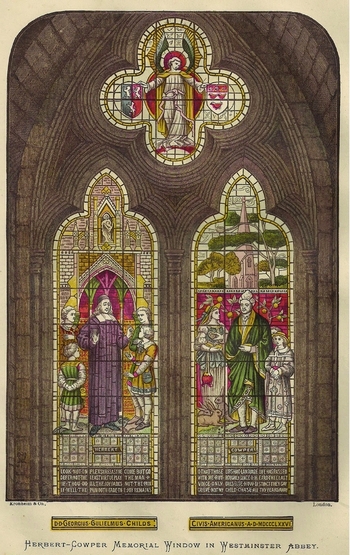
Stanley also played a discreet but capital role in the transatlantic transactions that led to the creation of another Baptistry memorial – a stained glass (Figure 11) that commemorated George Herbert (1593–1633)Footnote 18 and William Cowper (1731—1800),Footnote 19 two poets who had studied at Westminster School, although in different centuries, and whose religious inspiration was regarded as close to that of Keble. The memorial was erected in 1876 thanks to the financial help of a citizen of the United States, George W. Childs, who was the Editor-in-Chief of the Philadelphia Public Ledger, but it was Stanley who tactfully solicited the gift.Footnote 20
“Herbert-Cowper memorial window in Westminster Abbey.” Illustration from Sunday at Home (2 June 1877).

Stanley himself explained the meaning of this memorial in an article where he acknowledged his resolution to turn the Baptistry into “a Second Poets’ Corner – chiefly for sacred poets – in order to relieve the great pressure of the South transept.”Footnote 21 Stanley also explained that the two poets represented in the memorial window embodied “two opposite poles of the English Church – George Herbert, the ‘ecclesiastical,’ and William Cowper, the ‘evangelical’ tendency” (qtd. in Davis 176).Footnote 22 The window primarily symbolised a reconciliation between the diverging souls of the English church, but due to its celebration of diversity and to its origin as the gift of an American, it also became an icon of reconciliation between Great Britain and the United States, as the editor of Sunday at Home promptly underlined by describing the window as “a fitting and graceful tribute from an American citizen in the Centennial Year of Independence” (qtd. in Davis 176).
A bust of Frederick Denison Maurice (1805–72) by Thomas Woolner was placed in Little Poets’ Corner soon after his death. An active social reformer and a man of letters, Maurice was ordained in 1834. In 1840 he became professor of English history and literature at King's College, and in 1846 he also obtained the chair of divinity, although he lost this post in 1853 due to his unorthodox views. His influential volumes contributed to the fascination Maurice exerted on Charles Kingsley (1819–75),Footnote 23 who joined him and Thomas Hughes to form the Christian Socialist Movement.
Given the public status of Kingsley – who had become Canon of Westminster in 1873, but who was also renowned for his writings and civil engagement – it comes as no surprise that his bust (again by Thomas Woolner) was unveiled by his son as early as 1876, less than two years after his death. Like Herbert and Maurice, Kingsley was a clergyman and a prolific author, who had written poetry, novels, drama, historical works, sermons, religious tracts, scientific treatises, and various forms of criticism. Briefly Kingsley embodied a Victorian ideal of completeness, combining a high moral and cultural profile with an interest in social reforms and even in science.
In the discourse that accompanied the unveiling, Canon Duckworth described Kingsley as “the fearless champion of purity and truth,” and expanded on the new Christian pantheon that was forming in the Baptistry:
There is Maurice, . . . Yonder is Wordsworth, the poet of nature, whose marvels he delighted to explore and expound. There stands Keble, the sweet singer of that church which never had a more loyal and devoted son. And the light which streams upon him passes fitly through the blazoned figures of Herbert and Cowper, offerings from the great kindred people who claim their part and let in the worthies of England, and treasure the name of Charles Kingsley with an affection equal to our own. (“Unveiling of the Bust in Westminster Abbey”)
Duckworth did not fail to quote some of the well-known passages Kingsley himself had devoted to the Abbey in his Sermon XXII on “Noble Company,” where – taking his cue from the celebration of All Saints’ Day – Kingsley traced an apology of the Church and the nation of England:
All we ask is – and all we dare ask – of divine or statesman, poet or warrior, musician or engineer – of Dryden or of Handel – of Isaac Watts or of Charles Dickens . . . What was your work? Did we admire you for it? Did we love you for it? And why? Because you made us in some way or other better men. (258–59)
This sermon testifies to the views Liberal Anglicans and then Christian Socialists developed in the course of the nineteenth century, emphasising the connection between Church and State as the two sides of an entity that – in Matthew Grimley's words – “must conform to the divine purpose” (37). In Kingsley's eyes, the Abbey's memorials celebrated the English pragmatic way to “sanctity” – a mixture of purity and nobility, of moral and intellectual greatness, of self-assertion and generosity:
Your words and your achievements have gone out into all lands. . . . Our duty is, to guard your sacred dust. Our duty is, to point out your busts, your monuments around these ancient walls, to all who come, of every race and creed; as proofs that the ancient spirit is not dead; that Christ has not deserted the nation of England, while He sends into it such men as you. (259; my italics)
This description interestingly posits an observer of different race and creed, constructing the Abbey – with a combination of anxiety and chauvinism – as a contact zone between cultures, a monumental bulwark that both preserves and magnifies the English identity within a globalised world.
Transatlantic Voyages and Cultural Policies
In February 1874 the New York Times reported a talk Kingsley had given in New York, during a six-month tour of the States that left him exhausted (he died a few months later, in January 1875). The subject of the talk was reverence for age and for the past. After praising the behaviour of those American travellers he had met in Great Britain, Kingsley extolled the poetical genius of H. W. Longfellow, whose poems “had produced throughout Great Britain a just reverence and affection for the American mind” (“Westminster Abbey: Lecture by Rev. Charles Kingsley”), and also read Washington Irving's famous description of the Abbey.Footnote 24 Then Kingsley expounded on the restorations that had occurred in the Abbey in the intervening years, emphasising both the contemporary reverence for medieval art and the social function of this phenomenon as a “counter-check to that extreme of revolutionary feeling which issues – as in Paris but three years ago – in utter hatred and renunciation of the past, and destruction of its monuments” (“Westminster Abbey: Lecture by Rev. Charles Kingsley”). Kingsley's reference to the Paris Commune of 1870 helps us understand his conception of cultural memory as an ideological tool.Footnote 25
After a long poetic description of the Abbey's architecture and of its awe-inspiring character, due to its manifold associations with the sacred, the nation and a variety of human achievements, Kingsley ably underlined the importance the Abbey had not only for Britons, but for Americans too. Due to foreign immigration and the sheer passing of time, Americans of the future might forget the bond that once linked them to their British homeland, but the Abbey stood as “the symbol of common descent, common speech, common creed, common laws, common literature, common national interests,” as well as “of a common respect and affection such as only the wise can feel toward the wise and the strong toward the strong” (“Westminster Abbey: Lecture by Rev. Charles Kingsley”).
Four years later, Stanley himself crossed the Atlantic to visit the States. The trip had originally been planned for 1867, when his brother-in-law Sir Frederick Wright-Bruce was British Minister at Washington, but due to Bruce's sudden death the plan had been delayed. In a letter to an American clergyman dated 22 July 1872, Stanley wrote: “I sincerely wish that I could come to America. Every year that passes increases the number of my kind friends in the New World, and my desire to see the United States” (qtd. in Cuyler 113). The opportunity at last came in 1878, when – due to a series of bereavements, including the death of Lady Augusta in 1876Footnote 26 – a change of scenery was advised.
Although the American tour lasted less than two months, it proved a huge personal success and had great symbolic value. While evoking Stanley's sermon in Trinity Church, Boston, Rev. Phillips Brooks wrote: “He was for the moment the representative of English Christianity. And as he spoke the solemn words, it was not a clergyman dismissing a congregation, it was the Old World blessing the New; it was England blessing America” (Atlantic Monthly Magazine, October 1881; qtd. in Prothero II 521).
Rowland E. Prothero's account of Stanley's visit to the States abounds in references to the efforts Stanley made to bridge the gap that the War of Independence had created between Great Britain and its ex-colonies, by fostering a mutual understanding based on a common fund of cultural memories. Of course Stanley's visit also had a deep religious meaning,Footnote 27 and although he paid special attention to the American branch of the Church of England he also spoke to Congregationalist, Presbyterian and Methodist audiences, as is shown by the last stage of this tour, the hectic week the Dean spent in New York.Footnote 28
This visit enabled Stanley to strengthen the cultural and religious ties between Great Britain and the States, also thanks to the symbolic power of the Abbey memorials, as is evident in a sermon Stanley delivered in Philadelphia, where he was the guest of his friend George W. Childs:
There is in Westminster Abbey a Window dear to American hearts, because erected by an honored citizen of Philadelphia, in which these two elements are presented side by side. On the one hand, the sacred poet most cherished by the ecclesiastical royalist, priest-like phase of the Church, George Herbert; on the other hand, the sacred poet most cherished by the Puritan, austere, lay phase of the Church, William Cowper. That diversity is an example of the way in which God's will is wrought on earth as it is in heaven. (qtd. in Davis 165–66)
The sermon goes on to explain that rabbinical and medieval theology insisted on the diversity of angels, which mirrors that of earthly creatures. Acknowledging the simultaneous diversity and unity of Great Britain and the United States was part of a rhetorical strategy that characterised various cultural discourses in these decades. When Charles Wentworth Dilke published an account of his journeys through the United States and Imperial territories ranging from Australia and New Zealand to India and South Africa, the title he chose was Greater Britain (1868).Footnote 29
As Duncan Bell claims, Greater Britain was an ambivalent term, which could stand either for the British empire as a whole or for the “settlement colonies,” but which could encompass also the United States.Footnote 30 The geopolitical balance of the late nineteenth century was no less unstable than this definition, since the United States were perceived both as an ally – also due to the common cultural heritage – and as a potential competitor on a global level, together with Russia and Germany. Moreover, while Dilke included the United States in the political and cultural entity of his Greater Britain, in The Expansion of England (1883) J. R. Seeley conversely utilised the term “United States” as a metaphor for the simultaneous diversity and unity of the British empire: “When we have accustomed ourselves to contemplate the whole Empire together and call it England, we shall see that here too is a United States. Here too is a homogeneous people, one in blood, language, religion, and laws, but dispersed over a boundless space” (qtd. in Bell 1).
Cecil Rhodes also played a role within this geopolitical process. In 1877 Rhodes wrote what he termed a “Confession of Faith,” which was later incorporated into his second will. After explaining that his primary aim was “The extension of British rule throughout the world,” Rhodes went on to clarify that his project included “the ultimate recovery of the United States of America as an integral part of the British Empire” (qtd. in Schaeper and Schaeper 13). Following the model of the Jesuit organisation and of Masonic lodges, Rhodes advocated the creation of a secret society that would make the advent of this supranational entity possible, with the aim “to hereafter render wars impossible, and promote the best interests of humanity” (qtd. in Schaeper and Schaeper 13).
Rhodes's grandiose but disquieting project, with its combination of misguided philanthropism and ominous imperialism, alerts us to the complexity of the late nineteenth-century political scenario. It also helps us understand the attitude of public figures such as Stanley, who felt they had a religious, cultural and diplomatic mission to accomplish. Back from the States, Stanley gave a talk entitled “The Reminiscences of America in Westminster Abbey” (February 1879), which is a symptom of his ongoing effort to foster mutual understanding between the two countries, also by emphasising the continuity between the colonial past and the democratic present of the United States. After claiming that Sir Walter Raleigh – whose body was buried in St. Margaret's Church, close to the Abbey – “might fairly be called the father and founder of the United States” (qtd. in “America and Westminster Abbey”), Stanley moved on to the Abbey itself. Together with the tomb of Lord Howe, which had been erected by the then colony of Massachusetts,Footnote 31 the Dean mentioned those of Generals Townsend and Wolfe. He also expanded on the memorial of Major André, who had been famously hanged as a spy by order of George Washington, although in 1821 the Britons had him exhumed and brought back to London. Needless to say, this reference to André was meant to captivate the sympathies of Britons rather than those of Americans. Yet, a final reference to Childs's memorial window aptly closed this virtual visit to the Abbey's “American” memorials with a gesture of reconciliation.Footnote 32
Kingsley's and Stanley's American trips, as well as the sermons and talks they delivered in Britain, should be regarded as part of an enlightened “memorial policy.” On the one hand, Kingsley and Stanley celebrated the cultural reunification between Britons and Americans by pointing to the Abbey as the symbolic core of their common heritage. On the other, the flexible memorial function of the sacred edifice enabled them to recognise America's increasing claims to recognition on an international plane. As we shall see, Childs's memorial window was only the first instance of a phenomenon that reached its climax in the 1880s, when the Abbey took it upon itself to celebrate both American munificence and talent, implicitly recognising the financial and cultural status the United States had achieved.
Moreover, Kingsley's and Stanley's visits to the States followed a pattern of cultural dissemination – and also of cultural-market appropriation – that was common in those years. Suffice it to think of the American tours of writers such as Charles Dickens, William Wilkie Collins and Oscar Wilde. The Abbey authorities’ interest for the United States had certainly a religious and political import, but one wonders whether the growing number of American visitors to the Abbey also concurred to this phenomenon. After all, these were the years when Henry James developed his international theme, describing the encounter between “innocent” Americans and “old” Europe.
Yet, James's deep-seated anxiety concerning the present inferiority of American society and culture should not make us oblivious to the fact that the Americans’ attitude towards the European past was deeply ambivalent and also included visions of prospective greatness. In his study of nineteenth-century American travellers, Christopher Mulvey regards the latter position as being embodied by Emerson, who both “co-opted the past by identifying with the achievements of the English as a race” and “co-opted the future as one which would exclude the English since what was promised by the achieved past would be actualised by an American future” (4).
These reflections remind us of the concept of translatio imperii, the millenia-long shift of power from the East to the West, which in the eyes of many would eventually result in the predominance of the United States. They also remind us of the cyclical view of empire that presides over the five paintings the American Thomas Cole entitled The Course of Empire (1833–36).Footnote 33 In her study of nineteenth-century American Anglophilia, Elisa Tamarkin convincingly argues that this transatlantic reinvestment “in the symbolic authority of England . . . served as an index to the loss of real authority for an empire and monarchy that could at best influence the imagination of the colonies it no longer ruled” (xxiv).
The American perspective was indeed composed of contrasting attitudes, as is shown by the role the Americans played in the growing phenomenon of cultural tourism, notably in relation to the cult of Shakespeare. While on the one hand transatlantic visitors helped turn Stratford into a site of cultural pilgrimage, on the other they did much to fuel the authorship controversy. This ambivalence is encapsulated in “The Birthplace” (1903), the scathingly ironic story James devoted to Shakespeare's birthplace at Stratford.Footnote 34
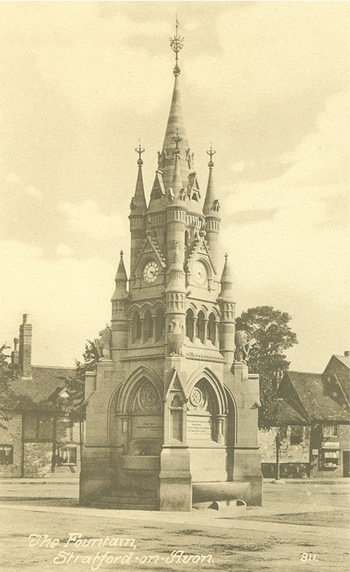
Interestingly enough, it was during Stanley's American tour that the idea of an American memorial in Stratford was broached. As we know, in Philadelphia the Dean was the guest of George W. Childs, who had already financed the Herbert and Cowper window. During an after-dinner talk, the Dean remarked that “a memorial of similar or other character of Shakspeare set up in Holy Trinity Church at Stratford-upon-Avon by an American would have a certain influence for good throughout England and America” (see Davis 6.). After Stanley's return, he and Childs started to exchange letters concerning the erection of a memorial window in the church of Stratford, although the Dean's death in 1881 brought this project to a halt. A few years later James Macaulay tried to involve Childs in a new plan to restore the parish church of Stratford, but this venture likewise came to nothing. It was Macaulay who suggested that Childs might pay homage to the Bard by erecting a drinking fountain in the Market Square at Stratford. This act could be made to coincide with Queen Victoria's Golden Jubilee in 1887, marking half a century of reign. The memorial fountain to Shakespeare (Figure 12) was dedicated on 17 October 1887 in the presence of Mr. Henry Irving.
The American Memorial Fountain in Stratford-on-Avon. Historical postcard. Author's own collection.

An American Window was finally unveiled in the Trinity Church of Stratford by the American Ambassador in 1896.Footnote 35 The event was celebrated in a New York Times article entitled “Columbus and Shakespeare” (18 May 1896) which opens with a very pragmatic discussion of the economic dimension of the transatlantic pilgrimage to Stratford:
Some 10,000 pilgrims did Columbus send last year to the town. Every pilgrim paid his or her sixpence to visit the Birthplace; every pilgrim trod the well-worn path across the fields to Anne Hathaway's cottage; every pilgrim went to church and got his or her money's worth of catch in the breath while looking at the tomb and the monument. Every pilgrim had to have something to eat and drink during the pilgrimage, and to buy some little article as a memento of the pilgrimage.
And at the end of the year it meant money.
The article moves on to analyse the cultural and political significance of the American Window, closing with a humorous hint at the controversy concerning the true identity of Shakespeare:
“War between England and America!” it says in effect. “It cannot and shall not be. It has been pointed out that we are each other's kith and kin beyond the sea, and, as far as it goes, it is quite true. It is also an obvious consideration that we speak the same dear old mother tongue that is manifestly destined to pervade the world, and speech, like blood, is thicker than water. But beyond and above these consideration, permit us to mention an insurmountable fact – William Shakespeare was born in Stratford-on-Avon.”
Americans in the Abbey
The Abbey authorities were undoubtedly aware of the reverent attraction Americans felt for the(ir) European past and they insightfully capitalised on it under the guidance of both Dean Stanley and his successor, Dean George Granville Bradley (1881–1902). Political and “market” forces all pointed in the same direction and contributed to an important cultural event, the canonisation in the Abbey of the American poet Henry Wadsworth Longfellow.
On 2 November 1882 an article in the New York Times announced that a bust of Longfellow was to be placed in Poets’ Corner. As Canon Rowsell commented, this act of homage would “cement the good feeling between England and the United States” (“In Memory of Longfellow”). The Times, however, rejected the candidature of Longfellow to the Abbey on the grounds that this “English institution . . . should remain a place for national memorial and not assume a cosmopolitan character” (“In Memory of Longfellow”).
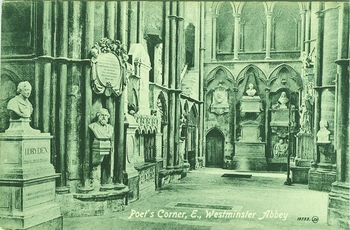
The bust of Longfellow – by Thomas Brock – was placed in the Abbey in March 1884. Reporting the event, the New York Times emphasised the role Lowell – who was then ambassador of the United States in London, and who was well-known as a poet – played in the ceremony. It also emphasised the prominent location (Figure 13) Longfellow had been reserved in the pantheon of literary worthies: “the very corner of the corner, so to speak – looking both into transept and nave. It will be in proximity to Chaucer and Dryden, having Cowley's monument beneath” (“Longfellow in Poets Corner”). Leslie Butler regards this event as “the climax of a broader campaign on behalf of Anglo-American literary harmony” (148), and indicates Lowell and the Liberal leader William Gladstone as the promoters of this diplomatic effort. In September 1884, the American poet Edgar Fawcett celebrated the monument in a poem where the Old and the New World blend in an inner imaginative space thanks to the emotional energy of memories:
The Longfellow memorial in Poets’ Corner. Historical postcard, published by British Manufacture – Valentine's Series, Author's own collection.

The Longfellow memorial was an important symbolic gesture,Footnote 36 but it definitely celebrated the “English” side of the American literary inspiration rather than those writers who most typically embodied the quest for an American “national literature.” As Edward Dowden wrote in the Westminster Review in 1871, “Longfellow is one of ourselves – an European. Evangeline is an European idyl of American life . . . Hiawatha might have been dreamed in Kensington by a London man of letters.” Dowden characteristically regarded Longfellow as the most recent exponent of a tradition that was rooted in English literature and had suffered no rift: “Longfellow's fellow-countryman, Irving, might have walked arm-in-arm with Addison, and Addison would have run no risk of being discomposed by a trans-Atlantic twang in his companion's accent.”
Back in the Abbey, a few years later, the transatlantic cultural connection was strengthened by a new act of memorial. In 1883 the newspapers announced that thanks to the post-mortem munificence of Dr. Alexander Mercer, a divine of the Episcopal Church of America, a bust of Samuel Taylor Coleridge (d. 1834)Footnote 37 by Hamo Thornycroft would be placed “near the statue of Wordsworth, in the Baptistry” (“Coleridge in the Abbey”). The location, however, was changed and the bust was finally placed in Poets’ Corner. It was Mr Lowell, the United States Minister, who unveiled the bust on 7 May 1885. Many important people were present, including Robert Browning, Canon Farrar, “members of the House of Commons, noblemen, Bishops, Deacons, and a large number of Americans” (“Coleridge's Bust Unveiled”). Dean Bradley made a speech, remarking that the ceremony “would add another link to the many that already bound together England and America” (“Coleridge's Bust Unveiled”). Mr. Lowell likewise expanded on the symbolic value of the event and claimed that “All the waters of the Atlantic cannot wash out the consciousness of either nation that we hold our intellectual property in common. The literary traditions and fame of those who shed lustre upon our race remain an undivided inheritance” (“Coleridge's Bust Unveiled”).Footnote 38
Lowell himself died in Cambridge (Mass.) in August 1891. On 28 November 1893 a memorial to the poet and diplomat was unveiled in the vestibule of the Chapter House. It consisted of a window depicting scenes such as the landing of the Pilgrim Fathers and the emancipation of slaves, and also of a bust beneath it, with the inscription “Placed here by his English friends.” Arthur Conan-Doyle and Lawrence Alma-Tadema were among those who subscribed to the fund. Henry James was present at the ceremony, together with the American ambassador Thomas F. Bayard, the Archbishop of Canterbury, Walter Besant and other eminent personages. Leslie Stephen who was the chairman of the Memorial Committee, gave a speech. After extolling Lowell's works and personal qualities, Stephen explained that the Committee had declined the many offers of funds it had received from the United States because “they wished to show that Englishmen themselves knew how to honor a great American” (“England's Love for Lowell”). The American ambassador correspondingly emphasised the deep significance of this gesture and the political value of the cultural bond that united the two countries:
Every day proves how the ties of common origin and ancestry are stronger than written treaties. The inborn sympathies of race finally silence international discord and jealousy. . . . In all American homes a sense of grateful pride will be felt when they learn the name and fame their countryman, the poet, scholar, statesman, and patriot has received at the hands of Britons in this venerable temple of national religion, honor, and renown. (“England's Love for Lowell”).
Lowell's words acquire a special meaning if we remember that at the turn of the century American politics were particularly open to the influences of “foreign models and imported ideas” (4), as Daniel T. Rodgers writes.Footnote 39
Canon Farrar's Revolutionary Views
After the death of Stanley, the memorial exchanges between the two shores of the Atlantic were revived by Frederick William Farrar, who became Canon of Westminster Abbey in 1876. A children's novelist as well as a theologian, Farrar harboured both a progressive view of education and a deep-seated interest in science. When Charles Darwin died, it was Farrar who fought to ensure that the scientist was buried in the Abbey close to Isaac Newton, despite the opposition of other ecclesiastics, and it was he who read the funeral sermon.
Farrar's trip to the United States (August–December 1883) was apparently successful, but his personality was not as unanimously appreciated as that of Stanley, given the ambiguous tone of the article J. W. Chadwick published after his death. Farrar's progressive approach to culture and politics, however, is proved by “The Share of America in Westminster Abbey” (January 1888). After claiming that “in signing away his own empire George III did not sign away the empire of English liberty, of English law, of English literature, of English blood, of English religion, or of the English tongue” (298), i.e., the cultural heritage the American colonies shared with their homeland, Farrar offered an overview of American memorials in the Abbey, touching on politicians, soldiers and poets alike.
More interestingly, Farrar traced a Whig history of England focussing on the Puritan Commonwealth and its aftermath. In Farrar's eyes, the desecration of the bodies of Cromwell and other Puritan exponents symbolised the failure of the British revolution. It took England a century to work through the national trauma of the civil war, and only in 1737 was a monument to Milton erected in the Abbey. It was in the American colonies, however, that “the principles of that Revolution, never wholly forgotten by Englishmen, were completely triumphant” (309). Quoting Gladstone, Farrar claimed that the colonists carried to America “all that was democratic in the policy of England, and all that was Protestant in her religion” (309). Escaping “the yoke of absolutism,” the ex American colonies were free to translate “Milton's vision” (309) into a political system.
This simultaneous celebration of England's revolutionary past and of American democracy on the part of a Canon of Westminster – who had also been a chaplain to Queen Victoria – is proof of the variety of political stances the Church of England embraced. It also shows that even within the precincts of Westminster Abbey memorial acts do not convey a monolithic view of the past, but rather polarise competing pasts. As Matthew Craske phrases it, the Abbey provides “an archaeology of State, a lapidary register of shifting concepts of patriotism, national identity and constitutional balance” (57).
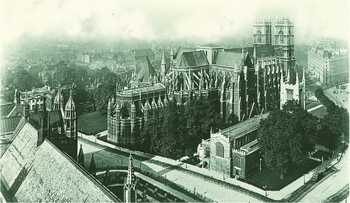
The ending of Farrar's article sounds like an appeal to the American public, as if a transatlantic influence were necessary to redirect the course of British history, helping the nation to achieve what had been tragically left incomplete. After lamenting the paucity of memorials commemorating Milton, Farrar – who was the Rector of St. Margaret's Church – informed his readers that he was “extremely desirous” (309) to erect a window to the poet in St. Margaret's, where Milton had married his second wife Katherine Woodcock, and where both she and her infant daughter were buried. Thanks to the financial help of American admirers, a window in honour of Sir Walter Raleigh, whose headless body was buried under the altar, had already been erected in St. Margaret's, and Farrar hoped that Milton would likewise be honoured by an American benefactor. The political nature of the article becomes apparent if we meditate on the fact that St. Margaret's Church has always been the church of the House of Commons (Figure 14).
Westminster Abbey and St. Margaret's Church seen from the roof of the Houses of Parliament. Historical postcard. Published by J. Beagles & Co. Author's own collection.

The final paragraph of Farrar's article actually reproduced the text of a letter that Farrar had sent to George W. Childs in November 1886. Childs, who at the time had already financed both the Herbert-Cowper window and the Stratford fountain, generously agreed to contribute the memorial. In the space of this private correspondence the political import of the whole matter comes to the fore with no veils:
The fact is that no man of [Milton's] pure and noble genius is so wholly uncommemorated in England. There is a poor bust to him in the Abbey, that is all. For one hundred and fifty years after his death the Stuart reaction against Puritanism and the adoration of “King Charles the Martyr” caused Milton's name to be execrated. But America is the glorious child of Puritanism; and it is to me a most touching and significant fact that a Memorial to Milton in the Church of the House of Commons for which he so greatly labored should now be given by a descendant of the Pilgrim Fathers after I had tried in vain to get it from Englishmen. (“Letter from Archdeacon Farrar to Mr. Childs, London, February 4, 1887.” Davis 188–89).
The memorial window was unveiled on 18 February 1888, just one month after Farrar's article “The Share of America in Westminster Abbey” appeared in the United States. A “selected number of friends” (“Letter from Archdeacon Farrar to Mr. Childs, London, February 18, 1888.” Davis 193) were invited, including Robert Browning and Matthew Arnold, who read a paper on Milton. Far from being solely celebratory, Arnold's address gave vent to his recurrent criticism of American culture, due to its tendency “to take, or at any rate attempt to take, profess to take, the average man and his performances too seriously” (“Matthew Arnold's Address.” Davis 198). While on a political level both Farrar and Arnold seemed to regard Milton as a sort of “ideological father” of the United States, on a poetical level Arnold considered Milton's unfailing style as an admonition to a country where the standards of excellence were too easily lowered.
To understand this stance we should remember that Arnold had travelled in the United States between 1883 and 1884, and that he had devoted several publications to America, both before and after his lecture tour.Footnote 40 Moreover, as a consequence of this journey, Arnold's daughter Lucy had married a New York lawyer, Frederick Whitridge. This marriage was conducive to a second visit to the States, between May and August 1886, although this journey had a more private character, for Arnold and his wife spent most of their time with their pregnant daughter. Due to his criticism of American society and culture, Arnold's visits to the States triggered in fact controversial reactionFootnote 41 and Arnold was afraid that his views might offend not only Americans in general, but more specifically the Whitridges. According to Clinton Machann, this possibly contributed to the worsening of his heart condition, which ultimately caused his death.Footnote 42
As proof of Arnold's ongoing critical engagement with the society and culture of the United States, we should remember that still in January 1888 he addressed various audiences with a lecture on American life, which was published in April that year as “Civilisation in the United States.” In this paper Arnold discussed “the character and worth of American civilisation” (486), claiming that a civilisation should be first and foremost interesting, a quality whose sources are distinction and beauty – two elements that the socio-cultural landscape of the United States was lacking. Arnold's arguments partly remind us of the lectures Oscar Wilde gave during his American tour of 1882 in an attempt to awaken the citizens of the United States to the gospel of aestheticism. Arnold's criticism of the American way of life focussed notably on “The glorification of ‘the average man,’ who is quite a religion with statesmen and publicists there” (489). This mistakenly egalitarian attitude engendered what Arnold regarded as a want of elevation and beauty, a “bondage to the common and ignoble” (491).
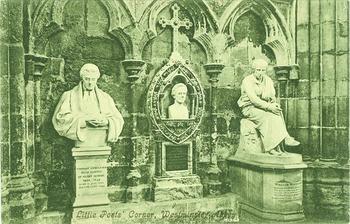
Arnold's tribute to Milton was fated to be his last work,Footnote 43 for he died on 15 April 1888 in Liverpool, while he was awaiting the arrival of his daughter from America. After his death,Footnote 44 a bust by Alfred Bruce Joy was placed in the Baptistry, close to those of Maurice and Kingsley, and unveiled on 31 October 1891. Probably due to the presence of this memorial to Matthew Arnold, his father – Dr. Thomas ArnoldFootnote 45 – was also commemorated in the Baptistry with a bust by Alfred Gilbert (Figure 15), which was erected thanks to a subscription by Arnold's former pupils and unveiled on 15 July 1896.Footnote 46
Little Poets’ Corner, with the Wordsworth, Keble and Arnold memorials. Historical postcard. Author's own collection.

The End of Little Poets’ Corner
Dean Stanley had cherished Little Poets’ Corner and under his guidance the Wordsworth monument had attracted a variety of other memorials.Footnote 47 At the beginning of the twentieth century the identity Little Poets’ Corner had acquired within the complex memorial topography of the building had apparently “strengthened,” as is shown by G. E. Troutbeck's Westminster Abbey (1900), where it is treated in detail. Even the “beautiful monument” to Henry Fawcett – the blind statesman and economist who had been memorialised in the Baptistry in 1887 – was commended by Troutbeck (232). Helen Marshall Pratt's 1914 guide to the Abbey likewise gives large space to Little Poets’ Corner, which the author regarded however as “a misnomer” (660), for not a single poet was actually buried there.Footnote 48
Dean Stanley's pantheon of “divine poets” was fated to dissolve. World War One deeply changed the political scenario and the need to commemorate the heroic dead prevailed over cosmopolitan concerns. Already on 11 November 1920 was the Unknown Warrior buried in the Abbey, but wider memorial strategies were implemented in the interwar years to address the collective trauma of loss, and also to prepare for future mobilization. In St. Paul's Cathedral the Kitchener Memorial Chapel was consecrated in December 1925 to commemorate Earl Kitchener of Khartoum, a war hero who had died in 1916 and whose body had never been found (Goebel 497–98).
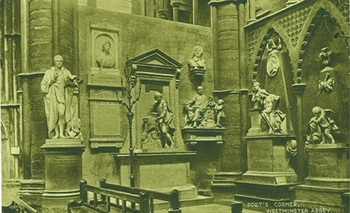
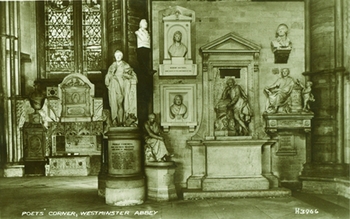
Little Poets’ Corner was sacrificed to this new need for memorial space. St. George's Chapel was therefore remodelled. On 24 June 1932 the “Warriors’ Chapel” was dedicated by Edward, Prince of Wales, to the memory of those who had died fighting. The chapel still houses the busts of Maurice and Kingsley, while the other monuments were relocated. The statue of Wordsworth was moved to Poets’ Corner (Figures 16 and 17), the bust of Keble was deprived of its frame and mounted on a new bracket in Poets’ Corner, Thomas Arnold migrated to the space under the north-west belfry tower and the bust of Matthew Arnold was removed to its present position in Poets’ Corner in 1967.
Poets’ Corner before the statue of Wordsworth was moved. Historical postcard. Published by Valentine's “Photogravure” Series. Author's own collection.

Poets’ Corner after the statue of Wordsworth was moved. Historial postcard. Published by Valentine & Sons. Author's own collection.

Dean Stanley's project of memorial reconciliation between Great Britain and the United States under the aegis of Christian culture had not proved capable of resisting the test of time and Poets’ Corner reasserted its canonical strength at the expense of its replica in small scale.
Although Little Poets’ Corner survives only as a chapter in the history of the Abbey, its development testifies to the negotiations that shifted the symbolic value of this building from the nation to the empire, and also to the cultural and political efforts that were made at the time to foster the reunion between the United States and their mother country. In so doing, the Abbey authorities took part in the creation of what Paul Giles has defined as a “transatlantic imaginary.” Instead of pitting one national mythology against another, they strove to create a transnational mythology by underlining the common linguistic, cultural and historical roots of Great Britain and the United States. This emphasis on transatlantic cohesion was arguably the less traumatic and more viable response to the anxiety induced by the early stages of globalisation.
Globalisation is by now a fact, and both European and American societies have acquired a distinctly transcultural character. In the light of these developments, there is one aspect of Stanley's project we should retain, that is to say his attempt to enable the coexistence of religious and cultural differences in the name of a common heritage, although the basis of this commonality should be regarded as planetary rather than restricted – as many envisaged at the time – to the “English-speaking race.”