

The question of why some people are more engaged in politics than others has captured the attention of political scientists for decades. Previous answers have focused on demographics, socialization, resources, and mobilization. Reference Brady, Verba and Schlozman1,Reference Gerber, Green and Larimer2,Reference Plutzer3,Reference Jennings and Niemi4 In recent years, scholars have started to take seriously the possibility that deep-seated individual differences play a role in shaping political engagement. Indeed, a relatively new body of literature has examined the biological underpinnings of political participation and attitudes. Reference Fowler, Baker and Dawes5,Reference Fowler and Dawes6,Reference Hatemi, Funk, Medland, Maes, Silberg, Martin and Eaves7,Reference Arceneaux, Johnson and Maes8,Reference Klemmensen, Hatemi, Hobolt, Skytthe and Nørgaard9,Reference Klemmensen, Hatemi, Hobolt, Petersen, Skytthe and Nørgaard10,Reference Fowler and Dawes11,Reference Loewen and Dawes12 A related body of research has explored the relationship between psychological attributes and measures of political engagement. Reference Mondak13,Reference Gerber, Huber, Doherty, Dowling, Raso and Ha14,Reference Mondak, Hibbing, Canache, Seligson and Anderson15,Reference Wang16,Reference Ha, Kim and Jo17,Reference Dawkins18,Reference Schoen and Steinbrecher19 Motivated by these studies and by research showing that many psychological traits are heritable, Reference McCrae and Costa20,Reference Loehlin, McCrae, Costa and John21,Reference Jang, McCrae, Angleitner, Riemann and Livesley22 some scholars have sought to understand the link between genes, psychological traits, and measures of political engagement, such as participation in political activities and political interest. To date, there have only been a few studies in this area, since this type of research requires data sets that contain large samples of identical and fraternal twins, measures of psychological traits, and measures of political engagement. Reference Dawes, Cesarini, Fowler, Johannesson, Magnusson and Oskarsson23,Reference Dawes, Settle, Loewen, McGue and Iacono24,Reference Weinschenk and Dawes25 Such data sets remain relatively rare, and political scientists have often had to rely on data sets that were not originally collected to study political topics but may have included a few politically oriented survey questions. Preliminary work on the connection between genetic factors, psychological measures, and political traits has been promising.
In this article, we examine the link between genes, psychological traits, and political engagement. The primary question we are interested in is whether there is genetic overlap between psychological and political traits. To answer this question, though, we must first examine the heritability of psychological traits and measures of political engagement and whether the psychological traits of interest are related to political traits. This study makes a number of contributions to the literature. First, we use a new data set, the TwinLife Study, which contains information on a large sample of German twins, to reexamine some of the results that have been reported in the literature to date. Reference Dawes, Cesarini, Fowler, Johannesson, Magnusson and Oskarsson23,Reference Weinschenk and Dawes25
One distinctive feature of the TwinLife Study is the age range of twins in the sample; existing studies on the link between genes, psychological traits, and political engagement have relied heavily on older samples, but the data set that we use is composed of a much younger sample (all twins are between 18 and 25 years old and the average age is 23). For example, Dawes et al. Reference Dawes, Cesarini, Fowler, Johannesson, Magnusson and Oskarsson23 study 2,346 Swedish twin pairs born between 1943 and 1958, with the average respondent being 60 years old at the time the survey was conducted. Weinschenk and Dawes Reference Weinschenk and Dawes25 also use two studies, the Mid-life Development in the United States Study and the Minnesota Twins Political Survey, which are composed of older samples. The young age of our sample of twins relative to previous twin samples provides us with an opportunity to examine whether genetic and psychological factors influence political engagement early on in the life cycle. Interestingly, research on the genetic and environmental transmission of ideology over the life cycle has illustrated that there is no evidence of genetic influence in childhood or late adolescence and that genetic influences on political attitudes are exhibited starting around age 21 and persist through adulthood. Reference Hatemi, Funk, Medland, Maes, Silberg, Martin and Eaves7
The use of older samples in previous studies on the genetic and psychological underpinnings of engagement allows us to look at one part of the life cycle (adulthood), but it is important to examine other parts of the life cycle, such as young adulthood, to get a more complete picture of the foundations of political engagement. When considered alongside previous studies on the biological and psychological underpinnings of engagement, Reference Dawes, Cesarini, Fowler, Johannesson, Magnusson and Oskarsson23,Reference Weinschenk and Dawes25 our sample of twins provides a unique chance to determine whether the finding from the literature on ideology — that genetic influences exist starting roughly in early adulthood — holds in the context of political engagement. Up until this point, researchers have been unable to assess the influence of biological and psychological factors on political engagement at various stagesof human development.
In addition, we note that existing studies of the link between genes, psychological traits, and political engagement have used U.S. and Swedish samples. Thus, our use of a German sample allows us to examine questions about genes, psychological traits, and engagement in a new context. When possible, research findings should be examined using multiple data sets, across different contexts, and in different time periods. Although Germany, Sweden, and the United States are all developed countries, we still believe it is useful to employ German data. Indeed, several recent studies have found evidence that genetic effects vary by context. Reference Klemmensen, Hatemi, Hobolt, Petersen, Skytthe and Nørgaard10,Reference Dinesen, Dawes, Johannesson, Klemmensen, Magnusson, Norgaard, Oskarsson and Pedersen26,Reference Fazekas and Littvay27
Finally, although we are able to reexamine some previous findings since we have similar measures in our data set, we are also able to extend previous studies. For example, while Dawes et al. Reference Dawes, Cesarini, Fowler, Johannesson, Magnusson and Oskarsson23 were able to examine the link between genes, three psychological traits (extraversion, cognitive ability, and self-control), and political engagement, they only had a measure of one trait from the Big Five model (extraversion). Our data set allows us to examine the relationship between the entire Big Five model (openness, conscientiousness, extraversion, agreeableness, and neuroticism), genetic factors, and political participation. Similarly, while Weinschenk and Dawes Reference Weinschenk and Dawes25 examined the link between genes, the Big Five traits, and a measure of political interest, they did not have any measures of psychological traits beyond those included in the Big Five model (nor did they have any behavioral measures of engagement). Our data set contains measures of important psychological traits that are not included in the Big Five framework, such as cognitive ability and self-efficacy. Thus, our study contains multiple measures of political engagement (e.g., psychological measures such as interest in politics and measures of participation in political acts) and a unique battery of psychological measures, enabling us to provide additional tests of the theoretical expectation advanced by numerous scholars, Reference Mondak13,Reference Mondak, Hibbing, Canache, Seligson and Anderson15,Reference Dawes, Cesarini, Fowler, Johannesson, Magnusson and Oskarsson23,Reference Oskarsson, Cesarini, Dawes, Fowler, Johannesson, Magnusson and Teorell28 that psychological traits mediate the relationship between genes and political traits.
The rest of this article proceeds in a straightforward manner. In the next section, we provide an overview of the literature on the psychological and biological underpinnings of political engagement. We also discuss the possible connection between genes, psychological traits, and political engagement. After describing our data and measures, we present the results of our empirical models. We conclude with a discussion of the implications of our results and ideas for future research.
Previous research and theoretical expectations
As we noted earlier, in recent years, political scientists have become more interested in the influence of individual differences (e.g., biological, psychological, etc.) that are present early in life on political engagement. A number of studies in political science and behavioral genetics, for example, have estimated the extent to which different measures of political engagement are heritable. Studies by Fowler, Baker, and Dawes, Reference Fowler, Baker and Dawes5 Klemmensen et al., Reference Klemmensen, Hatemi, Hobolt, Petersen, Skytthe and Nørgaard10 and Dawes and colleagues Reference Dawes, Cesarini, Fowler, Johannesson, Magnusson and Oskarsson23,Reference Dawes, Settle, Loewen, McGue and Iacono24 all find that various measures of political participation are heritable. We should note that Smith and Hatemi, Reference Smith and Hatemi66 using a regression-based approach (rather than the classic twin design), find evidence of a more limited role for genetic factors in shaping participation (though they note that genetic influences on participation might be working through some of their covariates, such as education and family discussion, which are likely not purely environmental). Psychological measures of engagement, such as having an interest in politics, also appear to have a high degree of heritability. Reference Arceneaux, Johnson and Maes8,Reference Klemmensen, Hatemi, Hobolt, Petersen, Skytthe and Nørgaard10,Reference Weinschenk and Dawes25,Reference Dawes, Cesarini, Fowler, Johannesson, Magnusson and Oskarsson23,Reference Bell, Schermer and Vernon29 Although these findings are interesting, they raise important follow-up questions. For example, how are genetic factors connected to political engagement? Recent research on psychological traits provides ideas about how genes might be linked to political engagement.
Related to the studies mentioned here are a series of studies that have explored the connection between individual psychological traits and measures of engagement in politics. Numerous scholars have examined the relationship between the Big Five personality traits and participation in political activities. Reference Mondak13,Reference Gerber, Huber, Doherty, Dowling, Raso and Ha14,Reference Mondak, Hibbing, Canache, Seligson and Anderson15 Such studies have indicated that the Big Five traits do have important effects on measures of political participation. For example, Gerber et al. Reference Gerber, Huber, Doherty, Dowling, Raso and Ha14 find that extraversion, openness, conscientiousness, and emotional stability are statistically significant predictors of an index measuring participation in political campaigns. It is also worth noting that the Big Five are related to psychological measures of engagement. For example, Weinschenk and Dawes, Reference Weinschenk and Dawes25 Weinschenk, Reference Weinschenk30 and Gerber et al. Reference Gerber, Huber, Doherty and Dowling31 find that several of the Big Five traits are statistically significant predictors of measures of political interest. Psychological measures that are not included in the Big Five model also appear to be related to political engagement. Several studies have found evidence that cognitive ability is positively correlated with different measures of political engagement. Reference Dawes, Cesarini, Fowler, Johannesson, Magnusson and Oskarsson23,Reference Dawes, Settle, Loewen, McGue and Iacono24,Reference Nie, Junn and Stehlik-Barry32,Reference Verba, Schlozman and Brady33,Reference Hillygus34,Reference Deary, Batty and Gale35,Reference Hauser36
It is important to point out that many psychological traits are heritable. Indeed, a vast body of research in psychology has examined the etiology of psychological traits, and numerous studies have demonstrated that the Big Five traits, and many psychological traits that are not included in the Big Five model such as cognitive ability, are heritable. Reference Dawes, Cesarini, Fowler, Johannesson, Magnusson and Oskarsson23,Reference Oskarsson, Cesarini, Dawes, Fowler, Johannesson, Magnusson and Teorell28,Reference Riemann, Angleitner and Strelau37,Reference McCrae and Costa38,Reference Stelmack39,Reference Bouchard40,Reference Bouchard41,Reference Jang, Livesley and Vernon42,Reference Oskarsson, Dawes, Johannesson and Magnusson43,Reference Haworth, Wright, Martin, Martin, Boomsma, Bartels and Posthuma44 Given that previous research has indicated that political engagement is heritable, that psychological traits are related to measures of political engagement, and that many psychological traits are heritable, it seems reasonable to examine whether there is genetic overlap between psychological and political traits. Mondak et al. Reference Mondak13 have noted that since personality is heritable, the effect of personality on political behavior likely indicates that personality traits are mediators for biological factors.
We are only aware of a few studies in political science that have been able to examine the link between genes, psychological measures, and political engagement. This is largely due to data limitations since few studies contain twin samples, batteries that measures psychological traits, and measures of political activities or orientations. Dawes et al. Reference Dawes, Cesarini, Fowler, Johannesson, Magnusson and Oskarsson23 sought to understand the extent to which extraversion, personal control, and cognitive ability have genetic overlap with measures of political engagement. Using a bivariate Cholesky decomposition model, they found that genetic factors account for between 67% and 89% of the correlation between extraversion and four measures of participation (voting, contacting a politician, contacting a public sector official, and a participation index). In addition, genetic factors account for between 87% and 98% of the correlation between personal control and three measures of participation (contacting a politician, contacting a public sector official, and a participation index). Dawes et al. Reference Dawes, Cesarini, Fowler, Johannesson, Magnusson and Oskarsson23 also reported that genetic factors account for between 50% and 100% of the total correlation between psychological traits and political orientations, such as political interest. Reference Dawes, Cesarini, Fowler, Johannesson, Magnusson and Oskarsson23 In a follow-up study, Weinschenk and Dawes Reference Weinschenk and Dawes25 examined the link between genes, the Big Five traits, and political interest. They found that a number of the Big Five traits were correlated with political interest and that genetic factors account for between 49% and 72% of the correlation between political interest and four personality traits: openness, conscientiousness, emotional stability, and extraversion. Finally, we note that Dawes et al. Reference Dawes, Settle, Loewen, McGue and Iacono24 were also able to examine the link between genes, several psychological traits (cognitive ability, positive emotionality, negative emotionality, and constraint), and measures of civic engagement. They found that most of the correlation between civic engagement and both positive emotionality and verbal IQ could be attributed to genes that affect both traits.
In this article, we are interested in building on the limited body of work examining the connection between genes, psychological traits, and political engagement. As we noted earlier, because of data limitations, existing studies have typically only had access to a few measures of psychological traits. We are interested in examining a broader array of psychological traits within the confines of one study. More specifically, we are interested in the relationship between seven psychological traits — openness, conscientiousness, extraversion, agreeableness, neuroticism, cognitive ability, and self-efficacy — and measures of political engagement.
Previous research serves as a useful guide for hypotheses about how each of these traits is related to political engagement. We begin with hypotheses about how the Big Five traits connect to political engagement and then consider cognitive ability and self-efficacy. As an overview, “The Big-Five framework suggests that most individual differences in human personality can be classified into five broad, empirically derived domains.” Reference Gosling, Rentfrow and Swann45 The Big Five are among the most widely researched personality traits within the field of psychology, and, as John and Srivastava note, “After decades of research, the field is approaching consensus on a general taxonomy of personality traits, the ‘Big Five’ personality dimensions.” Reference John, Srivastava, Pervin and John46
We expect that extraversion will be positively related to measures of political engagement given that extraverts are likely to experience social benefits or returns by participating in or being attentive to politics. Reference Mondak13,Reference Gerber, Huber, Doherty, Dowling, Raso and Ha14,Reference Gerber, Huber, Doherty and Dowling31 As Gerber et al. Reference Gerber, Huber, Doherty and Dowling31 note, political participation and information have a “social usefulness” for extraverted people. Put simply, extraverts are likely to enjoy expressing their ideas and gathering information that can help them develop their arguments and views. Openness should also be positively related to political engagement. Those with high scores on this trait should enjoy the exchange of ideas that happens in politics. Reference Mondak13,Reference Gerber, Huber, Doherty, Dowling, Raso and Ha14,Reference Ha, Kim and Jo17 Neuroticism should be negatively connected to political engagement. Those who have higher scores on neuroticism tend to experience high levels of anxiety and may avoid politics because they find exposure to conflict to be something that induces anxiety or is upsetting. Reference Gerber, Huber, Doherty, Dowling, Raso and Ha14,Reference Settle, Dawes, Loewen and Panagopoulos47,Reference Gerber, Huber, Doherty, Dowling and Panagopoulos48 Conscientiousness should be positively associated political engagement. Those with high scores on this trait tend to be dutiful and like to adhere to social norms. To the extent that being engaged in politics is viewed as a norm or obligation, conscientious individuals should report higher levels of engagement than their counterparts. Reference Gerber, Huber, Doherty, Dowling, Raso and Ha14 Finally, we expect agreeableness to be negatively associated with political engagement. Agreeable people tend to dislike conflict and prefer cooperation, and since conflict is inherent in political life, politics may not appeal to those with high scores on agreeableness. Reference Gerber, Huber, Doherty, Dowling, Raso and Ha14
We are also interested in two traits that are not included in the Big Five model, cognitive ability and self-efficacy. Previous research suggests that both traits will be positively related to political engagement. Based on the resource model of Verba, Schlozman, and Brady, Reference Verba, Schlozman and Brady33 those who are better able to bear the costs associated with participating in politics are more likely to engage. Those with higher cognitive ability tend to more easily acquire and process relevant political information, thus making participation less costly. Self-efficacy, which typically refers to one’s expectations about their ability to successfully influence outcomes, should also be positively related to political engagement. Reference Dawes, Cesarini, Fowler, Johannesson, Magnusson and Oskarsson23,Reference Vecchione and Caprara49,Reference Blais and St.-Vincent50 The basic idea is that people with high levels of self-efficacy should be more likely to participate in the political process than their counterparts because politics is a place where their actions can be rewarded with a desired political outcome. Reference Dawes, Cesarini, Fowler, Johannesson, Magnusson and Oskarsson23
We are not simply interested in whether these seven psychological traits are correlated with measures of political engagement. We want to examine whether the relationship between psychological traits and political engagement is driven primarily by environmental or genetic factors. To do this, we first need to confirm that these psychological and political measures are heritable, which is what previous research suggests, and establish that the psychological traits we study are correlated with political engagement. The initial evidence presented by Dawes and colleagues Reference Dawes, Cesarini, Fowler, Johannesson, Magnusson and Oskarsson23,Reference Dawes, Settle, Loewen, McGue and Iacono24 and Weinschenk and Dawes Reference Weinschenk and Dawes25 suggests that much of the relationship between psychological traits and political engagement can be explained by the same set of genes. Thus, our expectation based on the literature is that there will be genetic overlap between psychological and political traits.
Data and measures
Our data come from the TwinLife Study, which is a genetically informative, longitudinal study of same-sex German twin pairs reared together. Twin families are drawn from local resident registers in communities with at least 5,000 inhabitants in Germany. The twin families are recognized as such if two same-sex people with the same date of birth lived in the same household. Then, it was checked whether the selected persons were twins. Zygosity was determined by questionnaire information and corrected by result of the DNA test. Only twins of the same sex are surveyed in order to prevent distortions due to gender differences. Moreover, only such pairs that have grown up or are growing up in the same family are studied. Data collection for the study began in 2014 and will continue for nine years. The study employs a cross-sequential design wherein people of different age groups are examined multiple times. The cross-sequential design is a combination of a longitudinal and a cross-sectional design. While in longitudinal studies the same persons are examined at different points in time, in a cross-sectional design persons belonging to different age-groups are examined at one point in time. When both designs are combined to form a cross-sequential design, people of different age groups are examined multiple times. The TwinLife Study is based on four cohorts of identical and fraternal twins (twins born in 1990–1993, twins born in 1997–1998, twins born in 2003–2004, and twins born in 2009–2010). Since September 2017, data collected from the first face-to-face survey of the whole sample (4,097 twin pairs and their families) has been made available to researchers. We use TwinLife R2.0, Scientific use file (September 25, 2017).
Importantly, the first survey included in the TwinLife Study contains items measuring political activities, political interest, personality traits, and cognitive ability. Full question wordings are provided in the online appendix. We have measures of the following political activities: turnout in the most recent parliamentary election if eligible (
 $1=\text{yes}$
,
 $0=\text{no}$
); participation in a political meeting, discussion event, or demonstration in the past 12 months (
 $1=\text{yes}$
,
 $0=\text{no}$
); participation in an online petition or signature collection in past 12 months (
 $1=\text{yes}$
,
 $0=\text{no}$
); and participation in a boycott of a company or a product for political or ethical reasons or on environmental grounds in past 12 months (
 $1=\text{yes}$
,
 $0=\text{no}$
). Just to clarify, for the turnout measure, respondents are only included if they were eligible to vote (in other words, scores of 0 represent only those who were eligible to vote but opted not to do so; those who were not eligible to vote were not coded as 0). Based on these items, we created an index of political participation. We opt not to analyze each political act individually and instead focus on the participation index. This is based on the fact that the models we use in the sections that follow are typically quite unstable when there is not an extremely large sample size (and when dependent variables are dichotomous). On the issue of reliability, we note that Dawes et al. (2014) report a similar reliability score (
 $\unicode[STIX]{x1D6FC}=0.59$
) to ours (
 $\unicode[STIX]{x1D6FC}=0.54$
), as do Fowler, Baker and Dawes (2008) (
 $\unicode[STIX]{x1D6FC}=0.61$
). Beyond the participation index, we also have a measure of a respondent’s interest in politics (1
 $=$
completely disinterested, 2
 $=$
somewhat disinterested, 3
 $=$
somewhat interested, 4
 $=$
extremely interested). We use the participation index and political interest as our dependent variables. As expected, the two measures are positively correlated (
 $r=0.49$
,
 $p<0.05$
). Given the young age of some of the twins in the study, it is important to note that some questions were not asked of every cohort (e.g., it does not make sense to ask a five-year-old if he or she voted in the last election). Overall, in the data we analyze (people who have non-missing responses on all of the measures we examine), we have 386 respondents born in 1990, 446 respondents born in 1991, 430 respondents born in 1992, 476 respondents born in 1993, 22 respondents born in 1997, and 10 respondents born in 1998. In total, there are 1,770 respondents (966 monozygotic twins and 804 dizygotic twins) with nonmissing responses on the political and psychological measures that we analyze in this article.
To measure the Big Five personality traits, respondents in the TwinLife Study were asked to report how well a variety of different sentences describe them (e.g., “I see myself as someone who is outgoing, sociable”). Full question wordings are provided in the online appendix. We should note that the researchers who designed the TwinLife Study selected measures to include in the study based on preexisting batteries (e.g., Big-Five Inventory-SOEP or BFI-S) and studies. We created overall measures of personality for each of the Big Five personality traits by combining relevant items (all of the Big Five measures are based on three to seven survey items). We use the short Big Five Inventory (BFI-S), which is a 15-item battery capturing the Big Five traits, but we also have access to a number of other relevant Big Five items (which are not included in the 15-item BFI-S battery). By using additional personality measures (beyond the typical three items per trait in the BFI-S), we are able to generate more reliable measures of personality. We should note that because we make use of more than the 15 items that are included in the BFI-S, our personality measures are not directly comparable to those derived from just the BFI-S, though they are fairly similar. Importantly, scholars studying genes, personality, and politics rarely have access to exactly the same personality items across different data sources. We believe it is important to use a range of different measurement batteries. Overall, the reliability scores are as follows:
 $\unicode[STIX]{x1D6FC}=0.81$
(extraversion),
 $\unicode[STIX]{x1D6FC}=0.69$
(conscientiousness),
 $\unicode[STIX]{x1D6FC}=0.63$
(openness),
 $\unicode[STIX]{x1D6FC}=0.75$
(neuroticism), and
 $\unicode[STIX]{x1D6FC}=0.53$
(agreeableness).
To measure self-efficacy (a personality trait closely related to the personal control measure used by Dawes et al.
Reference Dawes, Cesarini, Fowler, Johannesson, Magnusson and Oskarsson23
), we use three survey questions designed to capture Bandura’s concept of self-efficacy (“I can rely on my own abilities in difficult situations”; “I am able to solve most problems on my own”; and “I can usually solve even challenging and complex tasks well”;
 $\unicode[STIX]{x1D6FC}=0.77$
). The items are derived from llgemeine Selbstwirksamkeit Kurzskala (ASKU). To measure cognitive ability, respondents took four subtests of the Culture Fair Test, which is a widely used and well-validated cognitive test battery that captures nonverbal (fluid) intelligence as a proxy for general cognitive ability. The four subtests focus on figural reasoning, figural classification, matrices, and reasoning. Correct answers are coded as a 1 and wrong answers are coded as a 0. Sum scores for each subtest are computed as sum of all correctly solved items. The first three subtests contain 15 items and the fourth subtest contains 11 items. We combine the four subtests to form an overall measure of cognitive ability (
 $\unicode[STIX]{x1D6FC}=0.80$
). Summary statistics for all of the psychological and political measures analyzed in this article, broken out by zygosity and gender, are provided in the online appendix.
Analysis and results
Our analysis comprises two steps. First, we estimate univariate twin models to determine how much of the variation in our measures of political engagement and psychological traits can be attributed to genetic and environmental factors. A more detailed description of the univariate model is presented in the online appendix for interested readers. A twin study leverages the fact that monozygotic (MZ) twins share 100% of their genes, while dizygotic (DZ) twins share on average 50% of their genes. By comparing the trait similarity among MZ twin pairs to that of DZ twin pairs, we can obtain an estimate of the degree to which genes influence that trait. More formally, the univariate twin model assumes that the variance in an observed trait can be partitioned into additive genetic factors (A), environmental factors that are shared or common to co-twins (C), and unique environmental factors (E). This is the so-called ACE model. For a primer of biometric modeling geared for political scientists see Medland and Hatemi. Reference Medland and Hatemi64 Common environment includes the family environment in which both twins were raised and any other factor to which both twins were equally exposed. In contrast, the unique environment includes influences that are experienced individually. The roles of genes and environment are not measured directly, but their influence is inferred through their effects on the covariances of twin siblings. Reference Neale and Cardon51 We note that identification of the univariate twin model based on MZ and DZ twins reared together requires the so-called equal environments assumption (EEA). A violation of the EEA leads to an upward bias in heritability and a downward bias in common environment estimates. Reference Suhay, Kalmoe and McDermott52,Reference Beckwith and Morris53,Reference Charney54 Interestingly, several recent studies attempting to test for upward bias in the heritability of political attitudes have failed to find evidence of an EEA violation. Reference Hatemi, Funk, Medland, Maes, Silberg, Martin and Eaves7,Reference Hatemi, Hibbing, Medland, Keller, Alford, Smith, Martin and Eaves55,Reference Smith, Alford, Hatemi, Eaves, Funk and Hibbing56,Reference Littvay57,Reference Conley, Rauscher, Dawes, Magnusson and Siegal58 A more detailed discussion of the EEA is contained in the online appendix.
Second, to estimate how much of the covariation between political engagement and each of the psychological traits, we study can be attributed to the same genetic source, we use a Cholesky decomposition model.
Reference Martin and Eaves59
The Choleksy model assumes that the latent factors underlying psychological traits also influence political engagement but that the latent factors underlying engagement do not affect psychological traits. A more detailed description of the bivariate model is presented in the online appendix. The parameter estimates generated by this bivariate model can be used to construct quantities of interest. The genetic correlation quantifies the degree to which the genetic endowment of two traits covary. A correlation of 0 means that the two traits are influenced by completely different genes, and a correlation of 1 (or
 $-1$
) means the same genes influence both traits. Another meaningful quantity is the percentage of the phenotypic correlation between two traits that can be explained by additive genetic factors. We denote the genetic correlation as
 $r_{g}$
, the common environment correlation as
 $r_{c}$
, and the unique environment correlation as
 $r_{e}$
and the percentage of correlation accounted for by genetic factors as
 $\%r_{g}$
, accounted for by common environment
 $\%r_{c}$
, and by unique environment as
 $\%r_{e}$
. By construction
 $\%r_{g}$
,
 $\%r_{c}$
,
 $\%r_{e}$
must sum to one but
 $r_{g}$
,
 $r_{c}$
,
 $r_{e}$
do not (necessarily) sum to one. Formal derivations of each quantity are presented in the online appendix.
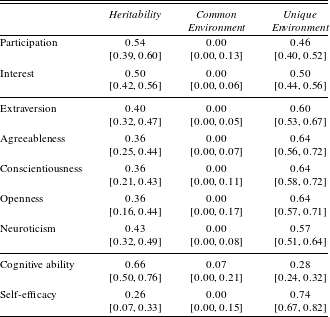
We begin by considering univariate estimates of heritability for political participation, interest, and the seven psychological traits, which are shown in Table 1. All measures are residualized of birth year, gender, and cohort. Respondents born in 1990–1993 are in one cohort. Respondents born in 1997 or 1998 are in a cohort. Thus, since we only analyze respondents from two cohorts, we simply use a dummy variable. The heritability estimates for the participation index and political interest are 0.54 and 0.50, respectively. Both estimates are significantly different from zero at the 5% level. In addition, both estimates are similar to those presented in previous studies. For example, Dawes et al. Reference Dawes, Cesarini, Fowler, Johannesson, Magnusson and Oskarsson23 report a heritability estimate of 0.36 for their participation index and a heritability estimate of 0.50 for their measure of political interest. Our political interest heritability estimate of 0.50 is close to the estimates presented in a number of recent studies. Reference Klemmensen, Hatemi, Hobolt, Skytthe and Nørgaard9,Reference Dawes, Cesarini, Fowler, Johannesson, Magnusson and Oskarsson23,Reference Weinschenk and Dawes25,Reference Bell, Schermer and Vernon29 The point estimates for common environment are zero for both measures, and neither estimate is significantly different from zero. This is consistent with earlier studies. Reference Arceneaux, Johnson and Maes8,Reference Dawes, Cesarini, Fowler, Johannesson, Magnusson and Oskarsson23,Reference Bell, Schermer and Vernon29
Heritability estimates for political participation, political interest, Big Five personality traits, cognitive ability, and self-efficacy. Parameter estimates and 95% confidence intervals in brackets are shown for a univariate ACE model.

Table 1 also indicates that the heritability estimates for all of the Big Five personality traits are significantly different from zero at the 5% level. The estimates range from 0.36 to 0.43. We note that the heritability estimates are a little lower than what is usually reported in the literature (40%–60% range). This likely reflects the low mean age of the sample compared to the samples used by other researchers (since heritability tends to increase with age). The point estimates for common environment are zero for all of the Big Five traits, which is a common finding in the personality literature. We also find that cognitive ability is heritable. The heritability estimate is 0.66, which is significantly different from zero at the 5% level. This is similar to the heritability estimate of 0.67 reported by Dawes et al.
Reference Dawes, Cesarini, Fowler, Johannesson, Magnusson and Oskarsson23
Lastly, we find that the heritability estimate for self-efficacy is 0.26, which is significantly different from zero at the 5% level. Dawes et al.
Reference Dawes, Cesarini, Fowler, Johannesson, Magnusson and Oskarsson23
find that personal control is heritable (estimate of 0.23,
 $p<0.05$
) in their sample of Swedish twins (though we note that our measure of self-efficacy is somewhat different than their measure since they use items from the locus of control scale).
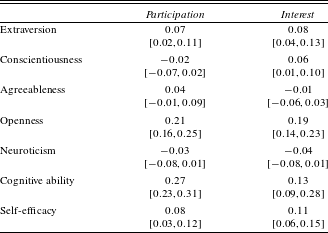
The second step of our analysis quantifies the amount of the covariation between each of our dependent variables and each psychological trait that can be attributed to a common genetic source. Before turning to the results of our bivariate Cholesky decomposition models, in Table 2 we present the phenotypic correlations between our two dependent variables and each psychological trait. The correlations are small to moderate, ranging from 0.01 to 0.27 in absolute value. Oskarsson et al.
Reference Oskarsson, Cesarini, Dawes, Fowler, Johannesson, Magnusson and Teorell28
have noted that bivariate decomposition models should be employed when there are at least moderately strong phenotypic correlations (they recommend correlations that are equal to or greater than 0.15). Table 2 indicates that both openness and cognitive ability are moderately correlated with our dependent variables. All four of the correlations are statistically significant at the 5% level. In addition, three of the four correlations exceed the recommended 0.15 threshold. Since the correlation between cognitive ability and interest is very close (
 $r=0.13$
) to the recommended threshold and statistically significant at
 $p<0.05$
, we opt to include it in our bivariate analysis.
Phenotypic correlations between each psychological trait and our two dependent variables (95% confidence intervals in brackets).

This result, however, should be interpreted with caution. While Dawes et al. found moderate correlations between extraversion, political interest, and political participation, we find correlations that are less than half the size of those reported by those authors. Reference Dawes, Cesarini, Fowler, Johannesson, Magnusson and Oskarsson23 Our correlations are positively signed, though, which is consistent with Dawes et al. Reference Dawes, Cesarini, Fowler, Johannesson, Magnusson and Oskarsson23 The differences we observe for extraversion could be a consequence of different measurement approaches, since Dawes et al. Reference Dawes, Cesarini, Fowler, Johannesson, Magnusson and Oskarsson23 did not use standard Big Five items to measure extraversion. In addition, while Dawes et al. Reference Dawes, Cesarini, Fowler, Johannesson, Magnusson and Oskarsson23 found significant correlations between personal control, political interest, and political participation, we find relatively weak correlations (that do not exceed the recommended 0.15 threshold) between self-efficacy and our dependent variables. Again, though, the correlations are positively signed, which is consistent with Dawes et al. Reference Dawes, Cesarini, Fowler, Johannesson, Magnusson and Oskarsson23
Finally, we note that while Weinschenk and Dawes Reference Weinschenk and Dawes25 found that extraversion, conscientiousness, openness, and neuroticism were moderately correlated with political interest in U.S. samples, we find that among the Big Five traits, only openness shows a moderate correlation with political interest in our sample. Since the correlations for all of the psychological traits besides cognitive ability and openness are small in magnitude (and many of them are not statistically significant), making it difficult to decompose their covariance without an extremely large sample, we exclude them from the bivariate analysis. In addition, since the common environment point estimates for political interest, participation, openness, and cognitive ability are at or close to zero and insignificant in the univariate models in Table 1, we estimate bivariate models assuming that the common environment correlation is zero. The results for the unrestricted models are presented in the online appendix. Fit statistics comparing the restricted and unrestricted models (and estimates from unrestricted models) are also presented in the online appendix. In all cases, the common environment correlation is insignificant in the full model.
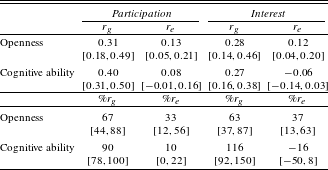
The genetic (
 $r_{g}$
) and environmental correlations (
 $r_{e}$
) and the percentage of the total correlation due to genetic (
 $\%r_{g}$
) and environmental factors (
 $\%r_{e}$
) are presented in top and bottom panel of Table 3, respectively. All four of the genetic correlations are significant at the 5% level. Beginning with openness, we find that genetic factors make up 67% of the correlation between this trait and participation and 63% of the correlation between openness and political interest. Using data from a U.S. sample and a comparable measure of political interest, Weinschenk and Dawes
Reference Weinschenk and Dawes25
found that genetic factors account for 58% of the correlation between openness and political interest. Their estimate of the genetic correlation between openness and interest was 0.35, which is close to our estimate of 0.28.
Top panel: Genetic (
 $r_{g}$
) and unique environmental (
 $r_{e}$
) Correlation and 95% CIs from bivariate Cholesky AE models of political participation and interest with the Big Five personality trait openness and cognitive ability. Bottom panel: Percentage of total correlation due to genetic and unique environmental correlation and 95% CIs from bivariate Cholesky AE models of political participation and interest with the Big Five personality trait openness and cognitive ability. Although
 $\%r_{g}$
exceeds 100% for cognitive ability and interest, this is not an error since, by construction,
 $\%r_{g}$
and
 $\%r_{e}$
must sum to one (
 $r_{g}$
and
 $r_{e}$
do not necessarily sum to one). Formal derivations of each quantity are presented in the online appendix.

When it comes to cognitive ability, we find that genetic factors make up 90% of the correlation between this trait and participation. While Dawes et al. Reference Dawes, Cesarini, Fowler, Johannesson, Magnusson and Oskarsson23 were not able to examine the genetic overlap between cognitive ability and participation, in another study, Dawes and colleagues Reference Dawes, Settle, Loewen, McGue and Iacono24 found that genetic factors make up 97% of the correlation between a measure of verbal IQ and a civic engagement index. Their estimate of the genetic correlation between IQ and civic engagement (0.39) is nearly identical to our estimate of the genetic correlation between cognitive ability and political participation (0.40).
When it comes to political interest, genetic factors account for 100% of the correlation between cognitive ability and political interest. Our estimate of the genetic correlation between cognitive ability and political interest (0.27) is nearly identical to the genetic correlation of 0.30 reported by Dawes et al. Reference Dawes, Cesarini, Fowler, Johannesson, Magnusson and Oskarsson23 They also found that genetic factors account for 100% of the correlation between these two items. We note that while many of the participation questions we used were not asked of the youngest cohort in the TwinLife sample, the political interest question was asked of children born in 2003–2004 (this cohort is not included in the results described earlier because we wanted the samples to be the same for both dependent variables). Thus, we are able to examine univariate and bivariate models for the 2003–2004 cohort (the 2009–2010 cohort was not asked the interest question). The results of this analysis are presented in the online appendix for interested readers.
In brief, we find that nearly all of the heritability estimates shown in Table 1 are smaller when we restrict the analysis to just those born in 2003–2004. This fits with previous research suggesting that heritability increases with age. Interestingly, the heritability estimate for political interest (0.35) is significant at the 5% level, though it is much smaller than the heritability estimate (0.50) in Table 1. In addition, it is worth noting that the common environment estimate is larger in the 2003–2004 cohort than it is in the older cohorts. The estimate for common environment is zero in Table 1 but increases to 0.12 in the 2003–2004 sample. The confidence interval for the 0.12 common environment estimate in the 2003–2004 cohort does include zero, but we note that the sample size is fairly small when we analyze only those born in 2003–2004. In terms of the correlations between openness, cognitive ability, and political interest in the 2003–2004 cohort, we find that they are smaller than the correlations shown in Table 2.
Finally, while we present bivariate results for the 2003–2004 cohort in the online appendix, which suggest some genetic overlap between cognitive ability, openness, and interest, we note that the models are fairly noisy given that the cohort is comprised of just 356 MZ and 545 DZ pairs (the fact that the heritability estimates are lower for this cohort compounds the small sample size). We therefore do not want to make too much of the bivariate results for this subsample. Replication is necessary in order to have more confidence in the results.
Overall, the results in Table 3 suggest that common genes account for a majority of the correlation between cognitive ability and the two measures of political engagement we consider in this paper. Common genes also account for a majority of the correlation between openness and our dependent variables. However, it is important to point out that the phenotypic correlations listed in Table 2 suggest that psychological traits, and thus genetic factors related to them, only explain part of the variation in political participation and political interest.
It is worth noting that although significant genetic correlations could be interpreted as evidence of psychological traits mediating the relationship between genes and political measures (this would imply a causal ordering), it is also possible that psychological traits and political measures may share the same underlying genetic mechanism but not share a causal relationship. Reference Posthuma, Beem, de Geus, van Baal, von Hjelmborg, Iachine and Boomsma60 The latter scenario, known as pleiotropy, implies that genetic factors are a confounder. Interestingly, numerous previous studies have failed to find much evidence of mediation. Indeed, when phenotypic correlations are small or modest, as they were in the foregoing analyses, it is clear that there is not a great deal of mediation. Thus, our findings mesh well with Dawes et al., Reference Dawes, Cesarini, Fowler, Johannesson, Magnusson and Oskarsson23 who note that much of the variation in political engagement that is explained by genetic factors is not mediated by the psychological traits they study.
It is important to recognize that the Cholesky model we use in this study does not allow us to adjudicate between different types of possible relationships, but the collection of additional waves of the TwinLife Study, which will provide data collected at different points in time, may enable researchers to better understand the nature of the relationships between genes, psychological traits, and political engagement. While longitudinal data would be valuable, there are other methods available that provide leverage in understanding the connection between deep-seated predispositions and political engagement. For example, political scientists have integrated candidate gene studies into research on political participation. Reference Fowler and Dawes6,Reference Fowler and Dawes11,Reference Deppe, Stoltenberg, Smith and Hibbing61,Reference Charney and English62 Future studies may be able to use this approach or related approaches (e.g., creation of genetic risk scores for psychological traits; see Settle et al. Reference Settle, Dawes, Loewen and Panagopoulos47 for example) to get an even more nuanced understanding of the biological underpinnings of participation.
Conclusion
We were interested in examining the link between genes, psychological traits, and political engagement. Although some studies have examined the genetic basis of political engagement and some studies have investigated the relationship between psychological traits and political engagement, only a few studies have tried to synthesize this research by examining whether there is genetic overlap between psychological and political measures. In this study, we used a newly released data set on German twin pairs to understand whether and how biological and psychological dispositions connect to different measures of individual political engagement. Our analysis indicates that cognitive ability is related to political interest and that there is genetic overlap between these traits, which is consistent with Dawes et al. Reference Dawes, Cesarini, Fowler, Johannesson, Magnusson and Oskarsson23 While we did uncover a positive relationship between self-efficacy and our two dependent variables, the correlations were simply not large enough to enable us to examine the covariation using a bivariate Cholesky model.
When it comes to the Big Five personality traits, we did not find a strong connection between agreeableness, conscientiousness, neuroticism, extraversion, and our political measures. We note that Dawes et al. Reference Dawes, Cesarini, Fowler, Johannesson, Magnusson and Oskarsson23 found that extraversion was moderately correlated with measures political engagement and that there was genetic overlap. In addition, Weinschenk and Dawes Reference Weinschenk and Dawes25 found that four of the Big Five traits were correlated with political interest and had genetic overlap. Again, we note that our correlations were positively signed, which is consistent with previous work, but not large enough to use a bivariate Cholesky model. The only Big Five trait that was an important correlate of political engagement and interest in our study was openness, which has been a fairly consistent predictor of interest in politics and participation across different studies. Reference Gerber, Huber, Doherty, Dowling, Raso and Ha14,Reference Weinschenk and Dawes25,Reference Gerber, Huber, Doherty and Dowling31 Our results regarding the genetic overlap between openness and political interest are nearly identical to previous estimates.
In future studies, we believe that researchers would be well served by focusing on psychological traits that are heritable and that connect to information acquisition, processing, and use. For example, it may be worthwhile to examine traits such as need for cognition, which focuses on inclinations toward effortful cognitive activities such as debates, and need to evaluate, a trait that focuses on the extent to which people evaluate objects or experiences as good or bad. It would be interesting to determine whether such traits have genetic overlap with measures of political engagement.
In addition, we hope that future scholars will replicate this study using different samples and measures. Although we were able to construct fairly reliable measures of personality, it would be useful to include well-established (and longer) personality batteries in future surveys (e.g., the BFI, which includes 44 items designed to tap the Big Five). Since our measures of personality were based on a unique combination of personality items, it will be important to make sure that our findings are consistent when other personality measures are employed. As a final note, one area that is ripe for future research is how personality traits interact with each other to influence political engagement. In this study, we focused on each personality trait individually, but it would be interesting to examine how different combinations of personality traits (or different combinations of psychological traits and biological factors) might be relevant to political engagement.