Introduction
Schistosomiasis is a disease caused by parasitic flatworms of the genus Schistosoma. The disease is a major public health problem, affecting more than 240 million people in developing countries. Schistosoma mansoni is endemic in 54 countries in South America, the Caribbean, Africa and the eastern Mediterranean region (WHO, 2014).
Currently schistosomiasis is endemic in the Americas. It is a predominantly rural parasitosis, although it may be suburban and even urban, depending on the existence of the conditions for transmission. Socio-economic factors influence the transmission of schistosomiasis, being prevalent in tropical and subtropical areas, in poor communities without potable water and adequate sanitation (Barreto, Reference Barreto1991; WHO, 2014).
The actual epidemiological situation of schistosomiasis in Venezuela is of low transmission (Alarcón de Noya et al., Reference Alarcón de Noya, Ruiz, Losada, Colmenares, Contreras, Cesari and Noya2007), which makes the parasitological diagnosis by standard coprology difficult. Serological diagnosis is carried out in Venezuela using the cumbersome gold-standard circumoval precipitin test (COPT), in addition to two other tests, the alkaline phosphatase immunoassay (Pujol et al., Reference Pujol, Alarcon de Noya and Cesari1989; Pujol & Cesari, Reference Pujol and Cesari1990) and the Western blot (Cesari et al., Reference Cesari, Ballen, Mendoza and Matos2005) – both tests of experimental use, requiring a reliable validation test, since the prevalence value for both tests is much higher than that obtained by COPT. Molecular diagnosis using polymerase chain reaction (PCR) appears to be an alternative. The PCR systems described are sensitive and have the potential to detect parasite DNA in snails, monitor cercariae in water bodies (Hamburger et al., Reference Hamburger, Turetzky, Kapeller and Deresiewicz1991, Reference Hamburger, He-Na, Xin, Ramzy, Jourdane and Ruppel1998a, Reference Hamburger, Xin, Ramzy, Jourdane and Ruppelb; Abath et al., Reference Abath, Gomes, Melo, Barbosa and Werkhauser2006) and diagnose human infection (Pontes et al., Reference Pontes, Dias Neto and Rabello2002, Reference Pontes, Oliveira, Katz, Dias Neto and Rabello2003; Abath et al., Reference Abath, Gomes, Melo, Barbosa and Werkhauser2006). More extensive validation studies in endemic areas are crucial to investigate the suitability of this molecular tool for the diagnosis of infected humans.
Standardization of a protocol for PCR amplification of the 121-bp highly repetitive sequence of S. mansoni (Pontes et al., Reference Pontes, Dias Neto and Rabello2002) could provide a technique that allows rapid, accurate, sensitive and specific diagnosis, which could be used for both clinical diagnosis and epidemiological studies, being able to distinguish active from non-active foci, a fact not easily attainable using immunological methods since antibodies may persist over time, while the presence of parasite DNA depends on an active infection. In addition, making the proper diagnosis of active outbreaks can provide benefits for the treatment of infected humans, and surveillance of infection in vectors and waters will be more reliable for decisions to be taken by a Schistosomiasis Control Programme.
Materials and methods
Collection of samples
In order to standardize protocols of the PCR for the amplification of a 121-bp highly repeated sequence of S. mansoni (Pontes et al., Reference Pontes, Dias Neto and Rabello2002), egg samples of the Brazilian BH strain of S. mansoni obtained from experimentally infected golden hamsters were used. In addition, DNA samples of other parasites, such as Fasciola hepatica, Taenia solium, Taenia saginata, Toxocara canis, Trypanosoma cruzi, Leishmania chagasi and Toxoplasma gondii, and human DNA were used to determine the specificity of PCR.
In addition, serum samples from 86 humans with immunological diagnosis of schistosomiasis from an ancient endemic focus of this disease (Barrio Nuevo, Tiara, Aragua State) were analysed. The patients were treated 1 year previously with praziquantel, and evaluated a year after treatment. The results showed that all patients were negative by coprological diagnosis (Kato–Katz) and positive by immunological diagnosis (Western blot). These serum samples were used to evaluate if there was active transmission at the time of evaluation, or if the immunological results were due to past infections.
Molecular analysis
Conventional methods for the extraction of DNA, such as extraction by salting out, and the use of Chelex® 100 resin (BioRad Laboratories, Redmond, Washington, USA) were used. DNA extraction by the salting-out technique was performed according to the original protocol described by Sambrook & Russell (Reference Sambrook and Russell2001), but increasing the time of incubation with proteinase K to 4 h and the centrifugation time after incubating with proteinase K to 30 min, to match the type of sample (parasite eggs). DNA extraction from serum samples from 86 patients with immunological diagnosis of schistosomiasis, using resin Chelex® 100, was done following the instructions of the manufacturer.
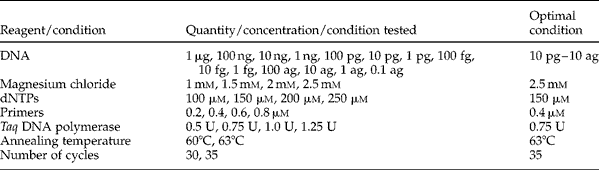
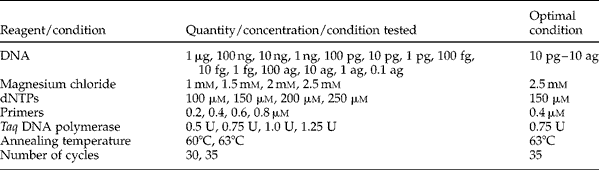
The PCR for the amplification of the 121-bp highly repeated sequence of S. mansoni (Pontes et al., Reference Pontes, Dias Neto and Rabello2002) was carried out using DNA samples extracted from parasite eggs obtained from the liver of experimentally infected golden hamsters. The amplification reactions were carried out according to the protocol described by Pontes et al., Reference Pontes, Dias Neto and Rabello2002), using the forward 5′-GATCTGAATCCGACCAACCG-3′ and reverse 5′-ATATTAACGCCCACGCTCTC-3′ primers and varying the concentrations of reagents, such as deoxynucleoside triphosphates (dNTPs), primers, polymerase and magnesium chloride, and conditions of temperatures and number of cycles (table 1), to verify the conditions for the best amplification. PCR products were visualized in 2% agarose gels and compared with molecular size markers.
The concentration and quantity of reagents, including conditions tested, for the PCR amplification of the 121-bp repetitive sequence of S. mansoni.
All tested conditions for PCR were compared, and they were selected as optimal, where the expected bands were clear and with the absence of non-specific products or smears, observed through photographic images of agarose gels.
The analytical sensitivity was determined using different quantities of DNA, 1 μg to 0.1 attogram (at) (table 1). The specificity was also determined using DNA samples from other parasites, such as F. hepatica, T. solium, T. saginata, T. canis, T.cruzi, L. chagasi and T. gondii, and human DNA.
The previously standardized PCR for the amplification of the 121-bp highly repeated sequence of S. mansoni (Pontes et al., Reference Pontes, Dias Neto and Rabello2002) was performed using DNA samples extracted from serum samples from 86 patients with immunological diagnosis of schistosomiasis.
Results and discussion
In Venezuela, transmission of S. mansoni can be characterized as hypoendemic and infected patients have low parasite loads, since the prevalence and intensity of infection have declined after many years of successful control. Therefore, the low sensitivity of parasitological methods due to the low parasite loads, and the undefined specificity of immunological methods mainly because of cross-reactions with other parasitic infections, do not allow a proper diagnosis of the disease. Furthermore, in the case of past infection, antibodies may remain, yielding positive serological results with certain techniques, even though the patient has been treated (Alarcón de Noya et al., Reference Alarcón de Noya, Ruiz, Losada, Colmenares, Contreras, Cesari and Noya2007).
Although the PCR technique has been utilized extensively for the diagnosis of numerous human diseases, its application for neglected diseases, especially schistosomiasis, has only recently been explored. Pontes et al., (Reference Pontes, Dias Neto and Rabello2002) reported the first use of PCR for the diagnosis of S. mansoni DNA in human serum and faecal samples, using a very sensitive marker, the 121-bp highly repeated sequence (Hamburger et al., Reference Hamburger, Turetzky, Kapeller and Deresiewicz1991). This sequence has about 600,000 copies per cell, equivalent to 10% of the total DNA of each cell of the parasite. For all PCRs, a prior standardization, adaptation and evaluation of the reaction conditions for use of the technique in each laboratory is required.
For the standardization of PCR for amplification of the 121-bp highly repeated sequence of S. mansoni amounts of template DNA were evaluated, and the optimal amount of DNA ranged between 100 picograms (pg) (10− 12g) and 1 femtogram (fg) (10− 15g). Consequently, 1 pg was taken as the amount of DNA to use in subsequent determinations (table 1).
The optimum reagent concentrations with good amplifications can be seen in table 1. The optimal concentrations of dNTPs, primers, MgCl2 and Taq polymerase were lower than those used by Pontes et al. (Reference Pontes, Dias Neto and Rabello2002), thereby allowing for a reduction in the use of reagents. Regarding the amplification program, where the annealing temperature and the number of cycles were evaluated, it was determined that at 63°C more defined and non-contaminated bands were observed, while at 60°C more tenuous bands and the presence of contamination in the negative controls were observed. In addition, using 30 cycles of amplification, no bands were observed, whereas when using 35 cycles, the diagnostic bands were evident (table 1).
Schistosoma mansoni DNA was able to produce adequate amplification (sharp bands, with the absence of non-specific products and smears) in a range from 10 pg to 10 ag (10− 18g), with the analytical sensitivity of the technique at 10 ag, indicating the minimum amount of DNA amplified by PCR (table 1). The sensitivity of conventional PCR based on other targets, such as Schistosoma 28S rDNA or internal transcribed spacer (ITS) rDNA, ranged from 0.98 to 15 pg, showing PCR to be useful for the detection of S. mansoni infection and that it may be used in non-invasive samples such as urine and faeces. Furthermore, this technique is more sensitive than the two classical methods for the diagnosis of schistosomiasis, the Kato–Katz and enzyme-linked immunosorbent assay (ELISA) (Sandoval et al., Reference Sandoval, Siles-Lucas, Lopez, Pérez, Gárate and Muro2006).
According to Hamburger et al. (Reference Hamburger, Xin, Ramzy, Jourdane and Ruppel1998b), the minimum amount of S. mansoni DNA detected by the 121-bp highly repeated sequence of S. mansoni PCR technique was 1.2 fg. Similarly, Gomes et al. (Reference Gomes, Marques, Enk, Coelho and Rabello2009) showed that the minimum amount of DNA detected by PCR was 3 fg. Comparing these results, with a sensitivity around 1–3 fg, with our first PCR using the reaction conditions of Pontes et al. (Reference Pontes, Dias Neto and Rabello2002), we obtained a result of 1 fg; but later, using the standardized PCR, the sensitivity increased to 10 ag. The S. mansoni genome contains around 580 fg of DNA, so 10 ag is equivalent to less than one-thousandth of the amount of DNA contained in a parasite egg or cell. This result suggests a very high sensitivity, the best obtained for molecular diagnosis of parasitic diseases using conventional PCR. This is an important factor for the diagnosis of the disease, since currently available methods show sensitivity problems because infected patients have low parasite loads. On the other hand, the high sensitivity of the standardized PCR could make it an important tool for the evaluation of treatment and as a criterion of cure.
In Brazil, Pontes et al. (Reference Pontes, Dias Neto and Rabello2002) showed that the high sensitivity of the method allowed detection of parasite DNA in stool samples containing only 2.4 eggs/g of faeces, making the PCR method ten times more sensitive than the Kato–Katz method. In the present study the standardized PCR method could, in theory, detect the amount of DNA corresponding to less than 1 egg/g of faeces. Compared with the diagnostic sensitivity of the Kato–Katz technique: according to Gomes et al. (Reference Gomes, Marques, Enk, Coelho and Rabello2009), in their study population of 67 inhabitants of an endemic area in Brazil, the number of positive samples detected using the PCR technique was higher (61.2% prevalence) than that determined by the Kato–Katz technique (41.8%) in positive patients with low parasite loads.
In addition, the amplification reaction showed that there was amplification only for DNA samples of S. mansoni, with no cross-reaction with the DNA of other helminths or protozoa, indicating a specificity of 100%. Similar results were obtained by Pontes et al. (Reference Pontes, Dias Neto and Rabello2002, Reference Pontes, Oliveira, Katz, Dias Neto and Rabello2003), obtaining no amplification with DNA from the parasitic helminths Ascaris lumbricoides, Ancylostoma duodenale, T. solium and Trichuris trichiuria.
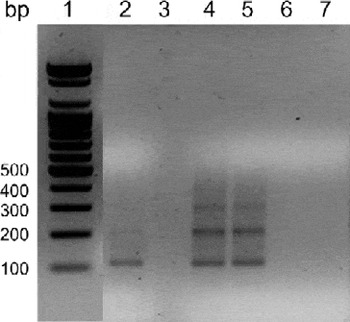
Of 86 DNA samples extracted from sera of patients with immunological diagnosis of schistosomiasis, using the standardized PCR, only two were positive (fig. 1). All patients were negative using coprological examinations (Kato–Katz) and positive for Western blot, but only some patients showed positivity with ELISA and the circumoral precipitin test. All positive tests involved detection using circulating antibodies.
Detection of S. mansoni DNA by PCR in serum samples of patients. Lanes: 1, molecular marker 100 bp plus DNA ladder (Promega, Madison, Wisconsin, USA); 2, positive control; 3, negative control; 4–5, samples of positive patients; 6–7, samples of negative patients.

Therefore, PCR could assess whether there is current transmission in the geographical area or if circulating antibodies correspond to past infections due to immunological memory of each individual. The standardized PCR technique allowed the demonstration of active infections in two patients from this endemic area. The results showed a characteristic focus of low transmission in Venezuela, and that treatment during the previous year may have decreased transmission. In addition, serum may not be the most sensitive sample, because there is more likelihood of finding DNA in the stools. It would be important to apply the standardized PCR to stool samples, since in a recent study (Carneiro et al., Reference Carneiro, Peralta, Pinheiro, de Oliveira, Peralta and Bezerra2013) the PCR results using stool samples from patients with positive and negative coprological and immunological diagnosis showed low diagnostic sensitivity. However, other studies have demostrated high sensitivity using this molecular target. The assessment of a single faecal sample by PCR detected more cases of infection than the analysis of two slides of one sample using the Kato–Katz technique, suggesting that PCR can be a useful diagnostic tool, particularly in areas with low endemicity (Costa et al., Reference Costa, Dos Santos, Gomes, Rabello, Ribeiro, Gorza, Cerrato, Soares and Abramo2012).
On the other hand, Wichmann et al. (Reference Wichmann, Poppert, Von Thien, Clerinx, Dieckmann, Jensenius, Parola, Richter, Schunk, Stich, Zanger, Burchard and Tannich2013), using sera, showed 92% diagnostic sensitivity of real-time PCR based on the 121-bp highly repeated sequence of S. mansoni. In addition, Enk et al. (Reference Enk, Oliveira and Rodrigues2012), using urine, and Härter et al. (Reference Härter, Frickmann, Zenk, Wichmann, Ammann, Kern, Fleischer, Tannich and Poppert2014), using cerebrospinal fluid, obtained high sensitivity for both types of samples, suggesting that these were also useful in the diagnosis of schistosomiasis and neuroschistosomiasis, respectively. Additionally, for the early diagnosis of acute schistosomiasis, real-time PCR in serum is more sensitive than classic diagnostic tools such as serology or microscopy, irrespective of the region of infection (Wichmann et al., Reference Wichmann, Poppert, Von Thien, Clerinx, Dieckmann, Jensenius, Parola, Richter, Schunk, Stich, Zanger, Burchard and Tannich2013).
The present results show that the PCR technique for amplifying DNA from S. mansoni, besides being specific, is capable of detecting small amounts of parasite DNA, allowing early diagnosis of the disease. Therefore, this conventional PCR assay is a valuable alternative for the diagnosis of S. mansoni infections. Prevalence values using molecular diagnosis would validate serological diagnosis, and will probably be the gold standard technique for the diagnosis of schistosomiasis in situations of low transmission. Molecular diagnosis techniques for S. mansoni have never been used in Venezuela. The sensitive and accurate identification of human infection and the precise monitoring of schistosome transmission sites may be important tools for the long-term control of this disease.