Implications
Pigs fight to establish dominance when mixed into new social groups. This aggressive behaviour affects growth and is a welfare concern. We estimated the effect of selective breeding on aggressive behaviour, using the number of skin lesions (scratches received) on different regions of the body to identify the least aggressive individuals to breed from. The results suggest that selection for reduced skin lesions at the front of the body at 24 h post-mixing would result in the greatest reduction in aggressive behaviour and is therefore the best selection criterion of all analysed lesion traits to reduce aggressiveness at mixing.
Introduction
In indoor commercial farming systems, pigs are housed in inflexible group sizes under space-limited conditions. In order to create groups of a predetermined and uniform size, growing pigs are often mixed with unfamiliar individuals throughout the production cycle. Physical aggression usually occurs at mixing, which serves to establish dominance relationships (Meese and Ewbank, Reference Meese and Ewbank1973). Mixing induced aggression has been associated with stress and injury (Mendl et al., Reference Mendl, Zanella and Broom1992), suppressed immune responses (de Groot et al., Reference De Groot, Ruis, Scholten, Koolhaas and Boersma2001), and reduced growth (Stookey and Gonyou, Reference Stookey and Gonyou1994), carcass (Faucitano, Reference Faucitano2001) and meat quality (D’Eath et al., Reference D’Eath, Turner, Kurt, Evans, Thölking, Looft, Wimmers, Murani, Klont, Foury, Ison and Mormède2010). Although a number of practical interventions continue to be explored, an under-explored solution to reduce aggression is via genetic selection. This study aimed to examine the best trait to select upon in order to reduce aggressive behaviour.
Phenotyping aggressive behaviour by direct observation or from video is highly labour intensive; therefore skin lesions – which occur as a result of physical aggression – may constitute valuable proxies for aggressive behaviour (Turner et al., Reference Turner, Farnworth, White, Brotherstone, Mendl, Knap, Penny and Lawrence2006; Guy et al., Reference Guy, Burns, Barker and Edwards2009). Skin lesions are genetically and phenotypically correlated with aggression and have been shown to have a significant heritable component (h 2: 0.08 to 0.43); therefore it is expected that selection against the quantity and body location of skin lesions will result in a corresponding reduction in aggression (Turner et al., Reference Turner, Roehe, D’Eath, Ison, Farish, Jack, Lundeheim, Rydhmer and Lawrence2009; Desire et al., Reference Desire, Turner, D’Eath, Doeschl-Wilson, Lewis and Roehe2015a).
Deciding how skin lesions should be used to select against aggression requires understanding of the complex relationship between skin lesions and aggressive behaviour. Skin lesions on one animal can be an indication of the behaviour of other members of the social group (via an unreciprocated attack), as well as the individual in question (via willing involvement in aggression). Failing to distinguish between the underlying causes of lesions may lead to biased estimates of individual aggression. On a phenotypic level, Turner et al. (Reference Turner, Farnworth, White, Brotherstone, Mendl, Knap, Penny and Lawrence2006) showed that skin lesions to the anterior region of the body are strongly correlated with the proportion of time involved in reciprocal aggression (RA), whereas lesions to the rear of the body indicated a larger proportion of time spent receiving non-reciprocal aggression (NRA).
Previous work suggests this relationship is partly under genetic regulation (Turner et al., Reference Turner, Roehe, D’Eath, Ison, Farish, Jack, Lundeheim, Rydhmer and Lawrence2009). In addition to measuring aggression performed immediately post-mixing, skin lesions have been explored as a method of phenotyping aggression experienced under socially stable conditions (several weeks post-mixing). Studies on both on a phenotypic (Desire et al., Reference Desire, Turner, D’Eath, Doeschl-Wilson, Lewis and Roehe2015a) and genetic (Turner et al., Reference Turner, Roehe, D’Eath, Ison, Farish, Jack, Lundeheim, Rydhmer and Lawrence2009) level have found that individuals involved in much aggression at mixing tend to have fewer lesions several weeks later. These results suggest that avoidance of aggression upon first mixing may be detrimental to the individual’s long-term welfare. Finally, genetic variation and heritabilities of skin lesion traits differ between different body regions and time points. In light of the above, it is important to carefully assess the potential impact of selection for reduced aggression via skin lesion traits. Although genetic correlations between skin lesion traits and some aggressive behavioural traits have been previously published (Turner et al., Reference Turner, Roehe, D’Eath, Ison, Farish, Jack, Lundeheim, Rydhmer and Lawrence2009), these correlations do not give an indication of the magnitude of the expected response to selection. In addition, the estimated genetic correlations among skin lesion and behaviour traits are complex, often in conflict with one another, and associated with high errors of estimation. This means that predicting the selection response based on genetic correlations can be difficult. Due to time constraints, only one skin lesion trait is likely to be recorded under practical conditions, therefore it is necessary to identify the single best skin lesion trait for selection. The objective of this study was to identify the optimum skin lesion trait for selection purposes, by determining the magnitude of the reduction in aggressive behavioural traits at mixing, when using lesion numbers recorded on different body regions at mixing and in the stable group as selection criteria.
Material and methods
Animals and housing
Data were collected from a commercial herd. Three individuals (average age 71 days, SD 4.5) taken from each of five litters were mixed to form a new social group of 15 same sex, same breed individuals. Animals with all skin lesion and behavioural phenotypes were included in the analyses, and the final data set contained 1146 individuals (698 purebred Yorkshire and 448 Yorkshire×Landrace) from 77 social groups. Experimental animals were the progeny of 82 sires and 217 dams and a two-generation pedigree was used (total 1862 animals). Groups mixed on the same day were classed as the same batch. At time of mixing, animals were approximately matched for BW in order to minimise variation between pen mates. Pigs were weighed 24 h following mixing. Animals were housed indoors in partially slatted pens (30% slats, 70% solid flooring with light straw bedding) and were provided with pelleted feed and water ad libitum.
Skin lesion traits
Fresh skin lesions were counted separately on the anterior (head, neck, forelegs and shoulders), centre (flanks and back) and posterior (hind legs and rump) regions of the body 24 h post-mixing (SL24h). In order to ensure injuries inflicted before mixing were not included in the analyses, lesions were also counted immediately before mixing, and pre-mix lesion counts deducted from the post-mixing count. Lesions were deemed to be fresh if they were a vivid red colour, bleeding or recently scabbed. Lesions were counted in the same manner 3 weeks post-mixing (SL3wk) as a measure of aggression under stable social conditions.
Behavioural traits
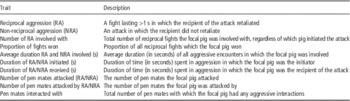
Animals were video recorded for 24 h following mixing. The behavioural traits used in this study were based on data recorded during these behavioural observations. Each interaction was classed as either RA or NRA as defined by Turner et al. (Reference Turner, Farnworth, White, Brotherstone, Mendl, Knap, Penny and Lawrence2006). Behavioural traits used in the analyses are defined in Table 1.
Definitions of skin lesion traits and behavioural traits used in the analyses

Characteristics of the data
Only aggressive behavioural traits that had been previously shown to be predictive of skin lesion traits on a phenotypic level in the same population were chosen for analysis (Desire et al., Reference Desire, Turner, D’Eath, Doeschl-Wilson, Lewis and Roehe2015a). Skin lesion and aggressive behavioural traits showed considerably skewed distributions (Supplementary Table S1), therefore a log transformation (y=log e +1) was used to approach the normal distribution.
Statistical analyses
Univariate analyses were used to estimate genetic components and estimated breeding values (EBVs) of all log-transformed skin lesion and behavioural traits using the following animal model:
 $${\bf y\,{\equals}\,Xb{\plus}Za{\plus}Wc{\plus}e}$$
where y is the vector of records for skin lesions (SL24h and SL3wk) and aggressive behaviour, and X, Z and W the incidence matrices of fixed effects, genetic effects and environmental (pen) effects, respectively. Vectors b, a, c and e represent fixed effects, additive direct genetic effects, common environmental effects (shared by all pigs in a pen) and residual error, respectively. Genetic line, sex and batch were included in all models as fixed categorical effects, whereas BW at time of mixing was fitted as a covariate. Age at time of mixing was included for SL24h and aggressive behavioural traits. Bivariate analyses were used to estimate genetic- and group-level correlations between skin lesion traits and aggressive behavioural traits using the same fixed and random effects described for the univariate analyses. Genetic analyses were performed using ASReml (Gilmour et al., Reference Gilmour, Gogel, Cullis and Thompson2009).
As skin lesion and behavioural traits are measured on different scales, it is impractical to directly compare genetic and phenotypic values across multiple traits. Breeding values and untransformed phenotypic values were therefore scaled and standardised, and expressed in terms of standard deviations from a population mean of 0. Individuals were chosen for inclusion in each subsequent analysis based on either SL24h EBVs in the lowest 10% of the population, or SL3wk EBVs in the highest 10% of the population. This methodology was chosen as it allows the selection response to be predicted based on the given data, rather than complex genetic correlations that have a high level of estimation error, which might affect the accuracy of predicted response using population genetics theory.
Results
Heritabilities and common environmental effects
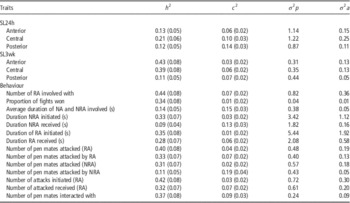
Heritabilities estimated for skin lesion traits ranged from 0.11 to 0.43 (Table 2). A substantially higher heritability was estimated for anterior SL3wk than anterior SL24h. Heritabilities for behavioural traits ranged from 0.09 to 0.44 (Table 2). The proportion of variance attributed to common environmental effects was generally lower than estimated heritabilities for skin lesion and behavioural traits (c 2=0.06 to 0.15), except for posterior SL24h, average fight duration and duration of time spent receiving NRA.
Heritabilities (h 2), phenotypic proportions of pen variances (c 2), phenotypic (σ 2 p) and genetic (σ 2 a) variances for skin lesion traits recorded on pigs 24 h post-mixing (SL24h) and 3 weeks post-mixing (SL3wk) and aggressive behavioural traits

RA=reciprocal aggression; NRA=non-reciprocal aggression.
Genetic- and pen-level correlations between skin lesion and behaviour traits
Genetic correlations
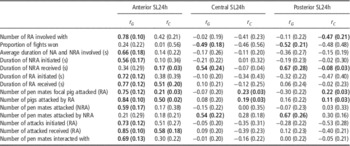
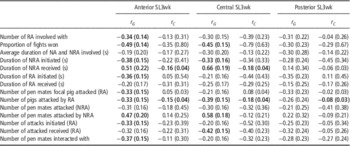
Where significant, genetic correlations between anterior SL24h and aggressive behavioural traits were positive (Table 3). The proportion of fights won was negatively correlated with central and posterior SL24h, whereas the duration of NRA received, and the number of pen mates that NRA was received from were positively correlated with these traits (Table 3). Genetic correlations between anterior SL3wk and aggressive behavioural traits were generally negative (Table 4), except duration of NRA received and number of pen mates that NRA was received from. Positive correlations were found between central SL3wk and duration of NRA received, and number of pen mates that NRA was received from (Table 4). No significant genetic correlations were found between posterior SL3wk and aggressive behavioural traits (Table 4).
Genetic (r G ) and pen-level (r C ) correlationsFootnote 1 between anterior, central and posterior skin lesion traits recorded on pigs 24 h post-mixing (SL24h), with aggressive behavioural traits recorded 24 h following mixing

Standard errors presented in parentheses.
RA=reciprocal aggression; NRA=non-reciprocal aggression.
1 Bold font signifies correlation significantly different from 0.
Genetic (r G ) and pen-level (r C ) correlationsFootnote 1 between anterior, central and posterior skin lesion traits recorded on pigs 3 weeks post-mixing (SL3wk), with aggressive behavioural traits recorded 24 h following mixing

Standard errors presented in parentheses.
RA=reciprocal aggression; NRA=non-reciprocal aggression.
1 Bold font signifies correlation significantly different from 0.
Pen-level correlations
Most pen-level correlations between skin lesions and aggressive traits did not significantly differ from 0. Those that did were mainly positive for SL24h (Table 3). Statistically significant negative pen-level correlations were found between posterior SL24h and the number of reciprocal fights involved with, and duration of NRA received (−0.08, SE 0.03; Table 3). Negative pen-level correlations were found between all SL3wk traits and the number of pigs attacked by (RA), and between anterior or central SL3wk and the duration of NRA received (Table 4).
Low EBVs for SL24h
Associations with SL24h
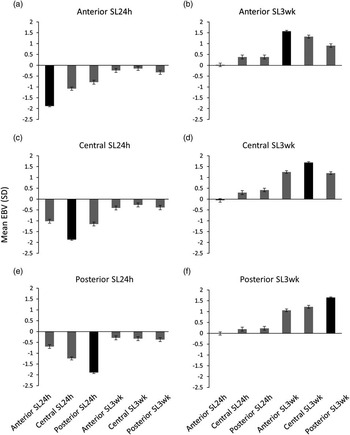
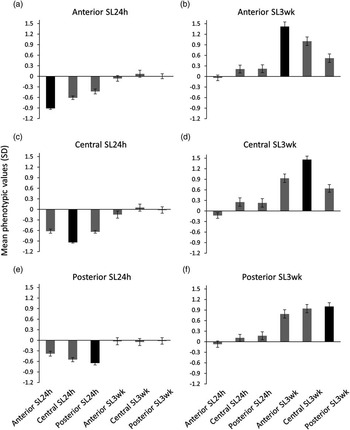
Individuals with low EBVs for anterior, central or posterior SL24h had low EBVs (−0.69 and −1.89 SD; Figure 1a, c and e) and phenotypic values (−0.38 to−0.94 SD; Figure 2a, c and e) for all skin lesion traits at mixing.
Mean estimated breeding values (EBVs) for skin lesion traits of pigs with EBVs in the lowest 10% for either anterior (a), central (c) or posterior (e) skin lesions recorded 24 h post-mixing (SL24h), or highest 10% EBVs for anterior (b), central (d) or posterior (f) skin lesions recorded 3 weeks post-mixing (SL3wk). Skin lesion trait that selection was based on is indicated above each panel and shaded black.

Mean phenotypic values for skin lesion traits of pigs with estimated breeding values (EBVs) in the lowest 10% for either anterior (a), central (c) or posterior (e) skin lesions recorded 24 h post-mixing (SL24h), or highest 10% EBVs for anterior (b), central (d) or posterior (f) skin lesions recorded 3 weeks post-mixing (SL3wk). Skin lesion trait that selection was based on is indicated above each panel and shaded black.

Associations with SL3wk
Individuals with low EBVs for SL24h had low EBVs for SL3wk (−0.15 SD to −0.41 SD (Figure1a, c and e). Phenotypically, individuals with low EBVs for SL24h did not differ significantly in the number of SL3wk in comparison with the population as a whole (−0.05 SD to 0.07 SD; Figure 2a, c and e).
Associations with aggressive behaviour
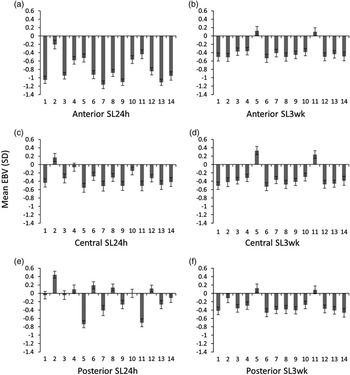
Individuals with low EBVs for anterior SL24h also had low EBVs for all aggressive behavioural traits (−0.21 to −1.17 SD; Figure 3a). Other than proportion of fights won, duration of NRA initiated, and number of pen mates attacked (NRA), individuals with low EBVs for central SL24h had significantly lower EBVs for aggressive behavioural traits (−0.28 to −0.51 SD), compared with the population average. Individuals with low EBVs for posterior SL24h had EBVs that were significantly lower than the population mean for duration of NRA received (−0.74 SD); duration of RA received (−0.41 SD); number of pigs attacked by (RA) (−0.27 SD); total number of RA received (−0.27 SD), and higher than the population average for proportion of fights won (0.45 SD) and duration of RA initiated (0.19 SD; Figure 3e).
Mean estimated breeding values (EBVs) for aggressive behavioural traits of pigs with EBVs in the lowest 10% for either anterior (a), central (c) or posterior (e) skin lesions recorded 24 h post-mixing (SL24h), or highest 10% EBVs for anterior (b), central (d) or posterior (f) skin lesions recorded 3 weeks post-mixing (SL3wk). Skin lesion trait that selection was based on is indicated beneath each panel. Numbers on horizontal axes correspond with the following behavioural traits: (1) number of reciprocal aggression (RA) involved with; (2) proportion of fights won; (3) average duration of RA and non-reciprocal aggression (NRA) involved (s); (4) duration of NRA initiated (s); (5) duration of NRA received (s); (6) duration of RA initiated (s); (7) duration of RA received (s); (8) number of pen mates focal pig attacked (RA); (9) number of pigs attacked by RA; (10) number of pen mates attacked (NRA); (11) number of pen mates attacked by NRA; (12) total RA initiated; (13) total RA received; (14) number of pen mates interacted with.

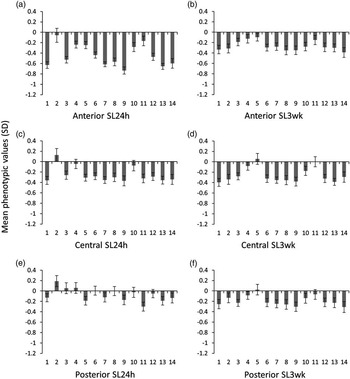
Phenotypic values for individuals with low EBVs for anterior, central and posterior SL24h largely mirrored those observed on the genetic level (Figure 4a, c and e). Individuals with low EBVs for anterior SL24h received non-reciprocal attacks for 11.55 s less than the population mean (Supplementary Table S2).
Mean phenotypic values for aggressive behavioural traits of pigs with estimated breeding values (EBVs) in the lowest 10% for either anterior (a), central (c) or posterior (e) skin lesions recorded 24 h post-mixing (SL24h), or highest 10% EBVs for anterior (b), central (d) or posterior (f) skin lesions recorded 3 weeks post-mixing (SL3wk). Skin lesion trait that selection is based on is indicated beneath each panel. Numbers on horizontal axes correspond with the following behavioural traits: (1) number of reciprocal aggression (RA) involved with; (2) proportion of fights won; (3) average duration of RA and non-reciprocal aggression (NRA) involved (s); (4) duration of NRA initiated (s); (5) duration of NRA received (s); (6) duration of RA initiated (s); (7) duration of RA received (s); (8) number of pen mates focal pig attacked (RA); (9) number of pigs attacked by RA; (10) number of pen mates attacked (NRA); (11) number of pen mates attacked by NRA; (12) total RA initiated; (13) total RA received; (14) number of pen mates interacted with.

High EBVs for SL3wk
Associations with SL24h
Individuals with high EBVs for SL3wk did not differ significantly from the population mean for anterior SL24h EBVs but had higher than average EBVs for central and posterior SL24h (0.19 to 0.42 SD; Figure 1b, d and f). On a phenotypic level, only central SL24h significantly differed from the population mean in individuals with low EBVs for central SL3wk (0.25 SD; Figure 2d). No other significant associations were found between SL24h and SL3wk at the phenotypic level(Figure 2b, d and f).
Associations with SL3wk
Individuals with high SL3wk EBVs had high EBVs for all other skin lesion traits at this time point (0.91 to 1.69 SD; Figure 1b, d and f). These individuals also had high skin lesion numbers on a phenotypic level compared with the population mean (0.52 to 1.45 SD; Figure 2b, d and f).
Response on aggressive behaviour
Except for the duration of NRA received, high EBVs for anterior SL3wk corresponded with low EBVs for all aggressive behavioural traits (−0.37 to −0.54 SD; Figure 3b). The same trends were also observed for high central SL3wk EBVs (−0.30 to −0.53 SD; Figure 3d). Individuals with high EBVs for posterior SL3wk had low mean EBVs for all behavioural traits (−0.28 to −0.46 SD), except for proportion of fights won and duration of NRA received, which did not significantly differ from 0 (Figure 3f).
Phenotypic values for individuals with low EBVs for anterior, central and posterior SL24h largely mirrored those observed on the genetic level (Figure 4b, d and f). Individuals with low EBVs for anterior SL3wk were involved in 2.39 fewer reciprocal interactions than the population mean (Supplementary Table S3).
Discussion
Heritabilities
Heritabilities for skin lesion traits were of a low-to-moderate magnitude. These estimates differed from those reported by Turner et al. (Reference Turner, Roehe, D’Eath, Ison, Farish, Jack, Lundeheim, Rydhmer and Lawrence2009) for the same population, as only those animals with behavioural data available were used in this analysis. Heritabilities for SL3wk were higher than SL24h, which is likely to be due to lower environmental variance 3 weeks post-mixing compared with 24 h post-mixing. The lowest heritability estimated for behavioural traits was for receipt of NRA. Receipt of NRA results from the behaviour of other individuals in a pen, and not the individual itself, which may explain why direct genetic effects account for so little of the genetic variation in this trait. The highest heritabilities were estimated for traits related to RA. During engagement in RA, the individual animal is actively involved in the event, choosing to either attack or respond to an attack, which may explain why these traits showed the highest heritabilities.
Social genetic effects describe genetic variation due to interactions between pen-mates (Bijma and Wade, Reference Bijma and Wade2008). It is likely that social genetic effects contribute significantly to mixing-related aggression in pigs. Ideally, both direct and social genetic effects would be considered when assessing the genetic basis of aggression in pigs, however, these effects are difficult to estimate, optimally requiring several hundred groups composed of few families (Bijma, Reference Bijma2010). It was therefore not possible to include social effects in this study, however, common environmental effects were included in the genetic model to approximate social effects. Common environmental effects had a low influence on the number of skin lesions and involvement in aggression. As expected, traits that related to behaviour of other group members, for example, the receipt of NRA, tended to have higher common environmental effects.
Expected response following selection for reduced SL24h
Consistent with the strength and direction of genetic correlations published previously (Turner et al., Reference Turner, Roehe, D’Eath, Ison, Farish, Jack, Lundeheim, Rydhmer and Lawrence2009), individuals with low SL24h EBVs had significantly lower genetic and phenotypic values for SL24h to all body regions compared with the population as a whole. The results suggest that selection for anterior SL24h would have the lowest effect on posterior SL24h and vice versa. This is likely to be because lesions to these body regions reflect involvement in opposing behaviours. On a genetic level, there was generally a positive association between SL24h and SL3wk, in that individuals with low SL24h EBVs had slightly reduced EBVs for SL3wk compared with the whole population, and vice versa. However, this relationship was not universally observed on a phenotypic level.
If the aim of using skin lesions for selection purposes were to simply reduce lesion numbers, central or anterior SL24h should be used. However, the main goal of any breeding programme incorporating skin lesions would be to reduce aggression, preferably on both a short- and long-term basis; therefore the results suggest that selection against anterior SL24h would have the greatest effect on aggressive behaviour. Associations between EBVs in the bottom or top 10% of skin lesion traits with aggressive traits were generally in accordance with genetic correlations between the same traits. The results suggest that selecting individuals based on low anterior SL24h would result in the greatest reduction in mean EBVs for behavioural traits relating to RA. Reciprocal contests make up the majority of time spent engaged in physical aggression and carry the biggest risk of injury, therefore reducing this behaviour is highly desirable. A slightly greater reduction in receipt of RA was predicted, in comparison with initiation of RA, suggesting that the recipient of an attack may be more likely to become injured than the initiator. This may be because the initiator is more likely to win a contest, inflicting more damage in the process (Stukenborg et al., Reference Stukenborg, Traulsen, Puppe, Presuhn and Krieter2011).
The possible role of social genetic effects on social aggression was mentioned above. Where there is a negative correlation between direct and social genetic effects, selection based on direct breeding values alone can result in an undesirable result (e.g. selecting for reduced SL24h could theoretically result in increased aggression; Ellen et al., Reference Ellen, Rodenburg, Albers, Bolhuis, Camerlink, Duijvesteijn, Knol, Peeters, Reimert, Sell-Kubiak, Van Arendonk, Visscher and Bijma2014). Previous studies suggest a positive correlation between direct and social effects for aggressive behaviour, meaning that animals with a low genetic propensity to become involved in aggression also have a low chance of being attacked (Wilson et al., Reference Wilson, Gelin, Perron and Réale2011; Alemu et al., Reference Alemu, Bijma, Møller, Janss and Berg2014). Negative correlations between social and direct effects have been found for dominance traits (Wilson et al., Reference Wilson, Morrissey, Adams, Walling, Guinness, Pemberton, Clutton-Brock and Kruuk2009; Sartori and Mantovani, Reference Sartori and Mantovani2012), however, social effects accounted for little of the variation in these studies. If a positive correlation exists between social and direct effects for aggressive traits, combined selection for social and direct EBVs for SL24h may reduce aggressive behaviour to a greater degree than our results suggest.
Individuals with low EBVs for anterior SL24h had EBVs that were close to the population mean for the proportion of fights won. This suggests that selection for low anterior SL24h would not result in a strong selection for individuals that win a high proportion of fights. It is likely that the low genetic correlation between anterior SL24h and proportion of fights won is due to the fact that proportion of fights won is independent from the duration of time spent engaged in aggression. For example, an individual with very high fight success may have spent little time engaged in aggression (receiving few lesions in the process), or much time engaged in aggression (receiving many lesions). Likewise, the same can be true for animals with a low fight success rate. Because of this relationship, individuals with low anterior SL24h EBVs were involved in low levels of aggression, but contained individuals with both high and low EBVs for proportion of fights won. These results may address the criticism that selection for low lesions may simply result in selection for meek animals, as it would seem that some dominant individuals are able to convey social rank with very little aggression, possibly via behavioural cues, or short, decisive fights.
Genetic correlations indicate that high fight success and low receipt of non-reciprocal attacks are associated with few lesions to the central and posterior regions of the body. These correlations alone would suggest that selection against either of these traits could result in selection for highly dominant individuals. The results of the analysis performed in this study suggest that selection for low central SL24h EBVs would result in a reduction of several other behaviours, including initiation of reciprocal fighting. This suggests that individuals with low EBVs for central SL24h have a low propensity to be involved in both reciprocal and NRA. In contrast to genetic correlations, traits likely to be related to dominance were not predicted to be affected by selection for low central SL24h. This conflict seems to suggest that central lesions are an ambiguous proxy measure of aggression, as they appear to capture both aggressive and unaggressive individuals. In contrast, individuals with low posterior SL24h had high values for proportion of fights won and duration of RA initiated, and a decrease in all traits relating to the amount of aggression received. This suggests that selecting against posterior SL24h would result in selection for dominance-related behaviours. Correlations between central or posterior SL24h and aggressive traits presented in this study sometimes conflicted with those previously calculated by Turner et al. (Reference Turner, Roehe, Mekkawy, Farnworth, Knap and Lawrence2008) using similar phenotyping methods. However, the strength and direction of genetic correlations between anterior SL24h and behaviour traits were similar between the two populations, providing further evidence that anterior SL24h is the best trait overall for reducing aggression at mixing.
Expected response following selection for increased SL3wk
Due to lower and opposing genetic correlations between aggressive traits at mixing and SL3wk, selection for increased SL3wk was predicted to reduce mean levels of aggressive behaviour to a lesser extent than selection for low anterior SL24h. Despite this, aggressive EBVs and phenotypes were still significantly lower than the population mean in individuals with high EBVs for SL3wk. Selecting for increased anterior or central SL3wk is expected to change mean EBVs for all aggressive traits to a similar degree. Most behavioural EBVs were lower than the population as a whole in this cohort; suggesting selection for increased lesions under stable social conditions would result in a reduction in aggressive behaviour at mixing.
In accordance with genetic correlations, individuals with high EBVs for central SL3wk had significantly higher EBVs for the duration of NRA received, which conflicts with the aim of reducing aggression via selection. However, selection for increased central SL24h is predicted to result in a higher proportion of unaggressive animals in subsequent generations, and a lower proportion of aggressive animals. It would therefore also be expected that duration of NRA received would actually decrease in subsequent populations, despite positive genetic correlations between skin lesions and this behavioural trait. Similarly, it is expected that the number of skin lesions would also reduce under stable conditions, despite selecting for increased lesions at this time, as this would ultimately reduce the amount of aggression experienced by subordinate animals as hypothesised above. From a behavioural perspective, the results suggest there would be little difference between using anterior or central SL3wk for selection purposes.
Aggression is most intense upon first mixing and it is behaviour at this time point that has been the focus of most research. It is worth considering the implications of aggression under stable social conditions as, once mixed, animals are often housed for several weeks or months within these groups. Practically, counting skin lesions on larger, older animals in a socially stable environment is less time consuming than counting lesions on younger animals, as there are fewer lesions, the animals are more settled and tend to show less avoidance of an observer present in the pen. Furthermore, heritability estimates of skin lesion numbers under stable social conditions have been found to be of a higher magnitude to those inflicted under newly mixed conditions, possibly due to less environmental noise, (Turner et al., Reference Turner, Roehe, D’Eath, Ison, Farish, Jack, Lundeheim, Rydhmer and Lawrence2009; Desire et al., Reference Desire, Turner, D’Eath, Doeschl-Wilson, Lewis and Roehe2015b), potentially increasing the response to selection for these traits.
At present, it is still not well understood how lesions 3 weeks post-mixing are related to longer-term aggressive behaviour. No study has yet looked at long-term aggressive behaviour in sufficient detail to allow for thorough investigation into the genetic and phenotypic relationships between skin lesion traits and aggression under stable and unstable social conditions. Lower correlations between behaviour at mixing and SL3wk suggest that individuals with the most lesions at 3 weeks may not always be the least aggressive individuals at this time point. Without behavioural information it is unknown what factors contribute to aggression under stable social conditions, and under what circumstances individuals engage in aggression. For example, lesions received under stable social conditions may be the result of attacks by dominant individuals or reciprocal fighting between subordinate individuals, perhaps partly due to unstable or ambiguous dominance hierarchies. Genetic correlations between SL24h, SL3wk and aggressive behaviour at mixing provide a conflicting narrative. Positive genetic correlations between SL24h and SL3wk (Turner et al., Reference Turner, Roehe, D’Eath, Ison, Farish, Jack, Lundeheim, Rydhmer and Lawrence2009; Desire et al. Reference Desire, Turner, D’Eath, Doeschl-Wilson, Lewis and Roehe2015b) suggest individuals that receive many lesions at mixing go on to receive many lesions under stable social conditions, whereas negative correlations between most behavioural traits at mixing and SL3wk suggest that on the whole, animals that are aggressive at mixing go on to have fewer lesions 3 weeks later. Direct behavioural observations on animals under stable social conditions are required to explore this further. Until long-term aggressive behaviour is better understood, skin lesions recorded under stable social conditions only provide information on the aggression performed by a group as a whole and not the individual in question. In contrast, the relationship between skin lesions at mixing and aggressive behaviour is well established. In particular, anterior SL24h are highly correlated with RA, meaning that skin lesions on this body region result from the actions of the individual in question. When anterior SL24h are used as a phenotype, it is a good proxy measure of an individual’s behaviour, rather than other animals in the social group. Moreover, although mixing aggression has been studied for several decades, the damaging effects of long-term aggression have not been quantified. It should be noted that in this study skin lesion numbers recorded immediately before mixing were subtracted from those counted 24 h later, to ensure only those lesions resulting from mixing aggression were included in the analysis. This methodology effectively doubles the amount of labour required to record SL24h, however, correlations between raw anterior lesion numbers recorded 24 h post-mixing and lesion numbers adjusted for pre-mix counts were very high (0.95; P<0.001) suggesting that recording skin lesions before mixing is not necessary.
This study provides evidence that significant reductions in social aggression could be achieved via selection for skin lesions. Much of the variation in skin lesion numbers is attributed to environmental factors, and previous research has demonstrated that variation in management systems can affect the phenotypic expression of aggression (Arey and Edwards, Reference Arey and Edwards1998), however, information regarding how environmental factors affect the genetic expression of these traits is limited. Although previous studies have found phenotypic correlations between skin lesions and aggression (Turner et al., Reference Turner, Farnworth, White, Brotherstone, Mendl, Knap, Penny and Lawrence2006; Stukenborg et al., Reference Stukenborg, Traulsen, Puppe, Presuhn and Krieter2011; Tönepöhl et al., Reference Tönepöhl, Appel, Voß, König von Borstel and Gauly2013), few studies have estimated genetic correlations across traits. Results from populations housed under different management systems suggest anterior SL24h is a reliable measure of social aggression in growing pigs (Turner et al., Reference Turner, Roehe, Mekkawy, Farnworth, Knap and Lawrence2008; Turner et al., Reference Turner, Roehe, D’Eath, Ison, Farish, Jack, Lundeheim, Rydhmer and Lawrence2009). In practice, selection for skin lesions would be incorporated into a selection index tailored to a wider breeding goal. Therefore, further research is required to estimate the genetic correlation with other traits in the breeding goal and derive the marginal economic and non-economic value of skin lesions to allow these traits to be weighted within a multi-trait commercial index.
Conclusion
Results suggest that selection against anterior SL24h would have the greatest effect on behaviour at mixing, both on a genetic and phenotypic level. The results also suggest that anterior SL24h are a more accurate representation of the behaviour of separate individuals, as opposed to other skin lesion traits, which may be more representative of the behaviour of others in the pen. There is also evidence that selection for increased SL3wk would have the favourable effect of reducing aggressive behaviour at mixing, although to a lesser degree than selection against anterior SL24h. Although there are several advantages of using skin lesions recorded under stable social conditions to phenotype individuals for selection purposes, more research into the relationship between aggressive behaviour at mixing and aggression under stable social conditions is needed. In conclusion, with the evidence currently available, anterior SL24h would be the preferable trait for genetic selection, as it has the potential to significantly reduce levels of aggression observed in the first 24 h post-mixing, and also reduce the genetic trend in longer-term aggression (3 weeks post-mixing).
Acknowledgements
The authors gratefully acknowledge BBSRC, KTN and Genus PLC for PhD studentship funding, as well as the Scottish Government. The data used are from a previous project funded by the European Union Sixth Framework Programme and Scottish Government. The assistance of data recording of Quality Genetics, S. Ison, M. Farish, M. Jack, B. Olsson, U. Schmidt, J. Vallgårda, E. Merin and Vallrums Lantbruk (Sweden) staff is gratefully acknowledged.
Supplementary material
For supplementary material/s referred to in this article, please visit http://dx.doi.org/10.1017/S1751731116000112