Introduction
Agitation and depression are among the most common symptoms leading to psychiatric treatment in patients with dementia (Zimmer et al., Reference Zimmer, Watson and Treat1984; Haupt et al., Reference Haupt, Kurz and Jänner2000; Margallo-Lana et al., Reference Margallo-Lana2001; Lyketsos et al., Reference Lyketsos, Lopez, Jones, Fitzpatrick, Breitner and DeKosky2002; Zuidema et al., Reference Zuidema, Derksen and Verhey2007a). High prevalence rates of between 75% (Testad et al., Reference Testad, Aasland and Aarsland2007) and more than 90% (Cohen-Mansfield et al., Reference Cohen-Mansfield, Marx and Rosenthal1989) have been reported for behavioral symptoms related to dementia. The term “agitation” refers to a heterogeneous group of behavioral disorders, including, for example, verbally and physically aggressive behaviors (Cohen-Mansfield et al., Reference Cohen-Mansfield, Marx and Rosenthal1989). Agitated behaviors are associated with decreased quality of life for both patients and caregivers (Shin et al., Reference Shin, Carter, Masterman, Fairbanks and Cummings2005), early institutionalization (Yaffe et al., Reference Yaffe2002), and frequent hospitalizations (Wetterling et al., Reference Wetterling, Gutzmann and Haupt2008). Furthermore, agitation leads to increased prescription of antipsychotics (Salzman et al., Reference Salzman2008; Selbaek et al., Reference Selbaek, Kirkevold and Engedal2008), which are known to be associated with severe side effects in the elderly (Kuehn, Reference Kuehn2008) and enhanced mortality, especially in dementia patients suffering from Alzheimer's disease (Ballard et al., Reference Ballard2009b). With respect to caregivers, agitated behaviors are known to lead to less job satisfaction (Gruber-Baldini et al., Reference Gruber-Baldini, Boustani, Sloane and Zimmerman2004), and increased professional burden (Dunkin and Anderson-Hanley, Reference Dunkin and Anderson-Hanley1998) and risk of burn-out (Takai et al., Reference Takai2009). Overall, agitation is one of the most frequent challenging behaviors and results in increased costs for national health systems (Beeri et al., Reference Beeri, Werner, Davidson and Noy2002).
Depressive symptoms are common in all stages of dementia (Chan et al., Reference Chan2008; Rosness et al., Reference Rosness, Barca and Engedal2010), with prevalence rates between 30% and 50% (Lee and Lyketsos, Reference Lee and Lyketsos2003). Depressive episodes in a patient's history appear to be a risk factor for dementia (Rapp et al., Reference Rapp2010) and vice versa, i.e. persistent symptoms of depression might accelerate cognitive and functional decline in cognitively impaired persons (Singh-Manoux et al., Reference Singh-Manoux2010). In contrast to agitation, depressive symptoms in nursing home residents with dementia are often under-diagnosed (Rovner et al., Reference Rovner, German, Brant, Clark, Burton and Folstein1991; Baller et al., Reference Baller2010) by caregivers and physicians because: (1) they overlap with other symptoms like apathy (Marin et al., Reference Marin, Firinciogullari and Biedrzycki1993; Lyketsos et al., Reference Lyketsos, Lopez, Jones, Fitzpatrick, Breitner and DeKosky2002); (2) they might present differently compared to depression in persons without dementia (Gallo and Rabins, Reference Gallo and Rabins1999; Kunik et al., Reference Kunik2010); and (3) patients with more advanced stages of cognitive decline might be unable to express distress adequately (Lee and Lyketsos, Reference Lee and Lyketsos2003). Thus, specific instruments have been developed to detect depression in persons with dementia (Sunderland et al., Reference Sunderland, Hill, Lawlor and Molchan1988; Prado-Jean et al., Reference Prado-Jean, Couratier, Bénissan-Tevi, Nubukpo, Druet-Cabanac and Clément2010a).
Unlike the cognitive symptoms of dementia, where causal therapy is limited, effective non-pharmacological (Deudon et al., Reference Deudon2009) and pharmacological (Sink et al., Reference Sink, Holden and Yaffe2005; Ballard et al., Reference Ballard2009a) strategies are available for the treatment of dementia-related behavioral and psychological symptoms like agitation and depression. Given the highly negative outcomes of agitation and depression symptoms in nursing home residents with dementia, research has recently focused on identifying predictors and correlates of behavioral and psychological symptoms in dementia (Gruber-Baldini et al., Reference Gruber-Baldini, Boustani, Sloane and Zimmerman2004; Reference Gruber-Baldini, Zimmerman, Boustani, Watson, Williams and Reed2005; Boustani et al., Reference Boustani2005; Steinberg et al., Reference Steinberg2006; Savva et al., Reference Savva, Zaccai and Matthews2009; Zuidema et al., Reference Zuidema, de Jonghe, Verhey and Koopmans2009). Underlying medical conditions such as pain (Geda and Rummans, Reference Geda and Rummans1999) or physical illness (Cohen-Mansfield et al., Reference Cohen-Mansfield, Billig, Lipson, Rosenthal and Pawlson1990), or mental disorders like depression (Theison et al., Reference Theison, Geisthoff, Förstl and Schröder2009) or psychosis (Tractenberg et al., Reference Tractenberg, Weiner, Patterson, Teri and Thal2003) have been suggested to have an impact on agitated behaviors. Both behavioral symptoms and depression may be induced or prolonged by medical intervention, especially prescription of psychotropic drugs (Nijk et al., Reference Nijk, Zuidema and Koopmans2009). Moreover, agitation has been discussed as a symptom inherent to the dementia process itself (Borroni et al., Reference Borroni2009). However, the findings on risk factors for agitation and depression in dementia have been conflicting.
Given this background, the aim of our study was to investigate the correlates of dementia-associated agitation and depression in nursing home residents. Using factorial analysis of agitation syndromes from the Cohen-Mansfield Agitation Inventory (CMAI) in a sample of nursing home residents with dementia, we investigated the correlates of each sub-syndrome prevalence with dementia severity, age, gender, presence of depressive symptoms, and prescription of typical and atypical antipsychotic drugs. In addition, the occurrence of depression was investigated as to its relationship to dementia severity, age, gender, and psychotropic drugs. Specifically, we hypothesized that depressive symptoms are associated with agitation beyond the effects of dementia severity.
Methods
Study design and sample characteristics
Cross-sectional data stem from the initial wave of a prospective cluster-cohort guideline implementation study in Berlin, Germany (Leuchtturm Projekt VIDEANT, funded by the German Ministry of Health, BMG, LT 44-076). Dementia patients were recruited from 18 nursing homes in Berlin, Germany. In each nursing home, between five and 33 persons were included (N = 304). The main inclusion criterion was a diagnosis of dementia. All patients met the following criteria: (1) a total score on Mini-Mental State Examination (MMSE; Cockrell and Folstein, Reference Cockrell and Folstein1988) of less than 25 points, (2) fulfilled criteria for dementia of the Diagnostic and Statistical Manual of Mental Disorders, 4th edition (DSM-IV; American Psychiatric Association, 1994), (3) duration of cognitive impairment of no less than six months, and (4) clinically significant cognitive and functional impairments in daily activities. Exclusion criteria were delirium or other relevant Axis-I-diagnoses like schizophrenia or bipolar disorder, or terminal somatic illness as defined by clinical examination and history taking. The presence of agitation or depression at baseline was neither an obligate criterion for inclusion nor an exclusion criterion for our study. All included patients had resided in their nursing home for at least four weeks. All stages of clinically relevant cognitive decline were included. Detailed information on the study design and its sample has been published elsewhere (Majic et al., Reference Majic2010). Patients were under medical surveillance of psychiatrists, neurologists, and general physicians, and were treated by professional caregivers of the nursing homes care staff. The study was approved by the ethics committee of Charité – University Medicine Berlin (Germany) and carried out in accordance with the Declaration of Helsinki and the guidelines on Good Clinical Practice.
Assessment of cognitive and non-cognitive behavioral symptoms
Clinical and demographic data were assessed from December 2008 until February 2009 by specifically trained nursing home staff and trained physicians and students, mostly medical students with an advanced academic degree. Supervision by physicians experienced in geriatric psychiatry and general psychiatry was constantly available.
For the assessment of cognitive symptoms, MMSE (Cockrell and Folstein, Reference Cockrell and Folstein1988) was performed. MMSE scores were classified as follows: 19–24 points, mild dementia; from 10 to 18 points, moderate dementia; and from 0 to 9 points, severe and very severe dementia.
Agitation symptoms were assessed with the standardized 29-item version of the CMAI (Cohen-Mansfield et al., Reference Cohen-Mansfield, Marx and Rosenthal1989), where each item is rated on a seven-point scale of frequency (1 = never; 7 = several times an hour). In our study, any CMAI item occurring at least once a week (CMAI item score > 2) was included for further analyses. The CMAI is a widely used instrument for the assessment of dementia-related symptoms of agitation. Since its publication, several factor analyses have been published (Cohen-Mansfield et al., Reference Cohen-Mansfield, Marx and Rosenthal1989; Miller et al., Reference Miller, Snowdon and Vaughan1995; de Jonghe and Kat, Reference de Jonghe and Kat1996; Choy et al., Reference Choy, Lam, Chan, Li and Chiu2001; Weiner et al., Reference Weiner2002; Suh, Reference Suh2004; Rabinowitz et al., Reference Rabinowitz, Davidson, De Deyn, Katz, Brodaty and Cohen-Mansfield2005; Zuidema et al., Reference Zuidema, de Jonghe, Verhey and Koopmans2007b), showing sufficient construct validity and psychometric properties of the scale in general (e.g. Cohen-Mansfield et al., Reference Cohen-Mansfield, Marx and Rosenthal1989; Miller et al., Reference Miller, Snowdon and Vaughan1995), and validating several non-English versions (Dutch: CMAI-D; de Jonghe and Kat, 1996; Korean: Suh, Reference Suh2004; Zuidema et al., Reference Zuidema, de Jonghe, Verhey and Koopmans2007b). In most of the studies similar factor structures were found, based on a verbal–physical and aggressive–non-aggressive dichotomy of agitation symptoms (Weiner et al., Reference Weiner2002). In an initial factor analysis of 408 nursing home residents (Cohen-Mansfield et al., Reference Cohen-Mansfield, Marx and Rosenthal1989), four sub-syndromes of agitation were found: (1) aggressive behavior, (2) physically non-aggressive behavior, (3) verbally agitated behavior, and (4) hiding and hoarding, which was observed in day shift only. The first three factors have been consistently confirmed by most factor analyses that followed and only a few additional factors have been proposed (Suh, Reference Suh2004; Rabinowitz et al., Reference Rabinowitz, Davidson, De Deyn, Katz, Brodaty and Cohen-Mansfield2005; Zuidema et al., Reference Zuidema, de Jonghe, Verhey and Koopmans2007b).
Depressive symptoms were measured with the Dementia Mood Assessment Scale (DMAS, Sunderland et al., Reference Sunderland, Hill, Lawlor and Molchan1988), an instrument developed for the assessment of depressive symptoms in persons with dementia. The DMAS assesses 24 depressive symptoms, and the frequency of each symptom is rated on a seven-point scale (0 = normal; 6 = severely impaired). According to the literature (Sunderland et al., Reference Sunderland, Hill, Lawlor and Molchan1988; Gutzmann et al., Reference Gutzmann, Schmidt, Richert and Petermann2008), we defined the presence of a depressive syndrome with a threshold sum score of >17 points. In addition, in a sub-sample (n = 120), the nursing home version of the Neuropsychiatric Inventory (NPI-NH; Cummings et al., Reference Cummings, Mega, Gray, Rosenberg-Thompson, Carusi and Gornbein1994) was administered in order to test the external validity of the used scales. The NPI is an instrument designed for the assessment of neuropsychiatric symptoms. It includes 12 symptoms, for which the frequency and severity are recorded on a five-point (0–4) and a four-point (0–3) scale. NPI-NH was used as the gold standard in our study, and the correlations between the DMAS and the subscale “depression” of the NPI (r = 0.71, p < 0.001) and CMAI and the subscales “aggression” and “aberrant psychomotor behavior” of the NPI and the CMAI (r = 0.73, p < 0.001) were satisfying. The observation period for all instruments was 14 days.
Dosage and duration of psychotropic drug prescriptions (antipsychotics, antidepressants, benzodiazepines, anticonvulsants, and anti-dementia agents) were assessed through medical documentation, which is mandatory for nursing home residents in Germany, over an observation period of 14 days. To investigate the relationship between psychotropics and agitation and depressive symptoms, dichotomous variables were used describing the presence or absence of psychotropic prescriptions.
Data analysis
All statistical analyses were performed using SPSS (SPSS 16.0, Chicago, IL). Demographic data, dementia severity, and presence or absence of psychotropic prescriptions were recorded both in terms of percentages and absolute frequencies. A factor analysis (principal component analysis with varimax orthogonal rotation) on the CMAI scores was carried out in order to define symptom clusters. Based on the inspection of the factor scree plot, five factors with eigenvalues >1.3 were extracted and orthogonally rotated. Extracted factors were identified by subscores, which had factor loadings of at least 0.4. By this means, CMAI symptoms of agitation were clustered into sub-syndromes of agitation. Factors exhibiting overall prevalences >10% were saved and used for further analyses. For each of the extracted factors, χ 2-test statistics were used to determine differences between groups of age (dichotomously as beneath or above the median), gender, stages of dementia severity as measured by MMSE, presence or absence of depression as measured by DMAS, and presence or absence of psychotropic prescriptions (antipsychotics and antidepressants), recorded as dichotomous variables. A p-value of p < 0.05 was considered statistically significant. In addition, linear regression analyses were performed in order to investigate the association between dementia severity, depression, and psychotropic prescriptions on agitation and depression. Dependent variables were the clustered CMAI items and DMAS total scores. Independent variables were MMSE total scores and presence or absence of psychotropics, controlling for age and gender. A p-value of p < 0.05 was considered statistically significant.
Results
Patient characteristics
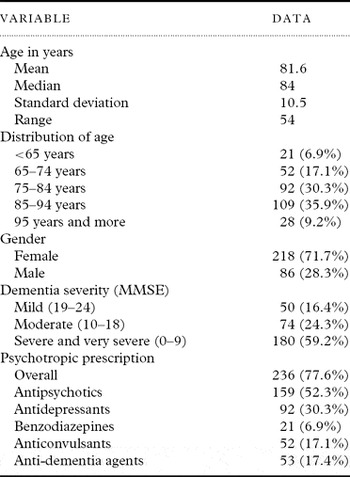
Our sample consisted of 304 nursing home residents with dementia of whom 86 (28.3%) were men and 218 (71.7%) were women. This high female-to-male ratio of more than 3:1 is consistent with previous studies on nursing home residents with dementia (e.g. Zuidema et al., Reference Zuidema, Derksen and Verhey2007a; Savva et al., Reference Savva, Zaccai and Matthews2009). The median age of the sample was 84 years, 59 (19.4%) patients were older than 90 years, and four (1.3%) were older than 100. More patient characteristics are shown in Table 1.
Patient characteristics

Note: Patients’ characteristics in a sample of (N = 304) patients with dementia in 18 nursing homes in Berlin, Germany. MMSE = Mini-Mental State Examination
Factor analysis
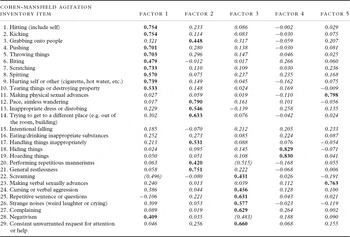
CMAI scores were available for N = 304 residents. Factor analysis with an eigenvalue cut-off set to 1.0 revealed an initial eight-factor solution explaining 61.65% of variance. The eight-factor solution, however, did not show any clinically meaningful factors. Furthermore, scree plot inspection revealed that five factors represent an optimal solution, with only minor increases (less than 4%) of variance explained by Factors 6 through 8. The results of these five factors explained 50.36% of the variance, as shown in Table 2.
Varimax rotated Cohen-Mansfield Agitation Inventory (CMAI) factor analysis

Note: N = 304 nursing home residents with dementia. In the left column, CMAI items 1–29 are listed; in the columns 2–6, factor labels and factor loadings are listed. Factors were labeled: (1) physically aggressive behavior, (2) physically non-aggressive behavior, (3) verbally agitated behavior, (4) hiding and hoarding, and (5) inappropriate sexual behavior. Numbers in bold highlight variables with a factor loading of 0.4 or more, which were considered to load significantly on to more than one factor; italics highlight variables that showed factor loadings of less than 0.4 and therefore failed to load on a factor; and parentheses highlight variables with a factor loading of 0.4 or more on to more than one factor that were subsumed to the other factor due to conceptual fitting.
Items loading on Factor 1 (25.4% explained variance) were hitting, kicking, pushing, throwing things, biting, scratching, spitting, hurting self or others, tearing things or destroying property, and screaming. This factor was labeled physically aggressive behavior. Grabbing onto people, pacing, aimless wandering, inappropriate dress or disrobing, trying to get to a different place, handling things inappropriately, and general restlessness loaded on Factor 2 (8.0% explained variance), which was labeled physically non-aggressive behavior. Items loading on Factor 3 (6.8% explained variance) were performing repetitious mannerisms, cursing or verbal aggression, repetitive sentences or questions, strange noises, complaining, negativism, and constant request for attention, and were labeled as verbally agitated behavior. Factor 4 (5.4% explained variance) was labeled hiding and hoarding, as hiding things and hoarding things loaded on this factor; and, finally, making physical sexual advances and making verbal sexual advances were items loading on Factor 5 (4.8% explained variance), which was therefore named inappropriate sexual behaviors. However, the latter was excluded from further analysis due to low overall prevalence. Intentional falling and eating/drinking inappropriate substances failed to load on any factor and were thus excluded. Three items loaded on two different factors: screaming (Factors 1 and 3), negativism (Factors 1 and 3), and performing repetitious mannerisms (Factors 2 and 3). Thus, they were each subsumed to the factor they conceptually fitted to. These findings are comparable to previous CMAI factor analyses (Cohen-Mansfield et al., Reference Cohen-Mansfield, Marx and Rosenthal1989; Suh, Reference Suh2004; Rabinowitz et al., Reference Rabinowitz, Davidson, De Deyn, Katz, Brodaty and Cohen-Mansfield2005; Zuidema et al., Reference Zuidema, de Jonghe, Verhey and Koopmans2007b).
Prevalence of agitation and depression
Physically aggressive behaviors occurred in 28.6%, physically non-aggressive behavior in 61.5%, verbally agitated behavior in 76.3%, and hiding and hoarding in 26.6% of the patients. Clinically relevant depression as estimated with DMAS occurred in 46.4% of patients.
Associations between patient characteristics and prevalence of agitation/depression
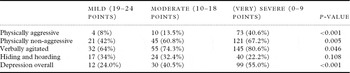
Association between stages of dementia severity and prevalence of agitation sub-syndromes and depression as compared by χ 2-statistics are listed in Table 3. Age was significantly associated with physically non-aggressive behavior (χ 2 = 11.09, df = 4, p < 0.05), showing an increasing risk for physically non-aggressive behaviors until the age of 95 years. There was a twofold increased risk for depressive syndromes from the age of 75 years when compared to the group aged 65–75 years (χ 2 = 11.73, df = 4, p < 0.01). Significant associations were found for gender and verbally agitated behaviors only (χ 2 = 5.23, df = 1, p < 0.05), with an increased risk for verbally agitated behavior in women. No association was found between gender and depressive symptoms.
Prevalence (%) of agitation sub-syndromes and prevalence of depression overall by stages of dementia severity

Note: p-values according to χ 2-tests.
Highly significant associations were found between stages of dementia severity as estimated by MMSE with all sub-syndromes except for hiding and hoarding. The latter decreased with further stages of dementia, but this association did not achieve statistical significance. For the other sub-syndromes of agitation, risk for agitated behaviors was positively associated with dementia severity. Furthermore, the risk for depression (i.e. a DMAS score of > 17 points) significantly increased with dementia severity (χ 2 = 16.46; df = 2; p < 0.001), making it more likely to be in depression with more severe stages of dementia. Depression was associated with physically aggressive (χ 2 = 12.06, df = 1, p < 0.001) and verbally agitated (χ 2 = 5.16, df = 1, p < 0.05) behaviors, but not related to other sub-syndromes. In addition, the relationship between dementia severity and symptoms of agitation and depression was analyzed with linear regression analyses, controlled for age and gender. Dementia severity stages, as measured with the MMSE, were inversely associated with CMAI total scores (β = 0.28, T = 4.92, p < 0.001). MMSE total scores were inversely associated with physically aggressive behavior (β = −0.33, T = −6.11, p < 0.001), physically non-aggressive behavior (β = −1.31, T = −2.29, p < 0.05), and hiding and hoarding (β = 0.163, T = 2.845, p < 0.01), but did not show a significant association with verbally agitated behavior (β = −0.10, T = −1.80, p = 0.07).
In linear regression analyses with DMAS total scores as independent variable and CMAI total score and clustered factors as dependent variables, adjusted for age and gender, significant associations were revealed between DMAS and CMAI total scores (β = 0.24, T = 4.13, p < 0.001), physically aggressive behaviors (β = 0.24, T = 4.22, p < 0.001), and verbally agitated behaviors (β = 0.13, T = 2.21, p < 0.05), effects that remained stable when controlling for MMSE total scores. We adjusted for multiple testing in all analyses using Bonferroni correction, and all significant correlations reported remained statistically reliable.
Discussion
Results from the present study indicate that symptoms of agitation and depression are common in nursing home residents with dementia in Germany and that they are associated with dementia severity. Physically aggressive and non-aggressive behaviors and verbally agitated behaviors increased with dementia severity, whereas hiding and hoarding behavior was more common in less severely impaired residents. In addition, the risk for depression increased with dementia severity, and depressive symptoms were associated with physically aggressive and verbally agitated behaviors beyond the effects of dementia severity. Prescription of antipsychotics was correlated with depression and all agitation sub-syndromes except hiding and hoarding. Physically non-aggressive behaviors increased with age until the age of >95 years. Depression showed a 2.5-fold increased risk in the eighth decade. Only verbally agitated behavior was associated with gender, showing higher prevalence rates in women.
The high prevalence of agitation and depression are comparable to previous studies (e.g. Lyketsos et al., Reference Lyketsos, Lopez, Jones, Fitzpatrick, Breitner and DeKosky2002; Selbaek et al., Reference Selbaek, Kirkevold and Engedal2007; Zuidema et al., Reference Zuidema, Derksen and Verhey2007a; Fernández et al., Reference Fernández, Gobartt and Balañá2010). The relationship between dementia severity and the prevalence of agitation and depression, however, has been conflicting.
In our study, the risk of agitation in general increased with more severe cognitive impairment and with advanced stages of dementia. Previous studies found dementia severity to be associated with agitation (Koss et al., Reference Koss1997; Lyketsos et al., Reference Lyketsos, Steinberg, Tschanz, Norton, Steffens and Breitner2000; Menon et al., Reference Menon2001; Gruber-Baldini et al., Reference Gruber-Baldini, Boustani, Sloane and Zimmerman2004; McCann et al., Reference McCann, Gilley, Bienias, Beckett and Evans2004; Aalten et al., Reference Aalten, de Vugt, Jaspers, Jolles and Verhey2005; Testad et al., Reference Testad, Aasland and Aarsland2007) and an elevated risk of behavioral and psychological symptoms in general (Selbaek et al., Reference Selbaek, Kirkevold and Engedal2007; Fernández et al., Reference Fernández, Gobartt and Balañá2010). Overall, most of the studies are in line with the finding of an association between dementia severity and prevalence of agitation and its sub-syndromes. Differences concerning specific correlations might be partly due to methodological differences, as Geriatric Depression Scale (GDS) and MMSE severity stages are not directly comparable, estimating the level of functional and cognitive impairment, respectively. While all other sub-syndromes were positively correlated with dementia severity in our sample, “hiding and hoarding” was more common in less severely impaired residents, although this correlation did not achieve statistical significance. This finding is in line with previous studies proposing distinct and more specific psychopathological mechanisms to be involved in hiding and hoarding in comparison to other sub-syndromes or simply “non-aggressive behavior” (Lahera et al., Reference Lahera, Saiz-González, Martín-Ballesteros, Pérez-Rodríguez and Baca-García2006; Zuidema et al., Reference Zuidema, de Jonghe, Verhey and Koopmans2007b). Inappropriate sexual behaviors showed a prevalence of 7.2% in our study. Research on sexually inappropriate behaviors in dementia patients is rare. Still, they have been reported consistently, exhibiting prevalence between 2.9% (Devanand et al., Reference Devanand1992) and 25% (Szasz, Reference Szasz1983; Burns et al., Reference Burns, Jacoby and Levy1990). Sexual inappropriate behaviors might be under-represented in CMAI, as not all of the conceivable problems are covered. As they are associated with increased caregiver burden and result in clinically relevant problems of social interaction, further research on sexual inappropriate behavior in dementia is needed.
We found a linear correlation between cognitive decline and the prevalence of depressive symptoms. Although depressive symptoms are a well-known risk factor for developing dementia for healthy persons and patients with mild cognitive impairment (MCI; Rapp et al., Reference Rapp2010; Singh-Manoux et al., Reference Singh-Manoux2010; Chan et al., Reference Chan2011), previous research is contradictory on the relationship between dementia severity and prevalence of depression. Some studies are in line with our findings, indicating depressive symptoms to be associated with more advanced stages of dementia (Rovner et al., Reference Rovner, Broadhead, Spencer, Carson and Folstein1989). Menon et al. (Reference Menon2001) found patients with moderate and severe cognitive impairment to have a higher risk to be depressed than those with milder stages of dementia. In contrast, other studies found depressive symptoms to be more prevalent in less severely impaired patients (Lyketsos et al., Reference Lyketsos, Steinberg, Tschanz, Norton, Steffens and Breitner2000; Aalten et al., Reference Aalten, de Vugt, Jaspers, Jolles and Verhey2005; Steinberg et al., Reference Steinberg2006), or did not find a correlation between dementia severity and depression (Lyketsos et al., Reference Lyketsos1997; Selbaek et al., Reference Selbaek, Kirkevold and Engedal2007). Depression probably is a risk factor and a prodrome for Alzheimer's disease (Enache et al., Reference Enache, Winblad and Aarsland2011), and different approaches have been suggested to explain the association between dementia severity and the prevalence of depression, including the hypotheses of shared genetic (Borroni et al., Reference Borroni2009) or neuropathological (Lai et al., Reference Lai, Tsang, Esiri, Francis, Wong and Chen2011) pathways and the psychosocial stress hypothesis (Tran et al., Reference Tran, Srivareerat, Alhaider and Alkadhi2011). However, the underlying pathomechanisms have not yet been clearly identified.
In addition, depressive symptoms were associated with physically aggressive and verbally agitated behaviors in our study, which is in line with previous studies (Lyketsos et al., Reference Lyketsos1999; Gruber-Baldini et al., Reference Gruber-Baldini, Boustani, Sloane and Zimmerman2004; Cohen-Mansfield and Libin, Reference Cohen-Mansfield and Libin2005; Leonard et al., Reference Leonard, Tinetti, Allore and Drickamer2006). Moreover, we found linear association with agitation in general (Prado-Jean et al., Reference Prado-Jean2010b). Disturbances of serotonergic (Murphy et al., Reference Murphy, Andrews, Wichems, Li, Tohda and Greenberg1998; Ueki et al., Reference Ueki, Ueno, Sato, Shinjo and Morita2007) and dopaminergic (Engelborghs et al., Reference Engelborghs2008; Proitsi et al., Reference Proitsi2012) neurotransmissions have been suggested as shared underlying pathophysiologic pathways of both agitation and depression, although to date, the exact pathomechanisms have not yet been identified and require further research. As depressive symptoms are correlated with agitation and tend to be under-recognized (Baller et al., Reference Baller2010), Menon et al. (Reference Menon2001) suggest aggressive features to be markers for depressive symptoms in dementia. Moreover, the association between agitation and depressive symptoms might be partly understood as an indicator for a high prevalence of untreated agitated depressions in our sample.
Antipsychotics are broadly employed to treat symptoms of agitation or psychosis in dementia – often being overdosed and thereby aggravating or causing further symptoms of agitation – including akathisia or tasikinesia. Moreover, typical antipsychotics like haloperidol can result in depressive symptoms. On the other hand, depressive symptoms can present as agitated behaviors and are correlated with agitation in the elderly, which finally results in adverse interactions. In addition, depression and all agitation sub-syndromes except “hiding and hoarding” were associated with prescription of antipsychotics. Again, this finding suggests a more differentiated approach regarding different sub-syndromes of agitation, especially hiding and hoarding.
In our sample, physically non-aggressive behaviors increased with higher age until the age of 95 years, whereas agitation in general and its other sub-syndromes were not associated with dementia severity. Depression showed a 2.5-fold increased risk in the eighth decade. This is consistent with age being a risk factor for depression and suicide.
Our study has some limitations: as the above-mentioned five factors explained 50.36% of variance only, and as one of these factors showed an overall prevalence of less than 10% and was therefore excluded from further analyses, conclusions drawn regarding agitation sub-syndromes should be considered with some caution in our study. However, the CMAI items and identified factors appear to be robust and corroborate previous CMAI factor analyses (Suh, Reference Suh2004; Rabinowitz et al., Reference Rabinowitz, Davidson, De Deyn, Katz, Brodaty and Cohen-Mansfield2005; Zuidema et al., Reference Zuidema, de Jonghe, Verhey and Koopmans2007b). As the vast majority of patients was female, some of our results might not be generalized regarding potential gender differences. On the other hand, the gender distribution in our study corroborates patients’ characteristics from several previous studies investigating nursing home residents with dementia for different epidemiological reasons.
Conclusions
Our findings have several implications for clinical practice and further research: Both agitation and depression are predicted by dementia severity, with increasing prevalence in advanced stages of cognitive decline when controlling for age, gender, and psychotropic prescriptions. Especially regarding depressive symptoms, our findings are in contrast with other studies (Lyketsos et al., Reference Lyketsos, Steinberg, Tschanz, Norton, Steffens and Breitner2000; Aalten et al., Reference Aalten, de Vugt, Jaspers, Jolles and Verhey2005) suggesting a decrease of depressive symptoms with further stages of dementia. Possible reasons for these discrepancies are sample selection (community vs. nursing homes), and the assessment tools used for depressive symptoms. The DMAS, an observer-based instrument, has been shown to be valid in advanced stages, and its application in this study may hence have increased the detection of depression. Under-recognition of depressive symptoms in severely impaired nursing home residents is a considerable problem, since effective antidepressant treatment options can thereby be missed. Furthermore, depression and agitation and some of its sub-syndromes were inter-correlated, which suggests shared etiological pathways and indicates the necessity of further research on neurobiological mechanisms underlying neuropsychiatric symptoms in dementia. By this means, new treatment alternatives might be revealed. Clinically, the close relationship between agitation and depression in our sample might be understood as a high prevalence of untreated agitated depression. Again, this finding may be important for the treatment of behavioral symptoms in dementia, as antidepressant drugs may be superior to antipsychotics or sedatives (Ballard et al., Reference Ballard2009b; Baller et al., Reference Baller2010).
Conflict of interest
None.
Description of authors’ roles
Tomislav Majic collected the data and wrote the paper; Jan P. Pluta and Yvonne Treusch assisted with the data collection; Thomas Mell assisted with writing the paper; Hans Gutzmann participated in designing the study; and Michael A. Rapp designed the study, supervised the data collection, and was responsible for the statistical design and for carrying out the statistical analyses of the study.
Acknowledgments
This study was supported by the German Federal Ministry of Health in the framework of the “Leuchtturm Projekt Demenz,” a services research program on dementia (BMG LT 44-076).