As David Morgan remarked nearly a decade ago in an essay assessing the Mongol empire in world history, “One of the deficiencies of scholarship on the Ilkhanate used to be its excessive concentration on the centre”.Footnote 1 Recent work, he noted there, has helped to redress the balance, and he called attention to several articles on the Injuʾids in Fārs.Footnote 2 This essay follows up Morgan's pertinent comment about investigating the provinces, using not only the historian's lens of written documents but also the art historian's gaze on buildings and their furnishings. It focuses on the town of Warāmīn and its multiple shrines, notably the Imāmzāda Yaḥyā, showing how the construction, enlargement, and redecoration of it and other buildings document the growing prosperity of the town and the role of its provincial rulers under the Mongols. It thus gives us another “view from the edge”.Footnote 3
The town of Warāmīn (lat. 35° 19ʹ N., long. 51° 40ʹ E.) lies about fifty kilometres southeast of Tehran in a fertile plain.Footnote 4 Benefiting from water supplied by the Jaja River, the town was already known in medieval times for its agricultural products, including cotton, corn and fruits. It flourished after the Mongols sacked Rayy in 617/1220, in part due to its strategic position on the main east-west highway that connected Tabrīz and Sulṭāniyya with sites further east in Qūmis and Khurāsān. During this period, Warāmīn was transformed from a village (dīh) into a provincial city (qaṣba) and capital (dār al-mulk) of the province (tūmān) of Rayy. The population of the district, according to contemporary chroniclers, was predominantly Shiʿite, especially Twelvers.
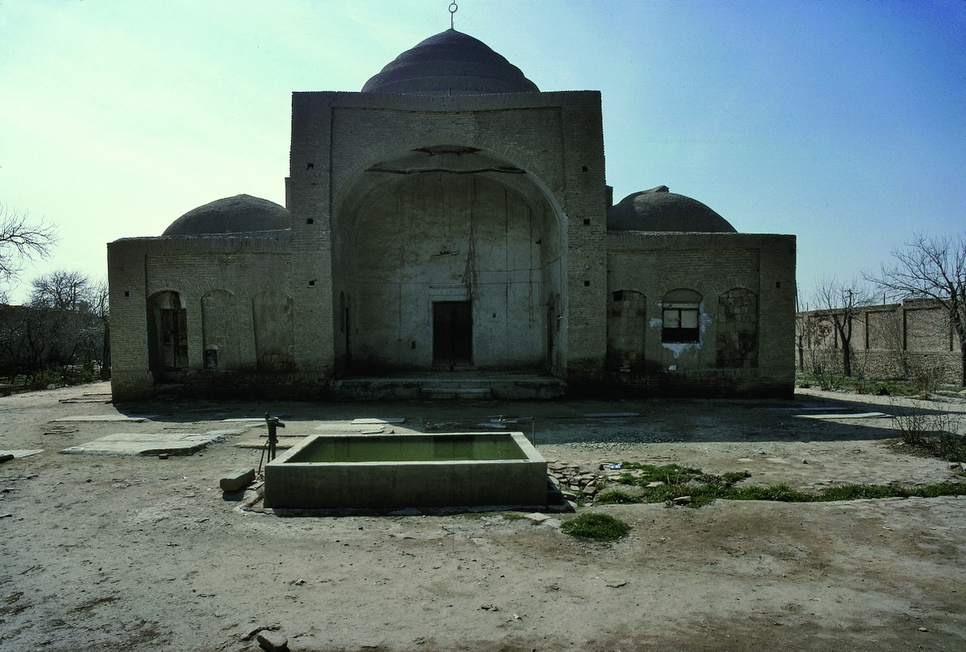
Warāmīn's florescence in the Mongol period and its religious fervour are neatly encapsulated in the Imāmzāda Yaḥyā, the most important of the several shrines in the town (Fig. 1).Footnote 5 Located in the quarter known as Kuhna Gil in the southeast sector near the Friday Mosque, the shrine is said to commemorate the grave of a sixth-generation descendant of the Prophet's grandson Ḥasan.Footnote 6 The modern complex comprises a square domed tomb (about 10.6 meters across) surrounded by a series of low rooms. The architectural historian Donald Wilber, who surveyed the shrine in May 1939, determined that although the surrounding rooms were of later date, the fabric of the structure dated to the Ilkhanid period, based on the size of the bricks (22 cm square), the use of deep corner niches, the division of the dado into separate bands, the type of brick end-plugs found on the upper exterior walls, and the series of setbacks on the exterior of the dome.
View of the Imāmzāda Yaḥyā in Varāmīn. Photo: Sheila Blair and Jonathan Bloom

The interior of the tomb room was once lavishly revetted in plaster and tile, but already by the date of Wilber's visit, all of the star and cross tiles had been stripped from the dado (up to a height of some 1.85 meters) and the mihrab area blocked up with bricks (the blocked area measured some 2.28 meters across). We know that the original decoration comprised lustre tiles, because the mihrab and some of the star and cross tiles as well as a cenotaph had still been in situ when the French traveller Jane Dieulafoy visited the site a half century earlier in 1881.Footnote 7 She called it one of the most interesting monuments in the region, remarking that of all the lustre tiles that she could remember, the ones at the Imāmzāda Yaḥyā were the purest and most brilliant and describing their three different colours of lustre: yellow, brass and red copper.
Dated inscriptions on the tomb and its interior revetment document two distinct stages of work on the Imāmzāda Yaḥyā during the Mongol period. The first took place in the 660s/1260s, as shown by inscriptions on some of its many lustre tiles that have been dispersed to museums and collections around the world. In his comprehensive survey of lusterwares, Oliver Watson reported that he knew of at least 150 star and cross tiles from the site, scattered among some twenty-four collections.Footnote 8 Since his publication, many more have been identified.Footnote 9
The largest selection belongs to the State Hermitage Museum in St Petersburg (nos IR-1046–1056), which is said to hold over one thousand whole tiles and fragments from the Imāmzāda Yaḥyā that were transferred to the museum in 1925 from the Stieglitz School of Technical Design.Footnote 10 The typical tile is large (approximately 31 cm in diameter), decorated with a quadripartite floral or geometric design in the centre surrounded by a Qur’anic inscription around the edge. Sixty examples in the Hermitage have inscriptions ending with a date, ranging from Dhū’l-Ḥijja 660 to Rabīʿ II 661 (16 October 1262–12 March 1263).
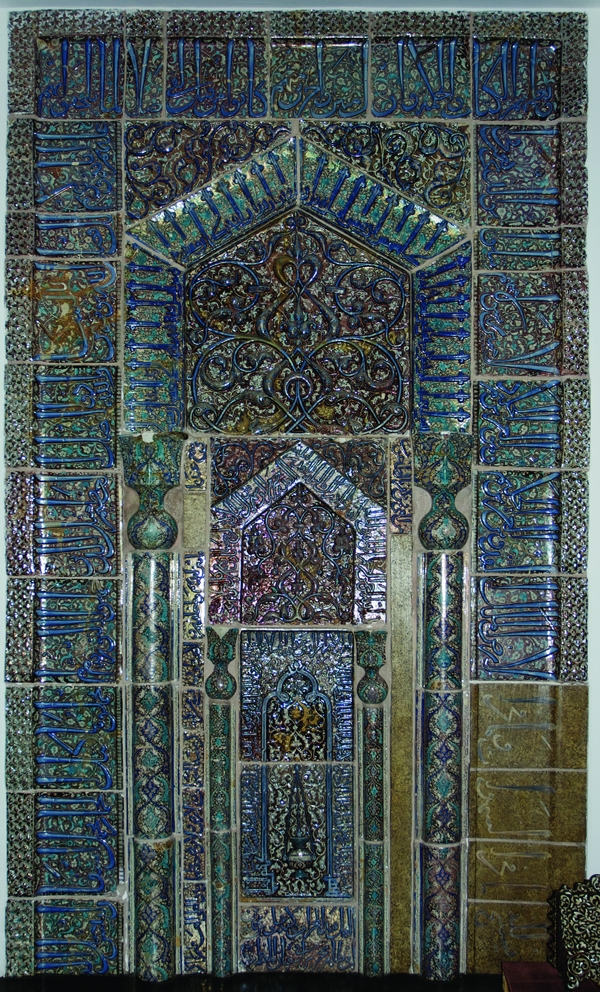
In addition to the lustre star and cross tiles in many museums, the lustre mihrab removed from the Imāmzāda Yaḥyā has also survived and is now in the Doris Duke Foundation for Islamic Art in Honolulu (no. 48.327; Fig. 2).Footnote 11 Like other mihrabs of the period, it comprises a set of three nested niches framed by several inscription bands. The large panel at the bottom gives the name of the maker, ‛Alī b. Muḥammad b. Abī Ṭāhir, one of the premier tile markers of the period, followed by the date Sha‛bān 663/May 1265, some two years after the dado tiles.Footnote 12
Luster mihrab removed from the Imāmzāda Yaḥyā in Varāmīn and now in the Doris Duke Foundation for Islamic Art (no. 48.327). Photo: Sheila Blair and Jonathan Bloom
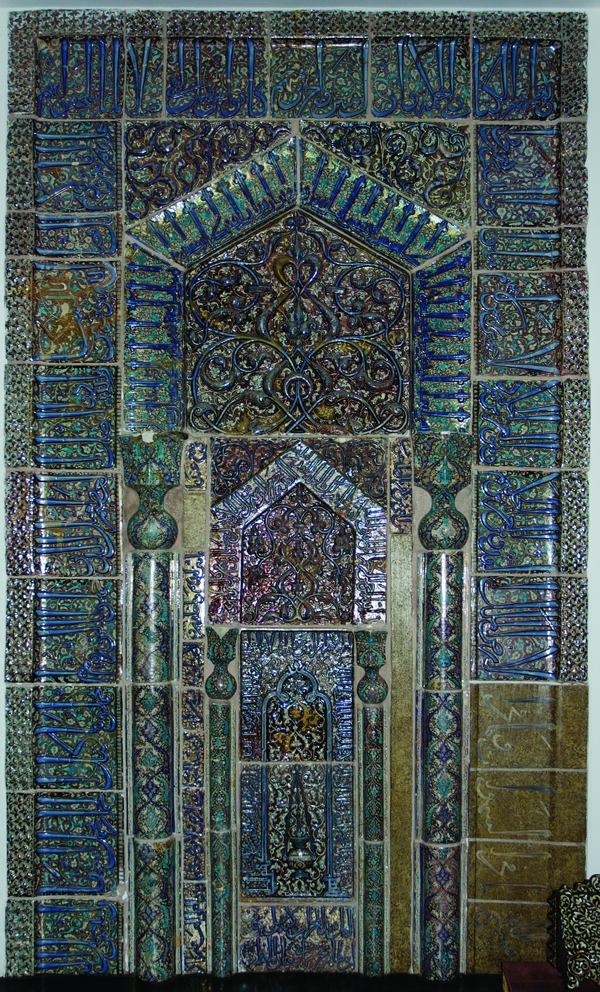
We can imagine, then, that the decision to build the Imāmzāda Yaḥyā was made in the early 660s/1260s and lustre tiles ordered from the city of Kāshān, about 200 kilometers due south and the centre of lustre production in Iran. It took some five months to make the thousand or more lustre tiles needed for the interior dado and a further two years to fabricate the masterpiece of the decoration, the sixty individual lustre tiles making up the mihrab. The mihrab ensemble is much more complicated to produce, as the tiles in it are not just moulded and painted, but require the additional step of adding the individual letters by luting (attaching with liquid clay).Footnote 13
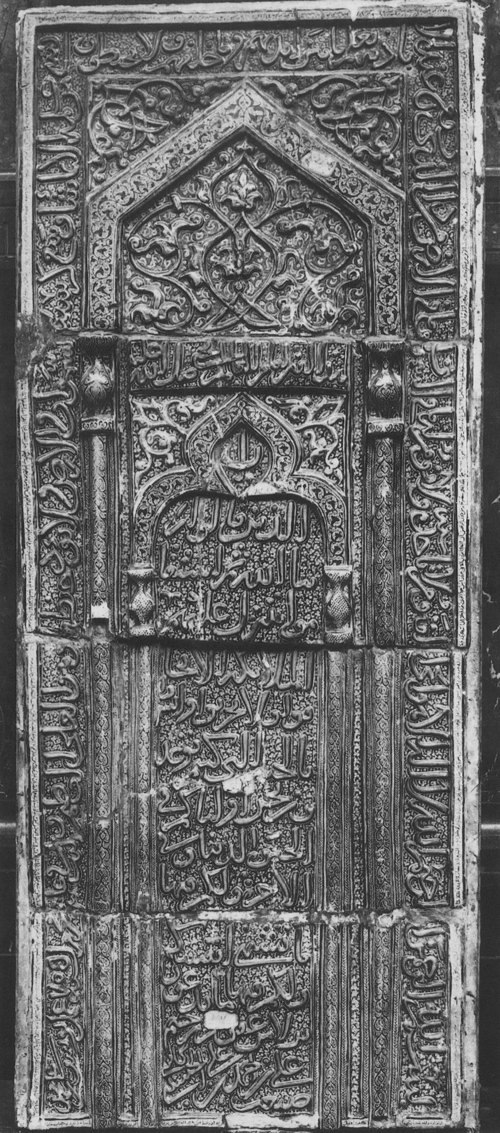
A second stage of work at the Imāmzāda Yaḥyā took place in the first decade of the eighth/fourteenth century. In addition to the large group of dado tiles from the 660s/1260s, the Hermitage owns a set of four lustre tiles (no. IR-1594) that together comprise a large (221 × 87 cm) rectangular panel (Fig. 3).Footnote 14 A raised band across the top says that “This is the grave (qabr) of the learned Imām, Yaḥyā, may God grant him peace”. Another raised band around the edge ends with the date, 10 Muḥarram 705/2 August 1305, and the signature of the potter who made the set, Yūsuf b. ‛Alī b. Muḥammad, son of the potter who had made the lustre mihrab dated 663/1265 for the same tomb. The inscription under the arch in the middle of the Hermitage set ends with a second signature: decoration (ṣana‛at) by ‛Alī b. Aḥmad b. ‛Alī al-Ḥusaynī Kāshī, a member of the al-Ḥusaynī family of Kāshān potters, of whom only one other individual has so far been identified.Footnote 15
Luster tiles removed from the cenotaph cover in the Imāmzāda Yaḥyā in Varāmīn and now in the Hermitage Museum, St Petersburg (no. IR-1594). Photo: Sheila Blair and Jonathan Bloom

This set of tiles in the Hermitage probably covered the top of the large cenotaph marking Imām Yaḥyā's grave, similar to the cenotaph still in situ in the tomb of Fāṭima at Qum.Footnote 16 By analogy with the one at Qum, there must have been more lustre tiles on the cenotaph in the Imāmzāda Yaḥyā. The one at Qum is entirely covered with lustre tiles, including another Qurʾānic band framing the set on the top, two large bands at the top and bottom of the sides that enclose panels of star and cross tiles, and corner colonnettes. Most of the lustre tiles for the Qum cenotaph were made at the beginning of the seventh/thirteenth century by a pair of famous lustre potters: Muḥammad b. Abī Ṭāhir b. Abī’l-Ḥusayn, who signed a plaque at the base of the cenotaph cover, and his regular partner, Abū Zayd, who signed the large raised foundation ringing the top and bottom of the sides dated 2 Rajab 602/12 February 1206. But at least one corner colonnette was added decades later to the Qum cenotaph, as it is signed by ‛Alī b. Muḥammad b. Abī Ṭāhir, son of the potter who signed the top and active in the middle of the century when he made the mihrab for the Imāmzāda Yaḥyā. Thus it seems that broken or damaged tiles were replaced over time. In the case of Warāmīn, therefore, we do not know whether the cenotaph was made entirely new in 705/1305 or whether only the top panel dated 705/1305 was added to a lustre cenotaph that was already in place.
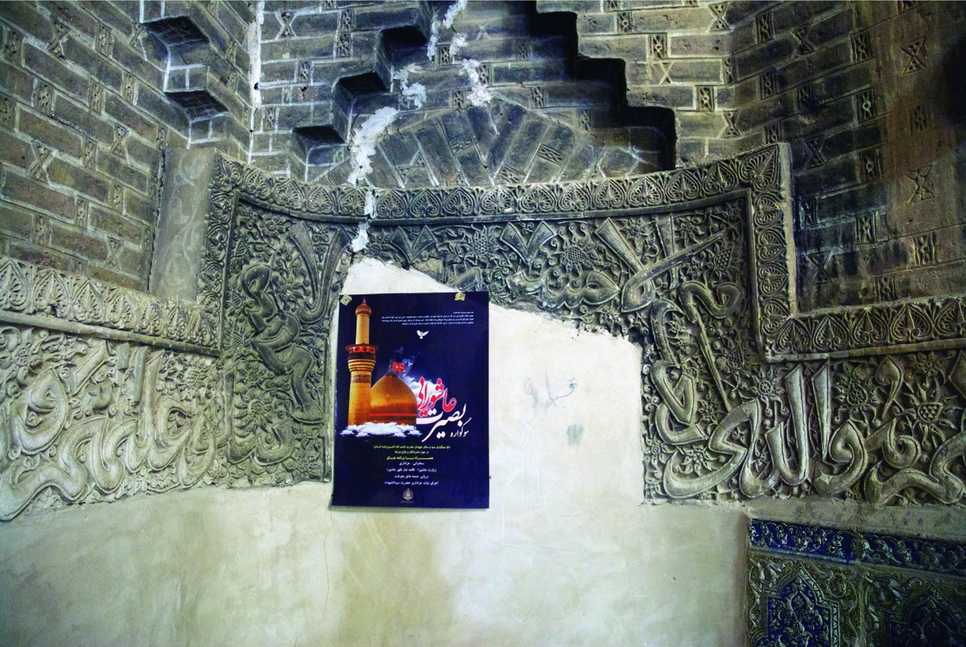
The new cenotaph cover was only part of the work carried out at Imāmzāda Yaḥyā in the opening decade of the eighth/fourteenth century. At the same time, a plaster band was added at the top of the dado encircling the room (Fig. 4). Elegantly carved against a floral scroll ground, the plaster band is the only inscription still in situ in the tomb. It is also the longest and most informative of the texts on the building, for following the first four verses of Qurʾān 62, the plaster inscription gives not only the date but also the name of the patron:

Efforts were made for the construction of this building to approach God the Most Exalted and endeavouring to please Him, who was gracious to His sinful and sinning servant, Abū Muḥammad al-Ḥasan ibn Murtaḍā ibn al-Ḥasan ibn Muḥammad ibn al-Ḥasan ibn Abī Zayd, may God forgive his evil deeds through Muḥammad and his progeny, in Muḥarram of the year seven hundred and seven [July 1307].Footnote 17
Stucco inscription decorating the interior of the Imāmzāda Yaḥyā in Varāmīn. Photo: Sheila Blair and Jonathan Bloom

The date, some two years after the one on the cenotaph cover, suggests that the renovations to the interior of the Imāmzāda Yaḥyā were substantial. They bespeak a high level of funding, not surprising as contemporary chronicles allow us to identify the patron mentioned in the plaster inscription as Fakhr al-Dīn, local ruler (malik/wālī) of the province of Rayy and Warāmīn at the turn of the eighth/fourteenth century. A protégé of the fourth Ilkhanid ruler Arghun (r. 1284–91), Fakhr al-Dīn crops up several times in Rashīd al-Dīn's Jāmiʿ al-tawārīkh, no surprise as Arghun's son Ghāzān (r. 1295–1304) commissioned the chronicle.Footnote 18
Fakhr al-Dīn is first mentioned when he was caught up in the disputes between the two successors to the second Ilkhanid ruler Abaqa (r. 1265–82): his brother and immediate successor Tegüder Aḥmad (r. 1282–84), and his son and second successor Arghun.Footnote 19 According to the chronicle, in the fall of 681/1282 Arghun, then still a prince, confirmed Fakhr al-Dīn as malik of Rayy. This action incensed Arghun's rival, the ruler Tegüder Aḥmad, who had Fakhr al-Dīn hauled off to Shīrwān and tortured. Arghun, in turn, was angered, and told the amirs and the ṣāḥib-dīwān that his father Abaqa had given him the malik and that he would revenge any slight done to any of his associates.
Arghun carried out his threat the following spring. Having wintered over in Baghdad, Arghun embarked for Khurāsān where his father had made him governor. Upon reaching Rayy, Arghun had the unnamed official (shaḥna) whom Tegüder Aḥmad had stationed there beaten, locked in a dushākha (a forked stick that fastened around a prisoner's neck and pinned one arm),Footnote 20 and dispatched in disgrace on an ass to his rival. These events exemplify the growing friction between the two Mongol princes, and relations between the two rivals only deteriorated after this contretemps.
Malik Fakhr al-Dīn soon crops up again in Rashīd al-Dīn's account about the conclusion of the enmity between Tegüder Aḥmad and Arghun and the events leading up to the former's demise.Footnote 21 On 9 Dhū’l-Qa‛da 682/29 January 1284, Tegüder Aḥmad moved against his rival Arghun by sending an army of a hundred thousand men. An advance party under the command of Tegüder Aḥmad's son-in-law, the Georgian general Alinaq, set out from Qazwīn, galloping as far as Warāmīn where they plundered three hundred households of artisans (khāna-yi awaz) who belonged to Arghun before returning to camp. Upon learning of this, Rashīd al-Dīn tells us, Arghun sent envoys to his treasury and to the workshops (kārkhānahā) at Nīshapūr, Ṭūs, and Isfarāyin to bring everything available. Within twenty days quantities of gold, jewels, and textiles were delivered to Gurgān to distribute to Arghun's soldiers. Malik Fakhr al-Dīn was in charge of inventorying the merchandise. The two sides eventually fought a pitched battle south of Qazwīn on 16 Ṣafar 683/4 May 1284. After more skirmishes and intrigues, Tegüder Aḥmad was finally handed over to Arghun who passed a death sentence that was carried out on 26 Jumādā I 683/10 August 1284.
Malik Fakhr al-Dīn also reappears in Rashīd al-Dīn's chronicle a decade later in the events following the death of Arghun's brother and successor Geikhatu (r. 1291–95) in Jumadā I 694/March 1295 and the brief reign of Baidu (r. 1295).Footnote 22 With the support of the previously rebellious amir Nawrūz, Arghun's son Ghazan converted officially to Islam on 2 Sha‛bān 694/17 June 1295.Footnote 23 He progressed from Ūjān to his father's capital Tabrīz, which he entered on 23 Dhū’l-Qa‛da 694/4 October 1295. According to Rashīd al-Dīn's account, while there Ghazan issued edicts calling for tolerance and then following a banquet in the ‛Adiliyya Kiosk in a garden of Tabrīz, departed for winter quarters in Mūghān. En route, Ghazan sent Malik Fakhr al-Dīn, clearly still a court favourite, back to Tabrīz to announce that tax monies were not to be given to amirs like Nawrūz who were to cease their insurrection. Nawrūz acquiesced, reaffirmed his fealty to Ghazan, and was confirmed as chief amir. At the same time Ghazan also confirmed several other appointments, including Ṣadr al-Dīn Zanjānī as head of the bureaucracy and Fakhr al-Dīn as general overseer (ashrāf hamkanān). Ghazan then continued on to the Qārābāgh steppe where he was enthroned on 23 Dhū’l-Ḥijja 694/3 November 1295 as the seventh Ilkhanid ruler of Iran.
Fakhr al-Dīn remained a favourite at court under Ghazan's brother and successor Öljeitü (r. 1304–16). Öljeitü had commissioned Rashīd al-Dīn to write a continuation of his collection of chronicles dealing with the sultan's reign. This section has been lost from the Jāmi‛ al-tawārīkh, but luckily the annals of Öljeitü's reign composed by Abū’l-Qāsim Kāshānī, probably one of the sources for Rashīd al-Dīn's collection of histories, has survived.Footnote 24 Abū’l-Qāsim Kāshānī includes a lengthy obituary about Malik Fakhr al-Dīn under the year 707/1307–8.Footnote 25 Fakhr al-Dīn was, according to Abū’l-Qāsim Kāshāni, the epitome of culture and refinement who was adept at six languages and three scripts (Mongolian, Persian, and kūfī). He also knew accounting and was little short of perfection, except that he died young in Sulṭāniyya on Wednesday 20 Sha‛bān 707 [14 February 1308], only seven months after the date in the plaster foundation inscription still in situ in the Imāmzāda Yaḥyā in Warāmīn.
Abū’l-Qāsim Kāshānī had good reason to be so fulsome in his account of Malik Fakhr al-Dīn, for the chronicler came from the famous Abū Ṭāhir family of lustre potters whose work was installed at Warāmīn: he was the brother of Yūsuf b. ‛Alī, the potter who made the cenotaph cover for the Imāmzāda Yaḥyā in 705/1305, and the nephew of ‛Alī b. Muḥammad, the potter who had made the mihrab there in 663/1265. Abū’l-Qāsim Kāshānī himself wrote a treatise on gems and minerals, Arāʾis al-jawāhir wa nafāʾis al-aṭāyib (“Brides of Gems and Precious Aromas”), which contains a lengthy section on making lustreware.Footnote 26 Abū’l-Qāsim Kāshānī therefore must have known Malik Fakhr al-Dīn well, and the chronicler's information is likely to be accurate, if somewhat panegyric.
Malik Fakhr al-Dīn Ḥasan was a generous patron. The lustre cover that he ordered for the cenotaph in the Imāmzāda Yaḥyā (Fig. 3) was the most expensive type of glazed ceramic produced for interior decoration in medieval Iran.Footnote 27 Lustre tiles were used to decorate the fanciest buildings of the Ilkhanid period, ranging from major shrines and tombs to secular buildings for the court, such as the summer palace at Takht-i SulaymānFootnote 28 and the observatory at Marāgha.Footnote 29 It is no surprise that Malik Fakhr al-Dīn Ḥasan spent so much money to redecorate the Imāmzāda Yaḥyā: the tomb commemorates a Ḥasanid, and Malik Fakhr al-Dīn was one too, for the lengthy six-generation genealogy in the plaster foundation inscription there indicates that every other generation of the family was named Ḥasan.
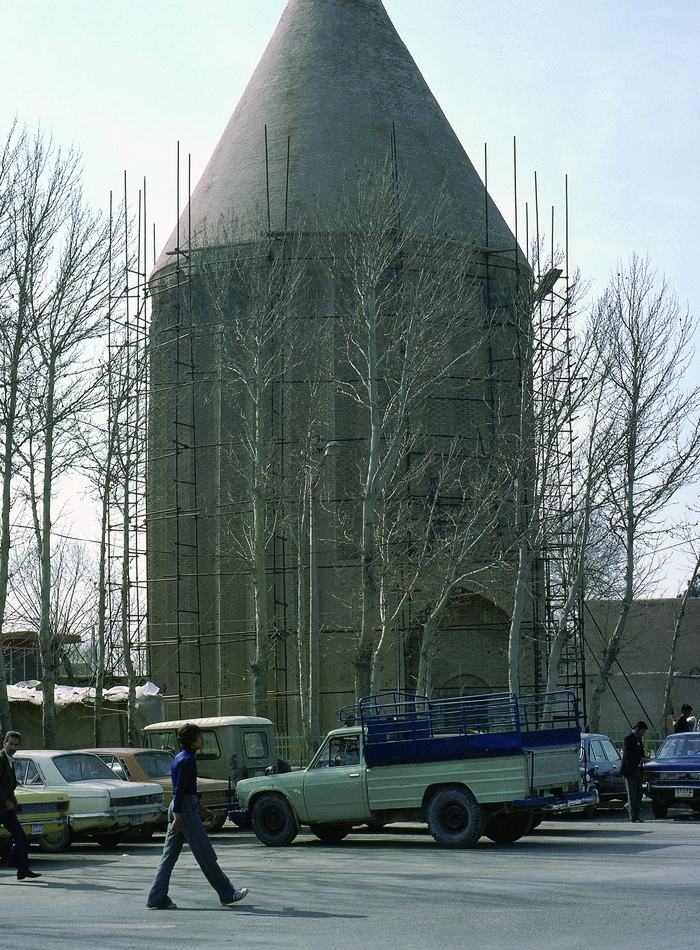
Malik Fakhr al-Dīn's architectural patronage also extended beyond the Imāmzāda Yaḥyā. He also commissioned the flanged tomb tower on the northern edge of Warāmīn (Fig. 5).Footnote 30 An inscription below the conical roof in turquoise glazed tile contains the foundation inscription.Footnote 31 It states that this domed tomb (qubba) marks the grave of ‛Alā’ al-Dīn Murtaḍā b. Fakhr al-Dīn Ḥasan al-Warāmīnī.

Basmala. . . . this tomb (al-qubba) . . . of Islam . . . mankind, ‛Alā’ al-Dawla wa’l-Dīn, pillar of Islam and the Muslims, refuge of the pure line, al-Murtaḍā, son of the august master (al-mawlā) Fakhr al-Dawla wa’l-Dīn al-Ḥasanī [al]-Warāmīnī, may God's satisfaction be on him [and on] the souls of his ancestors. He died on 4 Ṣafar 675 [17 July 1276]. This tomb (al-qubba) was finished in [6]88 [1289–90].
Tomb tower for ʿAlāʾ al-Dīn in Varāmīn. Photo: Sheila Blair and Jonathan Bloom

To judge from the lineage and the date given in the inscription on the tomb tower, the deceased ‛Alā’ al-Dīn al-Murtaḍā was the father of Malik Fakhr al-Dīn, who has the same epithet as al-Murtaḍā's father (and therefore Malik Fakhr al-Dīn's grandfather). According to the inscription, al-Murtaḍā who is lauded as the pillar of Islam and the Muslims (rukn al-islām wa’l-muslimīn) and the asylum of the pure line (kahf al-‛itrat al-ṭāhira i.e., the family of Muḥammad) was also a Ḥasanī. ‛Alā’ al-Dīn al-Murtaḍā died on 4 Ṣafar 675/17 July 1276, but the tomb was not finished until [6]88/1289, more than a decade later. Such a chronological gap is curious, as tombs are usually commissioned during the lifetime or just after the death of the person commemorated.
Knowing something of Malik Fakhr al-Dīn's biography from the chronicles suggests an explanation for this anomaly, and putting together the information from chronicles and buildings allows us to sketch a fuller biography of this provincial ruler. The chronicler Abū’l-Qāsim al-Kāshānī makes much of Fakhr al-Dīn's youth when he died. If we assume Fakhr al-Dīn was, say, forty years old at his death in 707/1308, then he would have been only eight years old when his father died in 675/1276. He may have inherited his father's position of malik, but he was unlikely to have commissioned a building at such a young age. Six years later, in the fall of 681/1282, prince Arghun, who had inherited the malik from his father Abaqa, confirmed Fakhr al-Dīn in this rank, but shortly thereafter Fakhr al-Dīn was hauled off to Shīrwān and tortured there. He must have re-assumed his duties as malik shortly after Arghun unceremoniously removed the unnamed shaḥna that his rival Tegüder Aḥmad had appointed in Warāmīn. Over the next few years Malik Fakhr al-Dīn would have amassed the monies to build the tomb tower for his father, a lucrative interval for which Fakhr al-Dīn specifically thanks God's graciousness in the foundation inscription for the tomb tower over his father's grave. The text was rather cleverly composed, as malik Fakhr al-Dīn's attempt to please God (li-mirḍātihi) makes a nice pun with his father's name al-Murtaḍā (literally, the satisfied one).
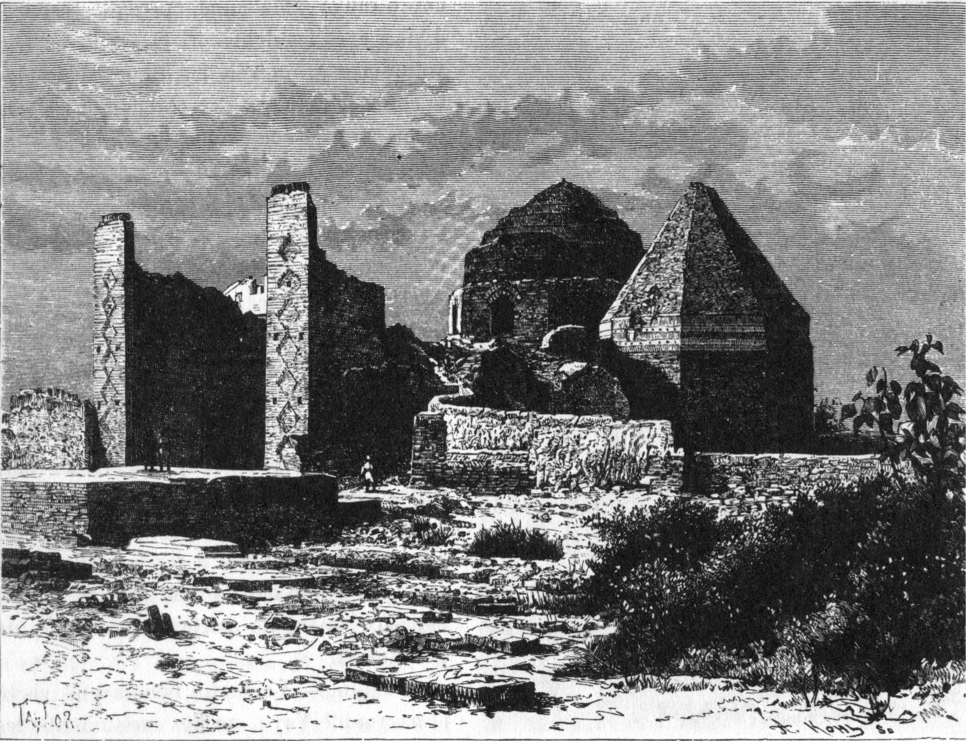
Given the long genealogy so carefully recorded on the plaster inscription in the Imāmzāda Yaḥyā, one wonders whether patronage of the shrine was a sort of family tradition, especially given the repeated reconstructions and redecoration of the square tomb. We can readily suppose that Fakhr al-Dīn's father Murtaḍā or even his grandfather Ḥasan carried out the original redecoration of the square tomb in the 660/1260s. Work at the shrine may date back even further, for the Imāmzāda Yaḥyā, although now freestanding, was once part of a larger complex described and illustrated by Dieulafoy. The woodcut engraving (Fig. 6) shows a ruined portal in front of the tomb tower along with another octagonal tomb tower on the right, all now destroyed.Footnote 32 Dieulafoy, a keen observer, suggested that the other buildings were of earlier date. Since the buildings have been destroyed, we have no way of verifying her suggestions, but some of the complex may well pre-date the (re)construction of the square tomb in the 660s/1260s.
Woodcut engraving of the complex around the Imāmzāda Yaḥyā in Varāmīn. After Dieulafoy, La Perse, la Chaldée et la Susiane, p. 147

The buildings of Warāmīn thus help us to trace the network of local politics, power, and patronage in Mongol Iran. The most important patron there around the turn of the eighth/fourteenth century was the local ruler (malik) Fakhr al-Dīn Ḥasan.Footnote 33 He built a tomb tower in honour of his father ‛Alā’ al-Dīn Murtaḍā in 688/1289–90 and renovated the interior of the Imāmzāda Yaḥyā between 705 and 707 (1305–7), a tomb that had been embellished already in the 660s/1260s, probably by an earlier member of his family, and perhaps founded even earlier. A protégé of Mongol rulers from Abaqa to Öljeitü, Malik Fakhr al-Dīn was also close to the Persian wazīrs in their administration, from Rashīd al-Dīn to his assistant Abū’l-Qāsim Kāshānī, who belonged to the most famous family of Kāshān lustre potters, themselves the artisans commissioned to decorate the Imāmzāda Yaḥyā.
But the maliks of Rayy and Warāmīn were also connected to other local families. They were cousins of the maliks of Simnān: according to the family tree put together by the historian Jean Aubin, Fakhr al-Dīn's grandfather, also called Fakhr al-Dīn, had a brother named Qāsim whose daughter Zuhrā married the malik of Simnān.Footnote 34 Their grandchild was the famous sufi shaykh, ‛Alā’ al-Dawla Simnānī (d. 736/1335), whose tomb was incorporated in his khānaqāh outside Simnān.Footnote 35 His tomb complex was one of the “Little Cities of God” that proliferated in this period around the graves of Sufi saints.Footnote 36 But so did Shi‛ite shrines for descendants of the Prophet's family, and they are often better preserved as they are still venerated today.
Fakhr al-Dīn and his counterparts exemplify the learned and artistically inclined patrons of the time. Their local revenues came from agriculture and trade, and they ploughed some of the income back into the community, endowing not only buildings but also their lavish furnishings. The mihrab at the Imāmzāda Yaḥyā, for example, is the largest of six examples surviving from the seventh/thirteenth and eighth/fourteenth centuries, bigger than the two made for the Shrine of Imām Riḍā at Mashhad.Footnote 37 As the person in charge of making an inventory of luxury goods like gold, jewels, and textiles to be distributed as payment to soldiers, Malik Fakhr al-Dīn was well acquainted with such commodities and well able to afford them himself.Footnote 38
Malik Fakhr al-Dīn's impact in Warāmīn did not stop with his father's tomb and the redecoration of the Imāmzāda Yaḥyā. His architectural legacy continued through his protégé, ‛Izz al-Dīn Qūhadī, patron of the new congregational mosque built in the town between 722 and 726 (1322–26) during the reign of Öljeitü's son Abū Sa‛īd (r. 1316–35).Footnote 39 It is the only extant congregational mosque from the Ilkhanid period showing the classic four-iwan plan. It is thus canonical. Its patron came from another local family of Shi‛ites, probably Ḥasanids. He rose through the bureaucracy, ultimately becoming assistant to the wazīr Tāj al-Dīn ‛Alīshāh when he split the office with Rashīd al-Dīn in 715/1315. Abū’l-Qāsim Kāshānī lauds ‛Izz al-Dīn, like his mentor Malik Fakhr al-Dīn, for his wealth and generosity.Footnote 40
David Morgan has waxed long and eloquently about the role of historical writing in the Mongol period. His recent article “Persian and non-Persian historical writing in the Mongol Empire” continues a discussion he began more than three decades earlier.Footnote 41 He notes rightly that the Mongol period is often cited as a high point in Persian historical writing and also one of the most prolific. But as the examples of Warāmīn and similar sites show, texts are not the only source for the history of the period. Buildings and their furnishings are equally high-quality and equally copious. They too are good sources for writing the history of the Mongol period, not only at the centre but also in the provinces.