


INTRODUCTION
During elections in many world regions, political parties distribute particularistic benefits to individuals. The standard depiction of this practice as “vote buying” presents an intriguing puzzle: how can vote buying coexist with the secret ballot? Scholars typically understand vote buying as offering rewards in exchange for vote choices (e.g., Hicken Reference Hicken2002, 2–3; Lehoucq Reference Lehoucq and Schaffer2007, 33; Stokes Reference Stokes2005, 315). But if parties are unable to monitor voting decisions, why can't individuals accept rewards and then vote for their preferred candidates anyway?
Susan Stokes's (Reference Stokes2005) insightful article, “Perverse Accountability: A Formal Model of Machine Politics with Evidence from Argentina,” greatly advances scholarly research on vote buying by highlighting this commitment problem and offering a plausible solution. Stokes (Reference Stokes2005, 315) argues that the Argentine Peronist party uses its “deep insertion in voters' social networks” to violate the secret ballot, and is therefore able to enforce compliance when it rewards weakly opposed voters for switching their votes.
However, the assumption that parties can monitor actions within the voting booth is often too stringent. An alternative explanation, focused on what I term “turnout buying,” provides insight into why parties might offer electoral rewards even if they do not compromise ballot secrecy.Footnote 1 By rewarding unmobilized supporters for showing up at the polls, parties can activate their own passive constituencies. Turnout buying offers a solution to the secret ballot puzzle, because the strategy does not require monitoring of specific vote choices. Instead, turnout buying requires monitoring whether rewarded individuals vote.
Recent elections in the United States provide examples of turnout buying. During the 2004 election, five Democratic Party operatives in East St. Louis were convicted in federal court for offering cigarettes, beer, medicine and $5 to $10 rewards to increase turnout of the poor. One party official pleaded guilty and testified that operatives offered individuals rewards “because if you didn't give them anything, then they wouldn't come out.” A local election in Oakland provides another example: campaign workers handed out thousands of coupons for free chicken dinners in an explicit and targeted effort to draw voters to the polls. More broadly, observers in various US cities have complained that some politicians use “street money”—small, unreported cash payments ostensibly used for legal get-out-the-vote efforts such as canvassing and transporting voters—as direct payments for turnout. For example, one journalist examining the use of “street money” in Chicago reports that “members of large families are still ‘hired’ by precinct captains on Election Day for $30 to $50 to make sure voters get to the polls.” Overall, such examples suggest that turnout buying deserves further investigation.Footnote 2
Unfortunately, the vote-buying literature rarely considers whether particularistic benefits are distributed to mobilize supporters. In general, scholars implicitly assume that parties offer rewards to influence the vote choices of opposing or indifferent voters, and therefore ignore turnout buying. Unlike some broader research on clientelism, most studies of vote buying, including Stokes's (Reference Stokes2005) influential paper, never mention mobilization or turnout. There are a few exceptions: Schaffer and Schedler's (Reference Schaffer, Schedler and Schaffer2007, 25) excellent conceptual overview of vote buying briefly mentions “participation buying”; Cox and Kousser (Reference Cox and Kousser1981) note that US parties in the late 1800s rewarded some farmers for showing up at the polls; and legal scholars (Hasen Reference Hasen2000, 1326, 1355–5; Karlan Reference Karlan1994, 1472–3) discuss normative implications of payments for turnout. But most studies fail to distinguish whether rewards are used to influence vote choice or induce electoral participation. And if researchers overlook the role of mobilization, serious analytical mistakes can arise. Thus, much of what scholars interpret as vote buying (exchanging rewards for vote choices) may actually be turnout buying (exchanging rewards for turnout).
This study advances research on electoral rewards by specifying and testing a mechanism by which parties can distribute particularistic benefits to mobilize supporters. Neither of these analytical tasks has been addressed by the existing literature. Formal modeling suggests that turnout buying is incentive-compatible, and also provides several testable predictions: (1) machines will focus rewards on strong supporters, (2) they will target the poor, and (3) they will offer rewards where they can most effectively monitor turnout. The turnout-buying model thus contrasts starkly with Stokes's (Reference Stokes2005, 321) vote-buying model, which predicts that machines target weak opposers. Although in reality both strategies coexist, empirical tests suggest that Argentine survey data in Stokes (Reference Stokes2005) are more consistent with turnout buying.
The findings of this study also have implications extending beyond research on electoral rewards. Scholars have long debated the logic, mechanisms, and motivations behind parties' distribution of targetable goods (e.g., infrastructure projects and particularistic benefits). Two major formal studies offer conflicting predictions: whereas Cox and McCubbins (Reference Cox and McCubbins1986) argue that parties will distribute targetable goods to core supporters, Lindbeck and Weibull (Reference Lindbeck and Weibull1987) contend they will target swing voters. Although most of this literature overlooks mobilization, as in the more narrow discussion of vote buying, an important new research agenda motivated by the work of Gary Cox promises to put mobilization at the heart of the debate. In an incisive conceptual paper, Cox (Reference Cox2006) argues that studies focus too narrowly on persuasion (changing voters' preferences); when strategies such as mobilization (affecting whether citizens vote) are considered, the core-supporter hypothesis is substantially strengthened. The present paper is one of the first formal and empirical studies to tackle the mobilization agenda and thus lays the groundwork for future research.
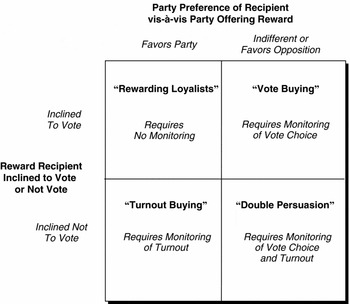
In order to clarify the distinction between turnout buying and vote buying, Figure 1 provides a typology of electoral mobilization strategies using rewards.Footnote 3 Each strategy targets different types of individuals and requires distinct monitoring assumptions. “Vote buying,” the exclusive focus of most researchers, targets opposing or indifferent voters and requires monitoring of specific voting decisions.Footnote 4 By contrast, “turnout buying” targets nonvoting supporters and requires monitoring turnout. Two other strategies are presented, but not examined thoroughly in this study. By “rewarding loyalists,” political parties can offer rewards to supporters who would vote anyway; this strategy does not require monitoring. For example, Diaz-Cayeros, Estévez, and Magaloni (forthcoming, ch. 4) argue that parties may offer particularistic benefits to core supporters during elections to sustain electoral coalitions over time. Parties may also engage in “double persuasion,” a strategy that rewards opposing or indifferent nonvoters for both turning out and for their vote choices. This strategy requires monitoring both turnout and voting decisions.
Targeting of Rewards in Electoral Mobilization

Of course, parties may in fact engage in a combination of these strategies, complicating both formal and empirical analyses. This paper focuses on distinguishing the understudied strategy of turnout buying from vote buying, and thus the formal model makes simplifying assumptions to illuminate this distinction. The Discussion section at the end of the paper returns to this issue, considering how parties may combine strategies.
TURNOUT BUYING IN ARGENTINA
In her influential study, Stokes (Reference Stokes2005) argues that the Peronist party pays weakly opposed voters to switch their votes. She provides a cogent rational choice model and analyzes one of the most extensive quantitative surveys ever collected on the topic.Footnote 5 The present paper, by contrast, argues that turnout buying offers an alternative explanation for observed patterns in Stokes's data.
With the goal of developing this argument, a straightforward potential objection to this line of explanation must first be addressed. Given that voting has been compulsory in Argentina since 1914, it might be hard to see how turnout buying would be relevant in this context. However, as Canton and Jorrat (Reference Canton and Jorrat2003, 199) argue in their study on abstention in Argentine elections, “compulsory voting is not particularly enforced any more.” The International Institute for Democracy and Electoral Assistance (IDEA 2006) codes Argentina's enforcement of compulsory voting as “weak” in its international comparison of electoral systems. Although turnout in Argentina is high by international standards, electoral participation reached lows of 78.2% of registered voters in the most recent presidential election of 2003, and 70.9% in the most recent legislative election of 2005 (IDEA; Ministerio del Interior 2006). These levels of electoral participation suggest that compulsory voting does not impose a binding constraint on turnout buying. After all, only 7.4% of respondents in Stokes's (Reference Stokes2005) survey reported receiving electoral rewards. Furthermore, rewards predominantly target the poor, who are significantly less likely to vote in Argentina (Canton and Jorrat, 188, 200; Vitullo Reference Vitullo2002, 242–43).
The present analysis of turnout buying relaxes Stokes's (Reference Stokes2005, 318) assumption that the Peronist party is able to monitor voting decisions effectively. Voting procedures in Argentina make it far easier for the Peronists to monitor whether individuals vote. Party delegates are permitted within polling places (mesas) and are actually expected to supervise electoral officials as they record who shows up at their designated location. As Canton and Jorrat (Reference Canton and Jorrat2003, 190) explain, “the mesa authorities, under supervision of the party delegates, write on the register list, beside the surname of the person who has just voted, in a special column, the word ‘cast.”’ Individuals' identity documents are signed and sealed to provide proof of voting, offering yet another way to monitor turnout.
Turnout buying addresses an unresolved puzzle acknowledged by Stokes (Reference Stokes2005, 323). A reexamination of the Argentine survey data she analyzes shows that rewards predominantly target machine supporters.Footnote 6 This crucial point is consistent with turnout buying, but directly contradicts Stokes's argument that “the machine should not waste rewards” on supporters (317). Vote buying fails to explain why the Peronist “machine”—by far the most active distributor of rewards in Argentina (Stokes, 322)—overwhelmingly targets its own supporters.
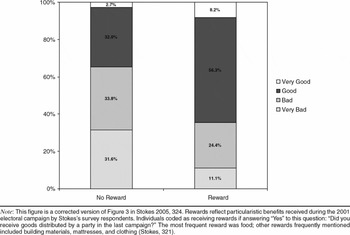
A descriptive overview of the data in Stokes (Reference Stokes2005) provides initial evidence that this line of analysis is worth pursuing. In her Argentine survey, Stokes asked respondents to indicate whether their opinions of the Peronist party were “very good,” “good,” “bad,” or “very bad.” Figure 2 compares responses to this question across rewarded and unrewarded individuals, and suggests that handouts predominantly target individuals with favorable opinions of the Peronists. Nearly 65% of reward recipients hold “very good” or “good” opinions of the Peronist party, compared to less than 35% of nonrecipients. In addition, over three times as many people who did receive rewards as those who did not receive them rated the Peronists “very good” (8.2% vs 2.7%). As Stokes carefully points out, this question measures postreward opinions, which may be “nudged” favorably by rewards (324). However, the most straightforward interpretation of these data is that rewards predominantly target Peronist supporters—as expected with turnout buying. Regressions below point even more strongly toward turnout buying: recipients of rewards disproportionately (1) identify the Peronists as their favorite party without prompting, (2) hold “very good” opinions of the Peronist party, and (3) voted for Peronist candidates in the past. But before turning to further empirical evidence, we first develop a formal model of turnout buying.
Opinion of Peronists among Recipients and Nonrecipients of Rewards

FORMAL ANALYSIS
This section takes Stokes's (Reference Stokes2005, 318–21) vote-buying model as a point of departure. To enhance comparability, the specific objective is to make one basic change to Stokes's model—considering nonvoters—while closely following her assumptions.Footnote 7 This adaptation suggests that offering rewards to supporters is incentive-compatible, even if a political party can only monitor whether individuals vote. Comparative statics from the turnout-buying model are then contrasted with those of Stokes's (321) vote-buying model. Although several comparative statics are similar, a key difference enables the models to be tested empirically. Whereas the turnout-buying model predicts that machines target unmobilized strong supporters, the vote-buying model predicts that they target moderate opposing voters.
Assumptions
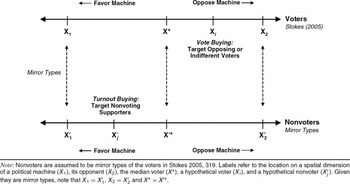
Following Stokes (Reference Stokes2005, 319), this analysis assumes a one-dimensional policy space. In Figure 3, X 1 represents the ideological position of the machine, X 2 represents the ideological position of the opposition, and X 1 < X 2. The turnout-buying model considers nonvoters, who are assumed to be “mirror types” of the voters analyzed in Stokes (Reference Stokes2005). As shown in Figure 3, corresponding voters and nonvoters lie along the ideological spectrum. Similar to Stokes, this paper assumes that parties have knowledge of individuals' ideal points. In other words, parties can distinguish whether—and the extent to which—individuals are supporters or opposers. The model assumes preferences are exogenous; consequently, rewards are presumed to have no effect on individuals' ideological positions.Footnote 8 In addition, the model assumes that parties can identify nonvoters.
Nonvoters as Mirror Types of Voters in Stokes Reference Stokes2005

The turnout-buying model adapts Stokes's (Reference Stokes2005, 319) utility function for voters. She assumes that each voter's utility is given by
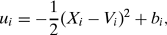
where X i reflects voter i's position on the ideological spectrum, V i ∈ {X 1, X 2} represents a vote for either the machine or the opposition, and b i ∈ {0, b} is the value to the voter of the reward, relative to the value of voting according to his or her preferences.
Whereas Stokes (Reference Stokes2005) ignores nonvoters, this analysis assumes that nonvoters may turn out if rewarded. A nonvoter who abstains is assumed to have a reservation utility of 0. A nonvoter who is induced to vote is assumed to have the following utility function:

where X′i reflects nonvoter i's position on the ideological spectrum, V′i ∈ {X′1, X′2} represents a vote for either the machine or the opposition, b′i ∈ {0, b′} is the value to the nonvoter of the reward relative to the value of abstaining, and c represents a constant cost of voting. The prime notation distinguishes variables from their counterparts in Stokes's vote-buying model. It should be emphasized that Equation 2 generalizes Stokes's (319) utility function for voters: Equation 1 is a special case with c = 0. Nonvoters who are induced to turn out face two types of costs incorporated in Equation 2. First, they face a material cost c, which includes both the direct (e.g., transportation) and indirect (e.g., forgone earnings) costs of voting.Footnote 9 This cost is assumed to be constant across nonvoters who are induced to turn out. In addition, they face an ideological cost of voting, captured by  , which is greater for individuals whose preferences diverge more from their preferred party's platform.
The turnout-buying model relaxes Stokes's monitoring assumption. Stokes (Reference Stokes2005, 318) assumes that “machines can effectively, if imperfectly, monitor the actions” of reward recipients, thereby enabling machines to condition rewards on vote choices. By contrast, turnout buying assumes that a party can monitor whether—not for whom—an individual votes. Whereas the vote-buying model assumes that a machine can monitor voting decisions with probability p, the turnout-buying model assumes that it can monitor participation with probability q.Footnote 10 Intuitively, it may be relatively easier to monitor turnout.
Other modeling assumptions follow Stokes's (Reference Stokes2005, 318–21) vote-buying model. An infinitely repeated Prisoner's Dilemma game is similarly used, in which credible promises and threats about future rewards can influence current behavior. The turnout-buying model also assumes that “both sides forsee their interaction extending indefinitely into the future” (Stokes, 319). In line with Stokes (320), the turnout-buying model assumes that the machine engages in a grim trigger strategy, providing rewards to a particular individual until he or she fails to cooperate, after which it never offers another reward. Also, Stokes's (320) structure of the game as one-sided uncertainty is adopted; therefore, no conditions are analyzed in which a political party chooses not to cooperate. The discount factor, β, corresponds to the value today of a peso to be received one stage later, and is assumed to be sufficiently high to enable sustained cooperation. With these assumptions, we now examine a model of turnout buying.
Model of Turnout Buying
This model explores whether a machine can gain votes by providing incentives to nonvoters for turnout. Given the assumption that vote choices cannot be monitored, the machine will only provide incentives to nonvoters who are expected to vote for the machine upon turning out. A nonvoter who receives a reward (b′) and shows up at the polls will vote for the machine (X′1) if doing so provides greater utility than voting for the opposition (X′2):Footnote 11
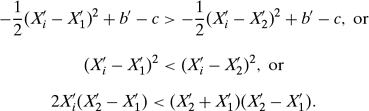
Since X′1 < X′2, this inequality can be simplified to:
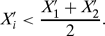
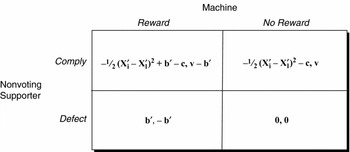
Inequality 3 suggests that a nonvoter who is induced to vote will cast a ballot for the machine if his or her ideological position is closer to the machine than to the opposing party. Thus, machines can potentially gain votes by offering rewards to these “unmobilized supporters,” who are defined as nonvoters with ideal points closer to the machine than to the opposing party. However, such “turnout buying” is not effective unless interactions are repeated. Without the prospect of future rewards, an unmobilized supporter is better off if he or she simply accepts a reward and does not show up at the polls. Consider the stage game between the machine and an unmobilized supporter in Figure 4. This stage game has a unique Nash equilibrium, in which the unmobilized supporter does not vote, and the party does not provide a reward. This outcome of noncooperation is a clear instance of the Prisoner's Dilemma, and is Pareto suboptimal for both players.
Normal Form of Game Between the Machine and a Nonvoting Supporter

Within a dynamic setting, cooperation is possible. When turnout-buying interactions are repeated, the unmobilized supporter may be induced to show up at the polls, depending on the value of future rewards. Even though no single-stage outcome is a Nash equilibrium, a subgame-perfect outcome exists if the game is infinitely repeated. Following Stokes (Reference Stokes2005, 320), Inequality 4 shows the conditions under which sustained cooperation is possible:
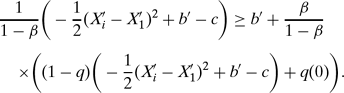
The left side of Inequality 4 represents the total discounted value of the rewards an unmobilized supporter receives if he or she cooperates during every stage by turning out. The right side of Inequality 4 represents the value of the reward an unmobilized supporter receives in a given stage if he or she defects by not showing up at the polls, plus with probability 1 − q the discounted value of the future rewards received if he or she is not detected and cooperates in all future rounds. Because the unmobilized supporter's reservation utility is assumed to be 0, if detected with probability q he or she will receive no future utility streams from the payoffs involved in this game. Overall, Inequality 4 suggests that turnout buying will be effective when the discounted value of the payoffs from sustained cooperation is greater than or equal to the discounted expected value if he or she defects in a given period. Simplifying Inequality 4 shows the reward values (b′) for which this condition is satisfied:

where
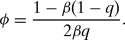
This inequality will bind, as a political party will use its bargaining power to expend the minimum amount necessary to sustain cooperation in the form of turnout. The turnout-buying model yields numerous comparative statics, but three should be emphasized as they are later contrasted with those from Stokes's (Reference Stokes2005, 321) vote-buying model. If we assume that a political party has a fixed budget, then turnout buying becomes a less effective strategy for obtaining votes as the cost of rewards increases. Therefore:
1. Targeting. Turnout buying is more effective when machines target individuals with ideal points (X′i) closer to that of the machine (X′1), for whom the cost of rewards is lower (
 > 0). Thus, turnout buying predicts that machines will target unmobilized strong supporters with rewards.
2. Monitoring. The effectiveness of turnout buying increases as the machine's ability to monitor turnout, q, increases (
< 0).
 > 0). Thus, turnout buying predicts that machines will target unmobilized strong supporters with rewards.
 < 0).
A third key comparative static is identified by implicitly differentiating Equation 5:
3. Reward Value. The potential for turnout buying increases when the value of the private reward, b′, increases (
> 0).
 > 0).
These comparative statics are now contrasted with those in Stokes (Reference Stokes2005, 321), providing a test by which the turnout-buying and vote-buying models can be evaluated.
Comparison with the Vote-Buying Model
We now turn to the vote-buying model analyzed in Stokes (Reference Stokes2005). Stokes (320) finds that to sustain a voter's cooperation, the following inequality must hold:

where
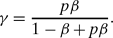
From this inequality, Stokes (Reference Stokes2005, 321) highlights four key comparative statics. These comparative statics are presented below with quotations from Stokes (321) and are contrasted to findings from the turnout-buying model.
1. Targeting. “Among its core constituents—those whom it can observe well—the machine is most effective when it targets Weakly opposed voters, rather than Loyal or Opposition voters.”Footnote 12 The vote-buying and turnout-buying models yield conflicting comparative statics for targeting. With turnout buying, the machine is most effective when targeting unmobilized strong supporters—not weakly opposed voters.
2. Monitoring. “The more accurately the machine can monitor voters, the greater the potential for vote buying.” The two models yield similar comparative statics for monitoring. Turnout buying is also more effective when the machine can more accurately monitor whether individuals vote.
3. Reward Value. “As the value of the private reward (b) relative to the value of voting in accordance to one's policy or ideological preference increases, the potential for vote buying increases.” The two models yield similar comparative statics for reward value.
4. Ideological Distance. “As the ideological distance between the two parties (X 2 − X 1) shrinks, the potential for vote buying grows.” The two models yield conflicting comparative statics for ideological distance, which has no predicted effect on turnout buying. Predictions for ideological distance cannot be tested with the Argentine data (Stokes Reference Stokes2005, 321).
These comparative statics reveal an important test for evaluating which interpretation—turnout buying or vote buying—provides a better account of the Argentine survey data. Although the turnout-buying and vote-buying models have similar predictions for monitoring and reward value, their predictions for reward targeting diverge sharply.
EMPIRICAL EVIDENCE
Empirical analysis suggests that the Argentine survey data in Stokes (Reference Stokes2005, 321–24) are more consistent with turnout buying than vote buying. The turnout-buying model developed above predicts that machines target unmobilized strong supporters, whereas Stokes's (321) vote-buying model predicts they target weakly opposed voters. Initial descriptive analysis (Figure 2) provides evidence that the Peronist party predominantly targets its own supporters—as expected with turnout buying—but does not control for factors such as income level and education that could potentially affect results. Stokes's extensive quantitative survey offers an excellent opportunity to evaluate the turnout-buying and vote-buying explanations empirically.
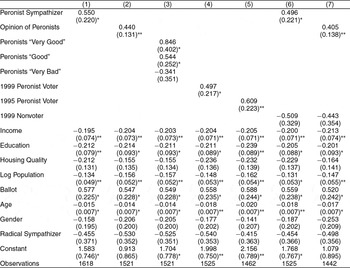
Even without additional analysis, findings in Stokes (Reference Stokes2005, 322) are more consistent with a turnout-buying interpretation. In Table 1, column 1 replicates Stokes's (322) analysis of factors associated with the probability of receiving rewards. The results of this logit regression show that Peronist sympathizers have a higher probability of receiving rewards than non-Peronist sympathizers, at a 95% level of significance and controlling for numerous factors. The variable Peronist Sympathizer refers to respondents who identify the Peronist party as their favorite party without prompting in an open-ended question. Given that the Peronist party is “by far the most active in distributing private rewards” (322), these results suggest that machine supporters are most frequently targeted for rewards—as expected with turnout buying.
Logit Model Estimations of Electoral Mobilization Using Rewards

Note: Entries are coefficients with robust standard errors in parentheses. *p < .05, **p < .01.
Dependent Variable: “Did you receive goods distributed by a party in the last campaign?” Coded Yes = 1, No = 0. Independent Variables: Peronist Sympathizer: coded 1 if answered Peronist party to open-ended question: “Independently of whom you have voted for in the past, which party do you like the most?”, 0 otherwise. Radical Sympathizer: coded 1 if answered Radical party, 0 otherwise. Opinion of Peronists: Responses to closed-ended question (“In general, what is your opinion of the Peronist Party?”) coded as: 1 = “Very Bad,” 2 = “Bad,” 3 = “Good,” 4 = “Very Good.” For this question, Peronists “Very Good,” “Good” and “Very Bad” are dummies for corresponding responses. 1999 Peronist Voter: coded 1 if voted for Peronist presidential candidate (Duhalde) in 1999, 0 otherwise. 1995 Peronist Voter: coded 1 if voted for Peronist presidential candidate (Menem) in 1995, 0 otherwise. 1999 Nonvoter: coded 1 if respondent reported not voting in 1999 presidential election, 0 otherwise. Income: Self-reported, 9-level scale. Education: 9-level scale, from no formal education to postgraduate. Housing Quality: Assessed by interviewer, 5-level scale (1 = poorest quality). Log Population: Natural log of population of respondent's municipality (2001 census). Ballot: coded 1 if voted with ballot given by party operative, 0 if voted with ballot acquired in voting booth. Gender: Female = 1.
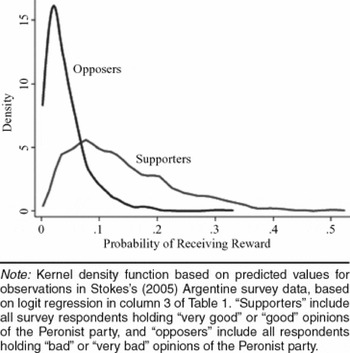
Reward targeting can be examined further using a different question in Stokes's (Reference Stokes2005) Argentine survey. Column 2 shows results for an Opinion of Peronists variable, in which higher values reflect a more favorable evaluation of the Peronist Party. This specification, which similarly employs a logit model and includes control variables, also provides evidence that rewards target machine supporters. Individuals with more favorable opinions of the Peronist party have a higher probability of receiving rewards, at the 99% level of significance. Using categorical variables for the “Opinion of Peronist Party” question provides additional insight (column 3).Footnote 13 This specification indicates that individuals with a “good” opinion (Peronists “Good”)—and even more so, those with a “very good” opinion (Peronists “Very Good”)—of the Peronist party have a significantly higher probability (at the 95% level) of receiving rewards than individuals with a “bad” opinion, controlling for other factors. These estimates suggest that the machine disproportionately targets strong supporters with rewards, as predicted by a comparative static of the turnout-buying model. Predicted values from the regression in column 3 are used to generate a kernel density function (Figure 5), which shows that individuals with more favorable opinions of the Peronist party are more likely to receive rewards. Overall, the regressions in columns 1–3 suggest that rewards target machine supporters—consistent with turnout buying.
Probability of Receiving Rewards, Supporters versus Opposers of Peronist Party

Voting behavior in previous elections provides additional evidence about reward targeting. The survey analyzed by Stokes (Reference Stokes2005, 321–24) only captures rewards distributed during Argentina's 2001 electoral campaign, but also specifically asks respondents for whom they voted in previous elections. Rewards disproportionately target individuals who voted for Peronist candidates in the past. As shown in column 4, respondents who reported voting for the Peronist presidential candidate in the 1999 election (Eduardo Duhalde) have a significantly higher probability of receiving rewards (at the 95% level). Similarly, individuals who voted for a Peronist gubernatorial candidate in 1999 are also more likely to receive rewards, at the 99% level of significance (not shown). Column 5 considers voting behavior in the earlier presidential election of 1995. Respondents who voted for Carlos Menem, the Peronist candidate, have a significantly higher probability (at the 99% level) of receiving rewards. These specifications suggest that the Peronist machine tends to distribute electoral rewards to individuals who have supported the party in the past.
Altogether, the specifications in columns 1–5 provide evidence that rewards target machine supporters.Footnote 14 Of course, endogeneity is an important consideration. The specifications in columns 1–3 examine postreward opinions, so it is possible that recipients' support for the Peronist party may have been “nudged” favorably by rewards (Stokes Reference Stokes2005, 324). It should be emphasized, however, that strong supporters have the highest probability of receiving rewards, and recipients also disproportionately identify the Peronist party as their favorite party without prompting. Another source of potential endogeneity is that vote buying may involve repeated interactions (as modeled by Stokes, 318–19), so reward recipients' past voting (columns 4 and 5) may have been influenced by rewards in previous elections. Without denying the possibility of such explanations, the most straightforward interpretation of the findings in columns 1–5 is that the Peronist machine targets its own supporters—consistent with turnout buying, not vote buying. As discussed later, panel data would provide more definitive evidence.
The specifications examined thus far suggest that rewards target machine supporters in Argentina, as predicted by the turnout-buying model. In order to test the mechanism of turnout buying developed above more thoroughly, we now consider evidence about other comparative statics. Whereas the turnout-buying and vote-buying models have starkly different predictions for reward targeting, they have similar predictions for both reward value and monitoring. Comparative statics predict that the potential for both turnout buying and vote buying increases when the value of private rewards increase. Poorer individuals may therefore be expected to receive rewards more frequently, because the diminishing marginal utility of income implies the poor gain more utility from particularistic benefits (Dixit and Londregan Reference Dixit and Londregan1996, 1144; Stokes Reference Stokes2005, 315). In line with this prediction, the coefficients on Income in all specifications in Table 1 provide evidence that individuals with lower income have a significantly higher probability of receiving rewards (at the 99% level). With respect to monitoring, comparative statics predict increased turnout buying when the machine can monitor turnout more accurately, and increased vote buying when the machine can monitor voting decisions more accurately. Both types of monitoring may be expected to be more accurate in small communities (Stokes, 322–23). The coefficients on Log Population in all specifications show that respondents in smaller municipalities are significantly more likely to receive rewards (at the 95% level or higher).Footnote 15 Evidence on reward value and monitoring is therefore consistent with both turnout buying and vote buying. Overall, empirical tests yield results consistent with all three comparative statics (targeting, reward value and monitoring) of the turnout-buying model presented above.Footnote 16
Thus far, regression analyses suggest that the Argentine data are more consistent with turnout buying than vote buying. An additional question is whether “rewarding loyalists” also provides a compelling explanation of the Argentine data. The typology presented above (Figure 1) shows that evidence of rewards targeting supporters points away from vote buying, and towards two strategies in the left column: turnout buying and rewarding loyalists. Whereas turnout buying rewards unmobilized supporters for turnout, rewarding loyalists targets supporters who would vote for the machine even without rewards. For example, Diaz-Cayeros, Estévez, and Magaloni (forthcoming, ch. 4) extend a rewarding-loyalists argument in their intriguing study of Mexico: parties may reward core supporters during an election to maintain future support, if partisan loyalities are conditional on particularistic benefits received in the past. Distinguishing between turnout buying and rewarding loyalists requires additional testing: do rewards primarily target individuals who are inclined to vote in the current election, or those who are inclined not to vote? Further regressions examine this dimension of reward targeting.
In order to test whether rewards target individuals who are predisposed not to vote in the current election, one approach would be to examine voting behavior in previous elections. One might expect individuals to be less likely to vote if they did not participate in previous elections. Thus, a potential test of turnout buying versus rewarding loyalists would be whether individuals who did not vote in the previous election have a significantly higher or lower probability of receiving rewards. To this end, columns 6 and 7 add a 1999 Nonvoter variable—a dummy with a value of one if an individual did not vote in the previous presidential election—to two specifications discussed above. Earlier findings that rewards target machine supporters remain robust: coefficients for Peronist Sympathizer and Opinion of Peronists are comparable in magnitude and statistically significant. By contrast, 1999 Nonvoter has no significant effect on the probability of receiving rewards in either specification (the signs are negative). Additional regressions (not shown) find that all interactions of 1999 Nonvoter with variables used to test Peronist party support are also insignificant. Overall, these specifications suggest that nonvoters in the previous election do not have a disproportionately higher or lower probability of receiving rewards.
At least two reasons explain why the insignificant coefficient on 1999 Nonvoter is consistent with turnout buying. First, it is important to emphasize that the theoretical mechanism of turnout buying involves distributing rewards to both individuals who did as well as those who did not vote in the previous election. As modeled above, individuals who receive turnout-buying rewards follow through with their side of the bargain because by turning out, they can receive future rewards. Therefore, for turnout buying to be effective, parties must explicitly target some individuals who were induced to vote in the previous election. Concerns about strategic behavior point to another reason why turnout-buying parties do not actively target individuals who abstained in the previous election. By conditioning rewards on past turnout, party operatives might unintentionally create incentives for unrewarded supporters not to vote. These individuals might attempt to increase their chances of future turnout-buying rewards by abstaining. To avoid such strategic behavior, operatives rely instead on their frequent, face-to-face interactions with supporters to identify who is unlikely to vote in an upcoming election, whether that be due to lack of interest, loss of a job, a sick relative, childbirth, or other reasons. For these two reasons, results for 1999 Nonvoter are consistent with a turnout-buying explanation.
Whereas the overall findings in Table 1 are consistent with turnout buying, they point away from a rewarding-loyalists interpretation. Diaz-Cayeros, Estévez, and Magaloni (forthcoming, ch. 4) argue that parties distribute rewards to voting supporters to “prevent the erosion of partisan loyalties” over time: unless operatives provide particularistic benefits, supporters may become swing or opposition voters during the next election. Given this argument, parties would be expected to concentrate on offering rewards to weak supporters, whose partisan loyalties are relatively more fragile. But the Argentine data instead show that rewards disproportionately target strong supporters—Column 3 shows that individuals holding “very good” opinions of the Peronist party actually have the highest probability of receiving rewards. Furthermore, the insignificant coefficient on 1999 Nonvoter may be inconsistent with rewarding loyalists. Parties engaging in this strategy might be expected to focus on reinforcing the loyalty of supporters who actually turn out to vote, because previous abstainers have already proven themselves to be unreliable suppliers of votes. Taken together, these two reasons suggest that the data in Table 1 are relatively less consistent with a rewarding-loyalists strategy.
DISCUSSION
This paper challenges much of the conventional wisdom about vote buying. Scholars typically assume that parties distribute particularistic benefits—especially to the poor—to influence vote choices. Although such vote buying is observed in many countries, parties also have another important reason for distributing rewards. Parties can activate their own passive constituencies by rewarding unmobilized supporters for turnout. Turnout buying involves a less stringent monitoring requirement than vote buying—the ability to observe turnout instead of voting decisions—and thus helps to explain why parties might offer rewards even with ballot secrecy. Formal modeling shows that turnout buying is incentive-compatible, and identifies reward targeting as a comparative test of turnout buying and vote buying. Empirical analyses suggest that the Argentine survey data in Stokes (Reference Stokes2005) are more consistent with turnout buying. Evidence of turnout buying in Argentina, a country that in any case has relatively high turnout and compulsory voting, forces us to consider whether it may be even more prevalent in other contexts. Turnout buying would be expected to be a more significant potential factor in electoral campaigns in countries where voting is voluntary, or where compulsory voting laws are even more weakly enforced than in Argentina.
Stepping back to consider the wider implications of this analysis, we may observe that the distinction between turnout buying and vote buying is important in part due to its normative significance. Vote buying may be seen as unambiguously pernicious for democracy—the strategy undermines political equality by allowing those who have resources to buy votes of the poor, interferes with free and fair elections, and makes “a mockery of democratic accountability” (Stokes Reference Stokes2005, 316; see also Schaffer and Schedler Reference Schaffer, Schedler and Schaffer2007). By contrast, Hasen (Reference Hasen2000, 1357–58, 1370) contends that the normative implications of turnout buying are more ambiguous: “unlike vote buying. . .payment for turnout is a mixed case” because it may increase equality of political participation by inducing the poor to vote. Beyond providing incentives for voting in the current election, turnout buying may also stimulate future electoral participation: a recent randomized field experiment suggests that voting is habit forming (Gerber, Green, and Shachar Reference Gerber, Green and Shachar2003). Despite various potential negative consequences of turnout buying—such as the commodification of voting and partisan use of state resourcesFootnote 17—its overall normative implications therefore remain a point of contention. In fact, some US states (including Alaska, California and Mississippi) even allow parties to offer incentives for turnout during local elections (Hasen, 1326). Also controversial are official, nonpartisan inducements for turnout, which Karlan (Reference Karlan1994, 1472–73) “tentatively” advocates while discussing lotteries, public transportation vouchers and event tickets as potential rewards. These normative questions about both partisan and nonpartisan turnout buying challenge scholars to deepen their empirical understanding about why parties distribute particularistic benefits during elections.
This paper has sought to address this challenge, and the remaining discussion lays the foundation for further responses to the challenge by suggesting productive directions for future research. Key tasks for further formal, quantitative and qualitative analysis are identified. This paper has focused on distinguishing turnout buying from vote buying, and has thus sought to maintain comparability with Stokes's (Reference Stokes2005) influential study: the dimension of turnout is added to her vote-buying model while making as few other changes as possible. One consequence is that machines are modeled as choosing either turnout buying or vote buying. Of course, reality is far more complicated. If parties are able to monitor both turnout and voting decisions—an assumption that is only realistic in some contexts—then they can engage in a combination of both strategies. Empirical evidence from Argentina suggests that the Peronist party may well be engaging in both turnout buying and vote buying. Although the party predominantly rewards its own supporters, it also appears to distribute some particularistic benefits to opposers (Figure 2). In addition, other evidence suggests that rewards can both influence vote choice and induce participation: regressions by Brusco, Nazareno, and Stokes (Reference Brusco, Nazareno and Stokes2004, 71) show that among Peronist sympathizers, those who receive rewards are more likely to vote for Peronist candidates in elections.
Given such empirical evidence, a particularly useful further line of formal analysis might therefore ask: how would a machine trade off between allocating resources to turnout buying and vote buying? To examine this question, we could move away from Stokes's (Reference Stokes2005) model by specifying a budget constraint. A machine can be modeled as facing a constrained optimization problem, in which its objective is to maximize the votes obtained, subject to its budget constraint. It would condition the size of rewards on individuals' presumed ideal points, and target those individuals whose turnout or vote choices it can obtain most cheaply. The machine might therefore begin with vote buying, targeting indifferent or very weakly opposed voters. After all, these (ideologically) marginal voters do not require incentives for showing up at the polls. Moreover, individuals switching their votes away from opposing parties offer the machine more net votes than turnout buying.
Yet as the machine buys more votes, the marginal cost of vote buying increases because it must target individuals with ideal points farther from the machine. Thus, turnout buying becomes a relatively cheaper strategy. Overall, the machine will allocate resources across the two strategies such that it equates the marginal net votes per unit of expenditure for turnout buying and vote buying. While this discussion is overly simplistic—for example, the machine may eschew vote buying altogether if monitoring turnout is much cheaper than monitoring voting decisions—it provides basic intuition about why a party might engage in both turnout buying and vote buying. Formal studies should explore the factors and tradeoffs involved when parties allocate resources across these and other strategies involving electoral rewards.
A second direction for future research on electoral rewards involves quantitative analysis of panel data. Empirical evidence in this paper strongly points towards turnout buying: recipients of rewards disproportionately (1) identify the Peronists as their favorite party without prompting, (2) hold “very good” opinions of the Peronist party, and (3) voted for Peronist candidates in the past. Panel data could provide more definitive evidence by addressing two potential forms of endogeneity: (1) postreward opinions may be “nudged” favorably by rewards (Stokes Reference Stokes2005, 324), and (2) voting behavior in previous elections may reflect repeated vote-buying interactions. Using panel surveys that capture ex ante partisan preferences (i.e., opinions before receiving rewards) would further enhance our ability to identify whether rewards target machine supporters or opposers. Furthermore, panel surveys could help to distinguish between strategies of turnout buying and rewarding loyalists. Whereas turnout buying predicts that rewards target individuals who are not inclined to vote, rewarding loyalists predicts they target those who are inclined to vote. Using panel data, one approach to distinguishing between these strategies would be to examine whether respondents who indicate (ex ante) they are unlikely to vote end up having a higher or lower probability of receiving rewards. Overall, our understanding of electoral strategies involving rewards would be enhanced by quantitative studies employing panel data.
Third and finally, qualitative research continues to be crucial to deepening our understanding of electoral mobilization using rewards. Formal models of vote buying, turnout buying and other strategies for distributing particularistic benefits employ assumptions that must be evaluated and refined through elite interviews, ethnographies and participant observation. Such qualitative research can also help to identify contexts in which other models, with different assumptions, should be used. For example, in cases where voters demand gifts just to consider candidates, parties may not really be offering “rewards” in exchange for turnout or vote choices. Voters may actually expect to be paid by everyone, and may choose among those parties or candidates who made a “contribution.” As another example, machines in some contexts may have difficulty distinguishing whether or not individuals are supporters, and may also be unable to distribute goods in neighborhoods where most voters support the opposition (e.g., due to negative publicity). Under such conditions, vote-buying machines may have to reward many loyalists in the course of finding the few undecided or weakly opposed voters that constitute their main target. Qualitative research can similarly serve to improve quantitative analyses through triangulation. For example, we must be careful when analyzing panel surveys: individuals may change their minds during an electoral campaign for many reasons, and they may not articulate clearly why they do so, especially when rapidly answering questions from interviewers who are perfect strangers. Such concerns can be mitigated by comparing regression results with findings from field research.
In order to understand the real-world complexities of how parties distribute electoral rewards, future studies will also need to pay closer attention to situations that blur the distinction between turnout buying and vote buying. Much literature on clientelism suggests that parties distribute particularistic benefits to individuals who have little in the way of ideological preferences or reasons to vote, outside of the material reward structures set up by parties and candidates. Rewards may thus play a dual role—influencing vote choice and inducing participation—in a strategy that combines elements of both vote buying and turnout buying. This strategy, termed “double persuasion” in the typology in Figure 1, can be distinguished from other strategies because it targets indifferent (or opposing) nonvoters. Unlike the swing voters often targeted with vote buying, indifferent nonvoters will not show up at the polls without incentives. And unlike the unmobilized supporters targeted with turnout buying, they do not inherently prefer the machine on ideological grounds. Double persuasion typically requires monitoring of both turnout and voting decisions. But when indifferent individuals are induced to show up at the polls, they would be expected to vote for the machine if they believe there is even the slightest possibility that vote choices can be monitored. Some scholars would contend that such monitoring is not even necessary; for example, “normative strategies” may make recipients feel personally obligated to vote for the machine (Schaffer and Schedler Reference Schaffer, Schedler and Schaffer2007, 33). Future studies should examine the strategy of double persuasion more extensively, and should be careful to distinguish it from turnout buying and vote buying.
A final question is also crucial to understanding how these strategies function in the real world: do strategies of vote buying and turnout buying involve competition among parties? As Stokes (Reference Stokes2005, 324) points out, one might hypothesize that “dueling machines” would compete to buy the votes of indifferent voters, bidding up the price of rewards. But such competition is empirically rare, potentially because different machines tend to develop links with different constituents (Stokes, 324). The “dueling machines” scenario might also be expected with turnout buying—when one machine offers its supporters rewards for turnout, opposing parties could be expected to counteroffer by extending the same individuals rewards for staying home. But payments for abstention, known as “negative” vote buying, are relatively rare and examined only by a few studies (e.g., Cox and Kousser Reference Cox and Kousser1981; Heckelman Reference Heckelman1998). Future studies on both turnout buying and vote buying should explore more thoroughly the conditions under which machines are likely to face these kinds of competition, and examine empirical evidence about how often these conditions are in fact observed.
Overall, this study has challenged scholars to deepen their understanding about why parties distribute particularistic benefits during elections. Failing to consider mobilization can have serious analytical consequences: much of what is interpreted as vote buying (exchanging rewards for vote choices) may actually be turnout buying (exchanging rewards for turnout). Many questions remain about how and when parties will choose amongst different strategies involving electoral rewards. The combined tools of formal and empirical analysis, along with the specific research strategies enumerated above, can open new avenues for understanding these basic electoral practices.
 ). But if the machine cannot monitor voting decisions, then it cannot ensure that these nonvoters will in fact vote for the machine.



Comments
No Comments have been published for this article.