‘[Collect] the herb betony with the Lord's Prayer. Let [the patient] take two ounces with honey for nine days.’Footnote 1
These instructions, found in a ninth-century medical manuscript (St Gallen, Stiftsbibliothek, Cod. sang. 751), are located within a large, anonymous recipe collection that contains pharmaceutical information from a range of sources. The recipe is the final entry in a group of recipes derived from the late antique herbal De herba vettonica liber. Although it lacks a title in Cod. sang. 751, the parallel treatment in De herba vettonica liber, ‘Ad tussim’, offers a cure for cough. The two prescriptions provide the same pharmaceutical information, but their instructions differ in one respect: the original does not include the Lord's Prayer.Footnote 2 How should the addition of such an explicitly Christian feature be interpreted? Is this evidence for the symbolic Christianization of pre-Christian medical knowledge, an attempt to make potentially controversial writings more acceptable to a ninth-century readership? Did a scribe include this feature with the hope that it would increase the efficacy of the cough treatment, strengthening an existing recipe through the power of prayer? Could this simply be a statement of the scribe's faith? Or does it represent a combination of all these possibilities?
Prayers are not the only overtly Christian material to appear in early medieval recipes: some treatments include sacred ingredients, such as holy water or chrism; some involve other Christian rituals, such as instructions to make the sign of the cross or to prepare the recipe while mass is being said; and a number of recipes integrate multiple Christian elements within a single treatment. While these features do not appear with great frequency in early medieval recipe literature, their presence is noticeable and noteworthy. This article offers the first systematic study of Christian elements recorded in early medieval Latin recipes found outside established classical and late antique medical writings. It considers the types of Christian elements included in such recipes, the ways in which they are used and the ailments these recipes attempt to treat. This analysis, although not comprehensive, highlights patterns concerning the appearance of this material and uncovers significant individual findings. These results provide another perspective on the intersections between health, healing and Christianity – medicine and the church – in the early medieval West, while simultaneously enriching our understanding of the place and evolution of medical knowledge in the Carolingian world.
Framing the Analysis
Although negative, reductive depictions of early medieval medicine remain common in popular culture, these outdated stereotypes have been effectively challenged and overturned by recent generations of scholars, and writings surviving from this period are no longer seen to offer only a simplified version of classical medical knowledge adulterated by ‘primitive’ folkloric or religious healing traditions.Footnote 3 Relatedly, many studies have demonstrated the inappropriateness of classifying medieval medical texts according to a modern, Western conceptual framework that distinguishes rigidly between ‘medicine’, ‘religion’, ‘magic’ and other familiar categories.Footnote 4 The present article offers another route into exploring these intertwined concepts by focusing on a traditionally overlooked genre of medical writing: Latin recipes recorded outside known classical and late antique texts or textual families, either as marginal additions or as independent recipe collections.
The long-standing focus on the inheritance and reception of classical and late antique medical texts has limited research into material that exists beyond this canon. Stemming from (and perpetuating) this preoccupation with the medical classics, the standard manuscript catalogues often label recipes and recipe collections outside this textual framework as ‘miscellaneous’, a term that obscures not only the texts themselves but also their potential relationships with other writings.Footnote 5 Although these recipe collections are not attributed to any specific (late) ancient authority, their contents are closely related to earlier texts; as the example from Cod. sang. 751 with which this article opened illustrates, early medieval compilers brought together a range of sources in the creation of new collections. Classical and late antique texts, however, were not the only sources used to produce new compilations. Many works contain signs of non-classical influences, including the use of ingredients unrecorded in earlier Western medical traditions as well as the appearance of Christian rituals, incantations and ingredients.Footnote 6 Although a substantial number of these unattributed recipe collections survive (totalling thousands of recipes), few have been analysed in depth and the genre has received little attention overall given the traditional preference for studying the transmission of classical writings.Footnote 7
In contrast, the much smaller corpus of early medieval recipes recorded in Old English has been comparatively well studied.Footnote 8 Research into this material has played a central role in countering the negative stereotypes that surrounded early medieval medicine and the inappropriate application of modern conceptual categories, such as ‘medicine’, ‘magic’ and ‘religion’, to medieval medical writings. Detailed analyses of the ‘extra-medical’ aspects of recipes, including charms, incantations and symbolically significant ingredients, have addressed how these features appear in pharmaceutical texts and their importance for understanding the evolving healthscape of early medieval England.Footnote 9 In particular, Audrey Meaney's thorough assessment of extra-medical elements within Old English recipe collections has revealed that the texts most closely related to Latin exemplars include significantly less Christian material than those more loosely based on Latin sources.Footnote 10
Problematically, however, when Old English recipe literature is compared to Latin continental recipe literature, the latter is generally treated as a single entity, and one based on the recognized, inherited texts of (Late) Antiquity without considering recipes found beyond this corpus. While the traditionally studied classical and late antique recipe collections, such as the Plinian family of texts or the herbals and bestiaries of the Herbariencorpus, include many extra-medical rituals, charms and incantations, they lack explicit references to Christianity or Christian(ized) material.Footnote 11 The handful of exceptions to this general picture, such as the two recipes within Marcellus's De medicamentis liber with Christian connections or the two recipes in the anonymous De taxone liber that contain Christian invocations, have been debated and do not offer unambiguous examples of Christian influence.Footnote 12 In short, the surviving classical and late antique recipe collections copied in the early Middle Ages lack Christian references within their prescriptions. This differs from much of the Old English material, where extra-medical elements incorporate Christian rituals and symbolism. From this perspective, early medieval recipe literature could be divided into the following groups:
a) Latin recipe literature from the Continent, consisting primarily of classical and late antique texts (and thus devoid of Christianized content);
b) Old English translations of this Latin material (correspondingly lacking Christianized content);
c) Old English recipe collections that combine a variety of sources, drawing on ‘a common reservoir of medicines native to Europe generally’ (including Christian elements).Footnote 13
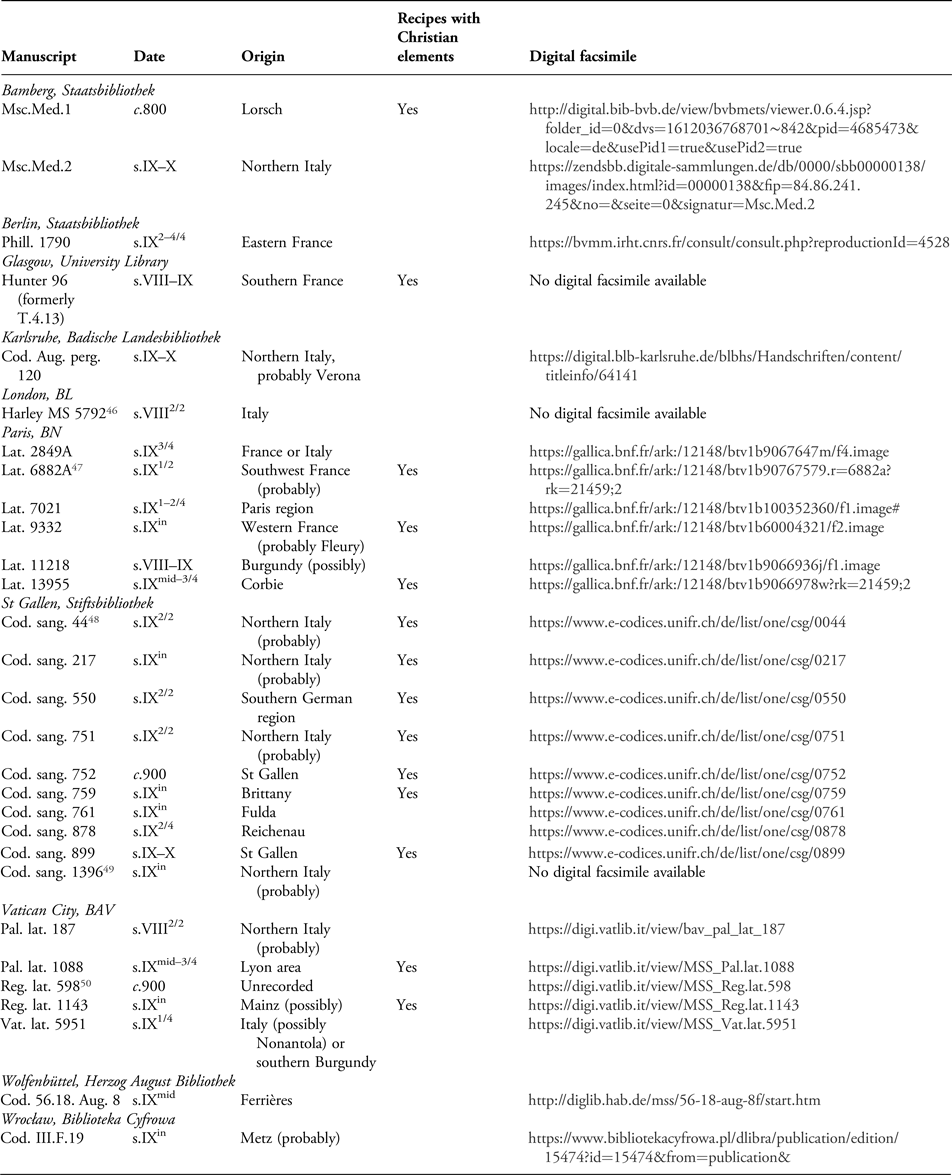
Yet, as the opening example shows, a division along these lines ignores many Latin continental recipes, namely those recorded outside established classical and late antique recipe collections. The remainder of this article investigates how Christian elements appear in this previously overlooked body of knowledge, analysing a sample of over six thousand recipes found in nearly thirty early medieval manuscripts, the vast majority of which have been dated to the ninth century (see Appendix 1 for a detailed description of the manuscripts under consideration). These codices were produced in writing centres across western continental Europe, with particular concentrations in the Rhineland, the area around Lake Constance and northern Italy, and thus offer a large and diverse sample. Only a relatively small percentage of the recipes under analysis have received much attention to date, and previous work has generally concentrated on individual codices rather than multi-manuscript studies.Footnote 14
Christian Elements in Early Medieval Latin Recipes
In this article, a recipe is described as including explicitly Christian features if it incorporates extra-medical elements that are unequivocally related to Christian rituals, spaces or substances. This definition is intentionally broad and flexible given the varied nature of this material; as delineated below, recipes present a diverse assortment of such Christian material, from prayers and rituals to holy ingredients. The following survey presents an overview of the data before considering what, where and how Christian elements were included in recipes as well as the ailments that these recipes were intended to treat.
First, nearly one hundred explicitly Christian features have been identified in sixty-four treatments, roughly one per cent of the recipes under analysis.Footnote 15 While this percentage may seem insignificant, it documents a major break with the classical material and a new development within pharmaceutical writing. Even if the handful of exceptions in late antique texts are taken into account, they represent such a miniscule fraction (the two recipes from De medicamentis liber, for example, comprise less than 0.1 per cent of the treatise's total number of recipes), that the sixty-four recipes within this sample still bear witness to a significant change.
When considering these examples in more detail, it becomes evident that Christian features appear at two primary stages within the treatment process: (a) preparation, and (b) application and administration. The former, represented by (for example) rituals relating to the collection of ingredients, are seen in thirty-one recipes, while the latter, exemplified by the use of symbolic ingredients, are recorded in thirty-two recipes. In ten recipes, such as those ending with a Christian phrase (in Christi nomine, in nomine domine, etc.), Christian elements appear to play a less active role in the treatment process.Footnote 16 While these features are deserving of further research, the rest of the present analysis concentrates on the two main contexts in which Christian elements appear.
Instructions to say the Lord's Prayer, an example of which was seen in the opening recipe, are given in twenty-one recipes and represent the most frequently recorded Christian element in the preparation stage. Several additional instances can also be found in Cod. sang. 751, including a recipe intended to treat haemorrhoids: ‘you collect a bundle of losera, which [others] call mentastrum, which is white mint, on a Thursday with a waning moon [and] with the Lord's Prayer. You mix [it] with thirty pepper grains and thirty grains of mastic in wine and let [the patient] drink [it] for three days. It is a cure.’Footnote 17 The instructions for collecting losera also provide directions regarding the timing of this activity. Similar extra-medical guidance naming specific days of the week, seasons, phases of the moon and other calendrical or astronomical information is found in just over half of the recipes that include the Lord's Prayer, a topic discussed below.
An entry in Cod. sang. 44 entitled Ad lunaticos et cadiuos (‘for lunatics and epileptics’) provides a further example of this connection between the Lord's Prayer and calendrical or astronomical information: ‘ribwort, mistletoe from oak, agrimony, milfoil – you collect all this with the Lord's Prayer and, for four lunar cycles, give [it] to the fasting person to drink with holy water’.Footnote 18 The recipe showcases two other striking features that will be elaborated below but deserve a brief mention here. First, this is a treatment for madness and epilepsy, which, as following examples demonstrate, is a recurring trend. Secondly, the herbal ingredients are to be liquefied by the addition of holy water, aqua benedicta. This recipe thus combines Christian elements during both phases of the treatment process: the preparation incorporates a Christian ritual and the end product contains an explicitly Christian ingredient, not simply water but holy water.
A recipe to expel demons, recorded in Paris, BN, Lat. 9332, also involves multiple Christian elements; here, both occur during the treatment's preparation. The Lord's Prayer is again linked to the initial ingredient collection, and then the recipe describes how to make the potion, instructing the reader to mix an egg-full of the juice of danewort or dwarf elder with an egg-full of oil and an egg-full of old wine while a priest sings mass.Footnote 19
A wide range of other types of Christian features can be seen during the preparation stage in addition to, or alongside, the Lord's Prayer. Some recipes suggest making a physical gesture, usually the sign of the cross. A remedy for stomach pain in Cod. sang. 44, for example, instructs that the sign of the cross should be made over an ingredient when preparing an ointment that will be applied topically to the stomach.Footnote 20 Other recipes include instructions for where or when to prepare a treatment related to spiritually significant places and times. Another remedy for demon possession found in Cod. sang. 44, for instance, states that the ‘herb that is called paniscardi’ should be collected at Easter and then put on the altar where mass is said that day.Footnote 21 The scribe left no doubt that Easter was the appointed day for this preparation to take place, writing that this process should occur on dies resurrectionis domini and adding hoc est prima pascha.
Turning to the application stage, the use of ingredients with Christian significance has already been noted: holy water was named as an ingredient in a recipe in Cod. sang. 44.Footnote 22 Of the various ingredients derived from or associated with Christian rituals that are listed in recipes, holy water and incense occur most frequently. The former can also be found in two recipes from Cod. sang. 751; BAV, Pal. lat. 1088; and Bamberg, Staatsbibliothek, Msc.Med.1. Incense appears once in four different manuscripts: Cod. sang. 759; BAV, Pal. lat. 1088; BAV, Reg. lat. 1143; and Bamberg, Staatsbibliothek, Msc.Med.1.Footnote 23 Other substances associated with Christian rituals named as ingredients include chrism and the oil from holy candles. An entry in Msc.Med.1, for example, uses red incense, chrism and holy water in another treatment for epilepsy.Footnote 24
In addition to these ingredients, Christianized rituals occasionally appear as active components in the administration of treatments. Like the rituals involved in the preparation phase, they most frequently take on spoken forms, varying in their level of detail. In one case, to help someone with something stuck in their throat, the reader (or whoever performs the cure) is instructed to say slowly ‘Christ is from the virgin Mary born’ into the patient's ear three times.Footnote 25 Most incantations and charms, however, are longer and more complex, such as a treatment in Cod. sang. 759 that offers protection against demons and fevers that covers half a folio.Footnote 26 It opens with a series of formulaic expressions beseeching ‘our Lord Jesus Christ’ and then lists a host of protective powers attributed to the cross, including its ability to conquer venom, swords and the devil. Before closing, the scribe names the archangels, who, in addition to the standard Michael, Gabriel and Raphael, also feature Uriel, Raguel and Tubel.
Christian rituals that take a physical form may also be directly involved in therapy. A recipe to treat an itchy skin condition, ‘Ad scabies’, in Paris, BN, Lat. 13955, instructs that the afflicted area should be ‘baptized’ (baptizetur).Footnote 27 Could this term have been used without Christian overtones, simply meaning that the affected area should be fully immersed? Given the word's general absence from the recipe literature in the context of bathing or washing, it seems highly unlikely that its use here is entirely detached from a Christian meaning; rather, labelling this therapeutic act as a baptism links the treatment to a Christian context.
Finally, remedies may describe where or when a treatment should occur, specifying a location or time with Christian significance. A treatment for kidney pain in Cod. sang. 751, ‘Contra renes dolorem’, offers one such example: after providing the instructions for a potion involving herba sancta, Venus's hair, wine and pepper grains, the reader is informed that the patient should drink this potion for six days, starting on a Sunday, ‘the day of the Lord [when] mass is performed in church’.Footnote 28 While these instructions about timing could serve a purely practical function by helping the patient count the days, the scribe's emphasis on the particular spiritual significance of this day, through the explicit reference to the celebration of mass in a church, suggests that this specification simultaneously introduces a layer of Christian symbolism into the process.
This review of Christian elements has highlighted recipes that aim to cure a range of ailments, from kidney pain to throat obstruction. Within the examples above, treatments targeting epilepsy, madness and demon possession have been noted most frequently: twelve recipes with Christian features target these conditions. Particularly striking is that five of the six recipes that name holy water as an ingredient are intended to treat those suffering from this group of conditions. Although modern medicine may not see a connection between these afflictions, they are often grouped together in early medieval recipe literature: epilepsy, also known as the ‘falling sickness’, and madness were sometimes associated with demonic possession.Footnote 29 The strong correlation between demon-related conditions and holy water suggests that this Christian ingredient was noted for its properties in combatting demonic influences, perhaps being perceived as imbuing the treatment with a higher power. This medieval aetiology and use of symbolically enriched ingredients offer useful reminders regarding the inappropriateness of attempting to understand past medical writings from a modern medical perspective. Relatedly, these findings emphasize an integrated approach to healing that was designed to heal both body and soul as it was predicated on the perceived inseparability of body and soul.Footnote 30 The linked nature of corporal and spiritual health reinforces the centrality of the church to the practice of medicine: spiritual guidance and proper beliefs were essential ingredients in the maintenance of health.
Returning to the dataset, four other distinct clusters emerge: eight recipes with Christian elements are intended to treat fevers, five recipes can be classified as general panaceas (non-specific antidotes), five target haemorrhoids and four aim to heal wounds.Footnote 31 The remaining recipes, just under half of the sixty-four, present an eclectic mix of treatments. While the examples reviewed above have already illustrated that Christian features can be found in recipes that target coughs, stomach pains, kidney pains, skin conditions and throat obstruction, similar Christian material can also be found in recipes intended to alleviate toothache, cure head pain, staunch blood-flow, help with birthing difficulties, resolve incontinence, and so on.Footnote 32
Assessing the Data and their Implications
The Question of Christianization
As noted earlier, many recipes with instructions to say the Lord's Prayer also include extra-medical information, not overtly Christian, specifying the time at which ingredients should be collected. Indeed, one of the examples named above, a treatment for haemorrhoids found in Cod. sang. 751, is one of seven recipes in this manuscript alone that combine instructions to say the Lord's Prayer with timing specifications that are probably pre-Christian.Footnote 33 Timing information is most often framed around the days of the week and the movements of the sun and moon. Given the similarities of this material with that recorded in classical and late antique herbals, such as Pseudo-Apuleius's Herbarius, these timing instructions likely have ancient origins.Footnote 34 The addition of prayers to pre-Christian calendrical rituals could suggest that those responsible for compiling recipe collections intentionally Christianized ancient medical traditions.Footnote 35
However, this type of pre-Christian, extra-medical material occurs with some regularity in simple herbal remedies and in many cases is not accompanied by Christian elements. The continued presence of extra-medical material from earlier traditions without accompanying Christian elements indicates that this content was not necessarily seen as in need of a Christian addition to make it acceptable, challenging the idea that early medieval scribes routinely Christianized recipes with pre-Christian extra-medical information. Given the vast range of calendrical information that circulated in early medieval manuscripts, from computistical texts to treatises on Egyptian Days (days thought to be unlucky, especially in the context of bloodletting), it seems possible that instructions regarding the timing of a treatment based on the seasons, sun and moon may not have appeared to transmit illicit knowledge.Footnote 36 While there is no question that Christian elements were introduced to some recipes in this period, it cannot be said with certainty that the primary motivation for their inclusion was to Christianize recipes that contained pre-Christian extra-medical content. Although a modern reader may recognize the different traditions behind these rituals and be tempted to interpret their association as indicative of a Christianizing reflex, the targeted Christianization of pre-Christian content remains one of many possible explanations for the appearance of Christian elements.
The opening example from a large recipe collection in Cod. sang. 751 offers another perspective on the Christianization of pre-Christian sources. Here a two-page cluster of nearly twenty recipes is derived from the late antique herbal De herba vettonica liber.Footnote 37 Although the standard edition of the herbal, a treatise dedicated to the medical uses of betony (Stachys officianalis), contains twice as many recipes as the group in Cod. sang. 751 (and presents them in a different order), the individual recipes are nearly identical. The final recipe of the excerpt, however, provides a conspicuous exception: it includes an instruction to say the Lord's Prayer, a command lacking in the late antique original. This example reveals an important difference between established classical and late antique textual traditions and early medieval compilations: copies of the former remained (relatively) stable and unmodified, but when scribes used these writings as the building blocks of new compositions they adapted and updated their contents. That is, Christian elements were not added to copies of classical texts, but they could be introduced to the same material outside its original context, such as the excerpts found within newly created recipe collections.
Was the excerpt from De herba vettonica liber recognized as being derived from a pre-Christian source and thus seen as in need of a Christianized closing recipe? While this is possible, as with the previous example, Christian elements may have been added for numerous reasons. Perhaps such features were included with the expectation that they would increase a recipe's potency by incorporating rituals or ingredients connected to a higher power. The correlation between demon-related conditions and Christian elements may reflect an understanding that certain ailments, particularly those seen to relate to demonic possession, were perceived as benefiting from treatments that involved a Christian component, curing body and soul concurrently. Ultimately, multiple overlapping reasons may have inspired the incorporation of Christian elements and these motivations probably varied between different contexts and scribes. Although it remains impossible to determine precisely why these features were included in individual recipes, their introduction in early medieval Latin recipe literature marks a break with the classical and late antique traditions on which they build.
The Sacralization of Recorded Medical Knowledge
One of the most striking patterns to emerge in the preceding analysis is, paradoxically, the lack of more patterning in the data: the sixty-four recipes that include explicitly Christian elements present an immense degree of variation in all respects. The specific Christian features range from sacred ingredients to symbolic rituals; they take on a multiplicity of formats (including spoken, written, performative, location-based and chronological); they occur at different points in the treatment process; and they can be found in treatments for a vast assortment of conditions. Another aspect of this diversity concerns the manuscripts in which these recipes are found: these codices were produced in writing centres across western Europe, from Italy to Brittany.Footnote 38 The variety of the material, combined with the wide-ranging origins of the manuscripts themselves, indicates that the incorporation of Christian elements in recipe literature was neither an isolated development nor a regional phenomenon but a change that should be seen within a much wider framework, that of the intellectual and ecclesiastical landscape of the Carolingian world.
Although the concept of a Carolingian ‘renaissance’ has been revised in recent years, the intellectual culture that developed in the wake of the reforms stemming from Charlemagne's court provides the framework within which written sources must be understood.Footnote 39 Medicine has traditionally been viewed as a field relatively unaffected by this reforming environment, feeling its impact only with respect to the general increase in manuscript production.Footnote 40 Recent research, however, has begun to challenge this view, arguing that medical writings were strongly influenced by and, in turn, contributed to the intellectual discourses of the period.Footnote 41 Meg Leja has shown that medical texts exhibit many of the same characteristics linked to the project of correctio that have been observed in writings from other genres, such as an interest in recovering classical knowledge, a strong focus on presentation and order, and the centrality of Christian rhetoric, symbolism and motifs.
The present article's review of Christian elements in recipes supports the idea that medical knowledge felt the impact of correctio as part of broader intellectual and ecclesiastical currents. The addition of explicitly Christian material in early medieval recipes fits into this intellectual climate, not only marking a break with classical and late antique pharmaceutical collections (works essentially devoid of Christian references), but also demonstrating that scribes and compilers modified the information they inherited from earlier medical texts to suit the needs and tastes of their contexts. More specifically, this evidence argues for the sacralization of medical writings in this period rather than of the field of medicine as a whole. Sources other than medical texts bear witness to a healthscape that had long engaged with Christianity: from histories and hagiographies to archaeology, there is abundant textual and material evidence in support of a sacralized medicine from Late Antiquity onwards.Footnote 42 The key development isolated in this article is that, during the early Middle Ages, the medical literature began to reflect this aspect of the healthscape. The use of ingredients produced by or associated with Christian rituals and sites, for example, strongly parallels similar practices that had been recorded in other types of writings for centuries. Its inclusion in pharmaceutical writings thus appears to be the next stage in the evolution of recorded medical knowledge, codifying and legitimizing these practices by presenting them alongside ancient authorities.
Not only does the timing of this transformation fit within the Carolingian intellectual and ecclesiastical framework, but the transformation itself plays an active role in the construction of this framework, partaking in the process of reformatio by updating the recorded medical knowledge. Scribes adapted pharmaceutical literature by reworking earlier sources to align better with a Christian community intent on correcting their beliefs and practices while simultaneously integrating contemporary approaches to healing within the learned traditions of medicine. Overall, the picture that emerges points to a shared drive that, although it produced many different individual responses, exhibits related impulses.
Conclusion
This article has presented the initial results and conclusions of the first large-scale analysis of Christian elements in early medieval Latin recipe literature. The investigation identified sixty-four recipes that included at least one explicitly Christian feature, although a sizeable proportion of these recipes combined multiple Christian features. The types of Christian elements, such as prayers and holy ingredients, and the ways in which these elements appear in treatments have strong parallels to the insular material analysed in earlier studies.
While recipes with Christian features remain a small percentage of the recipe literature overall, totalling roughly one per cent of treatments in the sample of recipes under analysis in the present study, their existence is significant, marking a distinct development in early medieval medical writing, since (late) ancient medical texts were essentially devoid of Christian content. It should not, however, be expected that the introduction of Christian elements would result in a straightforward replacement of existing pharmaceutical knowledge. While it may have replaced material in some cases, Christian elements more often appear to augment earlier writings: a recipe using Christian ingredients, for example, could offer one of several possible treatments for a certain condition, or Christian features could be added to a prescription, expanding it rather than eliminating its non-Christian content. Thus the recording of Christian elements in pharmaceutical writings generally appears to offer additional approaches to healing instead of a substitution of medical traditions.
From the analysis, it has become evident that the inclusion of Christian elements could stem from myriad motivations, such as the perceived potency of treatments involving a higher power, the need for explicitly Christian cures for certain ailments (especially those thought to be caused by demons) or the aim to Christianize non-Christian medical knowledge. Regardless of the rationale behind each individual Christian element, their diversity and widespread appearance indicates that these developments were known throughout the Carolingian world. Ultimately, the introduction of Christian features documents the adaptation of recorded medical knowledge, aligning with the reforming dynamics of the period and updating the written record to fit with the Christianized healthscape of the early medieval West.
These findings touch on major topics and themes at the intersections of Carolingian history, the history of Christianity and the history of healthcare and medicine. More research is needed in all directions, especially in connection to the wider society of early medieval Europe and the contexts in which the manuscripts containing these recipes were produced and used (remembering, however, that therapy represents just one of the possible ways in which medical texts could have been used).Footnote 43 In particular, it is essential to explore the relationships between medical texts incorporating Christian elements, healing practices involving Christian rituals, and Christian spaces and communities. The origins of these manuscripts demand that these medical writings be investigated further in relation to monastic communities (as sites of learning, manuscript production and knowledge exchange) and the intellectual, ecclesiastical and political networks that connected them.Footnote 44 Additional research into recipes and their manuscripts is thus needed in order to pursue these important topics. As an initial study of Christian elements in Latin recipes, this article has aimed to cast fresh light on the evolution of recipe literature within the context of the Carolingian world, offering a new perspective on the relationship between medicine and the church and pointing the direction for future research.
Appendix 1: ManuscriptsFootnote 45
Note regarding dating: If a superscript fraction follows the century in which a manuscript was written, it indicates that a more precise date has been suggested for the manuscript's composition. The bottom half of the fraction breaks the century into that fraction of time (so ‘2’ breaks it into halves and ‘4’ into quarters); the top half of the fraction then specifies which time (i.e., which half, third or quarter). So ‘2/4’ represents the second quarter of the century in question, ‘2/2’ is the second half and ‘2–4/4’ indicates that it was written between the second and fourth quarters (which can be useful if the manuscript was added to over time or if its dating is more ambiguous). In other cases (also written in superscript), ‘in’, ‘med’ or ‘ex’ are used to indicate that a manuscript was written at the beginning, middle or end of the century in question.