Background
Schizophrenia and affective psychosis are highly heritable (Cardno et al. Reference Cardno, Rijsdijk, Sham, Murray and McGuffin2002) enduring mental illnesses that typically begin in early adulthood, and often have profound effects on social and occupational functioning. Several studies have demonstrated that individuals with schizophrenia have fewer offspring compared with the unaffected population (Fananas & Bertranpetit, Reference Fananas and Bertranpetit1995; Battaglia & Bellodi, Reference Battaglia and Bellodi1996; Nimgaonkar et al. Reference Nimgaonkar, Ward, Agarde, Weston and Ganguli1997; Hutchinson et al. Reference Hutchinson, Bhugra, Mallett, Burnett, Corridan and Leff1999; McGrath et al. Reference McGrath, Hearle, Jenner, Plant, Drummond and Barkla1999; Haukka et al. Reference Haukka, Suvisaari and Lonnqvist2003; Bhatia et al. Reference Bhatia, Franzos, Wood, Nimgaonkar and Deshpande2004; Svensson et al. Reference Svensson, Lichtenstein, Sandin and Hultman2007).
In 1964, Julian Huxley, Ernst Mayr and others asserted that the high heritability of schizophrenia could not be reconciled with its apparently low biological fitness: the so-called ‘schizophrenia paradox’ (Huxley et al. Reference Huxley, Mayr, Osmond and Hoffer1964). Huxley, and many subsequent authors, suggested that a balanced polymorphism might be present that enhanced biological fitness in unaffected relatives, to compensate for the reduced fitness in patients. There has been much speculation as to the nature of this supposed advantage, including resistance to infection, enhanced neonatal survival and cognitive benefits (Nettle, Reference Nettle2001; reviewed in Jablensky & Kalaydjieva, Reference Jablensky and Kalaydjieva2003).
Several investigators have tested the hypothesis of increased fertility in carriers of schizophrenia alleles by studying fertility in the unaffected relatives of patients. The results have been conflicting, with some studies finding increased fertility in the relatives of schizophrenia patients (Fananas & Bertranpetit, Reference Fananas and Bertranpetit1995; Srinivasan & Padmavati, Reference Srinivasan and Padmavati1997) whereas others have not (Haukka et al. Reference Haukka, Suvisaari and Lonnqvist2003; Svensson et al. Reference Svensson, Lichtenstein, Sandin and Hultman2007).
A related question is whether the fertility disadvantage of schizophrenia persists for more than one generation. From an evolutionary perspective, fitness is defined as the probability of leaving descendants in the very long term, and Sober and others have argued that the number of grand-offspring is a more valid measure of fitness than the number of offspring (Sober, Reference Sober, Singh, Paul, Krimbas and Beatty2001). The model outlined above could in theory operate through a fertility excess in the offspring of schizophrenic patients, so that, in the long term, schizophrenic patients would have as many direct descendants as non-schizophrenics. Unfortunately, reliable family data covering more than one generation are rarely available.
The Uppsala Birth Cohort Multigeneration Study (UBCoS Multigen) is based on a cohort of individuals born in Uppsala University Hospital, Sweden from 1915 to 1929, who have been followed until 2002 using Swedish national registers. This provides a unique opportunity to study the fertility of patients with schizophrenia or affective psychosis and their unaffected relatives, and to explore confounding by sociodemographic characteristics over the life course. Furthermore, the advanced age of the cohort (aged 73–87 years at the end of follow-up in 2002) means that both they and almost all their offspring have lived through their entire reproductive period, allowing us to extend the analysis to include grandchildren.
Method
UBCoS Multigen was established in 2005 by combining existing data on a well-characterized cohort of all men and women born in the Uppsala Academic Hospital from 1915 to 1929 (Leon et al. Reference Leon, Lithell, Vagero, Koupilova, Mohsen, Berglund, Lithell and McKeigue1998) with later information from routine population registers, linked using the unique personal identifier carried by every Swedish resident (Koupil, Reference Koupil2007). The database is unique in being able to trace families longitudinally over multiple generations, starting more than 90 years ago, well before most of the routine registers were in place in Sweden.
The database is structured around the 12 168 members of the cohort who were alive and resident in Sweden in 1947. This represents 91.6% of the cohort members who survived to age 1 year. The remainder died or emigrated between their first birthday and 1947, or their Swedish personal identifier could not be found. Through the Swedish Multigeneration Registry, we identified their direct biological descendants (20 736 children and 36 637 grandchildren) born up to 2002, including individuals who were adopted away from (but not into) the family. We generated a family identifier by manually extracting information about sibling relationships (defined as births to the same mother) from birth records.
For each member of the birth cohort, we supplemented manually collected information on social and early life characteristics with social, educational and health data from censuses and other routine registers. We traced census data for 97% of the cohort in 1960, 96% in 1970 and around 90% in 1980, with most of the attrition due to mortality. We combined data from all censuses to produce lifetime variables for marital status (ever versus never married) and highest education level. The classification of employment changed from one census to the next, making it difficult to combine these data reliably. We therefore used employment status from the 1970 census because individuals were then aged 40–55; they were thus old enough to be established in their careers, yet none had reached retirement age. We used linkages to the Swedish death and emigration registries to identify dates of death and emigration.
We obtained information on psychiatric diagnosis through linkage to the Swedish Hospital Discharge Register. The register began in 1962 and had complete national coverage for all discharges from 1973 to 2002. However, because some patients stayed in hospital for many years, many of the admission dates were much earlier, the earliest being 1937. Diagnoses were coded according to the International Classification of Diseases (WHO, 1992). Schizophrenia was defined as code 295 in ICD-8 and -9, and F20 in ICD-10. Affective psychosis was defined as code 296 in ICD-8 and -9, and F30–31 in ICD-10.
Statistical analysis
We conducted all analyses using STATA-IC version 10.0 for Macintosh (www.stata.com). We classified members of the cohort into five groups: (i) schizophrenia, (ii) affective psychosis, (iii, iv) unaffected siblings of each diagnostic group, and (v) unaffected. We coded individuals with hospital admissions for both schizophrenia and affective psychosis (n=8) as schizophrenia, according to the diagnostic hierarchy inherent in the ICD. There was one sib-pair comprising one schizophrenic and one affective psychosis patient, but they had no other siblings so the question of how to classify their unaffected siblings did not arise.
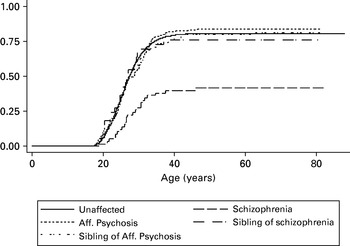
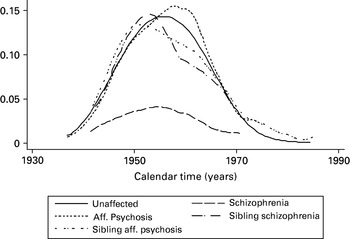
We first conducted a survival analysis to time of first birth, with age as the time-scale, taking into account censoring by death or emigration, and used this to construct the Kalpan–Meier curve in Fig. 1. We then conducted a second survival analysis, including all births to each individual, and with calendar time as the time-scale, and used this to construct the smoothed fertility estimates over time shown in Fig. 2.
Kaplan–Meier plot showing the proportion of individuals in each group to have had their first child, by age. Individuals who died or emigrated before 1970 are excluded.

Smoothed estimates for birth rate (annual live births per woman) by group, with calendar years on the time axis. Individuals who died or emigrated before 1970 are excluded.

We then used Poisson regression to calculate the fertility ratio (FR; the ratio of total lifetime reproductive output in each group compared to the reference group) with a 95% confidence interval (CI), while adjusting for potential confounders. Biological fitness may correlate more between siblings than between unrelated members of the population, so the analysis took account of the non-independence between data on siblings by using generalized estimating equations with robust standard errors adjusted for clustering on family. All available siblings were included in the analyses.
The distribution of the number of grandchildren was overdispersed (mean=3.39, variance=11.24), so we repeated the analysis on grandchildren using negative binomial regression, which is more robust to overdispersion than Poisson regression (Gardner et al. Reference Gardner, Mulvey and Shaw1995). The point estimates and CIs were almost identical (e.g. unadjusted FR for schizophrenia under Poisson regression 0.5142, 95% CI 0.3309–0.7989, p=0.003; and under negative binomial regression 0.5144, 95% CI 0.3313–0.7988, p=0.003). There were no findings that were significant at the p=0.05 level under one regression model but not the other. We therefore continued using Poisson regression throughout for consistency.
As the hospital discharge register only had complete coverage of hospital discharges since the early 1970s, there was a potential selection bias, whereby in order to be listed with a discharge diagnosis of psychosis, it was necessary to be living in Sweden until around 1970. We therefore excluded any individuals who had died or emigrated before 1970 (Table 1).
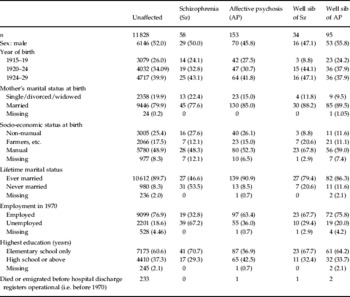
Demographic details for the sample

Values given as n (%).
The schizophrenia and affective psychosis columns include all cohort members with these diagnoses irrespective of whether they had an unaffected sibling.
The ‘Farmers, etc.’ category includes self-employed farmers, smallholders or proprietors of small businesses, with or without employees. It does not include agricultural workers or tradesmen. For the purposes of the analyses this category was combined with the non-manual group.
Ethical approval
The study received ethics approval from the regional ethics committee at Karolinska Institute [reference numbers 03-117 (2003-03-10) and 04-944T] and the London School of Hygiene and Tropical Medicine (approval number 05/156).
Results
Table 1 shows the demographic details of the sample, by group. There were 58 subjects with schizophrenia and 153 with affective psychosis. There was a small excess of females with affective psychosis. The most striking differences between groups were the proportions who had never married or were unemployed; schizophrenic subjects were more than six times more likely to have never married than the unaffected population [risk ratio (RR) 6.28, 95% CI 4.90–8.04], whereas patients with affective psychosis differed little from the population. Schizophrenic subjects were more than three times as likely to be unemployed than unaffected individuals (RR 3.41, 95% CI 2.84–4.09), whereas affective psychosis patients had approximately double the rate of unemployment of unaffected individuals (RR 1.83, 95% CI 1.48–2.27).
Fig. 1 is a Kaplan–Meier plot showing the proportion of individuals with at least one offspring by age in the five groups. Patients with schizophrenia had fewer offspring overall but there was no evidence that they reproduced earlier or later than unaffected individuals. Overall, 41.4% of schizophrenic individuals reproduced over their lifetime, compared with 80.3% of non-schizophrenics (RR 0.51, 95% CI 0.38–0.70).
Fig. 2 shows a kernel-smoothed hazard function of the birth rate (liveborn offspring per year) in the five groups over time. In this plot, calendar year, rather than age, is shown on the y axis. The schizophrenia group had a lower fertility at all times, and there was no evidence that the FR changed over time [χ2 test of proportional hazards between schizophrenic patients and the remainder over calendar time, using Schoenfeld residuals=0.47 (1 df), p=0.49].
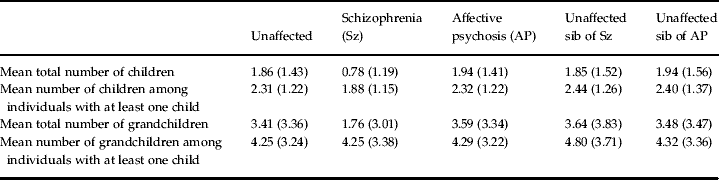
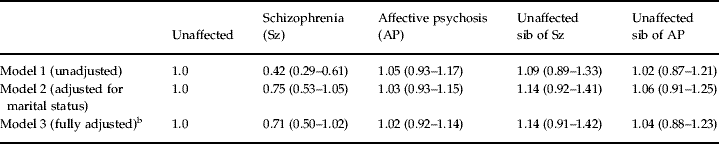
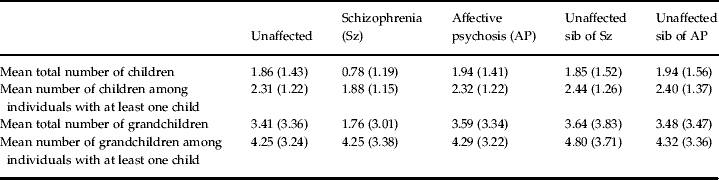
Table 2 shows the mean number of children and grandchildren by group. Table 3 shows FRs with 95% CIs for the first generation. There was strong evidence that patients with schizophrenia had lower fertility than the remainder of the population, but no evidence that the fertility of any of the other groups differed from that of the population (Table 3, Model 1). Much of the reduced fertility of patients with schizophrenia could be accounted for by the large proportion of schizophrenic patients who had no children. We therefore repeated the analysis, restricting to individuals with at least one child (n=9752 overall, n=24 with schizophrenia). Schizophrenic patients had somewhat lower fertility (mean 1.88 children versus 2.31 children; FR 0.80, 95% CI 0.63–1.02), although the 95% CI included the null value.
Mean number (standard deviation) of children and grandchildren
Fertility over one generation (number of children)Footnote a
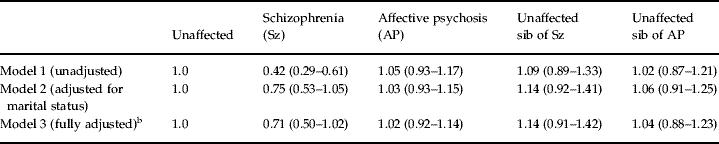
a Fertility ratios and 95% confidence intervals were calculated using generalized estimating equations for Poisson regression with robust standard errors. Individuals who died or emigrated before 1970 were excluded from all models.
b Model 3 was adjusted for marital status, gender, year of birth, maternal marital status at birth, socio-economic group at birth, unemployment and educational level.
Adding marital status to the model markedly attenuated the association between schizophrenia and fertility (Table 3, Model 2). There was no evidence that gender was a confounder, nor that the association between schizophrenia and fertility differed between sexes (FR for schizophrenia in males 0.41, 95% CI 0.23–0.75; FR for schizophrenia in females 0.42, 95% CI 0.26–0.70; schizophrenia×gender interaction term 0.99, 95% CI 0.46–2.12; p=0.980). There was no evidence of confounding by socio-economic group at birth, mother's marital status, education level, unemployment or year of birth (Table 3, Model 3).
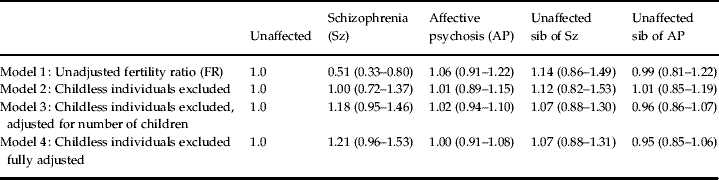
Table 4 shows FRs for grandchildren. There was strong evidence that patients with schizophrenia had fewer grandchildren overall than the remainder of the population (Table 4, Model 1). However, when we removed individuals who had no children (hence no grandchildren), schizophrenic patients no longer showed any fertility disadvantage (Table 4, Model 2). Given our previous observation that, even among fertile individuals, schizophrenic patients had somewhat lower fertility, this suggested that there may be some increase in fertility in the offspring of schizophrenic patients. We therefore controlled for number of children, to obtain an estimate of fertility in the offspring of the patients (Table 4, Model 3), and found tentative evidence of a small increase, although the CI included the null value. Finally, we controlled for all other potential confounders, which made little difference to the results (Table 4, Model 4).
Fertility over two generations (number of grandchildren)Footnote a
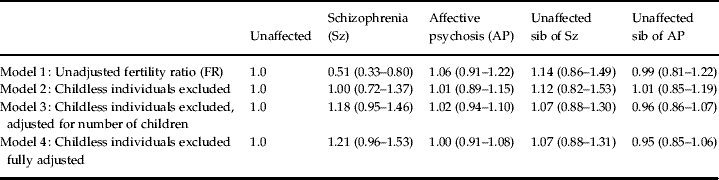
a Fertility ratios and 95% confidence intervals were calculated using generalized estimating equations for Poisson regression with robust standard errors. Individuals who had died or emigrated by 1970 were excluded from all models.
In Models 2–4, only individuals with at least one child (n=9752) are included.
Model 4 is adjusted for number of children, marital status, gender, year of birth, maternal marital status at birth, socio-economic group at birth, unemployment and educational level.
Discussion
Summary of principal findings
In a birth cohort followed up until late life, we found strong evidence that patients with schizophrenia have less than half as many children, and about half as many grandchildren, as the general population. Adding marital status to the model attenuated this effect, suggesting that reduced marriage rate was on the causal pathway, but there was no evidence of confounding by other sociodemographic factors. When we restricted the analysis to individuals with at least one child, schizophrenic patients still had somewhat fewer children, although this was of borderline statistical significance. This reduction was almost exactly compensated by a small excess in fertility in their offspring, also of borderline significance.
There was no evidence that patients with affective psychosis had fewer offspring than the general population. There was no evidence that the siblings of people with either disorder had more or fewer children or grandchildren than the population.
Comparison with previous studies
We have replicated the main finding of almost all studies to date, that schizophrenic patents have fewer children than the general population, and have extended these findings by demonstrating that the reproductive disadvantage persists into the subsequent generation. We did not replicate the finding of Howard et al. (Reference Howard, Kumar, Leese and Thornicroft2002) of reduced fitness in patients with affective psychosis. With regard to fitness in siblings, we did not replicate the finding of Fananas & Bertranpetit (Reference Fananas and Bertranpetit1995) of a compensatory excess of offspring in unaffected siblings in schizophrenic patients. Like the Haukka & Svensson studies, our study suggests that when individual data are used (rather than census data), there is no evidence of such an excess (Haukka et al. Reference Haukka, Suvisaari and Lonnqvist2003; Svensson et al. Reference Svensson, Lichtenstein, Sandin and Hultman2007). We did find tentative evidence that schizophrenic patients who do reproduce have more grandchildren than expected, but this failed to reach statistical significance and requires replication in another sample.
Possible mechanisms and implications
Availability of sexual partners, emotional functioning, goal-oriented behaviour, the ability to sustain long-term sexual relationships, sexual desire and a healthy reproductive system are all prerequisites for reproductive success, and schizophrenia may impair any or all of these.
Availability of sexual partners
People with schizophrenia, particularly prior to the 1970s, were often long-stay patients in psychiatric institutions. This would probably have restricted their access to potential sexual partners, although a previous study showing reduced fitness in first-episode patients (Hutchinson et al. Reference Hutchinson, Bhugra, Mallett, Burnett, Corridan and Leff1999) suggests that other mechanisms may also be operating.
Emotional functioning and reproductive behaviour
The effect of reduced fertility in schizophrenia was attenuated after adjustment for marital status. This suggests that individuals with schizophrenia have an impaired ability to enter, or remain, in a long-term relationship: in other words, marital status is on the causal pathway between schizophrenia and reduced fertility. Apathy, flattening of emotional responses, social withdrawal, lack of motivation and cognitive impairment are all core features of schizophrenia, and all are likely to impair the initiation and success of courtship behaviour.
Sexual desire and functioning: effect of neuroleptic drugs
Until the advent of ‘atypical’ neuroleptic drugs in the 1990s, all antipsychotic drugs caused potent dopamine blockade, leading to hyperprolactinaemia. This may interfere with fertility and sexual functioning by dysregulating the hypothalamo-pituitary-gonadal axis in females, and through erectile and ejaculatory dysfunction in males (Meaney & O'Keane, Reference Meaney and O'Keane2002). Compared to controls, schizophrenic patients engage less in sexual activity, and have greater sexual difficulties (Fortier et al. Reference Fortier, Mottard, Trudel and Even2003).
Neuroleptic treatment may not completely explain the high levels of sexual dysfunction in schizophrenia. Hutchinson et al. (Reference Hutchinson, Bhugra, Mallett, Burnett, Corridan and Leff1999) found that untreated first-episode patients show reduced pre-morbid fitness, and unmedicated patients also report lower sexual desire and reduced frequency of sexual thoughts than control subjects (Aizenberg et al. Reference Aizenberg, Zemishlany, Dorfman-Etrog and Weizman1995). Howard et al. (Reference Howard, Kumar, Leese and Thornicroft2002) found that within a large sample of schizophrenic patients, overall fitness was reduced, but this was not associated with neuroleptic treatment.
Moreover, there are two reasons to believe that the effect of neuroleptic drugs is relatively small in this cohort. First, because of the age of the cohort, many of the schizophrenic patients in the cohort would not have been exposed to neuroleptics until late in their reproductive lives. Neuroleptic drugs were not in widespread use until the late 1950s, and by that time, fertility was already in decline in this cohort (Fig. 2). Second, the age of this cohort gives us a unique opportunity to observe the effect of the introduction of neuroleptic drugs on reproductive fitness. In Fig. 2, which shows fertility by time, there is no evidence that fertility declined more rapidly than expected in the schizophrenia group during the 1950s, when these drugs became widespread.
Reproductive health: effects of substance misuse
The prevalence of alcohol, drug and tobacco misuse are all elevated in schizophrenia (Leonard et al. Reference Leonard, Adler, Benhammou, Berger, Breese, Drebing, Gault, Lee, Logel, Olincy, Ross, Stevens, Sullivan, Vianzon, Virnich, Waldo, Walton and Freedman2001; Van Mastrigt et al. Reference Van Mastrigt, Addington and Addington2004). Several studies have shown that women who abuse substances have higher rates of infertility (Buck et al. Reference Buck, Sever, Batt and Mendola1997), and both alcohol and smoking are also known to reduce sperm quality and motility (Muthusami & Chinnaswamy, Reference Muthusami and Chinnaswamy2005).
Enforced sterilization
There is another possible explanation for reduced reproductive success among women with schizophrenia. Between 1935 and 1975, sterilization laws existed in Sweden that permitted voluntary or compulsory sterilization on a variety of grounds, including mental illness (Armstrong, Reference Armstrong1997; Tannsjo, Reference Tannsjo1998). Sterilizations were performed in around 63 000 individuals, of whom 95% were women (Armstrong, Reference Armstrong1997; Runcis, Reference Runcis1998; Tannsjo, Reference Tannsjo1998). The excess of females undergoing sterilization may explain why, in this sample, the females with schizophrenia have a similar fertility disadvantage to males, in contrast to most other studies, where females had considerably less disadvantage than males (Bhatia et al. Reference Bhatia, Franzos, Wood, Nimgaonkar and Deshpande2004).
It is difficult to know how many women were sterilized on grounds of schizophrenia, although a high proportion were in mental institutions (Armstrong, Reference Armstrong1997). It may also be relevant that the ‘Institute of Racial Biology’, the major centre for Eugenics in Sweden, was located in Uppsala, although it has been reported that sterilization rates in Uppsala were no higher that those in other parts of Sweden (Bhatia et al. Reference Bhatia, Franzos, Wood, Nimgaonkar and Deshpande2004; Prof. M. Runcis, personal communication). Even in cases where sterilization was not enforced, there is evidence that patients were coerced into voluntary sterilizations (Tannsjo, Reference Tannsjo1998), and it is possible that the attitudes and values that accompanied the sterilization laws may also have led to patients with schizophrenia being discouraged from reproducing.
Persistence of risk alleles in the gene pool
Antipsychotic treatment, institutionalization and sterilization are relatively modern phenomena, but many of the other mechanisms described above would probably have impaired fertility in schizophrenic patients for as long as schizophrenia has existed. The question, then, remains: why has the prevalence of alleles predisposing to schizophrenia in the gene pool not fallen to zero?
The model proposed by Huxley et al. (Reference Huxley, Mayr, Osmond and Hoffer1964), and later refined by others, is that of a balanced polymorphism that predisposes to schizophrenia but enhances fertility in unaffected carriers. However, they assumed that schizophrenia was a single-gene disorder. As schizophrenia is now known to be a polygenic disorder, with locus heterogeneity, both across and within populations, such a mechanism is probably simplistic.
A more recent model for understanding balanced polymorphisms where multiple genes are involved is the concept of stabilizing selection. Many continuous phenotypes, for example height or anxiety, are normally distributed and influenced by several genes, where one allele tends to increase the value of the phenotype and another tends to reduce it. For most normally distributed phenotypes, fitness is generally greatest around the median value of the phenotype. Hence, individuals with extreme values of the phenotype will be at a selective disadvantage, but in the population as a whole, alleles serving to increase and decrease the trait will both be selected for (Walsh, Reference Walsh, Balding, Bishop and Cannings2003).
For an example of how such a mechanism might work in schizophrenia, we can consider a hypothetical continuous phenotype that determines an individual's disposition towards paranoid thinking, where optimal fitness occurs at an intermediate level of paranoia. Stabilizing selection will give rise to a mixture of paranoia-increasing and paranoia-reducing alleles in the population, even though a few individuals with many paranoia-increasing alleles will develop schizophrenia.
An alternative explanation for the persistence of schizophrenia despite reduced fitness is mutation-selection balance (Keller & Miller, Reference Keller and Miller2006). Several recent studies have demonstrated an association between advanced paternal age and schizophrenia (Sipos et al. Reference Sipos, Rasmussen, Harrison, Tynelius, Lewis, Leon and Gunnell2004), suggesting that some cases of schizophrenia arise from de novo mutations in the male germ-line (Keller & Miller, Reference Keller and Miller2006). In the past few months, four studies, all using different designs, have produced evidence that schizophrenia is associated with a substantial increase in rare de novo copy number variations (CNVs), particularly in regions associated with neurodevelopment (International Schizophrenia Consortium, 2008). If a significant proportion of schizophrenia is caused by rare de novo CNVs, this could explain how schizophrenia can persist in the population despite drastically reducing fertility; even if there is strong selection pressure against these CNVs, this may be counterbalanced by a constant supply of new CNVs entering the population (Stefansson et al. Reference Stefansson, Rujescu, Cichon, Pietilainen, Ingason, Steinberg, Fossdal, Sigurdsson, Sigmundsson, Buizer-Voskamp, Hansen, Jakobsen, Muglia, Francks, Matthews, Gylfason, Halldorsson, Gudbjartsson, Thorgeirsson, Sigurdsson, Jonasdottir, Jonasdottir, Bjornsson, Mattiasdottir, Blondal, Haraldsson, Magnusdottir, Giegling, Moller, Hartmann, Shianna, Ge, Need, Crombie, Fraser, Walker, Lonnqvist, Suvisaari, Tuulio-Henriksson, Paunio, Toulopoulou, Bramon, Di Forti, Murray, Ruggeri, Vassos, Tosato, Walshe, Li, Vasilescu, Muhleisen, Wang, Ullum, Djurovic, Melle, Olesen, Kiemeney, Franke, Sabatti, Freimer, Gulcher, Thorsteinsdottir, Kong, Andreassen, Ophoff, Georgi, Rietschel, Werge, Petursson, Goldstein, Nothen, Peltonen, Collier, St Clair, Stefansson, Kahn, Linszen, van Os, Wiersma, Bruggeman, Cahn, de Haan, Krabbendam and Myin-Germeys2008; Walsh et al. Reference Walsh, McClellan, McCarthy, Addington, Pierce, Cooper, Nord, Kusenda, Malhotra, Bhandari, Stray, Rippey, Roccanova, Makarov, Lakshmi, Findling, Sikich, Stromberg, Merriman, Gogtay, Butler, Eckstrand, Noory, Gochman, Long, Chen, Davis, Baker, Eichler, Meltzer, Nelson, Singleton, Lee, Rapoport, King and Sebat2008; Xu et al. Reference Xu, Roos, Levy, van Rensburg, Gogos and Karayiorgou2008).
Strengths and limitations of the study
As the members of our cohort have been followed to age 73–87 years, we can be confident that they have all completed their families, and that the great majority have also completed the second generation (i.e. grandchildren) (Koupil, Reference Koupil2007). We are not aware of any studies that have followed a cohort to such an advanced age, thus capturing their total reproductive output over two generations. However, our study has several limitations.
Our cohort only yielded 58 individuals with schizophrenia and 153 with affective psychosis. Although there is little doubt that the patients with schizophrenia had reduced fertility, it is possible that there are small increases or reductions in fertility in the other groups that our study did not have sufficient power to detect.
The diagnoses in this study were from routinely collected clinical data, based on the diagnosis made by the treating psychiatrist. For schizophrenia, good concurrent validity has been demonstrated for diagnoses of schizophrenia in this particular register, with 86% of register cases of ICD-9 schizophrenia also fulfilling DSM-IV criteria for schizophrenia syndrome (Dalman et al. Reference Dalman, Broms, Cullberg and Allebeck2002). However, the validity of affective psychosis has not been assessed in this register.
Although we identified some patients with schizophrenia as early as 1937, we only had full ascertainment for hospital discharges between 1973 and 2002. Some patients with schizophrenia in young adulthood later recover (Harrison et al. Reference Harrison, Hopper, Craig, Laska, Siegel, Wanderling, Dube, Ganev, Giel, an der Heiden, Holmberg, Janca, Lee, Leon, Malhotra, Marsella, Nakane, Sartorius, Shen, Skoda, Thara, Tsirkin, Varma, Walsh and Wiersma2001), so patients identified in this study will be biased towards chronic and late-onset cases.
The total number of beds in the Swedish mental health service was 35 000 in 1960 (Garpenby, Reference Garpenby1993), falling to 5000 by 2001 (Priebe et al. Reference Priebe, Badesconyi, Fioritti, Hansson, Kilian, Torres-Gonzales, Turner and Wiersma2005). Thus, some patients with schizophrenia may have been treated exclusively in the community during the study, and would consequently have been misclassified as unaffected. However, the introduction of community services was associated mainly with a large decrease in the average length of hospitalization, with little reduction in the number of patients admitted in a given year (Hansson, Reference Hansson1989). We therefore expect to have identified the majority of individuals with schizophrenia, and most of those with severe affective psychosis, who had active illness from 1973 onwards.
Conclusions
We have found strong evidence that patients with schizophrenia are less likely to marry, are less likely to have children, and have fewer children and grandchildren, than the general population. There was some evidence that even married patients had lower fertility than married people in the general population. There was tentative evidence that the offspring of schizophrenic patients had increased biological/reproductive fitness, but there was no similar increase in the fitness of siblings. We found no evidence that the fitness of affective psychosis patients or their siblings differs from that of the general population.
Acknowledgements
Joseph Kim of the LSHTM gave helpful statistical advice. Rawya Mohsen of CHESS prepared and managed the dataset, and Lisa Holmberg manually traced the siblings in the first generation. J.H.M. received funding through a Special Training Fellowship in Health of the Public Research (G106/1213), jointly funded by the Department of Health and Medical Research Council, UK, and is also supported by the Department of Health through the National Institute for Health Research (NIHR) specialist Biomedical Research Centre for Mental Health award to the South London and Maudsley NHS Foundation Trust and the Institute of Psychiatry at King's College London. I.K. is currently funded by the Swedish Council for Working Life and Social Research. The UBCoS Multigen study is supported by grants from the Swedish Council for Working Life and Social Research (FAS projects no. 2003-0101, 2007-1010) and the Swedish Research Council (VR projects no. 2003-2440, 2006-7498). The funders were not involved in the study design or execution and the views and conclusions expressed in this manuscript are the responsibility of the authors.
Declaration of Interest
None.