Introduction
Jennet milk is an excellent substitute for human milk. This product can be considered both innovative and traditional (Wagner, Reference Wagner1908 quoted in Anantakrishnan, Reference Anantakrishnan1941; Gonzalez-Diaz and Cravioto, Reference Gonzalez-Diaz and Cravioto1947; Oftedal and Jenness, Reference Oftedal and Jenness1988). Jennet milk proprieties as human food have recently been rediscovered and studied in Italy. Indeed different studies have investigated its chemical, physical, hygienic, health and nutritional characteristics (Iacono et al., Reference Iacono, Carroccio, Cavataio, Montalto, Soresi and Balsamo1992; Fiat et al., Reference Fiat, Migliore-Samour, Jolles, Droulet, Sollier and Cain1993; Froetschel, Reference Froetschel1996; Meisel, Reference Meisel1997; Carroccio et al., Reference Carroccio, Cavataio, Montalto, D’Amico, Alabrese and Iacono2000; Salimei et al., Reference Salimei, Belli Blanes, Marano and Varisco2001; Iannolino et al., Reference Iannolino, Iacono, Carroccio, Scalici, Russo, Pellerito and Schirò2005; Monti et al., Reference Monti, Muratore, Bertino, Coscia, Fabbris and Conti2005). Nowadays in Italy, consumers can only buy jennet milk directly from the farmers through the authorization of the Local Health Agency (ASL), thanks to the old legal decree number 994 issued in 1929. Therefore its production and marketing lack precise regulations. Many studies aim at filling the gap in the present policies for the production and marketing of milk from other animal species generally consumed by humans (Conte, Reference Conte2006).
When considering the specialized production of jennet milk, it is very important to establish profitable management systems, and, at the same time, to take into account the animal physiology and its welfare.
The effects of some technical and managerial factors on the production of jennet milk were studied in this survey.
Currently, in a Sicilian jennet milk farm, the animals are usually milked one or two times a day with milking interval between 4 and 8 h. Furthermore, the milk produced by one or two daily milking sessions does not correspond to the potentially realizable yields.
Defining the daily milking times and the relative intervals while respecting the jennet udder physiology should be the main concern. The jennet udder has a small tank (Barone, Reference Barone1983; Abbate, Reference Abbate2006) and excessively lengthy milking intervals could cause high intra-udder pressure, inducing early drying of the glandular activity.
For these reasons, also considering the lack of information on these topics, the ‘S.En.Fi.Mi.Zo’ Department of the University of Palermo in collaboration with the Istituto Sperimentale Zootecnico per la Sicilia (ISZS) carried out a study to quantify the total daily milk production by testing different milking typologies, even with a shorter milking interval.
Material and methods
A total of nine several Ragusana pluriparous jennets in lactation, which foaled in spring and summer, were investigated. The study was carried out from May to September 2004 at the ISZS at 100 m a.s.l.
The jennet did not use the pasture and were kept in a large paddock.
The diet consisted of hay ad libitum (dry matter (DM) 92.3%, CP 6.1%, NDF 69.5%, ADF 51.0% and ADL 8.1%) and 3.5 kg/jennet per day of a concentrate mixture constituted by 35.0% corn, 20.0% barleycorn, 17.5% fine bran, 10.0% soy, 5.0% pulps of beet, 5.0% sunflower, 5.0% beans and 2.5% mineral integrators (DM 89.3%, CP 18.6%, NDF 14.5%, ADF 8.8% and ADL 1.9%).
From post-foaling day 21, the milk yield, obtained through two daily manual milking sessions at 1100 and 1700 h and with a 6 h milking interval, was recorded every 3 weeks. After 2 days, the milk yield produced in 24 h by the same jennets was recorded by carrying out eight milkings, beginning at 1100 h and every 3 h thereafter. The trial also aimed at quantifying the milk yield obtained from two and three milkings of the eight-milking sessions with 3-h milking intervals; for this purpose, the first two milkings carried out at 1100 and 1400 h and the first three milkings carried out at 1100, 1400 and 1700 h were, respectively, taken into account.
The foals did not induce milk ejection before milking. From 0800 h to the end of the last milking, the foals were indeed penned separately but adjacently to the jennets, maintaining visual and acoustic contact with the jennets. After the last milking the foals were housed with the jennets. During the day with eight milkings, the milk yield from the jennets was fed to their respective foals, through bottles. From the 28th to the 90th post-foaling day, the foals were fed on starter concentrate ad libitum and, after the 90th post-foaling day, the same diet as the jennets.
Individual milk samples were collected at each milking. Fat, protein, lactose and somatic cells were analyzed through Milkoscans – calibrated by using the results of the laboratory analysis according to the Associazione Scientifica di Produzione Animale (ASPA) official method (1995). In the laboratory pH, crude protein and non-proteic nitrogen (NPN) were also determined (ASPA, 1995). The total bacterial count was determined monthly on mass samples.
Three different statistical analyses were carried out through ANOVA with the procedure GLM of Statistical Analysis Systems Institute (SAS) 9.1:
• one considering the effects of the milking interval (1…2), taking into account two milking times with 3- and 6-h milking intervals, of the lactation stage (1…3), which was subdivided into the following intervals delineated by the post-foaling days: from the 21st to 80th day, from the 81st to the 110th and from the 111th to the 150th, of the jennet (1…9) and of the interaction between lactation stage and the milking interval.
• one considering the effects of the milking frequency (1…3), which took into account the milking times (two, three and eight times) with 3-h milking intervals, of the lactation stage (1…3), of the jennet (1…9) and of the interaction between the lactation stage and the milking frequency.
• one considering the effects of the milking session (1…8), taking into account the daily eight-milking session, of the lactation stage (1…3) and of the jennet (1…9), and of the interaction between the milking session and the lactation stage.
The differences were tested using the Student t-test.
The correlations of Pearson were used to test the relationship between the different milking typologies, through the CORR procedure of the SAS 9.1.
Results and discussions
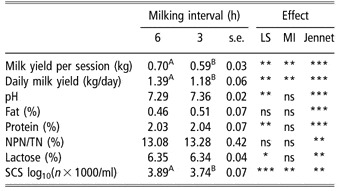
The production variables on the milking intervals are reported in Table 1.
Effect of the milking interval between two daily milking sessions on milk yield and chemical composition per session (means ± s.e.)

NPN = non-proteic nitrogen; TN = total nitrogen; SCS = somatic cells score.
*P ⩽ 0.05; **P ⩽ 0.01; ***P ⩽ 0.001; A,B: P ⩽ 0.01.
LS = lactation stage; MI = milking interval.
LP*MI = non-significant.
Total daily milk yields were 1.39 ± 0.06 and 1.18 ± 0.06 kg/day when jennets were milked at 6 or 3 h intervals.
Although the 6-h milking interval produced per session more milk (+19%) than the 3-h interval one (P ⩽ 0.01), a longer milking interval resulted in a lower milk production/h. This confirms that the udder storage capacity is limited (Barone, Reference Barone1983; Abbate, Reference Abbate2006).
The somatic cells score (SCS) always showed values lower than 4 logarithm points, in accord with a previous study carried out by Alabiso et al. (Reference Alabiso, Russo, Giosuè, Alicata and Torrisi2005).
The milking intervals influenced the SCS, which showed lower values in the two-time milking with a 3-h interval (P ⩽ 0.01).
The other variables considered in this study were not influenced by the milking interval.
The coefficient of variation (CV) of milk yield, fat and protein contents were, respectively, 16.8%, 72.3% and 13.9%.
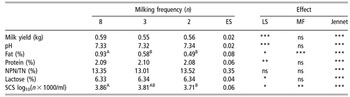
The production variables on the milking frequency are reported in Table 2.
Effect of daily milking time per session on milk yield and chemical composition per session (means ± s.e.)

NPN = non-proteic nitrogen; TN = total nitrogen; SCS = somatic cells score.
*P ⩽ 0.05; **P ⩽ 0.01; ***P ⩽ 0.001; A,B: P ⩽ 0.01.
LS = lactation stage; MF = milking frequency.
LS*MF = non-significant
Total milk yield was 4.87 ± 0.12 kg with eight-time milking frequency (data not shown in Table 2). This milk production could be considered the daily milk yield realizable by the jennets.
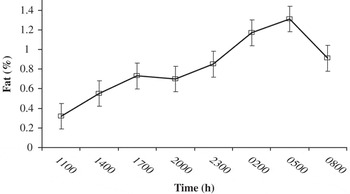
The fat content per session was greater with the eight-time milking frequency (P ⩽ 0.001) than with the others. This result can be explained when observing Figure 1, which reports the fat content at each milking of the eight-time milking frequency. The tendency of the fat content, which was higher in the milking times following the first one, as also observed by Chiofalo et al. (Reference Chiofalo, Azzara, Liotta and Chiofalo2004), seems to confirm the hypothesis that some jennets could prevent complete milking, reserving some of the milk for the foals (Alabiso et al., Reference Alabiso, Russo, Giosuè, Alicata and Torrisi2005). This portion of milk, which as known presents a high-fat content, would be gradually released in the following milkings. So the quantity of the fat drawn out would progressively increase with each milking, until its complete extraction; in this case, this recovery would occur at the seventh milking, when the fat content was greater than in the other ones (P ⩽ 0.001).
The milking frequency influenced the SCS, which showed greater values in the eight-time milking than in the two-time one (P ⩽ 0.01).
The other variables considered in this study were not influenced by the milking frequency.
The CV of milk yield per session, fat and protein contents were, respectively, 13.8%, 50.4% and 12.5%.
For each milking typology the lactation stage had a similar effect on all the variables except for fat and NPN/TN (non-proteic nitrogen/total nitrogen) content (Table 1) when using different intervals for milking and except for NPN/NT when using different milking frequencies (Table 2).
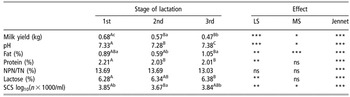
The production variables of the eight-time milking regarding the lactation stage are reported in Table 3.
The productive variables of the eight-time milking in regard to the lactation stage (means ± s.e.)

NPN = non-proteic nitrogen; TN = total nitrogen; SCS = somatic cells score.
*P ⩽ 0.05; **P ⩽ 0.01; ***P ⩽ 0.001; A,B,C: P ⩽ 0.01; a,b,c: P ⩽ 0.05.
LS = lactation stage; MS = milking session.
LS*MS = non-significant.
During the lactation, the milk yield and the protein content tended to decrease, while the lactose amount tended to increase as also reported in other studies on jennets and mares (Summer et al., Reference Summer, Formaggioni, Filippini, Martuzzi, Catalano and Mariani2000; Doreau et al., Reference Doreau, Gaillard, Chobert, Léonil, Egito and Haertlé2002; Malacarne et al., Reference Malacarne, Martuzzi, Summer and Mariani2002; Alabiso et al., Reference Alabiso, Russo, Giosuè, Alicata and Torrisi2005; Conte et al., Reference Conte, Scatassa, Todaro and Barreca2005). The fat content varied.
Increasing the milking frequency and/or reducing the interval time could allow the milk yield to increase, especially in the first lactation stages with the most elevated productive levels. There is indeed an average milking interval beyond which the production of the udder drops (Aguggini et al., Reference Aguggini, Beghelli and Giulio1992). This interval is short during the first stages of lactation and longer thereafter, as reported by Martin-Rosset et al. (Reference Martin-Rosset, Doreau and Cloix1978) who observed a greater suckling number in foals of mares during the first stages of lactation. However, to establish the best milking interval it would be necessary to know the effects of the different milking intervals on the length of the lactation.
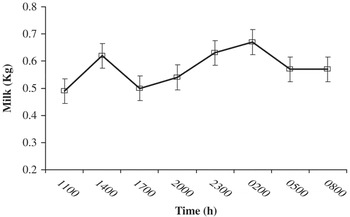
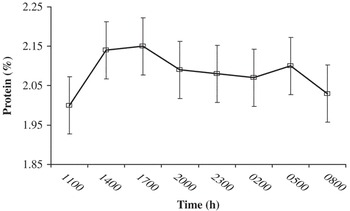
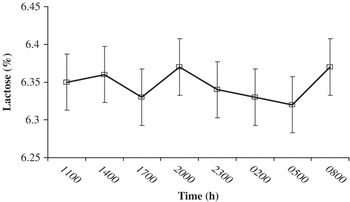
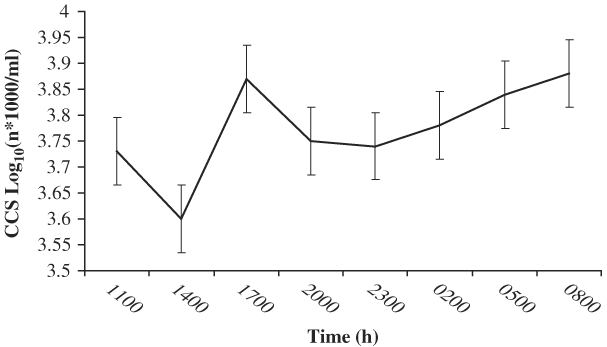
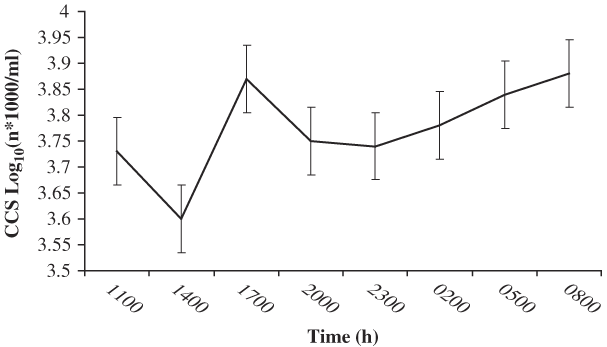
The tendencies of the principal quantitative and qualitative jennet milk variables, considering the milk yield produced in 24 h, are represented in Figures 1–5.
Fat content (%) at each milking using the eight-time milking.

Milk yield at each milking using the eight-time milking frequency.

Protein content (%) at each milking using the eight-time milking.

Lactose content (%) at each milking using the eight-time milking.

SCS (%) at each milking using the eight-time milking.
The milk yield per session was 0.59 + 0.02 kg (Table 2), and values ranged between 0.49 and 0.68 kg (P ⩽ 0.05) (Figure 2) and individual variability at milking session was CV = 30.4%.
During the daily milking sessions, the protein (Figure 3) and the lactose (Figure 4) contents were constant and individual variability was, respectively, CV = 15.2% and 2.6%.
The SCS increased (P ⩽ 0.05). This tendency is difficult to understand (Figure 5), and the individual variability was only CV = 7.7%.
The monthly bacterial total count results equal an average of 5300 UFC/ml, lower than the value found in another study, which was conducted from February to May, in some other Sicilian farms (Conte et al., Reference Conte, Scatassa, Todaro and Barreca2005).
The total daily milk yield produced by the eight-milking sessions, which were carried out every 3 h, provided an average of 4.9 ± 0.1 kg/day. This production positively correlated (P ⩽ 0.001) with the milk yield produced by the daily two, with 6- and 3-h milking intervals, and three milking times which were, respectively, 1.23 ± 0.1, 1.05 ± 0.1 and 1.62 ± 0.1 kg/day. The r-values were 0.72 for both the milking carried out twice a day, and r = 0.82 for the one carried out three times a day. The daily two- or three-time milking yield could provide an estimation for the daily production, having a higher number of data available.
The fat content produced by the eight-time milking positively correlated (P ⩽ 0.001) with the ones produced by the daily two-, with 6- and 3-h milking intervals, and three-time milking with the r-value equal to 0.65, 0.69 and 0.71, respectively.
Conclusion
Total daily milk yield is affected by milking interval but not by milking frequency. And total daily milk yield would be higher with long interval.
Moreover, daily milk yield is affected by lactation stage irrespective of milking typology as in mares.
But increasing the milking frequency and/or reducing the interval time allowed milk yield at each milking to increase, especially in the first lactation stages while production is the highest. Other investigations on milking intervals, using different intervals between milking sessions also in relation with different lactation stages, would be necessary. At the same time, these aspects need to be related to the jennets’ natural behavior and the welfare.
It is possible to obtain greater yields through different milking methods not used in this research, for example, machine milking and/or with the foal present during milking for complete milk release (oxytocin administration is illegal in Italy).
On average, in light of the different milking typologies tested in this study, the fat content increased while the protein and lactose percentages remained constant in the milk obtained through a larger number of daily milkings. Jennet milk is thought to have a low fat content. Jennet milk with a higher fat content could therefore be a better answer to the energetic and nutritional human requirements, considering it is mainly used as food for babies affected by Cow Milk Protein Allergy.
The milk yield and the fat content produced by two and three milking times are positively correlated to the daily eight-milking sessions.
However, more observations are necessary to establish a mathematical-statistic relationship between milk yield and fat content. The variables of the milk yield and the fat content could be used to estimate the genetic value of the ‘dairy jennet’ as in other dairy farm animals.
The results showed in this paper could contribute to give references to support the new recording system of jennet performance, which have been recently implemented by farmer associations in an experimental way; the AIA (Italian Farmer Association) is indeed starting to control milk yield and quality in jennet farms, adopting and adapting the rules that are normally used for other dairy species.
Other investigations, such as milk yield potential of jennets, the determination of nutrients requirements of dairy jennets, should also be conducted to design breeding plan and set up feed allowances to support more efficient management systems as there is little information.