


Franz von Werra, a flying ace of the Luftwaffe, is the only German known to have escaped Allied captivity and to have definitely made it back to Germany during the Second World War. His journey began in England in September 1940, when he was shot down near Kent and interrogated at length in camps in London and Middlesex. Then, he was taken to a holding camp in Cumbria, from which he briefly escaped while out on a walk. He was captured five days later and taken to a second camp in Derbyshire, from which he escaped through a tunnel he helped to dig. Once out of the camp and in the village of Swanwick, he convinced a number of locals that he was a Dutch pilot serving with the Royal Air Force, that he had been forced down on his way back from an Allied attack on Denmark and that he needed to reach the nearest RAF aerodrome. He was assisted in making his way to an aerodrome in Nottingham, where he maintained his story and was almost ready to fly away. He was arrested as he sat in the cockpit of a Hurricane, about to take off. Days later, in January 1941, von Werra was dispatched to Canada with over a thousand other prisoners. Most Axis personnel captured in or around Britain were sent to the dominions in the first half of the war to avoid maintaining an army of enemy soldiers in the country, ready to be liberated in the event of an invasion. No sooner had he reached Canada, von Werra did what came most naturally to him by that point: he jumped from the moving train taking him to his new camp. Knee-deep in snow, he made his way to the St. Lawrence riverbank and crossed over to New York on a rowing boat. From the then neutral United States, he made his way to Mexico, then Peru, Bolivia, Brazil, Spain and Italy, eventually making it to Berlin in April, where he received the Knight’s Cross of the Iron Cross from Hitler’s own hands.1
Already extraordinary, von Werra’s escape was even more significant because of what he had experienced while in Britain. Unlike most prisoners, von Werra had gone through the entire system of interrogation set up to elicit tactical, operational and strategic information from the enemy. Fewer than 1 per cent of all Germans captured by Britain during this conflict would share von Werra’s interrogation experience. His return home thus caused a panic in Britain. But it also created concern in Germany, which had now realised how much information its soldiers were giving away. For this reason, von Werra was asked by Hermann Göring to help train new recruits on how to evade British interrogations as well as to improve the Luftwaffe’s interrogations of Allied airmen, which compared to the British proved to be rudimentary.
How could it be that Germans were divulging intelligence to the British? German soldiers were known for their strong sense of military honour. Many of the interrogation reports produced in the first year of the war prove this point, with prisoners refusing to talk. It was precisely the fact that much information was being obtained without prisoners realising that they were giving it that was discovered through von Werra’s account. Interrogation was designed so as not to rely on prisoners’ willingness to give what they perceived to be ‘intelligence’, but rather to enable the systematic collection of seemingly trivial information, such as when a prisoner had last been on leave. At the individual level, questions about leave seemed harmless and were often answered. At a mass level, such answers would indicate how much strain the Wehrmacht was under and hence how infrequently it was allowing personnel to go on leave, information that was useful to the War Office and included in its weekly intelligence summaries. Other examples are changes to individuals’ salaries or how speedily they were being promoted, information that would contribute to Ministry of Economic Warfare analyses on economic conditions in Germany. In a total war, the collection of information was similarly total.
Sophisticated as it was, the subtle gathering of ‘big data’ was not interrogation’s only function. The camps that von Werra passed through had developed an elaborate process which used several methods to collect the kind of intelligence prisoners were often unwilling to share. Such methods included direct interrogation, stool pigeons and concealed microphones, which were used to monitor conversations between prisoners, between prisoners and stool pigeons, and between prisoners and interrogators. The von Werra scare was therefore not as disruptive as it might have been because the sophistication of the interrogation process in Britain was never realised. It is true that many prisoners suspected that their conversations were being monitored, but this rarely prevented them from talking.2 Many of those initially tight-lipped would, after inspecting the room, assure themselves that no devices were present. In other cases, dummy microphones were put in obvious places so that prisoners looking for them could find them – as indeed von Werra did, behind a ventilator grille – and move to have their conversations at the opposite end of the room, where the real microphones were hidden behind walls and ceiling roses. Plastered over, they were undetectable.
The cables from these microphones led to what was colloquially known as the ‘M’ Room, with ‘M’ standing for mother – because ‘Mother’ was always listening.3 There, staff from the Pioneer Corps, most of them Germans or German-speaking refugees and often Jewish, would listen in and produce verbatim excerpts of discussions deemed useful. Each excerpt would then be circulated to multiple government departments and agencies, whose interests this operation was designed to serve. But it was almost as if this operation was designed to excite as well. Its mere existence was full of intrigue: grandiose stately homes with state-of-the-art technology plastered behind the walls, picking up whatever intelligence the men of the Wehrmacht were unknowingly spilling out. Meanwhile, hidden in the basement some of the regime’s victims were transcribing what was being said, then passing it to a network of recipients ready to use those conversations against Nazi Germany.
That Britain was using microphones to eavesdrop on prisoners is now something close to common knowledge for those interested in the Second World War. Yet for all the attention the use of microphones is bound to attract, there is much that is unknown about the process that generated them.4 Who decided what conversations to record? Who was monitored, and why? The question of why is far from self-evident when the transcripts are read on their own. Some are a couple of sentences long, they concern topics apparently unrelated between them and the identity of the speakers is unknown, with soldiers’ names replaced by a code. Some contained information that was clearly intelligence, such as descriptions of weapons, but others contained only what was rightly called Nazi claptrap. Take for example a transcript from August 1940 which simply read: ‘I am the ping-pong champion of West Germany. But I am out of practice. I gave up the game after a typical Jew-boy – sixteen years old – had beaten me. Then I said to myself: “That is certainly not real sport!”.’5 Why was this antisemitic comment, devoid of military information, of interest to intelligence? If you turned the page to see whether the next transcript held any clues, you would be disappointed – it is an unrelated conversation between two different prisoners. The transcript before it is also unconnected – a five-page discussion between two airmen, unwittingly sharing air intelligence concerning the Battle of Britain. Before that, an airman was complaining about the high taxes his father-in-law was paying the regime. As with these examples, many transcripts are striking when read individually, but when read together they become rather disorientating. This is because intriguing as they may be to us, these conversations were not being recorded for posterity. There was a logic and a process behind those recordings, and these need to be retraced.
3.1 On A Wing and A Prayer
The association between covert listening and interrogation dates back to the start of the war in 1939, and had already been at the centre of discussions about interrogation before that September. Although interrogation had been a far less sophisticated affair in the First World War than it was about to become, it had nevertheless been considered an important source by all three service ministries, creating a conviction that it should be exploited further in a new conflict with Germany. This conviction was strengthened by the fact that in the Great War’s final stages, microphones were used to monitor some prisoner conversations, together with old-fashioned eavesdropping done by prison guards. These ad hoc activities yielded some useful intelligence, to the point that a bugged camp was apparently set up in South London in 1918 to exploit this method more systematically. With its planned opening date being – of all days – 11 November 1918, the day on which the war ended, it was never actually used. But when plans for interrogation were dusted off in 1938 following the Munich Agreement, the War Office picked up exactly where it had left off twenty years earlier, aiming to revive the same type of camp. Several properties were considered by the War Office with the Tower of London confirmed as the best place in April 1939, the plan being that it would become operational the day after war broke out.
Commanding this operation would be then Captain Thomas Kendrick, who had until recently worked for SIS. It was the Gestapo that had ended his fifteen-year-long spy career in the field only months earlier, when they arrested him in Austria on his way to England on a three-week holiday. Since the mid-1920s, Kendrick had been based in Vienna where he ran a network of SIS spies concerned primarily with Soviet espionage. To be able to do that, he was formally attached to Vienna as a ‘Passport Control Officer’, an established diplomatic cover for SIS officers on the Continent. Under that cover, he let his staff focus on issuing passports – including to Austrian Jews trying to escape following the Anschluss – while he focused on running several important agents including in Czechoslovakia, Hungary, Italy and Nazi Germany.6 When the Gestapo arrested him in August 1938, they had plenty of evidence to support their claim that Kendrick was a spy. They interrogated him extensively over three days before they released him following the intervention of the British ambassador to Berlin, Sir Nevile Henderson, effectively putting an end to his SIS career.7 Despite being uncovered, his high standing within SIS made him a natural option to head this new operation in the Tower, which required the skills and discretion of an SIS officer despite the camp itself having nothing to do with SIS. In addition to the fact that his career was forged in SIS, Kendrick was also known for his management skills and for effectively dividing labour among his team in Vienna. He was, in other words, both a good spy and a good leader.
Delegation of duty was to prove instrumental to interrogation, but initially Kendrick had little to delegate. An entry from Guy Liddell’s diary for 13 September 1939 notes that Kendrick was ‘kicking his heels’ in the Tower and had no prisoners to interrogate.8 With him, also kicking their heels, was a small team of two interrogation officers, two shorthand writers and two ‘secret listeners’. To these War Office personnel, the Royal Navy and Air Force soon attached their own officers. The arrangement was that the overall administration of the camp – including custody, transport and the bugging activities – would be the responsibility of the War Office, which also had responsibility for interrogating Army prisoners.9 But the Royal Navy and Air Force would be able to have their own interrogators, responsible for interrogating Kriegsmarine and Luftwaffe prisoners respectively. This combined, intra-service arrangement was reflected in the name of the organisation, which came to be known as the ‘Combined Services Detailed Interrogation Centre’ (CSDIC, pronounced sizdic).10 The formal name of this organisation was CSDIC(UK), but here it will be referred to as CSDIC for simplicity. The task of liaising between the camp and the three ministries was given to then Captain Arthur Richard Rawlinson. A successful screenwriter in peacetime, in the previous war Rawlinson had been an intelligence officer with MI1(a), the branch dealing with interrogation at that time.11 On the reserve list since 1919, he had returned to active service earlier in 1939. In January 1940, he became the link between CSDIC and the rest of the intelligence machine, even though initially he split his duties between that and travelling to Walton-on-Thames, where he was helping to produce a propaganda film for British soldiers to show the ‘deplorable results that may follow’ if they said anything more than their rank, name and number in interrogation.12
Yet the idea that microphones would simply provide raw intelligence proved to be more complex in practice. While most prisoners captured around the UK were taken to CSDIC between September and December 1939 – a total of 169 men, most of them captured at sea – obtaining useful information from them was a challenge. The first problem was that the technology the War Office possessed was subpar, and the conditions in the medieval Tower were ‘about as unfavourable as can be imagined’ for recording sound.13 The second transcript ever to have been produced contained a note, ‘outside interference very noticeable’, which contributed to unintelligible conversations.14 A further problem was that the methods used to make prisoners open up were too simplistic, and, even worse, detectable by the prisoners, such as British officers posing as Germans to try to gain their trust. On top of this, while the initial policy was that all prisoners would be sent to the Tower for up to three days before being released to permanent camps, some of those released had to be taken back to the Tower when it was realised that more information was needed from them. A bugged conversation between two Luftwaffe prisoners on Christmas Eve 1939 is telling of this problematic process:
I have already been in the Camp and have been fetched back again … I have had unpleasant experiences here. Even though the treatment is not too bad, I don’t trust these fellows any more. I don’t trust the quietness of it here … They use all sorts of means here to get information out of us. I think it is despicable when they put English officers into German Air Force uniforms.
They do that?
Yes, in the Tower … I am very sceptical about our being brought to gather just on Christmas Eve, for we are not generally so well treated. I don’t trust these people. They are doing it for some special reason.15
Weeks into the war, interrogation was proving a failure. The lack of support from outside CSDIC only exacerbated matters. In the Great War interrogation had been part of MI1, so the same arrangement was resurrected in 1939 without much question. But MI1 was the secretariat of the Directorate of Military Intelligence, responsible for the organisation of intelligence generally rather than a section with any expertise on the collection of human intelligence.16 Without expertise to advise or support CSDIC, MI1 also lacked the resources necessary to make CSDIC efficient. A prime example was coordination between CSDIC and other departments. While various departments needed prisoners of war to be asked certain questions, MI1 did not have the time to facilitate the necessary communication between them and the camp, leaving interrogators in the dark as to what intelligence they needed to obtain.
Camp staff were anxious to make the process work. A month from CSDIC receiving its first group of prisoners – all forty-three of them crew of a U-boat – a determined Kendrick drove to a stately home in Cockfosters to inspect whether that would make a more suitable camp than the Tower which, for all its symbolism, could not credibly function as an interrogation site.17 He took with him the regional director of the Radio Corporation of America (RCA) – the leading manufacturer of recording equipment and founder of NBC, the American television and radio network. The company had recently produced state-of-the-art recording equipment intended for musicians – allowing for ‘direct listening, recording, re-recording, monitoring during re-recording and play-back’ – which was much more suitable than the equipment in the Tower.18 With them was also RCA’s chief engineer.19 They all concluded that Trent Park, as the estate was called, was indeed more suitable than the Tower, pending alterations. Besides the optimal architectural factors was the fact that it had twelve rooms suitable for bugging, ten more than the Tower. That Trent Park was a country house, until recently frequented by people including Edward VIII, Wallis Simpson, Winston Churchill, Charlie Chaplin and Lawrence of Arabia (all friends of Sir Philip Sassoon, the owner who died just before the war started), was also certain to make prisoners talk to each other more than the Tower of London, with its history of torture and death.20 Things moved quickly from Kendrick’s reconnaissance trip that October and Trent Park started to be used in December.
Favourable developments indirectly affecting CSDIC’s potential were also at play. The realisation that this was going to be a long war meant that the size of the Directorate of Military Intelligence (DMI) had also quadrupled by early 1940, with one of the new sections, MI9, established to assume responsibility for intelligence concerning British prisoners of war, including their interrogation upon repatriation. Once MI9 began operations, it became clear that it would be a more suitable home for CSDIC than MI1. Both MI1 and MI9 thought so and drew up a joint proposal in March 1940, suggesting the transfer so that the interrogations of British and enemy prisoners would complement each other.21 The proposal was accepted by the DMI and consequently MI9 was split into two: MI9(a) would deal with enemy prisoner intelligence, including CSDIC, and MI9(b) would deal with intelligence from escaped British prisoners.22 Overlooking both activities was then Major, later Brigadier Norman Crockatt, another veteran of 1914–1918 who ‘in an age of drab clothes and battledress … wore at every opportunity the colourful gear of his regiment, the Royal Scots’.23 These developments also meant that soon enough, the technology supplied by RCA was replicated and adapted by the government’s Post Office Research Station, so that the entire affair would be completely secret.24
3.2 The System
The developments of early 1940 allowed CSDIC’s staff to begin to master the actual process of interrogation. To them, it was clear that the process so far had been based on a false premise, and that placing anyone and everyone in cells with microphones for up to three days would not, in itself, result in intelligence. At best, it would result in tactics that made prisoners suspicious. Far more beneficial, they thought, would be to send selected prisoners to Trent Park for a longer period, which would give time for CSDIC to liaise with expert departments as to what information they needed, and for prisoners to open up and discuss it. It was only then that microphones would be of use. This was articulated in a meeting with the War Office in February 1940, with staff suggesting that ‘the longer prisoners of war could remain at [Trent Park,] the better it would be’.25 The course of the war in 1940 also made a system of selection necessary for CSDIC; Western Europe had fallen under Nazi rule by the summer, resulting in more prisoners being brought to Britain than before. Not only was it undesirable to continue sending each one of them to CSDIC, it would now also be unfeasible to keep doing so.
Changes outside CSDIC also became entangled with its shifting trajectory at this point. This concerned attempts to have interrogation units in France, with Major Alexander Scotland – another veteran taken out of retirement to join the intelligence effort – sent to Dieppe in March 1940 to lead what was called the Prisoner of War Interrogation Section (PWIS). However, after two months he had to return to England in the most haphazard way. As he himself recalled the events of that fateful May:
At Dieppe the commandant called a conference. ‘We must get out within two days,’ he declared. No one knew precisely how far the German advance had gone and as the situation grew hourly more tense I asked for instructions about the fate of my German prisoners, of whom I now had eighteen in the Dieppe Cage. The commandant’s reply was terse. ‘That’s your affair’. I decided to try my luck with the naval officer in charge at Dieppe; asking if he would join me in commandeering a pair of trawlers to take our prisoners, ourselves and our equipment back to England. Within a few hours we had four Belgian fishing vessels at our joint disposal, of which I got two. I put nine prisoners under guard on each trawler and we left Dieppe in a storm of bombing.26
Reaching East Sussex the next morning, it seemed that PWIS had reached the end of its own journey as well. Instead of abandoning it, however, the decision was made to turn it into a ‘home’ organisation – the Prisoner of War Interrogation Section (Home), known as PWIS(H). Within a month or so, by July 1940, PWIS(H) would be operating out of nine camps – known as cages – across Britain. The preference was for cages to be in repurposed racecourses, which had plenty of space to accommodate both staff and prisoners. Both Kempton Park Racecourse in Surrey and Doncaster Racecourse became ‘cages’, while in the absence of a racecourse, the Preston North End football stadium became the cage serving Lancashire. The base for PWIS(H), where Scotland himself would also be based, was the London District Cage, situated only a few steps from Kensington Palace and Hyde Park.27 These cages began to act as a ‘sieve’ for CSDIC: they would interrogate all prisoners captured in or brought to the UK in order to select a minority for CSDIC. In the process, the cages would also gather intelligence for General Headquarters, so that CSDIC could focus on long-term intelligence of relevance to the three service ministries more generally. To avoid having either CSDIC or any of the PWIS(H) cages inspected by the International Red Cross or enemy delegations in the event of an invasion, their premises were presented as transit centres rather than as prisoner-of-war camps.28 They were, in other words, completely invisible to most people.
But they were far from invisible to senior figures within British intelligence, the armed forces and the government. The CSDIC premises were constantly being visited by a number of important people, both in order to inspect the work but in some cases also for inspiration: in October 1942 alone, some nine US Army officers visited CSDIC because they were in the process of setting up a similar camp. Many more senior UK officers visited that month alone, including the Director of Military Intelligence, Major-General Davidson (a regular visitor) and the Chief of the Imperial General Staff, Field Marshal Alan Brooke. Other senior figures included the Deputy First Sea Lord, Sir James Grigg who was the Secretary of State for War, as well as Victor Cavendish-Bentinck, Chairman of the Joint Intelligence Sub-Committee and Lord Rothschild visiting on behalf of MI5.29 The London Cage too was regularly visited by many senior ranking officers, both British and American.
This system of interrogation remained in place for the rest of the war, but how busy it was depended on policy towards prisoners in general. As mentioned earlier, while the fear of invasion remained acute, most Germans captured outside the UK were shipped off directly to the dominions rather than brought to Britain. They would have therefore passed through neither PWIS(H) nor CSDIC. Field interrogations became more streamlined after 1940, in order to question these prisoners briefly on matters of immediate relevance to local army headquarters.30 There would even be CSDICs – camps equipped with listening devices – set up in various theatres of war. Those were often mobile units, moving with the war and interested in intelligence relevant to the local general headquarters (e.g. Middle East). Any prisoners thought to have particularly useful information would be dispatched to CSDIC in Britain, but this was rare.
Things changed with the Allied successes in North Africa and Italy as well as Italy’s switching sides, which meant that prospect of an invasion of Britain diminished. As a result, the policy was altered at the end of 1943, whereby from then on, all newly captured German prisoners would be taken to Britain. The numbers were overwhelming. In July 1944, as a result of Operation Overlord, PWIS(H) received some 18,000 people that month alone, all but 300 of them other ranks.31 In September, they interrogated almost 48,500 individuals.32 All these arrivals – some 300,000 of them by the end of the war – would go through PWIS(H) as a matter of procedure. The UK CSDIC, in contrast, interrogated 11,000 prisoners in total, over half of those in 1944 and 1945, as Figure 3.1 shows.
Prisoners handled at CSDIC(UK), September 1939–November 1945 (N = 10,758). Figures generated from information given in ‘The History of CSDIC’, WO 208/4970, TNA, Appendix C.
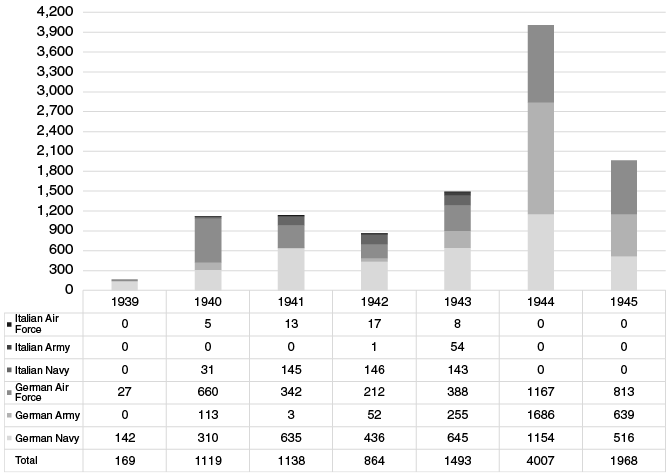
Figure 3.1 Long description
This stacked bar chart shows total counts by year for each branch of the Italian and German armed forces between 1939 and 1945. The x-axis shows years from 1939 to 1945. The y-axis shows total counts per category as well as combined. Each bar represents the total count per year, divided into stacked segments for individual categories. Totals rise from 169 in 1939 to a peak of 4,007 in 1944, then fall to 1,968 in 1945. Overall, total counts increase sharply in 1940s, peak in 1944, and then decline in 1945. The German Air Force, German Army, and German Navy account for most of the totals, while their Italian equivalents contribute very small numbers and only until 1943.
Thus, by the end of 1940, CSDIC in Britain became the final step on an interrogation ladder, tasked with gathering long-term intelligence such as order-of-battle plans, enemy weapons and trends in Wehrmacht recruitment, training and morale. All other potentially useful information was collected by PWIS(H), by CSDICs abroad or by field interrogators. Who would be selected for CSDIC was dictated by intelligence needs at a given moment, with ‘selection briefs’ often concerning an individual’s ‘service, unit, civilian experience, locations visited etc.’.33
Despite being selected for CSDIC, prisoners were not always helpful, especially in the first half of the war when the prisoner population from which PWIS(H) had to choose them was limited. For instance, in 1940 the Army Section of CSDIC produced 109 interrogation reports which, with few exceptions, were each a page long. This brevity was down to prisoners’ refusal to cooperate, in some cases as a matter of principle. In other cases, refusal was explicitly down to an ideological commitment to the regime, with one prisoner declaring that Mein Kampf was his ‘Bible’, Hitler was ‘a superman’ and Jews were not worthy ‘to be allowed to live’.34 In other cases refusal was down to a more general allegiance to Germany, while there were also those who claimed ignorance and wanted the war to end, often for personal reasons such as one prisoner who was about to become a father.35
But when the policy of sending prisoners to the dominions was overturned, resulting in hundreds and then thousands of prisoners being sent to Britain from mid-1944 onwards, a prisoner’s willingness to talk appears to have become a selection criterion for CSDIC. And it must have been an important one, because quite a few soldiers possessed a willingness to talk yet had nothing useful to say. At the pinnacle of the interrogation system in 1944, for example, one soldier was willing to talk but had not much of interest to say as he had been a kitchen orderly.36 The batman of a German general had similarly very little information to share ‘since his principal duties consisted (not unnaturally) of keeping the General’s boots polished and his rooms clean’.37 To confirm that he was not feigning ignorance, CSDIC listened in to his conversations with other prisoners; he truly was clueless on military matters. Soon after, a soldier was found to be ‘exceptionally stupid and unobservant’ to his interrogator.38 Other examples are a prisoner who was poor with maps, having been a milkman before the war,39 and another prisoner unable to ‘read a map convincingly’ despite being taken to CSDIC precisely to pinpoint locations on a map;40 a soldier who was previously a peasant was ‘very vague as to times, distances and places’.41 Many more were described as unobservant or unintelligent, but willing.
It follows that the fraction of prisoners that CSDIC interrogated was not exactly random. Proving this point further is the fact that some of the prisoners selected were not German, having fought with other armies before being conscripted into the Wehrmacht.42 We know this because with the fortunes of the Allies turning in 1943 and the resulting increase in how many prisoners they now held, CSDIC began to produce the ‘Subject Interrogation Reports’, in-depth accounts of direct interrogations, each on a specific subject. Unlike the transcripts of secretly recorded conversations, which are anonymised, these reports make brief mention to the prisoner’s particulars. A total of 1,728 such reports were produced, drawing on the direct interrogations of approximately 1,460 individuals. At least 246, or 17 per cent, of those men were either not German or part-German, a percentage disproportionate to that of non-Germans in the Wehrmacht.43 They included a private from Alsace-Loraine who now wanted to join the Free French;44 a Czech who wanted to join his national forces;45 and a Pole who wanted to do the same.46 Even two Russian officers were held by CSDIC at that point: one claimed to have been ‘forced by starvation into the German Army’47 and the other was unable to help much because, ‘as a Russian, he was never kept informed of all developments by the Germans’.48 Alongside him was a Yugoslav. And then there were those who were part-German, such as a prisoner who was English by birth and partly Jewish, and who had studied at Oxford.49 The man interrogated alongside him was a German who had studied and worked in America for years. Three lieutenants highlight this characteristic further: one had a Swedish mother and lived abroad;50 the other was born in Southport to an English mother;51 and the third was half Dutch – although ‘his interest in military matters was definitely weaker than his interest in the attractions of Paris night life’.52 A Pole was similarly ‘unobservant and not very knowledgeable’,53 even though he had been sent to CSDIC from Italy. Another compatriot of his was ‘goodhearted, stupid but cooperative’,54 a third did not speak German, so could not help with maps,55 followed by an ‘unobservant and rather stupid Czech’.56
The presence of deserters further indicates that willingness to cooperate was a selection criterion: 9 per cent of prisoners (127) who appear in the Subject Interrogation Reports fit this category, even though the Wehrmacht is thought to have suffered a less than 1 per cent desertion rate throughout the war.57 Many revealed long-term reasons behind their desertion, indicating ongoing disagreement with the regime. One of them had been ‘sentenced for desertion and political unreliability’ before escaping and surrendering to the Allies;58 a second had lived ‘in hiding in Godesberg for six months’;59 a third had deserted two years earlier.60 Another case was that of a non-commissioned officer who deserted in Belgium, then made his way to Italy ‘with forged papers and crossed over to the Allied lines’. Despite ending up in CSDIC, his usefulness was limited as he could not pinpoint locations on a map.61 There was also a priest who had deserted in August 1944 after been imprisoned in 1938 for anti-Nazi activities. With him was a prisoner whose uncle had been hanged for anti-Nazi activities, and another prisoner whose brother was hanged following the July Putsch of 1934.62 All three were selected to discuss Germany’s Indian Legion. Despite being a foreigner or a deserter not guaranteeing good intelligence, these categories of prisoner were still brought to the UK CSDIC in numbers disproportionate to those in the Wehrmacht.
The Subject Interrogation Reports were reports of direct interrogations and so of course the majority of the prisoners in them were those who willingly spoke – otherwise it was difficult to produce such a report. Still, the number of deserters and non-Germans strongly indicates that selection for CSDIC did take into account one’s attitude, at least from 1944 onwards. This is not to say that cooperation was the only criterion: rank, unit and occupation would have mattered as well. In fact, Subject Interrogation Reports exist even for non-cooperative prisoners, some of whom were considered to be anti-Nazi, thus indicating the hope that they would eventually open up. A lieutenant who was anti-Nazi was ‘at first reluctant, on account of his officer’s honour’ to talk about his Panzer Corps,63 as was another anti-Nazi lieutenant who remained ‘secure on military matters’ about his infantry division.64 A day before his capture, an anti-Nazi major was awarded the German Cross for his bravery in commanding all artillery west of Cherbourg.65 He too refused to discuss military matters and much of the information he revealed was provided by the microphones. All of this strongly suggests that in having to choose a member of a certain unit (e.g. the Indian Legion), selectors at the various cages would have chosen the prisoner who was already talking, or the officer whose politics or experience suggested he was likely to eventually cooperate.
3.3 Means and Ends
Such cases also show once again that valuable as microphones were, direct interrogations were important: CSDIC was not simply going through the motions of interrogation only to trick prisoners into opening up in bugged cells. If anything, the Air Ministry concluded in 1945 that ‘nearly all major intelligence scoops’ they obtained were from direct interrogation.66 Microphones would in several cases pick up useful intelligence directly, but their role in the process was to confirm the accuracy of information given in direct interrogation as well as to reveal new topics on which individuals could then be questioned. How exactly CSDIC worked was not laid out in writing, but staff often had to explain their methods to overseas headquarters setting up new CSDICs so that they could replicate the process. From one such discussion we glean some clarity into how the process worked:
The interrogator asks questions to obtain information on: (a) Past activity of that rating’s ship. (b) Any other information that may be required to corroborate or amplify information already obtained. (c) Any new information urgently required … The next procedure is to take any two officers or men from different ships or from different services and place them together in a wired room … Constant listening watch is kept on this point and, whenever conversations overheard show signs of military interest, the conversation is connected to an automatic recorder gramophone.67
The whole process was staged in order to leverage certain behaviours. Place together any two soldiers after they are interrogated, and inevitably the conversation will turn to what each was asked and what they answered – and whether it was true. ‘If [the interrogator] asks you whether you know something’, an airman was recorded advising his cellmate, ‘don’t say you don’t but rather that you cannot tell him. If it can’t be done otherwise, I simply stuff him with nonsense. I have invented phantastic “Geschwader”, “Staffeln”, “Gruppen” and numbers, and rub them under their noses’.68 Another similarly told his cellmate that the interrogator had just asked him about ‘the nitrogen factories in Rosenheim, whereupon I pretended not to know what he meant. Of course I know, but there’s no need for him to know that’, and then proceeded to say that their location was Trostberg in Bavaria.69 And if the two prisoners were from different services instead, soon enough they would start comparing experiences. If they were from the same service but different units, soon enough they would be discussing what equipment or tactics they were using. The secret listeners monitoring those conversations would have already been handed a brief by the interrogator, telling them what to look out for in the subsequent conversations. This way, the interrogators’ questions were answered truthfully, eventually. The listeners in the ‘M’ Room – also known as Pandora’s Box – would also monitor some direct interrogations as they took place. This too had a psychological dimension in that it allowed interrogators not to worry about taking notes as a prisoner spoke, which in turn would make the prisoner relax and speak freely, thinking that whatever he said was not considered important and would soon be forgotten.70
Psychology was at the core of CSDIC’s work and affected every aspect of it, not just the moment of direct interrogation. In order to coax prisoners to open up even to each other, the whole environment in the camp had to put them at ease. One way in which this was achieved was the building itself, as well as its countryside surroundings. But there was also ‘matey entertainment’, which involved interrogators and prisoners going for ‘walks and amusement and expeditions outside the interrogation centre’ (‘drunken orgies’ were explicitly prohibited, though) in order to develop a more informal relationship, in the hope that the prisoner would then discuss matters of importance with them.71 Even ‘certain tree-trunks had been wired with electronic connections’, so that prisoners could be monitored when out on walks.72 A German soldier would have imagined all manner of scenarios of what might happen to him if captured; CSDIC’s Trent Park would not have been among them.
The psychological aspect of CSDIC and what it necessitated also became entangled with the question of what to do with a prisoner once they had to leave CSDIC, usually after one or two weeks. Prisoners could not simply be moved to regular camps, where they would compare experiences with other prisoners and begin to piece together what CSDIC was all about – and perhaps write home about it. Even prisoners who were at CSDIC and then found one another in a regular camp could compare experiences and identify stool pigeons or the topics British intelligence were interested in – and again write home about it. This was another problem tackled through improvisation under the pressure of circumstances. Although the small number of prisoners in Britain initially made this a minor issue, von Werra’s escape in 1941 turned it into a pressing concern. In the first six months following his return to Germany, CSDIC’s prisoners were marked as ‘X’ or ‘Y’, each indicating whether they had been captured before or after von Werra told his story. The idea was to separate those who may have heard of his experiences and adjust the CSDIC experience for them, so that it was unlike that of von Werra.73 The segregation idea was then used for releasing these prisoners, with the X prisoners sent to a different camp to the Ys. This practice of releasing CSDIC’s prisoners into designated camps was maintained after the von Werra story faded away. The idea was that these prisoners would be kept in those camps for a few months, which would make them forget about CSDIC and minimise the security risk they posed when moved to a regular camp. The Y and X initials were also kept, though their meaning after a while had nothing to do with von Werra. ‘Y’ seems to have indicated that a prisoner was considered reliable. This is because ‘Y’ officers would be sent to Grizedale, which was used for evacuating prisoners who had given ‘material assistance’ to interrogators from July 1943 onwards. In 1944, Grizedale – which had a capacity for 300 prisoners – was replaced by a larger camp in Ascot due to the growing number of prisoners helpful to CSDIC.74 That camp became colloquially known as the ‘Political Warfare Executive Prisoner of War camp’, since its prisoners were being used by the propaganda organisation Political Warfare Executive.75
Another essential part of the process was the reliance on decoys – stool pigeons – who started to be used in December 1940 and talked to some 1,500 prisoners over the next five years, in conversations that were still monitored by microphones.76 For the Admiralty, ‘converted’ Kriegsmarine prisoners were indispensable as stool pigeons: ‘almost any question which could be answered by any member of a crew of a U-boat … could be obtained within half-an-hour’ by another Kriegsmarine prisoner.77 The other two services must have agreed because only four stool pigeons were civilian recruits; the rest – allegedly forty-nine, though possibly many more – were recruited from the existing prisoner population.78 Other than stool pigeons, talkative prisoners would also be used to unwittingly induce others to divulge information. The combination of prisoners placed together in wired cells was therefore not always random, even in cases where stool pigeons were not involved.
The process at CSDIC was thus cyclical: interrogation was followed by secret listening to confirm the veracity of what had been said in interrogation and to identify new areas of interest; direct questioning might then occur, or indirect questioning by a stool pigeon. Microphones were part of a process rather than the entire process, a conclusion that CSDIC came to in 1940: ‘Each of the three methods employed in obtaining information, i.e. [secret recording], [stool pigeons] and direct interrogation has its special advantages, but the most satisfactory results appear to have been obtained by a combination of all three.’79
But was all of this effort yielding intelligence, or just interesting insights of no value? The Vice Chief of the Imperial Chiefs of Staff, General Sir Robert Haining, asked this question in late 1940. To answer it, the recipients of CSDIC’s reports were asked whether these had so far been valuable. Their feedback was ‘overwhelmingly favourable from every point of view’.80 The Director of Intelligence at the Air Ministry commented that CSDIC allowed his division – in conjunction with other sources – to be up to date with the enemy’s capacities, and in certain cases to take counter measures.81 The Director of Military Intelligence had already responded that the information obtained, although indirect, ‘had proved very valuable, both to me and to other Departments’, making specific reference to the Ministry of Economic Warfare and the Foreign Office’s Political Intelligence Department.82 Their counterpart in the Admiralty, Rear Admiral John Godfrey commented that ‘the actual volume of information received for the expenditure of so much time, expense and labour, has been small’.83 Yet Godfrey continued that the large volume of information coming out of CSDIC only emphasised the authenticity of the source, which he thought was comparable only to photographs.84 These views were only strengthened as the war progressed, with CSDIC’s reports being circulated to – among others – General Headquarters, Home Forces; Anti-Aircraft Command; the Intelligence Department of the Ministry of Home Security; the Political Warfare Executive; SOE; and MI5.85 SIS were also interested in CSDIC’s work, particularly the question of whether they could recruit some of its anti-Nazi prisoners, although it was eventually decided that operating agents from prisoners of war was too risky to make it practicable.86
Quickly viewed as the only organisation that could gain intimate knowledge of individuals’ true allegiances, regardless of their background and rank, CSDIC came to be involved not just in the collection of military intelligence but in more political tasks as well. One of them was propaganda, with CSDIC having been tasked with identifying anti-Nazi prisoners for such work. Requests originated from SO1, predecessor of the Political Warfare Executive (PWE), responsible for propaganda in enemy territory, and SO2, predecessor of SOE. The idea was born after ‘several thorough anti-Nazis’ were identified at CSDIC in 1941, ‘of whom one or two [had] expressed a wish to assist actively in the British war effort’.87 Another was political intelligence. Topics that were generally of interest to PWE and the Foreign Office – including Germans’ faith in victory, their opinions of the BBC and living conditions in enemy territory – were being dealt with directly during interrogation at CSDIC, with PWE on the distribution list of their reports. Once the fortunes of the war began to change, another area that rose to prominence was psychiatric research into German morale. The head of the Directorate of Army Psychiatry, a War Office department, met PWE in 1942 to discuss the development of ‘psychological warfare’,88 and soon after he met staff at CSDIC to discuss the possibility of a psychiatrist moving there to do propaganda-related research with prisoners of war, in order to gain a more scientific understanding of German morale.89 With the intensification of propaganda efforts at that stage, such was the value of CSDIC to PWE that from January 1943 onwards, representatives of both would meet every second Friday of each month to discuss what information was needed from prisoners for propaganda purposes.90
Another instance that reinforced the importance of CSDIC was the reaction when its work came under threat. Like the Tower of London before it, Trent Park was found to be less than ideal; its location near the capital meant that it would possibly need to be evacuated (or worse, it would be bombed).91 Two new buildings were requisitioned to replace it in 1941, each offering over thirty rooms for bugging compared with Trent Park’s twelve. At around the same time however, the Air Ministry was preparing to build an aerodrome near the new premises, the noise from which would render CSDIC’s work impossible. In the ensuing stand-off between the Air Ministry and the War Office, the intelligence divisions of the three services concurred. Arguing against his ministerial colleagues, Director of Intelligence Air Commodore Archie Boyle wrote that CSDIC’s value had already been justified, the information obtained had been ‘inestimable’ and nothing ought to stand in the way of its continued functioning.92 Of the same opinion was the Admiralty’s Godfrey: CSDIC was of ‘such operational importance as to make it vital to develop this source of information to the full’.93 The case was put to the chiefs of staff, who concluded that CSDIC was ‘of the utmost operational importance, vital to the needs of the three fighting Services’ and ‘its requirements should be given the highest degree of priority’.94 Plans for the aerodrome were duly scrapped, and prisoners were moved to the new camp (Latimer House in Buckinghamshire) in July 1942, and to the second, smaller camp (Wilton Park in nearby Beaconsfield) later that year.95
Trent Park in Cockfosters was nevertheless not abandoned. It remained a CSDIC camp even after 1942 to house prisoners of the rank of general who started to arrive from North Africa in August 1942; the first such prisoner was Ludwig Crüwell, followed by Ritter von Thoma in November.96 The idea of interrogating them in Britain – or anyone above the rank of colonel – was not really entertained, both because these prisoners were unlikely to say much under interrogation and because there were no interrogators holding a corresponding rank. It is here that secret listening emerged as the only method at CSDIC’s disposal, though once again psychology could be used to generate interesting discussions. This did not prove to require much effort. Even when the two generals were the only ones in Trent Park, it became clear that they had interesting insights to offer. What was specifically noticed once Crüwell and Thoma started to converse was that they had different views towards the conduct of the war. In a conversation triggered by the capture of Field Marshall Paulus in Stalingrad in early 1943, Thoma told the more reserved Crüwell: ‘I am firmly convinced that it is not due to the stupidity of our soldiers and the General Staff [that we are losing the war on the Eastern Front] but because the FÜHRER simply looks at the map and say [sic]: “No – no – no – no – no!” I know him’.97 In a later conversation about atrocities in Minsk, Thoma was again more critical of what was happening:
Thoma: … I know myself that there were actually brutalised louts there, who trampled on the bellies of pregnant women, and that sort of thing.
Crüwell: Yes, but those are very isolated cases for which even the S.S. can’t be blamed. I can’t believe that Germans would do such a thing!
Thoma: I don’t think I should have believed it either, if I hadn’t actually seen it. I made two written reports about it. I feel that no-one can accuse me of having been in any way responsible for it.
Crüwell: What did you report in writing?
Thoma: The atrocities perpetrated by the S.S. and the shootings and the mass executions at Pskip(?) [sic] and at Minsk – two pages of typescript which I sent to the O.K.W. I received no reply. I established that no soldiers were ever involved, only a special detachment of the S.S. They introduced the name ‘Rollkommando.’ It’s no good denying it. Of course, these people have become completely brutalised by months of such conduct.
Crüwell: I am the last to want to defend such atrocities but, taking the broad view, you must admit that we were bound to take the most incredibly severe measures to combat the illegal guerrilla warfare in those vast territories.
Thoma: Yes, but the women had nothing whatever to do with it. Orders were actually given that all Jews were (to be cleared out of) the occupied territories – that is the great idea, but, of course, there are so many in the east that you don’t know where to start.98
As others started to arrive at Trent Park, they would gather around the two generals according to their politics, this way forming two cliques. Those critical of the regime would gather around Thoma (many of them, like Thoma, still made antisemitic comments even when they disagreed with the regime’s decisions), the others around Crüwell.99 In the absence of other methods, fostering this division became a way to generate useful discussions. And so various events would be staged in order to exploit their existing rivalries and provoke their reactions. For instance, an artist was once commissioned to draw portraits of the generals. The Crüwell clique rejected the idea of any one of them sitting for a portrait. The Thoma clique accordingly accepted it and Thoma not only had his portrait painted, he was also allowed to visit the artist’s studio to see it, precisely so that the rival clique ‘would be provoked into jealous discussion, with possible interesting results’.100 This subtle divide and rule, which was exploited rather than created, was seen as worthwhile, even by Churchill. When he first found out in March 1943 that prisoners were treated in this way – taken out for walks and on day-trips – he was furious: ‘What is the truth about the tales I hear of applications by SOE or PWE or some other body for the leading captured Generals to … be taken about the country to see things? There was an idea, for instance, that General Messe should visit Eton. I should be opposed to any of this nonsense.’101 Yet it was after one such outing that Crüwell unknowingly elicited ‘invaluable information on submarine tactics’ from another prisoner.102 A walk had turned a German general into Britain’s ‘best interrogator’, and so Crüwell was kept at Trent Park for nearly 700 days before being dispatched to the United States in 1944. The Joint Intelligence Sub-Committee (JIC) intervened to explain to Churchill the necessity of these tricks, with him then agreeing to such treatment. He even requested that reports of discussions between generals following such outings be sent to him.103
Not only were CSDIC’s methods known and condoned by the top tier of government, they were also on occasion directly encouraged. One such occasion was from mid-1944 when the JIC instructed CSDIC to gauge how the generals responded to the topic of a ‘Free German Movement’. Only months earlier, the Soviet-sponsored ‘National Committee for a Free Germany’ had been formed by Walther von Seydlitz-Kurzbach, a German general who defected to the East in 1943, and he was specifically mentioned in this instruction to CSDIC. Could there be a von Seydlitz-Kurzbach in Britain? To find out, CSDIC was instructed to ‘sound out the possibilities but no commitments to be made’ to any of the generals who showed an interest. Soon after, CSDIC reported that ‘several specially arranged interviews were devised [in May 1944] with those Generals who showed themselves most willing to co-operate’.104 Not much seems to have happened on the topic and the value of the generals to Britain was, on the whole, indirect rather than direct – it was how those generals saw the war’s course and conduct as well as how they judged each other that proved priceless to British intelligence, rather than their usefulness for other tasks.105
3.4 Staff
The rough version of CSDIC that started out in the Tower of London was soon honed into an efficient and versatile process, concerned not only with military facts but also the war’s political, propaganda and social scientific realms. Much of this transformation was enabled by the administrative changes that took place in 1940 – shifting it from MI1 to MI9 – which allowed more focused attention and resources to be given to CSDIC. This was also happening at a time when the intelligence system overall was becoming better coordinated and began to produce a stream of information that was comprehensive enough to allow interpretations drawn from it to be ‘generally correct’.106 But even those administrative changes were the work of the few who were initially based in the Tower and who articulated what needed to change to make this experiment work. There was much that was unique about the staff of CSDIC, but two characteristics stand out. The first is the linguistic aspect, which was integral to the interrogations’ functioning. In practice, this meant that about a third of CSDIC’s staff were not British, and many of those who were spoke at least one other language, that usually being German. The second was the desirability of drawing CSDIC’s staff ‘from personnel unfit or ineligible for general service’, as with other operations that were based in Britain.107 Together, these meant that it was women, refugees, veterans of the previous war and anti-Nazi soldiers that really honed the art of British interrogation.
Women were part of CSDIC from day one, with two of them having served on the six-strong intelligence team in the Tower of London as shorthand writers and linguists. From then on, and as CSDIC kept growing – from a few dozen staff at the start of the war to 1,000 in 1942 – the female Auxiliary Territorial Service (ATS) accounted for about a quarter of the establishment (Table 3.1). A document setting out the duties of four female junior commanders lists them as liaison officers, responsible for maintaining the war diary, updating the registry and distributing the reports. Yet women were not only tasked with general camp duties: a quarter of CSDIC’s intelligence section was female as well. We know, for instance, that it was almost always women translating the recorded conversations from German into English and compiling ‘glossaries of technical and slang terms’.108 Given these duties, we can assume that many of them were German-speaking émigrés fleeing the Nazis, such as Susanne Cohn, who was also Jewish.109 It is also likely that more German women worked in CSDIC considering that from 1941, Germans and Austrians could join the ATS.110
| Month | Intelligence personnel (of which ATS) | Administration and guards (of which ATS) | Total strength (of which ATS) |
|---|---|---|---|
| Sept. 1939 | 6 (33%) | N/A | N/A |
| May 1940 | 45 (27%) | N/A | N/A |
| Oct. 1940 | 151 (25%) | 364 (11%) | 515 (15%) |
| Dec. 1942 | 189 (26%) | 805 (25%) | 994 (25%) |
| Dec. 1943 | 218 (23%) | 770 (25%) | 988 (24%) |
| Feb. 1945 | 258 (22%) | 743 (22%) | 1,001 (22%) |
Interrogators were always men, and so were the prisoners; only one woman has been identified as having passed through CSDIC in the UK. Hauptführerin Elise Kirsch was a Nazi Party member who ‘talked willingly and indeed didactically’ about the women’s clerical service, to which she belonged.111 The role of interrogators was instrumental. They decided how to obtain intelligence from a specific prisoner and then instructed secret listeners and decoys on what to do. There was one crucial aspect in which they had no say, though: what intelligence to report, and how. They were instead instructed to report what a prisoner said in interrogation as faithfully as possible rather than to try to interpret it, and to be as factual as possible when it came to commenting on whether or not they thought the prisoner was being honest. This was to limit biases; after all, interrogators were as fallible to mind tricks as their prisoners.112
Interrogators were also the only members of CSDIC’s intelligence team who would come face to face with prisoners; the secret listeners never did, and decoys were obviously under cover. In those interactions, their job did not involve ‘putting the fear of God into the prisoner’ or using force.113 Instead, the interrogator’s job revolved around a mind game: trick the prisoner into giving information without realising that they were doing so, ‘by virtue of the fact that the interrogator [was] a master, or sufficiently informed to make himself appear the master, of a subject of interrogation’.114 To achieve this, an interrogator would consult what was known as his ‘bible’ before questioning a prisoner – this was made up of the prisoner’s recorded conversations, any assessments that stool pigeons had written about him, the prisoner’s correspondence and captured documents. Nor were the other activities in CSDIC separate from interrogation; rather, they were all a continuation of it:
[T]he importance – and they are essential to full-range interrogation – of microphones, stool pigeons, etc. lies in the fact that they are an extension of the sphere over which the interrogator can play his personal confidence trick on the prisoner; tools, in other words, can’t think but they give scope for the skill and subtlety of the user.115
All of this was learned on the job. There was a short training course for interrogators – mainly to introduce them to the structures of the German armed forces – but the relevant skills could only be mastered in practice. This would usually happen first in the cages of PWIS(H), where interrogators not only gained practical experience but became accustomed to being ‘face to face with a truculent Boche’.116 As for the kind of person selected for this task, preferences varied but they were not always military men. The Naval Section of CSDIC, for example, discovered that ‘lawyers and scholars used to sorting out masses of unfamiliar evidence, journalists and business men trained to warm their way into new situations’ made good interrogators.117 Lack of military training may have nonetheless exacerbated an existing problem, namely the inaccuracy of the documents CSDIC relied on. This problem was identified by the Military Intelligence Research Station, a War Office organisation analysing captured documents. Problems emanated from the Soldbuch carried by prisoners and on which CSDIC relied for their interrogation. Yet entries in a Soldbuch were made by German non-commissioned officers and errors were frequent.118 Interrogators would often replicate those errors due to their lack of specialist knowledge.
And while it has been mentioned that many of CSDIC’s staff were not British, they were not drawn from the Allied governments-in-exile but rather from refugee and immigrant populations directly. This was because there was reluctance to involve any European Allies in CSDIC or share with them the intelligence obtained. The aversion was not extended to US intelligence, whose representatives visited CSDIC and which received CSDIC’s reports from 1942 onwards (this included the US Navy, the Headquarters of the European Theatre of Operations USA and later the US War Department).119 On the rare occasion that the European Allies had to become involved, this would happen at the PWIS(H) cages rather than CSDIC. One such occasion took place in the spring of 1943, when three Free French interrogators were allowed to come to the London Cage to interrogate the survivors of a U-boat. It was made clear to them that this permission was exceptional and ‘a matter of courtesy only’.120 The aversion to the French in particular was maintained even in 1945, when it was suspected that the French were about to request access to intelligence obtained from naval prisoners; the line was then repeated that the ‘Chiefs of Staff have already laid down that the secrets of our own technical knowledge are not to be divulged to the French’.121
One reason for this opposition to the French being present in CSDIC – which was shared by the JIC – was blamed on the suspicion that the French would use violence.122 When in 1939 a British officer was sent to observe his French counterparts interrogate, the verdict was that Britain had ‘little to learn from the French, whose harsher methods would not suit the British mentality’.123 The fact that de Gaulle’s men had been accused of ill-treating French citizens in their London headquarters did nothing to help this view.124 The assumption that non-British interrogators would use ‘un-British’ methods extended to the Poles as well. The language skills of Polish personnel were needed when prisoners who were ethnic German or otherwise made to join the Wehrmacht from annexed territories awaited interrogation. And so there was more flexibility in employing them at PWIS(H) level. No sooner than the first two Polish interrogators arrived to assume duties in a cage in 1941 however, the officer in charge wrote to Alexander Scotland to say that ‘their ideas on the physical handling of [prisoners] are obviously not ours’. The men neither did nor said anything to confirm this view, and it was the officer who inferred that this was their intention: ‘although they did not say so in as many words, they were obviously expecting me to tell them what bludgeons and wrist-twisting gadgets were available for use on recalcitrant prisoners’.125 By the end of 1941, seven Poles were working in PWIS(H), interrogating prisoners in the presence of a British officer to ensure good treatment.126
Together with his own linguistic skills, the performance of a CSDIC interrogator relied much on eavesdropping, which was, in turn, dependant on the skill of the people executing it. Secret listening was initially the domain of bilingual British officers.127 Because there were not enough of them to meet the increasing demand, and because they often spoke academic German, meaning they could not always understand local dialects and slang, they came to be supported by the Pioneer Corps, which was made up of Germans and Austrians who had fled Europe, many of them Jewish. These individuals were vetted by MI5 and JIC before being sent to CSDIC, which found them to be so adept at the task that it was suggested that the number of British officers involved should be decreased and replaced with Pioneer Corps staff. By 1943, the ‘M’ room would be run almost entirely by them.128
However, while secret listeners were critical, they could only do so much if useful discussions did not occur. This is where stool pigeons played their part. Even Trent Park’s generals had a stool pigeon. Unlike in the usual process, where any man fluent in German and willing to work for Britain could be introduced as a fellow soldier to a genuine prisoner, it was impossible to introduce fake senior ranks to actual German generals. For this reason, an intelligence officer, Ian Munroe, was tasked with pretending to be a ‘Welfare Officer’, there to ensure that the generals’ detention was a comfortable one. To gain their trust, Munroe was introduced as ‘Lord Aberfeldy’, an aristocrat, when in reality he did not have a noble background. The trick worked. Theodor von Sponeck, who was kept in the camp for 480 days, wrote in his memoirs that he did not suspect Munroe to have been an intelligence officer.
When it came to selecting decoys, these also had to be native German speakers, good at assessing personalities and would ideally have had experience outside Nazi Germany.129 The few – most likely four – civilian recruits were refugees, recommended to CSDIC by MI5 who were interrogating civilians escaping to Britain from the Continent. Their job was to blend in: to appear as nothing more than prisoners awaiting interrogation. Yet what these people had lived through, and continued to live through, was anything but ordinary. One of them was Theodore (Bill) Barazetti, born in Switzerland in 1914.130 After helping to evacuate trainloads of Jewish children to London from German-occupied Prague in 1939, Barazetti was interned by the Gestapo but escaped to London later that year. It was then that he started work at CSDIC. Another stool pigeon was Josef Lampersberger, an anti-Nazi German whose citizenship had been revoked due to his activities with the Social Democrat Party. Like Barazetti, Lampersberger had been interned by the Gestapo, and had previously worked for the Czech Intelligence Service.131 A third man had been an anti-Nazi policeman in Hamburg until his escape from Germany in 1941. So adamant were MI5 and MI9 that he should work for CSDIC that despite being sent to Canada due to a miscommunication, he was sent back.132 The majority of decoys were, however, anti-Nazi German prisoners of war. The despair they must have felt while ‘on the job’ is hard to imagine. Decoys were selected for their defiance of the regime yet now had to sit across soldiers who often supported it and discuss the war without emotion. They must have also been nervous at the prospect of being identified as working for the British. Their mental state after such discussions is indicated by their being subject to what was described as ‘extreme nervous tension’ and ‘severe stomach disorders’, and so a doctor was always on call to visit them.133 This burden must also have been carried by those doing the secret listening and translating the conversations into English.
The people of CSDIC were vital to how the organisation’s process evolved. Their accelerated promotions suggest that the leadership was important too. Within two years of taking charge, CSDIC’s Commandant, Thomas Kendrick, went from captain to colonel.134 When Arthur Rawlinson was taken out of the reserve he was captain, but was promoted almost immediately to acting major upon being assigned the task of helping CSDIC liaise with the three service ministries,135 and to temporary lieutenant colonel in 1941. The hierarchical standing of CSDIC altogether was gradually upgraded. It went from the inadequate set-up of MI1 to being part of an expert department, MI9. Within less than two years, by 1942 CSDIC and PWIS(H)’s activities had massively expanded; the other side of the MI9 coin (intelligence to and from British prisoners of war) also had an increasing and important workload, making it doubly difficult for MI9 to continue as one unit.136 For this reason, each operation was split into two separate units: MI9 continued to deal with British prisoners of war, while CSDIC and PWIS(H) became part of a new section, MI19.137 Put simply, from 1942 onwards enemy prisoner intelligence was a separate sub-section of the War Office.138
Hierarchy, numbers or duties – by whatever standard we look at it, the development of CSDIC during the war was extraordinary. While it was established with the intention of eavesdropping for stand-alone pieces of information, it had to expand precisely because eavesdropping on its own proved to be insufficient. As part of this realisation and because of the course of the war, CSDIC in the UK became the final step in an elaborate system which processed hundreds of thousands of soldiers and then selected a cohort for these bugged camps. At the centre of CSDIC were refugees and immigrants, the women of the ATS, anti-Nazi German soldiers and Britons, many of them veterans who had been taken out of civilian life and into CSDIC. That their work was never interrupted, not even after Franz von Werra’s unlikely escape, is testimony to their processes having worked. For all its value to both intelligence and posterity, the vast material they produced must have had an enormous impact on all involved. Yet this impact had to stay muted. Having been sworn to secrecy, many of CSDIC’s staff kept their experiences to themselves and others only shared them decades later.
When Kendrick and Rawlinson closed the camp down on 7 November 1945 – with all their staff now redeployed and the premises handed over to new occupants – they had much reason to take (quiet) pride in what they had achieved. The following day, 8 November, MI19 ceased to exist on paper as well.139 It was as if nothing had ever happened. This was the predominant impression even within the official apparatus. Over a decade after his stool pigeon work in CSDIC had ended, Lampersberger, now a naturalised British citizen, wrote to the Home Office to ask if his Polish parents-in-law could be allowed into the country, where all their relatives now lived. After his application was rejected twice, and in a bid of despair, he finally hinted at his wartime work: ‘I base this appeal on … [the] Service I have given to this country between the years 1940–45 in a confidential matter of which I have never made any use of’, he wrote.140 It took weeks for the Home Office of the mid-1950s to establish what work that was. Whatever information they managed to find led to the conclusion that Lampersberger ‘was engaged as an interpreter’, a service not considered important enough to merit a relaxation of immigration rules.
‘I shall never in my life forget the moment I saw the Führer’, professed a naval officer during interrogation in April 1941. ‘I felt an electric shock, as if I had touched a live wire … [the] shock went through and through me, and it is just the same when he speaks’, he continued. ‘The Führer casts a spell over anyone he looks at. He looks at you once with his pale blue eyes, and when you hear him speak he carries everybody with him, no matter what their opinions.’1 The encounter took place three years earlier in Kiel, at the launch of the cruiser Prinz Eugen, which Hitler had attended with Hungarian regent Miklós Horthy. The officer, now a prisoner in England, did not interact with Hitler directly. But seeing him in person and hearing him speak was enough to turn him into a Nazi Party supporter. Up until that day, he had backed the conservative-liberal Deutsche Volkspartei and had even opposed the Nazi seizure of power in 1933. ‘You can’t hear him on the wireless, you must see him. He takes possession of you’, he told the interrogator.
Unbeknown to the officer, his interrogation was being recorded, with excerpts later included in a report of just over a page. Some 10,000 German soldiers (and just over 500 Italians) were monitored in this way in the CSDIC camps in England between 1939 and 1945. Some were also monitored in active theatres of war – from Khartoum to Cairo to Baghdad to Delhi and Rome – and others were monitored by US intelligence who, after training their interrogators in the British camps, set up their own eavesdropping operations for German and Japanese prisoners.2 Besides his vivid account of that 1938 day, the officer’s report also included a reference to ‘the big offensive in 1918’, which he believed was interrupted by the ‘staged’ munition strike in Germany that resulted in the seizing ‘of the weapons from our hands, just when we were on the verge of victory’. This was followed by his defence of the Gestapo, whose ‘only task’ was ‘to prevent a second revolution’. Some thirty copies of this interrogation were circulated across a dozen recipients, mainly sections of military intelligence but also the Foreign Office and the predecessors of SOE and PWE. Because while on its own this account was an anecdote, when combined with other prisoners’ words – such as one who said ‘If Hitler no longer lived, I should not desire to live either’ – it helped to illustrate the messianic light in which Hitler was cast and, as the war progressed, allowed CSDIC to detect changes in attitudes towards him and the regime.3
The resulting transcripts – known as Special Reports – are an unusual source. They capture the private views of hundreds of soldiers, recorded without their knowledge. It is unsurprising, then, that CSDIC is defined by them, as if it produced nothing else of note. This is not to say that the soldiers’ words have been studied widely either. Barring a project led by Sönke Neitzel and Harald Welzer, few others have used these dialogues in any systematic way.4 A likely reason is that their volume and format – some 19,000 reports, spanning close to 50,000 pages – give the appearance of a free-standing collection, suitable only to the kind of large-scale analysis undertaken by Neitzel and Welzer. This is not a valid assumption, however. These transcripts were never produced with the intention of being read independently, perhaps with the exception of the conversations between the generals in Trent Park.5 For everyone else, many of the transcripts are just a few sentences long, they concern several unrelated topics between them and the identity of the speakers was, for security reasons, not included.
Yet their exact purpose – if not to be read on their own – is not self-evident. The approximately sixty-five War Office files in which they are found contain only these dialogues and no other materials to contextualise them. This explains why these transcripts both define CSDIC and, paradoxically, prevent its history from being studied more fully. The answer to the question of what purpose the transcripts served can be seen in the other types of reports CSDIC published, and which were not the product of microphones. Amounting to c.2,500 documents, these fall into five categories, published at different points during the war. They include ‘Interrogation Reports’, brief accounts of an individual’s wartime service, and ‘Subject Interrogation Reports’, in-depth accounts of various military questions such as how specific weapons or defences worked.6 These documents were the result of direct questioning, with microphones then used to check that the prisoner had not lied. There were also ‘Prisoner of War Papers’, focusing on soldiers’ professional lives in the Third Reich. For these, soldiers who in civilian life were doctors, teachers, lawyers and civil servants were asked to write essays explaining how their professions had functioned since 1933, with the aim of using those accounts in administrative guides that were being drafted for the Allied occupation authorities. While only 137 of these papers were produced, they are incredibly detailed and exceed 3,000 pages in total. And then there were surveys of prisoners’ opinions. The expansion of the wartime state meant that non-military information was soon needed as much as military intelligence, including for economic and propaganda purposes, and CSDIC began gathering it for the benefit of civilian departments. The resulting surveys – the fourth type of report, known as GRX: General Report Mixed – were published between 1941 and 1943 and include information on the impact of Allied air raids in Germany and elsewhere; rationing in Germany; living conditions in occupied Europe; and the effect of Allied propaganda on soldiers and civilians. Finally, a psychiatrist called Henry Dicks and his team conducted ‘morale research’ in CSDIC in 1943 and 1944. Their goal was to study what motivated German soldiers to continue fighting despite unfavourable odds, in the hope that this scientific understanding would make Allied propaganda more effective. To measure morale, prisoners would be asked their opinions of Hitler, the regime, the US, the USSR and the outcome of the war. Their findings were published as statistical surveys, known as GRS: General Report Statistical.7
The purpose of the transcripts was to complement these other investigations rather than to tell a separate story. This is in line with our earlier discussion about the methods of CSDIC and the purpose of secret listening in the overall process, which was to confirm what a prisoner had said in interrogation or to reveal new topics of interest which could then be followed up in interrogation. This creates a link between the topics covered in these other reports and those in the transcripts. And it also means that while CSDIC’s material has so far been studied from the German perspective – what those dialogues tell us about German soldiers – it was the British who determined what questions prisoners were asked, what was considered worthwhile enough to record and put on paper, and what topics were not paid particular attention. The history of CSDIC therefore tells us at least as much about the British as about the Germans. And the British side of the story, as it emerges from the entirety of material produced, is one of how Britain tried to understand the enemy it was confronting.
4.1 Inklings
The initial expectation behind CSDIC, shaped by the Great War experience, was that it would be required for eliciting order-of-battle intelligence, ad hoc information about tactics and weapons, and occasional insights into enemy morale. Another early expectation was that the three services would be operating largely within their own distinct domains, despite an acknowledgement of the need for combined operations. This too was reflected in what was called CSDIC’s ‘federal’ structure. It was to be a War Office affair, but its intelligence activity would be split into three sections: Air, Army, Navy. Each of these sections, however, would be operating independently of the others and each would be responsible for interrogating the prisoners of its German equivalent. The Air and Navy Sections were accordingly staffed by the Air Ministry and the Admiralty respectively, and were independent in deciding how to format and issue their reports. The Navy Section, for example, would collate information and publish a single interrogation report per vessel, not per prisoner; the Army Section, in contrast, initially attempted to publish a single report per prisoner.
One positive implication of this structure was that it quickly made it possible to see the value of CSDIC to each ministry. As the Battle of Britain and then the Blitz raged overhead, the Air Section had far more prisoners to interrogate than the others and thus got much out of CSDIC from the start. Many interrogations concerned air defence, however, which had implications for the War Office as well. The ‘most important single contribution’ of microphones in their first year of use was on the Knickebein, X-Gerät and Elektra radio-navigation aids.8 To counter German air attacks, Britain needed first to understand how the Germans were navigating their fleet and how pilots knew they were over a target in total blackout conditions. Airmen in CSDIC provided that information, mainly by discussing it among themselves. With countermeasures introduced to detect and jam those systems, by mid-1941 CSDIC was then able to confirm that those were working because, again, German pilots were saying so to each other.9 Airmen’s discussions of British anti-aircraft measures also helped Britain gauge the accuracy of its anti-aircraft aiming and the type of barrage that was most effective. And they also spoke about what tactics they had been instructed to use to evade those countermeasures, such as varying the pitch of the propeller in order to mislead the British sound detectors. All of this strengthened British air defence, to the extent that in March 1941, the General Officer Commanding-in-Chief of Anti-Aircraft Command visited CSDIC to see the organisation that was helping him ‘to shoot down more Huns!’.10 There was also intelligence on order-of-battle matters and on losses: the number of airmen who were killed or missing. The latter topic in particular was one that airmen were reluctant to disclose directly to interrogators but would regularly discuss among themselves. Some glimpses into morale were also gained from the beginning, for instance based on how they spoke of the Spitfire (which had acquired ‘the reputation of a bogey’).
When it came to bombing targets, however, and more generally to time-sensitive intelligence, these were less in line with CSDIC’s strengths. On the one hand, CSDIC was not expected to secure such intelligence because there was some delay between prisoners being captured and then being transferred to CSDIC. But even when that delay was small, there was much hesitation in relying on what a single prisoner had said without corroborating evidence from other, more objective sources such as aerial photographs or signals. The most striking example of this reluctance was in the winter of 1940. On 12 November, an airman told his cellmate that Coventry and Birmingham were about to be bombed: ‘He [the prisoner] believes that riots have broken out in London and that Buckingham palace has been stormed and that “Hermann” [Göring] thinks the psychological moment has come for a colossal raid to take place between the 15th and 20th of this month at the full moon and that Coventry and Birmingham will be the towns attacked.’11 This information came on the back of an Enigma decrypt received only a day earlier, suggesting that the Germans were about to launch a particularly important operation codenamed ‘Moonlight Sonata’, presumably to take place at or near November’s full moon.12 The decrypt contained a list of four alternative targets in the Home Counties and London, but appeared not to mention the primary target. The interrogators went back to the prisoner who upon being questioned repeated that, based on what he knew, the target would be Coventry or Birmingham. But with no mention of either Coventry or Birmingham in the decrypt, the belief that the targets would be London and the Home Counties prevailed.13 After Coventry was bombed on 14 November, under a full moon, it was realised that the decrypt did, in fact, name the target through the word Korn, which turned out to be code for Coventry. Information that CSDIC obtained, and which proved to have been accurate was, for reasons beyond CSDIC’s control, not acted upon. This, however, did not overturn the policy of not relying on a prisoner’s word in the absence of other evidence. Despite the enthusiasm around CSDIC’s potential, interrogation was always seen primarily as a provider of raw information, to be corroborated against other sources.
Naval intelligence had its own reasons for valuing CSDIC. By 1940, the Admiralty had already realised that prisoners could help trace the histories of individual ships and their tactics –sometimes, it was only information from these prisoners that would help the Admiralty to do this.14 The additional benefit for the Navy Section was that several members of the same vessel were usually taken to CSDIC at once, and so whatever information a prisoner gave could then be corroborated by others on the spot. This concerned information about the strength, movements and losses of a prisoner’s vessel; occasionally such information was given by prisoners about vessels other than their own; and on progress made on the construction of battleships. Through secret listening in particular, detail was also received on topics such as codes and more technical questions, such as different types of torpedoes and mines that the Germans were using. As with the airmen, Kriegsmarine prisoners also discussed among themselves how effective they believed British tactics and weapons to be – for instance, the effectiveness of British torpedo attacks. And like the Air Section, the Navy Section would also overhear interesting discussions, such as about how many U-boats were thought to have been sunk or lost. Here, too, there was an attempt to gain insights into morale. It was noticed, for instance, that by the spring of 1941, U-boat crews were much less optimistic about the prospects of a successful German blockade of Britain, in contrast to the Luftwaffe prisoners’ optimism.15
Things looked less promising for the Army Section. They too tried to capture tactical and operational intelligence, initially by issuing an ‘Interrogation Report’ for each prisoner they interrogated. Those reports, issued in early 1940, offered little real value. As with much else at that point, the reports followed ‘the old standard pattern’ used in the previous war, where they contained the prisoner’s military background, the names of his officers, the order of battle of his unit, its organisation and movements, its training and its armament.16 This type of information was, of course, useful. The problem was that this line of questioning differed little to the brief, field interrogations these prisoners had already been subjected to, with the added hindrance that CSDIC was seeing them on average twenty days after capture. In these reports – 109 of them in 1940 – there was also a remarkable absence of detail. With few exceptions, each report was a page long, simply because prisoners refused to speak. A common excuse given was lack of knowledge. Others refused as a matter of principle, regardless of their rank. One man at the junior rank of Oberschütze was interrogated three times in a day and refused to talk in any of them.17 The officer interrogated immediately after was an exception, with his report taking up three pages. Since he was so talkative, he was put in a bugged cell with a man for whom no interrogation report exists, unwittingly interrogating him.18
Yet for all the tricks available, the real problem was one of numbers: only 168 Army prisoners were to pass through CSDIC between 1939 and 1942 inclusive. There were some successes still. The most notable was early information about the development of the ‘liquid air weapon’, which turned out to be the V-1 flying bomb, an early cruise missile; and the development of the V-2 rocket, which was the first long-range guided ballistic missile to be developed. Both of these missiles were dropped over London in 1944 and 1945. But there was no constant stream of information on topics such as order of battle or losses. Even the intelligence that was being received on specific topics, such as an account of the Vågsøy raid, still needed naval prisoners to be interrogated for supplementary and corroborating information.
The situation changed drastically in 1944, when army prisoners started to arrive in unprecedented numbers. The 21st Army Group, preparing to invade north-west Europe, had already liaised with CSDIC on what information they wanted them to obtain from prisoners, and these were questions about their units, their tactics and what they knew about German defence lines.19 It was for this purpose that the Subject Interrogation Reports started being published daily. Of the 1,728 such reports issued, around 40 per cent concerned specific German military units – from field armies down to companies. Initially, these tracked formations as they were being captured in France. The focus then turned eastward, with units in the Netherlands and Germany, and some also covering Eastern Europe.20 Defences were also widely covered, especially prior to D-Day, and again concerned France, the Netherlands, Germany and Austria.
The value of these documents was not to anticipate what would come next, but to record what had happened and be better prepared for the next war with Germany, which was seen as only a matter of time. Their aim, therefore, was to paint a fuller picture of Nazi Germany’s war and improve British military doctrine. For these reasons, there was an effort to make this material more reliable: to pre-empt accusations of false memory or lying, interrogators made efforts to confirm these reports before distributing them, usually by interrogating more than one person with similar experience. This meant that even a month after Germany had surrendered, CSDIC’s Army Section was still producing a report on Flak defences at Leuna, and many more such examples exist where a report was issued too late to be of operational use but its circulation was still considered useful.21 Other than their ‘historical’ military function, some of these reports still served immediate uses. A topic that featured with increasing frequency was the state of the Abwehr, information on which was needed by the London Counter-Intelligence War Room, an Allied operation gathering information on subversive enemy activities. In compiling their own reports, CSDIC’s material came to be one of their most vital sources. Similarly, information that featured with increasing frequency in 1945 concerned topics of long-term interest, including German cyphers. Information on the latter was of particular interest to SIS, the DMI’s signals intelligence (MI8) and to the DMI sub-section processing intelligence from Germany (MI3(c)), all of which were preparing for Germany’s occupation.22 Based on the early assumptions about the war and interrogation’s role within it – that it would provide order-of-battle intelligence, information about tactics and weapons, and occasional insights into enemy morale – CSDIC was a success indeed.
But this leaves out much and suggests that the Army Section lay dormant until 1944, when its interrogators suddenly sprang into action. The reality was very different, in that the Army did take on other tasks in the preceding years which proved transformative, both for CSDIC and for filling an important gap in the intelligence effort. From the very beginning, and based on the limited experience of the Great War, there was an inkling that secret listening would provide untainted insights into soldiers’ attitudes and morale. That initial feeling became stronger as the first months of the war progressed, especially when Winston Churchill replaced Neville Chamberlain and took a personal interest in the development and coordination of intelligence.23 This, in turn, drove the broader expansion of the wartime state and led to the refinement of several specialist organisations, which now also recognised the potential value of CSDIC to their work. This meant that very quickly after mid-1940, there was an interest in what soldiers had to say on non-operational matters such as economic and political conditions in Europe.24 And there was also the propaganda dimension of their dialogues. Even references soldiers made to ‘scandals, local colour, erotic stories and low-class jokes’ were considered worth recording for propaganda, and so were any references they made to Hitler or other Nazi leaders.25 The determination on the part of CSDIC to deliver is evident by discussions that were recorded while London was being bombed. An example was a conversation between two prisoners during one of the first days of the Blitz:
(Heavy guns firing)
B: That gets on my nerves every time, it shakes me, body and soul.
A: Do tell a story!
B: I’m not in the mood for it at present.
A: Yes, but by telling it, that will help you through! It’s rocking here! There’s another. It is terrifying. My nerves are so bad now that if anything moves, it makes me jump.
B: You can say what you like. It would be best if we were dead, then we should not have to go through this.
A: Yes, it’s best to talk at night and sleep during the day. I’d like to know what ADOLF is after, what is the use of the bombing, you can’t do that forever … Good God, what’s that? Everything is wobbling – at least they [presumably the guards] can get out of here.26
Technical and operational intelligence was central to justifying CSDIC’s existence – and it was delivering that – but the interest in non-operational matters was important too. And so when a survey of different recipients of CSDIC’s reports was carried out in late 1940 to gauge their opinions of them, it was the propaganda organisations that judged that material to be ‘vital’ more consistently (Table 4.1).
| User | Comment |
|---|---|
| MI2(b) – Scandinavia and Baltic countries | Of interest. |
| MI3(c) – Italy | Of interest. |
| MI5 | Important. |
| MI6 | Vital. |
| MI8 – Signals & Wireless | Sometimes of great importance. Source very valuable. |
| MI10 – Technical intelligence | Majority of interest only; 10% important; a few of vital importance. |
| Inter-Services Security Board | What concerns is of importance. |
| MI14 – Germany | Vital importance regarding enemy combined operations; Important for Feldpostnummer locations, personalities etc.; Of interest for morale etc. |
| MI14(e) – German Flak | Majority of considerable importance. |
| MO3 – Great Britain | Useful. Gives ideas on tactics in event of invasion. |
| MO8 – Ireland, Iceland | Important. Any moment may yield something of vital importance. |
| IP1 – Internal propaganda, War Office | Vital. |
| Brigadier General Staff (Intelligence) – Home Forces | Important for general atmosphere. |
| Anti-Aircraft Command | Considerable importance. Probably soon vital importance. |
| Department Electra House – Enemy Propaganda (later Political Warfare Executive) | Vital. |
| Future Operations (Enemy) Section | Great importance. |
| Special Operations Executive | Vital. |
The more specific question of morale was also of great interest, including to figures such as the Director of Military Intelligence and the Vice Chief of the Imperial Chiefs of Staff, both of whom were curious to hear what CSDIC had to say on the topic.27 Yet while the initial thought that CSDIC would offer insights into soldiers’ attitudes was proving correct, what was also being realised was that this feature still had to be harnessed – it was of no real use simply by existing. It was, for instance, of little value to be noting things such as that one airman sounded more pessimistic than a different airman the week before, when the German Air Force was made up of hundreds of thousands of men; nor was it useful to circulate only fragmented transcripts such as the conversation between the two prisoners during the Blitz, without at least grouping them into a more coherent narrative.
The attempts to address this problem in late 1940 were superficial. While the Army Section did attempt to produce a ‘morale survey’ in early 1941, and it admitted from the outset that this was unlikely to be representative of the Wehrmacht, the entire report was without systematic method or much evidence. One of the supposed trends noticed was that in the second half of 1940, prisoners more consistently began to criticise Nazi Party bureaucrats (whom they called ‘little Hitlers’) and, to a lesser extent, Hitler and the top Party leadership. Although respect for Hitler persisted, there was noticeable disappointment over his failure to deliver a quick victory, and the earlier aura of reverence around him was beginning to diminish. Overall, while not exactly anti-Nazi, prisoners were beginning to discuss politics with a more sober tone.28 But the evidence behind these trends was missing and this study was driven more by assumption than anything else.
4.2 A Window Onto Nazi Europe
This first ‘morale report’ was published just over a year into the war, when it was realised that the Army Section needed to carve out a different role for itself compared to the Air and Navy Sections, not least because the possibility of capturing large numbers of army prisoners was at that point non-existent. This was also the time when CSDIC’s reputation began to grow, and it was becoming more apparent how interrogation would fit into the wider intelligence effort; in the words of the Director of Military Intelligence after inspecting Trent Park in early 1941, ‘the whole show … was very efficiently run’.29 And so the impression was formed that CSDIC could be trusted with more. Asking it to cast its net wider was the logical way forward.
The expansion of CSDIC’s remit was therefore not simply the result of the Army Section having nothing else to do. It was shaped by the development of the wartime state and of the war more generally because the war now looked very different from the one imagined a year before, with Nazi Germany having dominated Europe within a matter of weeks. In this darkest hour, there were calls to take propaganda more seriously. When war broke out, Britain had turned again to Sir Campbell Stuart, the man who had overseen the Department of Propaganda in Enemy Countries at the end of the First World War. He came back in 1939 with a conviction that propaganda had to be tied directly to intelligence and military operations.30 This view reflected pre-war Foreign Office thinking, which had argued for tight coordination between government, military and propaganda.31 In theory, it all seemed entirely suitable. By early 1940, Stuart’s secret organisation – Department Electra House – had its own man on the ground interviewing prisoners of war (not in CSDIC) in order to help determine what the content of propaganda should be. This was possibly Cyrus Brooks, a Germanist and translator, and he even interviewed Franz von Werra before his escape.32 Such activities promised depth, but in practice propaganda in 1940 remained shallow. Built around tired stereotypes and jokes, it was criticised in Britain for showing little grasp of German mentalities and what was needed to break them.33
The lesson drawn from that experience was that propaganda conducted without a real understanding of its intended audience and purpose was simply ineffective. Ideas about how to address this came from different quarters, but several had mentioned the term ‘political warfare’. One of those calling for it was Churchill’s literary agent, the Hungarian Emery Reves. He wrote to Churchill towards the end of 1940 to say that Britain was too passive in how it was using propaganda, restricting itself to pointing out the dichotomy between the moral righteousness of the Allied cause and the evilness of Nazi Germany. This was not enough. Britain needed to take ‘political warfare’ seriously and integrate propaganda into the war effort with clear aims and a strategy, Reves wrote.34 Other intellectuals were at that point echoing this criticism, arguing that propaganda should be used offensively, not restricted to merely stating the British ‘case’.35 And so although Chamberlain favoured Stuart, Churchill quickly shut down Electra House soon after he took over and dispatched Stuart to Canada to do other work.36 Electra House’s propaganda tasks were absorbed partly into Hugh Dalton’s SOE, and partly into the Foreign Office’s Political Intelligence Department – the deliberately bland cover name for what became the Political Warfare Executive. The information that had once been gathered directly by Stuart’s organisation from prisoners of war through Cyrus Brooks would now be collected by CSDIC’s Army Section.37
To provide more systematic insights into life in occupied Europe as well as German opinions of the war, the Army Section started to interrogate prisoners (regardless of service) on questions including the impact of Allied air raids, especially on Germany; rationing; living conditions in occupied Europe and Germany; fighting morale; and the effect of Allied propaganda on both soldiers and civilians. These opinions would be published monthly, with soldiers’ comments grouped by topic. Whenever propaganda sections wanted to use such material – or any other material coming from CSDIC – there was a specific process to follow, in order not to betray the source. If, for example, PWE wanted to use a piece of information in its propaganda towards Germany, its Director-General would contact CSDIC’s Arthur Rawlinson for permission. Then, Rawlinson would contact his own Director, Norman Crockatt, who would decide whether to allow this.38 Even when permission was given, this was not simply a matter of putting CSDIC’s quotations onto leaflets. One example from early 1941 arose when CSDIC noticed that many prisoners were commenting on the high quality of food in British camps. One of them went as far as to say that ‘if German airmen only knew how good the food was, they would make more forced landings than they do’. Upon reading that transcript, Crockatt himself thought it could be used by PWE. He checked with the Air Ministry to make sure they had no objection to this information being used and then reached out to PWE’s Director-General with an idea for a ‘small plot’. The plot was that a comment along the lines of what the prisoner said would be broadcast on the BBC in Britain, and then it would deliberately be put into letters to British prisoners of war in Germany, so that German censors would pick it up.39 PWE thought this was an excellent idea and ‘shall be very glad to carry it out’.40 Even though CSDIC’s material was occasionally used in these ways, however, its real value was that it was giving British propaganda a window onto Nazi Europe in the first place.
A number of key themes arose from these more consistent investigations. One of the first was how soldiers spoke of the prospect of an invasion of Britain. This was a topic that was monitored and featured prominently in CSDIC’s early reports until prisoners gradually lost confidence in its likelihood. By the end of 1941, barely one in ten prisoners talked about it.41 What was instead discussed with increasing frequency in 1941 were the ‘strained relations’ with the Soviet Union, which some prisoners knew were leading to Germany fortifying its eastern frontier and undertaking air reconnaissance over the USSR. Such discussions became more frequent as the year progressed, to the point that nine days before Operation Barbarossa, a Luftwaffe officer spoke of Hitler’s ‘intention to break the Russo-German pact and drive the Russians to the Urals in 10–14 days’.42
Another theme was the relationship between Germans and Italians. The German soldiers asked between 1941 and 1943 all said, in various ways, that the Italians were bad soldiers, and that Germany ‘would have been better off’ without Italy. Their expressions ranged from one who said the Italians were good people but bad soldiers, to another who said that if Italy was invaded, it was the Germans who would have to defend it, not the Italians. A third thought that if Germany controlled the Italian Navy, ‘the English would have long ago been cleared out’ of the Mediterranean. Another believed that ‘the Italians are a poor lot who, without the German stiffening, would have been thrown out of AFRICA long ago’. And a further one thought that in Greece the Italians ‘strut about as though they had beaten the Greeks, whereas everyone knows that the Germans saved them from defeat’. Among the few Italians surveyed, the sentiment was similarly consistent. They knew that the Germans did not see them as equal partners and had them do the ‘dirty work’ for them. One of them thought ‘the German is a natural soldier and a very good one, but he is the most vain man in the world’.43 A second declared that he never wanted to see another German after the war – ‘unless they were tourists who had come to spend their money’ in Italy.44 Even when they revealed nothing new, these transcripts helped to gauge the force with which those opinions were being expressed.
Following the attack on Pearl Harbor in December 1941, prisoners’ opinions on Japan also started to be covered in the reports, under the racist and brazenly named category ‘Yellow Peril’, because the ‘Yellow Peril’ was what the prisoners were worried about. The consistent narrative that emerged from the start and remained until these surveys ceased in 1943 was that Japan was in the war for its own aims and that it would, in the long run, turn into a threat to Germany and ‘the white races’. From the beginning, in December 1941, an airman ‘pooh-poohed the claim put forward by Nazi propaganda’ that Japan entered the war as ‘part of a general Axis plan’. He instead believed Japan was ‘playing a lone hand and was out exclusively for her own interests’.45 Half a year on, another prisoner said that he had ‘heard talk of the so-called “Yellow Peril” but … in a general sense of a “remote possibility in a remote future”’.46 Others thought it was less remote. A naval rank reported in October 1942 that during training he was given a lecture on Japan. There, he was told that ‘there must be full co-operation’ with Japan now, ‘but that they must always bear in mind the idea of the Yellow Peril, and it was definite that in the future the white races would have to fight JAPAN’.47 At the end of 1942 – a year on from Pearl Harbor – the view remained that ‘after this war CHINA and JAPAN (having settled their differences) will unite against the Western Powers and will make a bid for world domination’. The few who were more optimistic based that belief on the fact that Germany ‘is so strong and is getting so much stronger, that JAPAN would always confine her activities to purely Asiatic interests’.48
Since each monthly survey drew on a different cohort of prisoners, other topics and locations varied depending on where soldiers had served. But there was an attempt to gauge living conditions in occupied territories. An airman, for example, was asked in August 1942 about Jews in Germany, and said ‘they are still to be seen on the streets’, and that in the Netherlands ‘there were only certain streets where Jews might be seen and only certain hours when they might be on those streets. Almost all cafés and public resorts bore the notion “Forbidden for Jews”’.49 In October 1942, a naval rating who had served in Greece in 1941 said that ‘conditions there were appalling, people were dying of hunger … Dying people were taken off the streets to German hospitals, given food and when they were better, were turned out again to starve’.50 The following month, a new insight concerned the spread of venereal disease, which was reported to have increased ‘to a dangerous extent’ in both Germany and in occupied territories.51 Various such comments were circulated each month.
Fighting morale was another constant feature of these analyses from the start. German morale was found to be as high in 1941 as the first ‘morale report’ had found it to be in 1940, and soldiers who had been on leave to Germany prior to capture were reporting the same for civilians: they were ‘still confident in German victory’.52 Faith in victory remained the prominent mood well into 1942, but there was occasional pessimism, which coincided with developments on the Eastern Front. A prisoner, for example, remarked that his friend had ‘completely grey hair’ after being on that front for eighteen months, despite being in his early twenties.53 Others noted the brutalisation of those who had served there. A prisoner commented in August 1942 that ‘the troops [in the East] are becoming completely coarsened. They are just like animals when they get home’.54 A month earlier, an airman said that the Eastern Front was ‘guaranteed to cure anyone of Bolshevism’, while another similarly thought that those who ‘still tarred with the brush of Bolshevism’ before the war but had since fought in the Soviet Union ‘had now been converted into fanatical supporters of National Socialism’.55 By December 1942, an airman said that friends of his whom he met when they were on leave from the Eastern Front ‘were confident of defeating the Russians by Summer 1943, and far from not wanting to return to that front, all were anxious to go back in order to be “in at the kill!”’.56
Even when aware of military realities, however, few prisoners would criticise Hitler for them. A non-commissioned naval officer interrogated in June 1941 was a case in point. Thought by the interrogators to be ‘the complete picture of war-weariness and dejection’ – he had lost his father in the previous war, he had not heard from his soldier brother since 1939 and his mother was surviving on a small pension – he ‘still had a word of praise for Hitler’.57 Hitler remained ‘for the majority of [prisoners] above controversy’, with only some ‘unusually irreverent references’ to him being made by naval personnel in particular.58 Even in 1942, when the quick victory that the Führer had promised had still not materialised, there was reluctance to criticise him. Individual exceptions existed here too, but they were outliers. They included a non-commissioned officer who, against the backdrop of Stalingrad in February 1943, told his cellmate, ‘I can’t bear this “Heil HITLER” … He is supposed to be a most unpretentious man who wears no decorations, yet he introduced this form of greeting for himself. There’s nothing like it in any other country – “Heil ROOSEVELT” or “Heil CHURCHILL”, not even “Heil King GEORGE”. This “Heil HITLER” business is ridiculous.’59 A conversation between three officers in June 1943 is another example of vocal and direct criticism of Hitler:
M199: Why did the ammunition shortage arise? Because the Russians had captured two Army dumps. That all happened and the Führer must take the blame for it. The Russians have robbed us of our aura of invincibility. In fact, against the Russians we have lost. We have sacrificed the flower of our youth and lost our best divisions – eighty of our best General Staff officers were left in Stalingrad. Let us assume that the Russians would have attacked us; still, a war on two fronts should have been avoided at all costs, no matter what the cost might have been.
M186: And they were always making speeches and saying that they were following the right policy.
M200: The newspapers are right: we have become infected by such a megalomania. […]
?M199: It had all gone so well. It was all so marvellous and perfect, and then with that damned Russia it all went awry. There are two people who didn’t know that in Russia it is cold in winter; one was Napoleon Bonaparte, and the other was the Führer, the dilettante general, but everyone else knew.60
But the general attitude was against speaking negatively of Hitler, with semi-religious attitudes towards him surviving the Battle of Stalingrad.61 ‘A shock went through one, as if sacrilege had been committed’, said a prisoner in 1943 in response to someone saying ‘Hitler lies’; he made ‘an involuntary prayerful folding of the hands’ as he told interrogators the story.62 Hitler was akin to a deity, which is what Nazi indoctrination was built to inculcate.63 Uncritical faith in Hitler was also a mechanism for soldiers to surrender their own individual conscience and judgement in relation to the war, the surveys concluded in 1943. Others refused to criticise Hitler simply because he was the ‘supreme military leader of the German state’. Or, as one airman explained to CSDIC in 1942, ‘the feeling towards Hitler is more one of respect for a person with whom one could not risk a joke’.64 Whatever the logic, the outcome was the same: few were ‘conscious of any immorality’ on Hitler’s part, and thus remained loyal to him, his regime and the war.65
Faith in other Nazi leaders remained high as well, even though individuals in Hitler’s entourage were criticised more regularly than he was. This was understood by CSDIC to be a way for soldiers to criticise developments without criticising Hitler. The anti-British propaganda of Goebbels was to blame for the failure to achieve a negotiated peace with Britain, some thought in the summer of 1941. They believed that such rhetoric ‘had never gone down well’ at home, and that Germans would favour a peace with Britain, as it conformed to ‘Nazi race-theories, German-Anglo-Saxon kinship, etc.’.66 Earlier in 1941, prisoners had also expressed a dislike of Ribbentrop and Himmler. One said:
I’ll tell you what I feel about Ribbentrop. I think that the ‘Führer’ is too much under the influence of Ribbentrop. He’s afraid of him. Ribbentrop has got that Gestapo, a special body of men which stands by him to the death and not by the ‘Führer’. I had the feeling when I occasionally saw Ribbentrop, that he and Himmler are as thick as thieves.67
Another prisoner who favoured ‘a well-mannered dictatorship on nationalist lines with a good mixture of Prussian tradition and privilege’ thought Hitler was the only person who could hold such a regime together, yet he deplored his ‘choice in many of his chieftains, who are much too vulgar and rowdy’, including Himmler and Ribbentrop.68
Yet even when prisoners were willing to criticise the regime and even Hitler, they were not prepared to withdraw their support for the war. Soldiers shared a conviction that this was an existential war for Germany, as again cultivated by Nazi propaganda, and this conviction served to stiffen morale when military developments were unfavourable. The fact that prisoners associated the outcome of the war with their own personal ruin is captured by the fact that in 1941, some ‘seriously discussed the likelihood of mass sterilization of the German people in the event of an Allied victory’.69 Such talk continued into 1942. A naval prisoner was convinced that if Germany was to lose, ‘the Allies [would] systematically sterilise all German men in order to exterminate the German race’. His fear was shaped by ‘various publications [in Germany] which gave convincing proof that such action was the intention of the Jews and naturally those Jews were bound to be influential factors behind Allied policy’.70 Some still had a ‘lively fear’ of mass sterilisation in mid-1943, in part influenced by Theodore N. Kaufmann’s Germany Must Perish which was published in 1941.71 But knowledge of the extermination policies Germany was pursuing across Europe must have also influenced this thinking. And indeed, fear of revenge by occupied populations was prevalent and explicit. Defeat would not only mean political and economic ruin, a prisoner explained in the summer of 1942, but that ‘hordes of Slav beasts would overrun the country, ravishing all women, abusing all children and crippling all men. It would mean the extinction of all German hopes and aspirations for at least a thousand years and the total elimination of German culture’.72 Even though Germans had become war-weary since 1941, opined an airman in early 1943, the ‘fear of being overrun by the Russians had made them determined to hold out’.73 Military realities were thus failing to translate into decreased support for the war and the regime. If anything, the fear of vengeance made soldiers to rally more forcefully around the regime as the tide was turning against them.
This desperate need for victory also meant that soldiers did not blame the regime for starting the war: all prisoners asked in September 1941 ‘agreed that Germany was blameless’. For some, the guilt instead ‘lay in England’s determination to maintain economic domination to the exclusion of Germany’, whereas for others it lay with ‘the Jews and international financiers’ or with ‘England’s bolstering up of Poland’s intransigence’.74 Asked again in November, a different cohort of prisoners answered ‘no’ to the question of German responsibility – the only one who said ‘yes’ explained it away in terms of Germany’s ‘inevitable expansion’.75 An interrogator took it upon himself to challenge the Nazi slogans a prisoner was repeating that month, while also giving an air of civility to these interrogations, quite different to what one might imagine:
the [prisoner’s] hitherto unquestioning belief in the Nazi ‘Stab in the back in 1918’ theory was rapidly dissipated by citation, with chapter and verse, of dispatches and official documents of Ludendorf [sic], Hindenburg and Max v. Baden in August, 1918 and the following months. This, as an instance of the deliberate falsification of history by the Nazis, shook him deeply. His blind belief in the ‘race theories’ was shaken with equal ease by an appeal to his common sense on the basis of the judgments of biologists and agreed facts of history … He was also brought to see the barbarity of the Nazi conceptions of justice with reference to the accepted Nazi principle of punishing innocent hostages, with special mention of the shooting of the hostages in France. He was most disconcerted when told that, on the basis of the above and similar arguments, the whole civilianised world ostracised the Germans as Huns and barbarians.76
Even in mid-1943, blame for the war was being attributed to Allied leaders for being ‘warmongers’ when ‘Hitler only wants the right to live’.77 Interrogators were disappointed that even a naval officer, who had a good education and had travelled extensively during his several years of service, was ‘completely enclosed in a world of Nazi clap-trap’, rendering him ‘as utterly incapable of original judgment or thought as the simplest Nazi sailor. All his knowledge and abilities were devoted to making a consistent and coherent “Weltanschauung” out of the Nazi catch-words’.78
When CSDIC started gathering intelligence on these non-operational matters in 1941, by morale they meant an individual’s ‘fighting qualities’ – their resolve to continue fighting.79 If that showed signs of decline, prisoners’ political support for the war and the regime’s pursuit of it would be upset as well. This association was not proving valid. Even when soldiers disagreed with aspects of the regime, they vehemently supported its war. And even when they were war-weary, they vehemently wanted the war to be won. This disconnect between soldiers’ political views and their attitudes towards the war was caused by what appeared to be a separation phenomenon between Hitler and National Socialism: it was not incompatible for an individual to be critical of aspects of National Socialism such as the SS, Gestapo or Hitler Youth and yet to be entirely devoted to Hitler and to the war he was pursuing. Germans were separating Hitler from his ideology and were advancing the latter by being devoted to him, not always by ascribing to the ideology directly and independently.
To confirm this observation, in 1943 CSDIC combined data it had gathered on the opinions of 223 prisoners between September 1939 and May 1943. It found that this phenomenon was indeed true, and that ‘attitude to Hitler personally may be a more reliable test of the loyalty of Germans to their regime than attitude to National Socialism’.80 In fact, half of the prisoners asked during those forty-three months ‘put Hitler above criticism’, refusing to even question his decisions. What these findings also proved, however, was that evaluating German morale was proving a more complex exercise than expected. Yet with the prospect of Germany’s defeat and likely occupation becoming clearer, and with a growing number of Germans in British hands, Britain really needed a better understanding of what Nazism meant to the Germans.
4.3 ‘What Do You Think of Hitler?’
It is at this point that Henry Dicks, the psychiatrist, was attached to CSDIC. This development arose from a mix of factors within and outside CSDIC, all unmistakeably pointing to the need for a more scientific study of morale. Discussions about attaching a psychiatrist or a psychologist began in the summer of 1942, the aim being to conduct studies that would serve mainly the propaganda interests of PWE. Soon after, the War Office’s Directorate of Army Psychiatry (to which Dicks belonged), also recorded its interest in understanding the ‘psychological weaknesses of Nazis’.81 These discussions ran parallel to Anglo-American plans for deploying psychologists in active theatres of war in order to inform – including through interrogation – Allied propaganda efforts. As part of the latter efforts, the Psychological Warfare Section of the Allied Force Headquarters (later renamed Psychological Warfare Branch) also came into being in late 1942.82 They were effectively waging what in Britain had long now been called ‘political warfare’ though the term was now ‘perverted into “psychological [warfare]” by the Americans’.83
Questions about authoritarian attitudes had been troubling social scientists well before 1942, not least the German thinkers of the Frankfurt Institute of Social Research in the 1920s and 1930s. American researchers picked up the topic in a more speculative way in the 1930s, while in December 1939, a Foreign Office document tried to draw on Alfred Adler’s theories to say that after the 1918 humiliation, ‘the group psychology of the German nation, as it has developed during the past twenty years, bears a marked resemblance to the psychology of a typical neurotic’.84 The start of the war saw even more speculative research into the personalities of Hitler and other Nazi leaders, influenced by Sigmund Freud’s psychoanalytic theory. What was different in 1942, however, was the option to look at these questions by gathering empirical evidence from German soldiers. It is at this moment that Dicks and CSDIC came to play their part, doing foundational research that would later be taken up by American social scientists on the Continent in the final stages of the conflict.85 By 1945, Theodor Adorno had already joined the project that would culminate in The Authoritarian Personality, published in 1950, arguing that authoritarianism was not a German peculiarity but a broader phenomenon. In this way, the work done at CSDIC between early 1943 and early 1944 was in the middle of an intellectual current.
At this point in the war, Dicks joined CSDIC’s Army Section in order to develop ‘a technique of morale assessment … which sought to avoid the dangers of one-sidedness, chance impression, and subjective bias’.86 Born in Estonia in 1900 to a Baltic German mother and an English father, he was not only fluent in German but he had already done important work as part of the medical team that monitored Rudolf Hess after he crash-landed in Scotland in 1941. Now, in attempting to assess German morale, Dicks tried to make the process as scientific as possible, despite operating in a limited context. Samples, for instance, never included army personnel, and thus could not have accurately reflected the Wehrmacht, let alone Germany as a country (not to mention the absence of women). As each survey relied on a new cohort of prisoners, the groups being studied were also never static – what they gave were snapshots of soldiers’ attitudes during a particular period. Yet the need to start gaining a deeper understanding of German attitudes was acute, and so partial statistical inferences were seen as more desirable than none at all. The process involved selecting at random prisoners who were in the camp and having what resembled ‘a casual chat’. During this chat they would be asked their opinions of Hitler, the regime, the US, the USSR and the outcome of the war. Other material would be consulted afterwards, particularly each prisoner’s secretly recorded conversations. An assessment would then be reached about how high each man’s morale was and what was driving it. A combination of assessments would be published in statistical form, with an average of sixty prisoners involved in each monthly survey.
In the resulting surveys (Figure 4.1), prisoners were divided into four categories when it came to their attitudes towards Hitler: those who worshipped him; those who accepted him; those who had doubts about him; and those who were hostile towards him. For those classified as worshipping him, Hitler was fulfilling a ‘pseudo-religious function’ – he was ‘the omniscient being’. For those accepting him, he was regarded as ‘the legal Head of the State, who, as such, deserved respect and support, in time of war’.87 Between April 1943 and April 1944 when CSDIC undertook these surveys, the combined total of those who worshipped and those who accepted him was over 80 per cent. Hitler was indeed commanding the support of a majority of prisoners despite the unfavourable military odds.
Attitudes towards Hitler in the CSDIC(UK) surveys (N = 355), using the six ‘Survey of P/W opinion’ reports in WO 208/5522, TNA.
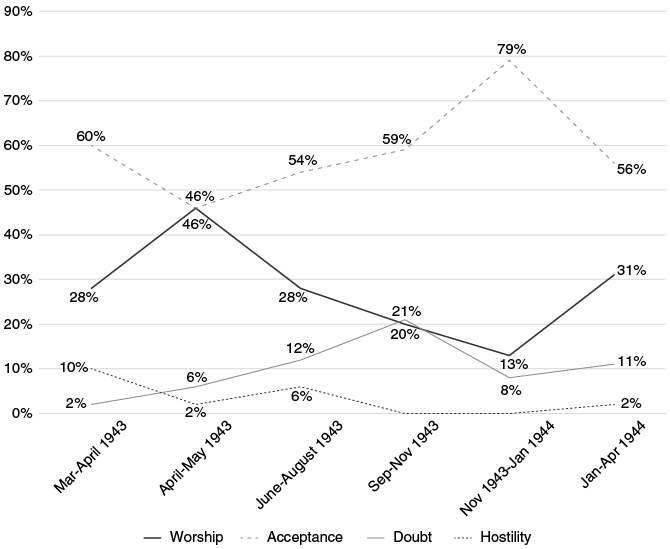
When it came to their attitudes towards the regime, prisoners were again divided into four groups: those completely loyal; those loyal but capable of criticising the regime, called ‘believers with reservations’; those who were anti-Nazis; and those who were ‘unpolitical’. The regime too commanded the majority support throughout the surveys, but in lower proportions to Hitler – the combined total of those completely loyal and those loyal with reservations ranged between 50 and 73 per cent.
If Hitlerism and Nazism were not synonymous, what did the latter mean to soldiers? The first survey in the spring of 1943 found that, for those completely loyal (27 per cent), the regime was indistinguishable from Germany, ‘to which it has given unity and social purpose’.88 These prisoners repeated the lines of Nazi propaganda, including that Poland and Czechoslovakia ‘cannot be considered as real nations’, that they are a necessary ‘living space’ for the Reich, and that in the event of German victory – in which these completely loyal prisoners still believed – would be put under direct Nazi rule. Antisemitism was also prevalent in this group who treated Jews as the ‘universal scapegoat’. Some of them made comments to the effect that ‘[Jews] are responsible for all Germany’s troubles’ or that ‘the Jew with his capital was behind it all’. This was precisely how National Socialism was perceived outside Germany, and just over a quarter of prisoners in CSDIC personified this definition.
A much larger proportion – the largest in the spring 1943 cohort (42 per cent) – were those who had some reservations about the regime but remained loyal to it. These men had ‘an essentially Nazi mentality’, in that they subscribed ‘to the main tenets of the creed – for example the “Führerprinzip” in home politics, German domination in the international field, and the anti-Jewish obsession’; indeed, some of the men in this group were classed as ‘worshipping’ Hitler, despite having reservations about his National Socialism. But they disproved of, in order of importance, ‘Nazi fanaticism – particularly of the S.S. – atrocities, Party rule with its graft and little Hitlers, the general regimentation of life, and sometimes, but not always, anti-Semitism’. Why did they remain loyal to a regime whose means they disagreed with? The main reason was that it had ‘alleviated the economic situation existing prior to 1933’.89 Despite disagreeing with key manifestations of National Socialism, individuals in this group preferred the regime over alternatives because they saw it as responsible for the improvement of their own economic position. Yet in its attempt to understand National Socialism from the perspective of the Germans, CSDIC also failed to see antisemitism itself as fanaticism. Believers with reservations, found to be as antisemitic as their completely loyal counterparts, were not considered fanatical Nazis because they opposed ‘atrocities’ and ‘Nazi fanaticism’ in general terms, both of which were of course systematically targeting Jews.
In the next survey, published in June 1943, those completely loyal to the regime were in higher numbers than before (40 per cent) but based their loyalty ‘less on ideology than on [the regime’s] alleged practical achievements in social welfare’.90 Those who had reservations still had them in regard to the violent means the regime was using – ‘e.g. religious persecution and the excesses of the S.S and Gestapo’.91 It was only in the autumn of 1943 that, although still the majority position, complete support for the regime decreased, possibly due to the survey taking place in the aftermath of the surrender in North Africa. Those who refused to question National Socialism (20 per cent), even at this stage, were those whose personal success was entangled with the regime’s, such as regular officers, sons of party members and landowners. Yet those who ceased being completely loyal at this point did not, of course, become anti-Nazi.92 They instead became ‘unpolitical’ – a group made up of those whose attitude was driven primarily by ‘immediate personal satisfactions – work, family, or personal pleasures – as opposed to more abstract loyalties such as Party or country’.93
The flight from complete loyalty to ‘unpoliticism’ was reversed two months later, when in early 1944 more prisoners were found to be completely loyal to the regime than ever before.94 They included people ‘who attach themselves to the regime because it appears to be the best guarantor of their (fundamentally unpolitical) private satisfactions’. This ‘unpolitical’ group hovered between complete loyalty and apathy depending on whether the regime was advancing their own position, and were thus seen as being motivated by opportunism, not ideology.95 Those with reservations remained sceptical about the means used by the regime but not its ends. ‘In the essentials’, including ‘the acceptance of an authoritarian philosophy, belief in the inevitability of social conflict and war, identification of personal satisfaction with national aggrandisement’, believers with reservations were the same as fanatical Nazis, CSDIC again observed. But unlike fanatics, this group was capable of expressing reservations, which implied ‘a greater readiness to listen to argument on the rational plane’. One of those considered to have had ‘reservations’ was a twenty-one-year-old seaman who opposed ‘the expulsion of Jewish doctors and scientists, as they now work against instead of for Germany’; he went on to describe ‘the massacre of 75,000 Jews in Vilna without any sign of being shocked’ nor could he ‘avoid a number of anti-Semitic remarks’.96 Yet the strongest reservations in this group continued not to pertain to anything concerning Jewish populations directly, but to ‘the German record with regard to atrocities, about which men in the Services are often well informed’ and the ‘restrictions of personal freedom under a totalitarian system’.97 Here again – in February 1944 – there was a distinction between ‘antisemitism’ and ‘atrocities’, illustrating that CSDIC was still not drawing the link between the two.
In April 1944, those who were unreservedly loyal remained in the majority (54 per cent). This time they were more ‘defensive in spirit’, making statements about ‘Germany being encircled’, as well as ‘of a Jewish international conspiracy, of British manipulation of the balance of power in her own interest, and of Germany’s lack of colonies and “Lebensraum”’.98 Those with reservations (19 per cent) remained critical of restrictions on personal liberty, but continued to see no relationship between their reservations about the regime and their allegiance to it. The case of one such prisoner exemplified how conflicting views coexisted in a soldier’s mind:
On the one hand he admits that many of the measures adopted by the Nazis were not only cruel, but also a mistake. Many Jews have been killed; at the most they should have been deported … On the other hand he … praises [Nazi] economic achievements and creation of unity in Germany. He wanted to see a strong Germany triumphing over other nations whether this was ethically right or wrong. He likes the excitement of war and candidly regrets he can no longer take an active part.99
This man regarded the means by which antisemitism was pursued as wrong and was for this reason not considered a fanatical Nazi. Yet his determination to see a dominant Germany was far stronger than his reservations, and his eagerness to play an active part to that end was such that he countenanced deportations of Jews. And so for CSDIC he was not completely loyal but had reservations. Others had made similarly contradictory statements before Dicks’s research began in 1943, such as a lieutenant of the Luftwaffe who in July 1942 said that ‘he approved of National Socialism, but objected strongly to the Jewish persecution’.100 In 1940, an officer initially appeared to have opposed Kristallnacht; ‘I could not understand the object of that plundering. If it was not desired that Jews should own property, it could have been confiscated’, he told his cellmate. Yet he continued that ‘the only thing I was not sorry about in the Jewish pogroms was that the synagogues were burnt. The plundering damaged our reputation abroad to a considerable extent. We have to defend these actions to foreigners but in our hearts we must be ashamed of them’.101 Contradictions therefore coexisted, with some soldiers objecting to some acts of antisemitism but not to others, and some soldiers being complacent about anything the regime did to achieve its ends (which they also desired). It is thus no surprise that throughout the year-long morale investigations, anti-Nazis formed a tiny proportion of prisoners, as seen in Figure 4.2. They came from groups already suspected to be critical of Hitler and his regime: Catholics, Social Democrats and Austrians.
Attitudes towards the regime in the CSDIC(UK) surveys (N = 355), using the six ‘Survey of P/W opinion’ reports in WO 208/5522, TNA.
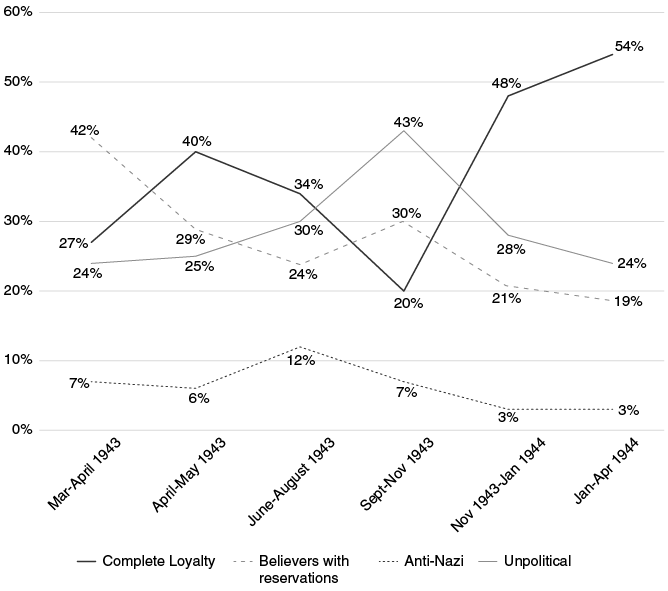
In trying to capture Nazism as perceived by the Germans, CSDIC and Dicks allowed for a definition of Hitler as a social reformer, and of the regime as a more conventional movement. Yet in this effort, they appeared to focus upon the slightest degree of doubt in the regime expressed by a prisoner, perhaps as a cause for hope: the less ‘Nazi’ soldiers appeared to be, the easier it would be to bring the war to an end and to ‘rehabilitate’ Germany. The recognition that a majority of Germans desired prosperity rather than atrocities also gave more hope to the conviction that the Germans could be ‘re-educated’ and democratised. Finding that Germans were not motivated by Nazism as widely understood – ‘the most accepted parts of National Socialism were its democratic aspects, the most rejected parts its fascist means’102 – was probably a better basis on which to build occupation policies, as it allowed the British to believe that Germans ultimately wanted democracy. The work in CSDIC played an important part in creating this cultural framework, which remained after the war. When subsequent research by the British Military Government in post-war Germany found that 60 per cent of Germans thought that National Socialism was ‘a good idea, badly carried out’, this was not seen as proof of ongoing support for National Socialism per se:
when half the Germans today assert the idea of National Socialism was good, but badly carried out, they mean primarily the idea of social and economic betterments, and find fault with its realization through oppression, aggression, and persecution. In this event the problem of the German mind is much less puzzling. No change of basic motives and goals is needed, only a more complete understanding on the part of the Germans of the real meaning of National Socialism, namely, that its vicious aspects were inseparably intertwined with its more constructive sides. Likewise, our concept of National Socialism also needs broadening, namely to include an awareness of the powerful rewards it offered to its followers – rewards not of an undemocratic nature. If such rewards made for loyalty to National Socialism, they would make for loyalty to democracy in Germany today.103
In the more immediate term, those surveys also provided the assumptions through which Britain evaluated the German people after the war: Dicks’s research went on to form the basis for a political classification scheme which was used to evaluate German prisoners of war in Britain – all 500,000 of them – into ‘Nazi’, ‘unpolitical’, or ‘anti-Nazi’ groups. The purpose was initially to facilitate the Foreign Office’s ‘re-education’ policy, of which the prisoners in Britain were the first (and arguably only, considering the myriad of other priorities in Germany) receivers. But those political classifications also went to determine who was to be repatriated first (the anti-Nazis) and who last (the Nazis). Even Dicks himself was sent to Germany to assist with denazification in the British Zone and the selection of Germans for public posts.104
The surveys, which drew on 355 prisoners from the German Navy and Air Force, ended in April 1944, the point when the number of prisoners being sent to Britain was overwhelming, the Army Section was turning its focus on the Subject Interrogation Reports and the prisoners being sent to CSDIC were more carefully selected for their willingness to cooperate. The surveys had several weaknesses, including their samples. But they were not meaningless. They consistently found that soldiers were supporting the regime for different reasons and to different degrees, even though the outcome was the same: a majority remained loyal to the regime until the end. Another consistent finding was that soldiers were not fighting the war merely because this was their job as soldiers. They were instead fighting in pursuit of certain ends that the regime promised them, even when they disagreed with the means. Even those who were motivated by more conventional economic and social aims were driven by them to such an extent that they would be complacent about anything the regime did to achieve them, activities about which they had knowledge. Crucially, what also emerged from these surveys was that soldiers were able to recognise excesses for what they were. This was not the case of men being immersed in a military culture that prevented them from recognising atrocities. The surveys repeatedly found that loyal servicemen were aware of, and often uncomfortable with, the regime’s criminal means. Yet they remained loyal.
4.4 Atrocities
That prisoners were aware of the atrocities committed by the Wehrmacht and paramilitary units was evident both in the morale surveys but also in their secretly recorded conversations long before Dicks joined CSDIC. What was being captured across the various types of reports were testimonies of the horrors unfolding in Nazi-occupied Europe – accounts of violence, rape, murder and extermination. The first such discussions concerned Poland. Speaking of the rape and murder of Polish women in October 1940, an airman said that in Radom ‘every woman had 14–15 men an hour. They changed the women there every two days. We buried a lot of women there’.105 So many people were being killed in Poland that a prisoner complained in December 1941 that his unit was not ‘allowed to bathe in the VISTULA. Not on account of the malaria but of dysentery; there were always dead bodies floating down the river’.106 Some blamed the SS for such crimes, though not always for their cruelty. It was also for their futility, like an airman who in June 1941 said ‘these S.S. are the biggest blackguards that ever lived. They go to POLAND and shoot the people’. He instead thought that ‘they ought to put the swine into aircraft as rear-gunners. We are the men who are really doing the fighting. Once we have defeated the enemy, the S.S. and S.A. men march in with a lot of show and bluster’.107
In some of these discussions, the soldiers themselves interpreted the treatment of the Poles (Jewish and non-Jewish) as foreshadowing genocide. This was mentioned in conversations they were having even before the decision for the ‘Final Solution’ was seen as having crystallised in the Nazi leadership’s minds in the second half of 1941.108 ‘Of course, abortion is flourishing in POLAND, so done by German doctors so that it is supposed to help the poor girls’, said a prisoner to his cellmate in the autumn of 1940. ‘The foetus is removed’, he continued, ‘[b]ut it is taken out so thoroughly that they cannot bear children again! Moreover, if a Pole is found drunk a few times […] he is sterilised’. The prisoner did not see these actions as senseless cruelty but as having a specific aim. Through them, he explained:
a brake is put on the propagation of […] the Polish people. It is all done with such humane and outwardly justifiable methods. If it continues like this, a man told me who is in the Gestapo […] in the course of a generation of thirty years the Polish nation […] will be a heap of ruins. The men can’t do anything and the women can’t produce children.109
In a similar vein, a Luftwaffe officer told another prisoner in early 1941 that only certain Jews were being spared in Poland, ‘for natural historical’ reasons:
Besides, what are the Poles? They are on such a low level of civilization that you cannot compare them to the Germans. It’s a good thing we recognised the Jew in time. The Jew is always a disruptive influence. We are only protecting some of the worst specimens of Polish Jewry, those swine with the red beards, from a natural historical point of view, so that we can show the coming generation what parasites they were.110
The prisoners’ language continued to be explicit about the fact that these atrocities did not seem to be random but coordinated. ‘What do they intend to do with the Poles? Do they want to exterminate them?’ asked one prisoner in November 1941. ‘It seems like it’, his counterpart replied.111 And in many discussions about the treatment of civilians – both in Poland and elsewhere – soldiers would often single out the Jews, like the prisoner who said that in the Baltic States ‘at six o’clock every evening they used to shoot up a lot of Jews. They simply threw a bit of sand over them and rolled a tank over them’.112 Another such account concerned mass executions in Poland in 1940, when an airman told his cellmate:
The prisoners who were brought in POLAND and who were in possession of revolvers and razor blades, had to dig their own grave at once. There was an old Jew, who was to be shot, too. He had probably brought food to the ones who were in the wood. He was not capable of digging his own grave. The F.L.A.K. usually got the job of shooting the people. At that time we couldn’t get water from anywhere and what we could get from CZENSTOCHAU was poisoned. So they opened one of those water-holes and water rose at once from the subsoil. Then they dragged him along … and shot him. He fell into the water-hole and they shovelled it all in again.113
By September 1942, and as part of CSDIC’s ‘opinion surveys’ discussed earlier, a German airman could see that the targeting of the Jews was not just coordinated but universal:
In his opinion, HITLER never meant to extend the persecution of the Jews in GERMANY to include all members of that race. He is quite convinced that HITLER’s original intention was merely to get rid of the ‘Ostjuden’ from the GERMAN REICH and to incorporate those Jews who, or whose families, had been in GERMANY for a number of years, into his New Order. But the campaign, once started, assumed greater proportions than the Nazi leader had envisaged.114
There were many more references to what prisoners had witnessed happen to civilians in Europe. When two boys aged around fifteen were captured as suspected ‘guerrillas’ somewhere in the Soviet Union, they were made to ‘dig their own graves, two pits, and then one of them was shot. He didn’t fall into the grave, he fell forwards over it. The other was told to push the first one into the pit before he was shot himself’. The airman telling the story continued that the boy ‘did so, smiling – a boy of fifteen! There’s fanaticism and idealism for you!’115 Or a non-commissioned officer who recounted how he took hostage a group of French civilians in Conches, near Evreux: ‘there were school teachers and all sorts of people among them and a whole crowd of Jews’. His cellmate, also a non-commissioned officer, thought that ‘it’s the only way to deal with them if they won’t change their ways’.116 Other discussions were had in more general terms, such as the fact that ‘in France a lot of people are being shot’, that ‘dreadful things are going on in Czechoslovakia’ and that ‘when the S.S. enter a village in RUSSIA they simply take all the men and put them up against the wall’. Another informed his fellow prisoners that ‘in Czechoslovakia general intelligence is being gradually eliminated. No one is allowed to complete his five year (university) studies’.117 An officer confessed that ‘sometimes we didn’t behave too well in France’ and described seeing soldiers in Paris rape girls and women ‘in the middle of a restaurant’.118
Others discussed reprisals against occupied populations. After a German was killed in Poland, an officer told his cellmate in early 1941, ‘the next day they stopped every tram in that district and hauled out every man. A quarter of an hour later there was the rattattatt of M.G.s’.119 ‘When one of us is murdered’ explained another officer in September 1942, ‘every single one of the male relatives (of the murderer) is shot, the women are put in a forced labour camp, and the children in institutions … In HOLLAND they got a troop train, but they couldn’t catch the perpetrators, so they immediately shot five or six hostages’. His cellmate interrupted him to say that ‘innocent people suffer thereby’, with the officer responding that ‘that’s inevitable in total war’.120 A bomber pilot similarly justified his own actions on the grounds that ‘in war you have to put all sentimental considerations aside. I have attacked hospitals myself’.121 Other prisoners were less reflective. An airman proudly declared that in his Staffel he was known as the professional sadist: ‘I went for everything, a bus on the road, a passenger train at FOLKESTONE. We had orders to drop our bombs right into the towns. I fired at every cyclist. In every town we attacked the station. We flew two metres above the water.’122 Another officer announced that he had bombed the centre of a town near Hastings: ‘A little seaport, it was on Sunday afternoon at 4 o’clock … we didn’t care. The people in the little town drinking their coffee will have been surprised and in the end will no longer have needed the coffee.’123 Two bomber mechanics were also proud of their targets, with one boasting about an attack over Penzance:
We flew across at a low level and dropped our bombs. You could see each bomb separately, could see the people walking below, people who were doing their evening shopping, etc. The attack was such a surprise and besides, it was at such a low altitude … I (fired) away with the M.G. into the streets. After all you can shoot people. That was great fun. That was the only time I ever did any shooting. We had only flown on night raids. I fired six drums. I was also the only one who had the chance of firing so well.124
The prisoner listening to that story had a competing experience: ‘We plastered both the patrol boats which they sent out, with our M.G. We made a special approach to do that, when we had no bombs left – we only used M.G.’s [sic]. The people down below were properly sprayed, you could see it perfectly clearly.’ Months earlier, in November 1940, another airman described a similar experience with equal pride: ‘(You fly) along the streets, the streets in the middle of the town. You only have one M.G. pointing downwards, left and right past the houses, the pavement, riddle the cars in the middle of the road, that is great fun.’125
The treatment of prisoners of war on the Eastern Front was also known to CSDIC, especially in 1942. An airman told two others in July that ‘in a battle for one village the Russians left behind them close on 5,000 killed and I believe only 300 wounded, for the Germans were giving no quarter, and practically no prisoners were being taken’.126 A second prisoner told his cellmates that Russian prisoners ‘were not guarded, they had no shoes, their faces, hands and feet were all black with frostbite, and they got nothing to eat. They were all Kirgheeres [sic] and such like. They let them all perish, they collapsed where they stood – except for the Ukrainians, they were [sic] well treated’. He also described a case where leaflets were dropped over enemy territory promising a hot meal to anyone who collected them: ‘Thousands of them came running over to us. Everyone had a leaflet and a tin. They came for food and were taken prisoner – were shot down.’127 Another officer of the Luftwaffe spoke of Russian prisoners of war being forced to sleep near a ‘rubbish dump … when the new ashes, etc. are tipped out on to it, you should see how the Russians make a dash for it; they eat lemon-peel and smoke cigarette-ends. A guard told me that the Russians ate each other … When they go to work, they put really sadistic fellows in charge of them, armed with pistols and whips’.128 Referring to a citadel near Templin, an airman said that 50,000 Russian prisoners were kept there:
It was crammed full – they could just stand – they could hardly sit down, the place was so full. When we arrived … in November, there were still 8,000 there, the others were already under the ground. At the time there was an outbreak of typhus (Flecktyphus). A sentry said to us: ‘We’ve got typhus in camp, it’ll last another fortnight, and then the Russian prisoners will all be dead and the Poles and the Jews’.129
The excerpts quoted here are from 1940, 1941 and 1942, but such conversations continued throughout the war. And they were landing on several desks, even if in a more fragmented way than presented here. Broader considerations would have foreclosed their practical use – in addition to the cultural, political, and military considerations that prevented a more forceful British and American stance towards the persecution of Europe’s Jews in particular, here there were the additional sensitivities around using CSDIC’s material.130 But these dialogues seemed to have had no impact on how the war was being interpreted either. They were acknowledged as evidence of atrocities, but the intentional and increasingly genocidal character behind those atrocities was not – despite evidence to that end coming from Britain’s own sources, and sources it considered untainted.
Indeed, while these discussions were seen as important enough to record, the topic did not appear to be probed any further in direct interrogations. Of the over 1,700 Subject Interrogation Reports produced, most of them between 1944 and 1945, only 15 dealt entirely with atrocities. One was on ‘personalities and incidents at Dachau’, as witnessed by a Czech prisoner of war who had previously been sent to Dachau by the Gestapo. He was interrogated in September 1944, and described how prisoners were purposefully infected with malaria, subjected to cold baths and put in a ‘gyrating sphere’.131 In the ‘Prisoner of War Papers’ reports, which CSDIC issued between May 1944 and October 1945, describing some prisoners’ civilian experiences in the Third Reich, there were again only a handful of reports on atrocities. One of them contained further information on Dachau by the Czech prisoner, and another was a report on euthanasia – entitled ‘the fight against the extermination of incurables’, issued in April 1945.132 In it, an Evangelische pastor from the Bethel Institute, part of the Inner Mission (church-run Protestant asylums) described his attempts to convince Nazi Party doctors that ‘incapable persons’ such as epileptic children ‘were capable of enjoying life’.133 Other interrogation camps – especially the Royal Patriotic School interrogating refugees, and PWIS (Home) selecting soldiers for CSDIC – were also beginning to gather some intelligence on concentration camps from mid-1944 onwards. Their aim was to understand how those places functioned and to prepare for their liberation.
Towards the end of the war, and alongside these other interrogations, there was discussion about using CSDIC’s transcripts. This seems to have come from Churchill himself, who was clearly aware of some of these conversations. In 1944, he suggested that CSDIC’s reports would form ‘a useful basis for a book on Germany, and German atrocities to be published after the war’ – and propaganda is perhaps the reason why they were being recorded in the first place. To assess whether a story could be told using those sources, Major Eric Linklater, a well-known author in civilian life who was at that point writing some of the War Office’s ‘instant histories’ (short accounts of the war for public consumption), was given access to relevant material. He seemed eager to start work, but the matter was left there.134 The additional considerations that likely reversed this intention were concerns around jeopardising war crimes trials and the uncertainty that surrounded Germany’s future. In discussions about how much to release to the public from the wealth of material captured upon Germany’s occupation, the Foreign Office wanted no documents ‘which threw light on Germany’s conspiracy to dominate the world and her firm intention to make war, nor documents concerning German atrocities’ to be released until the trials of major war criminals had started.135
The additional concern about revealing the sources of British intelligence turned this into a more permanent instruction, in effect long after the trials of major war criminals ended. As MI5 put it: ‘it is undesirable to advertise our successes in the Intelligence field. The more stupid our enemies believe us to be the easiest will be our task in dealing with them in the future’.136 While MI5’s primary concerns were its own deception operations and double agents, the logic applied to CSDIC too. And so when it came to its transcripts, the outcome was an explicit decision not to disclose them, including in war crimes trials. Revealing how such information was obtained, even for the purposes of justice, would render CSDIC’s methods ‘largely valueless – and the future must be considered’; it was ‘of the highest importance’ to avoid ‘anything which could draw attention to or make public the methods’ that those camps used.137 It was decided that not only would CSDIC not use its material in trials, the organisation would not be taking part in efforts to identify war criminals at all, even though some of its former prisoners were clearly implicated. For instance, a prisoner whom CSDIC interrogated for information on the organisation of the Ordnungspolizei and the police in Cologne was then released to a permanent prisoner-of-war camp.138 A year on, he was boasting in that camp ‘of atrocities which he committed in Warsaw’, which is how he was identified as a war crimes suspect and made to sign a statement admitting his guilt.139
The troubling compromise between secrecy and justice is partly the result of the value assigned to CSDIC’s work; the JIC had already put it on record that those camps had provided ‘much valuable operational, technical, economic and political intelligence’ and so its methods had to be protected, not least because a new CSDIC was at that point about to start operations in the British Zone of Germany.140 From a basic camp set up to ask soldiers the names of their officers and the order of battle of their unit, and then having them talk among themselves, CSDIC had expanded both in reach and sophistication. It was not a static organisation but one which reflected a broader evolution of the types of information that British intelligence considered worth collecting. This went from conventional military information to in-depth reports on specific topics to serve post-war purposes. The rudimentary attempts to gauge soldiers’ morale in 1940 were also transformed into more scientific studies, which influenced British occupation policies as well as policies pertaining to the prisoners of war in Britain. Throughout its existence and alongside all these efforts, CSDIC’s microphones kept recording persistent mentions of individual atrocities – reprisals, mass shootings, starvations – and soldiers beginning to see the genocidal intention behind them. This further confirms the widespread knowledge of crimes in the Wehrmacht, if even the small numbers sent to CSDIC, many of whom were navy and air personnel, were so aware of them. This evidence was quantitatively and qualitatively significant. Yet preserving CSDIC’s methods was considered more important than anything else. The irony, then, was that CSDIC as an organisation ended up being more important than the very information it was created to obtain.
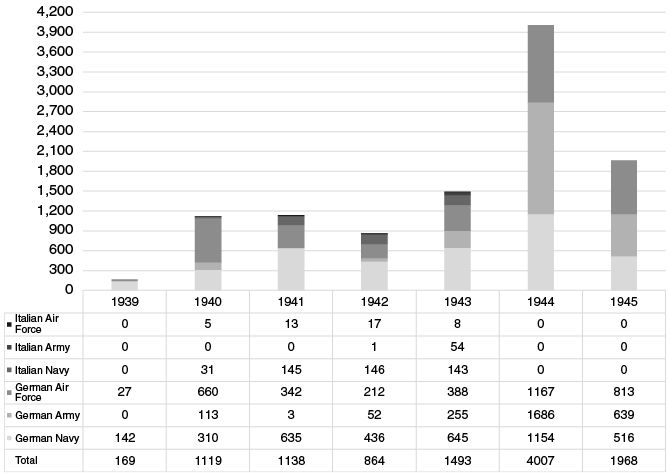
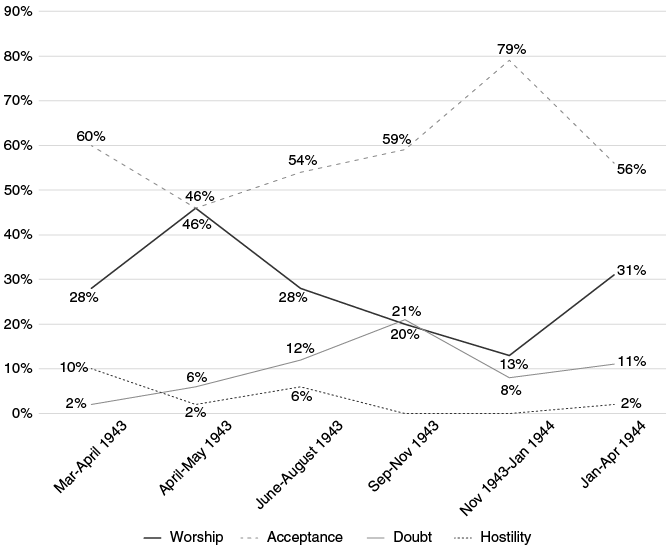
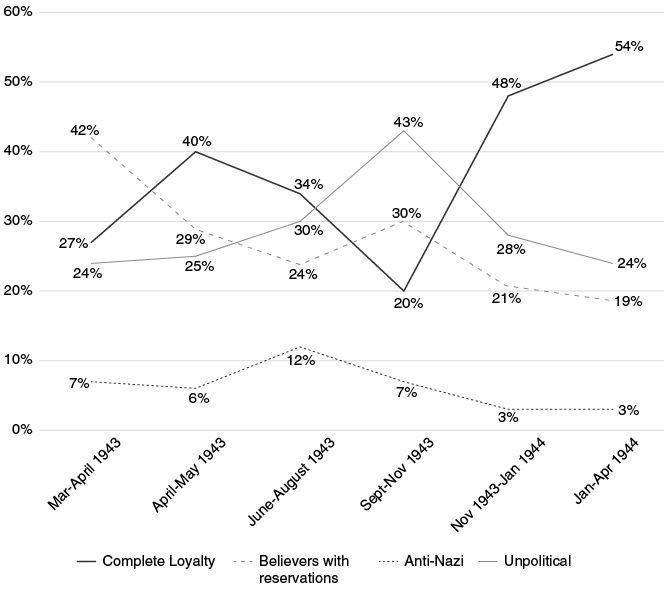

 Open access