


%20--%3e%3c!DOCTYPE%20svg%20PUBLIC%20'-//W3C//DTD%20SVG%201.0//EN'%20'http://www.w3.org/TR/2001/REC-SVG-20010904/DTD/svg10.dtd'%3e%3csvg%20version='1.0'%20id='Layer_1'%20xmlns='http://www.w3.org/2000/svg'%20xmlns:xlink='http://www.w3.org/1999/xlink'%20x='0px'%20y='0px'%20width='64px'%20height='64px'%20viewBox='5.5%20-3.5%2064%2064'%20enable-background='new%205.5%20-3.5%2064%2064'%20xml:space='preserve'%3e%3cg%3e%3ccircle%20fill='%23FFFFFF'%20fill-opacity='0'%20cx='37.785'%20cy='28.501'%20r='28.836'/%3e%3cpath%20fill='%23595959'%20d='M37.441-3.5c8.951,0,16.572,3.125,22.857,9.372c3.008,3.009,5.295,6.448,6.857,10.314%20c1.561,3.867,2.344,7.971,2.344,12.314c0,4.381-0.773,8.486-2.314,12.313c-1.543,3.828-3.82,7.21-6.828,10.143%20c-3.123,3.085-6.666,5.448-10.629,7.086c-3.961,1.638-8.057,2.457-12.285,2.457s-8.276-0.808-12.143-2.429%20c-3.866-1.618-7.333-3.961-10.4-7.027c-3.067-3.066-5.4-6.524-7-10.372S5.5,32.767,5.5,28.5c0-4.229,0.809-8.295,2.428-12.2%20c1.619-3.905,3.972-7.4,7.057-10.486C21.08-0.394,28.565-3.5,37.441-3.5z%20M37.557,2.272c-7.314,0-13.467,2.553-18.458,7.657%20c-2.515,2.553-4.448,5.419-5.8,8.6c-1.354,3.181-2.029,6.505-2.029,9.972c0,3.429,0.675,6.734,2.029,9.913%20c1.353,3.183,3.285,6.021,5.8,8.516c2.514,2.496,5.351,4.399,8.515,5.715c3.161,1.314,6.476,1.971,9.943,1.971%20c3.428,0,6.75-0.665,9.973-1.999c3.219-1.335,6.121-3.257,8.713-5.771c4.99-4.876,7.484-10.99,7.484-18.344%20c0-3.543-0.648-6.895-1.943-10.057c-1.293-3.162-3.18-5.98-5.654-8.458C50.984,4.844,44.795,2.272,37.557,2.272z%20M37.156,23.187%20l-4.287,2.229c-0.458-0.951-1.019-1.619-1.685-2c-0.667-0.38-1.286-0.571-1.858-0.571c-2.856,0-4.286,1.885-4.286,5.657%20c0,1.714,0.362,3.084,1.085,4.113c0.724,1.029,1.791,1.544,3.201,1.544c1.867,0,3.181-0.915,3.944-2.743l3.942,2%20c-0.838,1.563-2,2.791-3.486,3.686c-1.484,0.896-3.123,1.343-4.914,1.343c-2.857,0-5.163-0.875-6.915-2.629%20c-1.752-1.752-2.628-4.19-2.628-7.313c0-3.048,0.886-5.466,2.657-7.257c1.771-1.79,4.009-2.686,6.715-2.686%20C32.604,18.558,35.441,20.101,37.156,23.187z%20M55.613,23.187l-4.229,2.229c-0.457-0.951-1.02-1.619-1.686-2%20c-0.668-0.38-1.307-0.571-1.914-0.571c-2.857,0-4.287,1.885-4.287,5.657c0,1.714,0.363,3.084,1.086,4.113%20c0.723,1.029,1.789,1.544,3.201,1.544c1.865,0,3.18-0.915,3.941-2.743l4,2c-0.875,1.563-2.057,2.791-3.541,3.686%20c-1.486,0.896-3.105,1.343-4.857,1.343c-2.896,0-5.209-0.875-6.941-2.629c-1.736-1.752-2.602-4.19-2.602-7.313%20c0-3.048,0.885-5.466,2.658-7.257c1.77-1.79,4.008-2.686,6.713-2.686C51.117,18.558,53.938,20.101,55.613,23.187z'/%3e%3c/g%3e%3c/svg%3e)
%20--%3e%3c!DOCTYPE%20svg%20PUBLIC%20'-//W3C//DTD%20SVG%201.0//EN'%20'http://www.w3.org/TR/2001/REC-SVG-20010904/DTD/svg10.dtd'%3e%3csvg%20version='1.0'%20id='Layer_1'%20xmlns='http://www.w3.org/2000/svg'%20xmlns:xlink='http://www.w3.org/1999/xlink'%20x='0px'%20y='0px'%20width='64px'%20height='64px'%20viewBox='5.5%20-3.5%2064%2064'%20enable-background='new%205.5%20-3.5%2064%2064'%20xml:space='preserve'%3e%3cg%3e%3ccircle%20fill='%23FFFFFF'%20fill-opacity='0'%20cx='37.637'%20cy='28.806'%20r='28.276'/%3e%3cg%3e%3cpath%20fill='%23595959'%20d='M37.443-3.5c8.988,0,16.57,3.085,22.742,9.257C66.393,11.967,69.5,19.548,69.5,28.5c0,8.991-3.049,16.476-9.145,22.456%20C53.879,57.319,46.242,60.5,37.443,60.5c-8.649,0-16.153-3.144-22.514-9.43C8.644,44.784,5.5,37.262,5.5,28.5%20c0-8.761,3.144-16.342,9.429-22.742C21.101-0.415,28.604-3.5,37.443-3.5z%20M37.557,2.272c-7.276,0-13.428,2.553-18.457,7.657%20c-5.22,5.334-7.829,11.525-7.829,18.572c0,7.086,2.59,13.22,7.77,18.398c5.181,5.182,11.352,7.771,18.514,7.771%20c7.123,0,13.334-2.607,18.629-7.828c5.029-4.838,7.543-10.952,7.543-18.343c0-7.276-2.553-13.465-7.656-18.571%20C50.967,4.824,44.795,2.272,37.557,2.272z%20M46.129,20.557v13.085h-3.656v15.542h-9.944V33.643h-3.656V20.557%20c0-0.572,0.2-1.057,0.599-1.457c0.401-0.399,0.887-0.6,1.457-0.6h13.144c0.533,0,1.01,0.2,1.428,0.6%20C45.918,19.5,46.129,19.986,46.129,20.557z%20M33.042,12.329c0-3.008,1.485-4.514,4.458-4.514s4.457,1.504,4.457,4.514%20c0,2.971-1.486,4.457-4.457,4.457S33.042,15.3,33.042,12.329z'/%3e%3c/g%3e%3c/g%3e%3c/svg%3e)
%20--%3e%3c!DOCTYPE%20svg%20PUBLIC%20'-//W3C//DTD%20SVG%201.0//EN'%20'http://www.w3.org/TR/2001/REC-SVG-20010904/DTD/svg10.dtd'%3e%3csvg%20version='1.0'%20id='Layer_1'%20xmlns='http://www.w3.org/2000/svg'%20xmlns:xlink='http://www.w3.org/1999/xlink'%20x='0px'%20y='0px'%20width='64px'%20height='64px'%20viewBox='5.5%20-3.5%2064%2064'%20enable-background='new%205.5%20-3.5%2064%2064'%20xml:space='preserve'%3e%3cg%3e%3ccircle%20fill='%23FFFFFF'%20fill-opacity='0'%20cx='36.924'%20cy='28.403'%20r='28.895'/%3e%3cpath%20fill='%23595959'%20d='M37.442-3.5c8.99,0,16.571,3.085,22.743,9.256C66.393,11.928,69.5,19.509,69.5,28.5c0,8.992-3.048,16.476-9.145,22.458%20C53.88,57.32,46.241,60.5,37.442,60.5c-8.686,0-16.19-3.162-22.513-9.485C8.644,44.728,5.5,37.225,5.5,28.5%20c0-8.762,3.144-16.343,9.429-22.743C21.1-0.414,28.604-3.5,37.442-3.5z%20M12.7,19.872c-0.952,2.628-1.429,5.505-1.429,8.629%20c0,7.086,2.59,13.22,7.77,18.4c5.219,5.144,11.391,7.715,18.514,7.715c7.201,0,13.409-2.608,18.63-7.829%20c1.867-1.79,3.332-3.657,4.398-5.602l-12.056-5.371c-0.421,2.02-1.439,3.667-3.057,4.942c-1.622,1.276-3.535,2.011-5.744,2.2%20v4.915h-3.714v-4.915c-3.543-0.036-6.782-1.312-9.714-3.827l4.4-4.457c2.094,1.942,4.476,2.913,7.143,2.913%20c1.104,0,2.048-0.246,2.83-0.743c0.78-0.494,1.172-1.312,1.172-2.457c0-0.801-0.287-1.448-0.858-1.943l-3.085-1.315l-3.771-1.715%20l-5.086-2.229L12.7,19.872z%20M37.557,2.214c-7.276,0-13.428,2.571-18.457,7.714c-1.258,1.258-2.439,2.686-3.543,4.287L27.786,19.7%20c0.533-1.676,1.542-3.019,3.029-4.028c1.484-1.009,3.218-1.571,5.2-1.686V9.071h3.715v4.915c2.934,0.153,5.6,1.143,8,2.971%20l-4.172,4.286c-1.793-1.257-3.619-1.885-5.486-1.885c-0.991,0-1.876,0.191-2.656,0.571c-0.781,0.381-1.172,1.029-1.172,1.943%20c0,0.267,0.095,0.533,0.285,0.8l4.057,1.83l2.8,1.257l5.144,2.285l16.397,7.314c0.535-2.248,0.801-4.533,0.801-6.857%20c0-7.353-2.552-13.543-7.656-18.573C51.005,4.785,44.831,2.214,37.557,2.214z'/%3e%3c/g%3e%3c/svg%3e)
%20--%3e%3c!DOCTYPE%20svg%20PUBLIC%20'-//W3C//DTD%20SVG%201.1//EN'%20'http://www.w3.org/Graphics/SVG/1.1/DTD/svg11.dtd'%3e%3csvg%20version='1.1'%20id='Layer_1'%20xmlns='http://www.w3.org/2000/svg'%20xmlns:xlink='http://www.w3.org/1999/xlink'%20x='0px'%20y='0px'%20width='64.000977px'%20height='64px'%20viewBox='0%200%2064.000977%2064'%20enable-background='new%200%200%2064.000977%2064'%20xml:space='preserve'%3e%3cg%3e%3ccircle%20fill='%23FFFFFF'%20fill-opacity='0'%20cx='32.064453'%20cy='31.788086'%20r='29.012695'/%3e%3cg%3e%3cpath%20fill='%23595959'%20d='M31.943848,0C40.896484,0,48.476562,3.105469,54.6875,9.314453C60.894531,15.486328,64.000977,23.045898,64.000977,32%20s-3.048828,16.457031-9.145508,22.513672C48.417969,60.837891,40.779297,64,31.942871,64%20c-8.648926,0-16.152832-3.142578-22.513672-9.429688C3.144043,48.286133,0,40.761719,0,32.000977%20c0-8.723633,3.144043-16.285156,9.429199-22.68457C15.640137,3.105469,23.14502,0,31.943848,0z%20M32.060547,5.771484%20c-7.275391,0-13.429688,2.570312-18.458496,7.714844C8.381836,18.783203,5.772949,24.954102,5.772949,32%20c0,7.125,2.589844,13.256836,7.77002,18.400391c5.181152,5.181641,11.352051,7.770508,18.515625,7.770508%20c7.123047,0,13.332031-2.608398,18.626953-7.828125C55.713867,45.466797,58.228516,39.353516,58.228516,32%20c0-7.3125-2.553711-13.484375-7.65625-18.513672C45.504883,8.341797,39.333984,5.771484,32.060547,5.771484z%20M44.117188,24.456055%20v5.485352H20.859863v-5.485352H44.117188z%20M44.117188,34.743164v5.481445H20.859863v-5.481445H44.117188z'/%3e%3c/g%3e%3c/g%3e%3c/svg%3e)
Does meaningful decarbonization depend on policy stability that makes climate policies and institutional development irreversible, or does it depend on mastering a messy political conflict with steps forward and backward that might be inherent in large-scale political economy transitions? This chapter uses the example of energy transition in Brazil to suggest that policy stability in a bureaucratic and political status quo can in fact result in significant change, exemplified in the dramatic growth of wind power there since 2002. However, the Brazilian example also shows that the results were limited. Notably, solar power languished for a decade after wind power took off. Further, oil and gas production in Brazil expanded even faster than the new renewables. Thus, while a status quo policy stability enacted through bureaucratic politics led to some important changes in the Brazilian energy system, it proved unable to galvanize a full energy transition.
The delay to a full transition does not unequivocally point to politicization as a clear strategy either, however. A brief contrasting case study of South Africa, where politicization dominated the storyline as the country tried to move from its historic dependence on coal, shows the difficulty transformative forces faced as they took on powerful incumbent actors. While neither case casts a clear vote for either strategy, both show the virtues of a multifaceted approach to studying energy transition, which places climate motivations and political economies in the context of a wider set of interests and coalition building around renewable energy.
9.1 Overview of the Case Studies
In the first decade of the 2000s, both Brazil and South Africa began to contemplate the task of transforming their electricity sectors. For both, supply crises (in 2001 for Brazil, in 2008 for South Africa) were the proximate causes behind the shift, with new renewables like wind and solar power appearing as possible routes to diversifying the energy system for energy security despite their higher costs. Over the same decade, both also began to engage more extensively with international climate negotiations that increasingly called for comprehensive energy transitions and more commitments from emerging powers (Hochstetler Reference Hochstetler2012). By the end of the next decade, Brazil had seen an impressive rise in its installed capacity in wind power, although broader energy transformation there was patchy, as described. South Africa had made a promising start at decarbonizing its energy system in mid-decade, only to move into stalemate and even retreat.
These parallel experiences offer an excellent opportunity to look at the puzzle presented by this book. The opportunity is especially good since my recent study of the two concluded that the Brazilian case exemplified a more technical, self-reinforcing status quo process grounded in existing institutions and processes while the South African transition process faced continuous politicized scrutiny and opposition (Hochstetler Reference Hochstetler2021: 222). While the basic outcomes might seem to easily support those arguing in favor of aiming for a status quo of policy stability, this chapter argues for a more nuanced conclusion.
In particular, while the depoliticized Brazilian approach enabled specific achievements like the rapid growth of wind power, it proved unable to stimulate a wider process of energy transition, leaving Brazil’s petroleum ambitions untouched (Viola and Franchini Reference Viola and Franchini2018: 142–146). Extending to fuller energy transition would evidently require the more overtly contentious battle with powerful actors that South Africa has not been able to avoid, given that nearly all of the latter’s greenhouse gas (GHG) emissions are in the energy sector and nearly half of those in electricity. Thus, the final overarching argument is that full decarbonization faces an apparently inevitable confrontation over the distributive politics of shutting down existing and potential fossil fuel production and use (see VanDeveer, Chapter 5, this volume).
The need for confrontation does not mean the battle is inevitably lost. I argue that while decarbonization processes activate a powerful set of probable fossil fuel losers that will mobilize to resist change (see also Moe Reference Moe2015), other political economies of energy transition – industrial policy, consumption issues, and siting – may create either allies or opponents for them. That balance of incentives and disincentives for transition in the multiple political economies of energy transition sets the overall national transition outcome and allows important advances in decarbonization, if not a full achievement of it.
Brazil and South Africa are important case studies for this research puzzle, as much research on climate politics has focused on the advanced industrial democracies. As emerging powers, these countries widen the evidence base for drawing conclusions about broader theoretical questions. In addition, the countries are regional powers, which often are models for their regions. Finally, much of the world’s future GHG emissions is expected to come from emerging and other developing countries, so understanding climate politics there – and any differences with the Northern countries more commonly studied – is particularly important for understanding future GHG emissions trajectories. The conclusions are based on multiple periods of field research and about ninety original interviews with actors in the climate and energy sectors in the two countries. These are more fully referenced in my recent book on energy transition in Brazil and South Africa (Hochstetler Reference Hochstetler2021).
9.2 Energy Transition, Policy Stability, and Politicization: Four Political Economies
Energy systems and energy system change have wide and diverse effects on national and international political economies. That is, they reflect a series of different basic structures of interests that activate different coalitions of state and societal actors. Some of the most important are those related to climate change and decarbonization, where actors can be divided by whether they hold “climate-forcing” or “climate-vulnerable” assets (Colgan et al. Reference Colgan, Green and Hale2021). But energy systems also have other important political economies. There is a productive sector that produces the energy used, with its own firms, careers, technologies, innovations, and growth trajectories. Beyond that, energy is consumed in some form by both individual households and economic actors. Finally, energy infrastructure is placed in particular communities, which may or may not welcome it. All of these political economies of energy systems are potentially subject to state regulation and control. The energy sector is one that has historically seen significant state ownership and control, which has continued in most countries even after a period of partial liberalization (Victor and Heller Reference Victor and Heller2007; Victor et al. Reference Victor, Hults and Thurber2011). This makes energy transition a particularly relevant location to view the effects of state policy and whether policy stability or a more flexible and contention-savvy policy strategy will be more likely to build successful outcomes of energy transition.
The climate political economy of energy transition is where this theoretical debate has been put forward most explicitly (Paterson et al. Reference Paterson, Tobin and VanDeveer2022). On the one hand, many climate scholars argue that a status quo of policy stability is necessary because of the long time horizon of climate change and the need to provide credible signals of future policy to motivate the full range of public and private action needed. The exact logics and mechanisms behind this argument vary. From an economics or business perspective, the motivation is the need to reduce regulatory risk and to send clear and consistent signals to private economic actors (Blyth et al. Reference Blyth, Bradley and Bunn2007); such perspectives often prefer a carbon tax as mechanism. Others are more oriented to institutional or policy arrangements that are designed to deliberately lock in the desired pathway, including by creating positive feedback mechanisms (Levin et al. Reference Levin, Cashore, Bernstein and Auld2012; Lockwood et al. Reference Lockwood, Kuzemko, Michell and Hoggett2016). As a group, these approaches are looking to isolate climate policy from many current political debates and contestation.
Conversely, this same policy arena has generated some of the strongest counterarguments that decarbonization is an inherently conflictual and political process, which will belie any easy locked-in solutions on a scale that is fully adequate for the transformations necessary (Aklin and Mildenberger Reference Aklin and Mildenberger2021; Paterson et al. Reference Paterson, Tobin and VanDeveer2022). In fact, scholars argue, efforts to produce such long-term solutions that ignore politics are likely to lock in the preferences of powerful fossil fuel actors (e.g. Brulle Reference Brulle2018). The fact that decarbonization ultimately requires shutting down and leaving unexploited sources of fossil fuels contributes to this conflict. Yet the strength of many current political and economic elites derives either directly or indirectly from fossil fuels. That makes climate policy and true energy transition an existential threat to very powerful actors and requires substantial state capacity to restrain and manage their power, in this view (Meckling and Nahm Reference Meckling and Nahm2018; Moe Reference Moe2015).
The dynamics of stability/politicization in the production political economy are quite different, however. Here, energy transition is often driven through the dynamics of green industrial policy, or specific state initiatives to promote renewable energy and other related sectors, such as electric vehicles (e.g. Meckling and Nahm Reference Meckling and Nahm.2019). In green industrial policy literatures, some element of policy stability is seen as necessary to motivate public and private actors to respond to the incentives given. However, the industrial policy literature also places a great deal of emphasis on the need to plan withdrawal of the incentives in a timely fashion in order to prevent excessive rents and ensure efficient and competitive development of the new industries (Pegels Reference Pegels2014), so even the pro-stability argument is qualified in this area. Otherwise, the production dynamic is generally one of providing positive incentives for decarbonizing action, so it can generate allies for supporting stronger climate policy and consequently has less of the inherent conflict associated with climate politics.
In the consumption political economy of energy transition, scholars ask questions about energy access, the quality of energy supply, and energy pricing levels and structures, that is, whose energy use is subsidized or cross-subsidized (Hochstetler Reference Hochstetler2021: 132–135). There is little direct discussion about policy stability versus contention, but the political economy itself is one with implications for both. Policy stability can be enforced by the physical infrastructure of distribution, with options locked in and out. For example, if energy access is provided through centralized grids (electricity) and networks (e.g. vehicle fuel distribution), then certain kinds of policy choices become much more difficult. The large scale and long lifespans of existing infrastructure make change more difficult – although these considerations also work to reinforce transitions once new infrastructure, for example electrical vehicle charging networks, is built. The physical lock-in is commonly reinforced by political lobbying by actors who benefit from the system. For example, the utilities that manage central electricity grids have often been hostile to the development of small-scale solar power and warn of utility “death spirals” if self-provision is encouraged (Stokes Reference Stokes2020: 103). Quality and pricing issues are rarely themselves locked in directly, but decisions on these topics are very important for creating allies or opponents for energy transition. Consumer subsidies for fossil fuels, for example, are often defended with mobilized protests (e.g. Akanle et al. Reference Akanle, Adebayo and Adetayo2014) that provide a powerful force against leaving fossil fuels behind.
Finally, the political economy of energy transition siting – where fuels and industrial inputs are sourced, where energy is refined and produced, where the built infrastructures of electricity and pipelines are placed – share some of the features of the consumption political economy. The physical facilities themselves lock in particular energy choices and particular locations of impact, while the prospect of new ones, necessary for any transition to take place, often face significant resistance from prospective host communities (McAdam and Boudet Reference McAdam and Shaffer Boudet2012). Whether hosting an energy-related facility brings benefits like jobs and infrastructure to host communities (e.g. Xia and Song Reference Xia and Song2017) or imposes significant costs on often vulnerable hosts (e.g. Avila Reference Avila2018) is a matter of considerable theoretical debate. This is in part because the costs and benefits genuinely vary. The specific balance of costs and benefits is, again, likely to create opponents and proponents of energy transition. The solutions to those conflicts, to build or not to build, will then again physically reinforce any energy choice.
This discussion has remained quite abstract, while pointing out at numerous points that there is likely to be a fair amount of variation and specificity in national energy transition efforts. In addition, the final mix of the political economies will also matter. Thus, even policy and institutional consistency on climate change itself, narrowly defined, may be undermined – or reinforced – by decisions taken by other actors on, say, who has access to subsidized finance for building infrastructure (a production question). As a result, it is helpful to examine two vignettes of how energy transition debates unfolded in Brazil on the new alternatives of wind and solar power, and the simultaneous development of fossil fuel production in the oil and gas sector. This will be followed with a brief look at South Africa. Collectively, they will allow me to sketch how the political economies of energy transition can inform the broader question of this book.
9.3 Energy Transition in Brazil: Advancing the New Renewables
Energy transition in Brazil looks quite advanced, especially if one focuses on the growth of alternative renewables like wind power and (more recently) solar power (see Figure 9.1). Brazil has traditionally used hydroelectric power, which has fewer GHG emissions but more socio-environmental conflict than fossil fuel sources of electricity. Instead, almost all of its emissions have historically come from deforestation, agriculture, and other land-use sources of greenhouse gases (Basso Reference Basso2019: 5). Less than 3 percent of its GHG emissions come from electricity itself (Ministério de Minas e Energia 2018: 245). This means that the contentious debates there around climate change have rarely focused on energy or electricity, making it a country almost uniquely able to address climate change without engaging in a politicized debate around energy transition. In fact, most of Brazilian decision-making around renewable energy has in fact come in depoliticized, steady, standard operating-procedure bureaucratic decisions (Hochstetler Reference Hochstetler2021: 229–230).
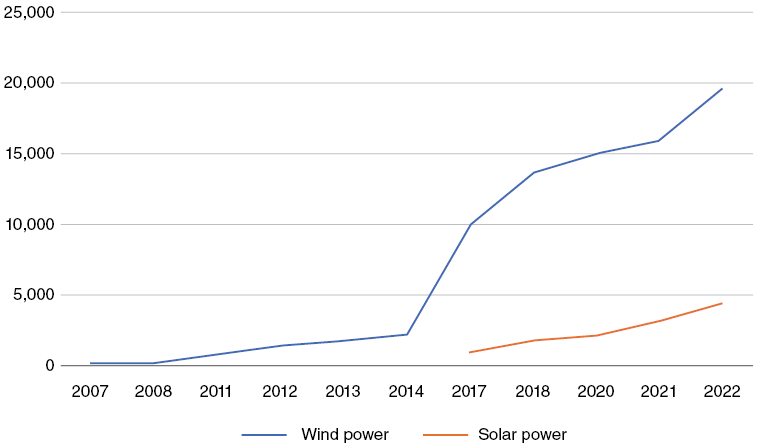
Figure 9.1 Long description
Line graph installed megawatts (MW) of wind and solar power in Brazil from 2007 to 2022. Two lines: wind power and solar power. Wind power increases steadily from 2007, notably rising from 2014 onwards. Solar power starts around 2017, increasing to 2022. Y-axis: 0 to 25,000 MW; X-axis: 2007 to 2022.
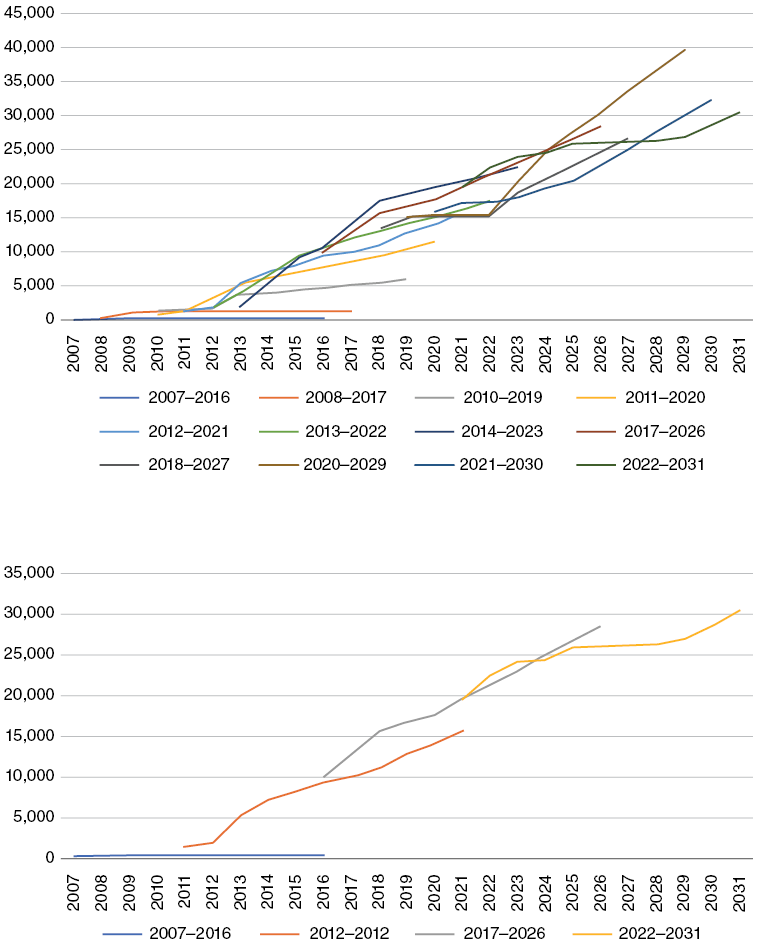
Figure 9.2 summarizes ten-year electricity planning in Brazil, showing the smooth and consistent expansion of wind and (eventually) solar power that resulted. Figure 9.2 shows why the idea of depoliticized, stable decision-making on climate is so appealing. The unfolding of wind power in Brazil exemplifies what climate activists hope for. Yet, while wind power expanded steadily after 2009 in Brazil, solar power lagged; the first auctions for the right to build solar power were held only in 2014 and it is only beginning to really take off a decade later. This difference cannot be explained by a narrow focus on climate change, since there are no climate-based reasons to avoid solar power in a sunny, tropical country. Instead, the different fates of wind and solar power in Brazil came down to the cost/consumption and industrial policy political economies of energy transition.
Ten-year electricity planning in Brazil: (a) ten-year wind power projections in Brazil, in installed MW and (b) ten-year solar power projections in Brazil, in installed MW.
Note: Starting points for each series are actual contracted/built quantities for that year.
Figure 9.2 long description.
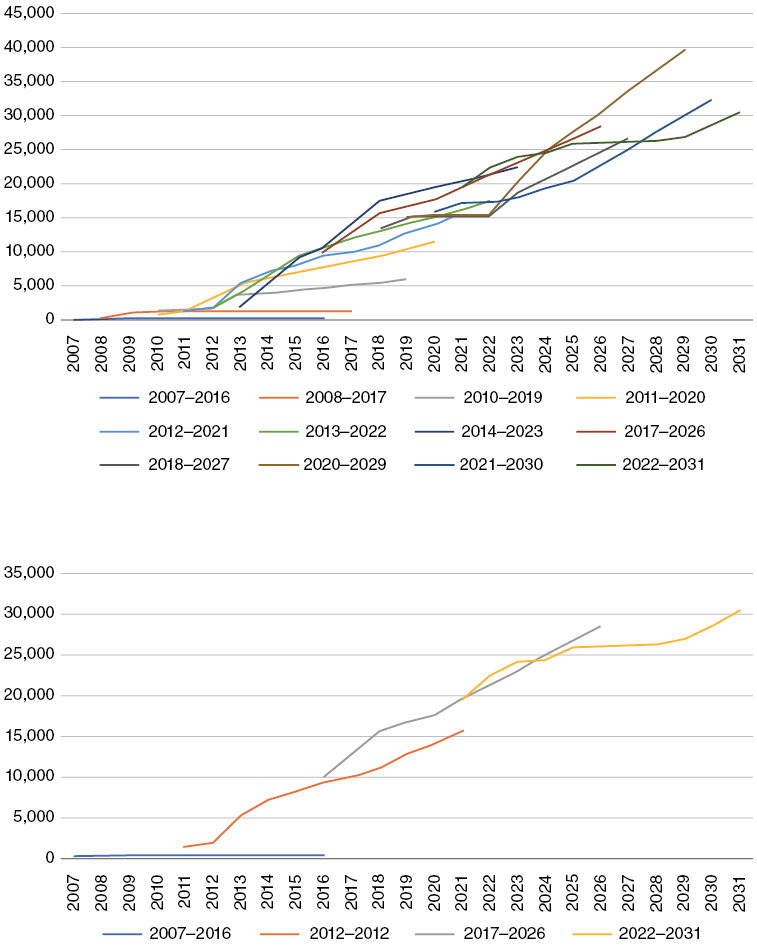
Figure 9.2 Long description
Two graphs showing ten-year electricity planning in Brazil. The top graph displays wind power projections in installed megawatts (MW) from 2007 to 2031, with various lines representing different ten-year periods. The bottom graph shows solar power projections in installed megawatts (MW) over the same period, also with different lines for various ten-year periods. Each line indicates projected growth in renewable electricity, starting from actual contracted or built quantities for each year.
Cost considerations – important for consumption decisions – are a significant part of the story. As Brazil first began to consider building the new renewables in 2001, solar power was much more expensive than wind power and other alternatives. While wind power was also more expensive than non-solar alternatives, Brazilian energy modelers believed the higher costs could be compensated with the greater potential to build an industrial sector that would supply components for wind power (Hochstetler Reference Hochstetler2021: 93).
Existing industrial capacities were further leveraged with routine policies in the Brazilian National Development Bank (BNDES) that provided subsidized funding for projects that included locally produced inputs, allowing them to win Brazil’s cost-based auctions to supply electricity to the grid. The result for wind power was the classic green spiral where industry and government worked together in a self-reinforcing way to steadily expand the sector (Hochstetler Reference Hochstetler2021: 103–104). Conversely, industrial development was much more difficult for solar power and BNDES finance was less decisive, so it lacked this self-reinforcing mechanism. Solar power did not expand until the sharp fall in the global cost of solar components took place after 2011. This contrast between wind and solar power therefore supports the versions of the policy stability model that emphasize path dependence, especially when reinforced through the building of new actors and coalitions in favor of the direction of transition.
As a final part of the story, the siting dimension of energy transition in Brazil worked against the dynamic established in the other political economies, although it was not decisive. About one-quarter of local host communities (nineteen of seventy-seven) strongly objected to and resisted the building of wind power farms in their communities. This resistance was most likely in communities where land tenure was uncertain, as in historic former slave communities where residents had had informal access to beaches and other locations without formal ownership of them (Hochstetler Reference Hochstetler2021: 202–205). The resistance was strong enough to generate a policy change away from a permissive environmental licensing process that had assumed there would be no negative local impacts (Hochstetler Reference Hochstetler2021: 191). Ultimately, the resistance was unable to block wind power and was more influential over time in determining exactly where wind power would be built in Brazil’s many potential sites. In contrast, there were no community mobilizations against hosting solar power, but that did not prove to be a decisive advantage for solar power given the other political economies of energy transition. It is worth noting that energy siting in Brazil is generally a highly contentious process, with communities and activists poised to quickly mobilize against new large hydropower sites – although fossil fuel-based electricity plants are the least likely to generate host community opposition (Hochstetler and Tranjan Reference Hochstetler and Tranjan2016).
9.4 Energy Non-transition in Brazil: Advancing the Oil and Gas Sector Too
All of Brazil’s gains in renewable energy production have not limited the continuing expansion of fossil fuels. Instead, the renewables and fossil fuels expanded together, following the discovery of large deposits of oil and gas deep offshore in 2007. Other scholars have noted this counterintuitive result (e.g. Aamodt Reference Aamodt2018; Basso Reference Basso2019; Viola and Franchesi Reference Viola and Franchini2018). In this chapter, I show that both outcomes result from very similar policy processes, with the exception of the climate political economy. With existing institutions repurposed to add more new renewables to the electricity sector without taking on a transformative climate ambition in the energy sector, Brazil is actually moving away from true climate-friendly energy transition even as its wind and solar power capacity continues to grow.
As noted, the climate political economy is the one that makes most explicit the demand that existing fossil fuel production must be truncated and even shut down to meet its end goals (Hochstetler Reference Hochstetler2021: 30). Unlike many countries with oil and gas production, Brazil does not have a long-standing dependency on the sector for state revenues and export earnings. Its historic reserves were small, and the available rents followed suit. Neither its fossil fuel subsidies nor the share of petroleum rents have surpassed 3 percent of gross domestic product (GDP).Footnote 1 Yet the state-controlled oil company, Petrobras, has long been “the most emblematic state-owned enterprise” (Mortari et al. Reference Mortari, Garcia Ribeiro, Loural and Oliveira2021: 147), a “jewel in the crown” of both Brazil’s domestic and international politics (Ceppi and Doval Reference Ceppi and Pereyra Doval2020: 102), with all of the cultural and economic power of other statist fossil fuel incumbents. Petrobras’s many deep ties to political and economic elites became evident when it became one of the primary targets of a large corruption scheme in the construction sector, known as Lava Jato or Carwash, eventually paying $853.2 million in fines to Brazil and the United States (Viswanatha and Lewis Reference Viswanatha and Lewis2018).
Neither Brazil’s 2016 nationally determined contribution (see Allan, Chapter 14, this volume) nor subsequent revisions even mention the fact that Brazil is an increasingly important oil and gas producer. They note instead that the renewables share in Brazil’s energy matrix was already three times the world average (Brazil Second Revised NDC 2022) and that they expect the share to rise by expanding non-hydro renewables. Governmental narratives on oil production and climate change either stress the way that petroleum expansion can pave the way for energy transition or assert that Brazil has a right to develop its resources in a world where most GHG emissions are associated with the Global North (Víglio et al. Reference Vígilio, Di Giulio, Barbi and da Costa Ferreira2019: 146, 148). The fact that deforestation and land-use change dominate Brazilian GHG emissions allows even actors serious about climate action to elide Brazil’s fossil fuel industry. Yet political conflict also intervened in this result. The Climate Law passed by the National Congress in 2009 included clauses that called for phasing out fossil fuels and replacing them with renewables but then (and current) President Lula da Silva used his line-item veto to remove them. The veto followed the wishes of the Ministry of Mines and Energy as well as Lula’s presidential successors (Aamodt Reference Aamodt2018: 386).
The regular ten-year energy planning documents that lay out steady expansion for wind and now solar power also contain chapters on oil and gas production. But while the former discussions frequently mention Brazil’s climate commitments, the latter do not mention climate change at all. They simply register amounts of reserves, rates of production and reserve depletion, and clearly are oriented toward maximizing possible production levels in the sector (e.g. Ministério de Minas e Energia 2023). In this chapter, but not in the rest of the document, sustainability means sustained production. The same sophisticated energy planning agency using its same standard optimization models bolstered the expansion of wind and solar power and also planned to boost oil and gas production. The planning logics are consistent on most metrics, favoring factors like low prices and energy security, but have opposite implications for decarbonization.
Similarly, BNDES used very similar decision-making metrics to support both wind power and oil and gas expansion. By statute, BNDES values Brazilian long-term economic development and both short- and long-term job creation, with a frequent focus on national industrial development. As seen in the last section, the local content conditions for its loans helped to promote the development of wind, but not solar, power, by providing an additional incentive and political support for wind power development through incentives for supply chain development. For oil and gas, BNDES’s loans were even more decisive for Petrobras’s investment needs after the pre-salt discovery. These coincided in time with the global financial crisis and a temporary disappearance of private investment funds. BNDES’s loans to Petrobras rose by more than five times (R$ 8.8 billion to R$ 47.87 billion) between 2007 and 2012. In that final year, loans to Petrobras were 30.69 percent of BNDES’s loan portfolio (Barbosa Reference Barbosa2013: 31), showing the importance of the petroleum parastatal to this public bank. The bank’s local content requirements were buttressed by an explicit governmental policy for oil and gas inputs, again providing increased political and economic incentives for the sector’s expansion (Mortari et al. Reference Mortari, Garcia Ribeiro, Loural and Oliveira2021). BNDES’s public database of all its lending shows no funds for extraction after 2013 and only loans for tankers and ports after 2014.Footnote 2 New public funds for Petrobras disappeared with austerity, the Lava Jato corruption scandal, and the Workers’ Party’s exit from the presidency, but BNDES still provided irreplaceable support for Petrobras’s expansion into deep sea production at a key moment that might otherwise have seen the initiative fail or develop more slowly.
The consumption political economy proved to be a double-edged sword for the oil and gas sector. The national government continues to control a majority of Petrobras’s shares and has frequently intervened in the company to pursue other national goals. Some of the most notable policies came in Dilma Rousseff’s first government (2011–2014) when Petrobras was forced to sell its products domestically at prices below what it paid for them internationally. Taxes were also lifted for automobiles as well as for oil and gas (Basso Reference Basso2019: 10). The policy was damaging to Petrobras as a company, but the subsidized prices also provided a climate-hostile subsidy for fossil fuel consumption. Gasoline was used at the expense of biofuels in Brazil’s common flex-fuel cars, for example (Basso Reference Basso2019: 10).
For local communities that host oil and gas installations, debates about local impacts have largely centered on the royalties long distributed to producing municipalities. These provided at least 5 percent of municipal budgets for 122 communities over a five-year period (Lima-de-Oliveira and Alonso Reference Lima-de-Oliveira and Alonso2017: 581). While the development outcomes for these municipalities did not improve (Lima-de-Oliveira and Alonso Reference Lima-de-Oliveira and Alonso2017: 584), they fought hard to retain the royalties through several contentious congressional debates (Trojbicz Reference Trojbicz2019). Alongside the political debates among elected elites, large crowds marched in Rio de Janeiro and other cities to demand continued royalties, even as there was a striking absence of contestation around the oil spills and other environmental hazards around offshore oil production (Hochstetler Reference Hochstetler2011). In other words, the question of local impacts spilled outside of standard bureaucratic processes in several ways, with both congressional and street mobilization dominated by those seeking continued oil and gas production.Footnote 3
In general, the political economies of the oil and gas sector (and the government policies that shaped them) thus worked to reinforce that sector even as wind and solar power expanded. Many of the same institutions – BNDES, the Energy Planning Agency, the climate institutions – promoted both, either intentionally or by omission, in the case of the climate institutions. Thus, the final summary of the Brazilian case shows that a status quo of bureaucratic politics can promote important changes in the energy sector but did not transform the sector as a whole. Contentiousness was generally low across the board but emerged in 2010 over the issue of adding a phaseout of oil and gas to the National Climate Law. Very new dynamics within Lula’s third presidency (2023–2027), beyond the scope of this chapter, also show that efforts to actually block the expansion of oil and gas sectors are introducing the politicization and conflict that had been avoided.
9.5 Energy Non-transition in South Africa
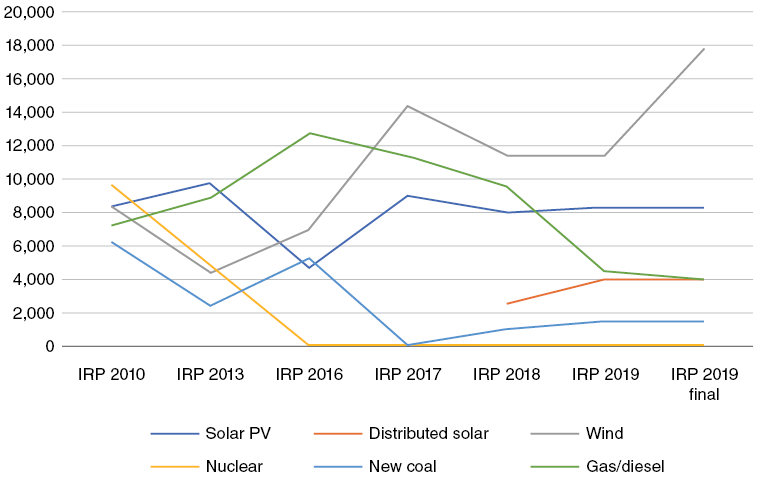
If South Africa is to reduce its GHG emissions, it can only do so by decarbonizing its energy sector, responsible for about 80 percent of its emissions (Hochstetler Reference Hochstetler2021: 36). However, it has the classic scenario expected by the authors who say transitions can only be politicized: The whole South African economy has been organized around a “minerals-energy complex” of political and economic elites who have relied on historically cheap coal-based electricity (Fine and Rustomjee Reference Fine and Rustomjee1996). For the parastatal Eskom and heavy electricity consumers in the Energy Intensive Users Group (EIUG), whose twenty-eight firms use 40 percent of South Africa’s electricity supply, the prospect of energy transition appeared as an existential threat from when it was first proposed in 1998. Early on, Eskom was able to simply block requests to diversify from coal, but after the crippling supply shortages after 2008, the sector quickly became the site of significant contestation, whether at consultative meetings on climate in 2009 or in debates around planning South Africa’s long-term electricity procurement plans (Hochstetler Reference Hochstetler2021: 39–57). Figure 9.3 illustrates the country’s inability to ever settle into a clear vision of its electricity sector, with successive plans for electricity procurement fluctuating wildly as different actors gained short-term influence in the planning process.
Projected total electricity procurement in installed MW to 2030 by fuel type in drafts of the South African Integrated Resource Plan for Electricity.
Figure 9.3 long description.
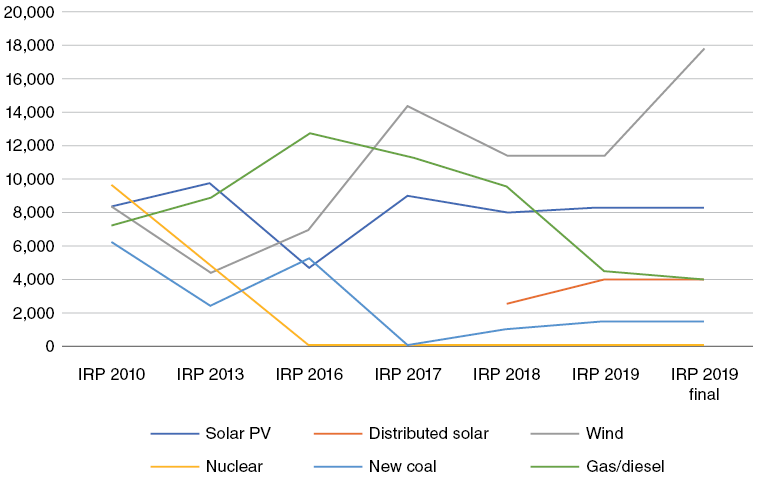
Figure 9.3 Long description
Line graph projected total electricity procurement in installed MW to 2030 by fuel type in South African drafts of the Integrated Resource Plan for Electricity. The x-axis represents drafts from 2010 to 2019. The y-axis shows installed MW from 0 to 20,000. The graph includes lines for Solar PV, Distributed solar, Wind, Nuclear, New coal, and Gas/diesel, each with different line styles and colors. The lines fluctuate wildly showing the short-term influence of different actors in the planning process. Distributed solar and Gas/diesel show moderate increases.
Institutions followed suit, with the 2009 Inter-Ministerial Committee on Climate Change omitting the most powerful relevant state actors, the Ministry of Energy, the Treasury, and Eskom, leaving a weak Ministry of Environmental Affairs unable to lead decisive climate action among its partners (Tyler and Hochstetler Reference Hochstetler2021: S191). In short, while effective climate policy might require policy stability and a steady hand, the South African experience shows that putting such policies and institutions in place is a daunting requirement in a context where there are powerful interests in blocking transition. There has been very little evidence that the South African state has the capacity to do so in the face of “the presence of a strong, well-resourced actor like Eskom fighting an existential threat [that] clearly drove the emergence of these counter-coalitions and their battles” (Hochstetler Reference Hochstetler2021: 224). Yet, while the basic South African climate story looks like the inevitable politicization following an activated fossil fuel power, the other dimensions of energy transition there show places where more harmonious and steady pro-transition coalitions and policies might have been built.
As already noted, the industrial policy and sectoral growth dimensions of energy transition have often provided a positive motivation for change, even resulting in a self-reinforcing green spiral of industry growth and governmental reinforcement for many early adopters (Zysman and Huberty Reference Zysman and Huberty2014). South African policymakers were very interested in this possibility, with numerous government departments putting forward plans (Hochstetler Reference Hochstetler2021: 112–115). This opportunity was interrupted in South Africa because reformers made the renewable energy program the entry point for private generation, which introduced the contentious and further politicized dynamics of sectoral privatization to decarbonization. This was in part because Eskom had earlier refused to decarbonize itself, but it eventually led to a poisonous association of public generation with coal and nuclear power while nearly all wind and solar power generation was private. This magnified Eskom’s opposition to shifting fuels and helped to shift the labor movement – supportive of climate action but ideologically opposed to private generation – into the opposition to developing wind and solar power (Hochstetler Reference Hochstetler2021: 115–117). The fits and starts visible in Figure 9.3 further drove away much private interest in localizing input manufacturing so that most jobs associated with renewable energy held little interest for labor, completing a negative rather than positive spiral.
Similarly, South African electricity planners had hoped that solar power could finally bring electrical service to all South Africans, especially the Black South Africans unserved by apartheid and still disproportionately unlinked to the national grid. Many of those disconnected rejected the minimal household service offered through solar power, however, with some researchers characterizing the offer as environmental injustice (Monyei et al. Reference Monyei, Adewumi and Jenkins2018). Instead, wind and solar power were most embraced by wealthier consumers opting for self-provision off the grid. The EIUG also appreciated the steadily dropping prices of renewables across the four auctions as coal prices simultaneously rose (Hochstetler Reference Hochstetler2021: 27). Thus, while this political economy can ease politicization and conflict, it did not in South Africa, with its racialized history of inequitable electricity service provision.
The South African government designed its renewable energy procurement program in ways that might have built opposition or support for broader energy transition in the local communities that host electricity infrastructure. On the one hand, it used the auction procurement mechanism for electricity, which tends to provide incentives for cheaper electricity – itself a source of support for transition – through larger and more intrusive installations that are more likely to encounter opposition from host sites (Grashof Reference Grashof2019). On the other hand, bidders won the auctions to build wind and solar farms based on bids that considered not only the price offered but also the benefits they promised to communities within 50 km of an installation. These included mandatory community ownership up to 5 percent, as well as promises for jobs for locals and for Black South Africans in particular (Tait et al. Reference Tait, Wlokas and Garside2013). In the end, only one community in South Africa had substantial mobilization against wind power (Hochstetler Reference Hochstetler2021: 210), but the small number of projects procured and built largely neutralized both the potential positive and negative benefits of renewable energy for local committees.
In summary, the South African experience demonstrates the basic dynamic of the politicized scenario. In a country with powerful actors committed to fossil fuels, politicization of energy transition was unavoidable. Those powerful actors, led by the parastatal Eskom, successfully outright blocked and maneuvered behind the scenes against energy transition for more than two decades. At the same time, the South African experience includes several places where there were points of intervention – actual and potential – that could have led to other outcomes, either less or more of an energy transition than actually happened. Had South Africans found a different way around the equally thorny politicization there around privatization, for example, transition might have been smoothed. Thus, its lesson is that politicization may be unavoidable in some circumstances but still leaves multiple potential leverage points that may affect outcomes.
9.6 Conclusions
Does meaningful decarbonization depend on policy stability that makes climate policies and institutional development irreversible, or does it depend on mastering a messy political conflict with steps forward and backward that might be inherent in large-scale political economy transitions? The case studies of energy transition in Brazil and South Africa that are considered here ultimately conclude that messy political conflict is probably an inevitable step in a full-scale energy transition in countries that produce fossil fuels. Fossil fuel producers and those allied with them politically and economically can see the existential threat that decarbonization holds for them and have the resources to fight that end. While this conclusion cannot be avoided, I would argue that the case studies here provide considerable nuance around it and even show important contributions that policy stability can make to the final outcome. Many of these nuances are best seen in considering other non-climate political economies around energy transition, which can skirt the direct threat that climate action poses to the fossil fuel coalitions.
The experiences of the two countries show that the potential for green industry developments can provide powerful short- and long-term counterweights to the fossil fuel coalition. Brazil shows this positively, as both public and private actors worked together in a mutually reinforcing green spiral to support ever-larger quantities of wind power production there; the absence of such a coalition slowed the introduction of solar power. South African shows it negatively, where policy instability in the form of electricity planning sent discouraging signals to private investors and installation firms, turning them away from the South African economy. Even though the expansion of Brazilian wind power was not enough to transform the whole energy sector, decarbonization requires having an alternative ready to replace the fossil fuels and Brazil shows how a state–society coalition can get that done. The consumption and siting political economies of energy transition are other dimensions where other allies can be developed as counterweights to the fossil fuel coalitions. It is noteworthy that this is not a process heavily shaped by NGOs in either country, although they have strong NGO sectors.
The discussion here sketches developments over two decades that also show that policy stability and politicization can both dominate at different points in time in the story. Brazil manages quite a bit of policy consistency in most political economies for most of those decades, but politicization emerges at key moments when fossil fuel producers are explicitly threatened, as with the 2009 climate legislation. For South Africa, the threats and politicization are more present most of the time, but there are also clear points where predictable policy interventions could have diffused some of the conflict, notably around privatization. Thus, the two approaches may necessarily appear together rather than being as clearly opposed as the literature can suggest.

 Open access