Introduction
In the last century, noncommunicable diseases have become a leading cause of morbidity and mortality worldwide; ischemic heart disease (IHD) is the world's leading cause of death.Reference Forouzanfar, Moran and Flaxman 1 This increased burden of noncommunicable disease alters the vulnerability of populations to disasters as persons with chronic disease may be more greatly impacted by disruptions to the health care system that result from large-scale emergencies.Reference Demaio A, Horn, de Courten and Tellier 2 In addition to direct injury from disaster events, affected persons are at risk of communicable disease, malnutrition, and exacerbations of underlying disease. There is a growing body of evidence to suggest that the acute stress of these events may trigger cardiac events as well.Reference Strike and Steptoe 3 Chronic stressors, such as low socioeconomic status, work stress, and depression, have been associated with increased IHD;Reference Strike and Steptoe 3 acute stressors, such as sporting events, earthquakes, and war, have all been associated with acute coronary syndrome (ACS).Reference Carroll D, Tilling, Macleod and Smith 4 - Reference Bergovec, Heim, Vasilj, Jembrek-Gostovic, Bergovec and Strnad 6 Increased arrhythmia, blood pressure lability, coagulopathy, and sympathetic dysregulation have been posited as mediating factors in this phenomenon.Reference Strike and Steptoe 3
This review aims to clarify the relationship between humanitarian emergencies and cardiovascular morbidity and mortality. Specifically, this review seeks to quantify the effect of natural and man-made disasters on the prevalence of ACS, acute decompensated heart failure (ADHF), and sudden cardiac death (SCD).
Methods
The full protocol for this review has been published in the PROSPERO International Prospective Register of Systematic Reviews (University of York, York, United Kingdom; registration number CRD420140007056). PubMed (National Center for Biotechnology Information; Bethesda, Maryland USA), Scopus (Elsevier BV; Amsterdam, Netherlands), CINAHL (EBSCO; Ipswich, Massachusetts USA), and Global Health (EBSCO; Ipswich, Massachusetts USA) databases were searched in January 2014 using two main concepts: humanitarian emergencies and cardiovascular morbidity and mortality. The search terms utilized are listed in the Appendix (available online only). The bibliographies of included studies were reviewed manually to identify studies missed using the initial search strategy.
Inclusion criteria were as follows:
-
● Reports of adult patients directly affected by humanitarian emergency, including natural disaster (eg, hurricane and tornado) and/or conflict (eg, war and acts of terror).
-
● Reported outcomes occurring within five years of the disaster event, with some cases occurring in the first year after the event.
-
● At least one of ACS, ADHF, or SCD quantified in the study.
-
● Observational studies with a comparison population (historical or geographic).
-
● Reports in all languages published after 1997.
Exclusion criteria were as follows:
-
● As this review sought to quantify changes in the population prevalence of cardiac events following disasters, studies of subsets of patients not representative of the entire population, such as those with implantable cardiac devices, were excluded.
-
● Reports of occupational emergencies not triggered by a natural disaster.
-
● Geographically remote exposures, such that those studied, were unlikely to have been injured by the disaster or incurred damage to their residence as a result of the disaster.
-
● Exposures greater than five years prior to the initial outcome measurements.
-
● No comparison population.
Two investigators independently reviewed all titles and abstracts for studies that met the inclusion criteria, and two investigators reviewed all potentially relevant full-text reports. A modified version of the Newcastle-Ottawa Scale was used to assess the risk of bias in studies.Reference Lo, Mertz and Loeb 7
The numbers of admissions for ACS, ADHF, and SCD (as defined by the study authors), as well as corresponding odds ratios or relative risks, were abstracted for each study and input into Review Manager 5.0 (Version 5.2, The Nordic Cochrane Centre; Copenhagen, Denmark). 8 Admissions for ACS included unstable angina (UA), ST-segment myocardial infarction (STEMI), and non-ST segment myocardial infarction (NSTEMI). When reported separately by the authors, these values were pooled to obtain totals. Admissions for chest pain that did not result in a diagnosis of ACS were excluded. When only graphical data were presented in the published study, authors were contacted to obtain numerical results. If authors did not respond within two weeks, numerical results were estimated from graphs using freely available software.
A summary ratio of events in the exposed vs unexposed (control) periods was calculated for each study. If the authors did not provide measures of variance, the standard error was estimated using Poisson assumptions for the purposes of visual representation in Forest plots. The unit of analysis was number of events. These studies were clinically and methodologically heterogeneous. In an exploratory analysis of statistical heterogeneity, I2 measure of heterogeneity ranged from 50%-80%. Given the marked heterogeneity between studies, only a qualitative synthesis of results has been provided.
Results
Study Selection
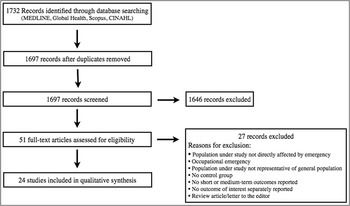
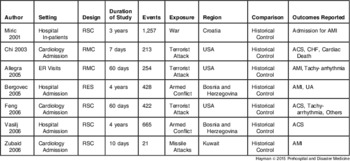
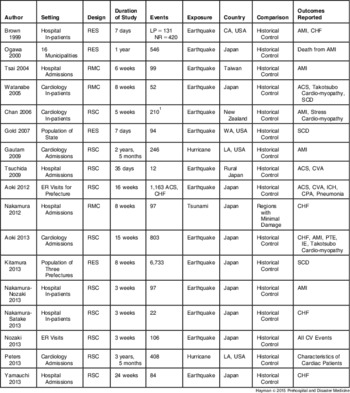
In total, 1,732 records were identified through database searches, 1,697 of which remained after duplicates were excluded. Fifty-one studies were assessed in full text for eligibility, 24 of which were included in the final review. Backward citation screening of included papers identified no further relevant studies. A PRISMA flow diagram is provided in Figure 1. Of the 24 included studies, seven reported on conflict events and the remainder reported findings following natural disasters. A detailed summary of the patient and exposure characteristics of included studies is provided in Tables 1a and 1b.
PRISMA Flow Diagram.

Characteristics of Included Studies, Conflict Events

Abbreviations: ACS, acute coronary syndrome; AMI, acute myocardial infarction; CHF, congestive heart failure; ER, emergency room; RES, retrospective epidemiologic study; RMC, retrospective, multicenter; RSC: retrospective, single center; UA, unstable angina.
Characteristics of Included Studies, Natural Disaster Events

Abbreviations: ACS, acute coronary syndrome; AMI, acute myocardial infarction; CA, California USA; CHF, congestive heart failure; CPA, cardiopulmonary arrest; CVA, cerebrovascular accident; CV, cardiovascular; ER, emergency room; ICH, intracranial hemorrhage; IE, infectious endocarditis; LA, Louisiana USA; LP, lumbar puncture; NR, not reported; PTE, pulmonary thromboembolism; RES, retrospective epidemiologic study; RMC, retrospective, multicenter; RSC: retrospective, single center; SCD, sudden cardiac death; WA, Washington USA.
1First two weeks after 2010 event. Further event totals not quantified.
Studies of Conflict Events
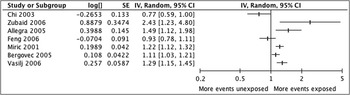
Four studies reported on the rates of acute myocardial infarction (AMI) during active conflict compared to periods of relative stability.Reference Bergovec, Heim, Vasilj, Jembrek-Gostovic, Bergovec and Strnad 6 , Reference Vasilj, Bergovec and Kvesic 9 - Reference Zubaid, Suresh, Thalib and Rashed 11 One study reported the acute effects of air raids in Kuwait on AMI, finding that the incidence of admission for AMI increased during the first five days of attacks (RR = 2.43; 95% CI, 1.23-4.26).Reference Zubaid, Suresh, Thalib and Rashed 11 Three studies identified a long-term increase in ACS in prolonged conflict settings.Reference Bergovec, Heim, Vasilj, Jembrek-Gostovic, Bergovec and Strnad 6 , Reference Vasilj, Bergovec and Kvesic 9 , Reference Miric, Giunio, Bozic, Fabijanic, Martinovic and Culic 10 Studying 3,454 consecutive admissions for ACS over a 9-year period, including the Middle Dalmatia War (Croatia), Miric et al found that significantly more patients were admitted with ACS in the 3-year period during the war than the preceding 3-year period (1,257 vs 1,024 patients; P < .05).Reference Miric, Giunio, Bozic, Fabijanic, Martinovic and Culic 10 Two separate studies also found a statistically significant increase in the number of patients with war-time ACS in Bosnia and Herzegovina (1992-1995) compared to the prewar period.Reference Bergovec, Heim, Vasilj, Jembrek-Gostovic, Bergovec and Strnad 6 , Reference Vasilj, Bergovec and Kvesic 9 A summary of the estimated effect of each conflict event is provided in Figure 2, with results ordered by length of follow up.
Incidence Rate Ratio for ACS Following Conflict Exposure (Ordered by Length of Study Period). Abbreviation: ACS, acute coronary syndrome.

Three included studies reported on the effects of the September 11th terrorist attacks on the World Trade Center (2001; New York, New York USA).Reference Chi, Speakman, Poole, Kandefer and Kloner 12 - Reference Gold, Kane, Sotoodehnia and Rea 15 A study of coronary care unit admissions at eight centers in New York City did not find a significant change in the number of admissions for ACS, ADHF, or chest pain in the week following the attacks.Reference Chi, Speakman, Poole, Kandefer and Kloner 12 Two studies examined outcomes to 60 days; a study of 16 hospitals in New Jersey (USA) found a 49% increase (P = .01) in the incidence of AMI in the 60 days following the event (42% when the number of patients presenting to the emergency department (ED) was controlled for).Reference Allegra, Mostashari, Rothman, Milano and Cochrane 14 A study of admissions to the telemetry and coronary care units at a single center in Brooklyn (New York, USA) also identified an increase in the overall occurrence of cardiac events in the post exposure period compared to the corresponding period in 2010 (P = .008).Reference Feng, Lenihan, Johnson, Karri and Reddy 13 The incidence of AMI and tachyarrhythmia was increased following the event, however, the incidence of admission for UA did not change.
Studies of Natural Disasters
Seventeen relevant studies on cardiovascular morbidity and mortality following natural disasters were identified, reporting on a variety of cardiac outcomes with widely varying follow up.
Acute Coronary Syndrome
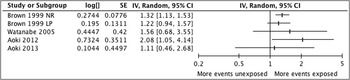
Four studies provided data on the change in ACS incidence in the first week following four different earthquakes.Reference Aoki, Fukumoto and Yasuda 5 , Reference Brown 16 - Reference Aoki, Takahashi and Fukumoto 18 Brown and colleagues had described the cardiac sequelae of two different events in California (USA), the 1989 Lomo Prieta Earthquake and the 1994 Northridge Earthquake.Reference Brown 16 An increase in AMI admissions on the day of the Northridge event (RR = 1.83; 95% CI, 1.29-2.59), but not the Loma Prieta event (RR = 0.96; 95% CI, 0.55-1.67), was identified.Reference Brown 16 At one week after the event, there was again an increase in events in the Northridge population, but not the Loma Prieta population. Following the 2004 Niigata, Japan earthquakes, a study of eight hospitals noted an increase in cases of ACS; however, it was not statistically significant.Reference Watanabe, Kodama and Okura 17 Similarly, studies of ACS incidence diagnosed in the emergency room (ER) and by cardiologists identified only a nonsignificant trend toward increased ACS admissions in the week immediately following the earthquake.Reference Aoki, Fukumoto and Yasuda 5 , Reference Aoki, Takahashi and Fukumoto 18 The first-week trend in ACS admissions is summarized in Figure 3.
Incidence Rate Ratio for ACS in the First Week Following Natural Disaster. Abbreviation: ACS, acute coronary syndrome.

One study reported the incidence of ACS during the 2-week period following two earthquakes in Christchurch (New Zealand).Reference Chan, Elliott and Troughton 19 The September 10, 2010 earthquake, magnitude 7.1, occurred at 4:36 am, while the February 2011 event occurred around 12:00 pm and had a lesser magnitude of 6.3. The STEMI occurrence increased following the September event (P = .016), but not following the February event.
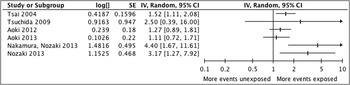
Six studies reported on the incidence of ACS in the period one to two months following a natural disaster.Reference Aoki, Fukumoto and Yasuda 5 , Reference Aoki, Takahashi and Fukumoto 18 , Reference Tsai, Lung and Wang 20 - Reference Nakamura, Nozaki, Fukui, Endo, Takahashi and Tamaki 23 In a study of six counties in Taiwan, there was a significant increase in AMI incidence during the 6-week period following the 1999 Ji-Ji Earthquake (99 admissions vs 65 admissions; P = .009).Reference Tsai, Lung and Wang 20 A rural hospital-based study of ACS incidence following the 2007 Noto Peninsula Earthquake (Japan) also found an increase in ACS events compared with corresponding historical averages (five vs two; P < .01).Reference Tsuchida, Kawashiri and Teramoto 21 Four studies described the effects of the Great East Japan Earthquake. Using ER records, Nozaki noted a significant increase in the number of patients with ACS in the 3-week period following the earthquake, compared with historical controls (n = 19 vs n = 7 in 2009 and n = 5 in 2010; P = .004).Reference Nozaki, Nakamura and Abe 22 Hospital admission data on the same subset of patients yielded similar results (odds ratio for AMI = 4.40; 95% CI, 1.01-18.35).Reference Nakamura, Nozaki, Fukui, Endo, Takahashi and Tamaki 23 Likewise, studies of ACS presentations to the ER5 and cardiology admissionsReference Aoki, Takahashi and Fukumoto 18 found a weekly increase in the number of patients presenting to the ER with ACS in the two weeks following the event that did not persist beyond that time. A Forest plot of these findings is provided in Figure 4.
Incidence Rate Ratio for ACS Three to Eight Weeks Following Natural Disaster. Abbreviation: ACS, acute coronary syndrome.

Two included studies described the long-term effects of Hurricane Katrina (2005; USA) on ACS presentations several years following the hurricane.Reference Gautam, Menachem, Srivastav, Delafontaine and Irimpen 24 , Reference Peters, Katz and Moscona 25 A single-center study found a 3-fold increased incidence in the proportion of admissions for AMI in the two years following Katrina (2.18% vs 0.71%; P < .0001), and also noted that the post Katrina group had higher rates of unemployment, lack of insurance, medication noncompliance, higher rates smoking, and higher rates of substance abuse. The expected trends in circadian variation of AMI onset were also altered in the post Katrina period.Reference Peters, Katz and Moscona 25
Acute Decompensated Heart Failure
Following the Northridge and Loma Prieta Earthquakes, there was no difference in the daily admission rate for ADHF in the seven days before, the day of, or the six days following the event for either earthquake.Reference Brown 16 The studies of ADHF following the Great East Japan Earthquake had longer follow up and consistently identified an increase in ADHF.Reference Aoki, Fukumoto and Yasuda 5 , Reference Aoki, Takahashi and Fukumoto 18 , Reference Nozaki, Nakamura and Abe 22 , Reference Nakamura, Satake and Abe 26 - Reference Yamauchi, Yoshihisa and Iwaya 28 Nozaki and colleagues identified an increase in ER visits for ADHF during the 3-week period after the earthquake compared with the same periods in 2009 and 2010 (32 in 2011 vs 16 in 2009 and 19 in 2010; P = .039).Reference Nozaki, Nakamura and Abe 22 Aoki et al found an increase in ADHF admissions that persisted for six weeks following the event.Reference Aoki, Fukumoto and Yasuda 5 , Reference Aoki, Takahashi and Fukumoto 18 When compared with the predisaster group, patients admitted in the post disaster period were also more likely to be older than 75 years of age (OR = 1.89; 95% CI, 1.12-3.19).Reference Aoki, Takahashi and Fukumoto 18
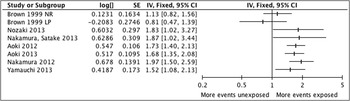
A study of the tsunami-hit area following the Great East Japan Earthquake found a relative risk of ADHF admission of 1.97 (95% CI, 1.50-2.59) in the tsunami area, compared with a relatively unaffected control region. Admissions for ADHF peaked three to four weeks following the event and then gradually returned to baseline over the remainder of the 12-week period studied.Reference Nakamura, Tanaka and Nakajima 27 Compared with patients admitted in the predisaster period, patients admitted during the first three weeks following the event were also less likely to have a history of admission for ADHF, more likely to have hypertension, and more likely to have atrial fibrillation.Reference Nakamura, Satake and Abe 26 At Fukishima Medical University (Japan), 84 patients were admitted with ADHF in the six months following the event, compared with 55 in the control period.Reference Yamauchi, Yoshihisa and Iwaya 28 Patients admitted in the post disaster period were also older (P = .031), more hypertensive (P = .0039), had a greater incidence of incident ADHF due to valvular disease (P = .040), and were more likely to have interrupted their drugs prior to admission (P = .001).Reference Yamauchi, Yoshihisa and Iwaya 28 A summary of findings is provided in Figure 5.
Incidence Rate Ratio for Acute Decompensated Heart Failure Following Natural Disaster (Ordered by Length of Study Period).

Sudden Cardiac Death
Four studies reported on SCD following natural disasters.Reference Gold, Kane, Sotoodehnia and Rea 15 , Reference Watanabe, Kodama and Okura 17 , Reference Kitamura, Kiyohara and Iwami 29 , Reference Ogawa, Tsuji, Shiono and Hisamichi 30 In the 48 hours following the 2001 Nisqually Earthquake (Washington USA), there were 32 SCDs, compared with an average of 22 in control periods (P = .02).Reference Gold, Kane, Sotoodehnia and Rea 15 There was no statistically significant difference at the 1-week point after the event. Following the 2004 Niigata Earthquake (Japan), there was an increase in the daily median of SCD in the week following the event (daily median was three in the week following event, compared to 0.5 in 2003 and zero in 2002), but no statistically significant increase beyond that period.Reference Watanabe, Kodama and Okura 17 Kitamura and colleagues used Poisson modeling to examine trends in out-of-hospital cardiac arrest (OHCA) of presumed cardiac origin in the 8-week period following the Great East Japan Earthquake.Reference Kitamura, Kiyohara and Iwami 29 The risk of OHCA was increased for the first four weeks following the earthquake (Week 1 RR = 1.70 (95% CI, 1.40-2.07), Week 2 = 1.48 (95% CI, 1.21-1.81), Week 3 = 1.47 (95% CI, 1.20-1.82), Week 4 = 1.26 (95% CI, 1.02-1.54), and Week 5 and onwards did not reach statistical significance). This was in keeping with a previous study that identified increased mortality attributable to AMI that persisted for eight weeks following the 1995 Great Hanshin-Awaji Earthquake (Japan).Reference Ogawa, Tsuji, Shiono and Hisamichi 30 The highest standardized mortality ratio (SMR) for AMI death was in the first week (SMR = 8.4; P < .05); overall, there were 546 deaths attributable to AMI in the earthquake year, compared to 266 in the control period. A summary of findings is provided in Figure 6.
Incidence Rate Ratio for Death of Presumed Cardiac Origin (Ordered by Length of Study Period).

Discussion
Risk of Bias Within Studies
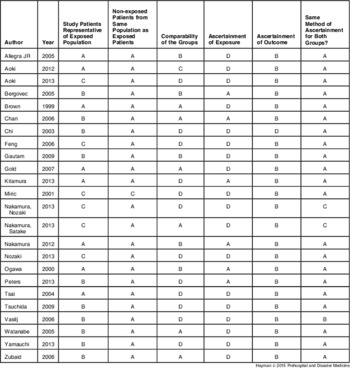
A modified version of the Newcastle-Ottawa Score for Cohort Studies was used to assess the risk of bias in individual studies.Reference Wells, O'Connell, Peterson, Welch, Losos and Tugwell 31 Three main domains were assessed: (1) the selection of the exposed and unexposed populations; (2) the ascertainment of exposure and outcome; and (3) the comparability of the groups. A summary of the risk of bias assessment for individual studies is presented in Table 2.
Risk of Bias Summary for Individual Studies

Nine of 24 studies utilized single-center data from hospitalized inpatients; these studies may not be representative of the regional population, particularly in regions where health costs are prohibitive or if transportation patterns were restricted in the aftermath of the event.Reference Miric, Giunio, Bozic, Fabijanic, Martinovic and Culic 10 , Reference Chi, Speakman, Poole, Kandefer and Kloner 12 , Reference Feng, Lenihan, Johnson, Karri and Reddy 13 , Reference Aoki, Takahashi and Fukumoto 18 , Reference Chan, Elliott and Troughton 19 , Reference Tsuchida, Kawashiri and Teramoto 21 , Reference Nakamura, Nozaki, Fukui, Endo, Takahashi and Tamaki 23 , Reference Nakamura, Satake and Abe 26 , Reference Yamauchi, Yoshihisa and Iwaya 28 This is particularly apparent when considering studies of the September 11th terrorist attacks, since many patients did not report to work in Manhattan (New York USA) in the weeks after the event, altering the daily hospitalization patterns of patients, both in the city and in the surrounding areas.Reference Chi, Speakman, Poole, Kandefer and Kloner 12 - Reference Allegra, Mostashari, Rothman, Milano and Cochrane 14 As almost all studies utilized historical controls from the previous year, the comparison population was generally similar to the exposed population. Comparability of the groups was not always well reported, and was particularly concerning for the three studies describing the effects of long-term conflict on the population.Reference Bergovec, Heim, Vasilj, Jembrek-Gostovic, Bergovec and Strnad 6 , Reference Vasilj, Bergovec and Kvesic 9 , Reference Miric, Giunio, Bozic, Fabijanic, Martinovic and Culic 10 While the authors included only patients who resided in the affected area for the duration of the conflict, population change due to emigration and demographic change due to military recruitment remain strongly possible and could bias the results.
Risk of Bias Across Studies
Publication bias may have contributed to the findings of this review, as studies reporting no change in the rate of cardiac events following a disaster may be less likely to be published. This is particularly true for studies of heart failure and SCD, as these are less well-established phenomena than the change in ACS risk following a disaster. Many of these studies also report on a small subset of disaster events; of 24 studies, eight report on the Great East Japan Earthquake alone.Reference Aoki, Fukumoto and Yasuda 5 , Reference Aoki, Takahashi and Fukumoto 18 , Reference Nozaki, Nakamura and Abe 22 , Reference Nakamura, Nozaki, Fukui, Endo, Takahashi and Tamaki 23 , Reference Nakamura, Satake and Abe 26 - Reference Kitamura, Kiyohara and Iwami 29 Several of the Japanese studies reported on ED admissions and cardiac care unit admissions in the same population of patients in sequential papers.Reference Aoki, Fukumoto and Yasuda 5 , Reference Aoki, Takahashi and Fukumoto 18 , Reference Nozaki, Nakamura and Abe 22 , Reference Nakamura, Nozaki, Fukui, Endo, Takahashi and Tamaki 23 , Reference Nakamura, Satake and Abe 26 Studies reporting on AMI, ADHF, and/or SCD among the same population in separate papers may have included overlapping subsets of patients, thus these results also cannot be interpreted independently of one another.Reference Nozaki, Nakamura and Abe 22 , Reference Nakamura, Nozaki, Fukui, Endo, Takahashi and Tamaki 23 , Reference Nakamura, Satake and Abe 26 , Reference Nakamura, Tanaka and Nakajima 27 Non-English studies may not have been identified by the search strategy, and may have yielded different results.
Discussion of Findings
Overall, studies of cardiac disease in conflict settings consistently find an increase in admissions for AMI in the period of months to years following the stressor. The studies reporting on short-term effects have disparate findings, with a clear increase in AMI in the population already under war-time stress, but a weaker correlation in the American population affected by the September 11th attacks. It is possible that the acute-on-chronic stressor had a different physiologic effect in the Kuwaiti population studied; however, it is also possible that the methodological limitations discussed earlier biased the results of the New York studies, since changes in hospital utilization in the immediate aftermath of the attacks may have altered the admission patterns at hospitals studied.
Altered patterns of ACS admission also varied among the studies of natural disasters. Early morbidity from ACS is likely predominantly attributable to the psychological stress of the event and corresponding physiologic derangements. Some of this derangement is due to sympathetic dysregulation, as demonstrated by altered patterns of heart rate variability and increased tachyarrhythmia in patients undergoing Holter and Implantable Cardiovascular Defibrillator monitoring during earthquakes.Reference Lin LY, Liu, Ho, Liau and Lee 32 , Reference Nakano, Kondo and Wakayama 33 Hypertension and hypercoagulability likely also play a role in pathogenesis.Reference Nishizawa, Hoshide, Shimpo and Kario 34
Acute myocardial infarction incidence is known to correlate with time of day; findings of this review are consistent with the hypothesis that earthquakes occurring in the early morning hours are correlated more closely with increased ACS morbidity than events occurring later in the day. The Loma Prieta and Great East Japan Earthquakes both occurred in the afternoon hours and were not as clearly associated with an early increase in ACS. The increase in ACS events in the weeks following these earthquakes may be predominantly attributable to psychosocial factors such as missed medications, changed diet, poor living conditions, and the stress of disorder and crime following the event.Reference Lavie, Gerber and Lanier 35 These psychosocial factors have a significant long-term impact on population vulnerability to AMI and are compounded further by compensatory behavioral changes. For example, AMI patients in the post Katrina phase had a higher incidence of smoking, which is potentially a coping mechanism for the chronic stress of displacement and unemployment.Reference Gautam, Menachem, Srivastav, Delafontaine and Irimpen 24
The widespread impact of the Great East Japan Earthquake was associated with an increase in admission for ADHF, peaking several weeks after the initial event. While sympathetic activation with resulting hypertension and tachycardia may have played a role, disruptions to the health care system likely also contributed. Aoki describes that the medication delivery system was significantly disrupted following the earthquake, tsunami, and nuclear disaster.Reference Aoki, Fukumoto and Yasuda 5 Further, many people consumed salted preserved foods rather than fresh foods during this period, which may have further exacerbated heart failure.Reference Aoki, Fukumoto and Yasuda 5 Future morbidity from disasters may be preventable through improved disaster-preparedness planning, particularly to ensure that patients have medications available in advance. Additionally, post disaster messaging to cardiac patients to minimize sodium consumption may help to decrease the risk of ADHF during this period of vulnerability.
Limitations
This review has some limitations. The authors sought to identify the change in population prevalence of cardiovascular disease following emergencies; however, the studies included lacked a clear denominator in most instances, therefore population prevalence of disease could not be extrapolated. A small number of high-risk populations, such as those with cardiac devices, may have been excluded. Most of the included studies were from Asia, which may have serious implications for the generalizability of results, given that population vulnerability and health systems resources differ considerably among regions. While generalizability may be limited, these results are still meaningful in terms of global disaster preparedness as Asia is disproportionately affected by natural disasters when compared with other regions. 36 Future study of the cardiovascular effects of disasters in low- and middle-income settings is needed, particularly to assist local governments and humanitarian aid organizations in disaster preparedness and response planning in those regions.
Conclusions
Despite the identified correlations between humanitarian emergencies and cardiac morbidity, noncommunicable diseases have not traditionally been considered in planning the humanitarian response. The findings of this review suggest that addressing chronic disease in disaster planning and response efforts may help mitigate cardiac morbidity and mortality following a disaster. Given the changing global burden of disease, planning for the monitoring and management of cardiac disease in the post disaster period should be prioritized.
Supplementary Materials
To view supplementary material for this article, please visit http://dx.doi.org/10.1017/S1049023X14001356