1. Introduction
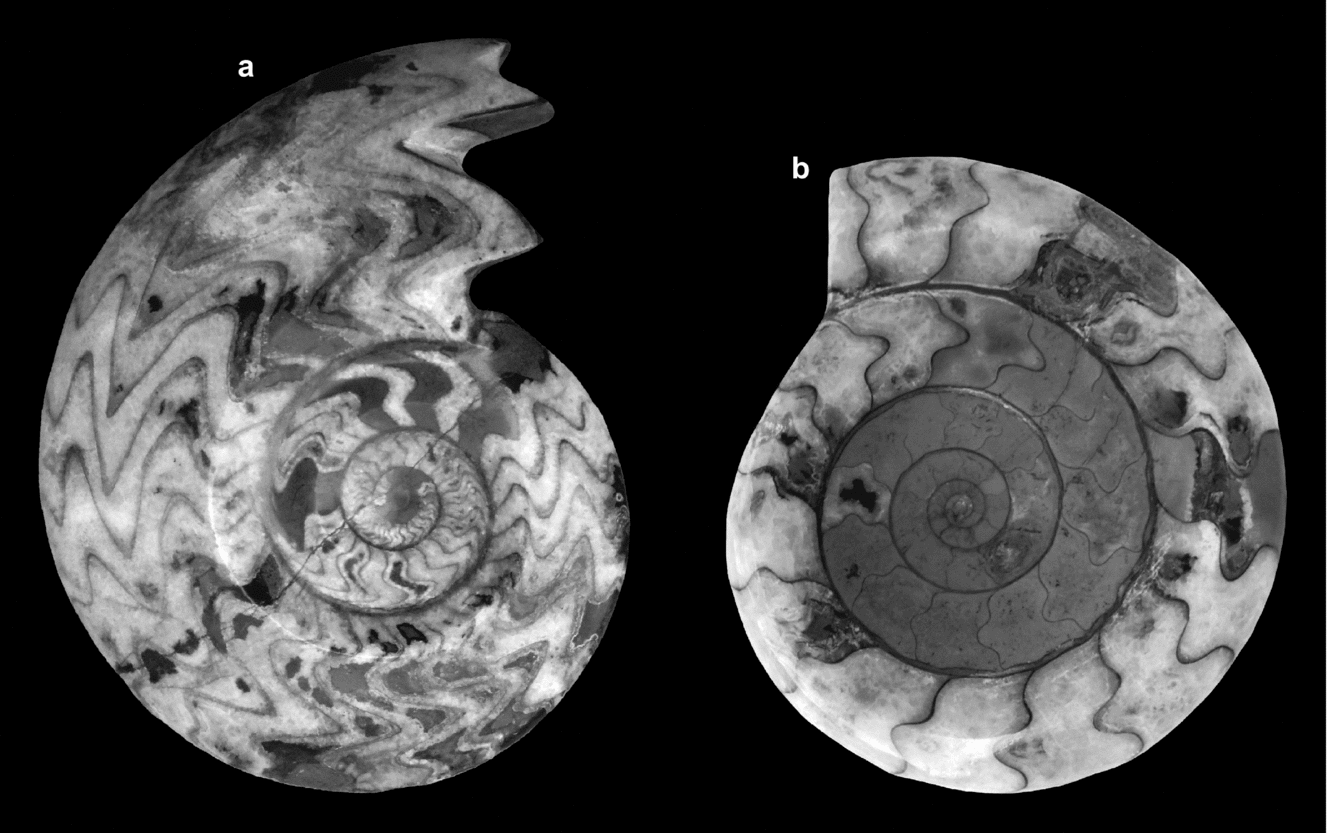
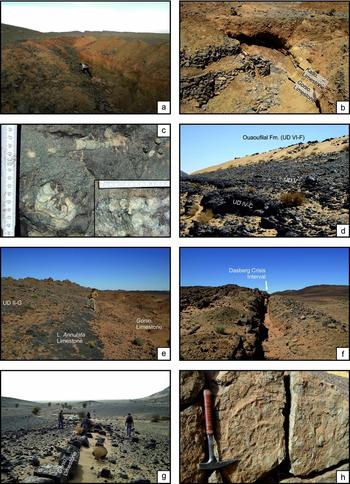
The Devonian of southern Morocco is world-famous for its rich fossils that are widely commercially exploited and sold in rock shops of many countries. Apart from its trilobites, polished middle to uppermost Famennian ammonoids are intensively traded (Fig. 1a, b). Large-sized to giant Gonioclymenia speciosa are sold as individuals or several specimens are mounted on large limestone slabs. These derive from a peculiar condensed and massive cephalopod limestone, the upper Famennian Gonioclymenia Limestone. It is exploited in km-long trenches dug through the desert or in small subsurface mines of the Tafilalt (eastern Anti-Atlas). The heavy mining has more or less destroyed all outcrops (Fig. 2a, e, f). Only in rare cases of vertical bedding can small stretches of the bed, even with numerous giant specimens on its upper surface (Fig. 2g, h), still be seen in the field.
Examples of upper/uppermost Famennian polished clymeniids from the Tafilalt purchased from Erfoud rock shops. (a) Gonioclymenia speciosa (Münster, Reference Münster1831), ×0.5; (b) Kalloclymenia subarmata (Münster, Reference Münster1832), ×1.

Tafilalt field photos. (a) Extensive trenches of the Gonioclymenia Limestone at the western end of Jebel Ihrs (western Tafilalt); (b) temporary exposure of the upper/uppermost Famennian succession with the Gonioclymenia and Kalloclymenia limestones at Jebel Ihrs West (spring 2011); (c) corroded and hematite-impregnated, reddish top of the Costaclymenia Limestone at Jebel Ihrs West (Bed 2), with Costaclymenia sp., large orthocones, and crinoid roots (insert); (d) position of Gonio. speciosa level within reddish nodule beds above the UD IV-C marker limestone at Ottara East (Bou Maiz Syncline, central Tafilalt); (e) trenched Gonioclymenia Limestone directly overlying the basal upper Famennian Lower Annulata Limestone (UD IV-A) at Takhbtit West (northern limb of Amessoui Syncline, southern Tafilalt); (f) deep, km-long Gonioclymenia Trench at Oum el Jerane (southern limb of Amessoui Syncline); (g) vertical outcrop of the locally massive Gonioclymenia Limestone above basal upper Emsian marls (Daleje Shale Equivalents) at a hill S of Jebel Kfiroun; (h) giant-sized (up to 40 cm in diameter) Gonio. speciosa on the upper surface of the Gonioclymenia Limestone at Jebel Kfiroun South.

The first record of this marker unit goes back to Hollard (Reference Hollard1960), who observed in the area S of Jebel Amelane that a massive red limestone with Sphenoclymenia (probably = Gonioclymenia) lies with an angular unconformity above the upper Frasnian, or, laterally, even on limestones with upper Givetian pharciceratids (still assigned to the lower Frasnian at the time of Hollard's publication). A similar transgression of a condensed limestone with Gonioclymenia was reported from El Fecht in the western Maider, which belongs to the separate Maider Platform (palaeogeography of Wendt, Reference Wendt1988 b). Hollard (Reference Hollard and Oswald1967) noted the enormous size (up to 40 cm) of the clymeniids.
In their pioneer work on the Upper Devonian sedimentation of the Tafilalt, Wendt, Aigner & Neugebauer (Reference Wendt, Aigner and Neugebauer1984) commented on the widespread prominent bed with Gonioclymenia, with specimens up to 60 cm in diameter, and assigned it to the Famennian V ß. This dating was based on the outdated ammonoid zonal terminology of Wedekind (Reference Wedekind1914). They emphasized that the unconformity below reflects an episode of non-deposition, not necessarily a Famennian tectonic phase with subaerial exposure of parts of the Tafilalt, as claimed by Hollard (Reference Hollard1960). This interpretation was repeated in Wendt (Reference Wendt1988 a), with new age assignments based on conodonts. Details or faunal lists, however, were not given. For the extremely condensed succession S of Jebel Amelane, Wendt (Reference Wendt1988 a) showed in his figure 4 an erosional omission surface, with reworked Frasnian clasts, of the Lower expansa (= Bispathodus stabilis stabilis) Zone, a second, iron-stained omission surface between wackestones of the Lower and Middle expansa zones (= B. aculeatus aculeatus Zone), followed by nodular limestone with the giant clymeniids assigned to the Upper expansa Zone (= B. ultimus ultimus Zone). Subsequently, Wendt (Reference Wendt1988 b) remarked that the up to 50 cm thick, prominent marker bed with giant clymeniids occurs all over the Tafilalt Platform and even in adjacent marginal areas of the Tafilalt Basin. His claims of an association of Gonioclymenia with Platyclymenia are at odds with the global record of both genera and have not been substantiated (Korn, Reference Korn1999; Korn, Klug & Reisdorf, Reference Korn, Klug and Reisdorf2000; Becker et al. Reference Becker, House, Bockwinkel, Ebbighausen and Aboussalam2002; Hartenfels, Reference Hartenfels2011). A significant upper Famennian transgression that flooded episodically emergent areas of the Maider and Tafilalt platforms was confirmed. In the subsequent regional sea-level curve of Wendt & Belka (Reference Wendt and Belka1991, fig. 16), this main transgression was placed within the Lower expansa Zone, without discussing their previous different phases of the successive Lower to Upper expansa zones.
Korn, Klug & Reisdorf (Reference Korn, Klug and Reisdorf2000) correlated a range of lateral sections in the Amessoui Syncline of the southern Tafilalt and depicted the Gonioclymenia Limestone as a 30–40 cm thick, rather uniform cephalopod packstone and significant marker, which overlies locally different older Famennian rocks. It was noted that the abundant, large-sized gonioclymeniids belong to Gonio. speciosa. They assigned the marker level to a Kosmoclymenia lamellosa Fauna with a still unclear correlation with the German zonation, since the zonal index species of the German Clymenia Stufe (Upper Devonian = UD V) were not found in Morocco (see discussion in Korn, Reference Korn1999, p. 153). Some large Gonioclymenia slabs on sale in Erfoud or Rissani rock shops show a direct association of large Gonio. speciosa with subordinate, somewhat smaller and more evolute Kalloclymenia subarmata. The occurrence of both taxa in the extensive Gonioclymenia trenches at Jebel Ihrs West, the western continuation of Jebel Amelane, was confirmed during joint field work with the late M. R. House in March 1994. Kalloclymenia was found in place at the top of the reddish limestone. Very solid blocks of the mining debris yielded in addition mostly incomplete Cly. laevigata, Kiaclymenia laevis, Cymaclymenia sp., Erfoudites rherisensis and Mimimitoceras sp. Based on the alleged co-occurrence of Kalloclymenia with the typical Dasbergian genus Clymenia in Cornwall (Selwood, Reference Selwood1960), and on the association with Gonio. corpulenta in the famous Kiya succession of NW Kazakhstan (Simakov et al. Reference Simakov, Bogoslovskiy, Gagiev, Kononova, Kochetkova, Kusina, Kulagina, Onoprienko, Pazukhin, Radinova, Rasina, Reitlinger, Simakova and Yanoulatova1983; updates in Nikolaeva & Bogoslovskiy, Reference Nikolaeva and Bogoslovskiy2005; Nikolaeva, Reference Nikolaeva, Landman, Davis and Mapes2007), Becker et al. (Reference Becker, House, Bockwinkel, Ebbighausen and Aboussalam2002) introduced a Kallo. subarmata Zone (UD V-C) for the Tafilalt, characterized by a Gonioclymenia–Kalloclymenia association. However, they noted that this interval was only known from the very condensed Tafilalt succession, whilst the thicker, more basinal Famennian ammonoid sequences of the region gave no indication for an overlap of both genera.
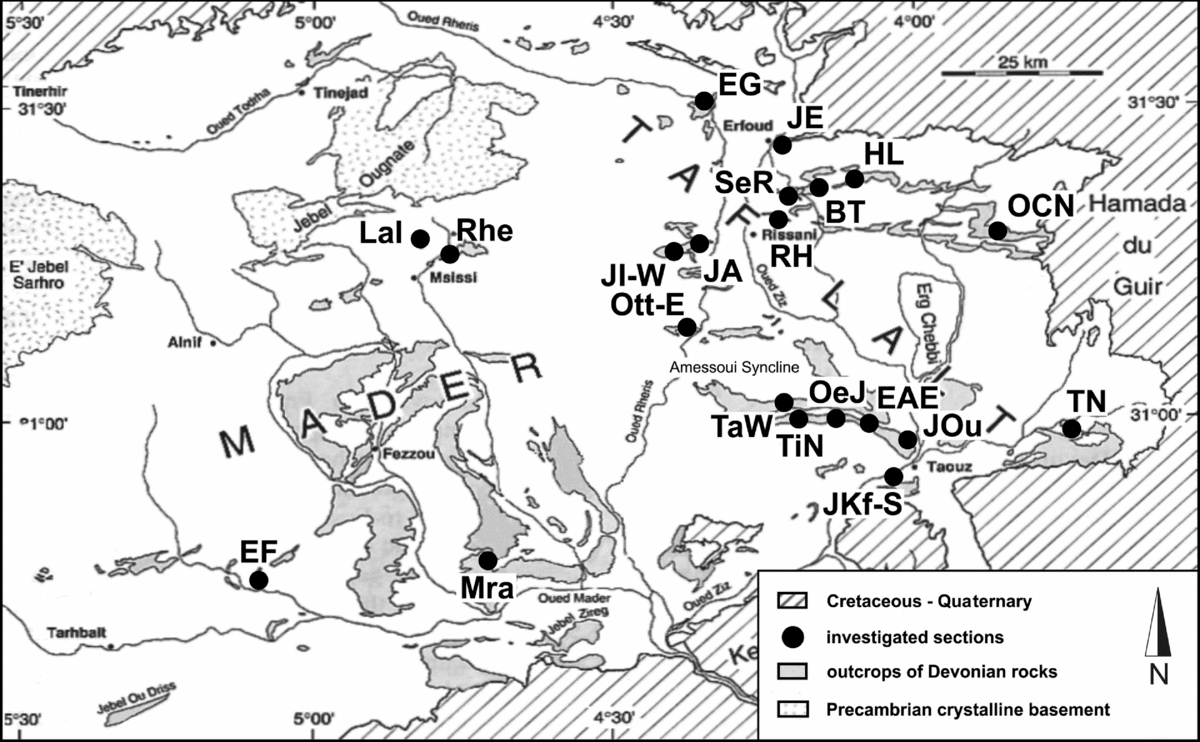
Ginter, Hairapetian & Klug (Reference Ginter, Hairapetian and Klug2002) described shark teeth from upper Famennian sections of the Amessoui Syncline (southern Tafilalt; Fig. 3). They noted the presence of B. ziegleri (= B. ultimus ultimus Morphotype 1) in the Gonioclymenia Limestone of Oum el Jerane, which was consequently assigned to the Upper expansa (= B. ultimus ultimus) Zone. It was recognized that the conodont age was in conflict with the ammonoid–conodont correlation elsewhere, but preference was given to the conodont dating. Samples from Tizi Nersas to the W were said to contain virtually identical conodont faunas but their details were not revealed. Kaiser (Reference Kaiser2005) found no marker conodonts of the B. ultimus ultimus Zone in a sample from the Gonioclymenia Limestone (her Bed 2) at Jebel Ouaoufilal, at the eastern end of the Amessoui Syncline. Hartenfels & Becker (Reference Hartenfels, Becker and Over2009) and Hartenfels (Reference Hartenfels2011) also analysed upper Famennian conodont faunas of the Amessoui Syncline, but did not report conodonts from the Gonioclymenia Limestone.
Position of sampled Gonioclymenia and uppermost Famennian conodont localities in the Tafilalt and Maider; EG = El Gara, JE = Jebel Erfoud, HL = Hamar Lagdad East, BT = Bou Tchrafine, SeR = Seheb el Rhassal, RH = Rich Haroun, OCN = Ouidane Chebbi Northwest, JA = Jebel Amelane, JI-W = Jebel Ihrs West, Ott-E = Ottara East, TaW = Takhbtit West, TiN = Tizi Nersas, OeJ = Oum el Jerane, EAE = El Atrous East, JOu = Jebel Ouaoufilal, TN = Tazoult Nehra, JKf-S = Jebel Kfiroun South, Mra = Mrakib, EF = El Fecht, Rhe = Jebel Rheris West, Lal = Lalla Mimouna.

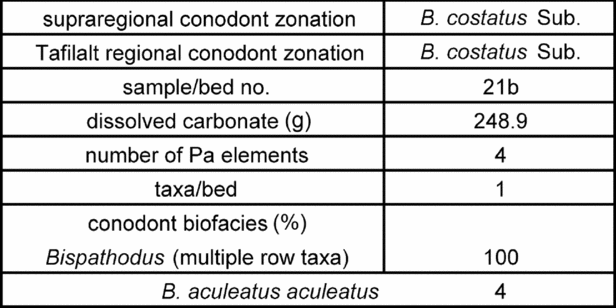
To summarize the evidence of past research, it is clear that the Gonioclymenia Limestone records an important episode of transgression and subsequent condensation in the upper Famennian of the Tafilalt. However, the controversial data concerning its precise timing prevent a meaningful international correlation and interpretation in the light of eustatic changes or regional synsedimentary tectonics. They also leave significant uncertainties concerning the precise ammonoid–conodont correlation, with implications for the regional and international ammonoid zonation. The data reported here provide a clear distinction between different and successive Gonioclymenia and Kalloclymenia limestones. Faunas allow a revision of the regional conodont and ammonoid zonations, their correlation, and recognition of a eustatic deepening pulse in the upper part of the B. aculeatus aculeatus Zone (= higher B. costatus Subzone or higher Middle expansa Zone).
2. Material and methods
We applied two approaches to resolve the stratigraphic contradictions by (a) using individual Gonioclymenia and Kalloclymenia specimens with attached matrix from various localities as conodont samples, and (b) sampling a new upper Famennian section that was exposed for a brief interval in one of the extensive Gonioclymenia trenches at Jebel Ihrs West (Fig. 2a–c). Between 2011 and 2013, three field campaigns provided more than 16 conodont samples of the Gonioclymenia interval. As is common practice in stratigraphic conodont studies, only the Pa element taxonomy has been utilized, because many Famennian multi-element reconstructions are still doubtful. Each sample was dissolved using a 10% solution of formic acid and the residues were separated by diluted sodium polytungstate ([Na6(H2W12O40)·H2O] 2.76–2.78 gml−1). The samples yield a variable number of conodonts, ranging from a minimum of zero to a maximum of 849 platform elements per kg. All Pa elements have been identified and counted.
Our conodont biofacies analysis builds on the model of Sandberg (Reference Sandberg and Barnes1976) as well as subsequent modifications by Ziegler & Sandberg (Reference Ziegler and Sandberg1984, Reference Ziegler and Sandberg1990) and Dreesen, Sandberg & Ziegler (Reference Dreesen, Sandberg, Ziegler, Bless and Streel1986). Since it is long known that different species groups within platform genera show different facies distributions, we expand the classical concept by documenting frequencies of the following groups separately: Palmatolepis perlobata Group, Pa. gracilis Group, single and double rowed bispathodids. The Pa. gracilis Group seems to represent a distinctive genus in multi-element taxonomy (Tripodellus, cf. Dzik, Reference Dzik2006).
Abreviations and repository
Conodonts: B. = Bispathodus, Biz. = Bizignathus, Br. = Branmehla, Clyd. = Clydagnathus, D. = Dasbergina, Eo. = Eosiphonodella, M. = Mehlina, Neo. = Neopolygnathus, Pa. = Palmatolepis, Po. = Polygnathus, Ps. = Pseudopolygnathus, S. = Siphonodella, Sc. = Scaphignathus; ammonoids: Cly. = Clymenia, Costa. = Costaclymenia, Cyma. = Cymaclymenia, Erf. = Erfoudites, Gonio. = Gonioclymenia, K. = Kiaclymenia, Kallo. = Kalloclymenia, Kosmo. = Kosmoclymenia, Levi. = Leviclymenia, Medio. = Medioclymenia, Muess. = Muessenbiaergia, Nano. = Nanoclymenia, Parawo. = Parawocklumeria, Pl. = Platyclymenia, Post. = Postclymenia, Protacto. = Protactoclymenia, Rect. = Rectimitoceras, Sp. = Sporadoceras, Spheno. = Sphenoclymenia. The used ammonoid zonal key follows Becker et al. (Reference Becker, House, Bockwinkel, Ebbighausen and Aboussalam2002).
Apart from the types of Gonio. hoevelensis (nos 388-54 and 588-53, Geowissenschaftliches Zentrum of the Georg-August-University of Göttingen) and a Tafilalt Kallo. subarmata (MB.C.3553, Museum für Naturkunde Berlin), all figured specimens (nos B9A.4-1 to B9A.4-84 for conodonts, nos B6C.42-1 to B6C.43-3 for ammonoids) are deposited in the Geomuseum Münster (GMM) of the Westfälische Wilhelms-University.
3. Gonioclymenia Limestone localities and samples (Fig. 3)
Our investigation revealed a restricted distribution of the true Gonioclymenia Limestone that follows the condensed parts of the hemipelagic Tafilalt Platform in the upper Famennian palaeogeographic map of Wendt (Reference Wendt1988 b, fig. 6). The extent of the marker unit is mirrored in the field by the km-long commercial trenches (Fig. 2f). A western occurrence from the S of the Jebel Amelane and Jebel Ihrs West ridges (Fig. 2a) continues much less distinctively to the NE of Rissani and the Rich Haroun/Seheb el Rhassal region. There is no typical development at Bou Tchrafine, the Jebel Erfoud or in the Rheris Basin further to the N, nor in the Achguig-Ouidane Chebbi and Mfis areas that fall in the eastern transition to the Tafilalt Basin. The marker unit is also missing in the Bou Maiz Syncline (e.g. near Ottara; Fig. 2d), which partly belongs to the western slope of the Tafilalt Platform towards the Maider Basin (cf. Lubeseder et al. Reference Lubeseder, Rath, Rücklin and Messbacher2010). The southern outcrop belt of the Amessoui Syncline (Fig. 2e, f) shows interruptions, e.g. between Tizi Nersas and Oum el Jerane (Korn, Klug & Reisdorf, Reference Korn, Klug and Reisdorf2000). It does not reach its NE part (El Khraouia; Hartenfels et al. Reference Hartenfels, Becker, Aboussalam, El Hassani, Baider, Fischer and Stichling2013), where the platform deposits turn into argillaceous, basinal deposits that continue towards Hassi Nebech, Tazoult Nehra and the Erg Kseir (cf. middle Famennian cross-section of Wendt, Aigner & Neugebauer, Reference Wendt, Aigner and Neugebauer1984, fig. 8). South of the Amessoui Syncline, at the Jebel el Mrier, all of the Upper Devonian is missing due to an unconformity below Upper Tournaisian/Lower Viséan strata. But remnants of the Gonioclymenia Limestone are beautifully exposed closer to Taouz, S of the Jebel Kfiroun (Fig. 2g, h), where it onlaps the Lower Devonian (basal upper Emsian; Aboussalam, Becker & Bultynck, Reference Aboussalam, Becker and Bultynck2015).
3.a. Jebel Ihrs West (Figs 2a–c, 4–7)
In spring 2011 the re-opening of a Gonioclymenia trench at the western end of Jebel Ihrs (GPS coordinates: 31°15ʹ 35.3″ N, 004°25ʹ 20.3″ W, map sheet 244 Tafilalt-Taouz) provided the temporary opportunity to sample a section through the condensed upper/uppermost Famennian (Figs 2b, 4). The upper part of Famennian IV consists of massive, reddish cephalopod limestone (Bed 1) with marker species of UD IV-C, such as Sp. muensteri orbiculare and large Protacto. ventriosa (Becker et al. Reference Becker, House, Bockwinkel, Ebbighausen and Aboussalam2002).
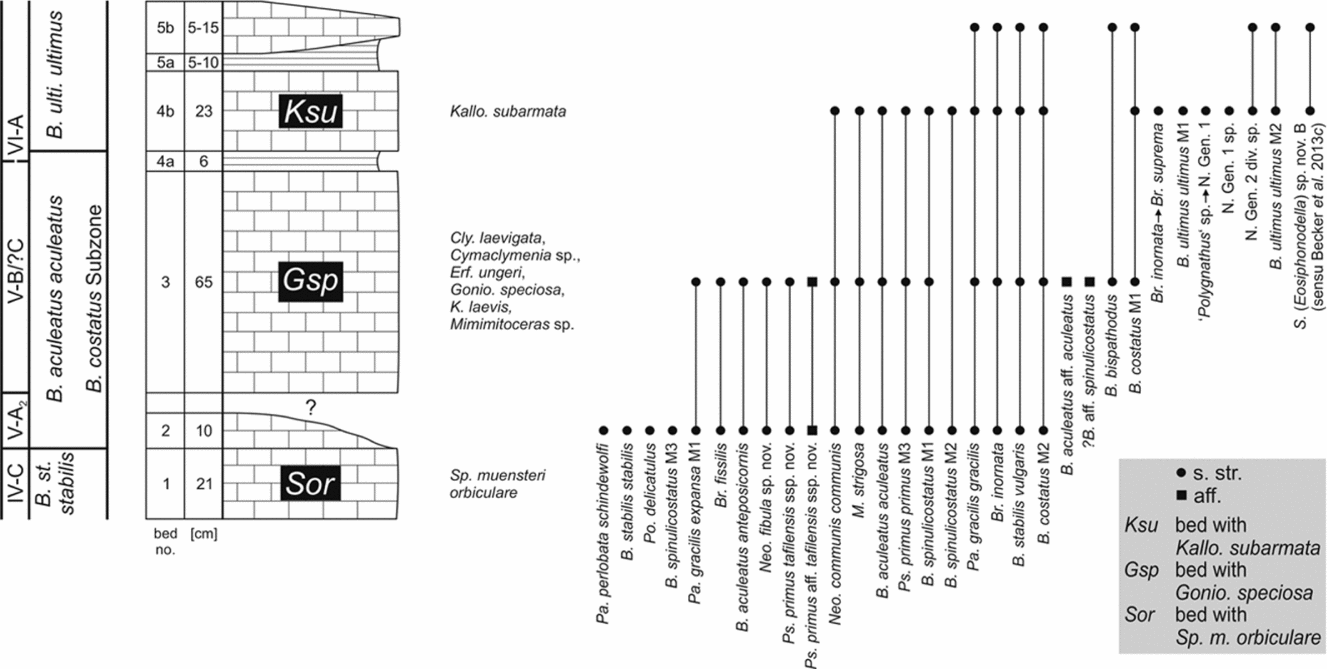
Section Jebel Ihrs West: bed numbers, thicknesses, ammonoid and conodont ranges and zonation (ammonoid zonal key after Becker et al. Reference Becker, House, Bockwinkel, Ebbighausen and Aboussalam2002 and Becker, El Hassani & Tahiri, Reference Becker, El Hassani and Tahiri2013).

Costaclymenia Bed (Bed 2)
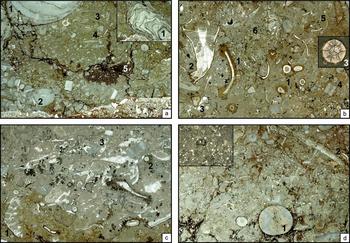
Encrusted on top of the underlying bed with Sp. muensteri orbiculare is a unit (Bed 2) with many crinoidal holdfasts in life position (Fig. 5a, insert), similar to those illustrated from older Famennian beds of the Jebel Bou Ifarherioun and Jebel Mech Irdane (Wendt, Aigner & Neugebauer, Reference Wendt, Aigner and Neugebauer1984; Wendt, Reference Wendt1988 a). They show irregular and branched shapes (Fig. 2c, insert), formed by repeated encrustation. Bed 2 consists of several depositional units. An irregular hardground surface with cavities is developed in the basal part (Fig. 5a, arrows) and formed the fundament for thin hematitic crusts. Above this hiatus surface, coarse crinoidal packstones follow. Fining upward gradings suggests storm sedimentation, which is supported by the fragmentation and only sub-rounded outline of crinoid ossicle pieces. Marginal microborings, probably by cyanobacteria, indicate an influx from a nearby shallow setting but there are no typical neritic faunas. The assemblage of Bed 2 contains ostracods, fragmented bivalves, rare small-sized gastropods, and ammonoids. Bioturbation is evident in the matrix-rich upper part. Reddish-brown to sporadically yellow-golden microstromatolites encrusted skeletal remains and caused cauliflower structures. They resemble Frutexites (Böhm & Brachert, Reference Böhm and Brachert1993) and were previously described by Préat, El Hassani & Mamet (Reference Préat, El Hassani and Mamet2008) and Hartenfels (Reference Hartenfels2011) from the higher Famennian of the Maider and Tafilalt. In general, laminated iron encrustations are regionally widespread in the Tafilalt (Wendt, Aigner & Neugebauer, Reference Wendt, Aigner and Neugebauer1984; Becker, Reference Becker1993, fig. 53; Becker et al. Reference Becker, Bockwinkel, Ebbighausen and House2000; Jakubowicz, Belka & Berkowski, Reference Jakubowicz, Belka and Berkowski2014) and indicate extremely slow depositional rates. Préat, El Hassani & Mamet (Reference Préat, El Hassani and Mamet2008) postulated that such crusts originated under dysaerobic conditions, which interpretation, however, was questioned by Koptíková et al. (Reference Koptíková, Bábek, Hladil, Kalvoda and Slavík2010) and Hartenfels (Reference Hartenfels2011), due to co-occurring normal benthic faunas. Grain margin solution, particularly between crinoid remains, is the result of diagenesis. Pseudopeloids occur only within ammonoid shells, where they were protected from diagenetic compression (cf. Hartenfels, Reference Hartenfels2011). The micritic matrix outside may have lost its original pseudopeloid structure by diagenesis. In summary, Bed 2 accumulated adjacent to a storm-swept crinoidal shoal (upper carbonate ramp). The hardground in the lower parts reflects an interval of regression and non-deposition. A second hardground is developed on the top surface, where corroded clymeniids and crinoid holdfasts (Fig. 2c, insert) suggest submarine carstification during long-lasting non-deposition.
Microfacies of upper/uppermost Famennian marker beds at Jebel Ihrs West. (a) Costaclymenia Bed (Bed 2, lower B. costatus Subzone), fining upwards sequence within a crinoidal (2) packstone with shell filaments (3), ostracods (4) and bioturbation (5) above an irregular hardground surface as evidence of submarine karstification (black arrows, figure width c. 30 mm). In situ crinoidal holdfasts (1) show irregular and branched shapes due to repeated encrustation (insert, figure width c. 32 mm); (b) Gonioclymenia Limestone (Bed 3, upper B. costatus Subzone), macrofossil-rich, oncolithic packstone with golden brown Frutexites encrustations (1), fragmented shells, crinoid remains (4), ostracods, solitary deep water rugose corals (2), trilobites (5), rare heterocorals (3, insert, 0.8 mm diameter) and minute gastropods (6); figure width c. 24 mm; (c) Kalloclymenia Limestone (Bed 4b, lower B. ultimus ultimus Zone), macrofossil-rich microbial packstone with crinoids (3), numerous sparite-filled fenestrae, fragmented ammonoids, ostracods, thin-shelled bivalves, rare trilobites, solitary rugose corals (1), heterocorals (2), bioclasts encrusted by brownish-black Frutexites-lamina, extremely rare oncolites, and angular quartz (silt) grains; figure width c. 27 mm; (d) Bed 5b (higher B. ultimus ultimus Zone), silty (see insert, figure width c. 2.5 mm) crinoidal (1) packstone with Frutexites encrustations, ostracods, shell filaments (2), rare trilobites, and bioturbation; figure width c. 14 mm).

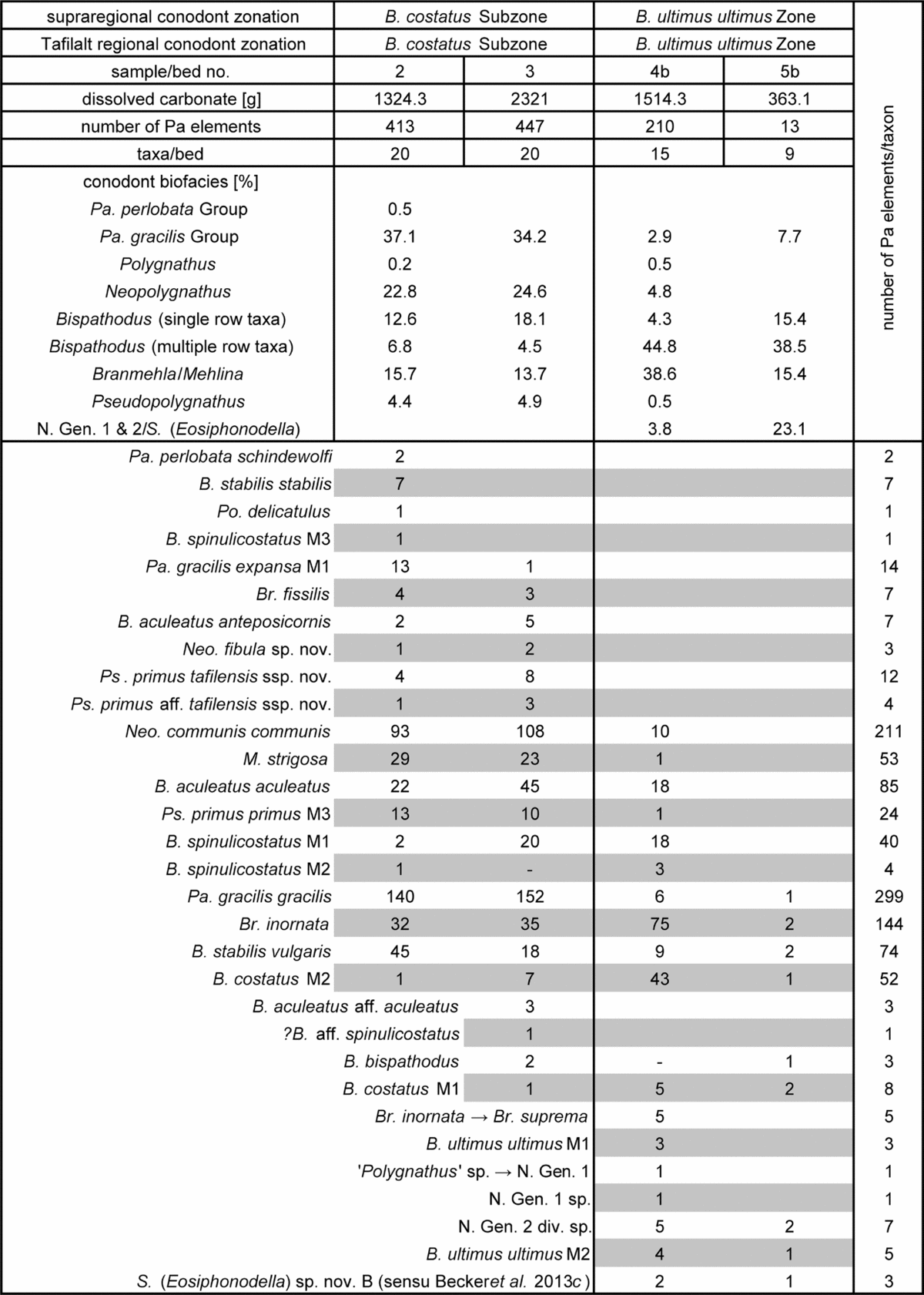
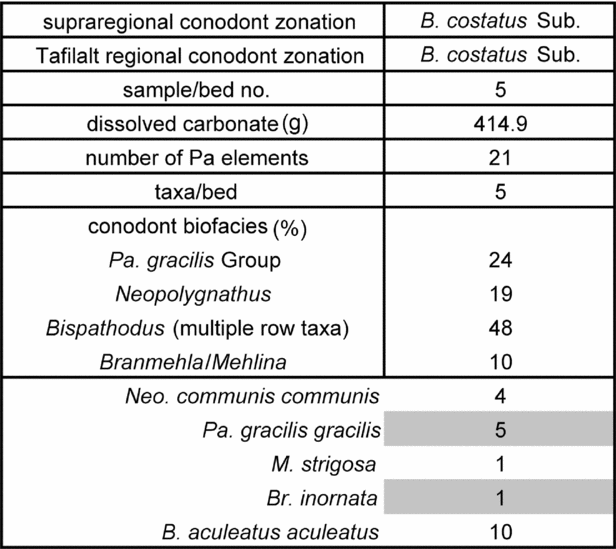
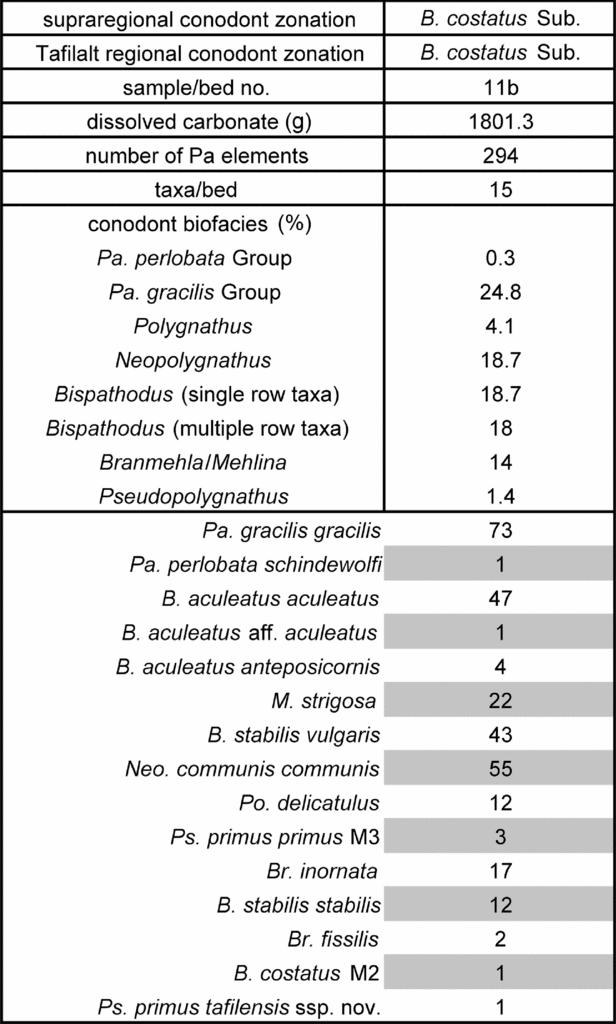
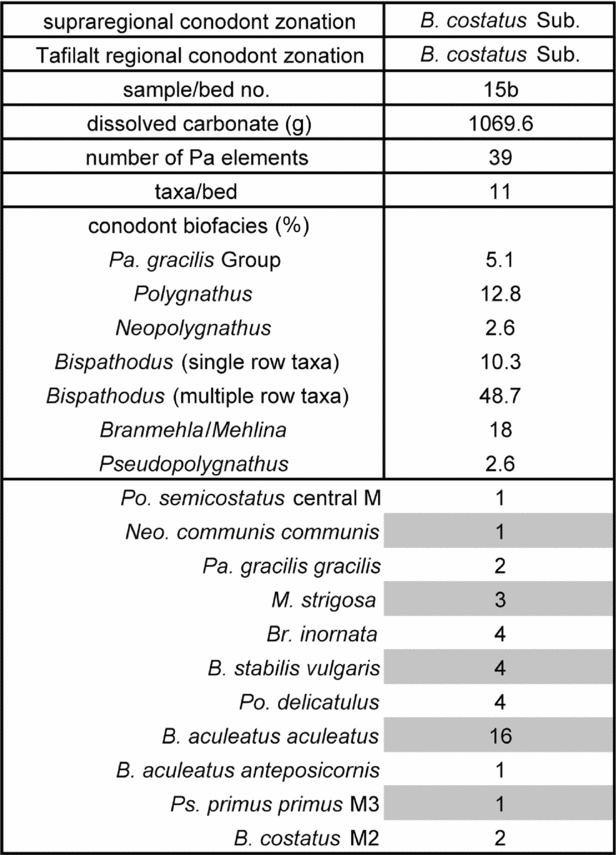
Costaclymenia sp. (Fig. 2c) indicate the lower Dasbergian (of German substage terminology) or UD V-A. The rich conodont fauna (Fig. 6) include rare, slender pseudopolygnathids (Ps. primus tafilensis ssp. nov. and Ps. primus aff. tafilensis ssp. nov.) and a single B. costatus Morphotype 2, the index species of the B. costatus Subzone of the B. aculeatus aculeatus Zone (Fig. 7; Hartenfels, Reference Hartenfels2011). Consequently, the Dasberg Event Beds of the basal B. aculeatus aculeatus Zone (and Subzone), which are widespread in other Tafilalt sections (Hartenfels & Becker, Reference Hartenfels, Becker and Over2009), are missing locally in the highly condensed sequence, possibly at the hardground level. There is a dominance of Pa. gracilis gracilis and Neo. communis communis, followed in terms of abundance by simple bispathodids and spathognathodids (Branmehla and Mehlina). This faunal composition agrees with a moderately deep shelf setting (see conodont biofacies model of Sandberg, Reference Sandberg and Barnes1976).
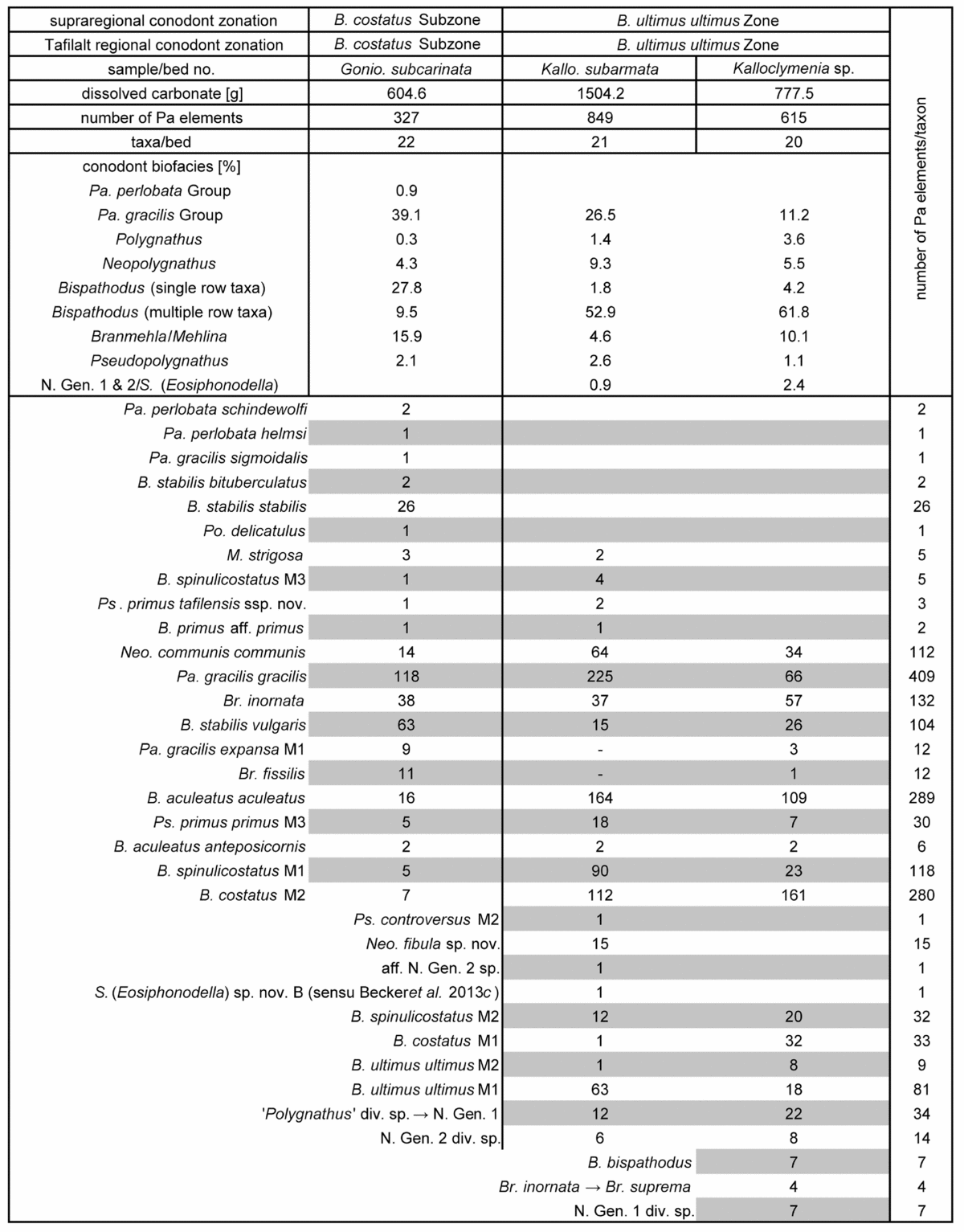
Conodont record and biofacies at Jebel Ihrs West, beds 2 to 5b.

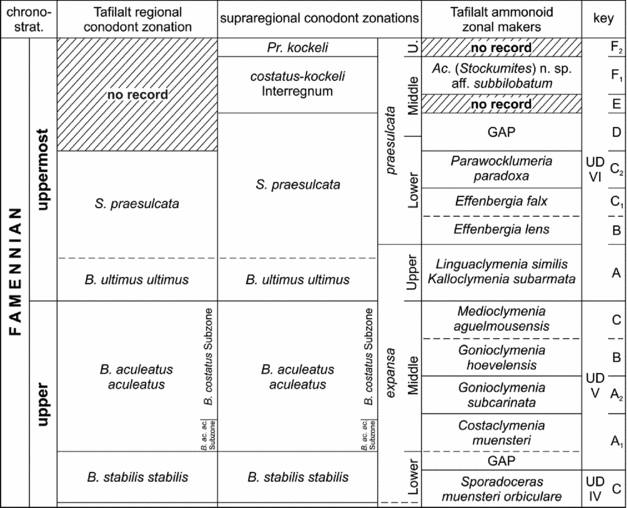
Correlation of upper/uppermost Famennian Tafilalt and supraregional conodont as well as ammonoid biostratigraphy.

Gonioclymenia Limestone (Bed 3)
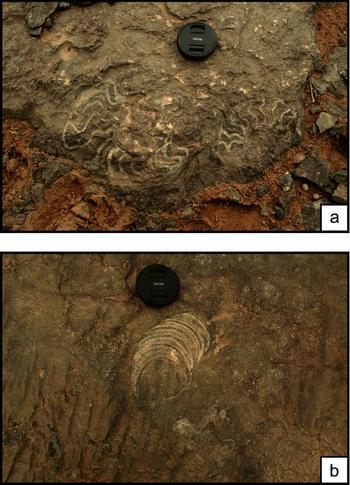
The transition from Bed 2 to the Gonioclymenia Limestone (Bed 3) was not exposed in the trench. It is likely that most or all of the Gonio. subcarinata Zone (UD V-A2) is locally missing. Bed 3 is up to 65 cm thick and consists of grey to reddish crinoidal limestone (Fig. 4). In thin-sections (Fig. 5b), it is developed as a bioturbated, macrofossil-rich float- packstone with a minor content of small-sized, angular quartz grains. The fauna is dominated by ammonoids (Gonio. speciosa; Fig. 8a), broken, reworked crinoid remains, trilobites and corals. There are small-sized oncolites/ooids, which were probably washed in by storms. Oncolites were previously documented in the region by Wendt (Reference Wendt1988 a, fig. 4) from the B. aculeatus aculeatus Zone of a condensed section 2 km south of the Amelane road pass. As in Bed 2, there is no typical neritic or even euphotic fauna. In contrast, orthoconic cephalopods, ostracods, remains of thin-shelled bivalves, trilobites, gastropods and deep-water, solitary rugose corals are common in thin-section. A bulk of the skeletal elements is fractured and broken. As a special feature there are heterocorals (Fig. 5b, insert). Based on records from the Rhenish Slate Mountains and Tafilalt, Weyer (Reference Weyer1995, Reference Weyer1997) and Piecha (Reference Piecha2004 a) showed that they are typical for dysphotic Famennian cephalopod limestones, but rare in aphotic environments. They occur widely in the upper Famennian of the Tafilalt Platform, including the hypoxic Dasberg Event Beds of the Amessoui Syncline (Hartenfels, Reference Hartenfels2011). Abundant laminated iron crusts enclosed both skeletal grains and early consolidated burrows. Evidence for diagenesis is given by grain margin solution. The micritic matrix consists of compacted pseudopeloids. Deposition took place below the normal wave base but was affected by storm waves, which explains the high percentage of fragmented benthic remains. Microborings of bioclasts, the silt content and the ooids/oncoids are evidence for reworking and an influx from an adjacent up-ramp environment that reached the photic zone. In the wide, undulating outcrop towards the western end of Jebel Ihrs, the top of Bed 3 shows eroded and corroded gonioclymeniids (Fig. 8a) and oncoceratid nautiloids (Fig. 8b). This suggests a next interval of submarine carstification during long-lasting non-deposition due to increased turbulence and regression. This explains the local lack of ammonoids typical for UD V-C (Medioclymenia).
Corroded top surface of the Gonioclymenia Limestone, indicating a long interval of non-deposition and submarine carstification, exposed widely at the western end of Jebel Ihrs. (a) Surface with deeply corroded Gonioclymenia speciosa (Münster, Reference Münster1831); (b) corroded section of a large oncoceratid.

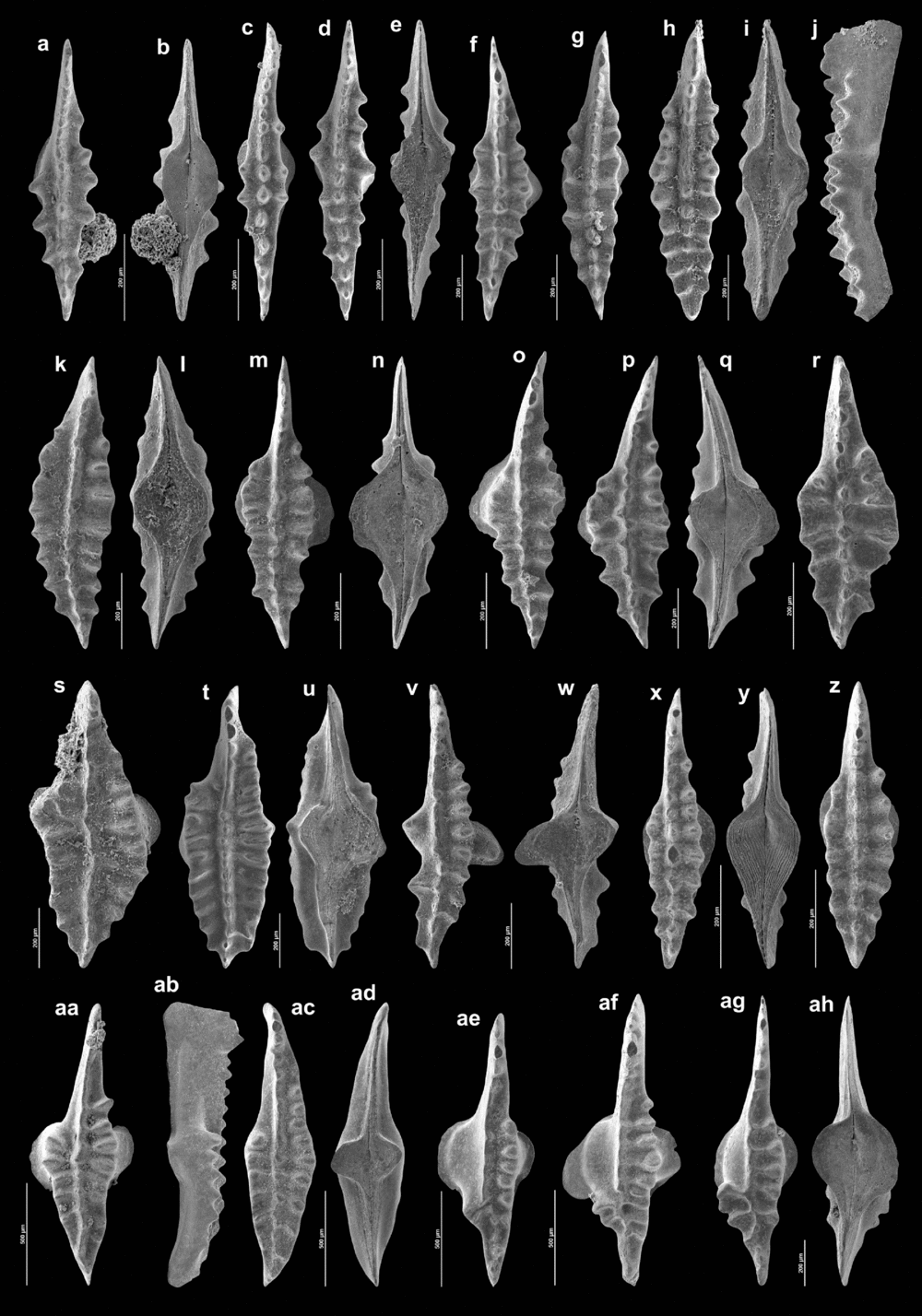
As for Bed 2, the rich conodont fauna of Bed 3 (Figs 6, 9) is dominated by Pa. gracilis gracilis and Neo. communis communis; B. aculeatus aculeatus is moderately common. Slender pseudopolygnathids as well as B. costatus Morphotype 2 continue from below as rare forms; B. costatus Morphotype 1 is also present. A similar association, but with rare Pa. perlobata schindewolfi, Pa. perlobata helmsi, B. stabilis bituberculatus, Ps. primus tafilensis ssp. nov. and Ps. primus aff. primus, with fewer Neo. communis communis and a higher content of B. stabilis vulgaris, was recovered by the dissolution of a limestone slab with a Gonio. subcarinata (Fig. 9). Therefore, both the loose and the in situ sample of the Gonioclymenia Limestone fall in the (higher) B. costatus Subzone.
Conodont record and biofacies of loose slabs with Gonioclymenia or Kalloclymenia from Jebel Ihrs West.

Kalloclymenia Limestone (Bed 4b)
Separated by c. 6 cm deeply weathered marl/shale (Bed 4a, Fig. 4), a second quarried, massive, slightly more reddish limestone (Bed 4b) is 23 cm thick and contains Kalloclymenia sp. Therefore, it is here called Kalloclymenia Limestone. The fauna is dominated by crinoids and ammonoids, but both are mostly broken. In thin-section (Fig. 5c) there are associated ostracods, fragmented bivalves, rare trilobites, rugose deep water corals, heterocorals and burrows. Again, brownish-black, laminated, Frutexites-type structures enclose many skeletal grains, which attests continuing slow sedimentation rates. As in Bed 3, there are some angular, small-sized quartz grains and, extremely rare, oncolites. However, as a significant difference, there are also numerous, irregular, sparite-filled, small-scale fenestral fabrics in the middle part (cf. Tebbutt, Conley & Boyd, Reference Tebbutt, Conley and Boyd1965). Such structures are commonly interpreted as filled biogenic/microbial textures and have previously been described from the Tafilalt (Wendt, Aigner & Neugebauer, Reference Wendt, Aigner and Neugebauer1984). Wolf (Reference Wolf1965) introduced the term ‘open-space structures’ for variously sized cavities in carbonate rocks, filled with calcite and/or internal sediment (Flügel, Reference Flügel2004). The whole bed shows an advanced microsparitization. According to Folk (Reference Folk1959), microsparite refers to a calcite matrix with rather uniform crystal size (5–10 µm) and equal shape. The recrystallization took place during late diagenesis, affected by surface water (Folk, Reference Folk1974; Longman, Reference Longman1977). The Gonioclymenia and Kalloclymenia limestones are separated by an interval of non-deposition (UD V-C), re- and transgression. The microbialithic microfacies of the latter suggests a moderately agitated, slightly shallower deposition within the dysphotic zone.
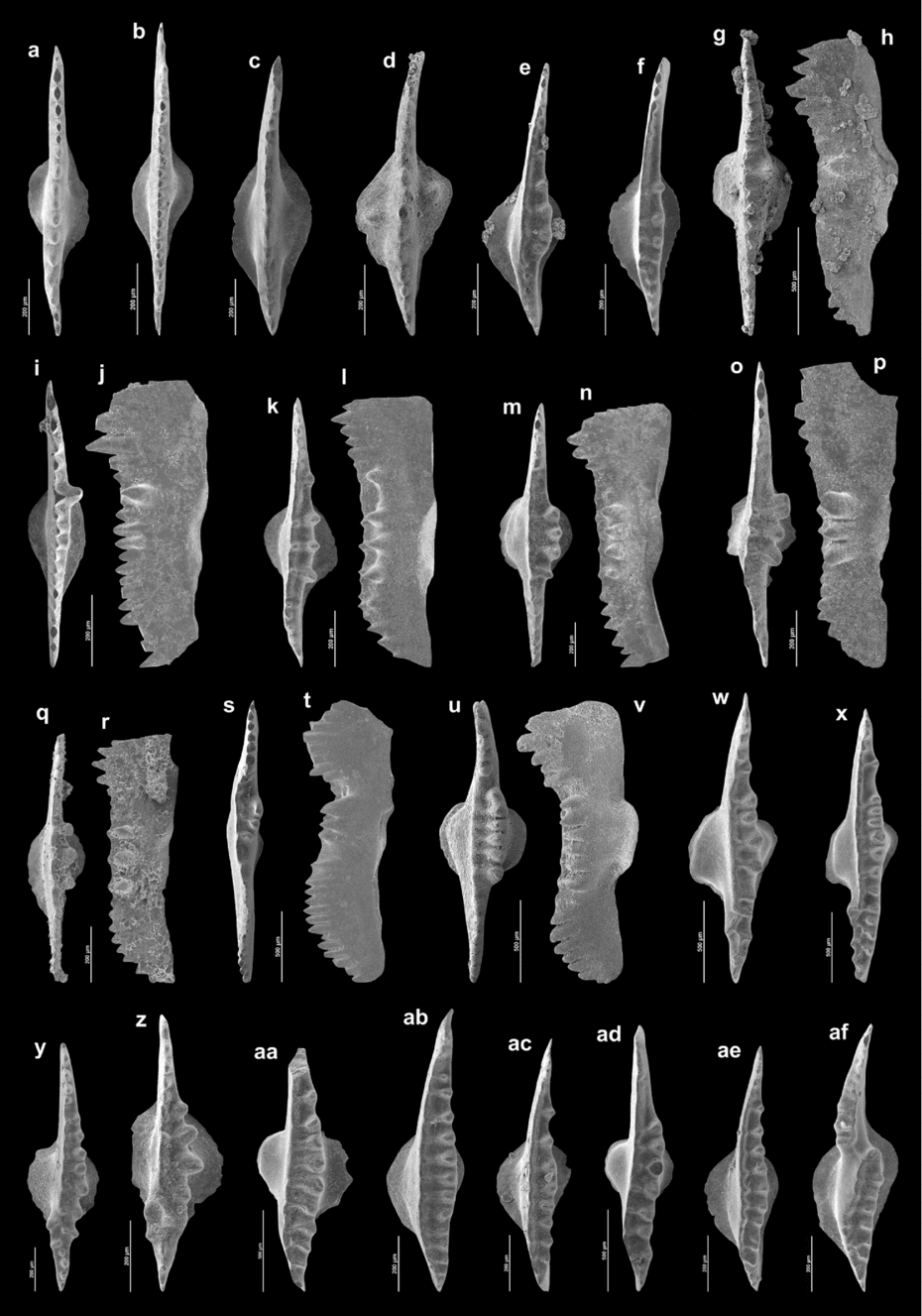
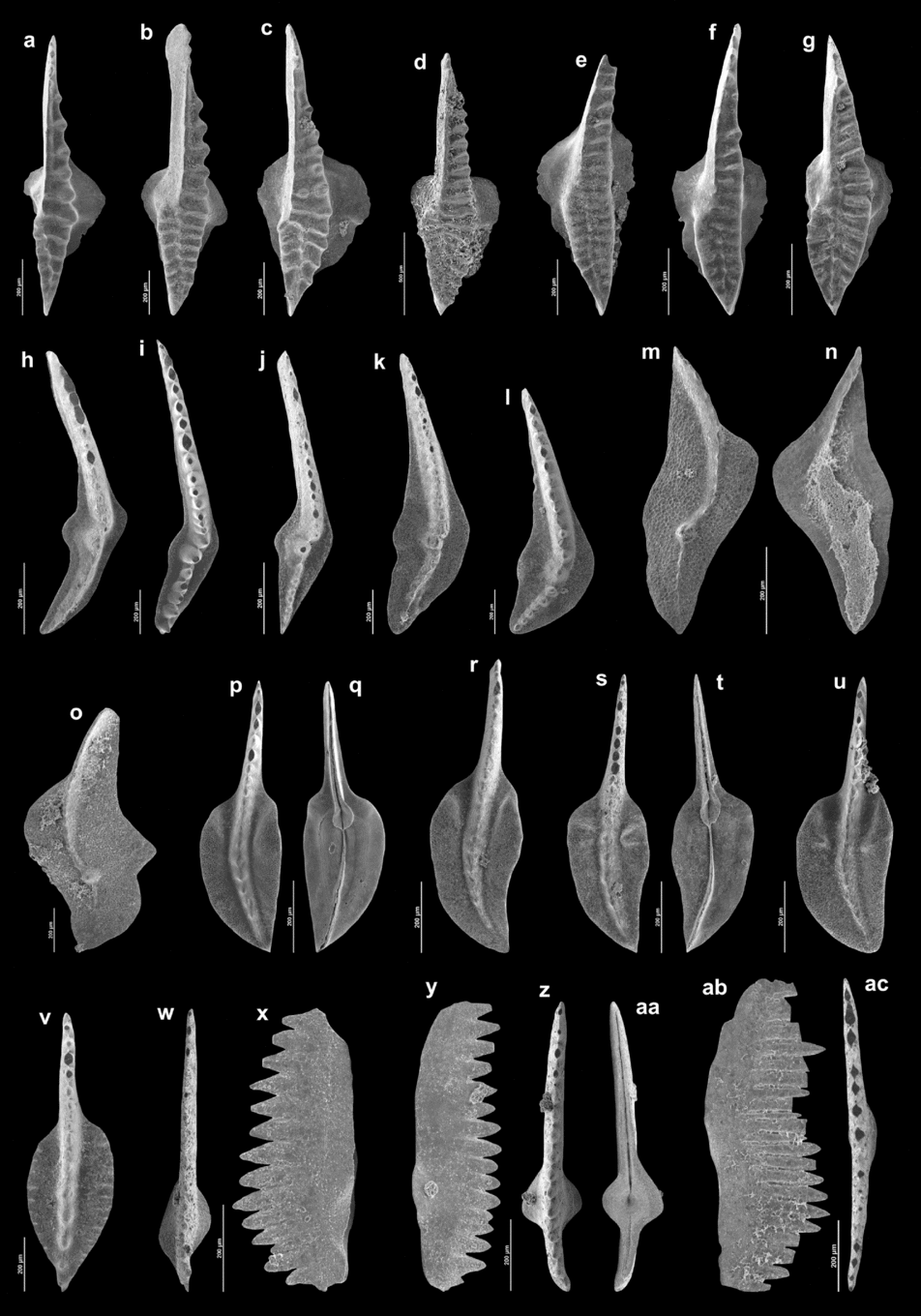
The conodont fauna of Bed 4b (Figs 6, 9) differs from the Gonioclymenia Limestone by the presence of B. ultimus ultimus Morphotype 1 and Morphotype 2 and by transitional forms between Br. inornata and Br. suprema. There are also several species of two different genera (‘siphonodelloids’), which are related to early Siphonodella. These were called N. Gen. 1 and N. Gen. 2 in Becker et al. (Reference Becker, Hartenfels, Aboussalam, Tragelehn, Brice and El Hassani2013c ). They differ from typical S. (Eosiphonodella) in the shape and morphology of their basal cavities. They are left in open nomenclature because of parallel ongoing taxonomic investigations by H. Tragelehn. Rare S. (Eosiphonodella) sp. nov. B (sensu Becker et al. Reference Becker, Hartenfels, Aboussalam, Tragelehn, Brice and El Hassani2013c ) could be taken as evidence for the praesulcata Zone, but in the absence of the zonal index species Bed 4b is still kept in the B. ultimus ultimus Zone. Like the microfacies, the conodont biofacies has changed to some extent from Bed 3, now with a strong dominance of Br. inornata. Bispathodus costatus Morphotype 2 is also very common in Bed 4b, followed by B. aculeatus aculeatus and B. spinulicostatus Morphotype 1. Palmatolepis perlobata schindewolfi has disappeared; on a global scale it is not known to have overlapped with B. ultimus ultimus (Kaiser et al. Reference Kaiser, Becker, Spalletta, Steuber and Over2009). This branmehlid (double rowed)–bispathodid assemblage seems to represent a new, moderately shallow (dysphotic) outer shelf conodont biofacies type.
Two loose slabs, one with Kallo. subarmata, one with Kalloclymenia sp., have similar conodont assemblages to Bed 4b (Fig. 9), but with more Pa. gracilis gracilis, B. aculeatus aculeatus and B. ultimus ultimus Morphotype 1. Their palmatolepid–bispathodid biofacies is more typical for pelagic cephalopod limestones (see Sandberg, Reference Sandberg and Barnes1976). Rare B. spinulicostatus Morphotype 3, B. ultimus ultimus Morphotype 2, Neo. fibula sp. nov., Ps. primus tafilensis ssp. nov. and Ps. primus aff. primus represent accessory taxa. Furthermore, N. Gen. 1 div. sp., N. Gen. 2 div. sp. and a yet different ‘siphonodelloid’ (‘aff. N. Gen. 2 sp.’) co-occur with a single specimen of S. (Eosiphonodella) sp. nov. B (sensu Becker et al. Reference Becker, Hartenfels, Aboussalam, Tragelehn, Brice and El Hassani2013c ). Therefore, all our Kalloclymenia limestone samples fall in the same interval.
Topmost Famennian (Bed 5b)
Separated by a thin, 5–10 cm thick marl/shale (Bed 5a, Fig. 4), a reddish, lenticular limestone with variable thickness between 5 and 15 cm terminates the local Famennian succession. Bed 5b is a coarse crinoidal packstone with some very fine quartz detritus (Fig. 5d). Skeletal remains derive from ostracods, bivalves, rare trilobites and burrows of uncertain origin. Reddish-brown microstromatolites encrusted skeletal remains, especially crinoids. Constant reworking during storm events is indicated by fragmentation whilst microborings confirm a shallow outer shelf setting. Grain margin solution, particularly between crinoid remains, is common. Similarly to the Kalloclymenia Limestone, Bed 5b shows a distinctive microsparitization. It was deposited on or directly adjacent to a storm-swept crinoidal shoal, but without an influx of skeletal grains from the photic zone. The scarcity of pelagic fauna is distinctive. So far there are no ammonoids and there is only a sparse conodont fauna (Figs 4, 6) with, amongst others, both morphotypes of B. costatus, B. ultimus ultimus Morphotype 2 and, again, N. Gen. 2 div. sp. as well as S. (Eosiphonodella) sp. nov. B (sensu Becker et al. Reference Becker, Hartenfels, Aboussalam, Tragelehn, Brice and El Hassani2013c ). The restricted fauna resembles the worsening of environmental conditions recorded in the contemporaneous crinoidal limestone platform of the northern Maider (Becker et al. Reference Becker, Hartenfels, Aboussalam, Tragelehn, Brice and El Hassani2013c ). By comparison with sections of the central (Jebel Erfoud; Fig. 10) and eastern Tafilalt Platform (Ouidane Chebbi; Hartenfels, Reference Hartenfels2011) and northern Maider (western Jebel Rheris to Lalla Mimouna), the uppermost Famennian of Jebel Ihrs is extremely condensed and incomplete.
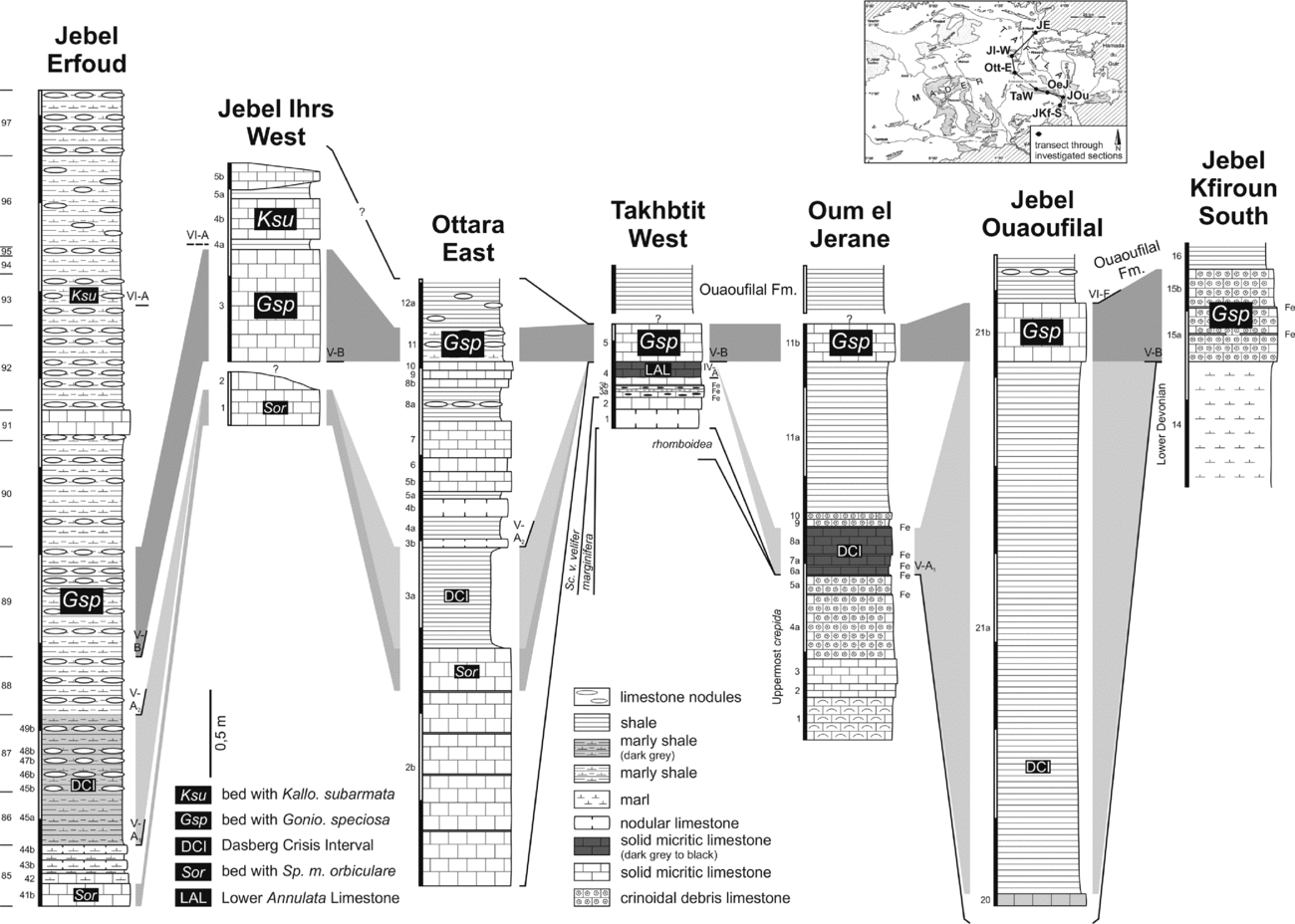
Correlation of the Gonioclymenia Limestone section at Jebel Ihrs West with thicker or strongly condensed and incomplete successions with Gonio. speciosa, along a curved transect through the Tafilalt Platform (see inserted map).

3.b. Jebel Erfoud (Figs 3, 10)
A summary of the investigation history of the Jebel Erfoud (GPS coordinates: 31°25ʹ 49.6″ N, 004°13ʹ 05.6″ W, map sheet 244 Tafilalt-Taouz) is given in Hartenfels (Reference Hartenfels2011), who studied in detail the succession from the base of the middle Famennian to the Dasberg Event beds. Above, there are only very sparse conodont data for Famennian V/VI in Alberti (Reference Alberti1970, section ‘Bordj East at Erfoud’). His written section log, unfortunately, cannot be compared with the log with ammonoid ranges in Korn (Reference Korn1999, ‘Bordj d´Erfoud’) or with our succession. Locally there is no typical development of the Gonioclymenia Limestone (Fig. 10). But a nodule level within Bed 89, which is not very distinctive from under- and overlying nodular beds, yielded the marker species Gonio. speciosa in association with kosmo- and cymaclymeniids. Fragmentary Kallo. subarmata commence above an interval without gonioclymeniids, probably the top of Famennian V, in layers of small, greenish-grey limestone nodules (Bed 93; compare the onset of Kalloclymenia above an interval of very small nodules in Korn, Reference Korn1999). Linguaclymeniids, the alternative index group for the Wocklumian (UD VI; Becker, Kaiser & Aretz, Reference Becker, Kaiser, Aretz, Becker, Königshof and Brett2016) enter just above, followed latest in Bed 98 by the Muess. bisulcata Group, the index forms of UD VI-A2, and higher by Effenbergia lens (Korn, Reference Korn1999: Bed 42), the index species of UD VI-B.
3.c. Ottara East (Figs 2d, 3, 10)
As at Jebel Erfoud, a massive marker limestone is not developed at Ottara East in the Bou Maiz Syncline of the western-central Tafilalt (map sheet 244 Tafilalt-Taouz, 500 m to the east of section s2 of Lubeseder et al. Reference Lubeseder, Rath, Rücklin and Messbacher2010). The Gonioclymenia level is locally a fossiliferous, reddish, shale/marl interval with red carbonate nodules yielding Cyma. striata and Gonio. speciosa (Fig. 2d). Higher strata are mostly covered by debris of the topmost Famennian (Hangenberg Crisis Interval) Ouaoufilal (= Aoufital) Formation.
3.d. Takhbtit West (Figs 2e, 3, 10, 11)
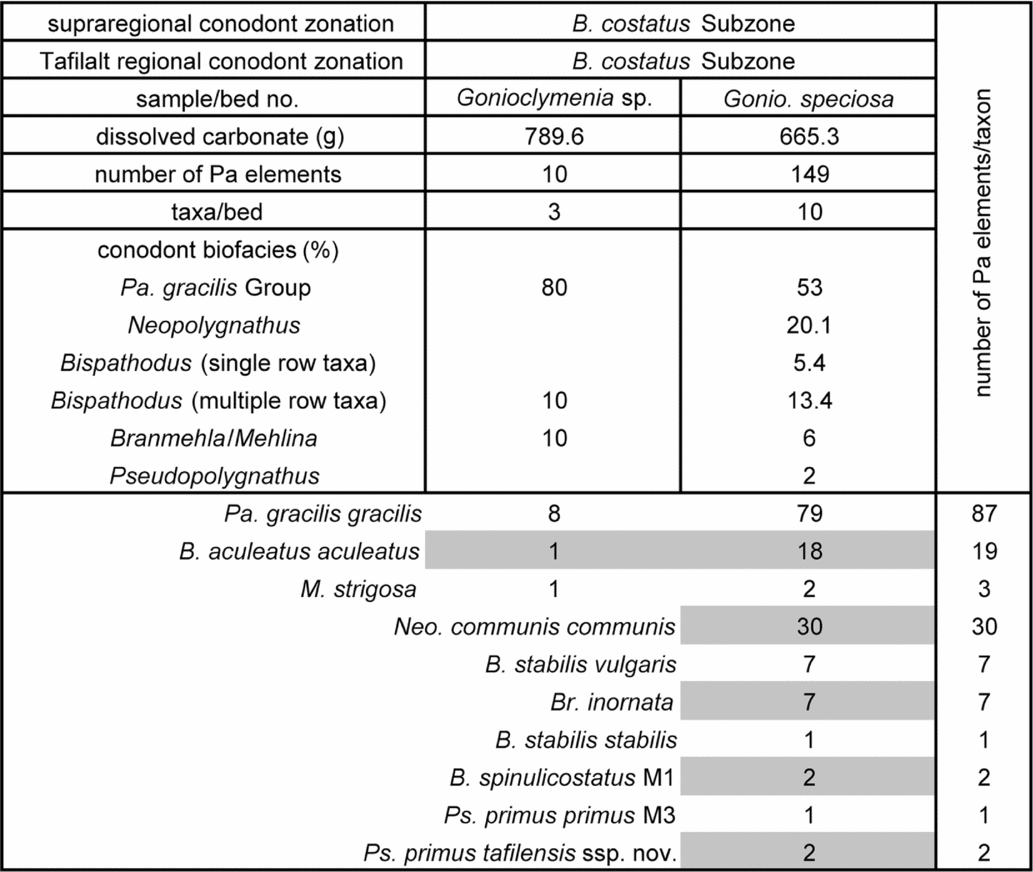
This section on the northern limb of the Amessoui Syncline (GPS coordinates: 31°00ʹ 44.5″ N, 004°10ʹ 15.7″ W, map sheet 244 Tafilalt-Taouz) was first illustrated by Korn, Klug & Reisdorf (Reference Korn, Klug and Reisdorf2000) and re-studied by Hartenfels (Reference Hartenfels2011). Very intensive fossil mining has destroyed all natural outcrop of the Gonioclymenia Limestone (Fig. 2e). A dissolved Gonio. speciosa produced a sparse conodont fauna dominated by B. aculeatus aculeatus (Fig. 11) and with approximately equally common Pa. gracilis gracilis and Neo. communis communis. There is no record of Kalloclymenia or any other UD VI ammonoids from Takhbtit West.
Conodont record and biofacies of the Gonioclymenia Limestone at Takhbtit West.

3.e. Oum el Jerane (Figs 2f, 3, 10, 12)
The condensed Famennian of Oum el Jerane on the southern Amessoui Syncline (GPS coordinates: 30°59ʹ 39.3″ N, 004°08ʹ 18.7″ W, map sheet 244 Tafilalt-Taouz) has been investigated by Korn, Klug & Reisdorf (Reference Korn, Klug and Reisdorf2000), Ginter, Hairapetian & Klug (Reference Ginter, Hairapetian and Klug2002), Hartenfels & Becker (Reference Hartenfels, Becker and Over2009), Hartenfels (Reference Hartenfels2011) and Becker et al. (Reference Becker, Aboussalam, Hartenfels, El Hassani, Baidder, Reiter, Yang, Wang and Reich2013 b). The deeply trenched Gonioclymenia Limestone (Fig. 2f) is separated from the underlying three-fold, thin-bedded, extremely fossiliferous black limestones of the transgressive Dasberg Crisis Interval (UD V-A1, beds 6a–8a: Costaclymenia – previously Endosiphonites – Limestones; compare Hartenfels, Reference Hartenfels2011 and Becker et al. Reference Becker, Aboussalam, Hartenfels, El Hassani, Baidder, Reiter, Yang, Wang and Reich2013 b) by a sequence of reddish-brown, iron-rich crinoidal debris limestones and subsequent greenish, unfossiliferous shale. The conodont assemblage of the Gonioclymenia Limestone is dominated by Pa. gracilis gracilis, Neo. communis communis, B. aculeatus aculeatus and B. stabilis vulgaris (Fig. 12), which resembles Takhbtit West. Based on a single B. costatus Morphotype 2 this palmatolepid–bispathodid–neopolygnathid assemblage falls in the B. costatus Subzone of the B. aculeatus aculeatus Zone, as at Jebel Ihrs. Above, the top of UD-V and the main part of the uppermost Famennian (UD VI) is missing due to an unconformity below the siliciclastic Aoufital Formation (Becker et al. Reference Becker, Aboussalam, Hartenfels, El Hassani, Baidder, Reiter, Yang, Wang and Reich2013 b).
Conodont record and biofacies of a loose Gonioclymenia slab from Oum el Jerane.

3.f. Jebel Ouaoufilal (Figs 3, 10, 13)
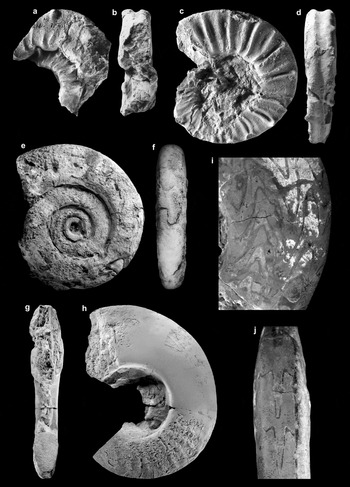
The Famennian of Jebel Ouaoufilal in the southeastern part of the Amessoui Syncline (GPS coordinates: 30°57ʹ 31.2″ N, 004°02ʹ 22.6″ W, map sheet 244 Tafilalt-Taouz; Aoufital on the topographic sheet Taouz-Ouest) has been studied by Korn, Klug & Reisdorf (Reference Korn, Klug and Reisdorf2000), Becker et al. (Reference Becker, House, Bockwinkel, Ebbighausen and Aboussalam2002), Kaiser (Reference Kaiser2005), Hartenfels & Becker (Reference Hartenfels, Becker and Over2009), Hartenfels (Reference Hartenfels2011) and Kaiser et al. (Reference Kaiser, Becker, Steuber and Aboussalam2011). It is especially famous for its rich and diverse goethitic ammonoids of the Dasberg Event beds (Costa. muensteri Zone, UD V-A1). The Gonioclymenia Limestone appears to follow above an unconformity that encompasses the Gonio. subcarinata Zone (UD V-A2). Due to the intensive quarrying the direct shale–limestone contact has not been observed. The dissolution of a Gonio. speciosa from the mining debris yielded a sparse, monospecific fauna with four B. aculeatus aculeatus (Fig. 13). Kaiser (Reference Kaiser2005) obtained a richer assemblage, with rare B. aculeatus aculeatus, B. aculeatus anteposicornis and B. stabilis stabilis (= stabilis Morphotype 2), in association with more common Br. inornata, M. strigosa, Pa. gracilis gracilis and Neo. communis communis. There is no evidence for B. ultimus ultimus; therefore, the Gonio. speciosa Limestone fauna is placed in the (higher) B. aculeatus aculeatus Zone. As an unexpected novelty, the fossil miners discarded an incomplete specimen of Levi. ramula sp. nov. (Fig. 14g–j), the first Moroccan representative of a genus that was so far only known from the upper Famennian of the southern Urals (Bogoslovskiy, Reference Bogoslovskiy1981; Korn & Klug, Reference Korn and Klug2002). Its upper surface is encrusted by numerous thecae of Cladochonus, a deep-water tabulate coral. They suggest that the clymeniid shell formed a small benthic island before burial. Kalloclymenia or other ammonoids of the pre-Hangenberg Event uppermost Famennian (Wocklumian, UD VI-A/D) are not known from the locality. Deeply weathered equivalents of the Hangenberg Blackshale can be observed just adjacent to the Gonioclymenia Limestone (Kaiser et al. Reference Kaiser, Becker, Steuber and Aboussalam2011).
Conodont record and biofacies of a loose Gonioclymenia slab from Jebel Ouaoufilal.

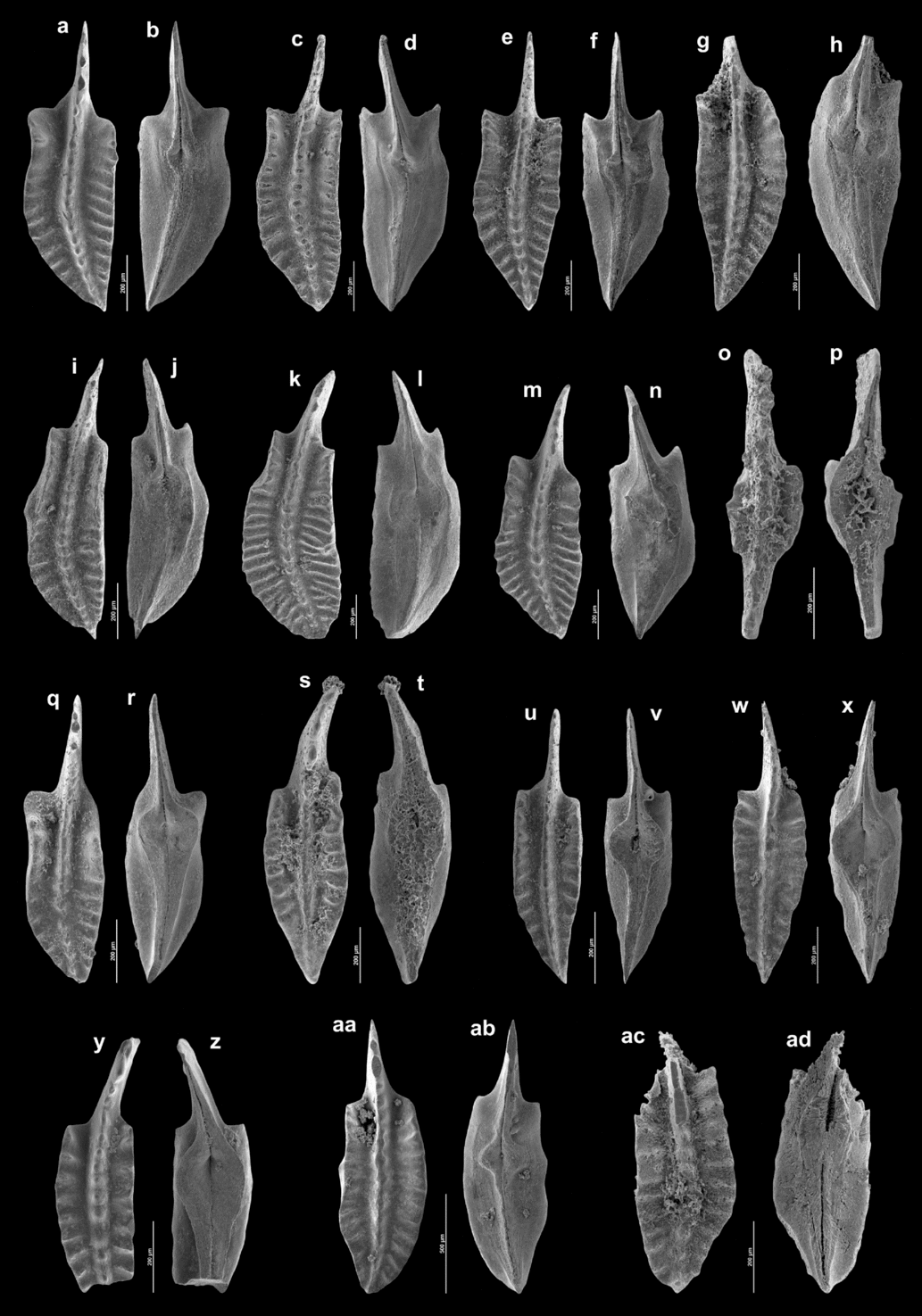
Upper/uppermost Famennian Gonioclymeniidae. (a, b) Lectotype of Gonioclymenia hoevelensis Wedekind, Reference Wedekind1914, preserved part, lateral and ventral views, Hövel, Rhenish Massif, Göttingen collection, no. 388-54, partial re-illustration of Wedekind (Reference Wedekind1914: pl. 6, fig. 2a), ×1; (c, d) paralectotype of Gonioclymenia hoevelensis Wedekind, Reference Wedekind1914, lateral (re-illustration of Wedekind, Reference Wedekind1914: pl. 5, fig. 7) and new ventral views, Hövel, Rhenish Massif, Göttingen collection, no. 588-53, ×1; (e, f) Kalloclymenia subarmata (Münster, Reference Münster1832), MB.C.3553, M'karig, Bed 18, basal B. ultimus ultimus Zone, re-illustration from Becker et al. (Reference Becker, House, Bockwinkel, Ebbighausen and Aboussalam2002: pl. 5, figs 1–2), ×0.55; (g–j) Leviclymenia ramula sp. nov., holotype, GMM B6.C.42-3, loose from Gonioclymenia Limestone at Jebel Ouaoufilal, B. costatus Subzone, ×0.55 (g, h), ×1.18 (i, j).

3.g. Jebel Kfiroun South (Figs 2g, h, 3, 10, 15)
At Jebel Kfiroun South, 3 km SW of Taouz (GPS coordinates: 30°53ʹ 06.4″ N, 004°02ʹ 20.0″ W, map sheet 244 Tafilalt-Taouz; see Aboussalam, Becker & Bultynck, Reference Aboussalam, Becker and Bultynck2015), the Gonioclymenia level is beautifully exposed as a massive, 56 cm thick, greenish-grey to brownish-grey, vertical marker limestone (Fig. 2g) with crinoidal debris and numerous giant-sized Gonio. speciosa (up to 40 cm in diameter) on the upper surface (Fig. 2h). The bed consists of a sequence of individual depositional events, notably with two levels of reworked red iron crusts and nodules. These suggest recurring phases of extreme condensation and subsequent storms. Whilst a sample from the base of the bed was barren, the top yielded a relatively rich conodont fauna, again dominated by B. aculeatus aculeatus (Fig. 15). The occurrence of B. costatus Morphotype 2 and the absence of B. ultimus ultimus indicate the regional B. costatus Subzone.
Conodont record and biofacies of the Gonioclymenia Limestone at Jebel Kfiroun South.

3.h. Seheb el Rhassal (Figs 3, 16)
The middle/upper Famennian succession of Seheb el Rhassal (GPS coordinates: 31°21ʹ 19.2″ N, 004°11ʹ14.2″ W, map sheet 244 Tafilalt-Taouz), the SW continuation of the more famous Bou Tchrafine, has not yet been published. It is also subject to very intensive quarrying, mostly of beds with Maeneceras and platyclymeniids (UD II-G and UD IV). It is the source for rather well-preserved, giant Protacto. giganta, Protacto. ventriosa, and Pl. ibnsinai of Famennian IV, which are sometimes sold unpolished. During several visits, there was no outcrop of the obviously directly overlying Gonioclymenia Limestone. A conodont fauna extracted from a dissolved, loose Gonio. speciosa is dominated by Pa. gracilis gracilis, followed in abundance by Neo. communis communis and B. aculeatus aculeatus (Fig. 16). The ammonoids suggest an identical age to that at the two previous localities. Furthermore, the conodont biofacies is the same. Again, Kalloclymenia and all UD VI strata are locally missing in an unconformity.
Conodont record and biofacies of loose Gonioclymenia slabs from Seheb el Rhassal.

3.i. Ouidane Chebbi Northwest (Fig. 3)
In the eastern Tafilalt, the Famennian of the Ouidane Chebbi area was investigated by Belka et al. (Reference Belka, Klug, Kaufmann, Korn, Döring, Feist and Wendt1999), Korn (Reference Korn1999), Becker et al. (Reference Becker, House, Bockwinkel, Ebbighausen and Aboussalam2002), Kaiser (Reference Kaiser2005), Hartenfels & Becker (Reference Hartenfels, Becker and Over2009) and Hartenfels (Reference Hartenfels2011). At section Ouidane Chebbis Northwest (GPS coordinates: 31°14ʹ57.4″N, 003°50ʹ00.2″W, map sheet 244 Tafilalt-Taouz), the Gonioclymenia marker bed is developed as a 21 cm thick, brownish-grey, solid cephalopod limestone (Bed 24b; Hartenfels, Reference Hartenfels2011, fig. 42) with well-preserved Gonio. subcarinata, Gonio. speciosa, Erfoudites sp., Kosmo. lamellosa, Muess. diversa, Rect. lineare and Rect. aff. lineare. This rich pelagic macrofauna contrasts with a very sparse conodont fauna (a single Pa. gracilis gracilis), which illustrates well the ecologically independent distribution of both fossil groups. Kalloclymenia enters above, within a rather uniform, not very fossiliferous and cyclic succession (Hartenfels, Reference Hartenfels2011, Bed 33b). Kaiser (Reference Kaiser2005) provided a conodont record across the UD V/VI transition for an adjacent section further to the east and, several km beyond, for section Mkarig (see also Kaiser et al. Reference Kaiser, Becker, Steuber and Aboussalam2011).
3.j. Bou Tchrafine (Fig. 3)
The higher upper Famennian (UD IV-V) of Bou Tchrafine has been briefly described by Becker & House (Reference Becker and House2000, with geographic coordinates). Above the Dasberg Event Beds, locally a green, unfossiliferous shale unit, there is an ammonoid-rich, very condensed succession (beds Z–Zb). Since most of the fauna was collected from scree, the ammonoid succession of UD V is only roughly established. There is no solid Gonioclymenia marker bed but Gonio. speciosa fragments occur abundantly in loose nodules assigned to ‘Bed Za’, followed by a loose collection (‘Bed Zb’) without Gonioclymenia but with frequent Medio. aguelmousensis that show that early whorls are spinose. This feature was not noted in the original description of Korn & Klug (Reference Korn and Klug2002) and caused a false record of Gonio. hoevelensis in Becker & House (Reference Becker and House2000). A spot conodont sample taken in 2012 showed that the succession ranges above the UD V-C with Medioclymenia, into the basal uppermost Famennian. Bispathodus ultimus ultimus Morphotype 1 is accompanied by both morphotypes of B. costatus, B. bispathodus, B. jugosus, B. aculeatus aculeatus, B. spinulicostatus Morphotype 1, Br. inornata, Br. fissilis, Neo. communis communis, and Pa. gracilis gracilis. Various ‘siphonodellids’ provide a correlation with the Kalloclymenia Limestone and there is no S. (Eo.) praesulcata. Loose Muess. sublaevis and Linguaclymenia sp. nov. are in agreement with an UD VI-A1 age for the youngest exposed limestones.
3.k. Hamar Laghdad East (Fig. 3)
The upper Famennian section described by Becker et al. (Reference Becker, House, Bockwinkel, Ebbighausen and Aboussalam2002) was found to be mostly covered in spring 2015. As at Bou Tchrafine to the west and Ouidane Chebbi to the east there is no Gonioclymenia marker bed, but Gonio. speciosa and Medio. aguelmousensis (originally recorded as Spheno. brevispina) occur within a c. 2 m thick nodular succession at the local top of the Devonian.
4. Upper/uppermost Famennian conodont zonation of the Tafilalt (Figs 7, 17)
The regional Famennian conodont zonation of the Tafilalt was introduced by Hartenfels (Reference Hartenfels2011) and Becker, El Hassani & Tahiri (Reference Becker, El Hassani and Tahiri2013). Spalletta et al. (Reference Spalletta, Perri, Corradini, Over, Gülli and Piller2015 a, b) proposed a new global zonation scheme, which can be easily correlated.
4.a. B. aculeatus aculeatus Zone
4.a.1. B. aculeatus aculeatus Subzone
Definition . Lower boundary: Entry of B. aculeatus aculeatus. Upper boundary: Entry of either morphotype of B. costatus.
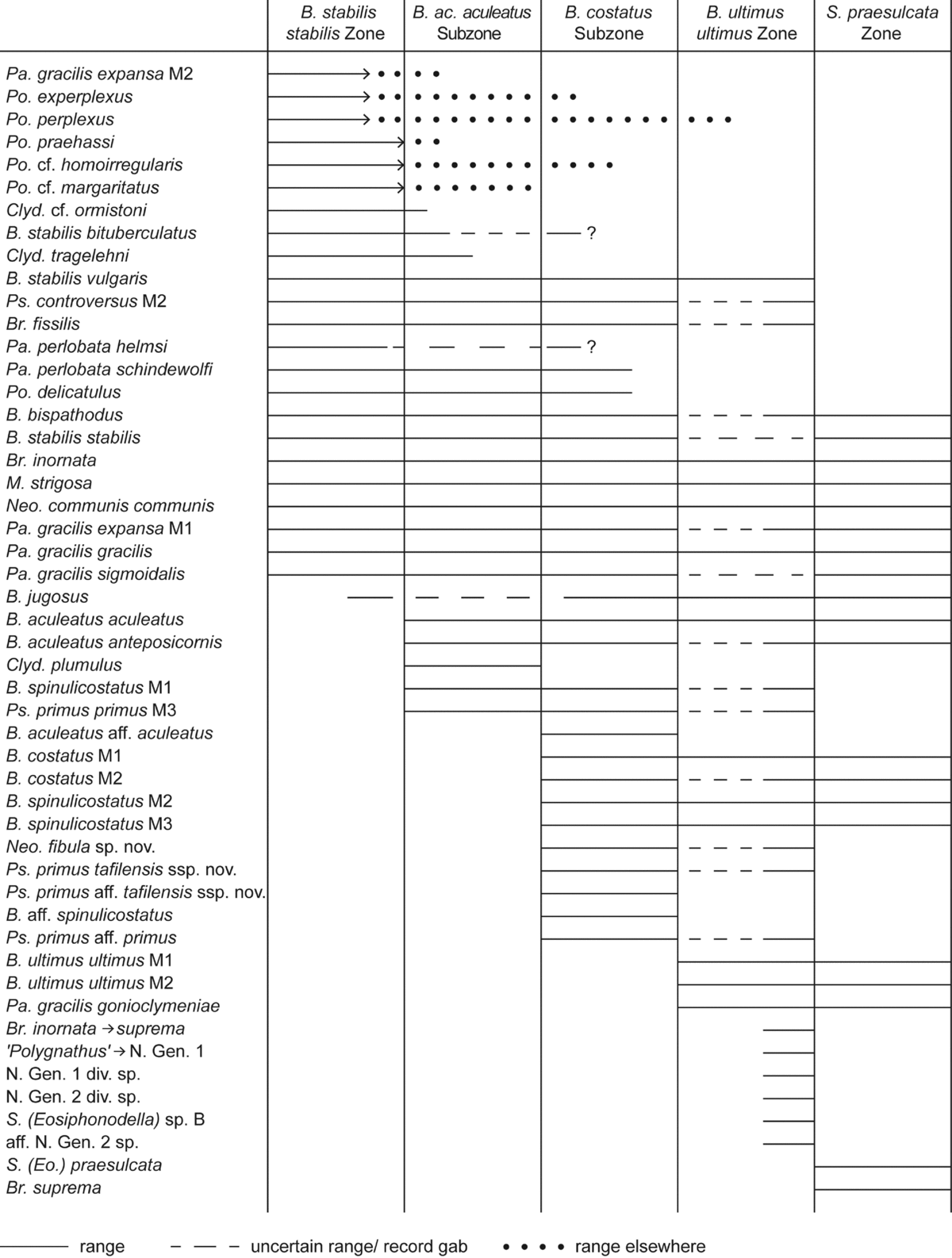
Other markers . Entry of B. aculeatus anteposicornis and Clyd. plumulus; both are rare forms, with locally delayed entries, and therefore of limited stratigraphic use. Oldest specimens of both coexist at Oum el Jerane (basal bed of Costaclymenia Limestone, Dasberg Crisis Interval) with the first B. aculeatus aculeatus. Bispathodus spinulicostatus Morphotype 1 (Jebel Erfoud, Bed 45b; Oum el Jerane, Bed 6a) and Ps. primus primus Morphotype 3 (Oum el Jerane, Bed 6a) enter on the Tafilalt Platform at the base of the subzone or just above (cf. Hartenfels, Reference Hartenfels2011).
Associated taxa . The oldest B. aculeatus aculeatus coexisted in the Tafilalt for a short term with Clyd. ormistoni (Jebel Erfoud, Bed 46b; Oum el Jerane, Bed 6a; Hartenfels, Reference Hartenfels2011), B. stabilis bituberculatus (= stabilis Morphotype 3, Oum el Jerane, Bed 8a) and Clyd. tragelehni (Oum el Jerane, Bed 9; Fig. 17). The following taxa range through the subzone: B. bispathodus, B. stabilis stabilis (= stabilis Morphotype 2), B. stabilis vulgaris (= stabilis Morphotype 1), Br. fissilis, Br. inornata, M. strigosa, Neo. communis communis, Pa. gracilis expansa Morphotype 1, Pa. gracilis gracilis, Pa. gracilis sigmoidalis, Pa. perlobata schindewolfi, Po. delicatulus and Ps. controversus Morphotype 2. Some taxa, which range elsewhere into the B. aculeatus aculeatus (Sub)zone, disappear earlier in the Tafilalt, high in or at the end of the preceding B. stabilis stabilis Zone. These are Pa. gracilis expansa Morphotype 2 (see higher range in Hartenfels, Reference Hartenfels2011), Po. experplexus (allegedly ranging into the lower costatus Subzone (Sandberg & Ziegler, Reference Sandberg and Ziegler1979, but without giving any precise evidence); co-occurrence with the oldest Po. znepolensis in the Carnic Alps (Perri & Spalletta, Reference Perri and Spalletta1991)), Po. perplexus (ranging in the Carnic Alps as a very rare form into the B.ultimus ultimus Zone; Perri & Spalletta, Reference Perri, Spalletta, Perri and Spalletta1998), Po. cf. homoirregularis (record of Kaiser, Reference Kaiser2005; see range of the typical form into the lower B. costatus Subzone in the Carnic Alps (Spalletta, Perri & Pondrelli, Reference Spalletta, Perri, Pondrelli, Perri and Spalletta1998), and Thailand (Savage, Reference Savage2013)), and Po. cf. margaritatus (record of Kaiser, Reference Kaiser2005; see imprecise upper range in Schäfer, Reference Schäfer1976). By contrast with German sections, there are also no Tafilalt records at this level of Bizignathus, Dasbergina, Pa. perlobata postera, subspecies of Pa. rugosa, Po. extralobatus, Po. hassi, Po. marginvolutus, Po. restrictus, Po. rhabdotus, Po. znepolensis, Ps. marburgensis marburgensis or Ps. micropunctatus. There is also a lack of early B. jugosus. This gives a much reduced biodiversity, which is also true for the ammonoid faunas, and which may reflect the more southern palaeolatitude.
Range chart of all recorded conodonts from the B. stabilis stabilis to S. (Eo.) praesulcata zones of the Tafilalt.

At M'Karig (Bed 12), Kaiser (Reference Kaiser2005) recorded two specimens, unfortunately without illustration, of Neo. carina (= Po. communis carina). Normally this is a Lower Carboniferous species; it may refer to a homoeomorphic form (see systematic palaeontology).
Conodont–ammonoid correlation . In the Tafilalt the base of the B. aculeatus aculeatus Subzone correlates with the Costa. muensteri-Zone (UD V-A1). This is based on Costaclymenia records from Hassi Nebech (Bed M1a), Jebel Erfoud (Bed 46b), Ouidane Chebbi Northwest (Bed 18a), Jebel Ouaoufilal (Bed 21a) and Oum el Jerane (beds 6a–8a) (Fig. 10; Hartenfels, Reference Hartenfels2011).
4.a.2. B. costatus Subzone
Definition . Lower boundary: Entry of either morphotype of B. costatus. Upper boundary: Entry of B. ultimus ultimus Morphotypes 1 or 2.
Discussion . A slightly earlier entry of Morphotype 1 than of Morphotype 2, as is common in central Europe (Hartenfels, Reference Hartenfels2011), could not be verified in southern Morocco. Previous regional records of B. costatus were from the UD V-B of M'Karig (Kaiser, Reference Kaiser2005) or from the highest part of the B. ultimus ultimus Zone (Kaiser, Reference Kaiser2005: Ouidane Chebbi, Bed 17c).
Other markers . Bispathopdus aculeatus aff. aculeatus, B. spinulicostatus Morphotypes 2–3, ?B. aff. spinulicostatus, Neo. fibula sp. nov., Ps. primus tafilensis ssp. nov., Ps. primus aff. tafilensis ssp. nov. and Ps. primus aff. primus first occur within this subzone but are not common enough for a consistent and reliable use as index taxa.
Associated taxa . A dissolved Gonioclymenia from Jebel Ihrs yielded B. stabilis bituberculatus (= stabilis Morphotype 3) and Pa. perlobata helmsi, which implies range extensions. Reworking is unlikely but not completely ruled out. Sandberg & Ziegler (Reference Sandberg and Ziegler1979) did not record an overlap of Pa. perlobata helmsi and B. costatus. There is evidence that Pa. perlobata schindewolfi and Po. delicatulus range until high in the subzone (compare Ji & Ziegler, Reference Ji and Ziegler1993 and Kaiser et al. Reference Kaiser, Steuber, Becker and Joachimski2006). The following taxa go through (Fig. 17): B. bispathodus, B. stabilis stabilis (= stabilis Morphotype 2), B. stabilis vulgaris (= stabilis Morphotype 1), B. jugosus (records of Kaiser, Reference Kaiser2005), B. aculeatus aculeatus, B. aculeatus anteposicornis, B. spinulicostatus Morphotype 1, Br. fissilis, Br. inornata, M. strigosa, Neo. communis communis, Pa. graxilis expansa Morphotype 1, Pa. gracilis gracilis, Pa. gracilis sigmoidalis, Ps. controversus Morphotype 2 and Ps. primus primus Morphotype 3.
Conodont–ammonoid correlation . The base of the B. costatus Subzone correlates roughly with the Gonio. subcarinata Zone (UD V-A2). Above, the subzone certainly comprises the Gonio. hoevelensis Zone (UD V-B), with the giant Gonio. speciosa as an alternative index species (Figs 1a, 2h), and, at the top, the new regional Medio. aguelmousensis Zone of Becker, El Hassani & Tahiri (Reference Becker, El Hassani and Tahiri2013; previously recorded as level of Spheno. intermedia (Becker et al. Reference Becker, House, Bockwinkel, Ebbighausen and Aboussalam2002) UD V-C; conodont faunas, but without B. costatus, from Ouidane Chebbi, beds 10a–11f, in Kaiser, Fig. 8). In the Algerian continuation of the Tafilalt Devonian (Ben Zireg region), there are similar joint Gonioclymenia–B. costatus occurrences (Weyant & Pareyn, Reference Weyant and Pareyn1975). For the lower part of the B. costatus Subzone there are more precise data for the Progonioclymenia–Gonioclymenia assemblage (UD V-A2) of the condensed Malpasso succession of the Carnic Alps (Korn, Reference Korn, Perri and Spalletta1998: Bed 5c; Perri & Spalletta, Reference Perri, Spalletta, Perri and Spalletta1998: conodont sample ML 7; Hartenfels & Becker, Reference Hartenfels, Becker and Over2009: Bed 7b/c). In the Rhenish Massif, the corresponding Cly. laevigata (or Progonioclymenia acuticostata) Zone was reported to begin slightly below the first B. costatus (Korn & Luppold, Reference Korn and Luppold1987: data from Effenberg). This agrees with recent data from Thuringia (Bartzsch & Weyer, Reference Bartzsch and Weyer2012; Kononova & Weyer, Reference Kononova and Weyer2014), where both Clymenia (Bed 1.1) and Gonioclymenia (Bed 3.2) enter several shale–limestone cycles below B. costatus (Bed 8). Accordingly, B. costatus was only found in an upper unit with Gonioclymenia–Kosmoclymenia faunas of the Cantabrian Mountains (Sanz-López et al. Reference Sanz-López, García-López, Montesinos and Arbizu1999: Unit 5b).
4.b. B. ultimus ultimus Zone
Definition . Lower boundary: Entry of B. ultimus ultimus Morphotypes 1 or 2. Upper boundary: Entry of S. (Eo.) praesulcata s.l. (see Tragelehn, Reference Tragelehn2010).
Discussion . The B. ultimus ultimus Zone was previously recognized in the Tafilalt by Ginter, Hairapetian & Klug (Reference Ginter, Hairapetian and Klug2002: Oum el Jerane, sample 4, B. ziegleri = B. ultimus ultimus Morphotype 1), Kaiser (Reference Kaiser2005: M'Karig, Ouidane Chebbi) and Kaiser et al. (Reference Kaiser, Becker, Steuber and Aboussalam2011).
Other markers . In many other regions throughout the world the entry of Pa. gracilis gonioclymeniae is a reliable alternative marker (e.g. Ji & Ziegler, Reference Ji and Ziegler1993; Kaiser et al. Reference Kaiser, Becker, Spalletta, Steuber and Over2009). Alberti (Reference Alberti1970) listed this taxon from several levels at Jebel Erfoud but its precise position in refined section logs (Korn, Reference Korn1999; Fig. 10) is not yet clear. It is absent from our Kalloclymenia Limestone samples and from the faunas of Kaiser (Reference Kaiser2005). Pseudopolygnathus marburgensis trigonicus is a third reliable zonal marker but completely lacking from the Tafilalt. The entry of Br. suprema is less reliable (Ziegler & Sandberg, Reference Ziegler and Sandberg1984; new data from Franconia by H. Tragelehn & S. Hartenfels), and in the Tafilalt it was only rarely recorded from the next higher zone (Kaiser, Reference Kaiser2005: M'Karig). An intermediate form between Br. inornata and Br. suprema from Jebel Ihrs was previously described by Hartenfels (Reference Hartenfels2011) from Kahlleite East in Thuringia, where it co-occurs with Pa. gracilis gonioclymeniae.
As briefly discussed by Becker, Kaiser & Aretz (Reference Becker, Kaiser, Aretz, Becker, Königshof and Brett2016), any record of a S. (Eosiphonodella) could be used to place samples in the next younger S. (Eo.) praesulcata Zone. However, in accord with Tragelehn (Reference Tragelehn2010) our faunas from the Kalloclymenia Limestone and similar faunas reported from crinoidal limestones of Lalla Mimouna (Becker et al. Reference Becker, Hartenfels, Aboussalam, Tragelehn, Brice and El Hassani2013c ) are probably slightly older, from the lower range of Kalloclymenia and the oldest Linguaclymenia. Conodont faunas may contain very rare new S. (Eosiphonodella) species, but no S. (Eo.) praesulcata (s.l., see Kaiser & Corradini, Reference Kaiser and Corradini2011), and more common different ‘siphonodelloids’ (N. Gen. 1 and 2 sensu Becker et al. Reference Becker, Hartenfels, Aboussalam, Tragelehn, Brice and El Hassani2013c , aff. N. Gen. 2, and intermediates between Polygnathus and N. Gen. 1; including possibly the record of Po. symmetricus from M'karig in Kaiser (Reference Kaiser2005)). Due to ongoing detailed taxonomic studies by H. Tragelehn, we leave all taxa of this group in open nomenclature. A precise stratigraphical placing in the Tafilalt is hampered by the fact that there is no B. ultimus ultimus – ‘siphonodelloid’ – S. (Eo.) praesulcata succession; the available ‘siphonodelloid faunas’ come from shallow biofacies (Jebel Ihrs, Lalla Mimouna) or isolated spot samples (Bou Tchrafine). A wide range of ‘siphonodelloids’ was documented by Kononova & Weyer (Reference Kononova and Weyer2014: as species of Polygnathus?) from just above the entry of Kalloclymenia and Br. suprema and from well below the entry of Effenbergia lens. This lends further support for a range of this group within the B. ultimus ultimus Zone; unfortunately, S. (Eo.) praesulcata has not yet been recognized in the Thuringian succession.
Associated taxa . Based on records in Kaiser (Reference Kaiser2005), the following (sub)species and morphotypes occur in the Tafilalt: B. jugosus, B. stabilis vulgaris (= stabilis Morphotype 1), B. aculeatus aculeatus, B. costatus Morphotype 1, B. spinulicostatus, Br. inornata, M. strigosa, Neo. communis communis and Pa. gracilis gracilis. Our samples with ‘siphonodelloids’ and rare, new S. (Eosiphonodella), possibly from high within the B. ultimus ultimus Zone, add B. aculeatus anteposicornis, B. bispathodus, B. costatus Morphotype 2, B. spinulicostatus Morphotype 1, Br. fissilis, Pa. gracilis expansa Morphotype 1, Neo. fibula sp. nov., Ps. primus primus Morphotype 3, Ps. primus tafilensis ssp. nov. and Ps. primus aff. primus. Regional Lazarus Taxa are B. stabilis stabilis (= stabilis Morphotype 2) and Pa. gracilis sigmoidalis.
Conodont–ammonoid correlation . In the Tafilalt, the base of the B. ultimus ultimus Zone is directly correlated with the onset of the Kallo. subarmata Zone at M'karig (Kaiser, Reference Kaiser2005: Bed 18; see also Kaiser et al. Reference Kaiser, Becker, Steuber and Aboussalam2011; fig. 13.3a–b, re-illustrated from Becker et al. Reference Becker, House, Bockwinkel, Ebbighausen and Aboussalam2002: pl. 5, figs 1–2). In the Rhenish Massif, the Spheno. brevispina Zone, which includes Kallo. subarmata as an alternative or better index form at the base (Becker, Kaiser & Aretz, Reference Becker, Kaiser, Aretz, Becker, Königshof and Brett2016), begins with Pa. gracilis gonioclymeniae (Korn & Luppold, Reference Korn and Luppold1987: Dasberg section), whilst B. ultimus ultimus is locally absent. In Thuringia (Saalfeld area), Kononova & Weyer (Reference Kononova and Weyer2014) mentioned a co-occurrence of first B. ultimus ultimus with Gonioclymenia, before the entry of Kalloclymenia. Unfortunately, there is no detailed description or illustration of these oldest specimens. Furthermore, B. spinulicostatus, a species which is very similar to B. ultimus ultimus Morphotype 1 (= B. ziegleri; cf. Ziegler, Sandberg & Austin, Reference Ziegler, Sandberg and Austin1974, p. 103) was not considered. The oldest Kalloclymenia (Bed 20.4) is from above the oldest bispathodids of the ultimus Group, which require further study, and from below the first Pa. gracilis gonioclymeniae (Bed 21.3, cf. Kononova & Weyer, Reference Kononova and Weyer2014).
4.c. Siphonodella praesulcata Zone
Definition . Lower boundary: Entry of S. (Eo.) praesulcata s.l. (see Tragelehn, Reference Tragelehn2010). Upper boundary: Extinction of B. costatus (base of the costatus–kockeli Interregnum).
Other markers . None.
Discussion. The regional knowledge of this zone is based on Kaiser (Reference Kaiser2005). Based on the restricted number of samples, the regional spectrum of species is not yet fully established. This leads to a wrong picture of strongly reduced regional palaeodiversity (Fig. 17). Various taxa that are currently shown to end with the B. ultimus ultimus Zone may have to be added to the faunal list with further sampling. The records of Pa. gracilis gonioclymeniae in Alberti (Reference Alberti1970), which have not been repeated by Kaiser (Reference Kaiser2005), can be taken as an example. On the other hand, the zonal index species is rare and partly lacking, for example in a fauna from Parawo. paradoxa nodules of El Atrous (UD VI-C2; Kaiser, Reference Kaiser2005; Kaiser et al. Reference Kaiser, Becker, Hartenfels and Aboussalam2013).
Since the Wocklumeria Zone (UD VI-D) is missing all over the Tafilalt (Kaiser et al. Reference Kaiser, Becker, Steuber and Aboussalam2011), it is not possible to document regional effects of the Hangenberg Mass Extinction on conodonts, as discussed in Kaiser et al. (Reference Kaiser, Becker, Spalletta, Steuber and Over2009) and Kaiser, Aretz & Becker (Reference Kaiser, Aretz, Becker, Becker, Königshof and Brett2015). The associated long-lasting carbonate crisis (e.g. Becker et al. Reference Becker, Aboussalam, Hartenfels, El Hassani, Baidder, Reiter, Yang, Wang and Reich2013 a) led to the effect that only three uppermost Famennian conodont taxa reappear in the Lower Tournaisian of the Tafilalt (Kaiser, Reference Kaiser2005): M. strigosa, Neo. communis communis and B. aculeatus aculeatus. The Lalla Mimouna conodont record of the northern Maider (Belka in Korn et al. Reference Korn, Belka, Fröhlich, Rücklin and Wendt2004; Becker et al. Reference Becker, Hartenfels, Aboussalam, Tragelehn, Brice and El Hassani2013c ) shows that there were more survivors or re-immigrants in the eastern Anti-Atlas.
Associated taxa . Bispathodus bispathodus, B. jugosus, B. stabilis stabilis (= stabilis Morphotype 2), B. aculeatus aculeatus, B. aculeatus anteposicornis, B. costatus (both morphotypes), B. ultimus ultimus (both morphotypes), B. spinulicostatus, Br. inornata, Br. suprema, M. strigosa, Neo. communis communis, Pa. gracilis gracilis, Pa. gracilis sigmoidalis and Pa. gracilis expansa occur. An icriodid from the last limestone at Ouidane Chebbi (Kaiser, Reference Kaiser2005), a very rare genus in the pelagic uppermost Famennian, was not identified at the species level.
Conodont–ammonoid correlation . In the Tafilalt, there is currently no correlation of the base of the S. (Eo.) praesulcata Zone with the ammonoid zonation. The so far studied sections of Ouidane Chebbi and M'karig are rather poor in uppermost Famennian macrofauna. The Jebel Erfoud offers the best potential (Alberti, Reference Alberti1970). In the Rhenish Massif S. (Eo.) praesulcata (s.l.) enters above the oldest Muess. bisulcata (basal UD VI-A2) and below the entry of Effenbergia (basal UD VI-B; Clausen et al. Reference Clausen, Korn, Luppold and Stoppel1989: Muessenberg; Kürschner et al. Reference Kürschner, Becker, Buhl and Veizer1993 and Becker, Reference Becker1996: Hasselbachtal; Schindewolf, Reference Schindewolf1937 and Kürschner et al. Reference Kürschner, Becker, Buhl and Veizer1993: Oberrödinghausen; Becker et al. Reference Becker, Korn, Paproth and Streel1993 and H. Nowak, unpub. B.Sc. thesis, Westfälische Wilhelms-Universität, 2008: Oese). There is complete agreement with data from the Carnic Alps (Kaiser et al. Reference Kaiser, Becker, Spalletta, Steuber and Over2009: sections Großer Pal and Casera Malpasso).
5. Implications for the regional and international ammonoid zonation (Fig. 17)
The loose slabs and the new Jebel Ihrs West section give a clear age difference between Gonioclymenia (B. costatus Subzone) and Kalloclymenia (B. ultimus ultimus Zone with early S. (Eosiphonodella)) limestones. This is supported by the only other previous conodont dating of a Moroccan Kalloclymenia from M'karig (Kaiser, Reference Kaiser2005: Bed 18; Fig. 14e, f). The record of B. ziegleri (= B. ultimus ultimus Morphotype 1) from the Gonioclymenia Limestone of Oum el Jerane by Ginter, Hairapetian & Klug (Reference Ginter, Hairapetian and Klug2002) is at odds with this distinction. Possibly, it can be explained by the inclusion of thin units encrusted on top of the true Gonioclymenia Limestone during the original sampling. Such units occur along strike in the Amessoui Syncline at El Atrous; there, they also contain many shark teeth and B. ultimus ultimus, but also Wocklumian (UD VI) ammonoids and trilobites (Kaiser, Reference Kaiser2005; Kaiser et al. Reference Kaiser, Becker, Hartenfels and Aboussalam2013).
The middle Dasbergian of the Tafilalt (UD V-B) is characterized by the onset of the spinose, relatively small-sized Gonio. hoevelensis (see Becker et al. Reference Becker, House, Bockwinkel, Ebbighausen and Aboussalam2002: pl. 6, figs 1–2; Bogoslovskiy, Reference Bogoslovskiy1981: pl. 8, fig. 1a–b). In order to stabilize this important marker species, a lectotype is fixed below (Fig. 14a, b, see taxonomic notes). Muessenbiaergia diversa and Post. camerata can serve as alternative regional markers. As discussed in Becker et al. (Reference Becker, House, Bockwinkel, Ebbighausen and Aboussalam2002), Gonio. hoevelensis enters in the Russian section Kiya-1 (Simakov et al. Reference Simakov, Bogoslovskiy, Gagiev, Kononova, Kochetkova, Kusina, Kulagina, Onoprienko, Pazukhin, Radinova, Rasina, Reitlinger, Simakova and Yanoulatova1983; Nikolaeva & Bogoslovskiy, Reference Nikolaeva and Bogoslovskiy2005) together with Ornatoclymenia, the marker of UD V-B in the Rhenish Massif (Korn, Reference Korn1981). Gonioclymenia speciosa enters at Ouidane Chebbi Northwest just slightly later than Muess. diversa (Hartenfels & Becker, Reference Hartenfels, Becker and Over2009; Hartenfels, Reference Hartenfels2011) and one nodule layer above the first Gonio. hoevelensis at the Ouidane Chebbi section of Kaiser (Reference Kaiser2005) and Kaiser et al. (Reference Kaiser, Becker, Steuber and Aboussalam2011). At Bou Tchrafine, Gonio. hoevelensis, Gonio. speciosa, Post. camerata and Muess. diversa occur jointly in the loose assemblage of ‘Bed Za’ (Becker & House, Reference Becker and House2000). Similar faunas are known from much thicker nodular limestone units of the Maider (Becker et al. Reference Becker, Bockwinkel, Ebbighausen and House2000).
In the Maider sections, Gonioclymenia disappears gradually in the upper part of the Dasbergian (UD V), well before the onset of Kalloclymenia and/or Linguaclymenia, the index clymeniids of the basal Wocklumian (UD VI-A1, section Lambidia 1, Kaiser, Reference Kaiser2005). This interval (beds 10c–11a) is characterized by the distinctive Medio. aguelmousensis, which occurs widely along the Aguelmous Syncline. In the Tafilalt it occurs in the same interval above Gonioclymenia at Ouidane Chebbi (Becker in Kaiser, Reference Kaiser2005: ‘Spheno. intermedia’ of Bed 10b), Hamar Laghdad East (Becker et al. Reference Becker, Bockwinkel, Ebbighausen and House2000: ‘Spheno. brevispina’ from the top of Bed X), Jebel Erfoud (Becker & House, Reference Becker and House2000: ‘relative of Gonio. kiense’ from ‘Bed Zb’) and El Khraouia (Hartenfels et al. Reference Hartenfels, Becker, Aboussalam, El Hassani, Baider, Fischer and Stichling2013). Consequently, Becker, El Hassani & Tahiri (Reference Becker, El Hassani and Tahiri2013) noted in their new stratigraphical chart for the Tafilalt a new Medio. aguelmousensis Zone (UD V-C). The different previous identications of the index species (see also the record as ‘Sphenoclymenia sp.’ in Korn, Reference Korn1999) stem from the time before Medio. aguelmousensis was established and separated from the closely related Medio. intermedia (Korn & Klug, Reference Korn and Klug2002). Also, it was not known then that juveniles may have ventral groves and spines as in Levi. kiensis and Spheno. brevispina. The correlation of the Moroccan Medio. aguelmousensis Zone with the Rhenish Piriclymenia piriformis Zone (Korn, Reference Korn1981; UD V-C) is currently tentative. But the recent discovery of very close relatives of Medio. aguelmousensis at Effenberg (Hartenfels & Becker, Reference Hartenfels, Becker, Becker, Hartenfels and Königshof2016), where the Piriclymenia piriformis level was noted by Korn & Luppold (Reference Korn and Luppold1987), gives prospects for a future refined correlation. Based on the presence of Medio. intermedia, the Anti-Atlas Medioclymenia Zone can be correlated into the topmost Dasbergian of Thuringia (Bartzsch & Weyer, Reference Bartzsch and Weyer2012: beds 18.2–20.1), where supposed last gonioclymeniids are associated (see discussion below). Unlike as in the Anti-Atlas, Medioclymenia is claimed to range into levels with the oldest Kalloclymenia.
Our new data reject an overlap of Gonioclymenia and Kalloclymenia in the Anti-Atlas as suggested by Becker et al. (Reference Becker, House, Bockwinkel, Ebbighausen and Aboussalam2002), who emphasized that this was not found in the thicker, more complete basinal successions of the Maider. This refutes the idea that the regional Kallo. subarmata Zone falls in the top of the Dasbergian (UD V-C). Kalloclymenia can be re-installed as a widespread index genus for the base of the Wocklumian (UD VI), as proposed in the classical monograph on the German Wocklum Beds by Schindewolf (Reference Schindewolf1937). At least Kallo. subarmata regains its old stratigraphical significance. The alleged overlap of Kallo. bimpressa (correctly = Kallo. insignis) and Clymenia in the Lower Petherwin Beds of Cornwall (Selwood, Reference Selwood1960) is based on faunas from the Gatepost Quarry and Oldwitt Farm. However, the Cly. hoevelensis record of both localities is not based on any modern description or illustration. Furthermore, the unit comprises more than one level/zone. Stewart (Reference Stewart1981) found no conodonts in the calcareous sandstones of Gatepost Quarry but showed that the Cephalopod Limestone Member (= Lower Petherwin Beds) covers in general a long interval, up to the Middle costatus Zone (= B. ultimus ultimus to S. (Eo.) praesulcata zones, UD VI). Accordingly, Price & Korn (Reference Price and Korn1989) noted that matrix from the holotype of Kallo. insignis yielded conodonts of the Middle costatus Zone (probably from the B. ultimus ultimus Zone).
The co-occurrence of Gonio. corpulenta and Kallo. subarmata in the Kiya-1 section of the southern Urals is also problematical. The section is condensed and Gonio. corpulenta was based on a single, large specimen (Bogoslovskiy, Reference Bogoslovskiy1981). Nikolaeva (Reference Nikolaeva, Landman, Davis and Mapes2007) and Gibshman & Nikolaeva (Reference Gibshman and Nikolaeva2011) commented on the rather provisional correlation of the regional frechi-corpulenta Zone, possibly partly with the Piriclymenia piriformis Zone and partly with the lower part of the ‘Kalloclymenia-Wocklumeria Genozone’ (= UD VI). Simakov et al. (Reference Simakov, Bogoslovskiy, Gagiev, Kononova, Kochetkova, Kusina, Kulagina, Onoprienko, Pazukhin, Radinova, Rasina, Reitlinger, Simakova and Yanoulatova1983) showed the entry of two marker conodonts of the B. ultimus ultimus Zone, Pa. gracilis gonioclymeniae and Ps. marburgensis trigonicus, between Ornatoclymenia and Kallo. frechi, below the subarmata–corpulenta level. The Kiya record, therefore, is no evidence for Kalloclymenia ranging into the Dasbergian (UD V) but evidence of a possible last gonioclymeniid in the lower Famennian VI (Wocklumian). However, a critical look at the holotype of Gonio. corpulenta shows that it is not a typical Gonioclymenia at all. Median whorls have no ventral furrow and the presence of a shallow ventral depression on the last whorl is obscured by weathering and not convincingly documented. The wide, bell-shaped subumbilical lobe differs from all other members of the Gonioclymeniidae. The morphologically isolated species is better placed in the lower Wocklumian giant ‘Kallo.’ pachydiscus Group, which requires a new generic name, and which occurs in Russia and the Rhenish Massif (Becker, Reference Becker1988: UD VI-A1; Hartenfels & Becker, Reference Hartenfels, Becker, Becker, Hartenfels and Königshof2016).
Price & Korn (Reference Price and Korn1989) discussed the possible occurrences of two other Kalloclymenia species in Dasbergian (UD V) beds of the Rhenish Massif. The strongly spinose, early Dasbergian (UD V-A) Kallo. crassa does not possess the lanceolate adventitious lobe of the genus, has an unusually deep and narrow external lobe and, therefore, belongs to a different (new) genus. In the original description by Wedekind (Reference Wedekind1914) similarities with Sellaclymenia torleyi were emphasized. It has been generally overlooked that, despite its name, the type-specimen of Kallo. dasbergensis is not from the Dasberg of the Rhenish Massif, but from Dzikowiec (Ebersdorf), Silesia, where the pelagic ammonoid succession falls entirely in the lower/middle Wocklumian (Schindewolf, Reference Schindewolf1937; UD VI-A to C). The species was not only omitted from the faunal list in Schindewolf, but also in later accounts of the Dzikowiec fauna (Lewowicki, Reference Lewowicki1959; Dzik, Reference Dzik2006). Due to the lack of descriptions or illustrations, there is no evidence that the stratigraphically older Dasberg fragments mentioned by Wedekind (Reference Wedekind1914) belong to the same species. The dasbergensis holotype has higher whorls than in typical Kalloclymenia, with a whorl expansion rate of c. 2.1, and possibly Gonioclymenia-type adventitious flank lobes (Wedekind, Reference Wedekind1914: pl. 5, fig. 6b). Therefore, it may be related to the ‘Kallo.’ pachydisca Group. Because of similarities of its shell form with Medioclymenia, it is possible that Wedekind's Dasberg fragments belonged to that genus.
In summary, the occurrence of typical Kalloclymenia in beds with Gonioclymenia or Clymenia (Dasbergian, UD V) is not proven by any record. There is also no unequivocal range overlap in the lower Wocklumian (UD VI-A1). Kononova & Weyer (Reference Kononova and Weyer2014) showed Gonioclymenia to range in Thuringia into the first beds with B. ultimus ultimus below the entry of Kalloclymenia. However, neither the last Thuringian gonioclymeniids nor the supposed first B. ultimus ultimus have been illustrated. This leaves doubts concerning their taxonomy, especially since B. spinulicostatus has not been separated from B. ultimus. Further research by D. Weyer is under way in order to solve the question.
6. Regional correlation of the Gonioclymenia Limestone (Fig. 10)
The trans-regressive couplet of the Gonioclymenia Limestone is recognizable in the higher Dasbergian of lateral, less condensed settings. At Bou Tchrafine (Becker & House, Reference Becker and House2000), the lower part of the Gonio. hoevelensis Zone (Bed Za, UD V-B) is characterized by a change from solid limestone to marls with limestone nodules, indicating a slight deepening trend. Towards the east, at the eastern end of Hamar Laghdad (Becker et al. Reference Becker, House, Bockwinkel, Ebbighausen and Aboussalam2002), the same deepening phase is recorded above a solid Cymaclymenia limestone (UD V-A1) by Bed X. Beyond, at Ouidane Chebbi Northwest (Hartenfels & Becker, Reference Hartenfels, Becker and Over2009; Hartenfels, Reference Hartenfels2011), the Gonio. hoevelensis Zone commences during a short deepening episode, characterized by the deposition of a marl unit with limestone nodules, which is overlain by a regressive, solid limestone with Gonio. speciosa and others. Further east, in the Ouidane Chebbi sections of Belka et al. (Reference Belka, Klug, Kaufmann, Korn, Döring, Feist and Wendt1999), Kaiser (Reference Kaiser2005) and Kaiser et al. (Reference Kaiser, Becker, Steuber and Aboussalam2011), nodule levels with Gonio. speciosa are lithologically not distinct from under- and overlying beds. The same applies to the Jebel Erfoud sequence (Fig. 10, section log of Korn, Reference Korn1999).
In the northern Tafilalt, the last recorded Famennian limestones fall in the Gonio. subcarinata Zone (UD V-A2), despite a generally more basinal setting (Rheris Basin; Becker, Reference Becker1993). The same is true for the Mfis and Hassi Nebech areas of the Tafilalt Basin to the south (Hartenfels, Reference Hartenfels2011; Kaiser et al. Reference Kaiser, Becker, Steuber and Aboussalam2011). At Tazoult Nehra, there is obviously a gap between lower Dasbergian beds and shales with a goethitic fauna of the lower Wocklumian (UD VI-A/B), including Kalloclymenia and Effenbergia (T. Fischer, unpub. B.Sc. thesis, Westfälische Wilhelms-Universität, 2010). Further east, at Erg Kseir, Wocklumian shales continue with sideritic ammonoid preservation but, again, Gonio. speciosa or other species of the Gonio. hoevelensis Zone have not been found. On the western slope of the Tafilalt Basin, at El Khraouia (NE Amessoui Syncline), the upper/uppermost Famennian consists of poorly exposed marls/shales without a gap at the UD V/VI transition. This assumption is based on loose specimens of Gonioclymenia sp. and Medio. aguelmousensis, followed by a single Muess. bisulcata of UD VI-B.
In the Bou Maiz Syncline, at Ottara East, the Gonio. subcarinata Zone (UD V-A2) consists of solid, iron-rich, reddish nodular limestone. Postclymenia camerata, one of the UD V-B markers, was found in overlying poorly fossiliferous red marl, which represents a deepening interval (see regional facies model of Hartenfels, Reference Hartenfels2011). Gonioclymenia speciosa enters in larger red limestone nodules right above. It is very difficult to trace the Gonioclymenia Transgression into the Maider Basin (Aguelmous Syncline), where Gonio. speciosa appears to be very rare or absent. The thick successions of shales with goethitic or calcareous faunas do not easily record sea-level changes.
The Medio. aguelmousensis Zone (UD V-C) is missing above the Gonioclymenia Limestone in the most condensed platform sections, such as Jebel Ihrs and all over the Amessoui Syncline in the southern Tafilalt. Therefore, the Kalloclymenia Limestone records a minor basal Wocklumian re-onset of sedimentation due to deepening. It is not recognizable in the rather uniform nodular limestones of Jebel Erfoud and the eastern Tafilalt (Ouidane Chebbi Northwest to M'Karig). In the Bou Maiz Syncline (Ottara) the Wocklumian may be represented by poorly exposed red shales with some cymaclymeniids. As noted above, a deepening trend is recorded by the onset of hypoxic, goniatite-rich shales of UD VI-A/B (T. Fischer, unpub. B.Sc. thesis, Westfälische Wilhelms-Universität, 2010) at Tazoult Nehra in the SE Tafilalt (Tafilalt Basin). In the northern Maider, crinoidal limestones of the B. ultimus ultimus Zone transgressed over an Ordovician seamount (Lalla Minouna; Becker et al. Reference Becker, Hartenfels, Aboussalam, Tragelehn, Brice and El Hassani2013c ).
7. Eustatic aspects
Hartenfels & Becker (Reference Hartenfels, Becker and Over2009) and Hartenfels (Reference Hartenfels2011) discussed upper/uppermost Famennian eustatic changes that were not recorded in previous global sea-level curves. They recognized the two transgressive Dasberg Event phases at the top of the B. stabilis stabilis (= top Lower expansa) Zone and at the base of the B. aculeatus aculeatus (= base Middle expansa) Zone. They justified the onset of Depophase IIf1 in the revised sea-level chart of Becker, Aboussalam & Hartenfels (Reference Becker, Aboussalam and Hartenfels2012). The Epinette Event on the Ardennes Shelf (Dreesen, Paproth & Thorez Reference Dreesen, Paproth, Thorez, McMillan, Embry and Glass1989) marks the initial phase of the ‘Strunian Transgression’ and the end of the Condroz Sandstone sedimentation (base of Depophase IIf2 in Becker, Aboussalam & Hartenfels, Reference Becker, Aboussalam and Hartenfels2012). Originally, it was linked with the base of the Wocklumian (‘Wocklum Event’), but it occurred earlier, still within the B. aculeatus aculeatus Zone. It is marked by the appearance of the globally distributed marker spore Retispora lepidophyta lepidophyta (e.g. Streel, Reference Streel and Königshof2009). A better correlation of the Gonioclymenia Transgression with the Epinette Event requires palynological data for the base of UD V-B, which are not yet at hand. As noted by Hartenfels & Becker (Reference Hartenfels, Becker and Over2009), expansa Zone transgressions of other regions are not dated with the necessary precision for reliable correlations. In general, there is some evidence for a eustatic deepening pulse higher in the B. aculeatus aculeatus Zone (B. costatus Subzone). The transgressive phase of the lower Wocklumian (UD VI-A) can be correlated with the main Strunian Transgression, which is a part of the eustatic Depophase IIf sensu Johnson, Klapper & Sandberg (Reference Johnson, Klapper and Sandberg1985) and the peak of transgression within Depophase IIf2 sensu Becker, Aboussalam & Hartenfels (Reference Becker, Aboussalam and Hartenfels2012).
8. Systematic palaeontology
8.a. Conodonts
8.a.1. Authorships and records
Bispathodus aculeatus aculeatus (Branson & Mehl, Reference Branson and Mehl1934 a), Figure 18k–r; 470 specimens from Jebel Ihrs West, Jebel Kfiroun South, Jebel Ouaoufilal, Oum el Jerane, Seheb el Rhassal and Takhbtit West.
Bispathodids from the upper/uppermost Famennian of the Tafilalt. (a, b) Bispathodus stabilis vulgaris (Dzik, Reference Dzik2006), GMM B9A.4-1 (a, Jebel Ihrs West, Bed 2, lower B. costatus Subzone) and GMM B9A.4-2 (b, Jebel Ihrs West, loose slab with Kalloclymenia sp., B. ultimus ultimus Zone); (c) Bispathodus stabilis stabilis (Branson & Mehl, Reference Branson and Mehl1934 a), GMM B9A.4-3, Jebel Ihrs West, Bed 2, lower B. costatus Subzone; (d) Bispathodus stabilis bituberculatus (Dzik, Reference Dzik2006), GMM B9A.4-4, Jebel Ihrs West, loose slab with Gonio. subcarinata, B. costatus Subzone; (e, f) Bispathodus bispathodus Ziegler, Sandberg & Austin, Reference Ziegler, Sandberg and Austin1974, GMM B9A.4-5 (e, Jebel Ihrs West, loose slab with Kalloclymenia sp., B. ultimus ultimus Zone) and GMM B9A.4-6 (f, Jebel Ihrs West, Bed 5b, B. ultimus ultimus Zone); (g–j) Bispathodus aculeatus anteposicornis (Scott, Reference Scott1961), GMM B9A.4-7 (g, h, Jebel Ihrs West, Bed 3, upper B. costatus Subzone) and GMM B9A.4-8 (i, j, Jebel Ihrs West, Bed 2, lower B. costatus Subzone, intermediate specimen between B. aculeatus anteposicornis and B. aculeatus aculeatus); (k–r) Bispathodus aculeatus aculeatus (Branson & Mehl, Reference Branson and Mehl1934 a), GMM B9A.4-9 (k, l, Jebel Ihrs West, loose slab with Kalloclymenia sp., B. ultimus ultimus Zone), GMM B9A.4-10 (m, n, Jebel Ihrs West, loose slab with Kallo. subarmata, B. ultimus ultimus Zone), GMM B9A.4-11 (o, p, Takhbtit West, Bed 5, B. costatus Subzone), and GMM B9A.4-12 (q, r, Jebel Ouaoufilal, Bed 21b, B. costatus Subzone); (s–v) Bispathodus aculeatus aff. aculeatus (Branson & Mehl, Reference Branson and Mehl1934 a), GMM B9A.4-13 (s, t) and GMM B9A.4-14 (u, v, both Jebel Ihrs West, Bed 3, upper B. costatus Subzone); (w–y) Bispathodus spinulicostatus (Branson, Reference Branson and Mehl1934) Morphotype 1, GMM B9A.4-15 (w) and GMM B9A.4-16 (x, both Jebel Ihrs West, loose slab with Kalloclymenia sp., B. ultimus ultimus Zone) and GMM B9A.4-17 (y, Jebel Ihrs West, loose slab with Kallo. subarmata, B. ultimus ultimus Zone); (z) Bispathodus spinulicostatus (Branson, Reference Branson and Mehl1934) Morphotype 2, GMM B9A.4-18, Jebel Ihrs West, Bed 2, lower B. costatus Subzone; (aa–ad) Bispathodus costatus (Branson, Reference Branson and Mehl1934) Morphotype 2, GMM B9A.4-19 (aa, Jebel Ihrs West, Bed 3, upper B. costatus Subzone), GMM B9A.4-20 (ab, Jebel Ihrs West, loose slab with Kalloclymenia sp., B. ultimus ultimus Zone), GMM B9A.4-21 (ac, Jebel Ihrs West, Bed 4b, B. ultimus ultimus Zone), and GMM B9A.4-22, Jebel Ihrs West, loose slab with Kallo. subarmata, B. ultimus ultimus Zone); (ae, af) Bispathodus costatus (Branson, Reference Branson and Mehl1934) Morphotype 1, GMM B9A.4-23 (ae) and GMM B9A.4-24 (af, both Jebel Ihrs West, loose slab with Kalloclymenia sp., B. ultimus ultimus Zone).

Bispathodus bispathodus Ziegler, Sandberg & Austin, Reference Ziegler, Sandberg and Austin1974, Figure 18e, f; ten specimens from Jebel Ihrs West.
Bispathodus costatus (Branson, Reference Branson and Mehl1934) Morphotype 2 (= typical morphotype sensu Ziegler, Sandberg & Austin, Reference Ziegler, Sandberg and Austin1974), Figure 18aa–ad; 335 specimens from Jebel Ihrs West, Jebel Kfiroun South and Oum el Jerane.
Bispathodus stabilis stabilis (Branson & Mehl, Reference Branson and Mehl1934 a), Figure 18c; 47 specimens from Hamar Laghdad, Jebel Ihrs West, Oum el Jerane and Seheb el Rhassal.
Bispathodus stabilis bituberculatus (Dzik, Reference Dzik2006), Figure 18d; two specimens from Jebel Ihrs West.
Bispathodus stabilis vulgaris (Dzik, Reference Dzik2006), Figure 18a, b; 232 specimens from Jebel Ihrs West, Jebel Kfiroun South, Oum el Jerane and Seheb el Rhassal.
Branmehla fissilis (Branson & Mehl, Reference Branson and Mehl1934 a), Figure 19y–aa; 21 specimens from Jebel Ihrs West and Oum el Jerane.
Various upper/uppermost Famennian conodonts of the Tafilalt. (a, b) Bispathodus ultimus ultimus (Bischoff, Reference Bischoff1957), GMM B9A.4-25 (a, Jebel Ihrs West, Bed 5b, B. ultimus ultimus Zone, slightly transitional specimen from B. spinulicostatus Morphotype 1) and GMM B9A.4-26 (b, Jebel Ihrs West, loose slab with Kalloclymenia sp., B. ultimus ultimus Zone); (c–g) Bispathodus ultimus ultimus (Bischoff, Reference Bischoff1957) Morphotype 1, GMM B9A.4-27 (c) and GMM B9A.4-28 (d, both Jebel Ihrs West, loose slab with Kalloclymenia sp., B. ultimus ultimus Zone) and GMM B9A.4-29 (e), GMM B9A.4-30 (f) and GMM B9A.4-31 (g, all Jebel Ihrs West, loose slab with Kallo. subarmata, B. ultimus ultimus Zone); (h, j) Palmatolepis gracilis gracilis Branson & Mehl, Reference Branson and Mehl1934 a, GMM B9A.4-32 (h, Takhbtit West, Bed 5, B. costatus Subzone), GMM B9A.4-33 (i, Jebel Ihrs West, Bed 2, lower B. costatus Subzone), and GMM B9A.4-34 (j, Jebel Ihrs West, loose slab with Gonio. subcarinata, B. costatus Subzone); (k, l) Palmatolepis gracilis expansa Sandberg & Ziegler, Reference Sandberg and Ziegler1979 Morphotype 1, GMM B9A.4-35 (k, Jebel Ihrs West, Bed 2, lower B. costatus Subzone) and GMM B9A.4-36 (l, Jebel Ihrs West, loose slab with Gonio. subcarinata, B. costatus Subzone); (m, n) Palmatolepis perlobata helmsi Ziegler, Reference Ziegler1962, GMM B9A.4-37, Jebel Ihrs West, loose slab with Gonio. subcarinata, B. costatus Subzone); (o) Palmatolepis perlobata schindewolfi Müller, Reference Müller1956, GMM B9A.4-38, Jebel Ihrs West, Bed 2, lower B. costatus Subzone); (p–r) Neopolygnathus communis communis (Branson & Mehl, Reference Branson and Mehl1934 b), GMM B9A.4-39 (p, q, Jebel Ihrs West, Bed 2, lower B. costatus Subzone) and GMM B9A.4-40 (r, Jebel Ihrs West, Bed 3, upper B. costatus Subzone); (s–u) Neopolygnathus fibula sp. nov., holotype GMM B9A.4-41 (s, t, Jebel Ihrs West, loose slab with Kallo. subarmata, B. ultimus ultimus Zone) and paratype GMM B9A.4-42 (u, Jebel Ihrs West, Bed 2, lower B. costatus Subzone); (v) Polygnathus delicatulus Ulrich & Bassler, Reference Ulrich and Bassler1926, GMM B9A.4-43, Jebel Ihrs West, loose slab with Gonio. subcarinata, B. costatus Subzone; (w, x) Branmehla inornata (Branson & Mehl, Reference Branson and Mehl1934 a), GMM B9A.4-44, Jebel Ihrs West, loose slab with Kalloclymenia sp., B. ultimus ultimus Zone); (y–aa) Branmehla fissilis (Branson & Mehl, Reference Branson and Mehl1934 a), GMM B9A.4-45, Jebel Ihrs West, loose slab with Gonio. subcarinata, B. costatus Subzone; (ab, ac) Mehlina strigosa (Branson & Mehl, Reference Branson and Mehl1934 a), GMM B9A.4-46, Takhbtit West, Bed 5, B. costatus Subzone.

Mehlina strigosa (Branson & Mehl, Reference Branson and Mehl1934 a), Figure 19ab–ac; 87 specimens from Jebel Ihrs West, Jebel Kfiroun South, Oum el Jerane, Seheb el Rhassal and Takhbtit West.
Neopolygnathus communis communis (Branson & Mehl, Reference Branson and Mehl1934 b), Figure 19p–r; 413 specimens from Jebel Ihrs West, Jebel Kfiroun South, Oum el Jerane, Seheb el Rhassal and Takhbtit West.
Palmatolepis gracilis gracilis Branson & Mehl, Reference Branson and Mehl1934 a, Figure 19h–j; 876 specimens from Jebel Ihrs West, Jebel Kfiroun South, Ouidane Chebbi Northwest, Oum el Jerane, Seheb el Rhassal and Takhbtit West.
Palmatolepis gracilis expansa Sandberg & Ziegler, Reference Sandberg and Ziegler1979 Morphotype 1 (= typical morphotype sensu Hartenfels, Reference Hartenfels2011), Figure 19k, l; 26 specimens from Jebel Ihrs West.
Palmatolepis gracilis sigmoidalis Ziegler, Reference Ziegler1962; one specimen from Jebel Ihrs West.
Palmatolepis perlobata helmsi Ziegler, Reference Ziegler1962, Figure 19m, n; one specimen from Jebel Ihrs West.
Palmatolepis perlobata schindewolfi Müller, Reference Müller1956, Figure 19o; five specimens from Jebel Ihrs West and Oum el Jerane.
Polygnathus delicatulus Ulrich & Bassler, Reference Ulrich and Bassler1926, Figure 19v; 18 specimens from Jebel Ihrs West, Jebel Kfiroun South and Oum el Jerane.
Polygnathus semicostatus Branson & Mehl, Reference Branson and Mehl1934 a (central morphotype sensu Dreesen & Orchard, Reference Dreesen and Orchard1974); one specimen from Jebel Kfiroun South.
Pseudopolygnathus controversus Sandberg & Ziegler, Reference Sandberg and Ziegler1979 Morphotype 2 (sensu Sandberg & Ziegler, Reference Sandberg and Ziegler1979), Figure 20aa; one specimen from Jebel Ihrs West.
Pseudopolygnathus and Bispathodus from the upper/uppermost Famennian of the Tafilalt. (a–l) Pseudopolygnathus primus tafilensis ssp. nov., paratypes GMM B9A.4-47 (a, b), GMM B9A.4-50 (f), and GMM B9A.4-53 (k, l, all Jebel Ihrs West, Bed 2, lower B. costatus Subzone), paratypes GMM B9A.4-48 (c), GMM B9A.4-49 (d, e), GMM B9A.4-51 (g) and holotype GMM B9A.4-52 (h–j, all Jebel Ihrs West, Bed 3, upper B. costatus Subzone); (m–u) Pseudopolygnathus primus primus Branson & Mehl, Reference Branson and Mehl1934 b Morphotype 3, GMM B9A.4-54 (m, n), GMM B9A.4-55 (o) and GMM B9A.4-58 (s, all Jebel Ihrs West, Bed 3, upper B. costatus Subzone), GMM B9A.4-56 (p, q) and GMM B9A.4-57 (r, both Jebel Ihrs West, Bed 2, lower B. costatus Subzone) and GMM B9A.4-59 (t, u, Jebel Ihrs West, loose slab with Gonio. subcarinata, B. costatus Subzone); (v, w) ?Bispathodus aff. spinulicostatus (Branson, Reference Branson and Mehl1934), GMM B9A.4-60, Jebel Ihrs West, Bed 3, upper B. costatus Subzone; (x–z) Psedopolygnathus primus aff. tafilensis ssp. nov., GMM B9A.4-61 (x, y, Jebel Ihrs West, Bed 2, lower B. costatus Subzone) and GMM B9A.4-62 (z, Jebel Ihrs West, Bed 3, upper B. costatus Subzone); (aa) Pseudopolygnathus controversus Sandberg & Ziegler, Reference Sandberg and Ziegler1979 Morphotype 2, GMM B9A.4-63, Jebel Ihrs West, loose slab with Kallo. subarmata, B. ultimus ultimus Zone; (ab–ad) Pseudopolygnathus primus aff. primus Branson & Mehl, Reference Branson and Mehl1934b, GMM B9A.4-64, Jebel Ihrs West, loose slab with Kallo. subarmata, B. ultimus ultimus Zone; (ae–ah) Bispathodus spinulicostatus (Branson, Reference Branson and Mehl1934) Morphotype 3, GMM B9A.4-65 (ae), GMM B9A.4-66 (af) and GMM B9A.4-67 (ag, ah, all Jebel Ihrs West, loose slab with Kallo. subarmata, B. ultimus ultimus Zone).

N. Gen. 1 div. sp., Figure 21i–n; eight specimens from Jebel Ihrs West.
‘Siphonodelloids’, early S. (Eosiphonodella) and transitional forms from ‘Polygnathus’ from the B. ultimus ultimus Zone at Jebel Ihrs West. (a–h) ‘Polygnathus’ sp. transitional to N. Gen. 1 sensu Becker et al. Reference Becker, Aboussalam, Hartenfels, El Hassani, Baidder, Reiter, Yang, Wang and Reich2013 c, GMM B9A.4-68 (a, b), GMM B9A.4-69 (c, d) and GMM B9A.4-70 (e, f, all loose slab with Kalloclymenia sp.) and GMM B9A.4-71 (g, h, loose slab with Kallo. subarmata); (i–n) N. Gen. 1 sp., GMM B9A.4-72 (i, j), GMM B9A.4-73 (k, l), and GMM B9A.4-74 (m, n, all loose slab with Kalloclymenia sp.); (o–z) N. Gen. 2 sp., GMM B9A.4-75 (o, p, Bed 4b), GMM B9A.4-76 (q, r) and GMM B9A.4-79 (w, x, both loose slab with Kallo. subarmata), GMM B9A.4-77 (s, t) and GMM B9A.4-80 (y, z, both Bed 5b) and GMM B9A.4-78 (u, v, loose slab with Kalloclymenia sp.); (aa, ab) aff. N. Gen. 2 sp., GMM B9A.4-81, loose slab with Kallo. subarmata; (ac, ad) Siphonodella (Eosiphonodella) n. sp. B sensu Becker et al. Reference Becker, Aboussalam, Hartenfels, El Hassani, Baidder, Reiter, Yang, Wang and Reich2013 c, GMM B9A.4-82, Bed 5b.

N. Gen. 2 div. sp., Figure 21o–z; 21 specimens from Jebel Ihrs West.
aff. N. Gen. 2 sp., Figure 21aa–ab; one specimen from Jebel Ihrs West.
Siphonodella (Eosiphonodella) sp. nov. B. (sensu Becker et al. Reference Becker, Hartenfels, Aboussalam, Tragelehn, Brice and El Hassani2013c ), Figure 21ac–ad; four specimens from Jebel Ihrs West.
8.a.2. Descriptions and taxonomic notes
Bispathodus aculeatus aff. aculeatus (Branson & Mehl, Reference Branson and Mehl1934a)
Figure 18s–v
Material . Four specimens from Jebel Ihrs West and Oum el Jerane.
Description . In oral view, this form is elongate, nearly straight, or only slightly bowed laterally. Two or more (up to six) fused side denticles are developed on the right side of the blade in a central position more or less above the basal cavity and not extending to the posterior tip of the blade. The side denticles form a discrete platform-like bulk rather than splitting off from the main blade denticles. The latter are distinctively fused in the range of the basal cavity. Posterior, the denticles stand in close contact and show rounded cusps. Ideally, they are spiky and triangular. Anteriorly, the transition from the carina to the free blade is slightly discontinuous. The high free blade is an extension of the carina; in lateral view, it shows a tendency towards Clydagnathus. The denticles increase successively and reach the highest point just before the anterior margin. The oral profile posterior to the basal cavity is gently convex. The aboral outline is conspicuously straight, but slightly arched downwards behind the basal cavity. The latter is relatively small, symmetrical, and restricted to the central part. Aborally, a small median groove extends from the anterior to the posterior end.
Discussion . In typical B. aculeatus aculeatus, the lateral denticles are connected by transverse ridges with the carina and stand more or less isolated from each other. Ziegler, Sandberg & Austin (Reference Ziegler, Sandberg and Austin1974) pointed out that in some specimens the side denticles split off from the main blade. According to Ziegler, Sandberg & Austin (Reference Ziegler, Sandberg and Austin1974: pl. 2, fig. 1), the re-illustrated lectotype of B. aculeatus aculeatus, selected by Ziegler (Reference Ziegler1962), shows a tendency towards B. aculeatus plumulus (= Clyd. plumulus) in the development of a high anterior free blade. This is also true for B. aculeatus aff. aculeatus. However, the typical plume-like Clydagnathus blade (Rhodes, Austin & Druce, Reference Rhodes, Austin and Druce1969), with denticles which are highest in the posterior part and markedly recurved backwards, are not developed. In Clyd. plumulus, the free blade does not continue the platform carina. Bispathodus aculeatus aff. aculeatus is distinguished from Clyd. tragelehni both by the dense arrangement of the right denticles and the absence of a plume-like free blade (see Hartenfels, Reference Hartenfels2011). In the latter, there is also a break between the carina and anterior free blade. Bispathodus bispathodus differs by having a basal cavity that extends to or close to the posterior tip. Again, the side denticles show a somewhat wider arrangement.
Geographical distribution . Tafilalt.
Stratigraphic range . Gonioclymenia Limestone (B. costatus Subzone).
Bispathodus aculeatus anteposicornis (Scott, Reference Scott1961)
Figure 18g–j
1961 Spathognathodus anteposicornis sp. nov.; Scott, pp. 1224–5, fig. 2H–K.
2011 Bispathodus aculeatus anteposicornis (Scott); Hartenfels, p. 217, pl. 33, fig. 1 [further remarks and synonymy].
2013 Bispathodus aculeatus anteposicornis (Scott); Kononova & Weyer, p. 32, pl. 3, figs 14–15.
Material . 18 specimens from Jebel Ihrs West, Jebel Kfiroun South and Oum el Jerane.
Discussion . One of the illustrated specimens (Fig. 18i, j) is intermediate between B. aculeatus anteposicornis and B. aculeatus aculeatus. A large denticle is present above the anterior margin of the basal cavity on the right side of the blade. In addition, two extremely weak right-side denticles split off from the carina just above the central basal cavity. This specimen is included as a variant within B. aculeatus anteposicornis.
Bispathodus costatus (Branson, Reference Branson and Mehl1934) Morphotype 1 (sensu Ziegler, Sandberg & Austin, Reference Ziegler, Sandberg and Austin1974)
Figure 18ae–af
1974 Bispathodus costatus (Branson) Morphotype 1; Ziegler, Sandberg & Austin, pp. 102–3, pl. 2, fig. 13.
2011 Bispathodus costatus (Branson) Morphotype 1; Hartenfels, p. 219, pl. 34, figs 3–4 [further remarks and synonymy].
2013 Bispathodus costatus (Branson) Morphotype 1; Kononova & Weyer, p. 33, pl. 4, figs 9–10, 12, 14.
Material . 41 specimens from Jebel Ihrs West.
Description . As noted by Hartenfels (Reference Hartenfels2011) and Kononova & Weyer (Reference Kononova and Weyer2014), the holotype of B. bischoffi Rhodes, Austin & Druce, Reference Rhodes, Austin and Druce1969 falls in this morphotype and would be available as a subspecies name. However, because of identical stratigraphic ranges and intergradation we do not support a subspecies distinction of the two costatus morphotypes.
The loose Kalloclymenia sp. sample yielded an aberrant adult specimen of B. costatus (Fig. 18af). The large, rather flat basal cavity extends close to the posterior tip. Thus, the specimen falls in Morphotype 1 sensu Ziegler, Sandberg & Austin (Reference Ziegler, Sandberg and Austin1974). Above the anterior margin of the basal cavity, the main blade is interrupted and offset to the left. The side denticles are connected by weak ridges with the main blade. But curiously, in the anterior part the ornamentation is developed on the left, not on the usual right side.
Bispathodus spinulicostatus (Branson, Reference Branson and Mehl1934), Morphotype 1 (= typical morphotype sensu the holotype)
Figure 18w–y
1934 Spathodus spinulicostatus n. sp., Branson, pp. 305–6, pl. 27, fig. 19
2011 Bispathodus spinulicostatus (Branson) Morphotype 1; Hartenfels, p. 221, fig. 59, pl. 32, figs 5–6 [further remarks and synonymy].
e.p. 2013 Bispathodus ziegleri (Rhodes, Austin & Druce) Morphotype 1; Kononova & Weyer, pp. 35–6, pl. 5, fig. 3 [slightly transitional towards ultimus], pl. 7, fig. 3 [only].
e.p. 2013 Bispathodus ziegleri (Rhodes, Austin & Druce) Morphotype 2; Kononova & Weyer, pp. 35–6, pl. 7, figs 1, 7 [only].
2013 Bispathodus costatus (Branson) Morphotype 2; Kononova & Weyer, pp. 32–3, pl. 5, fig. 6 [only].
e.p. 2014 Bispathodus spinulicostatus (Branson); Malec, fig. 4E, G.
Material . 160 specimens from Jebel Ihrs West and Seheb el Rhassal.
Discussion . Morphotype 1 is characterized by a small basal cavity. It includes several specimens assigned by Kononova & Weyer (Reference Kononova and Weyer2014) either to B. costatus or B. ziegleri.
Bispathodus spinulicostatus (Branson, Reference Branson and Mehl1934) Morphotype 2 (sensu Hartenfels, Reference Hartenfels2011)
Figure 18z
e.p. 1999 Bispathodus ultimus (Bischoff); García-López, Sanz-López & Padro Alonso, fig. 3, pl. 3, fig. 13 [only].
2011 Bispathodus spinulicostatus (Branson) Morphotype 2; Hartenfels, pp. 221–2, fig. 60, pl. 32, figs 5–6 [further remarks and synonymy].
e.p. 2013 Bispathodus ziegleri (Rhodes, Austin & Druce) Morphotype 1; Kononova & Weyer, pp. 35–6, pl. 5, fig. 3 [slightly transitional towards ultimus], pl. 7, figs 2, 5 [only].
e.p. 2013 Bispathodus aff. ziegleri (Rhodes, Austin & Druce); Kononova & Weyer, pp. 35–6, pl. 5, fig. 5 [transitional towards Morphotype 3], pl. 5, fig. 7 [only].
e.p. 2014 Bispathodus spinulicostatus (Branson); Malec, fig. 4F, ?S.
Material . 36 specimens from Jebel Ihrs West.
Description . Morphotype 2 is distinguished from the typical Morphotype 1 by having a large, shallow basal cavity that extends to or close to the posterior tip. The anterior margin of the cavity is more or less rounded and it tapers towards the posterior end of the element. The arrangement of the lateral denticles resembles the typical morphotype. In addition to a row of lateral denticles on the right side of the blade, a row of lateral denticles occurs in the posterior third on the left side. Both rows extend close to the posterior tip. Right and left side denticles are connected by transverse ridges with the main blade and alternate. These ridges are absent or only slightly developed in juveniles, which, however, show the typical proportions of the basal cavity. Bispathodus spinulicostatus Morphotype 2 differs from B. ultimus ultimus Morphotype 1 in the form and arrangement of the ornament, but transitional forms without alternating rows occur.
Discussion . Since Alberti (Reference Alberti1970) and Kaiser (Reference Kaiser2005) did not illustrate their B. spinulicostatus specimens, these first records of the species from the Tafilalt cannot be assigned to the morphotypes established by Hartenfels (Reference Hartenfels2011).
Bispathodus spinulicostatus (Branson, Reference Branson and Mehl1934) Morphotype 3 (new)
Figure 20ae–ah
1979 Bispathodus aff. spinulicostatus (Branson); Kononova, pl. 2, fig. 1.
Material . Six specimens from Jebel Ihrs West.
Description . This new morphotype of B. spinulicostatus shows a row of lateral denticles on the right side of the blade. In some specimens (Fig. 20ae), the minor side denticles anterior to the basal cavity split off (only slightly) from the blade. Towards the posterior end, the denticles are connected with the main blade variably by weak or strong transverse ridges (Fig. 20af–ag); they extend close to the posterior tip. A single transverse ridge or a second row of transverse ridges is developed on the left side of the main blade. They start above the posterior margin of the basal cavity or slightly behind this position and extend close to the posterior tip, too. Their arrangement seems to be irregular, without any specified scheme. If there is more than one transverse ridge, these build a very robust posterior platform. Since their terminal cusps reach beyond the platform, a serrate morphology is generated. In the posterior two-thirds, the denticles of the main blade are commonly fused and transformed into a ridge. The basal cavity is restricted to the central part of the element and does not reach the posterior tip, similar to B. spinulicostatus Morphotype 1. On the left side of the main blade, the basal cavity shows a distinctive bulge, that forms a smooth, platform-like structure. In aboral view, the basal cavity is flat and a weak median groove reaches from the anterior to the posterior tip (Fig. 20ah). Juveniles are not yet known.
Discussion . Within Bispathodus, several species/subspecies show a bulge-like basal cavity on the left side of the main blade. This has been illustrated for B. aculeatus aculeatus (Wang & Yin in Yu, Reference Yu1988: pl. 24, fig. 9), B. aculeatus anteposicornis (Bardasheva et al. Reference Bardasheva, Bardashev, Weddige and Ziegler2004: pl. 13, fig. 4), B. costatus Morphotype 2 (Luppold, Hahn & Korn, Reference Luppold, Hahn and Korn1984: pl. 4, fig. 5; Wang & Yin in Yu Reference Yu1988: pl. 24, fig. 14; García-López, Sanz-López & Padro Alonso, Reference García-López, Sanz-López and Padro Alonso1999: pl. 2, fig. 12) and B. spinulicostatus Morphotype 1 (Corradini, Reference Corradini2003: pl. 1, fig. 10). Similar features are illustrated here for B. aculeatus aculeatus (Fig. 18m), B. costatus Morphotype 2 (Fig. 18ad) and B. spinulicostatus Morphotype 1 (Fig. 18w, x). Bispathodus aff. spinulicostatus sensu Kononova (Reference Kononova1979) agrees with our concept of B. spinulicostatus Morphotype 3. As in our specimen illustrated in Figure 20ae, both characteristic features are developed in her material, an initial platform-bulk as well as a single strong transverse ridge on the left side of the main blade.
Morphotype 3 differs from Morphotype 1 in two features on the left side of the main blade, the distinctive bulge above the basal cavity and the strong transverse ridges, which cause a robust posterior platform. In contrast, Morphotype 2 has a large B. bispathodus-like basal cavity that extends to or close to the posterior tip. Bispathodus ultimus ultimus Morphotype 2 differs in the denticle arrangement on the left side of the main blade, which is much more regular, extending generally above the basal cavity. Bispathodus ultimus ultimus Morphotype 1 is additionally distinguished by its larger basal cavity that reaches to or close to the posterior tip. Both morphotypes of B. costatus differ in the absence of a second row of ornamentation posterior to the basal cavity.
A somewhat similar specimen was illustrated as Ps. dentilineatus by Wang & Yin (in Yu Reference Yu1988: pl. 24, fig. 12) from Sample 29 of the Nanbiancun section IV (Guangxi, south China), which falls in the Lower Carboniferous. However, this specimen develops a right platform with a significant extension to the anterior tip.
Geographic distribution . Tafilalt (Jebel Ihrs) and southern Urals (Sikaza River section 2).
Stratigraphic range . Gonioclymenia and Kalloclymenia limestones, B. costatus Subzone to B. ultimus ultimus Zone with the oldest S. (Eosiphonodella). The specimen of Kononova (Reference Kononova1979) is from the Lytvin horizon and Upper expansa Zone (= B. ultimus ultimus Zone).
?Bispathodus aff. spinulicostatus (Branson, Reference Branson and Mehl1934)
Figure 20v, w
Material . One specimen from Jebel Ihrs West.
Description . The two platforms halves of the adult specimen differ considerably. On the right side, the denticulation consists of regularly arranged, mostly isolated, elongated nodes of the platform margin. They extend much further anteriorly than on the left side. Thereby, the right platform forms a gentle, convex arch that gradually approaches the free blade. The last posterior node is linked with the carina. On the left side, the platform ornament consists of two isolated, widely spaced nodes and a thin ridge connected with the carina. These produce a serrate margin. An additional node is situated above the protruding basal cavity, almost at the same level as the posterior platform nodes. There is also a small node on the opposite right basal cavity extension. The carina is low and extends to the posterior tip. In the anterior part, its denticles are merged into a nodose ridge. The free blade consists of five laterally compressed and fused denticles, showing free tips. An adcarinal groove is restricted on the right side of the platform to the anterior half. In side view, the free blade is highest at mid-length. Towards the posterior tip, the platform is slightly bent downwards. In aboral view, there is a central, broad, constricted and strongly asymmetric basal cavity that tapers towards the posterior end. The lower left side forms a prominent side lobe that, in oral view, protrudes widely below the platform.
Discussion . The specimen may represent a new, rare taxon. It is distinguished from B. spinulicostatus Morphotype 1 by its laterally widened basal cavity with nodes on the upper surface and by the serrate posterior left margin. There are possibly distant relationships with B. ostrovkensis (Dzik, Reference Dzik2006), which type-series seems to include both some Ps. primus primus (his fig. 113A, E) and bispathodids (the holotype, his fig. 113F). In B. muessenbergensis Luppold in Luppold, Hahn & Korn, Reference Luppold, Hahn and Korn1984 the basal cavity is similar to that in B. aff. spinulicostatus, but the very different carina ends in the holotype above it.
Geographic distribution . Tafilalt.
Stratigraphic range . Bispathodus costatus Subzone.
Bispathodus ultimus ultimus (Bischoff, Reference Bischoff1957) Morphotype 1 (sensu Ziegler & Sandberg, Reference Ziegler and Sandberg1984)
Figure 19c–g
1957 Spathognathodus spinulicostatus ultimus Bischoff; Ziegler (in Flügel & Ziegler), pl. 1, figs 10, 16–17.
1959 Spathognathodus spinulicostatus ultimus Bischoff; Helms, pl. 3, figs 6, 9.
e.p. 1962 Spathognathodus costatus spinulicostatus (Branson); Ziegler, pp. 108–9, pl. 14, fig. 11 [only].
1962 Spathognathodus costatus ultimus Bischoff; Ziegler, p. 109, pl. 14, figs 19–20.
1967 Spathognathodus costatus ultimus Bischoff; van Adrichem Boogaert, p. 187, pl. 3, fig. 25.
e.p. 1969 Spathognathodus ziegleri sp. nov.; Rhodes, Austin & Druce, pp. 238–9, pl. 4, fig. 8 [holotype only].
e.p. 1973 Spathognathodus costatus spinulicostatus (Branson); Szulczewski, p. 53, pl. 2, fig. 5 [only].
1974 Bispathodus ultimus (Bischoff); Ziegler, Sandberg & Austin, p. 104, pl. 2, fig. 12.
1975 Bispathodus ultimus (Bischoff); Ziegler, pp. 53–4, Bispathodus, pl. 3, fig. 9.
1984 Bispathodus ultimus (Bischoff) Morphotype 1; Ziegler & Sandberg, pp. 186–7.
2009 Bispathodus ultimus (Bischoff) Morphotype 1; Kaiser, Becker, Spalletta & Steuber, p. 130.
2013 Bispathodus ultimus (Bischoff); Girard et al. fig. 3q.
e.p. 2013 Bispathodus ultimus ultimus (Bischoff); Kononova & Weyer, p. 34, pl. 5, figs 9–11, pl. 6, figs 6–8, pl. 7, figs 11, 14.
e.p. 2013 Bispathodus ziegleri (Rhodes, Austin & Druce) Morphotype 1; Kononova & Weyer, pp. 35–6, pl. 5, fig. 8, pl. 6, figs 1, 4, pl. 7, fig. 6 [only].
? 2013 Bispathodus ziegleri (Rhodes, Austin & Druce) Morphotype 1; Kononova & Weyer, pp. 35–6, pl. 6, figs 2–3, pl. 7, fig. 4 [only, transitional from B. spinulicostatus]
e.p. 2014 Bispathodus ultimus (Bischoff); Malec, fig. 4A–B.
Material . 84 specimens from Jebel Ihrs West.
Discussion : Because of past taxonomic uncertainties and discrepancies, we supply here a new synonymy list for Morphotype 1. The holotype of B. ziegleri Rhodes, Austin & Druce, Reference Rhodes, Austin and Druce1969 (their pl. 4, fig. 8) clearly has a broad basal cavity of bispathodus type, which tapers to the posterior tip. This fact has already been mentioned by Ziegler (Reference Ziegler1975, p. 55: ‘In the majority of specimens, the basal cavity, although aculeatus-like in shape, is distinctly larger than in B. aculeatus. There are few specimens including the holotype that have a bispathodus basal cavity’). Therefore, we re-assign the ziegleri holotype to B. ultimus ultimus Morphotype 1 (see synonymy list above), which corrects the wrong assignment to Morphotype 2 in the synonymy list of Ziegler & Sandberg (Reference Ziegler and Sandberg1984). Since the ultimus holotype represents Morphotype 2, it would be possible to separate both taxa at subspecies level. However, due to the identical stratigraphical range and complete intergradation between both types, we do not support such a taxonomic treatment. Kononova & Weyer (Reference Kononova and Weyer2014) used differences of the posterior ornamentation to separate both forms as species but in fact these are very subtle and there are intermediates that suggest ornament variability within one species. More important are intermediates from B. spinulicostatus Morphotype 2 in which the left posterior ornament consists partly still of nodes, not yet only of transverse ridges, but these do not alternate with the right-side ridges. Such specimens are assigned here with a query to B. ultimus ultimus Morphotype 1.
Bispathodus ziegleri muessenbergensis Luppold, Hahn & Korn, Reference Luppold, Hahn and Korn1984 is characterized by lateral extensions of the basal cavity that bear distinctive small to large denticles. Such forms fall outside the variability range of Moroccan or Thuringian B. ultimus populations and are, therefore, recognized here as a separate species.
Bispathodus ultimus ultimus (Bischoff, Reference Bischoff1957) Morphotype 2 (= typical morphotype sensu the holotype)
Figure 19b
1957 Spathognathodus ultimus sp. nov.; Bischoff, pp. 57–8, pl. 4, figs 24 (holotype)–26.
1959 Spathognathodus cf. costatus (Branson); Voges, p. 299, pl. 34, fig. 47.
e.p. 1962 Spathognathodus costatus spinulicostatus (Branson); Ziegler, pp. 108–9, pl. 14, figs 12–18 [only].
1967 Spathognathodus costatus spinulicostatus (Branson); van Adrichem Boogaert, p. 187, pl. 3, figs 23–4.
e.p. 1967 Spathognathodus costatus spinulicostatus (Branson); Wolska, p. 427, pl. 19, figs 15–16 [only].
e.p. 1969 Spathognathodus ziegleri sp. nov.; Rhodes, Austin & Druce, pp. 238–9, pl. 4, figs ?5, 6–7 [only, non fig. 8 = holotype].
e.p. 1973 Spathognathodus costatus spinulicostatus (Branson); Szulczewski, p. 53, pl. 2, figs 1–2 [only].
1974 Bispathodus ziegleri (Rhodes, Austin & Druce); Ziegler, Sandberg & Austin, p. 104, pl. 2, fig. 16.
1975 Bispathodus ziegleri (Rhodes, Austin & Druce); Ziegler, pp. 55–6, Bispathodus-pl. 3, fig. 10.
1980 ‘Bispathodus cf. B. ultimus’ (Bischoff); van den Boogaard & Schermerhorn, pp. 3–4, pl. 1, figs A–B.
1980 ‘Bispathodus ziegleri’ (Rhodes, Austin & Druce); van den Boogaard & Schermerhorn, p. 7, pl. 1, figs C–D.
e.p. 1984 Bispathodus ultimus (Bischoff) Morphotype 2; Ziegler & Sandberg, pp. 186–7, pl. 2, figs 3–5, 7 [only].
e.p. 1999 Bispathodus ultimus (Bischoff); García-López, Sanz-López & Padro Alonso, fig. 3, pl. 2, fig. 14 [only].
2009 Bispathodus ultimus (Bischoff) Morphotype 2; Kaiser, Becker, Spalletta & Steuber, p. 130.
e.p. 2013 Bispathodus ultimus ultimus (Bischoff); Kononova & Weyer, p. 34, pl. 6, fig. 5 [only].
?e.p. 2013 Bispathodus ziegleri (Rhodes, Austin & Druce) Morphotype 1; Kononova & Weyer, pp. 35–6, pl. 5, fig. 2, pl. 7, fig. 9 [only, still transitional from B. spinulicostatus].
?e.p. 2013 Bispathodus ziegleri (Rhodes, Austin & Druce) Morphotype 2; Kononova & Weyer, pp. 35–6, pl. 5, fig. 12 [only, still transitional from B. spinulicostatus].
e.p. 2014 Bispathodus ultimus (Bischoff); Malec, fig. 4C–D.
2015 Bispathodus ultimus (Bischoff); Mossoni, Carta, Corradini & Spalletta, fig. 7g.
Material . 14 specimens from Jebel Ihrs West.
Discussion . The concept of B. ultimus ultimus in the sense of the holotype, Morphotype 2 sensu Ziegler & Sandberg (Reference Ziegler and Sandberg1984), is based on a centrally situated, B. aculeatus aculeatus-like basal cavity, which does not form a right angle with the main blade. According to Ziegler & Sandberg (Reference Ziegler and Sandberg1984), Spathognathodus costatus ultimus sensu Ziegler (Reference Ziegler1962) does not conform to the holotype of B. ultimus. Its basal cavity is broader and extends to or close to the posterior tip, as in B. ultimus ultimus Morphotype 1. Kaiser (Reference Kaiser2005) and Kaiser et al. (Reference Kaiser, Becker, Spalletta, Steuber and Over2009) added that B. ultimus Morphotype 2 has a small, almost symmetrical basal cavity, whereas Morphotype 1 has a large, asymmetrical one.
Kononova & Weyer (Reference Kononova and Weyer2014) questioned the morphotype concept of Ziegler & Sandberg (Reference Ziegler and Sandberg1984) and did not accept the published synonymies. Based on minor ornament differences, as discussed above, Kononova & Weyer (Reference Kononova and Weyer2014) kept B. ultimus ultimus separate from B. ziegleri. They distinguished two morphotypes of B. ziegleri: Morphotype 1 with large, bispathodus-type and Morphotype 2 with smaller, aculeatus-type basal cavity located in mid-position of the platform. All their figured specimens of B. ziegleri Morphotype 2 are obviously B. spinulicostatus Morphotype 1 (their pl. 7, figs 1, 7) or questionable transitional forms towards B. ultimus ultimus Morphotype 2 (their pl. 5, fig. 12).
A form that is slightly transitional from B. spinulicostatus Morphotype 1 is illustrated in Figure 19a. Its basal cavity is short, more or less restricted to the central platform and the posterior left ridges are very short and denticle-like.
We accept B. ultimus bartzschi Kononova & Weyer, Reference Kononova and Weyer2014 as a valid subspecies of B. ultimus.
Branmehla inornata (Branson & Mehl, Reference Branson and Mehl1934 a)
Figure 19w, x
1934a Spathodus inornatus sp. nov.; Branson & Mehl, p. 185, pl. 17, fig. 23.
2011 Branmehla inornata (Branson & Mehl); Hartenfels, pp. 230–1, pl. 36, figs 4–6 [further remarks and synonymy].
Material . 305 specimens from Jebel Ihrs West, Jebel Kfiroun South, Oum el Jerane, Seheb el Rhassal and Takhbtit West.
Discussion . Nine specimens from the B. ultimus ultimus Zone of Jebel Ihrs West represent transitional forms between Br. inornata and Br. suprema. In contrast to typical Br. inornata, the basal cavity is more elongated but not so strongly asymmetric as in typical Br. suprema. They are also distinguished from Br. suprema by their posterior blade that is only slightly curved side- and downwards. We keep such intermediates as advanced variants of Br. inornata. Previously, similar specimens were noted from the Carnic Alps by Kaiser (Reference Kaiser2005) and Kaiser et al. (Reference Kaiser, Becker, Spalletta, Steuber and Over2009) and from Thuringia by Hartenfels (Reference Hartenfels2011).
Neopolygnathus fibula sp. nov.
Figure 19s–u
? 1966 Polygnathus communis Branson & Mehl; Klapper, p. 21, pl. 6, figs 6, 11.
Types . Holotype GMM B9A.4-41, Figure 19s, t, paratype GMM B9A.4-42, Figure 19u, 16 more paratypes from the type locality.
Derivation of name . From the Latin fibula, due to the cramp shape of the anterior platform ornamentation.
Type locality and level . Gonioclymenia trench at Jebel Ihrs West, loose limestone slab with Kallo. subarmata (Bed 4b), B. ultimus ultimus Zone with the oldest S. (Eosiphonodella), UD VI-A.
Diagnosis . A species of Neopolygnathus with an asymmetric, lanceolate, slightly ovate platform bearing a single, isolated, cramp-shaped node on each side of the anterior platform. The remaining platform is smooth; the curved carina consists of fused denticles and ends just before the posterior tip. The free blade is moderately long (c. 40% of the total length), the basal pit small and positioned under the anterior platform end. Posterior to the basal pit, a large, shallow depression is developed.
Description . The slightly ovate platform of the new species is widest in the anterior third. The outer margin is broadly curved, the inner margin is anteriorly convex, then slightly concave. On both platform sides a single cramp-shaped node is developed, which runs vertical or moderately diagonal towards the carina. The remaining platform is smooth. The carina is separated on each side and over its whole length by a trough, which shallows to the posterior tip. The carina is generally low, but higher in the anterior part, weakly curved, and consists of fused nodes that become very small near the posterior tip. The free blade is shorter than the platform and consists of 9–11 laterally compressed, fused denticles of equal height and with free tips.
In lateral view, the platform is weakly bent downwards towards the posterior end. Aborally, a small, rounded to ovate basal pit lies at the anterior margin of the platform, right at the junction to the free blade. Anteriorly, it extends along the blade as a narrow groove. Immediately posterior to the basal pit, a large, shallow depression is developed, as typical for the genus. From there, a strong and sharp keel increases in height towards the posterior tip.
Discussion . All morphotypes of Neo. communis communis, Neo. communis ozbakensis Weddige, Reference Weddige1984, and Neo. klapperianus (Ashouri, Reference Ashouri2006), which is only known from a juvenile, lack central platform nodes. In our samples there is no intergradation with the much more common Neo. communis communis. All other lower/middle Famennian species have different platform shapes and transverse costae, at least posteriorly. Among the upper/uppermost Famennian taxa, Neo. communis hanensis (Savage, Reference Savage2013) and Neo. communis phaphaensis (Savage, Reference Savage2013) have smooth platforms, Neo. namdipensis (Savage, Reference Savage2013), here elevated to species level, a more leaf-shaped, subsymmetric platform with many marginal nodes reaching the posterior tip. Neopolygnathus renatae Corradini & Spalletta in Corradini, Barca & Spalletta (Reference Corradini, Barca and Spalletta2003) is characterized by a large node or ridge at the margins of the anterior platform, Neo. margaretae Kononova & Weyer, Reference Kononova and Weyer2014 by longer ridges and a very peculiar, guitar-shaped, constricted platform. Neopolygnathus collinsoni (Druce, Reference Druce1969) differs from Neo. fibula sp. nov. in its nodose rostra on the anteriorly strongly constricted platform. In Neo. mugodzaricus (Gagiev, Kononova & Pazukhin, Reference Gagiev, Kononova, Pazukhin and Maslov1987), excluding stratigraphically older material (two morphotypes from Iran; Gholamalian, Reference Gholamalian2005), there are anterior rostra with few nodes and the unconstricted platform is smooth, with very deep adcarinal troughs. In the very different Neo. shangmiaobeiensis Qin, Zhao & Ji, Reference Qin, Zhao and Ji1988 there are two longitudinal ridges on each platform side. In an upper Famennian communis specimen from Wyoming figured in Klapper (Reference Klapper1966) both platforms halves show a node and anteriorly a collar-forming thickening, which gives an ornament reminiscent of our new species. Its adcarinal furrows appear to be deeper.
Neopolygnathus carina s. str., originally from the Upper Tournaisian, is defined by the presence of an oblique, noded ridge on each side of the anterior platform. Neopolygnathus fibula sp. nov. can easily be distinguished by its different, large, cramp-like nodes. Many authors, such as Sandberg (Reference Sandberg and Barnes1976), Sandberg & Ziegler (Reference Sandberg and Ziegler1979), Raven (Reference Raven1983), Weddige (Reference Weddige1984), Dreesen, Sandberg & Ziegler (Reference Dreesen, Sandberg, Ziegler, Bless and Streel1986), Kalvoda & Kukal (Reference Kalvoda and Kukal1987), Matyja (Reference Matyja and Austin1987), Ji & Ziegler (Reference Ji and Ziegler1993), Voronzova (Reference Voronzova1996) and Kaiser et al. (Reference Kaiser, Steuber, Becker and Joachimski2006), have described or listed supposed Famennian Neo. carina. In most cases, there are no illustrations to prove the identification. Ziegler & Sandberg (Reference Ziegler and Sandberg1984) suggested that the species started in the upper Famennian B. stabilis stabilis Zone (= roughly Lower expansa Zone). However, the few figured Famennian (pre-Hangenberg extinction) specimens differ from both Neo. carina s. str. and Neo. fibula sp. nov. in their arrangement and type of the anterior ornament. As pointed out by Carman (Reference Carman1987), the specimens of Sandberg & Ziegler (Reference Sandberg and Ziegler1979) are rejected from Neo. carina because their anterior ridges parallel the carina (cf. Xia & Chen, Reference Xia and Chen2004). They represent a new form, which is additionally characterized by deep and very narrow adcarinal furrows. The even older (rhomboidea Zone) Iranian specimen of Weddige (Reference Weddige1984) possesses a short parallel ridge on the anterior left side, whereas the anterior right side has at least four nodose transverse ridges. The published evidence does not support the view that Neo. carina s. str. occurs in Famennian strata below the Hangenberg Event. Even the oldest post-Hangenberg Event forms, from the Protognathodus kockeli (= Upper praesulcata) Zone of south China (Ji et al. Reference Ji, Wang, Luo, Li and Hu1989) and the Russian Far East (Gagiev & Kononova, Reference Gagiev and Kononova1990), are not typical.
Among the numerous Carboniferous Neopolygnathus taxa there are no similar forms. The serrate, upturned anterior platform margins of Neo. dentatus (Druce, Reference Druce1969) are rostra-like. In Neo. lectus (Kononova in Bushmina & Kononova, Reference Bushmina and Kononova1981) there are also short anterior, longitudinal rostra and the adcarinal furrows fade out on the posterior platform. The rostra of Neo. carmanae Xia & Chen, Reference Xia and Chen2004 form a peculiar collar and there are many platform margin nodes, also near the posterior tip. Numerous nodes on wider anterior platforms characterize Neo. tschatkalicus Nigmadzhanov, Reference Nigmadzhanov1986, Neo. aff. tschatkalicus in Bardasheva et al. (Reference Bardasheva, Bardashev, Weddige and Ziegler2004), Neo. aff. stylensis in Bardasheva et al. (Reference Bardasheva, Bardashev, Weddige and Ziegler2004), and Neo. longanensis (Qie et al. Reference Qie, Zhang, Du, Yang, Ji and Luo2004). Other forms have distinctive longitudinal ridges on the platform, such as Neo. porcatus (Ni, Reference Ni, Feng, Xu, Lin and Yang1984), Neo. communis quadratus (Wang, Reference Wang1989), an invalid junior homonym (Becker, 2012), and Neo. gancaohuensis (Xia & Chen, Reference Xia and Chen2004).
Geographic distribution . Tafilalt and Franconia, possibly Wyoming.
Stratigraphic range . In the Tafilalt, Neo. fibula sp. nov. ranges from the B. costatus Subzone to the top of the B. ultimus ultimus Zone. This agrees with unpublished data from Köstenhof (= Schübelhammer, Franconia, Tragelehn & Hartenfels). The questionable specimen figured in Klapper (Reference Klapper1966) falls in the Lower costatus Zone sensu Ziegler (Reference Ziegler1962, = B. aculeatus aculeatus Zone).
‘Polygnathus’ div. sp. (transitional to N. Gen. 1 sensu Becker et al. Reference Becker, Hartenfels, Aboussalam, Tragelehn, Brice and El Hassani2013c )
Figure 21a–h
Discussion . There are 35 specimens from Jebel Ihrs West, Bed 4b (Kalloclymenia Limestone), that are transitional between the Po. inornatus Group (s.l.) and ‘siphonodellids’ with respect to the transformation of a small polygnathid pit into a wider, flat, poorly delimited basal body attachment area as in N. Gen. 1 sensu Becker et al. (Reference Becker, Hartenfels, Aboussalam, Tragelehn, Brice and El Hassani2013c ; cf. Tragelehn, Reference Tragelehn2010, and Fig. 21i–n) or in ‘Po.’ spicatus Branson, Reference Branson and Mehl1934. Such forms will be treated in more detail in a publication by H. Tragelehn.
Pseudopolygnathus primus primus Branson & Mehl, Reference Branson and Mehl1934 b Morphotypes 1–3
Figures 20m–u, 22
1934b Pseudopolygnathus prima sp. nov.; Branson & Mehl, p. 298, pl. 24, figs 24–5 [Morphotype 1].
1934 Pseudopolygnathus irregularis sp. nov.; Branson, p. 316, pl. 26, figs 25–6 [Morphotype 2].
1934 Pseudopolygnathus lobata sp. nov.; Branson, p. 316, pl. 26, figs 1–2 [Morphotype 2 with side lobe].
1934 Pseudopolygnathus unispinosa sp. nov.; Branson, p. 316, pl. 26, fig. 24 [Morphotype unclear].
1934 Pseudopolygnathus corrugata sp. nov.; Branson, p. 317, pl. 26, fig. 23 [Morphotype unclear].
1934 Pseudopolygnathus dentilineata sp. nov.; Branson, p. 317, pl. 26, fig. 22 [Morphotype 2].
1934 Pseudopolygnathus costata sp. nov.; Branson, pp. 317–18, pl. 26, fig. 21 [Morphotype 2].
1934 Pseudopolygnathus varicostata sp. nov.; Branson, p. 318, pl. 26, figs 19–20 [Morphotype 2].
1934 Pseudopolygnathus subrugosa sp. nov.; Branson, pp. 318, pl. 26, fig. 18 [possibly Morphotype 2].
1934 Pseudopolygnathus projecta sp. nov.; Branson, p. 320, pl. 26, figs 10–11 [Morphotype 2].
1934 Pseudopolygnathus inequicostata sp. nov.; Branson, p. 321, pl. 26, fig. 6 [Morphotype unclear].
1934 Pseudopolygnathus crenulata sp. nov.; Branson, p. 321, pl. 26, figs 4–5, 7–8 [Morphotype 2].
1934 Pseudopolygnathus brevimarginata sp. nov.; Branson, p. 322, pl. 26, fig. 3 [Morphotype 2].
1949 Pseudopolygnathus carinata sp. nov.; Youngquist & Patterson, p. 68, pl. 16, fig. 4 [Morphotype 1 with incipient right side lobe].
1949 Pseudopolygnathus constrictiterminata sp. nov.; Thomas, p. 428, pl. 4, fig. 16 [Morphotype unclear].
1949 Pseudopolygnathus cf. Ps. crenulata Branson; Thomas, pl. 4, fig. 18 [Morphotype unclear].
1957 Pseudopolygnathus irregularis Branson; Bischoff, p. 51, pl. 6, figs 12–13 [Morphotype 1 with small side lobe].
1959 Pseudopolygnathus asymmetrica Branson; Hass, pl. 49, fig. 14 [Morphotype unclear].
1959 Pseudopolygnathus prima Branson & Mehl; Hass, pl. 49, fig. 27 [Morphotype unclear].
1959 Pseudopolygnathus dentilineata Branson; Voges, pp. 300–1, fig. 5/II-l [Morphotype 1], fig. 5/II-r [Morphotype 2], pl. 34, figs 49–50 [Morphotype unclear].
1966 Pseudopolygnathus prima Branson & Mehl; Klapper, p. 14, pl. 4, fig. 8 [Morphotype unclear].
1966 Pseudopolygnathus dentilineata Branson; Klapper, pp. 14–15, pl. 5, figs 10–11 [Morphotype 2].
1968 Pseudopolygnathus dentilineata Branson; Canis, p. 546, pl. 73, figs 10, 29 [Morphotype unclear], figs 30–1 [Morphotype 1].
1968 Pseudopolygnathus prima Branson & Mehl; Canis, p. 547, pl. 73, figs 12, 17, 32 [Morphotype 1].
1969 Pseudopolygnathus expansus sp. nov.; Rhodes, Austin & Druce, pp. 209–10, pl. 5, fig. 2 [Morphotype 2 with incipient right side lobe], fig. 4 [trend towards Morphotype 3].
1969 Pseudopolygnathus vogesi sp. nov.; Rhodes, Austin & Druce, pp. 216–17, pl. 5, figs 1, 3, 5–8 [Morphotype 2].
1969 Pseudopolygnathus prima Branson & Mehl; Schönlaub, p. 340, pl. 1, figs 23–4 [Morphotype 1].
1971 Pseudopolygnathus primus Branson & Mehl; Rhodes & Austin, pl. 1, fig. 2 [Morphotype 2].
1971 Pseudopolygnathus dentilineatus Branson; Rhodes & Austin, pl. 2, fig. 20 [Morphotype 2].
1973 Pseudopolygnathus dentilineatus Branson; Szulczewski, pp. 44–5, pl. 5, figs 5, ?6 [Morphotype unclear].
e.p. 1973 Pseudopolygnathus primus Branson & Mehl; Szulczewski, pp. 46–7, pl. 4, fig. 7 [Morphotype unclear], fig. 8 [Morphotype 1] [only].
1973 Pseudopolygnathus dentilineatus Branson; Matthews & Naylor, p. 365, pl. 38, figs 14–15 [?Morphotype 3].
1973 Pseudopolygnathus primus Branson & Mehl; Matthews & Naylor, p. 365, pl. 38, figs 5–6, 21–3 [Morphotype 1].
e.p. 1976 Pseudopolygnathus vogesi Rhodes, Austin & Druce; Dreesen, Dusar & Groessens, pl. 4, figs 1–2, pl. 13, fig. 3 [Morphotype 2] [only].
? 1979 Pseudopolygnathus cf. dentilineatus Branson; Sandberg & Ziegler, pp. 183–4, pl. 3, fig. 19 [non figs 18, 20–21 = relatives of Ps. koestenhofensis/Ps. inordinatus].
e.p. 1981 Pseudopolygnathus primus Branson & Mehl; Klapper (in Ziegler), pp. 401–8, Pseudopolygnathus-pl. 3, fig. 3, pl. 4, figs 1, 6–7, pl. 5, figs 2–3, ?4, 5 [only] [further remarks and synonymy].
1983 Pseudopolygnathus primus Branson & Mehl; Raven, pl. 5, fig. 4 [Morphotype unclear].
e.p. 1985 Pseudopolygnathus aff. dentilineatus Branson; Bartzsch & Weyer, pp. 21–3, pl. 5, figs 1, 4 [Morphotype 1], fig. 6 [Morphotype unclear] [only].
? 1986 Pseudopolygnathus primus Branson & Mehl; Buggisch, Rabien & Hühner, Tab. 1 [no illustration].
1987 Pseudopolygnathus primus Branson & Mehl; Korn & Luppold, pp. 213–14, pl. 2, figs 4, 9, 11 [Morphotype unclear], figs 8, 10 [Morphotype 3].
1987 Pseudopolygnathus primus Branson & Mehl; Kalvoda & Kukal, pl. 5, figs 11–12 [Morphotype unclear].
1989 Pseudopolygnathus primus Branson & Mehl; Ji, Wang & Luo, p. 93, pl. 22, fig. 9 [Morphotype 1].
? 1990 Pseudopolygnathus primus Branson & Mehl; Gagiev & Bogus, fig. 2b [no illustration].
1992 Pseudopolygnathus primus Branson & Mehl; Nemirovskaya, Chermnykh, Kononova & Pazukhin, pl. 3, fig. 2 [Morphotype 2], fig. 3 [Morphotype unclear], fig. 4 [slightly advanced Morphotype 3].
1997 Pseudopolygnathus primus Branson & Mehl; Molloy, Talent & Mawson, pl. 9, figs 4–8 [Morphotype 2].
1999 Pseudopolygnathus dentilineatus Branson; Sanz-López, García-López, Montesinos & Arbizu, pl. 2, fig. 6 [Morphotype unclear].
1999 Pseudopolygnathus primus Branson & Mehl; Sanz-López, García-López, Montesinos & Arbizu, pl. 2, figs 7–8 [Morphotype unclear].
2000 Pseudopolygnathus primus Branson & Mehl; Matyja, Turnau & Żbikowska, fig. 4.1 [Morphotype 3], fig. 4.2 [morphotype unclear].
non 2002 Pseudopolygnathus primus Branson & Mehl; Draganits et al. p. 17, tab. 1, pl. 2, figs 17–19, pl. 3, figs 13, 15 [different subspecies].
e.p. 2003 Pseudopolygnathus primus Branson & Mehl; Corradini, Barca & Spalletta, p. 240, pl. 5, fig. 5 [Morphotype 2] [only].
2004b Pseudopolygnathus primus Branson & Mehl; Piecha, pp. 259–60, pl. 2, figs 1–8 [Morphotype 3, including forms with incipient right side lobe].
2004 Pseudopolygnathus primus Branson & Mehl; Gereke, pl. 2, figs 26–7 [?Morphotype 2].
2007 Pseudopolygnathus dentilineatus Branson; Boncheva et al. p. 343, pl. 3, fig. 6 [Morphotype unclear].
2007 Pseudopolygnathus primus Branson & Mehl; Boncheva et al. p. 343, pl. 3, fig. 11 [Morphotype 2], figs 12–13 [Morphotype unclear].
2008 Pseudopolygnathus primus Branson & Mehl; Habibi, Corradini & Yazdi, p. 774, fig. 4.7 [Morphotype 1].
2009 Pseudopolygnathus primus Branson & Mehl; Gholamalian, Ghorbani & Sajadi, pl. 5, figs 20–1 [Morphotype unclear].
2011 Pseudopolygnathus cf. primus Branson & Mehl; Hartenfels, pp. 317–18, pl. 64, figs 9–12 [Morphotype 3].
non 2011 Pseudopolygnathus cf. dentilineatus Branson; Hartenfels, pp. 310–11, pl. 65, figs 1–3 [Ps. koestenhofensis/Ps. inordinatus].
2013 Pseudopolygnathus primus Branson & Mehl; Mossoni, Corradini & Spalletta, fig. 3.18 [morphotype unclear].
e.p. 2013 Pseudopolygnathus primus Branson & Mehl; Kononova & Weyer, pp. 44–5, pl. 8, figs 8–10 [Morphotype 2] [only, pl. 8, figs 11–12 = ‘siphonodelloids’].
Material . 59 specimens from Jebel Ihrs West, Jebel Kfiroun South, Oum el Jerane and Seheb el Rhassal (all Morphotype 3).
Description. Specimens from the Gonioclymenia Limestone, here assigned to Ps. primus primus Morphotype 3 (Fig. 20m–u), are nearly straight or slightly bowed, with the flexion point at mid-length. The two anterior margins do not face each other; the right platform extends much further anteriorly and gradually approaches the free blade. The left platform ends with a distinctive, rounded shoulder. The free blade and carina consist of low, laterally compressed, and more or less fused denticles with free tips. The platform bears coarse, slightly elongate nodes or transverse ridges that are commonly connected with the carina; the ornamentation is always somewhat irregular. In the posterior third of the platform, the elongated nodes or ridges stretch above the platform and generate a serrate margin. Aborally, a wide, central basal cavity is slightly constricted at both ends and tapers to or close to the posterior tip without forming a keel. A weak median groove reaches from the anterior to the posterior end. In lateral view, the basal cavity is separated from the platform by a distinctive constriction.
Discussion . The synonymy list of Ziegler (Reference Ziegler1981), here updated, suggests a large variability within Ps. primus, especially in the Tournaisian. According to Klapper (in Ziegler, Reference Ziegler1981), there is a complete gradation between forms with a wide basal cavity of the ‘dentilineatus’ type and a smaller, more restricted basal cavity of the ‘primus’ type. Consequently, Ps. dentilineatus was included in the synonymy of Ps. primus by Klapper (in Ziegler, Reference Ziegler1981). Piecha (Reference Piecha2004b ) postulated that the Devonian specimens have a large ‘dentilineatus’ pit, whereas the Carboniferous elements are characterized by a small ‘primus’ pit. This is contradicted by early variants with ‘primus’ type basal cavity from the B. aculeatus aculeatus Subzone of section Kahlleite East (Thuringia), which are illustrated here (Fig. 22a, b).
Upper Famennian Pseudopolygnathus primus primus Branson & Mehl, Reference Branson and Mehl1934 b, early variant of Morphotype 1 (= ‘primus’ Morphotype sensu Klapper, in Ziegler, Reference Ziegler1981) with a small basal cavity converting into a keel, which reaches the posterior tip, Kahlleite East, Thuringia, Bed 36, B. aculeatus aculeatus Zone. (a, b) GMM B9A.4-83; (c, d) GMM B9A.4-84, slightly transitional from Morphotype 3.

As noted by Klapper (in Ziegler, Reference Ziegler1981) and Corradini, Barca & Spalletta (Reference Corradini, Barca and Spalletta2003), Ps. primus primus shows a large variation of platform outline and ornament. Generally, the platform is thick, slightly or strongly asymmetric, and the left margin forms a distinctive projection (e.g. Ps. primus type material, Ps. crenulatus Branson, Reference Branson and Mehl1934, Ps. asymmetricus Branson, Reference Branson and Mehl1934, Ps. sulciferus Branson, Reference Branson and Mehl1934) or at least a rounded corner before it joins the free blade/carina. In typical specimens the right platform extends farther anteriorly. There are elements with either a pointed or more rounded posterior platform end. The ornament varies from strong transversal ridge (running across the whole platform width and partly fused with the carina) to somewhat oblique ridges or large nodes (sometimes elongated) that are restricted to the platform margins.
We recognize three morphotypes, which can be distinguished based on the size and shape of the basal cavity and on the presence or absence of a posterior keel. Morphotype 1 equals the ‘primus’ Morphotype sensu Klapper (in Ziegler, Reference Ziegler1981). The small basal cavity is restricted to the anterior third or the central part of the platform. Posteriorly, a sharp keel reaches the posterior tip (Fig. 22b, cf. Fig. 22d). The ‘dentilineatus’ Morphotype sensu Klapper (in Ziegler, Reference Ziegler1981), Morphotype 2, has a bilobate, laterally more expanded basal cavity than Morphotype 1, which is often more extended posteriorly. Again, a strong keel runs to the posterior end. In Morphotype 3 there is a large, shallow basal cavity, which is slightly constricted and tapers to the posterior tip (Fig. 20n, q). The posterior part of the basal cavity forms a narrow, flat ridge, instead of a keel. All our new Moroccan material belongs to the new Ps. primus primus Morphotype 3, which links Ps. primus primus with the more weakly ornamented Ps. controversus. We are aware that one could place our new morphotype alternatively as a distinctive morphotype within the latter species.
It may be argued to separate other morphological extremes as additional primus morphotypes, for example forms with shortened right platform, resulting in a longer free blade. Forms with an incipient right side lobe are not taxonomically relevant; they developed within Morphotype 1 (Ps. carinatus Youngquist & Patterson, Reference Youngquist and Patterson1949; Ps. irregularis in Bischoff, Reference Bischoff1957), Morphotype 2 (Tournaisian Ps. lobatus Branson, Reference Branson and Mehl1934, and Ps. expansus Rhodes, Austin & Druce, Reference Rhodes, Austin and Druce1969) and Morphotype 3 (see upper Famennian examples in Piecha, Reference Piecha2004 b and Hartenfels, Reference Hartenfels2011: pl. 64, fig. 9), and also in the Tournaisian Ps. constrictiterminatus Thomas, Reference Thomas1949. But there is no evidence for Famennian specimens with a large, anteriorly directed side-lobe or an ‘ear-like process’, as in Ps. foliaceus Branson, Reference Branson and Mehl1934, Ps. apetodus Cooper, Reference Cooper1939, or, especially, in Ps. auritus Youngquist & Patterson, Reference Youngquist and Patterson1949.
Stratigraphic range. As pointed out by Piecha (Reference Piecha2004 b), the main occurrence of the species is in the Lower Carboniferous. However, there is evidence of upper to uppermost Famennian specimens in the literature. Piecha (Reference Piecha2004 b, Refrath 1 Borehole, Rhenish Massif) and Hartenfels (Reference Hartenfels2011, Kahlleite East, Thuringia; Oum el Jerane, Tafilalt) described Morphotype 3 specimens from the B. aculeatus aculeatus Zone (= Middle expansa Zone). This may also apply to the record of Buggisch, Rabien & Hühner (Reference Buggisch, Rabien and Hühner1986, Beuerbach, southern Rhenish Massif, without illustration). Korn & Luppold (Reference Korn and Luppold1987) illustrated Morphotype 3 from the B. costatus Subzone of Effenberg, Rhenish Massif. The two specimens figured by Gholamalian, Ghorbani & Sajadi (Reference Gholamalian, Ghorbani and Sajadi2009) from the B. aculeatus aculeatus to B. ultimus ultimus Zone interval (= roughly Middle/Upper expansa Zone) of Kal-e-Sadar, east-central Iran, and the specimen from Sardinia figured by Mossoni, Corradini & Spalletta (Reference Mossoni, Corradini, Spalletta, Albanesi and Ortega2013) cannot be re-assigned to a morphotype. The possible oldest Morphotype 2 representatives are from the B. aculeatus aculeatus Zone of the Ardennes (Dreesen, Dusar & Groessens, Reference Dreesen, Dusar and Groessens1976; Yves-Gomezée Road Section), B. costatus Subzone of Thuringia (Kononova & Weyer, Reference Kononova and Weyer2014: pl. 8, figs 8, 10), and from the last limestone nodules below the Hangenberg Black Shale at Kahlleite East, Thuringia (Gereke, Reference Gereke2004). Our samples show Tafilalt occurrences of Morphotype 3 in the B. aculeatus aculeatus and B. ultimus ultimus zones.
There are alleged older records without illustrations from the Ps. granulosus Zone of Beringhauser Tunnel, Rhenish Massif (= Upper trachytera Zone; oral comm. of I. Schülcke, noted in Piecha, Reference Piecha2004 b), from the Upper styriacus Zone in Sardinia (Corradini, Barca & Spalletta, Reference Corradini, Barca and Spalletta2003), and from the B. stabilis stabilis (= Lower expansa) Zone of the Russian Far East (Gagiev & Bogus, Reference Gagiev and Bogus1990: Prikolymsky Anticline); these cannot be accepted without revision or further documentation. Older specimens with shorter platforms, a much longer free blade and very large basal cavity, described by Hartenfels (Reference Hartenfels2011) as Ps. cf. dentilineatus from the Tafilalt, Holy Cross Mountains, and Germany (see also specimens of Sandberg & Ziegler, Reference Sandberg and Ziegler1979), are closely related to Ps. koestenhofensis Tragelehn & Hartenfels, Reference Hartenfels2011, and Ps. inordinatus Tragelehn & Hartenfels, Reference Tragelehn and Hartenfels2012.
In summary, upper/uppermost Famennian beds are dominated by Morphotype 3, which ranges from the B. aculeatus aculeatus Zone to the B. ultimus ultimus Zone. However, from the B. aculeatus aculeatus Zone on, there are also isolated occurrences of the two other morphotypes, which dominate after the Hangenberg Event and which range into the Middle Tournaisian.
Pseudopolygnathus primus tafilensis ssp. nov.
Figure 20a–l
e.p. 1985 Pseudopolygnathus aff. dentilineatus Branson; Bartzsch & Weyer, pp. 21–3, pl. 5, figs 2–3, 5 [only].
e.p. 2013 Pseudopolygnathus dentilineatus Branson; Kononova & Weyer, p. 44, pl. 8, ?fig. 4 [broken and encrusted], figs 5–7, pl. 9, figs 1, 3 [only; pl. 9, fig. 2 ?pathological].
Types . Holotype GMM B9A.4-52, Figure 20h–j, paratypes GMM B9A.4-47, Figure 20a, b, GMM B9A.4-48, Figure 20c, GMM B9A.4-49, Figure 20d, e, GMM B9A.4-50, Figure 20f, GMM B9A.4-51, Figure 20g, GMM B9A.4-53, Figure 20k, l.
Derivation of name . After the type region.
Type locality and level . Gonioclymenia trench at Jebel Ihrs West, Bed 3, Gonioclymenia Limestone, B. costatus Subzone, UD V-B.
Diagnosis . A subspecies of Ps. primus with a slender, elongate and weakly curved platform, which lacks a rounded shoulder/corner at the anterior left margin. In medium stages the ornament consists of distinctive, irregularly arranged, partly elongate nodes of platform margins. On the right side, the denticulation extends much farther anteriorly than on the left side and gradually approaches the short free blade. In adult specimens the platform is slightly wider and bears large, closely spaced, partly elongated nodes. Both the right and left sides of the platform meet the blade at about the same position. The central, wide and shallow basal cavity of adults is slightly constricted and tapers to or close to the anterior and posterior tips.
Description . The new subspecies is characterized by its distinctively elongate and weakly curved platform, which is widest near mid-length. In typical specimens, the platform is 4.1–4.7 times as long as wide, but there are specimens with lower (Fig. 20k, l: 3.5) and much higher values (Fig. 20c: 6.0). Both right and left curved specimens are common. In medium stages (Fig. 20a–e) the marginal denticles are isolated, partly elongated and irregularly arranged. The carina comprises a row of discrete nodes, which are somewhat fused at the anterior end. Two adcarinal grooves parallel the carina. The denticulation extends much further anteriorly on the right than on the left side.
In adult forms (Fig. 20f–j) the platform margins bear large, closely spaced, partly elongated nodes. Thus, the ornament becomes less irregular, and the margin serration weakens. Furthermore, the left platform margin is built more anteriorwards. Therefore, the right and left platform sides meet the blade at about the same position. The carina is low and extends to the posterior tip. In the anterior part the nodes are commonly fused to a ridge. Adcarinal grooves are restricted to the anterior two-thirds. Posteriorly, the side nodes are incipiently connected with the carina. In the transition to the free blade, the carina rises slightly; the short free blade is highest in mid-position and consists of four or five laterally compressed, fused denticles with free tips. Throughout ontogeny there is no distinctive or rounded shoulder/corner of the anterior left margin.
In lateral view, the platform is weakly bent downward towards the posterior tip. The central basal cavity is separated from the platform by a constriction. Aboral, in adult forms it is slightly constricted and tapers to or close to the anterior and posterior tips. A weak median groove reaches from the anterior to the posterior end. There is no posterior keel.
Discussion . The new subspecies differs from all three morphotypes of Ps. primus primus in its different platform outline, especially of the left side. This distinction can also be applied to slender forms of Ps. primus primus (e.g. Matyja, Turnau & Żbikowska, Reference Matyja, Turnau and Żbikowska2000, fig. 4.2). Our new form has previously been described from Thuringia as Ps. aff. dentilineatus by Bartzsch & Weyer (Reference Bartzsch and Weyer1985), who recognized two different forms. Their specimens (their pl. 5, figs 1, 4, 6), in which the anterior margins are not directly opposite and with an anterior left platform corner are here re-assigned to Ps. primus primus. Other lanceolate elements (their pl. 5, figs 2–3, 5) show the diagnostic features of Ps. primus tafilensis ssp. nov., which was supported more recently by Kononova & Weyer (Reference Kononova and Weyer2014).
The majority of Famennian pseudopolygnathids have very different platforms and longer free blades (e.g. Bischoff & Ziegler, Reference Bischoff and Ziegler1956; Bouckaert & Groessens, Reference Bouckaert and Groessens1976; Korn & Luppold, Reference Korn and Luppold1987; Hartenfels, Reference Hartenfels2011; Tragelehn & Hartenfels, Reference Hartenfels2011; Mossoni et al. Reference Mossoni, Carta, Corradini and Spalletta2015). Among Carboniferous pseudopolygnathids, the similarly slender Ps. nodosus Wang & Wang, Reference Wang and Wang2005 has a much weaker ornament and different carina. Pseudopolygnathus primus tafilensis ssp. nov. is slightly similar in oral view to Ps. multistriatus (or rather, its younger synonym Ps. lanceolatus Hass, Reference Hass1959). But the latter consistently has a much more restricted basal cavity, especially in large specimens (see distinction of Ps. multistriatus from the ‘dentilineatus’ morphotype of Ps. primus by Klapper in Ziegler, Reference Ziegler1981). Pseudopolygnathus altaicus Kononova, Reference Kononova, Bushmina, Bogush and Kononova1984 records from the Carboniferous at Kozhim (Polar Urals), figured in Nemirovskaya et al. (Reference Nemirovskaya, Chermnykh, Kononova and Pazukhin1992), differs also in the position, shape and morphology of the basal cavity; the basal cavity is situated more anteriorly, not in a central position. The distinction of Ps. primus tafilensis ssp. nov. as an early subspecies is underlined by the fact that no similar Carboniferous specimen was recorded by the various authors who described or named the many Tournaisian primus/dentilineatus variants (see synonym list).
Geographic distribution. Tafilalt, Franconia, Thuringia.
Stratigraphic range . In the Tafilalt Ps. primus tafilensis ssp. nov. ranges from the B. costatus Subzone to the B. ultimus ultimus Zone. In Thuringia, Bartzsch & Weyer (Reference Bartzsch and Weyer1985) illustrated it from nodular interbeds of the Hauptquarzit (B. aculeatus aculeatus Subzone), Kononova & Weyer (Reference Kononova and Weyer2014) from the B. costatus Subzone. Unpublished collections from Köstenhof (= Schübelhammer, Franconia, Tragelehn & Hartenfels, in prep.) include specimens from the middle part of the B. aculeatus aculeatus Zone.
Pseudopolygnathus primus aff. tafilensis ssp. nov.
Figure 20x–z
e.p. 2013 Pseudopolygnathus dentilineatus Branson; Kononova & Weyer, pp. 44, pl. 8, fig. 3 [Morphotype 2] [only].
Material . Four specimens from Jebel Ihrs West.
Discussion . The specimens represent a slightly wider variant of Ps. primus tafilensis sp. nov. with straight platform and without posterior constriction of the basal cavity. The anteriormost node on the right side is separated from the others. This form is somewhat transitional towards the typical subspecies with respect to the presence of an incipient left platform shoulder. In contrast to adult Ps. primus tafilensis ssp. nov., the rounded left side nodes end with the anterior margin of the basal cavity. We include a similar specimen from Thuringia figured by Kononova & Weyer (Reference Kononova and Weyer2014).
Draganits et al. (Reference Draganits, Mawson, Talent and Krystyn2002) illustrated poorly preserved, partly fragmentary pseudopolygnathids from just below and above a supposed Hangenberg Black Shale equivalent of Spiti, NW India, unfortunately without views of the basal cavity. Two of the more complete specimens lack a left platform shoulder, as in Ps. primus tafilensis ssp. nov., but there are only a few left platform nodes. The Himalayan form, therefore, differs from both Ps. primus subspecies recognized here.
Geographic distribution . Tafilalt, Thuringia.
Stratigraphic range . Bispathodus costatus Subzone (Costaclymenia and Gonioclymenia beds at Jebel Ihrs West).
Pseudopolygnathus primus aff. primus Branson & Mehl, Reference Branson and Mehl1934 b
Figure 20ab–ad
Material . Two specimens from Jebel Ihrs West.
Discussion . The elongate specimens differ from typical Ps. primus primus Morphotype 1 in the lack of a distinctive left platform shoulder (Fig. 20ac). The left platform continues anteriorly from the basal cavity area as a very narrow, smooth area and both platform sides meet in same position close to the anterior tip. Therefore, there is only a very short free blade with three fused denticles that are higher than the carina (Fig. 20ab); the highest point of the free blade is at the central or posterior denticle. The main distinction from Ps. primus tafilensis ssp. nov., including the aff. specimens, is the wide but much shorter, strongly constricted basal cavity, which converts into a marked posterior keel.
No similar specimen has been previously described. With respect to the limited material, we keep open nomenclature but leave the option to establish a future second new subspecies or Ps. primus primus morphotype.
Geographic distribution. Tafilalt (Jebel Ihrs West).
Stratigraphic range . Bispathodus costatus Subzone (limestone slab with Gonio. subcarinata) to B. ultimus ultimus Zone (slab with Kallo. subarmata).
8.b. Ammonoids
Gonioclymenia hoevelensis Wedekind, Reference Wedekind1914
Figure 14a–d
Type . In order to stabilize the nomenclature of the species, the original of Wedekind (Reference Wedekind1914: pl. VI, fig. 2a–b, Göttingen Collection, no. 388-54, re-illustrated in Fig. 14a, b), is here designated as lectotype. Only a part of the original specimen was available for re-examination but it shows the typical, marked ventrolateral spines of an inner whorl, up to c. 35 mm diameter, and strong, paired ribbing. On the subsequent whorl (up to 18 mm whorl height and c. 11.5 mm whorl width), the spines turn into elongated ventrolateral nodes of approximately every second rib and there is a very deep median furrow on the venter. Sutures possess a very shallow, rounded outer flank lobe (second adventitious lobe), a deep, V-shaped, first adventitious mid-flank lobe and a subangular, moderately deep lobe on the umbilical edge. In the second, more complete syntype (Göttingen Collection, no. 588-53, original of pl. V, fig. 7), now paralectotype (Fig. 14c, d), the inner whorls with their distinctive spines are not preserved and there are no sutures. Up to c. 55 mm diameter, each rib pair produces a marginal node. This specimen is more difficult to separate from Gonio. subcarinata, which lacks pronounced spines and strong subumbilical ribbing at small size (cf. Moroccan and Russian representatives of both taxa illustrated in Bogoslovskiy, Reference Bogoslovskiy1981 and Becker et al. Reference Becker, House, Bockwinkel, Ebbighausen and Aboussalam2002).
Leviclymenia ramula sp. nov.
Figures 14g–j, 23
Types . Holotype GMM B6C.42-3.
Derivation of name . From the Latin ramulus = small spike or branch; due to the incipient subdivision of the ventral lobe by a small third adventitious lobe.
Type locality and level . Loose at Jebel Ouaoufilal, Gonioclymenia Limestone (UD V-B).
Diagnosis . Large-sized, moderately evolute (uw/dm = 0.39), strongly compressed (ww/wh = c. 0.50), bicarinate, with gently rounded flanks, ventrolateral edges and shallow ventral furrows until maturity, and with straight, low, rounded flank ribs. Sutures with deep, very narrow ventral lobe, moderately high, asymmetric and pointed ventral saddle subdivided by a small, rounded third adventitious lobe, moderately deep, asymmetrically pointed second A-lobe, high, narrowly rounded outer flank saddle, very deep, asymmetric, V-shaped first adventitious lobe on the mid-flanks, very high, subangular lateral saddle with a concavity of the upper, outer limb, asymmetric, pointed, deep lobe on the inner flanks, and a low saddle subdivided by a wide, shallow lobe on the umbilical wall.
Description . The holotype is still septate at 120 mm diameter, which suggests an original size of up to 200 mm or more. The inner whorls are not preserved. Shell parameters are: preserved maximum diameter (dm) 130 mm, umbilical width 51 mm, whorl height (wh) 48 mm (wh/dm = 0.37), whorl width (ww) c. 25 mm (ww/dm = c. 0.19, extremely discoidal, ww/wh = c. 0.50), whorl expansion rate 2.30–2.35. A typical suture is illustrated in Figure 23. There are nine low ribs on the quarter of a whorl, which are not as wide as the interspaces. The upper side of the specimen was corroded during a long exposure on the sea-floor and settled by numerous cladochonid corals.
Complete outer suture of Leviclymenia ramula sp. nov., holotype GMM B6C.42-3, at 36 mm wh.

Discussion . In terms of shell form and ribbing, the new species resembles Gonio. speciosa, from which it is clearly separated by its additional adventitious lobe that characterizes Leviclymenia Korn & Klug, Reference Korn and Klug2002. The type-species, Levi. levis (Bogoslovskiy, Reference Bogoslovskiy1981) and Levi. kiensis (Bogoslovskiy, Reference Bogoslovskiy1981), are both more evolute (uw/dm = 0.44–0.50 and 0.46–0.48, respectively). There are also suture differences, for example the shape of the saddle at the umbilical seam and of the lobe on the lower flanks.
Leviclymenia was a direct descendant of Gonioclymenia and, therefore, has been included by Korn & Klug (Reference Korn and Klug2002) in the Gonioclymeniidae. The recognition of very shallow ventral furrows in juveniles of Medio. aguelmousensis from both the Maider (Lambidia) and Tafilalt (Bou Tchrafine and Hamar Laghdad East) suggests that Leviclymenia, again, was the ancestor of Medioclymenia, currently the morphologically simplest member of the Sphenoclymeniidae. Bartzsch & Weyer (Reference Bartzsch and Weyer2012) proposed to distinguish the genus by its very small third A-lobes from the younger ‘Spheno.’ brevispina Group with deeper, well-developed A3, which is followed here. Ventral furrows are also present in ‘Spheno.’ plana Bogoslovskiy, Reference Bogoslovskiy1981, which represents a different genus with Kalloclymenia-type first and second adventitious lobes that may have rooted independently in Leviclymenia. With repect to this taxonomic and phylogenetic complexity it seems better to place all taxa with three A-lobes in a subfamily Sphenoclymeniinae, rather than placing the successive Leviclymenia and Medioclymenia in different families.
Geographic distribution . Restricted to the Tafilalt.
Stratigraphic range . Most likely exposed top of Gonioclymenia Limestone (top UD V-B).
9. Conclusions
1. The widespread and intensively mined Gonioclymenia Limestone of the Tafilalt falls in the B. costatus Subzone and represents a transgressive–regressive cycle of the middle Dasbergian (of German substage terminology, UD V-B, Gonio. hoevelensis Zone).
2. Apart from abundant, giant Gonio. speciosa, it also yielded Levi. ramula sp. nov., the first member of the genus from outside the Urals, which is re-assigned to the Sphenoclymeniinae.
3. The Kalloclymenia Limestone falls in the next younger B. ultimus ultimus Zone and records a second, younger (lower Wocklumian, UD VI-A1) sea-level cycle.
4. In more complete sections of the Tafilalt and Maider, Gonioclymenia and Kalloclymenia levels are separated by a Medio. aguelmousensis Zone (UD V-C). A global review of supposed Gonioclymenia from UD V and Kalloclymenia from UD VI shows that there is so far no reliable evidence of overlapping ranges.
5. The Gonioclymenia Limestone deepening is tentatively correlated with the Ardennes Epinette Event, the very subtle Kalloclymenia Limestone deepening with the supposedly eustatic ‘Strunian Transgression’.
6. Conodont faunas include a new Neopolygnathus, new subspecies and morphotypes of Bispathodus and Pseudopolygnathus, as well as new early siphonodellids and ‘siphonodelloids’ that are currently left in open nomenclature. The regional conodont zonation and the ranges of all Dasbergian/Wocklumian conodonts are summarized.
Acknowledgements
Over the several years involved, Dr Lahsen Baider (Casablanca), Dr Zhor Sarah Aboussalam (Münster), M.Sc. Tobias Fischer (Münster, now Heidelberg), M.Sc. Sören Stichling (Münster), Jürgen Bockwinkel (Leverkusen) and the late Dr Volker Ebbighausen took part in some of the field work. Work permits and fossil export licences were provided by Prof. Dr Ahmed El Hassani (Rabat), our principal Moroccan cooperation partner. Dr Harald Tragelehn (Wallenfels) and Dr Matthias Piecha (Krefeld) discussed conodont identifications and stratigraphy, based on largely unpublished huge collections from Franconia/Thuringia (Tragelehn) and the Rhenish Massif (Piecha). Gerd Schreiber and his team (Münster) prepared ammonoids and thin-sections. Traudel Fährenkämper (Münster) assisted with some of the illustrations. This research received no specific grant from any funding agency, commercial or not-for-profit sectors. We appreciate the helpful reviews.