Introduction
In response to the ageing of the populations in many developed and developing countries, the concept of ‘active ageing’ has increasingly come to the fore. This has been defined as the ‘process of optimizing opportunities for health, participation and security in order to enhance quality of life as people age’ (World Health Organisation (WHO) 2001). The implication is that, as they make the transition to retirement and beyond, older people should continue to remain physically and socially active. This, it is postulated, will have beneficial effects on individual health and wellbeing and will help to minimise the burden of ageing populations.
Lifelong learning, continuing to participate in learning throughout adulthood, has been regarded as a key component of active ageing (Moody Reference Moody and Tulle2004). It may include both education and training of the older workforce and also non-vocational learning through organisations such as the University of the Third Age (U3A; Swindell and Thompson Reference Swindell and Thompson1995). Since the late 1990s, the idea of lifelong learning has been taken up with some enthusiasm by policy makers at the national and the supra-national level. The WHO has stated that, as part of policies to promote active ageing, education and learning should be available throughout the lifecourse, including providing older people with opportunities to develop new skills (WHO 2002). According to the Organisation for Economic Co-operation and Development (OECD), if people are to remain engaged in meaningful and productive activities as they grow older, there is a need for continuous training in the workplace and lifelong learning opportunities in the community (OECD 2006). In various policy statements and documents since the beginning of the current century, the European Union has recognised the learning needs of older people and promoted lifelong learning (e.g. European Commission 2001, 2006). In 2010 the European Commission adopted a strategy for the next decade and the Europe 2020 agenda includes a focus on lifelong learning as part of the European Union's ability to meet the challenge of promoting a healthy and active ageing population (European Commission 2010).
Of course in appraising these documents there is scope for scepticism about what has actually been implemented and funded and how much remains mere rhetoric. Another important question is about the extent to which there is any evidence of positive effects deriving from continued participation by older adults in learning activities. While policy documents tend to assume a link between participation in lifelong learning and outcomes such as higher wellbeing and better health, in fact the evidence base remains thin. As Phillipson (Reference Phillipson2013: 163) emphasises, ‘more work is needed to assess how education might improve the quality of life in old age’. The limited amount of research to date has been mainly qualitative in nature and there have been calls for more quantitative analysis (Anderson Reference Anderson2008; Narushima Reference Narushima2008). Quantitative research would have particular advantages including representative samples and precise estimates of effect sizes.
Quantitative research to date has concentrated overwhelmingly on young adults and those in their thirties (Field Reference Field2011). Yet participation in learning may be particularly relevant for adults in the ‘Third Age’. This phase of the lifecourse, as originated by Laslett (Reference Laslett1996), lies after the stage of family formation and paid employment, but before the onset of physical dependency. The Third Age, then, is a life phase of being free from responsibilities and having greater opportunities for pleasure and self-realisation. Defining cut-off points for this phase of the lifecourse in terms of exact ages is bound to be somewhat arbitrary, but the Third Age is usually thought to encompass those from about the age of 50 or 55 through to about 70 or 75 (Laslett Reference Laslett1996). In practice, rather than a sudden cessation, it may be more realistic to think in more transitional terms for many adults, of gradually cutting down on the hours of paid work, or a progressive lessening of family care responsibilities. As the Third Age is a time of change for individuals, learning has a role to play in helping people to manage successfully the reshaping of lifestyle and activities which occur (Schuller and Watson Reference Schuller and Watson2009). Some, who move from their main career-defining job into part-time or self-employed work, will wish to take up training opportunities. Others will participate in learning which they were too busy to undertake in earlier parts of their lives. The disengagement from work which eventually occurs during the Third Age could also mean that attaining vocational qualifications and other forms of learning for work becomes progressively less relevant. Learning participation may become more focused on, or related to, personal interests and activities as people get older. It is therefore important to investigate the type of learning as well as learning participation in general. This paper considers whether there is evidence of a relationship between learning participation and wellbeing using large-scale longitudinal data on older adults in England. Hence the analyses focus on those who are in the age ranges usually considered as comprising the Third Age phase of the lifecourse and we seek to distinguish different types of learning, including both vocational and non-vocational learning.
Previous research literature
A pioneering study of the relationships between learning and wellbeing for older adults was undertaken by Dench and Regan (Reference Dench and Regan2000). They re-interviewed a sample of 336 older adults (aged 50–71) from the 1997 National Adult Learning Survey (NALS). The re-interviews were conducted in 1999 and aimed to update information on participation in learning. Questions were also asked about motivations to learn, reasons for not learning and the respondents' own perceptions of the impact that participation in learning had had on their lives. During the two years, 1997–1999, some 70 per cent of respondents had done some learning, on the broad definition of learning adopted in the Dench and Regan study. It was found that 48 per cent had done some taught and 56 per cent some non-taught learning. The survey data on the impact of learning revealed benefits for wellbeing and for social participation. Eighty per cent of learners reported a positive impact of learning on at least one of: their enjoyment of life, their self-confidence, their self-perception, their satisfaction with other aspects of their life and their ability to cope. Some groups were more likely to report benefits of learning than others. In particular, women were more likely to report positive benefits of learning; those in poor health or with a disability were also more likely to benefit from learning.
Withnall (Reference Withnall2010) reports on a research project into the role of learning in the lives of older adults in Britain, conducted between 2000 and 2004. The project gathered qualitative data initially via ten focus groups involving 98 older adults, and subsequently via questionnaires returned by 77 adults and follow-up in-depth interviews with 35 of them. All the older adults were retired. They were divided roughly evenly between participants and non-participants in learning. Some of the learning occurred in formal courses but there was also a good deal of informal learning activity. The benefits which these older adults perceived that they derived from learning included keeping the mind active and acquiring new knowledge (Withnall Reference Withnall2010). Social contact – meeting new people and making friends – was valued by many. Smaller numbers mentioned specific health benefits such as relaxation. Narushima (Reference Narushima2008) undertook research concerning a seniors' education programme in Canada. These were daytime courses specifically for people aged over 60 in subject areas such as calligraphy, sewing, Chinese poetry, folk dance, and fitness and exercise. Most of the 15 students who were interviewed had chronic health problems and the research focused on the health benefits of engaging in learning. The interviewees stated that the courses helped to ‘keep them going’. They looked forward to the weekly classes, and the topics were of great interest to them. The importance of keeping the mind active was mentioned often. In addition, the classroom was a lively and welcoming space for many and they had built up friendships through attending the classes.
Jamieson (Reference Jamieson2007, Reference Jamieson2012) reports findings from questionnaire data and interviews with retired people enrolled on courses at a British university. Interviewees discussed several ways in which participation in formal learning could contribute to their wellbeing. Prominent was that it was a component of their social lives, and that it could bolster or boost their self-esteem. Once more, the mental stimulation of learning new things was an important benefit for many of the interviewees. Jamieson also discusses a theme which emerged in her research of respondents wishing to make best use of their free time, and that learning was considered ‘time well spent’. Similarly, Russell (Reference Russell2008), in her study of 19 older adults in Australia who were learning computer skills, emphasised that these retirees had more time and freedom than in the past when lives were often filled with family or work commitments, and that they wanted to use this free, or unobligated, time in a meaningful way including by undertaking challenging learning activities.
There have, then, been rather few studies of the relationships between participation in learning and wellbeing outcomes among older adults. Such research as there is has used very small samples and has been mainly qualitative in nature. While the results of such studies are of much value and interest, even some qualitative researchers have acknowledged this limitation of the evidence base and called for more quantitative, especially longitudinal, studies (Anderson Reference Anderson2008; Narushima Reference Narushima2008). One of the principal advantages of the analysis of large-scale datasets is representativeness. By drawing on a large sample in quantitative studies we can be more confident that the findings are representative of the population of older adults. Furthermore, quantitative analysis can yield precise estimates of the size of an effect. As Jamieson (Reference Jamieson2007: 20) notes, reflecting on her qualitative interviews with older learners, ‘the benefits highlighted by our respondents suggest that studying improved their quality of life, but they do not in themselves indicate much about the magnitude of the impact’. The fitting of models in quantitative analyses can also control for other factors which affect wellbeing. The effect of learning after allowing for many other influences on wellbeing can then be measured.
Data, measurement and method
The dataset
This study uses data from the English Longitudinal Study of Ageing (ELSA). This is a continuing, longitudinal survey of adults who were aged 50 and above in 2002 and includes a broad range of information about their mental and physical health, wellbeing, quality of life, and economic and social circumstances. The original sample for ELSA was drawn from three waves – 1998, 1999 and 2001 – of the Health Survey of England (HSE). The survey is representative of people aged 50 years and above living in private households in England. Respondents were followed up in 2004–05 (Wave 2), in 2007 (Wave 3) and in 2009 (Wave 4). The survey was ‘refreshed’ at Waves 3 and 4, bringing in additional respondents from later waves of the HSE in order to boost the ELSA sample.
Since our interest was in adults in the Third Age, we selected individuals who were aged 50–69 at Wave 1 of the survey, and therefore aged 57–76 approximately seven years later at Wave 4. Cases which were not part of the core sample (such as younger partners of ELSA core sample members), any other cases where the recorded age was less than 50 and those who were interviewed by proxy were dropped from the dataset prior to analysis.
Measurement: subjective wellbeing
There are various measures of wellbeing, several of which are available in the ELSA survey (McMunn et al. Reference McMunn, Nazroo, Wahrendorf, Breeze and Zanninotto2009). Here we focus on a well-known and widely adopted measure of subjective wellbeing designed specifically for older adults known as CASP-19 (Wiggins et al. Reference Wiggins, Netuveli, Hyde, Higgs and Blane2008). In developing the measure old age was conceived as a distinct phase of the lifecourse, and one in which there was scope for reflection and pleasure. Quality of life was theorised as the satisfaction of needs in four areas: control (C), the need to be able to act freely in one's environment; autonomy (A), the need to be free from undue interference by others; the need for self-realisation (S); and pleasure (P), the need for enjoyment in life. There are 19 items in total across these four sub-domains of quality of life. Responses from the 19 questions were summed to yield a quality of life variable with a maximum value of 57.
Measurement: participation in learning
ELSA respondents were asked about four types of learning activity. In the self-completion module of the survey, which addressed leisure activities and social participation, they were asked whether they were members of any education, arts or music groups or evening classes, and they were asked about membership of sports clubs, gym and exercise classes. In the work and pensions module of the survey they were asked whether they had obtained any qualifications since the previous wave of the survey and whether they had taken a formal education or training course in the previous 12 months.
So, the four basic categories of learning which can be defined in the ELSA data are: firstly, obtaining qualifications; secondly, attendance at formal education/training courses; thirdly, membership of education, music or arts groups or evening classes; and fourthly membership of sports clubs, gym and exercise classes. Combining the first two of these yields a broader category which we term formal learning; while combining the third and fourth types was termed informal learning. These are the types of learning which we consider in this paper.
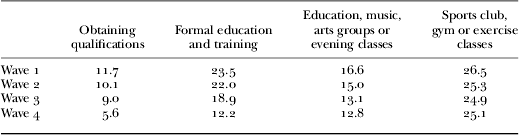
The proportion engaged in some form of learning was 49 per cent at Wave 1, declining to 40 per cent at Wave 4. So as the sample aged by approximately seven years between Wave 1 (2002) and Wave 4 (2009), learning participation declined. This decline was much steeper for formal learning than for informal learning. The proportion participating in formal learning fell from about 27 per cent at Wave 1 to just 14 per cent at Wave 4, while the proportion of informal learners also fell as the group aged, but the decline was much gentler, from 36 per cent at Wave 1 to around 32 per cent at Waves 3 and 4. The proportion engaged in each specific type of learning is shown in Table 1.
Percentages reporting each type of learning in the English Longitudinal Study of Ageing
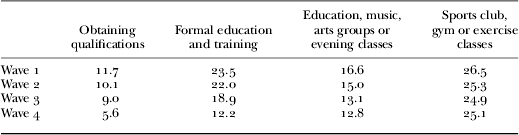
Notes: Values are weighted estimates. N=3,096.
In the first wave over a quarter participated in sports clubs and gym/exercise classes and this proportion fell only slightly over time; almost a quarter participated in formal education and training courses at Wave 1 but with a very substantial decline to only 12 per cent by Wave 4. The proportion doing education, music, arts groups or evening classes was nearly 17 per cent at Wave 1, falling to about 13 per cent by Wave 4. Few obtained qualifications, especially in later waves.
Method
We utilised regression models to examine the relationships between various types of learning activity, on the one hand, and the measure of subjective wellbeing, on the other. A cross-sectional multiple regression analysis would control for the effects of observable variables on wellbeing. However, there may be unobserved characteristics which could influence both the likelihood of participation in learning and wellbeing. For example, suppose that some well-motivated people are more likely to undertake courses and also happen to have high scores on wellbeing. Motivation as such was not measured in the dataset, and so could not be included in the analyses and might potentially bias the estimates of the effects of adult learning. The correlation between wellbeing and learning would be spurious – it has arisen solely because of the unobserved factor, motivation. To overcome this problem we apply fixed effect regression models to take account of all time-invariant observed and unobserved variables. This technique can only be used when several waves of data are available and so is the key advantage of utilising the longitudinal data from ELSA rather than a cross-sectional survey. This approach was applied to data from the first four waves of ELSA. The fixed effects method can handle two or more waves of data. It focuses on the deviation at each wave from the overall mean on each variable (Allison Reference Allison2009). Note that in fixed effects models, it is not possible to examine the impact of time-constant variables such as gender and ethnicity, or variables that change by the same amount for all respondents such as age. While longitudinal data has advantages it also has some drawbacks which need to be addressed. A common problem with longitudinal surveys is that people tend to drop out over time (attrition), so that the survey may become unrepresentative. The ELSA surveys are supplied with weights to ensure representativeness by adjusting for patterns of attrition. These weights were used throughout our analyses.
Limitations of the data
We considered using an overall health measure as an explanatory variable for subjective wellbeing. However, due to changes in the measure used, self-reported health in ELSA is not consistent across all four waves of the survey. In this paper we report results for all four waves of the survey and therefore omit self-reported health. Some alternative estimates which attempt to include self-reported health are reported in the Appendix. There was also an error in the coding of the questionnaire at Wave 3 of ELSA such that people were not asked in that wave about whether or not they had obtained a qualification since the previous wave. To overcome this we conducted an imputation exercise using regression modelling to predict whether someone obtained a qualification at Wave 3 or not. The Appendix also considers whether our results were sensitive to this imputation.
Results
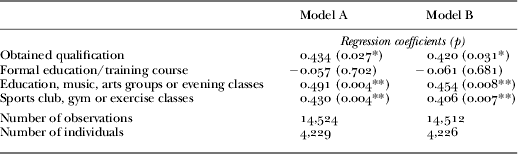
The results of fixed effects panel regressions of wellbeing outcomes on learning are presented in Table 2. All estimated models were weighted to adjust for attrition. In these models clearly things which do not change over time will drop out of the model as will factors such as age which change at the same rate for everybody. The simplest model (Model A) therefore contains only wave dummies as controls. In Model B we also control for some factors which do change over time, notably work status, as many in our sample made a transition to retirement during the observation period, and partnership status also. Controlling for these factors made only a slight difference to the results. For example, as can be seen in Table 2, the coefficient on the education, music, arts group and evening classes variable fell just slightly from 0.491 in Model A to 0.454 in Model B.
The effects of the four types of learning on wellbeing outcomes
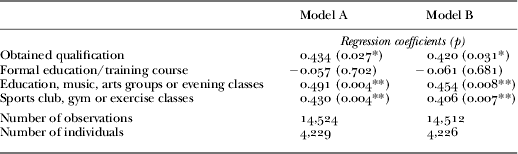
Notes: Fixed effects panel regression models applied to four waves of data from the English Longitudinal Study of Ageing. Both Models A and B include wave dummies; Model B also controls for partnership status and work status. Dependent variable: CASP-19 measure of subjective wellbeing.
Significance levels: * p<0.05, ** p<0.01, *** p<0.001.
The findings show strong evidence that both music/arts groups or evening classes, and gym/exercise classes and sports clubs had a positive and significant impact on wellbeing. The estimated magnitudes of the effects of each of these types of learning were similar at around 0.4–0.5 units of the CASP-19 score. There was also some evidence (statistically significant at the 5% level) that obtaining a qualification was positively associated with wellbeing. However, this result should be interpreted cautiously as we had to impute whether someone had obtained a qualification and there was some evidence (see the Appendix for details) that this result may be sensitive to this imputation exercise. Formal education/training courses were not significantly associated with the wellbeing outcome.
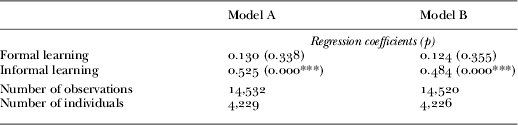
Results in which the various types of learning were aggregated into two broad categories of formal and informal learning are presented in Table 3. Once more there is a Model A which contained results without controls (apart from the set of wave dummies) and a Model B which also takes into account marital and work status as controls. It can be seen that the coefficients on formal learning were small and there was no evidence of any statistically significant impact on wellbeing outcomes. Informal learning, on the other hand, had a positive and significant (p<0.01) association with CASP-19 wellbeing outcomes, with participants in this type of learning estimated to gain approximately 0.48 additional points on their wellbeing outcomes.
The effects of formal and informal learning on wellbeing outcomes
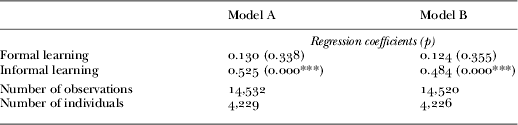
Notes: Fixed effects panel regression models applied to four waves of data from the English Longitudinal Study of Ageing. Both Models A and B include wave dummies; Model B also controls for partnership status and work status. Dependent variable: CASP-19 measure of subjective wellbeing.
Significance levels: * p<0.05, ** p<0.01, *** p<0.001.
Discussion
The results show that there was a statistical relationship between learning and subjective wellbeing. However, this applied only to certain types of learning. There was an association between informal learning and wellbeing even after controlling for other factors. In the analyses where types of learning were disaggregated participation in education, music and arts groups and evening classes, and participation in sports clubs, gym and exercise classes were both significantly and positively related to wellbeing. It might be wondered why this was the case, but quantitative results of the kind reported here cannot provide reasons why participation in informal learning would tend to enhance wellbeing. We might speculate that participation in informal learning would occur because of the intrinsic enjoyment of the subject and also sometimes because it provided opportunities for getting out and socialising. Indeed these messages are what emerge from the qualitative literature described earlier. It suggests that intrinsic interest in learning and/or in a specific subject, and meeting people are important reasons for learning at older ages. Older adults often appreciated learning because it helped them to be receptive to new ideas, to improve understanding and maintain a positive outlook.
As for the types of learning which we have described as formal learning, there was some evidence even after controlling for other factors that obtaining qualifications was associated with wellbeing, although relatively small numbers in the sample undertook qualifications, and there is some doubt about this result because of the need to impute data for the obtained new qualifications variable at Wave 3. There was no evidence that participation in formal education and training courses was related to wellbeing. These were vocational courses which did not lead to qualifications. Why did such education/training courses not increase wellbeing? These courses would have been undertaken principally for work-related reasons. It is possible that they would only boost wellbeing in the longer term if and when they led on to more satisfying work or promotion. Our analyses focus on changes in wellbeing over quite short periods of time, with waves of the ELSA survey usually about two years apart. Note also that participation in education/training courses was more widespread than the acquisition of qualifications. Hence when these two types of learning were combined into a formal learning variable, formal learning as a whole did not show any significant relationship with wellbeing.
Our quantitative models can be used to estimate the implicit effect sizes of informal learning on wellbeing. The magnitudes here can be regarded as quite modest when assessed, say, in terms of a standard deviation of the subjective wellbeing (CASP-19) score. However, research has consistently found that many variables only have small effects on wellbeing (Feinstein and Hammond Reference Feinstein and Hammond2004; Field Reference Field2009) so it is more relevant to compare the potential impact of learning with other factors which could influence wellbeing. Now the mean CASP-19 wellbeing score fell gradually over time by, on average, about half a point between each wave, from 43.7 at Wave 1 to 42.0 by Wave 4. Participation in informal learning would then be sufficient to offset this gradual decline in wellbeing. This suggests, therefore, that learning participation may have a useful role to play as a contributor to the wellbeing of older adults.
As well as encouraging participation in lifelong learning, policy makers have sought to ensure that access to it is available to all, including those in disadvantaged groups. So do all groups participate to a similar extent in learning at this later stage of the lifecourse, and therefore become equally likely to obtain such wellbeing benefits as may be obtained? The breakdown by gender revealed very similar levels of participation in some types of learning. The proportions acquiring qualifications were 11 per cent for males and 12 per cent for females at Wave 1, falling to 6 per cent for males and 5 per cent for females by Wave 4. Participation in formal education/training courses was 23.5 per cent for both males and females at Wave 1, dropping to 11.8 per cent among males and 12.6 for females at Wave 4. The major difference by gender was in participation in education/music/arts groups and evening classes where the participation rate was about twice as high for women as for men (21.1% for women and 11.5% for men at Wave 1, falling to 17.1% for women and 8.1% for men at Wave 4). Participation in sports clubs and gym exercise classes was also marginally higher amongst women (27.9% for women and 24.9% for men at Wave 1, falling slightly to 26.5% for women and 23.5% for men at Wave 4). Overall then, larger proportions of women were participating in the types of learning which we have found to be associated with increases in wellbeing.
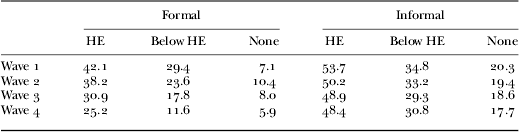
Some previous research on the activities of older adults has suggested that there are continuities between participation in cultural and social activities between younger and later life (Scherger, Nazroo and Higgs Reference Scherger, Nazroo and Higgs2011). Pursuing this logic would imply that the more highly qualified may be more likely to continue with learning participation later in life. So we considered prior education level as a predictor for participation in learning, by splitting the sample into three groups: those with higher education (HE) qualifications, those with qualifications below HE and those with no qualifications. The descriptive statistics for the balanced panel show that both informal and formal types of learning were lowest amongst those with no qualifications and greatest amongst those with HE qualifications (Table 4).
Percentages reporting participation in formal and informal learning, by highest qualification held, in the English Longitudinal Study of Ageing
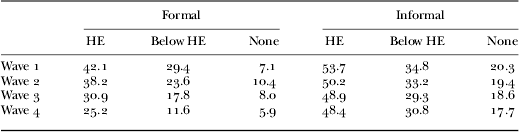
Notes: Values are weighted estimates. N=3,096. HE: higher education.
If highest qualification is considered as, essentially, a proxy for socio-economic status, then the lowest socio-economic groups were less likely to be participating in learning.
An analysis of whether benefits in terms of wellbeing differed by sub-group was also undertaken. In general, we found only small differences in sub-group analyses and these were, for the most part, not statistically significant. However, prior education was an exception. Here it emerged that, while those with higher qualifications and those with qualifications at a lower level both gained benefits from participation in informal learning, the wellbeing benefits for those with no qualifications were not statistically significantly different from zero. For the sub-group with no qualifications there was no evidence of a significant association between learning and wellbeing. This difference in the benefits derived from informal learning may help to explain the lower levels of participation in learning amongst those with no prior qualifications.
Conclusion
This paper has described research results on participation in learning and wellbeing for adults in the Third Age. We used longitudinal data on a sample of people aged 50–69 at Wave 1 of ELSA in 2002 and followed their learning participation and wellbeing to Wave 4 of ELSA in 2009. Fixed effect panel regression models were fitted to these four waves of ELSA data in order to take account of factors which might influence wellbeing.
The analysis distinguished between formal and informal learning. Formal learning was defined as obtaining qualifications and/or participation in formal education/training courses. Informal learning consisted of, firstly, participation in education, music and arts groups and evening classes, and secondly participation in sports clubs, gym and exercise classes. Learning was associated with higher wellbeing after controlling for a range of other factors.
We found evidence that informal learning was associated with higher wellbeing. There was also some evidence that obtaining qualifications was also linked to higher wellbeing but no evidence that formal education/training courses were associated with higher wellbeing.
It should be acknowledged that our study does have its share of limitations. We have already noted some imperfections of the data. These include the changing definition of self-reported health and the lack of information on whether respondents gained a qualification in the third wave of the ELSA study. These issues clearly are a concern for the robustness of the findings, although the further work reported in the Appendix suggests the results are not particularly sensitive to alternative ways of tackling these data limitations.
In seeking to test for an association between wellbeing and participation in learning, we have adopted a method which allows for potential confounding factors. Through the use of longitudinal data and a fixed effects methodology we were able to control for both observable and unobservable factors. That is the main strength of the method employed in this paper. A potential limitation of this method is that it does not allow for reverse causality. We are not aware of any well-established theory which would suggest that wellbeing has an effect on the likelihood of participating in learning but, nonetheless, it remains a possibility and one which, in the absence of experimental data, cannot be ruled out.
The limited amount of previous research, and especially the lack of quantitative analysis, on the relationship between learning and the wellbeing of older adults was highlighted in the literature review. The purpose of our study was to contribute to the filling of that gap using data on older adults in England. But there is clearly a need for further quantitative analyses of relationships between learning and wellbeing of older adults using other datasets and covering other countries in order to expand the evidence base. The scope for cross-national quantitative research may continue to be limited by the lack of good data. Many surveys do not include data on older adults. For example, the recent OECD Programme for the International Assessment of Adult Competencies (PIAAC) survey contains lots of information on adult learning but stops at age 64. A notable international survey of older people, the Survey of Health, Ageing and Retirement in Europe (SHARE), has good data on wellbeing, including a version of the CASP measure, but contains very limited information on learning indeed. So any further quantitative studies are likely to utilise national-level data sources rather than cross-national ones.
The results in this paper provide evidence which supports the potential role of participation in learning to contribute to the subjective wellbeing of older adults. They highlight that it is the informal type of learning which may be most relevant in this phase of the lifecourse. This is an important point to bear in mind when policy towards adult learning often tends to concentrate mainly or solely on vocational training and the development of human capital.
Acknowledgements
The research on which this article is based was funded by the Department for Business, Innovation and Skills (DBIS). We are grateful to DBIS for funding the research. The views expressed in this paper are solely those of the authors and do not necessarily reflect those of DBIS.
Appendix
Here we report on how data limitations were addressed and the extent to which they appear to affect the main findings.
A1. Imputation of whether obtained a qualification in Wave 3
As noted in the main text of the paper, there was an error in the coding of the questionnaire at Wave 3 of ELSA such that people were not asked in that wave about whether or not they had obtained a qualification since the previous wave. To overcome this we conducted an imputation exercise using regression modelling to predict whether someone obtained a qualification at Wave 3 or not.
Details of the imputation exercise
Some modelling was conducted on the determinants of obtaining a qualification in Wave 2 of the ELSA survey. A logistic regression model was estimated with obtaining a qualification as the response variable. Obtaining a qualification (at Wave 2) was found to be closely related to participation in formal education/training courses. Other statistically significant determinants were found to be: age, highest qualification level and whether obtained a qualification at Wave 1, marital status, score on a measure of depression (CES-D) and wealth decile. A logistic regression containing all of these variables was estimated on Wave 2 data. This model was then applied to Wave 3 data to generate predictions of the probability of obtaining a qualification at Wave 3. Cases with a high probability (greater than 0.3) were imputed to have obtained a qualification at Wave 3.
Sensitivity of the main results to imputation
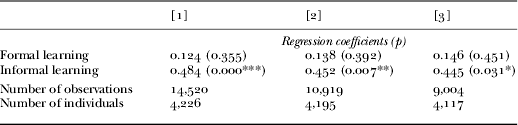
We considered the sensitivity of the results by re-running models without Wave 3 data. Referring to Table A1 and comparing column [1], which reproduces the main results for all four waves of data with column [2] which presents results omitting Wave 3 data, it can be observed that results do not appear to have been much affected by imputation. The coefficients on both formal learning and informal learning were essentially unchanged and, although the significance level of the informal learning variable was slightly lowered by the reduction in sample size of omitting Wave 3, it remained highly significant.
Regression models for the effects of formal and informal learning on wellbeing outcome (CASP-19): checking omission of Wave 3 data and addition of self-reported health
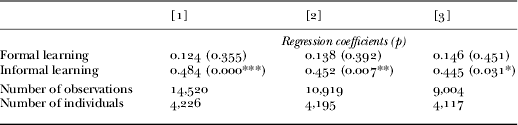
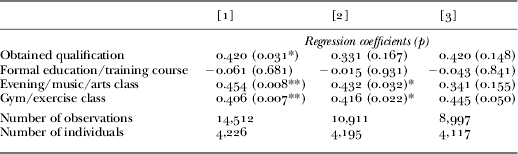
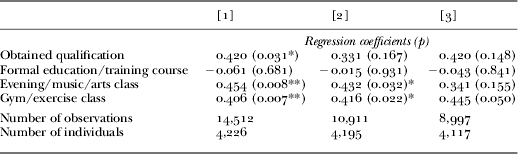
In Table A2 results are shown for the more disaggregated analyses of different types of learning. Again, in order to consider whether imputation of Wave 3 data had any influence on results, the relevant comparison is between columns [1] and [2] of the table. Here it seems that omitting Wave 3 made little or no substantive difference to the results for the education, music, arts and evening classes category of learning or to the sports club, gym and exercise classes category. However, the coefficient on the obtaining qualifications variable declined markedly when Wave 3 data were omitted and it became non-significant. This suggests the need for some caution when interpreting the impact on wellbeing of participation in courses which led to qualifications as results may be somewhat sensitive to the fact that, in one wave of the data, the variable was imputed rather than observed.
Regression models for the effects of types of learning on wellbeing outcome (CASP-19): checking omission of Wave 3 data and addition of self-reported health
A2. Self-reported health
It is debateable whether measures of overall health, such as self-reported health status, should be regarded as an independent variable which influences wellbeing. Some would regard it as an alternative measure of wellbeing and it has been used in this way in many analyses of subjective wellbeing (Betts Adams, Leibbrandt and Moon Reference Betts Adams, Leibbrandt and Moon2011). Nonetheless, we considered including it as an explanatory variable for our wellbeing outcome. However, the measure of self-reported health in ELSA is not consistent across all waves of the survey and therefore self-reported health was omitted from our analyses. In Wave 1 of ELSA there were two self-report health variables: ‘hegenh’ (also used in the HSE) and ‘hehelf’ (also used in the Health and Retirement Survey, USA). In Wave 2 ‘hehelf’ was used alone and in Wave 3 ‘hegenh’. In Wave 4 it reverted to ‘hehelf’. So, if one wants to include self-reported health in panel models then the simplest approach is to leave out all data from Wave 3, and just analyse data from Waves 1, 2 and 4.
In the main text of the paper, we reported results using data for four waves of the survey. By omitting data from Wave 3 we were able to include a self-reported health variable in the models. The variable was statistically significant but the main interest here is in whether controlling for (changes in) health status has any influence on our main findings with regard to the relationship between learning and wellbeing. In Table A1 the last column both omits all Wave 3 data and includes the self-reported health variable. It can be seen that there is a very large reduction in the number of observations compared to column [1]. This contributes to some weakening of statistical significance. Nonetheless the results remain broadly similar. The coefficients are more or less unchanged, and formal learning remains non-significant while informal learning is statistically significant. In Table A2, for more detailed categories of learning, when we include self-reported health, the statistical significance of the learning variables declined and most were not significant, with the exception of the membership of sports club/gym/exercise classes which was just significant at the 5 per cent level. This could indicate the importance of controlling for self-reported health status, but it could also be due to the substantial loss of sample size or because of the high correlation between health status and wellbeing.