Introduction
The date palm tree, Phoenix dactylifera L. (Arecaceae), is the oldest cultivated plant (Lee, Reference Lee1963). Of the many insect pests that attack date palm trees, the red palm weevil (RPW), Rhynchophorus ferrugineus (Olivier) (Coleoptera: Curculionidae), is the most important. Since the mid-1980s, the RPW has caused severe damage to date palm trees in several Middle Eastern countries (Abozuhairah et al., Reference Abozuhairah, Vidyasagar and Abraham1996). Initial attempts to control RPW in the Kingdom with insecticides were unsuccessful (Bokhari and Abozuhairah, Reference Bokhari and Abozuhairah1992). The RPW has been managed with integrated pest management (IPM) strategy since 1994 in the date plantations of Saudi Arabia (Abraham et al., Reference Abraham, Al-Shuaibi, Faleiro, Abozuhairah and Vidyasagar1998). Use of pheromone traps was the cornerstone in IPM strategies used to capture and kill the males and females and prevent the reproduction of the pest (Abraham and Kurian, Reference Abraham and Kurian1975; Faleiro and Chellapan, Reference Faleiro and Chellapan1999; Abraham et al., Reference Abraham, Faleiro, Al-Shuaibi and Al Abdan2001; Kaakeh et al., Reference Kaakeh, El-Ezaby, Abu-Al-Nour and Khamis2001; Al-Saoud, Reference Al-Saoud2006; Al-Saoud, Reference Al-Saoud2013). The food bait and pheromone act synergistically to attract adults of RPW (Oehlschlager, Reference Oehlschlager1998; Hallett et al., Reference Hallett, Oehlschlager and Borden1999; Vidyasagar et al., Reference Vidyasagar, Al-Saihati, Al-Mohanna, Subbei and Mohsin2000; Al-Saoud, Reference Al-Saoud2007). The state or farmers can implement this efficacious component of the IPM programme on a large scale either alone or on a collective basis. Scientists began working to develop ways to increase the effectiveness of the aggregation pheromone traps used to catch RPWs, as many factors were affecting trap effectiveness. These factors included: colour (Hallett et al., Reference Hallett, Oehlschlager and Borden1999; Ajlan and Abdulsalam, Reference Ajlan and Abdulsalam2000; Kalleshwaraswamy and Jagadish, Reference Kalleshwaraswamy and Jagadish2006; Al-Saoud et al., Reference Al-Saoud, Al-Deeb and Murchie2010); trap design (Rajapakse et al., Reference Rajapakse, Gunawardena and Perera1999; Hoddle and Hoddle, Reference Hoddle and Hoddle2011; Avalos and Soto, Reference Avalos and Soto2013); food bait (Nair et al., Reference Nair, Abraham and Nair2000; Kurian et al., Reference Kurian, Abraham and Ponnamman1984; Kalleshwaraswamy and Jagadish, Reference Kalleshwaraswamy and Jagadish2006; Al-Saoud, Reference Al-Saoud2011b); trap sites (Faleiro, Reference Faleiro2004; Al-Saoud, Reference Al-Saoud2011a); and trap height (Kalleshwaraswamy and Jagadish, Reference Kalleshwaraswamy and Jagadish2006; Al-Saoud, Reference Al-Saoud2010). Our field observations showed stirring the aggregation pheromone trap contents increased the number of RPWs captured, compared with the numbers caught in the traps that remained without stirring. We conducted this study to determine the role of weekly stirring of the contents of the white and brown RPW aggregation pheromone traps, on the numbers of captured weevils.
Materials and methods
Study sites
The experiment was conducted in five RPW infested date plantations at Al-Rahba, Abu Dhabi (Lat. 24°28′N; Long. 54°22′E), United Arab Emirates (UAE) from May 2010 to April 2011. Each farm contained at least 140 date palm trees of different ages.
Traps and treatments
Pheromone traps were fabricated using an 8 L polypropylene bucket with four rectangular (3 × 7 cm) windows cut equidistantly below the upper rim of the bucket. The distance between each window and the bottom of the bucket was 16 cm. The bucket was covered with a lid that had four windows similar to the ones on its sides. The outer surface of the bucket was rough with a small projection (1–2 mm) to help the weevils climb the trap and enter. The upper surface of the lid had a small handle to make it easier to open the trap, and the lower side had a small knob to which a wire was fixed to hold the pheromone and ethyl acetate (EA) dispensers. Each trap contained the following materials: (i) dispenser of the RPW male aggregation pheromone (Ferrolure™) containing 700 mg of the active ingredient (4-methyl-5-nonanol 90% + 4-methyl-5-nonanone 10%) at 95% purity; (ii) EA dispenser (Weevil Magnet™) containing 40 ml of the active ingredient of EA at 98% purity; (iii) 350 gm of fodder date fruits; and (iv) 4 L of water, with a water level inside of 4–5 cm below the windows.
Water in the traps was replenished weekly to keep sufficient moisture. Food bait (dates) was changed once a month, while the new pheromone lure was added every 45 days during the cold period (October–April) and every month during warmer months (May–September), to sustain the trapping efficiency. Traps were placed on the ground near the trunks of palm trees. The number of weevils captured (male, female) were recorded weekly. A perforated ladle was used to collect the trapped weevils and the traps’ contents thoroughly shaken to prevent the growth of any fungi/mould. Collection and recording of captured weevils (male, female) was carried out weekly as recommended by Al-Saoud (Reference Al-Saoud, Zaid and Alhadrami2014). Every trap in the treatment was rotated after taking weekly results, to avoid location effect on collected insects as recommended by Faleiro et al. (Reference Faleiro, Ashok and Rangnekar2002), Al-Saoud (Reference Al-Saoud2006) and Al-Saoud (Reference Al-Saoud2010).
The choice of trap colour in this trial was based on our previous experience, as we had seen that superior captures were recorded in dark colour traps (black, brown and red traps) compared to traps with lighter colour shades (Al-Saoud et al., Reference Al-Saoud, Al-Deeb and Murchie2010). Hence, we selected brown traps for this study along with the commonly used white (control) RPW pheromone traps in UAE.
Experimental design and statistical analysis
The experimental design was a randomized complete block design with four treatments and five replicates (5 date palm farms), where each farm constituted a single replication. All the experimental sites had the above four treatments and serial numbers were assigned to each trap (1–4) at each of the five test sites. A monthly record of the number of weevils trapped in the 20 (N) pheromone traps was maintained for the study period (May 2010–April 2011). Trap capture data were subjected to analysis of variance (ANOVA).
Results
Activity of red palm weevil in the date palm plantations at Al-Rahba (Abu Dhabi) during May 2010 to April 2011
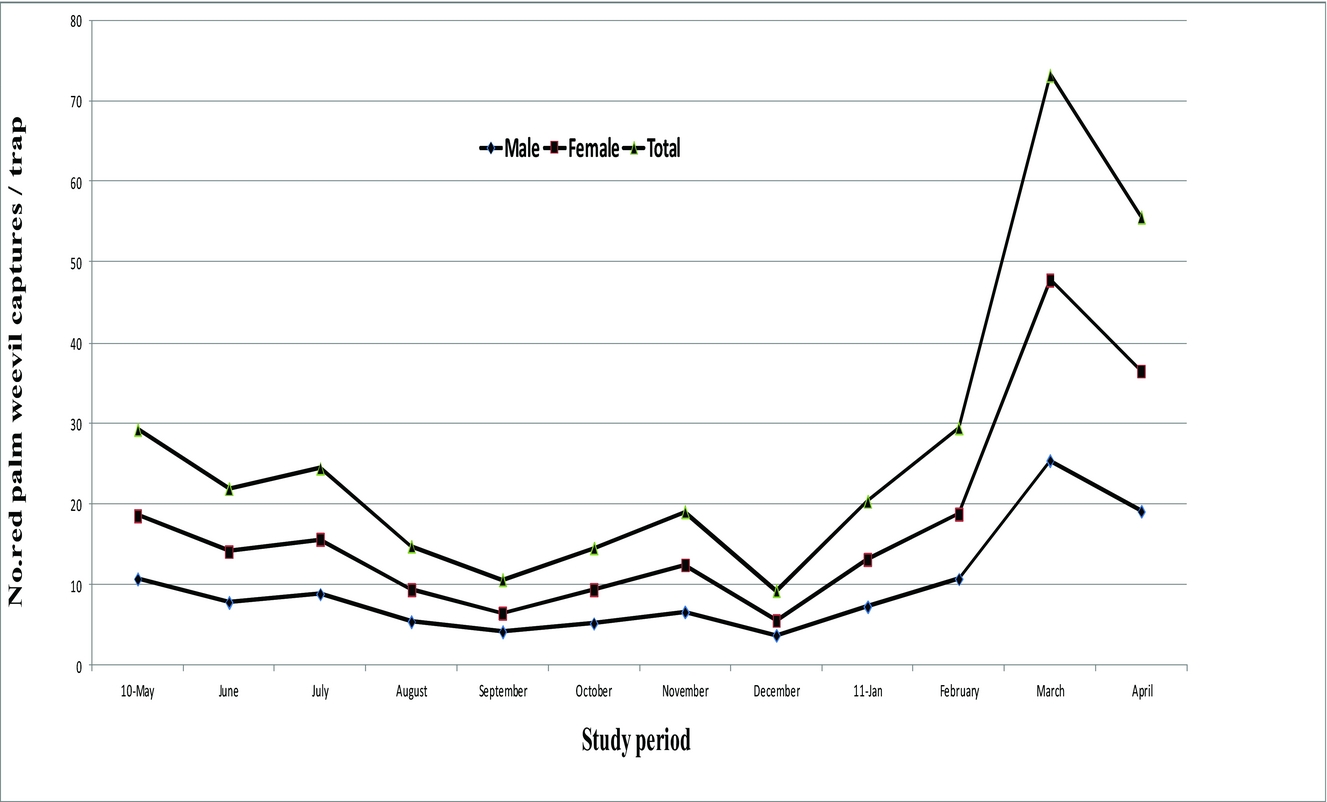
The results presented in Figs. 1 and 2 show that the RPW was present throughout the study period, but the numbers of the captured weevils changed. The highest numbers captured in the food-baited pheromone traps was 73.20 and 55.60 weevils/trap during March and April (peak of flowering period of date palm trees), respectively, compared with capture rates of 9.25 and 10.60 weevils/trap during December and September, respectively.
Activity of red palm weevil, Rhynchophorous ferrugineus at Al-Rahba (UAE) from May 2010 to April 2011.

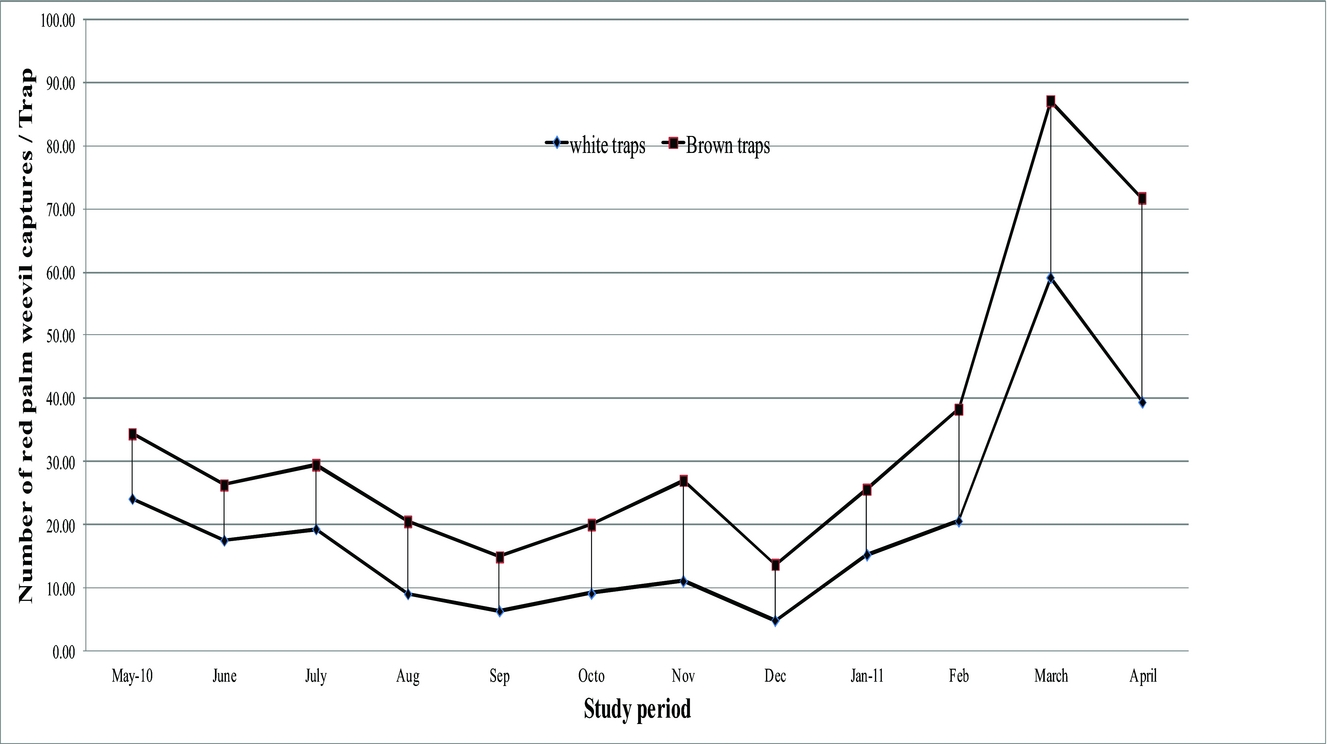
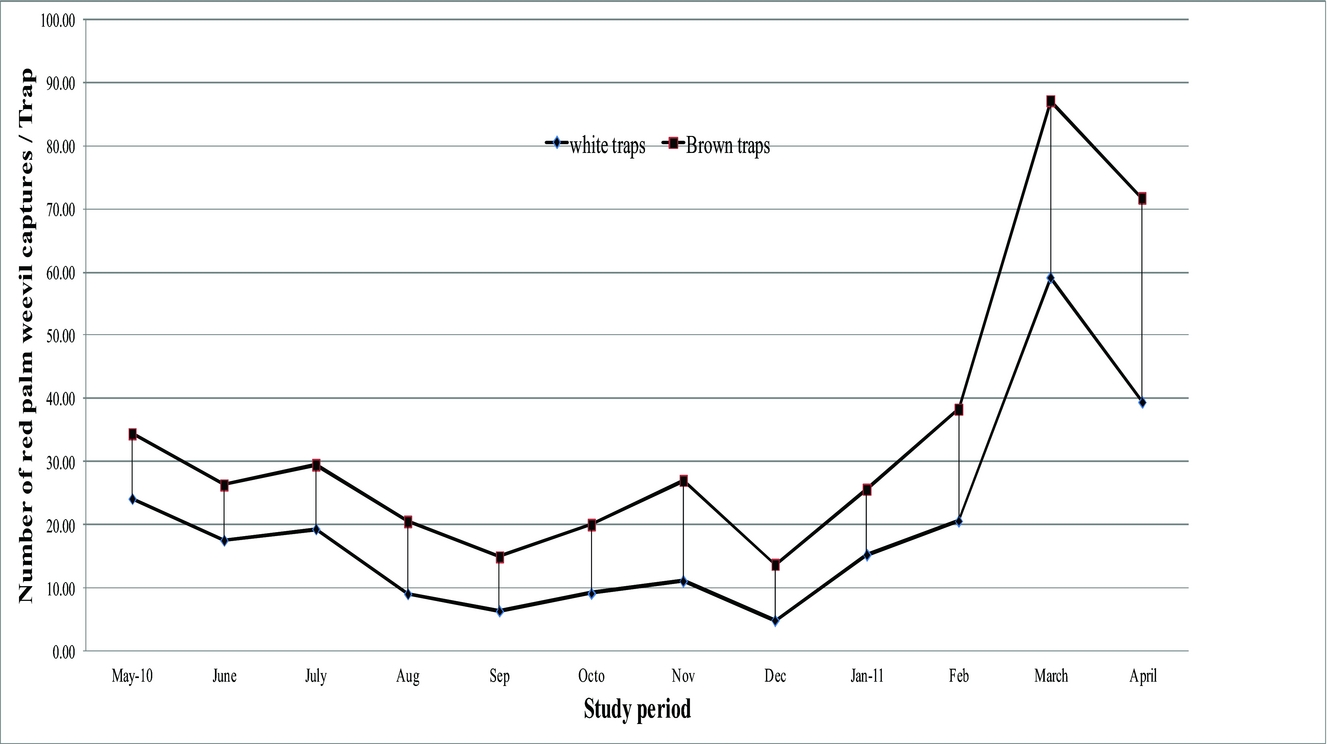
Number of red palm weevil, Rhynchophorous ferrugineus captured in white and brown aggregation pheromone traps at Al-Rahba (UAE) from May 2010 to April 2011.
The number of females was higher than the numbers of males captured in the traps for all the months of the study (Fig. 1).
Sex ratio of red palm weevil
The total number of RPW adults captured in all pheromone traps was 6448 (2297 males and 4151 females), with a sex ratio of 1:1.81 male:female. The sex ratios were 1:1.73, 1:1.85, 1:1.84 and 1:1.76 in the white traps, brown traps, traps with stirred contents and traps without stirred contents, respectively.
Effect of red palm weevil trap colours on the number of captured weevils
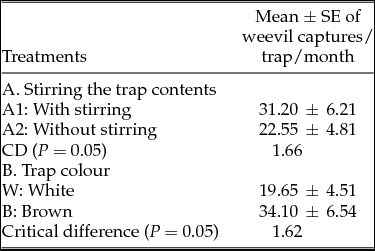
The brown traps captured 4091 RPWs, while the white traps captured 2357. Brown traps recorded statistically higher (P = 0.05) captures of 34.10 ± 6.54 weevils/trap/month as compared to 19.65 ± 4.51 weevils/trap/month in the commonly used white coloured pheromone trap in UAE (Table 1). The results show that the brown traps recorded higher numbers of captured weevils in all the months of the study (Fig. 2).
Effect of trap colours and stirring of the contents on captures of Rhynchophorus ferrugineus in food-baited pheromone (Ferrolure™) traps

Effect of stirring the contents of red palm weevil traps on the number of captured weevils
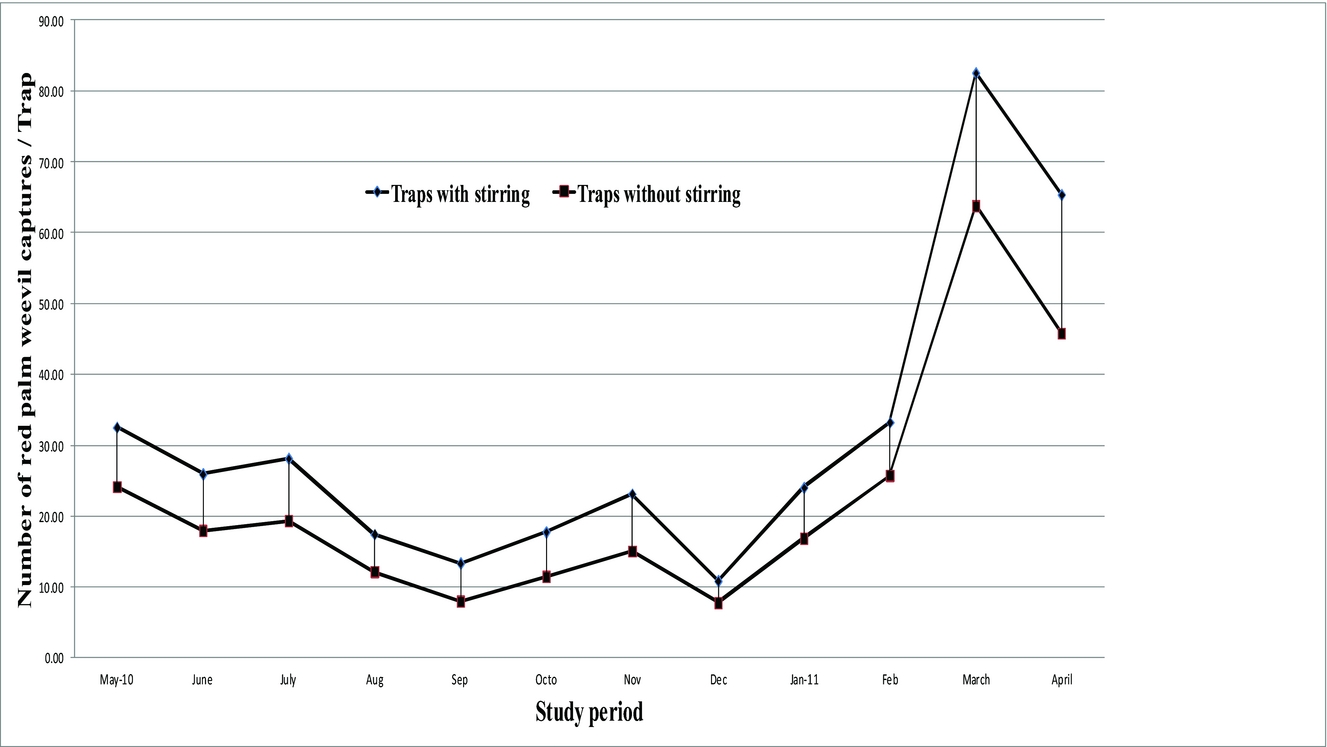
The numbers of captured weevils were 3741 and 2707 in the traps with stirring and in the traps without stirring of the contents, respectively. The results in Fig. 3 demonstrate that the traps with stirred contents recorded statistically more (P = 0.05) captured weevils throughout the study period. The overall means of captures were 31.20 ± 6.21 and 22.55 ± 4.81 weevils/trap/month in the traps with and without stirring of the contents, respectively (Table 1).
Effect of stirring the contents of pheromone traps on the numbers of Rhynchophorous ferrugineus captured at Al-Rahba (UAE) from May 2010 to April 2011.

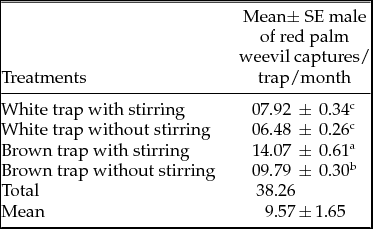
Effect of the red palm weevil trap colours and stirring the contents on the numbers of males captured
Table 2 shows highly significant differences (P < 0.05) between the numbers of males of RPW captured in these different treatments. The brown traps with stirred contents recorded the highest number of captures at 14.07 ± 0.61 weevils/trap/month and were superior to the other three treatments, followed by the brown traps without stirred contents, which recorded 9.79 ± 0.30 weevils/trap/month. The white traps with and without stirred contents recorded statistically non-significant captures of 07.92 ± 0.34 and 06.48 ± 0.26 weevils/trap/month, respectively.
Effect of trap colours and stirring of the trap contents on the mean monthly captures of Rhynchophorus ferrugineus males in food-baited pheromone (Ferrolure™) traps

Means with similar letters are not significant different (P ≥ 0.05; Tukey's test, ANOVA).
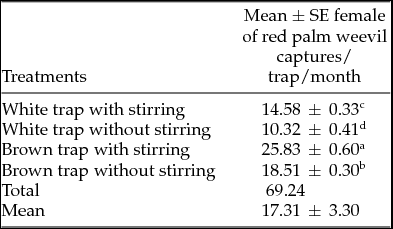
Effect of the red palm weevil trap colours and stirring of contents on the numbers of females captured
Table 3 shows highly significant differences between the numbers of females of RPW captured in these different treatments. All treatments were superior to the white traps without stirring of the contents, which recorded the lowest mean of captures, 10.32 ± 0.41 weevils/trap/month. The brown traps with stirred contents recorded the highest number of captures, 25.83 ± 0.60 weevils/trap/month and was better than the other two treatments, followed by the brown traps without stirred contents, which recorded 18.51 ± 0.30 weevils/trap/month.
Effect of trap colours and stirring of the trap contents on the mean of Rhynchophorus ferrugineus females captured in food-baited pheromone (Ferrolure™) traps

Means with similar letters are not significant different (P ≥ 0.05; Tukey's test, ANOVA).
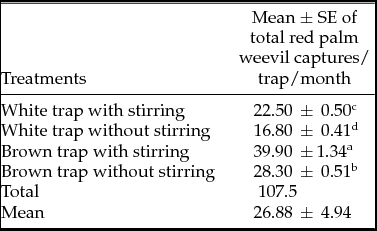
Effect of the red palm weevil trap colours and stirring of contents on the numbers of captured weevils
The results in Table 4 show highly significant differences (P < 0.05) between the numbers of RPW captures in these different treatments. The white traps without stirred contents recorded the lowest mean of captures; 16.80 ± 0.41 weevils/trap/month. The brown traps with stirred contents treatment recorded the highest number of captured (39.90 ± 1.34) weevils/trap/month and was superior to other two treatments, followed by the brown traps without stirred contents, which recorded 28.30 ± 0.51 weevils/trap/month. The white traps with stirred contents treatment occupied the third position and recorded 22.50 ± 0.50 weevils/trap/month.
Effect of trap colours and stirring the contents on the mean monthly captures of R. ferrugineus in food-baited pheromone (Ferrolure™) traps

Means with similar letters are not significantly different (P ≥ 0.05; Tukey's test, ANOVA).
Discussion
Bucket-traps have been used for mass trapping and monitoring the RPW. Figure 1 reveals that the highest catch of RPWs in the food-baited pheromone traps was during March and April (peak of the flowering period of date palm trees). Perhaps the RPWs are attracted to the smell emitted by palm flowers, as their numbers increased during this period; hence, further studies are warranted to determine the role of the scent emitted from the date palm tree flowers on the RPW. These studies may be helpful to improve the effectiveness of the traps. The results agree with those of Hallett et al. (Reference Hallett, Oehlschlager and Borden1999), El-Ezaby et al. (Reference El-Ezaby, Khalifa and El-Assal1998), Al-Saoud (Reference Al-Saoud2006) and Al-Saoud (Reference Al-Saoud2009a). Still, in Saudi Arabia, Abraham et al. (Reference Abraham, Faleiro, Prem Kumar and Al-Shuaibi1999) found high weevil activity in April to November 1995, yet in 1996 they got two peaks of activity (one in May to June and the other in October). Nonetheless, in 1997, the two zeniths were found in May and September.
The number of females was higher than the number of males captured in the traps for all months of the study (Fig. 1). Abraham et al. (Reference Abraham, Faleiro, Prem Kumar and Al-Shuaibi1999), Vidyasagar et al. (Reference Vidyasagar, Al-Saihati, Al-Mohanna, Subbei and Mohsin2000), Faleiro and Rangnekar (Reference Faleiro and Rangnekar2000), Faleiro and Satarkar (Reference Faleiro and Satarkar2003), Al-Saoud (Reference Al-Saoud2009b) and Al-Saoud and Ajlan (Reference Al-Saoud and Ajlan2013) found similar results.
Many factors affected the effectiveness of RPW traps, and the stirring of the trap contents was found to be one of these factors. Stirring the substances may increase the fermenting of the date fruits, the number of odours released and attraction of RPWs to these traps. Guarino et al. (Reference Guarino, Bue, Peri and Colazza2010, Reference Guarino, Peri, Lo Bue, Pulizzi and Colazza2011) found that the traps charged with ethyl propionate alone or with ethyl propionate (in combination with EA) gave better synergy in food-baited RPW pheromone traps than EA alone. They also found that the adults of RPW responded to all the synthetic palm esters with responses increasing at cumulative doses. The results in Table 3 show that both trap colours significantly influenced weevil capture in food-baited RPW pheromone traps. The brown traps captured more weevils compared with white traps (Table 1). Stirring the trap contents increased capture rates, and the traps with stirred contents recorded statistically higher (P = 0.05) rates of weevil capture compared with the traps without stirred materials (Table 1).
Conclusion
These results demonstrate that it is necessary to use brown traps and stir the trap contents periodically to increase the traps’ effectiveness. More studies could be done to improve the efficacy of this ecologically safe and environmentally friendly tool in IPM strategies adapted worldwide for RPW management.
Acknowledgements
I thank all my friends who helped me during my work, notably Engineer Nasser Sultan, and all other engineers at Al-Rahba Extension Center, for their efforts in providing necessary facilities in the date palm tree farms at Al-Rahba Province.