A number of studies show that a resource curse exists—that is, they demonstrate that relatively large natural resource endowments exert negative effects on political institutions. Both case studies and analyses based on data drawn from large numbers of countries across long periods of time show that individuals are less able to hold their leaders accountable if they live in countries blessed by abundant natural resources than if they reside in less well-endowed nations. In contrast to conventional wisdom, then, at least some types of wealth undermine rather than accelerate the development of democratic political institutions.
The existing literature, however, suffers from two problems that cast doubt on their conclusions about the resource curse. First, contributors to it cannot disentangle two very different mechanisms: (1) changes in resource income produce changes in political institutions, and (2) shifts in governments' policies explain variations in resource revenues. For example, oil prices rise when political leaders either consolidate their power (Russia and Venezuela) or pursue more radical policies (Iran). It is also true, however, that rising prices can enable leaders to abandon moderate policies, postponing, for example, the pursuit of market-oriented economic reforms (Tehran in the late 1990s). Second, doubts about the relationship between the right- and left-hand side variables also exist because it is not possible to control for unmeasurable or unmeasured covariates that affect political institutions.
In this article, I use an instrumental variable approach to resolve both problems. A valid instrument—that is, a variable that is correlated with the key independent variable but uncorrelated with the error term—can resolve the problems that measurement error, omitted variable bias, and simultaneous causation create (the last is sometimes referred to as “endogeneity bias” in the political science literature).Footnote 1 The instrument I use is the occurrence of natural disasters. More specifically, I measure the “out of region damage” that five types of natural disasters inflict on oil-producing countries.
The validity of this instrument, as I will discuss in more detail, comes from the fact that an earthquake in Mexico, for example, does not influence regime characteristics in Saudi Arabia other than through its effect on the price of oil. Similarly, a mud slide in Columbia has no effect on the political regime in Cameroon, except for its impact on world oil prices. As such, using the natural disaster instrument makes it possible to estimate the causal effect of changes in oil revenue on politics.
Using annual data on natural disasters and oil-producing nations between 1968 and 2002, I find that increasing oil income exerts a negative, statistically significant, and much larger impact on democracy than ordinary least-squares (OLS) regression analyses imply. This finding is robust to including controls for per capita gross domestic product (GDP), past political institutions, economic growth, and a number of other variables.
These results show that variation in world resource prices have important implications for the theory of development and the resource curse. First, I show that, controlling for oil resource wealth, variation in income from oil has a significant effect on the political environment. Second, this income effect implies that the politics of resource countries are tied to the markets for their primary goods and that dynamic market factors that influence income streams from oil are thus an important and neglected piece of the political puzzle in oil countries.
As in the resource curse literature more generally, the results in this study are relevant not only to students of development but also to policymakers. While the strategic advantages that accrue from green policies that reduce demand for oil are well recognized, these policies might also accelerate the development of democratic polities in developing countries, increasing both national and global welfare.
I begin below by briefly reviewing the results of existing studies.
Prices and Polities: The Existing Literature
Both political scientists and economists have examined the relationship between resource wealth and economic growth and development.Footnote 2 As Clark notes, the discovery of off-shore oil in 1969, along with the boom that resulted from the production shocks of the early 1970s, gave a boost to Marien Ngouabi's efforts to consolidate his control over the Republic of Congo.Footnote 3 Similar studies of petro-politics in Gabon and Cameroon suggest the same result.Footnote 4
Recent studies of the same issue using large cross-national data sets also find that oil income and democracy have a robust and inverse statistical association.Footnote 5 Ross, analyzing panel data across 113 countries from 1971 to 1997, finds that oil revenues, measured by the ratio of mineral-based fuel export to GDP, have a statistically significant negative effect on a country's political institutions. Similarly, Wantchekon reports that “a crucial determinant of many Third World political regimes is their level of dependence on natural resource revenues.”Footnote 6 In a follow-up paper, Wantchekon, along with Jensen, focuses on a subset of African nations. They find that countries in which executives control the distribution of resource rents have less democratic political regimes.
Natural resource wealth is also central to research on political development and democratization. In recent studies by Boix and Acemoglu and Robinson, shocks to resource wealth help to explain regime shifts.Footnote 7 In other analyses by Dunning and Smith, resource income plays a critical role in explaining the political economy of institutional development.Footnote 8
The research that most closely resembles my study is Tsui's.Footnote 9 Tsui, interested in the long-term effect of discovering oil, uses oil discoveries as an instrument for oil wealth. While he is also concerned about issues of identification, his interest is in the long-term effect of discovering resource wealth on democracy. Thus, he analyzes long-term changes in political freedom, using thirty-year differences in Polity IV scores.
Data
In the analysis are the forty-eight countries that British Petroleum (BP) reports have produced a nonnegligable amount of oil for at least some subset of the years between 1968–2002.Footnote 10 I use the 2005 World Development Indicators to record per capita GDP and GDP growth rates.Footnote 11 All values are expressed in constant 2000 US dollars. I measure per capita oil income for a given country as the product of the average daily spot price of crude oil (as reported by BP's statistical review 2005Footnote 12) and a country's annual production for that year (in barrels) divided by the population.Footnote 13 The spot price time series is the yearly average for Arabian Light set at Ras Tanura from 1968–83, then the Brent dated price from 1984–2002.
The latter measure is somewhat controversial. For example, Herb uses oil revenues as a percent of total state revenues.Footnote 14 Haber and Menaldo examine per capita windfall profits from resources.Footnote 15 Each measure addresses some issues that arise from using the value of oil and mineral exports, but for present purposes they also have limitations. First, tracking accurately what share of oil revenues are at the discretion of a leader depends on being able to decipher nonstandard accounting procedures, determine whether nonstate oil revenues are really nonstate, and capture the political value of domestic market manipulations generated via dumping oil to keep domestic market prices low. I keep the analysis simple and focus, therefore, on a measure of the world market value of production as the total value of a country's oil income.
I use three measures of political regimes. I construct the principal indicator by subtracting the annual Polity IV autocracy score from the democracy score. This variable ranges from −10 to 10, with −10 being the least democratic and 10 being the most democratic.Footnote 16 The democracy score variable is then just the 11-point democracy scale that makes up part of the Polity composite score. I normalize these and other measures of democracy so that the scores lie between 0 and 1, with 0 being least democratic and 1 being most democratic. The results I report below are robust to other measures, like various Freedom House scores.Footnote 17
The instrumental variable, out of region disaster damage for oil-producing nations, relies on publicly available disaster damage estimates.Footnote 18 They include damage totals from five classes of natural disasters: earthquakes, mudslides, windstorms and hurricanes, volcanos, and waves and surges. While data are available on other disaster types, I include these five types for two reasons. First, the damage they inflict are unlikely to be correlated with regime type or quality unlike industrial and transportation accidents, famines, and epidemics. In fact, many of the most severe natural disasters in the five classes considered occur in the developed world (for example, Hurricane Katrina in the United States and the 2011 tsunami in Japan).Footnote 19 Second, they also have the most plausible link to oil markets because they are physically powerful and have the ability to damage drilling and transportation infrastructure and, thus, prices.
Regression Estimates
Table 1 reports the results of an OLS regression of the normalized Polity IV composite score on the log of oil income per capita and a series of controls. The equation I estimate here is:

where Democracy it is country i's Polity score in year t, X it is a vector of “control” covariates that include a series of year fixed effects to control for time trends, and ɛit is a random disturbance. β is the coefficient on the key variable, measuring the effect of oil income per capita on democracy.
OLS regression: Measures of political freedom on oil revenues

Notes: *Pooled ordinary least squares (OLS), 1968–2002. Each regression includes year fixed effects.
In Table 1, column (1) shows the statistical association between the log of annual oil income and the Polity composite score. It is negative and statistically significant.
Many scholars argue that per capita income, growth, past political institutions, or some combination of them affect domestic political institutions.Footnote 20 To control for these potential effects, I report in columns (2) to (4) regression results that include log gdp per capita, gdp growth, and the normalized Polity score for each country when it enters the data set (polity at entry). The polity at entry variable ensures that there is within country variation over the time-series to be explained.Footnote 21
The coefficients on the control variables are consistent with prior research. Per capita GDP has a substantial positive association with higher Polity scores. GDP growth has a negative association, consistent with the claim that strong economic growth lowers the demand for political accountability. A strong positive correlation exists between previous characteristics of a regime, captured by the measure of the Polity score at entry into the data set, and its current characteristics. The association between oil income per capita and political institutions remains negative and significant, consistent with previous research.
Finally, columns (5) and (6) of Table 1 record the results of a replication of these analyses using alternative measures of political institutions (that is, the normalized 10-point democracy score and the normalized Freedom House measure of political rights).Footnote 22 The direction and magnitude of the effects are consistent with the coefficients in the first four columns.
It is interesting to note that the results in Table 1 show a weak correlation between oil revenues and Polity scores within the set of oil-producing nations, particularly when controlling for past institutions. This seems consistent with some criticisms of the political resource curse literature, especially the argument that the large effect found in previous studies is attributable to the variation between oil and nonoil countries rather than to the variation in political institutions within the set of oil producers.
There are several reasons for skepticism on this score, however. First, less democratic countries often have less stable polities and a higher risk of political unrest than other countries. Oil markets often react to these dangers, bidding up prices. In these cases, increases in oil income—as a result of increasing crude oil prices—could precede political change, attenuating any real effect.Footnote 23 Equally important, many variables that cannot be measured affect the political environment in a country yet are correlated with their oil income—for example, economic inequality.Footnote 24 Both problems make inference difficult.
Both could be resolved, however, by using a valid instrument—that is, a credible source of exogenous variation in oil revenues. I argue that out of region disaster damage affects oil revenue but has no direct effect on a country's Polity score. Below, I show that using this instrument shows that oil prices exert remarkably strong effects on political institutions, reinforcing the findings of previous studies.Footnote 25
Instrumental Variable Results: Natural Disasters and Oil Revenues
The potential for simultaneous causation and omitted variable bias in analyses of political freedom and resource rents requires an exogenous measure variation in oil revenues to estimate the average causal effect. As noted above, a useful strategy to identify the effect of oil revenues is to use an instrumental variable.
I argue that certain types of natural disasters provide such an instrument. The validity of this source of exogenous variation rests on the following assumptions. (1) Some natural disasters are relevant for oil revenues. This means that natural disasters in oil-producing countries influence the price of oil and, therefore, oil revenues. (2) There exist natural disasters, which are plausibly described as “far away”—that is, that occur in countries outside of a country's home region and that exert no independent (direct) effect on a country's political institutions, other than possibly through increases in returns from the resulting changes in world oil prices.
Based on these criteria, I use the out of region disaster damage estimates for five classes of natural disasters—earthquakes, volcanos, mudslides, waves and surges, and windstorms (for example, hurricanes, typhoons, etc.)—as an instrument for oil revenues. To satisfy the exclusion restriction, I need to take into account possible direct effects of these five types of natural disasters. Obviously it would not make sense to include a country's natural disaster damages in the instrument, as disasters at home can lead to the declaration of a state of emergency, with the executive's emergency powers being invoked. This is clearly a direct effect.
Next I take account of the direct effect of geographically “nearby disasters.” For example, a disaster in a country might lead to an outflow of refugees. Seeking shelter, food, and water they may enter bordering countries. This could lead neighboring states to tighten border controls, increase internal policing, or activate the military.
These exclusion restrictions require the use of only those natural disasters that occur “far enough” away. I operationalize “far away” by dividing the world into five regions: Europe, the Middle East and North Africa, sub-Saharan Africa, Asia, and the Americas. This makes clear why the instrumental variable includes only those natural disasters with clear geographical coordinates.
Finally, the instrument has to be related to the variable of interest. Intuitively the instrument seems relevant and for some large-scale natural disasters, such as Hurricane Katrina, the effect is obvious: the storm reportedly destroyed at least 113 off-shore platforms. More importantly I can quantitatively characterize the relevance of the instrument. The results of the first-stage regression, shown below, show that a statistically significant correlation exists between the out of region disaster damage estimates and oil income.
There is, however, a more technical requirement for relevance that the disaster damage instrument is not “weak,” in the statistical sense. In Table 2, I present the results of statistical tests designed to test the strength of the proposed instrument. In most cases the instrument satisfies the Stock and Yogo criteria for strong instrumentation.Footnote 26
Reduced form OLS

Notes: *Reduced form regression with heterosketastistic and autocorrelation consistent standard errors. Each regression includes year fixed effects. OLS = ordinary least squares.
As the Stock and Yogo criteria for weak instruments are not sharp statistical tests, an alternative means for exploring the strength of the instrument is a simple reduced-form regression of the democracy measure on out of region disaster damage. It is reassuring that the reduced form regression of the Polity composition score on the out of region disaster measure produces a coefficient that is negative, statistically significant, and consistent with the story motivating its use. This is evidence that the mechanism linking the instrument to Polity scores works as my argument requires—that is, the identification strategy does capture the effect of changes in oil revenues on political institutions. The relationship in the reduced form equation is robust to conditioning on other controls, but as it is just a reduced form, I use a two-stage least squares (2SLS) approach to estimate the parameter on the appropriate scale.
To obtain coefficient estimates of the effect of oil income on democracy, I run the instrumental variable analysis. In Table 3, the first-stage regression, presented in the lower panel, the coefficient on the instrumental variable is positive, statistically significant, and robust to various controls. Also reported at the bottom of the upper panel is the Cragg-Donald statistic for weak instrumentation. Stock and Yogo derive a set of critical values for the Cragg-Donald statistic that tests when the nominal 5 percent 2SLS t-test for the hypothesis that β = 0 has the size potentially exceeding 15 percent.Footnote 27 The value for a single endogenous right-hand side variable that is exactly identified is 8.96. In most 2SLS results reported in Table 3, the Cragg-Donald statistic exceeds this critical value and one can reject the null hypothesis. The regressions in columns (2) and (3) exceed the critical value for the possibility of exceeding the 10 percent level.Footnote 28
Two-stage least squares: Polity IV scores on oil income

Note: Each regression includes year dummies and reports the Newey-West heterosketastistic and autocorrelation consistent standard errors with the standard Bartlett kernel, bandwith = 2.
The estimates of equation (1) are also presented in the upper panel of Table 3. Log oil income is treated as endogenous and modeled by

where Xit is a set of control variables, including year fixed effects, from equation (1).Footnote 29 The exclusion restriction implies that Disaster damage it does not appear in equation (1), that is,

The top panel of Table 3 reports coefficients on log oil income per capita, as well as those on the control variables, with heterosketastistic and autocorrelation consistent (HAC) standard errors.Footnote 30 The effect of log oil income, reported in column (1), is −.633, an effect that is much larger than the association found in the OLS regression in Table 1. Columns (2) and (3) show that, controlling per capita GDP and GDP growth, the coefficient on log oil revenues is still negative and significant with an estimated effect of decreasing Polity scores by 2 points for a 3 percent increase in oil income, all else equal. Finally column (4) shows that, controlling for institutional legacy, using the polity at entry variable, the effect of log oil income is negative, significant, and stable.Footnote 31
In each case, the effect of changes in oil income is on the order of the association found between Polity scores and per capita GDP. Also note that, while GDP growth has a negative sign its effect is consistently small compared to GDP per capita and log oil income.Footnote 32
Robustness Tests
Table 3 provides a series of estimates and diagnostics that provide evidence for the causal relationship between oil rents and political freedom. The validity of the inferences from two instrumental variable analyses, however, depend on the assumption that out of region disaster estimates have no direct effect on political institutions—that is, that they are actually exogenous. Although this assumption has face validity, I substantiate it further here by controlling for other variables that could plausibly be correlated with natural disasters and political institutions. I further examine the quality of the 2SLS results by using alternative measures of institutional legacy, subsamples of the population of oil-producing countries, and controls for oil income using the log of known oil reserves and annual oil production. This last result is important because, if income changes matter, a relationship should exist between changes in income and Polity score, not just wealth.
I first check the robustness of the results I reported above against four different measures of political freedom and democracy. Table 4 reports the results for regressions of Polity IV democracy scores, Freedom House civil liberty scores, measures of the constraints on the executive, and Freedom House political rights scores on oil income and the controls. In every instance results are consistent with the initial instrumental variable estimates.
Two-stage least squares: Measures of regimes on oil income

Note: Each regression includes year dummies and reports the Newey-West heterosketastistic and autocorrelation consistent standard errors with the standard Bartlett kernel, bandwith = 2.
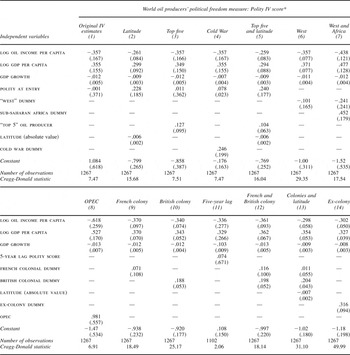
Next I focus on a few variables that could be correlated with disasters and politics. The first such variable is latitude. Given the prevalence of topical storms in disaster data sets, it seems possible that a particularly active storm year could induce correlation between the out of region disaster damage estimates and the number and severity of such disasters in the home region of any given country. Though this is an important reason to group the Americas together, the correlation could still be problematic, particularly in the tropics. To verify that the largest oil countries do not account for the results, I also control for the top five oil producers, measured as having the highest average annual oil output between 1968 and 2002. I also report results based on an analysis that includes a Cold War dummy to account for the change in the geopolitical climate after 1989.
Another possible problem inheres in the measure of institutional legacy. Recall that this concept is measured using the country's Polity score on entering the data set. As scholars such as Engerman and Sokoloff argue, the most important institutional legacy may not be related to such a score.Footnote 33 To explore the possibility that different measures of institutional legacy may influence our results, we use a number of different specifications. First, I use a dummy for the “West,” defined to be the United States, Canada, Norway, Denmark, Great Britain, and Russia, and I subsequently include dummy variables for sub-Saharan Africa and the Organization of Petroleum Exporting Countries (OPEC). Because La Porta and colleagues argue for the importance of colonial origin, I also use a country's colonial experience as a measure of institutional legacy.Footnote 34 Contrary to Englebert's conjecture, colonial origin does not make the effect go away.Footnote 35 Controls for former colonies and for the identity of colonial powers also have no substantial effect on our previous results. Table 5 records these results, as well as the results of a specification with the Polity score lagged by five years, as in Ross.Footnote 36
Two-stage least squares: Additional controls

Note: Each regression includes year dummies and reports the Newey-West heterosketastistic and autocorrelation consistent standard errors with the standard Bartlett kernel, bandwith = 2.
Some readers might wonder whether the particularly broad set of oil countries included in the data set drive the results. Here, it is important to note unlike many studies, I exclude nonoil producers from the sample. This means that the identification strategy I use here does not rely on pairs of countries such as Switzerland and Nigeria.
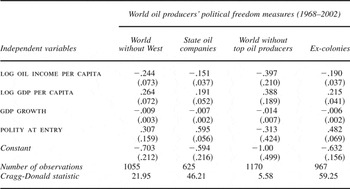
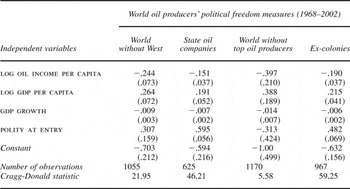
That said, I also test whether the results of the analyses in the previous section are robust to estimates based on subsamples of the countries in the data set. Table 6 shows the estimates remain consistently negative across the subsamples. As expected, the standard errors in the subsamples are larger and in the case of the world without the top five oil producers the instrument is weak. The weakness of the instrument in these cases has two effects. First, if there is even a small amount of correlation between the instrument and the disturbance term in the structural equation the coefficients will be biased in the direction of the OLS estimates.Footnote 37 Second, the weakness of the instrument can effect the actual size of the t-tests under the normal approximation. While the instrument is not as weak as others (for example, the F-statisticFootnote 38 on the first-stage regression in Acemoglu, Johnson, and Robinson), the estimates in these columns should be viewed as less reliable than the others.Footnote 39
Two-stage least squares: Subpopulations
Note: Each regression includes year dummies and reports the Newey-West heterosketastistic and autocorrelation consistent standard errors with the standard Bartlett kernel, bandwith = 2.
In addition to the results in Table 6, I ran the analysis on only nondemocracies—that is, I excluded countries characterized by Jaggers and Gurr as having a “highly coherent set of institutions” including competitive elections and significant constraints on executive power.Footnote 40Table 6, column (1), reports the results for the subset of countries with Polity scores less than 7 when they entered the data set. Estimates of the effect of oil income remain negative and significant, and the hypothesis of a weak instrument in the subsample can be rejected.Footnote 41 Importantly, my results are robust to changing the democracy threshold.
While there are many combinations of characteristics and subpopulations to explore, one of particular interest is Karl's set of thirteen “capital constrained” countries.Footnote 42 Contrary to what might be expected, even with strong instrument statistics, the negative effect of oil income is substantially smaller in this subpopulation, requiring more than a 10 percent change in oil income to move a single point on the Polity score, and the effect is only marginally significant. My results also speak to the relative size of the direct and indirect effects of oil income. The analysis shows that, among the set of oil countries, the direct “authoritarian effect” of oil revenue on average dominates the indirect “democratizing effect” proposed by Dunning.Footnote 43
The results of this study are broadly consistent with the existence of a resource curse: increased revenues from oil decrease the accountability of political institutions. These results are also consistent with the literature about the relationship between political development and democratization. My instrumental variables approach, however, can disentangle the two mechanisms that produce a shift in political institutions. In most of the literature, Karl being an important exception,Footnote 44 it is never clear whether it is oil wealth or “windfalls” associated with booms, that depress democracy. The resource (wealth) curse seems to suggest that fundamental economic and political forces create perverse incentives for agents to pursue the easy rents associated with the extraction and sale of natural resources.Footnote 45 The “boom” mechanism, on the other hand, suggests that it is not necessarily a commodity-specific distortion, but the opportunities that arise when leaders face new and large cash inflows. Many theoretical models of this problem imply that exogenous increases in revenues create price shifts that political leaders can exploit to advance their own interests.
Table 7 presents results that are consistent with the conclusion that the negative effect of oil on democracy is due largely to the effects of booms, or exogenous shocks to market price, rather than from oil wealth itself. Column (1) of Table 7 substitutes a measure of oil wealth—known oil reserves—for the previous measure of revenues. Data for known oil reserves run from 1980 to 2004 and come from BP's Annual Statistical Review.Footnote 46 Here analysis produces the usual picture, a significant effect that might be called the resource curse. In column (2) I replace the wealth measure with a production measure, where oil production data comes from the same source and covers the entire time-series. This shows no effect of production on Polity. Not only is the effect not statistically significant, but to the third place right of the decimal point the effect is zero. Column (3) includes both oil production and known oil reserves as variables. Production has a positive and significant effect, while known reserves has a significant and negative effect. The result for known reserves is not surprising, given the literature. The positive effect of production, within a sample of oil states, is also not surprising, as many of the most democratic states pull more barrels out of the ground per year than other states in the sample (see data in Table 8). The United States, Canada, Mexico, and Norway, all find themselves consistently in the list of top ten oil producers, where only Canada—with its large oil sands deposits—makes the list of top reserve holders.
Two-stage least squares: Known oil reserves and oil production

Notes: Each regression includes year dummies and reports the Newey-West heterosketastistic and autocorrelation consistent standard errors with the standard Bartlett kernel, bandwith = 2. OLS = ordinary least squares.
Top oil countries by production and reserves

Source: U.S. Energy Information Administration, 2006 statistics.
Column (4) of Table 7 includes a measure of oil revenues, oil production, and my instrument. Here one sees a robust estimate of the effect of oil revenues, consistent with the earlier findings, a positive effect of production, but no significant effect for known reserves. This suggests that windfalls are an important source of the political economy problems of oil countries. The relationship is also consistent with the more casual observation that oil countries' politics change in predicable ways with shocks to oil prices. Interestingly, this result can be replicated on the subset of nondemocracies, those countries with state oil companies, and Karl's capital deficient countries.Footnote 47
Conclusion
Many economists and political scientists have argued that natural resources and democracy are inversely related. Several careful case studies as well as some cross-national studies document this association. In this study, I attempt to address two problems that plague existing work on the resource curse.
First, expected changes in political institutions can affect oil revenue. This “simultaneity” problem makes it difficult to identify the effects of changes in polities on changes in oil revenues. Second, little agreement exists in the existing literature about the determinants of national institutions other than natural resource endowments. But many other factors also influence institutional outcomes. This creates the risk that any standard statistical analysis may be biased by one or more omitted variables.
The instrumental variables approach I take in this article addresses both problems by concentrating on one clearly defined hypothesis: increases in oil income produce negative effects on the political institutions. Focusing on this issue creates the possibility of locating credible sources of exogenous variation in oil revenues, allowing identification of the causal effect in question. The results of the instrumental variables analysis show that a negative and statistically significant relationship exists between oil income and political institutions among oil-producing nations. Conditioning on various other variables, such as GDP per capita, GDP growth, colonial history, previous regimes scores, and latitude, does not change this finding.
Most intriguing, perhaps, is that using an instrument like natural disasters makes it possible to separate the effects of changes in revenue due to price shocks and those that are instead due to production decisions or political and economic distortions created by the presence of resource wealth. The income result implies that a much more dynamic and short-run interaction exists between oil revenues and politics than has previously been recognized. Indeed, almost all previous work examines the long-run implications of resource wealth.
The short-term effects of resource prices puts into play many new factors about the resource curse. World prices, strategic cartels, and drilling and environmental policies in the developed world can now all be understood as having important implications for the political development of oil rich countries. Similar effects might be expected from other sources of windfalls, including foreign aid. Understanding the resource curse as an income effect creates many opportunities to effect change, including shifts in policies that promote the extraction of oil in developed countries or policies that subsidize energy efficiency or alternative fuels. Policies that promote substitutes for the oil that developing countries produce would depress their resource income flows, promoting government responsiveness and regime transition without the threat of force.Footnote 48 Policies in distant places can, this study suggests, generate positive externalities in oil-producing countries that benefit all of their citizens.