1 ‘Functionality’ in language change
Whether it be the sweeping eagle in his flight or the open apple-blossom, the toiling work horse, the blithe swan, the branching oak, the winding stream at its base, the drifting clouds – over all the coursing sun, form ever follows function, and this is the law. (Sullivan Reference Sullivan1896)
It seems common sense that the primary function of language is communication, that is, the expression and transfer of meaning (see e.g. Jakobson Reference Jakobson and Sebeok1960; Langacker Reference Langacker, Panther and Radden2011: 31). Functional paradigms of linguistics assume that the shapes that language takes are determined by this function:
Language is not seen as an abstract, isolated system, but one that is used to communicate meaning, and which is shaped by the ways it is used, by the contexts in which it occurs and by the structure of human cognition (McEnery & Hardie Reference McEnery and Hardie2011: 168).
If ‘form ever follows function’ in language, then linguistic forms should always be shaped to serve the purpose of communication. It seems logical, then, that changes in linguistic forms should follow the need to improve their communicative functionality. This has been called ‘teleological mechanisms’ of language change (Croft Reference Croft2000; McMahon Reference McMahon1994), that is, the change aims towards a goal (here, optimal communication). Croft (Reference Croft2000: 65) also refers to this approach as ‘systemic functional explanations, since their purported goal is to create, restore, or maintain certain properties of the linguistic system’. A functional approach in this sense is advocated, for instance, by Halliday (Reference Halliday1973: 7) in
seeking to explain the nature of language in functional terms: seeing whether language itself has been shaped by use, and if so, in what ways – how the form of language has been determined by the function it has evolved to serve.
In a similar vein, Hawkins (Reference Hawkins, Moore and Polinsky2003: 148) views ‘efficiency and ease of processing’ as ‘driving the adaptation [of grammar] in response to prior changes’. MacWhinney et al. (Reference MacWhinney, Bates and Kliegl1984: 128, italics mine) state that ‘[t]he forms of natural languages are created, governed, constrained, acquired and used in the service of communication’. While these authors’ primary concern is the synchronic organization of grammar, their comments on language change imply the idea that new linguistic forms and structures are called into being in order to serve a communicative need or processing efficiency. This is a strong assumption. It states not only that processes of language change must be consistent with the communicative function of language, but that functional requirements are a driving force of language change.
The opposing, ‘non-functional’ view on language change is that of a non-teleological, seemingly arbitrary ‘drift’. Lass (Reference Lass1980: 136) notes that ‘change can occur, presumably, for reasons totally unconnected with communicative “function”’. This idea is also found in grammaticalization theory: Bybee et al. (Reference Bybee, Perkins and Pagliuca1994: 298) state that ‘the relation between grammar and function is indirect and mediated by diachronic processes. The processes that lead to grammaticization occur in language use for their own sakes’. Changes occur, but not because there is a need for them to occur.
Against this backdrop, the present article investigates a specific change in the history of English, namely the emergence of stative possessive have got, and the early stage of the variation between have got and bare have.
In English, the main verb have and the construction have got both denote stative possession; this is detailed in section 2. The emergence of possessive have got presents an interesting case of change because both teleological and non-teleological explanations have been put forward. The assumption of function as a driving force underlies the hypothesis of ‘pattern preservation’ (Crowell Reference Crowell1959), which will be explicated in section 3.1. The non-teleological view relies on semantic mechanisms known from (but not restricted to) grammaticalization (see Traugott Reference Traugott1989). In this scenario, possessive have got has emerged ‘for its own sake’, through what Schulz (Reference Schulz2012: 139) has called ‘conventionalised conversational implicature’. This hypothesis will be detailed in section 3.2. The remainder of section 3 reports on an empirical test of the two hypotheses.
In order to understand how have got became established in the language, it is useful to also consider the immediate outcome of its emergence, that is, its early variation with bare have, and the potential functional divergence of the two variants. This is presented in section 4. Section 5 summarizes the conclusions from these studies, based on which I propose that functional motivations are a directing rather than a driving force in language change.
2 Stative possessive have got
have got is originally and structurally the present perfect form of get (see Denison Reference Denison1993: 341) – hence its original meaning is ‘to have obtained/acquired’. The use of the have got construction for stative possessive meaning emerged in the English language probably in the sixteenth century (see Crowell Reference Crowell1959). The Oxford English Dictionary’s first attestation is from 1600:
-
(1) What a beard hast thou got; thou hast got more haire on thy chinne, then Dobbin my philhorse hase on his taile. (Shakespeare, Merchant of Venice ii. ii. 89)
Earlier examples may be found but are equivocal as to their stative possessive meaning (see section 3 below). Thus, the relevant period for investigating the emergence of possessive have got is the time before and around 1600. The relevant period for its early usage and variation with bare have is from the seventeenth century onwards.
The characterization as ‘stative possessive’ contains two semantic concepts, ‘possession’ and ‘stativity’. Both are necessary for the interchangeable use of have or have got.
‘Possession’, as a category that is ‘both universal and fundamental’ (Langacker Reference Langacker, Taylor and MacLaury1995: 51), may appear to be self-explanatory, but eludes a straightforward definition. When we speak of ‘possession’ in everyday life, we usually mean things owned, but the linguistic concept clearly is more general than that. Things we ‘have’ or that are ‘ours’ include such diverse entities as pencils, parents, toes, hotel rooms, a headache, an idea, power, etc. Langacker (Reference Langacker, Taylor and MacLaury1995) lists eighteen relations that a possessive construction may express. This list is replicated here, along with possible examples of the have (got)-construction.
With respect to the possessor, the possessee may be:
-
a. something owned (his Porsche – he has (got) a Porsche)
-
b. a relative (your aunt – you have (got) a cantankerous aunt)
-
c. a part (my knee – I have (got) two knees)
-
d. an unowned possession (the baby's crib – the baby has (got) a beautiful crib)
-
e. something manipulated (her rook – she has (got) a rook on the base line)
-
f. an associated individual (our waiter – we have (got) a clumsy waiter)
-
g. a larger assembly (their group – they have (got) an ambitious group)
-
h. something at one's disposal (my office – I have (got) a tiny office)
-
i. a physical quality (his height – he has (got) the stature of a hard-working man)
-
j. a mental quality (her equanimity – she has (got) that equanimity)
-
k. a permanent location (our neighborhood – we have (got) a quiet neighborhood)
-
l. a transient location (my spot – I have (got) a spot in the park)
-
m. a situation (your predicament – you have (got) a problem)
-
n. an action carried out (Oswald's assassination – we had (*got) a game of chess)
-
o. an action undergone (Kennedy's assassination – John had (*got) an operation)
-
p. something selected (your candidate – you have (got) a promising candidate)
-
q. something fulfilling a certain function (our bus –? we have (got) a comfortable bus)
-
r. something hosted (the dog's fleas – the dog has (got) fleas)
(adapted from Langacker Reference Langacker, Taylor and MacLaury1995: 56f.)
Note that some uses (n, o, and q) are incompatible with have got, and q is at least problematic even with bare have. Moreover, types n and o refer to actions, hence they are non-stative. Jespersen (Reference Jespersen1933: 242) subsumes these uses of have under the meaning ‘partake of’ and keeps them distinct from the various types of ‘possession’. Langacker (Reference Langacker, Taylor and MacLaury1995: 57) notes that some of the types cannot be ‘analyzed simply as “ownership” meanings extended from examples like [type a]’. For the present purpose, it appears more useful to restrict the definition of ‘possession’ to ‘ownership’ and those cases that can be analysed as metaphorical extensions thereof, thus excluding types n, o and q.
‘Possession’ per se is, of course, a state (rather than an activity or event; see Huddleston & Pullum Reference Huddleston and Pullum2002: 121). In most cases, have is a stative verb. Non-stative uses of main verb have, such as have a beer and types n and o above, are excluded from the category of ‘possession’ in the present analysis. Stativity is more relevant with respect to the have got-construction: get as such, generally, is a dynamic verb, denoting an event. Syntactically, have got is the present perfect of this event. It is stative only to the extent that it is synonymous with have, denoting ‘possession’. The ‘get’-event may then be seen as the onset of the state of ‘possession’ (Gronemeyer Reference Gronemeyer1999: 11). The various functions of the perfect tense are particularly relevant to the ‘conventionalized implicature’ hypothesis, which is discussed in section 3.2.
3 The emergence of possessive have got
How did the have got-construction come to be used to express stative possessive meaning? The issue here is not (yet) the variation between bare have and have got, but rather how the younger variant (have got) emerged. As mentioned above, two hypotheses have been proposed, one that is ‘functional’ and one that is ‘non-functional’.
3.1 The ‘pattern preservation’ hypothesis
The pattern preservation scenario essentially hypothesizes a functional repair mechanism. It was first suggested by Crowell (Reference Crowell1959), and, as it were, implicitly adopted by Krug (Reference Krug2000: 64ff.) and Tagliamonte (Reference Tagliamonte, Rohdenburg and Mondorf2003: 533). Crowell's argument runs as follows. A general trend towards vowel reduction in unstressed syllables from the fifteenth century onwards affected the forms have and has (both as auxiliary and as main verb), whose vowels were reduced to schwa. In the sixteenth century, this schwa began to undergo further reduction to zero, leading to the contraction of have/has with the preceding item, i.e. the now common forms ’ve and ’s.Footnote 1 These contracted forms appear in the written language in the sixteenth century, as in (2).
-
(2) Though by my thoughts I've plunged into my life's bondage, I yet may disburden a passion. (OED 1593: Sir Philip Sidney, Countess of Pembrokes Arcadia 90)
Crowell further assumes that the pattern subject + verb, as ‘one of the strongest habits or “patterns of structure” of English’ (Crowell Reference Crowell1959: 282), needs to be complete and recognizable. This pattern is easily identified when have is stressed as in (3) or when it serves as an auxiliary for another verb as in (4). A contracted have in the function of a main verb, however, obscures the pattern, and it is here that have got comes in to preserve it (5a–b). Thus, ‘have got was substituted for have to strengthen the subject + verb construction in places where, through reduction of stress on have, that construction was not clearly signaled’ (Crowell Reference Crowell1959: 280). As possessive have got emerges in the late sixteenth century (see above), Crowell argues that this is a direct consequence of the increase of have-contraction.
-
(3) John hasn't been there, but I have. (Crowell Reference Crowell1959: 283)
-
(4) I've been living with a genius. (ibid.)
-
(5)
-
(a) I've two hands. (ibid.)
-
(b) I've got two hands.
-
The pattern preservation hypothesis invokes the competition of the opposing motivations of economy and explicitness (see Haspelmath Reference Haspelmath1999): contraction is employed in the service of economy, while pattern preservation is a matter of explicitness. The overuse of a strategy to increase economy (have-contraction) led to a problem which had to be repaired by increasing explicitness (got-insertion). Thus, possessive have got emerged because it was needed to mend the system: ‘Where there is a “gap” or inconsistency in the system of a language, something usually happens’ (Crowell Reference Crowell1959: 284). This line of thought is found in many accounts of language change, such as, for example, the notion of ‘renewal’ in cyclical change (van Gelderen Reference Gelderen and van Gelderen2009).
Despite the impression of intentionality that Crowell's description sometimes makes, the claim of got-insertion is not that speakers consciously decided to insert got in order to patch up the subject–verb pattern. It is an unconscious, cumulative process; the only intention that needs to be assumed is that speakers try to communicate effectively. However, got-insertion is teleological in that it serves the goal of pattern preservation.
The pattern preservation hypothesis is in line with the historical record as far as first attestations (of have-contraction and possessive have got) go. However, as Schulz (Reference Schulz2012) points out, early examples of have-contraction are rare and restricted to auxiliary have rather than the possessive use. Yet the theory of got-insertion hinges on the frequent contraction of main verb, possessive have. Schulz (Reference Schulz2012: 135) rejects it on this basis, concluding that
[t]he absence of any evidence of contracted possessive ’ve before 1600, its fairly low frequency even after 1600 and its limitation to contexts in the genres of drama and poetry where the full form have would not fit the meter, suggest that it was not a pervasive phenomenon during either the sixteenth or the seventeenth century.
Krug (Reference Krug2000: 64f.) argues that contraction was certainly more common in spoken interaction than in the written record, yet the problem remains that we are left without direct quantitative evidence from historical data. I will suggest a way of resorting to indirect evidence in my analysis below.
3.2 The ‘conventionalized implicature’ hypothesis
The conventionalized implicature hypothesis (see Lorenz Reference Lorenz2010; Schulz Reference Schulz2012) takes a slightly different approach to the origin of possessive have got – rather than asking how got came to be added to have, it focuses on how a present perfect of get came to denote stative possessive meaning. Its central assumption is that have got underwent a gradual semantic shift from ‘have obtained’ to ‘possess’. This view is already advocated (but not spelled out) by Visser (Reference Visser1973: 2202), who speaks of an ‘extremely slow and formally entirely indiscernible process’.
The idea of conversational implicatures leading to new meanings was tentatively explored in diachronic linguistics in the 1970s, e.g. by Bolinger (Reference Bolinger1971: 522): ‘[I]nferential meanings may in time become referential’. Traugott & König (Reference Traugott, König, Traugott and Heine1991) and Traugott & Dasher (Reference Traugott and Dasher2002: 34ff.) spelled out the idea in what they call the Invited Inferencing Theory of Semantic Change. The invited inference in the case of have got is that a past event of ‘obtaining’ or ‘acquiring’ with present relevance (as expressed by the present perfect) implies, or invites the inference of, ‘possession’. This holds irrespective of the specific verbs in use, so that statement (6b) follows from (6a) in exactly the same way as (7b) follows from (7a).Footnote 2
-
(6)
-
(a) I have got(ten) a new camera.
-
(b) I have a new camera.
-
-
(7)
-
(a) I have bought a new camera.
-
(b) I own a new camera.
-
With the form have got (and only this form), this implicature was gradually conventionalized, leading to a reanalysis of have got from dynamic to stative possessive. This is a semantic reanalysis as defined by Eckardt (Reference Eckardt2006: 236):
Semantic reanalysis: The process of semantic reorganization of a sentence whereby the salient overall conveyed information remains the same, but is composed in a different manner. What may have previously been in part assertion, in part implication, turns entirely into a literal assertion after reanalysis.
Thus, if (8a) is read in its initial sense, the acquisition is asserted, and the consequent possession implied; if read in the reanalysed sense, the sentence states that ‘some’ now own these estates. The completion of the reanalysis is evinced, for instance, in the use of have got for inalienable possession, as in (8b). A detailed formal account of this process of implicature conventionalization is provided in Schulz (Reference Schulz2012: 137ff).
-
(8)
-
(a) and some that were hardly able to shew their heads, have now got great Estates. (1703: CED D4HOMEMB)
-
(b) By all that's good, he has got the sorry cunning of our Sex. (1696: CED D4CMANLE)
-
The gradualness of the process rests not only in its spread across the population – there is clearly also a gradualness in the ambiguity of have got, i.e. in how easily it is analysed as stative possessive rather than perfective. In (9), it is possible that the first speaker meant to ask what food the addressees had procured, but the answer shows that What have you got was understood as stative possessive.
-
(9) What have you got to eat? We have a Piece of Beef on the Spit. (1731: CED D5HGBEIL)
Based on this gradual reanalysis, Schulz (Reference Schulz2012: 138ff.) describes three stages of invited inference. In the first stage, ‘possession’ may occur ad hoc as a conversational implicature of perfective have got. This is akin to what Eckardt (Reference Eckardt2006: 239) calls the PRE-stage of reanalysis. The activation of this implicature then leads to the second stage, in which ‘possession’ is a ‘generalized invited inference’ (see Traugott & Dasher Reference Traugott and Dasher2002: 35), rendering have got pragmatically polysemous between the perfective and the possessive reading. Its use and interpretation at this stage oscillates between those two poles, and is negotiated through context. In the third stage, the invited inference is semanticized, which is marked by uses of have got that allow only a possessive interpretation (such as (8b) above). This corresponds to Eckardt's (Reference Eckardt2006: 239) POST-stage. In my data analysis below, I will present an operationalization of these three stages.
The hypotheses of ‘pattern preservation’ and ‘conventionalized implicature’ are alternative explanations of the emergence of possessive have got, though they are not strictly mutually exclusive. Semantic change and structural pressure could work together in forwarding the new variant. The separate tests in the next sections allow for this possibility. Yet, the hypotheses differ crucially in the primary motivation of the change. Is it a structural repair mechanism or an implicature becoming conventional?
3.3 Data and method
The dataset used in this study is combined from the Parsed Corpus of Early English Correspondence (CEEC; Taylor et al. Reference Taylor, Nurmi, Warner, Pintzuk and Nevalainen2006) and the Corpus of English Dialogues 1560–1760 (CED; Kytö & Walker Reference Kytö and Walker2006). The CEEC is a collection of personal letters from late Middle English and Early Modern English; for the time span considered here, 1460 to 1700, it comprises 2.2 million words. The CED consists of various speech-related texts (drama, trial proceedings, didactic and fictional prose), with 1.2 million words in total and a time span from 1560 to 1760. Both corpora thus represent ‘speech-like’ data in the sense of Culpeper & Kytö (Reference Culpeper and Kytö2010: 17f.).
To examine the emergence of possessive have got(ten), all instances of this bigram were extracted from the combined CEEC/CED data, excluding only those in which get has a meaning clearly distinct from ‘obtain’, as in (10).
-
(10) 500 of the Mounster rebells have gotten into Beere Haven [. . .] (1602: CEEC CHAMBER,I,139.005.244)
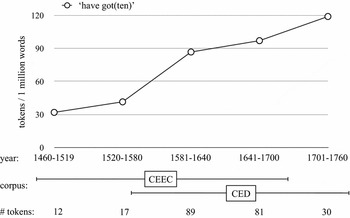
This yields a database of 229 tokens. A possessive interpretation is possible with 165 of these. Despite this low overall number, a consistent increase in frequency is observed over time, most notably around the year 1600 (see figure 1). In figure 1 and the following analyses, five time periods of 60 years each are stipulated, following the organization of the CED.
Frequency development of have got(ten) 1460–1760

3.4 Testing the hypotheses
We now turn to testing the hypotheses concerning the emergence of possessive have got, beginning with the ‘functional’ idea of got-insertion to preserve the subject–verb pattern.
As explicated above, the pattern preservation hypothesis assumes that early possessive have got was contingent on have-contraction, which is largely absent from the written record of Early Modern English but may have been common in the spoken vernacular. In the speech-like written data provided by the corpora, we can therefore only look for indirect evidence. If have-contraction is the trigger for possessive have got, it can be assumed that Early Modern English writers would preferably write have got in those contexts in which they would articulate ’ve got in speaking. These contexts can be determined. Labov (Reference Labov1969) identifies preceding vowels and pronominal subjects as favourable to the contraction of a copula or auxiliary (i.e. forms of be, have, do), and this is confirmed on a large database by MacKenzie (Reference MacKenzie2013: 23ff). Similarly, Krug (Reference Krug1998: 289) states that ‘pronouns favor and full nouns disfavor encliticization of adjacent reduced forms’, due to the high string frequency of pronoun + auxiliary. From this, a testable prediction of the pattern preservation hypothesis can be derived: early instances of possessive have got should be found in positions immediately following a vowel-final pronoun. Hence, the rise of have got from the fifteenth to the sixteenth century should be driven by exactly this type.
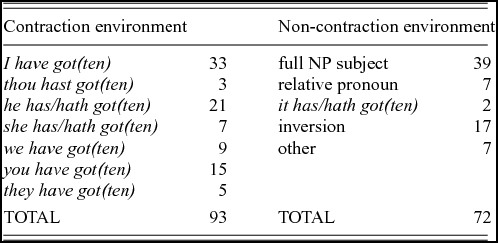
To test this prediction, those 165 instances of have got in the CEEC/CED data which allow for a possessive reading are grouped into two categories (see table 1): ‘Contraction environments’ are those with a preceding vowel-final pronoun, i.e. the strings I/thou/he/she/we/you/they have got, as in (11). All other tokens are labelled ‘non-contraction environments’, for instance with a full NP subject (12) or subject–auxiliary inversion (13); pronouns ending in a consonant (e.g. it, that) also belong in this category.
-
(11) I am glad to hear [. . .] of the little rise, which at the last yow have gott in your profession, (1615: CEEC HOLLES,I,66.015.336)
-
(12) I doubt your brother Williams hath got the grudging of an ague. (1608: CEEC CHAMBER,I,254.016.673)
-
(13) And what news have you got for me Sir? (1647: CED D3CTB)
Environments of have got(ten) in CEEC/CED
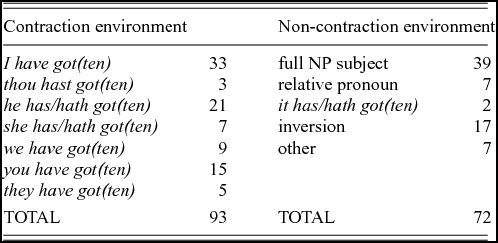
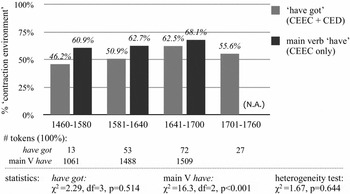
If got-insertion is triggered by the contraction of have, we should be able to observe an increased frequency of have got in ‘contraction environments’ in the crucial time, i.e. around 1600; the frequency in ‘non-contraction environments’ should remain stable, as these do not provide a trigger for got-insertion. Thus, the share of ‘contraction environments’ among the instances of have got is expected to increase. By the same token, this share should decrease with main verb have, if it is the contraction contexts that are taken over by have got.
Figure 2 presents the share of contraction environments across time periods for possessive have got and main verb have.Footnote 3 None of the above expectations is borne out. With have got the share of contraction environments is slightly increased in the latter half of the seventeenth century, but the differences between the time periods are not statistically significant (p(χ2) = 0.621.Footnote 4 Moreover, the same slight increase in contraction contexts is observed with main verb have, and throughout the data, main verb have even has a stronger tendency to occur after vowel-final pronouns (i.e. contraction environments). The χ2 test yields a significant result (p < 0.001) for the changes in main verb have due to the larger number of tokens of this form. However, using χ2 for a heterogeneity test (see Gries Reference Gries2013: 190ff.) to compare the results for main verb have and have got (disregarding the fourth time period) shows that the developments are not significantly different (p = 0.644).
have got and main verb have in contraction environments

The data show no visible effect of contraction environments on the development of possessive have got. Two caveats should, however, be noted. Firstly, the data contain also all the ambiguous instances of have got, for which a possessive reading is possible but may not have been intended by the authors. Secondly, the evidence considered here is indirect, since first-hand data of have-contraction in the spoken vernacular of Early Modern English is not available. Therefore, what is presented here is not counter-evidence to the ‘pattern preservation’ hypothesis. What can be asserted is that no evidence was found to support it.Footnote 5
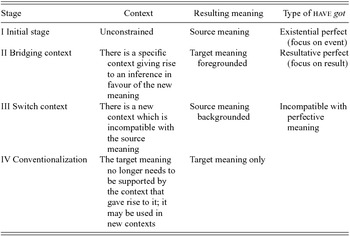
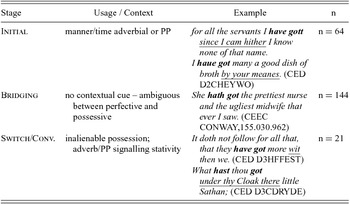
The hypothesis of conventionalized implicature makes very different predictions. The determinant here is not a specific phonological environment but rather the pragmatic meaning of the item. The pragmatic meaning is dependent on context. To operationalize the stages of invited inference (see Schulz Reference Schulz2012: 138), a model developed for grammaticalization by Heine (Reference Heine, Wischer and Diewald2002) is adapted to the case of have got. This is presented in table 2; the columns ‘Stage’, ‘Context’ and ‘Resulting meaning’ are directly adopted from Heine (Reference Heine, Wischer and Diewald2002: 86). The fourth column describes the model's application to have got.
Context model, adapted from Heine (Reference Heine, Wischer and Diewald2002: 86)

In the ‘initial stage’, have got is used with a focus on the event of ‘getting’, which is situated in the past. Lee (Reference Lee, Minkova and Stockwell2002: 374) defines the ‘existential perfect’ as denoting ‘a situation that occurred once or more in the past within a time span construed by the speaker as continuing up to the present’. For have got this is exactly the type which rules out a possessive reading; indicators in the context are adverbs of manner or time, and prepositional phrases that specify the ‘get’-event. The ‘bridging’ stage of have got is defined as giving rise to possessive meaning. This is the case in the ‘resultative perfect’, defined by Lee (Reference Lee, Minkova and Stockwell2002: 375) as ‘past action with present results’. The result of ‘get’ is almost necessarily ‘possess’. Thus, a ‘bridging context’ is present whenever the inference of ‘possession’ is possible, i.e. when there is no contextual cue to interpret it as an existential perfect. A ‘switch context’, then, is a context which is incompatible with the perfective meaning, that is, ‘possession’ is the only possible reading. This is identified by possession that is inalienable, and by adverbials that signal stativity. The last stage, ‘conventionalization’, is not clearly indicated by context; a possible candidate would be metaphoric uses of ‘possession’, such as (14). As this type is very rare in the data, it is here conflated with the ‘switch’ context. Table 3 summarizes the resulting three stages of have got and their operationalization in the CEEC/CED data.
-
(14) for he had got on a new Fustian Frock and Breeches, (1740: CED D5TGREEN)
The context model applied to have got

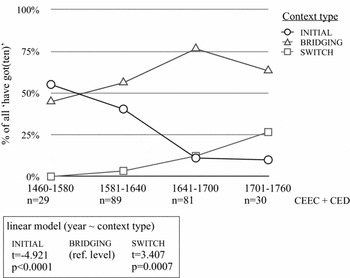
The conventionalized implicature hypothesis assumes a gradual progress through these stages. Its empirical prediction therefore is that bridging contexts increase over time, as it is this context that brings about the change. Switch contexts should appear only in the seventeenth century.
Figure 3 presents the relative frequencies of the three context types over time, as well as the results of a linear model taking context type as predictor for the year of occurrence (where ‘bridging’ as the ‘middle’ stage serves as the reference level). The developments clearly match the predictions of the conventionalized implicature hypothesis.
The development of have got(ten) by context types

Note that ‘bridging contexts’ are those that contain no specific cue to one or the other interpretation. This type is therefore expected to be frequent at all times, both before and after the reanalysis. Nevertheless, ‘bridging’ increases its share throughout the sixteenth and seventeenth centuries, clearly at the expense of ‘initial’ contexts. In the last period, when the ‘bridging contexts’ decrease slightly, it is the ‘switch contexts’ that increase their share. Thus, the data suggest a scenario by which contexts that invite the inference of stative possession (‘bridging’) slowly but steadily increased in frequency, thus strengthening the inference, to a point where it became the default interpretation, and speakers/writers begin to use the construction in contexts that rely on a possessive interpretation (‘switch’). The ‘initial’ use which coerces a resultative reading falls behind, but remains in use – its declining relative frequency is balanced by the overall rise of the have got construction (see figure 1).
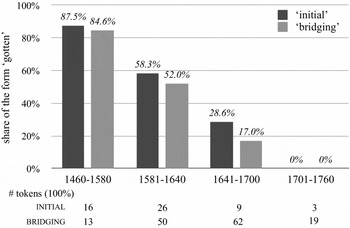
It is noteworthy that the variant have gotten – which in PDE denotes a perfective reading – is completely absent from ‘switch’ contexts. It appears that from the beginning, the shorter have got is the form of choice for expressing ‘possession’. However, have gotten gradually disappears from ‘initial’ and ‘bridging’ contexts alike (see figure 4). Thus, while have gotten is associated with perfective readings, the form have got does not serve to distinguish the emerging possessive reading, nor does this distinction arise over time. Note that in the last time period, 1701–60, no instance of have gotten is found, although ‘initial’ still occurs (with have got).
The decline of have gotten versus have got

4 Form meets function: early variation
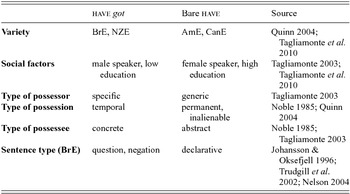
If possessive have got has not emerged through a functional need, the question that remains is how form and function play out once have got is established as an expression of stative possession and thus an alternative variant to bare have. In Present- day English, this variation has been investigated in various settings (Noble Reference Noble1985 – as cited in Kroch Reference Kroch1989; Tagliamonte Reference Tagliamonte, Rohdenburg and Mondorf2003; Quinn Reference Quinn2004; Tagliamonte et al. Reference Tagliamonte, D'Arcy and Jankowski2010). Table 4 provides an overview of the conditioning factors found by these studies. They have shown, firstly, that there are differences between varieties, have got being more common in British and New Zealand English than in the North American varieties (Tagliamonte et al. Reference Tagliamonte, D'Arcy and Jankowski2010; Quinn Reference Quinn2004), and secondly that the variation is in part socially conditioned, such that ‘less educated men favor have got or got’ (in Toronto English, Tagliamonte et al. Reference Tagliamonte, D'Arcy and Jankowski2010: 149).Footnote 6 As for semantic functions, the possessor (i.e. the subject), the possessee (i.e. the object) and the type of possession all have an effect on the choice of a variant (Noble Reference Noble1985; Tagliamonte Reference Tagliamonte, Rohdenburg and Mondorf2003; Quinn Reference Quinn2004). Thus, have got is usually preferred with specific possessors, temporal possession and a concrete possessee (all of which are present in example (15)); bare have, on the other hand, is favoured with generic possessors, permanent or inalienable possession, and an abstract possessee (16). Sentence types which demand an auxiliary, such as questions and negation, favour have got, where have functions as the auxiliary, in British English ((17a–b); Johansson & Oksefjell Reference Johansson, Oksefjell, Thomas and Short1996; Trudgill et al. Reference Trudgill, Nevalainen and Wischer2002; Nelson Reference Nelson2004). In North American English, however, questions and negation are almost categorically constructed with main verb have and auxiliary do ((18a–b); Biber et al. Reference Biber, Johansson, Leech, Conrad and Finegan1999: 161ff.; Trudgill et al. Reference Trudgill, Nevalainen and Wischer2002).
Factors conditioning the use of have got in Present-day English

-
(15) John has got new hiking boots.
-
(16) The Siberian tundra has an extreme climate.
-
(17)
-
(a) Have you got plans for tonight?
-
(b) I haven't got plans for tonight.
-
-
(18)
-
(a) Do you have plans for tonight?
-
(b) I don't have plans for tonight.
-
The above are all studies of contemporary English(es), and they show that there are now robust (though not absolute) differences in usage between the variants have and have got. In particular, we can observe a tendency towards a functional division of labour between the two forms. The functions taken over by have got can be seen as artifacts of its erstwhile perfective meaning, as they imply a previous ‘get’-event. The functions on the bare have side, by contrast, imply the absence of such an event. In a typical ‘get’-event, a specific participant obtains a concrete, transferable item, which is implied in example (15), but not in (16).
The syntactic constraint of sentence type is historically tied to the rise of ‘do-support’ and is therefore of particular interest to the analysis of early variation. ‘do-support’ refers to the insertion of an expletive auxiliary do in questions and negatives where no other auxiliary or modal is present. It emerged in late Middle English and increased in frequency, reaching a near-obligatory status in the nineteenth century (see Ellegård Reference Ellegård1953; Warner Reference Warner, Kay, Horobin and Smith2004). ‘do-support’ thus replaced an earlier structure by which questions were marked by subject–verb inversion and negation markers modified the main verb. The rise of ‘do-support’ has been observed to be concomitant with – and possibly a consequence of – the fixation of SVO constituent order in English, which was largely consolidated in Early Modern English (Pérez-Guerra Reference Pérez-Guerra2005; Culicover Reference Culicover2008). Jäger (Reference Jäger2006: 92) considers do-periphrasis a general strategy to maintain word order: ‘If a language has rigid or dominant word order, periphrasis is used to mark clause types that display a deviant or irregular word order.’ In this view, English do-periphrasis serves to maintain the fixed SVO order in questions and the adjacency of verb and object in negative sentences. In the early eighteenth century, the time period considered here, subject–verb inversion was already a rare syntactic structure.
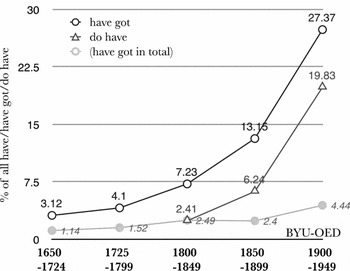
Considering the variants have and have got, it is clear that the latter can be employed to serve the same function as ‘do-support’, simply because it involves an auxiliary. It is therefore not surprising that the frequency of have got increased earlier and more rapidly in questions and negatives; consider the frequency developments in the OED database (figure 5, from Lorenz Reference Lorenz2010). ‘do-support’ with main verb have appears rather late, as is generally the case with stative verbs (Nurmi Reference Nurmi1999; Trudgill et al. Reference Trudgill, Nevalainen and Wischer2002: 5f.); have got is available as a periphrastic option long before the appearance of stative do have.
have got and do have in questions and negation (Lorenz Reference Lorenz2010)

Regarding the early stages of variation between have and have got, there are thus two ways in which it could be functional: firstly, have got may be employed to maintain the dominant word order; secondly, the two forms may be used for different aspects of ‘possession’. This is investigated in the next section.
4.1 Data and method
Possessive have got can be said to have become established as a variant in the seventeenth century. For the analysis of early variation, I therefore chose data from 1720–50, extracted from the Old Bailey Corpus of trial proceedings (OBC), transcripts of spoken English in a court of law in London (Huber Reference Huber2007). I consider this the most useful kind of data for the present purpose, due to its relative faithfulness to the actual spoken language (see Kytö & Walker Reference Kytö and Walker2003 for an appraisal of trial proceedings in this respect). The time frame predates the earliest period in Noble's (Reference Noble1985) diachronic study of have and have got. This thirty-year subset of the OBC comprises approximately 2.5 million words. All instances of finite, stative possessive have and have got in the present tense are considered, thus excluding perfective have got (the ‘initial stage’ above) and dynamic uses of have (e.g. have breakfast), as well as past tense, imperative and infinitive have, where the alternative have got is either ruled out or so rare that these uses cannot be regarded as variational contexts. This selection yields a total of 1,833 tokens, 1,549 of which are bare have and 284 have got.
Following from the above discussion, the questions to be answered are: is have got favoured in questions and with negation? And is there already a differentiation between have and have got for different aspects of possession? In addition, the speaker's role in court will be considered as a social factor.
Regarding the first question, the data has been coded for three sentence types: ‘affirmative’, ‘negative’ and ‘question’; ‘negative’ is defined by the presence of the negation marker not/n't (19a–b)Footnote 7 , and ‘question’ by the inversion of subject and verb or auxiliary (20a–b).
-
(19)
-
(a) I han't got so much Silver about me; (OBC_1_17250827)
-
(b) I am a poor silly Soul, and have not a Farthing in the World. (OBC_1_17250224)
-
-
(20)
-
(a) The Prisoner clapt a Pistol to my Breast, and said, Damn your Blood, what Money have you got? (OBC_1_17340630)
-
(b) Damn your Eyes, says he, what Money have you about you? (OBC_1_17320906)
-
The semantic aspects are operationalized by the labels ‘basic’, ‘abstract’ and ‘inalienable’. ‘Basic’ here refers largely to temporal and concrete possessionFootnote 8 (21a–b), in particular Langacker's (Reference Langacker, Taylor and MacLaury1995: 56f.) types a, d–f, l and r (as listed above); ‘abstract’ applies to non-concrete states or qualities (types i, j, m; examples (22a–b)); ‘inalienable’ possessions are family members, body parts and physical features (types b, c, k; examples (23a–b)). Some abstract possessions are inherently inalienable (24); these are also coded as ‘abstract’ as their abstractness is seen as the primary characteristic. It should also be noted that due to the nature of the data, certain ‘possessions’ tend to recur, such as money and watches (‘basic’), wives and husbands (‘inalienable’), having something to say and having a certain character (‘abstract’). It is also in the nature of the data that the possessor is almost always a specific person and generic subjects are extremely rare; this factor is therefore left out of the present analysis.
-
(21)
-
(a) G - D - ye, says I, You have got my Watch. (OBC_1_17350911)
-
(b) she laying her Hand upon her, said, You have my Watch, (OBC_1_17221205)
-
-
(22)
-
(a) and said to the Prisoner, Honesty, I was not alone; I have got Company. (OBC_1_17330628)
-
(b) If you have either Honour or Honesty, come away directly; (OBC_1_17380412)
-
-
(23)
-
(a) I know the Prisoner again, because he has got but one Hand; (OBC_1_17320223)
-
(b) but I know she has another Husband, and his Name is Sheppard. (OBC_1_17370420)
-
-
(24) He is an Irishman, and has the Character of most of his Countrymen – a very bad Character in general. (OBC_1_17331010)
Finally, the categories for the speaker's role are simply ‘court’ and ‘other’, where ‘court’ is the judge and ‘other’ may be the prosecutor, the defendant, a witness or a legal counselor. (For detail on the setting and power dynamics in the Early Modern English courtroom, see Cecconi Reference Cecconi2012: 49ff.).
4.2 Results
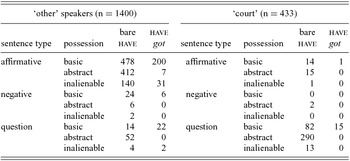
There are 1,400 tokens from ‘other’ speakers and 433 from judges (‘court’). Overall, the share of have got is 19.1 per cent with ‘other’ speakers and 3.7 per cent with the judges. This puts the judges’ usage close to that of written English of the time (see figure 5), while the ‘other’ speakers confirm that the spoken language is much more favourable to possessive have got. The raws are presented in table 5.
Distribution of have and have got (OBC 1720–50)

The difference between ‘other’ speakers and ‘court’ may be connected to social status, but it is primarily a difference of register. Judges are compelled by their role to use an extremely formal language. As the data show, possessive have got is largely ruled out from this register. Only questions regarding ‘basic’ possession allow for exceptions.Footnote 9 Moreover, the speech of the ‘court’ abounds in quasi-formulaic questions such as What have you to say (in your defence / for yourself / against the prisoner)? (n = 206) and Have you any witness(es)? (n = 52). These are uniformly phrased with bare have.
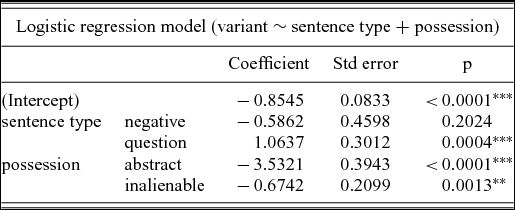
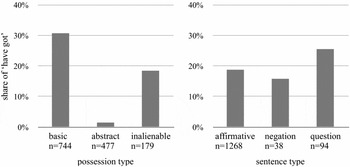
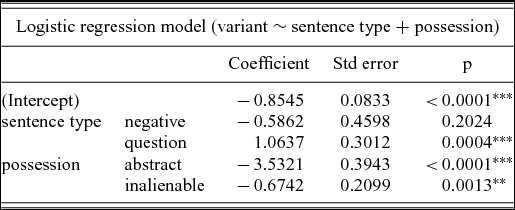
As register proves to be a near-categorical determinant in this case, the effects of the semantic and syntactic types can only be assessed in the data from ‘other’ speakers. In this group there is variation in most of the category combinations. The effects show very clearly in a logistic regression modelFootnote 10 taking ‘sentence type’ and ‘possession type’ as independent variables (table 6); ‘affirmative’ and ‘basic’ are the respective reference levels to which the other types are compared. The model has also been tested for interaction effects, which were found to be non-significant (and therefore excluded from the model). Thus, each effect holds independently of the other. The varying shares of the younger variant have got across the categories are presented in figure 6.
Logistic regression model of the effects of sentence type and possession type
have got versus have by possession type and sentence type (‘other’ speakers)

In the factor sentence type, it is questions, but not negatives, that promote the use of have got. Negative sentences also provide the smallest amount of data, but even on a small scale there is no discernible trend towards have got. This layering parallels Ellegård's (Reference Ellegård1953) findings on do-support, where ‘negative declarative’ is the sentence type that is slowest to adopt auxiliary do. It seems that the present data represent a stage at which the pressure to avoid subject–verb inversion is already pervasive but main verb negation is still the norm with have.
Regarding the semantic types, there is a strong effect for both abstract and inalienable possession. The share of have got is greatest in the ‘basic’ type (31 per cent), and by far the most instances of the periphrastic variant fall into this category. This is where the form's potential ambiguity between perfective and stative meaning is of the least consequence, as one implicates the other. By contrast, the preference for bare have is almost absolute in the abstract type (1.5 per cent have got, p < 0.0001), and still very strong with inalienable possessees (18 per cent have got, p = 0.0013). That abstractness has a stronger effect than inalienability follows directly from the evolution of possessive have got described above – inalienable possession is often more readily construed as ‘obtained’ than abstract possession (e.g. one ‘gets’ a wife or husband in a specific event, but not qualities like honour and honesty).
In sum, the early variation between have and have got shows the expected social patterning in that speakers of higher status using a more formal register (here the ‘court’) avoid the incoming variant. In the speaker group that shows more variation (‘other’) we see a division of labor between the variants that is strikingly similar to that in today's English(es): have got is favoured in questions and disfavoured with inalienable and abstract possession.
5 Conclusion
The corpus investigations presented in this article show two things. Firstly, there is empirical evidence that perfective have got(ten) acquired stative possessive meaning through the gradual conventionalization of the implicature of ‘possession’. This process spans the late Middle English and Early Modern English periods and has led to the split between perfective have gotten and stative have got. No evidence has been found for the competing view that have got emerged as a repair strategy to preserve the subject–verb pattern.
However, once have got is established as an alternative to bare have for stative possessive meaning, even the early stage of the variation is characterized by a clear patterning. Socially and stylistically, the new variant is associated with lower status and less formal registers.
Syntactically, the periphrastic form have got is employed to serve a function similar to that of do-support, namely to maintain the SVO constituent order in interrogative sentences. In light of the earlier history of the have got construction, it is not that such ‘do-support contexts’ necessitated possessive have got, but once available, the syntactic properties of the variant were exploited in this way.
Semantically, have got is avoided in senses of ‘possession’ that do not follow from a preceding event of ‘obtaining’, i.e. abstract and inalienable possession. The predominant use of the variant is for ‘basic’ possession. This may serve the ease of processing and communication as it mitigates the potential ambiguity between perfective and stative meaning. Moreover, such a division of labor conforms to the ‘essentially structuralist observation that the semantic interpretation of one linguistic construct tends to be affected by the existence of possible alternatives’ (Goldberg Reference Goldberg2006: 43).
Thus, the early use of possessive have got presents a case in which ‘functional motivation takes the form of motivated decisions made by language users on the basis of what synchronic grammar has to offer’ (De Smet Reference De Smet2008: 96), with a heavy emphasis on ‘synchronic’, as the diachronic emergence of the variation is independent of functional motivation. Also, given the clear register difference in the use of have got, it seems that at this early stage of the variation, register constraints override functional strategies. Yet, it is notable that questions for ‘basic’ possession allow the variant have got even in the very formal speech of the ‘court’ – the new variant makes its way into the most formal register exactly in the conditions under which it is functionally motivated.
To conclude, the role of functional motivations in language change can be delineated rather precisely in the case at hand, and a generalization from this seems possible. De Smet (Reference De Smet2008: 96) concludes from his study of gerund constructions that
if a new form did not differ substantially from a more common older form, the older form has been maintained, but if a new form had a unique functional advantage, it has come either to replace or to complement the older form.
The present account of possessive have got somewhat deviates from this interpretation. The new form does not secure its place in the language by a functional advantage but through a gradual pragmatic development. It seems, however, that speakers immediately revert to functional motivations to make the best use of a variation that is already there, leading to the syntactic and semantic division of labour between the variants have and have got. Thus, the case study presented here makes a theoretical claim extending beyond the individual case: that functional strategies are not necessarily a driving force of language change, but rather a directing force. They do not initiate change, but they play a strong part in determining variation.