Introduction
Although great strides have been made in the treatment of schistosomiasis mansoni, especially via mass treatment programmes, the disease remains widespread, not least because the diagnosis is problematic. The World Health Organization identified it as the second most important human parasitic disease in the world, after malaria. The causative agents are trematode worms (Phylum Platyhelminthes) of the Genus Schistosoma and three principal species infect humans: Schistosoma japonicum, Schistosoma mansoni and Schistosoma haematobium, along with other minor species like Schistosoma intercalatum and Schistosoma mekongi. Adult worms of S. japonicum and S. mansoni reside in the mesenteric veins and those of S. haematobium in the vesicle venous plexus of the bladder. This intravascular location has always made validation of the sensitivity of diagnostic techniques for schistosomiasis difficult (De Vlas and Gryseels, Reference De Vlas and Gryseels1992). The current prevalence is hard to gauge but 10–15 years ago it was estimated to affect approximately 207 million people in tropical countries, 20 million of whom had severe illness (Engels et al. Reference Engels, Chitsulo, Montresor and Savioli2002; Chitsulo et al. Reference Chitsulo, Loverde and Engels2004; Steinmann et al. Reference Steinmann, Keiser, Bos, Tanner and Utzinger2006). Since then, while the intensity of infection has undoubtedly declined due to mass treatment programmes (Fenwick, Reference Fenwick2017), the overall prevalence may not have, and recent studies indicate that the number of low-intensity cases has been seriously and consistently underestimated (Colley et al. Reference Colley, Andros and Campbell2017; Ortu et al. Reference Ortu, Ndayishimiye, Clements, Kayugi, Campbell, Lamine, Zivieri, Magalhaes, Binder, King, Fenwick, Colley and Jourdan2017), perhaps by a factor of 3–6-fold (Kittur et al. Reference Kittur, Castleman, Campbell, King and Colley2016). Egg-induced pathology, the hallmark of the disease, is related to worm burden so low levels of infection may not be clinically important. However, in the context of disease elimination possession of sensitive diagnostic tools, ideally detecting a single worm pair is essential. Based on current widely used diagnostic techniques, 93% of the infected individuals live in sub-Saharan Africa (Steinmann et al. Reference Steinmann, Keiser, Bos, Tanner and Utzinger2006; Hotez and Kamath, Reference Hotez and Kamath2009), with approximately 76% of those in high-transmission areas (Rujeni et al. Reference Rujeni, Morana, Ruberanziza and Mazigo2017). The disease is also endemic in four countries of the Western Pacific region, with 6.7 million people in the Philippines alone at risk of infection with S. japonicum (Magalhães et al. Reference Magalhães, Salamat, Leonardo, Gray, Carabin, Halton, McManus, Williams, Rivera, Saniel, Hernandez, Yakob, McGarvey and Archie Clements2014). Additionally, schistosomiasis mansoni is a public health concern in Brazil, Venezuela and some Carribean Islands (Barreto et al. Reference Barreto, Gomes and Barbosa2016; Zoni et al. Reference Zoni, Catalá and Ault2016).
A range of parasitological, immunological and molecular methods have been used for diagnosis of schistosomiasis mansoni, each having advantages and limitations (comprehensively reviewed by Weerakoon et al. Reference Weerakoon, Gobert, Cai and McManus2015). The most widely used has been stool examination for eggs, using the Kato-Katz faecal smear (Rujeni et al. Reference Rujeni, Morana, Ruberanziza and Mazigo2017). However, its limited sensitivity has been acknowledged in the detection of individuals with a low worm burden, reducing its effectiveness in determining overall prevalence in areas of low endemicity (Feldmeier and Poggensee, Reference Feldmeier and Poggensee1993; Kongs et al. Reference Kongs, Marks, Verlé and Van der Stuyft2001). The detection of antibodies specific to schistosome antigens using enzyme-linked immunosorbent assay (ELISA) is a more sensitive way to find light infections and can be used on a large scale (Sorgho et al. Reference Sorgho, Bahgat, Poda, Song, Kirsten, Doenhoff, Zongo, Ouédraogo and Ruppel2005; Alarcón de Noya et al. Reference Alarcón de Noya, Ruiz, Losada, Colmenares, Contreras, Cesari and Noya2007). Its sensitivity depends on the right choice of coating antigen (Ishida et al. Reference Ishida, Rubinsky-Elefant, Ferreira, Hoshino-Shimizu and Vaz2003; Sorgho et al. Reference Sorgho, Bahgat, Poda, Song, Kirsten, Doenhoff, Zongo, Ouédraogo and Ruppel2005; Alarcón de Noya et al. Reference Alarcón de Noya, Ruiz, Losada, Colmenares, Contreras, Cesari and Noya2007), but the principal limitation is that it does not discriminate between ongoing and previous infections (Kato-Hayashi et al. Reference Kato-Hayashi, Kirinoki, Iwamura, Kanazawa, Kitikoon, Matsuda and Chigusa2010). A third approach has been to detect parasite DNA in host-derived samples using molecular techniques. (Pontes et al. Reference Pontes, Oliveira, Katz, Dias-Neto and Rabello2003; Sandoval et al. Reference Sandoval, Siles-Lucas, Aban, Pérez-Arellano, Gárate and Muro2006). Finally, the detection of Schistosoma antigens in the serum or urine has become a widely applied alternative. To date this has been focused on the glycans, Circulating Cathodic Antigen (CCA) and Circulating Anodic Antigen (CAA), released from the parasite gut into the bloodstream (van Dam et al. Reference van Dam, Wichers, Ferreira, Ghati, van Amerongen and Deelder2004; Corstjens et al. Reference Corstjens, De Dood, Kornelis, Fat, Wilson, Kariuki, Nyakundi, Loverde, Abrams, Tanke, Van Lieshout, Deelder and Van Dam2014; Ortu et al. Reference Ortu, Ndayishimiye, Clements, Kayugi, Campbell, Lamine, Zivieri, Magalhaes, Binder, King, Fenwick, Colley and Jourdan2017). The poorly defined sensitivity of current diagnostics remains an important impediment in large-scale control programmes, intended ultimately to eliminate the disease.
Our involvement in the topic of schistosome diagnostics emerged from vaccine trials in primates, and by extension, the need to evaluate such trials in humans. One problem encountered was the impossibility of estimating egg output by the Kato-Katz method in the fluid, opaque stools produced during the acute phase of infection between 7 and 12 weeks (Kariuki et al. Reference Kariuki, van Dam, Deelder, Farah, Yole, Wilson and Coulson2006). To circumvent this, we developed a density gradient method to enrich eggs from faeces using Percoll medium (Eberl et al. Reference Eberl, Al-Sherbiny, Hagan, Ljubojevic, Thomas and Wilson2002). Its superiority over faecal smears was subsequently demonstrated on human samples from Egypt. In vaccine experiments using the olive baboon (Papio anubis) we charted the progress of challenge infections using both faecal smears and circulating antigen assays (Kariuki et al. Reference Kariuki, Farah, Yole, Mwenda, van Dam, Deelder, Wilson and Coulson2004, Reference Kariuki, van Dam, Deelder, Farah, Yole, Wilson and Coulson2006). Since the animals were ultimately perfused to determine worm burden, it was possible for the first time to determine the absolute sensitivity of these diagnostic tools in a large animal model of intestinal schistosomiasis (Wilson et al. Reference Wilson, van Dam, Kariuki, Farah, Deelder and Coulson2006). Furthermore, sera from baboon experiments have subsequently been used to determine the sensitivity of improved circulating antigen assays (Corstjens et al. Reference Corstjens, De Dood, Kornelis, Fat, Wilson, Kariuki, Nyakundi, Loverde, Abrams, Tanke, Van Lieshout, Deelder and Van Dam2014). We review here the advantages and limitations of diagnostic methods for S. mansoni, which are crucial for monitoring programmes intended to control and eliminate the disease, and for current and future human vaccine trials. We also evaluate the results of proteomic analyses over the last decade that have defined the secretome of adult worms and eggs and may provide new diagnostic targets.
Parasitological methods
Diagnosis of schistosomiasis infection by the demonstration of eggs in stool or urine specimens is often referred to by clinicians as the ‘diagnostic gold standard’ in patients from endemic countries. Equally, the disappearance of eggs after drug treatment has been considered as confirmation of its success (Wichmann et al. Reference Wichmann, Panning, Quack, Kramme, Burchard, Grevelding and Drosten2009). Parasitological methods or the use of questionnaires for self-reporting of characteristic symptoms (Lengeler et al. Reference Lengeler, Utzinger and Tanner2002; Rabarijaona et al. Reference Rabarijaona, Boisier, Ravaoalimalala, Jeanne, Roux, Jutand and Salamon2003) are frequently used for targeting population-based mass drug administration (MDA) in schistosomiasis control campaigns. After MDA, the number of negative stool tests increases and the performance characteristics of standard diagnostic tests decrease (especially in terms of sensitivity and negative predictive value) and test-to-test variability increases (Carabin et al. Reference Carabin, Balolong, Joseph, McGarvey, Johansen, Fernandez, Willingham and Olveda2005). In addition, it is observed that the sensitivity of parasitological methods diminishes when prevalence and intensity of infection are low, making them less appropriate for low-endemic areas or post-treatment situations. Parasitological methods are also unable to diagnose recent infections where worms have not yet started to produce eggs (the prepatent period) (Shane et al. Reference Shane, Verani, Abudho, Montgomery, Blackstock, Mwinzi, Butler, Karanja and Secor2011).
The Kato-Katz technique is preferred because it requires relatively simple technology, based on a slide template that can take 50 mg of faecal material, allowing a rapid estimation of infection burden, expressed as eggs per gram (epg) of a stool sample (Katz et al. Reference Katz, Chaves and Pellegrino1972). One drawback is that the sensitivity of Kato-Katz smears is influenced by the consistency of the faecal material (Teesdale et al. Reference Teesdale, Fahringer and Chitsulo1985; Feldmeier and Poggensee, Reference Feldmeier and Poggensee1993); for instance, moderate to heavy infections may cause diarrhoea and seasonal variations in the availability of fruit can lead to changes in faecal fibre content (Stelma et al. Reference Stelma, Talla, Verle, Niang and Gryseels1994), both situations obscuring egg identification. The results may be affected by day to day variability in egg excretion (Barreto et al. Reference Barreto, Silva, Mott and Lehman1978; Teesdale et al. Reference Teesdale, Fahringer and Chitsulo1985; Kongs et al. Reference Kongs, Marks, Verlé and Van der Stuyft2001; Knopp et al. Reference Knopp, Glinz, Rinaldi, Mohammed, N'Goran, Stothard, Marti, Cringoli, Rollinson and Utzinger2009). Most importantly, the technique has an automatic detection limit of 20 epg, based on the ~50 mg capacity of the chamber (Katz et al. Reference Katz, Chaves and Pellegrino1972). A theoretical calculation illustrates the problem. A single female S. mansoni produces ~300 eggs per day not all of which will be excreted in the faeces (Moore and Sandground, Reference Moore and Sandground1956; Pellegrino and Coelho, Reference Pellegrino and Coelho1978). The median faecal production per day of an adult human in a low-income country is estimated as 250 gm wet weight (Rose et al. Reference Rose, Parker, Jefferson and Cartmell2015). Assuming the most favourable condition of total egg excretion, detection of one egg in a single Kato-Katz smear equates to the daily egg output of 17 worm pairs. To have a chance of detecting lower burdens, multiple smears must be made. Put another way, the daily production of one worm pair equates to one egg per 0.8 gm faeces, which would need 16 smears to locate. Compare that with the 2.5 × 10⁵ egg output of a single female Ascaris lumbricoides per day that equates to 20 eggs in a single Kato-Katz smear.
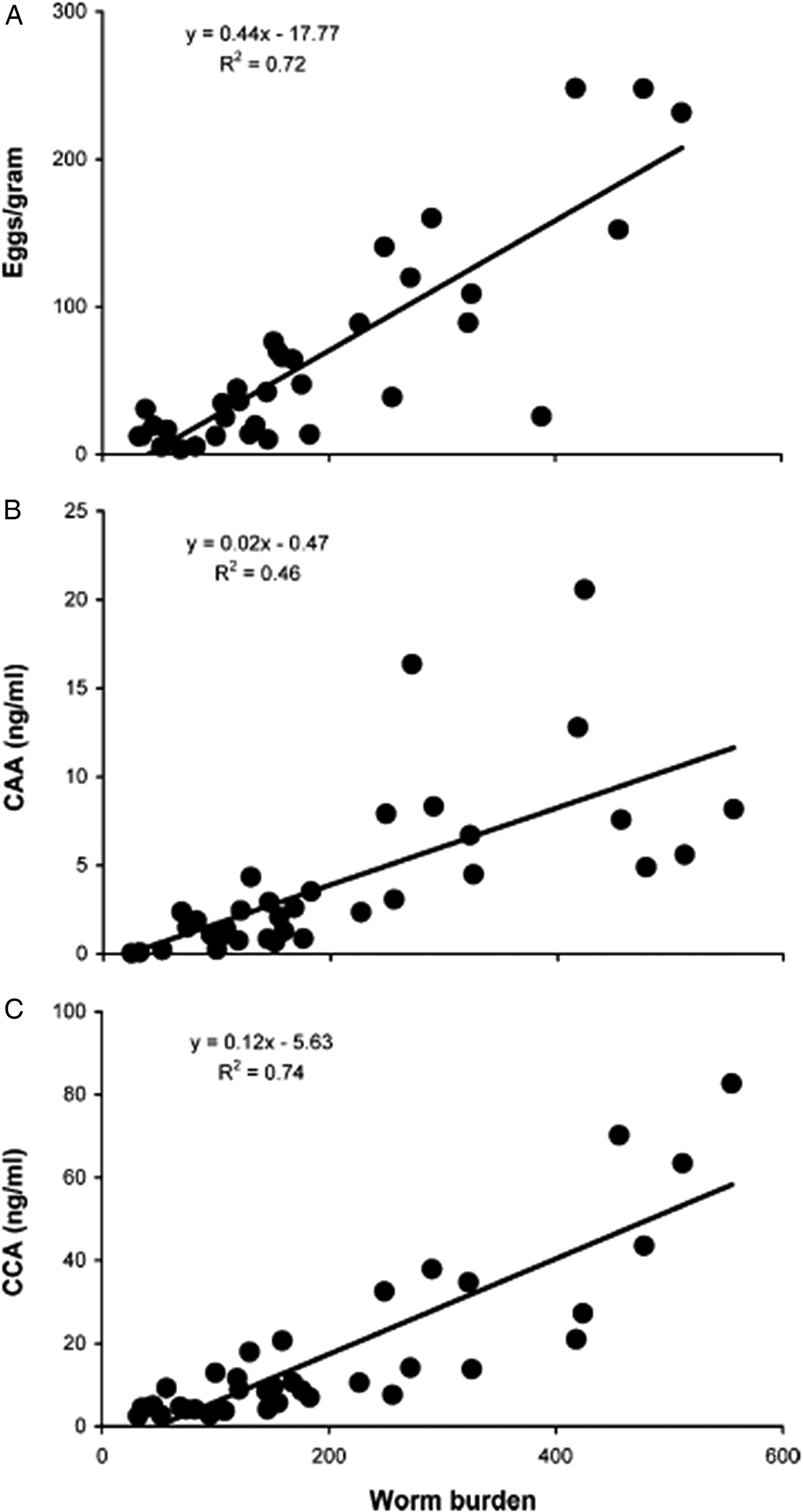
Our work with the olive baboon confirmed the low sensitivity of the Kato-Katz smear. This host is highly permissive for S. mansoni infection and provides a realistic laboratory model with which to assess and compare the efficacy of diagnostic techniques (Kariuki and Farah, Reference Kariuki and Farah2005). Indeed, we argue that it is the only such model regularly available and its principal attribute is that surrogate estimates of worm burden, such as epg of faeces, can be compared directly with actual worm burdens obtained by portal perfusion of infected animals. Our studies, based on data from 37 baboons, used simple linear regression of mean epg from nine replicate Kato-Katz smears on worm burden and revealed a detection threshold of 40 worms (Wilson et al. Reference Wilson, van Dam, Kariuki, Farah, Deelder and Coulson2006) (Fig. 1). Note also that eggs were not detected in nine replicate smears from three animals with a measurable worm burden (25 or more worms; 8%) which would have been false negatives by the Kato-Katz smear technique. On the positive side, the R 2 of 0.72 shows what is normally assumed, namely that faecal egg counts are good quantitative surrogate estimates of actual worm burden. Adjusted for sex-ratio (Kariuki et al. Reference Kariuki, van Dam, Deelder, Farah, Yole, Wilson and Coulson2006), the threshold is equivalent to approximately 16 worm pairs. The estimate is remarkably similar to the theoretical calculation for the baboon, based on a faecal production of 200 gm per day (Wasser et al. Reference Wasser, Monfort, Southers and Wildt1994), of 13 worm pairs.
Linear regression of surrogate values against corresponding worm burdens for (A) faecal eggs, (B) circulating anodic antigen (CAA) and (C) circulating cathodic antigen (CCA). Values are means of nine, three and two replicates, respectively; zero values for eggs per gram (three) and CAA (two) were omitted to avoid biasing the regression calculation. One animal was also omitted from the egg regression due to incomplete data. The regression coefficient R 2 provides a measure of goodness of fit to the data. When y = 0, the respective intercepts of the x-axis represent the threshold of detection for each technique. (From Wilson et al. Reference Wilson, van Dam, Kariuki, Farah, Deelder and Coulson2006).

One way of circumventing the low frequency of eggs in a faecal mass, their random distribution and the small sample taken for analysis, is to enrich eggs prior to counting using a larger amount of faces. Flotation methods, such as zinc sulphate solutions (SG 1.2–1.35), used for many nematode eggs in faecal samples, are intrinsically less suitable for schistosome eggs because these lack an impermeable vitelline membrane. The high osmotic pressure of such solutions means they suck all the water out of the eggs and crush them. Nevertheless, both ether concentration (Marti and Escher, Reference Marti and Escher1990) and the FLOTAC method (Cringoli et al. Reference Cringoli, Rinaldi, Maurelli and Utzinger2010) have been evaluated against the Kato-Katz smear technique (Glinz et al. Reference Glinz, Silue, Knopp, Lohourignon, Yao, Steinmann, Rinaldi, Cringoli, N'Goran and Utzinger2010). One advantage is that the methods can be used on fixed and stored faecal samples, with a much larger amount of starting material (~0.5 to 1 g). Both estimated a higher % prevalence of S. mansoni infections in human faecal samples, compared to triplicate Kato-Katz smears. However, the FLOTAC method, in particular, produced lower quantitative epg counts, suggesting that many eggs were not recovered by the flotation. The fragility of the schistosome egg in the FLOTAC zinc sulphate solution was confirmed by the images displayed by (Glinz et al. Reference Glinz, Silue, Knopp, Lohourignon, Yao, Steinmann, Rinaldi, Cringoli, N'Goran and Utzinger2010).
We previously addressed the problem of egg fragility using a biocompatible 60% Percoll solution in 0.9% saline, as a separation medium (Eberl et al. Reference Eberl, Al-Sherbiny, Hagan, Ljubojevic, Thomas and Wilson2002). Percoll is a colloidal suspension of silica particles coated with polyvinylpyrrolidone that exerts a very low osmotic pressure. The method works on the opposite principle to FLOTAC, being of slightly lower density than viable eggs (SG 1.224). It was used with 250 mg faeces to float off the colloidal material that would obscure eggs in a smear (especially at the acute stage of infection), leaving the eggs in the pellet for counting. For both rhesus macaques and chimpanzees the method was 10–20 times more effective than the Kato-Katz smear. It proved similarly superior when employed with human faecal samples from Egypt. However, the Percoll method requires viable eggs, a centrifuge and an expensive reagent, and so seems best suited to research applications, rather than mass treatment programmes.
Another approach, based on the physical properties of eggs, termed Helmintex, has been developed in Brasil (Teixeira et al. Reference Teixeira, Neuhauss, Ben, Romanzini and Graeff-Teixeira2007). It starts with 30 gm of faecal material, processed by passage through a series of sieves, excluding larger debris but allowing colloidal particles to travel in the flow-through. The eggs are then stained and concentrated further using paramagnetic beads, before counting (Favero et al. Reference Favero, Candido, Verissimo, Jones, St. Pierre, Lindholz, Da Silva, Morassutti and Graeff-Teixeira2017). The method has been calibrated by spiking of faeces with known numbers of eggs and shown to give a mean recovery rate of 27%. The method proved significantly superior to both the Kato-Katz smear and a saline gradient method in diagnosing individuals with a light infection (Pinheiro et al. Reference Pinheiro, Carneiro, Hanemann, de Oliveira and Bezerra2012). Its main drawback is the time taken to process each sample. However, using the values given above for egg output per worm (300) and daily human faecal production (250 gm), with a 30 gm faecal sample and a 27% recovery rate, the method should be capable of detecting an infection comprising one worm pair.
It is hard to avoid the conclusion that, although widely used, the Kato-Katz smear has serious limitations. In areas of high transmission, it can be used with confidence to control morbidity by identifying individuals with high worm burdens, whose health and prospects will be markedly improved by chemotherapy. However, where worm burdens are low, its insensitivity gives the impression that prevalence is much lower than the reality, perhaps even causing complacency about the status of control measures.
Antibody-based tests
In order to overcome some of the drawbacks of the Kato-Katz smear and other faecal sampling techniques, attempts have been made to develop more sensitive diagnostic tests based on the detection of antibodies in serum reactive with schistosome antigens, particularly in situations of light infections (Noya et al. Reference Noya, Alarcón de Noya, Losada, Colmenares, Guzmán, Lorenzo and Bermúdez2002; Doenhoff et al. Reference Doenhoff, Chiodini and Hamilton2004; Bottieau et al. Reference Bottieau, Clerinx, de Vega, Van den Enden, Colebunders, Van Esbroeck, Vervoort, Van Gompel and Van den Ende2006). Such tests, usually in ELISA format, are most valuable in patients with infrequent exposure to schistosome cercariae, such as tourists visiting an endemic area (Coltart et al. Reference Coltart, Chew, Storrar, Armstrong, Suff, Morris, Chiodini and Whitty2015). They are generally more sensitive than examination of stool samples, particularly in low transmission areas (Cesari et al. Reference Cesari, Ballen, Mendoza and Matos2005). Antibody assays may utilize crude antigen extracts such as schistosome egg antigen, soluble adult worm antigen preparation (SWAP), or can be constructed to detect purified or recombinant antigens (Oliveira et al. Reference Oliveira, Kanamura, Takei, Hirata, Valli, Nguyen, Rodrigues, Jesus and Hirata2008). In patients with Katayama syndrome – an acute inflammatory response driven by the body's immune response to schistosomula migration and egg deposition, often characterized with nocturnal fever, cough, myalgia, headache and abdominal tenderness (Ross et al. Reference Ross, Vickers, Olds, Shah and McManus2007), – a positive antibody test is usually the earliest diagnostic laboratory result. Still, a large fraction of patients will initially test negative (Hamilton et al. Reference Hamilton, Klinkert and Doenhoff1998; Zhu, Reference Zhu2005). Such false negative tests prevent timely treatment of schistosomiasis in travellers who present with fever of unknown origin. A potential solution to the early diagnosis of acute schistosomiasis using ELISA was provided by the identification of a glycan epitope shared between keyhole limpet haemocyanin and the schistosome surface (Grzych et al. Reference Grzych, Dissous, Capron, Torres, Lambert and Capron1987). In recently exposed individuals in both Egypt (Mansour et al. Reference Mansour, Omer-Ali, Farid, Simpson and Woody1989) and Brasil (Alves-Brito et al. Reference Alves-Brito, Simpson, Bahia-Oliverira, Rabello, Rocha, Lambertucci, Gazzinelli, Katz and Correa-Oliveira1992) strong antibody responses to the glycan were detected, even before eggs were present in faecal samples and the method readily distinguished between patients with acute vs chronic disease in almost all instances.
A major limitation of antibody-based tests is that while the methods tend to be more sensitive than Kato-Katz smears, parasite-specific antibodies remain detectable in the circulation for years after the infection has been cleared. As a result, measuring anti-schistosome antibody titres in serum may not distinguish between current and previous infections. In addition, antibody levels in serum do not necessarily correlate with the intensity of the schistosome infection as determined by mean epg of faeces (Shane et al. Reference Shane, Verani, Abudho, Montgomery, Blackstock, Mwinzi, Butler, Karanja and Secor2011). This limits the clinical value of antibody detection for confirmation of the success of chemotherapy (Rabello et al. Reference Rabello, Garcia, da Silva, Rocha and Katz1997) since specific antibodies continue to be present long after the worms have disappeared. The occurrence of cross-reactivity with other helminthic infections due to shared antigenic epitopes constitutes another limitation of the immunodiagnostic approach. One way to circumvent is to select specific antigens for coating ELISA plates (Valli et al. Reference Valli, Kanamura, Silva, Silva, Vellosa and Garcia1997; Oliveira et al. Reference Oliveira, Kanamura, Dias, Soares, Lima and Ciaravolho2003). Use of peptides from schistosome proteins has an even higher potential of eliminating cross-reactivity while improving on specificity (Oliveira et al. Reference Oliveira, Kanamura, Takei, Hirata, Valli, Nguyen, Rodrigues, Jesus and Hirata2008). Sufficient information is now known about the secreted proteins from the gut and tegument of adult worms, and from mature eggs (Wilson, Reference Wilson2012), for researchers to evaluate their potential in such a diagnostic assay (see below). The recent review by Hinz et al. (Hinz et al. Reference Hinz, Schwarz, Hahn and Frickmann2017) has revealed how little progress has been made away from use of crude extracts towards single specific targets as diagnostics.
Circulating glycan-based antigens
One solution to the problems associated with testing for reactive antibodies in infected individuals is to detect parasite-derived antigens in the circulation or urine (Pontes et al. Reference Pontes, Dias-Neto and Rabello2002). Several assays have been described in different laboratories (de Jonge et al. Reference De Jonge, Rabello, Krijger, Kremsner, Rocha, Katz and Deelder1991; Barsoum et al. Reference Barsoum, Bogitsh and Colley1992; Hassan et al. Reference Hassan, Badawi and Strand1992) but the major player in their development has been the group of Deelder and colleagues in Leiden, The Netherlands. The current assays depend on adult worms vomiting CAA and CCA into the host bloodstream (Nash, Reference Nash1978; Deelder et al. Reference Deelder, Qian, Kremsner, Acosta, Rabello, Enyong, Simarro, van Etten, Krijger and Rotmans1994) and the detection of their immunologically reactive O-linked glycan residues. The repeated epitope in CAA is unique to the worm (Bergwerff et al. Reference Bergwerff, van Dam, Rotmans, Deelder, Kamerling and Vliegenthart1994) but the multiple Lewis X epitopes of CCA (van Dam et al. Reference van Dam, Bergwerff, Thomas-Oates, Rotmans, Kamerling, Vliegenthart and Deelder1994) are also present in the host, and this can result in high backgrounds for the assay (Polman et al. Reference Polman, Diakhate, Engels, Nahimana, Van Dam, Ferreira, Deelder and Gryseels2000). A prerequisite for these assays was the generation of monoclonal antibodies specific for the glycan epitopes (van Lieshout et al. Reference van Lieshout, de Jonge, El-Masry, Mansour, Bassily, Krijger and Deelder1994; Al-Sherbiny et al. Reference Al-Sherbiny, Osman, Hancock, Deelder and Tsang1999). A feature of the ELISA format is that the assays are performed on serum samples after precipitation of proteins by trichloroacetic acid, releasing the glycans from immune complexes and leaving them in the supernatant (de Jonge et al. Reference de Jonge, Fillie and Deelder1987).
Detection of CAA and CCA by ELISA (Deelder et al. Reference Deelder, De Jonge, Boerman, Fillié, Hilberath, Rotmans, Gerritse and Schut1989; de Jonge et al. Reference de Jonge, Kremsner, Krijger, Schommer, Fillié, Kornelis, van Zeyl, van Dam, Feldmeier and Deelder1990; van Lieshout et al. Reference van Lieshout, Polderman and Deelder2000) demonstrates only active infections, it is suitable for assessing the effect of treatment on worm burden, and has a high specificity. Early in their development, the tests were extended to detection in urine (Deelder et al. Reference Deelder, Qian, Kremsner, Acosta, Rabello, Enyong, Simarro, van Etten, Krijger and Rotmans1994) opening up the possibility that invasive methods of sample collection could be eliminated. CCA detection in urine was found to be as sensitive as a single Kato-Katz test in areas that have a high intensity of infection (Polman et al. Reference Polman, Stelma, Gryseels, Van Dam, Talla, Niang, Van Lieshout and Deelder1995). However, although the detection of circulating antigens by ELISA is highly specific (Hamilton et al. Reference Hamilton, Klinkert and Doenhoff1998; Attallah et al. Reference Attallah, Ismail, El Masry, Rizk, Handousa, El Bendary, Tabll and Ezzat1999), in areas of low endemicity it was not thought to be more sensitive than the detection of eggs by the Kato-Katz faecal smear (de Jonge et al. Reference de Jonge, Gryseels, Hilberath, Polderman and Deelder1988; Van Lieshout et al. Reference van Lieshout, Panday, De Jonge, Krijger, Oostburg, Polderman and Deelder1995; Hamilton et al. Reference Hamilton, Klinkert and Doenhoff1998).
In our vaccine studies with the olive baboon, we were able to compare the detection limits of circulating antigen assays vs faecal smears (Fig. 1) (Wilson et al. Reference Wilson, van Dam, Kariuki, Farah, Deelder and Coulson2006). When surrogate estimates of worm burden provided by CAA and CCA assays on serum from 37 animals (three and two replicates, respectively) were compared by linear regression with the number of worms recovered by portal perfusion, thresholds of detection of 24 and 47 worms respectively, were revealed. The respective R 2 values of 0.74 and 0.46, respectively, indicate that CAA was a better predictor of worm burden than CCA. Extrapolated to human populations as with the Kato-Katz smear, these assays were just as likely to miss individuals with low worm burdens. Furthermore, two animals with 25 or more worms were false negatives after three replicate CAA tests.
Given the diagnostic potential of circulating antigens, considerable efforts were made to simplify their application in endemic areas. Two urine CCA assays were developed and commercialized (Shane et al. Reference Shane, Verani, Abudho, Montgomery, Blackstock, Mwinzi, Butler, Karanja and Secor2011). The first, using a colloidal carbon conjugate of a monoclonal antibody specific for CCA, was designed for use in the laboratory (van Dam et al. Reference van Dam, Wichers, Ferreira, Ghati, van Amerongen and Deelder2004). A version of this assay was used in studies of children less than 3 years of age (Odogwu et al. Reference Odogwu, Ramamurthy, Kabatereine, Kazibwe, Tukahebwa, Webster, Fenwick and Stothard2006) and in school-aged children with sensitivities and specificities in the low 80th percentiles when compared with stool egg data (Odogwu et al. Reference Odogwu, Ramamurthy, Kabatereine, Kazibwe, Tukahebwa, Webster, Fenwick and Stothard2006), but is no longer available. The second assay was a gold-conjugated, lateral flow cassette-based assay, which was designed to be a point of care CCA assay (POC-CCA) (Shane et al. Reference Shane, Verani, Abudho, Montgomery, Blackstock, Mwinzi, Butler, Karanja and Secor2011), and its introduction has changed the schistosome diagnostics landscape.
Shane et al. (Reference Shane, Verani, Abudho, Montgomery, Blackstock, Mwinzi, Butler, Karanja and Secor2011) showed that the SWAP ELISA and the cassette urine CCA assay were the most sensitive assays, albeit also the least specific when analysed by latent class analysis. The authors also observed that the CCA urine assays were more sensitive than examination of three stools by Kato-Katz and were as sensitive as the adult worm-specific antibody tests. The urine CCA assays are also easy to use and less time consuming than the other methods currently employed for S. mansoni screening. CCA assays may also have the potential to assess cure, as CCA levels declined significantly from week 1 after treatment of individuals with S. mansoni (van Lieshout et al. Reference van Lieshout, De Jonge, Mansour, Bassily, Krijger and Deelder1993). The manufacturer's technical brochure suggests that false positive CCA results may occur if the individual being tested has haematuria or pio-uria due to urinary tract infection. Shane et al. (Reference Shane, Verani, Abudho, Montgomery, Blackstock, Mwinzi, Butler, Karanja and Secor2011) found a strong correlation between stool egg concentration and intensity of the CCA test band and concluded that the CCA urine assays are an effective screening tool for S. mansoni infections in areas of high prevalence. However, a complication of the POC-CCA assay is the subjective visual assessment of the test strip result, and the way in which a ‘trace’ reading should be interpreted (Colley et al. Reference Colley, Andros and Campbell2017). Nevertheless, the POC-CCA has now been widely used in mass treatment programmes in several African countries, where it has outperformed the faecal smear as a diagnostic tool (Kittur et al. Reference Kittur, Castleman, Campbell, King and Colley2016; Colley et al. Reference Colley, Andros and Campbell2017; Ortu et al. Reference Ortu, Ndayishimiye, Clements, Kayugi, Campbell, Lamine, Zivieri, Magalhaes, Binder, King, Fenwick, Colley and Jourdan2017). One conclusion of all these studies could be that in so-called ‘egg negative’ individuals, adult worms are still present, and the prevalence of schistosomiasis mansoni has been seriously underestimated (Colley et al. Reference Colley, Andros and Campbell2017). Indeed, the diagnostic deficit may apply to all the species of Schistosoma infecting humans (Colley et al. Reference Colley, Andros and Campbell2017). It is unfortunate that the POC-CCA cassette assay was not available when we performed our baboon vaccine experiments so no data are available on how its sensitivity relates to actual worm burdens.
Perhaps as a tacit acknowledgment of still inadequate performance, attempts to improve the sensitivity of circulating antigen assays have been made using a combination of various quantitative lateral flow (LF)-based assays utilizing up-converting phosphor (UCP) reporters (Deelder et al. Reference Deelder, van Dam and van Lieshout2012; Colley et al. Reference Colley, Binder, Campbell, King, Tchuem Tchuente, N'Goran, Erko, Karanja, Kabatereine, van Lieshout and Rathbun2013; Corstjens et al. Reference Corstjens, De Dood, Kornelis, Fat, Wilson, Kariuki, Nyakundi, Loverde, Abrams, Tanke, Van Lieshout, Deelder and Van Dam2014). Of note, the UCP-LF assay for CAA detection has been adapted to a dry reagent format that is stable at ambient temperature and worldwide shipping without the need for a cold chain (van Dam et al. Reference van Dam, de Dood, Lewis, Deelder, van Lieshout, Tanke, van Rooyen and Corstjens2013). The stability of the target antigen has a direct effect on the assay sensitivity and the CAA glycan fraction is a stable component in urine and blood, detectable after storage of clinical samples for prolonged periods of time (Corstjens et al. Reference Corstjens, De Dood, Kornelis, Fat, Wilson, Kariuki, Nyakundi, Loverde, Abrams, Tanke, Van Lieshout, Deelder and Van Dam2014). Corstjens and colleagues showed that the quantitative UCP-LF assay had the capacity to determine active infections of various Schistosoma species with excellent clinical sensitivity and specificity (Corstjens et al. Reference Corstjens, De Dood, Kornelis, Fat, Wilson, Kariuki, Nyakundi, Loverde, Abrams, Tanke, Van Lieshout, Deelder and Van Dam2014). Nevertheless, to achieve maximum sensitivity they needed to concentrate the CAA in the serum or urine sample using centrifugal filters with a 10 kDa cut-off. With baboon sera from vaccination experiments and graded infections, they obtained an improved resolution of the relationship between CAA levels and worms, in the low burden range. Used in conjunction with a concentration step, the UCP-LF assay takes us some way towards the goal of detecting a single worm pair.
Molecular approaches
Schistosomes do not multiply within the definitive host implying that there would be a little turnover of DNA from the adult worms (apart perhaps from shedding of spermatozoa by excess unmated males). However, a salient feature of S. mansoni infections is the deposition of ~300 eggs per female in the tissues each day. Those which die in the tissues release parasite DNA, which must reach the bloodstream and urine to serve as the basis for diagnosis. Several groups have developed polymerase chain reaction (PCR) methods to improve the direct detection of schistosome infections. The tests can be done on urine, stool, or organ biopsy samples and involve the recovery of parasite-derived DNA prior to PCR amplification (Pontes et al. Reference Pontes, Oliveira, Katz, Dias-Neto and Rabello2003; Sandoval et al. Reference Sandoval, Siles-Lucas, Aban, Pérez-Arellano, Gárate and Muro2006). Unfortunately, only a small volume of starting material – faeces, blood or urine – can be processed for DNA extraction. In the case of faecal sampling, successful PCR amplification depends on whether the processed sample contains eggs or not; it has the same limitations as optical microscopy and does not provide a significant clinical benefit.
Nonetheless, cloning and characterization of a 121-bp, tandemly repeated DNA sequence (Sm1–7), which comprises 12% of the genomes of both male and female S. mansoni (Hamburger et al. Reference Hamburger, Turetski, Kapeller and Deresiewicz1991) opened the opportunity for using PCR technique to diagnose schistosomiasis mansoni (Pontes et al. Reference Pontes, Oliveira, Katz, Dias-Neto and Rabello2003; Wichmann et al. Reference Wichmann, Panning, Quack, Kramme, Burchard, Grevelding and Drosten2009). The small, repeat sequences are suitable probes because their copy number (600 000 per schistosome cell) should make for high detection sensitivity, even if only a few DNA fragments reach the blood stream. Secondly, such sequences are most likely to be non-coding and therefore evolve more rapidly than the rest of the genome, making for high specificity. A second DNA sequence, the ITS2 spacer situated between the small and large subunits of the ribosomal RNA genes and present as thousands of copies, has been independently developed for PCR-based diagnosis (Obeng et al. Reference Obeng, Aryeetey, de Dood, Amoah, Larbi, Deelder, Yazdanbakhsh, Hartgers, Boakye, Verweij, van Dam and van Lieshout2008).
The utility of PCR was revealed when a single survey, using primers designed from Sm1-7 repeat sequence, detected more cases of infection with S. mansoni than three Kato-Katz stool examinations (Pontes et al. Reference Pontes, Oliveira, Katz, Dias-Neto and Rabello2003). The discrepancy confirmed the greater sensitivity of PCR when eggs were detected by further faecal sampling from the same patients. PCR has the ability to achieve amplification with as little as 1fg of S. mansoni egg template DNA (Pontes et al. Reference Pontes, Dias-Neto and Rabello2002) and the specificity of the test was shown by the absence of amplification when DNA from four other helminths commonly found in the same endemic areas as S. mansoni was used as templates. The ITS2 spacer was initially detected in urine samples from patients with a S. haematobium infection where it compared favourably with a CCA strip test. Subsequently this PCR technique has been extended to the detection of S. mansoni DNA (i.e. eggs) in stool samples from human populations in areas of high (Senegal) and low transmission (Kenya), where it proved more sensitive than one or more faecal smears; it was especially useful in areas with low-level infections (Meurs et al. Reference Meurs, Brienen, Mbow, Ochola, Mboup, Karanja, Secor, Polman and van Lieshout2015). It should be noted that the PCR method applied to stool samples suffers the same constraints as direct faecal sampling for eggs by microscopy. At low worm burdens, if the amount of stool sampled is small, it may not contain any eggs. In the Sm1–7 study (Pontes et al. Reference Pontes, Oliveira, Katz, Dias-Neto and Rabello2003) 0.5 gm was processed from each patient so it was very likely to miss some infections. With the ITS2 study (Meurs et al. Reference Meurs, Brienen, Mbow, Ochola, Mboup, Karanja, Secor, Polman and van Lieshout2015) 0.7 mls of faeces was sieved and diluted in ethanol. Again this was probably not an adequate amount of starting material to detect the eggs released by single worm pair. If technically feasible, DNA extraction from a larger faecal sample appears essential, to increase sensitivity.
When stool and serum/plasma were compared as the source of DNA for PCR amplification (Pontes et al. Reference Pontes, Dias-Neto and Rabello2002; Wichmann et al. Reference Wichmann, Panning, Quack, Kramme, Burchard, Grevelding and Drosten2009), serum DNA bands were not as strong as those seen with faecal samples, suggesting limited quantities of free-circulating DNA (Pontes et al. Reference Pontes, Dias-Neto and Rabello2002). Nevertheless, Pontes et al. (Reference Pontes, Dias-Neto and Rabello2002) concluded that PCR is probably more sensitive than the Kato-Katz technique in situations of low worm burden. Wichmann et al. (Reference Wichmann, Panning, Quack, Kramme, Burchard, Grevelding and Drosten2009) also detected cell-free parasite DNA (CFPD) in human plasma, which in contrast to eggs in stool or urine, should be equally distributed throughout the plasma volume of the patient, resolving the issue of random sampling that confounds clinical sensitivity of classical detection methods. The disappearance of CFPD from the bloodstream might also be a way to confirm the elimination of schistosomes after treatment (Wichmann et al. Reference Wichmann, Panning, Quack, Kramme, Burchard, Grevelding and Drosten2009). Additionally, CFPD can be very useful in early diagnosis of Katayama syndrome caused by acute Schistosoma infection which is a major differential diagnosis in returning travellers presenting with fever of unknown origin (Ross et al. Reference Ross, Vickers, Olds, Shah and McManus2007; Wichmann et al. Reference Wichmann, Panning, Quack, Kramme, Burchard, Grevelding and Drosten2009).
Sometimes, PCR can report false negative results due to many factors such as inhibition of the amplification reaction by faecal compounds and/or DNA degradation during transportation from the field (Engels et al. Reference Engels, Sinzinkayo and Gryseels1996).
A recent development has been the successful application of PCR for detection of the Sm1–7 DNA fragment (Hamburger et al. Reference Hamburger, Turetski, Kapeller and Deresiewicz1991) in urine samples from potentially infected individuals (Lodh et al. Reference Lodh, Mwansa, Mutengo and Shiff2013), in comparison with the CCA dipstick assay and Kato-Katz faecal smear. The PCR detection of parasite DNA in patient urine consistently outperformed the other two assays. The major drawback is the need for a PCR instrument and a well-equipped laboratory so at this time it cannot be described as a point-of-care assay. Nevertheless, it would be worth calibrating the PCR technique against worm burden in a realistic host like the baboon, using both the Sm1–7 and ITS2 sequences as DNA targets to see how they compare in sensitivity.
Loop-mediated isothermal amplification (LAMP), a novel molecular alternative to PCR, has also been developed and tested. It differs from PCR in that four or six primers are used for the amplification of a single target gene at a single temperature step from 63 to 65 °C, maintained at 65 °C for 60 min. Many amplicons with various structural conformations are produced in LAMP reactions which can be detected by simple turbidity or fluorescence (Zhang et al. Reference Zhang, Brown and González-Escalona2011). LAMP, initially described in 2000 (Notomi et al. Reference Notomi, Okayama, Masubuchi, Yonekawa, Watanabe, Amino and Hase2000), has rapidly gained acceptance for detection of a variety of infectious agents including Plasmodium falciparum and S. japonicum (Poon et al. Reference Poon, Wong, Ma, Chan, Chow, Abeyewickreme, Tangpukdee, Yuen, Guan, Looareesuwan and Peiris2006; Xu et al. Reference Xu, Rong, Zhang, Shi, Zhu and Xia2010). It does not require complex equipment for DNA amplification or for amplicon detection (Mori et al. Reference Mori, Nagamine, Tomita and Notomi2001) and is potentially suitable for molecular monitoring in basic laboratory facilities (Boehme et al. Reference Boehme, Nabeta, Henostroza, Raqib, Rahim, Gerhardt, Sanga, Hoelscher, Notomi, Hase and Perkins2007). Given these features, LAMP is potentially useful for work in the field and has already been used in rural laboratories in developing areas for the diagnosis of tuberculosis (Boehme et al. Reference Boehme, Nabeta, Henostroza, Raqib, Rahim, Gerhardt, Sanga, Hoelscher, Notomi, Hase and Perkins2007). However, some points still need to be addressed in considering LAMP implementation in the field. First, a simple and inexpensive DNA preparation method is required. For achieving field applicability, the expensive DNA extraction kits should be replaced by user-friendly and affordable DNA preparation tools, particularly where large numbers of samples are to be examined. Also, to be applicable in field laboratories, LAMP reaction mixtures will need to be premixed, ready for use, and storable under field-laboratory conditions (Abbasi et al. Reference Abbasi, King, Muchiri and Hamburger2010). Reaction mixtures having these features are now available for PCR (Sohni et al. Reference Sohni, Kanjilal and Kapur2008) and can likely be developed for LAMP. The diagnosis of schistosomiasis mansoni infection in humans using Sm1–7 sequence amplification for copro-PCR (Pontes et al. Reference Pontes, Oliveira, Katz, Dias-Neto and Rabello2003) or plasma-PCR (Wichmann et al. Reference Wichmann, Panning, Quack, Kramme, Burchard, Grevelding and Drosten2009) has already been accomplished and it can detect low-grade infections with high sensitivity. It is feasible that LAMP assays would add another order of magnitude of detection sensitivity, namely 0.1 fg worm DNA compared with 1 fg detection sensitivity of the corresponding PCR assays (Hamburger et al. Reference Hamburger, Turetski, Kapeller and Deresiewicz1991, Reference Hamburger, Abbasi, Ramzy, Jourdane and Ruppel2001).
Diagnostic sensitivity and human vaccine testing
The search for a schistosome vaccine has a long history and at least three candidates, TSP-2, Sm-14 and Smp80 calpain (Siddiqui and Siddiqui, Reference Siddiqui and Siddiqui2017), are at Phase I testing in humans, whilst one (ShGST) has reached Phase III, but with unknown outcome (summarised by Merrifield et al. Reference Merrifield, Hotez, Beaumier, Gillespie, Strych, Hayward and Bottazzi2016). How will the efficacy of these vaccines be tested at Phase II and Phase III in human populations in areas endemic of schistosomiasis? Our experience with trials of the radiation-attenuated cercarial vaccine in baboons has highlighted the problems caused by the diagnostic deficit (Kariuki et al. Reference Kariuki, van Dam, Deelder, Farah, Yole, Wilson and Coulson2006). In five separate experiments protection was evaluated ten weeks after challenge when surrogate estimates of worm burden in test and control animals were at steady state. Compared with actual worm burden, epg faeces overestimated protection by >5% on all occasions, four times by >20% CAA overestimated protection on 3/5 and CCA on 4/5 occasions. The existence of thresholds of detection is clearly a major contributory factor in this overestimation (Wilson et al. Reference Wilson, van Dam, Kariuki, Farah, Deelder and Coulson2006). Human vaccine trials are likely to be undertaken in individuals given chemotherapy to ‘clear’ their worms. These individuals will then gradually accrue worm burdens that will only become reliably detectable as they rise above the thresholds. The threshold distortion diminishes over time with accumulating worm burden but protection will always be overestimated in the test relative to the placebo group. The outcome would be a misleading impression that the vaccine is performing (much) better than the reality, especially if the evaluation took place early after patency.
Secreted schistosome proteins as potential new diagnostics
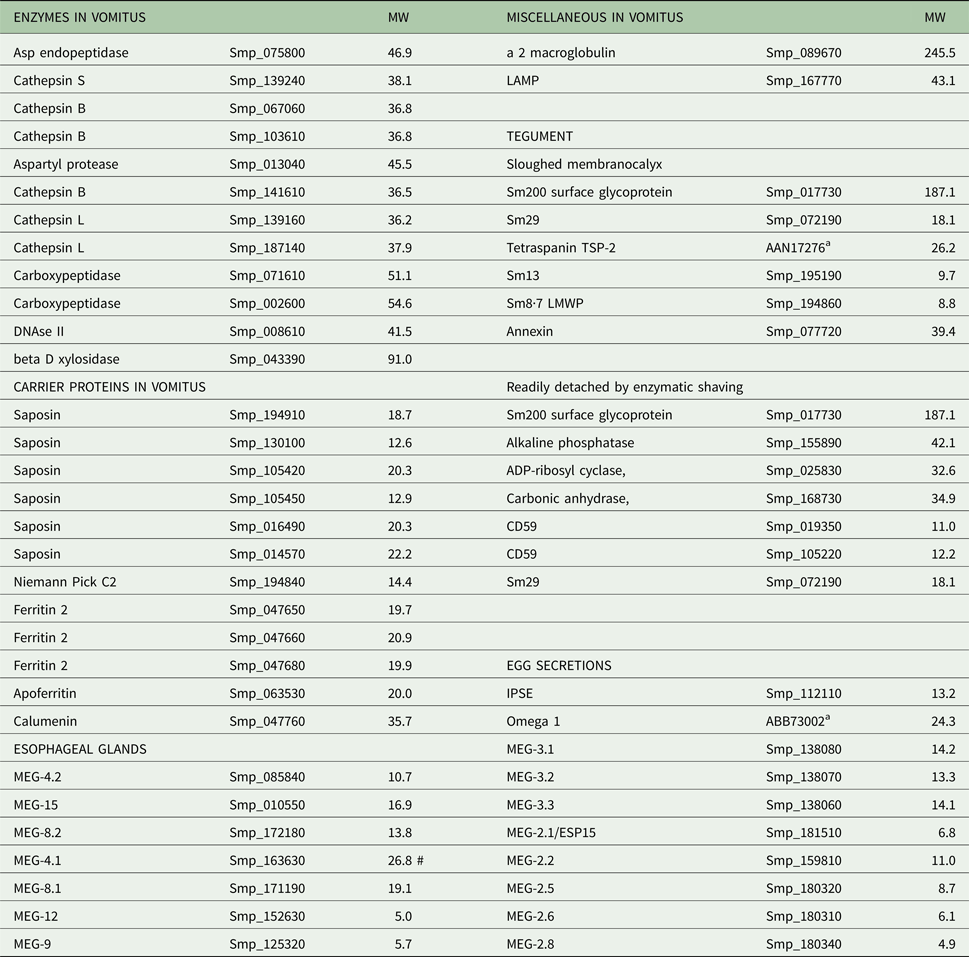
Large-scale sequencing of schistosome cDNAs to define the transcriptome (Verjovski et al. Reference Verjovski-Almeida, DeMarco, Martins, Guimaraes, Ojopi, Paquola, Piazza, Nishiyama, Kitajima, Adamson, Ashton, Bonaldo, Coulson, Dillon, Farias, Gregorio, Ho, Leite, Malaquias, Marques, Miyasato, Nascimento, Ohlweiler, Reis, Ribeiro, Sa, Stukart, Soares, Gargioni and Kawano2003) was followed by the sequencing, assembly and annotation of the S. mansoni genome (Berriman et al. Reference Berriman, Haas, LoVerde, Wilson, Dillon, Cerqueira, Mashiyama, Al-Lazikani, Andrade, Ashton, Aslett, Bartholomeu, Blandin, Caffrey, Coghlan, Coulson, Day, Delcher, DeMarco, Djikeng, Eyre, Gamble, Ghedin, Gu, Hertz-Fowler, Hirai, Hirai, Houston, Ivens and Johnston2009). Over the same period advances in mass spectrometry made it possible to determine the precise protein composition of parasite fractions (Wilson et al. Reference Wilson, Ashton, Braschi, Dillon, Berriman and Ivens2007). An intense period of investigation followed in which the proteins secreted by invading cercariae (Curwen et al. Reference Curwen, Ashton, Sundaralingam and Wilson2006), migrating schistosomula were characterized (DeMarco et al. Reference DeMarco, Mathieson, Manuel, Dillon, Curwen, Ashton, Ivens, Berriman, Verjovski-Almeida and Wilson2010). An inventory of the proteins exposed at, or released from the adult tegument surface (Braschi et al. Reference Braschi, Castro-Borges and Wilson2006a; Braschi and Wilson, Reference Braschi and Wilson2006) and those vomited into the blood stream from the blind-ending gut (Hall et al. Reference Hall, Braschi, Truscott, Mathieson, Cesari and Wilson2011) was also compiled. Lastly, the products of the live mature egg, released into the tissues to aid its passage through host tissues, were defined (Cass et al. Reference Cass, Johnson, Califf, Xu, Hernandez, Stadecker, Yates and Williams2007; Mathieson and Wilson, Reference Mathieson and Wilson2010). It should be noted that there are wide discrepancies in the results of these compositional studies, and we take here a conservative view that only proteins with a signal peptide are components of the secretome, unless there is a very good reason to believe otherwise. The potential for the secretions of adult worms and eggs to act as new diagnostic targets was reviewed in 2012 (Wilson, Reference Wilson2012) and a Table incorporating recent findings is presented here (Table 1). This information could be used to improve the specificity of antibody detection and to find new markers of active infection in blood or urine. It should assist future searches for schistosome-derived biomarkers in those fluids.
The secretome of adult worms and eggs characterized by proteomics

MW of mature secreted protein minus signal peptide.
a GenBank annotation. # actual MW = 100 kDa due to extensive O glycosylation.
Data from: Vomitus, Hall et al. Reference Hall, Braschi, Truscott, Mathieson, Cesari and Wilson2011; Neves & Castro-Borges unpublished.
Esophageal glands, Wilson et al. Reference Wilson, van Dam, Kariuki, Farah, Deelder and Coulson2016; Tegument, Wilson, Reference Wilson2012; Egg secretions, DeMarco et al. Reference DeMarco, Mathieson, Manuel, Dillon, Curwen, Ashton, Ivens, Berriman, Verjovski-Almeida and Wilson2010.
The secretions of the gastrodermis that lines the gut are a major source of worm proteins entering the host bloodstream when the worm regurgitates the residual contents of a blood meal (Hall et al. Reference Hall, Braschi, Truscott, Mathieson, Cesari and Wilson2011). They comprise, in approximately equal measure enzymes, largely but not entirely proteases, and a selection of carrier proteins that are probably involved in uptake of inorganic ions (Ferritins, Calumenin) and lipids (Saposins, NPC2) into the worm tissues. The alimentary tract products have recently been augmented by the identification of around 40 esophageal gland proteins (Wilson et al. Reference Wilson, Li, MacDonald, Neves, Vitoriano-Souza, Leite, Farias, James, Ashton, DeMarco and Castro-Borges2015), only the most abundant of which are listed in Table 1. Identification of tegument surface constituents released into the bloodstream has been bedevilled by the extreme fragility of this syncytial layer in vitro. Only the products released after cationised ferritin-stimulated sloughing of the membranocalyx (Braschi et al. Reference Braschi, Curwen, Ashton, Verjovski-Almeida and Wilson2006b; Wilson, Reference Wilson2012) and those GPI-anchored proteins that can be released from live worms by enzymatic shaving with phosphatidyl-inositol phospholipase C (Sauma et al. Reference Sauma, Tanaka and Strand1991; Castro-Borges et al. Reference Castro-Borges, Dowle, Curwen, Thomas-Oates and Wilson2011), are listed in Table 1. Lastly, the live mature eggs are a major source of secretions (Mathieson and Wilson, Reference Mathieson and Wilson2010), and proteomics has revealed that together IPSE and Omega-1 constitute the vast bulk. When these are depleted from eggs secretions, groups of MEG-2 and MEG-3 family proteins are revealed (DeMarco et al. Reference DeMarco, Mathieson, Manuel, Dillon, Curwen, Ashton, Ivens, Berriman, Verjovski-Almeida and Wilson2010). The contribution of tegument proteins to the total secretome is likely to be slight – this syncytium is primarily concerned with immune evasion. The relative contributions of alimentary tract vs eggs secretions are hard to judge. The female gut, in particular, is very active, consuming eight times more blood than the male and presumably, therefore, producing eight times more vomitus. Although only 300 eggs are produced per day, when mature, they secrete their ‘escape proteins’ for days to weeks so that a single worm pair will be responsible for the secretions of some thousands of viable tissue eggs at any one time.
The search for biomarkers is not a new idea: evidence of secreted schistosome proteins was first reported in 1967 (Berggren and Weller, Reference Berggren and Weller1967), who demonstrated the presence of adult worm antigens in the serum and urine of mice and hamsters infected with S. mansoni. However, it has received remarkably little attention from researchers. Most reports have been concerned with the detection of host markers in the blood stream as an indicator of tissue damage caused by eggs (e.g. Pereira et al. Reference Pereira, Syn, Amancio, Cunha, Caporali, Trindade, Santos, Souza, Andrade, Witek, Secor, Pereira, Lambertucci and Diehl2016). The CAA and CCA glycoproteins were the first secretome products identified and then developed for diagnostic puroposes. We can pose a series of questions about other possibilities:
• Do some other adult worms or egg products have properties that surpass CAA or CCA?
• What is the half-life of worm or egg secreted proteins in the bloodstream?
• Are they immunogenic and form immune complexes with immunoglobulins leading to their rapid clearance?
• Do they persist in the circulation at concentrations proportional to worm burden?
• Do some of them pass easily into the urine and can be detected there?
Factors such as molecular weight, charge and shape will determine whether worm proteins pass through the glomerular membrane filters of the kidney or are retained in the bloodstream (Hall, Reference Hall2016). Macromolecules like inulin (MW 5.5 kDa) are completely filterable, while 75% of myoglobin (MW 17kD) but only 0.5% of albumin (MW 69 kDa) enter the kidney tubules. Many of the adult worm and egg secreted products listed in Table 1 have relatively low MW so might be expected to enter the urine unless reabsorbed by the tubule cells. Importantly, since 99% of the water solvent filtered through the glomerular membranes is reabsorbed by the tubules, the smaller schistosome proteins entering the filtrate should be concentrated by a factor of 100 in urine, over the blood stream. Remarkably, no-one yet seems to have carried out a systematic biomarker analysis of urine (or plasma) from infected patients or laboratory animals to search for these released products.
There is one report of an oligosaccharide target of a monoclonal antibody being identified by mass spectrometry in the urine of infected individuals, which confirms the existence of such biomarkers (Robijn et al. Reference Robijn, Planken, Dieuwke, Hokke and Deelder2008). The tegument surface glycoprotein Sm200 has been detected in circulating lipoprotein particles from the blood of schistosome-infected humans (Sprong et al. Reference Sprong, Suchanek, van Dijk, van Remoortere, Klumperman, Avram, van der Linden, Leusen, van Hellemond and Thiele2006). Lastly, the gastrodermal Cathepsin B protease was previously identified as a suitable target for immunodiagnosis by antibody ELISA (Li et al. Reference Li, Idris, Corachan, Han, Kirschfink and Ruppel1996; El-Sayed et al. Reference El-Sayed, Ghoneim, Demian, El-Sayed, Tawfik, Sakr, Abou-Basha, Renganathan, Klinkert and Abou-Rawash1998; Sulbarán et al. Reference Sulbarán, Ballen, Bermùdez, Lorenzo, Noya and Cesari2010) and an assay has now been developed to capture the enzyme in the circulation of infected patients using a specific polyclonal rabbit antibody (Gonzalez et al. Reference Gonzalez, Sulbaran, Ballen and Cesari2016). The activity of the captured enzyme was then measured using a solid phase assay and the test was able to detect low-level infections in Venezuelan patients with 100% sensitivity and 100% specificity. This last report indicates that evaluation of other gastrodermal enzyme components in the circulation of patients is worthwhile, bearing in mind the questions posed above.
Proteins in the worm and egg secretomes can also be used as specific targets to improve antibody detection but research in this area has been sporadic. Before the advent of proteomics, the gut cathepsin B was employed in the diagnosis of schistosomiasis using antibody-detecting ELISA assays in mice and human subjects (Ruppel et al. Reference Ruppel, Xing, Dell, Numrich and Shi1991; El-Sayed et al. Reference El-Sayed, Ghoneim, Demian, El-Sayed, Tawfik, Sakr, Abou-Basha, Renganathan, Klinkert and Abou-Rawash1998). Doenhoff et al. (Reference Doenhoff, Chiodini and Hamilton2004) suggested the use of the major egg secretion IPSE as a potential immunodiagnostic to detect antibody responses after infection. More recently, two gut saposins likely to be prominent in S. japonicum vomitus (SjSAPLP4 and SjSAPLP5) have been used in ELISA format to detect schistosome infections in laboratory animals and human patients in China (Liu et al. Reference Liu, Zhou, Piao, Hou, Shen, Zou, Li, Cao and Chen2016) and the Philippines (Cai et al. Reference Cai, Weerakoon, Mu, Olveda, Piao, Liu, Olveda, Chen, Ross and McManus2017). Their orthologs are also prominent in proteomic analyses of S. mansoni vomitus. Definition of the worm and egg secretome has provided a large number of potential new diagnostic targets.
Concluding remarks
Parasitic helminths differ in one key aspect from other infectious agents as the lack of multiplication means that primary worm burden is the key factor in disease morbidity. For schistosome infections in humans that burden cannot be measured directly so all diagnostics must serve as surrogates for the parameter. As argued above, the baboon is the only realistic laboratory host in which the absolute sensitivity of surrogate estimates can be evaluated against worm burden. If we aim for detection of a single worm pair, what are the merits of each surrogate?
Faecal sampling for eggs. The main attraction has to be the quantitative relationship between egg output and worm burden. However, the low egg output per S. mansoni female relative to the daily faecal output is the major obstacle. Enrichment of eggs in faeces (or removal of the contaminants that obscure eggs) offers the only hope for increasing sensitivity. A flotation medium with low osmolality or a sieving method and at least 1 gm of faecal starting material are prerequisites.
Circulating antibodies by ELISA. The sensitivity of antibody detection may be high but the problem remains the difficulty of distinguishing between current and previous infections.The specificity of such assays can be increased by using single secreted targets, and there are now plenty of such targets to choose from. It is also unclear in current infections whether antibody titre relates to worm burden. Ideally, an antibody ELISA test would use a single and specific schistosome protein as the target, recognized by the immune response of all infected humans. The antibody response to that antigen, approximately proportional to the worm burden, would rapidly fall towards zero when the stimulus provided by infection was eliminated by chemotherapy. IgM responses might have better diagnostic features than IgG responses.
Circulating antigens. CAA and CCA ELISAs are as sensitive as the Kato-Katz faecal smear and proportional to worm burden; the POC-CCA dipstick is apparently more sensitive. However, the dipstick has not been calibrated against worm burden in a host like the baboon. The CAA lateral flow test on serum samples has been validated using baboon sera and may be the nearest approach yet to the goal of single worm pair detection. However, this was only achieved by spin-concentrating the target glycan from ~1 ml of serum. There is a need for biomarker studies on blood and especially urine of infected humans and laboratory host like the baboon to identify those markers of the worm and egg secretome that might develop as new diagnostic targets. Given the schistosome specificity of many secreted products, this could overcome the problem that the CCA epitope in the current dipstick is shared with the host.
Detection of parasite DNA. This is the most enigmatic of the diagnostic possibilities because it is unclear whence the schistosome DNA detectable in blood and urine derives. The most likely source seems to be the death and degradation of tissue eggs, a feature that might have an extended kinetic profile of weeks to months. In that respect detection of DNA could prove little better than antibody titre as an indicator of current infection. Set against this, the specificity and abundance of the Sm 1–7 and ITS2 DNA markers in the S. mansoni genome are very desirable characteristics. It is entirely possible that use of PCR or LAMP amplification could reach the requisite sensitivity of single worm pair detection, but that needs calibration in the baboon host.
Is the diagnostic ideal of detecting one worm pair via a fingerprick blood sample or a urine sample achievable, without the need for enrichment of the parasite stage (egg) or product (protein, DNA)? That goal is still distant and the development of diagnostic techniques for schistosomiasis with greater sensitivity appears to us essential if disease control and eradication are to be attained. When mass chemotherapy is used to reduce infection in school children, low worm burdens become undetectable with current diagnostics. There is still a need to identify such individuals as they may subsequently develop severe pathology and they also serve as reservoirs of infection. The early intervention with effective chemotherapeutic agents is most efficacious when sensitive and specific methods for detecting infection are available.
Acknowledgements
The authors are grateful to the European Foundation Initiative into African Research in Neglected Tropical Diseases (EFINTD).
Financial support
This work was supported by Senior Fellowship Grant by EFINTD to T.M.K through the VolkswagenStiftung Foundation.