


One of the central questions in the study of representation is the degree to which descriptive representation—conceptualized as demographic similarities between representatives and those they represent—shapes the attitudes and behaviors of the polity—symbolic representation.Footnote 1 While this question is broadly applicable to—and has normative implications for—a variety of groups and political contexts, it has become a particularly important line of inquiry in the scholarship on gender and politics, where researchers have examined the consequences of women’s presence in office for citizens’ understanding of—and interactions with—political institutions and actors. Since Pitkin’s (Reference Pitkin1967) foundational work on the topic, scholars have examined symbolic representation from a variety of angles and used a number of different operationalizations to capture the concept. One definition of symbolic representation, and the one employed in this article, is the extent to which citizens feel that they are being “fairly and effectively represented” (Schwindt-Bayer and Mishler Reference Schwindt-Bayer and Mishler2005). While these feelings can be influenced by a host of factors—such as policy congruence (Wolak Reference Wolak2018), or communications between representatives and constituents (i.e., Fridkin and Kenny Reference Fridkin and Kenney2014b)—a key question in the representation literature is whether, and how, the inclusion of underrepresented groups plays a role in shaping these attitudes and behaviors.
In this sense, symbolic representation can be thought of as “the link between [women’s] presence and citizens’ attitudes and behavior” (Clayton, O’Brien, and Piscopo Reference Clayton, O’Brien and Piscopo2019, 1–2 emphasis added).Footnote 2 Theoretical work contends that descriptive representation sends important signals about who should (and should not) participate in politics and the degree to which certain groups and interests will receive a fair hearing (Celis and Mazur Reference Celis and Mazur2012; Mansbridge Reference Mansbridge1999; Phillips Reference Phillips1995; Sapiro Reference Sapiro1981). These signals should in turn evoke more positive attitudes from citizens and be associated with increased engagement with politics.Footnote 3
Despite the centrality of these arguments in the literature, research from American politics has produced mixed results. While some scholars argue that women candidates and elected officials can evoke symbolic attitudes and behaviors from constituents (Atkeson Reference Atkeson2003; Atkeson and Carrillo Reference Atkeson and Carrillo2007; Jones Reference Jones2014; Reingold and Harrell Reference Reingold and Harrell2010), others argue that political attitudes and identities outweigh any gendered considerations that citizens might make (Dolan Reference Dolan2006; Lawless Reference Lawless2004; Wolak Reference Wolak2015). In this article, I approach the question of women’s descriptive representation and citizen attitudes from a collective perspective, rather than a dyadic perspective, which is prevalent in the American politics literature on the topic (see also Atkeson and Carrillo Reference Atkeson and Carrillo2007; Uhlaner and Scola Reference Uhlaner and Scola2016). Though previous work on collective representation in the U.S. context has also produced mixed results—perhaps suggesting ambivalence toward gender diversity among the American public—I argue that these mixed findings may be because many Americans’ hold beliefs about women’s inclusion that are out of step with reality.
Using original survey data, I show—consistent with past research—that most individuals are unaware of women’s presence in politics and that the distribution of beliefs is wide-ranging. However, where previous research has pointed to the public’s lack of awareness about women’s representation as an impediment to linking descriptive and symbolic representation, I argue that variations in respondent beliefs about women’s presence represent a fruitful research opportunity. Drawing on the literature relating to misperceptions, which shows that erroneous beliefs can play a pivotal role in shaping public attitudes and behaviors, I argue that leveraging variations in respondent estimates of women’s representation can provide critical insights into how citizens think about, and relate to, the institutions that represent them. Using data from the Cooperative Congressional Election Study, and the concept of external efficacy as a starting point, I conduct three tests examining the relationship between perceptions of women’s representation and respondent feelings of efficacy.
My first empirical analysis indicates that perceptions are indeed related to the levels of efficacy expressed by survey respondents. A second analysis builds on this finding and examines how perceptions of state-level representation influence evaluations of state legislatures. This allows me to more directly compare how perceptions relate to efficacy compared with the objective levels of representation experienced by respondents. Indeed, I find that while actual levels of women’s representation are a poor predictor of respondent efficacy, beliefs about women’s inclusion are a strong predictor of these attitudes. A third, and final, analysis more thoroughly tests this relationship by examining how respondent levels of efficacy changed from a preelection survey to a postelection survey where they were given correct information about women’s representation following the 2018 midterm elections. Here, I find that respondents who initially underestimated women’s representation expressed higher levels of efficacy after receiving correct information, while overestimators reported decreased efficacy. Moreover, the results of my analyses suggest that beliefs about women’s representation are associated with more positive evaluations among both men and women, offering important insights into how—and for whom—beliefs about women’s representation matter.
Building on the body of scholarship on misperceptions and public opinion, the results of my analyses indicate that Americans do consider factors such as gender composition when evaluating institutions, even if the information they draw upon to make these inferences may not be correct. The findings presented here offer critical insights into literature on descriptive and symbolic representation and suggest that this relationship is best understood through the subjective prism of respondent beliefs as opposed to the objective reality observed by scholars. As I discuss further in the conclusion, the implications of this finding are cause for both optimism and pessimism. On the one hand, my findings indicate that citizens do value gender diversity in their institutions. On the other hand, they indicate that increases in women’s actual levels of representation are unlikely to bolster public support for institutions unless these gains are highly visible and the public is aware a shift has occurred.
Does Women’s Descriptive Representation Produce Symbolic Outcomes?
A critical question in the literature on representation is the extent to which the inclusion of historically marginalized groups influences the way citizens perceive and interact with governments. While this question has been a central line of inquiry in the women and politics scholarship, past research often offers conflicting results, and there are few clear conclusions about whether the presence of women candidates and elected officials leads to the feelings of “being fairly and effectively represented” that are associated with symbolic representation (Schwindt-Bayer and Mishler Reference Schwindt-Bayer and Mishler2005). While some scholars have found evidence in support of the relationship (Atkeson Reference Atkeson2003; Atkeson and Carrillo Reference Atkeson and Carrillo2007; Barnes and Burchard Reference Barnes and Burchard2012; Burns, Schlozman, and Verba Reference Burns, Schlozman and Verba2001; Campbell and Wolbrecht Reference Campbell and Wolbrecht2006; Fridkin and Kenney Reference Fridkin and Kenney2014a; Reference Fridkin and Kenney2014b), others have displayed more skepticism (Broockman Reference Broockman2014; Dolan Reference Dolan2006; Lawless Reference Lawless2004; Wolak Reference Wolak2015; Reference Wolak2020). In this section, I outline some of the competing perspectives and findings in the current literature, including questions of who should respond to women’s representation, whether citizens evaluate political institutions and systems through a dyadic or collective lens, and whether citizens actually know who represents them.
Who Responds to Descriptive Representation?
Traditionally, the literature has examined how women respond to receiving descriptive representation (Alexander and Jalalzai Reference Alexander and Jalalzai2020; Atkeson Reference Atkeson2003; Atkeson and Carrillo Reference Atkeson and Carrillo2007; Barnes and Burchard Reference Barnes and Burchard2012; Broockman Reference Broockman2014; Campbell and Wolbrecht Reference Campbell and Wolbrecht2006; Dolan Reference Dolan2006; Lawless Reference Lawless2004; Reingold and Harrell Reference Reingold and Harrell2010). As the group that has been historically excluded (relative to men), women are thought to be especially receptive to the cues provided by women’s presence in office. This presence is argued to send empowering signals to women that the political sphere is open to them, that their perspectives are valued and will receive fair hearing, and that politics is not inherently a “man’s game” (Barnes and Burchard Reference Barnes and Burchard2012; Burns, Schlozman, and Verba Reference Burns, Schlozman and Verba2001; Mansbridge Reference Mansbridge1999; Sapiro Reference Sapiro1981). Under this framework, men (as the dominant group) should not express more positive affect toward institutions or engage in more participatory acts in response to women’s representation.Footnote 4 Indeed, several scholars have found evidence to suggest that while women candidates and officeholders can influence the attitudes and behaviors of women in the electorate, the behaviors of men are relatively unaffected (Atkeson Reference Atkeson2003; Atkeson and Carrillo Reference Atkeson and Carrillo2007; Barnes and Burchard Reference Barnes and Burchard2012; Reingold and Harrell Reference Reingold and Harrell2010).
However, increasingly, scholars are finding that women’s presence in deliberative bodies shapes the attitudes and opinions of men as well as women. (Barnes and Taylor-Robinson Reference Barnes, Taylor-Robinson, Alexander, Bolzendahl and Jalalzai2018; Clayton, O’Brien, and Piscopo Reference Clayton, O’Brien and Piscopo2019; Karp and Banducci Reference Karp and Banducci2008; Schwindt-Bayer Reference Schwindt-Bayer2010; Schwindt-Bayer and Mishler Reference Schwindt-Bayer and Mishler2005; Stauffer Reference Stauffer2018; Verge, Wiesehomeier, and Espírito-Santo Reference Verge, Wiesehomeier and Espírito-Santo2020). Specifically, this research finds that women’s presence legitimizes institutions (Clayton, O’Brien, and Piscopo Reference Clayton, O’Brien and Piscopo2019), increases feelings of trust (Schwindt-Bayer Reference Schwindt-Bayer2010), confidence and satisfaction in institutions (Barnes and Taylor-Robinson Reference Barnes, Taylor-Robinson, Alexander, Bolzendahl and Jalalzai2018; Schwindt-Bayer Reference Schwindt-Bayer2010; Schwindt-Bayer and Mishler Reference Schwindt-Bayer and Mishler2005), perceptions of institutional responsiveness (Verge, Wiesehomeier, and Espírito-Santo Reference Verge, Wiesehomeier and Espírito-Santo2020), and evaluations of how the institution functions (Karp and Banducci Reference Karp and Banducci2008; Stauffer Reference Stauffer2018). Extant literature suggests at least two possible mechanisms underlying this relationship.
First, women’s inclusion may serve as a signal not only that political institutions are open and responsive to women, but also that these institutions are open to a wide array of viewpoints and perspectives. Schwindt-Bayer and Mishler (Reference Schwindt-Bayer and Mishler2005) refer to this as a sociotropic model of representation. In this framework, citizens understand that the interests of their group are bound to the fortunes of other groups in the polity, with the optimal institution being one that is open and responsive to many groups and interests. While women’s inclusion certainly sends important signals about gender inclusivity, it may also enhance the feeling that all points of view will be represented and that “government values representation and the participation of diverse groups” (Schwindt-Bayer Reference Schwindt-Bayer2010, 165). Moreover, it is important to acknowledge that men (and women) hold multiple identities beyond their gender identity. Thus, while increasing women’s presence necessarily means decreasing men’s, this may still engender greater feelings of trust, efficacy, and legitimacy among men by signaling that institutions will be open and responsive to these other identities and viewpoints.
Second, women’s inclusion may send signals about how government institutions function and the procedures used to reach decisions. Atkeson and Carillo (Reference Atkeson and Carrillo2007), for example, speculate that their finding that both men and women express higher levels of external efficacy when represented by a female governor may be due to “perceived characteristics and traits of female leaders, including honesty” (90). Valdini (Reference Valdini2019) argues that parties and institutions capitalize on public perceptions of women as more honest and less corrupt by strategically including women after a government scandal to bolster public support. Others have argued that women’s inclusion sends important signals about institutional decision making and the extent to which these processes are fair and embody positive characteristics (Clayton, O’Brien, and Piscopo Reference Clayton, O’Brien and Piscopo2019; Stauffer Reference Stauffer2018). Indeed, while Karp and Banducci (Reference Karp and Banducci2008) find minimal evidence that women’s inclusion in political office increases citizen engagement, they do find evidence that citizens are more satisfied with how government and elections operate when women are included. In short, women’s inclusion may signal to citizens that government simply works better, which should in turn lead to all citizens feeling more positive affect toward those institutions.
Collective versus Dyadic Representation
Beyond questions of who responds to women’s inclusion, there are also questions of how women’s presence confers “attitudinal and behavioral effects” to citizens (Lawless Reference Lawless2004). Do these effects manifest when citizens consider their individual representatives in office—dyadic representation—or when citizens consider the overall composition of their institutions—collective representation (Weissberg Reference Weissberg1978)? Scholarship in American politics has most frequently tended toward the former, often offering conflicting conclusions about the consequences that individual women candidates and officeholders have for the constituents they represent.Footnote 5
On the one hand, scholars have found evidence that exposure to female candidates and representatives leads to higher levels of political knowledge (Fridkin and Kenney Reference Fridkin and Kenney2014a; Reference Fridkin and Kenney2014b; Jones Reference Jones2014; Wolak Reference Wolak2020) and higher levels of political interest and engagement (Atkeson Reference Atkeson2003; Campbell and Wolbrecht Reference Campbell and Wolbrecht2006; Hinojosa and Kittilson Reference Hinojosa and Kittilson2020; Reingold and Harrell Reference Reingold and Harrell2010), and it encourages women to emerge as candidates in down-ballot races (Ladam, Harden, and Windett Reference Ladam, Harden and Windett2018). On the other hand, other scholars have found minimal or no evidence that women candidates or officeholders lead to more engaged or mobilized citizens (Broockman Reference Broockman2014; Dolan Reference Dolan2006; Lawless Reference Lawless2004; Wolak Reference Wolak2015; Reference Wolak2020) or that these individuals lead to greater feelings of trust and efficacy toward the broader political system (Dolan Reference Dolan2006; Lawless Reference Lawless2004). One potential explanation for these mixed findings is that constituents may not always be sufficiently familiar with the individuals who represent them. To that end, some research has shifted toward thinking about the symbolic effects associated with women serving in highly visible positions—such as governors, senators, heads of state, and cabinet posts—where citizens are far more likely to be familiar with the representative, and this research has tended to produce more consistent results (Alexander and Jalalzai Reference Alexander and Jalalzai2020; Barnes and Taylor-Robinson Reference Barnes, Taylor-Robinson, Alexander, Bolzendahl and Jalalzai2018; Fridkin and Kenney Reference Fridkin and Kenney2014a; Ladam, Harden, and Windett Reference Ladam, Harden and Windett2018; Morgan and Buice Reference Morgan and Buice2013).
Alternatively, the question of descriptive and symbolic representation can be approached from a collective standpoint. In this context, women’s overall presence in institutions is argued to send signals about openness, inclusion, and policy responsiveness regardless of whether constituents’ dyadic representative(s) is a man or woman. This approach has been more common in comparative politics, where scholars have documented an association between women’s overall presence in national legislatures and increases in participation, political trust, institutional approval, and confidence in women’s ability to lead (Alexander Reference Alexander2012; Barnes and Burchard Reference Barnes and Burchard2012; Desposato and Norrander Reference Desposato and Norrander2009; Hinojosa and Kittilson Reference Hinojosa and Kittilson2020; Kittilson and Schwindt-Bayer Reference Kittilson and Schwindt-Bayer2010; Schwindt-Bayer Reference Schwindt-Bayer2010; Schwindt-Bayer and Mishler Reference Schwindt-Bayer and Mishler2005).
While a focus on dyadic representation in the United States has produced a robust literature, collective representation offers important insights into our understanding of when, how, and for whom descriptive representation confers symbolic benefits. Though individual women may be able to engender support for the political system in some contexts, the ability of any one woman candidate or officeholder to do so may be contingent on the broader institutional contexts in which she serves. Moreover, when evaluating a political institution or system, constituents may care more about the features of the institution overall than the characteristics of any individual legislator. To the extent that American politics scholars have examined the symbolic effects of women’s collective representation, results have been mixed. While some scholars find evidence that women’s presence in state legislatures is tied to higher levels of voter turnout and increased feelings of external efficacy (Atkeson and Carrillo Reference Atkeson and Carrillo2007; Uhlaner and Scola Reference Uhlaner and Scola2016), other scholars have found no relationship between women’s collective representation and citizen affect toward or engagement with political institutions (Lawless Reference Lawless2004; Wolak Reference Wolak2018; Reference Wolak2020). However, just as incorporating citizen knowledge and awareness has proven fruitful for the study of descriptive and symbolic representation from a dyadic perspective, so too may incorporating citizen knowledge enhance our understanding of collective representation.
Do Citizens Know Who Represents Them?
To some extent, much of the previously cited research assumes that citizens have some understanding of the gender representation they receive. Yet, research on political knowledge casts doubts on this assumption, finding that many Americans are ill-informed about politics and that many lack knowledge about “political players” (Delli-Carpini and Keeter Reference Delli-Carpini and Keeter1996). Indeed, studies that explicitly ask respondents to estimate the percentage of women serving in the U.S. Congress show not only that most Americans are unable to provide a correct answer but also that the range of beliefs that Americans hold about women’s presence is quite broad (Dolan Reference Dolan2011; Reference Dolan2014; Sanbonmatsu Reference Sanbonmatsu2003). Evidence outside of the US reaches similar conclusions about citizens’ awareness of women’s presence in national legislatures (Cowley Reference Cowley2014; Verge, Wiesehomeier, and Espírito-Santo Reference Verge, Wiesehomeier and Espírito-Santo2020).
To illustrate this point more thoroughly, the left panel of Figure 1 presents the distribution of estimates provided by 2,000 survey respondents across the 2016 and 2018 Cooperative Congressional Election Study (CCES) who were asked to estimate the percentage of seats in Congress that were held by women. At the time the surveys were conducted, women held 19.4% and 20.6% of seats in Congress, respectively. While respondent estimates do center on the correct answer, the range of estimates is striking. In both years, roughly 35% of respondents estimated that women’s representation in Congress was at, or below, 15%, while 20% believed women held upwards of 30% of seats. Knowledge of women’s representation in state legislatures is—perhaps unsurprisingly—no better. The right panel of Figure 1 plots estimates from 1,000 respondents from the 2017 CCES, who were asked to estimate the percentage of women serving in their state legislature. Few respondents were able to register a correct answer to this question. Moreover, the correlation coefficient between respondent estimates and the actual percentage of women serving in their state was just 0.147, suggesting most respondents did not hold even a general idea of women’s presence in their state legislature.
Respondent Estimates of Women’s Representation
Note: The left panel illustrates the distribution of respondent estimates of the percentage of women in Congress. The right panel plots respondent estimates of the percentage of women in their state legislature on the x-axis compared with the real percentage on the y-axis.

That so many individuals are unaware of women’s presence in political institutions may seem problematic, as our ability to leverage variations in representation across regional and institutional contexts is limited if citizens are unaware this variation exists. Alexander and Jalalzai (Reference Alexander and Jalalzai2020) point to this lack of information as a reason to shift away from examining women’s overall presence in legislatures and toward understanding how individual women in high-profile positions—where citizens are more likely to be knowledgeable—empower constituents (see also Barnes and Taylor-Robinson Reference Barnes, Taylor-Robinson, Alexander, Bolzendahl and Jalalzai2018). Yet, the perceptions that respondents hold about women’s presence in their legislatures may prove valuable in their own right. As I argue in the next section, respondent beliefs about women’s collective representation offer important insights into how individuals evaluate their political institutions and the extent to which collective considerations play a role in shaping these evaluations.
Perceptions of Women’s Inclusion and Symbolic Representation
Misperceptions predominate in virtually all aspects of American politics, from beliefs about economic performance (Bartels Reference Bartels2002; Lewis-Beck Reference Lewis-Beck1990), to domestic policies (Aronow and Miller Reference Aronow and Miller2016; Nyhan Reference Nyhan2010), to foreign policy (Kull, Ramsay, and Lewis Reference Kull, Ramsay and Lewis2003), to beliefs about the group compositions of political parties (Ahler and Sood Reference Ahler and Sood2018). The pervasiveness of these perceptions has very real ramifications, as individuals form opinions and take action based on their perceived state of the world rather than objective realities. Sides and Citrin (Reference Sides and Citrin2007), for example, find that anti-immigration sentiment is not linked to the percentage of foreign-born residents in a given country but rather citizen beliefs about the number of these residents. Aronow and Miller (Reference Aronow and Miller2016) find that erroneous beliefs about current gun-control measures deflate public support for policies like universal background checks. Nyhan (Reference Nyhan2010) likewise shows that public misperceptions about the Affordable Care Act played a large role in shaping discourse around American health care reform. In the realm of foreign policy, Kull, Ramsay, and Lewis (Reference Kull, Ramsay and Lewis2003) find misperceptions about weapons of mass destruction, world public opinion, and the role played by Iraq in September 11 shaped support for the war in Iraq.Footnote 6
Beyond being consequential for policy debates, misperceptions can also shape how individuals understand, evaluate, and interact with groups and institutions. Ahler and Sood (Reference Ahler and Sood2018), for instance, find that many individuals overinflate the percentage of partisans that belong to “party-stereotypical groups” (e.g., the percentage of Democrats that are LGBT or the percentage of Republicans that are very wealthy). These perceptions have large implications for polarization, as they inflate beliefs about extremism and negative affect toward out-partisans as well as individual loyalty to their own party (Ahler and Sood Reference Ahler and Sood2018).
Just as these perceptions can influence evaluations and affect toward political parties, so too should perceptions of group composition influence evaluations of political institutions like Congress or state legislatures. In this sense, the array of perceptions of women’s representation highlighted in the previous section can actually be marshaled as a powerful tool that can shed light onto how considerations related to gender diversity influence public evaluations of political institutions.Footnote 7 In short, I argue that it is citizen perceptions of women’s representation that shape their evaluations of institutions, rather than the objective reality of women’s presence.
Indeed, existing evidence does suggest that these perceptions are politically consequential. Sanbonmatsu (Reference Sanbonmatsu2003) and Dolan (Reference Dolan2014), for example, find that American support for increasing the number of women in office is tied to beliefs about the number of women currently serving.Footnote 8 Building on this work, I argue that the effects of perceptions of women’s inclusion may be even further reaching, influencing evaluations of political institutions and the system more generally. Indeed, work on Black politics suggests that perceptions of group representation can serve as a powerful predictor of system level evaluations. Using a survey of African American respondents, Tate (Reference Tate2003) finds that beliefs about the percentage of African Americans in Congress predicts levels of trust in the institution. In a similar vein, I argue that perceptions about women’s representation can be leveraged to understand broader attitudes toward the political system and institutions.
In this research, I examine how perceptions of women’s representation are linked to levels of external efficacy. This concept consistently appears in work on symbolic representation (Atkeson and Carrillo Reference Atkeson and Carrillo2007; Dolan Reference Dolan2006; Lawless Reference Lawless2004), and it is tightly linked to regime stability, democratic legitimacy, and citizen participation (Atkeson and Carrillo Reference Atkeson and Carrillo2007), making it the ideal attitude to examine here. Though Cowley (Reference Cowley2014) offers some insights into how perceptions of representation influence feelings of trust in the context of the British House of Commons, my analysis advances our understanding of this topic in a few key ways that make it the most comprehensive study to date. First, I use multiple years of survey data and show that perceptions of representation are linked to external efficacy in multiple institutional contexts—Congress and state legislatures. Second, after demonstrating an association between perceptions and efficacy, I use panel data to test how respondents’ efficacy changed when provided with correct information, allowing for stronger claims on the nature of this relationship.
Beyond these contributions, I also test the competing expectations in the literature regarding who responds to inclusion. If women’s status as an underrepresented group leads them to place greater importance on women’s representation, I expect to find an effect among women only. If believing women are included is associated with a belief that politics is open to all groups and perspectives, perceptions of women’s representation should be associated with higher levels of efficacy among both men and women.
Efficacy and Perceptions of Congressional Representation
To test the link between perceptions of women’s descriptive representation and symbolic outcomes, I examine the relationship in the context of external political efficacy and the U.S. Congress. Early public opinion research conceptualized efficacy as a single construct that captures the “feeling that individual political action does have, or can have, an impact on the political process, that it is worthwhile to perform one’s civic duties” (Campbell, Gurin, and Miller Reference Campbell, Gurin and Miller1954, 187). Later research delineates two distinct dimensions of the concept: internal and external efficacy. In the case of external efficacy, the feeling of “worthwhileness” described by Campbell et al. manifests in a belief that government is open and responsive to citizen interests. That is, the individual can affect political change because the institution is receptive (Balch Reference Balch1974; Craig, Niemi, and Silver Reference Craig, Niemi and Silver1990). It is this notion of responsiveness that is central to the concept of external efficacy. This is juxtaposed with internal efficacy, where the worthwhileness of participation is derived from a belief that the individual possesses the requisite skills and resources to meaningfully participate (Balch Reference Balch1974; Craig, Niemi, and Silver Reference Craig, Niemi and Silver1990).
The concept of external efficacy has been integral to the study of public opinion and democratic legitimacy since some of the earliest studies of American public opinion and voting behavior (see Campbell, Converse, and Miller Reference Campbell, Converse, Stokes and Miller1960; Campbell, Gurin, and Miller Reference Campbell, Gurin and Miller1954). Moreover, the concept is tightly linked to political participation, is often cited as an indicator of “health of democracy,” and has important implications for regime stability and democratic legitimacy (Abramson and Aldrich Reference Abramson and Aldrich1982; Atkeson and Carrillo Reference Atkeson and Carrillo2007; Pollock Reference Pollock1983). For this research, I am primarily interested in how perceptions of women’s representation influence attitudes toward political institutions. As such, external efficacy serves as the primary dependent variable for the analyses that follow.
To test the link between perceptions of women’s representation and external political efficacy, I rely on data from the CCES. My analysis uses a pooled sample of 2,000 survey respondents from the 2016 and 2018 waves of the study. In addition to the “common content” portion of the survey, these respondents were asked additional questions about their attitudes toward government and their beliefs about women’s presence in politics.Footnote 9 With this data, I measure external efficacy using the following two survey items.
-
1. Government officials care what people like me think.
-
2. People like me have a say in what the government does.
For each statement, respondents were asked the extent to which they agreed or disagreed.Footnote 10 These questions are adapted versions of the items used by the ANES (Craig, Niemi, and Silver Reference Craig, Niemi and Silver1990) and are consistent with other recent studies of political efficacy and women’s representation (Dolan Reference Dolan2006; Lawless Reference Lawless2004; Wolak Reference Wolak2018). For each statement, respondents selected one of five options ranging from “Strongly Disagree” to “Strongly Agree.” To create a measure of external political efficacy, I sum responses to the two questions (α = 0.71) and rescale the result to range from 0 to 1. Consistent with previous work, I find that most respondents feel relatively low levels of external efficacy (μ = 0.36).
Analysis and Results
Model 1 in Table 1 presents the results of an additive model in which efficacy is regressed on respondent perceptions of women’s representation. Model 2 presents the results of an interactive model, which interacts perceptions with respondent gender to determine whether any effects of women’s perceived inclusion are more pronounced for women (Barnes and Burchard Reference Barnes and Burchard2012; Lawless Reference Lawless2004). Also included in the models are controls for respondent political attitudes and identities that may influence external efficacy including: respondent partisanship, ideology, strength of partisanship, and respondent political knowledge.Footnote 11 , Footnote 12 Because the Republican Party controlled both chambers of Congress at the time the 2016 and 2018 CCES was administered, the partisanship variables also capture individual congruence with the institution.
Regression Models: Perceptions of Women’s Inclusion in Congress and External Efficacy

Note: Standard errors in parentheses; *p < 0.1, **p < 0.05, ***p < 0.01.
The models also include a number of demographic controls: age, level of education, employment status, religiosity, and whether respondents identify as white.Footnote 13 In addition to being common correlates of political efficacy, inclusion of these variables also helps to address potential concerns of confounding, as the estimates provided by respondents may be related to these individual characteristics.Footnote 14
Beyond these individual-level measures, the models also include controls meant to capture the actual gender representation experienced by respondents. These variables include a control for whether respondents were represented by a woman Senator, a woman member of the House, and the percentage of women currently serving in respondents’ state legislatures.Footnote 15 , Footnote 16 Inclusion of these variables, again, helps to address potential confounding by ensuring that respondent estimates of representation are not merely proxying for actual representation (i.e., respondents represented by a woman in Congress assuming the overall number of women is higher).Footnote 17 In Model 2, each of these variables is also interacted with respondent gender to account for differential responses men and women may have.Footnote 18 All models include survey-year fixed effects and state random effects to account for possible covariance among respondents and to capture any unobserved effect these factors may have on the dependent variable.
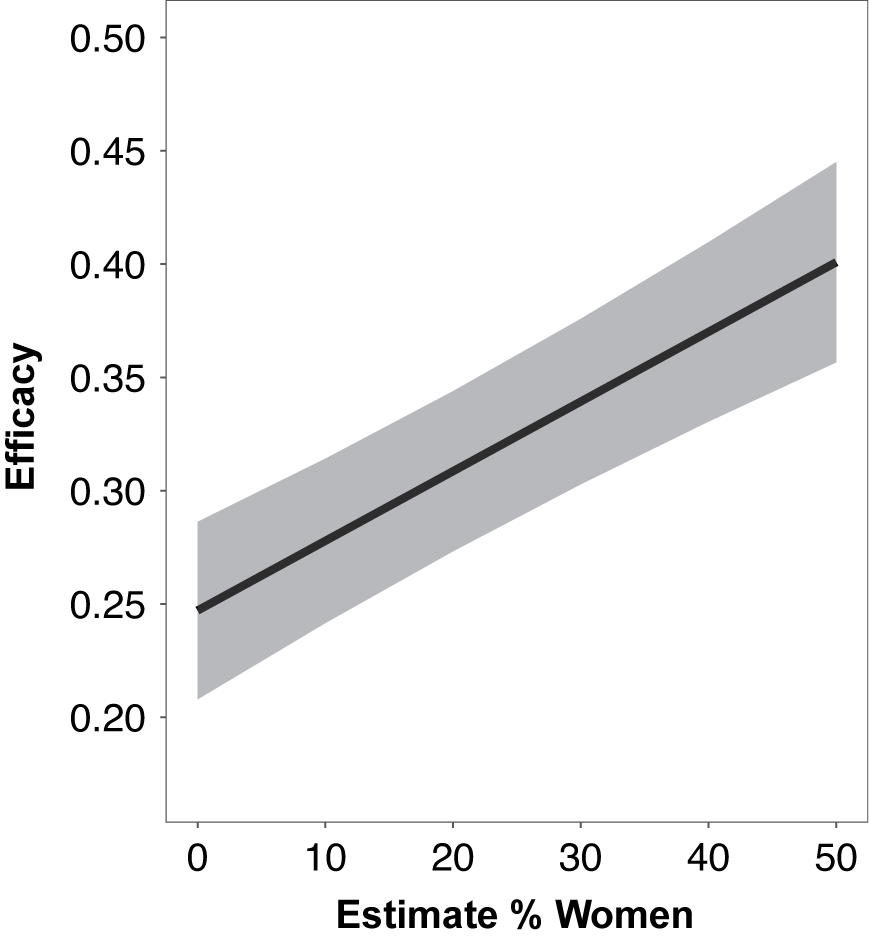
Results from Model 1 indicate that perceptions of women’s inclusion are positively associated with feelings of efficacy among respondents. Moreover, results from Model 2 suggest that this relationship is not significantly different for men and women. For both groups, the marginal effect of perceptions is significant and positive. The insignificant interaction in the model indicates the effect size is not significantly different across the two groups.Footnote 19 To better understand the substantive meaning of this result, Figure 2 presents the relationship visually. Because there are no significant differences between men and women respondents, Figure 2 presents average effects derived from Model 1.
Respondent Estimates and Predicted Levels of Efficacy
Note: Predicted values are calculated by holding all other variables at their mean or modal values. Shaded region represents 95% confidence intervals.

Examining Figure 2, an individual who believes that just 10% of seats in Congress are held by women is expected to have an efficacy score of 0.247. Believing that 40% of Congress are women, in contrast, is associated with an expected efficacy score of 0.370.Footnote 20
The results thus far indicate that beliefs about women’s representation in Congress are a strong predictor of political efficacy. Further, the results indicate that this positive association is present for men as well as women. These findings are consistent with a sociotropic view of representation, and they are in line with research that finds that men as well as women prefer gender-inclusive institutions (Clayton, O’Brien, and Piscopo Reference Clayton, O’Brien and Piscopo2019; Schwindt-Bayer and Mishler Reference Schwindt-Bayer and Mishler2005; Verge, Wiesehomeier, and Espírito-Santo Reference Verge, Wiesehomeier and Espírito-Santo2020). While these findings offer support to my argument about perceived representation, they are limited to a specific context and just two years of survey data. In order to test the veracity of my findings, I test my expectations in the context of state legislative bodies to determine whether similar relationships exist at this level of government.
Efficacy and Perceptions of State Representation
In order to strengthen the conclusions drawn from my previous analysis, I test my expectations in a different institutional context—U.S. state legislatures—using data collected as part of the 2017 CCES. In this wave of the survey, respondents were again asked to estimate the percentage of women in Congress, as well as the percentage of women serving in their state legislature. If perceptions of representation influence feelings of external political efficacy, respondent beliefs about representation in their state legislatures should be associated with evaluations of these bodies. Moreover, this analysis affords me the opportunity to compare how variations in perceptions of state-level representation relate to efficacy compared with variations in actual representation in a manner not possible in the preceding analysis.Footnote 21
The 2017 module included several questions in which respondents were asked to evaluate their state legislatures, including one capturing perceived levels of responsiveness. Specifically, the question asked, “How responsive do you think that your state legislature is to the concerns of people like you?” Respondents selected one of four responses: “not at all responsive,” “not very responsive,” “moderately responsive,” and “very responsive.” This measure serves as the dependent variable for this portion of the analysis.Footnote 22
Table 2 presents the results from a series of ordered probit models with state random effects.Footnote 23 , Footnote 24 Models 1 and 2 display the results of an additive and interactive model, respectively, and do not include a measure of respondent perceptions. Rather, these models estimate external efficacy as a function of the actual levels of representation experienced by respondents in their states. Models 3 and 4 present the same models, this time introducing respondent perceptions. All models include the same individual-level controls as in the previous analysis. To account for variation in state political context, I include a variable measuring whether there was congruence between respondents’ partisanship and the party controlling their state legislature. In addition to this measure, I also include a control for state-government ideology using Berry et al.’s (Reference Berry, Fording, Ringquist, Hanson and Klarner2010) measure (see also Berry et al. Reference Berry, Ringquist, Fording and Hanson1998). This measure is interacted with respondent ideology to roughly capture the level of ideological congruence between respondents and their state government (see Wolak Reference Wolak2018).Footnote 25
Ordered Probit Models: Perceptions of Women’s Inclusion in State Legislatures and Evaluations of State Responsiveness

Note: Standard errors in parentheses; *p < 0.1, **p < 0.05, ***p < 0.01.
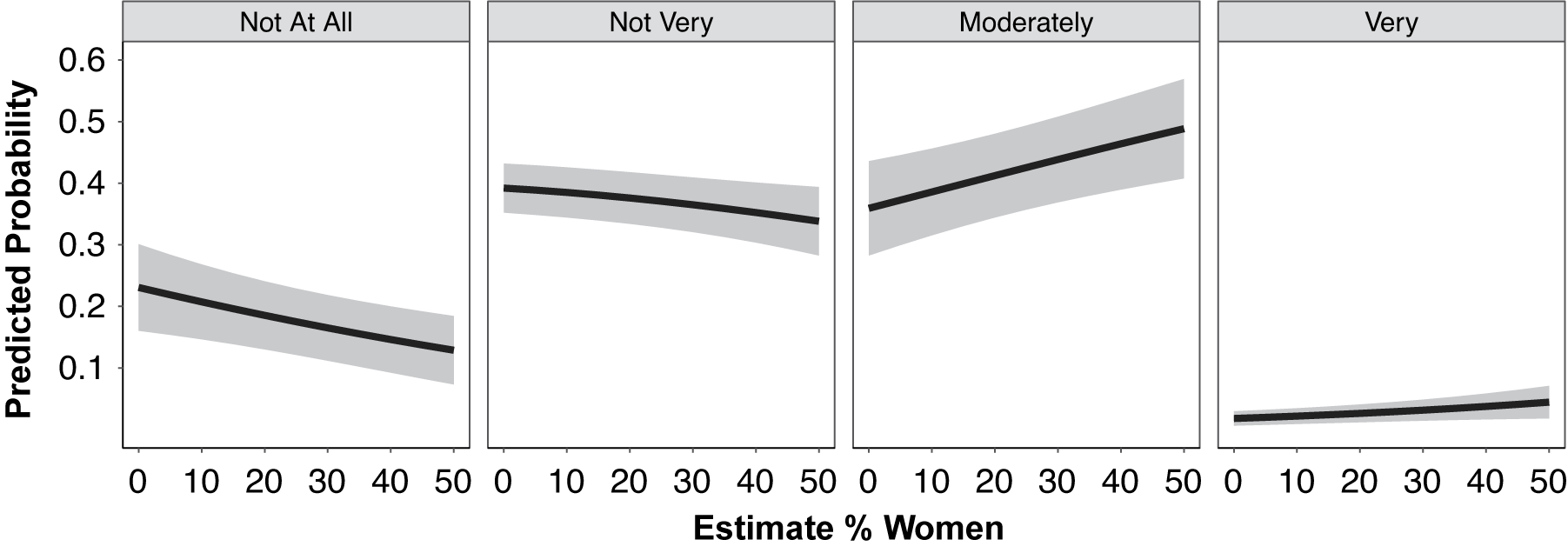
Consistent with Wolak (Reference Wolak2018) and Lawless (Reference Lawless2004), I do not find evidence that women’s collective representation is associated with respondent evaluations of state legislative responsiveness (but see Atkeson and Carrillo Reference Atkeson and Carrillo2007). However, consistent with the previous analysis, when perceptions of representation are included in the models, there is a positive association between these perceptions and respondent evaluations. Results from Model 3 indicate an overall relationship between respondent perceptions and evaluations of responsiveness. As in the previous analysis, results from the interactive model (Model 4) indicate a positive and significant relationship for both men and women, and this effect does not differ across the two groups. In order to give more substantive meaning to these results, Figure 3 presents predicted probabilities of respondents selecting each answer on the state responsiveness question across various levels of perceptions of women’s representation. Like the previous analysis, because the relationship does not significantly differ based on respondent gender, I present the overall effects from the additive model (Model 3). As this figure indicates, as perceptions of women’s representation increase, respondents are less likely to say their state legislature is “not at all” or “not very” responsive and more likely to say it is “moderately” responsive.
Respondent Estimates and Predicted Evaluations of State Responsiveness
Note: Predicted probabilities are calculated by holding all other variables at their mean or modal values. Shaded regions represent 95% confidence intervals.

The results of the state-level analysis, coupled with the results from the previous section, indicate that the belief that women are included in political institutions is positively linked to external efficacy, and this is the case for both men and women. However, due to the nature of the data and analyses presented here and in the preceding section, these results can only show that perceptions and feelings of efficacy are associated with one another. It remains possible that some other underlying political attitude or individual attribute is simultaneously influencing respondents’ expressed efficacy as well as their perceptions of women’s inclusion. Alternatively, individuals who believe that their institutions are open and responsive may not give much thought to membership composition and instead draw on their efficaciousness to make inferences about women’s presence when prompted to do so on the survey.
One way to address these possibilities is to examine whether, and how, feelings of efficacy change when respondents’ perceptions are corrected. If the relationship is endogenous, respondent efficacy should not be influenced by receiving updated information. Moreover, if perceptions of women’s inclusion precede efficacy, correcting respondent perceptions should be associated with decreases in the reported efficacy of overestimators and increases in efficacy among underestimators. In the next section, I present the results from a series of models using panel data that examine changes in respondent efficacy after receiving such a correction.Footnote 26
Correcting Respondent Perceptions
In order to more fully evaluate the relationship between perceptions of women’s representation and feelings of efficacy, I use data from the 2018 CCES. In election years, CCES respondents participate in both a pre- and postelection survey. In the preelection portion of the study, respondents were asked to estimate the percentage of women in Congress and two questions related to external efficacy (see above).Footnote 27
In the postelection portion of the study, respondents were presented with a short vignette that offered a correction of their perceptions vis-à-vis the incoming 116th Congress. The text presented to respondents read as follows:
When you were surveyed earlier this fall, you were asked to estimate the percentage of seats held by women in the U.S. Congress. You estimated [R’s October 2018 Estimate]. As a result of this year’s congressional elections, women will hold 23.6 percent of congressional seats beginning in January 2019.
After reading the text, respondents were asked the same efficacy questions that were used in the preelection wave. To measure change in the efficacy, I subtract respondent efficacy in T 1 (the preelection survey) from their efficacy in T2 (the postelection survey). The resulting measure ranges from -1 to 1, with negative values indicating decreases in efficacy and positive values indicating increases. Likewise, I calculate the change in respondent perceptions across the two waves. Holding all respondents fixed at 23.6 in T 2, I subtract respondent estimates in T 1 from this value. The resulting measure captures the magnitude and direction of the correction received by each respondent. Again, positive values represent an increase across the two waves, while negative values indicate a decrease.
Using these measures, I regress change in efficacy on change in perceptions. This modeling strategy is the equivalent of a respondent-fixed effect and allows me to account for all time-invariant characteristics of my respondents and to capture the average within-subject effect of changing respondent perceptions of women’s representation. The constant included in the models captures any over-time trends that may have occurred between the two waves, thus accounting for any time specific factors that may influence respondent efficacy.
These models offer an improvement over those presented in the previous sections in many respects. While the results in previous sections accounted for many individual-level factors that might influence efficacy, it is possible that some individual attitude or characteristic not accounted for is influencing the results. By using a first-difference estimation strategy, I am able to account for all time-invariant characteristics of respondents between when they made their original estimates in the preelection study and when they were corrected in the postelection study, helping to further guard against omitted variable bias.Footnote 28 Because these models account for both time and unit invariant factors, estimation relies on within-respondent variation, allowing for much stronger claims about the relationship between perceptions of women’s representation and external efficacy.
Results
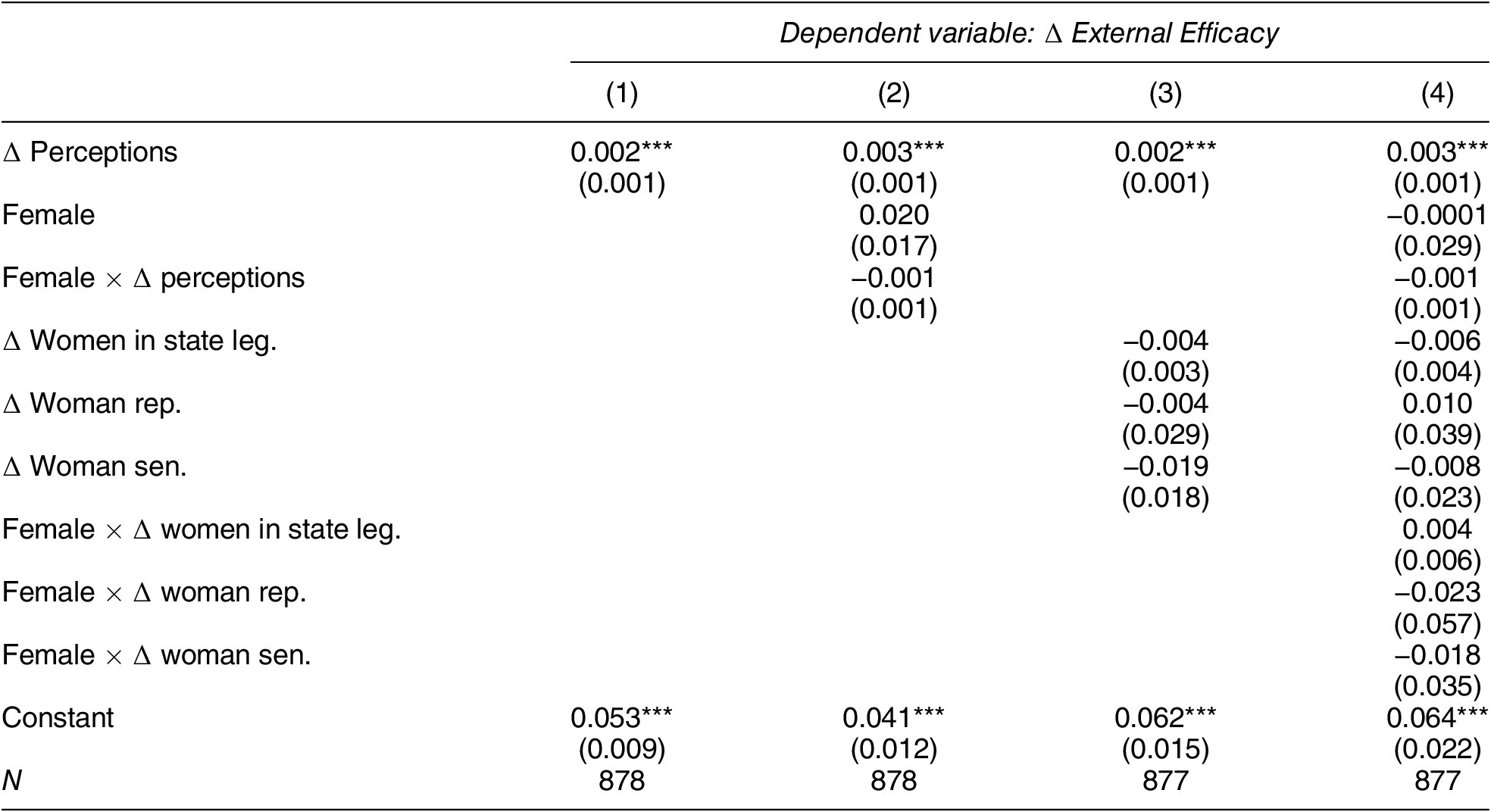
Table 3 presents the results of four models. Model 1 regresses changes in efficacy from T 1 to T 2 on changes in perceptions across the same period. Model 2 includes an interaction between changes in perceptions and respondent gender, allowing me to determine whether shifts in perceptions influenced efficacy differently for men and women. While using a first-difference estimation strategy allows me to account for time-invariant characteristics of my respondents, it does not account for the changes in context that might have occurred between the pre- and postelection studies as the result of the midterm elections. That is, some respondents went from not being represented by a man in Congress in the preelection study to having an incoming Congresswoman or Senator, and other respondents went from having women represent them in the House or Senate to incoming male members. Models 3 and 4 account for these changes in representational context, as well as changes in women’s representation in respondents’ state legislatures.Footnote 29
Panel Models: Changes in Respondent Perceptions of Women’s Inclusion in Congress and Changes in External Efficacy

Note: Standard errors in parentheses; *p < 0.1, **p < 0.05, ***p < 0.01.
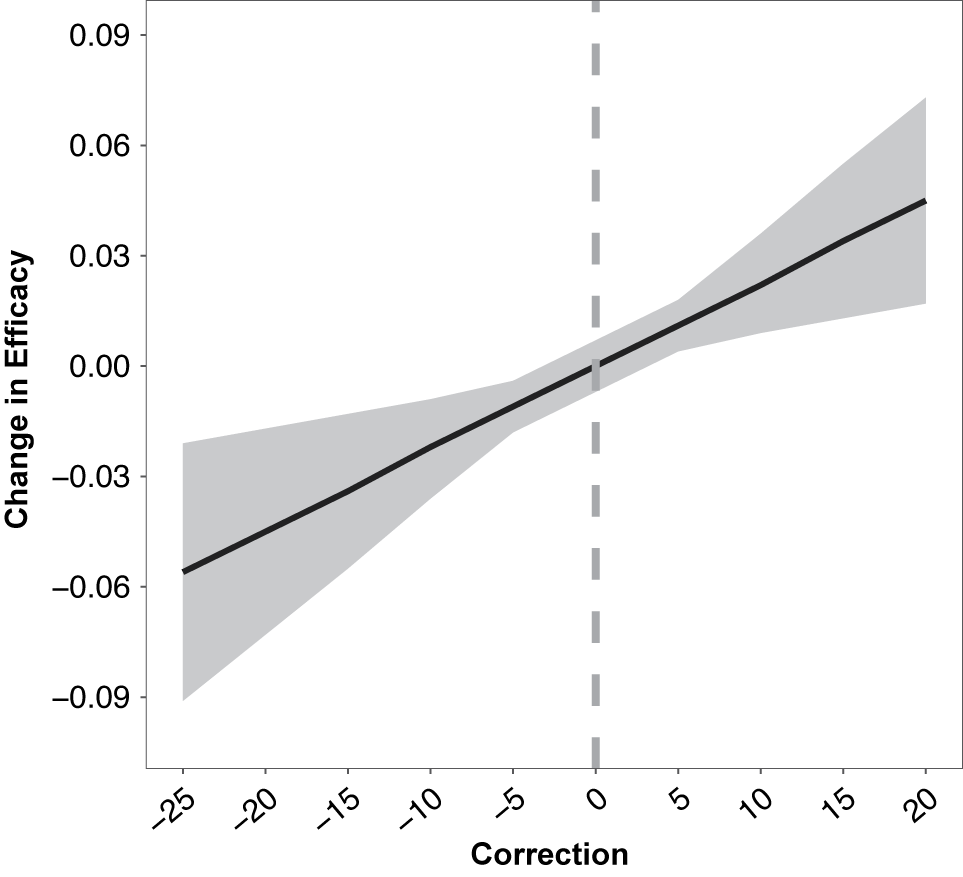
Results in Table 3 provide strong support for the link between perceptions of women’s representation and feelings of efficacy. The coefficient ∆ Perceptions is positive and significant in Model 1. This coefficient can be interpreted as the average within-unit change in efficacy associated with positive changes in respondent estimates of women’s representation. Put differently, these results indicate that, on average, increases in respondent perceptions are associated with increases in efficacy (as would be the case for underestimators), while decreases in respondent perceptions (as would be the case for overestimators) are associated with decreased efficacy. This is more clearly illustrated in Figure 4, which presents the predicted within-unit change across a range of possible corrections. Results in Model 3 indicate this relationship is robust to the inclusion of variables capturing changes in respondents’ representational context.
Predicted Change in External Efficacy Based on Correction Received By Respondents
Note: Negative values on the x-axis indicate that the respondents received a correction indicating that representation was lower than their original estimate. Positive values indicate that respondents were corrected with information that women’s representation was higher than their first estimate. Negative values on the y-axis correspond with decreases in efficacy, while positive values correspond to increased efficacy. The shaded region represents 95% confidence intervals.

Findings in Table 3 also offer further support the conclusions from previous analyses that beliefs about women’s representation can influence levels of efficacy among men as well as women. Results in Model 2 offer no evidence that changes in perceptions had a different influence on women’s efficacy compared with men. For both men and women, the marginal effect is positive and significant, and the magnitude of this effect is not significantly different across groups.Footnote 30 Again, these results are robust to the inclusion of variables capturing change the actual levels of women’s representation experienced by respondents (Model 4).
The analysis of panel data in this section offers a more rigorous test of the relationship between respondent beliefs about women’s representation and political efficacy by examining how changing respondent perceptions changes their levels of expressed efficacy.Footnote 31 Overall the results offer strong support for my theoretical argument and further bolster the conclusion that beliefs about women’s representation play a role in shaping respondent political efficacy and that this can be the case for men as well as women.
Discussion and Conclusion
This article addresses an ongoing debate in the literatures on women and politics and representation. Do citizens consider diversity when evaluating political institutions and their members? The conclusions from past research have been mixed, and there is no clear consensus on the extent to which gender diversity is valued by the public. My research addresses this debate directly and offers new insights into how citizens think about and evaluate the institutions that represent them. While the majority of the literature on symbolic representation in American politics has focused on dyadic representation, I apply a collective lens to this question, asking how individuals consider the overall gender composition of institutions when forming political attitudes (see also Atkeson Carrillo Reference Atkeson and Carrillo2007; Uhlaner and Scola Reference Uhlaner and Scola2016; Wolak Reference Wolak2018). However, where past research has examined how the objective reality of women’s descriptive representation influences attitudes and behaviors, I instead rely on citizens perceptions of this representation, an approach that sheds new and important light on the question of how diversity influences attitude formation and institutional evaluations.
The results presented in this article offer strong support for my theoretical argument. I find that citizens’ beliefs about women’s inclusion are associated with political efficacy, with those believing women are well represented viewing governments as far more responsive than those who believe women are largely absent. Moreover, results from the state-level analysis further point to a need to understand the role of perceptions in citizen evaluations. This analysis showed that while objective measures of representation were a poor predictor of efficacy—consistent with past research (Lawless Reference Lawless2004; Wolak Reference Wolak2018; but see Atkseson and Carillo Reference Atkeson and Carrillo2007)—citizen beliefs about women’s presence were associated with more positive evaluations of the legislature. The conclusion that perceptions of groups’ representation influence how individuals think about legislative bodies is consistent with past research on racial representation (Tate Reference Tate2003). This highlights the critical role of perceptions in our understanding of how citizens think about and evaluate political actors/institutions and the quality of representation they provide, as analyses that include these perceptions lend themselves to far different conclusions than understandings that rely on objective indicators alone.
To more rigorously test the relationship between perceptions and feelings of efficacy, I employed panel data which allowed me to capture changes in respondent efficacy after respondent perceptions had been corrected. As this analysis showed, efficacy increased among those who underestimated women’s inclusion relative to the 116th Congress, while decreasing among those who overestimated. The over-time nature of this analysis allowed for much stronger conclusions about the relationship between perceptions and institutional evaluations. Though I am unable to examine how enduring the effects of being corrected are for my respondents, recent research by Carnahan, Bergan, and Lee (Reference Carnahan, Bergan and Lee2020) finds that corrective messages can produce effects that are quite stable and detectable for several weeks after respondents receive the correction.
Beyond their implications for our understanding of how perceptions can shape citizen evaluations of political institutions, my findings address another critical question: for whom does descriptive representation matter? Increasingly, scholars have found that men may also feel more positively toward institutions when women are included (e.g., Barnes and Taylor-Robinson Reference Barnes, Taylor-Robinson, Alexander, Bolzendahl and Jalalzai2018; Clayton, O’Brien, and Piscopo Reference Clayton, O’Brien and Piscopo2019; Karp and Banducci Reference Karp and Banducci2008; Schwindt-Bayer Reference Schwindt-Bayer2010; Schwindt-Bayer and Mishler Reference Schwindt-Bayer and Mishler2005). One possible reason for this relationship is that women’s inclusion signals broader openness and acceptance to a wide variety of groups and interests, which may signal to men that other identities and positions they hold will be more likely to be accepted by institutions. Alternatively, women’s inclusion may send signals about how institutions function and the procedures used to create legislation. In this sense, women’s representation may serve as a heuristic that fair and effective governance is occurring. While I am unable to distinguish between these two mechanisms in the present study, my findings do underscore that women’s descriptive representation may influence attitudes and behaviors among men as well as women. Continued focus on when and why men respond positively to women’s inclusion represents a fruitful path for future research.
The findings of this article are cause for both pessimism and optimism. On the one hand, the findings presented here may have pernicious ramifications for the health and legitimacy of democratic governance. While the results of my analyses indicate that Americans are more positive toward gender-inclusive institutions, in practice few hold an accurate perception of what these institutions actually look like. Given the sizable portion of Americans that overestimate women’s presence in office, a large segment of the public has an overinflated sense of political voice, which in turn means that these citizens’ views of the legitimacy of their institutions are being propped up by their own misperceptions. For those who underestimate women’s presence, these attitudes are unnecessarily deflated, which could have negative downstream consequences for political participation and general engagement with the democratic process.
On the other hand, these findings suggest that the public indeed does care about gender diversity and that information about women’s inclusion plays a role in shaping public evaluations of institutions and the quality of representation they provide. This has important implications for political institutions, parties, and the design of electoral institutions, as it suggests inclusion may be one viable path toward forging stronger relationships between governments and citizens. In an era when public trust in institutions has diminished, my findings indicate that it might behoove institutions to work toward increasing the presence of women in political office. However, there is an important caveat. This article was predicated on the observation that many individuals hold erroneous beliefs about the number of women serving in political office. As I have shown throughout this research, these beliefs play a stronger role in citizen evaluations of institutions than objective reality. Thus, simply adding more women to institutions is likely to have little influence on public opinion if the public is unaware these women are there. In order for inclusion to benefit an institution’s standing with the public, that institution and its members must do the work of promoting women to make their presence more visible to the public and put women in high profile visible positions of power.
SUPPLEMENTARY MATERIALS
To view supplementary material for this article, please visit http://dx.doi.org/10.1017/S0003055421000678.
DATA AVAILABILITY STATEMENT
Data and code to replicate the results of this paper are available at the American Political Science Review Dataverse: https://doi.org/10.7910/DVN/QYZGEI.
ACKNOWLEDGMENTS
I would like to thank Diana O’Brien, Bernard Fraga, Jerry Wright, Christina Wolbrecht, Monica Komer, Alex Badas, Jessica Schoenherr, Josh Kalla, Matthew Hayes, Ted Carmines, Whitney Hua, Juan Tellez, Cody Drolc, Jeff Ruth, Barry Burden, the editors, and the three anonymous reviewers for their incredibly helpful comments and suggestions on this work. Thanks to Eric Schmidt and Matt Fowler for coordinating the content in the CCES modules used in this article and Susan Miller for collaborating on the survey in Appendix 11. I also thank Ted Carmines and the Center on American Politics at Indiana University for facilitating the 2016 and 2017 Indiana University CCES modules. Previous versions of this article were presented at the 2019 Midwest Political Science Association Annual Meeting, the 2019 Empirical Study of Gender workshop, and the 2020 Southern Political Science Association Annual Meeting. Participants at these conferences provided feedback that enriched and strengthened the project.







Comments
No Comments have been published for this article.