1. Introduction
One of the major trends in the developmental literature over the last 40 years or more has been the shift of focus from pure economic development based on industrialization to sustainable development comprised of strategies including reduction of pollution, replacement of coal and oil intensive energy with solar, wind and other renewable resources (see, for example, Brundtland, Reference Brundtland1987). It is also well known that environmental norms and qualities are typically lower in developing countries due to a host of factors such as absence of well-defined property rights (Chichilnisky, Reference Chichilnisky1994), low income levels that lead to relatively lower value for the environment, and weaker environmental regulation and difficulties in implementation (Greenstone and Jack, Reference Greenstone and Jack2013). Table 1, which lists the world's most polluted countries, clearly shows that all of these countries except the United Arab Emirates have low per capita income.
Ten most polluted countries, 2023

Table 1 Long description
Ranks 1 through 10 list countries and their average PM2.5 concentration for 2023, measured in micrograms per cubic meter. Rank 4 is Tajikistan at 49.0, and rank 5 is Burkina Faso at 46.6. Rank 6 is Iraq at 43.8, and rank 7 is United Arab Emirates at 43.0. Rank 8 is Egypt at 42.4, and rank 9 is Nepal at 42.4. Rank 10 is Democratic Republic of Congo at 40.8.
Data source: IQAir 2023 World Air Quality Ranking.
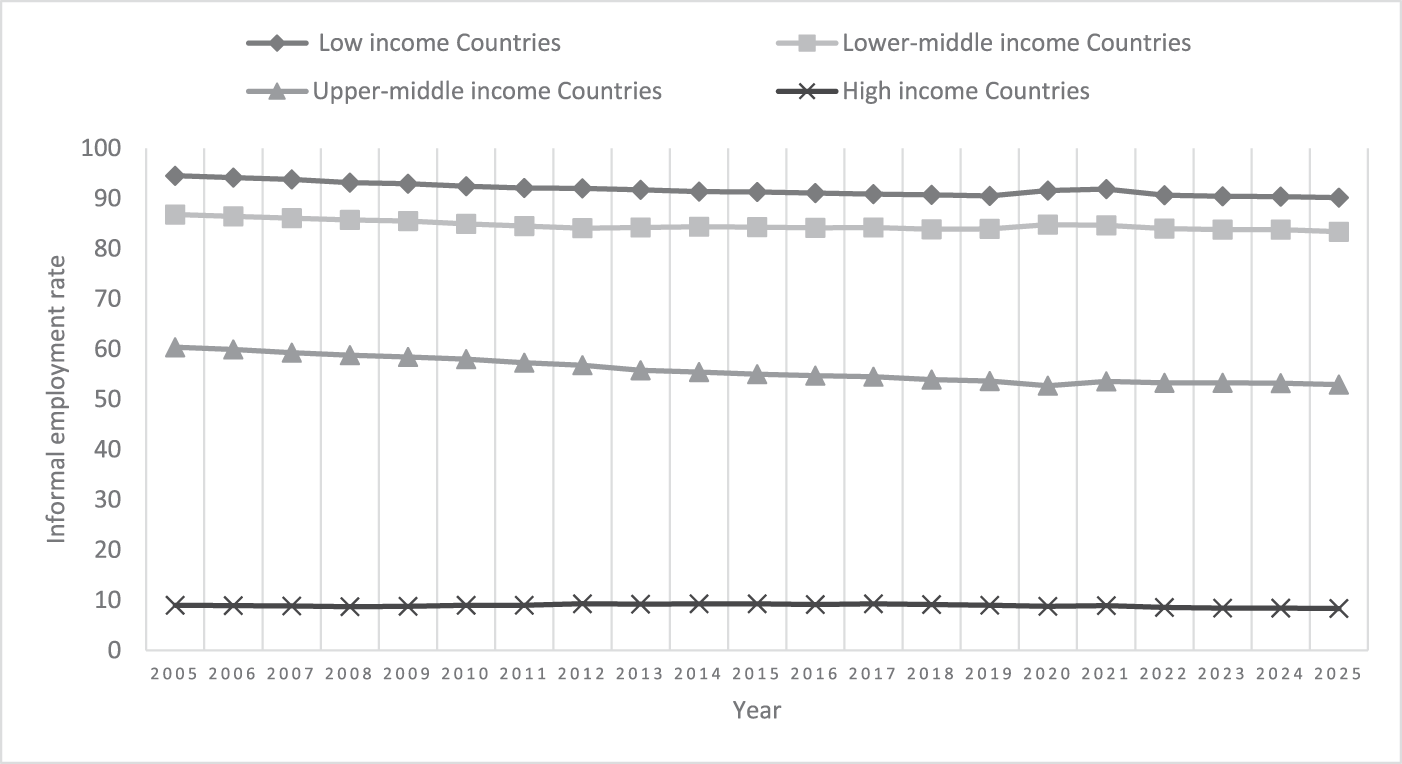
This is particularly true for large and newly industrialized countries. This is because first – unlike the OECD countries – these countries do not want to install highly effective and costly abatement technologies as that would increase their cost of production and in effect might adversely affect their price competitiveness in the world market. Secondly, the OECD countries often try to shift their dirty good production to the poor and developing countries which the latter can hardly afford to deny. Corruption also raises pollution. Welsch (Reference Welsch2004) examines how corruption affects pollution through both its effect on the formation and enforcement of environmental laws and its effect on income. Another factor is the existence of a large informal sector in the low- and middle-income countries (figure 1).
Regional informal employment rate.

Informal enterprises typically circumvent most of the common regulations and taxes (De Soto, Reference De Soto1989; Feige, Reference Feige1990). Such situations with weak property rights demand well-monitored regulations, and taxes and penalties on evasion to protect the environment. Public authorities frame environmental regulations, set environmental standards and collect taxes and grant subsidies to promote sustainable development. However, the informal sector is seen as violating the fiscal and working legal framework imposed by the state authorities (Cole, Reference Cole2007; Shahbaz et al., Reference Shahbaz, Nuta, Mishra and Ayad2023).Footnote 1 Using data for over 100 nations over the years 2004–2007, Goel et al. (Reference Goel, Herrala and Mazhar2013) examine the effect of institutional quality on environmental pollution, focusing on influences of corruption and shadow economy for MENA (Middle East and North Africa) countries.
This paper theoretically examines how entrepreneurs avoid environmental regulations such as mandatory installation of pollution abating technologies, by choosing the informal route and using bribes, thereby leading to greater environmental degradation. Here, the government selects a penalty for firms that do not voluntarily abate. It allocates an amount for random inspection of a proportion of firms that increases with the allocation. The inspector can only observe whether the firm abates and, if honest, charges the penalty and forces it to abate on pain of closure. A corrupt inspector can waive the penalty and abatement in return for a bribe. The firm, based on its private cost of abatement, chooses whether to enter, select the form of organization, decide whether to voluntarily abate and to the pay the penalty or bribe.
The paper is organized as follows. Section 2 reviews the relevant literature. Section 3 describes the model and presents the sequence of the game. Section 4 describes the outcome of the game in terms of setting the bribes, firms’ choices regarding entry, organizational forms with or without abatement and its impact on profits and environmental outcomes. Section 5 describes the outcomes categorized by cost realizations and, finally, section 6 concludes.
2. Review of literature
As indicated in the title, our paper is closely connected to three related strands of the literature: (1) environmental policy and compliance with environmental standards, (2) regulatory costs and the choice between formal and informal market entry and (3) bribery and corruption in complying with environmental regulations in the presence of an informal sector.
The environmental economics literature discusses effluent taxes (Spulber, Reference Spulber1985) and penalties imposed on firms for evading environmental standards (Karpoff et al., Reference Karpoff, Lott and Wehrly2005).Footnote 2 In order to detect violations, the government carries out inspections. Frequent inspection is a straightforward way to improve the enforcement effectiveness because it increases the probability of identifying loopholes in manufacturers’ environmental practices (Wiengarten et al., Reference Wiengarten, Singh, Fynes and Nazarpour2017). However, the monitoring tool of inspection is costly to implement. This problem is especially pertinent in developing countries where the local regulators may have fewer resources and experience to conduct effective inspections (Gray and Shimshack, Reference Gray and Shimshack2011). Arguedas (Reference Arguedas2008) considers the decision of the firm as to whether to comply or not with environmental standards in the presence of costly monitoring.
The research on the informal sector is primarily focused on developing countries (De Soto, Reference De Soto1989). It is well known that entering the formal sector is costly in terms of paying taxes and complying with government regulations including labour and environmental laws (Loayza, Reference Loayza1996; La Porta and Shleifer, Reference La Porta and Shleifer2014). On the other hand, informal activities are subject to stiff penalties in terms of fines and capital confiscation. Also, firms in the informal sector are unable to enter into legally binding contracts as they have limited access to capital markets and consequently borrow at higher rates of interest.
De Soto (Reference De Soto1989) perceives the producer's choice between operating formally and informally as an outcome of the firm's rational evaluation of the costs of operating under different systems. Straub (Reference Straub2005) considers an entrepreneur who can pay a charge to operate formally with verifiable returns and borrow from formal lenders. Alternatively, the entrepreneur may approach informal lenders who impose a penalty on failure. Firms below an asset level operate informally. Mishra and Ray (Reference Mishra and Ray2013) consider an entrepreneur who must pay a registration cost to become formal or run the risk of being apprehended by an inspector who may be honest and close down the firm, or be corruptible and demand a share of the profit. The informal sector, which does not have to pay the registration cost, has to pay the penalty for detection or bribe. While firms with assets below a critical level are always informal, those with higher assets may also choose to be informal depending on the relative costs of registration and detection.
Bribery, defined as a corrupt benefit given or received to influence official action so as to afford the giver better than fair treatment, has been common for a long time (Lindgren, Reference Lindgren1993). Typically, standard bribes are set to optimize collections over time and this is common knowledge among relevant actors.Footnote 3 Note that it is a common practice to pay bribes to avoid penalties.Footnote 4 Polinsky and Shavell (Reference Polinsky and Shavell2001) consider a situation where individuals can gain by committing an act of harm. The state chooses the probability of detecting offenders, enforcement expenditure as well as the sanction to be imposed on the offenders. Given that probability of detection goes up with enforcement expenditure, an offender who is caught pays the fine if the offense is reported to the state, or a bribe to the enforcer in return for the offense not being reported. Damania (Reference Damania2002) studies these problems in the context of violation of environmental regulations. Elgin and Oztunali (Reference Elgin and Oztunali2014) investigate the relationship between the size of the informal economy and the level of environmental pollution/energy use.Footnote 5 In Biswas et al. (Reference Biswas, Farzanegan and Thum2012), the firm divides production between formal and informal sectors where the latter bypasses environmental standards. Detection (increasing in the share of the informal output) leads to penalty and loss of informal output. Firms avoid these losses by paying bribes when officials are corrupt, leading to environmental degradation. Tighter environmental regulations lead to a decline in the formal sector. Their cross-country empirical study shows that a larger informal sector is associated with greater pollution. However, the assumption that the same firm operates both formally and informally may not always be true. In Biswas and Thum (Reference Biswas and Thum2017), the government sets an emission level that is costly to abate. Firms have a fixed entry cost but differ by their cost of abatement, which determines their decision to enter the market. Some officials are corrupt and extract a uniform bribe for non-abatement, as the officials cannot observe the abatement cost of the individual firm. A greater share of corrupt officials induces more firms to enter, which raises the bribe rate as well as the number of abating firms. Corruption also makes weaker regulation preferable. While this paper makes the entry decision endogenous, all firms are homogeneous and there is no role for the informal sector.
This present paper assumes that it is unlikely for a firm to operate simultaneously in the formal and informal sectors. We study the consequences of the rational decisions by the entrepreneur to choose – based on parameters like the entry cost, penalty, cost of abatement and bribe – whether to (1) enter, (2) operate formally or informally, (3) voluntarily install the abatement technology before inspection and (4) abate and pay the penalty or pay a bribe or quit, if caught operating without abatement. Following Biswas and Thum (Reference Biswas and Thum2017), we assume that cost of entry differs between firms and is private information unobservable to corrupt officials.
In the context of the above-mentioned literature, our study indicates that while higher monitoring and penalties encourage formal organization and greater abatement, if these are too high they may discourage firms, particularly those with high abatement costs, from entering the market at all. High abatement costs, on the other hand, push the firm towards informal organization and bribes. The contribution of this paper is to bring out the consequences of government actions and abatement costs on entry, mode of organization and abatement decisions with or without bribe.
3. The model
3.1. Basic assumptions
Firms differ by their cost of abatement  $\left( c \right)$,Footnote 6 which is uniformly distributed over a range
 $[\underline{c}, \overline{c}]$ with density 1. This is private information and cannot be observed by outsiders including government inspectors (Biswas and Thum, Reference Biswas and Thum2017). A formal firm is set up on private land, has authorized public utility connections, pays taxes, can obtain formal credit and is registered by local and state authorities. These cause high set-up costs but the firm's revenue or operating profits are also high due to greater market access.Footnote 7 It can also install required abatement technology accessible only through formal channels. In contrast, the informal firm occupies public land informally or illegally, has no authorized public utility connections, pays no taxes, borrows from the informal credit market and, of course, has no access to the abatement technology because it can be obtained only through a government permit.Footnote 8
Both gross profits ( ${ }{{\Pi}_F}$) and entry cost (
 ${E_F}$) in the formal sector are assumed to be higher than in the informal sector
 ${ }{{\Pi}_F}$ and, that is,
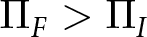 ${ }{{\Pi}_F} \gt { }{{\Pi}_I}$ and
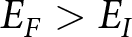 $\,{E_F} \gt {E_I}$. This is because first, the set-up costs are higher when assets have to be acquired formally and second, gross profits are higher as the formal sector has lower institutional borrowing costs and can sell to formal and public sector firms. To focus exclusively on the choice between formal and informal organizations from the perspective of the abatement cost difference, net profits in the sectors are assumed to be identical, that is,
 \begin{equation*}{ }{{\Pi}_F} - {E_F} = { }{{\Pi}_I} - {E_I} = { }{{\Pi}^*}.\end{equation*}
The government or environmental regulator selects the penalty,  $A$, to be charged in addition to mandatory abatement in case of noncompliance. We make the reasonable assumption that penalty is less than net profits,
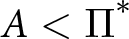 $A \lt { }{{\Pi}^*}$. The government also decides about how much is to be spent on inspection which determines the probability of inspection,
 $p$. Typically this probability is low, much less than 0.5 as only a small percentage of firms are usually inspected.Footnote 9 As the informal firm cannot access the abatement technology, it must be closed down if inspected by an honest government inspector. While it is possible that a firm may be repeatedly monitored, the low monitoring budget allows for the monitoring of only a small percentage of firms so it is very unlikely for the same firm to be monitored repeatedly. Further, the threat would be real only if, after paying a bribe to a corrupt inspector, it is monitored again by an honest one.
The inspector is honest with a known probability,  $\mu $. While the honest inspectors enforce compliance and force closure otherwise, the corrupt inspectors (probability,
 $1 - \mu $) charge a bribe devised to maximize (expected) profit given the other parameters and known to all agents (see section 1 and footnote 4).
Voluntary abatement must be done at the beginning, before inspection takes place. The firm comes to learn that it is being inspected and the type of inspector only at the time of inspection. Formal firms that abate voluntarily do not need to pay a penalty or bribe. If not, an honest inspector forces them to abate and pay a fixed fine ( $A$); otherwise, they must close down and lose the entry fee,
 ${E_F}$. We assume that for the formal firm, closing down is always costlier than abating and paying the penalty, that is,
 ${E_F} \gt c + A.$
A formal firm that does not abate voluntarily has three options if confronted with a corrupt inspector: (1) pay the penalty ( $A$) in addition to abating, (2) pay a bribe (
 $b$) or (3) cease operation. An informal sector firm that has no access to the abatement technology will close down and lose its expenditure on entry,
 ${ }{E_I}$, when inspected by an honest inspector. If inspected by a corrupt inspector, it can survive by paying a bribe. As the inspector cannot observe anything regarding the organization of the firm except whether it has abated or not, the bribe (
 $b$) is the same irrespective of the firm being formal or informal. The bribe is always less than the gross profit of the formal sector, that is,
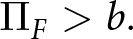 ${ }{{\Pi}_F} \gt b.$
3.2. Timeline
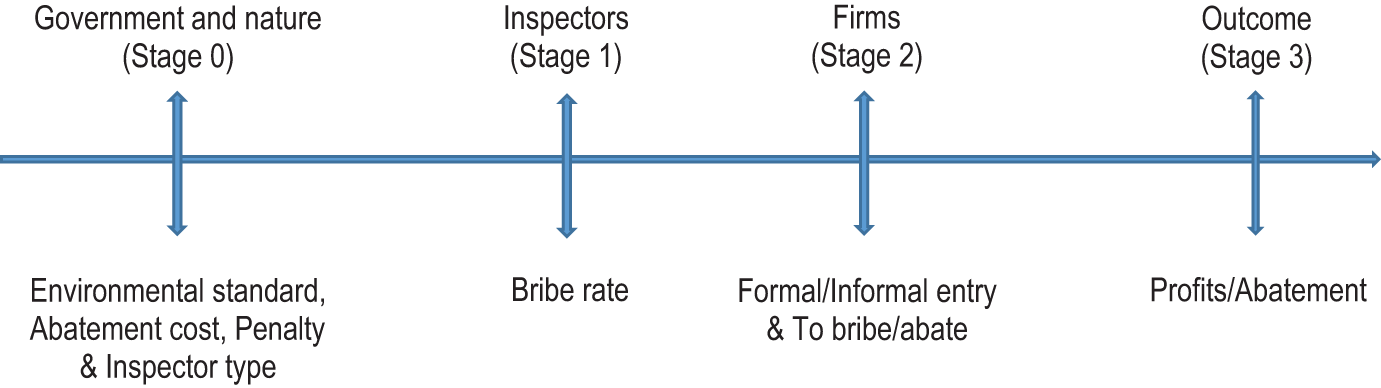
As shown in figure 2, at stage 0, the government publicly sets the pollution standard, the penalty  $\left( A \right)$ for non-compliance and the allocation for monitoring which determines the probability
 $\left( p \right)$ with which any firm is inspected. Nature determines whether the inspector is honest (probability
 $\mu $) or dishonest
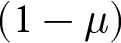 $\left( {1 - \mu } \right)$. As indicated, only the firm knows its cost of abatement
 $c$,
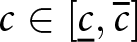 $c \in [\underline{c}, \overline{c}]$ The probability and the distribution of
 $c$ are both common knowledge. The gross profits,
 ${ }{{\Pi}_F}$ and
 ${ }{{\Pi}_I}$, and the set-up or entry costs of the formal and informal sectors, are also known to all.
Sequence of the game.

At stage 1, the bribe  $b$ is determined based on the publicly observed parameters like penalty
 $\left( A \right)$, probability of inspection
 $\left( p \right)$, gross profits
 ${ }{{\Pi}_F}$ and
 ${ }{{\Pi}_I}$, entry costs E F and
 ${E_I}$ in the formal and informal sectors, respectively, the probability that the inspector is honest
 $\left( \mu \right)$ and the distribution of
 $c$. The inspector cannot observe whether the firm is informal or formal but only whether the abatement technology is installed or not.
At stage 2, having observed the government decision on abatement, cost parameters and the bribe, the firm decides whether to (1) enter the market, (2) operate in the formal or informal sector and pay entry costs  ${E_F}$ or
 ${E_I}$, respectively, and (3) voluntarily abate at cost
 $c$, if in the formal sector.
At stage 3, the inspections are carried out and outcomes are realized. If a firm is in the formal sector and has abated voluntarily, it makes a profit 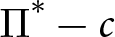 ${ }{{\Pi}^*} - c$, assuming
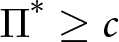 ${ }{{\Pi}^*} \geq c$. If
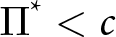 ${{\Pi}^{\text{*}}} \lt c$, it does not abate voluntarily and makes a profit of
 ${{\Pi}^{\text{*}}}$, if it is not inspected (with probability
 $1 - p$). If it is inspected (with probability
 $p$) and has entered formally, it has to abate and pay the penalty if confronted with an honest inspector (probability
 $\mu $) but has the option of paying a bribe if the inspector is corrupt (probability
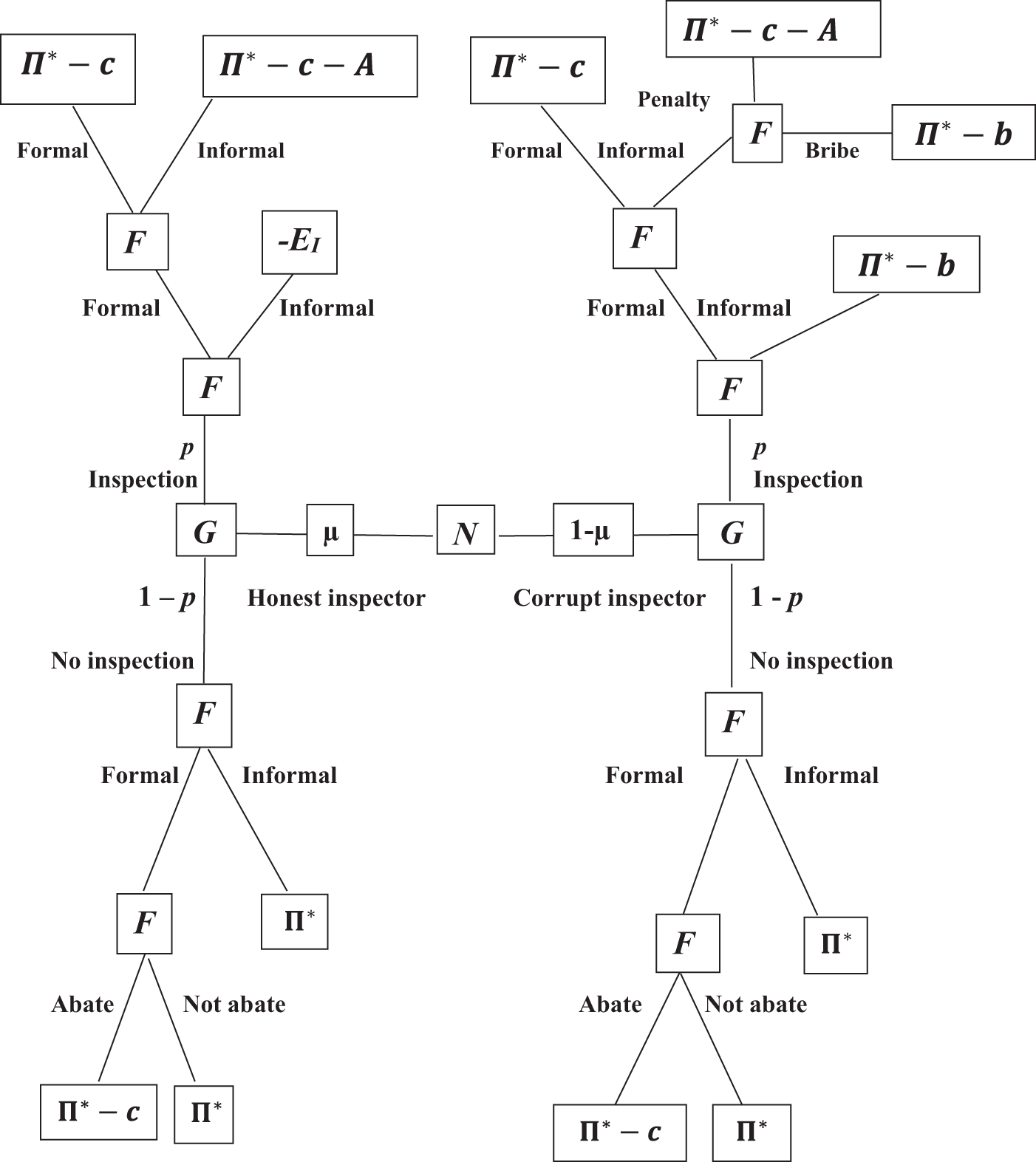
 $1 - \mu $). If it has entered informally, it has to close down if confronted with an honest inspector or may pay the bribe if it faces a corrupt one. Figure 3 plots the stages of the sequential game. As usual, we solve the game by the backward induction method.
The structure of the game.

4. Environmental outcomes, firm choices and bribes
This section analyses the choices of the firms regarding entry, organizational forms and abatement decisions.
4.1. Stage 1: market and environmental outcomes
4.1.1. Formal firm with abatement
Suppose that the entrepreneur has entered the market with a formal organization and decided to abate voluntarily. Its net profit is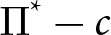 $\,{{\Pi}^{\text{*}}} - c$. An entrepreneur is able to make the decision to enter through the formal route and choose to voluntarily abate only when the cost of abatement is lower than critical abatement cost
 ${c_o}$ (equal to the net profit level for all firms excluding abatement cost):
 \begin{equation*}c \leq \,{c_o}|\,{ }{{\Pi}^*} - {c_o} = 0.\end{equation*}
Firms with cost 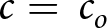 $c = \,{c_o}$ that voluntarily abate will merely survive in the market or obtain ‘normal profits,
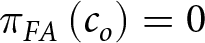 ${\pi _{FA}}\left( {{c_o}} \right) = 0$, while those with abatement cost level
 $c \lt { }{c_o}$ get supernormal profits,
 ${ }{\pi _{FA}}\left( c \right) = {c_o} - c \gt 0$ for
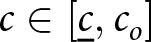 $c \in [\underline{c}, {c_o}]$ In this case, environmental standards are maintained.
4.1.2. Formal firm without abatement
A formal sector firm that does not voluntarily abate realizes full profits  ${{\Pi}^{\text{*}}},$ if not inspected (with probability
 $1 - p$). If it is inspected (with probability
 $p$) and faces the honest inspector (with probability
 $\,\mu \cdot p$), it will have to install the abatement technology and pay the penalty (
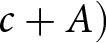 $c + A)$ or be forced to close down. If faced with a corrupt inspector, with probability
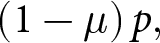 $\left( {1 - \mu } \right)p,$ it will abate and pay the penalty if this is less than the bribe, that is,
 $c + A \leq b\,\,\,{\text{or }}c \leq b - A$. At the time of the entry decision, the firm is assumed to know the level of the bribe (see footnote 4). In other words,
 \begin{equation*}E{{\Pi}_{F1}} = \left( {1 - p} \right)\!{{\Pi}^{\text{*}}} + p\!\left( {{{\Pi}^{\text{*}}} - {\text{c}} - A} \right)\,{\text{if}}\,c \leq b - A,\end{equation*}
that is, an entrepreneur with abatement cost 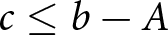 $c \leq b - A$ can enter formally without pre-abatement if
 \begin{equation*}E{{\Pi}_{F1}} = {{\Pi}^{\text{*}}} - p\left( {c + A} \right)\, \gt { }0,{\text{ or}}\end{equation*}
 \begin{equation*}c \lt \hat c\left( {p,\,A} \right) = \frac{{{{\Pi}^{\text{*}}}}}{p} - A = \frac{{{c_o}}}{p} - A.\end{equation*}
In other words, it is feasible whenever 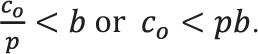
If the cost is higher, so that abatement cost plus penalty is higher than the bribe, that is,  $c + A \gt b\,\,{\text{or}}\,c \gt b - A,\,$ the formal firm, when inspected with probability
 $p,$ will abate and pay the penalty if faced with an honest inspector, but will pay a bribe if inspected by a corrupt one, so that:
 \begin{equation*}E{\Pi _{F2}} = \left( {1 - p} \right){\Pi ^*} + p\mu \left( {{\Pi ^*} - c - A} \right) + p\left( {1 - \mu } \right)\left( {{\Pi ^*} - b} \right)\,{\text{if}}\,c \geq b - A.\end{equation*}
Thus, a firm with abatement cost 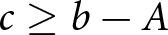 $c \geq b - A$ can enter formally without voluntary abatement when:
 \begin{equation*}E{{\Pi}_{F2}} = {{\Pi}^{\text{*}}} - p\left[ {\mu \left( {c + A} \right) + \left( {1 - \mu } \right)b} \right]\, \gt { }0,{\text{ or}}\end{equation*}
 \begin{equation*}c \lt \overline {\overline c} \left( {p,{ }A} \right) = \frac{1}{\mu }\left( {\frac{{{c_o}}}{p} - \left( {1 - \mu } \right)b} \right) - A.\end{equation*}
Under abatement, the environmental standards are maintained, while with bribes they are violated.
4.1.3. Informal firm
An informal firm that has entered the market has already spent the entry cost, EI. When confronted with a corrupt inspector with bribe demand, the firm pays the bribe and continues operation (closes down) given the bribe does not exceed (exceeds) the informal sector profits  ${ }{{\Pi}_I}.$ That is,
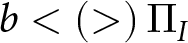 $b \lt ( \gt )\,{ }{{\Pi}_I}$. Hence the condition for the bribe to be acceptable to the informal firm is
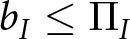 ${b_I} \leq {{\Pi}_I}$. The entrepreneur finds it feasible to enter (not to enter) through the informal route as long as its expected profit is positive (negative).
 \begin{equation*}E{\pi _I} = \left( {1 - p} \right){{\Pi}^{\text{*}}} + p\mu \left( { - {E_I}} \right) + p\left( {1 - \mu } \right)({{\Pi}^{\text{*}}} - b)\end{equation*}
The first term on the right-hand side indicates the profits when it is not inspected, and the second term shows the losses when it is inspected by the honest inspector and is forced to shut down, losing its entry cost. The third term is the profit net of bribes when inspected by the corrupt inspector. This implies that it is feasible for the entrepreneur to enter through the informal route when:
 \begin{equation*}{\overline b_I}\, \leq \frac{{{{\Pi}^{\text{*}}}\left( {1 - p\mu } \right) - p\mu \left( {{E_I}} \right)}}{{p\left( {1 - \mu } \right)}} = \frac{{{c_o}\left( {1 - p\mu } \right) - p\mu \left( {{E_I}} \right)}}{{p\left( {1 - \mu } \right)}},\end{equation*}
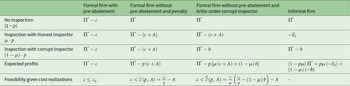
where  ${\overline b_I}\,$ is the highest bribe for which it is feasible for an entrepreneur to enter through the informal route. Clearly, environmental standards are violated in this case. This is summarized in table 2.
Profits and feasible organizational forms

Table 2 Long description
Rows list four inspection states and two summary rows, and columns list four firm types: formal firm with pre abatement, formal firm without pre abatement and penalty, formal firm without pre abatement and bribe under corrupt inspector, and informal firm. Under no inspection, all but the pre abatement formal firm show Pi star, while the pre abatement formal firm shows Pi star minus c. Under inspection with honest inspector, the pre abatement formal firm remains Pi star minus c; both formal firms without pre abatement show Pi star minus the sum of c and A; the informal firm shows negative EI. Under inspection with corrupt inspector, the pre abatement formal firm remains Pi star minus c; the formal firm without pre abatement and penalty shows Pi star minus the sum of c and A; the formal firm without pre abatement and bribe shows Pi star minus b; the informal firm shows Pi star minus b. In the expected profits row, the pre abatement formal firm is Pi star minus c; the formal firm without pre abatement and penalty is Pi star minus p times the sum of c and A; the formal firm without pre abatement and bribe is Pi star minus p times a weighted combination of the sum of c and A and b using mu and one minus mu; the informal firm combines Pi star and negative EI using p and mu, and also includes a term with one minus mu times negative b. In the feasibility given cost realizations row, the pre abatement formal firm is feasible when c is less than or equal to c sub o; the formal firm without pre abatement and penalty is feasible when c is less than c hat of p and A; the formal firm without pre abatement and bribe is feasible when c is less than double overline c of p and A; the informal firm column shows a dash.
Given our reasonable assumption that 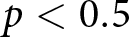 $p \lt 0.5$ and
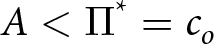 $A \lt {{\Pi}^{\text{*}}} = {c_o}$ in section 3.1, it is clear that
 \begin{equation*}\hat c\left( {p,\,A} \right) = \frac{{{c_o}}}{p} - A \gt 2{c_o} - A \gt {c_o}.\end{equation*}
It is easy to check that, given our assumption that since  $\frac{{{c_o}}}{p} \gt 2{c_o} = 2{{\Pi}^{\text{*}}} \gt \mu b,$ we have:
Lemma 1: For entry through the formal route, generally the (abatement) cost level at which voluntary abatement is feasible is lower than that for involuntary abatement (i.e., after inspection). In the latter category, the cost level at which it is feasible to survive after paying a penalty (and abating) is lower (higher) than that for paying a bribe accordingly as 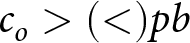 ${c_o} \gt ( \lt )pb$ or
 \begin{equation*}\overline {\overline c} \left( {p,\,A} \right) = \frac{1}{\mu }\left( {\frac{{{c_o}}}{p} - \left( {1 - \mu } \right)b} \right) - A \gt rless \frac{{{c_o}}}{p} - A = \hat c\left( {p,\,A} \right)\end{equation*}
 $\,accordingly\,as$
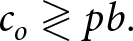 ${c_o} \gt rless pb.$
4.1.4. Some comparative statics
From table 2, check that profits of formal firms with pre-abatement are unaffected by change in probability of inspection  $\left( p \right)$ or penalty
 $\left( A \right)$,
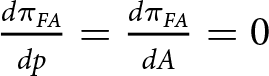 $\frac{{d{\pi _{FA}}}}{{dp}} = \frac{{d{\pi _{FA}}}}{{dA}} = 0$. Further, profits of the firms that enter formally without pre-abatement fall with an increase in
 $p$ and
 $A$, irrespective of whether the firms pay penalties and abate if inspected by honest officials,
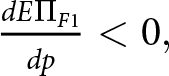 $\frac{{dE{{\Pi}_{F1}}}}{{dp}} \lt 0,\,$
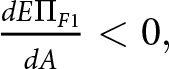 $\frac{{dE{{\Pi}_{F1}}}}{{dA}} \lt 0,$ or pay bribes when facing corrupt inspectors,
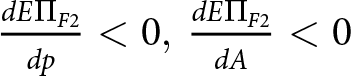 $\frac{{dE{{\Pi}_{F2}}}}{{dp}} \lt 0,\,\frac{{dE{{\Pi}_{F2}}}}{{dA}} \lt 0$. Profits of informal firms fall with an increase in
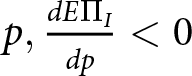 $p, \frac{{dE{{\Pi}_{I}}}}{{dp}} \lt 0$ but are unaffected by the penalty. Again, provided
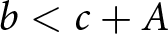 $b \lt c + A$, the firms without pre-abatement prefer to pay bribes,
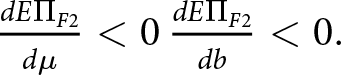 $\frac{{dE{{\Pi}_{F2}}}}{{d\mu }} \lt 0\,\frac{{dE{{\Pi}_{F2}}}}{{db}} \lt 0.$ An increase in the probability that the inspector is honest or the level of bribes leads to a fall in profits. The same is also true for the profits of the informal firms,
 $\frac{{dE{{\Pi}_I}}}{{db}} \lt 0,\,\frac{{d{{\Pi}_I}}}{{d\mu }} = - p{{\Pi}_{\text{I}}} + b\, \lt 0$ (as bribes are lower than expected profits of the informal firms). Profits in the above cases may turn negative if probability of inspection, probability of the inspector being honest, penalties and bribes are too high. Under such circumstances, it may not be feasible for firms to enter through these routes at all.
Next, from table 2, we can check that:
 \begin{align*}\frac{{d{c_o}}}{{dp}}& = \frac{{d{c_o}}}{{dA}} = 0,\,\frac{{d\,\hat c\left( {p,\,A} \right)}}{{dp}} = - \frac{{{c_o}}}{{{p^2}}} \lt 0,\,\frac{{d\,\hat c\left( {p,\,A} \right)}}{{dA}} = - 1 \lt 0,\frac{{d\,\overline {\overline c} \left( {p,\,A} \right)}}{{dp}}\\& = - \frac{{{c_o}}}{{\mu {p^2}}} \lt 0,\,\frac{{d\,\overline {\overline c} \left( {p,\,A} \right)}}{{dA}} = - 1 \lt 0,\,\,\frac{{d\,\overline {\overline c} \left( {p,\,A} \right)}}{{db}} = - \frac{1}{\mu }\left( {1 - \mu } \right) \lt 0.\,\end{align*}
This leads to our first proposition.
Proposition 1: An increase in abatement cost negatively affects the feasibility of entry of all formal firms. Increase in frequency of monitoring and level of penalties negatively affects the feasibility of entry of firms that decide to enter formally without abatement or informally, but have no impact on firms that enter with abatement. Higher bribes negatively affect the feasibility of informal firms as well as formal firms that pay bribes to corrupt inspectors.
It is easy to check that the feasibility of firms entering formally with pre-abatements is not affected by monitoring, penalty or bribes. The feasibility of formal firms entering without abatement declines with high monitoring and penalties, but only those who pay bribes are negatively affected by increasing bribe rates.
4.2. Stage 2: choice between formal (without pre-abatement) and informal organization
In this section, we compare between different feasible modes of entry by firms given that all parameters and the optimal bribe set by the corrupt inspectors are known (or can be inferred) by the entrepreneurs.
Lemma 2: Suppose the bribe rate set is  $b$. Any potential entrant with cost realization
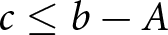 $c \leq b - A$ always chooses the formal sector without abatement over the informal sector and prefers to pay the penalty and abate rather than the bribe if confronted with the corrupt inspector.
Proof: We already know that when 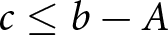 $\,c \leq b - A$, the formal firm without voluntary abatement always chooses to abate and pay the penalty instead of bribe when faced with the corrupt inspector. A firm's profit is
 ${{\Pi}^{\text{*}}} - p\left( {c + A} \right)$. Hence, the formal sector without voluntary abatement is preferred over the informal sector when:
 \begin{equation*}{{\Pi}^{\text{*}}} - p\left( {c + A} \right) \geq {{\Pi}^{\text{*}}} - p\left[ {\mu \left( {{{\Pi}^{\text{*}}} + {E_I}} \right) + \left( {1 - \mu } \right)b} \right],{\text{ or}}\end{equation*}
 \begin{equation*}\mu \left( {{{\Pi}^{\text{*}}} + {E_I}} \right) + \left( {1 - \mu } \right)b \geq c + A,{\text{ or}}\end{equation*}
 \begin{equation*}\mu \left( {{{\Pi}_{\text{I}}} - b} \right) + b \geq c + A.\end{equation*}
Since we already have 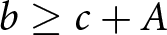 $b \geq c + A$, we only require that
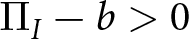 ${ }{{\Pi}_I} - b \gt 0$, which is obvious as no corrupt inspector will set the bribe above the gross informal sector profits. Thus, potential entrepreneurs with cost realization
 $c \leq \hat c\left( {b,A} \right) = b - A$, who do not choose to voluntarily set up the abatement technology, prefer to pay the penalty and abate when faced with the corrupt inspector over either paying the bribe or informal organization.
Lemma 3: Given that there is a uniform bribe  $b$ for formal firms (without voluntary abatement) that have cost realization
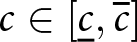 $ c \in [\underline{c}, \overline{c}]$ such that
 $c \geq \hat c\left( {b,A} \right) = b - A$, it is preferable to pay the bribe rather than the penalty plus abatement cost. Informal entry will be chosen for
 $c \geq {c_o} + \,({E_I} - A)$ and formal entry without voluntary abatement for
 $c \leq {c_o} + ({E_I} - A)$.
For proof, see the appendix.
4.3. Stage 3: the bribe
In this section, we assume that the bribes are set before the firms make their choices regarding whether to enter the market, the form of organization (formal or informal), whether to abate prior to inspection and whether to pay the penalty or bribe if inspected by a corrupt inspector. The reasons we do so are both empirical and theoretical. As indicated both in the introduction and literature survey (particularly footnotes 4 and 5), bribes – including those given to escape penalties, though set optimally – are commonly known to all relevant participants and relatively stable over time. So, except for minor negotiations, it may be assumed that the rates are set before the firms make their choices.
Theoretically, we assume that the inspector, honest or corrupt, can only verify whether the firms that are operating have installed the mandated abatement technology (e.g., effluent treatment plant) or not at the time of inspection. Specifically, they cannot observe the (abatement) cost realization of the firms or whether those are formal or informal.
Of course, the standard parameters – the penalty, probability of inspection and the probability of a given inspector being honest (or corrupt) and the range and distribution of abatement costs – are common knowledge. From these, the inspectors can estimate the range of cost realization of a particular firm that has entered the market and is operating (or not operating) with the abatement technology at the time of inspection. But these can be estimated by the corrupt monitor before inspection as well. Hence, nothing is lost if it is assumed that the calculation of the bribe, based on the above observations and estimates, is made before the firm makes its choices related to entry, organizational form and prior abatement.
As the inspector cannot distinguish between formal and informal firms, the bribes cannot be different for the two sectors. Nonetheless we begin by considering the appropriate bribes for the two sectors.
4.3.1. The maximum bribe acceptable to the informal sector
From section 4.1.3, the maximum bribe acceptable to the informal sector is
 \begin{equation*}{\overline b_I}\, \leq \frac{{{c_o}\left( {1 - p\mu } \right) - p\mu \left( {{E_I}} \right)}}{{\,p\left( {1 - \mu } \right)}}.\end{equation*}
This is true for all informal sector firms irrespective of abatement cost realization as they do not abate and pay a bribe if faced with a corrupt inspector or shut down if inspected by an honest one.
4.3.2. The optimal bribe
In case of formal sector firms with abatement, the possible maximum acceptable bribe depends on whether the bribe is lower than the cost of abatement plus penalty when confronted with a corrupt inspector,  ${\text{i}}.{\text{e}}.,\,b \leq c + A\,{\text{or}}\,b - A \leq c$. Else they will go for abatement along with penalty. As long as the bribe is acceptable to the informal sector, for which installation of abatement technologies is not possible and thus the abatement cost is irrelevant, this will be true for
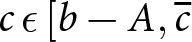 $c\,\epsilon \,[b - A,\overline c$]. Hence, we have the corrupt inspector's return from setting the bribe at b as
 $R = b\left( {\,\overline c - b + A} \right).$
Lemma 4: The bribe set by the (corrupt) inspector is
 \begin{equation*}b_F^* = \frac{{\overline c + A}}{2},\end{equation*}
provided that this is below the maximal bribe acceptable to the informal sector, that is, 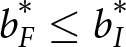 $b_F^* \leq b_I^*$. If, however,
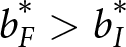 $b_F^* \gt b_I^*$, the inspector will either charge the lower bribe
 $b_I^*$ acceptable to both sectors or a higher bribe
 $b_F^*$ acceptable to the formal sector only.
For proof, see the appendix.
5. Abatement cost realization and the choice of organizational mode
We first examine the cost realizations for which firms entering formally choose between voluntary abatement (before inspection) and involuntary abatement. This leads to proposition 2.
Proposition 2: A firm that enters formally will abate voluntarily if its private cost of abatement is low enough relative to the penalty  $A$ and the likelihood of inspection,
 $c \leq {c^*}\left( {p,A} \right) = \frac{p}{{1 - p}}A$. Otherwise, it will not install the abatement technology at the time of entry.
For proof, see the appendix.
It is easy to check that the right hand side is increasing in  $A$
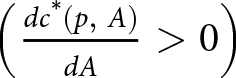 $\left(\frac{{d{c^*}\left( {p,\ A} \right)}}{{dA}} \gt 0\right)\,$ and increasing and convex in p
 $\left(\frac{{d{c^*}\left( {p,\ A} \right)}}{{dp}} \gt 0,\,\frac{{{d^2}{c^*}\left( {p,\ A} \right)}}{{d{p^2}}} \gt 0\right).\,\,{\text{These }}$ imply that as the penalty and probability of inspection increase, firms with higher abatement cost realizations prefer to abate voluntarily rather than wait for inspections to take place.
Let us now compare the informal and formal firms, which leads us to proposition 3.
Proposition 3:
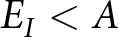
(a) If entry cost of the informal sector is lower than the penalty,
 ${E_I} \lt A$, so that
$\tilde c\left( {{E_I},A} \right) = {c_o} + \,({E_I} - A) \leq {c_o}$, then for all
$c$ such that
${c_o} + \,({E_I} - A) \leq c \leq {c_o}$, the informal organization is preferred to formal organization without voluntary abatement.
(b) If informal entry cost is higher than the (formal) penalty for non-abatement
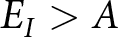
${E_I} \gt A$, so that
$\tilde c\left( {{E_I},A} \right) = {c_o} + \,({E_I} - A) \geq {c_o}$, and for all cost realizations
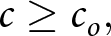
$c$ such that formal operation with voluntary abatement is unprofitable,
$c \geq {c_o},\,$ then,(i) for very high cost realizations,
$c \geq {c_o} + \,({E_I} - A) \geq {c_o}$, the informal organization is preferred to formal organization without voluntary abatement;(ii) for relatively lower cost realizations,
${c_o} + \,({E_I} - A) \geq c \geq {c_o}$, the formal organization with voluntary abatement is preferred.







For proof, see the appendix.
When cost of informal entry  ${E_I}$ is lower than the non-abatement penalty,
 $A$ (
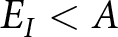 ${E_I} \lt A$), then for all
 $c$ lower than the critical cost level
 ${c_o}$ by the quantum of difference between the informal entry cost and formal penalty, that is,
 ${c_o} + \,({E_I} - A) \leq {c_o}$, informal organization is preferred to formal entry with non-abatement.
For cost realizations higher than the critical level such that formal entry with prior abatement is not feasible and cost of entry through the informal route is higher than the penalty, formal entry without prior abatement is preferred when cost is lower than the critical level plus the (positive) difference between informal entry cost and penalty. This is because when the probability of inspection is high, the firm which enters formally or informally without prior abatement faces a high chance of inspection either by a corrupt or an honest inspector. When inspected by a corrupt official, both formal and informal firms are likely to pay the bribe as this is typically lower than the combined costs of abatement and penalty. When confronted by an honest monitor, if the informal entry cost is low relative to abatement and penalty, it is preferable to close down.
5.1. Some comparative statics: monitoring intensity, fines and abatement costs
From proposition 1, the range of costs for which pre-abatement is preferred increases with  $p$ and
 $A$. Thus, higher monitoring and penalties favour pre-abatement and are likely to improve environmental outcomes. However, firms with high abatement cost levels that are not profitable with prior abatement will either opt for informal organization or decide not to enter at all. This may paradoxically lead to worse environmental outcomes and/or decline in output.
It is simple to check (from table 2) that profits of all formal firms decrease with an increase in abatement costs while informal firms are not affected. Clearly this also adversely impacts the feasibility of entry through formal organization (table 2 and lemma 1). The same is true regarding the choice between prior abatement and non-abatement at the time of entry (proposition 1) and between formal and informal organization (proposition 2).
6. Conclusion, future research and policy recommendation
In this paper, we study how the forms of organization chosen by entrepreneurs are linked to abatement decisions of firms and ultimately how environmental outcomes are impacted. Specifically, we show that high abatement costs push firms to avoid pre-installation of abatement technologies, leading them to confront either the risk of penalties or bribes or a less formal mode of organization resulting in greater evasion of environmental regulations and hence more environmental degradation. On the other hand, greater monitoring and higher penalties for evasion tilt the balance towards formal organization and more pre-abatement.
Setting high penalties can deter evasion but, beyond a certain level, can make it difficult for firms with high abatement costs to enter the market at all, leading to reduced output production. Greater monitoring, on the other hand, is costly while initiatives to reduce abatement costs require either greater encouragement to do R&D or reducing tariffs – and hence loss of revenue – on imported abatement technologies. Public policy must balance these competing approaches to ensure better environmental outcomes while maintaining output levels and prices without severely impacting the government budget.
One possible direction of future research is to consider the problem in an optimality framework. In devising environmental policy, the government attempts to optimize public welfare taking into account consumer surplus, and profits as well as the damage from pollution. In this framework, one may consider market-based incentives like penalties and fines (Pargal et al., Reference Pargal, Hettige, Singh and Wheeler1997) in addition to providing access to communal treatment through expensive abatement technologies (Blackman, Reference Blackman2000), which are beyond the reach of small and informal firms.
Note that the loss due to exit may be higher than the cost of installing abatement technology in a command-and-control-based regulatory structure. However, paying charges for access to communal abatement may be preferable to fines or penalties. These methods therefore raise environmental compliance, increase output and lower corruption. Thus, we agree with most studies on implementation of environmental regulations – particularly for small and informal sector units – that the focus should be on market-based incentives and informal community-based pressure rather than command-and-control-based approaches.
Acknowledgements
We are thankful to the two anonymous referees of the journal for their helpful comments and suggestions. The usual disclaimer applies.
Competing interests
The authors declare none.
Appendix
Proof of lemma 3
Suppose  $c \geq \hat c\left( {b,A} \right) = b - A$. Then the formal sector firm without voluntary abatement would clearly prefer to pay a bribe when confronted by the corrupt inspector and its expected profit is
 ${{\Pi}^{\text{*}}} - p\left[ {\mu \left( {c + A} \right) + \left( {1 - \mu } \right)b} \right]$. Hence, the formal sector without abatement is preferred/not preferred to the informal sector when
 \begin{equation*}{{\Pi}^{\text{*}}} - p\left[ {\mu \left( {c + A} \right) + \left( {1 - \mu } \right)b} \right] \gt rless {{\Pi}^{\text{*}}} - p\left[ {\mu \left( {{{\Pi}^{\text{*}}} + {E_I}} \right) + \left( {1 - \mu } \right)b} \right]\,,\end{equation*}
or  ${{\Pi}^{\text{*}}} + {E_I} \gt rless c + A$, implying
 $c \lessgtr \tilde c\left( {{E_I},A} \right) = \,{{\Pi}^{\text{*}}} + \,({E_I} - A) = {c_o} + \,({E_I} - A).$
Clearly  $\tilde c\left( {{E_I},A} \right) \lessgtr {c_o},$ accordingly as
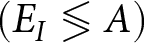 $({E_I} \lessgtr A)$.
Thus, for cost realization  $[\underline{c}, \overline{c}]$ such that
 $c \geq \hat c\left( {b,A} \right) = b - A,\,$ if
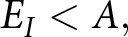 ${E_I} \lt A,$ clearly the informal organization is preferred for all
 $c$ such that
 \begin{equation*}c \geq {c_o} \geq {c_o} + \,({E_I} - A) \text{ as well as }{c_o} \geq c \geq {c_o} + \,({E_I} - A).\end{equation*}
Similarly, if 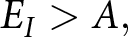 ${E_I} \gt A,$ the informal organization is preferred for all
 $c$ such that
 $c \geq {c_o} + \,({E_I} - A) \geq {c_o}$, while the formal organization without voluntary abatement is preferred for
 $c \leq {c_o} \leq {c_o} + \,({E_I} - A),$ implying
 ${c_o} \leq c \leq {c_o} + ({E_I} - A).$
Proof of lemma 4
As  $c$ is distributed uniformly over a range
 $[\underline{c}, \overline{c}]$ with density 1, the first order condition for optimum is
 $\frac{{dR}}{{db}} = - 2b + A = 0,{\text{ implying}}$
 \begin{equation*}b_F^* = \frac{{\overline c + A}}{2}\end{equation*}
as the second-order condition is satisfied. Clearly, this will be acceptable to the informal sector as long as this is lower than the maximal acceptable informal sector bribe:
 \begin{equation*}b_F^* = \frac{{\overline c + A}}{2} \lt \left[ {\frac{{{c_o}\left( {1 - p\mu } \right) - p\mu \left( {{E_I}} \right)}}{{\,p\left( {1 - \mu } \right)}}} \right] = b_I^*.\end{equation*}
In this case, the revenue earned by the (corrupt) inspector is:
 \begin{equation*}{R^*} = b_F^*.\left( {\,\overline c - b_F^* + A} \right) = {\left( {\frac{{\overline c + A}}{2}} \right)^2}.\end{equation*}
If, however, the informal bribe is lower than the optimal formal bribe, 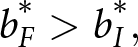 $b_F^* \gt b_I^*,$ the inspector has to decide whether to (1) charge the maximal informal bribe
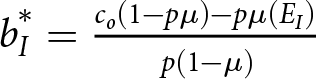 $b_I^* = \frac{{{c_o}\left( {1 - p\mu } \right) - p\mu \left( {{E_I}} \right)}}{{\,p\left( {1 - \mu } \right)}}$, or (2) charge formal bribe
 $b_F^\circ ,$ which is not affordable by informal firms.
In case (1), the inspector charges the maximal bribe acceptable to the informal sector,  $b_I^*$, to all formal and informal firms in the range
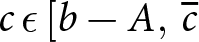 $c\,\epsilon \,[b - A,\,\overline c$]. Since this bribe will be paid by all firms in this range, the revenue of the corrupt inspector is:
 \begin{equation*}{R^{**}} = b_I^*.\left( {\,\overline c - b_I^* + A} \right) = \left( {\,\overline c + A - \left( {\frac{{{c_o}\left( {1 - p\mu } \right) - p\mu \left( {{E_I}} \right)}}{{\,p\left( {1 - \mu } \right)}}} \right)} \right)\left( {\frac{{{c_o}\left( {1 - p\mu } \right) - p\mu \left( {{E_I}} \right)}}{{\,p\left( {1 - \mu } \right)}}} \right).\end{equation*}
If the inspector charges a bribe that is only affordable to the formal firms (up to the cost level) but not to the informal firms, the revenue would be:
 \begin{equation*}R = b\left( {\overline {\overline c} \left( {p,\,A} \right) - b + A} \right) = b(\frac{1}{\mu }\left( {\frac{{{c_o}}}{p} - \left( {1 - \mu } \right)b} \right) - A.\end{equation*}
Maximizing R with respect to  $b$, we have:
 \begin{equation*}b_F^\circ = \frac{1}{{2\left( {1 - \mu } \right)}}\left[ {\frac{{{c_o}}}{p} - \mu A} \right].\end{equation*}
Proof of proposition 2
Suppose that the corrupt inspector sets a bribe  $b$. For all
 $c \leq \hat c\left( {b,A} \right) = b - A,$ the formal firm that does not voluntarily abate will prefer to abate and pay the penalty if inspected, irrespective of whether the inspector is honest or corrupt and has expected profit
 $E{{\Pi}_{F1}} = {{\Pi}^{\text{*}}} - p\left( {c + A} \right).$ Thus, the formal firm will choose to abate/not abate voluntarily accordingly as:
 \begin{equation*}{{\Pi}^{\text{*}}} - {\text{c}} \gt rless {{\Pi}^{\text{*}}} - p\left( {c + A} \right) \text{ or } \left( {c + A} \right) \gt rless {\text{c implying}} c \lessgtr {c^*}\left( {p,A} \right) = \frac{p}{{1 - p}}A.\end{equation*}
Suppose, instead,  $c \geq \,\hat c\left( {b,A} \right) = b - A$ or
 $b \lt c + A.$ Then the formal firm that does not abate voluntarily would clearly prefer to pay the bribe rather than abate and pay the penalty so that
 $E{{\Pi}_{F2}} = {{\Pi}^{\text{*}}} - p\left[ {\mu \left( {c + A} \right) + \left( {1 - \mu } \right)b} \right].\,\,$ Hence, the formal firm will choose to abate/not abate voluntarily when
 \begin{equation*}{{\Pi}^{\text{*}}} - {\text{c}} \gt rless {{\Pi}^{\text{*}}} - p\left[ {\mu \left( {c + A} \right) + \left( {1 - \mu } \right)b} \right] \text{ or }\end{equation*}
 \begin{equation*}p\left[ {\mu \left( {c + A} \right) + \left( {1 - \mu } \right)b} \right] \gt rless c \text{ or }\end{equation*}
 \begin{equation*}c \lessgtr \hat c\left( {p,A} \right) = \left[ {\frac{{p\mu A + p\left( {1 - \mu } \right)b}}{{1 - p\mu }}} \right] \text{ [abate voluntarily if } c \text{ is smaller, otherwise not]}.\end{equation*}
Since in this case, 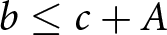 $b \leq c + A$, clearly
 $\hat c\left( {p,A} \right) = \left[ {\frac{{p\mu A + p\left( {1 - \mu } \right)b}}{{1 - p\mu }}} \right]\, \leq \left[ {\frac{{p\mu A + p\left( {1 - \mu } \right)\left( {c + A} \right)}}{{1 - p\mu }}} \right]$.
Hence,  $c\left( {1 - p\mu } \right) \leq p\mu A + p\left( {1 - \mu } \right)\left( {c + A} \right)$ or
 \begin{align*} c\left( {1 - p\mu - p + p\mu } \right) \leq pA \text{ implying } c \leq {c^*}\left( {p,A} \right) = \frac{p}{{1 - p}}A.\end{align*}
Proof of proposition 3
Step a: The corrupt inspector will not set.  $b \gt \tilde c\left( {{E_I},A} \right) + A = c_0 \left( {{E_I},A} \right) + A = c_0 + {E_I}$. This is because if
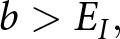 $b \gt {E_I},$
(a) it is always preferable for the informal firm to close down than to pay the bribe so that a corrupt inspector gets nothing from informal firms;
(b) firms with cost levels
$c \leq {c_o}$ that enter voluntarily will always enter with abatement;(c) by lemma 2, so long as
$b \gt \tilde c\left( {{E_I},A} \right) + A \gt \tilde c\left( {{E_I},A} \right) + {E_I},$ it is always preferable for the formal firm that enters without prior abatement to abate post facto than to pay the bribe irrespective of whether it is confronted by an honest or corrupt inspector. Thus, the corrupt inspector never gets a bribe.

 \begin{equation*}{\text{Step}}\;{\text{b}}:\;{\text{Given}}\;b\; \lt \;\widetilde c\left( {{E_I},A} \right) + A = {c_o} + \left( {{E_I} - A} \right) + A = {c_o} + {E_I}\;{\text{and}}\;{E_I}\; \lt \;A,\end{equation*}
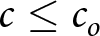
by lemma 3, informal organization is always chosen over formal organization for all  $c \geq \tilde c\left( {{E_I},A} \right) = {c_o} + \,({E_I} - A)$ where
 $\tilde c\left( {{E_I},A} \right) \leq {c_o}$ and hence for all
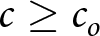 $c \geq {c_o}$. Also by lemma 3, when
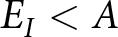 ${E_I} \lt A$, the informal organization is chosen when
 $c \geq \tilde c\left( {{E_I},A} \right) = {c_o} + \,({E_I} - A) \geq {c_o}$ while the formal organization without voluntary abatement is chosen when
 ${c_o} + \,({E_I} - A) \geq c \geq {c_o}$.
Step c: In the case 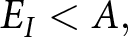 ${E_I} \lt A,{ }$ the firm prefers to enter through formal mode and abate voluntarily for all
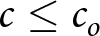 $c \leq {c_o}$ and involuntarily for all
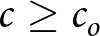 $c \geq {c_o}$. The optimal bribe in this case is clearly targeted at the informal sector and is, therefore,
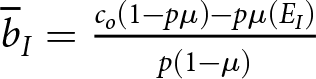 ${\overline b_I} = \frac{{{c_o}\left( {1 - p\mu } \right) - p\mu \left( {{E_I}} \right)}}{{p\left( {1 - \mu } \right)}}$.
Step d: In the case 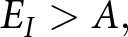 ${E_I} \gt A,\,$ when
 $c \geq \tilde c\left( {{E_I},A} \right) = {c_o} + \,({E_I} - A) \geq {c_o},$ the preferred form is the informal organization and the maximal feasible bribe is clearly
 ${\overline b_I}$. On the other hand, when
 ${c_o} + \,({E_I} - A) \geq c \geq {c_o},$ the preferred form is the formal organization without abatement and the maximal feasible bribe for any
 $c$ in this range is
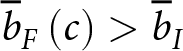 ${\overline b_F}\left( c \right) \gt {\overline b_I}$. Clearly, the corrupt inspector who does not find it profitable to exclude all informal sector firms would set an optimal bribe,
 ${\overline b_I}$.