Acute rheumatic fever is an autoimmune disease that occurs approximately three weeks after the upper respiratory tract infection with group A beta-hemolytic streptococcus bacteria. Inflammatory response results in subcutaneous nodules, erythema marginatum, arthritis, Sydenham chorea, and carditis; thus, the heart, joints, skin, and brain can be affected. Acute rheumatic fever is caused by an autoimmune mechanism, not directly by bacterial infection itself. Increased hyperimmune response against Group A streptococcus (GAS) was observed in patients with acute rheumatic fever, and association between the severity of this immune response and the severity of acute rheumatic fever was exposed. A prodromal period of three weeks, rare occurrence in children under 5 years of age whose immune system is not fully developed, and its cross-reaction between proteins in human tissue and the GAS antigen proves the underlying immune mechanisms. Reference Karthikeyan and Guilherme1 However, detection of antibodies against GAS in patients who do not develop acute rheumatic fever after pharyngitis suggests that there may be other immune mechanisms that would cause tissue damage. While humoral immune response is dominant in the first week of acute rheumatic fever, cellular immune response becomes evident in the following weeks. Reference Cunningham2
Acute rheumatic fever is more common in crowded and low socio-economic populations. Reference Seckeler and Hoke3 The incidence of carditis after acute rheumatic fever is 50–70% and develops 1–2 weeks after the arthritis symptoms. While mitral and aortic valves are the most frequently involved valves, tricuspid and pulmonary valves may also be involved rarely. Reference Tubridy-Clark and Carapetis4 Sydenham chorea is a nervous system disease which is characterised by sudden involuntary, non-rhythmic purposeless movements. Sydenham’s chorea is mostly reported in 5–15 age group, and it is more common in female gender. Reference Loiselle and Singer5,Reference Faustino, Terreri, da Rocha, Zappitelli, Lederman and Hilário6
Breast milk is an invaluable nutritional product for the newborn since it protects against infectious diseases and augments the development of the immune system. Reference Vieira Borba, Sharif and Shoenfeld7 It has been reported that breast milk improves the microbial flora of the nasopharynx and protects from upper respiratory tract infections, as compared to formula intake. Reference Biesbroek, Bosch and Wang8 A Cochrane review from 2012 has confirmed that breast milk intake for six months or longer protected from gastrointestinal system infections and related diseases. Reference Kramer and Kakuma9 In another study, it was determined that breast milk intake of less than 16 weeks increases the risk of asthma and allergic diseases, while breast milk intake for more than 16 weeks protects the child against asthma and allergens until the age of 8. Reference Oddy10 In addition, breast milk intake for more than six months has been shown to be protective against Kawasaki disease, where autoimmune pathology was blamed. Reference Wang, Xiang, Fang and Yao11 Regarding aforementioned effects of breast milk intake on the immune system and autoimmune mechanisms in the development of carditis during acute rheumatic fever, it might be hypothesised that breast milk intake and duration might be related to acute rheumatic fever carditis.
Materials and methods
Patients aged between 5 and 18 years who were diagnosed with acute rheumatic fever between 2010 and 2019 were retrospectively screened. Hospital records including history, electrocardiographic, and echocardiographic findings of the patients were reviewed. The records of patients related to acute rheumatic fever were screened, and then, the data related to breast milk intake and socio-economic status were collected prospectively by telephone. The author F.G. made the phone calls. Patients with acute rheumatic fever under five and over 18 years of age, patients with other neurological diseases, other rheumatological diseases, and CHD, parents and children who did not want to participate in the study, and patients who did not have all the information requested in the hospital database were excluded from the study. 182 of 263 patients with acute rheumatic fever were included in the study according to the criteria. The study protocol was approved by the local ethics committee.
SPSS 22.0 (IBM Corp. Armonk, NY, USA) program was used for data analysis. Whether the data were normally distributed was evaluated using the Kolmogorov–Smirnov test and histograms. Among the continuous data between the groups, those with normal distribution were evaluated with Student’s t-test and those without normal distribution were evaluated with Mann–Whitney U-test. Categorical data were evaluated using the appropriate chi-square test or Fisher’s exact tests. In addition, multivariate logistic regression analysis was used to determine independent variables that predicted the development of carditis in the first acute rheumatic fever attack, predicted the development of carditis in all attacks, and predicted the development of chorea. Variables with a p value below 0.25 in univariate analysis were included in the logistic regression analysis. Values with a p value less than 0.05 were considered statistically significant.
Results
182 patients (79 female, 43.4%) of which 149 (81.8%) had carditis in the first episode were included in the study. Mitral and aortic valve involvement in the first episode were observed in 132 (72.5%) and 60 (33.0%) patients, respectively.
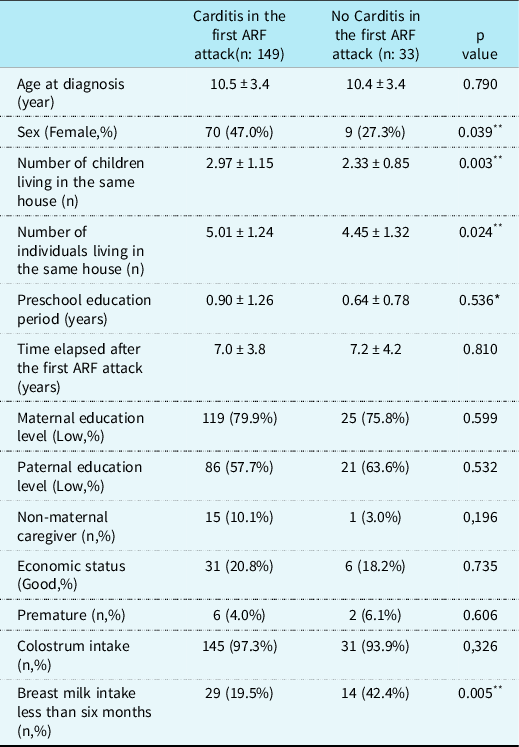
Characteristics of the patients that developed carditis in the first acute rheumatic fever attack (n: 149) were compared with those who did not (n: 33) (Table 1). The female gender ratio was significantly higher in the group that developed carditis in the first acute rheumatic fever attack compared to the group without carditis (p < 0.039). The number of children and individuals at home was significantly higher in the group that developed carditis during the first acute rheumatic fever attack (p < 0.003, p < 0.024; respectively). No statistically significant difference was found between the two groups in terms of age, the duration of pre-school education, the time (year) elapsed after the first acute rheumatic fever attack, maternal and paternal education levels, the rate of those who received non-mother care, the rates of premature birth, and colostrum intake. The frequency of patients who received breast milk for less than 6 months was higher among the patients who did not have carditis during the first attack as compared to those who had.
Demographic, socio-economic, and breast milk intake characteristics of patient groups with and without carditis in the first ARF attack

ARF, Acute rheumatic fever.
* Mann–Whitney U-test was used.
** Since p < 0.05, it is statistically significant.
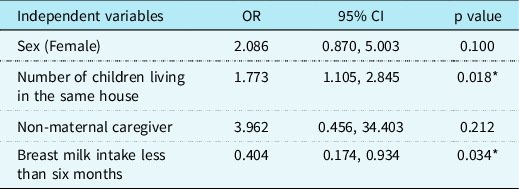
The variables that independently predicted the development of carditis in the first acute rheumatic fever attack were the number of children at home (OR: 1.773, 95% CI: 1.105, 2.845; p: 0.018) and breast milk intake less than 6 months (OR: 0.404, 95% CI: 0.174, 0.934; p: 0.034) (Table 2).
Variables independently predicting the development of carditis in the first ARF attack according to the multivariate logistic regression analysis

ARF, Acute rheumatic fever.
* Since p < 0.05, it is statistically significant.
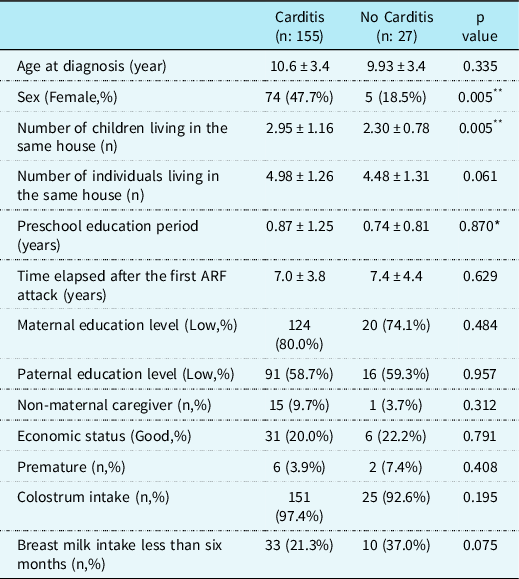
Characteristics of the patient groups according to the development of carditis in any of the acute rheumatic fever attacks are summarised in Table 3. It was determined that the female gender ratio was significantly higher in the group that developed carditis in any of the acute rheumatic fever attacks compared to the group without carditis (p < 0.005). The number of children at home was significantly higher in the group developing carditis in any of the acute rheumatic fever attacks (p < 0.005). No statistically significant difference was found between the groups regarding age, the number of individuals at home, the duration of pre-school education, the time (year) elapsed after the first acute rheumatic fever attack, the education level of the mother and father, the rate of those who received non-mother care, the rates of premature birth, and colostrum intake. The frequency of patients who received breast milk for less than six months did not differ between the groups as well.
Demographic, socio-economic, and breast milk intake characteristics of patient groups who developed carditis in any of ARF episodes and who never developed carditis

ARF, Acute rheumatic fever.
* Mann–Whitney U-test was used.
** Since p < 0.05, it is statistically significant.
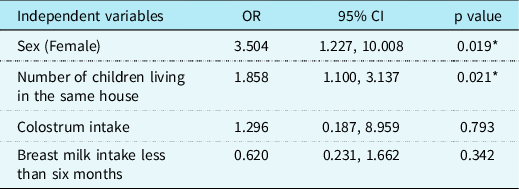
Female gender (OR: 3.504, CI 95%: 1.227, 0.008; p: 0.019) and number of children at home (OR: 1.858, CI 95%: 1.100, 3.137; p: 0.021) were the independent predictors of development of carditis in any of the acute rheumatic fever episodes (Table 4). In receiver operating characteristic curve analysis, the number of children at home greater than 2,5 had a 64% sensitivity and 60% specificity (p = 0.006) for accurately predicting development of carditis in any of the acute rheumatic fever episodes.
Variables independently predicting the development of carditis in any ARF attack according to multivariate logistic regression analysis

ARF, Acute rheumatic fever.
* Since p < 0.05, it is statistically significant.
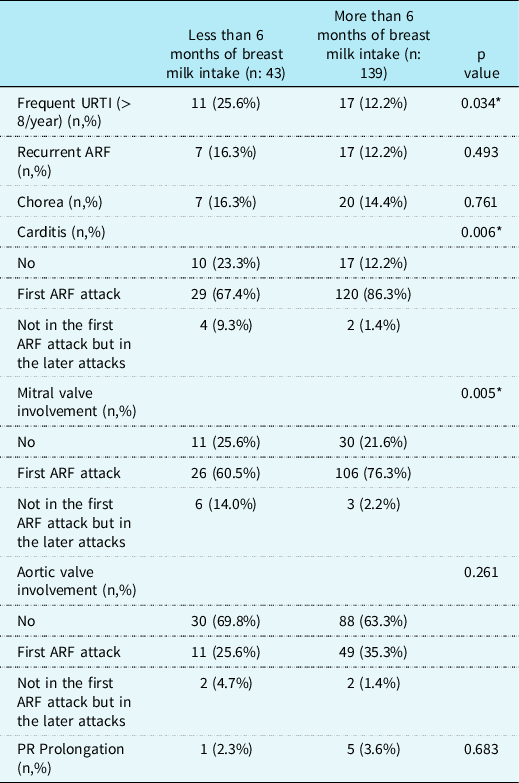
The presence of frequent upper respiratory tract infections, recurrent acute rheumatic fever, carditis, chorea, and heart valve involvement in relation to the period of breast milk intake is shown in Table 5. Frequent upper respiratory tract infections were more common among patients with breastfeeding for less than 6 months (p: 0.034). There was no significant difference between the groups in terms of aortic valve involvement, PR prolongation, and chorea occurrence. Although the frequency of patients with recurrent acute rheumatic fever was lower in those with breastfeeding for less than 6 months, it was not found to be statistically significant. The patients receiving breast milk for less than 6 months less frequently presented with carditis development and mitral valve involvement during the first attack. However, when all acute rheumatic fever attacks (first and recurrent attacks) were taken into account, both groups had similar rates of carditis development and mitral valve involvement.
Development of URTI, recurrent ARF, carditis and chorea in patients according to the duration of breast milk intake

ARF, Acute rheumatic fever; URTI, upper respiratory tract infection.
* Since p < 0.05, it is statistically significant.
Discussion
In this study, acute rheumatic fever prevalence was similar in both gender groups. This finding is compatible with previous studies. Reference Lawrence, Carapetis, Griffiths, Edwards and Condon12,Reference Rothenbühler, O’Sullivan and Stortecky13 A previous study demonstrated the increased risk for acute rheumatic fever in crowded households. Reference Jaine, Baker and Venugopal14 Our study exposed the low parental education level and socio-economic status of the patients with acute rheumatic fever. Economic disadvantage and low education level of the parents were shown to be risk factors for acute rheumatic fever. Reference Riaz, Selim, Karim, Chowdhury, Chowdhury and Rahman15 However, number of individuals living at home is claimed to be the most significant risk factor. Reference Carapetis, Beaton and Cunningham16 In the present study, approximately 85% of patients with acute rheumatic fever were diagnosed with carditis by echocardiography. This relatively high rate of carditis actually indicates that both clinical and subclinical carditis cases were included. Clinical carditis is being diagnosed in 50–70% of acute rheumatic fever cases, whereas subclinical carditis was diagnosed in only 12–21% of cases. Reference Tubridy-Clark and Carapetis4 Both clinical and subclinical carditis are currently considered as the major criterion for acute rheumatic fever. Relatively higher rate of carditis in our study compared to previous studies might be due to the inclusion of the patients diagnosed in both paediatric and adult cardiology clinics. Our study revealed that mitral and aortic valves were involved in about two-thirds and one-third of the patients, respectively. The mitral valve was most commonly involved, and the aortic valve was the second. Reference Carapetis, Beaton and Cunningham16
Approximately 15% of patients with acute rheumatic fever were diagnosed with chorea, and all the patients with chorea presented in the first acute rheumatic fever attack. Majority (96%) of the patients with chorea had carditis in the first acute rheumatic fever attack, and chorea was not observed in subsequent acute rheumatic fever attacks. In previous studies, chorea was generally diagnosed after 1–3 months following the first acute rheumatic fever attack, whereas the rate was reported to be as low as 10–30%. However, most studies included only clinically relevant carditis. When subclinical involvement is taken into account, it was asserted that up to 90% of patients with chorea also suffered from carditis. Reference Carapetis, Beaton and Cunningham16–Reference Swedo, Leonard and Schapiro18
The female gender and the high number of children at home were determined as independent predictors for the development of carditis in any of the acute rheumatic fever attacks in this study. Although acute rheumatic fever affects both genders equally, it has been shown that the development of carditis is more common in female gender. Reference Karthikeyan and Guilherme1,Reference Carapetis, Beaton and Cunningham16 Having four or more siblings appeared to be an increased risk factor for carditis in previous studies. Reference Jaine, Baker and Venugopal14,Reference Carapetis, Beaton and Cunningham16 In the current study, economic status of the families with and without carditis was similar. There is no doubt that rheumatic heart disease and poverty are related, and acute rheumatic fever should be regarded as one of the diseases of social injustice. Reference Rothenbühler, O’Sullivan and Stortecky13 Overcrowded habitat is the best-identified factor among the environmental risk factors. Thus, it is argued that the crowded living environment poses a risk rather than the economic situation itself. Reference Omurzakova, Yamano and Saatova19 Our findings vehemently supported this view.
Riaz et al. showed that low maternal literacy was associated with both acute rheumatic fever and rheumatic heart disease. Reference Riaz, Selim, Karim, Chowdhury, Chowdhury and Rahman15 This relationship was not shown in another study in different geographic site. Reference Dobson, Steer, Colquhoun and Kado20 A clear association was not found for the education levels of fathers as well. Reference Coffey, Ralph and Krause21 In light of our data, neither maternal nor paternal education level had an effect on the development of carditis.
Breastfeeding for less than 6 months appeared to be associated with frequent upper respiratory tract infections. This can be attributed to the fact that lengthy breast milk intake improves the microbial flora of the nasopharynx and consequently protects it from infections. Reference Biesbroek, Bosch and Wang8 In addition, it is well documented that effective breast milk intake reduces otitis media which is caused by similar microorganisms in upper respiratory tract infection. Reference Duncan, Ey, Holberg, Wright, Martinez and Taussig22,Reference Abrahams and Labbok23 While carditis was seen less frequently in patients who breastfed for less than six months in the first acute rheumatic fever attack, these patients were equally vulnerable to recurrent acute rheumatic fever.
Carditis develops approximately three weeks after upper respiratory tract infection, when the protective immune response against GAS antigens generally causes damage to the heart muscle and valves via cross-reaction. Positive correlation was found between the severity of this immune response and the severity of acute rheumatic fever. While the humoral immune response is evident in the first week of acute rheumatic fever, the cellular immune response becomes prominent in the following weeks. Carditis development after acute rheumatic fever is thought to be dominated by cellular immune response later than three weeks. Reference Carapetis, Beaton and Cunningham16 Detection of T-cell clones stimulated by streptococcal M protein and cardiac myosin epitopes in samples obtained from the valves of the patients elucidated the role of cellular immunity. In addition, it is claimed that these T-cell accumulations in the valves contribute to the granulomatous reaction. Reference Cunningham24
Studies have shown that breast milk plays an important role in the development of the cellular immunity, the response to vaccines, and the development of the thymus gland. The number of memory B cells decreases with breast milk intake, while the number of memory T cells increases significantly. Reference Jansen, van den Heuvel and van Zelm25
Breast milk intake is required for the proper development of intestinal microbiota. It has been shown that the intestinal microbiota increases the secretion of secretory Ig A, augments the helper T2 cell response, and activates regulatory T cells. Reference Goldman26,Reference Cerf-Bensussan and Gaboriau-Routhiau27 In addition, thanks to the immunoglobulins, nucleotides, lactoferrin, and lymphocytes in breast milk, which are protective against infections.
Decreased frequency of carditis in the first acute rheumatic fever episode who received breast milk for less than six months may be attributed to the underdevelopment of the cellular immune system, due to the low or no intake of breast milk in these patients. The response of an immature immune system to GAS antigens will be weak. Considering the mechanism of acute rheumatic fever carditis, the severity of the immune response will determine the development of carditis. Although breastfeeding less than six months is seemingly an advantage against developing carditis in the first acute rheumatic fever attack, the fact that these patients lose this advantage in recurrent attacks illustrates the importance of enough breast milk intake. Although carditis did not develop in the first acute rheumatic fever attack in those who received breast milk for less than 6 months, the relative increase in the development of carditis in subsequent recurrent attacks can be explained by the memory feature of the cellular immune response. As in vaccines that cause cellular immune response, symptoms and immune response that develop at a mild level during vaccination create a distinct immune response against the microorganism, when they encounter the same microorganism again. Reference Saso and Kampmann28
Cumulative frequency of carditis during recurrent acute rheumatic fever attacks appears to be not altered by the breastfeeding duration. However, considering all the beneficial properties of breast milk, an optimal period of breastfeeding should always be encouraged.
Acknowledgements
None.
Financial support
Authors have no financial or any other kind of personal conflicts with this letter.
Conflicts of interest
None.
Ethical standards
The study was approved by the Local Ethics Committee (Necmettin Erbakan University, Meram Medical Faculty 2020/2381).