Why do some children embrace their parents’ influence and embark on adaptive, positive developmental trajectories toward prosocial, internalized, rule-abiding conduct, whereas others reject and resent their parents’ socialization efforts and embark on maladaptive paths toward disregard for conduct rules and antisocial behavior? Understanding mechanisms that lead to these divergent paths has long been a key aim in developmental psychology and psychopathology, and much research progress has been made.
A rich body of work that considers child and parent effects has been particularly informative. That research, well supported by increasingly sophisticated designs, has highlighted a common path to behavior problems that emphasizes an important role of children's early difficulty (Caspi, Henry, McGee, Moffitt, & Silva, Reference Caspi, Henry, McGee, Moffitt and Silva1995; Eisenberg, Taylor, Widaman, & Spinrad, Reference Eisenberg, Taylor, Widaman and Spinrad2015; Gartstein, Putnam, & Rothbart, Reference Gartstein, Putnam and Rothbart2012; Kiff, Lengua, & Zalewski, Reference Kiff, Lengua and Zalewski2011; Shaw & Bell, Reference Shaw and Bell1993). Originating with Thomas and Chess (Reference Thomas and Chess1977) the “difficult child” type, difficulty has since become a notoriously broad concept, but several key qualities have consistently emerged in the voluminous literature. In infancy, those include the child's frequent and intense negative affect, particularly anger, and low soothability, as well as poor responsiveness to parental overtures and influence. In toddler age and beyond, following the onset of control, those qualities expand to include also defiance, unmanageability, and resistance to control (Bates, Reference Bates1980; Lengua & Wachs, Reference Lengua, Wachs, Zentnerv and Shiner2012; Rothbart & Bates, Reference Rothbart, Bates, Damon, Lerner and Eisenberg2006; Sanson, Hemphill, & Smart, Reference Sanson, Hemphill and Smart2004).
Conceptualizations and methodologies deployed to capture “child difficulty” in developmental psychology and psychopathology encompass a very broad range of constructs and assessment. They have originated from and flourished most prominently in research on children's temperament, under the umbrella construct of “difficult temperament” (Bates, Reference Bates1980; Goldsmith et al., Reference Goldsmith, Buss, Plomin, Rothbart, Thomas, Chess and McCall1987; Rothbart & Bates, Reference Rothbart, Bates, Damon, Lerner and Eisenberg2006). Difficult temperament, as a biologically based trait, can be observed as stable individual differences. Accordingly, researchers have developed observational tools to code children's temperamental response (e.g., anger, negative affect) in standard lab episodes (e.g., Goldsmith & Rothbart, Reference Goldsmith and Rothbart1999). However, outside of standardized paradigms, the child's behavior reflecting “difficulty” is expected to vary across contexts and relationships (e.g., different stimuli and different caregivers; Goldsmith et al., Reference Goldsmith, Buss, Plomin, Rothbart, Thomas, Chess and McCall1987). Correspondingly, researchers have also developed measures specific to caregiver–child dyadic interactions, such as observed child negative emotionality, unmanageability, or unresponsiveness to the caregiver. Researchers have also developed a broad range of caregiver-reported tools to assess child difficulty. Those tools elicit caregivers’ descriptions of indicators of child difficulty (e.g., anger, negative emotions, unresponsiveness).
Those various measures of child difficulty, albeit capable of producing rich information about the child's difficulty in multiple contexts, are sometimes inconsistent with each other. For instance, caregiver-perceived child difficulty often has been found to correlate only modestly with observed difficulty. Various caregivers, including mothers and fathers, sometimes disagree in their reports of child difficulty (e.g., Bates, Reference Bates1980; Stifter, Willoughby, & Towe-Goodman, Reference Stifter, Willoughby and Towe-Goodman2008), likely because caregivers observe children's behaviors in different contexts, and can be biased by their own schemas and beliefs (more on this later). The validity of various measures of difficulty (and other child characteristics) has been the subject of much debate (Kagan & Fox, Reference Kagan, Fox, Damon, Lerner and Eisenberg2006; Rothbart & Bates, Reference Rothbart, Bates, Damon, Lerner and Eisenberg2006). The general consensus is that both have advantages and disadvantages, may offer different insights into processes of development, and often complement each other. Consequently, in our work, we deploy both observational and parent-reported methodologies.
The focal role of child difficulty in developmental psychology and psychopathology is underscored by a large body of evidence that has depicted child difficulty as triggering a cascade of unfolding adversarial transactions between the child and the parent. Difficult children can elicit increasingly negative, insensitive, and harsh parental control, which in turn leads to future disruptive child outcomes, including disregard for rules and other conduct problems (Braungart-Rieker, Garwood, & Stifter, Reference Braungart-Rieker, Garwood and Stifter1997; Braungart-Rieker, Garwood, Powers, & Wang, Reference Braungart-Rieker, Garwood, Powers and Wang2001; Dadds & Salmon, Reference Dadds and Salmon2003; Dishion & Patterson, Reference Dishion, Patterson, Cicchetti and Cohen2006; Lipscomb et al., Reference Lipscomb, Leve, Harold, Neiderhiser, Shaw, Ge and Reiss2011; Lorber & Egeland, Reference Lorber and Egeland2011; Scaramella & Leve, Reference Scaramella and Leve2004; Shaw & Bell, Reference Shaw and Bell1993; Taraban & Shaw, Reference Taraban and Shaw2018).
Although considerable research has supported this model, growing evidence, including meta-analytic reviews, has also clearly highlighted its limitations. The findings have been far from consistent and not always replicated, and effects often small (Lorber & Egeland, Reference Lorber and Egeland2011; Paulussen-Hoogeboom, Stams, Hermanns, & Peetsma, Reference Paulussen-Hoogeboom, Stams, Hermanns and Peetsma2007; Putnam, Sanson, & Rothbart, Reference Putnam, Sanson, Rothbart and Bornstein2002). Consequently, researchers have increasingly shifted to efforts aimed at identifying moderators of the path from infant difficulty to parental negative control (and more generally, negative parenting) to children's future outcomes, and have described multiple factors that alter either that entire path or its components. As one example, families’ sociodemographic resources or socioeconomic status (SES) have often served as moderators. Associations among child difficulty, negative parenting, and child outcomes were typically found in stressed and disadvantaged families, and in parents facing adversity, but not in those with more resources and higher SES (Crockenberg, Reference Crockenberg, Lerner and Lerner1986; Kim & Kochanska, Reference Kim and Kochanska2020; Paulussen-Hoogeboom et al., Reference Paulussen-Hoogeboom, Stams, Hermanns and Peetsma2007; Sentse, Veenstra, Lindenberg, Verhulst, & Ormel, Reference Sentse, Veenstra, Lindenberg, Verhulst and Ormel2009; Taraban & Shaw, Reference Taraban and Shaw2018).
Qualities associated with the early parent–child relational experience have played an especially strong role as moderators of all components of the future cascade from child difficulty to negative parenting to child outcomes, including impaired internalization of rules (Kochanska, Boldt, & Goffin, Reference Kochanska, Boldt and Goffin2019). Specifically, that cascade has been only present in the relationships that were insecure or otherwise suboptimal in infancy, but defused or absent in optimal ones. Seeking to understand mechanisms that account for those findings, Kochanska et al. (Reference Kochanska, Boldt and Goffin2019) proposed that parents’ representations, or internal working models (IWMs) of their children may play the key role in determining whether or not child difficulty triggers parents’ power-assertive, harsh discipline. Such effects may be more likely for parents whose IWMs are less reflective and more hostile than for parents whose IWMs are more reflective and more benign.
This emphasis dovetails with several bodies of research on the role of parental representations, or IWMs, in parent–child relationships (Bretherton & Munholland, Reference Bretherton, Munholland, Cassidy and Shaver2008; Bugental & Johnston, Reference Bugental and Johnston2000; Carlson, Sroufe, & Egeland, Reference Carlson, Sroufe and Egeland2004; Dykas & Cassidy, Reference Dykas and Cassidy2011; Leerkes et al., Reference Leerkes, Supple, O'Brien, Calkins, Haltigan, Wong and Fortuna2015). Diverse yet synergistic literatures have elucidated multiple inter-related dimensions of parents’ IWMs, encompassing the reasoning processes involved in parental interpretations of the child's behaviors, as well as their perceptions of the child. Parents’ mind-mindedness (MM) and reflective functioning (RF) refer to their willingness or ability to see the child as a psychological agent with internal states that underlie behavior (Benoit, Zeanah, Parker, Nicholson, & Coolbear, Reference Benoit, Zeanah, Parker, Nicholson and Coolbear1997; Camoirano, Reference Camoirano2017; Dykas, Ehrlich, & Cassidy, Reference Dykas, Ehrlich, Cassidy and Benson2011; Katznelson, Reference Katznelson2014; Luyten, Mayes, Nijssens, & Fonagy, Reference Luyten, Mayes, Nijssens and Fonagy2017; Luyten, Nijssens, Fonagy, & Mayes, Reference Luyten, Nijssens, Fonagy and Mayes2017; McMahon & Bernier, Reference McMahon and Bernier2017; Meins, Reference Meins1999; Meins et al., Reference Meins, Fernyhough, de Rosnay, Arnott, Leekam and Turner2012; Meins, Fernyhough, Fradley, & Tuckey, Reference Meins, Fernyhough, Fradley and Tuckey2001; Rutherford, Booth, Luyten, Bridgett, & Mayes, Reference Rutherford, Booth, Luyten, Bridgett and Mayes2015; Rutherford, Goldberg, Luyten, Bridgett, & Mayes, Reference Rutherford, Goldberg, Luyten, Bridgett and Mayes2013; Sharp & Fonagy, Reference Sharp and Fonagy2008; Slade, Reference Slade2005). Parents’ attributions reflect the interpretations of the child's difficult or aversive behavior as either voluntary, deliberate, hostile, and intentional acts, or else as unintended, benign, natural expressions of internal states (Park, Johnston, Colalillo, & Williamson, Reference Park, Johnston, Colalillo and Williamson2018; Snarr, Slep, & Grande, Reference Snarr, Slep and Grande2009; Snyder, Cramer, Afrank, & Patterson, Reference Snyder, Cramer, Afrank and Patterson2005; Wagner, Gueron-Sela, Bedford, & Propper, Reference Wagner, Gueron-Sela, Bedford and Propper2018).
A broad conceptual model that depicts parents’ internal representations or working models of their children as significant moderators of developmental trajectories that often originate with the infant's difficulty served as the framework for two goals addressed in this article. The first goal was to examine whether parents’ IWMs, specifically, appropriate MM in infancy, alter the path from the infant's early difficulty, assessed in infancy, to parental future negative, power-assertive control, assessed in toddler and preschool age. Power-assertive control was then examined as associated with children's regard for rules, assessed at kindergarten age. Consistent with past research (Kochanska et al., Reference Kochanska, Boldt and Goffin2019), we expected the path from infant difficulty to future parental negative control to future child negative outcomes (disregard for rules) to unfold only for parents who were relatively low in their MM, but not for those who showed high MM. Specifically, we expected parental MM to moderate the association between infant difficulty and parental negative control.
This model dovetails with the extant literature. A parent with an impoverished, negative IWM of the child is primed to perceive even mild difficulty as challenging and aversive. For that parent, difficult, irritating, unresponsive infants can easily trigger harsh, negative control (Haltigan, Leerkes, Supple, & Calkins, Reference Haltigan, Leerkes, Supple and Calkins2014; Leerkes, Reference Leerkes2010; Lorber & O'leary, Reference Lorber and O'leary2005; Nix et al., Reference Nix, Pinderhughes, Dodge, Bates, Pettit and McFadyen-Ketchum1999; Scaramella & Leve, Reference Scaramella and Leve2004; Smith, Dishion, Shaw, & Wilson, Reference Smith, Dishion, Shaw and Wilson2015). By contrast, for a parent with a rich, reflective, mind-minded, and positive IWM, the same infant characteristics would not trigger such coercive control; they may even elicit supportive, patient, accepting, and empathic control (Dix, Reference Dix1991; Leerkes & Siepak, Reference Leerkes and Siepak2006). We tested this moderated mediation model longitudinally over the first 5½ years of children's lives in the first study, Family Study (FS), a sample of 102 community families. We used observed measures of child difficulty and parental MM and control, as well as observed and parent-reported measures of child (dis)regard for rules.
The second goal was to examine whether parents’ dysfunctional IWMs of the child, specifically impoverished RF and hostile attributions, moderate their perception of infants’ difficulty. McMahon and Bernier (Reference McMahon and Bernier2017) explicitly stated that “An orientation to child mental states may also influence how parents subjectively experience and respond to their child's behavior, with those more oriented to the motives and feelings that underlie behavior less inclined to experience and label child behaviors as irritating, irrational or difficult” (McMahon & Bernier, Reference McMahon and Bernier2017, p. 65).
This issue is particularly crucial for research on child difficulty that relies on caregivers’ reports. Parents’ reports of children's characteristics are very broadly used in developmental psychology and psychopathology (Kostyrka-Allchorne, Wass, & Sonuga-Barke, Reference Kostyrka-Allchorne, Wass and Sonuga-Barke2020), but as we indicated, their accuracy has been long debated (Kagan, Reference Kagan, Damon and Eisenberg1998; Kagan & Fox, Reference Kagan, Fox, Damon, Lerner and Eisenberg2006; Rothbart & Bates, Reference Rothbart, Bates, Damon and Eisenberg1998; Reference Rothbart, Bates, Damon, Lerner and Eisenberg2006). In particular, and pertinent to the current work, it is important to examine the correspondence between behavioral measures of child difficulty, coded by independent observers, and the parents’ description of child difficulty, provided in a questionnaire format. Examining factors that may affect such correspondence remains a very useful goal.
We addressed this goal in the second study, Children and Parents Study (CAPS) of 200 community families. We examined whether parents’ dysfunctional IWMs moderate their perceptions of infants’ difficulty, with the focus on the correspondence between objectively observed and parent-reported measures. We expected that parents with highly dysfunctional IWMs (compared to those with less dysfunctional IWMs) would produce reports that align poorly with the objective measures.
Researchers studying parental representations have relied on multiple methodologies, depending on the studied dimension of those representations (McMahon & Bernier, Reference McMahon and Bernier2017). With regard to parental MM, the most broadly accepted measures include interviews about the child, coded for various qualities of parental descriptions, and observational measures based on MM comments the parent made to the child during interactions (“MM in action,” or “online”). RF has been assessed from lengthy interviews (e.g., Parent Development Interview, PDI-R; Slade, Aber, Bresgi, Berger, & Kaplan, Reference Slade, Aber, Bresgi, Berger and Kaplan2004), and more recently, using a carefully developed and validated questionnaire, Parental Reflective Functioning Questionnaire (PRFQ, Luyten, Mayes, et al., Reference Luyten, Mayes, Nijssens and Fonagy2017). Parental attributions have been typically measured using questionnaires and vignettes. Few studies have used more than one methodology. In the present work, we relied on the behavioral measure of MM in FS and on parent-reported measures of RF and hostile attributions in CAPS.
Although research on parental internal representations has been growing rapidly, studies of mother–child relationships far outnumber studies that include both mother– and father–child dyads. This parallels the general imbalance in research on social–emotional development that has prompted urgent appeals for change (Cabrera & Volling, Reference Cabrera and Volling2019; Cabrera, Volling, & Barr, Reference Cabrera, Volling and Barr2018), echoed by researchers studying parental representations (McMahon & Bernier, Reference McMahon and Bernier2017). Although still rare, such research has been growing (Arnott & Meins, Reference Arnott and Meins2007; Buttitta et al., Reference Buttitta, Smiley, Kerr, Rasmussen, Querdasi and Borelli2019; Colonnesi, Zeegers, Majdandžić, van Steensel, & Bögels, Reference Colonnesi, Zeegers, Majdandžić, van Steensel and Bögels2019; Gagné, Bernier, & McMahon, Reference Gagné, Bernier and McMahon2018; Leung & Slep, Reference Leung and Slep2006; Lundy, Reference Lundy2003; Luyten, Mayes, et al., Reference Luyten, Mayes, Nijssens and Fonagy2017; Miller, Kim, Boldt, Goffin, & Kochanska, Reference Miller, Kim, Boldt, Goffin and Kochanska2019; Park et al., Reference Park, Johnston, Colalillo and Williamson2018; Pazzagli, Delvecchio, Raspa, Mazzeschi, & Luyten, Reference Pazzagli, Delvecchio, Raspa, Mazzeschi and Luyten2018; Zeegers et al., Reference Zeegers, de Vente, Nikolić, Majdandžić, Bögels and Colonnesi2018). However, the picture of the findings on relations among characteristics of parental representations, parenting, and child characteristics in mother– and father–child dyads lacks coherence and consensus. Consequently, although in both FS and CAPS we assessed all constructs in mother– and father–child relationships, we had not formulated specific predictions, and we treated this aspect of the current work as exploratory.
Family Study: Parents’ Internal Working Models (IWMs) of the Child (Mind- Mindedness, MM) Moderate the Path from Infant Difficulty to Parental Control to Children's Regard for Rules
Method
Participants
One-hundred and two two-parent, intact families of infants, born mostly in 2001, who lived in a Midwestern college town, a nearby small city and surrounding rural areas, responded to ads flyers and posters disseminated broadly in the community, and volunteered for our longitudinal study. The eligibility criteria were: the two parents living together and both willing to participate and speak English during sessions; a typically developing infant (a biological child); and no plans to move in the next five years. Demographic characteristics varied: 25% of mothers and 30% of fathers had no more than a high school education, 54% of mothers and 51% of fathers had an associate or college degree, and 21% of mothers and 20% of fathers had a postgraduate education. In terms of income, 8% of families made less than $20,000 per year, 17% made between $20,000 and $40,000, 26% made between $40,000 and $60,000, and 49% made over $60,000. In terms of ethnic background, 90% of mothers and 84% of fathers were White, 3% of mothers and 8% of fathers Hispanic, 2% of mothers and 3% of fathers African American, 1% of mothers and 3% of fathers Asian, 1% of mothers Pacific Islander, and 2% of mothers and fathers reported Other. In 20% of families, at least one parent was not White.
Overview of design
In this article, we report data collected at five time points. At age 7 months (N = 102, 51 girls), we observationally assessed children's difficulty and parents’ MM. At age 2 (N = 100, 50 girls), age 3 (N = 100, 50 girls), and age 4.5 (N = 99, 49 girls), we observed parental power assertion. At age 5.5 (N = 92, 45 girls), we assessed children's outcomes – (dis)regard for rules, using an observed and parent-rated measures. In addition, the child's sex and family annual income served as covariates, due to common effects of those variables in socialization research. All behavioral data were collected during observational mother–child and father–child sessions, 2–4 hr long, parallel for both parents, conducted by female experimenters (Es) and video-recorded. All sessions were in a university laboratory, except at age 7 months, when they were at home, and at age 3, when the sessions were at home and in the laboratory. Parallel measures were collected for mother– and father–child relationships. Families that returned at age 5.5 years and those that did not return did not differ on any measures in this report. The University of Iowa's Institutional Review Board approved the study (Developmental Pathways to Antisocial Behavior: A Translational Research Program, 200107049). We obtained parents’ informed consents at the entry to the study.
Behavioral data were coded from the videos. Reliability was typically established on 15%–20% of cases, followed by frequent realignments to prevent observer drift. We used kappas, weighted kappas, and alphas or intra-class correlations, ICCs (note that the best practices have evolved over the course of the study). Details of our constructs and measures that have been previously published are referenced where appropriate.
Measures
Children's difficulty, age 7 months (negative affect and unresponsiveness toward the parent)
Observed contexts
Both negative affect and unresponsiveness were observed in approximately 45 min (with each parent) of naturalistic, scripted interactions that encompassed a variety of contexts (e.g., free play, parent busy, caregiving routines, including bath time and changing the baby's clothes and diaper, opening the gift for the baby and parents).
Negative affect: coding and data aggregation
Details are in Kim and Kochanska (Reference Kim and Kochanska2012). The infant's affect was coded every 30 s across all the observed contexts. In this study, we focus on negative affect expressions only: neutral/negative (not a “full-blown” negative affect, but signs of fatigue, subtle discomfort, a minor whimper, negatively “tinged” affect, etc.), and discrete negative affect expression (“full-blown” distress, cry, fussiness, anger, etc.). Particularly intense or pervasive (15 s or more) expressions were marked. The average kappa across several pairs of coders was .81.
All the tallied instances of the infant's intense or pervasive negative affect were weighed by 3, discrete negative affect by 2, and neutral/negative mood by 1. These figures were then added and divided by the number of coded segments to create a score of the infant's negative emotion expression in naturalistic interactions, separately with each parent; with mother, M = .38, SD = .34, range .00–1.63, with father, M = .40, SD = .41, range .00–2.85.
Unresponsiveness: coding and data aggregation
The coders assigned one overall code for each of the observed contexts (e.g., caregiving routines, free play). We developed the coding system as complementary to Ainsworth, Bell, and Stayton's (Reference Ainsworth, Bell, Stayton and Schaffer1971) parental responsiveness system, redefining the three classic dimensions in a way that was developmentally appropriate. The key consideration was how likely the infant's behavior was to please the parent, make him or her feel effective, and how much the infant seemed to enjoy the interaction with the parent. Sensitivity captured the amount and quality of attention the infant gives the parent and promptness of response to parental cues. Cooperation captured the degree to which the child cooperated smoothly with the parent. Acceptance referred to the infant's enjoyment and interest expressed during the interaction. Multiple examples, illustrating each rating, were included in the coding manual. The overall code integrated the three dimensions and ranged from 1 = highly unresponsive to 7 = highly responsive. Reliability, alpha, was .93.
For each parent, the ratings were averaged across the contexts into the infant's responsiveness composite (for details, see Kochanska & Aksan, Reference Kochanska and Aksan2004); with mother, M = 4.99, SD = .52, range 3.17–6.33, with father, M = 4.85, SD = .67, range 2.17–5.83. To reflect unresponsiveness, the final composite was reversed.
Child difficulty composite
The child's negative affect and unresponsiveness correlated; for mother–child relationships, r(102) = .71, p < .001, and for father–child relationships, r(102) = .84, p < .001. Consequently, they were standardized and aggregated into the overall child difficulty scores (one with each parent).
Mothers’ and fathers’ appropriate MM comments, age 7 months
Observed contexts
Parents’ appropriate MM comments were assessed during two contexts, snack (7 min), and play with one standard small toy (6 min; for details, see Goffin, Kochanska, & Yoon, Reference Goffin, Kochanska and Yoon2020; Miller et al., Reference Miller, Kim, Boldt, Goffin and Kochanska2019). The contexts were parallel for the mother–child and father–child sessions.
Transcribing, coding, and data aggregation
Our approach followed the guidelines by Meins and Fernyhough (Reference Meins and Fernyhough2015). First, a team of transcribers wrote down verbatim each parental comment to the child (reliability for parsing the speech into units, or comments, ICCs, ranged from .74 to .99). Second, a team of coders coded the transcripts while also watching the video. They coded each comment as MM (references to the infant's desires, cognitions, emotions, and talking on the infant's behalf) or not MM (the latter were not considered further). Reliability, kappas, ranged from .96 to .99. They further coded each MM comment as either appropriate or as nonattuned. An MM comment was coded as appropriate when the coder agreed with the parent's reading of the infant's internal state, the comment linked the infant's current activity with similar events in the past or future, or served to clarify how to proceed after a lull in the interaction. The remaining MM comments were coded as nonattuned. Reliability, kappas, ranged from .69 to .95.
For each parent, we tallied, and then summed across snack and play all appropriate MM comments and nonattuned comments. The latter were very rare (average of 1.60 and 1.28 for mothers and fathers, respectively), and were not considered further. Mothers made more appropriate MM comments than fathers, t(100) = 3.09, p < .001.
Mothers’ and fathers’ power-assertive discipline, ages 2, 3, and 4.5
Observed contexts
Each mother– and father–child dyad was observed in Do control context (when the parent requested that the child pick up toys after play) and several Don't contexts (the periods in the laboratory room when the child had an easy access to extremely attractive objects and toys on a low shelf, designated as off limits to the child). The parent issued the prohibition at the outset and enforced it throughout the session. The observed times for each parent–child dyad (Do and Don't) were 47, 42, and 75 min at ages 2, 3, and 4.5, respectively (total 164 min with each parent).
Coding and aggregation
For details, see Kochanska, Barry, Stellern, & O’Bleness (Reference Kochanska, Barry, Stellern and O'bleness2009). Parental style of control was coded for each 30-s segment (for Do, throughout the toy cleanup; for Don't, following every instance once the parent and/or child became involved with the prohibited objects). For each segment, coders assigned a global rating and coded all parental physical techniques. The global ratings included: no interaction, social exchange (sociable interaction but no control), gentle guidance (parent hints, suggests), control (parent controls in an assertive, firm control, with direct commands and prohibitions), and forceful, negative control. Reliability, kappas across multiple teams of coders, ranged from .71 to .80. The physical techniques included: assertive interventions (holding the child's hand firmly, physically preventing child from leaving the chore, blocking access to toys) and forceful interventions (yanking a toy away, handling the child roughly). Reliability, kappas across multiple teams of coders, ranged from .68 to .91.
For each context (Do and Don't), the instances of each code were tallied and divided by the number of coded segments. We then weighed those scores to reflect the amount of parental power: no interaction −2, social exchange, −1, gentle guidance, 1, control, 2, forceful control,3, physical assertive, 4, and physical forceful, 5. Those weighted figures were summed into one weighted power assertion composite for Do and one for Don't, for each parent. Those two scores were standardized and averaged into one power assertive control score. Those scores cohered longitudinally across ages 2, 3, and 4.5; the inter-correlations for mothers ranged from .38 to .59, all ps < .001, for mothers, and from .44 to .58, all ps < .001, for fathers. Consequently, for each parent, they were averaged into the overall power assertive discipline score.
Children's outcomes, age 5.5: regard and disregard for rules of conduct
Disregard for rules: observed contexts
We observed the child's rule-violating behaviors during two “cheating games,” when he or she was alone, one in each laboratory session. The child was promised rewards for winning. The games involved throwing either balls or rings at the target, while remaining in a designated space. E described the rules of the game (e.g., remain fully within the designated space, throw each ball or ring only once, face away from the target while throwing). The rules were such that, if followed, they made it essentially impossible for the child to win a game. E reviewed the rules with the child during a friendly, but serious conversation, and asked him or her to follow the rules and not “cheat.” The child was then left alone for 3 min. When E returned, she apologized for having given the child “the wrong rules” and asked the child to play again in an easier way, until every child won a prize.
Coding and data aggregation
Child behavior was coded for every 3-s segment as fully rule compatible or as representing one of possible rule violations (kappas .96 for both games). Details are in Kochanska and Kim (Reference Kochanska and Kim2014). The latencies to the first instance of each violation were also coded (ICC 1.00 for both games). We created a composite of rule-violating behavior by combining the tallies of the various violations and reversed latencies (all standardized) for each game (Cronbach's alphas .86 to .90). Those composites correlated across the two games, r(91) = .67, p < .001, and were aggregated into the overall score of disregard for conduct rules.
Regard for rules: parental ratings
Each parent completed the 20-item scale of Internalized Conduct from My Child Questionnaire (Kochanska, DeVet, Goldman, Murray, & Putnam, Reference Kochanska, DeVet, Goldman, Murray and Putnam1994). The items, rated from 1 = extremely untrue of child to 7 = extremely true of child, captured the child's compliance without surveillance and rule-compatible behavior. Examples include: “Rarely repeats previously prohibited behavior, even if adult is not present,” “Can stop herself or himself in the middle of doing something forbidden without any intervention from an adult,” “If out of parent's sight, may ignore a household rule” (reversed). Cronbach's alphas were .91 for mothers and .90 for fathers. All descriptive data for the final constructs are in Table 1.
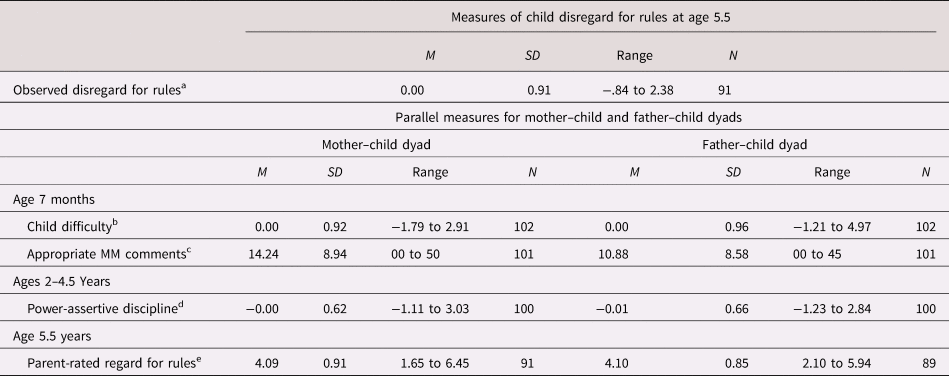
Descriptive data for all measures in family study

a Composite of standardized scores of rule violations in two “cheating games.”
b Composite of standardized scores for child negative affect and unresponsiveness in interactions with the parent.
c Sum of appropriate MM comments across snack and play.
d Composite of power-assertive discipline scores at ages 2, 3, and 4.5; the score at each age was a mean of standardized scores for Do and Don't control contexts.
e Internalized Conduct scale, My Child questionnaire. MM = mind-minded.
Results
Preliminary analyses
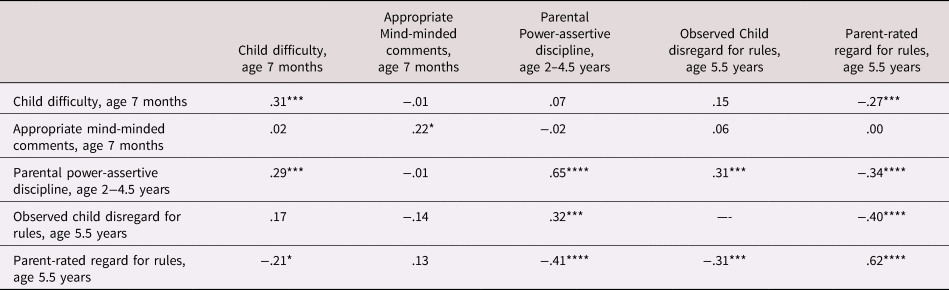
We first inspected the correlations among the measures (see Table 2). In both mother– and father–child relationships, the infant's higher difficulty observed in interactions at 7 months was associated with lower scores on parent-rated regard for rules approximately 5 years later. In father–child relationships, higher difficulty was also associated with more power-assertive discipline from age 2 to 4.5. In both relationships, more power-assertive discipline was associated with children's poorer regard for rules at age 5.5, both observed and rated by the parent. The observed and parent-rated measures of regard for rules correlated. All measures parallel for mother– and father–child dyads were correlated modestly (child difficulty, appropriate MM comments) to robustly (power-assertive discipline, parent-rated regard for rules) across the two relationships.
Correlations among all measures in family study
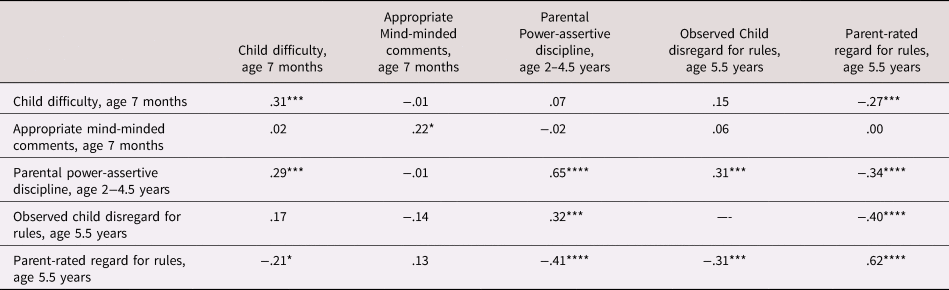
Note: * p < .05. ** p < .025. *** p < .01. **** p < .001.
Correlations for mother–child dyads are above the diagonal, and correlations for father–child dyads are below the diagonal. Correlations between mother– child and father–child constructs are on the diagonal.
Main analyses: testing the moderated mediation model
We examined the proposed moderated mediation model separately for mother– and father–child dyads. Specifically, we modeled child difficulty at 7 months as the predictor, parental use of power-assertive discipline from age 2 to 4.5 as the mediator, and child observed and parent-rated (dis)regard for rules at age 5.5 as separate outcome variables (modeled as correlated). In addition, parents’ appropriate MM comments were modeled as a moderator of the link between early child difficulty and parents’ power-assertive discipline. Child gender and family income served as covariates. To reduce multicollinearity and increase the interpretability of the moderating effects, child difficulty and parents’ appropriate MM comments were standardized before forming the interaction terms (Aiken & West, Reference Aiken and West1991). Other continuous variables, such as parents’ power-assertive discipline and family income, also were standardized.
We tested the moderated mediation effect using Mplus codes adapted from Stride, Gardner, Catley, and Thomas (Reference Stride, Gardner, Catley and Thomas2015). By converting the original syntax into the Mplus program (Muthén & Muthén, Reference Muthén and Muthén1998-2019), this method allows for the use of the full information maximum likelihood (FIML) missing data treatment within the framework of PROCESS (Hayes, Reference Hayes2013), as well as for the inclusion of multiple outcome variables. We estimated the mediation effect by deriving the 95% confidence intervals (CI) using the nonparametric resampling method (bias-corrected bootstrap) with 10,000 resamples drawn. Bootstrapping is a commonly recommended method for assessing indirect effects in mediation analysis, because it accounts for the nonnormal sampling distribution of indirect effects and provides accurate estimations and maximized power for small to moderate sample sizes while minimizing Type I error rate (MacKinnon, Lockwood, & Williams, Reference MacKinnon, Lockwood and Williams2004; Preacher, Rucker, & Hayes, Reference Preacher, Rucker and Hayes2007; Shrout & Bolger, Reference Shrout and Bolger2002). We probed significant moderation effects using simple slopes (Aiken & West, Reference Aiken and West1991).
Mother–child dyads
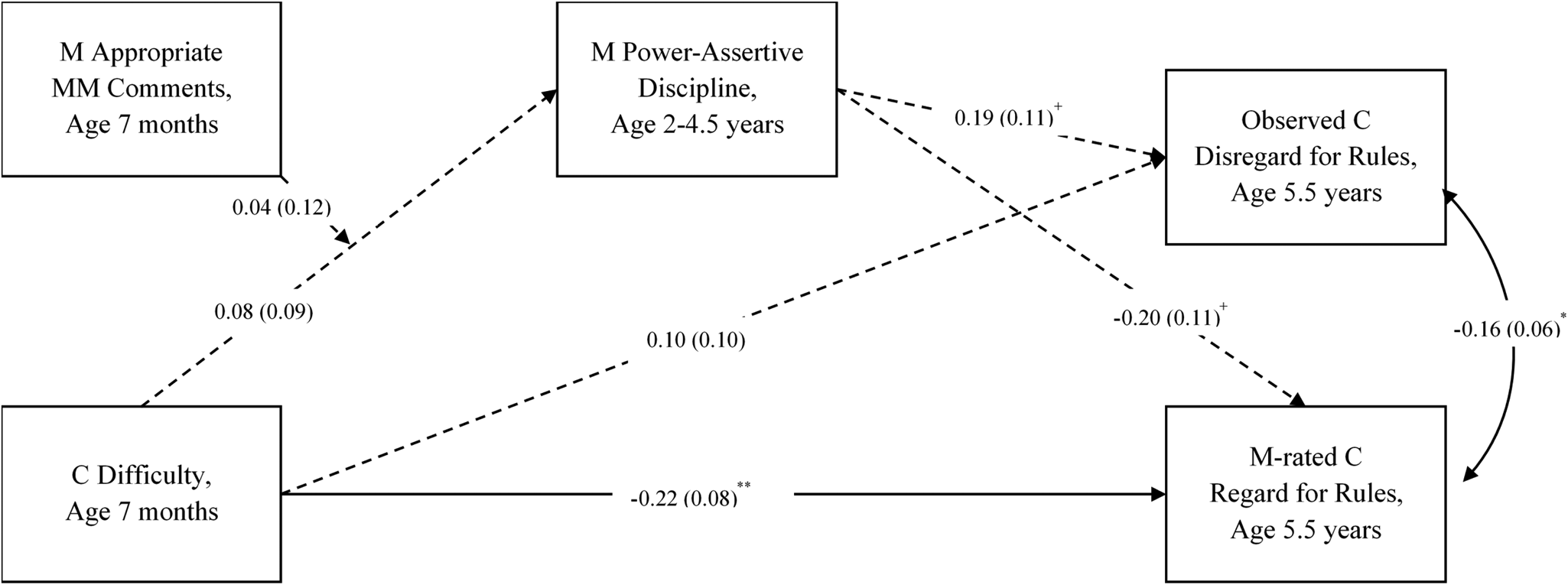
In mother–child dyads (model depicted in Figure 1), the mother's power-assertive discipline at ages 2–4.5 seemed to be associated with the child's more observed disregard for rules, as well as with lower mother-rated regard for rules, but the effects were marginal (ps = .07 and .07, respectively). Child difficulty at 7 months was not associated with the mothers’ power-assertive discipline. Furthermore, we failed to support the expectation that the mother's number of appropriate MM comments would moderate the link between the infant's difficulty and maternal use of power assertion.
Family Study. The moderated mediation model of the paths from the predictor, child difficulty at age 7 months (in mother–child interactions), to the mediator, the mother's power-assertive discipline at age 2 through 4.5 years, to the outcomes, the child's observed rule-violating behaviors in “cheating games” and mother-rated internalized conduct at age 5.5 years. The mother's appropriate MM comments were modeled as a moderator of the path from child difficulty to power-assertive discipline. Paths from power-assertion to (dis)regard for rules were modeled as not moderated. Although not depicted, the child's gender and family income are included as covariates for both the mediator and the outcomes. Solid lines represent significant effects and dashed lines represent nonsignificant effects. Standard errors are in the parentheses. C = child. M = mother. MM = mind-minded. +p < .10. * p ≤ .05. ** p < .01.

The indirect effects from child difficulty to power-assertive discipline to observed and parent-rated (dis)regard for rules were not present, either for the entire sample or for mothers with different levels of MM. However, we observed a significant direct effect from child difficulty at 7 months to mother-rated regard for rules at 5.5 years, B = −0.22, SE = 0.08, p = .004. At age 5.5, mothers perceived the children who as infants had been more difficult as having poorer regard for rules.
Father–child dyads
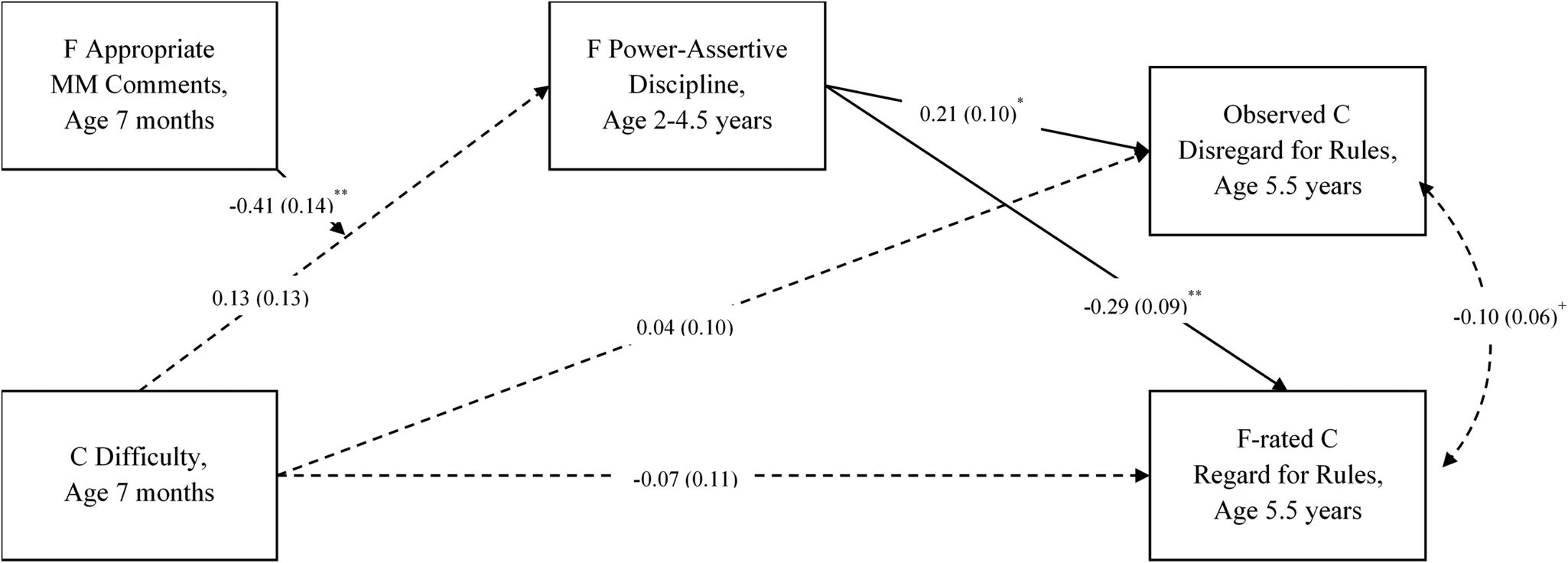
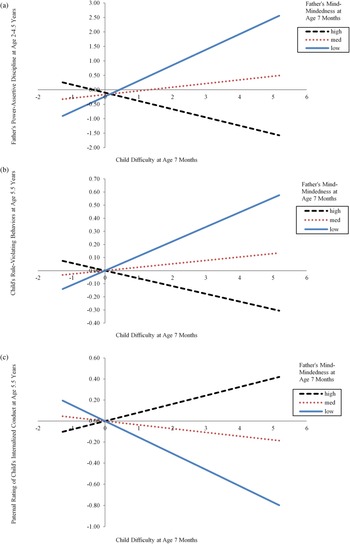
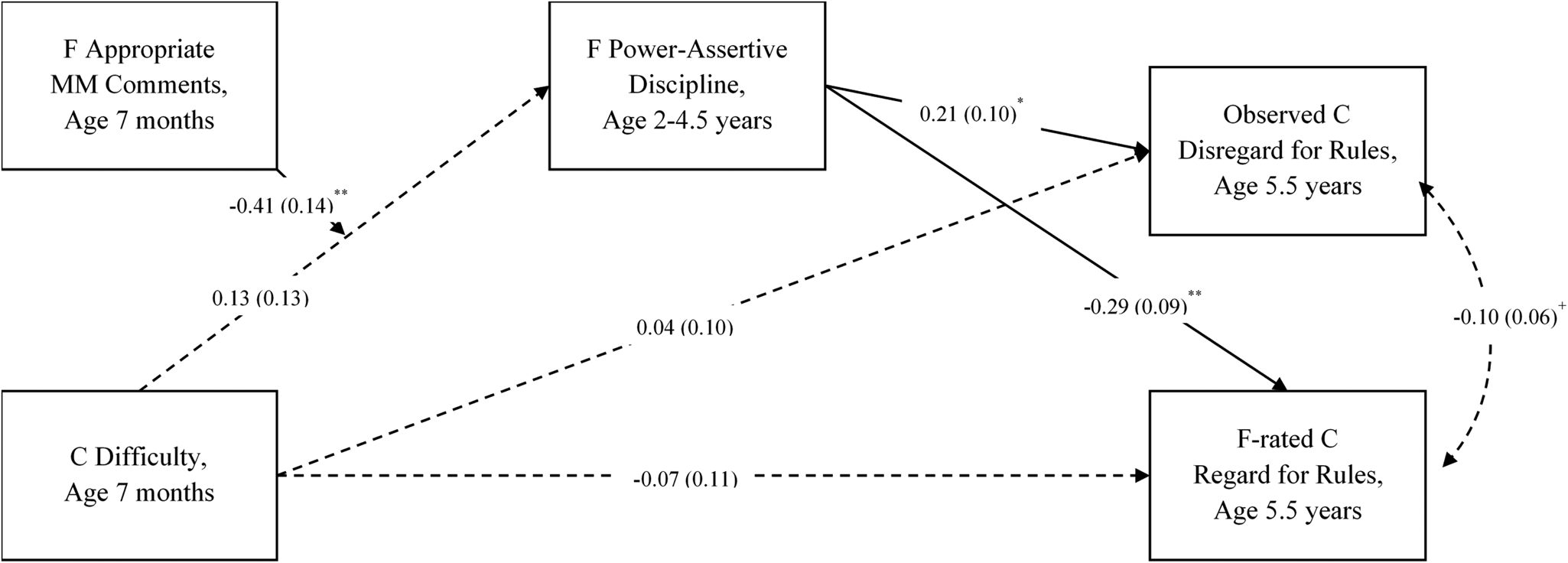
In father–child dyads (model depicted in Figure 2), the father's power-assertive discipline was associated significantly and positively with the child's observed disregard for rules, and negatively with paternal ratings of regard for rules. As expected, paternal MM significantly moderated the association between the infant's difficulty and paternal use of power assertion. For fathers who made few appropriate MM comments (−1 SD), infants’ difficulty was associated positively with paternal power-assertive discipline, B = 0.54, SE = 0.19, 95% CI [0.15, 0.85]. By contrast, infants’ difficulty was unrelated to paternal power-assertive discipline for fathers whose appropriate MM comments were average (0 SD), B = 0.13, SE = 0.13, 95% CI [−0.10, 0.38], or high (+1 SD), B = −0.28, SE = 0.19, 95% CI [−0.66, 0.09]. The respective simple slopes are depicted in Figure 3, panel (a).
Family Study. The moderated mediation model of the paths from the predictor, child difficulty at age 7 months (in father–child interactions), to the mediator, the father's power-assertive discipline at age 2 through 4.5 years, to the outcomes, the child's observed rule-violating behaviors in “cheating games” and father-rated internalized conduct at age 5.5 years. The father's appropriate mind-minded (MM) comments were modeled as a moderator of the path from child difficulty to power-assertive discipline. Paths from power-assertion to (dis)regard for rules were modeled as not moderated. Although not depicted, the child's gender and family income are included as covariates for both the mediator and the outcomes. Solid lines represent significant effects and dashed lines represent nonsignificant effects. Standard errors are in the parentheses. C = child. F = father. MM = Mind-Minded +p < .10. * p ≤ .05. ** p < .01.
Family Study. Panel (a). Simple slopes of child difficulty predicting father's power-assertive discipline at low (−1 SD), mean (0 SD), and high (+1 SD) values of father's appropriate mind-minded (MM) comments. Panel (b). Moderated indirect effects (i.e., the slopes of child difficulty predicting father's power-assertive discipline, conditional at low (−1 SD), mean (0 SD), and high (+1 SD) values of father's appropriate MM comments, multiplied by the path coefficient from father's power-assertive discipline to rule-violating behaviors in “cheating games”). Panel (c). Moderated indirect effects (i.e., the slopes of child difficulty predicting father's power-assertive discipline, conditional at low (−1 SD), mean (0 SD), and high (+1 SD) values of father's appropriate MM comments, multiplied by the path coefficient from father's power-assertive discipline to paternal rating of internalized conduct). Solid lines represent significant simple slopes, and dashed lines represent nonsignificant simple slopes.
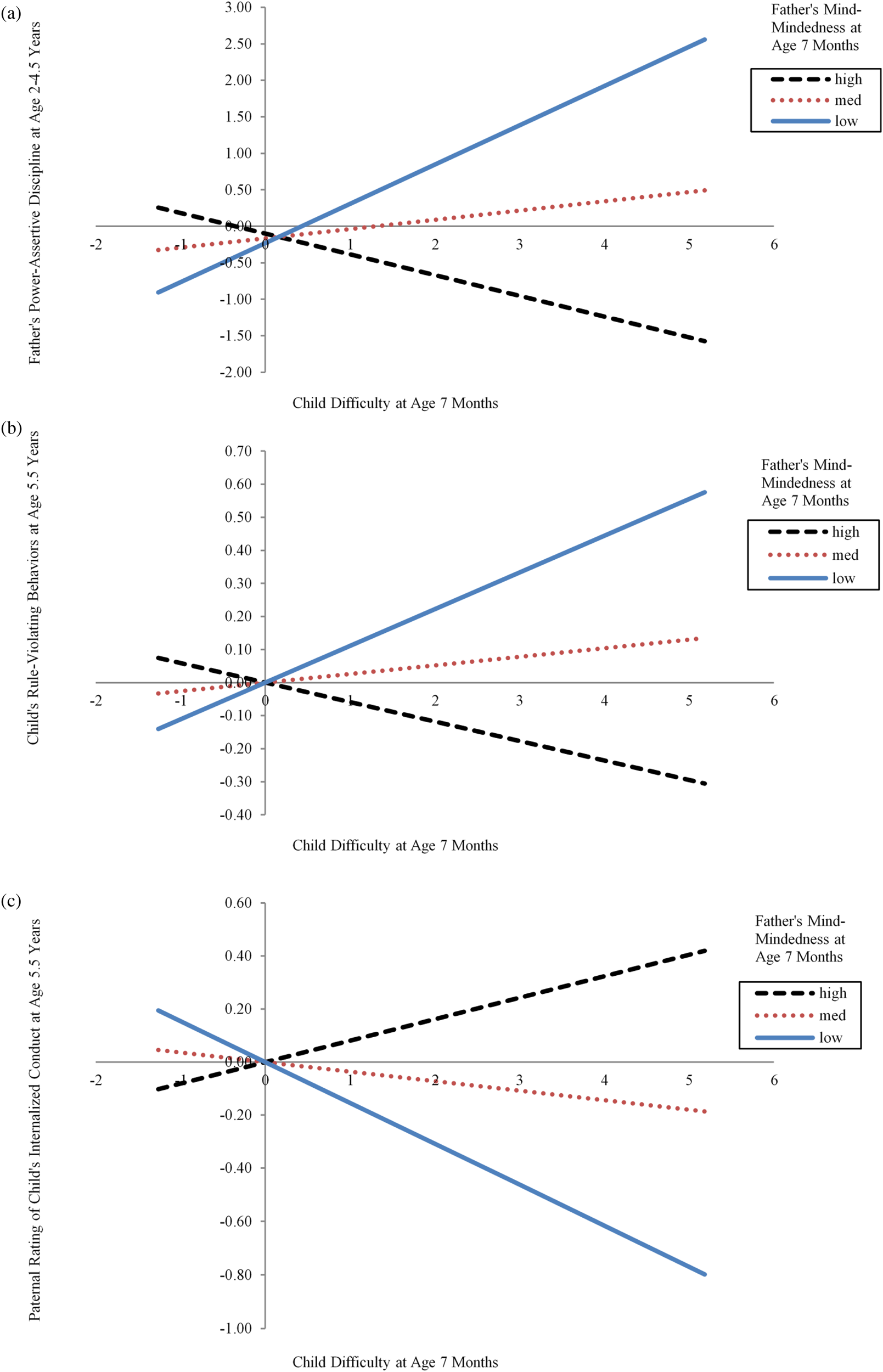
Consequently, the indirect effects from the infant's early difficulty to later (dis)regard for rules, observed and father-rated, via paternal power assertion, were moderated by the father's level of MM. For observed disregard for rules, in the dyads with fathers whose appropriate MM comments were low (−1 SD), the indirect effect was present, B = 0.11, SE = 0.07, bias-corrected bootstrap 95% CI [0.01, 0.29]. In contrast, in the dyads with fathers whose appropriate MM comments were average (0 SD) or high (+1 SD), the indirect effect was not present, B = 0.03, SE = 0.03, 95% CI [−0.01, 0.13], and B = −0.06, SE = 0.05, 95% CI [−0.21, 0.01], respectively.
The findings for father-rated regard for rules were similar. The indirect effect from infant difficulty, via paternal power assertion, was present in the dyads with fathers whose appropriate MM comments were low (−1 SD), B = −0.15, SE = 0.08, 95% CI [−0.35, −0.04]. In contrast, there were no such indirect effects in the dyads with average (0 SD) or high (+1 SD) levels of MM: B = −0.04, SE = 0.04, 95% CI [−0.14, 0.02], and B = 0.08, SE = 0.06, 95% CI [−0.01, 0.24], respectively. The moderated indirect effects are in Figure 3, panel (b) (for observed disregard for rules), and panel (c) (for father-rated regard for rules).
Family Study Discussion
Difficult infants are often considered at risk for externalizing and disruptive behavior problems; however, the specific developmental paths that lead to maladaptive outcomes involve considerable heterogeneity and complexity of interwoven child and parent effects. The current findings add to our understanding of factors that can alter or modify the oft-described maladaptive socialization cascade, typically launched by the infant's difficulty. The findings also inform the rapidly growing literature on the role of parents’ internal representations of the child in guiding their socialization strategies. Of note, throughout that literature, including our own work, qualities of parents’ representations, including MM, are typically modeled as predictors, or causes of their parenting behaviors, such as sensitivity (McMahon & Bernier, Reference McMahon and Bernier2017; Miller et al., Reference Miller, Kim, Boldt, Goffin and Kochanska2019), discipline style (Nix et al., Reference Nix, Pinderhughes, Dodge, Bates, Pettit and McFadyen-Ketchum1999), or secure base provision (Katznelson, Reference Katznelson2014; Luyten, Nijssens, et al., Reference Luyten, Nijssens, Fonagy and Mayes2017; Meins, Reference Meins2013; Slade, Reference Slade2005). Those parenting behaviors, in turn, mediate the indirect effects of the internal representations on a broad range of children's outcomes (McMahon & Bernier, Reference McMahon and Bernier2017).
Although that growing body of work is valuable, promising, and compelling, we believe that its account of the role of parental internal representations is incomplete. In particular, the role of those representations as altering or moderating developmental cascades has been largely under-appreciated. We have located only two recent studies that have examined this question.
Wong, Stacks, Rosenblum, and Muzik (Reference Wong, Stacks, Rosenblum and Muzik2017) followed 84 mother–infant dyads from infancy to 18 months. Mothers rated their children's negative affect in infancy, and their behavior problems at 18 months, using well-established questionnaires. Mothers’ RF, coded from a semi-structured interview at 16 months, moderated the developmental prediction from infants’ negative affectivity to behavior problems at toddler age, such that this association was significant only in dyads with mothers had average or low – but not high – RF. In other words, high level of maternal internal representations defused or offset the developmental risk posed by the child's early difficulty. This finding is fully consistent with our current framework; however, the fact that all three measures came from the same informant is a limitation.
Buttitta and colleagues (Buttitta et al., Reference Buttitta, Smiley, Kerr, Rasmussen, Querdasi and Borelli2019), studying 77 father–toddler dyads, reported a significant moderating effect of fathers’ RF, coded from an interview, on the association between family income (with low income conceptualized as a risk factor for adaptive parenting) and the father's autonomy support, observed as his helpful, sensitive structuring behavior in a teaching task. The association was significant only for fathers with low levels of RF, but not for those with average or high levels. In other words, paternal relatively reflective internal representations served to defuse the risk posed by adverse sociodemographic circumstances. This finding is again consistent with our framework, although limited by the fact that all measures were concurrent.
Several features of our current study complement the extant work. We deployed a longitudinal design from infancy to kindergarten age and behavioral measures of child difficulty, parental MM, and power-assertive control. Children's (dis)regard for rules was assessed using both observations and parental reports. Parallel data were collected for mother– and father–child dyads.
The findings for fathers and children fully supported our model of socialization cascades as conditional on parental internal representations. Highly difficult infants were more likely to receive more power-assertive paternal discipline as toddlers and preschoolers, and to show more disregard for rules at age 5.5, but only if their fathers exhibited low levels of MM in infancy. Presumably, fathers who were less capable and willing to use appropriate references to their infants’ mental state were less adept in reading their infants’ affective cues, less tolerant of their negative emotions, and more discouraged by their infants’ unresponsiveness than fathers with better mind-minded capacities. In turn, the less mind-minded fathers of difficult infants were more likely to embark on a coercive and power-assertive path, leading ultimately to children's future rejection of behavioral standards and higher disregard for rules.
We did not support our model for mothers and children. The only significant finding was highly difficult infants being at risk for lower regard for rules at kindergarten age, although only as assessed by maternal perception. To fully understand why the findings differed between mother–child and father–child dyads, more research is needed to systematically examine mothers’ and fathers’ parenting behaviors. The dimension of parenting under scrutiny may be one important factor. For instance, in our previous work with these data (Miller et al., Reference Miller, Kim, Boldt, Goffin and Kochanska2019), we found that mothers’ appropriate MM comments at 7 months were associated positively with their responsiveness at 15 months. There was no such association for fathers. Perhaps implications of MM on mothers’ and fathers’ parenting depend of the studied dimension of parenting – responsiveness versus control.
The study had limitations. In these low-risk community families, parents generally deployed very low levels of power assertion, most children followed very typical developmental trajectories, and very few, if any, had significant behavior problems (as assessed by other measures, not reported here). Nevertheless, for fathers and children, we successfully supported our model. It would be very desirable, however, to replicate our findings in samples enriched for at-risk parenting and children's behavior problems. Due to the labor-intensive nature of our measures and longitudinal design, our sample size was relatively modest, which precluded more comprehensive moderated mediation analyses (Fritz & MacKinnon, Reference Fritz and MacKinnon2007) and examining both mother– and father–child dyads simultaneously. Ideally, future larger samples would test analytic longitudinal models that account for stability and change in the studied constructs over time, for correlations among them, and for the transactional nature of developmental phenomena (e.g., cross-lagged designs with an autoregressive structure).
Finally, we purposely did not include measures of children's negative affect and unresponsiveness past infancy, because those measures were largely observed in the same contexts as parental power assertion, thus potentially obscuring the relations between them. In future studies, it would be desirable to have measures of child difficulty and parental control obtained in nonoverlapping contexts.
Children and Parents Study: Parents’ Internal Working Models of the Child (Reflective Functioning, RF, Hostile Attributions) Moderate Accuracy of their Perception of Infant Difficulty
Method
Participants
Two hundred two-parent families with infants born in 2017 and 2018, from the same geographic location as FS, were recruited through flyers, posters, social media, and mass emails. The eligibility criteria were the same as in FS, except for parents not being required to cohabitate. Demographic characteristics varied broadly: 14.5% of mothers and 24.0% of fathers had no more than a high school education, 46.5% of mothers and 43.5% of fathers had an associate or college degree, and 39.0% of mothers and 32.5% of fathers had a postgraduate education. The median household income was $85,000 (SD = $44,530, range = $4,000 to $320,000). In terms of racial background, 88.5% of mothers and 88.5% of fathers were White, 1.5% of mothers and 3.0% of fathers African American, 5.5% of mothers and 3.5% of fathers Asian, and 4.5% of mothers and 3.5% fathers multiracial. Three (1.5%) fathers did not disclose their race. In terms of ethnicity, 4.5% of mothers and 1.5% of fathers identified as Latino, with the rest identifying as non-Latino (95.0% of mothers and 98.5% of fathers) or not reporting their ethnicity (0.5% of mothers). Parents reported 82.5% children as being White, 2.5% African American, 3.0% Asian, and 10.5% multiracial. Three (1.5%) families did not disclose the race of the child. Eleven (5.5%) of the children were identified as Latino, 94.0% as non-Latino, or were missing ethnicity information (0.5%).
Overview of design
At age 7–9 months (N = 200, 96 girls), we observed children's difficulty conceptualized as anger proneness in standard episodes during video-recorded sessions conducted at home by female Es. Mothers and fathers reported their RF and their children's difficulty using questionnaires. As in FS, we included the child's sex and family annual income as covariates. The University of Iowa's Institutional Review Board approved the study (Children and Parents Study, CAPS, 201701705). We obtained parents’ informed consents at the entry to the study. Questionnaire data were managed using REDCap electronic data capture tools hosted at the University of Iowa (Harris, Taylor, Minor et al., Reference Zeegers, de Vente, Nikolić, Majdandžić, Bögels and Colonnesi2019; Harris, Taylor, Thielke et al., Reference Zeegers, de Vente, Nikolić, Majdandžić, Bögels and Colonnesi2009).
Measures
Children's observed difficulty (anger expression in standard laboratory episodes)
Observed contexts
We observed the child's anger using three episodes from the Laboratory Temperament Assessment Battery (LAB-TAB, Goldsmith & Rothbart, Reference Goldsmith and Rothbart1999): Arm Restraint (holding down the child's arms; two 30-s trials), Car Seat (buckling the child in a car seat; one 60-s trial), and Toy Retraction (taking away a toy and holding out of reach; three 15-s trials).
Coding and data aggregation
Teams of coders rated the child's bodily, facial, and vocal expressions of anger in 5-s segments. Range for bodily anger were from 0 = none, to 4 = high-intensity struggle; for facial anger, from 0 = none, to 3 = strong expression in all three facial regions; for vocal anger, from 0 = none, to 3 = full-intensity cry or scream. The latency to express anger in each trial was also coded. The coders used 15% cases for reliability and realigned periodically to prevent drift. Reliability for discrete anger expressions, kappas, averaged .81 for Arm Restraint, .76 for Car Seat, and .75 for Toy Retraction; ICCs for the latencies to express anger averaged 1.00 across coders.
To form the observed anger variable, we summed the codes for discrete anger expressions for each trial, reversed the latency score, and averaged across trials for the entire episode. Those raw scores were standardized and aggregated into scores of observed anger for each episode (Cronbach's alphas .76, .80, and .81 for Arm Restraint, Car Seat, and Toy Retraction, respectively). Those scores cohered across episodes, with inter-correlations ranging from .15 to .22, ps = .002 – .04. Therefore, we averaged them into an overall composite across all three episodes.
Parent-rated difficulty (anger proneness reported in a questionnaire)
Both parents completed the Infant Behavior Questionnaire-Revised Very Short Form (Putnam, Helbig, Gartstein, Rothbart, & Leerkes, Reference Putnam, Helbig, Gartstein, Rothbart and Leerkes2014; Rothbart & Gartstein, Reference Rothbart and Gartstein2000). The items were rated on a 7-point scale (1 = never, 7 = always). For the purpose of this study, we selected five items specifically capturing anger proneness, e.g., “How often did the baby seem angry (crying and fussing) when you left her/him in the crib?” “How often during the last week did the baby protest being placed in a confining place (infant seat, play pen, car seat, etc.)?” For each parent, those items were averaged (Cronbach's alphas were .70 for mothers and .72 for fathers).
Parents’ dysfunctional IWMs of the child (low RF, hostile attributions)
Both parents self-reported their own RF, using the Parental Reflective Functioning Questionnaire (PRFQ; Luyten, Mayes, et al., Reference Luyten, Mayes, Nijssens and Fonagy2017), and attributions for children's aversive behaviors, using the Parent Cognition ScaleFootnote 1 (PCS, Snarr et al., Reference Snarr, Slep and Grande2009). To create a composite of dysfunctional IWMs, we selected the prementalizing modes subscale from PRFQ and child-responsible causal attributions subscale from PCS.
The prementalizing modes subscale consists of six items that reflect parents’ inability to understand the child's mental states (e.g., “When my child is fussy, he or she does that just to annoy me”; “Often, my child's behavior is too confusing to bother figuring out”). One item, “I find it hard to actively participate in make-believe play with my child,” was eliminated, because it is not appropriate for infants. Items were rated on a 7-point scale (1 = strongly disagree, 7 = strongly agree).
The child-responsible subscale consists of nine items that measure the extent to which parents attribute children's difficult behavior to deliberate hostile intentions (e.g., “My child purposely tries to get me angry”; “My child tries to get my goat or push my buttons”). Items were rated on a 6-point scale (1 = never true, 6 = always true).
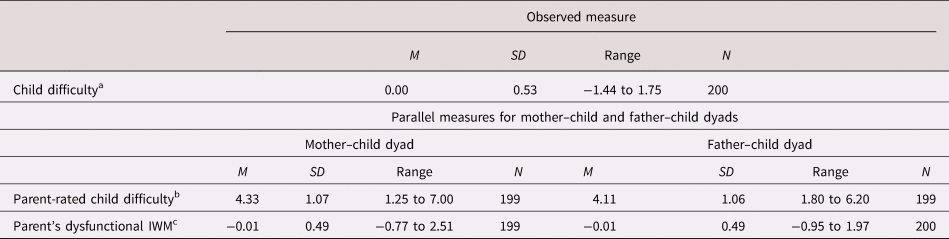
The correlations between the PRFQ prementalizing subscale and the PCS child responsible subscale were r(189) = .13, p = .068, and r(186) = .18, p = . 014, for mothers and fathers, respectively. The 14 items (5 from PRFQ and 9 from PCS) were standardized and aggregated into a composite score, with higher scores representing more dysfunctional IWMs of the child. Cronbach's alphas supported the aggregation (.77 for mothers and .79 for fathers). Table 3 lists all descriptive statistics for the final constructs.
Descriptive data for all measures in children and parents study
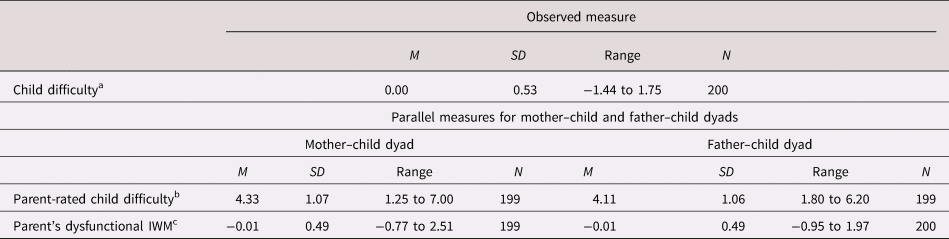
a Composite of standardized scores of observed anger in three episodes.
b Composite of parent-rated child anger using items from the Infant Behavior Questionnaire.
c Composite of (standardized) parental reports on the Parental Reflective Functioning Questionnaire (PRFQ) prementalizing modes and PCS child-responsible subscales. IWM = internal working model.
Results
Preliminary analyses
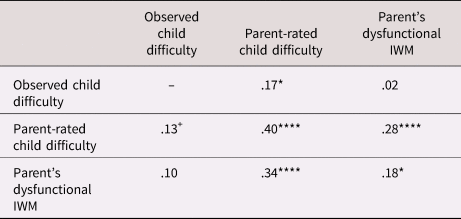
We first inspected the correlations among the measures (see Table 4). In both mother–child and father–child relationships, the infant's higher difficulty as reported by the parent was associated positively with the parent's higher dysfunctional IWM. Mothers’ and fathers’ reports of child difficulty positively correlated. Observed child difficulty correlated weakly with mother–rated child difficulty, and marginally with father-rated child difficulty. Observed child difficulty was unrelated to parents’ IWMs.
Correlations among all measures in children and parents study
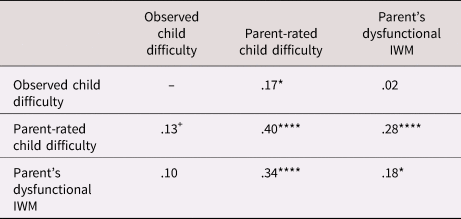
Note: +p < .10. *p < .05. **p < .025. ***p < .01. ****p < .001.
Correlations for mother–child dyads are above the diagonal, and correlations for father–child dyads are below the diagonal. Correlations between mother–child and father–child constructs are on the diagonal. IWM = internal working model.
There were several differences between mothers and fathers. Compared to mothers, fathers reported higher levels of prementalizing modes; M = 1.31, SD = 0.04 and M = 1.50, SD = 0.04, before standardization, for mothers and fathers, respectively; t(198) = −3.82, p < .001. Fathers also produced more child-responsible attributions, M = 2.46, SD = 0.06 and M = 2.63, SD = 0.06, before standardization, for mothers and fathers, respectively; t(181) = −2.11, p = .04. Fathers reported lower levels of child difficulty than mothers did (M = 4.33, SD = 1.07 and M = 4.11, SD = 1.06, for mothers and fathers, respectively; t(198) = 2.64, p = .009).
Main analyses: the moderating effect of parental IWMs
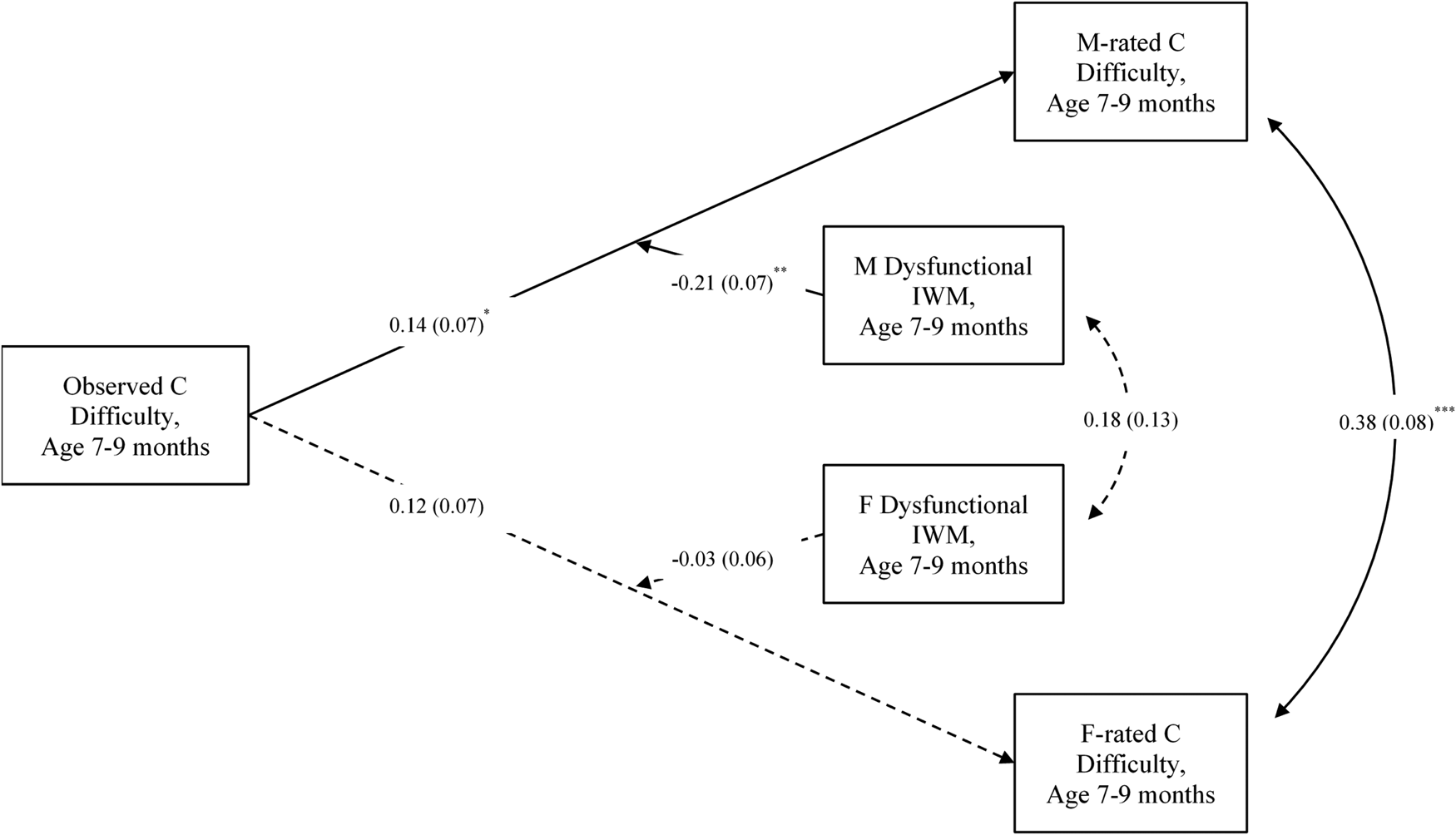
To examine the effect of IWMs on the accuracy of parent-reported child difficulty, we modeled parents’ dysfunctional IWMs as moderating the relation between observed child difficulty and parent-rated child difficulty. Consistent with the analytical approach in FS, we included child gender and family income as covariates, and used standardized scores to form the interaction terms. Given the large sample size and the shared predictor of observed child difficulty, we estimated the associations for mother–child and father–child dyads in the same model (see Figure 4 for model configuration). Analyses were conducted in Mplus, using bias-corrected bootstrapping with 10,000 resamples for estimating the confidence intervals. The amount of missing data was negligible.
Children and Parents Study. The moderating effects of parental IWMs on the associations between observed and parent-rated child difficulty. Although not depicted, the child's gender and family income are included as covariates. Solid lines represent significant effects and dashed lines represent nonsignificant effects. Standard errors are in the parentheses. C = child. M = mother. F = father. IWM = internal working model. * p ≤ .05. ** p < .01. *** p < .001.

Mother–child dyads
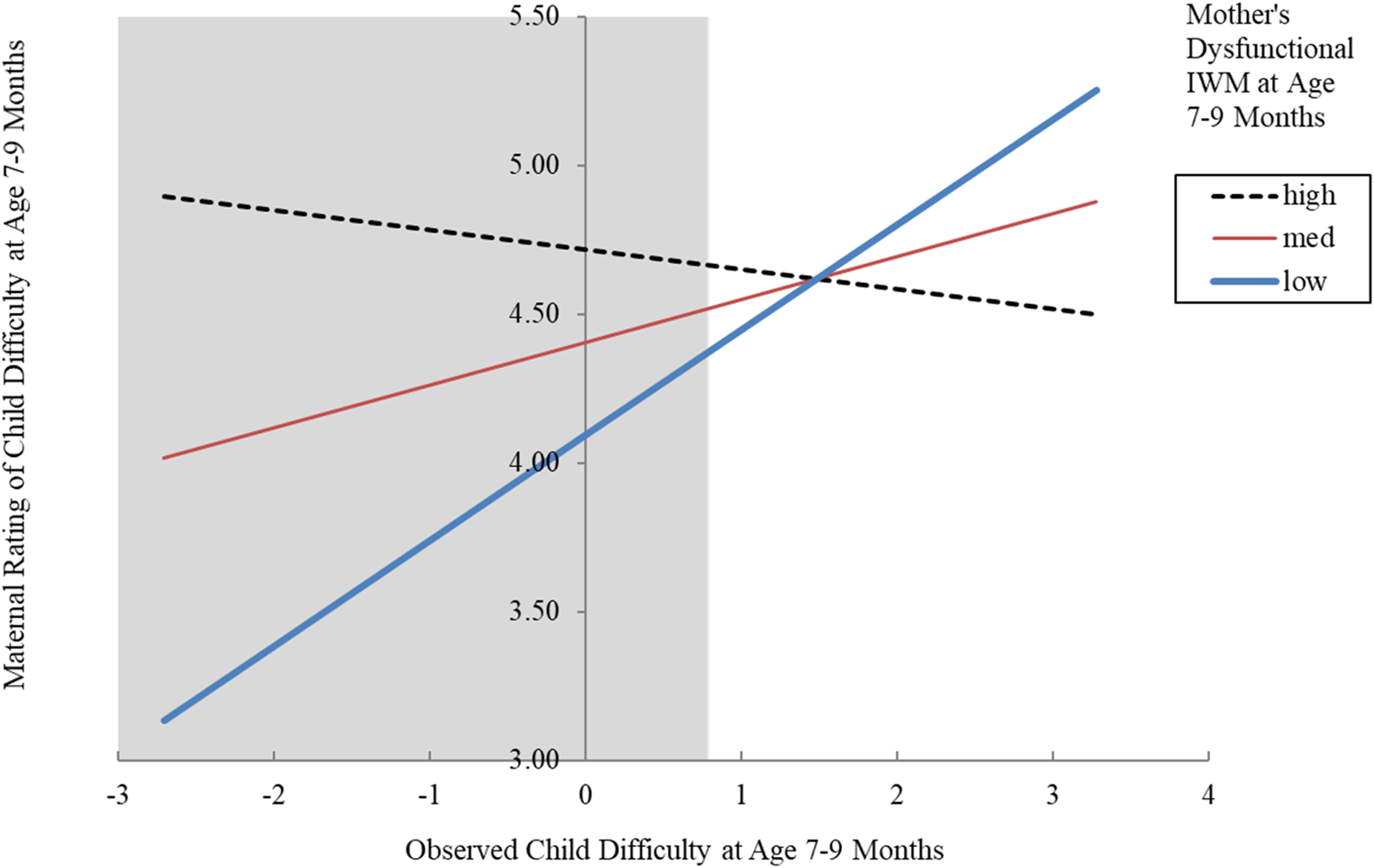
Observed child difficulty and mothers’ dysfunctional IWMs were associated positively with mother-rated child difficulty, B = 0.14, SE = 0.07, p = .04, 95% CI [0.01, 0.28], and B = 0.31, SE = 0.06, p < .001, 95% CI [0.19, 0.43], respectively. These associations, however, were qualified by the interaction between observed child difficulty and mothers’ IWMs, B = −0.21, SE = 0.07, p = .001, 95% CI [−0.34, −0.08]. The follow-up analysis of the interaction, using simple slopes, is depicted in Figure 5.
Children and Parents Study. Simple slopes of observed child difficulty predicting mother-rated child difficulty at low (−1 SD), mean (0 SD), and high (+1 SD) values of mothers’ dysfunctional IWMs. Solid lines represent significant simple slopes, and the dashed line represents nonsignificant simple slope. The shaded area represents the region of significance. IWM = internal working model.

For mothers with low (−1 SD) and average (0 SD) dysfunctional IWMs, the reports of child difficulty were associated positively with observed child difficulty, B = 0.35, SE = 0.07, p < .001, 95% CI [0.23, 0.50], and B = 0.14, SE = 0.07, p = .04, 95% CI [0.01, 0.28], respectively. By contrast, for mothers’ with highly dysfunctional IWMs (+1 SD), the reports of child difficulty were unrelated to observed child difficulty, B = −0.07, SE = 0.12, p = .58, 95% CI [−0.29, 0.18]. In other words, mothers with highly dysfunctional IWMs provided reports that were unrelated to observations, whereas the remaining mothers provided accurate reports of their children's difficulty, aligned with the observed measures. Curiously, mothers with dysfunctional IWMs viewed their children as difficult even when the observed child difficulty was low. Further analysis using the Johnson–Neyman region-of-significance technique (Johnson & Fay, Reference Johnson and Fay1950) showed that dysfunctional IWM was associated with biased maternal rating of child difficulty when the observed child difficulty was average to low (< 0.75 SD).
Father–child dyads
Interestingly, observed child difficulty was unrelated to father-rated difficulty, B = 0.12, SE = 0.07, p = .11, 95% CI [−0.02, 0.27]. This was true regardless of the fathers’ IWMs: Fathers’ IWMs did not moderate the relation between observed and father-rated child difficulty, B = −0.03, SE = 0.06, p = .66, 95% CI [−0.14, 0.10]. As was the case for mothers, fathers’ dysfunctional IWMs were associated positively with father-rated child difficulty, B = 0.33, SE = 0.06, p < .001, 95% CI [0.21, 0.45].
Children and Parents Study Discussion
Parents’ reports about their children's characteristics are very broadly used in developmental psychology and psychopathology. In particular, their reports of children's difficult and problematic behaviors are often considered valid assessments of children's mental health. The validity of parental reports, however, has been questioned on multiple grounds. Extensive research has addressed factors that may potentially affect the accuracy of parental (mostly maternal) reports. Most typically, researchers have focused on parental depression, anxiety, negative mood, and general psychopathology, as well as memories of one's own childhood (e.g., Fergusson, Lynskey, & Horwood, Reference Fergusson, Lynskey and Horwood1993; Maoz et al., Reference Maoz, Goldstein, Goldstein, Axelson, Fan, Hickey and Kupfer2014; Richters, Reference Richters1992).
Addressing a closely related question, temperament researchers have examined factors that influence concordance between reported and observed child characteristics. In general, concordance tends to be small to moderate (e.g., Kiel & Hummel, Reference Kiel and Hummel2017, for review). Gartstein and Marmion (Reference Gartstein and Marmion2008) and Leerkes and Crockenberg (Reference Leerkes and Crockenberg2003) reported that parents’ (mostly mothers’) depression negatively affected the concordance between their ratings of infants’ fear or distress to novelty and the infants’ fear observed in the laboratory. Parents’ depression has been linked to their reports of their infants’ difficult temperament (Edhborg, Seimyr, Lundh, & Widström, Reference Edhborg, Seimyr, Lundh and Widström2000; Whiffen, Reference Whiffen1990). However, significant (albeit modest) links between infants’ crying and fussing in the laboratory and parents’ ratings of difficult temperament have also been reported (Atella, DiPietro, Smith, & St James-Roberts, Reference Atella, DiPietro, Smith and St James-Roberts2003). Characteristics of the laboratory episodes eliciting children's responses have also been implicated as moderators of concordance (Kiel & Hummel, Reference Kiel and Hummel2017). Few, if any studies, however, have addressed whether dysfunctional parental IWMs may influence the accuracy of parental perceptions of the child.
Our findings for mothers were consistent with the expectation that dysfunctional IWMs, operationalized as prementalizing, nonreflective, and hostile representations of the child can significantly influence the concordance between infants’ difficulty (anger) observed in standard laboratory paradigms by objective coders and anger as reported by mothers. Further, as we had expected, reports produced by mothers with highly dysfunctional IWMs (+1 SD) failed to align with the observations. For the remaining mothers, objective observations and reports corresponded. Curiously, and surprisingly, the findings were particularly striking for mothers of infants who showed relatively little anger in laboratory paradigms; mothers with highly dysfunctional IWMs perceived those objectively easy infants as more difficult, compared to the remaining mothers.
We did not support our moderation hypotheses for fathers and infants. We did, however, find an effect of dysfunctional IWMs, in that the fathers with higher scores (less reflective, more hostile) described their infants as more difficult, or anger prone, regardless of the child's anger coded by observers. In other words, the more dysfunctional the father's IWM, the more negative the perception of the infant.
It is unclear why the findings differed for mothers and fathers. This may be because of the fact that in the studied families, mothers spent substantially more time caring for their infants (on average 59 hr per week, compared to 35 hr for fathers). Note, however, that mothers were accurate reporters only as long as their IWMs of the child were relatively functional.
Our findings are relevant to socialization processes, because the parent's perception of the infant as difficult (e.g., anger prone, unmanageable) may subsequently promote coercive, power-assertive control (Sawrikar & Dadds, Reference Sawrikar and Dadds2018; Smith et al., Reference Smith, Dishion, Shaw and Wilson2015; Strassberg & Treboux, Reference Strassberg and Treboux2000). Consequently, parental dysfunctional IWMs may play a key role in the unfolding of the overall path from child difficulty to parental control to child outcomes (the path we demonstrated in FS). Particularly, parents with hostile, dysfunctional IWMs may hold a negative bias in their perceptions of their children's behaviors (Pesonen, Räikkönen, Strandberg, Kelitikangas–Järvinen, & Järvenpää, Reference Pesonen, Räikkönen, Strandberg, Kelitikangas–Järvinen and Järvenpää2004; Priel & Besser, Reference Priel and Besser2000); consequently, they may perceive even mild forms of child difficulty as serious. This perception may then trigger power-assertive and harsh parenting, which maintains or amplifies their children's difficulty (Leung & Slep, Reference Leung and Slep2006; Lorber & O'leary, Reference Lorber and O'leary2005; Park et al., Reference Park, Johnston, Colalillo and Williamson2018). In contrast, parents with reflective, benign IWMs may perceive their children's problematic behaviors accurately and therefore utilize responsive parenting strategies. In sum, these findings provide initial support for a hypothesis that parental IWMs of their infants play a role in their perceptions of child difficulty, either influencing those perceptions directly (for fathers) or moderating concordance with objectively observed child characteristics (for mothers).
This study has limitations. Although observed infant difficulty was based on several tasks, coded by several trained observers, and thus relatively “objective,” we acknowledge that those data were constrained by the fact that they were all collected during the same home session. In contrast, parents based their descriptions on their observations of their infants in a broad range of interactions over several months. This is a typically recognized asset of parents’ reports. This factor may have influenced the findings in unknown ways, including diminished effect sizes.
CAPS, like FS, utilized a low-risk community sample, and therefore the findings may not generalize to at-risk populations. Further, the data were concurrent, and therefore, are best viewed as preliminary. Future studies, with diverse samples and longitudinal designs, are needed better to elucidate the role of parental IWMs in the developmental paths from child difficulty to parental perceptions, and then to parenting behaviors and child outcomes.
General Discussion
The role of parental representations, or IWMs of the child, has been recognized broadly in parent–child socialization processes (e.g., Bretherton & Munholland, Reference Bretherton, Munholland, Cassidy and Shaver2008; Bugental & Johnston, Reference Bugental and Johnston2000; Dykas & Cassidy, Reference Dykas and Cassidy2011; Leerkes et al., Reference Leerkes, Supple, O'Brien, Calkins, Haltigan, Wong and Fortuna2015). Kochanska and colleagues (Reference Kochanska, Boldt and Goffin2019) have proposed that parental representations may play a key role in determining the unfolding cascades from early child difficulty to negative parenting to later child behavioral problems. The current article tests this model in two studies.
In FS, relying on longitudinal behavioral data, we demonstrated that parental appropriate MM comments moderated the link between child difficulty and fathers’ power-assertive discipline: Those comments served to attenuate the risk of negative developmental cascades from infant difficulty to paternal power assertion to children's rule-violating behaviors at age 5.5. We observed the negative cascade only for fathers with poor capacity or willingness to engage in appropriate MM during interactions with their infants.
In CAPS, we focused on one possible mechanism – not examined in FS – that may account for the role parents’ IWMs play in negative cascades triggered by infant difficulty. We found that parental representations moderated the degree of concordance between observed and parent-rated child difficulty. Mothers with dysfunctional IWMs (highly prementalizing, attributing hostile intentions to their infants) described even their objectively easy, not anger-prone infants as difficult, compared to mothers with more adaptive IWMs.
Consistent across the two studies, we found evidence that child difficulty was associated with negative parenting behaviors or negative parental perceptions only for parents who held maladaptive, dysfunctional representations of their infants, characterized by low MM, low RF, highly prementalizing mode, and hostile attributions. In those parent–child dyads, infants’ early difficulty was likely to trigger unfolding negative socialization cascades.
Longitudinally, in FS, parents who were relatively less mindful of their children's mental states used more power-assertive discipline with difficult children. Parenting behaviors often are associated more strongly with parental perceptions of child difficulty as compared to child difficulty rated by other people, such as teachers (Miner & Clarke-Stewart, Reference Miner and Clarke-Stewart2008). The extent to which parents are capable of utilizing effective parenting strategies depends on their ability to accurately interpret their children's mental states (Davidov & Grusec, Reference Davidov and Grusec2006; Hastings & Grusec, Reference Hastings and Grusec1997). Informed by the CAPS findings, we propose that parental accuracy of their perceptions of children's mental states, which depends on parental IWMs, may be a mechanism linking child difficulty with power-assertive control. Parents with dysfunctional IWMs may interpret even innocuous child behaviors as signaling heightened difficulty, which leads them to assert more power, whereas parents with reflective, positive IWMs are able to see their children's difficulty accurately and respond more sensitively and appropriately.
The asymmetry of our findings was curious. It was interesting that in both studies, all significant effects consistently applied to negative phenomena: dysfunctional parental IWMs, harsh parenting, children's disregard for rules, and parents’ overly negative perceptions of the child. We did not find any positive socialization effects for parents with highly adaptive, reflective, highly mind-minded IWMs and their children. This pattern corresponds with the gist of the findings reported by Kochanska et al. (Reference Kochanska, Boldt and Goffin2019) on the significant developmental implications of child difficulty, found generally in parent–child relationships that were sub-optimal during the early years. In theory, we would expect corresponding significant positive effects in dyads with highly adaptive parental IWMs. Perhaps this was due to our focus on negative parenting, perceptions, and outcomes. It will be important to include positive parenting dimensions and children's positive outcomes in future studies.
In addition, in CAPS, infants with low difficulty were perceived as highly difficult by mothers with dysfunctional IWMs, whereas in FS, it was infants with high difficulty who received more power-assertive control from fathers with dysfunctional IWMs. Different measures may have played a role; in addition, these studies were also conducted at different ages (CAPS data were all collected at 7–9 months, whereas in FS, parental power assertion was measured at 2–4.5 years), which may have contributed to the discrepancies. For instance, with the child's age increasing, parents may be better at recognizing the child's emotions, and more likely to hold bias towards their child only when the child is difficult. Such possibilities need to be examined in the future when more data are collected at later waves for CAPS.
The strengths of this work include a multimethod approach. We assessed parental IWMs using observed MM measures (MM comments), and reported measures (RF or prementalizing modes, and hostile attributions). These measures covered a range of aspects of parental IWMs, with MM comments focusing more on the parent’ perspective taking in the real-time interactions with the child, and RF and attributions more directly addressing the parent's biases in interpretations of the child behavior. We measured child difficulty using observed negative affect and unresponsiveness, again coded live in real-time interactions with parents, anger in laboratory episodes, and parents’ reports. We observed parental power assertion in interactions, and we assessed children's disregard for rules through observations and reports. Unfortunately, parallel measures for all constructs across both studies were not available, but as we continue to follow up the CAPS families, we will aim to obtain such measures. We will then be able to replicate and extend our current findings.
Including both mother–child and father–child relationships is another strength, as very few studies of parental representations have done so. We observed different patterns in the two relationships. In FS, only fathers’ but not mothers’ MM moderated the association between child difficulty and parental power assertion. In CAPS, only mothers’ dysfunctional IWM moderated the link between observed and mother-rated child difficulty, whereas fathers’ dysfunctional IWM was directly associated with father-rated child difficulty. The reasons for the discrepancies are not clear, but the literature suggests that mothers and fathers interact with children in different ways. Fathers are often unsupportive and even punitive to children's negative emotions, whereas mothers often are more comforting and encouraging of children's emotion expression (Eisenberg, Fabes, & Murphy, Reference Eisenberg, Fabes and Murphy1996; McElwain, Halberstadt, & Volling, Reference McElwain, Halberstadt and Volling2007). Mothers generally spend more time with children and are more sensitive to their emotions (Lamb & Tamis-LeMonda, Reference Lamb, Tamis-LeMonda and Lamb2004). Perhaps those differences account for fathers being more prone to use power-assertive control with difficult infants, and for fathers reporting higher dysfunctional IWMs, compared to mothers. More research is needed to understand the origins and the meaning of the differences between mothers and fathers.
When considering the implications of parental representations for children's outcomes, researchers typically conceptualized a mediated path, viewing the parent's representations as causes or determinants of their parenting, which in turn was associated with child outcomes (e.g., McMahon & Bernier, Reference McMahon and Bernier2017; Miller et al., Reference Miller, Kim, Boldt, Goffin and Kochanska2019). The current work suggests that parental representations of their infants may serve as important moderators of socialization processes launched by early infant difficult characteristics, and that this moderating role may be important as well. Mental representations of the child may alter the way parents perceive and react to their children's difficulty, and thus serve a conditional role for the unfolding divergent developmental trajectories.
It is worth noting, though, that the sizes of parental representations’ moderating effects were modest in FS and CAPS. Although parental representations have been increasingly considered as important factors in parenting and parent–child relationships (Dykas et al., Reference Dykas, Ehrlich, Cassidy and Benson2011), the relevant effect sizes have often been small to moderate. Other factors, such as genetics, socioeconomic status, and other ecological characteristics may also moderate children's developmental cascades. Future studies need to adopt a comprehensive approach to the roles of parental representations and those multiple sets of factors, and their interplay in children's developmental trajectories.
This work has limitations. As discussed previously, both studies utilized low-risk community samples, limiting generalizability to at-risk and diverse populations. In future studies, it will be important to include samples enriched for multiple forms of parental psychopathology, as compromised parental IWMs have been robustly identified as mechanisms of developmental risk and target for intervention in such populations (e.g., Berthelot et al., Reference Berthelot, Ensink, Bernazzani, Normandin, Luyten and Fonagy2015; Camoirano, Reference Camoirano2017; McMahon & Bernier, Reference McMahon and Bernier2017; Schacht et al., Reference Schacht, Meins, Fernyhough, Centifanti, Bureau and Pawlby2017; Suchman et al., Reference Suchman, DeCoste, McMahon, Dalton, Mayes and Borelli2017; Zayde, Prout, Kilbride, & Kufferath-Lin, Reference Zayde, Prout, Kilbride and Kufferath-Linin press). Further, CAPS data were concurrent, and neither study utilized experimental designs; consequently, our ability to make causal inferences was limited. Nevertheless, this work elucidates one potential mechanism through which parental early representations can attenuate or amplify developmental risks due to child difficulty and suggests that parental representations may play a role in parental socialization and children's adjustment even in relatively well-functioning community samples. These findings can inform future translational applications. Corresponding with our findings, research targeting parental IWMs has yielded promising results (Schacht et al., Reference Schacht, Meins, Fernyhough, Centifanti, Bureau and Pawlby2017; Suchman et al., Reference Suchman, DeCoste, McMahon, Dalton, Mayes and Borelli2017; Zayde et al., Reference Zayde, Prout, Kilbride and Kufferath-Linin press). Further research in this field, both basic and translational, may allow us to break the cycle of parent–child mutual negativity and reduce disruptive developmental outcomes.
Acknowledgments
The authors thank Lea J. Boldt, Robin Campbell, Meaghan Flynn, Katrina Friedrich, Sanghag Kim, Rochelle Praska, Neevetha Sivagurunathan, and Nicole Yeager for their contributions, and all the participating families for their commitment to our research.
Financial Statement
This work was funded by the grants from National Institute of Mental Health (R01 MH63096, K02 MH01446) and National Institute of Child Health and Human Development (R01 HD069171 and R01 HD091047) to Grazyna Kochanska. Research reported in this publication was supported by the National Center For Advancing Translational Sciences of the National Institutes of Health under Award Number UL1TR002537. The content is solely the responsibility of the authors and does not necessarily represent the official views of the National Institutes of Health.
Conflicts of Interest
None