Introduction
Conflict brings excess and changing demands to local civilian health care resources, with the potential to increase trauma and orthopedic attendances and to reduce activity in planned care.Reference Hadary, Schecter and Embon1 While these conflict-related needs are often easily identifiable, in the aftermath of disaster or conflict, health care systems may struggle to identify changing needs and humanitarian actors may initiate responses targeted to traumatic injuries while facing different operational realities.Reference Wolff, Shankiti and Salio2
The Nasser Medical Complex (NMC) is the largest tertiary referral center in the South of the Gaza Strip, serving an estimated resident population of 990,000 in November 2025.3 Its location in the Gaza Strip is demonstrated in Figure 1. Since the commencement of the 2023 war in the Gaza Strip, NMC experienced an increase in trauma presentations alongside limitations on resources to deliver care, concomitant with its location proximal to active conflict.Reference Qandil4,Reference Qandil, Ransom and Shammala5 From a pre-conflict baseline of approximately 600 patient presentations per day, the NMC Emergency Department (ED) adapted its operations to best serve needs – including with the introduction of a “fast track” area to assess and treat lower-acuity patients and the construction of tented treatment facilities.6 Further adaptations to the hospital infrastructure have included expansion of in-patient capacity from 300 beds to facilitate the care of over 700 in-patients.7 A ceasefire to the conflict was implemented on October 10, 2025.8
Location of Nasser Medical Complex within the Boundaries of the Gaza Strip.

The primary aim of this study was to quantify the immediate changes in, and short-term trends of, the number of patient presentations to an ED following a break in conflict, and secondarily to generate hypotheses regarding changes in patient profile over the same period. Greater understanding of such effects has the potential to inform humanitarian intervention and the prioritization of local health care resources in future contexts.
Methods
A single center, retrospective Interrupted Time Series (ITS) analysis was undertaken comprising of every patient attendance to NMC ED from September 1, 2025 through November 30, 2025, inclusive, to evaluate the impact of the ceasefire on October 10, 2025. This time period was selected to best represent the short- and mid-term effects of a ceasefire. An ITS is a quasi-experimental design for evaluating population-level interventions when randomized controlled trials are not feasible, controlling for pre-existing trends.Reference Bernal, Cummins and Gasparrini9
Attendances were stratified by sex, age group (pediatric patients <16 years or adults age ≥16 years), and diagnostic category as determined by the clinician at discharge. Traumatic presentations were further stratified by disposition. The diagnostic categories used are part of the institutional core dataset and implemented in liaison with the World Health Organization (WHO; Geneva, Switzerland). Data were collected from the institutional electronic database for the NMC ED, which is input manually by medical data officers from proformas completed for every presentation. Medical data officers receive specific training in addition to professional backgrounds in health sciences. These data are routinely reviewed for quality and emerging trends. Summary statistics were presented as medians with interquartile range (IQR).
For count outcomes of presentations for specific diagnostic groups, negative binomial regression was used. Changes to the binary outcomes of age and sex profiles over the time period were considered with binomial regression, which weights daily estimates by total presentation volume. All analyses adjusted for day-of-week confounding and modelled with Newey–West robust standard errors. Autocorrelation was assessed visually with an autocorrelation function (ACF) plot and with Durbin-Watson tests. The primary outcome was of changes to total daily attendances, while the secondary exploratory outcomes were of changes by diagnostic category and in age and sex profiles.
For the count models, coefficients were exponentiated to Incidence Rate Ratios (IRR) for interpretation as the percentage change in the relevant presentations numbers or trend, and for the binary models for age group and sex, exponentiated as Odds Ratios (OR). Both were presented with 95% Confidence Intervals (95%CI). The threshold for statistical significance of the primary outcome was set at P < 0.05. The widths of the 95% confidence intervals have not been adjusted for multiplicity and the intervals should not be used in place of hypothesis testing. All analyses were completed in R (Version 4.5.0; R Foundation for Statistical Computing; Vienna, Austria). The study was approved by the Nasser Medical Complex Research Ethics Committee (Reference: NMC-RC/2024-03-15/012) and was reported using STROBE guidelines.Reference von Elm, Altman and Egger10
Results
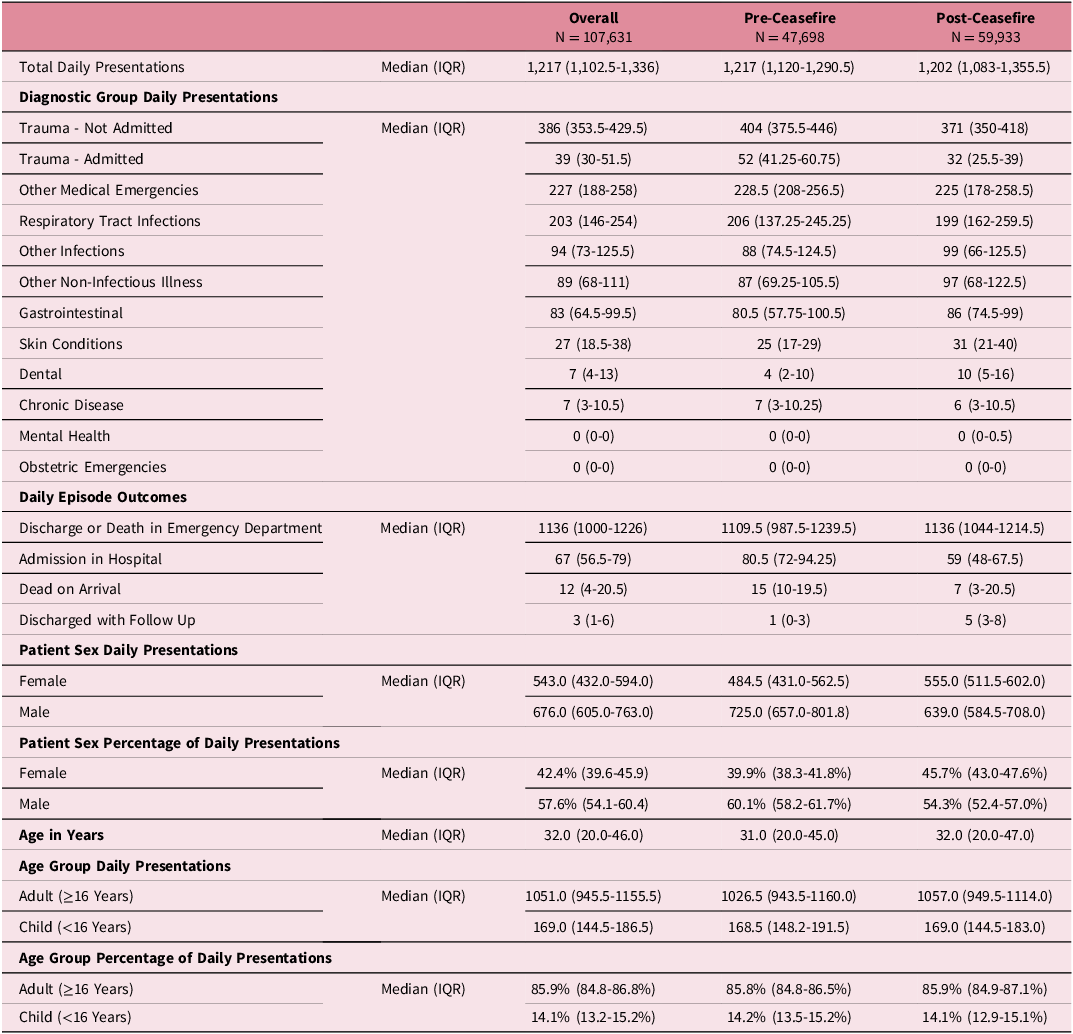
There were 107,631 presentations to the NMC ED over the study period, a median of 1,217 patient presentations (IQR 1,120-1,291) per day prior to, and 1,202 per day (IQR 1,083-1,356) following, the ceasefire. There were no missing data. Summary statistics, stratified by ceasefire period, are demonstrated in Table 1.
Characteristics of Daily Presentations to Nasser Medical Complex Emergency Department from September 1 - November 30, 2025, Inclusive, Stratified by Ceasefire Phase

Table 1. Long description
A table comparing daily presentations to Nasser Medical Complex Emergency Department by ceasefire phase. The table has 25 rows and 6 columns. The columns are labeled Overall, Pre-Ceasefire, and Post-Ceasefire, each with a sample size (N) and median values with interquartile ranges (IQR). The rows are grouped into Total Daily Presentations, Diagnostic Group Daily Presentations, Daily Episode Outcomes, Patient Sex Daily Presentations, Patient Sex Percentage of Daily Presentations, Age in Years, Age Group Daily Presentations, and Age Group Percentage of Daily Presentations. Each row provides median values and IQR for the respective categories. Notable trends include variations in daily presentations across different diagnostic groups, patient sexes, and age groups before and after the ceasefire. For example, the median total daily presentations slightly decreased from 1,217 pre-ceasefire to 1,202 post-ceasefire. The table also shows detailed breakdowns of diagnostic groups, daily episode outcomes, patient sex, and age group presentations.
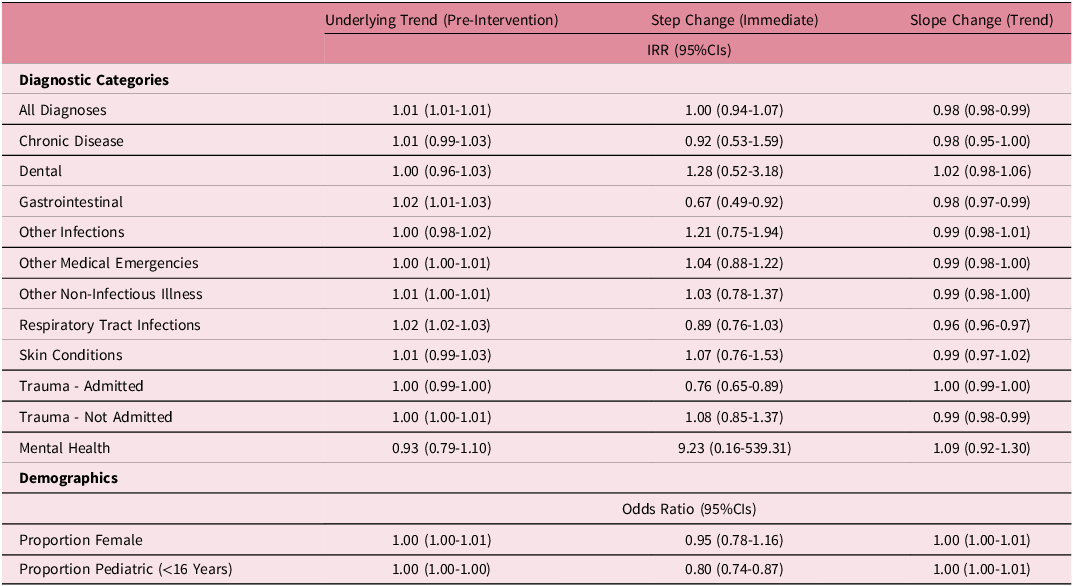
The negative binomial ITS analysis evaluated both the immediate and sustained impacts of the ceasefire on total ED attendances. Immediately following the ceasefire, there was no significant step-change in attendance numbers (IRR 1.00; 95%CI, 0.94-1.07; P = 0.918). However, there was a significant shift in the post-intervention trend; relative to the pre-ceasefire trajectory, attendances experienced a sustained decrease of two percent per day (95%CI, 1.0% to 2.0% reduction; P < 0.001).
The exploratory, hypothesis-generating secondary outcomes indicated several changes in the profile of ED attendances. Immediately following the ceasefire, there was an observed reduction in trauma admissions (24% reduction; 95%CI, 11.0% to 35.0%) and gastrointestinal presentations (33% reduction; 95%CI, 8.0% to 51.0%). Multiple diagnostic groups demonstrated downward trajectories in their sustained daily trends relative to the pre-ceasefire period. There were daily decreases in traumatic injuries discharged from the ED (one percent daily decrease; 95%CI, 1.0% to 2.0%), respiratory infections (four percent daily decrease; 95%CI, 3.0% to 4.0%), gastrointestinal presentations (two percent daily decrease; 95%CI, 1.0% to 3.0%), and other medical emergencies (one percent daily decrease; 95%CI, 0.0% to 2.0%).
While there were no significant differences in the patient sex profile across the period, the introduction of the ceasefire was associated with reductions in the proportion of pediatric presentations (OR 0.80; 95%CI, 0.74 to 0.87), which then went on to increase steadily in the post-ceasefire period.
Full ITS outputs are detailed in Table 2 and visualized in Figure 2.
Results from Interrupted Time Series Modelling the Effect of the October 10th Ceasefire on Presentations to the Nasser Medical Complex Emergency Department from September 1 - November 30, 2025, Inclusive

Table 2. Long description
A table comparing the effect of a ceasefire on emergency department presentations by diagnostic categories and demographics. The table has 15 rows and 4 columns. The columns are labeled ‘Underlying Trend (Pre-Intervention)’, ‘Step Change (Immediate)’, and ‘Slope Change (Trend)’. The row labels include various diagnostic categories such as ‘All Diagnoses’, ‘Chronic Disease’, ‘Dental’, ‘Gastrointestinal’, ‘Other Infections’, ‘Other Medical Emergencies’, ‘Other Non-Infectious Illness’, ‘Respiratory Tract Infections’, ‘Skin Conditions’, ‘Trauma - Admitted’, ‘Trauma - Not Admitted’, ‘Mental Health’, and demographic categories such as ‘Proportion Female’ and ‘Proportion Pediatric (<16 Years)’. Each cell contains values representing the incidence rate ratios (IRR) with 95% confidence intervals (CIs) for the underlying trend, step change, and slope change. Notable trends include a step change of 9.23 for Mental Health with a wide confidence interval, and a step change of 0.80 for the proportion of pediatric patients. The table provides a detailed analysis of how different diagnostic categories and demographics were affected immediately and over time by the ceasefire.
Note: Due to low numbers, it was not possible to estimate the association between presentations for obstetric emergencies and step changes or trends following the ceasefire. The widths of the 95% confidence intervals have not been adjusted for multiplicity, and they should not be used in place of hypothesis testing.
Interrupted Time Series Analysis of Ceasefire Intervention by Diagnostic and Demographic Group.

The ACF plot for the primary outcome demonstrated little autocorrelation (Supplementary Figure 1) and there was acceptable independence of errors (Durbin-Watson test statistic = 1.71).
Discussion
This study demonstrates that the implementation of a ceasefire has the potential to significantly change presentation patterns to a civilian ED in a conflict area. While no immediate step-change was demonstrated in overall numbers of ED attendances, the previously-increasing trend of rising daily attendances was reversed, with attendance numbers reducing by two percent per day following the ceasefire. The proportion of pediatric presentations significantly reduced immediately following the implementation of the ceasefire, before steadily returning to those levels immediately prior to the ceasefire over a period of weeks.
Changes were also observed in the profile of attendances by diagnostic category. Presentations with traumatic injuries reduced, as did other presentations not directly related to interpersonal violence, such as gastrointestinal and respiratory presentations. A reduction in interpersonal violence is likely to account for much of the effect, however improvements in the living conditions of displaced populations and movements of those populations may account for many of the findings.
Presentations from the broad diagnostic category “other medical emergencies” (which includes conditions such as stroke, myocardial infarction, or diabetic emergencies) saw a significant reversal of its pre-ceasefire increasing trend. Such effects may be due to the wider availability of medications to manage chronic disease and so prevent deterioration to emergency conditions. The support of supply of medications for chronic diseases to conflict areas should remain an important humanitarian priority.Reference Aldabbour, Barakat and Elamassie11
It should be noted that most presentations both before and after the ceasefire were for non-traumatic events. These findings highlight the need to continue support and resource for the non-traumatic workload of emergency care during crises, a pattern described in other contexts.Reference Wolff, Shankiti and Salio2
The study design is strengthened by robust quasi-experimental methodology with a proven record of evaluating the effect of interventions or external influences in health care,Reference Bernal, Cummins and Gasparrini9 and by a systematic data collection system that achieves complete coverage of every presentation to the ED, even in times of system stress.
Limitations
The study is limited by its retrospective single-center design, and it represents only the experience of a single ceasefire event. The dataset meets conventional thresholds for the minimum number of time points over which a trend may be reasonably established,Reference Bernal, Cummins and Gasparrini9 though still describes the early experience of ceasefire events on ED presentations. While this may be useful to organizations implementing immediate actions, further work should seek to describe the effects in the short-, medium-, and long-term to assist in planning across the phases of recovery following conflict. The analysis was not adjusted for seasonality, though considering the phase of conflict and the significant changes to the health care system in this context over recent years,Reference Qandil4,8 such adjustments are unlikely to be meaningful.Reference Bell and Hillmer12 Due to local health care pathways, with direct admissions to obstetric care and low numbers of presentations via the ED, changes in emergency maternal presentations were unable to be estimated in the time series model. As a single-center study, these results also reflect the specific structures of care locally, seen for example in low numbers of mental health-related presentations, as local health care infrastructure provides alternative routes for access to this care.
Conflict brings pressure to health care data collection systems,Reference Helweg-Larsen, Abdel-Jabbar and Al-Jabriri13 and so granular assessment of presentations beyond the diagnostic categories collected by the institutional database is not possible. These diagnostic categories themselves are intended to enable acceptable, pragmatic records of diagnoses and to support reporting of diagnoses with potential public-health implications during active conflict; as such, they may provide less information than other systems of diagnostic coding, for example that of the International Classification of Diseases.14 Additionally, due to similar limitations resulting from the local context, it is not possible with this methodology to distinguish discharges from patients who died in the ED, nor to ascertain longer term outcomes.
Conclusion
There is the potential for significant changes in presentations to EDs proximate to conflict following ceasefire. In this setting, the majority of the burden of disease is of non-traumatic presentations in both pre- and post-ceasefire periods. Health care providers in conflict regions and humanitarian actors should develop their response to ensure their resources match expected needs.
Supplementary Material
To view supplementary material for this article, please visit https://doi.org/10.1017/S1049023X26109030
Author Contributions
RM conceived the study with MQ. RM analyzed the data with YA. All authors provided important contextual information on the results and made meaningful contributions to the final manuscript. RM takes responsibility for the paper as a whole.
Conflicts of Interest
HA is an Emergency Physician at Nasser Medical Centre Emergency; AH is an Emergency Physician at Nasser Medical Centre Emergency; MQ is an Emergency Physician at Nasser Medical Centre Emergency; RM is an Emergency Physician with UK-MED; YA is a Medical Data Officer with UK-MED. No conflicts of interest to declare.
Use of AI Technology
AI tools were not used for the construction of the manuscript.