

INTRODUCTION
While HIV/AIDS is causing an increased demand for health services in Africa, large numbers of healthcare professionals may be directly affected by the epidemic as a result of their occupational risks [Reference Bell1, Reference Gerberding2] and sexual behaviours [Reference Mead3].
The World Health Organization estimates that 3 million percutaneous exposures occur annually among 35 million healthcare workers (HCWs) globally, corresponding to 1000 new HIV infections from occupational exposure with over 90% occurring in resource-constrained countries [Reference Pruss-Ustun, Rapiti and Hutin4, 5]. The risk is probably highest in sub-Saharan Africa and Asia where incidence rates as high as nine exposures/HCW per year have been reported [Reference Gumodoka6, Reference Gupta7].
HCWs are also very mobile, which exposes them to HIV infection [Reference Lurie8]. In the Health sector in Burkina Faso, HCWs often change appointments throughout the 13 regions of the country. Temporary housing arrangements for the HCWs in training are sometimes lacking, preventing HCWs' families from joining them. This forces HCWs from rural regions to travel long distances and to be absent for long periods of time in order to have a stable job. The resulting disruption of social and family relationships has been reported to further increase HIV infection [Reference Turmen9]. In isolated and poor areas, their economic status may be greater than those of the locals, thus increasing the risk of acquiring HIV as they may have access to multiple sexual partners.
Two studies of HIV prevalence in HCWs from Africa suggest that doctors and nurses are at least as likely to become infected as other people [Reference Buve10, Reference Mann11]. Based of this finding, a country with stable 5% HIV prevalence can expect between 0·5% and 1% of its healthcare providers to die from AIDS each year; a country with 30% prevalence would lose 3–7% each year [Reference Mead3]. Botswana, for example, lost 17% of its healthcare workforce due to AIDS between 1999 and 2005. A study in one region of Zambia and in a representative sample in South Africa found that 40% of midwives and 11·2% of HCWs were HIV positive, respectively [12]. A Medline search on this topic in West Africa, using a variety of key word combinations, proved unproductive. It is unclear if HCWs in the context of a moderated epidemic of HIV are more exposed than the general population.
It is also important to provide evidence on the direct effects of HIV/AIDS on the healthcare workforce in order to inform policy. Upon request of the national health authorities, we therefore conducted a study to assess the prevalence of HIV infection in HCWs throughout Burkina Faso.
METHODS
HCW survey
We conducted a national survey to estimate the prevalence of HIV in HCWs in four provinces of Burkina Faso, namely Ouagadougou, Bobo-Dioulasso, Poni, and Yatenga. Based on an expected prevalence of 4% and a 95% confidence level, the required sample size was 1476 to get a 1% precision on prevalence estimate. Assuming an acceptability rate for anonymous urinary HIV testing of 65%, the required sample size was 2270 people. Working with four provinces, we planned to recruit 600 participants per province, i.e. 2400 overall.
Before the study began, the latest statistics on the number of health facilities, the number of staff and nominal lists by activity and addresses of all HCWs in the selected areas were obtained from the Ministry of Health. A numbering system of survey areas, health facilities and potential subjects was established. HCWs were selected between January and December 2003. For rural areas (Poni and Yatenga), all health facilities were visited without selection to achieve the sample size. HCWs from urban areas (Ouagadougou and Bobo-Dioulasso) were selected by random sampling with probability proportional to size, the size being the number of HCWs per health facility. The study was approved by the Ministry of Health of Burkina Faso regarding methodological and ethical issues. We used an anonymous linked approach whereby the HIV results could not be supplied to the participants who were encouraged to get a HIV test if they wish to know their HIV status. The study purpose was clearly discussed with the participants, and after informed consent was obtained, demographic characteristics were collected through a questionnaire administered by an experienced sociologist, and a urine sample was collected from each participant. Only ID numbers were used in the questionnaire and matched urine samples. Study staff answered questions about HIV after completion of the questionnaire and urine sampling and the corrected answers of the questionnaire on HIV were provided to participants.
For medical doctors, the survey involved self-administration of an anonymous written questionnaire (copies available from corresponding author). Empty questionnaires were distributed and collected anonymously to all physicians working in the health centres covered by the study using unmarked envelopes. The medical doctors were asked to write down an ID number of their own both on the questionnaire and the urine tube, and to place them at a collection point within their health centre. This complex procedure aimed at securing anonymity. Questionnaires were validated by a 2-month period of field observation and interviews with 30 HCWs in other rural and urban health posts.
We decided to use a urine-based HIV test to improve the acceptability of the study. Urine samples were screened for HIV using a Calypte test kit (Calypte Biomedical Corporation, USA) and confirmed by Western blot. Samples that were positive for both the Calypte test and Western blot were considered HIV positive. Meehan et al. [Reference Meehan13] and Oelemann et al. [Reference Oelemann14] reported a sensitivity of 100% and a specificity of 97·7–98·7% for this combination (Calypte EIA + Western blot), making it acceptable and appropriate for epidemiological purposes. All tests were performed at Centre Muraz laboratory in Bobo-Dioulasso.
Demographic and Health Survey (DHS)
In 2003, Burkina Faso organized its third DHS and included HIV testing for the first time [15]. A national representative sample of 9470 households was selected using two-stage cluster sampling. All women aged 15–49 years and men aged 15–59 years who were either permanent residents of the sampled households or visitors present in the household on the night before the survey were eligible to be interviewed and to give consent for blood draw for HIV testing. A laboratory technician collected capillary blood from a finger prick on a filter paper. A face-to-face interview covered sociodemographic characteristics and other health issues, including HIV-related behaviour.
The diagnosis of HIV infection was made according to a decisional algorithm using a combination of three ELISA tests. Serum samples were screened by a first ELISA (Vironostika HIV Uniform II plus O; bioMérieux, France) [Reference Meda16] and positive results were confirmed by a second ELISA to distinguish between HIV-1 and HIV-2 infection (Wellcozyme HIV Recombinant, Murex Diagnostics Ltd, UK).
Statistical analyses
SAS software, version 9.2 (SAS Institute Inc., USA) was used for statistical analyses. Frequencies and cross-tabulation of various demographic characteristics was performed for descriptive purposes. The χ 2 test was used to compare proportions. Continuous normally distributed variables are presented as mean with standard deviations (s.d.). Means were compared using Student's t test. Strength of associations between teachers and DHS participants were estimated by calculating the prevalence ratios (PRs) with 95% confidence intervals (95% CIs).
We examined the potential factors associated with HIV infection and multivariable logistic regression models were built to calculate adjusted odds ratios (aORs) and 95% CIs. We used a backward-elimination procedure in building the multivariable model. All variables were included in the initial model; those variables without associations (P > 0·10) were then excluded in the final model unless forced in because of previously published findings (age [Reference Amornkul17], marital status [Reference Auvert18], geographical location [Reference Ramjee19], mobility [Reference Boerma20, Reference Lagarde21], sexual behaviours [Reference Amornkul17]). All statistical tests were two-sided and a P value <0·05 was considered as significant.
HIV prevalence in male and female HCWs was standardized (direct standardization) according to age and region of the DHS.
RESULTS
Because of a very low participation rate of medical doctors (about 1%) in over 500 questionnaires distributed, this report is based on non-medical-doctor data.
Sociodemographic characteristics
Of 1697 HCWs invited to participate in the study from 97 health facilities in the four provinces, 1570 (92·5%) agreed to participate. Of the HCWs enrolled, all responded to the questionnaire and 1013 (64·5%) provided a urine sample for HIV testing.
Comparing HCW participants who did and who did not accept HIV testing, age (34 ± 8 years vs. 35 ± 8 years, P = 0·06), sex (men 42% vs. 47%, P = 0·51), area (rural 47% vs. 49%, P = 0·32), and marital status (married 85% vs. 78%, P = 0·11) were similar. Therefore, missing HIV testing of participants was unlikely to bias our results.
The majority (58%) of respondents were female. The average duration of employment was 10 years (range 1–38 years), and the sample was made up of nurses (29·6%), specialist nurses called ‘Attaché de santé’ (7·8%), auxiliary nurses called ‘agents itinérant de santé’ (6·5%), midwives or auxiliary midwives (21·2%), students and trainees (STU) (15·0%), administrative and manual workers (ADM) (17·5%) and laboratory workers (2·4%). For all analyses, job categories were collapsed into nurses/midwives (NUR/MID) (65·1%), STU (15·0%), laboratory workers (2·4%), and administrative and manual workers (17·5%).
The mean age for male HCWs was 33 ± 8 years, with 29·6% of men aged between 25 and 29 years. For female HCWs, the mean age was 37 ± 9 years, with age 30–34 years being the more representative group. Overall, 80% of female HCWs worked in urban cities, while men were equally distributed between urban (49%) and rural areas. More than half of the HCWs were married, and almost all in a monogamous relationship.
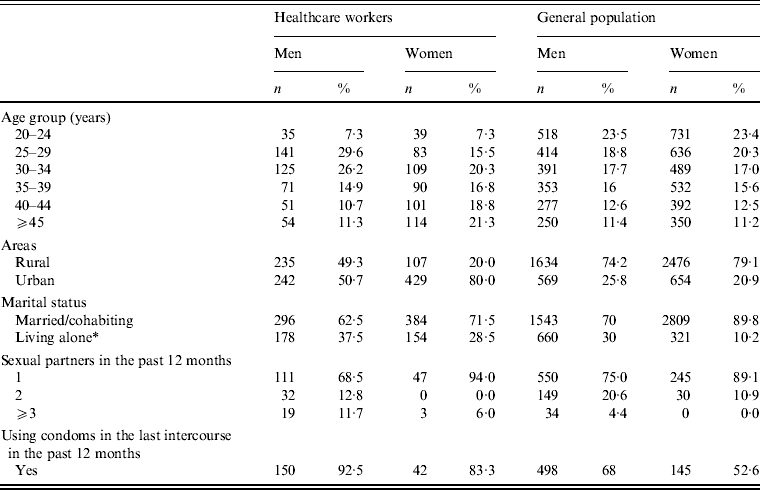
Men and women included in the HCW survey were older, more likely to be unmarried, and lived more frequently in urban areas compared to DHS men and women (Table 1).
Sociodemographic and sexual behaviour characteristics of healthcare workers compared to the general population distribution from the 2003 demographic health survey (DHS)
* Single, separated, divorced, widowed.
Sexual behaviour characteristics
Of those who reported having sex with someone other than a spouse or live-in partner (higher-risk sex) in the 12 months preceding the survey, a larger proportion of male HCWs than female HCWs reported having had more than one sexual partner (Table 1). The same trend has been observed in the general population (Table 1). Although 1/13 male HCWs and 1/7 female HCWs reported unprotected intercourse the last time they engaged in sex with an occasional partner, these proportions were lower than in the general population (Table 1).
HIV prevalence
The overall crude prevalence of HIV in HCWs was 3·5% (95% CI 2·3–4·6) with 2·7% (95% CI 1·3–4·2) for male HCWs and 4·1% (95% CI 2·4–5·8) for female HCWs (P = 0·13). Students and trainees were less infected with HIV (0·7%) than others groups (3·8% for NUR/MID group, 4·5% for ADM, and 4·6% for laboratory workers), although this difference was not statistically significant (P = 0·22).
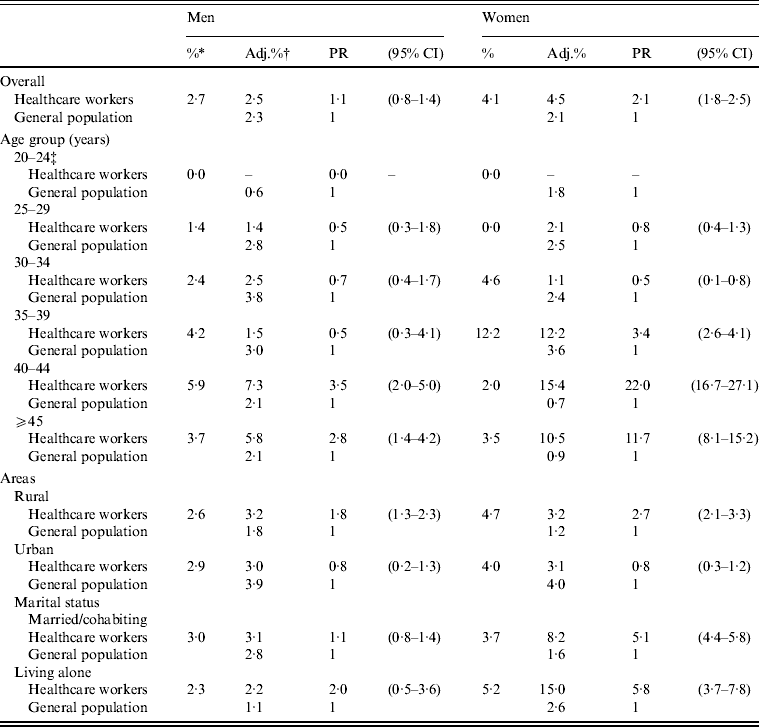
The overall age- and area-standardized prevalence of HIV was 3·5% (95% CI 2·2–4·8), with 2·5% (95% CI 1·1–4·0) for male HCWs and 4·5% (95% CI 2·3–6·0) for female HCWs (Table 2). The overall prevalence of HIV in the general population was estimated at 2·2% (95% CI 1·8–2·6). HIV prevalence in DHS men was 2·3% (95% CI 1·4–2·9), which compares to the adjusted prevalence in male HCWs (2·5%, 95% CI 1·1–4·0) (PR 1·1, 95% CI 0·8–1·4). Adjusted HIV prevalence in men aged 40–49 years was statistically higher in the HCW survey than in the DHS. In rural areas, HIV prevalence was higher in male (3·2% vs. 1·8%, P = 0·04) HCWs than in the DHS. In urban areas, male (3·0 vs. 3·9%, P = 0·11) HCWs had a somewhat lower prevalence of HIV than men and women from the DHS but the difference was not significant.
Comparison of HIV prevalence between healthcare workers (n = 1013) and the general population (n = 5333)
Adj., Adjusted; PR, prevalence ratio; CI, confidence interval.
The first prevalence is the proportion of positive HIV tests, without any weight: crude prevalence. The second is an adjusted proportion of positive HIV tests, using age, sex, and area distribution in the general population as reference for weighting observed numbers of HIV-positive tests: standardized prevalence.
* Crude prevalence.
† Standardized prevalence.
‡ Not included in adjustments because of too low numbers.
For women, the prevalence of HIV in HCWs (4·5%, 95% CI 2·5–6·0) was twofold higher than in the general population (2·1%, 95% CI 1·3–2·4).
In rural areas, HIV prevalence was higher in female (3·2% vs. 1·2%, P = 0·02) HCWs than in the DHS. In urban areas, female (3·1% vs. 4·0%, P = 0·25) HCWs had a somewhat lower prevalence of HIV than women in the DHS but the difference was not significant. Finally, female HCWs were more infected with HIV than DHS women when married or cohabiting (P = 0·003) (after adjustment on age).
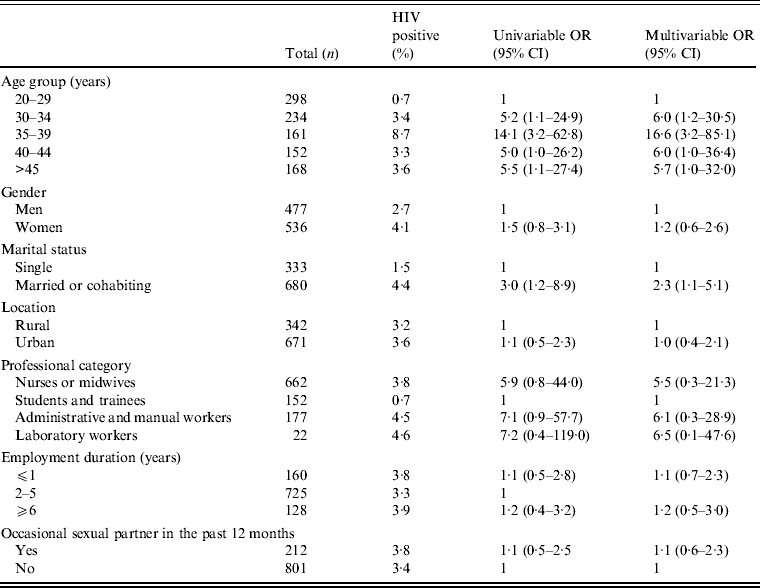
In univariable analysis, married HCWs were significantly more likely to be HIV-infected than single HCWs (4·4% vs.1·5%, P = 0·02). In the 20–29 years age group, 0·7% (95% CI 0·02–1·6) of HCWs were infected with HIV. Of HCWs aged ⩾30 years, the HIV prevalence was 4·6% (95% CI 3·1–6·2, P = 0·002). We observed no difference in HIV infection between rural and urban areas (3·2% vs.3·6%, P = 0·76).
Using multivariable logistic regression, age (aOR 7·1, 95% CI 1·8–30·0) and being married (aOR 2·3, 95% CI 1·1–5·1) were independently associated with HIV infection (Table 3).
Sociodemographic and sexual behaviour factors associated with HIV infection in healthcare workers in Burkina Faso, in univariable and multivariable analyses
OR, Odds ratio; CI, confidence interval.
DISCUSSION
We report for the first time the prevalence of HIV infection in a large representative sample of HCWs in West Africa. The overall prevalence for this population was 3·5%, with no difference between job categories, which compares to the prevalence in the general population after standardization, although female HCWs were more infected. There is a paucity of reports of HIV prevalence in HCWs and in the general population in Africa particularly in West Africa. In South Africa, HIV prevalence in public hospital employees was also estimated to be nearly identical to that found in the general adult population [Reference Shisana22].
As expected, our prevalence of HIV in HCWs is lower than that observed in other developing countries with higher HIV prevalence in the general population. In South Africa in 2002, a 16% prevalence has been estimated in the health workforce [Reference Shisana22]. In 2005, a 12% prevalence has been reported in Gauteng [Reference Connelly23]. Recently, in 215 female HCWs in Cape Town, South Africa, a HIV prevalence of 20% has been reported [Reference Kranzer24]. A major limitation of these surveys is that the extent of occupational or community exposure to HIV of tested workers was not known. Nevertheless, these surveys do not suggest a high rate of previously undetected HIV infection in the HCWs studied.
We did not find any significant difference in HIV prevalence between professional categories. This result is also reported by Mann et al. in HCWs in Kinshasa [Reference Mann11]. In the South African Human Sciences Research Council (HSRC) HCW study, non-professional HCWs had a higher prevalence of HIV of 20·3% compared to 13·7% for professionals [Reference Shisana22].
The higher prevalence of HIV in female HCWs is even more surprising, and reflects an increased vulnerability of women working in the health sector, with no clear explanation as they are less mobile and exposed to the same prevention programmes as men. A significant proportion of HIV-infected staff results in HIV-related absenteeism as well as in early retirements and lower productivity. Before the wide scale implementation of HIV treatment, the impact of the HIV epidemic in HCWs was enormous. In Kenya, 34% of absenteeism was due to personal illness and 6% to caring for a sick person [25]. African health systems expect to lose 20% of their workers to HIV/AIDS over the coming years [26]. In 2005, a Swaziland study indicated that a substantial level and proportion of attrition in HCWs has been due to staff deaths. Of health staff in the 20–45 years age group, mortality was 4·9% in 2004 [Reference Kinghorn27]. Today, the availability of antiretroviral therapy (ART) has certainly reduced considerably this impact. However, current ART coverage in HCWs is unknown, and the majority of HCWs still do not test for HIV.
The relationship between marital status and HIV is complex [Reference Shisana22]. In our study, married HCWs had a higher HIV prevalence than single HCWs suggesting they are more at risk of HIV infection, probably because they engage in unsafe sexual practices. Separation from partners (more frequent in HCWs) creates opportunities to start new sexual relationships elsewhere thus putting partners at risk of acquiring HIV. Moreover, migration has long been identified as a risk factor of HIV infection [Reference Lurie8], and the resulting disruption of social and family relationships further increases the likelihood of HIV infection [Reference Turmen9].
Although occupational exposure to HIV is a reality for HCWs in sub-Saharan Africa [5, Reference Hutin28–Reference Sagoe-Moses31], few studies have attempted to evaluate the incidence rate of accidental blood exposure (ABE) in African HCWs. However, in the published studies, a high incidence rate of ABE has been reported. In Tanzania, medical ward personnel showed a risk of five percutaneous injuries (PCIs) and nine mucocutaneous contacts (MCCs)/HCW per year [Reference Gumodoka32]. In Nigeria, one study documented a risk of two PCIs/surgeon per year, and 0·6 PCIs/nurse per year [Reference Adegboye33]. Another study in surgical wards in Zambia estimated the annual risk to be three PCIs/surgeon [Reference Consten34]. A survey conducted in Dutch HCWs returning from developing countries estimated the annual risk to be 1·9 PCIs in nurses [Reference de Graaf, Houweling and van Zessen35]. More recently, Tarantola et al. showed an estimated incidence of 0·33 PCIs and 0·04 MCCs/HCW per year in medical or intensive-care personnel and 1·8 PCIs/HCW per year in surgeons in a multi-centre study (Côte d'Ivoire, Mali, Sénégal) [Reference Tarantola36].
The similar overall prevalence of HIV in HCWs and the general population suggests that occupational transmission of HIV is very low in HCWs in Burkina Faso. In addition, the risk of HIV infection was very similar between HCW categories; nurses and laboratory workers were not more infected than administrative staff.
Our study has some limitations related to the study design. We may have underestimated HIV prevalence if the workers who were absent from work and therefore excluded from the survey were more likely to be infected. Moreover, because participants could choose providing a urine sample, it is possible that our HIV results could suffer from self-selection bias (e.g. if HIV-positive employees were either more or less likely to provide a urine sample because of knowledge of their HIV status). However, comparing the sociodemographic characteristics of HCW participants who did and who did not have HIV testing in the enrolled participants (we found not statistical difference), it is unlikely that we missed any large trends. Moreover, all of the data in the survey were self-reported. Therefore, some degree of under-reporting of socially unacceptable behaviours and over-reporting of socially desirable behaviours are possible.
Data in our study were collected in 2003; the HIV prevalence in HCWs is likely to have changed along with improved strategies to fight HIV in the country and the relative decline of HIV prevalence in the general population (2003 DHS 1·8%, 2010 DHS 1·0%). However, the prevalence ratio between HCWs and the general population is certainly still appropriate for epidemiological purposes and to inform policy makers, since no real HIV prevention measures have been taken so far in the Health sector. Another limitation of this study is that a ‘desirability’ bias cannot be excluded. In addition, given the limited number of physicians in our study, the study findings based on non-medical-doctor data may not be generalized to physicians. The difficulty in obtaining physician participation in survey research has been reported by other groups [Reference Kaner, Haighton and McAvoy37–Reference Templeton39]. Commonly cited reasons for physician non-participation include a lack of time, lack of interest, and insufficient office staff [Reference Kaner, Haighton and McAvoy37, Reference Maheux, Legault and Lambert40]. In our study, the main issue was the perceived risk of linking their data to their identity, particularly for HIV testing, despite complex procedures for anonymization. Nevertheless, these data are the first epidemiological survey in West Africa addressing HIV prevalence in HCWs.
In conclusion, female HCWs in Burkina Faso have a higher HIV prevalence than females in the general population, while male HCWs have a similar rate of HIV prevalence, without a clear explanation as to why. These results do not argue for contamination by AES.
A better access to voluntary counselling and testing (VCT) service, improved counselling on safe-sex behaviours and HIV treatment specifically adapted to female HCWs could be developed within the Ministry of Health.
ACKNOWLEDGEMENTS
We thank the head of all health facilities where the study took place and the staff of Centre Muraz for their invaluable assistance and cooperation. We acknowledge the healthcare facility administrators, head nurses and midwives for their extraordinary participation. This project was funded by the United Nations Development Programme (UNDP), World Health Organization (WHO), the United Nations Population Fund (UNFPA), Embassies of Holland, Switzerland, Denmark, and Belgium. The authors also thank William D'hoore [Institut de recherche santé et société (IRSS), Faculté de Santé Publique (FSP), Université catholique de Louvain (UCL), Bruxelles, Belgique] for helpful comments on several substantive issues. Technical assistance was provided by the Ministry of Health and the National AIDS Control Programme.
DECLARATION OF INTEREST
None.



