I. INTRODUCTION
Photosynthesis is a highly studied natural phenomena since the solar energy conversion efficiency is quite high in terms of an almost 100% quantum efficiency of charge separation. For example, bacteriochlorophylls (BChls) c, d, and e are the main light-harvesting pigments of green photosynthetic bacteria that self-assemble into nanostructures within the chlorosomes, forming efficient antennas of photosynthetic organisms.Reference Jochum, Reddy, Eichhöfer, Buth, Szmytkowski, Kalt, Moss and Balaban1 Recently, solar cells have attracted much attention relevant to global environmental issues. Particularly, organic semiconductors have become attractive as lightweight, flexible, and color-tunable materials that are expected to lead to simple fabrication processes with the potential for ubiquitous utilization.Reference Brabec and Durrant2 In this regard, we have developed photovoltaic systems composed of organic semiconductors of poly(3-hexylthiophene)s (P3HT) and fullerene derivative (6,6)-phenyl C61 butyric acid methyl ester (PCBM).Reference Yoshikawa, Sonobe, Sagawa and Yoshikawa3 Currently, a combination of a novel polymer of poly[4,8bis-2-ethylhexyloxy-benzo[1,2-b:4,5-b′]dithiophene-2,6-diyl-alt-4-heptylcarbonyl-thieno[3,4-b]thiophene-2,6-diyl] with PC70BM resulted in a remarkable enhancement of the power conversion efficiency (PCE) of 7.7%.Reference Chen, Hou, Zhang, Liang, Yang, Yang, Yu, Wu and Li4 Matsuo et al. reported a columnar structured bulk-heterojunction solar cell based on synthetic tetrabenzoporphyrin and bis(dimethylphenylsilylmethyl)[60]fullerene showing a relatively higher PCE of 5.2%.Reference Matsuo, Sato, Niinomi, Soga, Tanaka and Nakamura5 However, such new materials are prepared by a complicated synthetic route in fairly small amounts. In this context, application of environmentally benign photosynthetic dyes for a photovoltaic system is promising in terms of the biomimetic approach, which allows us to prepare large amounts of various self-assembling chlorophyllous pigments that exist in nature with tailored properties of highly efficient charge separation and light-harvesting through simple cultivation of organisms. In this context, self-assembling analogues of the natural chlorophylls,Reference Yun, Jung, Kim and Han6 bacteriochlorophylls,Reference Linke-Schaetzel, Bhise, Gliemann, Koch, Schimmel and Balaban7–Reference Huijser, Marek, Savenije, Siebbeles, Schere, Haschild, Szmytkowski, Kalt, Hahn and Balaban9 and chlorinsReference Linke-Schaetzel, Bhise, Gliemann, Koch, Schimmel and Balaban7, Reference Huijser, Marek, Savenije, Siebbeles, Schere, Haschild, Szmytkowski, Kalt, Hahn and Balaban9 have already been applied for organic thin-film photovoltaics, but due to spontaneous aggregation and very fast charge recombination, the device performance was rather modest. In order to regulate and adjust the self-aggregation of the photosynthetic dyes, we report here the novel application of photosynthetic dye of bacteriochlorophyll c (BChl c) as light-harvesting and/or photosensitizing part for the bulk heterojunction organic thin-film solar cell.
II. EXPERIMENTAL
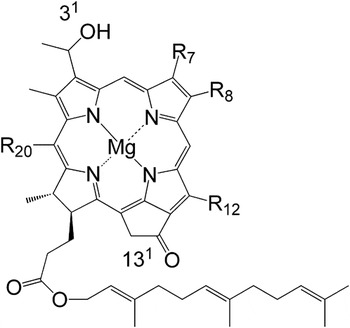
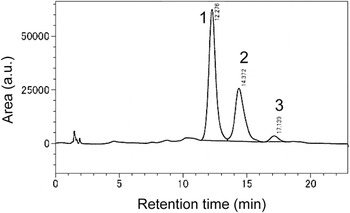
Chlorobium tepidum was grown and its chlorosomes were isolated by using methods similar to those previously reportedReference Nozawa, Ohtomo, Suzuki, Morishita and Madigan10 with a slight modification. Cultivation was carried out at 40 °C under continuous illumination of 20 W fluorescent light to the surface of a 20 L PET bottle for 10 days. The extraction, isolation, and purification of BChl c (Fig. 1) from Chlorobium tepidum were carried out according to a modification of the method of Ishii et al.Reference Ishii, Uehara, Ozaki and Mimuro11 Ten volumes of methanol were added to the cell, and the extracts were filtered through diatomaceous earth that had been previously washed with acetone. This extraction procedure was repeated three times for complete extraction of the pigments. The extracts were combined and dried in vacuo. The pigment mixture was dissolved in acetone and was filtered through Avicel FD-101 (crystalline cellulose; Asahi-Kasei Co., Ltd.) to remove water-soluble materials. Then n-hexane was added to the acetone solution to precipitate BChl c. Acetone was removed by evaporation, and a precipitate of BChl c was washed with n-hexane to remove carotenoids (mainly chlorobactene) and bacteriopheophytin until the filtrate was colorless. The precipitate of BChl c was redissolved in acetone and filtered again through the cellulose column for purification. The obtained BChl c homologues were analyzed by high-performance liquid chromatography (HPLC) using an ODS column (COSMOSIL 5C18-AR-II, 4.6 × 10 mm, Nacalai tesque Co. Ltd., column temperature at 40 °C) with a mobile phase of 9:1 (vol/vol) methanol/water at a flow rate of 1.5 mL/min. Figure 2 shows HPLC traces of the mixture of BChl c homologues grown and obtained from Chlorobium tepidum in this work. Fraction 1 is assigned to R[E, E]BChl c,Reference Ishii, Uehara, Ozaki and Mimuro11 in which relative peak area was 69% as compared with the other peak areas of fractions 2 and 3. Fraction 2 is R- and S[P, E]BChl c (28%), and fraction 3 is S[I, E]BChl c (3%).Reference Ishii, Uehara, Ozaki and Mimuro11
BChl c R7 = CH3. R8 = C2H5 (E), n-C3H7 (P), iso-C4H9 (I). R12 = C2H5 (E), R20 = CH3.

HPLC traces of the mixture of BChl c homologues.

Indium-tin oxide (ITO) on a glass substrate (5 Ω/cm2) with an aluminum wire as electrode were purchased from Geomatec Co. Ltd. and Nilaco Co. Ltd. The ITO substrate was sonicated with purified water, acetone, and ethanol. After air- and blow-drying, poly (ethylene dioxythiophene) doped with polystyrene sulfonic acid (PEDOT/PSS, Clevios P, KC Starck) was spin-coated at 4000 rpm onto the substrate. The active layer of the blended BChl c and PCBM in chloroform was spincoated at 1500 rpm. Finally, the Al electrode was deposited through thermal evaporation.
The energy-conversion efficiency was measured under 1 sun of AM 1.5 illumination by using simulated solar light from a CEP 2000 illuminator (Bunkoh-Keiki Co., Ltd.). The light intensity of the illumination source was calibrated by using a standard silicon photodiode (BS 520, Bunkoh-Keiki Co., Ltd.). The absorption properties were measured by UV-vis spectrophotometry (Shimadzu UV 2450).
III. RESULTS AND DISCUSSION
A. BChl c thin-film
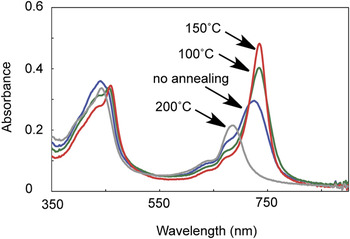
Aggregated BChl c forms a rod-like structure through coordination of a 3Reference Jochum, Reddy, Eichhöfer, Buth, Szmytkowski, Kalt, Moss and Balaban1 hydroxyl or a 13Reference Jochum, Reddy, Eichhöfer, Buth, Szmytkowski, Kalt, Moss and Balaban1 ketocarbonyl group of one BChl c to the Mg center of another BChl c.Reference Egawa, Fujiwara, Mizoguchi, Kakitani, Koyama and Akutsu12 Absorption spectra of BChl c thin films showed similar profiles (Fig. 3) to that of the aggregates found for the chlorosome.
UV-vis absorption spectra of BChl c thin film before and after annealing at 100 °C, 150 °C, or 200 °C for 6 min.

FTIR spectra of the BChl c thin film showed a broad peak at 1643 cm−1, which is assigned to the coordinative bonding.Reference Ishii, Uehara, Ozaki and Mimuro11
Through annealing at 100 °C or 150 °C for 6 min, the absorption peak of the Qy band of the BChl c thin film was remarkably shifted from 722 nm to 735 nm as shown in Fig. 3. On the other hand, annealing at 200 °C resulted in a blue shift of the Qy band from 722 nm to 684 nm. This result implies that heat treatment of the thin film alters the morphological states of the aggregated BChl c. Consequently, heat treatment at 100 °C and 150 °C promoted growth of the molecular assemblies, while heat treatment at 200 °C was followed by thermal decomposition.
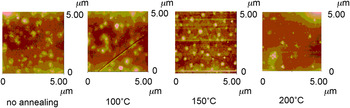
Atomic force microscope (AFM) images of the thin film before and after the annealing process also support the results of the absorption spectral changes. As shown in Fig. 4, a microdomain with 400 nm of diameter was observed in the case of the heat treatment at 100 °C and 150 °C in addition to the as-prepared (i.e., not annealed) one. On the other hand, after annealing at 200 °C, this microdomain decreased remarkably.
AFM images (5 μm square) of BChl c thin film before and after annealing at 100 °C, 150 °C, or 200 °C for 6 min.

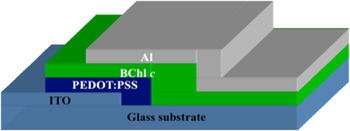
A BChl c thin film was fabricated onto the surface of the ITO/PEDOT–PSS substrate by the spin-coating method as shown in Fig. 5.
BChl c thin film.

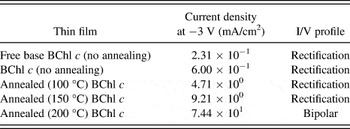
The current-voltage profile of the BChl c thin film was measured in the range of –3 V and +3 V and summarized in Table I. The current density increased with increasing annealing temperature. Free base (i.e., Mg-free) BChl c showed the lowest conductivity. Therefore, molecular assembly markedly improves the conductivity of the thin film. While as-prepared and annealed thin film at 100 °C and 150 °C exhibited rectification, bipolar behavior was observed in the case of the heat-treated films at 200 °C. Consequently, the conductivity of the thin film can be regulated through heat treatment by altering the morphology of the film.
Current densities of BChl c thin film.

B. Blended BChl c and PCBM thin film
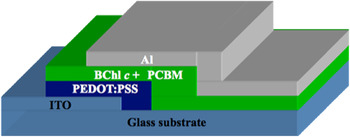
Blended BChl c and PCBM thin films were spin-coated on the surface of an ITO/PEDOT–PSS substrate using CHCl3 as the solvent (Fig. 6) and their photovoltaic properties were characterized and evaluated.
Blended BChl c and PCBM thinfilm.

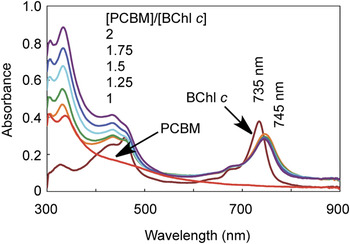
The absorption spectra of blended BChl c and PCBM thin films were measured and compared with a pristine BChl c thin film as shown in Fig. 7. A red shift of the Qy band from 735 nm to 745 nm was observed after the addition of PCBM into BChl c. This spectral change is ascribed to the complexation of BChl c and PCBM. FTIR measurements also support this result since a new absorption band at 1651 cm−1 was observed when PCBM was blended with BChl c thin film, which is assigned to the coordination bond between the O atom of the C = O group in PCBM to Mg in BChl c.Reference Jochum, Reddy, Eichhöfer, Buth, Szmytkowski, Kalt, Moss and Balaban1, Reference Ishii, Uehara, Ozaki and Mimuro11
UV-vis absorption spectra of blended BChl c and PCBM thin film.

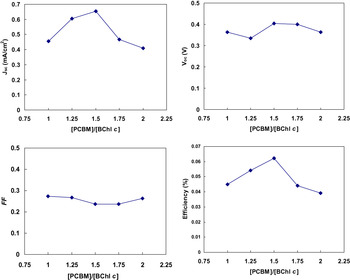
Bulk heterojunction solar cells composed of ITO/PEDOT–PSS/BChl c and PCBM/Al were fabricated and their photovoltaic properties were investigated. Weight ratios of BChl c and PCBM of 1:1, 1.25:1, 1.5:1, 1.75:1, and 2:1 were examined. Each cell exhibited low PCE ranging from 2.7 × 10⁻²% to 6.2 × 10⁻²%, with a short circuit current (J sc) of 0.41–0.65 mA/cm2, an open circuit voltage (V oc) of 0.33–0.40 V, and a fill factor (FF) of 0.24–0.27 as shown in Fig. 8. Among these results, maximum J sc and V oc and the highest PCE were attained with [PCBM]/[BChl c] at 1.5.
Photovoltaic properties of ITO/PEDOT–PSS/BChl c and PCBM/Al.

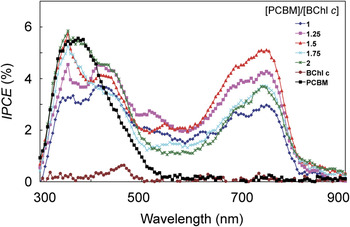
The incident photon-to-current conversion efficiency (IPCE) profile of ITO/PEDOT–PSS/BChl c and PCBM/Al with various weight ratios of [PCBM]/[BChl c] are shown in Fig. 9. The maximum IPCE value is 5.1% at 745 nm. This increase corresponds to an increase of short circuit current density. A remarkable increase in photocurrent at around 745 nm (Qy band region) was observed in each blended BChl c and PCBM thin film. This result implies that complex formation of BChl c and PCBM might be responsible for the increase in effective charge separation sites.
IPCE profile of ITO/PEDOT–PSS/BChl c and PCBM/Al with various weight ratios of [PCBM]/[BChl c].

It is known that the V oc of the bulk heterojunction polymer solar cell is related to the difference between the highest occupied molecular orbital (HOMO) of the donor materials and the lowest unoccupied orbital (LUMO) of the acceptor material.Reference Brabec, Cravino, Meissner, Sariciftci, Fromherz, Rispens, Sanchez and Hummelen13, Reference Scharber, Mühlbacher, Koppe, Denk, Waldauf, Heeger and Brabec14 When the charge transport path is not appropriate, the internal resistance of the cell increases. In this work, increase of V oc was attributed to the formation of an appropriate charge transport path through PCBM. Although the predominant factor of the V oc is still not clear, V oc in this work might be related to the donor-acceptor morphology.
The self-assembling BChl c was utilized as a light harvesting and charge transporting material. The accurate structure of molecular assembly is still obscure because the obtained BChl c is composed of three homologues. However, the thin films of BChl c showed interesting spectral changes caused by the addition of PCBM, which was assigned to the intermolecular coordination in the thin films. Furthermore, a bulk heterojunction based on a blended BChl c and PCBM thin film was fabricated and the device showed specific photovoltaic performance. The energy conversion efficiency of the cell increased remarkably through the complex formation of BChl c and PCBM in terms of the increase of the effective charge separation site.
Consequently, although the optimizations of the weight ratios of BChl c, PCBM, and/or other conditions still have to be investigated, our self-assembling photosynthetic dye is able to form an effective light-harvesting part and such a morphologically controllable aggregate can act as a charge transporting path for organic thin-film solar cells.
ACKNOWLEDGMENTS
We thank Prof. Hitoshi Tamiaki and Prof. Kaku Uehara for the provision of Chlorobium tepidum. We also thank Dr. Yoshikazu Suzuki for FTIR measurement.