Introduction Histories of the Manila Chinese at war
After a gap of some decades, the social and cultural history of the ‘Philippine Chinese’ during the twentieth-century is now beginning to be explored afresh. In the emerging scholarship, two distinct strands are noticeable. The first, in keeping with the much wider fashion since the 1990s for the study of ‘identities’ and the pervasive influence of ‘post-structuralism’, deconstructs the very idea of ‘Chineseness’ in the Philippines, and questions the notion of a single, definable community known as the ‘Philippine-Chinese’.Footnote 1 In the second approach, which is championed most vocally by Kaisa Para Sa Kaunlaran (often simply abbreviated as ‘Kaisa’)—a private organization in Manila which sees as its remit both scholarly research and an ‘advocacy role of building bridges and enhancing greater understanding and acceptance of the ethnic Chinese’Footnote 2—the contributions of people of Chinese descent to postcolonial Philippine nation-building have been underlined, and ‘Tsinoys’Footnote 3 as a group celebrated as a link between the Philippines and the People's Republic of China which is now beginning to replace Japan as the pre-eminent, Asian economic power in Manila.
It is this latter strand of scholarship which has begun to see the role of Chinese suffering and resistance in the Philippines during the era of the Japanese Occupation revisited.Footnote 4 With support from the Chinese government, for instance, Kaisa opened the ‘Memory of Nanjing’ display in September 2009—an exhibition which incorporated images and artefacts from ‘War of Resistance’ museums in China together with narratives about the experiences of ethnic Chinese in the Philippines under Japanese rule. Building on scholarship on Chinese armed resistance against the Japanese which emerged in the 1980s and 1990s, the exhibition presented a shared (Chinese, Philippine-Chinese and Filipino) history of degradation punctuated by acts of Japanese aggression and Chinese and/or Filipino martyrdom.Footnote 5 The picture painted was not entirely different from that which Antonio Tan had provided 30 years earlier in his description of The Chinese in the Philippines During the Japanese Occupation:
After the Japanese occupied the Philippines it became increasingly difficult for Chinese to do business. Practically all big Chinese business enterprises were either sealed or taken over by the Japanese. Their banks were closed down. Their factories were idle; their shops were empty of goods to sell.Footnote 6
Such descriptions are accurate to a degree, and the Occupation was undoubtedly a turbulent experience for many people of Chinese descent. The Japanese deliberately attempted to undermine the Chinese economic hold on the retail industry in Manila, for instanceFootnote 7; Chinese businesses and individuals were forced to contribute financially to Japan's war effortFootnote 8; Chinese property was confiscated; and some Chinese were imprisoned or executed.Footnote 9 All of this occurred on top of the rampant inflation, corruption, over-crowding and food shortages that affected every community in the city at the time.
It is also true, however, that the Japanese (and their ‘collaborators’ in Manila, Chinese amongst them) allowed for certain areas of Chinese commercial activity to continue, particularly in that part of the city which was home to the largest concentration of ethnic Chinese residents—Binondo. Most important of these was the realm of popular entertainment, which, despite always representing the potential for subversion, could also be used to keep an otherwise dissatisfied population distracted, or could help spread Occupation messages in more subtle ways than might otherwise be possible. It was for this reason that the reopening of theatres marked one of the Japanese military's first acts following conquest—all be they subject to various restrictions.Footnote 10
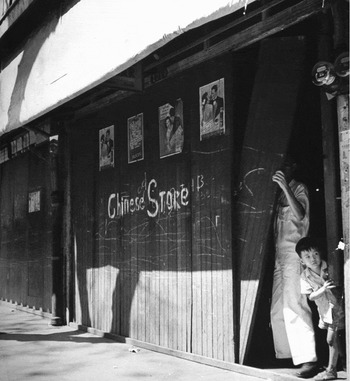
Many businesses did indeed close in Binondo during the war years [Figure 1]. All of Manila's pre-war Chinese movie houses, however, remained open. Moreover, not only were Chinese theatre operators able to continue to make a living under the harsh economic and cultural restrictions of the Occupation, they continued to compete against one another, and even establish new ‘traditions’ that would come to influence the exhibition, distribution and even financing of Chinese films in and from Manila in the postwar years. Just how they were able to do so is the question which this study seeks to answer.
Chinese shopkeeper in Manila boarding up store, December 1941. © Getty Images.

A note on methods and sources
The Battle of Manila (January–March 1945) was one of the most destructive of the entire Second World War.Footnote 11 It not only left much of the city in ruins, but also led to a dearth in textual sources from the war and pre-war years. Furthermore, in the early postwar period, there was little concern within the government of the newly independent Philippine Republic for the conservation of texts, heritage or artefacts associated with ‘non-Filipino’, for instance Chinese, communities. For all these reasons, research on the modern history of Manilans who produced or consumed Chinese-language newspapers, films, magazines and gossip remains challenging.Footnote 12
There are, however, some exceptions. This present study is based on research conducted in Manila, but it is also based on Chinese newspapers produced in the Philippines during the Japanese Occupation which no longer exist in Manila itself, and which are held, instead, in libraries overseas.Footnote 13 The primary source used in this study is a newspaper called Huawen Manila Xinwen (The Manila Chinese-language News—hereafter ‘Xinwen’): a ‘four-page propaganda tabloid. . .’; which became a ‘. . .major tool for introducing the New Order in Asia’. . .and an ‘. . .instrument of the state. . .’.Footnote 14 This was the only newspaper legally circulated amongst Chinese readers in Manila from 1943 to 1945, and the only forum for the regular advertisement of Chinese films in the city.Footnote 15
In light of the control that was maintained over the media at this time, it would be easy to dismiss such a source as nothing more than a mouthpiece for the regime. But as recent and comparable scholarship on comic strips published in the non-Chinese media in Manila during the same period demonstrates, Occupation newspapers provide an incomparable window into the choices made by members of the local intelligentsia who did not join the armed resistance. Occupation entertainment as it appeared in the pages of such newspapers sought to convince Manila's population of the successful ‘restoration of normalcy’, yet it also left for posterity a record of the limits of Japanese propaganda—be that in terms of the continued pervasiveness of the English language as a lingua franca, or in subtle and nuanced acts of subversion which appeared in print.Footnote 16 Used in combination with secondary sources about the period, as well as early pre and postwar material, the Xinwen—despite its flagrantly didactic role—provides one of the few ways in which we can garner knowledge about how (and which) films were exhibited amongst the Chinese community in Manila at the height of Occupation.
In drawing on such sources, we should remain conscious of the extensive work that has already been done on the use of comparable local or community newspapers in the study of early film history in other geographic contexts. As Paul S. Moore has noted, for example, ‘subcultural newspapers’ associated with often marginal or immigrant communities in North America, have provided the ‘evidential basis’ for a great deal of casework produced in recent years. As Moore suggests, such an approach
. . .require[s] the researcher to understand the ways in which a history of early cinema is embedded in the promotional discourses of newspapers that envisioned their own roles as serving their readerships as a public. The difference between mainstream and ethnic moviegoing was not simply a matter of who the empirical audience was, but of how those different publics were differently included in documents recording the public life of a locality.Footnote 17
In other words, although we are restricted in terms of what is available when tracing the history of film exhibition amongst Chinese Manilans during the war years, the sources which do exist, if considered critically and within their proper context, might also provide far more than the film titles, ticket prices or showing times. They also serve to illustrate how theatre operators sought to overcome the practical difficulties inherent in importing and exhibiting films during a period of great unrest and also how they sought to present themselves to their perceived clientele.Footnote 18
There is, of course, much that such sources can not tell us: who actually patronized such theatres? How did they behave whilst watching films? What did they think of the films they were watching? And how significant, frequent or remarkable was a trip to a Chinese theatre in Manila during wartime? Given the paucity of material surviving from the Chinese community during the middle of the twentieth century, it may be difficult for us ever to answer such questions. Equally, and as historians of the Occupation have already noted, the world as it was presented in the pages of the Japanese-censored press had only limited connections to the everyday experiences of the average Manila resident.Footnote 19 Nevertheless, and as this paper hopes to demonstrate, newspapers such as the Xinwen do tell us something about how—and, in some cases, why—those who chose to remain in Binondo under Japanese rule went about their everyday business. They shed light on at least one angle of quotidian life for Chinese immigrants in Manila in the war years, but also challenge us to reconsider the ways in which we view the Occupation.
Chinese film exhibition in the Philippines
A Chinese enclave near the area known today as Binondo was established by the Spanish in the late 1500s. Located beyond the walled city of Manila, but close to the Pasig River, it remained, until well into the twentieth century, the largest concentration of ethnic Chinese in the entire archipelago.Footnote 20 As a community, it was constantly being replenished by newly arrived emigrants from China—the vast majority of whom originated in southern Fujian.Footnote 21 Chinese migration to Manila continued throughout the Spanish colonial period (despite various attempts, at times, to restrict it), but accelerated from the 1860s onwards.Footnote 22
The first permanent space exclusively set aside for Chinese entertainment in the city appears only to have been established in the final years of Spanish colonial rule. Architectural historians have noted the existence of a Teatro Guiñol Chino in Binondo from the final decades of the nineteenth century, initially being located on modern-day Juan Luna Street, but eventually moving to Calle Sacristia (which became, from 1915 onwards, Ongpin Street).Footnote 23 And by 1902 A ‘Chinese Theater’ was listed as standing on present-day Yuchengco Street.Footnote 24
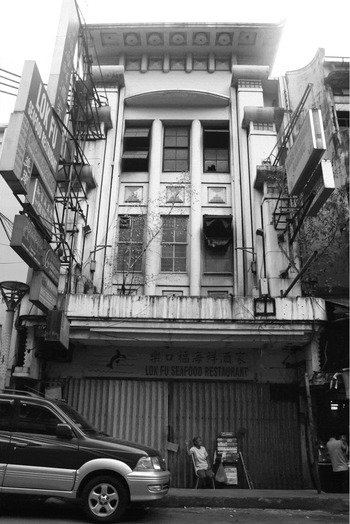
It was only in the late 1910s and 1920s, however, during a period when the cine (cinema) was developing into the pre-eminent pastime in the city,Footnote 25 that more permanent establishments for the exhibition of Chinese commercial entertainment—and specifically (silent) films made in China—began to be built in the city.Footnote 26 The first of these was established by a clan association known as the Yu Uy Tong, the founders of which purchased a plot of land at one of the main crossroads, on the corner of Ongpin and Salazar, in Binondo in 1915. The Yu Uy Tong decreed that the ground floor of its new edifice would be utilized as a theatre, with the funds generated from this business being used to support the activities of the clan association itself.Footnote 27 The theatre that came to operate on the site—which still remains at the time of writing, the only Chinese movie house still standing in Binondo (though operating now as a restaurant)—would go by a number of different Chinese names over the following years: starting out as the Da Hua Xiyuan in the 1930s, becoming the Da Guangming in the same decade and remaining so under the Japanese, and emerging in the early postwar era as the Hua GuangFootnote 28; in English, however, it would be known, from the 1930s until the postwar years, as the Rex Theater.Footnote 29 In its early years, the Rex operated almost exclusively as a Chinese movie house, exhibiting films imported from the Chinese mainland for Chinese-literate audiences. It was managed directly by the Yu Uy Tong (or individual members of this association), as was its affiliate film distribution business, known in English (rather incongruously for an importer of Chinese films) as Mabuhay Picture Co., but in Chinese as Xin Yuandong Yingye Gongsi.Footnote 30
Within a few years, however, a competitor to the Rex had been established. This was the Asia Theater (Yazhou Xiyuan), which was erected only a few hundred metres down the same thoroughfare of Ongpin Street.Footnote 31 Built by a lumber magnate called Vicente Gotamco, the Asia was established in the early or mid 1920s (though Gotamco's investment in the theatre may have been heightened during the Great Depression, when the lumber industry in Manila was hit particularly hard).Footnote 32 The venue was certainly being used as early as January 1925 for fundraising events amongst the ‘overseas Fujianese’ (Nanyang minqiao) community. By the mid 1930s, the Asia was claiming to ‘exhibit famous talking pictures from all the main companies in China’.Footnote 33
The art deco Asia Theater was arguably an even more imposing establishment than its neighbour (Figure 2). Indeed, the Asia Theater Building (Yazhou Xiyuan Daxia), which was directly attached to the main theatre itself, soon emerged as an institution in its own right, renting out space to eateries, broadcasters and various other businesses. The Asia presented itself—in the pages of its own house publication, for instance—as an institution with a patriotic, or Chinese, and cultural role to play. ‘Since its establishment in this port [Manila]’, claimed the company, ‘Asia Theater has been importing China-made films from the motherland [zuguo] into the Philippines. . .choosing only the best quality [films]’.Footnote 34 By the end of the 1930s, however, it was also exhibiting a substantial number of Hollywood films—despite continued claims that it represented a ‘centre of famous China-produced films’.Footnote 35
The Asia Theater, shortly before its demolition in 2008. Courtesy of the Heritage Conservation Society, Manila.

Like the Rex, the Asia was also home to a film distribution business—Asia Pictures (Yaxiya Yingxi Gongsi), though apparently sometimes referred to as Dian Hua (Zhonghua Yingxi Gongsi) by the mid 1930sFootnote 36—in these early years, a company which managed the import of films from China. By the mid 1930s, this was trading as Far Eastern Motion Pictures, and was managed by Henry Yang (Yang Zhaoxing).Footnote 37
By the end of the 1920s and early 1930s, both the Rex and the Asia had become major landmarks in their own right—two of the tallest and most easily recognizable buildings in the immediate area, and sites by which other establishments defined their position on Ongpin Street. Indeed, it was precisely because of the existence of these theatres and their affiliated businesses that this thoroughfare became associated with ‘restaurants, Chinese movie houses and curio shops’.Footnote 38 It is also noteworthy that these two theatres trace their origins to a time when, as Richard Chu notes, nationalism in the Philippines (and, just as importantly, in China) was encouraging the development of far clearer divisions of identity between ‘Chinese’ and ‘Filipino’ communities in Manila. In other words, the emergence of Chinese movie houses along Ongpin Street went hand in hand with the rise of more immutable definitions of what it meant to be ‘Chinese’ in Binondo in the middle years of American colonial rule.Footnote 39
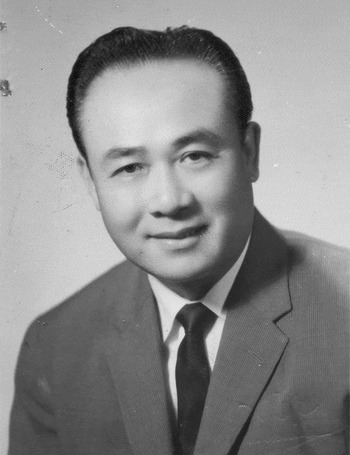
In the late 1930s, however, two new theatres catering to the Chinese community were built to rival the Rex/Asia duopoly, though often on less advantageous sites away from the bustle of Ongpin Street. One of these was known as the Coco (Hongxing Xiyuan) and was located on Juan Luna Street; arguably more important, however, was the Cathay Theater (Jindu Xiyuan: also listed as the Guotai Xiyuan) on Gandara—a street more commonly associated at the time with shoe production and canvas stores—which exhibited ‘. . .100% Chinese first-run pictures imported from China’.Footnote 40 Significantly, the Cathay was founded by the same Henry Yang who had earlier worked at the Asia. [Figure 3] In 1937, he established not only the Cathay itself but also his own film distribution and production business called Manila Films Co.Footnote 41 Like the Rex, Cathay went through various name changes in the early years of its existence, trading as City Theater (Jincheng Xiyuan) during the war.Footnote 42
Henry Yang (circa late 1950s)—manager of the Cathay/City Theater. Courtesy of the Lopez Foundation Library.

By the eve of the Japanese invasion, Binondo was thus home to at least four Chinese theatres.Footnote 43 This was also a time when the Nationalist Chinese Government in Nanjing was beginning to assert itself amongst Chinese communities abroad, particularly via the medium of film, and when Manila was emerging as one of many important sites in the Chinese Diaspora for promoting the Chinese film industry.Footnote 44 Olive Yang (Yang Aili), of the Great Wall Studio in Shanghai, for instance, made a much publicized visit to Manila in 1927 (appearing during her stay at some of the city's Chinese theatres), with this being partly organized by the Nationalist Chinese consul in the city.Footnote 45 And following the Japanese invasion of China in 1937, the Binondo theatres regularly exhibited patriotic, pro-Chinese, and anti-Japanese films to support the Chinese war effort.
Screening China in Occupied Manila
The long-standing narrative of the Second World War and its effects on the film business in the Philippines is a straightforward one: ‘The Japanese Occupation killed the Filipino film industry, for production during the period virtually came to a dead end’.Footnote 46 As the import of films from the United States (and other enemy states) was banned, theatres were forced to run and re-run existing stocks of Hollywood or other films that had entered the Philippines prior to 1942—providing these were not considered to contain any political content and were accepted by censors—or else to show Japanese propaganda pictures. Consequent audience fatigue with outmoded Hollywood features saw many theatre operators turning to vaudeville and drama as sources of revenue. Indeed, most historians of the Philippines view the war years as a period in which live drama came to replace film exhibition itself.Footnote 47
Chinatown theatres certainly suffered from this same lack of film stock. China-made films from the pre-war era were shown repeatedly in Chinese movie houses during the Occupation. The 1938 film adaptation of Cao Yu's Leiyu (Thunderstorm) starring Chen Yanyan, for instance, was a favoured movie at the Rex, the film being shown for a number of days at a time on various occasions during the years 1943 and 1944. Anything that could be even vaguely associated with the films or songs of the Shanghai singer-cum-actress Zhou Xuan proved particularly popular for virtually all of the Chinese movie houses, with her pre-war films being shown and re-shown throughout the period. And when a film that had hitherto never been exhibited in Manila did arrive on Binondo screens, it was considered a noteworthy event, even if the film itself was not particularly ‘new’: ‘we guarantee this is absolutely a first-run film—the first since the war started!’ exclaimed advertisements for the Zhou Manhua film Xin Meirenji (New Love Trap) (1941) being shown at the Asia in mid-1944, for example.Footnote 48
Nonetheless, the end of imports did not necessarily lead to the end of Chinese film exhibition. Indeed, although box office figures are not available, the record as it exists in the Occupation-sponsored Chinese press shows that, rather than reach a ‘dead end’, theatre operators on and around Ongpin Street attempted to keep their businesses running in often quite innovative (though not always entirely honest) ways.
There were a number of reasons for this. Firstly, and as has been well documented in studies of the Manchukuo film industry and film production in Occupied Shanghai,Footnote 49 the making of Chinese films—as well as films made in China and with partially Chinese casts—on the Asian mainland continued during the war years. Unlike Hollywood (the enemy) product, the import of such films was not only permitted in Japanese-controlled Manila but encouraged. As we shall see below, for instance, the Chinese-language films of Li Xianglan (Ri Koran)—the face of the Japanese-sponsored Man'ei—were exhibited in Manila in substantial number during this era.
Furthermore, and although questions of the reception of Chinese cinema in Manila at this time lie beyond the scope of this study, it is clear that theatres offered one of the few outlets for entertainment in Manila Chinatown during the years of Occupation (the others being a small number of dancehalls and cabarets), and also one of the few means by which Chinese residents could remain ‘connected’ to China, albeit a China filtered either through a skewed lens, or one which was sometimes a decade out of date. The feature films sponsored by the Japanese authorities in Manchukuo or elsewhere which made it to Manila may not necessarily have been accepted at face value by movie-goers in Manila, but they did represent at least one avenue through which slivers of information about China—remembered, imagined or perceived—could be gleaned.
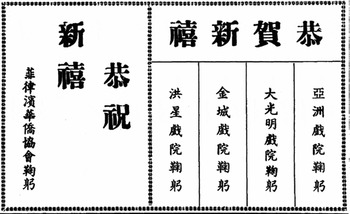
For all these reasons, the Chinese theatres all continued to operate throughout the period of Japanese Occupation.Footnote 50 Either through coercion or opportunism—we cannot know—all four of the main Chinese theatres were affiliated with the Philippine-Chinese Association,Footnote 51 a body set up under Japanese tutelage to ‘help provide the material requirements of the Imperial army’ and ‘as a center for information-gathering about anti-Japanese elements and activities in the Chinese community’Footnote 52 (Figure 4). Chinese Manilans who took up armed resistance against the Japanese often saw high-ranking members of this association—including theatre managers—as legitimate targets for assassination.Footnote 53
The four Chinese theatres, as members of the Philippine-Chinese Association, wish the Manila Chinese community a Happy New Year in the Xinwen, February 1944. Courtesy of the National Library of Australia.

None of this is to suggest that the individuals and firms who managed or owned these theatres wholly acquiesced with the Occupation authorities. Perhaps fearing that their long-standing place in the community would put them at risk, most high-ranking members of the Yu Uy Tong Club, for example, apparently fled the city, but they did so only after leaving the building that they owned, and the theatre within it, in the hands of lower-ranking Club members who continued to operate it throughout the Occupation.Footnote 54
Precisely how each of the four theatres chose to operate in this period, however, is another story, for the Xinwen shows that the four main theatres followed quite different paths, catering to specific audiences and tastes from 1942 onwards. Most noticeably, the two ‘younger’ theatres—the Coco and the City (formerly the ‘Cathay’)—saw the war as a means of broadening their market beyond the Chinese community. A glance at the City's offerings, for example, suggests an eclectic mix of films which occasionally included the exhibition of Chinese films made in pre-war Shanghai, but which included, more often than not, pre-war Hollywood movies which had been exhibited in theatres outside Binondo (as well as at the Asia) prior to the war, as well as Tagalog and European films. Indeed, the City occasionally exhibited Japanese propaganda films.
Significantly, and unlike the Asia and the Rex, both the Coco and the City advertised in the English-language press (The Manila Tribune), doing so with little if any indication that these were theatres run for (and, prior to the war, catering to) the Chinese population. Yet they also marketed their offerings in the Chinese press, doing so with direct appeals to Chinese audience sensibilities (some of which shall be examined below). The Coco also made the most of its relative youth and hence its more up-to-date amenities: it was the only Chinese movie house to regularly mention ‘stable projection’, ‘clear sound’, a ‘cool atmosphere’ and ‘comfortable seating’ in its newspaper advertisements, perhaps in direct reference to the less than ideal facilities of its older competitors.Footnote 55
In a quite different vein, the Rex and the Asia continued to present themselves as serving the Chinese (and Chinese-literate) community almost exclusively—at least until late in the Occupation. These two theatres exhibited China-produced films, the vast majority having been imported into the city prior to 1942. Only in mid-1944, for example, did the Rex begin to exhibit Japanese propaganda films (and only in small numbers), usually after these had played at larger theatres outside Binondo. The Asia appears never to have shown anything other than Chinese-language films, and to have never succumbed to the exhibition of overtly Japanese propaganda, despite the ironically coincidental ‘pan-Asianism’ of its 1920s-era name.
Similarly, the Rex and the Asia continued to present themselves as sites of cultural leadership for what was referred to in the Xinwen as the ‘qiaojie’ (‘the overseas Chinese community’) in the city, and this appears to have become even more pronounced as the war dragged on. Both theatres chose their films carefully: dominant amongst them were what the theatres themselves classed as ‘shenguaipian’ (fantasy films),Footnote 56guzhuangpian (period dramas) and films derived from minjian gushi (folktales). They claimed that such films were being exhibited ‘to raise the spirits of our audience’ or to ‘break the boredom’ (dapo menqi) of Manila theatre-goers.
Equally important, however, was how both the Rex and the Asia chose to justify the need for exhibiting predominantly Chinese films, and the lengths to which each theatre went in appeasing Occupation censors whilst maintaining some degree of cultural integrity and continuity with their pre-war role. When, in 1943, the Rex chose to dig out a 1930s re-make of the 1928 film Huoshao Hongliansi (The Burning of Red Lotus Temple), for example, it chose to market a film based on what had been one of the most commercially successful movies amongst Chinese audiences in Southeast Asia during the late 1920sFootnote 57—one that many film historians have acknowledged as one of the first examples of the wuxia (knight errand) genre—as ‘a great fantasy film (shenguai jupian) which people all over Asia have welcomed (Dongfang renren huanying)’. Chinese audiences in the city, many of whom would have been aware of the film (perhaps having seen it, or one of the many copies it inspired, in either Manila or Fujian in the 1920s and 1930s) would probably have been aware of this film's significance in the martial arts genre and its place in the history of Chinese film-making. Yet in promoting the film, the Rex barely mentioned China, cloaking the film instead in the woolly rhetoric of ‘pan-Asianism’. The same was the case for the Asia's offering of pre-war movies starring the Shanghainese comedic duo of Han Langen and Liu Jiqun—‘the genuine Oriental Abbott and Costello’ (Dongfang zhengpai Apang Asou). And successive Chinese child performers from the pre-war era were referred to in Xinwen adverts as ‘the Oriental Shirley Temple’ (Dongfang Xiulan Dengpo): Hu Rongrong was presented in this manner by the Asia, and Mou Ling by the Rex.
This did not stop the Rex from appealing to specifically Chinese pride in pre-war film-making, however. Its decision in December 1943 to show the 1934 film Yuguangqu (Song of the Fishermen) is surprising not simply because of the success that this movie had achieved following its early release in the Soviet Union (thanks to its demonstrably Leftist message) but also because the Rex boasted about this being a ‘guopian daibiaozuo’ (‘a representative Chinese film’) that had been filmed ‘on location in Ningbo’. In other instances, the Rex appealed to specifically Chinese events in its programming. It re-ran the 1940 film Xixiangji (The Romance of the Western Chamber) over a series of days in 1944 to coincide with Chinese New Year (referring to this as ‘New Year in the old calendar’), for example, consciously celebrating the festival with the screening of a ‘classical subject adaptation’ film set in ‘cultural China’, but which also harked back to the golden age of Republican Shanghai film-making.Footnote 58 In the Xinwen, the theatre boasted a full house for a number of days as a result.
Just as importantly, the Rex and the Asia often directly competed against one another—whilst also maintaining some degree of cooperationFootnote 59—in pursuing the ‘cultural China’ market. In June 1944, the Asia exhibited for a number of days Du Shiniang (For Love or Money) (1939), a Hong Kong-produced Cantonese period drama based on a story from the Chinese classics (doing so with the inclusion of projected synopses for non-Cantonese speakers). Within days, the Rex was exhibiting a film starring the Shanghai starlet Gu Lanjun with a remarkably similar setting, Ernü yingxiong zhuan (Heroes and Heroines) (1938), renaming the movie Shisan Niang (Lady Thirteen)—the name of the main character played by Gu—for the immediate purpose of marketing it against the Asia's offering.Footnote 60
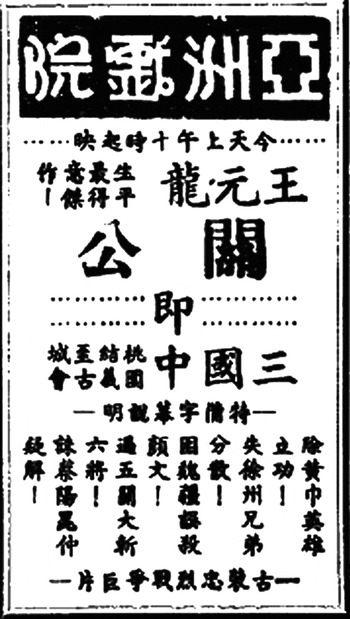
Furthermore, whilst the Rex took a slightly more cautious approach in advertising certain films, the Asia was more adventurous, its promotion of pre-war historical epics giving allegorical significance to films which were not necessarily political in the first place. When in 1943 the Asia exhibited a pre-war filmic adaptation of Guan Gong (based on the Romance of the Three Kingdoms classic), it did so with language that any Nationalist Chinese bureaucrat in Chongqing would have been proud of (though with no overt reference to China itself), promoting it as a ‘a great historical war drama about martyrdom’ (guzhuang zhonglie zhanzheng jupian) (Figure 5).
Xinwen advert for Guan Gong, showing at the Asia. Courtesy of the National Library of Australia.

At other times, there were instances where both the Rex and the Asia appear to have flirted with the boundaries of Occupation acceptability in trying to present themselves in ‘patriotic’ guise by promoting particular films in particular ways. For example, at different points throughout 1943 both theatres exhibited a 1941 period drama entitled Xiangsi zhai (Xiangsi Stockade), which told the story of a patriotic woman living in China's western borderlands who takes up arms against foreign invaders. Both promoted this film with direct reference to the story of Hua Mulan and earlier cinematic explorations of that same story (such as the 1939 movie Mulan Joins the Army) that had been made in direct response to the Japanese invasion of China in (a then only partially-occupied) Shanghai,Footnote 61 and exhibited in Manila Chinatown in June of the same year.Footnote 62 In claiming that Stockade was ‘a great film that surpasses Mulan Joins the Army’, as the Rex did in the pages of the Xinwen, or in stating that it told the story of the ‘second Mulan’ who ‘sought glory for her brethren (tongzu) and sacrificed herself for the nation’, as the Asia argued, both theatres were sending a clear and barely shrouded message to Chinese-speaking audiences in Manila.
The limits of pan-Asianism
The decision of the Rex and the Asia to continue the role that each had played since the 1920s, that of institutions through which Chinese commercial culture could be distributed in the heart of the Manila Chinese community, might well be read in themselves as acts of subversion against the Occupation. The exhibition of films which celebrated Chinese heroes and heroines of legend, particularly those who resisted forces invading China from other parts of Asia, equally seem incongruous with the promotion of pan-Asianism at the time.
However, and despite the very clear (though unspoken) references to Chinese resistance in advertising for a handful of films, there was nothing necessarily contradictory in celebrating cultural China, marking the Chinese New Year with special film showings or reminding Manila's Chinese community of Shanghai's earlier eminence as the film-making capital of the Chinese world whilst at the same time accepting (or appearing to accept) Japanese rule in the Philippines—or even in China. As George Weightman has argued, for instance, it was in the interests of the Japanese at this time not to try and directly combat Chinese nationalism in Manila but instead to coerce the Chinese community into support for the Wang Jingwei regime in Occupied Nanjing.Footnote 63 Indeed, in continuing to refer overtly to China and Chinese history, and to use many of the symbols that had once been attached to the Republican Chinese state (the Republican calendar, for example), the Manila Chinese community was in essence conforming to all that the Wang Jingwei government stood for. Celebration of Chinese culture and even of a recent Republican Chinese heritage was welcomed, providing that it was worked into a wider discourse of pan-Asianism (and all that went with that, from ‘anti-communism’ to ‘anti-Chiangism’).Footnote 64
Similar nuances and complexities surround the showing of the Li Xianglan films in Binondo, which were exhibited mainly at the City and at the Rex's affiliate, ‘New Cathay’. Whilst the provenance and clear propaganda messages inherent in Li's films form the basis of a substantial scholarly literature in their own right, recent studies indicate a far more nuanced reception of such films in the Chinese-speaking world. As Shelley Stephenson has suggested, for example, the ambiguities that were cultivated around this China-raised Japanese performer who became almost inextricably associated with imperial Japan's ‘pan-Asianism’ did not necessarily ‘dupe’ gullible Chinese audiences. Instead, the ambiguities surrounding this celebrity ‘allowed audiences to see in her whatever they wanted to see’.Footnote 65
Stephenson's argument is given weight by the exhibition context in Manila. In a number of cases—such as Sun Wukong (The Monkey King) (1940), which ran at the City in late 1943—Li is listed alongside Chinese actors with no overt reference to her ancestry, and with virtually no reference to her role in imperial Japanese propaganda. In such cases, there is little to tell this ‘shenguaipian’ from any other ‘fantasy film’ inspired by stories from Chinese legend and literature, and virtually no way—barring the three character's of Li's name itself —to distinguish the film's ‘canlan mingxing’ (‘shining star’) from any other pre-war Chinese celebrity.
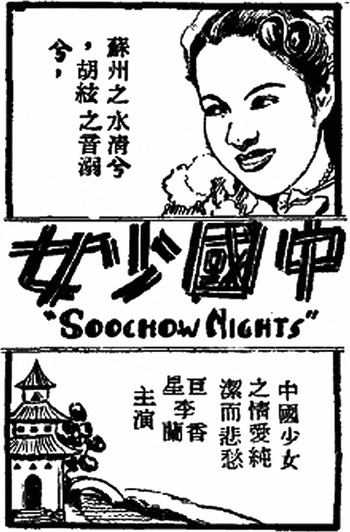
In other cases, however, Li's far from apolitical career at this stage was clearly an issue. When Zhongguo shaonü (Soochow Nights) (1942) was shown at the Rex in September 1944, for instance, it was marketed not as a ‘pan-Asianist’ film, but one which instead showed images of China itself—something alluded to in the traditional Chinese architecture drawn in the advertisements for the film—and starring the ‘mingxing’ (neither Chinese or Japanese) Li Xianglan. Potential viewers who were confused about the provenance of the film were informed that its dialogue was in Mandarin, whilst those amongst the community who preferred could make use of its English subtitles. Despite the pan-Asianist message contained in a film that depicted a recalcitrant Chinese orphanage owner falling in love with a benevolent Japanese doctor, no overt reference to the political message of this ‘romance’ is present (Figure 6).
Generic advertisement for the Li Xianglan film Zhongguo Shaonü (Soochow Nights) appearing at the Xinwen in 1944. Courtesy of the National Library of Australia.

As with other Japanese-occupied territories in Southeast Asia, Japanese-produced films extolling the virtues of pan-Asianism and the self-sacrifice of the imperial army, and decrying British and American imperialism, were also exported en masse to the Philippines.Footnote 66 Films praising Japanese rule in other parts of Asia such as Bōrō no Kesshitai (Suicide Troops of the Watchtower) (1944) (which showed for a period of weeks in 1944), were advertised in the Chinese press, although such films generally had their first run in much larger theatres outside the immediate Binondo area. There were also a handful of Japanese films made with Filipino actors and based on Philippine-themed plots which celebrated Japanese rule in the archipelago,Footnote 67 and each of these was advertised in the Xinwen: examples include Ana Hata wo Ute (Dawn of Freedom) (1943) and Tatlong Maria (1944), the latter advertised in Chinese as San ge Maliya (The Three Marias).
Arguably more relevant for specifically Chinese audiences, however, were films such as the much-documented Ahen sensō (The Opium War) (1943), which sought to justify Japanese actions on the Asian mainland with reference to the history of British imperialism in the region. The Opium War was exhibited at the City in March 1944. The pan-Asianist message of the film itself, however, was absent from its advertising in the Xinwen. Here, the film was promoted, in an almost endless string of adjectives, as a ‘magnificent period war drama set in China’ (quanbu Zhongguo lishi guzhuang zhanzheng chaote weida jupian’). There are references to the grandness of the film's war scenes and to its depictions of the burning of opium by Lin Zexu,Footnote 68 yet direct references to imperialism, the British, or Asian liberation, are conspicuously absent.
The situation was similar even for those films which had been produced in other Axis countries but which could be made to tell what Occupation censors believed were highly relevant messages about the evils of Western colonialism. The classic example of this was the 1941 German production Ohm Krüger. This high-budget historical epic detailed the British treatment of Afrikaners during the Boer War. It was also exhibited widely in Japan, where the film was worked into the wider rhetoric of Pan-Asianism, and where the evils of British rule in South Africa were equated with British imperialism in East and Southeast Asia in the entertainment press.Footnote 69
Running for a number of weeks in Manila in 1944, Ohm Krüger was advertised extensively in the Chinese press, both under its German title, but also under the Chinese title of Yingguo zuie shi (A History of British Evil). However, whereas the ‘anti-British’ element of such films was certainly alluded to in advertisements that accompanied them, the Xinwen also sought other ways in which to interest Chinese viewers. In the case of Ohm Krüger, for example, advertisements began with an hysterical, and highly Japanified,Footnote 70 focus on the film's anti-colonial message: ‘The incomparably ghastly ruthlessness of the British empire is exposed without doubt during the South African War [sic]’. Within a few weeks, however, a very different approach was being taken to a movie ‘which was filmed in the Transvaal [sic]: the largest source of gold on earth’. For those who lived and worked on a street famed for its jewellers (Ongpin), it would seem that an appeal to South African mineral wealth was the best way to coax potential viewers to theatres—rather than the moral of the film itself. Some weeks later, the same film crossed the Pasig River and turned up first on the screens of the City, where it was re-titled as an action film—Nanfei Ying De Daxuezhan (The Great Anglo-German War in South Africa)—and where it played (rather incongruously given earlier attempts to promote it as a ‘Pan-Asianist’ text), alongside Bing Crosby's Road to Singapore (1940), the latter being re-titled Meinüdao youji (Travels on the Isle of Beauties). Some days later it appeared at the Coco, for less than a week, eventually playing as a support to Laurence Olivier's Pride and Prejudice. Once in Chinatown, the film was no longer A History of British Evil: the Coco hung a far more neutral title of Guoqing Kaluge (Nobleman Krüger) on this ‘German film about war in South Africa’—and assured viewers that the film included English subtitles.
Japanese propaganda thus was exhibited in Binondo. However, in most cases, the Chinese movie houses showed Japanese-produced war films only after these had been exhibited at the far larger theatres in other parts of the city. Furthermore, whereas theatres such as the Rex and the Asia took great pride in stressing the Chinese provenance of the films that they showed (emphasizing the place of such films in China's film-making history or reminding audiences that parts of a certain film had been shot in China) they avoided virtually all mention of the provenance of the Japanese films they showed (in contrast to first-run theatres, which appear to have translated Japanese synopses for the films in question directly into Japanese). For the Binondo theatres, that which went unmentioned appears to have been just as important as what was spelled out in advertising space.
China—in any form
As the various ways in which Li Xianglan films were exhibited to Chinese audiences in Manila suggests, there seems to have been a belief amongst theatre operators on Ongpin Street and its environs that audiences would be willing to consume certain movies, despite their overt ‘pan-Asianist’ message—be that because they contained references to China, were in Chinese, or were the only things on offer.
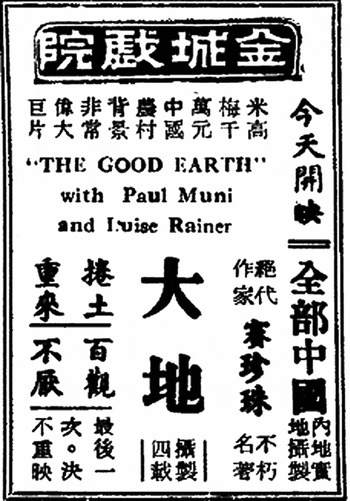
Strangely enough, however, the perceived need to view China (and Chinese people), however they appeared, also drove the choice of films to be exhibited in the Binondo movie houses, even when such films clearly contradicted Japanese efforts to purge the Philippines of ‘Occidental’ influence. In mid-July 1944, for instance, the City competed directly with the Asia over a period of days by appealing to Chinese audiences who were apparently filling the Asia to capacity (keman) at the offer of the 1939 Guohua film Xin Diyu (New Hell). In response, the City exhibited the 1937 Hollywood film The Good Earth (given in Chinese as Dadi); whilst the fact that the film was an American import was not hidden from readers (its main stars Paul Muni and Luise Rainer were listed in English within the Chinese advert), it added in large type the erroneous claim that the film was ‘completely filmed in the Chinese interior’ (see Figure 7). Audiences were thus given a choice (and one which, ironically, contrasted with the English names of the competing theatres themselves): urban Shanghai at the Asia, or (apparently) rural China at the City.
City advertisement for the The Good Earth, July 1944. Courtesy of the National Library of Australia.

Similarly, the few Hollywood films in which Chinese characters were portrayed in a benevolent light proved particularly popular. Charlie Chan (advertised as Chen Chali) films from the pre-war era played at City occasionally, and films starring Anna May Wong (‘Hollywood's number one and most popular Chinese actress’, according to the Xinwen) were also exhibited in significant number.
The four theatres also competed directly with one another by appealing to audiences with culturally Chinese references—even in advertisements for films which had nothing whatsoever to do with China. This was particularly true of the Coco and the City. For example, whereas the Rex was exhibiting pre-war Zhou Xuan films such as Malu Tianshi (Street Angel) (1939)—marketed in 1944 as Tianya genü (The Wandering Songstress), after the name of one of the film's songs—the Coco was renaming its pre-war b-grade Hollywood movies with what were remarkably similar Chinese titles: Maureen O'Hara's Dance, Girl, Dance (1940) was advertised as Tianya wunü (‘the wandering dance girl’). The Marx Brothers’ film Go West of the same year was marketed as Xin Xiyouji (‘the new Journey to the West’) in direct reference not simply to the Chinese classic of the same name, but in competition with the Shanghai-produced martial arts films being shown in other Chinese theatres at the same time. And as the Asia exhibited Yidai chongwu (The Perfect Woman) (1939)—a vehicle for the dancer-cum-actress ‘Peking Lily’ (Beiping Lili)—during the summer of 1944, the Coco exhibited the 1940 biopic Lillian Russell, giving it an identical Chinese tile (Yidai chongwu) to the Chinese film being shown in the neighbouring theatre. Even the Chinese title given to the b-grade horror film The Black Cat (1934)—Hei mao‑had a specific significance to Binondo audiences which might otherwise have found the film both dated and not of terribly good quality: the Heimao wuchang (Black Cat Dancehall) had been one of Republican Xiamen's most celebrated sites of ‘modern’ entertainment, and the same name was used to christen an Occupation-era dancehall in Manila's Chinatown.Footnote 71
The Rex was not always on the receiving end of such marketing innovations. Its affiliated New Cathay attempted to win Chinese viewers to the 1939 Code of the Streets by advertising this American film's characters as having ‘the deportment of characters from the Water Margin (Shuihuzhuan)’. Pre-war Tagalog films, such as Nag-iisang Sangla (1940), were re-christened with Chinese titles identical to those of celebrated movies from the pre-war Shanghai canon—in this case the highly successful Hu Die film Zimeihua (Sisters Two) (1933).
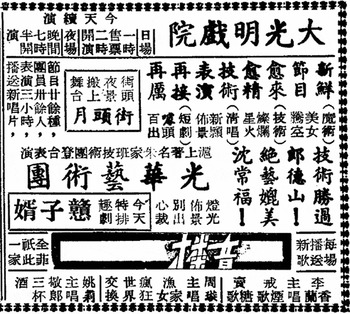
Towards the end of Occupation, however, this desire for specifically Chinese entertainment—particularly on the part of the Rex and the Asia—led some of the Chinatown theatres into new fields. From late 1944 onwards, for example, the Rex became second home to an ‘artistic troupe’ which touted a name remarkably similar to that under which the Rex had traded in the pre-war days, and which carried overtly Chinese connotations—the Guanghua Yishutuan (the ‘Glorify China Artistic Troupe’).Footnote 72 The troupe performed what would today be classed as ‘variety acts’ on the Rex's stage, ranging from magic tricks to dramatic performances (in Chinese). These were originally presented alongside film showings, yet they soon appear to have eclipsed the exhibition of films themselves and become one of the Rex's main drawcards by late 1944. Guanghua included about 30 performers, all of whom, guaranteed the Rex, were Chinese. The Rex also experimented with other modes of commercial entertainment during this era. This included the broadcasting of popular shidaiqu Mandarin songs ‘imported directly by air from Shanghai’. Audiences could listen to the latest Li Xianglan and Zhou Xuan records at sessions which the Rex christened, for a time at least, ‘Yinlou’—‘Sound shop’.Footnote 73 At other times, the broadcasting of songs was combined with an afternoon of variety from the Guanghua Troupe, and the exhibition of a pre-war Shanghai film. If an increasingly limited selection of films meant that the ability for an audience to see China was becoming rare, then the Rex could at least ensure that Shanghai could be heard (Figure 8).
Xinwen Advert for the Guanghua Troupe and the Yinlou music broadcasts at the Rex, late 1944. Courtesy of the National Library of Australia.

Conclusion: The legacy of Occupation
In his work on the Shanghai film industry during the years of the Japanese Occupation, Poshek Fu has moved beyond what he refers to as the ‘binary reductionism’ of earlier narratives concerning film-making in that Chinese city, in which all actions were reduced to either collaboration or resistance. He examines the ‘cultural-political ambiguity’ of film-making in what was a highly complex network of Chinese producers, Japanese censors and local audiences, but also points out that ‘in. . .a highly politicised situation, apolitical entertainment can become significantly political precisely because it is depoliticised’.Footnote 74
Less has been written about how similar nuances and ambiguities also applied to those at the other end of the Chinese cinematic chain in Asia—the theatre operators spread throughout Southeast Asia who had made a living out of exhibiting Shanghai products in the years prior to the war, and who sought to continue to survive by showing ‘apolitical entertainment’ in a post-Pearl Harbor world. For the Yu Uy Tong Club or others in wartime Manila the situation was arguably even more complicated than it had been in Japanese-Occupied Shanghai, serving as they did a community which was itself marginalized in Philippine society, which sought to maintain links with a homeland that represented the main ‘theatre of war’ for the Japanese in mainland Asia, and which was at war with itself for much of the Occupation. As Fu implicitly suggests in his study, however, there is much that can be learned from the ways in which individuals or organizations which have hitherto been dismissed as collaborationist (or whose role during the war has not been discussed before) chose to behave in extraordinary circumstances—be they the producers or exhibitors—on Nanking Road or Ongpin Street. As we have seen above, some Chinese theatres exhibited Japanese and even Nazi propaganda (and some more than others). Others, however, used the rhetoric of Japanese pan-Asianism to promote pride in Chinese cinema, or to celebrate a pre-war China that had been known to many of their clientele. They showed formulaic films based on folktales and stories from Chinese myth and legend, but they often did so with particular justification. In some cases, their allegorical references to the situation in China, via the complicated route of references to films that were not being exhibited in Manila at the time (but were known to contain explicitly political messages), appear to have successfully subverted Japanese attempts to shift local Chinese sympathies in the direction of Wang Jingwei.
Fu's approach also encourages a re-focusing on the war years, not as a mere aberration that is better forgotten (a throw-away paragraph in a much longer narrative about immigration, marginality and ultimate integration or ‘deconstruction’Footnote 75) but as a legitimate period in the social history of this community, and one that is worthy of study. In this regard, the story of Chinese film exhibition in Manila also helps to contextualize a small but growing literature on the relationship between the Philippine-Chinese and the realm of cinema.Footnote 76
Furthermore, the same lessons that are applied to film exhibition might also be applied to production. There is a remarkable continuity, for instance, in Chinese film exhibition practices in Manila, before, during, and after the war. Indeed, whilst it might be tempting to view as unique the sudden and severe restrictions on Chinese film imports that were experienced during the Occupation (and theatres’ responses to these) events in China in 1949, and the subsequent collapse of the Shanghai film industry in that same year, led to a similar crisis of supply for the Rex, the Asia and other Chinese movie houses in Manila. In this case, the experience of Occupation proved useful. Returning to the ‘cultural China’ that had been celebrated in the pre-war Shanghai films circulated in wartime Manila, the Binondo theatre managers turned to financing the production of ‘new’ films—many of them little more than remakes of the pre-war cannon of period dramas or ‘modern’ Zhou Xuan movies that had been recycled in wartime—in Hokkien. They continued to support live stage shows to accompany film exhibition in Manila as they had done in the latter years of the war (just as the Rex had begun to do in the latter stages of 1944). And the Rex and the Asia, in particular, continued to champion an imagined ‘cultural China’ until well into the 1960s, first with black-and-white Hokkien period dramas and opera films (the ‘Amoy-dialect films’ which were originally largely financed from ManilaFootnote 77) being churned out in Hong Kong and later the huangmeidiao films of Shaw Brothers’ fame. The very titles of films that were shown in Manila Chinatown in 1954—to say nothing of the language used to advertise such films, the names of the theatres themselves or the claims of those theatres to be showing ‘an absolutely new film’—look remarkably similar to those exhibited ten years earlier.
The path chosen by Cathay/City and Coco led to new markets for such theatres, and this clearly benefited these institutions following the war. Whilst maintaining a commercial stake in Chinese movie houses (and rebuilding City—as the ‘Golden City’—after it was destroyed in the Battle of Manila), for example, Henry Yang expanded into completely new areas of exhibition in the postwar years. By the 1980s, his ‘Yang circuit’ had become one of the two largest cinema operators in the country (doing so on the back of Tagalog and American films).Footnote 78 Such examples are perhaps indicative of the extent to which the experience of negotiated accommodation with the realities of Occupation could also be put to use in the face of rising post-war Philippine nationalism, and an anti-communist sentiment which often took the form of blatant anti-Chinese feelings in many sections of Philippine society.
Yet it could just as easily be argued that, as a result of the Occupation, Binondo emerged in the 1950s as an even more Chinese Chinatown—a place in which constant re-runs of ‘old China’ and ‘Republican Shanghai’ as imagined through gramophone records or Chinese period dramas, had become the staple. Whereas the Occupation may have broken down the barriers to some degree, in others it reinforced them. The longevity of the Asia and the Rex as sites of almost exclusive Chinese entertainment from the 1920s until their closure in the 1990s—despite the difficulties that this entailed during the war years—speaks directly of the strength of many of the older communal identifications that sections of this community clearly maintained throughout the twentieth century.
Such conclusions fit uncomfortably with much of the scholarship that today seeks to undermine the very notion of a single and definable Chinese community in Manila; the idea of a Chinese audience watching re-runs of Zhou Xuan films whilst their cousins were fighting in the jungle also unsettles the narrative embodied in exhibitions such as the itinerant Nanjing display with which this paper began. Yet the entertainment pages of the Xinwen tell a far more complicated story than either strands of research on the Manila Chinese would usually stress—one of filmic texts being utilized in the service of myriad ideologies, of the pervasiveness of the very idea of ‘China’, and of the commercial realities faced by those whose livelihoods depended on selling cinema tickets to Chinese-speaking audiences in wartime Manila.