Introduction
Starting from the late 1980s, the quality of government or government performance became an issue of both academic interest and policy significance. The ‘good governance’ discourse grew out of the development community, and gained much currency elsewhere. ‘Official’ conceptualizations of good governance mainly came out of World Bank, the IMF, the United Nations (especially the UNDP), the OECD, and other donor organizations. According to the United Nations, for example, ‘governance’ can be simply defined as ‘the process of decision-making and the process by which decisions are implemented (or not implemented)’ (United Nations, 2006). The international development community's understanding of governance is typified in World Bank's now well-known six-dimensional definition of good governance, including elements such as voice and accountability, political stability, government effectiveness, rule of law, and control of corruption (see, for example, Kaufmann et al., Reference Kaufmann, Kraay and Zoido1999).
Such efforts by the Bank, the UN, and other agencies to help improve governance in the developing countries are certainly admirable. In practice, however, this ‘good governance’ effort and the discourse supporting it have come under heavy attack. The central problem, of course, is with regard to the measurement of governance quality (Nanda, Reference Nanda2006). Measurements designed by the experts of these Western agencies are often criticized as being ineffective, failing to capture the realities on the ground. Setting conditions for the aid-receiving governments, furthermore, the international groups are often accused for politicizing their aid projects (see, for example, Santiso, Reference Santiso2001).
This study is an attempt to extend our understanding of good governance. By looking at citizens’ satisfaction with government performanceFootnote 1 as a new dimension, the findings from this paper will help address a major deficit of the current literature on good governance: that of a citizen perspective. Citizens are the consumers of the goods the government supplies; hence, they should be the ultimate evaluators of government quality. Another deficit of the current literature is that it overwhelmingly addresses governance issues in developing countries. The six countries this paper examines will include both developed and developing countries. Findings from this study, therefore, will help shed some light on the insufficient comparison of government performance issues between developing and developed countries.
The paper starts by reviewing ‘good governance’ as an area of research in the literature as well as an international effort for promoting development. Next, I introduce a perspective of ‘good governance’ centring on the citizens. From this perspective, I try to develop hypotheses regarding citizens’ assessment of governance: what would make citizens give a higher evaluation of government performance, and what would make them to give a lower evaluation? These hypotheses are then presented in the following section, where their independent variables are also explained. A further methodological section then introduces the measurements of the dependent variables of this study: citizens’ satisfaction with governance. Findings are then presented, before a final section closes the paper with discussions and conclusions.
The good governance ‘movement’
International concern about good government runs back to the 1980s. Through the years a whole body of literature, instruments, and practices have developed, and become institutionalized. This discourse points to ‘good governance’ as critical for economic, social, and human development, and identifies ‘bad governance’ or ‘poor governance’ as the root cause of failed or delayed development. The United Nations and the World Bank, as well as the aid-related government agencies in the developed countries are the main voices for improving governance to achieve developmental goals.
These now institutionalized emphases on good government make sense at a time when the world faces serious challenges to achieving equitable and sustainable development, such as the Millennium Development Goals. Good quality government in third world countries is essential to achieving such goals. The United Nations believes good governance should comprise characteristics such as participation, rule of law, transparency, responsiveness, consensus orientation, equity and inclusiveness, effectiveness and efficiency, and accountability (Kaufmann et al., Reference Kaufmann, Kraay and Mastruzzi2008). While acknowledging such goals are difficult to achieve in their totality, the UN as well as other agencies still believe that actions should be taken to work toward such ideals in order to achieve sustainable human development.
The World Bank's WGI (Worldwide Governance Indicator) is so far probably the most successful effort to operationalize the ‘good governance’ concept into executable policy tools (Kaufmann et al., Reference Kaufmann, Kraay and Mastruzzi2008). This instrument looks at six dimensions of a country's governance quality: voice and accountability, political stability and absence of violence, government effectiveness, regulatory quality, rule of law, and control of corruption. By aggregating measurement data from various sources, WGI has enabled the research and policy communities to compare governance across the world. In the first attempt, undertaken in 1993, the WGI exercise only relied on 13 data sources, and generated an indicator that covered 173 countries. By 2008, the measurement has expanded to include data from 35 separate sources, and cover 212 countries (Kaufmann et al., Reference Kaufmann, Kraay and Mastruzzi2008). These mainly rely on perceptions, that is subjective data on governance from cross-country surveys of firms, commercial risk-rating agencies, think-tanks, government agencies, and international organizations.
While resulting in probably the most comprehensive and methodologically rigorous measurement of quality of governance, the WGI still faces several conceptual challenges. For example, how reliable are the polls of experts it overwhelmingly draws from? Many argue these polls have small samples and are often coloured by economic outcomes; that is, they are biased toward economically more successful countries. Also, many international watch-dogs such as Freedom House and the Amnesty International, whose data WGI relies on, are well-known for their ideological emphases. It is, therefore, possible that ratings from these organizations are biased toward, for example, countries with established electoral democracy. In recent years, the WGI has attempted to include in its data sources larger N surveys, including some household surveys, but a question still remains whether such data are interpreted in culturally specific ways.
One can challenge the validity of these indicators by pointing to the high correlations between these supposedly separate measurements. For example, among African countries, one can find from the Freedom House's ‘Freedom In the World’ rating, an indicator of democratic consolidation. At the same time, for each country one can find in the WBI an indicator of governance performance. These two indicators, while clearly constructed and calculated by two separate organizations, can explain each other very well (Bratton and Chang, Reference Bratton and Chang2006). This finding speaks to the ‘sequencing’ debate in comparative democratization, that is in a developing country, whether democratization should proceed state-building or vice versa (Rose and Shin, Reference Rose and Shin2001). Bratton and Chang (Reference Bratton and Chang2006) conclude that since democratization (measured by the Freedom House score) and state-building (measured by the WGI) are mutually supportive, they should not be sequenced, but should go hand in hand instead. But the finding that the indicator of democracy and that of governance explain each other may in fact substantiate the accusation that the two measurements, although conceptually distinct, and produced and promoted by two separate organizations, in reality are actually measuring the same thing.
Besides these conceptual and methodological issues in turning the ‘good governance’ concept into policy tools, controversies also abound in that the enforcement of ‘good governance’ measures through aid conditionality simply does not work. Since no consensus regarding definition and measurement of governance can be found, no universally acceptable measures can be developed to actually improve governance (Nanda, Reference Nanda2006): if you cannot measure it, you cannot improve it. Empirically, in terms of linking governance improvement with debt forgiveness, often countries with an improving record of governance are not rewarded by cancellation of debt (Neumayer, Reference Neumayer2002). While development agencies deny the political nature of aid conditionality, asserting that they aim at promoting governance not democracy, researches find that democracy and governance are not sustainable without one another. As a result, the study argues that, instead of claiming to be a-political, UN and the World Bank should explicitly promote both governance and democracy at the same time (Santiso, Reference Santiso2001).
Resistance against imposing developmental standards designed in the Western capitals remains strong in the aid-recipient countries. Sometimes, relying on ‘good governance’ and ‘sustainable human development’ in order to press for changes from governments in developing countries is depicted as ‘ideological imperialism’ (Blunt, Reference Blunt1995). The tension between political and non-political goals is certainly strong, and any effort from the Western capitals to differentiate them will be difficult, if not impossible. Because of this, China's recent involvement in providing aids without requiring accompanying governance reforms seems to have stirred up a new round of debate.Footnote 2
Citizens and government performance
Ideological imperialism or not, at least so far WGI and other indicators have not included citizen evaluation of government performance in their data sources. Certainly, this is not due to the lack of such data: cross-country opinion surveys have long existed, and many of these surveys, such as the World Values Survey and the various regional ‘barometers’, ask about citizens’ satisfaction with their government. AsiaBarometer, for example, has since 2003 surveyed citizens’ opinions about their government's spending on the environment, health, policing, national defence, and pensions, among others. It has also surveyed their satisfaction with their government's approach to the economy, corruption, human rights, and many other policy issues. Similar questions are also included in other cross-country surveys, such as the Asian Barometer, the Latino Barometer, the New Democracy Barometer, and the Afrobarometer. Do rating agencies such as the World Bank Research Institute see such survey data as unreliable, or do they fear citizens lack the ability to judge the performance of their government? While we have no answers to these questions at the moment, these surveys enable the researcher to shift his or her focus from external to internal evaluators of governance. The ultimate internal evaluators of governance, in this case, are the citizens of a given country, who are the consumer of the goods supplied through governance.
As soon as one starts to inquire into citizens’ evaluation of government performance, one is confronted by the scarcity of existing studies. In political science and public administration, surprisingly, one finds very little literature on citizens’ satisfaction with government. In general, such questions are frequently asked in public opinion surveys, and often used in political analysis. For example, in the American politics literature and practices, the answer to the question ‘overall, do you think things in this country are going on the right direction or the wrong direction?’ is often used to predict the outcome of a pending presidential election. But measurements of citizens’ satisfaction with governance are seldom analyzed as dependent variables. In other words, citizen satisfaction with government performance is often used to explain political phenomenon, but is seldom explained. For example, we know quite a lot about how citizen satisfaction will lead to electoral results and changes in citizen trust in political institutions. By contrast, we know very little about what actually leads to citizen satisfaction itself.
What makes a citizen happy with his or her government's performance? Is it increased household income? Is it high economic growth of the country, a low inflation rate, or both? Is it that crime rate decreases in his or her neighbour? To these questions the literature offers very little help indeed.
But nevertheless, we are not left totally helpless. Political research has accumulated a large literature on political trust, that is citizens’ trust in government institutions, such as the parliament, the court, and the bureaucracy. In this literature, citizens’ satisfaction with government performance is often treated as an independent variable, a factor that explains the level of political trust. In these studies, citizen satisfaction seems to obtain the quality of objectively measureable indicators, such as income level or temperature. It explains other things without the need to be explained. Furthermore, many tend to mix trust in government with satisfaction in government performance. When some researchers undertake to examine citizen satisfaction with government performance, it was found to be difficult to measure and very service-specific. In public administration literature, for example, one can expect to find service- or issue-specific studies of customer (citizen) satisfaction, but not over-all satisfaction with government performance or governance. On the other hand, trust in government is easier to measure, but its linkages with good governance are far from clear (Bouckaert and van de Walle, Reference Bouckaert and van de Walle2003).
These studies, however, do appear to suggest the existence of strong relations between personal satisfaction, satisfaction with government, and trust in government. All these are clearly affected by government performance: in fighting corruption, developing the economy, and providing education and other services, for example. Government performance can affect citizens’ life satisfaction; for example, it was found that globally, individual life satisfaction is more closely linked to several WGI measures of the quality of government than to real per capita incomes (Helliwell and Huang, Reference Helliwell and Huang2006). Turning the causality arrow the other way, citizens’ life satisfaction can lead to satisfaction with government performance, which in turn will impact on citizens’ trust in government institutions (Mishler and Rose, Reference Mishler and Rose2001; Wang, Reference Wang2005). This suggests that to explain citizens’ satisfaction with government, we can start by looking at the factors that political science literature has found to affect political trust.
Constructing hypotheses
Based on the political trust literature, a main task of this paper is to explore factors that can explain citizens’ satisfactions with governance. Using the 2008 AsiaBarometer data, the rest of this paper aims at finding variables that contribute to a citizen's satisfaction with government performances. The political trust literature is voluminous, but the various findings break down to several hypotheses:
Performance Hypothesis: Citizens’ assessment of and trust in government is a function of government performance, such as developing the economy, tackling unemployment, and curbing corruption (Nye et al., Reference Nye, Zelikow and King1997).
Critical Citizen, Cultural Shift, Postmodernization Hypothesis: As economic development advances, citizens’ priorities shift from materialist ones to democratic and self-expressive ones. As a result, citizens’ expectations rise and they become more critical toward government (Inglehart, Reference Inglehart1990, Reference Inglehart1997; Norris, Reference Norris2002).
The Critical Citizen, Cultural Shift, Postmodernization Hypothesis could display complicated patterns. On the one hand, the shift from materialist to post-materialist outlook and the emergence of a postmodern worldview generally means that citizens will be more critical toward the government. On the other hand, the rise of postmaterialism and postmodern attitudes normally means the citizens are more likely to feel a higher level of satisfaction regarding their life or environment (Inglehart, Reference Inglehart1990, Reference Inglehart1997). That will also mean, supposedly, that a person with stronger postmaterialist or postmodern attitudes will display a higher level of satisfaction with the government.
Civic Culture and Social Capital Hypothesis: Citizens’ perception of government is a function of the individual's political knowledge, sense of political efficacy, participation in politics, and trust in fellow citizens, among others (Almond and Verba, Reference Almond and Verba1963; Putnam, Reference Putnam1993).
In addition to these hypotheses, some interaction effect may exist. For example, among the various dimensions of government performance, a person with stronger modern values (hence less postmodern) may put more emphasis on government performance in ensuring public safety, while someone with stronger postmodern values is likely to put more emphasis on government performance in ensuring environmental quality and social welfare. Whether these effects can be teased out with the available data, we will see in the following sections.
I use these hypotheses to organize the variables identified from the AsiaBarometer dataset. Specifically, factors that might affect an individual's satisfaction with governance include the following. These will be the independent variables in the later analyses.
Measuring performance I: personal satisfactions
The first group of variables are about personal satisfaction. Let us assume one goal of government policies and their implementation is to generate satisfaction among citizens. In the AsiaBarometer, several layers of individual satisfaction are measured. Using factor analyses, I identified the following:
1 Hard satisfaction: I call an individual's satisfaction with his or her housing, standard of living, household income, and job ‘hard satisfaction’. This is about the ‘hard’ factors that either enable or obstruct human beings from pursuing higher goals in life.
2 Soft satisfaction: I call an individual's satisfaction with his or her family life, leisure, spiritual life, friendships, and life as a whole ‘soft satisfaction’. This reflects the more ‘soft’ aspects of human life, which may or may not be directly related to the ‘hard’ factors listed above. Satisfaction in these aspects may have an impact on satisfaction with government.
3 Public satisfaction: I call an individual's satisfaction with public safety, the condition of environment, the social welfare system, and the democratic system ‘public satisfaction’. This variable captures an individual's perception of issues in the ‘public’ domain; hence may be more directly impacted by government performance.
4 Subjective well-being: This is measured by averaging an individual's responses to several questions: how happy he or she is, how often he or she enjoys life, and whether he or she is accomplishing what he or she wants out of life. This is simply another way to measure a person's overall assessment of the quality of his or her life.
5 Government apathy: Citizens may be dissatisfied if they feel government officials care little about the people. In the dataset, this is measured by averaging an individual's perception that politicians stop thinking about the public once they are elected and her or his perception that government officials pay little attention to what ordinary citizens (like him or herself) think.
6 Corruption: Citizens may be dissatisfied if they feel there is widespread corruption among those who govern the country. In the survey two questions specifically asks the individual's perception of how serious and how widespread he or she thinks the corruption in the government is. I use the average of these two questions to represent the respondent's perceived level of corruption.
Critical citizens measurement
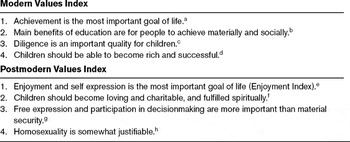
Pippa Norris's (Reference Norris2002) ‘critical citizen’ theory and Inglehart's (Reference Inglehart1990, Reference Inglehart1997) ‘cultural shift’, postmodernziation, and self-expression theories (Inglehart and Welzel, Reference Inglehart and Welzel2005) all stress the importance of value change in affecting citizens’ perception of government. They argue that once economic development enables citizens to shift their priorities from material security to political aspirations, citizens will become more critical toward government. The AsiaBarometer offers some very good data to measure this survival–achievement–expression sequence in value change. A ‘modern values’ index and a ‘postmodern values’ index can be constructed and included in this analysis (Wang, Reference Wang2007).
7 Modern values: The individual emphasizes achievement, diligence, and similar values (see Appendix for measurement of this variable).
8 Postmodern values: The individual emphasizes expression, enjoyment, and political rights (see Appendix for measurement of this variable).
9 Information: Both ‘critical citizen’ theory and ‘civic culture’ theory argue that access to information affect the citizen's perception of government. In this paper, access to information is measured by the use of internet, which can indicate the knowledge-intensiveness of an individual's work and life, with the possibility that people with a more knowledge- and information-intensive lifestyle are more likely to be critical toward the government.
10 Education: The ‘critical citizen’ theory and self-expression theory both point to education level as increasing the likelihood of an individual being critical toward the government.
Cultural shift (and lifecycle) theory
11 Age and generation: These matter in the ‘cultural shift’ and ‘lifecycle’ theories. ‘Cultural shift’ theory argues that value changes take place by generational replacements (Inglehart, Reference Inglehart1990). Hence, in a modernizing society, such as China and India, later generations are more likely to be critical citizens. In countries that have already been through rapid modernization, such as Japan, generational differences may also exist as different generations grow up amidst different socioeconomic environments.
‘Lifecycle’ theory, on the contrary, argues that people demonstrate different values because young people and old people are different: once young people grow older, they will acquire those values of older people. Young people are more likely to be more radical and leftist, for example, but when they grow older their attitudes are likely to change toward more conservative ones. In either case (cultural shift or lifecycle), age differences are likely to show up in an individual's satisfaction level with governance.
Civic culture and social capital variables
12 Political efficacy: Whether an individual feels competent in understanding and influencing politics is an important dimension of the ‘civic culture’ and ‘social capital’ literature. In this study, this is measured by averaging two indicators: the individual's assessments of whether he or she has the power to influence government policy or actions, and whether he or she feel politics and government are too complicated to understand.
Performance: macro variables
Mishler and Rose (Reference Mishler and Rose2001) introduced country-level macro variables into their regression models explaining political trust. Such variables, such as a country's economic growth rate, work much better than country dummies in accounting for country differences in pooled datasets. In this paper, when regressing citizens satisfaction with governance, I will include several country-level variables: economic growth rate, inflation rate, level of government corruption (measured by the Transparency International rating), government effectiveness (measured by the Government Effectiveness index in WGI), and voice and accountability (also measured by WGI index).
The problem with this approach is the AisaBarometer 2008 dataset contains data from only six countries. As such, the macro variables offer very limited explanatory power in the regression models, especially if country dummies are also included. In the analysis, I first included both these country-level variables and the country dummies. When the analysis showed some variables to be irrelevant or insignificant, I dropped them for the sake of model parsimony.
Measuring citizen satisfaction
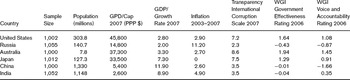
The data used in this study is the 2008 Asiabarometer survey, which covers the six Asian-Pacific countries: Australia, China, India, Japan, Russia, and the US. The sample size and other information of the surveyed countries are presented in Table 1. These make up the six largest countries in the Asian-Pacific region, hence I call them the six ‘giants’.
AsiaBarometer 2008 countries

Source: AsiaBarometer 2008; The Economist, Pippa Norris ‘Democracy Crossnational Dataset’, CAI Factbook.
AsiaBarometer measures citizens’ satisfaction with governance by asking the respondent to rate several governance issues. The respondent is asked to say how he or she thinks the government is dealing with the economy, political corruption, human rights, unemployment, fighting crime, improving the quality of public services, as well as increase of immigration, ethnic conflict, religious conflict, and environmental problems.
As mentioned earlier, satisfaction is very issue- or service-specific; hence, citizens’ satisfaction with these various issues or areas of governance seem to require separate treatments. But the data show that citizens’ satisfaction in these various areas or issues are in fact highly correlated. Especially, their satisfaction with the government's handling of the first six areas – the economy, corruption, human rights, unemployment, crime, and quality of public services – forms a very cohesive cluster. For parsimony purposes, I use the average of these six satisfaction areas to represent an individual citizen's overall satisfaction with governance. This will be the dependent variable of the remaining analyses.
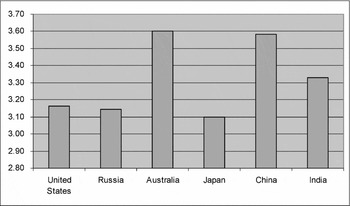
Figure 1 shows the country means of citizen satisfaction with government. On average, Australians are the most satisfied, followed by the Chinese. Japanese seem the least happy with how their government performs, with the Americans and Russians not showing much difference. Indians seem to be in the middle.
Citizen satisfaction with government performance in six countries.

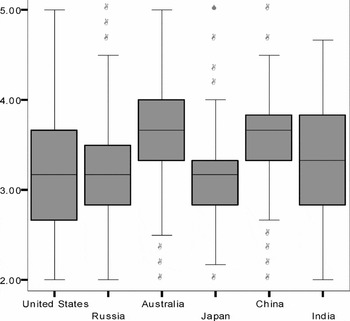
The problem with this comparing-country-means approach is obvious: it overlooks the internal diversities within each country, as well as the specific samples that were drawn in the individual countries. In fact, within each country, tremendous variations exist. The intra-country differences appear to be the largest for India and the US, the smallest for China and Japan (Figure 2).
Within-country variations of citizen satisfaction with government performance.

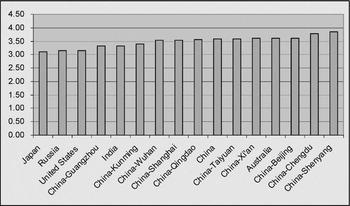
Assuming samples are drawn in a representative way at least at the sub-national level (that is, samples from each sub-national region in these countries are representative of the population of that region), regional differences within countries may also present interesting pictures. In India, the highest satisfaction (found in Mumbai) gives a 3.6 rating out of five, while the lowest satisfaction (found in Kolkata) gives only 2.77, resulting in almost a 1-point difference. In China, the highest satisfaction (found in Shenyang) gives a 3.84 rating out of five, while the lowest satisfaction (found in Guangzhou) gives only 3.32, resulting in a half-point gap. Figure 2 shows how citizens of the ten surveyed areas in China rate government performance in comparison to the country averages. Citizens in Guangzhou, the least satisfied among the surveyed cities in China, rate the performance of the Chinese government just slightly above US citizens’ average rating of their government, and below that of the Indian citizens.
Citizen vs. expert views
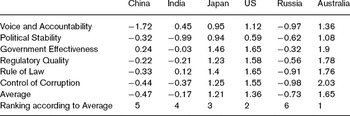
Before we move to explain what make citizens satisfied with government performance in these countries, it is probably necessary and interesting to put these citizen evaluations into perspective. If we compare these citizens’ views with the World Bank governance indicators, they appear to be quite different. That is, citizens in these countries clearly give very different views about their government compared to the World Bank experts. For 2008, combining all the six dimensions together (voice and accountability, political satiability, government effectiveness, regulatory quality, rule of law, and control of corruption), the World Bank rank these six countries in this order: Australia, the US, Japan, India, China, and Russia.
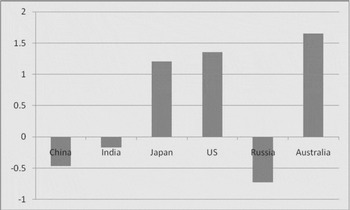
The WGI clearly gave very high evaluations to Australia, the US, and Japan. For an average of the six scores that range from –2.5 to +2.5, Australia is rated as 1.65, almost above 94% of all countries in the world, while the US is rated at 1.36 (around 87% percentile), and Japan 1.21 (around 84%). On the other hand, China only scored an average of –0.47 (39%), India –0.17 (46%), and Russia –0.73 (21%) (see Appendix II for the scores). While our data from the citizens show that the Chinese and Indian together with the Australian governments are the best performers among the six countries, the WGI show that the Chinese and Indian together with the Russian governments are the worst performers (compare Figure 4 with Figure 1). Australia is of courses the dream case, where experts see a high-quality government and citizens express high level of satisfaction with government performance. The divergence is most significant in China and the US. For China, citizens seem highly satisfied with their government, but experts see a seriously low-quality government, while for the US, the case is just the opposite.
While to explain this divergence between citizen perception and expert evaluation may take an effort that is way beyond the scope of this paper, the analyses below can probably offer some insights. For example, the six dimensions the WGI rely on may carry different weights in citizens’ mind in different countries. In China, the Bank's rating of ‘government effectiveness’ is in fact pretty high, while those of ‘voice and accountability’ and ‘control of corruption’ are low. It may be that Chinese citizens, at least at the moment, see government effectiveness as the most important, hence are satisfied even if the government is insufficient in providing ‘voice and accountability’ and controlling corruption. Meanwhile, our analyses below may show that, at the individual level, some factors are highly important for citizens’ satisfaction with government. If that is the case, we may be able to explain why citizens of some countries are highly satisfied with their government, despite low judgement by the experts.
Regional differences of citizen satisfaction in China – in comparison with the other five countries.

Explaining citizen satisfaction
Bi-variate analyses
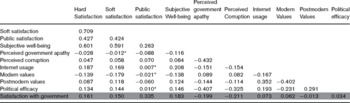
I first look at bi-variate correlations between the explanatory variables I identified above and the dependent variable. The bottom row in Table 2 shows that most of these explanatory variables correlate significantly with citizens’ satisfaction with government. Specifically, satisfaction at the individual level, either with personal economic situations (hard satisfaction), with the ‘soft’ parts of personal life (soft satisfaction, such as with marriage and friendship), or with public issues (public satisfaction, such as with education and public safety), all positively correlate with satisfaction with government performance. Furthermore, public satisfaction appears to have the highest correlation with satisfaction with government. Subjective well-being also correlates positively with satisfaction with government. These findings seem to confirm the Performance Hypothesis; that is, citizens’ satisfaction with government depends on the level of government performance.
Correlations between main independent variables with satisfaction with government perfromance

Notes: With the exception of those marked with *, all are significant at 0.05 level or higher.
The relatively high levels of significance in this table may be misleading. As can be seen from below, in Table 3, many variables actually fail to report significant correlation with the dependent variable in country-specific models. This means that the high statistical significance in Table 3 may be a result of larger N instead of the high statistical correlations. I am grateful to this journal's reviewer for pointing this out.
Government apathy, by contrast, negatively correlates with satisfaction with government. The same pattern applies to corruption. This seems easy to explain: if a person feels the government cares little about the citizens (apathy), or are corrupt (corruption), he or she will also likely feel dissatisfied with government performance. Again this confirms the Performance Hypothesis: government's negative performance leads to decreased satisfaction on the part of the citizens.Footnote 3
Other variables, including political efficacy, modern and postmodern values, and internet usage, are only marginally correlated with satisfaction with government (the dependent variable). Hence this correlation table provides only weak support to a few hypotheses: the Critical Citizen, Cultural Shift, Postmodernization Hypothesis as well as Civic Cultural and Social Capital Hypothesis.
Multivariate analyses: country-specific patterns
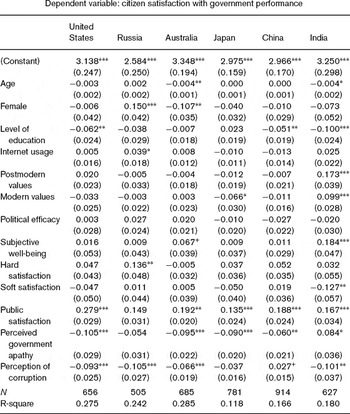
When these explanatory variables are thrown in country-specific regression models, the bi-variate patterns identified above seem to be reproduced. In almost every country, public satisfaction, perceived government apathy and perceived corruption significantly affect an individual's satisfaction with government. The more satisfied one is with public issues, such as education, health care, and the running of the country's democratic system, the more one is likely to be satisfied with overall government performance. By contrast, if one feels government officials care little about citizens, and that there is widespread corruption within the government, the more likely one will feel highly dissatisfied with government performance.
Country-specific regressions

Notes: +α < 0.1; *α < 0.05; **α < 0.01; ***α < 0.001.
Except in Russia, satisfaction with personal economic situation (hard satisfaction) does not seem to contribute to an individual's satisfaction with government performance. Similarly, except in India, satisfaction with one's emotional and relational lives (marriage, friendship, etc, termed soft satisfaction) matters little for satisfaction with government performance. Subjective well-being, that is whether one feels happy or is satisfied with life, seems to contribute slightly (and positively) to satisfaction with government performance.
In several countries, females seem to be less satisfied with government performance. Higher levels of educational achievement seem to lead to lower satisfaction with government performance, a piece of evidence that supports the Critical Citizen, Cultural Shift, Postmodernization hypothesis at the same time. Other factors examined in the model, such as age, modern values, postmodern values, political efficacy, and internet usage, generate neither consistent nor significant results.
Pooled analyses
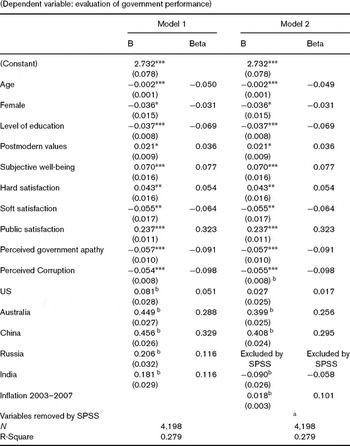
When all the country data are pooled together, however, almost all the selected explanatory variables significantly affect an individual's satisfaction with government performance. The two models presented in Table 4 tell this story well. First, younger people and people with a higher level of education tend to be less satisfied with government performance; a partial confirmation of the Critical Citizen, Cultural Shift, Postmodernization Hypothesis. Hence, especially in countries such as China, India, and Japan, during a period in which the socioeconomic modernization is advancing, later generations tend to become more critical toward the government.
Pooled data analyses

Notes: Entries are OLS regression coefficients with standard errors in the parenthesis.
+α < 0.1; *α < 0.05; **α < 0.01; ***α < 0.001.
aVariables included in the model but excluded by SPSS: GWI Government Effectiveness; WGI Voice and Accountability; Transparency International Corruption Rating; Russia.
bFor country dummies and country-level variables such as the GDP growth rate, the SPSS provided relatively high level of significance (except for ‘US’ in Model 2). But this appears to be mistaken, as their significance level should be calculated according to number of contexts (six countries) instead of the number of respondents. Hence, I did not report the SPSS-generated significant levels here. I am grateful to this journal's reviewer for pointing this out.
Second, subjective well-being, public satisfaction, and hard satisfaction contribute positively to satisfaction with government performance, while perceived government apathy and perceived corruption both contribute negatively. This repeats the bi-variate patterns and represents a strong support to the Performance Hypothesis. Public satisfaction, which is about citizens’ perception of public policy issues, such as education, environment, public safety, and the political system, has the largest coefficient. That clearly shows that citizens have the competence to evaluate government performance by public policy issues. Hard satisfaction, which is about citizens’ income, housing, and living standards, has but a modest effect.
One interesting point is that in the pooled analyses, soft satisfaction has an negative effect on satisfaction with government performance. As soft satisfaction measures an individual's perception of his or her family life, personal relationships, and spiritual life, it is highly plausible that it does not directly affect a person's evaluation of his or her government. Nevertheless, people who are more satisfied with their personal life tend to be those who are highly educated, spiritual; hence, they may be those who are more demanding and critical toward the government. If this is true, then we can explain the negative effect this variable has on the satisfaction with government.
Third, postmodern values contribute positively to satisfaction with government. At first this appears counter-intuitive: the self-expression and critical citizen theories predict harsher attitudes toward government among the more post-modern citizens. But this may support the Postmodernization theory (i.e. Critical Citizen Hypotheses) in that the postmodern citizens are those that have a stronger sense of satisfaction as regard various aspects of their life, including, presumably, the government. This is the case where the hypothesis can point in both directions, and in the end the data show that it does go to one of the two directions.
The shift from Model 1 to Model 2 in Table 4 is achieved by adding the country-level macro variables. The variables introduced include GDP growth rate, WGI indicator of government effectiveness, WGI indicator of voice and accountability, Transparent International Corruption Scale, and inflation rate (all measured for the latest available year before the survey year, see Table 1 for the data). This addition of the country-level variable brings no increase to the explanatory power of the model, as the R-square level of the model remains the same. But, nonetheless, two interesting findings emerge.
The first is that the GDP growth rate seems a very powerful variable in this context. The inclusion of this variable in the model results in the exclusion of all other country-level macro variables by SPSS. In other words, with the GDP growth rate in the model, other country-level variables provide no additional explanatory effect. Hence, among all the macro-level variables, the GDP growth rate seems to be the dominant factor explaining citizens’ satisfaction with their government.
Second, once controlling for the GDP growth rate, the between-country differences take new forms. Chinese citizens’ overall satisfaction with their government is no longer higher than that of the Japanese; and Indian and Russian citizens are now less satisfied with their government than the Japanese. In other words, the fact that the Chinese are much more satisfied with their government can be simply explained by the fact that the economy is growing well in China but not in Japan. If given the same level of economic growth, the Japanese would be more satisfied with their government than the Chinese, and even much more so than the Indians and Russians.
Discussion and conclusions
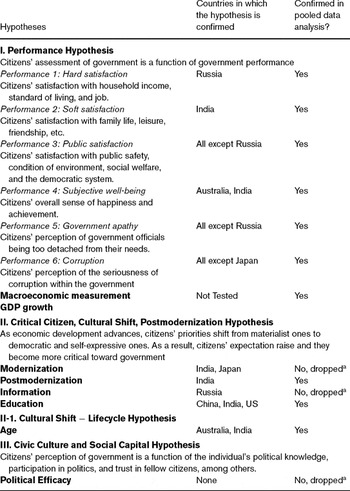
Table 5 summarizes the main findings. The Performance Hypothesis obtains the strongest support from the data. Citizens’ satisfaction on public issues as well as in the ‘hard’ aspects of their lives leads to an increase in satisfaction with government performance. The overall sense of happiness and achievement of an individual will also reflect on his or her satisfaction with government performance. In terms of macro-level variables, a country's economic growth plays a critical role in affecting citizen satisfaction with government.
Summary of hypothesis testing

Note: aNot included in the model.
As mentioned above, when controlling for economic growth, Chinese and Japanese citizens are equally satisfied with their government's performances. Under the same conditions, Japanese citizens see government performance more positively than citizens in India and Russia. A comparison of China and India also merits some discussion. When controlling for economic growth, Indian people are less satisfied with their government than the Chinese. Because at the time of the survey, both countries had experienced a sustained period of high economic growth, one wonders what makes Indians more dissatisfied with their government when economic growth is controlled. Maybe economic growth in India is not widely shared by the larger population? Maybe India's democratic institutions (such as the media) encourage citizens to take critical views toward their government? More research will generate interesting findings regarding these questions.
The small number of countries included in this study forbid many country-level variables from being meaningfully engaged in the models. Including more than one additional country-level variable offers little increase in the space for statistical operation. Hence, one strategy for upcoming research is to extend this analysis to cover all the countries AsiaBarometer surveyed in recent years. In terms of methodology, a mixed model will probably generate different outcomes than the current OLS model.
Within-country differences also present a promising ground for further exploration. In the case of China, for example, the lowest satisfaction level was found in Guangzhou. Guangzhou was the frontier of China's economic opening and development in the early 1980s, and remains one of the most economically advanced cities of China. This contradictory coexistence of a good economy and low citizen satisfaction is even more striking if we take into account the highest satisfaction level among Chinese cities was found in Shenyang, a rust-belt city in Northeast China that has suffered economic stagnation for about a decade. We should find new data to explain these regional differences within one country.
For individual level factors, this paper seems to offer very much and very little at the same time. We learn that individual-level satisfaction with public issues, such as healthcare and education, contribute most positively to satisfaction with government performance. The government should also try to reduce its distance from the citizens, so that citizens feel less apathy on part of government officials. The government should also fight corruption seriously: once citizens feel there is widespread corruption within the government, they feel strongly dissatisfied with government.
The good thing is that these findings seem to offer clear criteria for good governance: to earn support and affection of the citizens, the government needs to deliver public goods, be close to the people, and reduce corruption. But these findings seem clichéd as they are repeating what everyone is supposed to know. The problem is whether government leaders have the right means to achieve these goals, or, rather, whether they are even trying to achieve these goals besides paying them lip service. Hence, twenty years into the ‘good governance’ era, we are still confronted by the fundamental obstacles to achieving good governance; we understand fairly well what good governance should amount to, but we have very limited power to induce the governments in many developing countries to move toward those goals.
Nevertheless, this paper does show that citizen satisfaction can be relatively independent of ‘objective’ government performance, if by ‘objective’ we mean expert rating of governance quality such as those offered by WGI. Figure 1 and Figure 4 in this paper clearly show that government rated by WGI as low-quality can sometimes enjoy high evaluation from citizens. If the government can identify the areas that the citizens are most concerned with, and can concentrate its efforts in these areas, then even if there is a temporary lag in certain dimensions, citizens may still register a high level of satisfaction. China may be a good example: although the government is lagging behind in providing ‘voice and accountability’ for example, but because it can produce relatively sufficient increase in income, public safety, welfare, and employment, the citizens seem to harbour highly positive views.
WGI indicators for the six countries: average of the six dimensions (range –2.5 to +2.5)
Source: ‘Word Governance Indicator 2008, available online at World Bank, Governance Matters 2009’, http://info.worldbank.org/governance/wgi/ (accessed 16 October 2009).

Once a country moves up on the development ladder, however, citizens’ demands may also increase. By then it will not be enough for the government to only provide an increase in income. By then government legitimacy will probably move from substance-based to rule-based; and satisfying the ever-increasing demands from the citizens will become more and more challenging, as the cases of Japan and the US probably show in this study. For development agencies such as the World Bank, however, the key is probably to identify areas in which citizens of developing countries hold the highest expectation (such as the ‘hard satisfaction’ aspects), and support country governments to deliver in those areas.
About the author
Dr Zhengxu Wang is Senior Research Fellow and Research Coordinator at China Policy Institute, University of Nottingham, and Adjunct Associate Professor, School of International Studies, Renmin University of China.
Appendix
Indices of ‘Modern’ and ‘Postmodern’ Values based on Wang (Reference Wang2007)

Notes: aAchievement Index of Table 1; bRespondent choosing as the benefits of education ‘enables you to obtain a job of your choice’ and ‘enables you to gain higher social status’; cRespondent choosing ‘diligence’ as one of the most important quality for children; dRespondent choosing ‘become very wealthy’ and ‘become more proficient in profession than I am’ as she would wish for her children.
eEnjoyment Index of Table 1; fRespondent choosing ‘become a loving and charitable person’ and ‘become fulfilled spiritually’ as she would wish for her children; gRespondent choosing ‘giving people more say in important government decisions’ and ‘protecting freedom of speech’ as important government priorities; hRespondent choosing homosexuality is somewhat justifiable.
Constructed based on factor analyses from the 2006 AsiaBarometer Survey.
World Bank World Governance Indicators, 2008

Source: ‘Word governance indicator 2008, available online at Governance Matters 2009’, http://info.worldbank.org/governance/wgi/ (accessed 16 October 2009).