Since the release of ‘Wuthering Heights’ in 1978, singer-songwriter Kate Bush has continued to create complex and imaginative song worlds.Footnote 1 Nature and non-human life often occupy a central role in these worlds, functioning not just as a backdrop for human experience but as active participants in a song’s story. It is this aspect of Bush’s music that I explore in this article. I am specifically interested in framing Bush’s representation of human and non-human relationships as an expression of female pastoral, a corrective forward-looking pastoral form that reimagines the enduring narratives of inequality in pastoral’s historical lineages. By drawing on ecofeminist understandings of care and empathy in human–non-human interactions, I want to uncover an explicitly feminist pastoral expression in Bush’s music, one that expands existing understandings of her pastoral articulations.
My analysis focuses on A Sky of Honey (henceforth A Sky), a song cycle released as the second half of Bush’s (Reference Bush2005) album, Aerial. The evocation of pastoral themes is evident throughout A Sky, from the album artwork and lyrical content to the compositional techniques Bush employs. Upon closer examination, however, these evocations are not typical in their presentation of pastoral convention and, in working to destabilise key narratives in pastoral tradition, they manifest a reconfigured pastoral environment. The technical underpinnings of this reconfiguration – for instance, Bush’s use of musical motifs, her vocal practices, and engagement with technology – are vital in contextualising A Sky as a female pastoral space that is responsive to the interrelated socio-historical and cultural discourses implicated in pastoral’s history. Of these, the primacy of dualist thinking, particularly human/non-human, culture/nature, and the conflation of women and nature, has proved especially problematic.Footnote 2 Key to female pastoral, however, is the confrontation and reimagining of the injustices caused by these binaries. Given this, I turn to ecofeminist understandings of human–non-human interrelationality and the importance of empathy in human–non-human interactions to help me unravel A Sky’s (re)vision of pastoral tradition.
I have structured the following discussion into four parts. In the first, I briefly detail the origin of female pastoral before outlining the primary political motivations of ecofeminism and ecofeminist ethics of care, empathy, and the importance of attentive listening in these theories. Finding ecofeminist principles reflected in female pastoral’s overarching concerns, I establish the foundation for my interpretation of A Sky. In section 2, I summarise existing understandings of both Bush’s pastoral articulations and her representations of nature more broadly to support my characterisation of A Sky as a female pastoral work. From here, I explore how the background to A Sky’s creation – including the story it tells, the accompanying album artwork, and lyrical content – communicates a pastoral setting whilst bringing tension to pastoral convention, thereby initiating the (re)vision of pastoral mythologies. Through a close reading in section 3, I explore Bush’s compositional practice and the technical intricacies of A Sky’s sound world. My analysis, including transcriptions, identifies the various character voices in A Sky, particularly their originary statement via musical motifs and sampled sound, and the subsequent development of these motifs as the song cycle progresses. Through this, I also examine the significance of Bush’s imitative vocal practices and in charting the developmental interactions between human voice and birdsong, I interpret A Sky as the articulation of a pastoral space that dissolves hierarchical relationships common to pastoral convention in favour of interspecies collaboration and reciprocity. Further, I argue that these processes point to a new pastoral speaker – the chorus – which I contextualise as the sounding of A Sky’s pastoral world. To close, in section 4 I reflect on how Bush’s technical realisation of female pastoral demonstrates an ecofeminist ethics of care, and I consider how musical expressions, such as those in A Sky, think beyond troubling legacies of the past to offer alternate visions of equality and relationality.
1. An ethics of care: Female pastoral and ecofeminism
Emerging from the field of literary criticism, the female pastoral was first characterised by Elizabeth Harrison (Reference Harrison1991) in her study of women authors from America’s Southern states. Harrison is primarily concerned with how her chosen texts respond to pastoral tradition, and in identifying a text as female pastoral, she highlights how pastoral’s centralisation of the male subject, the male poetic voice, and the resulting marginalisation of women’s experience is re-visioned into a celebratory, life-affirming form.Footnote 3 She is particularly critical of the ways women are used as symbolic representations of landscape and are contextualised either as a womb-like sanctuary or a wilderness to be tamed (see Merchant Reference Merchant2020, pp. 8–9). Female pastoral texts reconfigure this dynamic – including its association with man’s domination and mastery over nature – where the land is cast as an ‘enabling force’ and the cultivation of communities built on ‘cooperative action’ is prioritised over the needs of the individual (Harrison Reference Harrison1991, pp. 11–12).Footnote 4
Whilst Harrison avoids strict definition, she identifies recurring themes and narrative elements in female pastoral texts. Female characters are centralised as protagonists and active agents. Freed from the roles of mother or wife, the female pastoral moves beyond the romance plot common in pastoral tradition to reshape relationships between men and women whilst also encouraging friendships between women. Landscape is crucial in the development of both the protagonist’s identity and the creation of alternate pastoral communities. In reimagining their symbolic association with the land, women in the female pastoral draw strength from the rural space they inhabit, thereby changing ‘passive association to active cultivation’ (Harrison Reference Harrison1991, pp.10–11). This altered representation of land prioritises nature as a source of empowerment through which female characters derive autonomous expression and circumvent the expectations of patriarchal society. In Harrison’s study, these elements function as female pastoral’s re-visionist strategies, balancing the interrogation of pastoral histories with acts of reimagination.Footnote 5 Finding points of convergence with and divergence from pastoral tradition is, therefore, fundamental to how the female pastoral creates new pastoral visions.
This brief overview of female pastoral provides one part of the interpretive framework through which I read A Sky. Ecofeminist ethics of care, particularly the role of listening in ensuring ethical interspecies encounters, is the second, and I want to shift my focus at this point to draw these ideas into the discussion and establish their connection to female pastoral.
Ecofeminism encompasses a diverse range of theoretical, philosophical, and activist practices that are connected by the recognition and interrogation of intersecting forms of oppression, including but not limited to gender, race, class, sexuality, ecology, and species.Footnote 6 Finding a link between the domination of women and the destruction of nature, ecofeminists highlight how overlapping, hierarchical binary structures – for example, culture/nature, human/non-human, and man/woman – ensure the ‘ecological superiority of humans and the cultural superiority of men’ (Mallory Reference Mallory2010, p. 309).Footnote 7 A key motivation for ecofeminists is, therefore, recognising and interrogating the inextricable link binding freedom from oppression, in all its forms, to ecological sustainability and interspecies justice (Gaard Reference Gaard2017; Harper Reference Harper2010; Kemmerer Reference Kemmerer2011; Stevens et al. Reference Stevens, Tait and Varney2018).
Working towards a system that prioritises, without prejudice, exclusion, or appropriation, the experiences of all beings, ecofeminists advance the need to rethink the mechanisation of nature – famously termed the ‘death of nature’ in Carolyn Merchant’s (Reference Merchant2020) canonical text – and pervasive human-centeredness that has resulted in what Val Plumwood (Reference Plumwood2009) has called the ‘hyperseparation’ of humans from the ecological world. This separateness reduces non-human life to inert objects or tools for human use, thereby destroying the possibility of empathetic engagement with the non-human world. In response, ecofeminists, past, present, and from a range of perspectives, have rejected reductionism and the ideology of a self/other identity, promoting instead a nondualist system that highlights nature’s agency to emphasise the relationality and interdependence of all beings, human, and non-human (see Adams and Gruen Reference Adams and Gruen2022a; Caldecott and Leland Reference Caldecott and Leland1983; Donovan and Adams Reference Donovan and Adams2007; Gaard Reference Gaard1993; Merchant Reference Merchant2005, Reference Merchant2016); Phillips and Rumens Reference Phillips and Rumens2016; Plumwood Reference Plumwood1993, Reference Plumwood2006; Shiva, Reference Shiva1988).Footnote 8
To ensure nondualist encounters between humans and non-humans, ecofeminists advocate cultivating an ethics of care. Combining theory and practice, this approach focuses on developing caring relationships whilst thinking about the power structures at play in human–non-human interactions. Analysing the cultural embeddedness of exploitation and cruelty along an axis of race, gender, and economics, ethics of care replaces universalising, abstract principles with context- and situation-based ethical systems (Adams and Gruen, Reference Adams, Gruen, Adams and Gruen2022b, p. 39).
Lori Gruen’s (Reference Gruen2021) ‘entangled empathy’ is one example of ecofeminist care ethics. Seeking to improve human relationships with animals, Gruen (Reference Gruen2021) argues that entangled empathy is a process initiated when the ‘wellbeing of another grabs the empathizer’s attention’ (p. 51). Imagining themselves in the same condition, the empathiser reflects on the broader context that contributes to the well-being of another to determine what information is required to effectively empathise. The empathiser is then motivated to respond, thereby improving the quality of the relationship. In a similar vein, Josephine Donovan’s (Reference Donovan, Adams and Gruen2022) dialogical care theory suggests that humans should attend, both emotionally and intellectually, to what animals are saying about their own needs in their own language rather than trying to reshape their difference to conform to human-centred preconceptions (p. 49). The intricacies of Gruen’s and Donovan’s account draw into their scope broader debates on moral theory and feminist animal care theory, and what empathy and care mean amidst these discussions. Whilst these debates are fraught with epistemological questions, Gruen and Donovan emphasise how attentiveness to the experiential condition of non-human life, with a focus on the context and particularity of the situation, and an attitude of receptivity and imagination, can initiate empathetic exchanges whilst shifting theory into practice.
Each of these approaches seeks to dismantle interspecies inequality – which, in ecofeminist thought, is a move towards eradicating all inequality – and each advocates the fostering of a more empathetic understanding of humanity’s role in a wider network of beings. They are similarly connected by affording an attuned practice of listening to a vital role in the realisation of more equal interspecies relations. Supporting Gruen’s and Donovan’s emphasis on listening, Lauren Corman (Reference Corman, Castricano and Corman2016) examines voice-orientated discourses in animal advocacy to consider the difficulties that arise when humans speak for non-human beings. Finding that some advocacy campaigns overuse the word ‘voiceless’ in their descriptions of animals, Corman (Reference Corman, Castricano and Corman2016) argues that the ‘proclamation that animals are voiceless and advocates alone are their voices’ highlights ‘subjectivity at the same moment that it inadvertently erases it’ (p. 487). She suggests that a shift from speaking up for animals to listening to animal voices prioritises their position as agents not objects, allowing the recognition of their ‘experiential knowledge, relationality, and resistance’ (Corman Reference Corman, Castricano and Corman2016, p. 474). Gruen’s, Donovan’s, and Corman’s prioritisation of listening is representative of a broader turn to listening in ecofeminism (see Gaard Reference Gaard2017; Plumwood Reference Plumwood2001, Reference Plumwood2009), which regards listening as an ethical and political practice that attends to the development of interrelationality and the remodelling of human–non-human interactions.
Ecofeminist values are clearly reflected in Harrison’s female pastoral. Both emphasise the identification, interrogation, and reimagination of dualist systems of power and the development of mutually sustaining relationships between human and non-human selves, and throughout her analysis, Harrison tracks the development of these relationships as they are cultivated through openness and attention. Ecofeminists have long recognised the role of the arts in creating narratives that imagine a more ethical future. Plumwood (Reference Plumwood2009), for example, centralises writing as a way to ‘think differently’ about the material world and disrupt the reductionist mechanisation of nature. Developing a ‘restor(y)ing’ of climate change narratives, Gaard (Reference Gaard2017) similarly emphasises the potential of the arts – including popular music – to explore human kinship with non-human beings as well as challenging the inequalities determined by gender, race, class, and sexuality between humans (pp. 143–86). The work Harrison undertakes in Female Pastoral is an example of this sort of ecofeminist imagination despite not being explicitly aligned with ecofeminist discourses. If I were to make one criticism of her task, it is that her focus rests on dismantling human inequalities, although, in doing so, she recasts the human/non-human dualism. Bringing ecofeminism to bear upon female pastoral supports an expanded reading of the potential of the genre, thereby allowing me to lean more heavily on the flows between human and non-human. This opportunity presents itself in A Sky, allowing a restor(y)ing of female pastoral in a new artistic and expressive context.
In the above discussion, I have outlined both the characteristics of the female pastoral genre and the central tenets of ecofeminist ethics of care. As female pastoral demonstrates strategies that subvert and re-vision hierarchical power structures through the creation of alternate narratives, ecofeminists express concern about the various ways inequalities intersect across boundaries of gender, race, class, and species. Dismantling the symbolic representation of women and landscape, female pastoral directly engages ‘restrictive myths’ (Harrison Reference Harrison1991, p. 134) to arrive at a new pastoral story, one that, in reorganising human–non-human interactions, develops a system that is advantageous for the needs of all. Crucially, this is achieved through attunement and active identification rather than dominance and assertion of the individual, a dynamic that echoes an ecofeminist listening practice. Taking the female pastoral from a literary to a musical context, in the next section, I turn to my analysis of A Sky. Establishing interpretive context for my close reading, I explore Bush’s existing connections to pastoral tradition, and by drawing on A Sky’s creative background, I identify how she initialises an expressive state that simultaneously converges with and diverges from pastoral convention.
2. Kate Bush, pastoral tradition, and A Sky of Honey
In existing Bushian scholarship, Bush’s music is connected to pastoral tradition in several ways. One critical thread finds a link between her evocation of pastoral convention and her expression of Englishness. Ron Moy (Reference Moy2007), for example, identifies musical and non-musical references to English pastoral traditions that range from the evocation of bucolic topographies, the identification of similar melodies and harmonic structures, to the lyrical images associated with canonical pastoral composers (pp. 59–66). Lucy O’Brien (Reference O’Brien2002) makes a comparable observation, describing Bush’s music as ‘Innocent art…painted in bright colours and deeply emotional hues’ (p. 194). Reynolds and Press (Reference Reynolds and Press1995) also emphasise the importance of childlike imagination (pp. 241–2), while Rob Young (Reference Young2010) places Bush in a tradition that ‘resonates with Romantic yearning’ (p. 7). More recently, Abigail Gardner (Reference Gardner, Brooks, Donnelly and Mills2017) has characterised Bush’s pastoral expression as one of idealistic retreat and has used her theatrical incorporation of traditional aspects of English culture as a benchmark through which to read a more radical pastoral articulation in the music of P.J. Harvey (p. 71).
There is, then, a strong interpretive thread connecting Bush to themes of Englishness, nostalgia, and idealised pastoral expressions, with frequent references to her 1978 release, Lionheart. This is, however, only one way to understand Bush’s relationship to pastoral spaces. Richard King has approached the subject from a different angle. Focusing on her album Hounds of Love, King (Reference King2019) combines a sociological reading of the political climate into which the album was released with an analysis of Bush’s composition and production techniques (pp. 188–203). Arguing that the expression of an idealised bucolic life is compromised by the sonic environment Bush creates, King finds tension, not nostalgia, in the depicted landscape. Deborah M. Withers (Reference Withers2010) approaches Bush’s music from a similar perspective, drawing together feminist theories, sociocultural context, and interpretation of musical gestures to chart the evolution of the Bushian Feminine Subject (BFS). Withers identifies the stages of the BFS’s story, and through this, they find various representations of nature, from nostalgic articulations of pastoral idylls to the immersion of selfhood in the cycles of nature. Withers’s study challenges the isolated reading of Bush’s pastoral expression as one of romanticised idealisation and their focus on context draws out the complex articulations of difference as it manifests across and between Bush’s albums.
Whilst the critical reception of Bush’s music in direct relation to pastoral convention hovers around romanticised ideals of a specifically English countryside and a nostalgia for lost ways of life, the writings of Moy, King, and Withers allude to a more expansive expression of human–non-human relationships. Casting an ear over Bush’s back catalogue reinforces these perspectives. In the song ‘Breathing’, for example, Bush portrays a foetus in utero begging for air in the wake of a nuclear blast. Expressing anti-nuclear sentiment – an agenda that remains of utmost importance to ecofeminism – Bush (Reference Bush1980) wrote the song as a ‘warning and plea from a future spirit to try and save mankind and his planet from irretrievable destruction’. In the eponymous track on The Dreaming, she addresses the destruction of Aboriginal land by white Australians and creates a soundscape of multiple, often conflicting, narrative perspectives to communicate the impact of colonisation on Indigenous peoples and their land. Acknowledging that Bush’s engagement with Aboriginal culture could be interpreted as appropriative, her use of music and sound nevertheless opens a space where the colonised voice, which she extends to non-human articulations, is prioritised (Withers Reference Withers2010, pp. 88–93). In 50 Words for Snow, Bush tells stories set amidst a backdrop of snow.Footnote 9 Each song zooms in on a specific experience in the snowscape, from a snowflake’s contemplation as it leaves the cloud and floats to earth (‘Snowflake’) to the tale of a group of explorers who cover a Yeti’s footprints in the snow to protect him from hunters (‘Wild Man’).
These examples, which by no means exhaust Bush’s articulation of more-than-human worlds, offer a sense of her engagement with nature and non-human beings. Imagination and political interjections combine to create an overarching narrative in Bush’s music that uses convention as a step to deeper engagement with the evoked topography and the life inhabited within. From landscapes and seascapes to snowscapes, Bush drills into the microcosms of these spaces to enter a dialogic communion with the life she finds there. In this configuration, nature and non-human life are freed from the mechanised role of medium and are afforded agency and the capacity for self-expression. This aesthetic, which I read as the key to Bush’s pastoral poetics, carries into A Sky.
As previously noted, A Sky was released in 2005 as the second half of Bush’s album, Aerial. Where the first disc, A Sea of Honey, features seven unrelated songs with thematically diverse subject matter, A Sky adopts a song cycle form where each song is connected by musical and non-musical themes.Footnote 10 Narratively abstract, A Sky does not tell its story through the unfolding of linear events; rather, the listener is introduced to the presence of several voices, or characters, whose interactions are charted across a summer’s afternoon into the dawn of the next day. Despite the lack of a story in a traditional sense, reading each song as the expression of a particular moment anchors the listening experience and provides a useful frame of reference for my analysis.
The first song, ‘Prelude’, sets the scene for the song cycle and draws the listener into the birdsong-saturated soundscape of a summer’s day. Moving into the second song, ‘Prologue’, the listener is introduced to a presence I refer to as ‘the narrator’, a persona who provisionally adopts a narrative position in the song cycle and recounts moments to the listener. In ‘An Architect’s Dream’ and ‘The Painter’s Link’, the narrator watches a pavement artist’s attempts to capture shifting patterns of light foiled by the rain, and as the day draws to a close, the narrator converses with the blackbird (‘Aerial Tal’). Approaching twilight, she occupies a liminal space between wakefulness and sleep (‘Somewhere in Between’), and in a dream sequence, she bathes in the sea under the light of the moon (‘Nocturn’). A Sky culminates in ‘Aerial’, with the dawn chorus of birds heralding the start of a new day.
From the composition and recording of Aerial, through to the release and promotion of the album, Bush was keen to produce a unified piece of work. As such, each aspect of the album, including its physical presentation, was carefully conceived (Thomson Reference Thomson2015, p. 298). Reading the album artwork as a ‘pictorial narrative’ (Nicholls Reference Nicholls2007, p. 309), the images accompanying Aerial’s release offer further insight into the pastoral world articulated in A Sky.
Aerial’s cover image centralises a stylised sea stack – revealed in the liner notes to be a waveform of blackbird song – reflected in the sea and backlit by the rising sun. This ‘visual pun’ (Thomson Reference Thomson2015, p. 299) continues into the liner artwork where A Sky’s associated images depict the temporal progression of a day, integrating the blackbird waveform into shifting colour palettes and figures of birds, both in flight and in song.Footnote 11 The final image, a stave adorned with silhouetted birds morphing into waveforms, connects A Sky’s expressive and conceptual world to its technical production.Footnote 12 Offering a visual representation of the album’s connotative meanings and adding ‘wordplay’ (Thomson Reference Thomson2015, p. 299) to the visual pun, these images present an initial articulation of A Sky’s expressive state. Their focus on open skies and shifting patterns of light suggest a rural space and give an early indication of the musical and conceptual importance of birdsong, which appearing in multiple guises – from sampled sound, vocal mimicry, and imitative practices – informs the construction of melodic motifs and other thematic material.
This context is continued by the story – as outlined above – and lyrics of A Sky, the content of which is common to both literary and musical traditions. It features idyllic depictions of contrasting rural spaces, themes of retreat and return, synesthetic and impressionistic descriptions of light and colour, the placing of characters within the landscape, the presence of birdsong, and passages of nostalgic reflection. Bush also makes direct references to pastoral tradition in Western art music. In ‘Prologue’ and ‘Sunset’, for example, she refers both to Ralph Vaughan Williams’s canonical pastoral work, The Lark Ascending, and Frederick Delius’s tone poem, A Song of Summer. These thematic elements are similarly expressed through stylistic markers common in pastoral music: extended passages of harmonic stasis, the use of drones, pedal points and sustained chords, the manipulation of tonal conventions, references to modal scales, motivic repetition and recombination, irregular phrase lengths, lyrical ascending melodies, flowing rhythms, and light open textures (Saylor Reference Saylor2017, pp. 19–20). In characterising the ‘pastoral sensuality’ of Aerial, Thomson (Reference Thomson2015) also notes a reduction in backing vocals, ‘less technological fuss’, and a texture that prioritises piano, guitar, voice, and natural drums (p. 302). This, he argues, distils into a ‘blessed sense of light and space’ as themes of ‘sun, sea and sky’ permeate the music (Thomson Reference Thomson2015, p. 302).
There are, then, clear points of convergence between A Sky and pastoral convention. Read through the lens of female pastoral, however, these intersections also mark moments of departure. The artwork, for instance, is not typical of pastoral art.Footnote 13 The quintessential image of open blue skies beating down on lush green fields, with a shepherd tending his flock, gives way to a more abstracted pastoral space. Birds and birdsong are prioritised, and in several of the images, this is done so from a technological viewpoint – that is, through waveforms – thereby anticipating their significance as creative agents in A Sky’s musical fabric. The presence of birds and birdsong is not new to pastoral tradition, and both birds and their song have a lasting presence in both musical and literary pastoral traditions.Footnote 14 Composers and poets have engaged with birdsong for the purposes of scene setting, to represent the human condition, evoke otherworldly spaces, or meditate upon human and non-human encounters (Taylor Reference Taylor2020, pp. 8–10). Bush has similarly expressed curiosity about the communicative potential of birdsong as a ‘language that we don’t understand’, where ‘it’s almost as if they’re [birds] vocalising light’ (Bush quoted in Thomson Reference Thomson2015, p. 295). This curiosity led Bush to spend time listening, recording, and transcribing the songs of birds in her garden (Doyle Reference Doyle2022, p. 278). These recordings made their way into A Sky and her transcriptions helped form the musical motifs centralised in A Sky. The emphasis on technology in the artwork, and indeed in the recording and production of A Sky – a point to which I will return – departs from examples of transcription where birdsong undergoes a more overt process of musicalisation, for example, in the work of Olivier Messiaen.
Whilst Bush demonstrates common technical and thematic approaches to the use of birdsong, interpreted alongside female pastoral, the preliminary context provided by A Sky’s creative background – including the album artwork and the song cycle’s story – establishes an attunement to birdsong that initiates a shift away from the prioritisation of the human, specifically male, perspective common in pastoral history. As a statement of intent, empathy for the communicative potential of other beings similarly demonstrates ecofeminist principles on listening as a movement towards non-hierarchical encounters between human and non-human beings. Withers (Reference Withers2010) has similarly highlighted the conceptual significance of birdsong in A Sky, contextualising the human–bird interactions as part of a wider rebirth narrative that denotes the BFS’s ‘becoming-imperceptible’ (pp. 145–52). They also emphasise the role of listening in achieving a state free from the power of divisive structures. Reading A Sky through an ecofeminist interpretive framework, however, supports the recognition not only of a newly configured pastoral state but also of the textual processes by which this reconfiguration happens, mapping the process from initial engagement with pastoral tradition to its (re)visioning. In a similar vein, ecofeminist principles of care allow me to lean more on the role of listening as an empathetic act of engagement both inside and outside A Sky’s sound world, thereby highlighting the importance of Bush’s compositional practices and my own interpretive approach.
Empathy and attunement through listening are the characteristics of Bush’s articulations of human–non-human interactions, and drawing together the examples discussed earlier with the prioritisation of birdsong, A Sky demonstrates her capacity to give precedence to the agency of non-human beings. She rarely contextualises nature as a medium for the exploration of human selfhood; instead, she grants agency to non-human voices and musically imagines their perspectives. A Sky, however, with its clear thematic links to pastoral convention, is the ideal place through which to begin characterising Bush’s approach to human–non-human interactions as an expression of female pastoral. The parallel points of convergence and divergence identified in this discussion demonstrate Bush’s preliminary (re)visionary strategies, and in being technically and narratively rooted in birdsong, I take this initial context to a close reading of A Sky.
3. Close reading
In the previous section, which outlined the creative context surrounding A Sky, I showed that birdsong has a pivotal role in the expressive world of the song cycle. This prioritisation of birdsong continues into A Sky’s musical fabric. Through the close reading that follows, I demonstrate that birdsong – and the interaction between human voice and birdsong – underpins the reconfiguration of A Sky’s pastoral space and supports the revelation of a new pastoral speaker, the chorus. After outlining the sonic environment as it is set up from the start of the cycle, I focus my analysis on two consolidating moments, one in the song ‘Aerial Tal’ and the second in ‘Aerial’, the closing song in the cycle.Footnote 15
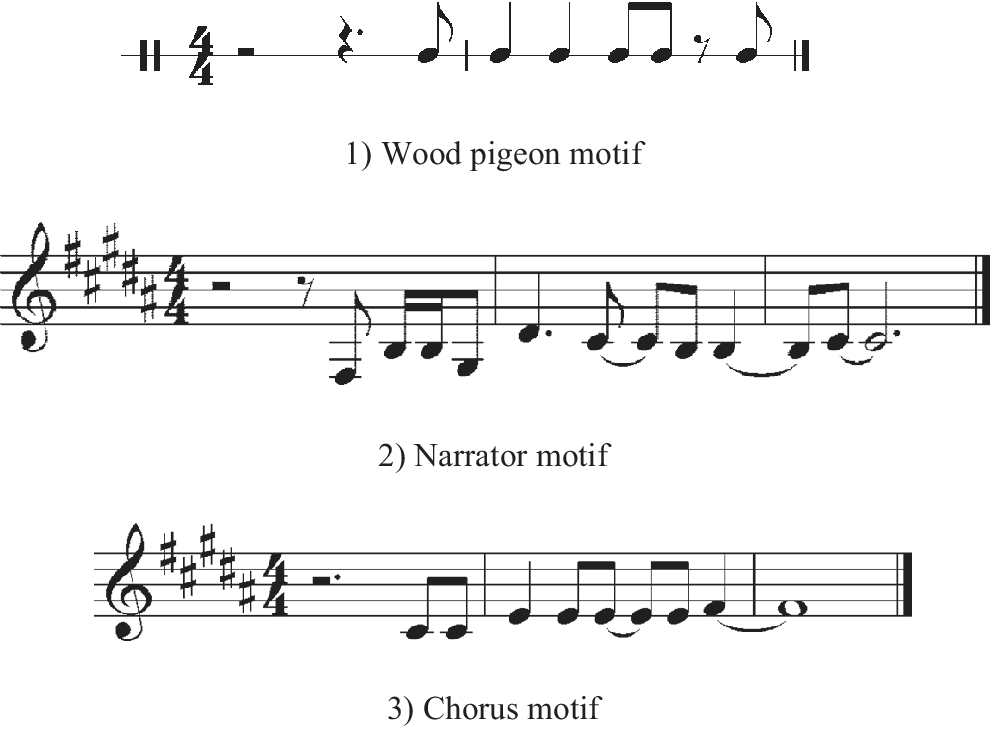
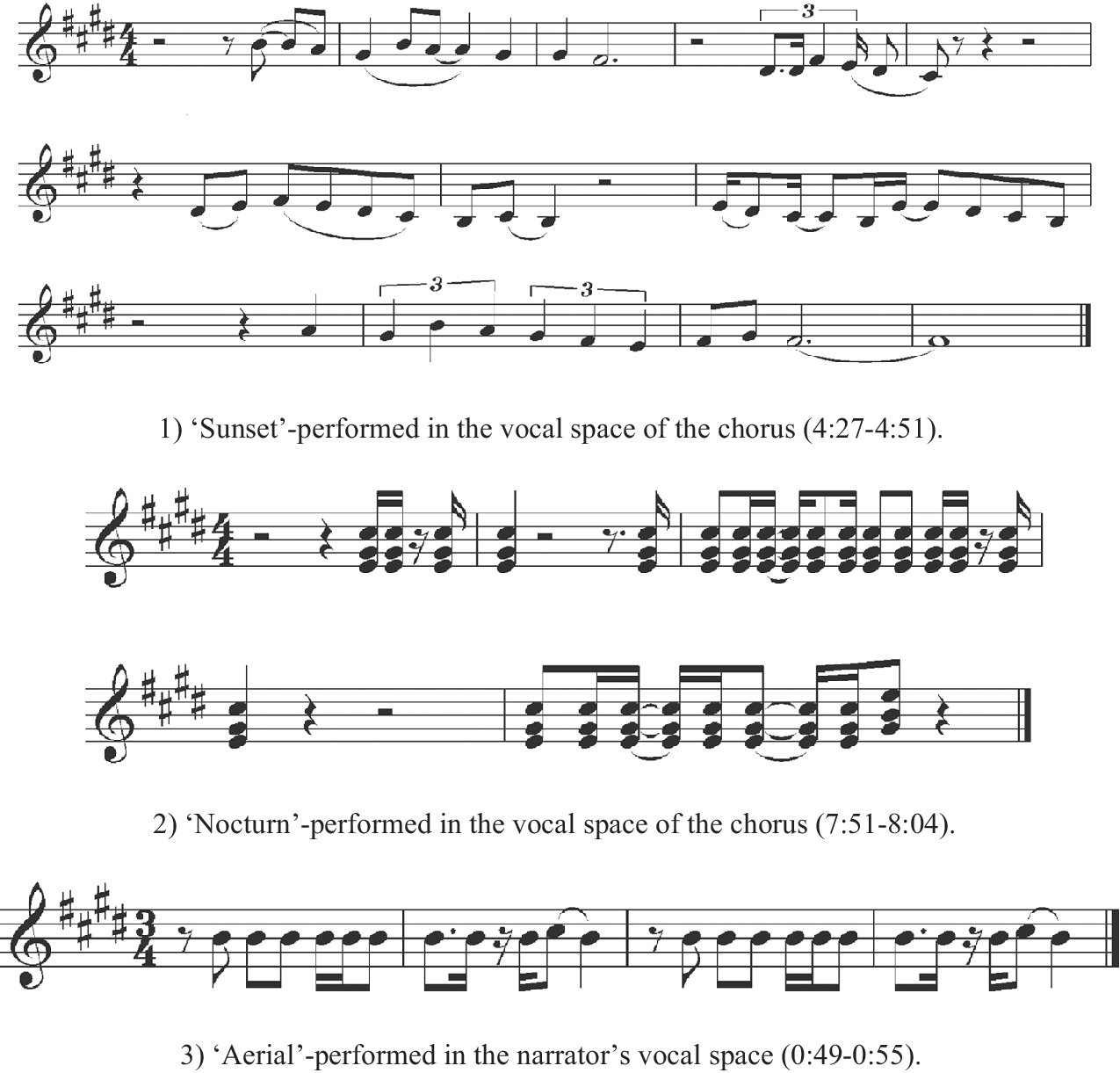
The pastoral setting, as one defined by birdsong, is established from A Sky’s opening song, ‘Prelude’, where sampled birdsong is gently faded into the mix. The sampled sound is important in offering an early characterisation of the chorus, A Sky’s pastoral speaker. I hear the chorus as A Sky’s natural world; it is omnipotent, communicating the continuous presence of nature whilst representing all of A Sky’s voices – including their technical realisation as it develops through Bush’s practices of mimicry and the layering of both human voice and sampled birdsongs – as individual expressions of selfhood and a communal articulation of togetherness. From this interconnected whole, Bush draws out the rhythmic, timbral, and melodic qualities of specific voices – the chorus (who is named in Aerial’s liner notes), the wood pigeon, and the narrator – to create motifs, or refrains, which she then weaves into the musical fabric of A Sky. Each character has their first sounding in the opening two songs, ‘Prelude’ and ‘Prologue’. Figure 1 is a transcription of these motifs as they first appear.
Character Motifs.

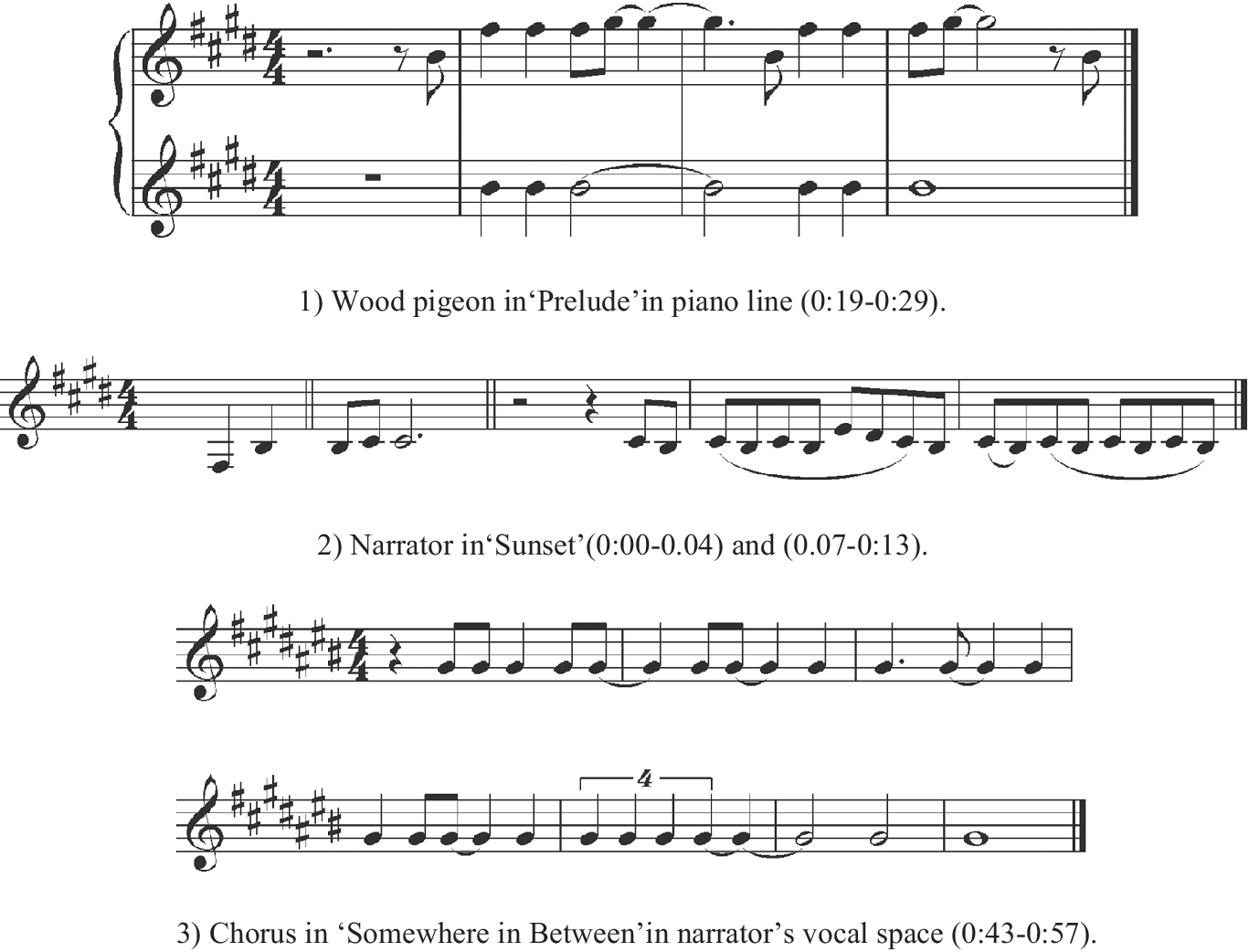
The progression of the cycle marks a shift in how the characters interact. This can be traced via a narrative arc that begins with an invitational stage (‘Prelude’, ‘Prologue’, ‘An Architect’s Dream’, and ‘The Painter’s Link’) and moves through a period of communion (‘Sunset’ and ‘Aerial Tal’) that leads to the renunciation of selfhood (‘Nocturn’) and culminates in the narrator’s realisation of her already interconnected state (‘Aerial’). This progression is musically encoded through the development of established character motifs. The character statements heard at the start of the cycle are disrupted by processes of augmentation, diminution, fragmentation, repetition, recombination, and accumulation that become an expressive feature of A Sky. Figure 2 shows some examples of this and the re-presentation of characters in different spaces in the cycle’s musical fabric. Whilst it is beyond the scope of my discussion here to provide a comprehensive analysis of this narrative arc, a discussion of two consolidating moments demonstrates the importance of birdsong in Bush’s pastoral expression.
Development of character motifs.

The first consolidating moment occurs in ‘Aerial Tal’, a texturally sparse vignette that reconfigures the interactions between characters. Here, a fourth character, the blackbird – whose voice can be heard in the sampled birdsong in ‘Prelude’ – emerges from the closing seconds of the previous song, ‘Sunset’, to perform a duet with the narrator. Where Bush voices the narrator, the blackbird is represented by a recorded sample of the bird’s song. Until this moment, the narrator has communicated via human linguistic expression. ‘Aerial Tal’ signals a moment in the cycle where the communal engagement initiated in ‘Sunset’ intensifies.
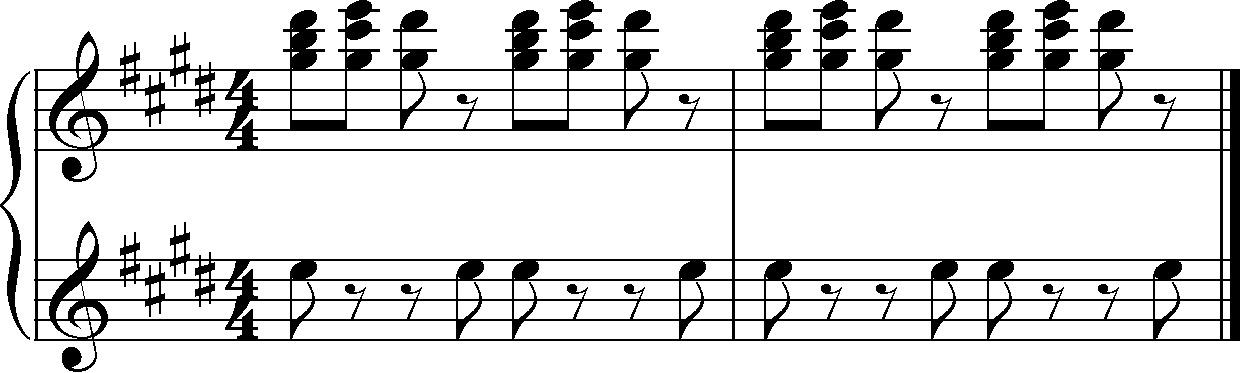
The duet itself consists of ten motifs that are guided by the fragmentary call vocabulary of the blackbird song. Abandoning linguistic expression, the narrator mimics these calls through exclamations of melodically and rhythmically stylised syllabic sounds: ‘drrr di-da, drraa du-da’ (Bush Reference Bush2018, p. 100). Similarly, Bush draws the pitch and timbral inflections of the blackbird song into the narrator’s vocal line. The duet is accompanied by a three-note ostinato, built around an E major seventh and C-sharp minor chord – the cycle’s dominant tonality – that develops from the wood pigeon motif whilst drawing on the rhythmic and timbral qualities of the blackbird song (Figure 3). The final motif is followed by an utterance from the wood pigeon, and then the chorus singing the title of both A Sea of Honey and A Sky to the pitch, rhythm, and timbral inflections of the wood pigeon call. Despite being a duet between the narrator and the blackbird, the other characters are present, although they are recombined and re-presented in new vocal spaces. The wood pigeon motif, for example, can be heard in the ostinato line and in the verbal utterances of the chorus; the narrator imitates the blackbird song, while the blackbird takes a more prominent vocal space.
‘Aerial Tal’ piano ostinato (0:00-0:13).

‘Aerial Tal’ crystallises previous character interactions and marks the forming of a new configuration of reciprocal exchange. This is set up in the previous song, ‘Sunset’, where the narrator and the chorus begin to demonstrate an awareness of each other’s presence by dialogically ‘coming together’ in song, a form of engagement that is fundamental in pastoral history (see Alpers Reference Alpers1996, pp. 80–1). The coming together of characters in ‘Aerial Tal’, however, is different from other such convenings in pastoral tradition, and this, I suggest, is the result of Bush’s imitative practice. The duet between the narrator and the blackbird is not one of mechanical imitation, where the effort is placed on exact replication. Instead, the stylised, syllabic exclamations emphasise the relationality between vocal spaces by ensuring expressive distinction. This represents both the narrator’s experience of birdsong and her emerging conception of interspecies relationality.
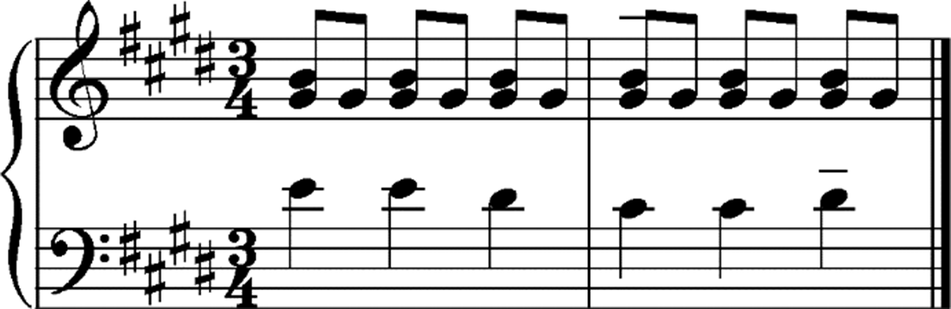
This changing relationship is further emphasised in the second consolidating moment, occurring in ‘Aerial’, the final song in A Sky. ‘Aerial’ provides a narrative culmination that integrates the simple accompaniment from ‘Aerial Tal’ into a more elaborate musical environment. Two minutes into ‘Aerial’, a moment of stillness suspends the song’s prior focus on building layers of sound through the recombination of character motifs. This stillness leads to a call-and-response duet between the narrator and blackbird. As in ‘Aerial Tal’, the blackbird song is sampled sound and Bush performs as the narrator. The accompaniment is stripped back to feature a variation of the ostinato from ‘Aerial Tal’ bringing the narrator’s and blackbird’s voices to the front of the mix (Figure 4). The call and response is structured around fragments from the blackbird’s call vocabulary and the narrator’s exclamations of laughter, again, referring to and developing the exchanges heard in ‘Aerial Tal’.Footnote 16 The blackbird initiates the exchange with two motivic fragments, proceeding to a further 12 fragments of song and laughter. The gap between each exclamation gradually closes until they synchronise on the thirteenth fragment. The narrator closes the exchange with three fragmented exclamations of laughter doubled with an echo effect. From this point, the textural density that characterises the opening minutes of ‘Aerial’ returns, adding layers of accompaniment and an increasing amount of echo that suffocates the vocal lines and renders the narrator’s voice incomprehensible. The closing section of the song features multiple layered voices performing phrases of stylised, monosyllabic imitations of laughter that end abruptly, giving way to a reprise of the sampled birdsong from A Sky’s opening moments.
‘Aerial’ ostinato (0:00-0:03).

I interpret the call and response between the narrator and blackbird as the gradual smothering of the narrator’s vocal and the phrases of stylised laughter a continuation of the exchanges heard in ‘Aerial Tal’. Where ‘Aerial Tal’ documents the direct communion between the narrator and her world, in ‘Aerial’, her immersion in her landscape realises her re-emergence in the chorus’s vocal space. This is illustrated by the imitative laughter that closes the piece. Not only does this re-present the narrator’s earlier call and response with the blackbird, but it also recalls the exclamations in ‘Aerial Tal’. These progressive practices of vocal mimicry, which result in the re-presentation of vocal utterances, are an extension of Bush’s technical expression of character interaction through the statement, development, and recombination of motifs. Consequently, the chorus’s laughter as ‘Aerial’ draws to a close suggests the world accepting and responding to the narrator, echoing her exclamations in a now redefined state. To achieve this, Bush draws on the different textures of birdsong heard from the opening phrases of the cycle, giving the key characteristics shape by layering her voice with increasing density. Through this, she creates the chorus whose consistent presence in the cycle, beginning with sampled birdsong, now takes a reconfigured state both by recombining all character motifs into new phrases and expanding its presence across multiple vocal spaces.Footnote 17 Figure 5 shows examples of the recombined motifs.
Recombination of character motifs.

As the expressive lynchpin of A Sky, it is important to note that the revelation of this condition is new only to the narrator as the chorus is presented, from the opening of the cycle, as the already established condition of this pastoral world. This is encapsulated by the sound of birdsong that opens and closes the cycle. It is from these sounds that Bush creates the character motifs, the individual statement of which is intended to musically articulate the dialogic interactions between characters whilst representing the narrator’s realisation of her role amidst the chorus. Consequently, to musically represent the already realised pastoral space expressed in A Sky, the motifs have an underlying similarity in shape, rhythm, and texture.
At the start of this section, I considered the existing interpretations of Bush’s pastoral expression and in expanding the discussion to her broader articulations of nature, found an empathetic articulation of human–non-human relationships. Allowing this wider expressive state to resonate with A Sky, I explored how Bush, from the album’s conception and physical presentation, communicates an altered pastoral world to the listener. This reconfigured state is reinforced through Bush’s compositional practices to articulate a world that reaches beyond human–nature relationships typical of pastoral convention. As my analysis shows, an increasing amount of tension gives way to a condition of interrelationality between human and non-human characters by the persistent swapping and sharing of character motifs. This is demonstrated most clearly in my close reading of two consolidating moments, which reveals, in microcosmic form, A Sky’s overarching condition of (re)vision through the statement, development, and progression of established themes. Through this, the division between the human and non-human personas as an articulation of dualist logic is irretrievably lost, replaced by a condition of interspecies collaboration and reciprocity.
In the next section, I reflect on the significance of Bush’s musical version of female pastoral, considering how the sound world she creates in A Sky interrogates, dismantles, and restructures human/non-human and culture/nature binaries through cultivating and demonstrating an ethics of care.
4. A musical female pastoral
My discussion in the previous section identified Bush’s (re)visionary approach to pastoral convention and revealed a revised pastoral world where subject and landscape are entangled in a responsive, mutually engaging relationship. This condition reflects Harrison’s characterisation of female pastoral where community is emphasised over hierarchical displays of power. Bush’s musical version of female pastoral is exemplified by the exchanges between human voice and birdsong. These exchanges not only characterise A Sky’s pastoral world and demonstrate an empathetic engagement with the expression of alterity, but the compositional practices that underscore their articulation display a comparable level of empathy. I reflect on these different threads below, beginning with A Sky’s inner sound world.
Decentring the privilege typically given to human perspectives in pastoral history, the focus in A Sky rests on the cultivation of an egalitarian, non-hierarchical expression that envisions human and non-human interactions as equal. This is mobilised through the narrator’s gradual immersion into the chorus and her realisation of her role within this space. Where she initially seems to be the primary expressive voice at the start of the cycle, a conduit between the events of the cycle and the listener’s ear, the musical environment negates a claim to monologic identity, prioritising instead dialogic encounters. The erosion of individualism is exacerbated by the tension between the narrator’s and the painter’s presence. Where the painter tries to capture the light as it changes, rendering the world according to his own vision, the narrator enters a state of communion with the world around her, nurturing reciprocity and recognising collective experience. Here, the painter’s techniques align with Romantic ideals of pastoral art where the transposition of landscape onto canvas was a demonstration of man’s dominion over nature. In this respect, the painter in A Sky is representative of patriarchal authority over the natural world,Footnote 18 and is contrasted by the narrator’s response, who acknowledges nature as an active agent beyond its role as a passive medium: as the narrator listens to the world, the world responds.
The pastoral space of A Sky can, to quote Nigel Thrift’s (Reference Thrift, Clifford, Holloway, Rice and Valentine2008) theory of geographic spatiality, be understood as ‘undergoing continual construction as a result of the agency of things encountering each other in more or less organized circulations’ (p. 86). The swapping and sharing of motifs, representing the processes of A Sky’s communal state, demonstrates the characters’ awareness of their capacity to act upon each other and their immersion in a landscape that is constituted by and through the exchange of contrasting perspectives. A microcosmic expression of this condition occurs in the vocal mimicry in ‘Aerial Tal’, where the narrator imitates, in an altered form, the song of the blackbird. A further example can be heard in the call and response in ‘Aerial’, and again, later in the same track, with stylised, imitative outbursts of laughter. These instances demonstrate a condition of persistent empathy and indelible relationality, as each character’s perception of interior self-knowing is exposed to the affective capabilities of exterior experience. The chorus, as the manifestation of A Sky’s pastoral world, expresses an interconnected tapestry of voices that is, being defined by the sharing of difference, fluid and adaptable.
This condition of being reflects both Harrison’s interpretation of female pastoral, which stresses the reciprocal interactions between human and landscape, and an ecofeminist ethics of care. As examples of ecofeminist principles, Gruen’s entangled empathy, Donovan’s dialogical care theory and Corman’s views on listening all emphasise the enmeshed relationship between human and non-human beings, and each highlights the importance of embracing similarities and differences in the realisation of kinship. The various interactions in A Sky restructure the human/non-human duality, thereby relieving it of its power. This is the sort of ‘thinking differently’ called for by Plumwood (Reference Plumwood2009), where imaginative responses confront reductionist culture and resist the mechanisation of nature.
This brings me to Bush’s compositional practices. Examining the potential of an interspecies feminist ecocriticism, Gaard (Reference Gaard2010) puts forward a list of questions that could be asked of a text: ‘How does this text handle the problem of speaking for other species? Does the text depict other animal species as passive agents who need human saviours, or does the text depict the agency of other animal species?’ (pp. 8–9). Bush’s engagement with birdsong, whether through incorporating birdsong’s texture, timbre, melody, and rhythm into the creation of motifs or editing recorded birdsong into the cycle, directly engages these questions and interrogates traditional power dynamics between human and non-human beings where the production of knowledge is often accomplished through exploitative practices that strengthen processes of othering.
In this respect, Bush’s compositional practices align with the practices of musicologists and composers such as Hollis Taylor and Rachel Mundy, whose work with birds and other animal voices moves beyond the status of animals as informants or ‘laboratory equipment’ (Taylor Reference Taylor2017). Incorporating pied butcherbird songs into her music, Taylor (Reference Taylor2017) refers to her compositions as ‘(re)compositions’ to acknowledge the bird’s role as collaborator and composer. She argues that taking a bird’s call to a human voice or instrument encourages alternative ways of listening and challenges the boundaries between human and non-human beings. Mundy (Reference Mundy2018), similarly, questions the value systems that consider human music-making superior to non-human forms of musicking, and in asking readers to attend to how they listen to the voices and sounds of perceived others, proposes a more informed and interconnected understanding of difference, music, and listening. This ethics of engagement is demonstrable from the outset of A Sky as Bush immediately contextualises birdsong as a vital experiential sound. Her compositional practices do not depict birdsong in a passive way; quite the opposite, she opens deliberate and considered space for the agency of the birds. Attending to the specificity of their individual voices and giving the characteristics of their songs and calls shape through her own voice and other musical instruments, A Sky feels guided by the creativity of birds. Her recollections of composing A Sky attest to this and emphasise the importance of attention through listening, of being silent long enough to hear a bird’s song and imagine their communicative meaning in their own context. Further restructuring the human/non-human binary, Bush’s music-making practices draw birds and birdsong into a co-creative relationship where they are recognised as authors.
Technology and digital media are vital in facilitating this reframing. Whilst Bush’s mastery of record production undermines the masculine-coded field of music production (see Wolfe Reference Wolfe2020), her use of technology in the realisation of A Sky’s sound world also dismantles the culture/nature dualism and its related binary, technology/nature. Warning against industrialisation and technological progress, traditional pastoral ideology maintains the opposition of nature and culture through thematic conventions such as retreat and return, nostalgia, and escapism. In A Sky, the boundaries between these oppositions are unclear as acoustic instrumentation – sonically referencing nature – is combined with digitally edited and produced sounds – a sonic reference to culture (Størvold Reference Størvold, Dines, Smith and Rambarran2025). Writing about the composer Emily Doolittle, Denise von Glahn (Reference Von Glahn2013) notes that by allowing human ears to perceive the minutiae of nature’s sound, technology affords a closer, more careful listening practice, and in drawing human and non-human voices into closer proximity allows for a more intimate experience of cross-species expression (pp. 308–13).Footnote 19 This considered use of technology works to expose the overlaps between nature and culture, thereby rewriting its authority as it manifests through the human/non-human duality. Technology, therefore, makes it possible for Bush to record, sample, edit, and sing alongside one of pastoral’s most enduring sonic presences – birdsong – and she uses these techniques in the articulation of the chorus. This, combined with the translation of birdsong into other musical gestures, takes the pastoral idea of birdsong and initiates an affective transformation of tradition.
From inside A Sky’s sound world to its technical realisation, empathy, care, and attention characterise Bush’s (re)visionist approach to pastoral expression. Powerful yet damaging binary structures that are historically bound to pastoral convention are dismantled and restructured through Bush’s envisioning of relationships built on co-operation and collaboration. Building a world where human and non-human beings embrace one another’s agency via creative exchange, A Sky develops the legacy of female pastoral and in utilising the potential of music and sound, offers a new expressive context through which to experience the formation of non-hierarchical interactions as they develop.
5. Conclusion
In this article, my goal has been to offer an ecofeminist interpretation of female pastoral expression in Kate Bush’s song cycle, A Sky of Honey. Focusing on Bush’s articulation of human–non-human interactions, I have framed A Sky as a (re)visionary work of female pastoral that interrogates and restructures pastoral’s troubling historical legacies to imagine a world free from hierarchical structures of power. To achieve this, I chose ecofeminist ethics of care, with a focus on attentive listening practices, as key to my interpretive framework. Finding the sorts of principles and encounters advocated by ecofeminism depicted in female pastoral, I read female pastoral as an explicit articulation of ecofeminist values. This interpretive framework has supported a politicised re-reading of Bush’s pastoral expression and has allowed me to explore her imaginative responses to pastoral’s dominant metaphors as they are textually realised.
A Sky lends itself to such a re-reading due to its ambiguous expression. Presenting what seems to be an idyllic pastoral environment, one drenched in sunlight and birdsong, I found multiple references to pastoral convention, from the album’s conception to its realisation. Following the thematic traits of female pastoral, I read these points of convergence with pastoral convention as simultaneous moments of divergence that work to consistently undermine its own idyllic state and create a world that feels both familiar and unfamiliar, peaceful yet disturbed. Exploring Bush’s (re)visionary strategies in A Sky’s surrounding context revealed birds and birdsong to be expressively vital to the pastoral world under development. This is similarly reflected in Bush’s compositional practices, where the relationship between human voice and birdsong articulates the types of dialogical, interconnected human–non-human encounters called for by ecofeminists. My analysis found this exemplified by the generative state of the chorus, which, as the soniferous representation of the natural world, holds each voice, balancing the interchanging viewpoints of difference and similarity to create a microcosmic culture of multiple divergent perspectives. As in female pastoral, the (re)vision of anthropocentric perspectives common in pastoral convention leads to a multifarious, open system that is populated with multiple human and non-human subjects.
Bush has never outwardly aligned herself with either feminist or ecofeminist principles, and there are multiple other ways A Sky might be interpreted. Despite this, reading A Sky through an ecofeminist female pastoral framework has enabled me to identify corrective acts of reframing. Similarly, in creating a world that reflects an empathetic and attentive understanding of human–non-human engagement, the piece resonates with ecofeminist ideals. Bush has demonstrated, both in A Sky and in her wider career, an imaginative awareness of the potential of music to question, interrogate, and engage with structures of power that do not serve a vision of equality and justice. In the world’s current state of environmental emergency, the ability to imagine alternate futures is imperative in encouraging and sustaining hopeful responses to our multiple extant crises. Tore Størvold (Reference Størvold, Dines, Smith and Rambarran2025) suggests that music gives environmental issues ‘tangible form…anchoring them in emotional and embodied experiences’. Through music, therefore, listeners are drawn into acts of reconnection where they can realise new forms of relationality and forge new collaborative encounters. This takes hold in A Sky as listening not only ensures the reconfiguration of pastoral space by making audible the interaction of human voice and birdsong but also allows the listener to learn the language of this world as it develops.
Towards the end of Female Pastoral, Harrison (Reference Harrison1991) questions the future of female pastoral and whether it will be abandoned as an ‘unnecessary displacement of gender, race, and class’ (p. 134). Thirty years after its original publication, I hope my analysis, in being open to the resonance of ecofeminist history with contemporary ecofeminist concerns, represents one possible future for the genre. Bush’s musical female pastoral in A Sky of Honey presents an imaginative reweaving of damaging historical legacies into a hopeful vision of equality. Creating a complex tapestry of voices that is at once political and liberatory, Bush recasts the female pastoral environment as a liminal space where self and other are indivisible, engaged in an entangled landscape of persistent formation and reformation.
Discography
Kate Bush, Lionheart. EMI, EMA-787. 1978.
Kate Bush, ‘Breathing’, Never for Ever. EMI, 1A062-07339. 1980.
Kate Bush, Aerial. EMI, 0946 3 43960 2 8. 2005.
Kate Bush, 50 Words for Snow. Fish People, FPCD007. 2011.
Kate Bush, ‘The Dreaming’, The Dreaming. Fish People, FPCD002, 2011.
Kate Bush, Hounds of Love, Fish People, 190295568948. 2018.