Introduction
The prediction of sperm fertilizing ability has great economic relevance for breeding when assisted reproduction techniques (ART) are used, remaining one of the major challenges to the andrology laboratory, especially for human application. So far, many studies have focused in the relationship between sperm parameters and fertility, with very different outcomes (Larsson & Rodríguez-Martínez, Reference Larsson and Rodríguez-Martínez2000; Silva & Gadella, Reference Silva and Gadella2006). In most ART, as in IVF or artificial insemination, the assessment of male fertility still mainly depends on the classic semen analysis that usually involves the evaluation of sperm concentration, motility and morphology. However, unless these parameters are extremely abnormal, this procedure provides little prognostic information (Gadea, Reference Gadea2005).
Despite increasing knowledge about gamete interactions, our understanding of fertility is still far from being complete. In general, low conclusive and sometimes contradictory results could be obtained from the literature dealing with the influence of sperm factors on the success of in vitro fertilization (IVF). Among reasons to explain this lack of consistency, we can mention large experimental differences, low number of ejaculates, high ratio of sperm:oocyte in the IVF system or pre-selection of the ejaculates (Gadea, Reference Gadea2005). Moreover, due to the multi-component nature of the spermatozoa and the many successive steps that must occur for in vivo as in vitro fertilization success, the analysis of a single sperm quality parameter usually does not give a high predictive value of fertility (Januskauskas et al., Reference Januskauskas, Johannisson and Rodríguez-Martínez2003). The lack of homogeneity in the assessment of individual semen characteristics in relation to oocyte fertilization confirms the difficulties in finding a good predictive model based on seminological parameters (Jedrzejczak et al., Reference Jedrzejczak, Pawelczyk, Taszarek-Hauke, Kotwicka, Warchoł and Kurpisz2005), therefore it is necessary to find more accurate methods to evaluate the fertility of sperm samples.
The inclusion of several sperm variables on a multiple regression analysis has been regarded as a more discriminating method that in some cases may even provide a predictive value (Rodríguez-Martínez, Reference Rodríguez-Martínez2006). Nevertheless, in order to find a model for fertility prognosis in IVF, our primary task consists in determining which sperm characteristics are most associated with oocyte fertilization. Additionally, an accurate estimation of reproductive efficiency of these in vitro procedures is also important. In general, the endpoints of IVF studies have been the outcome of cleaved oocytes and/or their development to morulae or blastocysts, although in vitro fertility can be also assessed by oocyte penetration rates (Larsson & Rodríguez-Martínez, Reference Larsson and Rodríguez-Martínez2000). Again, the fact that different IVF outcome criteria have been used to determine sperm fertilizing ability indicates that a competent method to assess efficiently semen fertility does not yet exist.
In this present work, a study was performed to find a connection between several sperm parameters such as motility, viability and acrosome integrity assessed during the IVF process and three IVF outcome criteria (total penetration, normal penetration and cleavage rates). Therefore, our main objective was to improve the accuracy of sperm parameters in predicting sperm fertilizing ability for IVF and to develop a mathematical model that allows the discrimination of optimal semen measurements to obtaining better IVF outcomes.
Material and methods
In order to achieve our objectives, a series of experiments was carried out and 56 replicates were analysed.
Recovery and in vitro maturation of oocytes from prepubertal goats
Ovaries were recovered from prepubertal goats (younger than 2 months old) at a commercial slaughterhouse (Carns Pallejà, Pallejà, Barcelona), 20 km away from our university. Once in the laboratory, the ovaries were washed three times in phosphate-buffered saline (PBS; P-4417; Sigma, St. Louis, MO, USA) supplemented with gentamicin (50 mg/ml) at 38.5ºC. Oocytes were obtained by slicing the ovaries in TCM199/HEPES medium (M-2520, Sigma, St. Louis, MO, USA) supplemented with 2.2 mg/ml sodium bicarbonate and 50 µg/ml gentamicin. Oocytes with one or more complete compact layers of cumulus cells with an evenly granulated cytoplasm were selected and cultured in 50 µl microdrops (eight oocytes per microdrop) of TCM 199/HEPES medium supplemented as described previously (Mogas et al., Reference Mogas, Palomo, Izquierdo and Paramio1997), and covered with paraffin oil (Sigma, St. Louis, MO, USA) at 38.5ºC for 27 h in an atmosphere of 5% CO2 in saturated humid air in a CO2 incubator (Shel-Lab®, model 2400, Sheldom Manufacturing, Inc., Cornelius, OR, USA).
Spermatozoa processing
Ejaculates were collected using an artificial vagina from three adult Murciano-Granadina males (2–4 years old) of proven fertility and transported to the laboratory at 37ºC (one ejaculate per male and replicate). The percentage of progressive motility was assessed and all samples that showed less than 60% motile sperm cells were rejected. Also, in order to eliminate the individual male effect, ejaculates from three males were pooled in equal quantities. Spermatozoa were selected by the swim-up technique depositing 50 μl of the mixture of pooled ejaculates in different tubes containing 2 ml of HEPES-TALP (Parrish et al., Reference Parrish, Susko-Parrish, Leibfried-Rutledge, Critser, Eyestone and First1986). After 1 h at 38.5ºC, the top 0.6 ml from each tube was removed and pooled in a sterile 15-ml centrifuge tube and centrifuged (200 g) for 10 min. The supernatant was discarded immediately afterwards and the pellet was diluted (1:2) in HEPES-TALP medium with 100 µg/ml heparin sodium salt (H-3393, Sigma, St. Louis, MO, USA) with a final incubation concentration of 50 µg/ml of heparin and incubated at 38.5ºC for 45 min.
IVF procedure and embryo culture
After the maturation culture interval, cumulus–oocyte complexes were transferred to microdrops (14 to 16 oocytes per 95 µl drop) of fertilization medium (TALP; Parrish et al., Reference Parrish, Susko-Parrish, Leibfried-Rutledge, Critser, Eyestone and First1986) supplemented with 1 µg/ml of hypotaurine (H-1384, Sigma, St. Louis, MO, USA). After heparin pre-treatment, sperm concentration was assessed using a haemocytometer. An aliquot (5 µl) of sperm suspension was added to each fertilization drop for final concentration of 4 × 10⁶ sperm/ml (sperm:oocyte ratio of 28,000 approx.). Insemination was under paraffin oil (Sigma, St. Louis, MO, USA) in a humidified 5% CO2 in air atmosphere at 38.5ºC.
Following 24 h of gamete co-culture, spermatozoa and cumulus cells were removed from zygotes using a finely drawn and fire-polished glass pipette, and transferred onto monolayers of the granulosa cells. Monolayers were prepared from granulosa cells aspirated from follicles judged to be non-atretic as described previously (Mogas et al., Reference Mogas, Palomo, Izquierdo and Paramio1997).
Assessment of the results
Three IVF outcome criteria (total penetration, normal penetration and cleavage rates) were registered. At 48 hours post-insemination (hpi), the cleavage rate (number of cleaved > 1 cell embryos/oocytes inseminated) was evaluated. Previously, in order to evaluate the penetration rates at 17 hpi, a sample of oocytes was separated from the spermatozoa attached to the zona pellucida by agitation in an isotonic solution of sodium citrate at 3% and fixed for 3 days in acetic acid:90% ethanol (1:3, v:v) at 4ºC. Afterwards, oocytes were stained with 1% lacmoid and the nuclear stage was observed under a phase contrast microscope. The total penetration rate was evaluated as the number of penetrated oocytes with minimum sperm tail in the cytoplasm, also the normal penetration rate was evaluated as the number of normal penetrated oocytes (male pronucleus, female pronucleus and only one sperm tail in the cytoplasm) from the total inseminated oocytes as described previously (Mogas et al., Reference Mogas, Palomo, Izquierdo and Paramio1997).
From the initial mixture of the ejaculates, a 50 μl aliquot was diluted in 2 ml of HEPES-TALP to evaluate sperm motility, viability and acrosome integrity. Afterwards, several aliquots were taken in order to evaluate these sperm parameters from the sperm suspension collected immediately after the swim-up technique, after the heparin pre-incubation period and finally after 17 h of gamete co-culture. Sperm viability and acrosome integrity were evaluated using a simplified triple staining technique (TST) described in goats by Kusunoki et al. (Reference Kusunoki, Yasui, Kato and Kanda1984). Briefly, live and dead sperm were first differentiated using the vital stain trypan blue (Merck, Darmstadt, Germany). The sperm cells were then fixed in glutaraldehyde and dried onto slides to determine the postacrosomal region and acrosome status using Bismark brown (Fluka, Buchs, Switzerland) and rose Bengal (Fluka, Buchs, Switzerland). A coverslip was mounted and the spermatozoa were examined under bright field microscopy at ×1000 magnification. Four hundred spermatozoa were examined and classified into 1 to 4 of the TST sperm categories: (1) live acrosome-non-reacted (LNR), with a light brown postacrosomal region and pink acrosome; (2) dead acrosome non-reacted (DNR), with dark brown postacrosomal region and dark pink acrosome; (3) dead acrosome-reacted (DR), with dark brown postacrosomal region and unstained or dark blue-brown or damaged acrosome region; and (4) acrosome reaction incidence or live acrosome-reacted spermatozoa (LR), with light brown postacrosomal region and unstained acrosomal region.
Also, one aliquot of the same sperm suspensions was taken simultaneously to assess the sperm viability by eosin–nigrosin (E/N) stain described by Hancock (Reference Hancock1951) as a routine procedure in our laboratory. Two hundred spermatozoa were counted in duplicates at ×1000 magnification with oil immersion.
The percentage of progressive forward motile sperm was assessed by placing 10 μl drop of sperm suspension on a warm slide and covered with coverslip, observation was done using a phase contrast microscope fitted with a stage warmer at 38°C. The sperm motility rate was evaluated by the same technician by rating the progressive forward motile spermatozoa to spermatozoa with circular, reverse, vibrating and rocking movements. Sperm motility estimates were performed in four different microscopic fields for each sample under ×400 magnification. The mean of the four successive estimates was taken as the final motility score.
Statistical analysis
In all analyses, normal probability plots and Kolmogorov–Smirnov tests were performed to investigate the goodness of fit of the residuals with normal distribution. In general, the arcsin transformation of data corrected the departure from normality and White's test on the residuals of the fitted model was used to discard the heteroscedasticity. All variables (sperm motility, viability and acrosome integrity) were subsequently examined for differences across the IVF process period. This preliminary analyses was carried out by the General Linear model procedure of SAS (SAS Institute Inc., Cary, NC, USA), including in the model the IVF process period (four levels: initial, swim-up, heparin pre-incubation and at 17 h co-culture) and the replicate date as fixed factors. The least squared means (LS means) for the four levels of IVF process period were computed, and multiple comparisons among them were made. Relationships between IVF outcome and the sperm parameters considered as potential predictors were preliminary investigated through Pearson correlation coefficients.
Subsequently, multiple regression analyses were performed in order to select the best regression model accounting for the variability in the in vitro fertilizing ability of the spermatozoa. Taking into account the collinearity among the sperm parameters, a stepwise regression procedure was used as criterion for selecting the combination of explanatory variables to include in the final model. Three in vitro fertilizing ability criteria were analysed as response variables: penetration, normal penetration and cleavage rates. For each analysed variable, three ‘maximum models’ (i.e. models that would include all considered explanatory variables) were analysed considering different groups of sperm variables assessed along the IVF process:
-
• Model A: considered the progressive motility and E/N viability assessed in the IVF phases previous to the gamete co-culture.
-
• Model B: included the progressive motility, E/N viability, TST viability, TST acrosome integrity and the four TST sperm categories assessed in IVF phases previous to the gamete co-culture.
-
• Model C: considered the progressive motility and E/N viability assessed both, previously and subsequently to the gamete co-culture.
An additional analysis was performed considering the progressive motility, E/N viability, TST viability, TST acrosome integrity and the four TST sperm categories assessed both before and after the gamete co-culture, but results were initially discarded due to the limited number of replicates available for this analysis (19 observations).
For all nine stepwise regression analyses (three groups of variables × three maximum models), new variables were added to the model in the forward step where the F-ratio had a P-value lower than 0.05, whereas P-values above 0.10 lead us to remove the tested variable in the backward selection. The stepwise regression procedure continued until no more variables could be added nor removed.
Finally, the goodness of fit of the final regression models was evaluated by the adjusted coefficient of determination (R2 ). The adjusted-R2 represents the proportion of the total amount of data variability that can be explained by the fitted model, but adjusted by the number of observations and explanatory variables in the model.
Results
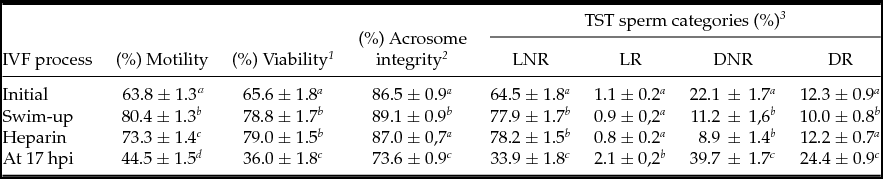
The evolution of the sperm parameters assessed along the IVF process is shown in terms of least square means (LS means) in Table 1. The results as regards to the obtained IVF outcome in the totality of the assays are summarized in the following manner. From a total of 56 different replicates, 960 oocytes were fixed at 17 hpi, from which 340 were penetrated (36.2 ± 3.3%), being normally fertilized 135 (14.6 ± 1.6%). Conversely, from 2822 oocytes cultured until 48 hpi in granulosa cell monolayer, only 961 were cleaved (32.8 ± 2.8%). After analysing the relationship between these IVF outcome, high correlation coefficients were found between total and normal penetration rates (r = 0.77; P < 0.0001), and also between total penetration and cleavage rates (r = 0.71, P < 0.0001), meanwhile correlation coefficient between normal penetration and cleavage rates was lower but also significant (r = 0.59, P < 0.0001).
Evolution of different sperm parameters along the IVF process of prepubertal goat oocytes (LS mean ± SEM; n = 56)
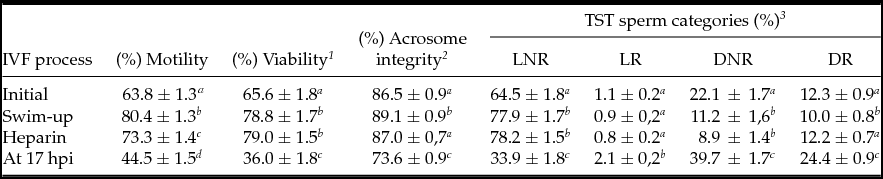
1 Viability TST: LNR + LR.
2 Acrosome integrity: LNR + DNR.
3 LNR: live acrosome-non-reacted sperm; DNR: dead acrosome non-reacted sperm; DR: dead acrosome-reacted sperm; and LR: live acrosome-reacted sperm or acrosome reaction incidence.
a,b Values within a column with different superscripts differ significantly at P< 0.005.
Conversely, when the relationship between the sperm parameters assessed along the process and the IVF outcome was examined, no significant correlations were found among any of the sperm characteristics measured in the initial assessment of the pooled semen samples. Only a limited number of significant and positive, although moderate, correlations were obtained between the cleavage rate and sperm parameters measured on the swim-up sperm fraction, such as the percentage of motile spermatozoa (r = 0.33, P < 0.014) and the proportion of live spermatozoa assessed by E/N stain (r = 0.34, P < 0.015). Similar relationships of the total cleavage rate with the percentages of E/N live spermatozoa and live sperm with reacted acrosome assessed at 17 hpi were observed (r = 0.38, P < 0.025 and r = 0.37, P < 0.018 respectively). It is also worth mentioning that, from the plethora of sperm parameters tested, only the proportion of dead sperm with intact acrosome after the heparin pre-treatment and the proportion of E/N live sperm after 17 hpi showed significant correlations with the total penetration rate (r = 0.29 and 0.37, with P < 0.048 and P < 0.037, respectively).
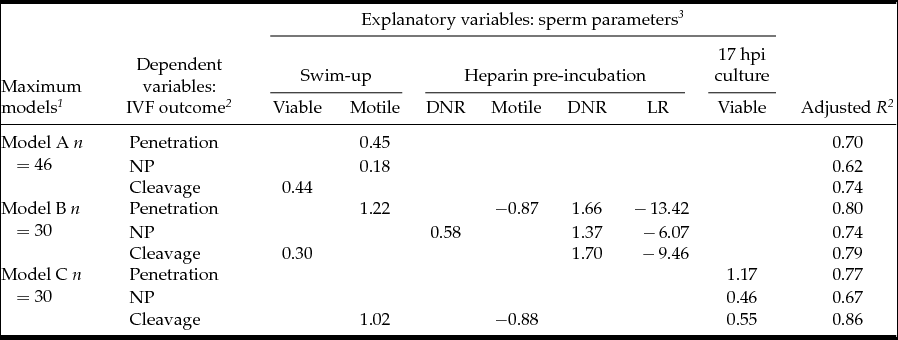
The stepwise regression procedure was conducted in order to determine if a linear combination of these sperm variables could better fit the observed variation in IVF outcome. Three measures of IVF outcome were evaluated: total penetration, normal penetration and cleavage rates. Results from these analyses are shown in Table 2. The obtained models providing the best fit of these data in the nine analyses (three variables × three maximum models) showed adjusted-R2 values ranging between 0.62 to 0.86. These R2 values indicate a medium to high proportion of the total variability in IVF outcome explained by these fitted models, so a moderate predictive value of the models was obtained in these analyses.
Partial regression coefficients of the IVF outcome variables on the sperm parameters measured along the IVF process (explanatory variables) in the final models obtained through Stepwise Multiple Regression with three initial maximum models along with the adjusted-R Footnote 2 of the final models
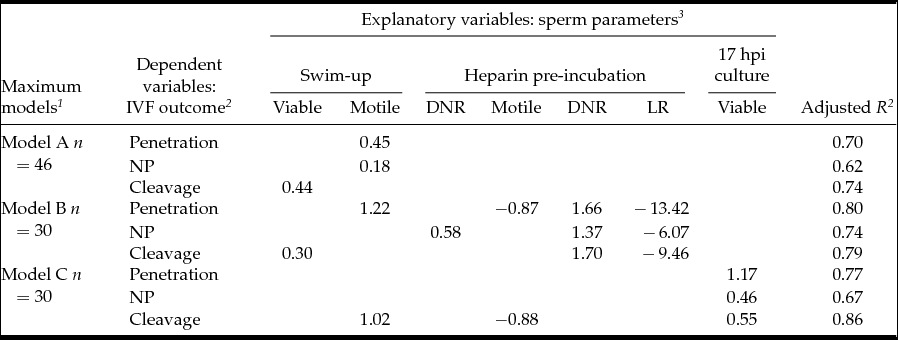
1 Model A: maximum model that includes progressive motility and E/N viability assessed in the in IVF phases previous to the gamete co-culture as explanatory variables considered in the analysis. Model B: includes progressive motility, E/N viability and TST sperm categories assessed in the IVF phases previous to the gamete co-culture as explanatory variables. Model C: includes progressive motility and E/N viability assessed prior and after the gamete co-culture as explanatory variables.
2 Penetration rate; NP: normal penetration rate; cleavage rate.
3 Viable: sperm viability (%) assessed by E/N stain. Motile: progressive sperm motility (%). DNR: dead acrosome non-reacted sperm (%) by TST. LR: live acrosome-reacted sperm (%) or acrosome reaction incidence by TST.
Also, from the whole group of sperm parameters measured, only seven were selected as explanatory variables of the IVF outcome in at least one of the analyses. The sperm parameter more frequently selected as explanatory variable among these models was the progressive motility assessed immediately after swim-up selection. This measure of motility was selected as the explanatory variable in four of the nine analyses. In the first analysis (model A), this motility was the only covariable selected in the regression model for both penetration rates, showing a positive relationship with IVF outcome. However, the partial regression coefficient became particularly relevant for total penetration and cleavage rates in models B and C, respectively, in which this variable was selected jointly with other sperm parameters measured later in the IVF process. Conversely, the proportion of live sperm assessed immediately after swim-up was the only explanatory variable selected in regression model A for cleavage rate, but jointly with other sperm parameters measured after the heparin pre-incubation in model B.
In this way, some parameters assessed immediately after heparin pre-treatment, as the percentage of dead sperm with intact acrosome (positive partial regression coefficient) and the incidence of live sperm with reacted acrosome (negative and high partial regression coefficient), became selected explanatory variables when the TST sperm categories were considered in the analyses (model B) for the three response variables. The dead sperm with intact acrosome percentage on swim-up selected sperm fraction was also selected as an explanatory variable, but only for the normal penetration rate. There was also a relevant increase in the adjusted-R2 of the fitted models for the three IVF outcome variables (total penetration, normal penetration and cleavage rates) when these TST sperm categories were included (model B versus model A).
When the sperm parameters measured after gamete co-culture were included in the stepwise selection procedure (model C), the percentage of sperm E/N viability assessed after 17 h of co-culture was selected as the only explanatory variable in the model of total and normal penetration rates with positive partial regression coefficients in both cases. The adjusted-R2 with regard to model A that did not consider these parameters increased slightly.
In contrast with penetration rates, the R2 of the final model for the cleavage rate increased notably when the sperm parameters after 17 h of co-culture were included in the analysis. In this case, the progressive motility after swim-up and the percentage of sperm E/N viability after 17 h of co-culture appeared as the main descriptive variables positively related to the cleavage rate, although the high collinearity between motility assessed after swim-up and after heparin pre-incubation that led to partial regression coefficients apparently is contradictory. Finally, it must be emphasised that the highest predictive ability in terms of determination coefficient (R2 ) for the cleavage rate was obtained for the model including sperm parameters measured after gamete co-culture, whereas for the total and normal in vitro penetration rates the models including TST sperm categories explained a higher proportion of variance.
Discussion
Generally, the sperm quality of the ejaculates used in this work is slightly lower than that observed by other authors in the Murciano-Granadina breed (Mateo Rex, Reference Mateo Rex1990). These differences may be due to the limited number of males used and the unfavourable season for goat semen quality in which most assays were made (Roca et al., Reference Roca, Martinez, Sánchez-Valverde, Ruiz and Vázquez1992). Nevertheless, consistently with previous studies made in our laboratory (Palomo et al., Reference Palomo, Izquierdo, Mogas and Paramio1999), all assessed sperm parameters were significantly improved by the swim-up technique, excepting the number of live acrosome-reacted spermatozoa.
Unfortunately, few studies about relationships between sperm parameters and IVF rates have been done in goats (Berlinguer et al., Reference Berlinguer, Madeddu, Pasciu, Succu, Spezzigu, Satta, Mereu, Leoni and Naitana2009). Our results suggest that the analysis of fresh semen quality of goat ejaculates did not provide any predictive value on IVF success, as no significant correlations were found between sperm parameters evaluated immediately after pooling the ejaculates and IVF outcome. However, we must consider that the variations of these initial parameters were quite small due to the fact that samples showing less than 60% of motile sperm cells were rejected. This pre-selection of the ejaculates drastically limits the variability of the sperm parameters and could reduce its relation with fertility (Gadea & Matas, Reference Gadea and Matas2000). Moreover, we should keep in mind the concept of compensable sperm traits as those that do not affect fertility if the insemination dose contains a large number of spermatozoa (Saacke, Reference Saacke2008).
Nevertheless, the analysis of swim-up selected spermatozoa seems to provide more information about the fertilizing potential of a semen sample than the initial sperm quality and, consequently, a more accurate predictive value for the outcome of IVF (Michaeli et al., Reference Michaeli, Peer, Anderman, Ballas and Ellenbogen2004). As Rodríguez-Martínez (Reference Rodríguez-Martínez2006) suggested, the methods used in the laboratory to separate spermatozoa can be useful to obtain a sperm population with favourable attributes to fertilize oocytes. In fact, significant positive correlations between swim-up separated motile spermatozoa and IVF outcomes have been found (Zhang et al., Reference Zhang, Larsson, Lundeheim, Haard and Rodriguez-Martinez1999; Michaeli et al., Reference Michaeli, Peer, Anderman, Ballas and Ellenbogen2004; Gillan et al., Reference Gillan, Kroetsch, Maxwell and Evans2008).
In our study, each single sperm parameter analysed was found to be insufficient itself for oocyte fertilization prediction, showing in the most favourable cases a moderate correlation coefficient of 0.3 at best. However, the swim-up separated spermatozoa motility was the sperm characteristic more frequently selected as explanatory variable among the investigated multiple regression models for predicting in vitro fertilization. As a result, the assessment of the selected sperm fraction following a separation procedure should be considered or even implemented in the ‘basic’ semen analysis as Oehninger et al. (Reference Oehninger, Franken, Sayed, Barroso and Kolm2000) proposed, as it is a simple, quick, inexpensive and very informative test. Nevertheless, the value of subjective motility as a predictor of the sperm fertilizing capacity has been disputed (Tartaglione & Ritta Reference Tartaglione and Ritta2004; Gadea, Reference Gadea2005). Even the accuracy in the estimation of sperm motion also plays an important role in its predictive value (Foote, Reference Foote2003; Gadea, Reference Gadea2005), it is still not clear which characteristics of sperm movement assessed by computer-assisted sperm analysis (CASA) systems is of clinical value for predicting fertility and fertilization rates (Verstegen et al., Reference Verstegen, Iguer-Ouada and Onclin2002). The use of statistical techniques for clustering CASA data can be potentially useful for grouping the spermatozoa in subpopulations with biological meaning, although the standardization and improvement of these methods must be carried out in order to find their relation with sperm quality and fertility and facilitate comparison among studies (Martínez-Pastor et al., Reference Martínez-Pastor, Tizado, Garde, Anel and de Paz2010).
Conversely, the stepwise regression results seem to suggest a relevant predictive value of the acrosome reaction incidence (LR%) assessed immediately after heparin pre-treatment when combined with other sperm parameters. Its partial regression coefficient reveals that, at constant dead non-reacted acrosome sperm, viability and motility, a major incidence of acrosome reaction before the gamete co-culture is negatively related to the IVF outcome, indicating that a premature acrosome reaction may be detrimental in IVF. However, one problem found in the clinical application of such parameter consists in its low incidence, resulting in a very limited dynamic range (around 4% in human sperm) for the acrosome reaction bioassay (Aitken, Reference Aitken2006).
In the opposite direction to the proportion of live acrosome-reacted sperm, the percentage of dead sperm with intact acrosome after the heparin pre-incubation period was also selected as the explanatory variable in all regression analyses in which it was considered. It is difficult to assign a physiological explanation to these results, but the important correlation among the four TST sperm categories must be considered. Finally, after gamete co-culture, the only sperm parameter selected as the unique explanatory variable of IVF outcomes was the percentage of E/N assessed live spermatozoa, indicating the relevance of maintaining favourable culture conditions for the survival of sperm and its fertilizing abilities.
The results from multiple regression analyses provided complementary elements to decipher the relationship among these variables, although they must be interpreted with caution. It must be considered that a partial regression coefficient gives a measure of the response variable increase when one explanatory variable is increased by one unit and all the other explanatory variables are held constant. This way, the value of this coefficient depends upon the other explanatory variables included in the regression equation and the relationships among them. Therefore, the collinearity among sperm parameters and the lower number of observations must be taken into account when interpreting these results.
In any case, it seems reasonable to measure multiple sperm attributes simultaneously on individual sperm in a population (Graham, Reference Graham2001) and to develop multiple regression equations to estimate the relative fertility of a semen sample more accurately (Amann, Reference Amann1989; Foote, Reference Foote2003). Although estimates represent approximate numerical calculations at best and sometimes only reflect subjective values, it is therefore necessary to obtain accurate estimates on both variables with minimal random errors, in order to establish a true biological relationship (Foote, Reference Foote2003). The formation of two pronuclei in at least one oocyte was a criterion of IVF success. Such a criterion seems to be unambiguous and clearly defines an in vitro fertilizing potential (Jedrzejczak et al., Reference Jedrzejczak, Pawelczyk, Taszarek-Hauke, Kotwicka, Warchoł and Kurpisz2005). Conversely, the cleavage rate seems to be most suitable to evaluate semen samples than the blastocyst rate, likely because the blastocyst is much more dependent on culture conditions during embryo development than cleavage (Larsson & Rodríguez-Martínez, Reference Larsson and Rodríguez-Martínez2000). Nevertheless, high correlation between penetration and cleavage rate was found in the present work, which leads us to conclude that both criteria could be useful as the specific endpoints to estimate the in vitro fertility.
The performed stepwise multiple regression resulted in a set of models that, depending upon the variables considered and the analysed replicates, better fit the different studied IVF outcomes, then providing the best predictive power. According to these final models, IVF fertilization could be predicted on the basis of only seven out of 32 analysed semen features considered as potential explanatory variables. Six of these semen features were assessed at some point in time prior to the gamete co-culture, giving the chance to predict the outcome of a sperm sample before the treatment was being undertaken. This feature outstand the importance of analysing the selected spermatozoa, whereas the addition of more parameters to our model as those obtained after the gamete co-culture only improved slightly the IVF prognosis in relation to cleavage rate.
Concerning the statistical approaches for oocyte fertilization predictive purposes, it is worthy to note that stepwise multiple linear regression has been described in the literature as a useful model, providing interesting conclusions (Tanghe et al., Reference Tanghe, Van Soom, Sterckx, Maes and de Kruif2002; Tartaglione & Ritta, Reference Tartaglione and Ritta2004; Selvaraju et al., Reference Selvaraju, Ghosh and Ravindra2009). Also logistic regression has been shown as a robust method for such analysis (Jedrzejczak et al., Reference Jedrzejczak, Pawelczyk, Taszarek-Hauke, Kotwicka, Warchoł and Kurpisz2005, Reference Jedrzejczak, Taszarek-Hauke, Hauke, Pawelczyk and Duleba2007; Berlinguer et al., Reference Berlinguer, Madeddu, Pasciu, Succu, Spezzigu, Satta, Mereu, Leoni and Naitana2009). Even though the new developed sperm tests have improved enormously our knowledge and capacity for measuring certain sperm functions with stronger prognostic power, a simple and universal model for predicting the sperm fertilizing potential in vitro is still far from being established (Jedrzejczak et al., Reference Jedrzejczak, Pawelczyk, Taszarek-Hauke, Kotwicka, Warchoł and Kurpisz2005). However, the strength of these new sperm tests may vary depending on how the ART is employed. In other words, the IVF procedures as used routinely are essentially designed to maximize blastocyst yields rather than for detecting differences in fertilizing ability between batches of sperm in order to create effective IVF prognosis. Also, there is no evidence that the evaluation of semen quality through IVF provide a useful predictor of AI pregnancy rate under field conditions (Papadopoulos et al., Reference Papadopoulos, Hanrahan, Donovan, Duffy, Boland and Lonergan2005), unless IVF systems are modified.
In conclusion, regarding the predictive ability of these obtained models, the proportion of the total amount of IVF outcome variation that can be explained by the fitted models ranged from 0.62 to 0.86, depending upon the trait analysed and the variables considered. The obtained regression models allowed us to describe the differences in embryo outcome following IVF as a linear function of several semen parameters, but their predictive value should be tested in a prospective manner and with a larger sample size before properly assessing their applicability.