




No CrossRef data available.
Article contents
Justification for information and knowledge: Perceptions of family members in palliative home care in Sweden
Published online by Cambridge University Press: 26 February 2004
Abstract
Objective: Several studies have concluded that family members in palliative home care want information about the patient's disease. The aim of this study was to describe family members' perceptions of their motivation for receiving information about the patient's disease.
Method: Semistructured tape-recorded interviews were performed with 20 family members of patients with incurable progressive cancer who were admitted to hospital-based home care in Sweden. Data were analyzed using a qualitative phenomenographic method.
Results: Family members justified their informational needs by emphasizing that they needed to understand and confirm what would happen when the disease progressed, to be mentally prepared for the future, to organize their daily life, to be a source of information to others, and that receiving information was a natural right.
Significance of results: This study has revealed some explanations as to why family members want information. In clinical practice, it is important that palliative care team members are aware of family members' level of knowledge and their need for information, as this mental preparation is important.
Information
- Type
- Research Article
- Information
- Copyright
- © 2003 Cambridge University Press
INTRODUCTION
An advanced form of palliative hospital-based home care (HBHC), the aim of which is to replace institutional care, is increasingly common in Sweden. This type of care offers the patient 24-h availability of both doctors and nurses, and the patient is assured of immediate help—within 30 min in urgent cases. It is paid for by the public health service. Family members in HBHC often actively participate in the care of the patient. The Swedish government offers to pay family members for 60 days of care for a dying family member. Previous studies of family members in this area have focused on the caregiver role (Archbold et al., 1990; Åstedt-Kurki et al., 1997), suffering (Hinds, 1992), informational needs (Houts et al., 1991; Conley & Burman, 1997; Clumpus & Hill, 1999), adaptation to meet the demands of a partner's disease (Stetz, 1987; Zahlis & Shands, 1991), and transitions from curative to palliative care (Friedrichsen et al., 2002b).
Communication is one of the most important issues in palliative care, and in this context, communication between spouses has been shown to be minimal (Hinton, 1981; Chaitchick et al., 1992). Previous research has concluded that family members want to have their questions answered honestly, to get facts about the patient's progress, and to know there is hope (Tringali, 1986; Kilpatrick et al., 1998; Iconomou et al., 2001). In Wakefield and Ashby's (1993) study more than half of the respondents reported feeling sufficiently informed about the patient's condition and progress. Lack of information is reported to have a negative effect on both the patient's care and the physical and psychological well-being of family members (Houts et al., 1991; Rose, 1999). An Australian study (Wilkes et al., 2000) reported that information about practical resources and physical care made family members feel empowered and in control. Swedish legislation stipulates that patients have the right to receive information about their disease. Family members can only get this information when the patient explicitly allows the physician to give it to them. However, in clinical practice both the patient and the family member are usually involved when information is given about a cancer diagnosis and prognosis. Nevertheless, there are practical problems. It is not always possible to involve family members as they may be at work, taking care of the children, or because they are prevented from participating because the patient wants to protect them.
Studies have reported that family members in curative care (Hilton et al., 2000) and in palliative home care (Clumpus & Hill, 1999) need information, but the reasons why they want or do not want to receive information are not well studied. The aim of this study was therefore to study family members' perceptions of their motivation for wanting to receive information about the patient's disease, care, and prognosis.
METHODS
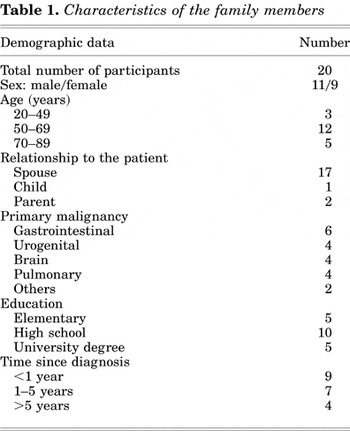
Twenty family members of patients with incurable progressive cancer who were admitted to hospital-based home care were included in this study. The family members were selected according to a maximum variation sampling strategy (Patton, 1990), which aims at purposefully picking a wide range of variations in dimensions of interest, which in this study comprised age, gender, relationship to the patient and educational level, as well as time since diagnosis and type of cancer. The sampling variation is shown in Table 1. The respondents were selected for participation in this study based on the following inclusion criteria:
- Being a family member of a cancer patient admitted to a palliative hospital-based home care unit.
- Having been present with the patient or alone when information was given about ending treatment.
- A time period of less than three months since receiving this specific information.
- Having the physical and psychological capacity to participate as judged by the palliative care team.
- Speaking Swedish and accepting tape recording during the interview.
Characteristics of the family members

The hospital-based home care team assessed the family members based on the inclusion criteria. The patient's physician or nurse approached the family member with verbal and written information about participation in the study. Five test interviews were conducted to explore what was considered to be of importance from the perspective of a family member. The interview guide was modified, and questions were then asked about their participation when receiving information, their reactions, whether they thought information was important to them as family members, and why they needed information. Qualitative semistructured interviews lasting between 50 and 120 min were conducted in the family member's home or in the researcher's office. All interviews were tape recorded and transcribed verbatim. The data were collected during the year 1999–2000 and the procedure was approved by the Regional Ethics Committee.
A phenomenographical approach was used in analyzing the data (Dahlgren & Fallsberg, 1991). Phenomenography was developed in the domain of pedagogic research by Professor Marton and coworkers in Sweden, and was first described in the 1970s. The goal of phenomenography is to identify different ways of experiencing a certain phenomenon. Marton (1981) describes a distinction between the first-order perspective, explaining how things really are, and the second-order perspective, describing how people experience and conceive the world. Phenomenography as a research method uses the second-order perspective. Marton also describes a “what” and a “how” aspect. The “what” aspect corresponds to the object in the experience, the key elements of the explored phenomenon (what is discussed?). The “how” aspect is the act of the experience, and describes the structure and variation of the descriptions (how it is discussed). The categorization in this study was inspired by Dahlgren and Fallsberg's (1991) seven steps, described elsewhere (Friedrichsen et al., 2000).
VALIDATION
To obtain trustworthiness in this study, the researcher used face validity (Patton, 1990) to test the results obtained from the participants. After transcription of the interviews, each interview was sent back to the participant in question for comments and changes. One year after the interviews, the researcher contacted and met with five of the family members. Each of them represented a different category. This test was done to be sure that the researcher's interpretations were representative of the perceptions of the participants, that is, the second-order perspective. Testing for face validity comprised the following steps: (1) The participants were again asked to talk about their need for information. (2) The researcher then showed them the different categories, described in simple language without abstraction. (3) The family members were asked if this description was similar to their experience, if there were any misunderstandings or incorrect interpretations, and if something was missing that they felt was important. They were also asked to indicate what was most likely and what was least likely based on their experience. (4) The researcher recorded their answers in writing, and if there were any missing results, these were added to the analysis.
Without exception the five participants agreed with the categorization, and made only minor comments regarding details of other family members' perceptions.
RESULTS
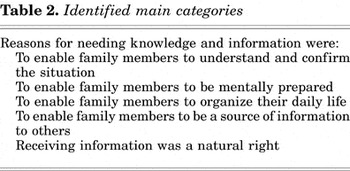
Central factors in the experiences of family members were the need for knowledge and information about the disease, reactions, how to take care of a dying person, and the process of death. All of them, both those who had received sufficient information as well as those who had not, gave reasons for and defended their right to information and knowledge. Their justification for needing knowledge involved different factors: to enable them to understand and confirm the situation, to mentally prepare themselves, to organize their daily life, to enable them to be a source of information to others, and as a natural right (Table 2).
Identified main categories

To Enable Them to Understand and Confirm the Situation
Central factors in this category were comprehension, realization, and insight. The family members described their need to clarify facts to understand the situation as it really was. To understand and start adapting to the situation, they needed clear facts and confirmation on their own level to get some insight, and sometimes they needed to receive this information several times before they were satisfied, even if that meant not having the patient present.
When my husband was in hospital and they'd talked with him there … well, I felt I wanted to talk with them too. So the physician called me at home so I could talk with him. During that conversation he explained that it had spread, and he made that very clear. Then I realized … after this talk—this is how it is. When I'd spoken with him myself. (Interview 11)
Sometimes family members described a conversation when the patient was present as an obstacle, as both the physician and the family member were very careful to take the patient's integrity and level of knowledge into consideration. Family members were not able to focus on their own questions.
You can't ask questions about things that she might be thinking about, that might hurt her; you have to watch out for such questions. If she's there then I have to be careful, but if I'm alone then I can be straightforward. (Interview 19)
Clear facts were themselves experienced as very important in enabling the family member to progress and adapt to the new situation, to the new level of knowledge.
To Enable Them to Be Mentally Prepared
Central factors in this category were anticipation, expectation, and prevention. Another reason for receiving information involved the need to be mentally prepared for the new situation, to know what to expect in the future. This mental preparation involved being able to trust in oneself as a caregiver 24 h a day. Being responsible for a dying person at home was sometimes described as burdensome, even if this was something they wanted to do and had chosen to do. It was felt that receiving more knowledge made them better prepared to help the patient in a concrete way.
I really want to know … to count on being able to handle this. That's something you want to know before you embark on something like this. (Interview 6)
They also assumed that mental preparation would help them feel calmer about the dying process. Some family members said they were worried about the future, when the patient's disease progressed. They thought that getting some knowledge about the dying process, rather than worrying and fantasizing about it, would prepare them for this and result in fewer surprises.
Well I think I'm a little anxious about … what the course will be like … therefore I think they should say something like—It can be like this, and so on. Then I'll be a little prepared, I won't be surprised. (Interview 6)
He's going to die for some reason or other … maybe his peritoneum will split open or maybe he'll just quietly pass away. I think it's very difficult to ask about this and talk with my husband about it. I want to talk with the doctor alone about such things. (Interview 16)
To Enable Them to Organize Their Daily Life
Central factors in this category were arranging, coordination, and control. Some family members said they needed information because they had to organize their daily life. Without any knowledge they were unable to plan their everyday life or do things they wanted or needed to do. A feeling of uncertainty was described. Having knowledge concerning the patient's health status or risk for complications was perceived as facilitating their feeling of being able to have some control and make plans with respect to activities like traveling, visiting friends, and even buying a house.
I think it meant a lot to him to be able to travel home and visit his mother's grave, and all the other things he wanted to do. I arranged it so that he could. If I hadn't had any knowledge about this (about the disease) I would have said, No, of course we can't go there. (Interview 3)
The information was also needed to enable family members to act and have control over everyday life. They described risks that could result in consequences for the patient.
Sometimes he's confused about time and where he is. How risky is it to leave him alone when I need to go shopping? I'm afraid he might go out, lock himself out, or end up sitting somewhere where it's cold. But I haven't been away for that long yet, but things can happen in two hours, or in an hour and a half. (Interview 13)
Having knowledge about what health care professionals thought was the best care for the patient was perceived as important, as family members did not want to expose or hurt the patient unnecessarily.
To Enable Them to Be a Source of Information to Others
Another reason for feeling they had the right to receive information was because family members functioned as a source of information to the patient and to significant others. Family members acted as contacts regarding the patient's status and what the physician had said. Other relatives expected the family member to be informed. Not knowing, and simply having a layman's knowledge, was experienced as insufficient.
And then I think, do I really have to know? But I have to inform his brothers and sisters who call and want to know. I don't know anything, I say. But it feels “empty” in some way, saying that I don't know. (Interview 12)
Family members could also justify their right to information because they had to remember what the patient was unable to remember because of advanced illness. They had to answer the patient's questions at home.
She has terrible problems remembering the information she's been given. She's asked the same questions 20–25 times and received the same answer. In this case it's my duty, in addition to everything else, to be a memory instrument. (Interview 20)
As a Natural Right
In this category the right to receive information and knowledge about their spouse's disease was described as a natural right. Central factors in this category were perceptions of oneself as primary and fundamental. The fact of a long marriage was emphasized, as was the obvious role of caregiver. Living side by side during a lifetime and then when life was ending suddenly not having the right to receive facts about your loved one was perceived as unbelievable and strange.
I just don't understand that as a family member, someone who's been married to him for 39 years, that I can't have a conversation with the physician without letting my husband know about it. I want to get more information without worrying my husband because I'm talking with the doctor. (Interview 16)
Another reason getting more information was perceived as a natural right was the positive consequences experienced as a result of both parties knowing what was going on. This knowledge could start a natural and constructive dialogue.
After getting the information we talked more openly with one another, and I think I've changed a lot. I have a different outlook on life. Many things that were so important before now seem trivial. We talk to each other. That's why this information is so important. It's extremely important that both of us have the same information. (Interview 4)
DISCUSSION
In this study, different explanations emerged as to why family members perceive knowledge and information about various aspects of the patient's cancer in the final phase of life to be important.
The first category, “to enable them to understand and confirm the situation,” indicates that information has to be repeated several times, even to family members. It has been shown that cancer patients remember only 25% of the information given by the physician when receiving a cancer diagnosis (Dunn et al., 1993). Knowledge concerning how much cancer patients remember after receiving information about a terminal prognosis is not well studied, but they do remember emotional aspects such as words and phrases (Friedrichsen et al., 2002a), and behavior (Friedrichsen et al., 2000). It is not known how much information family members remember, and although this study does not focus on this aspect, it does show that family members also need time to understand. Their understanding is also a process, and they may need repeated information. In addition, family members in this study also suggested receiving information alone, without the patient, which would give them the opportunity to ask more sensitive questions. This is, however, an ethical issue. Furthermore, Swedish legislation does not allow physicians to give any information about the patient's disease without the patient's permission.
It was also important to receive information so as to be mentally prepared for what was going to happen. Family members caring for a patient at home do not have a caregiver identity (Harding & Higginson, 2001), nor do they have a caregiver's professional knowledge. Family members in the current study were afraid of the future, as this trajectory was something new to them and they did not know what to expect. They did not want to be shocked by surprises. Some of them also had fantasies about the progression of the disease or were afraid of harming the patient. A previous study reported that caregivers prioritized information about the prognosis, what to expect after chemotherapy, and how to deal with an emergency (Iconomou et al., 2001). It is obvious that information is an essential component in reducing stress, but there are also some pitfalls. Information that is not adapted to the situation as a whole, including, for example, the patient's level of knowledge, the family member's capacity, and so forth, might be more harmful than it is constructive. The sense of responsibility felt by family members is both burdensome and very essential to them. It is important that palliative care team members are aware of family members' level of knowledge and their need for information, as this mental preparation is an important factor with respect to their feeling of confidence (Walker, 2002).
More concrete issues were also perceived as important. If these family members did not have enough information, they had difficulty organizing their daily lives. McCorkle and Pasacreta (2001) suggest that caregivers should be prepared before they become caregivers. But it is difficult for health professionals to provide exact information about things that can be done or planned over a period of one or several weeks. Even if the patient seems stable, an emergency can occur the next day. Health care professionals should provide as much support and help as possible to facilitate family members' wishes and plans. But in every family, repeated assessments are necessary so that support given to family members does not interfere with the interests of the patient.
A limitation of this study is that it is not possible to generalize the results, nor is it possible to transfer the results to other settings or groups, as the cancer context and the geographical context, a Swedish health care organization and culture, is a specific context. It is, however, possible to compare the results for similarities and differences for family members living in a culture similar to the Swedish context.
This study has given some examples as to why family members perceive receiving information about the patient's disease to be of central importance. Wilkes' study (Wilkes et al., 2000) showed that information made family members feel empowered and in control. The current study confirms that, but it also provides knowledge about the underlying reasons. It is not possible to fulfill all their wishes, as the patient has the legal right to stop this information. Further research could focus on how much information family members receive, how they understand the given information, and if conflicts of interest concerning information are common with respect to the patient, family members, and the palliative team.
CONCLUSIONS
The reasons family members give for needing information and knowledge are that it helps them understand the new situation, organize their daily life, and prepare themselves mentally.
ACKNOWLEDGMENTS
I extend special thanks to Jane Wigertz for skillful revision of the English text.
References
REFERENCES
Archbold, P.G.,
Stewart, B.J.,
Greenlick, & M.R.,
et al.
(1990).
Mutuality and preparedness as predictors of caregiver role strain.
Research in Nursing & Health,
13,
375–384.Google Scholar
Åstedt-Kurki, P.,
Paunonen, M., &
Lehti, K.
(1997).
Family members' experiences of their role in a hospital: A
pilot study.
Journal of Advanced Nursing,
25,
908–914.Google Scholar
Chaitchick, S.,
Kreitler, S.,
Rapoport, & Y.,
et al.
(1992).
What do cancer patients' spouses know about the patients?
Cancer Nursing,
15,
353–362.Google Scholar
Clumpus, L. &
Hill, A.
(1999).
Exploring the views of carers of cancer patients in an inner city
locality.
International Journal of Palliative Nursing,
5,
116–123.Google Scholar
Conley, V. &
Burman, M.
(1997).
Informational needs of caregivers of terminal patients in a rural
state.
Home Healthcare Nurse,
15,
808–817.Google Scholar
Dahlgren, L. &
Fallsberg, M.
(1991).
Phenomenography as a qualitative approach in social pharmacy
research.
Journal of Social and Administrative Pharmacy,
8,
150–156.Google Scholar
Dunn, S.,
Butow, P.,
Tattersall, & M.,
et al.
(1993).
General information tapes inhibit recall of the cancer consultation.
Journal of Clinical Oncology,
11,
2279–2285.Google Scholar
Friedrichsen, M.,
Strang, P., &
Carlsson, M.
(2000).
Breaking bad news in the transition from curative to palliative
cancer care: Patient's view of the doctor giving the
information.
Supportive Care in Cancer,
8,
472–478.Google Scholar
Friedrichsen, M.,
Strang, P., &
Carlsson, M.
(2002a).
Cancer patients interpretation of verbal expressions when given
information about ending active tumour treatment.
Palliative Medicine,
16,
323–330.Google Scholar
Friedrichsen, M.,
Strang, P., &
Carlsson, M.
(2002b).
Receiving bad news: Experiences of family members.
Journal of Palliative Care,
17,
241–247.Google Scholar
Harding, R. &
Higginson, I.
(2001).
Working with ambivalence: Informal caregivers of patients at the
end of life.
Supportive Care in Cancer,
9,
642–645.CrossRefGoogle Scholar
Hilton, B.,
Crawford, J., &
Tarko, M.
(2000).
Men's perspectives on individual and family coping strategies
with their wives' breast cancer and chemotherapy.
Western Journal of Nursing Research,
22,
438–459.Google Scholar
Hinds, C.
(1992).
Suffering: A relatively unexplored phenomenon among family
caregivers of non-institutionalised patients with cancer.
Journal of Advanced Nursing,
17,
918–925.Google Scholar
Hinton, J.
(1981).
Sharing or withholding awareness of dying between husband and wife.
Journal of Psychosomatic Research,
25,
337–343.Google Scholar
Houts, P.S.,
Rusenas, I.,
Simmonds, & M.A.,
et al.
(1991).
Information needs of families of cancer patients: A literature
review and recommendations.
Journal of Cancer Education,
6,
225–261.Google Scholar
Iconomou, G.,
Vagenakis, A., &
Kalofonus, H.
(2001).
The informational needs, satisfaction with communication, and
psychological status of primary caregivers of cancer patients receiving
chemotherapy.
Supportive Care in Cancer,
9,
591–596.CrossRefGoogle Scholar
Kilpatrick, M.,
Kristjanson, & L.J.,
et al.
(1998).
Information needs of husbands of women with breast cancer.
Oncology Nursing Forum,
25,
1595–1601.Google Scholar
Marton, F.
(1981).
Phenomenography: Describing conceptions of the world around us.
Instructional Science,
10,
177–200.CrossRefGoogle Scholar
McCorkle, R. &
Pasacreta, J.
(2001).
Enhancing caregiver outcome in palliative care.
Cancer Control,
8,
36–45.Google Scholar
Patton, M.
(1990).
Qualitative Evaluation and Research Methods.
London:
Sage Publications.
Rose, E.K.
(1999).
A qualitative analysis of the information needs of informal carers
of terminally ill cancer patients.
Journal of Clinical Nursing,
8,
81–88.Google Scholar
Stetz, K.M.
(1987).
Caregiving demands during advanced cancer: The spouses' needs.
Cancer Nursing,
10,
260–268.Google Scholar
Tringali, C.
(1986).
The needs of family members of cancer patients.
Oncology Nursing Forum,
13,
65–69.Google Scholar
Wakefield, M. &
Ashby, M.
(1993).
Attitudes of surviving relatives to terminal care in south
Australia.
Journal of Pain and Symptom Management,
8,
529–538.Google Scholar
Walker, E.
(2002).
Partners' experiences of living with a patient with lung
cancer.
Professional Nurse,
17,
345–348.Google Scholar
Wilkes, L.,
White, K., &
O'Riordan, L.
(2000).
Empowerment through information: Supporting rural families of
oncology patients in palliative care.
Australian Journal of Rural Health,
8,
41–46.Google Scholar
Zahlis, E. &
Shands, M.
(1991).
Breast cancer: Demands of the illness on the patient's partner.
Journal of Psychosocial Oncology,
9,
75–93.Google Scholar
Characteristics of the family members
Identified main categories
 You have
Access
- 17
- Cited by