Introduction
The Hungarian Republic, which emerged from of the ashes of Austria-Hungary, experienced two revolutions between October 1918 and April 1919. However, neither the democratic regime nor the more radical Soviet Republic born in these revolutions was able to solve the country's most pressing economic and social problems. The collapse of the Soviet Republic at the end of July 1919, in turn, was followed by a rapid rise in extra-legal violence. Freikorps units (szabadcsapatok) and civic guards (polgárőrségek), aided by the members of the local police, set up kangaroo courts, organized summary executions, and ignited pogroms in the central and western parts of the country.
The White Terror, as the pogroms and the atrocities against workers and peasants later became known in Europe, cost the lives of about 3,000 people. Perhaps half of these victims were Jews. About 70,000 people (mainly labor leaders and political activists, but also bystanders whom their jealous neighbors and colleagues denounced) were taken prisoner. They spent months and, in many cases, years, in overcrowded jails and poorly constructed internment camps, where sadistic prison guards often brutalized them. At least 100,000 people, including some of Hungary's best minds, went into exile to escape arrest and seek a better life in the democratic West or the Soviet Union.Footnote 1
The history of paramilitary violence in Hungary after World War I is relatively underresearched. Although a recent German publication lists more than one hundred books and articles dealing with the Freikorps, Hungarian readers are lucky to find a dozen or so scholarly works on the history of postwar militias.Footnote 2 With few exceptions, books and articles written in Hungarian on this topic before 1990 are politically biased at best and unreliable at worst. Although relevant data could be found especially in the older Marxist works, to date no comprehensive study on the social composition of the officers' detachments, the Hungarian equivalent of the German Freikorps, and civic militias and urban gangs engaged in anti-Semitic violence between 1919 and 1921 exists in any language.Footnote 3 In regard to the social background of the leaders and rank and file of these groups, historians tend to repeat and, in the process, perpetuate the often biased views of contemporary commentators. Engaged in intense political and ideological debates, contemporary commentators were interested in paramilitary and mob violence mainly as a political issue: They viewed the actions of the officers' detachments and civic militias through the prism of their respective ideologies and, often enough, their short-term political interests. Hence, the brilliant social scientist, and one of the leaders of the radical democrats, who came to power during the October Revolution of 1918, Oskár Jászi, thought that the officers' detachments attracted reactionary military officers of mainly gentry background.
The civic militias in the cities and the anti-Semitic gangs in the cities, on the other hand, allegedly recruited their members from the German petty bourgeoisie, known for their deep hatred for Jews, as well as civil servants, conservative students, unemployed soldiers, and the urban Lumpenproletariat. With the counterrevolution, the allegedly “Asian soul” of the country raised its head again; the goal of the reactionary groups engaged in violence was to turn the clock back at least a hundred years by destroying the small class of mainly Jewish intellectuals and merchants who had represented modernity in Hungary before the war. The elite, made up of the Magyar landed aristocracy and the Jewish financial oligarchy, tolerated and often even secretly encouraged paramilitary and mob violence in order to destroy the achievements of the two revolutions and hence hasten the restoration of the prewar conservative liberal regime.Footnote 4
The anti-Communist Jászi feared “re-feudalization” and restoration; he considered the paramilitary groups and the anti-Semitic mobs as the agents or the stooges of the semifeudal Magyar landed aristocracy and their Jewish capitalist allies. The Marxists József Pogány and József Révai, both of whom had occupied important positions in the defunct Soviet regime, also believed that the paramilitary groups had acted on the behalf of, or on the order of, their social superiors. However, unlike Jászi, Pogány and Révai thought that the White Terror targeted mainly organized workers rather than the intelligentsia and the merchant class, whom Jászi considered the vehicle of modernity. The White Terror, Pogány argued, “is nothing more than the dictatorship of the bourgeoisie. Its [specific] form is determined by the fact that the leaders of the dictatorship are professional soldiers.”Footnote 5
Although both the radical democrats and Marxists painted the officers' detachments and the civic militias as agents of the elite, the political scientist, Imre Makkai, who had a university post in Hungary in the 1930s, believed that the officers' detachments represented what was best in the Hungarian middle class. Last among the social groups, the middle class had acquired class-consciousness after the Great War, he argued. The officers' detachments represented the rebellion of middle-class youth; modern, patriotic, yet also socially conscious, middle-class war veterans wanted to create a society based on “the democracy of the trenches.” Their actions during this chaotic period of Hungarian history served both rational and noble goals. They were the members of the same generation that gave the world Mussolini and Hitler. Middle-class rebels in Italy, Germany, and Hungary followed the same recipe: In their program, they combined progressive economics and social reforms with the idea of the nation and the “the principle of order”; and this combination, Makkai believed, was the very essence of Fascism.Footnote 6
Marxist works written after 1945 uncritically repeated Pogány's and Révai's assertions about the feudal and reactionary character of the officers' detachment; they also argued that the members of civic militias had come either from social groups in decline, such as artisans and shopkeepers, or from the ranks of those who had suffered disproportionately after the war, such as civil servants and wealthy farmers. The White Terror in Hungary represented the first successful Fascist revolution in Europe, they contended. The counterrevolutionary regime was conceived in the reign of terror; violence was its midwife. Admiral Miklós Horthy, the Commander of the National Army, had either personally ordered, or had knowledge of and fully approved of, his men's actions. The Horthy regime belonged to the same political genre as Italian Fascism and German Nazism.Footnote 7 The militias never disappeared. Hidden in the state bureaucracy, they were periodically called upon to arrest, torture, and kill political activists and to spread fear among the general population. The White Terror represented a fateful event in Hungarian history: The atrocities paved the way for World War II, Hungarian participation in the Nazi campaign against the Soviet Union, the German occupation of the country in 1944, and the genocide of Hungarian Jews.Footnote 8
After the mid 1960s, a new generation of historians began to portray the Horthy regime first as a “semi-Fascist,” then as a conservative authoritarian state and, finally, after 1990, as a conservative democracy.Footnote 9 They also cast doubt on the militias' contribution to the foundation and consolidation of the counterrevolutionary regime and questioned whether Horthy, both as the Commander of the National Army and later Regent, had been, indeed, privy to their actions and had ordered the atrocities.Footnote 10 The new generation of historians portrayed paramilitary violence as a product of economic and social chaos and the collapse of the state, rather than as part of a well-thought-out plan to destroy political opponents and consolidate power.Footnote 11 While in Hungary, scholars built on, and at the same time tried to overcome, the Marxist biases present in the works of interwar commentators; in the West, the American-Hungarian historian, Imre Mócsy, revived the interwar conservative view of the militias as the carriers of middle-class interests. Unlike Marxist scholars and liberal scholars, Mócsi rejected the idea that the militias acted as the agents of the elite. In contrast to Jászi, Mócsy did not see the paramilitary groups as inherently reactionary. The people who entered these units, he argued, tended to be politically and socially progressive: They sought to modernize the state and the economy and accepted the necessity of social, including land, reforms.Footnote 12
This essay examines the social composition of paramilitary groups in Hungary in light of parallels that can be drawn with similar groups in Germany and Austria.Footnote 13 The purpose of this study is to make a contribution to the scholarly debate on the social basis of the Right radical and Fascist movements in interwar Europe. The best-known part of debate, which concerns voting patterns and the elite's political and financial contribution to Nazi victory, requires no rehashing in this short essay. The consensus today is that the NSDAP was a Volkspartei, and it received votes and attracted financial and political support from every social and religious group.Footnote 14
Historians have reached a somewhat similar conclusion with regard to Italian Fascism. Fascism, they argue, emerged in an urban environment. Mussolini's supporters in 1919 and early 1920 were few in number and came from a heterogeneous background. They were students, disillusioned socialists, intellectuals, officers, war veterans, workers, and the urban underclass. Only in the fall of 1920 was the movement able to expand its social base both in the cities and in the countryside. Frightened by the occupation of the factories and the radicalism of the rural masses and angry over the liberal regime's failure to restore law and order and openly favor them over the poor, factory owners and large landowners abandoned parliamentary rule in favor of paramilitary politics in the fall of 1920. The Fascist squads owed their success to a large extent to the financial and political support they received from the propertied classes. Yet, their support in the countryside was not confined to large landowners and civil servants. Middling farmers and the agrarian poor backed the Fascist militias because their interests had been violated by the closed-shop policy of the Socialist trade unions.Footnote 15
With regard to the Freikorps movement in Germany after World War I, Robert G. L. Waite argued in the 1950s that both its leaders and rank and file hailed from the lower middle class.Footnote 16 In the late 1960s, the German historian Hagen Schulze, however, emphasized the essentially middle, that is, both lower- and upper-middle, class character of the movement.Footnote 17 In the 1970s, Hannsjoachim W. Koch contended that, despite their middle-class origins, the members of the Freikorps, like those of the NSDAP a decade later, were able to transcend regional, religious, and social divides.Footnote 18 Also in the 1970s, Klaus Theweleit sought to identify the causes of violence against working-class women by young middle-class militia men in postwar Germany. Drawing heavily upon Marxist and Freudian theories popular at the time, Theweleit concluded that militia violence functioned as an outlet for sexual frustration and sadomasochism inherent in middle-class culture, the institution of patriarchy, and the system of capitalism.Footnote 19 In Germany and Italy, the Freikorps and the squadristi were popular both in the cities and countryside. In the neighboring Austria, on the other hand, the homegrown Heimwehr remained a predominantly rural movement. In the late 1920s, more than 70 percent of its active members and sympathizers were peasants. The Heimwehr was popular in states with strong anti-Semitic traditions, such as Styria and Carinthia.Footnote 20
This study provides a detailed analysis of the social composition of paramilitary groups in post-World War I Hungary. It examines, and in the process rearticulates, older theories about the social origins, ethnic and religious backgrounds, educational qualifications, language skills, age, and regional origins, as well as wartime service, of militia members. The second part of the paper connects the data provided on social and cultural background of militia members to their actions. Can paramilitary violence be equated with class violence? Whose interests did these groups ultimately represent: those of the elite, of the social group, or of the individual? Were the perpetrators typical representatives of their class, or did they come from the margins of their social group? Were they déclassé, as older theories of Fascism had it, or were the leaders and the rank and file of paramilitary units young men on the move in 1919, who also experienced upward social mobility in the interwar period? Did the political elite hinder or aid their careers? The social dimension of power and violence and the conflict-ridden relationship between the conservative authoritarian Right and paramilitary and proto-Fascist groups are the subjects of this article.
A Short History of the Paramilitary Movement
Paramilitary politics had a long history in Hungary. Civic guards and guerilla units recruited from the ranks of semiliterate peasants played an important role in military events of the Revolution of 1848 and War of National Liberation. However, the idea of paramilitary groups based on the urban and middle-class youth emerged only at the turn of the century. Since 1905, nationalists such as Miklós Szemere advocated the formation of university battalions as the first step toward the creation of an independent National Army. One of the most important anti-Semitic ideologues in Hungary, Szemere, and his nationalist friends supported the introduction of comprehensive paramilitary training in high schools. They also set up shooting ranges in the outskirts of Budapest to further militarize society. Although the main function of the university battalions would have been to defend the country against foreign adversaries, the same troops, the nationalists believed, could have been used to put down domestic disturbances as well.Footnote 21 During the last stage of World War I and on the eve of the October Revolution of 1918, high-ranking civil servants and military officers proposed the creation of paramilitary organizations powerful enough to seize power and introduce authoritarian rule.
Even though the idea of a preventive counterrevolution failed to materialize, the notion of a class army formed to defend and restore order did not die with the victory of the democratic forces in October 1918. In the spring of 1919, counterrevolutionary officers and civil servants both in Budapest and in provincial towns, such as Kecskemét, advocated the creation of a peasant army called the “Brigade of the Plain” (Alföldi Brigád) and led by conservative officers. The organizers, however, completely misunderstood farmers and the rural poor. Peasants, with a few exceptions, showed no interest in the restoration of the prewar political and social status quo. Farmers and agricultural laborers, if anything, sought to drive the revolution forward by demanding the distribution of the large estates and the introduction of even more radical political reforms. That they, in the end, did rebel against the federal government had precious little to do with the alleged conservatism of the rural population.
The violation of peasants' material interests and cultural sensitivities by the new Soviet Republic, founded at the end of March, led to peasant uprisings first on the Hungarian Plain and later in the western parts of the country in the spring and the summer of 1919. These rebellions bore all the characteristics of an “antirevolution.”Footnote 22 Cut off from Vienna and Szeged, which then functioned as the centers of the counterrevolution, the poorly equipped peasant militias, like the peasant armies in medieval and early modern times, were quickly and decisively defeated by the army and police units of the state.Footnote 23 Many of the leaders of the antirevolution, especially refugee officers from Transylvania, but also sons of local dignitaries and wealthy peasants, then joined the counterrevolution in Szeged. After their return home in August 1919, they helped to set up the civic militias in their towns and regions. Many of these paramilitary groups took an active part in the counterrevolution and provided the foot soldiers for the officers' detachments and Horthy's National Army.
The peasant militias had their roots in the antirevolution; the officers' detachments, on the other hand, were the product of the counterrevolution. Although the farmers were battling the troops of the Red Army, aristocrats, high-ranking civil servants, and politicians of the old regime set up an Anti-Bolshevik Committee (ABC) in Vienna in April 1919. The ABC, in turn, organized its own paramilitary group. The greatest accomplishment of this ragtag unit was the theft of 150 million koronas from the Hungarian Embassy on 2 May 1919. A few days later, to establish a foothold in their homeland, the same squad crossed the border into Hungary. To the surprise of these men, however, the Hungarian border-guards failed to switch sides. Instead of welcoming the counterrevolutionaries as liberators, the guards opened fire and threw them back to the Austrian side of the border. Meanwhile, Colonel Anton Lehár, a military hero and the brother of the famous composer, Franz Lehár, set up headquarters in the Carinthian town of Graz. Thanks to the financial support and military assistance of the Austrian authorities and militias, by the end of the summer Lehár's detachment had grown into a 4,000-men-strong battalion. By November, more than 17,000 soldiers had awaited his orders. Lehár's regiment was also built along traditional military lines, which explains why his troops committed relatively few atrocities and were later easily absorbed into the evolving National Army.Footnote 24
Meanwhile, in June, the center of the counterrevolution switched from Vienna and Graz to the southern Hungarian town of Szeged, which then stood under French occupation. Attracted by the promise of revenge, adventure, and regular income, young officers from all over the country and from Vienna flooded the town. Their entry into the provincial city had helped to speed up the organization of the National Army, which, by early August, had about 3,000 poorly equipped soldiers under arms. The National Army in Szeged consisted of both regular army units and officers' detachments. The regular army units were created on the basis of selective recruitment among politically reliable peasants. Volunteers, on the other hand, made up the six officers' companies.Footnote 25
By early November 1919, the National Army had about 15,000 armed men.Footnote 26 In the spring and summer of 1920, as Horthy and his advisors planned to attack Czechoslovakia, they counted on the support of an army of 100,000. By December 1921, as a result of the Treaty of Trianon of June 1920, these numbers were reduced to 35,000, of which fewer than 2,000 were officers.Footnote 27 The National Army continued to include units, which, even though organized along military lines, served mainly domestic functions. Hence, the two most infamous paramilitary groups, Prónay and Ostenburg officers' companies, which grew into battalion size with about 1,500 men each in late 1919, remained part of the regular armed forces until January 1921.Footnote 28 Then, to keep them far from entente interference, the government put them under the gendarme command. In reality, however, the two battalions continued to function as Horthy's praetorian guards. As their history suggests, until 1922, the boundaries between regular and irregular units, on the one hand, and szabadcsapatok (the officers' detachments that resembled the German Freikorps the closest) and civic militias, on the other hand, remained fluid.
Many officers were members of professional organizations and patriotic associations, such as the Association of Awakening Hungarians (Ébredő Magyarok Egyesülete or ÉME), the Hungarian Association of National Defense (Magyar Országos Véderő Egylet or MOVE), and the League for the Defense of Territorial Integrity (Területvédő Liga), which either had their own armed gangs, responsible for much of the anti-Semitic disturbances in Budapest, or were associated with the known paramilitary groups. The National Army recruited mainly from regions and communities known for their support of the civic militias. According to Aurél Héjjas, Iván Héjjas' brother, in addition to the 4,000 men who had entered the Prónay Battalion, Horthy's National Army recruited 2,000 men from the Danube-Tisza Mid-Plains in late 1919 and early 1920.Footnote 29 After six months' service in the regular army, many veterans joined or rejoined the paramilitary groups active in their district. On the other hand, regular army units could also submerge into the militia movement. The Transylvanian Division (Székely Hadosztály), which had about 10,000 men under arms, played a major role in the successes of the Red Army of the Hungarian Soviet Republic in the spring of 1919. The division was dissolved in the summer, but about 4,000 of its members entered the various paramilitary groups, including the Prónay and Héjjas detachments during the summer and early fall.Footnote 30
There is, unfortunately, only scattered information available on the number of people active in paramilitary politics during the counterrevolution. Although contemporaries made reference to the officers detachments in their memoirs and newspaper articles, detailed information on the civic militias is lacking. The majority of these units seemed to have served only local functions. They tended to be less violent, arrested rather than executed the local representatives of the defunct Soviet Republic, and prevented rather than helped to organize pogroms. Yet, there were at least a dozen paramilitary groups on the Hungarian Plain alone that were violent and remained active beyond the boundaries of their authority. Many (the Hir, the Budaházy, the Babarczy, the Förster and Rácz detachments) had close ties to the Héjjas militia. However, the same units also considered Prónay as their leader. About 3,000 people from the Hungarian Plain joined the nationalist insurgency in Burgenland (territory awarded to Austria by the treaties) in the fall of 1921. The size of their reserve is unknown, but one can safely assume that they left at least as many people with ties to the paramilitary movement at home.Footnote 31 In Transdanubia, in the autumn of 1919, local landowners organized their own squads to punish peasants and estate servants implicated in Communist rule. The majority of these detachments disappeared from the scene in 1919; however, a few of them, such as the Jankovich militia, survived into 1920. In Budapest, the two university battalions had 3,000 men under arms in early 1920. They posed, however, no direct danger to the government. The counterrevolutionary regime was more afraid of the loose elements who claimed to be members of the Hir, the Budaházy, and the Babarczy detachments. The government put the number of these armed desperados in the fall of 1920 at 4,000.Footnote 32 In my estimate, the paramilitary groups, at the zenith of their power in the summer of 1920, had in active service about 10–12,000 members.Footnote 33 Because they had many sympathizers in the National Army, as well as among the gendarmes and the police, not to mention, the urban underclass always ready to exploit trouble, the paramilitary groups, even though poorly armed and internally divided, represented a significant force.
The paramilitary groups (and the National Army for the same reason) posed no serious threat to the neighboring states. They were strong enough, however, to terrorize the political Left and the Jewish population and raise, in the wake of the Kapp putsch in Germany, the specter of a right-wing coup. For almost a year, the political elite had judged the paramilitary units useful in their political games and the maintenance of law and order. Concerned about the impact of the ongoing atrocities on domestic and foreign public opinion, in the summer of 1920, the Teleki government finally decided to dissolve, with the exceptions of the Prónay and the Ostenburg battalions, all paramilitary groups not yet integrated into the local government. The majority of militias, however, simply refused to go. In the fall of 1921, about 5,000 poorly equipped insurgents, mainly from the Southern Hungarian Plain and Budapest, flooded the province of Burgenland, which had been awarded by the peace treaty to Austria in 1920. The insurgency kept the town of Sopron and its environs in Hungarian hands and, had it not been for the attempted legitimist coup, which coincided with the last phase of the insurgency, the militias could have benefited significantly from their role in the affair. This was, however, not the case. Lehár and Ostenburg, who had supported the king, were forced to quit politics after the failure of the coup. Prónay, who could not decide which side to take during the coup, also lost favor with Horthy in November.
Having been outlawed by the Teleki and the Bethlen governments, the surviving paramilitary groups went underground at the end of 1921. The militia wing of the ÉME, led by Prónay and Héjjas, were still able to pull off a few spectacular attacks on Jewish organizations in the next three years. Nonetheless, the underground militia no longer posed an existential threat to the regime after 1922. As a sign of the increasing consolidation of the regime, some returned to their prewar occupations. Others, perhaps the majority, found their way into the civil service, the police, and the armed forces. The Conservatives were able to outflank and defeat the paramilitary groups and their Right radical allies within the political elite and the state bureaucracy. The specter of Right radicalism and Fascism, however, continued to haunt them until the end of World War II.
Social Composition of the Szabadcsapatok
The most important paramilitary group, the Prónay Detachment and later the officers' corps of the Prónay Battalion, had a decisively elite character. Deputy Colonel Pál Prónay hailed from an old Hungarian noble family, which received the title of baron in the late eighteenth century.Footnote 34 In December 1920, the officer corps of the Battalion included seventeen aristocrats; one duke (Károly Odeskalchy), eight counts, and seven barons served under the command of Baron Prónay. Seven had instantly recognizable names (Esterházy, Zichy, Andrássy, Széchenyi, Pálffy, Prónay, and Feilitzsch), whereas one, Count Péter Crouy, who was in part French, claimed to have descended from the Árpáds, Hungary's first dynasty.Footnote 35 Beside seventeen aristocrats, at least twenty officers hailed from noble but not aristocratic families, which put the percentage of nobles in the officer corps of the Battalion around 30 percent.Footnote 36
The elite character of the Prónay Battalion was reinforced by the close relations that many of its members shared with the military and political elite. Prónay claimed to have been distantly related to Admiral Horthy; he considered the admiral and future regent, as well as the latter's brothers, as his friends and social equals, rather than his superiors. The militia leader cultivated close ties with, and was considered one of, the “twelve captains,” i.e., the group of young officers, often described in the literature as the Gömbös-Kozma-Tóókos-Magasházy group, which had the admiral's ear until 1922.Footnote 37 Three of his officers, János Gömbös, István Stréter, and Tibor Rakovszky, were the close relatives of leading politicians.Footnote 38
Important as it was in the history of the White Terror, the Prónay officers' company, nevertheless, did not speak for all paramilitary units. It is not because nobles were absent from the other units. Each of the six officers' companies founded in Szeged in the spring and summer of 1919, was, after all, established and led by a noble.Footnote 39 On the other hand, no commander could display and brag about the noble pedigree of a Prónay. The leader of the second most important paramilitary unit, the Ostenburg Detachment (which later grew into a battalion), Count Gyula Ostenburg, was born to a middle-class family in the Transylvanian town of Marosvásárhely in 1885. His original name was Moravek. He had married into the noble Ostenburg family, and his father-in-law later adopted him, hence his full name: Gyula Count Ostenburg-Moravek. Baron Anton Lehár, who commanded the Lehár Battalion (and later regiment), also hailed from a bourgeois family; he received his baronial title as a reward for his sacrifices during the war.
Unfortunately, no statistics exist on the noble status of the rank and file. Impressionistic evidence (the name of the leaders and the rank and file), however, suggest that, with the exception of the Prónay officer company, the share of people who could claim noble pedigree was not higher than 15 percent. Moreover, while in the Prónay detachment traditional aristocrats and service nobles (individuals and their parents who received the baron or knight titles only in the nineteenth or early twentieth centuries) seem to have been represented in equal proportion; one has to look diligently to find any historical names in other units. The data on the social composition of officers' detachments, in brief, suggest a continuation of earlier trends. The military conflict and civil war, if anything, hastened the modernization of the armed forces. By further reducing the number of nobles and favoring the influx of middle-class elements, they laid the foundation for the more egalitarian interwar professional army.Footnote 40
The great majority of people who entered the officers' detachment in the summer and fall of 1919 were, in brief, commoners. Because the statistics kept at the company and battalion levels do not list the individuals' or their parents' civilian occupations, it is difficult to determine members' social origins. The debate on who qualified to be a member of the middle class before and after World War I is also too complex to be surveyed here.Footnote 41 Suffice it to say, however, that, because of the mass impoverishment of the population, traditional criteria, such as income, property, the number of rooms and servants in one's home, etc., had lost much of their validity by the fall of 1919. The acquisition of a high-school diploma (érettségi or Matura), on the other hand, continued to be recognized as a marker of middle-class status. Because a high-school certificate was a requirement for promotion to the officer corps, with very few exceptions, the reserve and professional officers who constituted these units had at minimum this certificate. They were, therefore, irrespective of their social origins, considered members of the middle class. Although the requirements for promotion to the rank of reserve officer was relaxed during the war, the great majority of reserve officers had most likely finished high school before they were conscripted into the army.
In Hungary, high-school graduates had to master at least one foreign language. Significantly, in the elite Prónay Company, no more than two people spoke only Hungarian. Almost everyone spoke German as a second language, and one-third of the members were able to communicate in more than two foreign languages. The writer, Mrs. György Bölöni, who had been interrogated by Prónay's men in the infamous military prison located on Margit Boulevard, was shocked to learn how well educated her torturers were. She communicated with one of her captors, a medical student, in French.Footnote 42 Using the same criteria, one can conclude that that more than fourth-fifths of Ostenburg's officers had finished high school as well (see Table 1), which means that they had either come from the upper strata of the middle class or they were upwardly mobile men from the lower middle class.
Knowledge of foreign languages among the officers of the Ostenburg Battalion.

Ostenburg Zlj. Névjegyzéke,” ABTL, 4.1 A–878.
Because of the multiethnic character of the Austro-Hungarian Empire, the professional officers in the common army spoke more languages than average high-school graduates. Their level of proficiency, especially the comprehension of Slavic languages, however, left much to be desired.Footnote 43 The same was true for the Prónay and the Ostenburg detachments. Although the majority of officers both in the Prónay and the Ostenburg companies spoke decent German, their knowledge of French and English, not to mention Polish, Czech, Slovak, Slovenian, Serb, and Romanian (unless they had come from mixed ethnic background) was limited. That, even in the elitist Prónay Company, only nine people were able to speak French, which was the language of the aristocracy and the upper class, however, is significant: It both suggests the essentially middle-class character of the paramilitary units and testifies to the continued democratization of the officer's corps during the war and its aftermath.Footnote 44
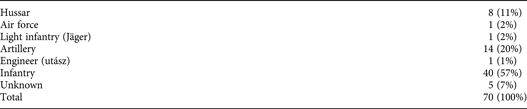
The distribution of officers on the basis of training and wartime service assignment yields similar results.Footnote 45 Because aristocrats and the gentry preferred cavalry to other branches of service before 1914, the relatively low number of ex-hussars in the officer corps of the Prónay and the Ostenburg Battalions underscores the middle-class character of the two most important paramilitary units (see Table 2 and Table 3). The numbers are somewhat misleading, however, since, as mentioned earlier, there were more than a dozen aristocrats in the Prónay Battalion alone. The low number of cavalry officers in these elite units might also have to do with technological changes. Yielding to the logic of modern warfare, in March 1917, the Army High Command had ordered hussars to dismount and fight as infantry men. Many cavalry officers were then retrained to command infantry units.Footnote 46
Service background of Prónay's officers.
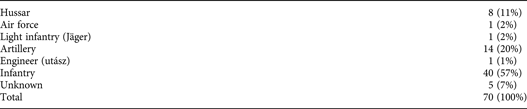
Based on M..kir. szegedi vadász zlj. 1924 szám. kt. 1920. A 479. 256/8 1920 sz. rendeletre. Névjegyzék a zászlóaljnak szolgálatot teljesítő azon tisztekről akik már Szegeden tagjai voltak a zászlóaljnak (1919 augusztus hó 2-áig); ugyanott Névjegyék azon tisztekről aki a magyar kir. Honv. Min. 78701/eln. A—1920 számú rendeletének tudomásvételét becsületszavukkal irásban megerősítették; HL, Horthy-kori csapatanyag, Szegedi vadászzászlóalj (Prónay), Kt. 2439–2947, 120 doboz.
Service background of professional officers in the Ostenburg Battalion.

“Ostenburg Zlj. Névjegyzéke,” ABTL, 4.1 A–878.
The complete absence of General Staff officers in the Prónay Battalion, on the other hand, had nothing to do with technological changes. Prónay barred the entry of General Staff officers, military judges, and army priests into his unit because, as he explained in his diary, “their functions had been replaced by common sense and radical determination which did not know compromise.”Footnote 47 In other words, he considered General Staff officers, legal experts, and priests arrogant, useless, and soft—too much wedded to the values of the bygone liberal and humanitarian age. That there was no General Staff officer in Ostenburg's unit either suggests that Prónay was not alone with his prejudices; his friend and competitor, and most likely the majority of frontline soldiers, shared his dislike of the old army intelligentsia. On the other hand, General Staff officers were not very eager to enter the officers' detachments. General Staff officers, and even some of the hussar officers, such as Miklós Kozma, were politically too experienced and savvy to do the dirty work of the counterrevolution. Instead of lashing peasants, arresting and executing workers, and killing Jews, they used their time both in Szeged and Siófok to gain access to Horthy, as well as to rub shoulders with other members of the political elite. And it was these soldiers-turned-politicians, rather than paramilitary leaders such as Prónay, Ostenburg or even Héjjas, who, in the end benefited most from the counterrevolution.
The typical member of the Prónay officers' company was a young man in his mid-twenties (the mean age of the members was 24.2 years). The squad, and later the company commanders, were in their thirties or early forties; older soldiers tended to be professional officers, while the majority of their followers had been promoted to the rank of a reserve officer during the war. About half of the members of the officer corps of the Prónay Battalion at the end of 1920 were refugees from the recently detached territories.Footnote 48 The Prónay Detachment was considered to be the most Hungarian unit in the new National Army in the summer of 1919. Yet, there were at least six Austrian-Germans in the company and one person with a French or Italian last name.Footnote 49 Transylvanian Saxons and Schwabs (ethnic Germans who settled in Hungary in the eighteenth century) made up between 15 and 20 percent of the members of the officer corps of the Ostenburg Battalion in 1920.Footnote 50 Colonel Anton Lehár's unit was perhaps ethnically the most diverse of all paramilitary groups: since the commander himself spoke only broken Hungarian, the language of communication among his officers must have been German.Footnote 51
It was not only ethnic Germans, but also Jews who were overrepresented in the first officers' detachments. About half of the members of the Heim Company, the first or one of the first officers' detachments established in Szeged in the spring of 1919, were Jewish. Two of the five organizers of the company, Dr. Jenő Biedl and Dr. Marcell Fischer, who held the rank of first lieutenant (főhadnagy) of the reserve, came from the same ethnic and religious group. Fischer's squad, made up of highly decorated Jewish war veterans, played a vital role in the occupation of the Mars military base in Szeged and the disarming of soldiers who sympathized with the Council Republic.Footnote 52 Jews also helped Horthy, the National Army, and the counterrevolution financially. The weekly of the Reformed Jews, Egyenlőség (Equality), periodically listed the names of bankers and wealthy merchants who had donated money to counterrevolutionary causes. Conservative and patriotic Jews were quick to point out that the main counterrevolutionary organization in Szeged, the Anti-Bolshevik Committee, had been financed entirely by local Jews. The liberal weekly went so far as to claim that “it was mainly Jews who gave money to the counterrevolutionary government and the National Army… .We are not exaggerating when we say that without Jews there would have been no counterrevolution.”Footnote 53
The Civic Guards
The main difference between the szabadcsapatok and the civic guards was that the first were national organizations, whereas the latter both recruited their members and operated locally. Although their members were mainly reserve officers and decorated war veterans, many of whom had joined the officers' detachments, the student battalion of the University of Budapest and the Technical University of Budapest can be best described as civil guard units, serving close to home. The task of the two student militias, which had been created in August 1919, was to restore order in the capital with the help of other civic guard units. They also functioned as strikebreakers, who could, in the case of emergency, operate the transit system and the power plants. In the fall of 1919, the two student battalions enjoyed the support of the occupying Romanian Army, the new Friedrich government, and the veteran and patriotic associations, such as the MOVE and the ÉME, which had amassed, thanks to their reputation as the centers of resistance to the Council Republic, immense power in the summer of 1919.
In the fall of 1919, the majority of police officers involved in the interrogation, torture, and occasional murder of political prisoners in the infamous military prison on the Margit Boulevard came from two university battalions. The two student battalions hated the working class, labor activists, and the representatives of the defunct democratic and Communist regimes. For more than a year, armed Right radical students terrorized Jewish students and professors on university campuses in the capital. As members of the civic guards in charge of maintaining order, they also harassed, robbed, physically abused, and otherwise humiliated Jews on the streets and parks, in railways station, restaurants, cafes, swimming pools, and other public places. Hence, instead of becoming a source of order, the student militias functioned as one of the main sources of disorder in the capital.Footnote 54
Unfortunately for scholars, there is no reliable data on the family background of university students who entered the militias. If we assume, however, that they came from the same social groups as the student body at large, then the following picture emerges. In 1920–1921, 78–80 percent of university students in Budapest came from the middle and lower middle classes (their parents were civil servants, members of the liberal professions, white-collar workers, artisans, and shopkeepers). The offspring of the lower classes (poor farmers, landless agricultural laborers, estate servants, factory workers, domestics) made up about 9–12 percent, whereas students from the elite (the aristocracy, the gentry, the managers and owners of corporations and banks) constituted about 9–10 percent of the student population in Budapest. Hence, at least 90 percent of students in the two paramilitary units must have come from the middle class and the elite. The medical, engineering, and law students were overrepresented among militia members, whereas theology majors and students in the humanities tended to steer clear of the paramilitary units. In the academic year of 1920–1921, 37.59 percent of students at the two universities in Budapest were refugees from the territories recently lost to the neighboring states. The largest contingent of refugee students came from Transylvania (42.32 percent), Upper Hungary (today's Slovakia) (33.96 percent), and Southern Hungary (regions lost to the new state of Yugoslavia) (23.72 percent). Because impoverished refugee students were more dependent on the monthly stipends provided by the Ministry of Defense, one can assume at least 40–50 percent of the members of the two university militias in Budapest must have been refugees during the counterrevolution.Footnote 55
The student battalions were not the only paramilitary groups that helped to maintain order on the streets of Budapest in the fall of 1919. Hungarian military commanders, with the assistance of Romanian Army, set up militias to control strategically vital points in the city. The five or six paramilitary units that had been set up in September and October (besides the two university battalions) do not seem to have represented the population of their district: students of the Ludovika Military Academy, remnants of the Transylvanian (Székely) Division, a large contingent of gendarmes (more than 1,000 people) probably from the countryside, police officers, reliable soldiers from all over the country, and the affiliates of sport club associations made up the majority of the members. Locals seem to have had a limited input, especially in the heavily Jewish and lower-middle-class seventh and eighth districts.Footnote 56 That the militia members had to be housed in military bases and school buildings only underlines their status as refugees and provincials in the capital.Footnote 57
In the midsized agricultural town of Kecskemét, the rural middle class and farmers (in contrast to landless agricultural laborers) dominated the militia. Conspicuous was the absence of elite and upper middle-class groups: aristocratic landowners (the Prónays, the Harkányis, the Vigyázós, the Rádays, and the Bakys) and wealthy Jewish manufacturers (the members of the Benedeks, the Lőwys, the Feldmayers, the Grosshauses, the Rosenfelds, and the Steinfelds), as well as Jewish professionals (doctors, lawyers, newspaper editors, etc). On the other end of the political and social spectrum, blue-collar workers, who had supported the democratic and left-radical regimes, also kept their distance from the paramilitary groups.
The same was true for small towns and villages in the region. In the nearby small town of Kiskunhalas, Dr. Dezső Taróci led the civic guard. The inner core of the militia included Dezső Kun, the owner of a local department store; Dr. István Musa, the local physician; Lajos Jeremiás, a high school teacher; Pál Suba, a postal employee; János Murgács, the owner of a local butcher shop; Zoltán Bernáth, a newspaper editor; Andor and László Berki, farmers; and Pál Kruszpier, an elementary school teacher. The unit had 60–70 members in the fall; the leaders of the paramilitary groups had served in the war as reserve officers and noncommissioned reserve officers.Footnote 58 The civic guard in the village of Jászszentlászló was set up by Prónay's officers in the fall of 1919. In 1920, the unit had 72 members, all under the age of 40. The paramilitary group was led by a bank clerk, Vilmos Kinsztler, who also held the rank of a first lieutenant in the reserve. His deputy with the gentry-sounding name, the 22-year-old reserve lieutenant, Jenő Révfy, listed “landowner,” which is best translated as “gentleman farmer,” as his civilian occupation. Middle-class individuals led the unit; more than three-quarters of the members, however, were middling and poor peasants, who had served in the war as enlisted men.Footnote 59
Police files show that the structure of the street gangs that kidnapped Jews from the streets of Budapest and then held them captive on military bases and hotels and ransacked cafés, restaurants, and movie theaters frequented by Jews in 1919 and 1920 closely resembled that of the mobile civic guards. On the evening of 20 May 1920, the Neue Freie Presse reported that a group of about 50 young men visited the cafés on the Aréna Street and manhandled their Jewish clients; the same group broke into a nearby open air movie theater and closed the show. The police, typically, arrived too late on the scene, making only a few arrests. The same night, around 10 p.m., a second gang led an assault on Café Vajdahunyad on Thököly Street near the Eastern Railway Station. Between 25 and 30 people, mainly Jews but also arriving police officers, were injured in the skirmish.Footnote 60
The victims' testimonies and the police reports usually described the gangs that carried out attacks like the one on Café Vajdahunyad as “ÉME hooligans.”Footnote 61 They were made up of officers, university students, and well-dressed young men in civilian dress.Footnote 62 Many Jews were convinced that the government of Prime Minister István Friedrich and the Christian Socialist parties stood behind the atrocities.Footnote 63 These criminal bands, the following story demonstrates, not only received advice and material support from the ÉME, but could also rely, in emergencies, on the assistance of the Prónay Battalion. On the eve of 27 July 1920, a mob led by the war veteran László Illy attacked the Club Café in downtown Budapest.Footnote 64
The mob entered the café in small groups of two and five. Finally, Illy went in and ordered a coffee. After the first sip, he yelled out, “Beat the Jew!” and hit the man who was sitting next to him in the face and the chest. Then he pulled out his revolver, broke into the adjacent room, thinking that a Zionist meeting was being held there. The mob physically assaulted and expelled the Jewish guests and shot one to death. Having destroyed the interior of the building, the attackers then left the café and melted into the night.
One small group led by Illy, however, continued with their revelry. As they were marching down Szemere Street, the attackers met two middle-aged men and their female companions. The mob asked the two men if they were Jewish. The attackers were not satisfied with the answer, which was no, but demanded that the two men either show some identification or pull down their pants. A scuffle followed as the victims refused to follow the order, which led to the murder of the two men. After the shooting, the two assassins, who were also the members of the Héjjas Detachment, returned to the Hotel Britannia. Iván Héjjas told them that they should disappear for a while; Lieutenant Dénes Bibó, a member of the Prónay Battalion, had first procured fresh clothing for the assassins and then brought them over to the Hotel Berlin to spend the night there to avoid arrest. The next day, Illy and his friend Illek left Budapest with an ÉME pass. In Kecskemét, they found refuge in the house of Árpád Raád, who was also a member of the Héjjas Detachment; in Szolnok, Ferenc Gyulai Molnár, Héjjas' close friend and associate, hid them. Illek was able to cross into occupied territories; the authorities, however, were able to arrest Illy a few days later.Footnote 65
In the capital, soldiers, gendarmes, cadets, and university students dominated the civic guards; the street gangs attracted the same middle-class elements, as well as young workers, apprentices, and the Budapest underclass.Footnote 66 In large provincial towns, such as Szeged, on the other hand, the civic guards were firmly rooted in the social and cultural milieu of the middle class. The Bárdoss Company, which had been set up in the summer by Béla Bárdoss, a retired officer, in Szeged in the summer of 1919, for example, originally had been composed of well-educated civil servants and white-collar workers. Later they were joined by refugee officers, who were at least high-school educated and most likely came from middle-class families. The minor commanders in the company included one professional officer, a university-trained economist, an accountant, three tax collectors, and a refugee civil servant.Footnote 67
In the western part of the country, Transdanubia, which was dotted by large estates, aristocrats often invited the Prónay and Ostenburg Detachments to their manors to punish estate servants and agricultural laborers who had sided with the democratic and the radical leftist regimes.Footnote 68 Aristocratic and gentry landowners also created local militias to restore social peace and settle scores with their political enemies. In early September 1919, Count Endre Bésán Jankovich, for example, organized an 84-men strong militia on his estate. The paramilitary group turned the count's residence in Öreglak into a prison and torture chamber and killed at least a dozen people in the region during the fall. In November, the Jankovich militia accompanied the National Army into Budapest, where it continued its terror campaign against Jews and leftist sympathizers. It was finally dissolved at the end of February or in early March of 1920; some of its members found their way into the Prónay Battalion, whereas the rest returned to their place of origin or entered regular army units.Footnote 69
Similarly, in the village of Pusztakovácsi, the gentry Bogyay brothers, Pál and Szilárd, who had served in an elite hussar regiment during the war, organized a small militia of 32 men in the fall of 1919. The unit terrorized the country for weeks. Their most infamous act was the kidnapping from the prison in Lengyeltóthi of four Jews and their subsequent torture and execution. None of the victims had anything to do with the crimes committed by the followers of the defunct leftist regime.Footnote 70 In the same village, a civic guard was set up by a gendarme corporal with the name of Ferenci, who had promoted himself to the rank of first lieutenant in the wake of the Commune. He and his friends collected labor activists and Jews and locked them up in the court house. At night, in a fit of drunkenness, they entered the building and physically abused the prisoners.Footnote 71
In Transdanubia, it seems, on the basis of available evidence, that aristocrats and gentry landowners played a major role in the creation of the rural militias. In the second most important region of the counterrevolution, on the Danube-Tisza Mid-Plains (Duna-Tisza Köze), the rural middle class seems to have taken the initiative. While in Transdanubia, the rural militias recruited their members mainly from the ranks of the agrarian poor. On the Plain, the same organizations bore a close resemblance to the Fascist squads in northern Italy. Both on the Danube-Tisza Mid-Plains and in northern Italy, the civic guard units received their support from capitalist farmers and rural administrators.Footnote 72
The hard core of the Héjjas Detachment, which claimed the town of Kecskemét as its base, had about 25–30 members during the last days of the Council Republic. During the dictatorship, the members held secret meetings in ‘the Owl's Nest’ (Bagolyvár), a room located on the second floor of a local hardware floor, whose owner sympathized with the counterrevolution. In August, the group was led by the Héjjas brothers, who had fought in the war as reserve officers, and Mihály Francia Kiss, a reserve noncommissioned officer. The parents of both the Héjjas brothers and Mihály Francia Kiss were wealthy peasants. About half of the members were well-to-do peasants and noble landowners. The rest came from the ranks of civil servants, free professionals, white-collar workers, and tavern keepers. With a few exceptions, they had all served in the war. In late summer and early fall of 1919, the unit expended rapidly. Recruitment usually progressed along blood lines (the Héjjas, Polyák, Felföldi, Pulay, Muraközy, and Kállay clans, for example, had at least three members each in the militia); employees, friends, and acquaintances were also encouraged to join, however. The largest group of outsiders was comprised of Transylvanian officers housed at the local military base.Footnote 73
Even though the civic guards, with a few notable exceptions, were organized and acted locally, they were not necessarily independent of larger national forces, nor did they represent local interests only. The paramilitary groups in and around the town of Kecskemét recognized the leadership of Iván Héjjas, who had become a national figure in 1919. In the Kuntszentmiklós District, the civic guard units followed the orders of the anti-Semitic local administrator, Chief Sherriff (főszolgabíró) Lajos Förster, an important luminary of the radical Right. Both Héjjas and Förster counted Prónay as their friend and superior. Prónay's officers helped to set up the militias in many small towns and villages on the Southern Hungarian Plain. These officers, in turn, worked closely and shared power, glory, and booty with local ÉME leaders. In the village of Izsák, a university student, with the name of Ferenc Balogh, and István Teuschler, the 19-year-old son of the manager of a local bank, József Teuschler, established the local cell of the ÉME. The “siheders” (teenagers), as one of the victims called them, committed countless atrocities in the village and its vicinity during the White Terror. They beat up elderly and middle-aged men and women, humiliated parents in front of their children, chased entire families out of their homes and community, and stole in the process everything from horses to underwear.Footnote 74
Iván Héjjas, who sat on the Executive Board of the ÉME in 1920, clearly approved and most likely encouraged their actions. The boundaries between the ÉME, the Héjjas militia, and the Prónay Battalion were fluid in the region. Héjjas and about 80 of his men entered the Prónay Battalion at the end of 1919 in order to escape prosecution for the crimes that they had committed in the fall. Héjjas was one of the most important leaders of the national ÉME. Many of Héjjas' close friends and associates—such as the reserve officer from Transylvania, Árpád Raád; the bloodthirsty noncommissioned officer for Izsák, János Zbóna; wealthy farmers such as Imre Füvessy, Géza Korb, and Gyula Kállai; and rural administrators, such as János Hohki, the village secretary in Orgovány—had all joined and played a major role in the local organizations of the Right radical organization during the White Terror.Footnote 75
Unlike the two most important szabadcsapatok, the Ostenburg and the Prónay Battalions, the rural civic guards seem to have been ethnically more homogeneous. Ethnic Germans were overrepresented only in the civic guards of ethnically German communities in Transdanubia and Southern Hungarian Plain. Czechs, Slovaks, Croats, Serbs, and Bosnians, who found their way into the officers' detachments, were absent in the locally recruited civic guard units. The only major exception to this rule was the Héjjas Detachment, which included a contingent of Southern Slavs, as well as Austrian Germans. The presence of about eight or ten Albanians and Bosnians in the Héjjas Detachment had to do with the adventurous life of their commander, Iván Héjjas.Footnote 76 These ferocious fighters seem to have been attached to Héjjas and came to Hungary in search of fame, fortune, and adventure.Footnote 77 The Croats had political motives. They had never supported the creation of a Yugoslav state and wanted either autonomy within Hungary or an independent Croatia. Finally, the Austrian-Germans who entered the Héjjas Detachment were counterrevolutionaries who disagreed with policies of their leftist government.Footnote 78
As mentioned earlier, Jews constituted the majority in the Heim Company, one of the first officers' detachments in Szeged. After August 1919, the anti-Semitic Right was infuriated by the suggestion that Jews could have fought on the side of the counterrevolution. To prove the patriotism of their fellow co-religionists, Reformed Jews, in their weekly, Egyenlőség, listed the names of more than a hundred individuals who had either been killed by the Red troops or had languished, because of their politics, in Communist jails during the Soviet interlude.Footnote 79 There was, in fact, nothing surprising about Jewish participation in the counterrevolution in Hungary. Upwardly mobile individuals and their families who had remained loyal to their ancestors' religion had precious little to gain from the radical leftist experiment. This was, by the way, true for Austrian and German Jews as well.Footnote 80 Wealthy Jews not only supported the counterrevolution financially: young Jewish war veterans, including reserve officers and decorated war heroes, also sought to join the officers' detachments and civic militias in large numbers after August 1919. Their applications were rarely successful.
In mid September 1919, Ferenc Székely, the President of the Reformed Community of Pest, complained bitterly to Prime Minister István Friedrich about the barring of highly decorated Jewish reserve officers from the recently organized paramilitary groups in Budapest.Footnote 81 The leaders and rank and file of the two university battalions were especially eager to exclude Jews. Still, a handful of Jews and part-Jews did join the civic militias and patriotic associations, including the ÉME, which played a major role in the anti-Semitic excesses, especially in Budapest, during the counterrevolution. One Jewish student fell, as a member of the battalion of the Technical University of Budapest, at the Battle of Budaőrs in October 1921, when pro-Horthy forces sought, successfully, to prevent the return of the Habsburg king.Footnote 82
Class and Paramilitary Violence
The presence of Jews and ethnic Germans in the early paramilitary groups reinforced these units' middle-class character. Because Jews and ethnic Germans represented slightly different segments of the middle class (Jews tended to run or work for private businesses or found employment as liberal professionals, whereas ethnic Germans were overrepresented among civil servants and army officers), their motives for joining the paramilitary groups must have been somewhat different. Shared middle-class values, such as respect for education and merit, notwithstanding, the Gentile and Jewish segments of the middle class continued to live separate lives. They resided in different parts of the capital; frequented different cafés and restaurants; read different novels, newspapers, and even comic strips; and spent their holidays at different resorts.Footnote 83 Politically, the vast majority of Jews in Budapest remained liberal or supported the Left. The Gentile segments of the middle class, on the other hand, became attracted to Christian Socialist, nationalist, and agrarian parties. The Hungarian middle class, like its German and Austrian counterparts, was also divided along rural-versus-urban, regional, religious (Catholic versus Protestant), occupational, generational, and, increasingly, gender lines. The middle class was too fragmented to articulate a comprehensive social and political program, let alone create a class army to defend and promote its interests.
In his diary, Prónay claimed that aristocrats had invited him and his men to put servants and poor farmers in their place. In return for their services, the officers' detachments received food, shelter, and entertainment.Footnote 84 A recent study, however, has shown that the officers' detachment did not simply carry out the wishes, acting as the mere agents, of the old landed elite. The aristocracy, like the middle class, did not constitute a class in the traditional sense. The old landed elite was also fragmented along property, regional, religious, and political lines. Some aristocrats had first supported the militias; however, as the news of atrocities hit the headlines, even they tended to withdraw their support. Others, the majority, kept their distance from the militias from the start.Footnote 85 The paramilitary groups could not count on the unconditional and nearly unanimous backing of any social group. The rural middle class was perhaps the most natural ally of the militias. In many communities, on the Hungarian Plain in particular, rural administrators helped to set up the civic guards. They looked on as the paramilitary groups arrested, manhandled, and occasionally executed the representatives of the previous regime. In many places, they also organized pogroms and helped to prevent the return of Jewish merchants and farmers.
Yet, even the rural middle class failed to line up completely behind the paramilitary groups. In many villages and small and middle-sized towns in Transdanubia, rural administrators and members of the local elite asserted a moderating influence on the civic guards. They also tried, often successfully, to keep the more murderous officers' detachments out of their communities. Prónay and his officers, predictably enough, did not hide their contempt for these “weaklings, liberals, free-masons and friends of the Jews.”Footnote 86 The lower we descend on the social scale, the less popular the paramilitary groups become.
As a recent study on the behavior of the rural population during a “people's verdict” (népítélet) has shown, peasants, with a few notable exceptions, reacted unfavorably to the mock trial and the execution of three Jewish men in the village of Fonyód in August 1919.Footnote 87 Even wealthy peasants did not always condone violence against their alleged class enemy, the rural poor, and their competitors, the Jewish merchants and commercial farmers resident in their communities. Iván Héjjas' father, Mihály, for example, maintained close correspondence with and considered Prónay as his friend; in 1920, the car that he drove was a gift from his son, who had stolen it from a Jewish businessperson.Footnote 88 On the other hand, the father of Mihály Francia Kiss, Héjjas' lieutenant accused of more than a dozen armed robberies and murders, reacted differently to his son's actions. The elderly Kiss was deeply ashamed of the paramilitary leader and, following a series of heated exchanges between the two, completely cut ties with him.Footnote 89
Clearly, the leaders and rank and file of paramilitary groups did not speak for their parents and their parents' and siblings' social groups. The relationship between class interests, on the one hand, and militia membership and violence, on the other, must have been hence more complex than many contemporaries and later historians believed. Militia membership and violence against Jews, Socialists, workers, and women may have provided a possible, but far from only, solution to the socioeconomic problems that many young middle-class men faced after the war. Militia membership offered one of the few opportunities for rapid promotion left to young and ambitious young men after the war. Short-term advantages were equally important. The officers' detachments and the civic guards received relatively good stipends; they were allowed to wear uniforms when the stores were empty, and clothing on the black market was prohibitively expensive. People on the payroll of the army and the Ministry of the Interior also got higher food rations than civilians (while officers could simply refuse to pay their bills in restaurants). Militia members were even provided housing when apartments were scarce and rents were high.Footnote 90 As Horthy's bodyguards, intelligence, immigration and custom officers, and detectives in charge of fighting corruption and black marketeering, Prónay's men had plenty of opportunities to line their pockets.Footnote 91
Many students, on the other hand, enlisted in the university battalions to vent their frustration on their Jewish classmates. Although much of their violence was fuelled by ethnic and religious hatred, the wish to remove future competitors also contributed to the attacks on Jewish students and professors during the counterrevolution.Footnote 92 The same can be said about Gentile farmers and merchants in agrarian towns, such as Kecskemét and Izsák, who took advantage of the collapse of law and order to get rid of their Jewish competitors and to corner the market for wine, fruits, and vegetables in the region in the process.Footnote 93
Joining the militias and participating in the atrocities was a personal decision. In public, militia leaders often claimed that they and their men were motivated by anti-Communism and selfless love for their troubled land.Footnote 94 In reality, their motives were complex. Refugee officers joined the paramilitary groups and patriotic, including revisionist, associations to hasten the return of their native provinces. Many war veterans saw the militias, especially the officers' detachments, as the conduits of social mobility; others missed the camaraderie of closely knit male groups and the guidance of their commanding officers. Still others reveled in violence. The Red and White Terrors led to a rapid increase in the number of criminal cases tied to the revival of very old types of violence. Rape, or as Jan Philip Reemtsma called it “rapturous violence” (raptive Gewalt), and torture, sadistic murder, and assaults on the remains, i.e., “autotelic violence” (autotelische Gewalt) had not been practiced as state violence or violence tolerated by the state since the Enlightenment.Footnote 95 Simultaneously, with the revival of old types of violence, the authorities lost their monopoly over the means of violence, as they began to farm out vital functions of the state to private and semiprivate armed groups. As a result of these trends, the boundaries between legal and illegal, limited and limitless, old and new forms of violence became increasingly blurred.
The mob that attacked the Jews in the villages of Diszel and Marcali in late summer of 1919 apparently wanted to force their “racial enemies” out of their communities (and in the process line their own pockets). Yet, in the end, they not only expelled middle-class Jews and stole their cash and valuables, but they also brutally murdered two families and gang-raped a young woman and a 13-year-old child.Footnote 96 Similarly, political interrogation allegedly aimed at securing “actionable” information against the Communists often degenerated into orgies of violence. In one case, the interrogators even raped their male victim.Footnote 97 Militia members forced inmates to have sex with each other in their presence,Footnote 98 cut off the breasts of women,Footnote 99 and castrated and crucified men.Footnote 100 Prónay's and Héjjas' men did not simply execute their prisoners. They skinned or burned them alive,Footnote 101 sawed them into two,Footnote 102 and cut their stomachs open and filled their bellies with pebbles.Footnote 103
Jews were always easy targets, irrespective of their political affiliations. In one infamous case of torture, a university student cut off the beard and hair of an 80-year-old Jewish man and feigned execution by putting a revolver to his head.Footnote 104 In the case of Jews, the boundaries between different types of violence became even more fluid. The proponents of pogroms often argued their actions served only limited, and from their perspective, rational and morally defendable goals: the expulsion of “aliens” and the “reacquisitioning” of goods allegedly stolen from Magyars. In reality, mob violence always went much further. At the height of the pogroms in August and September of 1919, in a small village, for example, local authorities tied a bundle of cloth (batyu) onto the back of the local rabbi to make him resemble the stereotypical image of “the wandering Jew.”Footnote 105 Expulsion of Jews in many places, in turn, led to the vandalization of cemeteries and synagogues—actions too rich in meaning to be explained on the basis of material interests and social background of the participants alone.Footnote 106
What exactly moved the members of the death squads, civic guards, and mobs to commit these horrendous crimes remains a mystery. The traditional explanations for aggressive behavior given by psychologists, such as low self-esteem, protection of the psychological self, one's self-concept and identity; the desire to enhance one's sense of personal efficacy and power and to replace shame with pride; obtain entry into, or solidify membership in, a group; obedience to authority; and the will to gain a renewed comprehension of the world seem to provide only a partial explanation at best.Footnote 107 What they do show, however, is that aggression had become “a persistent behavior mode” of militia members either before their entry into the paramilitary group or soon after they had committed their first crime.Footnote 108
Social Class, Anomie, and Political Violence
Omer Bartov has recently argued that moral and cultural disorientation, the need to make sense of the world and “define what and who is human and then to set rules as to how human beings should live in society and who must be excluded altogether” contributed significantly to the rising spiral of violence in the twentieth century.Footnote 109 The purpose of the second part of this essay is to connect moral and cultural disorientation to social status and highlight the social dimension of violence. Older literature on Fascism emphasized the “déclassé” background of the Nazi leaders and many of their followers to explain their complete disregard for human life. Threatened with the loss of their livelihood and with social decline, the members of the lower middle and middle classes, traditional historians argued, became attracted to radical Right-wing ideologies and political groups disproportionately before 1914.Footnote 110 The rank of these “losers of modernization” swelled dramatically with the return of war veterans unable or unwilling to find jobs and readjust to civilian life in Central Europe and in Italy.Footnote 111
More recently, in his work on political violence in interwar Austria, Gerhard Botz has questioned the usefulness of traditional class categories. He demonstrates that support for political violence in interwar Austria did not come from any particular social class. It was the loose elements located on the margin of most important social strata (for example, students rather than the members of the liberal professions; entry-level civil servants and office assistants rather than high-grade civil servants and managers; the sons of peasants and agricultural laborers rather than established farmers; journeymen and apprentices rather than artisans and shopkeepers; unskilled rather than skilled, unemployed rather than gainfully employed workers, etc.), who participated in riots and other types of violence in interwar Austria. Young and unmarried, these people had less to lose and had the luxury of free time to think about politics, attend meetings, and join political parties.Footnote 112
Unfortunately, no similar study yet exists on the social background of political criminals in interwar Hungary.Footnote 113 As we have seen, the people who had entered the officers' detachments and civic guards after the collapse of the Soviet Republic came mainly from the middle sections of society. However, they possessed other characteristics as well. They were young, many were refugees, and most had recently fallen on hard times and had a vociferous hatred for Communist and Jews. From a distance of more than 90 years, it is difficult to reconstruct their psychological profile, not to mention their mood swings, during the counterrevolution. Yet, their actions show that, despite the recent setbacks in their lives, the young men who joined the paramilitary groups were no “losers.” They all recognized and tried to take advantage of the opportunities for rapid social advancement that militia membership offered them. The terms “losers” and “déclassé,” in any case, best function as stigmas (as if the loss of wealth or social status would be necessarily the individuals' fault). They are ill-suited to analyze motives and political behaviors. The war and the economic collapse in its aftermath led to the impoverishment of millions of individuals and entire social groups, for example. Yet, relatively few of these “losers” turned to violence.Footnote 114
Impoverishment and social decline are, in any case, relative terms. The middle and upper-middle classes may have lost their savings and even their livelihood; yet, with the exception of refugees, they did not lose their social connections and cultural capital. Conservative and Right radical memoirs often talked about the “idealism” of the militias' young, mainly middle-class members. The words and, more importantly, the actions of these young “idealists” show a very different value orientation. Militia men, like their middle-class and elite fathers and grandfathers, sought to gain access to power. Like their parents and grandparents, they also had an insatiable appetite for money and material possessions. The objects (cars, motorcycles, jewelry, paintings, oriental carpets, and expensive wardrobes) that they stole from their Jewish victims were middle-class status symbols. What changed was not their priorities but the greater willingness to resort to violence to achieve them.
Militia men and their actions can be best described as a product of a deep socioeconomic and cultural crisis that affected individuals and social groups differently and evoked different responses. Émile Durkheim, Robert Merton, and their followers have argued that anomie, or normlessness, occurs when a gap develops between culturally produced material aspirations and the socially sanctioned means to satisfy them. Depending on their psychological profile and social status, people deal with anomie differently. One important mode of personality adaptation includes criminal activities, such as embezzlement, theft, and organized crimes. Ambitious and upwardly mobile people, including the members of the middle class and the elite who, because of their social connections, can realistically hope to avoid detection and escape prosecution, are more likely to choose this avenue, whereas the poor tend to retreat into religious fanaticism, alcoholism, and drug addiction. Only a small minority, the so-called rebels, possess both the courage and the imagination to reject both the dreams of their forefathers and the socially structured and culturally approved means to achieve them.Footnote 115
Militia men were clearly no rebels or revolutionaries. They did not want to alter the structure of society drastically, redistribute wealth and life chances, and create a better, more egalitarian and humane world for all. They focused their aggression on individuals, minority groups, and the downtrodden (i.e., on scapegoats) rather than on structures and the powerful who had benefited from the restoration of the social status quo. In regard to their priorities and world view, they bore a closer resemblance to common criminals, concerned with loot and profit, than to revolutionaries. Although no reliable statistics exist, the majority of individuals who entered the paramilitary groups most likely had no criminal record.
On the other hand, there is plenty of evidence to prove that the paramilitary groups exercised a special attraction on criminals and antisocial individuals. Deputy Colonel Pál Prónay, the head of the Prónay Battalion, was reprimanded during the last stage of the war for unusual cruelty toward his subordinates. Many of his officers had criminal records. While on furlough, First Lieutenant Károly Kmetty, for example, had allegedly committed murder in 1916. Lieutenant László Okolicsányi had been a convicted robber before the war.Footnote 116 Prónay admitted in his diary that he had welcomed individuals with a criminal background, such as the professional boxer and hit man, the Italian-born Giovanni Colini [sic], with open arms. When his superiors reproached him for accepting such a shady character, the militia leader responded that because neither priests nor academics had applied for the job (he wanted to use Collini as a spy), he had no other option but to avail himself of the Italian's services.Footnote 117
Prónay's protégée, Iván Héjjas, the commander of the Héjjas militia, which served as the auxiliary unit of the Prónay Battalion, had a brush with the law in 1910 or 1911. According to his police file, leaked to the liberal and Socialist newspapers in early 1920, he had tried to embezzle 10,000 koronas (crowns) by forging his lover's signature on a check. The individual with whom he had been involved, a Jewish woman many years his senior, had died suddenly under suspicious circumstances. To escape justice, Héjjas had fled to the Balkans, where he had participated in the two Balkan wars and then become an advisor to German Prince William of Wied, who, at the request of the Western powers, ruled Albania for six months in 1914. Héjjas' deputy, Captain Dávid, was described in a secret police report as “a drunkard and degenerate person.” The “Csipő Boys,” perhaps the most infamous among criminals, who had found their way into the Héjjas Detachment, terrorized peasants in the villages and isolated farmsteads around Kecskemét for years. One of “the Csipő Boys,” most likely József, was arrested by the police and jailed in the high security prison in the Markó Street in Budapest. However, the Héjjas Detachment, in Robin Hood style, entered the building and, with the complicity of the prison guards, freed the legendary criminal at the end of 1919.Footnote 118
Members of the two Freikorps units and the civic guards, especially those from the Southern Hungarian Plain, committed every imaginable crime during the White Terror. They requisitioned cars, motorcycles, gasoline, carts, horses, horse equipment, fodder, pigs, and other livestock. They attacked Jewish families at night and stole their money, food and wine, and clothing, including their underwear. The militias kidnapped people from the streets, their homes, and even prisons. They kept civilians in prison until their family members came up with the ransom. With a few exceptions, militia men tortured and killed the political prisoners whom they had stolen from the jails. Hardly any of these criminals faced justice in the interwar period; the Horthy regime, which claimed to be a Rechtsstaat, not only failed to prosecute robbers and murderers, but also showered them with favors. On the one hand, the political elite pushed aside two most important paramilitary leaders, Gyula Ostenburg and Pál Prónay, in late 1921. Their departures, however, were only indirectly connected to their atrocities. The two commanders were punished for turning against (Ostenburg) or not giving support (Prónay) to Horthy during the second legitimist coup in October 1921.
The career of minor leaders, such as Iván Héjjas and his brother, Aurél Héjjas, followed a different trajectory. On 16 June 1929, at the end of an elaborate ceremony held on Margaret Island in Budapest, Regent Horthy awarded the vitéz title to the Héjjas brothers and dozens of other counterrevolutionaries.Footnote 119 In 1933, Héjjas received a doctorate from the University of the Economics; soon after graduation, thanks to Gömbös' patronage, he landed a well-paying job as aviation supervisor (légügyi felügyelő) in the Ministry of Transportation and Trade. In 1940, with Horthy's support, he was promoted to the position of Chief Inspector of Civilian Aviation within the Ministry of Trade and Transport and remained in this position until 1944. He was a close friend and political ally of Horthy's two sons, which explains why he kept a low profile during the Holocaust.Footnote 120
In the late 1930s, the Horthy regime established the National Defense Cross (Nemzetvédelmi Kereszt) to honor the work and sacrifices of individuals who had participated in the counterrevolution. The curator of the National Defense Cross was László Magasházy, who had acted as Horthy's aide-de-camp in 1919. Tivadar Kovács, who had kidnapped and subsequently murdered a Jewish piano manufacturer during the White Terror, had sat on the curatorial board. His brother and accomplice in the murder, Árpád Kovács, commanded in 1944 a Jewish labor battalion in the Dréher Beer Factory, where he made a name for himself as a sadist. Between 1920 and 1921, the two Kovács brothers were members of the Prónay Battalion.Footnote 121 As Table 4 and Table 5 show, the majority of the recipients of the National Defense Cross came from the middle and the upper middle classes and were Roman Catholic. The strong overrepresentation of these groups among the honorees confirms this article's main argument about the middle-class character of the paramilitary units. At the same time, it suggests that the militia members were no “losers” and that they suffered, because of the crimes they had committed, no discrimination in their professional and private lives in the 1920s and 1930s.
Social background of the recipients of the National Defense Cross.

In 1941, the list included 968 names. The list of recipients had survived the war and was later used to track down and punish counterrevolutionaries. ABTL, 4.1. A-877/1 “Kimutatás a Nemzetvédelmi Keresztesekről,” 1–102.
Religious distribution of the recipients the National Defense Cross.

In 1941, the list included 968 names. The list of recipients had survived the war and was later used to track down and punish counterrevolutionaries. ABTL, 4.1. A–877/1 “Kimutatás a Nemzetvédelmi Keresztesekről,” 1–102.
Unfortunately for scholars, the curatorial board did not gather information on the occupation of the recipients' parents or the honorees' social status between 1919 and 1922. The overrepresentation of the upper-middle- and middle-class elements suggests a class bias: Peasants and agricultural laborers, as it has been demonstrated earlier, clearly played a larger role in the White Terror than these numbers reveal. The list was not meant to paint a reliable picture of the social composition of the paramilitary units and other counterrevolutionary groups in 1919 and 1920. Rather, its function was to celebrate success and upward social mobility. We do not know exactly how many of the recipients' lives followed the same trajectory as that of the Kovács and Héjjas brothers. But clearly, many of the middle- and upper middle-class recipients of the vitéz title and the National Defense Cross came from the lower middle class, whereas the rest were at least able to maintain or improve their social status in the interwar period. The strong presence of civil servants among the owners of the National Defense Cross underlines the state's generosity toward ex-militia men. The overrepresentation of entrepreneurs (wholesale merchants, bank managers, owners and managers of industrial companies) among the recipients, hardly any of whom were Jewish, on the other hand, sheds light on a recent event: the expropriation of Jewish businesses on the basis of anti-Semitic laws.
In spite of constant complaints about neglect and discrimination, the militia men clearly benefited from the Horthy regime. It was, in fact, their social success that recommended yesterday's radicals to old-style conservatives, such as István Bethlen and Regent Horthy. By the late 1930s, the war generation had been replaced by the Arrow Cross and other Fascist parties and movements as agents of the revolution on the Right. These Fascists were outsiders: They not only dreamt about social reforms detrimental to the material interests of the elite, but also wanted to turn the foreign policy of the country in a more pro-German direction. The Arrow Cross made little distinction between old-style conservatives and their Right radical allies; they considered both to be reactionary at best and traitors to the fatherland at worst. Occasionally, they paid homage to the counterrevolution and the murder of labor activists and Jews. They wanted to go much further, however, than restoring property relations and limiting the number of Jewish students at institutions of higher learning.Footnote 122
Like the Héjjas brothers, the vast majority of ex-militia men became integrated into the conservative political and social system in the 1920s and 1930s. Because they had too much to lose, yesterday's radicals did not sympathize with the Fascists and placed their bets on the Western states rather than on Nazi Germany during the war. There were a few notable exceptions to this rule, however. László Baky, who served as the lieutenant of the reserve in the Prónay Detachment from 1919 to 1921, and László Endre, who had participated as a private in the insurgency directed by Prónay in the Burgenland in the fall of 1921, on the other hand, played a major role in the genocide of the Hungarian Jews. Endre, as the State Secretary in Charge of Political (Jewish) Affairs in the Ministry of the Interior in 1944, and Baky, as Undersecretary in the Ministry of the Interior in charge of the gendarmerie, organized, with the Nazi Adolf Eichmann, the deportation of Hungarian Jews in the spring and summer of 1944. Both men were tried and executed after the war.Footnote 123
Conclusion
This article has helped to put to rest some of the old ideas about the composition of paramilitary groups and the motives of their members. The most prevalent of these ideas was that the Freikorps units were comprised of hussar officers of noble (gentry) background. It has shown that even in the Prónay Detachment the majority of members were commoners, and only a small minority served in the more elitist hussar regiments during the war. Although the squad and later company commanders tended to be middle-aged professional officers, their subordinates were young reservists, who could easily return to civilian life. This article has also highlighted the fallacies of the old agent theory of Fascism and proto-Fascism. Pogány's and Révai's argument that the anti-Semitic militias acted as the agents of the heavily Jewish entrepreneurial class was both untrue and unfair, because at least one-third of the more than 3,000 victims of the White Terror were middle-class Jews, the majority of whom were small entrepreneurs. In Transdanubia, landed aristocrats often invited the detachments to restore order and terrorize the agrarian poor. But many landed aristocrats were also troubled by the pogroms and clearly disapproved of the militia' heavy-handed methods used to pacify the countryside and restore order in the cities. The same was true for the political and military elite: They used the paramilitary groups both to settle scores against their rivals and increase their power.
However, Horthy and his advisors could not control the militias and were clearly troubled by the cruelty and destruction of paramilitary groups. The militias, in brief, represented the interests of the people who had joined them: young men in their twenties and war veterans, with a certain psychological profile, which predisposed them to commit the most horrendous crimes. The high majority came from middle- and lower-middle-class families. They were not “losers” but ambitious and often talented young men prepared to do almost anything to improve their standing in society. This conclusion is significant. It suggests that perhaps the connection between crimes and social status should be rethought and a return to the Durkheim theory of anomie, which postulates a direct relationship between upward social mobility and ambition, on the one hand, and crime and the propensity to commit crimes, on the other hand, is in order.
Moreover, militia men were not “anti-bourgeois bourgeois rebels” seeking to destroy the values of their middle-class fathers. Their goal (social success), after all, remained the same, and only their methods reflected the impact of the war and the two revolutions. Finally, the Horthy regime did not simply overlook the atrocities. It transformed these crimes into patriotic acts and treated the perpetrators as heroes. The integration of criminals into state and society may have contributed to the consolidation of the counterrevolutionary regime. It also seriously weakened its moral foundation, based as it allegedly was on Christian principles and respect for the law, however. And the higher ex-militia men climbed on the social ladder in the interwar period, the closer the country came to war and genocide. The majority of ex-militia men may not have been directly involved in the Holocaust. Yet, their extreme nationalism and violent anti-Semitism, as well as their pattern of behavior, especially when it came to the treatment of civilians by military personnel in occupied lands, paved the way to and foreshadowed the tragic events of World War II.