Introduction
There is a general consensus on the widespread anthelmintic resistance (AR) of gastrointestinal nematodes in Europe in sheep and goats because of the numerous and extensive published data (in Rose et al., Reference Rose, Rinaldi, Bosco, Mavrot, de Waal, Skuce and Morgan2015). In contrast, there is less data available regarding AR in cattle, although reports of lack of efficacy of macrocyclic lactones (ML) in bovine farms in Belgium, Denmark, France, Germany, Ireland, UK, Sweden and Spain have been published recently (Demeler et al., Reference Demeler, Van Zeveren and Kleinschmidt2009; Geurden et al., Reference Geurden, Chartier and Fanke2015; Martínez-Valladares et al., Reference Martínez-Valladares, Geurden, Bartram, Martínez-Pérez, Robles-Pérez, Bohórquez, Florez, Meana and Rojo-Vázquez2015; Peña-Espinoza et al., Reference Peña-Espinoza, Thamsborg, Denwood, Drag, Hansen, Jensen and Enemark2016). With regard to benzimidazoles (BZ), a single survey on 12 cattle herds in Germany and Sweden indicated the full effectiveness of albendazole (ABZ) (Demeler et al., Reference Demeler, Van Zeveren and Kleinschmidt2009). The early detection of AR is crucial to avoid an exponential increase of AR and associated production losses, and, therefore, farmers should be advised to routinely monitor anthelmintic efficacy, even in areas where AR is not yet present. The aim of our study was to assess the anthelmintic efficacy of ivermectin (IVM) and fenbendazole (FBZ)/albendazole (ABZ) in dairy cattle (western France) and beef cattle (southern Italy) farms using the faecal egg count reduction test (FECRT).
Materials and methods
Between June and October 2017, 15 cattle farms were randomly selected in western France (Normandy and Brittany, five dairy farms) and in southern Italy (Campania and Basilicata, ten beef farms); the animals used for the trials were Holstein or Normande breed and Limousine, Podolica or Marchigiana breed, respectively. The selection was mainly driven by the willingness of the farmers and by the representativeness for the area concerning gastrointestinal nematode infection levels and the frequency of anthelmintic treatments. The use of anthelmintics ranged from zero to one treatment per year focused on young animals (IVM) for the French farms and once a year on calves and adults (IVM or BZ) for the Italian farms. On each farm, after individual animal weighing, one or two groups of 9–20 individual faecal samples from first-grazing-season cattle (aged from six to 20 months) were collected before (D0) and two weeks after (D14) anthelmintic treatment with IVM (injectable solution, Ivomec® (Mérial, Lyon, France); 0.2 mg/kg of body weight) or BZ (oral suspension) – that is, FBZ (Panacur 2.5%® (Intervet, Beaucouzé, France); 7.5 mg/kg of body weight) in France and ABZ (VALBAZEN 1.9%® (Zoetis, Malakoff, France); 7.5 mg/kg of body weight) in Italy to determine faecal egg count reduction (FECR) post-treatment (Coles et al., Reference Coles, Bauer, Borgsteede, Geerts, Klei, Taylor and Waller1992). Due to the limited size of some groups of heifers and considering that most farmers wanted their animals to be treated at the same time during the operations, a control (untreated) group could not be included. Overall, 11 groups were treated with IVM and 11 with BZ (table 1). FEC was assessed by the Mini-FLOTAC technique with a detection limit of five eggs per gram (epg) of faeces, using a sodium chloride flotation solution (specific gravity = 1.200) (Cringoli et al., Reference Cringoli, Maurelli, Levecke, Bosco, Vercruysse, Utzinger and Rinaldi2017). This copromicroscopical technique was chosen because of its high accuracy (closeness of the measured value to the true one) and precision (closeness of repeated measures on the same sample) for FECRT (Paras et al., Reference Paras, George, Vidyashankar and Kaplan2018). The percentage of FECR after treatment was calculated according to Kochapakdee et al. (Reference Kochapakdee, Pandey, Pralomkarm, Choldumrongkul, Ngampongsai and Lawpetchara1995) as follows: %FECR = [1 − (arithmetic mean FEC post treatment ÷ arithmetic mean FEC pre-treatment)] × 100%. Resistance was considered present if both the %FECR was less than 95% and the lower limit of the 95% confidence interval (CI) less than 90%, doubtful if only one criteria was met and absent (susceptible) in all other cases (Coles et al., Reference Coles, Bauer, Borgsteede, Geerts, Klei, Taylor and Waller1992). For each group of cattle, a pooled faecal culture was performed at D0 and D14 during 14 days at room temperature (MAFF, 1986) and third-stage larvae were identified using the morphological keys of van Wyk & Mayhew (Reference Van Wyk and Mayhew2013). Identification and percentages of each nematode genus were conducted on 100 L3.
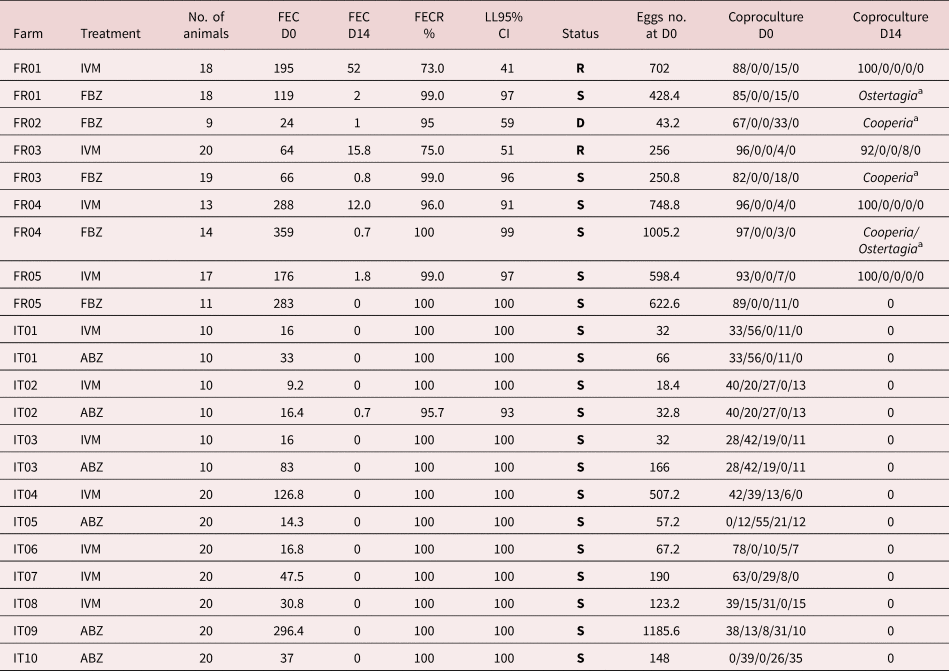
Mean faecal egg counts at D0 and D14 after anthelmintic treatment, % of faecal egg count reduction and lower limit (LL) of the 95% confidence intervals, status (resistance, doubtful, susceptibility), number of eggs counted at D0 and coproculture results for each treatment group on French and Italian farms.
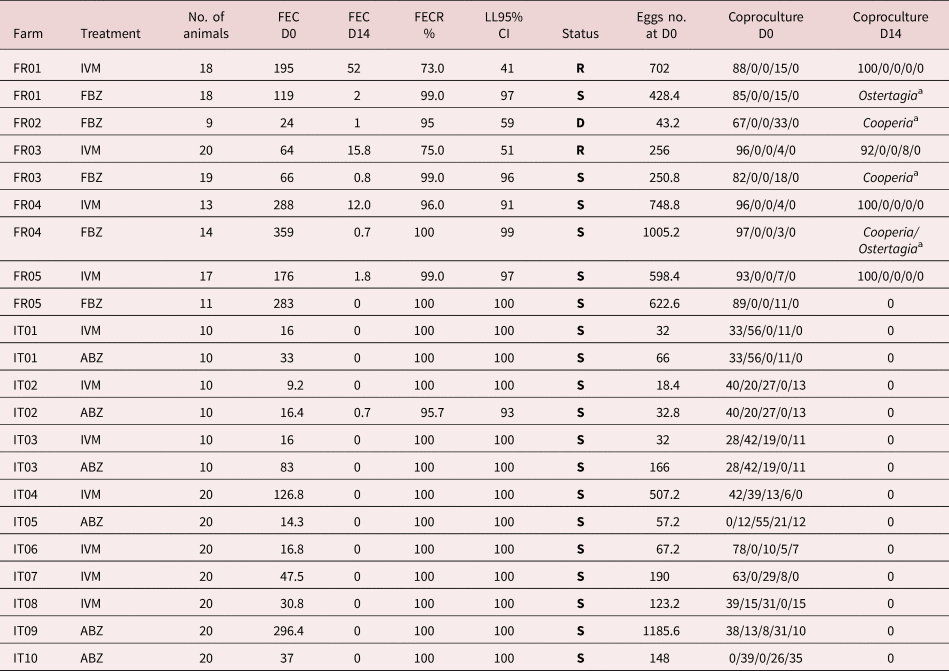
FR, France; IT, Italy; IVM, ivermectin; FBZ, fenbendazole; ABZ, albendazole; R, resistance; D, doubtful; S, susceptible.
Coproculture results expressed as: %Cooperia/%Trichostrongylus/%Oesophagostomum/%Ostertagia/%Haemonchus L3.
a Indicates that only a few larvae were recovered.
Results and discussion
The FEC at D0 and D14, %FECR with the lower limit of the 95% CI, AR status and results of coprocultures are presented in table 1. FECs at D0 ranged from 9 to 359 epg of faeces, with higher values in dairy cattle.
In the original World Association for the Advancement of Veterinary Parasitoloy (WAAVP) guidelines (Coles et al., Reference Coles, Bauer, Borgsteede, Geerts, Klei, Taylor and Waller1992), it is recommended that only animals (e.g. sheep) with a FEC of at least 150 epg are included in the calculation of FECR. Later, the value of 100 epg was proposed to take into account the lower FECs in cattle compared to small ruminants (Coles et al., Reference Coles, Jackson, Pomroy, Prichard, von Samson-Himmelstjerna, Silvestre, Taylor and Vercruysse2006). More recently, it was shown that the use of a more sensitive method, such as the Mini-FLOTAC (5 epg) used in this study, may render less stringent recommendations on sample size or egg count (Levecke et al., Reference Levecke, Dobson, Speybroeck, Vercruysse and Charlier2012) and that the total number of eggs counted may be used as a criterion to evaluate reliability of the classification as (non-)resistant (Levecke et al., Reference Levecke, Kaplan, Thamsborg, Torgerson, Vercruysse and Dobson2018). For groups of ten, 15 and 20 animals, values of approximately 250, 200 and 150 counted eggs, respectively, can be proposed to reliably detect reduced efficacy of ≤87% (Levecke et al., Reference Levecke, Kaplan, Thamsborg, Torgerson, Vercruysse and Dobson2018). These numbers of eggs were reached in all but one of the French farms (FR02) and four of the Italian farms (table 1). New WAAVP guidelines taking into account these factors and providing new approaches based on true egg counts will be published soon (Edwin Claerebout, pers. comm.). As a result, those of our results obtained with lowest FECs at D0 have to be interpreted with caution.
Coproculture results indicated the predominance of Cooperia L3 in dairy cattle in France, whereas several genera were seen in beef cattle in Italy, including Haemonchus. For IVM, the percentages of FECR ranged from 73% to 100%. AR to IVM was detected in two farms out of four in France (FR01: 73%; FR03: 75%). These two farms are located, respectively, in Maine-et-Loire and Finistère departments at more than 300 km apart, and, most importantly, have not been trading animals with each other. In the remaining two farms in France and in the seven Italian farms, the FECRT for IVM indicated a >96% efficacy with a 95% CI ≥96%. For BZ, the percentages of FECR ranged from 95% to 100%. In one farm in France (FR02), the lower limit of the 95% CI was less than 90% (59%) and indicated a doubtful status for resistance to FBZ. In the remaining four farms in France and all six farms in Italy, the FERCT for BZ indicated a >95% efficacy with a 95% CI ≥96%.
The single available published data about AR in cattle in France or Italy concerned a survey using FECRT about ML efficacy – that is, IVM and moxidectin (Geurden et al., Reference Geurden, Chartier and Fanke2015): out of eight dairy cattle farms in western France, resistance was confirmed in one farm for IVM and three farms for moxidectin, while, out of ten beef cattle farms in northern (Veneto) and southern (Apulia) Italy, no confirmed case of resistance to IVM or moxidectin was found. Our results confirm the occurrence of ML resistance in dairy cattle farms in France. The main nematode genus involved was Cooperia, as previously described (Geurden et al., Reference Geurden, Chartier and Fanke2015). Given the fact that AR was found in farms with no intensive treatment history (only 0–1 treatment per year) and without any epidemiological/trade link, the extent of the problem has to be urgently addressed to estimate the concern for the French cattle industry. Similarly, the situation of AR to BZ was almost unknown for cattle in Europe and limited to the study of Demeler et al. (Reference Demeler, Van Zeveren and Kleinschmidt2009) using FECRT and concerning ten farms in Germany and two farms in Sweden where no case of ABZ resistance was found. In our study, one FECRT result was doubtful in a single French farm, and an egg hatch assay with thiabendazole (TBZ) performed the following year according to von Samson-Himmelstjerna et al. (Reference von Samson-Himmelstjerna, Coles and Jackson2009) did not confirm the resistance with an EC50 of 0.038 µg TBZ/ml, which is in the range of EC50 values (0.027–0.038) obtained in German cattle farms with confirmed susceptibility to BZ using FECRT (Demeler et al., Reference Demeler, Kleinschmidt, Küttler, Koopmann and von Samson-Himmelstjerna2012) and also well below the commonly accepted cut-off value for BZ resistance of 0.1 µg TBZ/mL in sheep (Coles et al., Reference Coles, Bauer, Borgsteede, Geerts, Klei, Taylor and Waller1992). Other results from the four farms in France and six farms in Italy indicated a full efficacy of BZ, including the two French farms with IVM resistance. Although requiring confirmation on a larger scale, the present findings are consistent with previous data and indicate that testing for AR is advisable when anthelmintic treatments are performed.
Acknowledgements
This article is based upon work from COST Action COMBAR CA16230, supported by COST (European Cooperation in Science and Technology). The authors thank all the cattle owners and the French experimental cattle farms network (F@rm XP) for their contribution.
Financial support
This study was supported by the Italy/France Hubert Curien Galileo Project (2016) (grant number: 37419ZF).
Conflicts of interest
The Mini-FLOTAC device has been developed and is patented by Prof Giuseppe Cringoli, but the patent will be handed over to the University of Naples ‘Federico II’. The fact that one of the authors is the current patent holder of the Mini-FLOTAC technique had no role in the preparation and submission of the protocols reported or the design and implementation of ongoing and future studies. To obtain Mini-FLOTAC or Fill-FLOTAC devices, a contribution is required that is used only to cover costs of production and packaging, and to contribute to ongoing FLOTAC research. The remaining authors have no competing financial interests.
Ethical standards
The study involved the use of client-owned animals and was restricted to faecal samples. As such, no permission from an ethics committee was necessary. All necessary steps have been taken to ensure a high standard of animal care, with informed client consent.